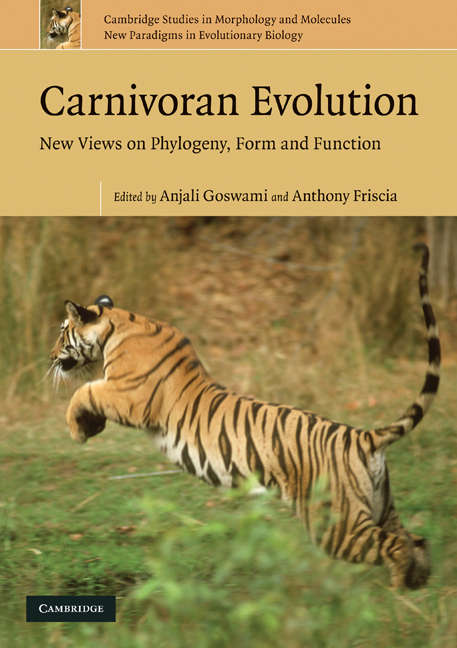

Members of the mammalian clade Carnivora have invaded nearly every continent and ocean, evolving into bamboo-eating pandas, clam-eating walruses and of course, flesh-eating sabre-toothed cats. With this ecological, morphological and taxonomic diversity and a fossil record spanning over sixty million years, Carnivora has proven to be a model clade for addressing questions of broad evolutionary significance. This volume brings together top international scientists with contributions that focus on current advances in our understanding of carnivoran relationships, ecomorphology and macroevolutionary patterns. Topics range from the palaeoecology of the earliest fossil carnivorans to the influences of competition and constraint on diversity and biogeographic distributions. Several studies address ecomorphological convergences among carnivorans and other mammals with morphometric and Finite Element analyses, while others consider how new molecular and palaeontological data have changed our understanding of carnivoran phylogeny. Combined, these studies also illustrate the diverse suite of approaches and questions in evolutionary biology and palaeontology.
"The language and many of the chosen chapters are written for the scientist; specifically, the paleomammalogist that is interested in select details. For this audience and this audience alone, the volume is without question a worthwhile addition to the library."
Richard A. Kissel, American Paleontologist
Loading metrics...
* Views captured on Cambridge Core between #date#. This data will be updated every 24 hours.
Usage data cannot currently be displayed.
This section outlines the accessibility features of this content - including support for screen readers, full keyboard navigation and high-contrast display options. This may not be relevant for you.
Accessibility compliance for the PDF of this book is currently unknown and may be updated in the future.
