


Introduction
Inappropriate antibiotic use contributes to antibiotic resistance and is associated with antibiotic-related adverse events such as allergies and Clostridioides difficile infection. Reference Fleming-Dutra, Hersh and Shapiro1–Reference Hersh, King, Shapiro, Hicks and Fleming-Dutra3 Antimicrobial stewardship programs (ASPs) have been instituted inpatient within many health systems to address this issue and optimize antibiotic use. Reference Barlam, Cosgrove and Abbo2,Reference Wagner, Filice and Drekonja4,Reference Majumder, Rahman and Cohall5 However, the benefit of ASPs in optimizing antibiotic prescriptions in the outpatient setting, including urgent care centers—which is one of the fastest growing settings for outpatient care in the United States, remains unclear. Reference Barlam, Cosgrove and Abbo2,Reference Poon, Schuur and Mehrotra6
Most antibiotics prescribed to outpatients are for the treatment of acute respiratory infections including bronchitis and upper respiratory tract infections. Reference McCaig and Hughes7 However, approximately 1 in 2 outpatient antibiotic prescriptions might be inappropriate. Reference Fleming-Dutra, Hersh and Shapiro1,Reference Sanchez, Fleming-Dutra, Roberts and Hicks8–Reference Ho, Patterson, Gadgeel, Kenney and Veve10 Given this data, outpatient stewardship interventions have been focused on reducing antibiotic prescriptions, however there is limited evidence assessing optimal antibiotic selection in the outpatient setting with respect to current guidelines. Reference Seo, Corrado, Lim and Thornton11
The Centers for Disease Control and Prevention (CDC) and The Joint Commission have published core elements of outpatient antibiotic stewardship to provide a framework for improving antibiotic prescribing among outpatient clinicians that are focused on commitment, policy, data tracking and reporting, as well as education. Reference Sanchez, Fleming-Dutra, Roberts and Hicks8,12 However, it is the clinical practice guidelines, including the 2019 American Thoracic Society and Infectious Diseases Society of America community-acquired pneumonia (CAP) guideline, that provides evidence-based data and guidance for clinicians on diagnostic and therapeutic decisions when managing outpatients. Reference Woodhead, Blasi and Ewig13,Reference Metlay, Waterer and Long14
Here we describe the implementation and results of a quality improvement stewardship intervention to improve guideline-concordant antibiotic prescribing for community-acquired bacterial pneumonia (CABP) in primary care clinics and urgent care centers.
Methods
The study was approved by the Hartford Hospital institutional review board and deemed exempt via a waiver (HHC-2022-0220).
Study design and population
Hartford HealthCare includes the flagship Hartford Hospital and 6 community hospitals, 92 primary care clinics, and 39 GoHealth affiliated urgent care centers throughout Connecticut. Each clinic is staffed by physicians and advanced level practitioners. The inpatient ASP across Hartford HealthCare was initiated in 2014 and is led by 4.0 full-time equivalent (FTE) Infectious Diseases (ID) pharmacists and supported by 0.8 FTE ID physicians. However, within this community-based health system, no formal outpatient or ambulatory stewardship program exists thus the implementation of an electronic order set to guide prescribers on CABP-concordant antibiotic selection was considered a reasonable approach.
A pre-post intervention study design was implemented to assess the impact of the stewardship intervention across primary care clinics and urgent care centers. The prespecified dates compared a baseline period (preintervention: May 2023–April 2024) with an intervention window (May 2024–December 2024).
Intervention
Our intervention was based on (a) integration of an antibiotic order set in the electronic health record that highlighted guideline-concordant antibiotic recommendations according to patient comorbidities (Supplemental). (b) order-set awareness campaign at departmental huddle meetings pre and postlaunch, and (c) 2-minute video provided to all providers by department heads that narrates and demonstrates how to access the order set and place an antibiotic order.
The order set was created to seamlessly integrate with current prescriber workflow and was accessed with a synonym search strategy of key words including: “CAP,” “Community Acquired Pneumonia,” “Amoxicillin,” “Amox/Clav,” “Augmentin,” “Amoxil,” “Doxycycline,” “Vibramycin,” “Azithromycin,” “Z-Pak,” “Zithromax,” “ZPAK,” “Z Pak,” “ZPak,” “Cefuroxime,” “Ceftin,” “Levofloxacin,” or “Levaquin.” Furthermore, the use of azithromycin monotherapy was cautioned based on local microbiological resistance rates demonstrating that Streptococcus pneumoniae resistance to macrolide exceeded 25% across Hartford Healthcare System emergency departments in 2023 (antibiogram data on file).
Study outcome
Data were electronically extracted from the EHR for each adult patient (18 yr or older) encounter based on the following International Classification of Diseases, Tenth Revision, Clinical Modification (ICD-10-CM) CABP-related codes: “A48.1,” “A49.0,” “A49.01,” “A49.1,” “A49.3,” “B95.0,” “B95.3,” “B95.4,” “B95.5,” ”B96.0,” “B96.1,” “B96.3,” “J13,” “J14,” “J15,” “J16.0,” “J18.0,” “J18.1,” “J18.8,” and “J18.9”; Supplemental. Data extracted from each medical record included patient demographic characteristics, encounter location, date and time, payor type, and antibiotic prescriptions ordered. IDSA relevant patient comorbidities (chronic heart, lung, liver, or renal disease; diabetes mellitus; alcoholism; malignancy; asplenia) were extracted from patient problem lists. Patients with an ordered antibiotic in the 30 days preceding index visit that is, washout period were excluded. A random selection of cases (1 in 10 encounters) during baseline and intervention time frames was reviewed for pneumonia diagnosis and antibiotic prescription accuracy.
The primary outcome was to describe the proportion of patients receiving concordant therapy (as defined by antibiotic choice and prescription of monotherapy or combination therapy depending on presence of comorbidity, Supplemental) per IDSA guideline and local antibiogram.
Statistical analyses
Descriptive statistics were performed using GraphPad Prism (version 10.4.1; Boston, Massachusetts USA). Any difference in the CABP-guideline discordance or concordance rates among patients with and without comorbidities was determined using the χ 2 test, and a prespecified alpha level of .05. For additional analysis, concordant rates were also assessed based on patient encounter location (primary care clinics or urgent care centers).
Results
A total of 4,401 and 4,954 patient encounters were identified in the baseline and intervention period, respectively (Table 1). Patient were predominantly female, white, and utilized commercial insurance. Patients were younger (age (mean [SD], 48 [18] vs 57 [18] years) in the intervention period and had fewer comorbidities (42.3% vs 59.8%). The most common clinical diagnosis code documented per encounter was J18.9 (pneumonia, unspecified organism; [baseline 90.7%; intervention 90.3%]).
Patient demographics and characteristics among outpatient encounters by study period

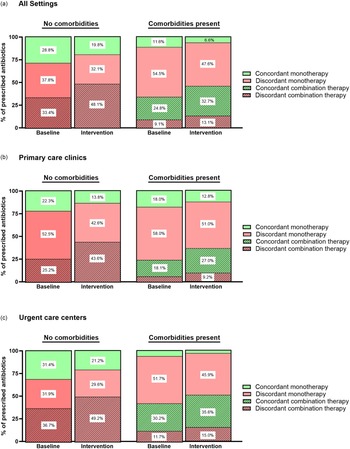
Overall, the guideline adherence based on antibiotic selection decreased from 33.3% during the baseline period to 28% in the intervention period. Table 2 details each concordance metric by antibiotic class and Figure 1 highlights the proportion of concordant and discordant monotherapies and combination therapies during the baseline and intervention periods.
Guideline adherence of empirical antibacterial therapy in the study periods

Proportion of concordant and discordant antibiotics per patient encounter during the baseline and intervention periods.

No comorbidities
Among patients with no comorbidity, both concordant (amoxicillin and doxycycline only) and discordant monotherapy prescriptions, decreased after the intervention while the proportion of patients receiving combination therapy (all discordant based on lack of patient comorbidities) increased by approximately 15% between the 2 periods. The most common discordant combination therapy prescribed in this patient cohort was amoxicillin/clavulanate plus azithromycin.
Presence of comorbidities
The proportion of patients with comorbidities that received monotherapy decreased from 66% to 54% after the intervention. A large proportion of these orders were inappropriate that is doxycycline or azithromycin instead of a respiratory fluoroquinolone (Table 1). Antibiotic combination therapy increased by 12% after the intervention, driven largely by guideline-concordant prescriptions including amoxicillin/clavulanate plus azithromycin while the most frequently prescribed discordant combination was amoxicillin plus azithromycin.
Encounter location
A greater proportion of patients visited the urgent care center (74.8%) during the intervention period compared with the baseline period (61.7%). The concordance rates and trends were similar across encounter locations. However, the increase in concordant combination therapy was more pronounced in primary care clinics.
Discussion
We piloted an EHR-based stewardship program targeting antibiotic prescriptions for CABP across outpatient locations in a large community-based healthcare system. Baseline antibiotic concordance or appropriateness was low and consistent with reported data for upper respiratory tract infections, highlighting the room for improvement. Reference Fleming-Dutra, Hersh and Shapiro1,Reference Sanchez, Fleming-Dutra, Roberts and Hicks8–Reference Ho, Patterson, Gadgeel, Kenney and Veve10 Postintervention, we did not observe an increase in overall guideline concordance, however antibiotic selection among patients with comorbidities was improved and driven by an increase in appropriate combination therapy prescription. The use of fluoroquinolones, commonly associated with adverse events, was low overall and decreased further postintervention.
This intervention was the first antibiotic intervention conducted in the outpatient setting for this institution. Our findings highlight the challenge of outpatient stewardship efforts in community-based healthcare systems despite antibiotic prescribing rates that are similar to larger academic institutions. Reference Livorsi, Reisinger and Stenehjem15,Reference Stenehjem, Hyun and Septimus16 While our inpatient stewardship program is robust across 6 hospitals, with inpatient clinicians familiar with stewardship core metrics, the outpatient setting has not been a point of focus. With the growing outpatient and urgent care landscape, institutions will need to provide ASPs with resources to exceed The Joint Commission and CDC metrics.
The lack of improvement in overall concordance is likely multifactorial. Notably, successful stewardship interventions have a component of oversight and accountability such as audit and feedback as well as EHR justification prompts that require clinicians to provide a reason for discordant antibiotic orders. Reference Abbas17–Reference King, Fleming-Dutra and Hicks20 There have also been studies that have used achieving antibiotic stewardship goals as a part of clinician compensation. These accountability measures and financial incentives have been shown to have an influence on prescribing patterns. Reference Stenehjem, Hyun and Septimus16,Reference Berthiaume, Chung, Ryskina, Walsh and Legorreta21,Reference Balinskaite, Johnson, Holmes and Aylin22 Inappropriate antibiotic prescribing in the management of upper respiratory illnesses is also high due to uncertainty regarding the etiology and the probability of viral, bacterial, or viral-bacterial coinfection. With this uncertainty is an increased frequency of inappropriate antibiotic prescriptions to please patients, improve satisfaction scores, and placate providers fear of misdiagnosis. Reference Gonzales, Malone, Maselli and Sande9,Reference Dempsey, Businger, Whaley, Gagne and Linder19,Reference Nielsen, Santarossa and Probst23,Reference Sanchez, Roberts, Albert, Johnson and Hicks24 Given the high severity of the 2024–2025 influenza season per the CDC, high antibiotic discordance including an increase in combination therapy during this study period is not entirely surprising. 25 Despite the barriers discussed above, these data have spurred discussion among the stewardship team, healthcare leaders, and clinicians to put effort and resources into more robust data collection and interventions such as audit and feedback, continuous education, and involvement of ID-trained clinicians to improve patient care.
There are several limitations to consider. First, lack of a randomized control study design limits a determination of causality and also allows external factors such as an active influenza season to potentially affect the study intervention. Additionally, non-uniform intervention periods and lack of stratified sampling may have introduced unknown biases. We also performed a pre and-post analysis rather than an interrupted time-series analysis to assess prescribing patterns. Finally, patient outcome such emergency department visit and hospitalization was not assessed to ascertain the impact of antibiotic concordance. Of note, an important update in October 2024 was made during the study period whereby the Advisory Committee on Immunization Practices updated its vaccine recommendation, advising that all adults receive the pneumococcal vaccine starting at age 50, a shift from the previous age of 65 years. The uptake of this recommendation as well as the impact on disease burden and patient outcome has yet to be evaluated. Reference Kobayashi, Leidner and Gierke26
Conclusion
In summary, we present our collective experience of an antibiotic stewardship initiative targeting CABP that did not improve overall antibiotic prescribing patterns to align with 2019 CAP guidelines. A large proportion of patients (with and without comorbidities) received combination therapy, and azithromycin monotherapy orders were still elevated despite a caution regarding high S. pneumoniae resistance rates across the healthcare system. This study however provides valuable baseline data and opportunities to galvanize resources and optimize our stewardship efforts across the spectrum of care.
Supplementary material
The supplementary material for this article can be found at https://doi.org/10.1017/ash.2025.10100.
Acknowledgments
We would like to recognize Victor Ruiz, Angel Pagan, Nicole Stitz-Galvan, and Emily Maheras from Hartford Healthcare for their assistance in conducting this study.
Financial support
The study was funded by Paratek Pharmaceuticals. The funder provided financial support and did not exercise control over the conduct of or reporting of the research.
Competing interests
DPN served as a consultant, speaker’s bureau member or has received research funding from: Abbvie, Cepheid, Innoviva, Pfizer, Wockhardt, Shionogi, Venatorx. TEA has received research funding from Venatorx, Paratek, Shionogi, Innoviva, and Spero Therapeutics. All other authors report no relevant disclosures.




 Open access

