

Introduction
Recent work in urban studies claims that racial meanings and categories play a significant role in shaping urban redevelopment. Racialization, or the use of racial discourses to define and legitimize social and spatial changes, is seen in much of this scholarship as a strategic means by which urban developers seek to control and implement efforts to reshape the urban landscape. Yet researchers understand these strategies in somewhat different ways. Although conceptions of colorblind racism as a “hegemonic” discourse inform how certain researchers interpret the racialization of development in U.S. cities (Bonilla-Silva Reference Bonilla-Silva2018; Christian et al., Reference Christian, Seamster and Ray2021; Mele Reference Mele2013), recent case studies suggest that developers and public officials may employ various racial discourses to facilitate the development process, from territorial ascription and colorblind discourse to multicultural diversity and racial equity (Brand Reference Brand2015; Clay and Hill, Reference Clay and Hill2023; Freeman Reference Freeman2023; Mele Reference Mele2019; Summers Reference Summers2019; Wilson and Heil, Reference Wilson and Heil2022).
In this article, we understand these discursive processes as different types of strategic racialization and investigate how the use of these strategies may work to legitimate economic redevelopment in an urban context. Racial discourse about urban redevelopment in U.S. cities is inherently intertwined with capitalist notions of economic interest and opportunity, and yet, may take various forms as it is articulated by particular actors in distinct urban settings. For this reason, public exchanges over the racial legitimacy of economic development projects need to be studied, we suggest, as dialogical interactions in community context. Our study focuses on public discourse and its racial articulations in several community engagement meetings held by the City of Chicago, Illinois in 2022 to consider proposals to develop a casino. Chicago’s specificity, in terms of its political culture, ongoing racial segregation, and historic backdrop of racial injustice, all shape how participants talk about race in ways that may not directly transfer to other contexts. However, many U.S. urban areas exhibit racialized development as well as recent efforts to address it, and processes that shape Chicago’s racially charged landscape may generate insights relevant to other cities. By comparing discursive exchanges across three different proposals within Chicago, we contend that city officials, developers, and community participants invoke a variety of racial strategies in ways that are strongly related to community context, tactical advantage, and conflict. Among these strategies are several forms that have been noted in earlier studies—territorial ascription, multiculturalism, and colorblind racialization—but we also locate a more unexpected variety of racial equity frames. We define and explore three such racial equity frames, which we term: Black-led capitalism, racially representative capitalism, and spatially connective capitalism.
We analyze racial discourse surrounding Chicago’s casino development project by observing and interpreting the public exchanges between city officials, developers, and community members who participated in the three major community engagement meetings held in early 2022. To be clear, our focus is on discourse. Therefore, we do not focus directly on material processes of development or the political economy of casinos, but we do consider them to illuminate key pieces of context that participants strategically mobilize or avoid. By closely attending to how these actors characterize the proposed development and its impacts on the city and nearby communities, we aim to locate and interpret their use of race-related claims to advance their projects. Much of the existing literature on urban redevelopment has focused on racialized discourse by elites (e.g., statements by developers and city officials expressed through press releases or planning documents), and we will focus on these actors as well. However, community engagement meetings also offer significant opportunities to examine discursive exchanges between elite actors and community participants in a more dynamic, dialogical setting. Whereas urban developers tend to approach these settings as occasions for generating public support for their proposed projects, such events, even when they constrain non-elite participation in important ways, can also complicate efforts by developers to employ racial discourses to advance their goals. We examine developers’ public presentations of their proposals as well as their real-time interactions with community participants in order to locate certain characteristic patterns of talking about race and its relationship to urban redevelopment. The broader goal of the study is to use our findings to contribute to a better understanding of how racialized discourse is strategically deployed in public encounters over particular development projects, but also, on this basis, to better inform community actors how to more effectively participate in and influence these processes.
This article draws on theories of strategic racialization to guide a closely focused empirical analysis of the racial discourse employed in Chicago’s casino-related community engagement meetings. Consistent with a selective review of recent literature on race and urban development, our study finds various types of racial discourse being used over the course of these meetings, including what other researchers have emphasized as colorblind forms of racialization. However, we also focus on several racial equity discourses that become central to the public exchanges at these events. The City of Chicago began institutionalizing racial equity efforts within the City government in 2019 and, as we will discuss, embedded equity criteria in the request for proposals (RFPs) issued as part of its casino development process. As a sort of “official antiracism” (Melamed Reference Melamed2011), this stated commitment to racial equity might be expected to encourage the use of race-related discourse by developers and community participants. For this reason in particular, public discussions of the Chicago casino development proposals offer unusually rich settings for the analysis of racial discourses as strategic frameworks.
Based on our empirical observations, we define and explore three different racial equity frames that developers advance in the course of those meetings: Black-led capitalism, racially representative capitalism, and spatially connective capitalism. Each development team, we will suggest, offers up a distinctive racial frame—a set of claims grounded in popular ideologies about how its particular project will advance racial equity—that also becomes a target of challenge.
Racialization and Redevelopment
Recent work in urban studies contends that redevelopment projects often take shape and gain legitimacy through the deployment of racial meanings and categories. In this scholarship, racialization—the use of racial discourses to define and legitimize social and spatial changes—can be understood as “an adaptive and strategic means for city leaders and developers to control, define, plan and implement efforts to reshape neighborhoods” (Mele Reference Mele2019, p. 27). Economic development, then, often gains form and support by animating racialized imaginings of the city and the impacts of urban change.
Yet researchers have understood this process in somewhat different ways. In a study of Flint, Michigan, for example, David Wilson and Melissa Heil (Reference Wilson and Heil2022) focused on how exoticizing or threatening representations of poor Black and Latine residents were used by developers to construct a persuasive rationale for neoliberal redevelopment strategies. Christopher Mele’s (Reference Mele2019) study of Toronto, in contrast, emphasized the use of racial tropes and narratives to represent gentrification as “social mix” redevelopment; the rhetorical appeal in this case was to urban diversity as a supposed antidote to the social isolation of the poor minority residents. In a comparative study by Kevin L. Clay and Jasmine D. Hill (Reference Clay and Hill2023), racial rhetorics were used to smooth over the class-based divisions inherent in “predatory” forms of urban redevelopment. Summers (Reference Summers2019, pp. 3-4), meanwhile, has developed the notion of “black aesthetic emplacement” to explain how the imparting of Blackness to certain urban places can enhance their cultural authenticity and, in turn, land valuation and marketability. In different ways, then, urban scholars have shown how notions of race can be mobilized strategically on behalf of urban redevelopment.
We understand these processes as different types of strategic racialization. As elaborated most fully by Wilson and Heil (Reference Wilson and Heil2022), the notion of strategic racialization focuses on efforts by planners and developers to draw on racial categories, often in conjunction with market ideologies, to create and deploy unstable “structures of meaning” as a “city-building resource.” In this sense, racial representation in U.S. cities is typically intertwined with neoliberal notions of urban development as both entrepreneurially driven and universally beneficial. Yet the various studies of this phenomenon also suggest that there is no one way that urban developers mobilize racial meanings to facilitate the development process.
Certain racial discourses, for example, involve what might be called territorial ascription, a process of racializing urban places in ways that represent a project site as ripe for redevelopment. Such a process can involve stigmatizing urban areas as abandoned, wasted, or dangerous spaces simply because they have been historically occupied by communities of color; or, conversely, territorial ascription can involve effacing the prior racialization of a place in ways that represent it anew as a blank slate, ready for renewal (Ewing Reference Ewing2018; Mele Reference Mele2016; Rucks-Ahidiana Reference Rucks-Ahidiana2024; Schwarze and Wilson, Reference Schwarze and Wilson2022). A second type of strategic racialization involves the use of colorblind discourse in ways that can “invisibilize” Whiteness or minimize the relevance of race in public discussion (Bonilla-Silva Reference Bonilla-Silva2018; Seamster Reference Seamster2015). Presuming that structural or institutional racism is simply an artifact of the past, this type of rhetoric implies that the racially disparate impacts that ensue from urban redevelopment are likely to stem from individual-level misperception of the stakes of social difference rather than the tendency of urban redevelopment to reproduce racial hierarchies—with the implication, in turn, that race-neutral approaches to redevelopment lead to widely shared social benefits (Hashimoto Reference Hashimoto2021; Saito Reference Saito2015).
Urban scholars have also recognized a type of strategic racialization that centers on affirmative appeals to multicultural diversity. This redevelopment rhetoric typically presents ethnic heterogeneity and inclusion as an antidote to racial disadvantage as well as a spontaneous source of urban creativity and economic innovation (Hashimoto Reference Hashimoto2021; Mele Reference Mele2019). Multiculturalist racialization can also entail the exoticization of difference, signaled by a commodified ethnic identity or “Black heritage” suitable for investors’ visions of a neighborhood future or by the representation of racial- or class-based difference as the gritty “reality” of vibrant and authentic urban experience (Collins Reference Collins2020; Hyra Reference Hyra2017; Summers Reference Summers2019; Wilson and Heil, Reference Wilson and Heil2022). In either case, racial or ethnic diversity is commended as a desirable public good or a marker of inclusive, creative development.
Most recently, urban redevelopment and policy discourse has begun to incorporate a growing appeal to racial equity norms (Freeman Reference Freeman2023; Khare Reference Khare2022). Premised on the need to break with a well-established history of persistent racial inequality, the discourse of equity emphasizes the importance of foregrounding particular racial groups—often specified as Black, Indigenous, or People of Color—as targeted beneficiaries of redevelopment. Certain versions of racial equity discourse present Black or other non-White leadership over development as a bulwark against Black displacement or as a trustworthy sign of developer commitment to deliver economic benefits to Black working-class residents (Boyd Reference Boyd2008; Clay and Hill, Reference Clay and Hill2023; Parks et al., Reference Parks, Sites and Davis2025). Conversely, community actors may also invoke notions of racial equity in demands for antiracist development. Emphasizing a city’s history of systemic neglect or racist dispossession, for example, activists may seek development concessions as a form of racial equity compensation or reparations (Ramírez Reference Ramírez2020; Williams and Steil, Reference Williams and Steil2023).
How do these different types of racialization relate to one another? And why might one such type be employed in any given instance? Discussion in the urban literature can impart a certain monolithic quality to how racial meanings and categories are deployed, with the implication that development tends to be racialized in a singular, dominant way or that it encounters little resistance. We will suggest, however, that development actors have a range of racial discourses at their disposal, and which discourse they invoke in any given moment is strongly related to urban context, tactical advantage, and conflict. By observing real-time urban processes in which these discourses are circulating in distinct community settings within Chicago, we can better understand the strategic dimensions of racial discourses as well as how these discourses relate, sometimes in conflictual ways, to one another.Footnote 1
While racial equity discourse has become increasingly prominent in U.S. urban politics, very little empirical scholarship addresses how this discourse is being deployed or contested. What are the ways in which racial equity discourse is being used in redevelopment contexts, and what accounts for observable differences in how this discourse is being shared? By situating racial appeals within the broader discursive repertoire available to urban actors, we seek to understand how developers and community members may select different discourses in varying contexts in order to advance conflicting strategic objectives.Footnote 2
The research design of this study and the method of investigation employed have been shaped by the meetings themselves. In April 2022, the City of Chicago held community engagement meetings for the three finalist casino proposals at locations near each proposed development site. The authors attended the first of these meetings together, and based on our observations and field notes of this event, we expanded our initial motivating question (focused on how community members might be resisting colorblind racial discourses) to a more dialogical research question about how a range of forum participants—developers as well as community members—might be engaging in racial discourse and responding to the discourse of others (Schegloff Reference Schegloff1997; Steinberg Reference Steinberg1999). We expanded our dataset to include video recordings of all three community engagement meetings, enabling us to leverage comparative insight.Footnote 3
Situating discourse from each community engagement meeting within its context, our analysis has focused on the immediate format of the event as well as the social and geographic characteristics, policy issues, and development-site particularities to which participants referred. We have also sought to identify how institutional norms and roles (e.g. presenter, panelist, moderator, public commenter) at the meetings might have shaped discursive interactions, and how city officials and developers were making use of power asymmetries to modulate or guide the demands of community members (Heritage Reference Heritage and Silverman1997; Parker and Street, Reference Parker and Street2015). Recognizing the high degree of similarity in the institutional structure of the meetings, we were drawn to variation in the local community context—often closely related to the spatial location of each proposed development site—as a source of comparative insight into distinct tactics of strategic racialization.
Chicago Casino: Setting and Discourse
Casinos have become major vehicles for urban redevelopment in the United States (Anisfeld and Rosenthal-Kay, Reference Anisfeld and Rosenthal-Kay2025; Lim and Zhang, Reference Lim and Zhang2017). As in many cities, Chicago’s slow economic growth and long-term fiscal pressures have made casino development increasingly attractive as a potential source of urban investment, employment, and tax revenue.Footnote 4 In May 2020 the State of Illinois removed long-standing legal and financial obstacles to developing a casino within the city of Chicago, and early the following year the city’s mayor, Lori Lightfoot, a strong proponent of casino development, issued an RFP (Byrne Reference Byrne2021; City of Chicago Office of the Mayor 2021; Pearson Reference Pearson2020). Later that year, her office announced that five casino proposals were under consideration, and by March 2022 the mayor had narrowed the finalists to three (Channick et al., Reference Channick, Petrella and Byrne2021; Channick Reference Channick2022a). To offer community members an opportunity to learn about the proposals and comment on them before the final decision, the mayor’s office announced that the city government would hold a series of three community engagement meetings, one for each finalist (Channick Reference Channick2022b). This community engagement process, however, was not connected to a public referendum (cf. Clay and Hill, Reference Clay and Hill2023).
Racial equity concerns influenced the political environment in which Chicago’s casino selection process took shape. Like many other U.S. cities, Chicago had long privileged market-oriented development projects that contributed to economic growth and land-value appreciation in its downtown business district and nearby areas of White residential settlement (Bennett et al., Reference Bennett, Garner and Hague2017). This pattern continued under Lightfoot’s predecessor, Mayor Rahm Emanuel, whose corporate-led redevelopment projects in or adjacent to the Chicago Loop attracted major criticism for neglecting Black, Latine, and Asian communities on the city’s South and West Sides (Farmer and Poulos, Reference Farmer and Poulos2019; Metropolitan Planning Council 2017). Mayor Lightfoot, whose electoral platform had included a pledge to promote racial equity in city government, launched a series of initiatives in 2021 under the name of Invest South/West to encourage redevelopment in outlying commercial corridors in many of those neglected communities (The Civic Federation 2021). The casino RFP, issued that same year, included language suggesting that bids would be evaluated, among other considerations, on the basis of equity and inclusion goals (City of Chicago Office of the Mayor 2021).Footnote 5 A follow-up report in March 2022 evaluated the bids of the three casino finalists on the basis of equity criteria as well as likely economic and financial benefits to the city, union job creation, and design and planning goals (City of Chicago Office of the Mayor 2022b).Footnote 6 By April of that year, therefore, when mayoral officials announced the three community engagement meetings, racial equity had been publicly established as one of the significant criteria on which public evaluation of each project might rest.
Each of the three meetings drew at least several hundred public attendees. Top city officials began each meeting with similar presentations, emphasizing the potential of “an entertainment district anchored by gaming” (Mayekar Reference Mayekar2022) to act as an economic stimulus, job creator, and fiscal support. Beyond pandemic-related economic losses and routine budgetary pressures, the City of Chicago faced the long-brewing challenge of unfunded pension liabilities estimated at $32 billion (roughly half of which were for police and fire personnel), and city officials presented the envisioned revenues from casino proceeds as a way to shore up those pensions without resorting to property tax increases (The Civic Federation 2021). Following these presentations, the respective development team introduced its casino development proposal, relying on video presentations and a series of speakers—casino corporation executives, investors, real estate developers, builders, and various business partners—to appeal for public support.
Many discursive themes in these presentations and speeches were quite similar. Presenters emphasized the casino as an effective way to compete with other “global cities” and with neighboring states for tourist dollars while also providing good jobs for local workers. They claimed that a well-designed casino could serve those priorities while limiting traffic congestion and ensuring public safety. And they argued that their casino project would meet or exceed the city’s equity goals. In this sense, all three casino teams promised what Harvey Molotch and John Logan (Reference Molotch and Logan1984) have called “value-free development”: an urban redevelopment project in the interest of all the city’s stakeholders.
These shared claims were often articulated in ways that did not talk explicitly about race. Nevertheless, the claims were conveyed in language that did racialize redevelopment in various ways. One recognizable tendency was that developers tended to talk about their sites as locations without histories or any strong historical connection to nearby communities of settlement. The impression conveyed by this territorial ascription was that development teams were working upon spatial blank slates—places that were entirely free of pre-existing claims or places that prior urban actors had merely devalued and discarded. For example, the Bally’s team, which proposed a River West casino development project to replace a Chicago Tribune printing plant located on the same site, gave no indication that closure of the plant would lead to a loss of several hundred jobs, many of them held by Black and Latine workers (Channick Reference Channick2024). Nor did the developers acknowledge that located directly across the river from the site was the former location of the 3,500-unit Cabrini Green public housing development, once home to thousands of Black families, most of them displaced by its demolition (Vale Reference Vale2013). Instead, the proposed casino site, apparently free of obligation to any historic community, was depicted in images and words as an entirely empty space to be filled with a new development that would serve everyone in Chicago. Instead of stigmatizing territory, then, the casino team in this instance was effacing the prior racialization of a place—erasing its “spatial taint” (Wacquant et al., Reference Wacquant, Slater and Pereira2014)—in ways that dramatized the power of redevelopment to actively constitute new territory.
A related tendency became apparent in the use of discourse that was ostensibly color-blind but that, within a Chicago context, was recognizably color-coded. A real estate developer on the Rivers/Related team promised that its project would “bring sustainable wealth to all of Chicago communities… every part of our city from the North Side to the West Side to the South Side” (Garcia Reference Garcia2022). While an emphasis on universal wealth-building was a discursive mainstay for all three development teams, this geographical appeal invoked a racial shorthand conventionally used in Chicago to refer to White (North Side) and non-White (West and South Side) communities. In a somewhat different way, a presentation by a Black investor in the Bally’s River West project also invoked racial distinction, in this case by using a seemingly race-neutral metaphor of inclusion. “In many of these circumstances … there are lines drawn, it’s an Us against Them. [But] with Bally’s it was them drawing a circle, a circle of inclusion, taking in what parties had to contribute and taking that into account with their bid” (Hicks Reference Hicks2022). Inclusion here was depicted as an open and participatory investment opportunity, but with an acknowledgment—one that can be read racially—that selective exclusion has been a common experience for certain groups. In different ways, then, ostensibly color-blind racial rhetoric was being used to signal the promise of a universal benefit, as it often is in development discourse, but in ways that would also register in a local context as affirmatively color-coded inclusion.
All three development teams, then, engaged in multiple types of racializing rhetoric. The three teams also engaged in extended moments of racial equity discourse, but they did so in somewhat different ways—ways that, as we will see, were influenced by context, strategy, and particular moments of conflict. To explore these differences in detail, it will be useful to more carefully examine the development teams’ presentations as well as their interactions with community members.
Community Context and Discourse Variation
While the development teams for the Hard Rock, Bally’s, and Rivers/Related casino proposals all confronted the same criteria for equity in the City’s RFP (City of Chicago Office of the Mayor 2021), their racial equity discourses differed. The following analysis identifies local variation that shaped the discourse. We observe that the geographic and organizational characteristics of each proposal afforded the development teams different resources to employ (see the map situating each proposed site in Figure 1). For each proposal, we begin by outlining the sociospatial and organizational context. Then, we closely analyze the development team’s opening statement, noting specificities in how they frame equity. Lastly, we examine an interaction from the public comment portion of the meeting to analyze public responses to the development teams’ frames.
Residential racial demographics surrounding the proposed sites.
Black location pins mark each proposed casino site on a map of Chicago. The small colored dots represent the residential racial demographics. The contemporary racial demographics are one piece of the sociospatial context of each proposal. The base racial demographics map uses 2020 U.S. Census data. (ESRI 2021).

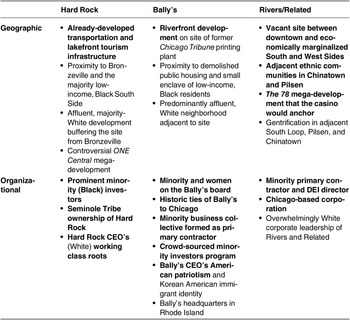
We identify three discursive frames—Black-led capitalism, racially representative capitalism, and spatially connective capitalism (summarized in Table 1)—that describe developers’ divergent approaches to communicating the racial equity benefits of their projects. Although all three developers emphasize job opportunities, business contracts, investment opportunities, and tourist spending as levers to increase equity, we show that their strategic approaches to racial discourse differ significantly. Exemplifying what we designate as Black-led capitalism, the Hard Rock team relies heavily on centering Black business leadership as a discursive assurance of the authenticity of their equity commitments. In a different discourse that we term racially representative capitalism, Bally’s presentation emphasizes significant levels of representation for minorities, women, and the community within its own corporate leadership as evidence of its commitment to equity. Finally, in a discourse we term spatially connective capitalism, Rivers/Related relies on spatial proxies for race to make an argument about the potential for their proposal to shift the flow of consumption—and thereby connect and benefit differently positioned communities—within the segregated landscape of the city. Community responses, in turn, resist these frames in varied ways, challenging at different moments the claims that leadership, representation, or spatial connection are reliable warrants of racial equity. Yet, as we will see, these responses do not cohere into a unified counter-frame in opposition to the development.
Comparison of the racial equity discursive frameworks

Hard Rock: Black-Led Capitalism
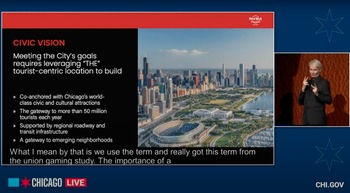
With their proposed casino sandwiched between an affluent, majority-White residential area and a popular lakefront tourist area (see Figure 1), the Hard Rock team did not draw upon their site’s local geographic context to claim equity. This lakefront area already included a stadium, city-run museums, and a convention center. On the other side of the site, a public policy mechanism known as Tax Increment Financing (TIF) had subsidized infrastructure improvements since the 1980s (Weber Reference Weber2023) to catalyze the development of over 14,000 housing units in the adjacent residential area between 1990 and 2010 alone (Hunt and DeVries, Reference Hunt and DeVries2013; Wille Reference Wille1997). Along with residential expansion, the area had become significantly Whiter and more affluent (CMAP 2024).Footnote 7 The site itself was already slated for ONE Central, a mega-development that had elicited significant pushback from nearby residents during the plan approval process. Therefore, the local context afforded Hard Rock little opportunity to claim equity through either improving adjacent communities or shifting existing spatial patterns of tourism.Footnote 8 Reflecting these realities, the Hard Rock team stressed the already-existing strengths of the casino’s “tourist-centric location” (Dunn Reference Dunn2022) while making only a passing geographic claim that the casino could serve as a “gateway to emerging neighborhoods” by “opening up opportunities for jobs, employment, and equity” (see Figure 2).
Hard Rock outlines the strengths of its site.
This slide from the Hard Rock presentation emphasizes the already existing advantages of the site (Hard Rock International 2022a).

While Hard Rock shied away from mobilizing sociospatial context in its equity discourse, the team strongly emphasized Black business leadership as an assurance of equity, articulating a discursive frame that we call Black-led capitalism. The Hard Rock team prominently featured Black business leadership both in its live presentation and its projected video footage. Moreover, the team equated what it described as an unprecedented level of Black and minority ownership with a broader “opportunity [for African Americans and Hispanics]… to have a say… [in] what goes on” at the proposed casino (Reynolds Reference Reynolds2022a).Footnote 9 This decision-making power was linked in turn with broader “economic empowerment,” not just for “African American and Hispanic investors” but for “regular folks” as well, since decision-makers will drive “who gets the contracts… [and] who gets the jobs” (Reynolds Reference Reynolds2022a). In Black-led capitalism, the power of Black investors is presented as an assurance for the fair distribution of economic opportunities for Black folks and minorities across the class spectrum through a normative assumption of racial homophily. Thus, an organizational structure that grants decision-making power to leaders who share the racial identity of marginalized racial groups is implied to ensure equitable capitalist development.
The Hard Rock team began its public presentation by vividly emphasizing its racial equity commitment through a striking presentation of celebrity-level Black leadership. Following a brief video introducing Hard Rock Chicago as a “world-class partnership for a world-class city” (Hard Rock International 2022b), there was a dramatic silence. A distinguished-looking Black man rose slowly from the center of a seated group of five presenters (including one Black civic leader and three White people) to take the podium and, without giving his name, began speaking about himself in ways that tied his own identity to the racial equity goals of his project. “Obviously, my presence here is no accident,” he said. “MWBEs [minority- and women-owned business enterprises] are near and dear to my heart and instrumental in helping me build what is now the largest minority investment banking firm in the country” (Reynolds Reference Reynolds2022a). The speaker, as only became clear later, was James Reynolds, Jr., the principal owner of Loop Capital and the leading investor in the Hard Rock casino development project. Given the stated purpose of these public meetings, community members might well have expected to hear first about the design, operation, or construction of the long-anticipated Chicago casino. Yet Reynolds’ presentation was very much styled to demonstrate the connection between his own “presence,” in light of his racial and professional identities, and the equity commitments embodied in the Hard Rock casino proposal. Choosing to begin with Reynolds suggests that speaking to the equity goals of its project was of particular importance to the Hard Rock team.
Due to two discursive features, however, Reynolds’ (Reference Reynolds2022a) racial self-presentation was less straightforward, less obvious, than he himself first characterized it. First, though audiences might have seen him as a well-dressed Black man, he racialized his firm as “minority”, connecting his racial identity to a larger potential group of interests pertinent to the RFP goal. Second, the reason for his commitment to MWBEs—minority- and women-owned businesses—is somewhat unclear based on his personal narrative. Had MWBE requirements been instrumental to his own professional success? Did his ownership of a minority-owned business mean that he personally embodied the equity-producing nature of this goal? Was it his experience with minority-owned businesses that might enable him to guide his development team toward racial equity goals? This ambiguity invited audience members to align his discursive claims with the RFP equity goals in any number of ways.Footnote 10
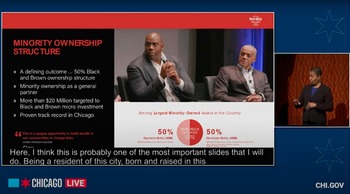
Continuing, Reynolds elaborated on how his minority leadership could facilitate the fair distribution of benefits to minorities while implicitly substituting Black for minority. After introducing the rest of the Hard Rock team, he transitioned to a slide (see Figure 3) titled “Minority Ownership Structure.” The slide described a “50% Black and Brown ownership structure” as a defining outcome and situated the proposed casino as being “among the Largest Minority-Owned Assets in the Country” (Hard Rock International 2022a). A convenient slippage in the term minority enabled the presentation slide to facilitate multiple interpretations: “minority” could be substituted for “Black and Brown,” and it could also prompt viewers how to interpret an accompanying picture that featured two prominent Black businessmen. Reynolds went on to explain that previous “opportunities… given to minorities, Black and Brown and women in this state, [were all] in the limited partnership range,” whereas this casino would give minorities “involvement in the general partnership… where all the decisions are made” (2022a). Without naming himself or explicitly labeling his racial identity, Reynolds positioned himself as both a spokesperson and leader for a certain kind of racialized capitalist development. His statement implied that the unprecedented inclusion of wealthy Black investors in a general partnership, perhaps an equity win in its own right, also implied fairer decision-making about contracts and employment. Black capitalist leadership would result in more equitable resource distribution for the benefit of Black people, and even racial minorities more broadly.
Hard Rock outlines minority ownership structure for the casino.
This slide from the Hard Rock presentation presents the “minority” ownership structure but quickly substitutes “Black and Brown” for minority. A picture of investor James Reynolds Jr. seated next to fellow investor and Black NBA Hall-of-Famer Magic Johnson further emphasizes the Black identity of the ownership. At the bottom of the slide, the City’s projected subtitles show Reynolds’s statement about the importance of this slide (Hard Rock International 2022a).

Reynolds also paired characterizations of success with reminders of his humble origins. On the slide shown in Figure 3, he indexed his high social status by displaying a picture of himself seated with businessman and NBA Hall of Fame athlete Magic Johnson.Footnote 11 However, Reynolds sought to balance this with a reminder of his working-class roots. In the final moments of his opening presentation, he elicited laughter from the audience by claiming that he and Magic Johnson were both “hall-of-famers”. This allowed him to emphasize his own Black, working-class roots by clarifying, “I’m in the hall of fame too, in my high school, Chicago Vocational High School” (2022a). These remarks asserted a sort of legitimacy for Reynolds as a worthy representative of Black people beyond the wealthy investor class while simultaneously underscoring the potential for racial uplift through capitalism.
In the discursive frame of Black-led capitalism, successful business owners like Reynolds serve as both proof of capitalist racial uplift and an assurance that economic activity can benefit Black people across the class spectrum, under the stewardship of the right Black leaders. Reynolds efficiently oriented the audience toward the overall relevance of his presentation and put forth a discursive framework to tie his identity to possibilities for capitalist development to bring greater equity to Black and other minority individuals. His role in the presentation was less about the substantive details of the proposal than assuring the authenticity of the team’s promises to promote equity. Connecting his identity with Loop Capital and underscoring its racial significance, he established himself as a key authority on Black (and possibly minority) capitalist success as and for racial equity.
However, this highly personalized racial frame, with its implicit appeals to respectability, provided the basis for disavowal from his audience in the form of alternative assertions of lower-class Black identity.Footnote 12 In the public comments portion of the meeting, several community members pushed back against Reynolds by attacking his character. In doing so, they cast doubt on the assurance his involvement provided but stopped short of challenging his implicit claim that Black-led capitalism provides a mechanism for promoting equity. For example, community member Tyrone Muhammad, after introducing himself and his organization’s violence-prevention work, directly challenged Reynolds and the rest of the Hard Rock team seated on the stage. Drawing a comparison with the Illinois cannabis industry, which had recently been criticized for its disproportionately White ownership (Braboy Reference Braboy2020), Muhammad described the Hard Rock development team as “White people [with] a very small minority of Black [people],” and then singled out Reynolds, the only Black man on stage, noting the absence “especially of the [sort of] Black men who [were] affected by the war on drugs” (Muhammad Reference Muhammad2022). Next, as he accused Reynolds of breaking past promises to support his violence-prevention organization, Muhammad invoked the language of them and us to emphasize the class disparity between wealthy Black men like Reynolds and the more marginalized Black men he claimed to represent.Footnote 13 And finally, he suggested that Reynolds was more aligned with the city’s White-coded business interests, addressing Reynolds to say, “You [only call] us … to keep crime from downtown… [but never] call us to the table to share in the economic opportunities of [the] city” (Muhammad Reference Muhammad2022). Muhammad’s comments asserted that Reynolds was not a sufficient or reliable representative to distribute economic benefits to Black Chicagoans and that perhaps someone like Muhammad himself should have a seat at the table.
Reynolds responded by defending his character and distinguishing himself as having the concrete skills to bring about equity. After multiple members of the Hard Rock team rushed to respond, the city moderator made space for Reynolds to speak, quelling Muhammad’s repeated attempts to hold the development team to their allotted response time. Reynolds made it clear that he received Muhammad’s comment as “an attack on [his] character,” and took a moment to defend his record of serving and giving. Then, Reynolds flipped the script to attack Muhammad, highlighting his potential criminality by characterizing him as frustrated due to “having gone to prison for a crime [he] may or may not have done.” Lastly, Reynolds uplifted his own approach to “[making] a difference in our community” through “[creating] jobs for folks… [giving business owners] opportunities to work…, and [getting young people] on a path to skills” so that “[hopefully] they won’t end up in prison.”Footnote 14 He closed by invoking a respectability framework to underscore the contrast between his and Muhammad’s approaches, saying, “I don’t just run around yelling at people, accusing them falsely of things, I actually do things” (Reynolds Reference Reynolds2022b). In sum, Reynolds discredited conflict-oriented approaches to community advocacy as unproductive in comparison to his own approach of promoting economic development.
Reynolds characterized his interaction with Muhammad as a conflict over who could effectively take action in service of marginalized communities. Issues of representation and whose experiences get recognized as valuable (Fraser Reference Fraser2005) focus on who gets to be at the table, leaving concrete issues of redistribution unaddressed. Tactically, Hard Rock’s strategy of claiming equity hinged on emphasizing the leadership of a Black, not just minority, businessman of Reynolds’s status. While some disagreement emerged about the qualities and trustworthiness of that leader, the notion that appropriate racialized leadership could assure greater racial equity remained unchallenged.
Bally’s: Racially Representative Capitalism
The Bally’s team proposed building a $1.6 billion stand-alone development, including a hotel, entertainment venue, and a casino, along the west bank of the North Branch Chicago River. Redeveloping the thirty-acre lot would not only mean shutting down the Chicago Tribune printing plant but also further stimulating a majority-White, affluent residential area (see Figure 1) where other postindustrial development projects were already in the works (City of Chicago 2017, CMAP 2024). As noted earlier, Bally’s strategy of territorial ascription involved ignoring the fraught racial history of the area and instead framing its proposed development as an unobtrusive amenity for a high-end residential community. Despite a commitment to hire a certain number of employees from the local area to operate the casino, Bally’s representatives referred to this area vaguely as the community and did not provide any concrete description of potential beneficiaries of the project or their connection to equity concerns.
Downplaying local context, the Bally’s team in turn constructed a discursive frame we call racially representative capitalism. This frame strongly emphasized the firm’s diverse corporate leadership and minority inclusion commitments, portraying these characteristics as a distinct approach to capitalism that would benefit the corporation and increase community pride. Whereas Hard Rock insisted that the involvement of Black investors would ensure a fairer distribution of benefits, Bally’s maintained that its own particular corporate character provided the assurance that promised racial-equity benefits would materialize. In sharp contrast to Hard Rock, lead speaker Soo Kim, Chairman of Bally’s, deemphasized his own racial identity and instead touted his corporation as a racially progressive actor. Kim’s remarks centered on Bally’s as a corporate agent capable of disrupting barriers to minority participation. After briefly introducing the team and the corporation, Kim underscored Bally’s commitment to equity and inclusion as an example of how “the values of the city… are our values as well.”Footnote 15 As evidence that Bally’s leadership believed in inclusion, Kim observed that “four out of our nine directors, right from the top, are women and minorities—almost the majority.” This philosophy of inclusion, he insisted, “goes all the way through our entire company” (Kim Reference Kim2022a).
Whereas Hard Rock’s Reynolds had employed the term minority to stand in for Black, Kim’s use of the word was decidedly unspecific, allowing it to encompass a broader array of evidence. Bally’s, Kim claimed, looked at the City of Chicago’s equity goals with respect to “minority ownership, minority construction, minority employment and operations” and “planned… to well exceed all of [them],” later backing up this claim with concrete percentages for women and minorities (see Figure 4). Kim further explained that Bally’s was committed to minority inclusion “because we think that is what’s reflective of the community” (Kim Reference Kim2022a). Here, Kim connected a vague notion of community with minority representation to subtly imply his shared values with a non-White community. Yet this implicitly racialized invocation of community also obscured the reality that the local community in this particular area was predominantly White and relatively affluent.
Bally’s percentage commitments to women and minority inclusion.
This slide from the Bally’s presentation, presented by Tracy Wiley, the head of Bally’s DEI efforts, offered concrete commitments for minority investment and workforce participation that went beyond the City’s RFP goals (Bally’s Corporation 2022).

By framing commitments to inclusion and community as a distinct, ameliorative approach to capitalism, Kim further developed his characterization of Bally’s as a force for promoting the broader social good. The proposed casino complex, he contended, would be a “flagship property” of which both the corporation and community would be proud. The best and most successful projects are ones that “the community is truly behind,” Kim claimed. What this means, he argued, is that “doing good actually ends up being the best business of all” (Kim Reference Kim2022a). When subsequently pressed by a White community member on whether the casino would bring crime to the area, Kim insisted that community pride resulting from inclusive development would lead community members to choose not to commit crimes. Responding to protests that he hadn’t answered the question, Kim summarized, “We trust that making the community feel like this project is their own is the best way to ensure community safety.” Distinguishing Bally’s approach from that of other corporations, Kim proclaimed, “So look, we want to do good, we want to make money, and again, doing good is good for money… We know that this is a very different approach to capitalism” (Kim Reference Kim2022b).
The discursive frame of racially representative capitalism implies a set of assumptions about the structures at the root of racial inequality. These structures, it is implied, can be corrected by carefully distributing opportunities to participate in capitalism in a way that represents minorities and the community across the class spectrum. In Kim’s formulation, the exclusion of minorities from capitalist investment and labor opportunities stands in the way of racial equality. This is not a problem with capitalism itself but an issue of calibrating the benefits so that they correspond to the composition of the community. Minority representation across the spectrum of capitalist development plays a central role, then, in Bally’s equity claims. On the most apparent level, these racial commitments assert that specific individuals (e.g. investors and employees) adequately represent the collective interests of minority groups. At another level, these assertions characterize the corporation as not simply reflecting a particular racial representation but actively enhancing equity through its values and approach. By making an authentic commitment to reasonable rates of participation across levels, Kim suggested, his corporation could fulfill the social obligation to address inequality (doing good) by simply doing business.
During the public comment portion of the meeting, community members responded by attacking the lack of specificity within this equity framework. Focusing particularly on the omission of Black people as a specified group of beneficiaries, one community participant remarked caustically, “If we ask a Black question, we get a minority answer” (Israel Reference Israel2022). Another community member, George Blakemore, challenged the way Bally’s proposal designated project benefits for particular “minority” groups in percentage terms. Blakemore declared, “I am not interested in ‘Minority: 25%’. I’m not interested in [people of] Color, Hispanics, Whites, or Asians. … I’m only interested in Black people receiving a fair share of good jobs, contracts, and services.” Continuing, he pointedly critiqued Kim’s focus on board representation as a “dog and pony show” and noted that, in reality, unions could present barriers to qualified Black workers getting jobs. Based on this, Blakemore implored Bally’s to back up its self-professed equity commitments with a stipulated allocation to working-class Blacks. “Why don’t you set aside twenty percent for Black people? Twenty percent! For who? Black people!” (Blakemore Reference Blakemore2022a) While legal constraints would inhibit such a commitment from Bally’s, Blakemore’s comment underscored the challenge of convincing some community members that it was possible to advance racial equity without providing greater specificity with respect to race and class.
The responses to Blakemore’s comment largely generalized away from Black people. Before Bally’s could respond, the City’s Chief Engagement Officer interjected to explain that Blakemore’s “[emphasis on] … the needs of the African American community rather than minority communities at large” was because “the lowest incomes and the highest unemployment rates are in the neighborhoods in Chicago that are predominantly African American” (Hone Reference Hone2022). Substituting African American for Black, the city official reframed Blakemore’s account of deceptive representation and structural barriers in terms of neighborhood conditions.Footnote 16 Next, Miguel d’Escoto, the leader of Bally’s construction collaborative, assured Blakemore that unions would have to open their apprenticeship programs because of the high volume of labor needed for the project. D’Escoto framed this opportunity as open to all: “African American, Hispanic, anybody from these neighborhoods [that Blakemore was] talking about.” Acknowledging that recruitment efforts would shape participation, d’Escoto returned to Bally’s representational frame, suggesting that the “fifty percent minority… [and] probably more than thirty-five percent African American” leadership of the collaborative would support recruitment efforts across “all these different communities” (d’Escoto Reference d’Escoto2022). These responses effectively offered an equal-opportunity assurance in response to the targeted benefit that Blakemore, the community member, was demanding.
In addition, community members challenged the vagueness of Bally’s commitments to community. While, at times, Bally’s use of community implicitly indexed the racialized poor, it also concretely referred to the relatively White, affluent area surrounding the proposed site. In response, one Black community member drew attention to the history of displacement and gentrification at nearby Cabrini Green, saying, “I come from a neighborhood where seventy percent of my people didn’t get to come back” (Fleming Reference Fleming2022).Footnote 17 Framing his demand that contractors hire Black workers for this project, he troubled the incongruent meanings of past, present, and future community. His implied reference to Cabrini Green surfaces narratives of disinvestment and broken promises that Bally’s developers did not address, thereby creating an opening for his demand. His critique asserted that by ignoring this history, Bally’s commitments to the present community could not be trusted to address the sorts of deep injustices that shaped it. More generally, Bally’s frame, with its ambiguous specification of both race and place-based beneficiaries, spurred at least several community members to see the corporation’s racial equity claims as suspect at best.
The Bally’s team, meanwhile, continued to assure the audience that the corporation itself was committed to racial equity within an ethos of capitalism for social good. Touting its diverse corporate board and its promise to exceed the city’s racial-equity minimums for minority inclusion, Kim emphasized numerical metrics as a solid promise of racialized social mobility and equity across the class spectrum. Bally’s public defense of its casino project advanced racial representation as a distinctive racial equity frame.
Rivers/Related: Spatially Connective Capitalism
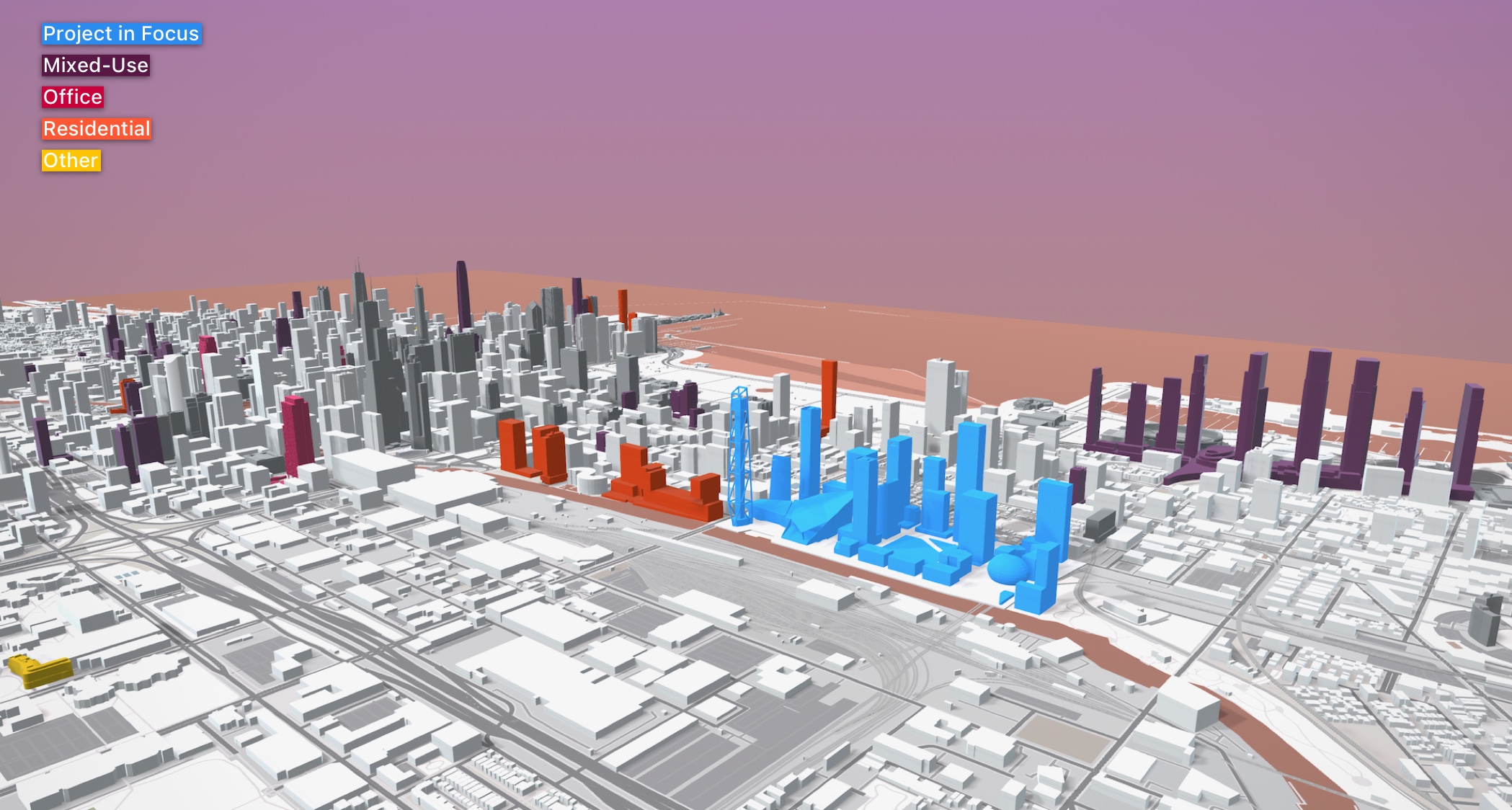
In sharp contrast to the other finalists, the Rivers/Related team reflected overwhelmingly White corporate leadership. However, the Rivers/Related site presented more opportunities to connect development to racial equity issues. Therefore, the development team leaned heavily on geographic context to frame their equity claims. Whereas the Hard Rock and Bally’s sites were located in relatively affluent, majority-White areas, the Rivers/Related site would border working-class, majority-Asian Chinatown, the gentrifying but majority-Latine neighborhood of Pilsen, and the gentrifying but racially diverse South Loop (see Figure 1). The site’s proximity to these racialized spaces provided discursive resources that could work for or against the equity claims of the proposal. The casino itself was framed as an essential part of a $7 billion mega-development called The 78, slated to include 10,000 residential units and various commercial structures (see Figure 5). The overall sixty-two-acre plot along the South Branch Chicago River had sat vacant since the railyard there was demolished in the 1970s. Although the Rivers/Related site was only seven blocks away from Hard Rock’s, the local context called for engagement with distinct ethnic neighborhoods around a largely uncontested site.
3D rendering of planned development south of Chicago’s downtown “Loop” district.
The purple cluster of tall buildings on the right side of the image and the blue cluster of tall buildings near the middle show renderings of ONE Central and The 78 megadevelopments, respectively (Crawford Reference Crawford2022).

The Rivers/Related presentation avoided discussing the development team’s racial characteristics almost entirely.Footnote 18 Instead, it relied on racialized notions of space to claim that enhanced geographical mobility could bring about a more equitable distribution of economic activity in the area. We call this discursive frame spatially connective capitalism. The geographic context presented an opportunity to frame the current Rivers/Related site as a void, and the team narrated how filling this void would bring about greater equity by connecting adjacent marginalized communities to existing patterns of commercial activity.
Curt Bailey, the President of Related Midwest, presented a racialized notion of space by linking his project to an already-institutionalized City initiative to promote equitable development. Bailey opened by extending thanks to Mayor Lightfoot for “her leadership in changing where [developers] invest in this city.” Lightfoot’s signature development initiative, Invest South/West, was concurrently projected to catalyze development in certain racialized poor communities on the South and West sides of the city. Although his site was not actually located within an Invest South/West community area (see Figure 6), Bailey (Reference Bailey2022) framed his Rivers/Related proposal, by analogy, as “the largest Invest South/West project in the city”—suggesting, in effect, that The 78 megadevelopment was an intentional effort to bring equity to its adjacent, long-neglected ethnic neighborhoods. This claim, while geographically untrue, provided Bailey with a characterization of urban space that enabled him to connect his own project to institutionally established efforts to address the disadvantages of race and poverty.
Rivers/Related site in relation to the City’s Invest South/West Initiative.
The 78 megadevelopment site is indicated by a red box with red text above that says “The 78” added to a map of the Invest South/West community areas from the City of Chicago Department of Planning and Development (2019).

Bailey also articulated the development’s potential to change the flow of consumption and tourism through the city. His emphasis here was that the Rivers/Related project would be a “transformational” intervention into the mobile resource flows that often bypass neglected areas. Remaking a vacant site into “one of the most connected spots in the entire city,” his development’s new transportation options would enable the benefits of interconnection to travel in both directions; just as the development would “finally open [the] stagnant site to the entire city…, certain parts of the city [would also] be opened through the [development].” Chinatown, for example, would become “easier to access from downtown, infusing the local economy with new visitors who once thought a trip to Chicago was complete without ever setting foot south of [downtown]” (Bailey Reference Bailey2022). By creating “a great gateway to [the] neighborhoods in the south and the west” (Thompson Reference Thompson2022), the development would “[shift] the epicenter of Chicago’s tourism southward” (Bailey Reference Bailey2022), funneling downtown-centered tourism far beyond adjacent neighborhoods and thereby bringing greater equity to racialized places on the South Side.
The discursive frame of spatially connective capitalism positions development as having the potential to shift the typical direction of the city’s material flows to produce more equitable economic benefits. These claims rely on an understanding of racial inequality as resulting, at least in part, from uneven development overlaid on an already racially segregated urban landscape. In the case of Chicago, tourists and other sources of economic activity are seen as flowing outward, and generally north, from downtown. As an intervention into this geography of mobility, The 78 development site was implied to have not just a location, but a direction; facing southward, it would draw tourists—and thus economic benefit—from the downtown area, the Loop, into marginalized communities, lifting them up. Within this frame, building a casino at the right location could offer a powerful solution to stubborn spatial patterns that reinforce racialized, market-based disparities.
Community members challenged Rivers/Related’s narrative of proximity and connection with opposing spatial claims. For example, David Wu, the executive director of a Chinatown community organization, offered a spatial metaphor of obstruction rather than connection, calling the development “the Great Wall against Chinatown.” Expressing disappointment that Rivers/Related’s design would obstruct downtown views from Chinatown’s only open-space parkland, Wu asked, “If you don’t listen to our comments about the design and how it affects neighborhood communities, how are you going to address our real concerns: problem gambling, congestion, impact on small businesses?” (Reference Wu2022) Wu’s comment countered the claim that the project would connect Chinatown to economic opportunity, instead emphasizing the harms that greater spatial integration through a predatory development, such as a casino, could bring about.
George Blakemore, the community member who challenged the Bally’s project, was equally caustic about the Rivers/Related development. Delivering an impassioned critique of “the games that people play,” Blakemore challenged the notion that a casino on the edge of downtown could funnel economic activity to peripheral Black neighborhoods on the South Side. Blakemore asked rhetorically why “all three of [the] casinos” were proposed to be in “a White or Asian neighborhood… when there’s plenty of vacant land in the ghetto” —and then characterized this decision as “racism.” He proceeded to critique the “economic theory that [investment] at the top… trickles down to the little person,” asserting that what ultimately filters down to Black people is “a golden shower, piss,” since “none of [the] economic development comes back to the ghetto” (Blakemore Reference Blakemore2022b). Contradicting Bailey’s narrative of mobility as the solution to racial inequity, Blakemore’s comment implied that developing a casino in, rather than near, a marginalized Black neighborhood would be more equitable. While both Blakemore’s and Wu’s critiques strongly resisted the central logic of spatially connective capitalism as a path to racial equity, they diverged sharply regarding whether a casino could even play a constructive role in equitable development—a point to which we will return.
Among the three proposals, the particular characteristics of the Rivers/Related site presented distinctive possibilities for advancing spatially grounded equity claims. In contrast, the Bally’s site did not offer much potential for changing geographic patterns, given its relatively White, affluent surroundings on the northwest edge of downtown. Nor did the Hard Rock site, insulated by a White, affluent neighborhood and convention center from the more racially mixed South Side. In a sense, then, while all three presentations rested in broad terms on a general appeal to presumed racial-equity benefits, each development team sought to capitalize discursively on a distinctive set of claims, pressing what it saw as its own particular competitive advantage (see Table 2 for an overview of each proposals’s context). For Rivers/Related, this was a promise that spatial integration into the downtown tourist economy would change the racial distribution of benefits. Meanwhile, for Bally’s and Hard Rock, the promises centered instead on jobs, contracts, and investment opportunities, backed up by assertions—supported in different ways—as to the unique depth and authenticity of their racial equity commitments.
(De)emphasized context pertinent to development team’s racial equity discourse. Points of emphasis are bolded while deemphasized points are unbolded.

Conclusion
In this article, we have analyzed the redevelopment discourses surrounding racial equity at a series of community engagement meetings held for the finalists in Chicago’s 2022 casino proposal process. By analyzing the live public discourse, we were able to assess developers’ rhetorical frames as well as the way those frames interacted with community members’ concerns. We paid close attention to how local and project-specific contexts shaped those possibilities. This approach led us to recognize the connections between the live discourses, city policy, and local and organizational context.
We found that developers dynamically drew upon various modes of strategic racialization, including discourses marked by territorial stigmatization, color-blindness, multicultural diversity, and racial equity. We note that, perhaps stemming from the City of Chicago’s strong emphasis in its request for proposals, racial equity discourses played an especially important role in how developers sought public buy-in for their projects. While much developer rhetoric no doubt reflected the equity requirements put forth by the City, each team pragmatically mobilized certain elements of its project and context to demonstrate its racial equity commitments and to imply racial equity benefits beyond the City’s minimum specifications. We identified three frameworks to describe their differing tactical approaches to claiming racial equity: Black-led capitalism, racially representative capitalism, and spatially connective capitalism (see Table 1).
We found that community input regarding racial equity tended to directly respond to the sorts of tactical claims made by developers, bringing new perspectives and context into the conversation to cast doubt on developers’ claims. Community members’ comments often rejected certain elements of developers’ frameworks, yet these criticisms failed to cohere into a unified demand within or across the three proposed development sites. Moreover, most critical commentators failed to challenge the assumption that capitalist development, if conducted appropriately, could drive racial equity. This failure raises for us several more basic questions: Is a casino by its very nature a predatory urban development? Does it matter who leads such projects or where they are located within the city? Are there trade-offs nevertheless that community members may wish to grant to such projects so that certain racial-equity-related benefits can be won?
In May 2022, the mayor’s office announced the selection of the Bally’s proposal, receiving approval from the City Council and the State of Illinois several weeks later (Yin and Pratt, Reference Yin and Pratt2022). A Casino Recommendation Report (City of Chicago Office of the Mayor 2022a) accompanying the mayor’s press release evaluated the three finalist proposals across the major RFP categories, with one section dedicated to “equity.” The recommendation report characterizes the three finalists as equivalent regarding construction, vending, and workforce-related equity commitments. Despite an array of news articles criticizing Bally’s minority investor program in the preceding months (Channick Reference Channick2022b; Crain’s Editorial Board 2022; Hinz Reference Hinz2022), the report characterized Bally’s “crowdsourcing” approach to attracting minority investors as “the most sophisticated and greatest opportunity for minority wealth creation” (City of Chicago Office of the Mayor 2022a, p. 20) among the bidders. Other racial equity-related assurances advanced by the developers were not mentioned.
Press reports about the engagement meetings generally characterized community responses to the presentations as negative but failed to mention racial equity concerns (e.g., Channick Reference Channick2022a). The disconnect between the equity-oriented discursive exchanges we observed and published accounts of the proposal selection process, therefore, raises further questions of significance. The discourse at the community engagement meetings may or may not have had a decisive influence on city decision-making or public opinion. However, community members and developers both engaged with racial issues well beyond the official equity criteria, suggesting that the City’s framing of equity has not thus far established any sort of hegemonic racial project. In other words, the discourse at these meetings reveals that, despite the City’s assertion of explicitly defined equity criteria, the meaning of racial equity is far from settled.Footnote 19
In this sense, the insertion of racial equity discourse by the City of Chicago into the development process appears to have invited, or at least made space for, strongly argued racial counterclaims by community members. Keavy McFadden (Reference McFadden2026) has suggested that, in the context of “post-neoliberalism,” heightened contradictions of the sort we observed in these public confrontations should be recognized as an early step toward more transformative change. While the equity-related passages in the City’s RFP lacked specificity and failed to fully address the racially disparate impacts of capitalist urban development, those provisions compelled developers to articulate public stances regarding equity. Developers at the engagement forums spoke explicitly about the RFP equity criteria and outlined mechanisms through which their projects would advance the interests of minority workers, businesses, and investors. These assertions, in turn, opened up space for community members to challenge developer claims and present their own alternative understandings of racial equity.
While community members’ critiques generally focused on representational issues and did not cohere into a unified, alternative frame, they point to deeper possibilities for contestation. Several Black community members asserted the need for more specificity regarding the race of beneficiaries as they pushed against the generalizing use of minority. Others asserted intersecting class-based identities in resistance to the racially homogenizing discourse of developers, rejecting elite claims of representation. Still others criticized sweeping spatial generalizations linked to presumed racial-equity benefits. However, these challenges did not contest the underlying capitalist logic that delivering material benefits to investors and workers alone—however racialized—could sufficiently enhance racial equity. Indeed, only one community member across the three meetings troubled the notion that a casino could serve as an engine of equitable development. None of the participants proposed consideration of a particular strategy, such as a community benefits agreement, that might secure contractually mandated resources beyond the promised opportunities for workers and investors. Still, community members’ critical comments regarding development-as-usual could serve to inform more comprehensive demands for racial equity in the future. Based on our data, such demands might include greater specificity about beneficiaries that account for the intersection of race and class, historically informed conceptions of community, and an understanding of community development that goes beyond a more inclusive capitalism.
Early in 2025, a legal case emerged to remind us of the dynamic nature of discourse and policy surrounding racial equity. Building on recent momentum eroding government’s ability to provide benefits to minority groups, two White men from Texas brought a federal lawsuit against Bally’s Corporation for its minority investor program, framing it as a “race-based stock offering” discriminating against White men (Armentrout Reference Armentrout2025; Mercado Reference Mercado2025b). Several months later, Bally’s reneged on the minority investor’s program attached to its Chicago casino project and replaced the stipulation that investors must be women or minorities with a stated preference for investors who live in Chicago or Illinois (Mercado Reference Mercado2025a). Given that many local programs in the United States supporting women and minorities are under attack, it may seem counterproductive to criticize the limitations of Chicago’s recent initiative to promote racial equity. Nevertheless, our study, by recognizing the multiple ways that “racial equity” may be characterized by developers and contested by community members, helps to clarify the challenge of articulating more robust frameworks for the future. We call for academics, organizers, policymakers, and community members to continue pressing forward with—and refining—approaches to racial equity that more effectively address the structurally embedded and deeply intersectional disparities endemic to current forms of capitalist urban development.
Acknowledgements
The authors would like to acknowledge participants in the Faculty Workshop at the Crown Family School of Social Work, Policy, and Practice for feedback on an earlier version of this article. The first author would like to recognize community organizations for an invitation to the Rivers/Related meeting and the National Academy of Education for support through the National Academy of Education/Spencer Dissertation Fellowship.





 Open access