

A Warning from the Past
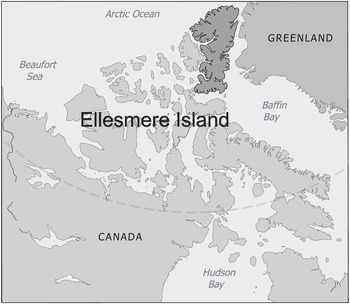
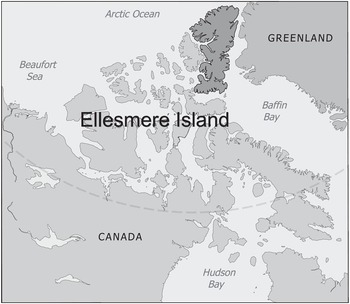
Ellesmere Island is in the very far north of Canada, above the Arctic Circle. It lies just to the west of Greenland, and like its bigger neighbor it is almost entirely glaciated. If you are on your way to the North Pole by way of Canada, this will probably be your last stop (see Map I.1). Few scientists had made their way to Ellesmere when Mary Dawson, a paleontologist at the Carnegie Museum of Natural History, launched her first expedition there in 1973. Dawson, forty-two at the time, was fascinated by the possibility that there had once been a land bridge between North America and Europe, and she hoped to find evidence that terrestrial species had migrated across it millions of years ago. Accompanied by a coworker, she hauled her gear to a remote camp and began scouring the desolate, frozen territory for fossil remains.1
Map of Ellesmere Island.
Her initial efforts met with little success, but on a return visit in 1975 she struck paydirt. One after another, she found fossils of ancient mammals, turtles, plants – and alligators. Alligators. By analyzing the oxygen isotopes embedded in bone material, Dawson and her colleagues were able to estimate the temperature conditions that made semi-tropical life possible hundreds of miles north of the Arctic Circle. They found that, during the time of the alligators, summer temperature on Ellesmere averaged a balmy 68°F (20°C), and even average winter temperatures didn’t dip below freezing. Was this because the island was further south back then? No: ancient Ellesmere was a few degrees south of its current position, but still well above the Arctic Circle. Somehow the far north had roughly the same climate then as the southeastern United States has today, with cypress swamps where you might find not only large reptiles but also hippopotamus-like mammals wading in to gnaw on aquatic plants. If you find this stunning, imagine the surprise of Dawson’s team when they stumbled upon the fossil evidence.
They kept coming back to Ellesmere and nearby islands, working under challenging conditions and deepening our understanding of an extraordinary period in Earth history. (Dawson herself fought off a wolf attack in 1977.2) Her last visit was in 2002 – she’s now an emeritus Curator of Vertebrate Paleontology at the Carnegie Museum – but a team from the University of Colorado headed by Jaelyn Eberle has continued where she left off.3 There is another astonishing fact to reveal, but first we need to put Ellesmere’s alligators in context.
Arctic lushness dates from an unusual episode in the geological record, the Paleocene–Eocene Thermal Maximum (PETM). This occurred approximately 56 million years ago, when temperatures soared for about 170,000 years, a long time from a human perspective but just a brief moment in Earth history.4 Just how and why this happened is a matter of dispute, but decades of research have progressively culled the list of possible explanations and are narrowing the differences in estimated temperatures and environmental conditions.5 One reason it is taking time to reach consensus is that the geological brevity of 170,000 years means there are relatively few traces for today’s researchers to locate and analyze, and different remains require different methods and modeling frameworks.
How warm did it get during the PETM? Temperatures rose 5–8°C from a previously warm epoch, making the average temperature at the PETM peak 12 to 18°C warmer than today.6 When alligators roamed the north, sea-level temperatures at the North Pole averaged between 14 and 19°C year-round,7 which of course meant not only that there was no sea ice in the Arctic but that humans, if they had existed, would have enjoyed comfortable summer swimming conditions at their polar getaways. Balmy weather at the pole meant torrid conditions in the tropics, however. A recent analysis of a site in Tanzania, which at the time of the PETM was 70 kilometers offshore, found that surface water temperatures were as high as 36–43°C, or 97–109°F, suggesting that inland temperatures were even steamier.8 As we will see later, conditions of this sort would render a significant portion of the globe uninhabitable by humans, at least if they are not enclosed in a technological cocoon.
There is little doubt the temperature extremes of the PETM were primarily the result of large emissions of greenhouse gases, carbon dioxide (CO2) and methane (CH4), into the atmosphere. Several explanations exist for its cause. For a time there was speculation that a cyclic change in the Earth’s orbit around the sun might have played a significant role, but as measurement of the timing of the event and the composition of atmospheric carbon has become more precise, other explanations have gained ground.9 A plausible hypothesis, for instance, is that the triggering event was the separation of the North American and European landmasses east of present-day Greenland, which might have resulted in a period of intense volcanic releases of greenhouse gases into the atmosphere. The initial warming resulting from this cataclysmic process may then have led to further releases of carbon previously sequestered in soils or very cold, deep marine deposits, although this is currently a matter of considerable dispute.10 This is our first hint that feedback mechanisms may play an important role in historic, and future, climate fluctuations, a topic we will return to shortly.
Of critical importance to modern-day humans is the question of how much additional carbon dioxide did it take to turn the Earth into a PETM planetary sauna and how close are we today to replicating it? Of course, the amount of carbon dioxide in the atmosphere millions of years ago is not directly measurable today, so researchers have to find indicators that point to it indirectly.
A (relatively) convenient approach takes advantage of the fact that chemical elements are not uniform in nature. They can differ in the number of protons and electrons they contain, and the term “isotope” is used to designate a specific combination. Carbon-13 (written as 13C) is one such isotope, whose six protons and seven neutrons sum to thirteen, and it is associated with a particular molecular history, especially methane; by measuring the proportion of the carbon preserved from an earlier period that shows up as carbon‑13 it is possible to estimate how much of it originated from various methane‑generating sources like decaying plant matter and magma releases. The point is that, on release, this methane would have found its way into the atmosphere, where, as we will see in the next chapter, it would have been transformed into carbon dioxide, augmenting the greenhouse trapping of solar radiation. Even after this additional carbon dioxide leaves the atmosphere many thousands of years later to be incorporated in carbon‑bearing sediments, fossils or rocks, its telltale 13C isotope records its sojourn as methane and then atmospheric carbon dioxide.
Once the quantity of prehistoric methane releases can be estimated, the next step is to determine how much of this additional carbon would have accumulated in the atmosphere and for how long. This can be estimated using models of the global carbon balance (stable relationships between the amounts of carbon in the atmosphere, soils, ocean and living organisms). Because different research sites and carbon-bearing substances yield different isotopic proportions, and different climate models perform this conversion into estimates of atmospheric carbon dioxide somewhat differently, there is a range of estimates of how carbon-saturated the PETM atmosphere was when alligators dipped into waters that sport polar bears today. The latest research gives us a lower bound of about 1,200 parts per million (ppm) carbon dioxide and an upper of about 2,000 ppm.11 Note these are estimates of peak carbon dioxide concentrations; as we will see, it is possible that less than this is needed to set the process of extreme climate change in motion.
So, if the PETM was triggered by unusual releases of greenhouse gases and produced a global heat wave that lasted for over 100,000 years, how did it end? Why didn’t the planet just stay hot? As you would expect, this is another matter of dispute, since the record that has come down to us is so fragmentary. One possibility is increased weathering, where carbon is stripped from soils or precipitated into rock formations and buried beyond the reach of the Earth surface carbon cycle. It is increasingly agreed, however, that a significant role was played by a profusion of living organisms, which pulled carbon from the atmosphere and redirected some of it to deep sea or deep earth burial.
What does that mean specifically? Here is where a remarkable fact about the PETM comes into play. Recall the far north experienced near-tropical conditions for many thousands of years. The Arctic Ocean was not only free of ice, it was a welcoming habitat for plants and animals usually found far to the south. One such new inhabitant was Azolla, a fern that floats freely on open waters with moderate temperatures and limited salinity. With the Arctic sea accepting massive inflows of freshwater from north-flowing rivers in Canada and Siberia – a reflection of altered precipitation patterns – and enjoying alligator-friendly temperatures, it was eventually covered with a mat of this sea fern.12 Tangles of ferns, not ice, would have obstructed your trip to the North Pole. Azolla serves as a poster child for the explosion of biological growth during the PETM, although even more carbon would have been funneled into increased growth of marine plankton invisible to the naked eye. While most of the carbon pulled out of the atmosphere by this “biological pump” would have returned through transpiration and decay, some small amount each year would have migrated down into the sea floor, no longer available for greenhouse service. After tens of thousands of years, enough carbon would be withdrawn in this fashion to help bring atmospheric carbon dioxide concentrations down to a more normal level.13
A Warning from the Future
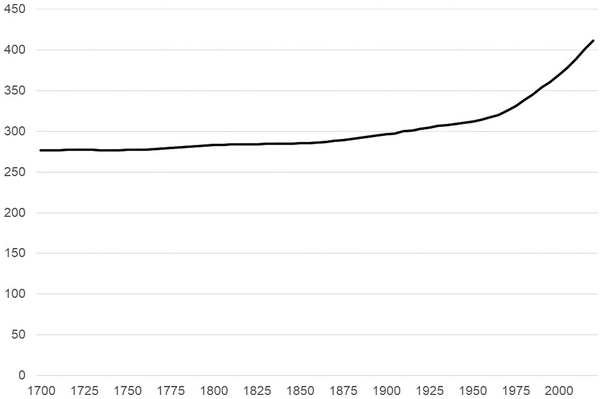
And so, from alligators to Azolla, this completes our first exposure to the disturbing topic of catastrophic climate change. What we know is that, spurred by singular natural processes, like the pulling apart of tectonic plates – processes unlikely to be repeated for many millennia to come – much of the Earth became uninhabitable for organisms like modern-day humans. But the truly frightening prospect is that human beings, through their own actions, could bring about a similar result. Instead of volcanoes we have coal, oil and natural gas companies drawing long-buried carbon from the earth and sending it into the atmosphere. Where are we on the road to the PETM? Consider the most recent data posted by the US Environmental Protection Agency (EPA), shown in Figure I.1. This time path considers only carbon dioxide, the main form that carbon appears in the atmosphere. Carbon also shows up in methane, whose heat-trapping effects are far greater but whose life span is also much shorter. Carbon dioxide, however, is a stable gas, and its carbon exits the atmosphere only as a result of the flows between air, land and water we will look at in the next chapter, while methane reacts with oxygen, resulting in the separation of its hydrogen and the formation of new carbon dioxide. This process is complete in a few decades, so measuring just carbon dioxide over a timescale like that in Figure I.1, with its global carbon dioxide concentrations over the past 300-plus years, captures most of the “older” methane as well. (There are also other, highly potent greenhouse gases with intermediate life spans like nitrous oxide, but we will set them aside for now.)
Atmospheric CO2 accumulation since 1700 in parts per million (ppm). The carbon concentration in the atmosphere has increased from about 275 ppm in 1700 to over 400 ppm today. Multiple measurements in a given year are reported as arithmetic averages. Direct measurement began in 1959.
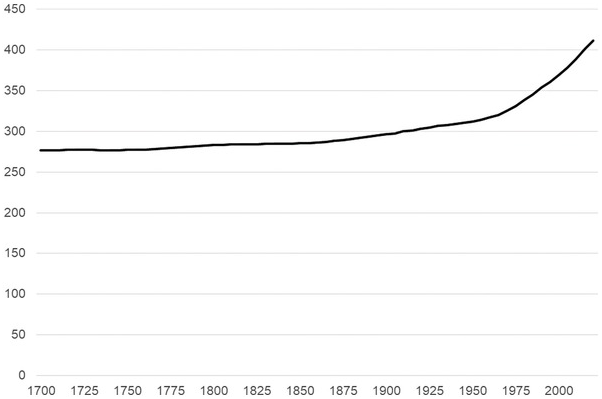
For many tens of thousands of years, the carbon dioxide concentration has fluctuated between 180 and 280 ppm, as ice ages came and went. For the past thousand years it remained stable at around 275 ppm – until the late eighteenth century, when it slowly began to rise. The rate of increase gradually picked up as the industrial revolution took hold, and fossil fuel use became widespread. For the past half-century it has taken off at a full gallop, and each year brings us into new, unexplored territory.
The most recent annual average is 410 ppm, nearly a 50% increase over the preindustrial level. Extraordinary as this is, however, it still leaves us well short of the 1,200 ppm that can serve as a guess of likely carbon dioxide concentrations during the PETM, but there are two more factors that need to be considered. First, carbon dioxide concentrations in the atmosphere continue to grow year by year, as people extract, burn and release carbon in various forms. Because carbon dioxide (and some other) greenhouse gases are very long-lived, in the absence of any further large-scale human intervention annual net additions of atmospheric carbon are effectively permanent.14 While there have been slight ups and downs, during the past decade the rate of growth in carbon dioxide concentrations was a bit over 0.5% (0.00575) per year – until, of course, the global economic slump triggered by the coronavirus.
Let’s extrapolate this trend. Taking 410 ppm as our starting point in 2019 and 0.575% as our growth rate, unless we change course we will hit 437 ppm in 2030, 490 ppm in 2050 and 652 ppm by 2100. But what about the economic slowdown due to the pandemic? We will return to that question later, but for now, let’s assume that the growth in atmospheric carbon dioxide falls by 25% as the world struggles with the coronavirus, and that this phase lasts for five years, after which growth returns to its 0.575% trajectory.15 Making that adjustment gives us 434 ppm in 2030, 486 ppm in 2050 and 648 in 2100 – just a minor reduction. These numbers would be alarming, but not enough in themselves to cause us to worry about wandering alligators.
But there is a second factor that casts an even darker shadow over all our thinking on this topic. It is likely that the very high atmospheric carbon dioxide concentration of the PETM was not the result of a single triggering event and nothing more. Suppose the process that set it in motion began, as many think, with an upsurge of volcanic releases as two giant tectonic plates in the North Atlantic tore apart. That would have caused a big influx of carbon, previously sequestered within the Earth, into the atmosphere–ocean–biosphere carbon cycle, leading in short order to higher temperatures. But higher temperatures, in turn, would likely have caused further releases of stored carbon, as methane was released from soils, peats and underwater deposits. The benchmark against which we should measure our own “progress” in achieving higher atmospheric carbon dioxide is not the final peak realized during the PETM, whether this was 1,200 ppm or some other level, but the concentration resulting from the initial trigger that was sufficient to bring about further releases, creating a self-feeding process that stopped only when a much hotter planet struck a new balance.
To put numbers on it, suppose the peak was 1,200 ppm and the trigger alone brought the atmosphere to 600 ppm, after which the initial warming released the rest of the carbon that contributed the other 600. This should be taken with many grains of salt, since there may have been multiple triggers operating at different times and coexisting with many feedback mechanisms, and of course the numbers we are using are strictly hypothetical. The logic, however, is essential: it tells us that, if this example were true, the level of atmospheric carbon dioxide with “thou shalt not pass” written on it would not be 1,200 but 600 ppm. If we were to allow ourselves to exceed this limit, we would run a very high risk of initiating the same feedback processes that fueled the PETM.
What makes the situation so uncomfortable, however, is that, rather than a line, what we face is a slippery slope of increasingly dangerous and unforeseeable feedback risk. There is no perfectly safe level of atmospheric carbon dioxide we can still plateau at given past and unavoidable future emissions. Perhaps there are particular carbon dioxide concentrations we might regard as tipping points, and if we had perfect knowledge of the Earth’s carbon system in prehistoric times as well as the present we could possibly identify them. But the system is extraordinarily complicated. We have models of it, but they embody assumptions that can’t be fully tested because we don’t have enough data, especially as we begin to alter the Earth’s climate in ways it hasn’t experienced in millions of years. We know only that peak atmospheric carbon dioxide during the PETM was somewhere between 1,200 and 2,000 ppm. That’s not nothing, but it leaves a lot of uncertainty for what to expect in the coming century.
A frightening thought: Could we have already passed key tipping levels of carbon dioxide that make a full-on climate catastrophe unavoidable? Very unlikely. What if we add to the current level the near-future emissions that are baked in irrespective of policy? Still unlikely. But this is the wrong question. What we do know, even with our still-emerging knowledge of complex Earth systems, is that the longer we allow greenhouse gases to be emitted, the greater is the risk that we could trigger feedback responses that make runaway climate change a dire threat. Even intermediate scenarios, with feedbacks that intensify climate change but not on a PETM scale, involve taking unknown risks with unfathomable consequences. It is the premise of this book that it is simply unacceptable to continue blindly on the current course and let these risks mount year after year.
To be specific: I will argue for the position that climate change needs to be minimized as a matter of extreme urgency, and that this entails, above all, adhering to a carbon emissions budget that would steadily reduce the use of fossil fuels each year until they are largely phased out in just a few decades. The pace of this phaseout needs to be set by the necessity of keeping warming to a minimum, not by economic convenience. This will not be easy; in fact, it will be highly disruptive to the institutions, technologies and habits we have come to depend on – and which have brought us to this point. I am convinced it can be done, that we have the economic tools we need to extricate ourselves from a carbon nightmare, but there is little room for delay, obfuscation, magical thinking or compromise. I wish the message could be friendly and encouraging, but instead it’s hard and offers little wiggle room. Perhaps there was a time, decades ago, when easier, more relaxed methods might have done the job, but not now.
Mapping a New Economics and Politics
Why begin with a tale of wandering alligators and hothouse temperatures 56 million years ago? This is not a treatise on paleoclimatology or Arctic environments. What I hope this story gives you, however, is a feeling for the scale of the crisis we face and its extraordinary implications in light of Earth history. The difficult part will be holding onto this frame when we wade, as we must, into the morass of economic and policy detail.
Many books have been published putting contemporary climate change into a planetary and geological perspective. (One of these, Laboratory Earth: The Planetary Gamble We Can’t Afford to Lose by the late Stephen Schneider, was the book that first convinced me of the centrality of this issue.16) I have little to add to them. The problem, however, is that they don’t draw out the economic and political implications of this perspective, while the much greater number of policy-oriented books on climate change, although inspired in a general way by the science, put the constraints of economics and politics first. What would it mean to consider today’s policy debates through the lens of Earth history and global environmental processes – the same lens through which we viewed the PETM? That’s what the rest of the book is about.
In particular, I will focus on the strange dual role of economics, an indispensable tool for formulating and evaluating policies, yet also a primary source of misunderstanding. Carbon emissions are produced, every bit as much, and often in the same moment, as automobiles, restaurant meals and bank loans. Economics is the branch of knowledge that best explains how and why these things are produced and therefore also how to produce them differently or not at all. In addition, the economy is intricately interconnected, so that changes in some products or industries typically have ramifications throughout the system. This too is the province of economics.
But economics, at least in its dominant versions, brings a perspective to climate change that competes with the Earth history view. Consider the interesting case of William (Bill) Nordhaus of Yale University, winner of the 2018 Economics Prize “in honor” of Alfred Nobel.17 This award was based on decades of work during which Nordhaus developed methods that have come to be standard for most researchers. As we will see in more detail later, his innovation was to marry models of economic “general equilibrium” with other equations representing the impacts of human activity on global warming. You would think this was exactly the integration of scientific understanding and human production systems we need in order to avoid the recurrence of PETM‑like conditions.
The purpose of Nordhaus’ modeling, however, was not to minimize the risk of a catastrophe but to ascertain the “optimal” level of global warming, the one that ideally balances, in his view, the costs of not taking enough action with the costs of taking too much. His recommended target has changed over the years as he has continued to revise his model and the data it feeds on; at first he advocated only the most minimal effort to tamp down carbon emissions, while now he is willing to go further. Even so, he still advocates policies that would result in a 3.5°C global temperature increase, far above the 1.5–2.0° ceiling proposed by the UN’s Intergovernmental Panel on Climate Change (IPCC) and endorsed, at least on paper, by the Paris Climate Agreement.18
To be as clear as possible, the situation is this: the economist who has received the highest honors for his research on climate change and has been the most influential in guiding the work of his peers thinks the upper limit on allowable warming should be twice as high as the one set by the world’s leading climate scientists – an accommodation, we will see, that carries with it a substantial risk of uncontrollable further warming with even more catastrophic implications. How is this possible?
The short answer is that economics has two faces. One describes and forecasts, telling us how effective different policies are likely to be in controlling carbon emissions and what impacts on different groups in society will result. The other assigns value; it treats every outcome as if it were a consumption good and asks how we can maximize the benefit we get from the total basket. In the pages to come we will have a lot more to say about both faces – how we aren’t using enough of the first but instead too much of the second. Even as regiments of economists are enlisted to second‑guess science and compute “optimal” levels of warming, immensely consequential aspects of regulations to control carbon emissions are barely considered. The questions not asked about the economics of climate change will be surprising and disturbing.
Insisting on an honest, clear‑eyed view of the economics of forestalling a climate catastrophe is one way of being realistic, but there is another version of realism that currently dominates policy debates. According to this other view, we should begin with measures that are politically popular, or can readily be sold to the public, and not too costly economically. Once modest climate policy gets a foothold we can gradually ramp it up, and if we are fortunate the process will go quickly enough that we might be able to avoid the worst climate outcomes. This approach is realistic, which is to say not too demanding, in its economics and politics but crosses its fingers about climate tipping points. The way this book interprets realism, however, is to begin with climate imperatives and commit to ways to adhere to them even if the economics and politics are difficult. Just how difficult they might be is one of the core themes of the pages to come, and what we will learn will not be comforting. Nevertheless, if looking at the challenge we face through the lens of Earth history and its peripatetic alligators means anything, it’s that climate realism has to come first.
Defogging
Meanwhile, as we have drifted through decades of obfuscation and delay, a number of misconceptions have grown up around how to think about climate action. In some cases, this is because people brought their prior mental frameworks to this new area of concern, not stopping to reflect on whether they still made sense. In others it was a matter of expedience: it was simply more convenient to believe that a climate disaster could be prevented by simple, low-cost, politically popular measures even if the reality were otherwise. In order to clear space for an economics and politics fitted to the climate challenge it will be necessary to dispel these sources of confusion.
Here is a list of specific misconceptions that future chapters will examine:
1. False symmetry: Action against climate change is just another case of economic balancing, weighing the costs of climate alteration against the costs of limiting it. Yes, these commentators say, the accumulation of greenhouse gases is a problem, but it isn’t fundamentally different from other problems we cope with every day. We shouldn’t do too little about it, but we shouldn’t do too much either. The trick is to recognize that climate change is simply an economic problem, costly in the same way regulation to counter it will be. This allows us to measure the combined costs at each level of global warming, so we can turn the policy dial to the precise point where their sum is minimized.
2. Wishful thinking: Combating climate change will not be difficult. It’s just a matter of getting past the diehard denialists. We will create lots of green jobs, and we won’t even have to put a climate label on it. People will support our program for all the economic opportunity it creates. And government revenue from carbon caps or taxes is a wonderful resource for new public services, since only the corporate polluters will pay it.19
3. Ideological preconceptions: Climate change is not primarily about geology and chemistry; it’s a sign of a deep flaw in human nature or ideology or modern ways of life. Climate change may superficially look different, but it is just another result of the same deep flaw responsible for all modern problems. Depending on who you ask, this flaw is (a) overpopulation, (b) the desire for economic growth, (c) money and markets, (d) living in cities, cut off from deep experience of nature, (e) racism and sexism or (f) all of the above. Unless we fix the root cause, policy actions focused directly on reducing carbon emissions will only reinforce the system that gave us climate change in the first place. In fact, policies that zero in on fossil fuels without getting to the “true” causes are illusory and should be opposed.20
4. The individualist illusion: We can solve the climate problem by changing behavior one person/company/community at a time. Each of us can calculate our own carbon footprint and then take measures to become carbon neutral. Once our carbon audits show we’ve all brought our net emissions down to zero the problem is solved. In the end, climate change is about personal responsibility.
Each of these misconceptions, in its own way, is well‑intentioned; the people who hold them understand we face a serious problem and want to do something about it. Nevertheless, usually without much reflection, they have imported assumptions that make effective action less rather than more likely.
Economists and policy wonks espousing a false symmetry between the costs of planetary destabilization and those of combating it want to fit climate change into a well‑known mold, a sort of business‑reform‑as‑usual that would minimize uncertainty and inconvenience. Those are reasonable goals under many circumstances, but climate change is not one of them; its threat is existential and the economic problem is how to minimize it with the least disruption to our quality of life. Of course, there are still trade-offs, yet the metaphor that comes to mind is not balancing but navigation. As we will see, difficult choices lie ahead, especially when we confront the tension between decarbonization and the need for low-income countries to develop their economies to meet other human needs. Rejecting the false symmetry between the demands of the natural world and the economy we erect on it forces us to think more deeply about the paths open to us.
The soft-pedaling of climate action summarized in claim (2) is often motivated by the desire to sidestep potential political obstacles. It’s a bit like being told by a doctor that a needed medical procedure won’t hurt very much, as a way to convince you to go through with it. No doubt, it will be easier to take the first steps toward addressing the climate crisis if the public thinks the economic costs will be minimal or that there won’t even be costs at all. But what if the claim isn’t true? Unraveling the likely costs entailed in drastically reducing carbon emissions is complex, especially as some of the most troublesome economic aspects have barely been considered – but the evidence isn’t encouraging. When we examine the perils of wishful thinking close up it will become clear why downplaying cost is bad politics, and also why understanding what forms these costs will take and who will bear them reveals what a more effective politics will look like.
Just as some people downplay the climate crisis for purposes of political convenience, others, in thrall to ideological preconceptions, try to exploit its epic seriousness to pursue other, largely unrelated goals. The problem is not necessarily the ideologies themselves, but the tendency to apply them to climate change whether they fit or not – especially when they are made the basis of a politics of all‑or‑nothing. Although the claim we can meet the climate challenge only by addressing some other “deeper” cause is often advertised as radical, we will find that directly curtailing carbon emissions on the timescale required by climate science is itself a radical, even transformative undertaking, although not in ways most standard ideologies would predict.
If ideological preconceptions appeal to all‑encompassing social theories, the individualist illusion lies at the opposite extreme, lacking any theory to explain why society is more than just an aggregation of individuals. This illusion operates on two levels. One is the adding‑up approach to limiting carbon emissions, according to which the social objective of meeting a climate target can be broken down to each person’s or organization’s individual share. It is not too difficult to show, on the contrary, that serious action needs to be collective, since many of the necessary changes can be made only at scale. The more surprising illusion, however, is more fundamental, that we can know what our individual contributions to global emissions are at all. As we will see, even the most scrupulous of carbon audits depend on assumptions and arbitrary accounting boundaries that leave the bottom line uncertain – and there is no way to avoid this.
One of the reasons the misconceptions sketched above have taken hold is that existing measures to curtail the use of fossil fuels have been so inadequate: with the path of direct public action to shut down emissions discredited, those who care about the problem have been attracted by other paths, however wayward. Part of the project of dispelling false leads in climate policy has to be explaining why it has been so difficult to make progress at keeping fossil fuels in the ground; unless we can do this the science‑based realism I advocate will turn out to be just another form of magical thinking.
Here we come to a crucial point in the story, the political economy of climate change. Our economies have evolved over centuries in which fossil fuels played a central role but their impact on the global carbon cycle was overlooked. Where we live, how we travel, the work we do and the goods we consume all reflect this evolution. This has obvious implications for the livelihoods that millions of people have devoted their lives to and depend on. These people vote, and technocratic policy strategies haven’t given enough thought to making solutions to the climate crisis work for them too, at least tolerably.
But we also can’t overlook the significance of living in a capitalist world. Wealth derives its value from the revenues generated by carbon‑dependent production and consumption networks, and a large portion of it would be at risk if we were to implement tough policies against fossil fuels. Although the vulnerability of the fossil fuel sector itself has been studied, not enough attention has been given to the wider impacts of decarbonization on wealth – a topic we will take up later. As we will see, there is a deep conflict between the no‑loss‑of‑wealth constraint that usually binds political life and the no‑loss‑of‑planet constraint imposed by the need to forestall catastrophic climate change. Understanding the basis for this conflict and what it implies for future economic and political agendas is central to any hope of making meaningful progress.
The rest of the book will weave together these different strands: the implacable demands of the climate challenge, the misconceptions that continue to obstruct progress even apart from the efforts of the outright climate deniers, the dismal record of existing policies and programs despite the feasibility of measures that would actually ensure a livable planet, and finally the conundrums of politics and power that have to be overcome nationally and internationally. It’s an immense set of topics, but each bears on the others. To examine them responsibly means taking account of a wide range of research and the uncertainties of still‑evolving fields of study. Fortunately, there will be a stream of surprising discoveries along the way and at least the faint glimpse of a possible happy ending.