


1. Introduction
Advances in digital technology and computing have reshaped the financial landscape.Footnote 1 In particular, we see changes in the means that people use to pay for things. The underlying financial innovations mean that financial instruments are more accessible than before, resulting in increased financial inclusion.
To illustrate this, note that the use of cash payments relative to those made with a deferred payment has changed dramatically. The Federal Deposit Insurance Corporation reports that since 2009, there has been a downward trend in the fraction of households without a checking or savings account (See Figure 1).Footnote 2
Financial inclusion in the U.S.

In addition, increased financial access has allowed new financial instruments to be traded. In the United States, Figure 2 shows that both the value and number of non-cash payments, including credit, have increased over time.
Trends in non-cash payment in the U.S.

In this paper, we examine how financial innovations affect people’s payment decisions. In the baseline model economy, we consider a primitive economy in which buyers use cash or checks. We then extend the model to include credit. In a strict sense, everyone has access to banks, but the measure of trades in which non-cash payments are accepted is endogenous; indeed, acceptance depends on how costly it is for sellers to accept this means of payment. In trades where sellers only accept cash, it is due to the high cost of adopting a non-cash payment option. We interpret the measure of buyers using non-cash as our indicator of financial access.
There is a divide among researchers about whether financial innovation increases or decreases expected welfare. On the one hand, financial innovation reduces financial frictions and expands production possibilities set.Footnote 3 On the other hand, researchers derive conditions under which financial innovations can lead to lower welfare.Footnote 4 With limited commitments, we can derive conditions under which financial innovations can be welfare-improving or lowering within the same setup, bridging the two strands of literature.
Our analysis provides answers to the following important questions: How does financial innovation affect financial access? Does greater access to banking services and secure credit unambiguously raise the welfare of all agents? Does greater financial access increase or decrease long-run inequality? Is there any role for policymakers in mitigating the impact of these innovations?
To answer these questions, we build on the frictional and incomplete-market framework of Williamson (Reference Williamson2016) and Dhital et al. (Reference Dhital, Gomis-Porqueras and Haslag2021). Time is discrete and each time period is divided into three sub-periods. In this economy, there are three types of agents: buyers, sellers, and bankers. These agents face limited commitment and trade in sequential markets that are characterized by different frictions and trading protocols. In the first sub-period (DM), a buyer bilaterally trades with a seller. In the baseline case, the seller can accept claims against deposits (checks), or accept cash.Footnote 5 It is costly to verify claims against deposits. In the second sub-period (CM), all agents make consumption, labor, and asset portfolio decisions in competitive markets. In the third sub-period, sellers receive an idiosyncratic shock from a time-invariant distribution of costs for adopting the deposit-verifying technology. The buyers learn the type of match they will face in the next period’s DM and decide whether to liquidate their bank deposits or not.
In our model economy, sellers choose the means of payment they are willing to accept. For the experiments considered, financial innovations are characterized as a change in the distribution of the seller’s cost of adopting a technology. In the baseline case, the technology allows the seller to verify the deposits the buyer holds. The financial innovation is modeled as a first-degree stochastic change in the distribution of costs. In the extended economy, we also consider innovations in terms of change in the distribution of costs associated with accepting credit. Thus, the experiments examine how financial innovations induce changes in the measure of buyers using different means of payment.
With limited commitment, bank deposits are backed by securities. With the bank’s deposit-repayment constraint, the shadow value plays a critical role. Bank collateral is referred to as scarce if the repayment constraint is binding. Conversely, bank collateral is plentiful if the repayment constraint is not binding. Correspondingly, asset prices equal their fundamental value when collateral is plentiful. With scarce collateral, asset prices have an additional liquidity premium.Footnote 6
Two margins are at work in this economy, depending on whether the repayment constraint binds or not. First, for equilibrium with plentiful collateral, we show that only the extensive margin is operative. Along the extensive margin, a larger measure of buyers will purchase more goods as deposit-backed consumption dominates money-backed consumption. With plentiful collateral, consumption is efficient in those trades using deposits. Financial innovations, therefore, result in expected welfare gains as a larger measure of buyers consume larger quantities.
Second, with scarce collateral, there is also an intensive margin at work. Here, the intensive margin captures the fact that a fixed quantity of collateral is spread across a larger number of buyers, resulting in less consumption per buyer in non-cash trades. Thus, the difference between consumption by buyers in non-cash trades and those in cash trades will diminish when collateral is scarce. In general, the two countervailing forces deliver an indeterminate effect on welfare. In a numerical experiment, we find that the intensive margin dominates the extensive margin, resulting in a decline in welfare.
We also show how policymakers can offset the financial innovation’s intensive margin. For example, an open market operation sale injects enough collateral to raise the money-to-bond ratio. With the additional collateral, consumption increases through intensive margin. By implementing the open market sale with financial innovation, expected welfare increases along with inequality.
In the extended version of the economy, we consider both changes in the distribution of deposit-verification costs and changes in the distribution of costs associated with identifying buyers and accepting credit. With a change in the distribution of costs associated with identifying buyers, for example, sellers can opt for cash or credit. There are implications for the measure of credit users and deposit users as a result.
With a credit-cost-reducing innovation, the intensive margin potentially reinforces the extensive margin. With a first-degree stochastic dominant shift in the distribution of costs, a larger measure of buyers are matched with sellers willing to extend credit. Each of these buyers consume the first-best quantity. A smaller measure of buyers are matched with sellers accepting deposits. The upshot is that connected buyers consume more in economies with scarce collateral. In addition, inequality increases. In the scarce collateral setting, the change in the Gini coefficient is roughly 14% of the change observed between 1990 and 2020. We also consider a case in which collateral is plentiful. In this economy, the increase in the Gini coefficient accounts for 40% of the observed change.
Thus, two factors play quantitatively important roles determining how financial innovation affects economic outcomes. Financial innovation in deposit-verifying technology can result in lower expected welfare when the repayment constraint is binding. In the scarce collateral setting, inequality also decreases with the financial innovation. The financial innovation raises welfare and inequality when the repayment constraint is non-binding. In economies with credit, cash, and deposits, financial innovations associated with the cost of credit result in higher expected welfare and greater inequality. This finding is independent of whether the bank’s repayment constraint is binding or not. The quantitative impact on inequality is substantially greater when collateral is plentiful.
1.1 Literature review
With limited commitment, our findings lie at an intersection of two literatures. First, there is a body of research on financial innovation. Overall, researchers are divided over whether financial innovation is good or bad. On the one hand, financial innovation is treated as similar to technological progress; by reducing frictions, financial innovation expands the production possibilities set.Footnote 7 There is a large literature that derives conditions under which financial innovations lower transaction costs, reduce information problems, improve contract enforcement, and improve payment-system efficiency.Footnote 8
Second, with the information friction, we are examining economies with incomplete markets. Greenwood and Smith (Reference Greenwood and Smith1997) find that the formation of equity markets (rather than banks) need not be growth-enhancing, while Gomis-Porqueras (Reference Gomis-Porqueras2001) derives conditions in which restricting access of poor agents to banking services can be desirable. In addition, Henderson and Pearson (Reference Henderson and Pearson2011) and Gennaioli et al. (Reference Gennaioli, Shleifer and Vishny2012), among others, argue that financial innovation can introduce complexity to exploit uninformed investors.Footnote 9 Within the same spirit, Elul (Reference Elul1995) finds that welfare generally declines in cases in which there are $\mathcal{N}$
goods and
$\mathcal{N}$
goods and $\mathcal{M} \lt \mathcal{N}-1$
Arrow securities. Elul (Reference Elul1995) considers an experiment in which financial innovation creates one additional Arrow security and derives conditions in which expected welfare declines because of the introduction. In a dynamic setting, Brock et al. (Reference Brock, Hommes and Wagener2009) shows that an additional Arrow security in an economy results in greater volatility in economic activity over time. As we can see, depending on the context, financial innovation may not always be beneficial for everyone.
$\mathcal{M} \lt \mathcal{N}-1$
Arrow securities. Elul (Reference Elul1995) considers an experiment in which financial innovation creates one additional Arrow security and derives conditions in which expected welfare declines because of the introduction. In a dynamic setting, Brock et al. (Reference Brock, Hommes and Wagener2009) shows that an additional Arrow security in an economy results in greater volatility in economic activity over time. As we can see, depending on the context, financial innovation may not always be beneficial for everyone.
In general, our mechanism emphasizes countervailing forces at work in the payment system. Because of limited commitment, the bank’s repayment constraint will play a critical role. We have a very specific form of financial innovation. The distribution of costs changes over time. The intuition is straightforward. With a decrease in the average cost of settling with a buyer, the seller is more likely to accept non-cash forms of payment. Our welfare results do depend on limited commitment. However, our experiments are quite different from the welfare gains or losses associated with introducing an additional Arrow security. Rather, our experiments distinguish between when limited commitment is active (when the shadow price on repayment is zero) or passive (when the shadow price is positive). Because collateral is the solution to the hidden-action problem, we see how collateral shortages affect outcomes in the financial-access experiments.Footnote 10 Indeed, it is in the economies in which collateral has a positive shadow value that greater financial access can result in welfare losses. In contrast, in economies in which the supply of collateral is sufficient–that is, the shadow value of the collateral is zero– greater financial access results in welfare gains.
The bottom line is that collateral serves as a mechanism for affecting expected welfare when limited commitment is present. In our view, this paper adds to existing literature that examines welfare gains and losses in economies with incomplete markets. We can see exactly how limited commitment drives the results by relaxing the repayment constraint. In our economy, a positive shadow value of collateral (or limited commitment being effective) is a necessary condition for welfare loss results.
Lastly, we consider how financial innovations affect inequality. Because we focus on stationary equilibria, our results bear on the long-run relationship between technological progress in the payment system and inequality. Our motivation is tied to the notion that financial innovations have occurred in combination with the low-frequency upward trend in inequality. Our study provides some quantitative evidence that could account for a positive correlation between financial innovations and inequality.
The model economy is modified following Lotz and Zhang (Reference Lotz and Zhang2016). In this paper, the payment choice is endogenized. The basic idea is to let sellers receive a draw from a distribution of costs. In our setup, there are up to two draws. One draw is the deposit-verification cost. If the cost is below a threshold level, the seller accepts deposits as a means of payment. We also consider an economy with identification costs. If the identification cost is below the threshold level, the seller accepts credit as the means of payment. Because credit dominates deposits when collateral is scarce, the seller will always opt for credit in cases in which both deposits and credit are acceptable.
The rest of the paper proceeds as follows. The paper presents the economic environment in Section 2. We derive the agents’ optimal decisions in Section 3. In Section 4, we characterize the monetary equilibrium. The effects of financial innovation are examined in Section 5. In section 6, we extend the model to allow sellers to extend secured credit. A summary is presented in Section 7.
2. Economic environment
Our model builds on the frictional and incomplete-market framework of Williamson (Reference Williamson2016) and Dhital et al. (Reference Dhital, Gomis-Porqueras and Haslag2021).Footnote 11 In particular, there are an infinite number of discrete time periods indexed by $t$
. Each period is divided into three sub-periods; hereafter, morning, afternoon, and evening. The economy is populated by three types of infinitely-lived agents: sellers, buyers, and bankers, all of measure one. Agents trade sequentially in these markets that are characterized by different frictions and trading protocols. In the morning, a specialized good is produced, consumed, and traded in a frictional market that is characterized by search and bilateral matches. We refer to this morning market as DM. In the afternoon, there is a frictionless, competitive market where production, consumption, and savings occur. This sub-period is referred to as CM. In the last sub-period, the evening, sellers decide whether to adopt a deposit-verifying technology that allows them to accept claims against deposit (checks) as payment in the DM.Footnote 12 Finally, the buyers learn the type of match they will face in the next period’s DM and decide whether to liquidate their bank deposits or hold them until maturity.
$t$
. Each period is divided into three sub-periods; hereafter, morning, afternoon, and evening. The economy is populated by three types of infinitely-lived agents: sellers, buyers, and bankers, all of measure one. Agents trade sequentially in these markets that are characterized by different frictions and trading protocols. In the morning, a specialized good is produced, consumed, and traded in a frictional market that is characterized by search and bilateral matches. We refer to this morning market as DM. In the afternoon, there is a frictionless, competitive market where production, consumption, and savings occur. This sub-period is referred to as CM. In the last sub-period, the evening, sellers decide whether to adopt a deposit-verifying technology that allows them to accept claims against deposit (checks) as payment in the DM.Footnote 12 Finally, the buyers learn the type of match they will face in the next period’s DM and decide whether to liquidate their bank deposits or hold them until maturity.
Sellers are capable of producing the DM good and derive utility from consuming the CM good, while buyers can only consume the DM good and derive disutility from the CM effort. Bankers operate in CM only. They can produce and consume the CM good as well as accept deposits and acquire money balances and nominal government bonds. Each buyer can trade with at most one bank. However, a banker may deal with any number of buyers. Bankers have access to a costless record-keeping technology that allows them to register the identity of their clients.Footnote 13 In addition to their activities in the afternoon sub-period, a banker passively and costlessly operates an ATM during the evening sub-period that allows depositors to withdraw currency. The deposit contract offered to their client specifies the return given to depositors depending on when the withdrawal is made. More concretely, at date $t$
, deposits made in the afternoon sub-period can be withdrawn during the date-
$t$
, deposits made in the afternoon sub-period can be withdrawn during the date- $t$
evening sub-period, or left at the bank until maturity, depending on the payment shock buyers experience.
$t$
evening sub-period, or left at the bank until maturity, depending on the payment shock buyers experience.
Government: There is also a government operating that issues the following liabilities: currency and nominal bonds. As in Berentsen and Waller (Reference Berentsen and Waller2011), Martín (Reference Martín2011), Domínguez and Gomis-Porqueras (Reference Domínguez and Gomis-Porqueras2019), and Carli and Gomis-Porqueras (Reference Carli and Gomis-Porqueras2021) among others, public debt is viewed as electronic book entries in the government’s records. These records are only available in the afternoon sub-period. To finance the nominal government bond, the government levies lump-sum taxes on buyers, while the central bank sets the path for the quantity of fiat money. The government’s debt promises to pay one unit of money in the following period.
The government budget constraint is then given by
 \begin{equation} \phi _{t} \Big (M_{t} - M_{t-1} + z_{t}B_{t} - B_{t-1} \Big )-\tau _{t}=0, \end{equation}
where $\phi _t$
is the rate at which the CM goods are exchanged for one unit of money and
$\phi _t$
is the rate at which the CM goods are exchanged for one unit of money and $\tau _t$
are lump-sum taxes.
$\tau _t$
are lump-sum taxes. $M_{t}$
, and
$M_{t}$
, and $B_{t}$
denote aggregate fiat money and nominal bonds at time
$B_{t}$
denote aggregate fiat money and nominal bonds at time $t$
, respectively, while
$t$
, respectively, while $z_{t}$
represents the price of bonds issued at time
$z_{t}$
represents the price of bonds issued at time $t$
. Implicit in this formulation is the assumption that the government has no assets or liabilities at the beginning of period
$t$
. Implicit in this formulation is the assumption that the government has no assets or liabilities at the beginning of period $0$
.Footnote 14 In what follows, we examine an economy in which the central bank chooses the money growth rate,
$0$
.Footnote 14 In what follows, we examine an economy in which the central bank chooses the money growth rate, $\mu$
, while the treasury chooses taxes and the path for government debt. We further assume that the government takes the money-to-total-value-of-nominal-government-liabilities ratio (M-L ratio) as given and implements policies that are consistent with this ratio. Let
$\mu$
, while the treasury chooses taxes and the path for government debt. We further assume that the government takes the money-to-total-value-of-nominal-government-liabilities ratio (M-L ratio) as given and implements policies that are consistent with this ratio. Let $\delta$
denote the M-L ratio. For a given money growth rate, the M-L ratio implies the following evolution of money balances
$\delta$
denote the M-L ratio. For a given money growth rate, the M-L ratio implies the following evolution of money balances
 \begin{equation} M_{t+1}=\mu M_t= \mu \delta (M_{t}+z_{t}B_{t}). \end{equation}
Preferences: All private agents discount the future at a rate $\beta \in (0,1)$
. As in Lagos and Wright (Reference Lagos and Wright2005) and Rocheteau and Wright (Reference Rocheteau and Wright2005), each buyer derives utility from consuming the DM perishable good and obtains disutility from CM effort. An individual buyer has preferences given by
$\beta \in (0,1)$
. As in Lagos and Wright (Reference Lagos and Wright2005) and Rocheteau and Wright (Reference Rocheteau and Wright2005), each buyer derives utility from consuming the DM perishable good and obtains disutility from CM effort. An individual buyer has preferences given by
 \begin{equation} E_{0}\sum _{t=0}^{\infty }\beta ^{t}\left [ \frac {Q_{t}^{1 - \sigma }}{1 - \sigma } - H_{t}\right ], \end{equation}
where $Q$
stands for the quantity of DM goods consumed by buyers. Depending of the DM match buyers experience, we have that
$Q$
stands for the quantity of DM goods consumed by buyers. Depending of the DM match buyers experience, we have that $Q_{t} \in \{q_{t},q^{u}_{t}\}$
where
$Q_{t} \in \{q_{t},q^{u}_{t}\}$
where $q_{t}$
is consumption by buyers in matches with sellers that accept checks and
$q_{t}$
is consumption by buyers in matches with sellers that accept checks and $q^{u}_{t}$
denotes the quantity in matches with sellers that only accept money. Finally,
$q^{u}_{t}$
denotes the quantity in matches with sellers that only accept money. Finally, $H_{t}$
denotes effort exerted in CM, and
$H_{t}$
denotes effort exerted in CM, and $E_{0}$
is the expectation operator. Throughout our analysis, we assume
$E_{0}$
is the expectation operator. Throughout our analysis, we assume $\sigma \in (0,1)$
.
$\sigma \in (0,1)$
.
Sellers, on the other hand, derive disutility from DM effort and obtain utility from consuming the CM perishable goods. Their preferences are given by
 \begin{equation*} \sum _{t=0}^{\infty }\beta ^{t}\left [ -h_{t}+X^p_{t} - \mathbb{I}_{t} \; \kappa _{t} \right ] , \end{equation*}
where $h_{t}$
denotes DM effort,
$h_{t}$
denotes DM effort, $X^p_{t}$
represents consumption of the CM good and
$X^p_{t}$
represents consumption of the CM good and $\kappa _{t}$
denotes the cost of adopting the deposit-verifying technology. Finally,
$\kappa _{t}$
denotes the cost of adopting the deposit-verifying technology. Finally, $\mathbb{I}_{t}$
is an indicator function such that
$\mathbb{I}_{t}$
is an indicator function such that $\mathbb{I}_{t}=1$
if the seller pays the cost of adopting the deposit-verifying technology, zero otherwise. Finally, bankers derive utility from CM consumption and effort. Their preferences are given by
$\mathbb{I}_{t}=1$
if the seller pays the cost of adopting the deposit-verifying technology, zero otherwise. Finally, bankers derive utility from CM consumption and effort. Their preferences are given by
 \begin{equation*} \sum _{t=0}^{\infty }\beta ^{t}\left [ X^b_{t}-H^b_{t}\right ], \end{equation*}
where $X^b_{t}$
represents consumption of the CM good by bankers and
$X^b_{t}$
represents consumption of the CM good by bankers and $H^b_{t}$
denotes their CM effort.
$H^b_{t}$
denotes their CM effort.
Timing and shocks: We describe the evolution of the states by working from the end of the day to the beginning of the period. In the evening sub-period, sellers receive an idiosyncratic cost shock $\kappa$
, measured as a flow utility, from a time-invariant distribution
$\kappa$
, measured as a flow utility, from a time-invariant distribution $F(\kappa )\,:\, \mathbb{R} \rightarrow [0, 1]$
with support
$F(\kappa )\,:\, \mathbb{R} \rightarrow [0, 1]$
with support $\kappa \in [0,\bar {\kappa }]$
. Once realized, each seller decides whether to adopt the technology by paying the utility cost or not. When making this choice they take the buyers’ choices as given.
$\kappa \in [0,\bar {\kappa }]$
. Once realized, each seller decides whether to adopt the technology by paying the utility cost or not. When making this choice they take the buyers’ choices as given.
Let $\rho \in (0,1)$
be the measure of sellers that decide not to adopt the record-keeping technology, whom we refer to as unconnected sellers. The remaining measure of sellers,
$\rho \in (0,1)$
be the measure of sellers that decide not to adopt the record-keeping technology, whom we refer to as unconnected sellers. The remaining measure of sellers, $1 - \rho$
, adopt the costly technology. We refer to them as connected sellers. These sellers can redeem the deposit claims for a specified quantity of CM goods. Unconnected sellers, on the other hand, only accept currency as payment as in DM buyers are anonymous to sellers.
$1 - \rho$
, adopt the costly technology. We refer to them as connected sellers. These sellers can redeem the deposit claims for a specified quantity of CM goods. Unconnected sellers, on the other hand, only accept currency as payment as in DM buyers are anonymous to sellers.
In the evening sub-period, after sellers know the payment means they will accept, buyers receive a shock that is independently and identically distributed across time. This shock dictates the kind of bilateral meeting they will encounter in the ensuing (next period’s morning) DM. By the law of large numbers, with probability $1-\rho$
, a buyer will be matched with a connected seller, and with complementary probability,
$1-\rho$
, a buyer will be matched with a connected seller, and with complementary probability, $\rho$
, a buyer will be matched with an unconnected seller. Buyers who are matched with unconnected sellers can liquidate their deposits and withdraw money through the ATM.
$\rho$
, a buyer will be matched with an unconnected seller. Buyers who are matched with unconnected sellers can liquidate their deposits and withdraw money through the ATM.
In the afternoon sub-period, bankers and buyers produce CM goods and trade in competitive and frictionless markets. In addition, the issuing of government securities, asset sales, interest payments, and tax collections also take place. Within this period, production of the CM good occurs first followed by the trades in financial markets. As in Diamond and Dybvig (Reference Diamond and Dybvig1983), banks offer insurance against the buyers’ shock that determines whether the buyer requires currency to trade or not. Along with production, the government redeems all nominal obligations to bond holders. Buyer’s proceeds are deposited and the bank allocates resources between currency and newly issued government debt. After the asset purchases have taken place, buyers, and bankers cease any activities in the afternoon.
In the morning sub-period, bilateral matches occur. Both production and consumption of the DM goods occur in the morning. We solve for the terms of trade by applying Kalai bargaining. After the appropriate exchange has taken place, the morning sub-period ends.
Saving and deposit contracts: In the afternoon sub-period, agents can acquire money balances, electronic government bonds, or deposit goods with a bank. With limited commitment, the equilibrium deposit contract takes into account the banker’s incentive not to repay depositors. For the deposit contract, the terms consist of the payoffs promised to depositors and the quantity of collateral backing those deposits. Money and government bonds are different in terms of their pledgeability; money is pledgeable dollar-for-dollar while government bonds are only partially pledgeable. Let $1 - \theta$
represent the fraction of nominal public debt that banks can pledge as collateral where
$1 - \theta$
represent the fraction of nominal public debt that banks can pledge as collateral where $0 \lt \theta \lt 1$
.Footnote 15
$0 \lt \theta \lt 1$
.Footnote 15
Bank operations can be summarized as follows. Once agents deposit CM goods, the bank buys fiat money and government bonds from financial markets and uses them as collateral. In particular, banks use their own CM production along with principal and interest payments from their assets to purchase newly issued bonds to back their deposits. Note that sellers do not have access to the government’s records in the morning, hence claims against government bonds are not accepted as payments. Consequently, buyers do not gain anything from purchasing government bonds outright.
The deposit contract is state-contingent. Buyers can withdraw currency in the evening. Alternatively, buyers can offer checks to sellers in the next DM. The sellers present the check to the bank for settlement in the following CM. The buyers’ decision to withdraw or not depends on what kind of seller they are matched with. If the seller only accepts cash, buyers will withdraw from the ATM. However, because we focus on economies in which government bonds pay a positive nominal interest rate, buyers matched with sellers accepting checks will not withdraw. The deposit contract promises different payouts depending on when the withdrawal is made.
3. The decision problems
With a complete description of the economic environment, it is time to formalize the decision problems. For $t \geq 0$
, the sequential nature of the environment, we solve agents’ optimal decisions backward. In what follows, we first analyze buyers’ and sellers’ decisions. Finally, we characterize the bankers’ problem.
$t \geq 0$
, the sequential nature of the environment, we solve agents’ optimal decisions backward. In what follows, we first analyze buyers’ and sellers’ decisions. Finally, we characterize the bankers’ problem.
Throughout the rest of the paper, we focus on monetary equilibria where the central bank does not implement the Friedman rule. Thus, positive nominal interest rates are observed in equilibrium; i.e, $\frac {\beta \phi _{t+1}}{\phi _{t}} \lt 1$
. For completeness, we assume that the economy begins in the afternoon of period
$\frac {\beta \phi _{t+1}}{\phi _{t}} \lt 1$
. For completeness, we assume that the economy begins in the afternoon of period $0$
.
$0$
.
3.1 Buyers
Note that depending on the type of shock buyers have experienced, these agents may have traded with a connected or unconnected seller. Throughout our analysis, the superscript $u$
denotes the state of the world where the buyer has traded with an unconnected seller. In contrast, the absence of a superscript represents the state in which the buyer has traded with a connected seller.
$u$
denotes the state of the world where the buyer has traded with an unconnected seller. In contrast, the absence of a superscript represents the state in which the buyer has traded with a connected seller.
3.1.1 Evening sub-period problem
In period $t$
, buyers learn whether the seller will accept deposits or not. Based on this state, the buyer decides to withdraw funds from the bank or keep their deposits until maturity. Formally, the buyer chooses to maximize the following problem:
$t$
, buyers learn whether the seller will accept deposits or not. Based on this state, the buyer decides to withdraw funds from the bank or keep their deposits until maturity. Formally, the buyer chooses to maximize the following problem:
 \begin{equation} \max [V(c_{t},d_{t}),V^{u}(c_{t},d_{t})], \end{equation}
where $V(c_{t},d_{t})$
and
$V(c_{t},d_{t})$
and $V^{u}(c_{t},d_{t})$
represent the buyer’s value function in the next (DM) morning. Trades with cash (deposit) sellers are represented by
$V^{u}(c_{t},d_{t})$
represent the buyer’s value function in the next (DM) morning. Trades with cash (deposit) sellers are represented by $c_{t}$ $((d_{t}))$
, respectively.
$((d_{t}))$
, respectively.
Because of the positive nominal interest rate, note that buyers in cash matches withdraw all of their deposits in the form of currency. Conversely, in check-accepting matches, only checks are offered as payment. This is the case as connected sellers can verify the buyer’s deposit holdings with banks. Moreover, buyers will receive a larger payoff on deposits left in the bank until the following CM when government bonds mature. Indeed, the rest of the paper focuses on economies where the return on bank deposits, $R_t$
, dominates the return on fiat money. In such a scenario, there is no need for buyers to simultaneously hold both currency (
$R_t$
, dominates the return on fiat money. In such a scenario, there is no need for buyers to simultaneously hold both currency ( $c_{t}$
) and deposits (
$c_{t}$
) and deposits ( $d_{t}$
). In particular, we have that buyers have
$d_{t}$
). In particular, we have that buyers have $c_{t}=0$
and
$c_{t}=0$
and $d_{t}\gt 0$
, depending on the realization of the buyer–seller match. Buyers either hold their deposits until maturity or withdraw currency early (
$d_{t}\gt 0$
, depending on the realization of the buyer–seller match. Buyers either hold their deposits until maturity or withdraw currency early ( $c_{t}^{w}$
) before the end of the period.
$c_{t}^{w}$
) before the end of the period.
Sellers face a decision on whether or not to adopt the deposit-verifying technology in the evening after the realization of the cost shock. The corresponding seller’s technology adoption problem is as follows
 \begin{equation} \max \left \{-\kappa +(1-\omega )S(d),(1-\omega )S(z) \right \}, \end{equation}
where $0 \leq \omega \leq 1$
is the buyer’s bargaining power when trading in DM and
$0 \leq \omega \leq 1$
is the buyer’s bargaining power when trading in DM and $S(d)$ $ (S(z))$
represents the DM surplus when trade is settled using bank deposits (fiat money), where the seller treats the DM surplus as given.Footnote 16 Note that there exists a cost threshold such that sellers invest in the technology. Let
$ (S(z))$
represents the DM surplus when trade is settled using bank deposits (fiat money), where the seller treats the DM surplus as given.Footnote 16 Note that there exists a cost threshold such that sellers invest in the technology. Let $\hat {\kappa }$
denote that threshold level, which is implicitly defined by
$\hat {\kappa }$
denote that threshold level, which is implicitly defined by
 \begin{equation} \hat {\kappa }= (1-\omega )[\!\left (S(d) \right )-S(z)]. \end{equation}
The seller’s decision to invest in the record-keeping technology is represented by $\lambda (\kappa ) \in [0,1]$
. In other words, for a given value of
$\lambda (\kappa ) \in [0,1]$
. In other words, for a given value of $\kappa$
, the seller’s decision problem is given by
$\kappa$
, the seller’s decision problem is given by
 \begin{equation} \lambda (\kappa )= \begin{cases} 1 & \text{if} \; \kappa \lt \hat {\kappa }, \\ [0,1] & \text{if} \; \kappa =\hat {\kappa },\\ 0 & \text{if} \; \kappa \gt \hat {\kappa }. \end{cases} \end{equation}
By the law of large numbers, the measure of sellers that invest in the costly technology is equal to the probability that a seller draws $\kappa \leq \hat {\kappa }$
. It follows that the aggregate fraction of sellers adopting the costly technology that allows them to verify buyers’ deposits is given by
$\kappa \leq \hat {\kappa }$
. It follows that the aggregate fraction of sellers adopting the costly technology that allows them to verify buyers’ deposits is given by
 \begin{equation} 1-\rho = \int _0^{\hat {\kappa }} \lambda (\kappa ) \; dF(\kappa )= F(\hat {\kappa }). \end{equation}
In general, the fraction of sellers adopting the technology will depend on taxes, money growth rates, pledgeability of collateral, government debt, preferences, and bargaining weights.
3.1.2 Afternoon sub-period problem
In period $t$
, depending on the shock that they have experienced, buyers may enter CM with deposits net of claims traded (
$t$
, depending on the shock that they have experienced, buyers may enter CM with deposits net of claims traded ( $d_{t-1}-n_{t-1}$
).
$d_{t-1}-n_{t-1}$
).
In this competitive market, buyers choose CM effort ( $H_{t}$
), public debt holdings
$H_{t}$
), public debt holdings $\mathcal{B}_{t}$
, and deposits (
$\mathcal{B}_{t}$
, and deposits ( $d_{t}$
). Buyers also pay lump-sum taxes. To fund
$d_{t}$
). Buyers also pay lump-sum taxes. To fund $t+1$
DM consumption, buyers can either use cash or accumulated savings. Fiat money, public debt, and deposits are the savings instruments available to these private agents. Since government bonds are book entries in the government’s record, any physical claims to public debt are not accepted by either unconnected or connected sellers. This is the case as sellers cannot verify the ownership of a buyer’s bond holdings in DM. These government records are only available in CM. As a result, buyers do not directly hold any public debt.
$t+1$
DM consumption, buyers can either use cash or accumulated savings. Fiat money, public debt, and deposits are the savings instruments available to these private agents. Since government bonds are book entries in the government’s record, any physical claims to public debt are not accepted by either unconnected or connected sellers. This is the case as sellers cannot verify the ownership of a buyer’s bond holdings in DM. These government records are only available in CM. As a result, buyers do not directly hold any public debt.
Given the timing of CM savings decisions and the opening and closing of asset markets, buyers must make the deposit decision (and hence, the asset-holding decision) before the end of the afternoon period (before the seller match is realized). To deal with the uncertain match, buyers can deposit goods with the bank. The state-contingent deposit contract offers the buyer the option of withdrawing “early” (in the evening of date- $t$
) or “late” on the following date-
$t$
) or “late” on the following date- $t+1$
CM. Buyers withdraw early only if they are in unconnected matches. In connected matches, the check is offered as payment and the seller receives the proceeds of the deposit contract in the following afternoon sub-period. Insofar as the seller match is an idiosyncratic liquidity shock, banks offer insurance to risk-averse depositors.Footnote 17 As a result, buyers will deposit goods in the bank as they can withdraw if needed. This is preferable to carrying fiat money outright whenever the state-contingent return (if held until maturity) on bank deposits,
$t+1$
CM. Buyers withdraw early only if they are in unconnected matches. In connected matches, the check is offered as payment and the seller receives the proceeds of the deposit contract in the following afternoon sub-period. Insofar as the seller match is an idiosyncratic liquidity shock, banks offer insurance to risk-averse depositors.Footnote 17 As a result, buyers will deposit goods in the bank as they can withdraw if needed. This is preferable to carrying fiat money outright whenever the state-contingent return (if held until maturity) on bank deposits, $R_t$
, dominates fiat money. The deposit contract offered by competitive banks is partly insuring buyers against the shocks they will experience.
$R_t$
, dominates fiat money. The deposit contract offered by competitive banks is partly insuring buyers against the shocks they will experience.
Given the evening subperiod problem, the resulting date- $t$
CM value function is expressed as follows
$t$
CM value function is expressed as follows
 \begin{equation} W (c_{t-1},d_{t-1}-n_{t-1}) = - H_{t} + \beta \; [ (1 - \rho ) \; V(0,d_{t}) + \; \rho \; V^{u}(c^{w}_{t},0) ] , \end{equation}
where CM effort is $ H_{t}=d_{t}- R_{t-1}(d_{t-1}-n_{t-1}) - c_{t-1} - \tau _{t}$
,
$ H_{t}=d_{t}- R_{t-1}(d_{t-1}-n_{t-1}) - c_{t-1} - \tau _{t}$
, $c^{w}_{t}$
denotes the currency withdrawn at the end of the period after the match has been revealed, and
$c^{w}_{t}$
denotes the currency withdrawn at the end of the period after the match has been revealed, and $d_{t}$
represents the deposit held until maturity. Because currency withdrawn cannot exceed the quantity deposited, we have that
$d_{t}$
represents the deposit held until maturity. Because currency withdrawn cannot exceed the quantity deposited, we have that $c^{w}_{t} \leq d_{t}$
. It is important to emphasize that the decision of how much of the new deposits to withdraw is made after the shocks are revealed. Given that banks face free entry and trade in a competitive market, the optimal deposit contract is solved by the bank’s problem.
$c^{w}_{t} \leq d_{t}$
. It is important to emphasize that the decision of how much of the new deposits to withdraw is made after the shocks are revealed. Given that banks face free entry and trade in a competitive market, the optimal deposit contract is solved by the bank’s problem.
Sellers do not hold assets across periods. To pay for CM consumption, they simply use the proceeds from their previous DM production. Thus, sellers do not carry fiat money across periods. Nor do sellers deposit with private banks. The resulting date- $t$
CM value function of a connected seller is given by
$t$
CM value function of a connected seller is given by
 \begin{equation} W^p (0, n_{t-1} ) = X^p_{t} + \beta \; V^p(0,0), \end{equation}
where CM consumption is given by $X^p_{t}=R_{t-1}n_{t-1}$
. Similarly, the date-
$X^p_{t}=R_{t-1}n_{t-1}$
. Similarly, the date- $t$
CM value function of an unconnected seller is given by
$t$
CM value function of an unconnected seller is given by
 \begin{equation} W^p (c_{t-1},0 ) = X^p_{t} + \beta \; V^p(0,0), \end{equation}
where CM consumption is given by $ X^p_{t}= \phi _t c_{t-1}$
, where
$ X^p_{t}= \phi _t c_{t-1}$
, where $c_{t-1}$
denotes the cash payment he receives for producing DM goods in the previous sub-period.Footnote 18
$c_{t-1}$
denotes the cash payment he receives for producing DM goods in the previous sub-period.Footnote 18
3.1.3 Morning problem
In an unconnected match, the buyer trades with a seller according to proportional bargaining. Let $\omega$
denote the fraction of surplus given to the buyer with
$\omega$
denote the fraction of surplus given to the buyer with $1-\omega$
going to the seller.
$1-\omega$
going to the seller.
The terms of trade specify the date- $t$
quantity of DM goods to be exchanged and the corresponding payment. Because the realization of the shock is known, the buyer withdraws all his deposits in the form of currency. This is the case as fiat money is costly to carry across periods, and it is the only medium of exchange that will be accepted when trading with an unconnected seller. Recall that
$t$
quantity of DM goods to be exchanged and the corresponding payment. Because the realization of the shock is known, the buyer withdraws all his deposits in the form of currency. This is the case as fiat money is costly to carry across periods, and it is the only medium of exchange that will be accepted when trading with an unconnected seller. Recall that $c_{t-1}^{w}$
is the currency withdrawn from the bank by a buyer during the date
$c_{t-1}^{w}$
is the currency withdrawn from the bank by a buyer during the date $t-1$
in CM in order to finance DM trades in period
$t-1$
in CM in order to finance DM trades in period $t$
. Let
$t$
. Let $q^{u}_{t}$
denote the quantity of DM goods produced by the seller and
$q^{u}_{t}$
denote the quantity of DM goods produced by the seller and $l^{u}_{t}$
denote the unit of currency paid by the buyer in exchange for the DM goods. The optimal terms of trade at date
$l^{u}_{t}$
denote the unit of currency paid by the buyer in exchange for the DM goods. The optimal terms of trade at date $t$
DM when a buyer is matched with an unconnected seller then solve the following problem
$t$
DM when a buyer is matched with an unconnected seller then solve the following problem
 \begin{equation*} V^u(c^w_{t-1},0)=\max _{q^{u}_{t}, l^{u}_{t}} \left \{ \frac {(q^{u}_{t})^{1 - \sigma }}{1 - \sigma }+ W(c_{t-1}^{w} - l_{t}^{u},0) \right \} \; \; \: \text{s. t.} \end{equation*}
 \begin{equation*} -q^{u}_{t} + \phi _t l^{u}_{t}= \frac {1-\omega }{\omega } \left [ \frac {(q^{u}_{t})^{1 - \sigma }}{1 - \sigma } -\phi _t l^{u}_{t} \right ], \end{equation*}
 \begin{equation} l^{u}_{t} \leq c_{t-1}^{w}, \end{equation}
where $\omega$
is the bargaining power of the buyer. Note that the first constraint represents the incentive compatibility constraint of the seller, which is required to induce DM production. The second one highlights the fact that the buyer cannot hand in more fiat money than what he has brought into the match.
$\omega$
is the bargaining power of the buyer. Note that the first constraint represents the incentive compatibility constraint of the seller, which is required to induce DM production. The second one highlights the fact that the buyer cannot hand in more fiat money than what he has brought into the match.
It is easy to show that the optimal terms of trade imply the following DM consumption schedule
 \begin{equation} q^u_{t}(m_{t-1})= \begin{cases} q^{*} & \text{if $\phi _{t}c_{t-1}^{w} \geq (1-\omega )\frac {(q^{*})^{1 - \sigma }}{1 - \sigma }+\omega q^{*}$}, \\[10pt] q^u_t & \text{if $\phi _{t}c_{t-1}^{w} \lt (1-\omega )\frac {(q^{*})^{1 - \sigma }}{1 - \sigma }+\omega q^{*},$} \end{cases} \end{equation}
where ${q}^{*}$
is the efficient DM allocation, which is implicitly defined by
${q}^{*}$
is the efficient DM allocation, which is implicitly defined by $u'({q}^{*})=1$
. Finally,
$u'({q}^{*})=1$
. Finally, $q^u_t$
solves
$q^u_t$
solves
 \begin{equation*} \frac {\phi _{t}}{ \phi _{t-1}}m_{t-1}= (1-\omega ) \frac {(q^{u}_t)^{1 - \sigma }}{1 - \sigma }+ \omega \; q^u_t, \end{equation*}
where $m_{t-1}=\phi _{t-1}c^{w}_{t-1}$
is the real money balance in term of
$m_{t-1}=\phi _{t-1}c^{w}_{t-1}$
is the real money balance in term of $t-1$
CM goods.
$t-1$
CM goods.
Next, consider the case in which the buyer is assigned to a connected match. In this case, the buyer can use his deposits to fund DM consumption. In particular, the buyer does not need to transfer his deposits to the seller. Instead, he can offer claims to them. Let $n_{t-1}$
denote the quantity of claims to the buyer’s deposits, which the seller can redeem from the bank in the next CM. With proportional bargaining, the optimal terms of trade at the beginning of period
$n_{t-1}$
denote the quantity of claims to the buyer’s deposits, which the seller can redeem from the bank in the next CM. With proportional bargaining, the optimal terms of trade at the beginning of period $t$
solve the following problem
$t$
solve the following problem
 \begin{equation*} \begin{gathered} V(0,{d}_{t-1})=\max _{q_{t},n_{t-1}} \left \{ \frac {q_{t}^{1 - \sigma }}{1 - \sigma }+W(0,{d}_{t-1}-n_{t-1}) \right \}\; \; \: \text{s. t.} \end{gathered} \end{equation*}
 \begin{equation*} -q_{t} + R_{t-1}n_{t-1}= \frac {1-\omega }{\omega } \left [ \frac {q_t^{1 - \sigma }}{1 - \sigma } -R_{t-1}n_{t-1} \right ], \end{equation*}
 \begin{equation} n_{t-1} \leq d_{t-1}, \end{equation}
where the first constraint represents the seller’s incentive compatibility constraint that induces production. The second one reflects the fact that the buyer may not offer more claims than his deposits.Footnote 19
Note that, since the seller incurs the cost of adopting the technology, they must receive a surplus that is at least as large as the cost. Hence, it is important to assign bargaining power to the seller.
It is easy to show that the optimal terms of trade imply the following DM consumption schedule
 \begin{equation} q_{t}(n_{t-1})= \begin{cases} q^{*} & \text{if $R_{t-1}n_{t-1} \geq (1-\omega )\frac {(q^{*})^{1 - \sigma }}{1 - \sigma }+\omega q^{*}$}, \\[8pt] q_t & \text{if $R_{t-1}n_{t-1} \lt (1-\omega )\frac {(q^{*})^{1 - \sigma }}{1 - \sigma }+\omega q^{*},$} \end{cases} \end{equation}
where $n_{t-1} = d_{t-1}$
and
$n_{t-1} = d_{t-1}$
and $q_t$
solves the following condition
$q_t$
solves the following condition
 \begin{equation*} R_{t-1} n_{t-1} = (1-\omega ) \frac {(q_t)^{1 - \sigma }}{1 - \sigma }+ \omega \; q_t. \end{equation*}
3.2 Bankers
Bankers operate in a free-entry and competitive market. These agents only trade in CM. Without loss of generality, given perfect competition among bankers, we consider the banking industry to operate as a single bank.Footnote 20 While buyers can trade at most with one banker, a banker can contract with all buyers and sellers. As in Williamson (Reference Williamson2012), banks maximize the expected utility of depositors, offering state-contingent deposit contracts subject to their balance sheet constraints.Footnote 21 Because of free entry and perfect competition, the deposit contract maximizes the expected utility of a representative buyer. The deposit contract specifies a state-contingent return, $R$
, per unit of CM good deposited if held until maturity. Claims to deposit are redeemed by the bank in CM in the afternoon sub-period for
$R$
, per unit of CM good deposited if held until maturity. Claims to deposit are redeemed by the bank in CM in the afternoon sub-period for $R$
units of CM goods per unit of deposit claims.
$R$
units of CM goods per unit of deposit claims.
As in Diamond and Dybvig (Reference Diamond and Dybvig1983), after a buyer realizes his match in the evening sub-period, he can either withdraw currency or leave his deposit until the next CM afternoon sub-period. However, in contrast to Diamond and Dybvig (Reference Diamond and Dybvig1983), bankers cannot commit to repaying deposits. Thus, their incentive compatibility–that is, repayment constraint–has to be considered by depositors. As a result, when offering deposit contracts, buyers require that bank deposits be collateralized, as in Kiyotaki and Moore (Reference Kiyotaki and Moore1997), among others. However, not all public assets provide the same collateral services. In particular, government bonds are less pledgeable forms of public asset, with pledgeability $(1-\theta )$
.
$(1-\theta )$
.
Using the law of large numbers, the representative banker’s objective function in period $t$
is given by
$t$
is given by
 \begin{equation} \mathcal{U}_{t} = -d_{t} + \beta \left [ \rho \; u\bigg (q^u_{t+1}(m_t)\bigg ) + (1-\rho ) \; u\big (q_{t+1}(n_t)\big ) \right ] , \end{equation}
where $d_t$
represents the quantity of goods deposited by the representative depositor, which is funded by exerting effort in CM.
$d_t$
represents the quantity of goods deposited by the representative depositor, which is funded by exerting effort in CM. $q^u_{t+1}(m_t)$
and
$q^u_{t+1}(m_t)$
and $q_{t+1}(n_t)$
are the DM consumption in the two different states of the world, which are given by optimal terms of trade equations (13) and (15), respectively.
$q_{t+1}(n_t)$
are the DM consumption in the two different states of the world, which are given by optimal terms of trade equations (13) and (15), respectively.
The bank uses buyers’ deposits to acquire fiat money and government debt. The banker receives proceeds from all the holdings of public debt to fund payments to his depositors. Since the return on bonds dominates the return on fiat money, a bank that wishes to maximize the buyer’s utility would only acquire the minimum amount of fiat currency necessary to honor the withdrawal from buyers in unconnected meetings, $\rho m_{t}$
. Thus, bankers would not carry any money balance across periods. These considerations then imply the following banker’s participation constraint and repayment constraints
$\rho m_{t}$
. Thus, bankers would not carry any money balance across periods. These considerations then imply the following banker’s participation constraint and repayment constraints
 \begin{equation} d_{t}- \rho m_{t}- z_{t}b_{t}-(1-\rho ) \beta R_{t} n_{t}+ \frac {\phi _{t+1}}{\phi _{t}} \beta b_{t} = 0 , \end{equation}
 \begin{equation} -(1-\rho ) R_{t} n_{t}+\frac {\phi _{t+1}}{\phi _{t}}b_{t} (1-\theta ) \geq 0, \end{equation}
where $m_{t}= \phi _{t} c_{t}$
denotes real balances expressed in terms of CM goods that the banker holds and
$m_{t}= \phi _{t} c_{t}$
denotes real balances expressed in terms of CM goods that the banker holds and $b_{t}= \phi _t B_{t}$
represents real public debt that the banker holds in his portfolio.
$b_{t}= \phi _t B_{t}$
represents real public debt that the banker holds in his portfolio.
The participation constraint, given by equation (17), emphasizes that the proceeds from deposits are used to acquire assets. There must be sufficient money to repay early withdrawal. In the next CM (afternoon) sub-period, the payoffs from the bank’s asset holdings are used to pay the claims to its deposits. There is one other restriction that the bank faces; the repayment constraint captures the limited commitment problem. Equation (18) establishes that the net payoff for the bank from paying off all its liabilities at $t+1$
is at least as large as the payoff from absconding with part of the bank’s assets. With partial pledgeability, the banker can appropriate the unpledgeable value of the nominal government bonds. The deposit contract, therefore, assures that the “run-away” value is not greater than the net payoff earned by redeeming claims on deposits with the proceeds from the bank’s assets.Footnote 22 The banker’s problem is then given by
$t+1$
is at least as large as the payoff from absconding with part of the bank’s assets. With partial pledgeability, the banker can appropriate the unpledgeable value of the nominal government bonds. The deposit contract, therefore, assures that the “run-away” value is not greater than the net payoff earned by redeeming claims on deposits with the proceeds from the bank’s assets.Footnote 22 The banker’s problem is then given by
 \begin{equation*} \max _{d_{t},c^{w}_{t},n_{t}, m_{t}, b_{t}} \mathcal{U}_{t} \; \; \text{s.t. (17) and (18) }. \end{equation*}
After substituting deposits from the repayment condition into the objective function, the banker’s first-order conditions are given by
 \begin{equation} n_t\,: \; \; - \beta R_t + \beta \; q_{t+1}^{- \sigma }(n_{t}) \; \frac {\partial q_{t+1}(n_{t})}{\partial n_{t}} - \Lambda _{t} R_t \leq 0, \end{equation}
 \begin{equation} m_{t}\,: \; \; -1+ \beta \; \bigg (\frac {\phi _{t+1}m_{t}}{\phi _{t}}\bigg )^{- \sigma } \frac {\phi _{t+1}}{\phi _{t}} \leq 0, \end{equation}
 \begin{equation} b_{t}\,: \; \; -z_{t}+ \beta \frac {\phi _{t+1}}{\phi _{t}} + \Lambda _{t}\frac {\phi _{t+1}}{\phi _{t}} (1-\theta ) \leq 0, \end{equation}
where $\Lambda _{t}$
is the Lagrange multiplier associated with the bank’s repayment constraint represented by equation (18). Recall that we have that
$\Lambda _{t}$
is the Lagrange multiplier associated with the bank’s repayment constraint represented by equation (18). Recall that we have that
 \begin{equation*} \frac {\partial q}{\partial n} = \frac {R_{t}}{(1-\omega )q^{-\sigma } + \omega }, \end{equation*}
 \begin{equation*} \frac {\partial q^{u}}{\partial m} = \frac {\frac {\phi _{t+1}}{\phi _{t}}}{(1-\omega )(q^{u})^{-\sigma } + \omega }. \end{equation*}
From the first-order conditions, we can establish that the Lagrange multiplier is given by
 \begin{equation*} \Lambda _{t} = -\beta + \frac {\beta q^{-\sigma }}{(1-\omega )q^{-\sigma } + \omega }. \end{equation*}
Given that the participation constraint binds, the discounted payoff to the banker is zero. With limited commitment, the deposits received by the bank are less than the pledgeable value of assets acquired. The difference is bank capital, which the banker can acquire by working at a constant marginal cost (disutility from effort). Here, the banker’s repayment constraint binds in equilibrium when collateral is scarce.
The solution to the banker’s problem yields the deposit contract, $d_{t}, n_{t}, m_{t}$
, and the quantity of each fundamental asset acquired by the banker. The solution provides us with the means of characterizing whether the consumption of buyers in connected trades is first best or not.
$d_{t}, n_{t}, m_{t}$
, and the quantity of each fundamental asset acquired by the banker. The solution provides us with the means of characterizing whether the consumption of buyers in connected trades is first best or not.
4. Monetary equilibrium
By solving for the optimal decisions of agents, we can characterize the resulting monetary equilibrium. The equilibrium emerging in this economy will be different depending on whether the bank’s repayment constraint binds or not.
4.1 Plentiful collateral
Equilibria are divided into two groups. First is where assets are plentiful so that the banker’s repayment constraint is not binding. Second is where collateral is scarce and the shadow value of the repayment constraint is positive.
In the plentiful-collateral economy, it is easy to check that in equilibrium, nominal bonds are priced fundamentally and that the stationary equilibrium can be summarized by DM consumption, $q$
and
$q$
and $q^u$
, as follows
$q^u$
, as follows
 \begin{equation} q=q^*, \end{equation}
 \begin{equation} \beta \left [(1-\omega )\frac {(q^{u})^{1-\sigma }}{1-\sigma } + \omega q^{u} \right ]^{-\sigma } = \mu , \end{equation}
which can be solved separately. In other words, DM consumption in connected trades does not depend on DM consumption in unconnected trades and vice versa. Note also that neither $q^{u}$
nor
$q^{u}$
nor $q$
depends on either the measure of sellers that are connected or the fraction of assets that the bank can abscond.
$q$
depends on either the measure of sellers that are connected or the fraction of assets that the bank can abscond.
4.2 Scarce collateral
With scarce collateral, the banker’s repayment constraint binds. With market clearing conditions and with participants taking government policies as given, equilibrium DM consumption is given by
 \begin{equation} q_{t+1}(n_{t})= \begin{cases} q^{*} & \text{if $R_{t} n_{t} \geq (1-\omega )\frac {(q^{*})^{1 - \sigma }}{1 - \sigma }+\omega q^{*}$}, \\[10pt] q_{t+1} & \text{if $R_{t} n_{t} \lt (1-\omega )\frac {(q^{*})^{1 - \sigma }}{1 - \sigma }+\omega q^{*}$}, \end{cases} \end{equation}
where $n_{t} = d_{t}$
and
$n_{t} = d_{t}$
and $q_{t+1}$
satisfies the following condition
$q_{t+1}$
satisfies the following condition
 \begin{equation*} R_{t} n_{t} = (1-\omega ) \frac {(q_{t+1})^{1 - \sigma }}{1 - \sigma }+ \omega \; q_{t+1}, \end{equation*}
and $q^{u}_{t+1}$
solves the following implicit equation
$q^{u}_{t+1}$
solves the following implicit equation
 \begin{equation} \frac {\phi _{t+1}}{ \phi _{t}}m_{t}= (1-\omega ) \frac {(q^{u}_{t+1})^{1 - \sigma }}{1 - \sigma }+ \omega \; q^u_{t+1}. \end{equation}
Note that the efficient quantity is not supported in an unconnected meeting in the equilibrium when the Friedman rule is not implemented. Next, we plug Equation (25) into Equation (20) and rearranging, the following condition holds in equilibrium
 \begin{equation} \beta \left [(1-\omega )\frac {(q_{t+1}^{u})^{1-\sigma }}{1-\sigma } + \omega q_{t+1}^{u} \right ]^{-\sigma } = \frac {\phi _{t}}{\phi _{t+1}} \end{equation}
The measures of sellers in each type of market are determined from equation (8), which is given by the following expression
 \begin{equation} 1- \rho = \int _0^{\hat {\kappa }} \lambda _{k}(\kappa ) dF(\kappa )= F(\hat {\kappa }). \end{equation}
where $\hat {\kappa }= (1-\omega )[S(d)-S(z)]$
. From equation (19), the banker’s optimal asset allocation and optimal terms of trade implies the following banker’s binding repayment constraint
$\hat {\kappa }= (1-\omega )[S(d)-S(z)]$
. From equation (19), the banker’s optimal asset allocation and optimal terms of trade implies the following banker’s binding repayment constraint
 \begin{equation} -(1-\rho )\left ( (1-\omega ) \frac {(q_{t+1})^{1 - \sigma }}{1 - \sigma }+ \omega \; q_{t+1} \right ) + \frac {\phi _{t+1}}{\phi _{t}}b_{t} (1-\theta ) = 0. \end{equation}
With $\Lambda _{t}\gt 0$
, the return on deposits dominates the return on fiat money. Moreover, public debt, which also acts as collateral, is scarce. As a result, the gross nominal bond yield exhibits a premium. In particular, we have that
$\Lambda _{t}\gt 0$
, the return on deposits dominates the return on fiat money. Moreover, public debt, which also acts as collateral, is scarce. As a result, the gross nominal bond yield exhibits a premium. In particular, we have that
 \begin{equation} \frac {1}{z_{t}} \equiv 1+r_t =\frac {\phi _{t}}{\beta \phi _{t+1}\Big ( \frac {q_{t+1}^{-\sigma }(1-\theta )}{(1-\omega )q_{t+1}^{-\sigma } + \omega } +\theta \Big )}, \end{equation}
where $r$
is the net interest for the government bonds.
$r$
is the net interest for the government bonds.
The market-clearing conditions for money and government bond are given by
 \begin{equation} \phi _{t}M_{t}=\rho m_{t}, \end{equation}
 \begin{equation} \phi _{t}B_{t}=b_{t}, \end{equation}
This describes the conditions that characterize the optimal behavior of agents and the market-clearing conditions. We now define a monetary equilibrium.
Definition 1.
Given monetary and fiscal policies, a stationary monetary equilibrium is a set of CM and DM consumption bundles $\left \{x, q^{u},q\right \}$
, real money balances, and real bond holdings
$\left \{x, q^{u},q\right \}$
, real money balances, and real bond holdings $\left \{m, b \right \}$
, deposits, claims to deposits, return on deposits, and prices
$\left \{m, b \right \}$
, deposits, claims to deposits, return on deposits, and prices $\left \{d, n, R, z\right \}$
that are constant over time and satisfy the agents’ optimization problems (equations (24) – (29)), market-clearing conditions (equations (30) – (31)) and the government budget constraint (equation (1)).
$\left \{d, n, R, z\right \}$
that are constant over time and satisfy the agents’ optimization problems (equations (24) – (29)), market-clearing conditions (equations (30) – (31)) and the government budget constraint (equation (1)).
Throughout the rest of the paper, we focus on stationary equilibria. After some algebra, the stationary equilibria can be summarized by the following system of equations that characterize DM consumptions.
 \begin{equation} (1-\rho )\left ( (1-\omega ) \frac {q^{1 - \sigma }}{1 - \sigma }+ \omega \; q \right ) = \frac {\rho (1-\theta )}{\delta }\left ( (1-\omega ) \frac {(q^{u})^{1 - \sigma }}{1 - \sigma }+ \omega \; q^u \right ), \end{equation}
 \begin{equation} \beta \left [(1-\omega )\frac {(q^{u})^{1-\sigma }}{1-\sigma } + \omega q^{u} \right ]^{-\sigma } = \mu , \end{equation}
where equation (33) pins down the buyer’s DM consumption in unconnected meetings, while equation (32) then determines DM consumption in connected trades. It is through the banker’s binding repayment constraint, equation (32), that the DM consumption in the two states of the world is linked to each other. The measures of sellers in connected meetings are given by
 \begin{equation} 1- \rho = \int _0^{\hat {\kappa }} \lambda _{k}(\kappa ) dF(\kappa )= F(\hat {\kappa }), \end{equation}
where
 \begin{equation} \hat {\kappa }= (1-\omega )[\!\left (S(d) \right )-S(z)]. \end{equation}
Throughout the rest of the paper, we suppose that $\kappa$
follows a uniform distribution with a support of
$\kappa$
follows a uniform distribution with a support of $[0,\bar {\kappa }]$
. The proposition below summarizes the characteristics of the monetary equilibrium.
$[0,\bar {\kappa }]$
. The proposition below summarizes the characteristics of the monetary equilibrium.
Proposition 1.
For a given money growth rate, $\mu$
, we have that
$\mu$
, we have that
-
(i) the monetary equilibrium is unique
-
(ii) $q^{u}$
is inversely related to
$\mu$
$q^{u}$
is inversely related to
$\mu$
-
(iii)
$q$
is positively related to
$q^{u}$
-
(iv)
$q$
is positively related to
$(1-\theta )$


All proofs are presented in the Appendix. Note that in equilibrium when the collateral is scarce, $q\gt q^{u}$
as return on deposit is higher than return on money. Indeed, if
$q\gt q^{u}$
as return on deposit is higher than return on money. Indeed, if $q\lt q^{u}$
, no seller would adopt the technology and
$q\lt q^{u}$
, no seller would adopt the technology and $1-\rho$
would equal
$1-\rho$
would equal $0$
. Since
$0$
. Since $q^{u}\gt 0$
, Equation (32) would not hold.Footnote 23
$q^{u}\gt 0$
, Equation (32) would not hold.Footnote 23
5. Financial innovations
We now consider the effect that a change in the distribution of costs for the sellers will have on equilibrium quantities. A financial innovation is captured by the change in the distribution of costs. We focus on how such changes affect consumption inequality and welfare.
5.1 Improvements in intermediation
Within the context of our model economy, greater financial access is a response to a financial innovation that reduces the cost associated with verifying the buyer’s deposit accounts. As the distribution of costs shrinks, we see a larger measure of sellers capable of observing buyers’ deposit claims when trading in DM. Such an innovation can be thought of as capturing financial inclusion and improvements in the payment system.
We consider a first-order stochastic dominance change in the distribution of costs. Formally, let there be two alternative distributions of costs: $F_{0}(\kappa )$
and
$F_{0}(\kappa )$
and $F_{1}(\kappa )$
with
$F_{1}(\kappa )$
with $F_{0}(\kappa ) \thinspace FSD \thinspace F_{1}(\kappa )$
. Thus, a financial innovation that increases financial inclusion corresponds to
$F_{0}(\kappa ) \thinspace FSD \thinspace F_{1}(\kappa )$
. Thus, a financial innovation that increases financial inclusion corresponds to $F_{1}(\kappa ) \geq F_{0}(\kappa )$
for all
$F_{1}(\kappa ) \geq F_{0}(\kappa )$
for all $\kappa$
. Accordingly,
$\kappa$
. Accordingly, $F_{1}$
has a larger probability mass over the lower values of
$F_{1}$
has a larger probability mass over the lower values of $\kappa$
. It follows that
$\kappa$
. It follows that $\Lambda$
will increase. More sellers now adopt the technology.
$\Lambda$
will increase. More sellers now adopt the technology.
5.1.1 Plentiful collateral
The stationary equilibrium can be summarized by DM consumption, $q$
and
$q$
and $q^u$
by equation (22) and (23). In this equilibrium, assets are priced fundamentally. In addition, the equilibrium is characterized by
$q^u$
by equation (22) and (23). In this equilibrium, assets are priced fundamentally. In addition, the equilibrium is characterized by $q$
and
$q$
and $q^{u}$
that are independent of each other. To determine the effect of an increase in the measure of financially-included buyers, we study the effects of a change in
$q^{u}$
that are independent of each other. To determine the effect of an increase in the measure of financially-included buyers, we study the effects of a change in $\rho$
on buyers’ welfare and consumption inequality. In particular, we define buyers’ ex-ante expected welfare as
$\rho$
on buyers’ welfare and consumption inequality. In particular, we define buyers’ ex-ante expected welfare as
 \begin{equation} \Xi = (1 - \rho )\left [\frac {\left (q\right )^{1-\sigma }}{1-\sigma } -\kappa \right ]+ \rho \frac {(q^{u})^{1-\sigma }}{1-\sigma }. \end{equation}
With the structure of seller’s and banker’s preferences and with proportional bargaining in the morning market, buyer’s welfare, adjusted for the seller’s cost of adopting the technology, is the only relevant welfare measure for the study. The measure captures the overall welfare of all the agents in the economy. To understand the effect on buyers’ consumption inequality, we can consider the area under the Lorenz curve. In the context of our model, we have that
 \begin{equation} \mathcal{L} = \frac {1}{2} \left [ \frac {2 \rho q^{u}}{q^{u}+q} + 1 - \rho - \frac {q^{u}}{q^{u}+q} \right ]+ (1 - \rho ) \left [ \frac {q^{u}}{q^{u}+q} \right ]. \end{equation}
It follows that the Gini coefficient is $(1/2 - \mathcal{L} ) \div 1/2$
. We have the following result.
$(1/2 - \mathcal{L} ) \div 1/2$
. We have the following result.
Proposition 2. A first-order stochastic dominant change in the sellers’ distribution of adoption cost implies that
-
(i) the threshold cost
$\hat {\kappa }$
decreases;
-
(ii) the measure of sellers adopting the technology
$(1-\rho )$
increases;
-
(iii) buyers’ ex-ante expected welfare increases;
-
(iv) buyers’ consumption inequality increases.


The results of Proposition 2 are quite intuitive. When assets are priced fundamentally, $q$
and
$q$
and $q^{u}$
are not only independent of each other but also invariant to the measure of sellers that are connected. As a result, increasing financial inclusion has only an extensive margin effect; that is, a larger measure of sellers adopt the deposit-verifying technology. This implies that a larger measure of buyers get to consume the efficient DM quantity. It follows that ex-ante expected welfare increases as more buyers will be able to consume the first best. This in turn will increase the buyers’ DM consumption inequality.
$q^{u}$
are not only independent of each other but also invariant to the measure of sellers that are connected. As a result, increasing financial inclusion has only an extensive margin effect; that is, a larger measure of sellers adopt the deposit-verifying technology. This implies that a larger measure of buyers get to consume the efficient DM quantity. It follows that ex-ante expected welfare increases as more buyers will be able to consume the first best. This in turn will increase the buyers’ DM consumption inequality.
5.1.2 Scarce collateral
The stationary equilibria can be summarized by DM consumption, $q$
and
$q$
and $q^u$
, and the fraction of sellers adopting the technology, defined by equations (32), (33), and (34). Recall that the quantity consumed in unconnected matches is invariant to changes in
$q^u$
, and the fraction of sellers adopting the technology, defined by equations (32), (33), and (34). Recall that the quantity consumed in unconnected matches is invariant to changes in $\rho$
, while the quantity consumed in connected matches and the measure of connected sellers are not independent of each other.
$\rho$
, while the quantity consumed in connected matches and the measure of connected sellers are not independent of each other.
To understand the simultaneous effects, consider the innovation that lowers the cost of adopting the technology. The decrease in cost induces an extensive margin–that is, the measure of buyers using deposits to make DM purchases—and an intensive margin. Along the intensive margin, an increase in the measure of connected sellers, for instance, decreases the consumption in connected matches. With limited commitment, DM consumption is backed by a fixed value of collateral. An increase in the measure of buyers in the connected matches lowers collateral per buyer, hence their consumption declines.
To make the commingling more clear, note that the consumption $q$
in the expected welfare measure and the inequality measure is now a function of
$q$
in the expected welfare measure and the inequality measure is now a function of $\rho$
,
$\rho$
, $q(\rho )$
. As we can see, this welfare measure captures both the intensive margin through
$q(\rho )$
. As we can see, this welfare measure captures both the intensive margin through $q(\rho )$
and the extensive margin through the measure of buyers that trade with deposits (
$q(\rho )$
and the extensive margin through the measure of buyers that trade with deposits ( $\rho$
).
$\rho$
).
The following proposition outlines the effect of a change in the distribution of costs on equilibrium outcomes.
Proposition 3. With an FSD change in the distribution of costs, there is a decrease in the quantity consumed by buyers in connected trades and a decrease in consumption inequality. Consequently, if the intensive margin dominates the extensive margin for the buyers, expected welfare declines.
Along the intensive margin, an innovation that lowers the cost of adopting the technology $\kappa$
has a direct effect and a general equilibrium effect. The direct effect of a decline in the cost is to induce more sellers to adopt the technology, and hence, an increase in the measure of connected sellers
$\kappa$
has a direct effect and a general equilibrium effect. The direct effect of a decline in the cost is to induce more sellers to adopt the technology, and hence, an increase in the measure of connected sellers $1-\rho$
. An increase in connected matches induces a reduction in the quantity consumed in those matches.Footnote 24 With limited commitment, DM consumption is backed by a fixed value of collateral. An increase in the measure of buyers using deposit claims lowers collateral per buyer, hence their consumption declines. The general equilibrium effect owes to the decline in consumption, and the decline in surplus, in connected matches. A smaller surplus induces fewer sellers to adopt the technology. Based on the results in Proposition3, the direct effect is greater than the general-equilibrium effect. Consequently, for buyers in connected matches, consumption declines. It is still true that a
$1-\rho$
. An increase in connected matches induces a reduction in the quantity consumed in those matches.Footnote 24 With limited commitment, DM consumption is backed by a fixed value of collateral. An increase in the measure of buyers using deposit claims lowers collateral per buyer, hence their consumption declines. The general equilibrium effect owes to the decline in consumption, and the decline in surplus, in connected matches. A smaller surplus induces fewer sellers to adopt the technology. Based on the results in Proposition3, the direct effect is greater than the general-equilibrium effect. Consequently, for buyers in connected matches, consumption declines. It is still true that a $q \gt q^{u}$
. It follows that consumption inequality declines. Along the extensive margin, there is a gain for those switching from unconnected matches to connected matches (or switching from cash matches to check matches). The two countervailing forces render the expected welfare indeterminate in general.
$q \gt q^{u}$
. It follows that consumption inequality declines. Along the extensive margin, there is a gain for those switching from unconnected matches to connected matches (or switching from cash matches to check matches). The two countervailing forces render the expected welfare indeterminate in general.
Note that when the collateral is plentiful, there is an unambiguous increase in the expected welfare due to the innovation. Based on the analysis so far, it is clear that the intensive margin only operates when collateral is scarce. In other words, a potential decline in expected welfare and inequality that occurs when intensive margin dominates occurs only when limited commitment has a role. Hence, limited commitment drives the decline in expected welfare in our model.
Because the seller chooses to adopt the technology, the magnitude of potential decline in the expected welfare is muted. The choice is not driving the decline. Scarce collateral is a product of limited commitment. Hence, limited commitment is the mechanism through which expected welfare can decline. Indeed, when we fix the measure of sellers in connected and unconnected meetings (make $\rho$
exogenous), the qualitative results hold. The seller’s endogenous choice only reduces the magnitude of change in the expected welfare. The endogenous choice of the seller does give rise to the general equilibrium effect, which would be absent if the choice is exogenous. Overall, the potential decline in the expected welfare in the endogenous case is quantitatively smaller but qualitatively the same as that of the exogenous case. Hence, it is not necessary for the seller’s choice to be endogenous to achieve a decline in expected welfare. Scarce collateral is driving the result.Footnote 25
$\rho$
exogenous), the qualitative results hold. The seller’s endogenous choice only reduces the magnitude of change in the expected welfare. The endogenous choice of the seller does give rise to the general equilibrium effect, which would be absent if the choice is exogenous. Overall, the potential decline in the expected welfare in the endogenous case is quantitatively smaller but qualitatively the same as that of the exogenous case. Hence, it is not necessary for the seller’s choice to be endogenous to achieve a decline in expected welfare. Scarce collateral is driving the result.Footnote 25
With two opposing forces at work, we turn to numerical methods to gain further insight into the expected welfare impacts.
5.1.3 Numerical exercise
Consider an experiment in which the cost of verifying deposit accounts realizes an FSD shift in the distribution. To be more thorough, we conduct a numerical experiment in which the following parameters are applied: $\beta =0.99$
,
$\beta =0.99$
, $\sigma = 0.4$
,
$\sigma = 0.4$
, $\mu =1.007$
,
$\mu =1.007$
, $\theta =0.01$
,
$\theta =0.01$
, $\delta =0.3$
.Footnote 26 We assume the distribution of costs is uniform. Formally, let
$\delta =0.3$
.Footnote 26 We assume the distribution of costs is uniform. Formally, let $\kappa \sim U(0,0.1)$
. In this table and in future tables, we refer to this model economy as the baseline version. Changes in the Gini coefficient are measured relative to the level of Gini for the baseline model. Following this case, we consider
$\kappa \sim U(0,0.1)$
. In this table and in future tables, we refer to this model economy as the baseline version. Changes in the Gini coefficient are measured relative to the level of Gini for the baseline model. Following this case, we consider $\kappa \sim U(0,0.005)$
and
$\kappa \sim U(0,0.005)$
and $\kappa \sim U(0,0.002)$
to capture the financial innovation. The results of these two cases are reported in Table 1.
$\kappa \sim U(0,0.002)$
to capture the financial innovation. The results of these two cases are reported in Table 1.
FSD change in the distribution of deposit verification costs

With an FSD experiment applied to the distribution of deposit-verification costs, note that the quantity consumed in unconnected DM trades is not affected. In contrast, there are changes to the quantity consumed in connected matches. As we move from column 1 to column 3, the effects of the FSD shift show that consumption in connected DM trades decreases as the distribution of costs narrows. In addition, the measure of sellers accepting deposits ( $1 - \rho$
) increases with FSD shifts in the distribution. This is the intensive margin at work. With an increase in measure of buyers in connected matches, the existing collateral is spread across a fewer buyers, reducing consumption in those connected matches. To get a sense of costs in this experiment, the maximum deposit-verification cost–
$1 - \rho$
) increases with FSD shifts in the distribution. This is the intensive margin at work. With an increase in measure of buyers in connected matches, the existing collateral is spread across a fewer buyers, reducing consumption in those connected matches. To get a sense of costs in this experiment, the maximum deposit-verification cost– $\bar {\kappa }$
declines from 1.2% of consumption in unconnected matches to 0.6% of consumption in unconnected matches. Table 1 also shows the change in the Gini coefficient relative to the baseline model. Our results indicate that inequality decreases as financial access increases. Unfortunately, greater equality owes to harming the deposit buyers. We see this from the decline in expected welfare.
$\bar {\kappa }$
declines from 1.2% of consumption in unconnected matches to 0.6% of consumption in unconnected matches. Table 1 also shows the change in the Gini coefficient relative to the baseline model. Our results indicate that inequality decreases as financial access increases. Unfortunately, greater equality owes to harming the deposit buyers. We see this from the decline in expected welfare.
Overall, the consumption gains occur when there is an FSD shift in the distribution of deposit-verification costs. Inequality increases with the FSD shift in deposit-verification costs. More importantly, the strength of the intensive margin means that expected welfare increases. So, with more buyers in unconnected matches, scarce collateral is spread over fewer deposit buyers.
5.1.4 Fiscal accommodation
Because the intensive margin is tied to the availability of collateral, it seems natural to ask what policy would mitigate the intensive margin.
Here, we propose an open market operation that mitigates welfare loss due to financial innovation with scarce collateral. Indeed, by increasing the quantity of government debt, it is possible to offset the effects of the intensive margin and thus, realize expected welfare gains in the face of greater financial inclusion. We consider the policy that raises government debt, and hence available collateral, without changing the money growth rate. Such policy is captured by a decline in $\delta$
.Footnote 27 The proposition below summarizes the findings.
$\delta$
.Footnote 27 The proposition below summarizes the findings.
Proposition 4.
Consider a decrease in $\delta$
, holding the money growth rate constant. This accommodating policy results in
$\delta$
, holding the money growth rate constant. This accommodating policy results in $q$
increasing,
$q$
increasing, $\rho$
decreasing, and expected welfare gains.
$\rho$
decreasing, and expected welfare gains.
The driving force operating in this policy experiment is that collateral increases. In the scarce-collateral setting, more collateral means greater consumption in connected matches. In turn, a larger measure of sellers choose to be in connected matches. The accommodation policy can effectively shut down the intensive margin. Expected welfare unambiguously increases when only the extensive margin is operational.
In comparison to the experiments with both margins operating, the inequality increases as a larger fraction of matches are with connected sellers. The Gini coefficient here is non-monotonically changing with $\rho$
. A potential decline in inequality due to intensive margin previously is attributed to the decline in the gap between the two quantities. When the intensive margin is shut down, the declining effect is also shut down. For the measure of matches considered, inequality is larger when the government accommodates financial innovation. However, the non-monotonicity is evident when we consider the case in which
$\rho$
. A potential decline in inequality due to intensive margin previously is attributed to the decline in the gap between the two quantities. When the intensive margin is shut down, the declining effect is also shut down. For the measure of matches considered, inequality is larger when the government accommodates financial innovation. However, the non-monotonicity is evident when we consider the case in which $\rho = 0$
–that is, when everyone is in connected DM matches– and when
$\rho = 0$
–that is, when everyone is in connected DM matches– and when $\rho = 1$
when everyone is in unconnected DM matches. In both cases, consumption inequality vanishes because quantities are equal for all buyers. The case with
$\rho = 1$
when everyone is in unconnected DM matches. In both cases, consumption inequality vanishes because quantities are equal for all buyers. The case with $\rho =0$
Pareto dominates the case with
$\rho =0$
Pareto dominates the case with $\rho =1$
.
$\rho =1$
.
The government can implement policies that would mitigate, or even eliminate welfare losses. For instance, government can impose banking regulations that reduce the bank’s ability to abscond with the assets. With market power, banks could suffer by absconding. For instance, suppose any market power declines when a bank absconds. Thus, the bank’s loss would consist of lost market power and the pledgeable portion of the collateral. The additional punishment mechanism raises the cost of absconding and would alter the contracting problem. There is still a limited commitment problem given the repayment constraint. It is also true that the contract means that, in equilibrium, the bank never absconds. Given scarce collateral, the government has to increase pledgeable collateral in the economy to mitigate the welfare losses. So, with greater punishment, a smaller increase in pledgeable securities would yield the same outcome.
Limited commitment operates through the repayment constraint. It follows that the government raises expected welfare by increasing collateral available in the market. Consequently, the optimal policy is for the government to increase the supply of government debt until the collateral becomes plentiful. This is because there’s no cost in terms of quantity consumed to increase the one-time supply of collateral (change in $\delta$
) as long as the money growth rate going forward does not change. Introducing a cost of operating a currency system, as in Williamson (Reference Williamson2016) for instance, could lead to a constrained optimum with scarce collateral. In our setup, the optimum is plentiful collateral. The goal of the paper is not to understand how the collateral became scarce, or to study the optimal monetary policy, but to understand the impact of financial innovations when the economy has scarce collateral.
$\delta$
) as long as the money growth rate going forward does not change. Introducing a cost of operating a currency system, as in Williamson (Reference Williamson2016) for instance, could lead to a constrained optimum with scarce collateral. In our setup, the optimum is plentiful collateral. The goal of the paper is not to understand how the collateral became scarce, or to study the optimal monetary policy, but to understand the impact of financial innovations when the economy has scarce collateral.
5.2 Trade credit
Trade credit is economically significant. By some estimates, provided trade credit and received trade credit respectively account for 20% of the assets and 44% of the liabilities of US public firms (Lieberman 2017). Indeed, US non-financial firms now have about $500 billion in each provided trade credit and received trade credit (Federal Reserve Board 2021). The Diary of Consumer Payment Choice reports that credit accounts for 32% of transactions in 2023.
We now explore how developments in digital technologies and record-keeping have enabled trade credit. To do so, we now consider the possibility of sellers having access to a costly technology that allows them to register the identity of the buyer and track them to the afternoon sub-period CM. This allows sellers to extend credit to buyers as these contracts can then be enforced.
In CM, sellers now receive an idiosyncratic shock from a time-invariant distribution of costs that allows them to adopt an identification technology that allows them to keep track of buyers. In particular, each seller decides whether to adopt the technology of identifying buyers by paying a cost or not. The adoption cost is measured as a loss of flow utility and is represented by $\gamma \geq 0$
. Each seller receives an idiosyncratic draw from the cost distribution, where the date-
$\gamma \geq 0$
. Each seller receives an idiosyncratic draw from the cost distribution, where the date- $t$
draw is taken from a time-invariant distribution. Let the distribution be represented by
$t$
draw is taken from a time-invariant distribution. Let the distribution be represented by $G(\gamma )$
:
$G(\gamma )$
: $ \mathbb{R} \rightarrow [0, 1]$
with support
$ \mathbb{R} \rightarrow [0, 1]$
with support $\gamma \in [0,\bar {\gamma }]$
. Sellers decide whether or not to invest in this record-keeping technology. They do so taking the buyers’ choices as given. Henceforth, a meeting where the seller has adopted the identification technology will be referred to as a credit meeting. Let
$\gamma \in [0,\bar {\gamma }]$
. Sellers decide whether or not to invest in this record-keeping technology. They do so taking the buyers’ choices as given. Henceforth, a meeting where the seller has adopted the identification technology will be referred to as a credit meeting. Let $\eta$
denote the measure of sellers who adopt this record-keeping technology. If the technology is adopted, the seller can register the identity of buyers and track them in the CM where the enforcement of credit contracts is possible and defaults are not feasible.
$\eta$
denote the measure of sellers who adopt this record-keeping technology. If the technology is adopted, the seller can register the identity of buyers and track them in the CM where the enforcement of credit contracts is possible and defaults are not feasible.
The realization of the record-keeping technology shock and the decision is made at the beginning of the CM (afternoon sub-period). In addition, buyers learn whether or not they are in a credit meeting at the beginning of the CM before the consumption and production decision takes place. In the evening, as in the benchmark case, sellers receive an idiosyncratic cost shock $\kappa$
from a time-invariant distribution
$\kappa$
from a time-invariant distribution $F(\kappa )\,:\, \mathbb{R} \rightarrow [0, 1]$
with support
$F(\kappa )\,:\, \mathbb{R} \rightarrow [0, 1]$
with support $\kappa \in [0,\bar {\kappa }]$
. Once realized, each seller decides whether to adopt the deposit verification technology by paying the utility cost or not. When making this choice they take the buyers’ choices as given.
$\kappa \in [0,\bar {\kappa }]$
. Once realized, each seller decides whether to adopt the deposit verification technology by paying the utility cost or not. When making this choice they take the buyers’ choices as given.
In the evening sub-period, after sellers know the payment means they will accept, buyers who are not matched in a credit meeting receive a shock that is independently and identically distributed across time. This shock dictates the kind of bilateral meeting they will encounter in the ensuing (next period’s morning) DM. Consequently, only buyers who are not matched in a credit meeting deposit resources until maturity with the bank.
Sellers decide whether or not to invest in the record-keeping technology, taking the buyers’ choices as given. Sellers solve the following problem
 \begin{equation} \max \left \{-\gamma +(1-\omega )S(l),(1-\rho )\left (-\kappa + (1-\omega )S(d)\right )+\rho \left ( (1-\omega )S(z) \right ) \right \}, \end{equation}
where $S(l)$
is the DM surplus when trade is settled using credit, where
$S(l)$
is the DM surplus when trade is settled using credit, where $S(l)= \frac {(q^{c})^{1 - \sigma }}{1 - \sigma } -q^{c}$
where
$S(l)= \frac {(q^{c})^{1 - \sigma }}{1 - \sigma } -q^{c}$
where $q^{c}$
denote the DM quantities that the seller takes as given in the credit meeting.
$q^{c}$
denote the DM quantities that the seller takes as given in the credit meeting.
As with the sellers’ adoption of deposit verification technology, there exists a cost threshold such that sellers invest in the identification technology. Let $\hat {\gamma }$
denote that threshold level, which is implicitly defined by
$\hat {\gamma }$
denote that threshold level, which is implicitly defined by
 \begin{equation} \hat {\gamma }= (1-\omega )[\!\left (S(l) \right )-\mathbb{E} \left ( (1-\rho )\left (S(d)-\kappa \right )+\rho S(z) \right )\!]. \end{equation}
Thus, the key tradeoff for the seller is the surplus for a given realization of the record-keeping cost against the expected surplus by waiting for the draw of the deposit-verification cost.
The seller’s decision to invest in the technology is represented by $\lambda _{\gamma }(\gamma ) \in [0,1]$
. In other words, for a given value of
$\lambda _{\gamma }(\gamma ) \in [0,1]$
. In other words, for a given value of $\gamma$
, the seller’s decision problem is given by
$\gamma$
, the seller’s decision problem is given by
 \begin{equation} \lambda _{\gamma }(\gamma )= \begin{cases} 1 & \text{if} \; \gamma \lt \hat {\gamma }, \\[5pt] [0,1] & \text{if} \; \gamma =\hat {\gamma },\\[5pt] 0 & \text{if} \; \gamma \gt \hat {\gamma }. \end{cases} \end{equation}
By the law of large numbers, the measure of sellers that invest in the costly identification technology is given by the probability that a seller draws $\gamma \leq \hat {\gamma }$
. It follows that the aggregate fraction of sellers choosing credit matches is given by
$\gamma \leq \hat {\gamma }$
. It follows that the aggregate fraction of sellers choosing credit matches is given by
 \begin{equation} \eta = \int _0^{\hat {\gamma }} \lambda _{\gamma }(\gamma ) dG(\gamma )= G(\hat {\gamma }). \end{equation}
After solving agents’ problem, the stationary monetary equilibrium with two types of technology can be summarized by DM quantities, $q^{c}$
,
$q^{c}$
, $q$
, and
$q$
, and $q^{u}$
, and measures of sellers in credit, connected and unconnected trades,
$q^{u}$
, and measures of sellers in credit, connected and unconnected trades, $\eta$
,
$\eta$
, $\alpha$
, and
$\alpha$
, and $\rho$
that satisfy this system of equations:Footnote 28
$\rho$
that satisfy this system of equations:Footnote 28
 \begin{equation} q^c = q^* \end{equation}
 \begin{equation} \alpha \left ( (1-\omega ) \frac {q^{1 - \sigma }}{1 - \sigma }+ \omega \; q \right ) = \frac {\rho (1-\theta )}{\delta }\left ( (1-\omega ) \frac {(q^{u})^{1 - \sigma }}{1 - \sigma }+ \omega \; q^u \right ) \end{equation}
 \begin{equation} \beta \left [(1-\omega )\frac {(q^{u})^{1-\sigma }}{1-\sigma } + \omega q^{u} \right ]^{-\sigma } = \mu , \end{equation}
 \begin{equation} \alpha \equiv 1- \rho -\eta = \int _0^{\hat {\kappa }} \lambda _{k}(\kappa ) dF(\kappa )= F(\hat {\kappa }). \end{equation}
where $q^c$
is the consumption in a credit meeting and
$q^c$
is the consumption in a credit meeting and $\alpha$
is the measure of connected sellers.
$\alpha$
is the measure of connected sellers. $\eta$
is given by Equation (41) Since there is perfect record keeping in the credit market, sellers extend unlimited credit to the buyers. Hence, the buyers in these meetings consume the first best. Note that the consumption in credit and unconnected meetings are pinned down by Equations (42) and (44). Similar to the baseline case, different quantities are connected through Equation (43). The following proposition describes the properties of the equilibrium.
$\eta$
is given by Equation (41) Since there is perfect record keeping in the credit market, sellers extend unlimited credit to the buyers. Hence, the buyers in these meetings consume the first best. Note that the consumption in credit and unconnected meetings are pinned down by Equations (42) and (44). Similar to the baseline case, different quantities are connected through Equation (43). The following proposition describes the properties of the equilibrium.
Proposition 5.
For a given money growth rate, $\mu$
, we have that
$\mu$
, we have that
-
(i)
$q^{c}$
is independent of
$\mu$
-
(ii) the monetary equilibrium is unique
-
(iii)
$q^{u}$
is inversely related to
$\mu$
-
(iv)
$q$
is positively related to
$q^{u}$
-
(v)
$q$
is positively related to
$(1-\theta )$


The equilibrium properties are similar to those of the baseline case. An increase in money growth rate lowers $q^{u}$
and
$q^{u}$
and $q$
, while
$q$
, while $q^{c}$
remains unaffected.
$q^{c}$
remains unaffected.
5.3 Changes in the distribution of costs of identification technology
In addition to the increase in banking access, we now consider a financial innovation that increases access to trade credit. This corresponds to a change in distribution of cost of adopting identification technology, characterized by first-order stochastic dominance; formally, suppose at date $t$
, there is an unexpected and permanent change in the distribution of costs from
$t$
, there is an unexpected and permanent change in the distribution of costs from $G_{0}(\gamma )$
to
$G_{0}(\gamma )$
to $G_{1}(\gamma )$
with
$G_{1}(\gamma )$
with $G_{0}(\gamma ) \thinspace FSD \thinspace G_{1}(\gamma )$
. Thus, a financial innovation that increases the number of credit markets corresponds to
$G_{0}(\gamma ) \thinspace FSD \thinspace G_{1}(\gamma )$
. Thus, a financial innovation that increases the number of credit markets corresponds to $G_{1}(\gamma ) \geq G_{0}(\gamma )$
for all
$G_{1}(\gamma ) \geq G_{0}(\gamma )$
for all $\gamma$
. Accordingly,
$\gamma$
. Accordingly, $G_{1}$
has a larger probability mass over the lower values of
$G_{1}$
has a larger probability mass over the lower values of $\gamma$
. It follows that
$\gamma$
. It follows that $\Lambda$
will increase. More sellers now adopt the technology.
$\Lambda$
will increase. More sellers now adopt the technology.
5.3.1 Plentiful collateral
The stationary equilibria can be summarized by DM consumption, $q^{c}=q=q^{*}$
and
$q^{c}=q=q^{*}$
and $q^u$
given by Equation (44). The equilibrium quantities are independent of each other. The following proposition summarizes the effect of the two financial innovations.
$q^u$
given by Equation (44). The equilibrium quantities are independent of each other. The following proposition summarizes the effect of the two financial innovations.
Proposition 6. Consider the following financial innovations.
-
1. Given a financial innovation that lowers the average cost of deposit-verifying technology, there are increases in the number of connected sellers and the ex-ante expected welfare of buyers.
-
2. Given a financial innovation that lowers the cost of identification technology, there are increases in the number of credit sellers, the ex-ante expected welfare of buyers, and the consumption Gini coefficient.
The financial innovations have only an extensive margin effect; that is, a larger measure of sellers adopt either the identification technology or the deposit-verifying technology, which means a larger measure of buyers get to consume the first best. It follows that ex-ante expected welfare increases.
5.3.2 Scarce collateral
Note that the quantity consumed in credit matches and unconnected matches are invariant to changes in $\rho$
and
$\rho$
and $\eta$
. Changes in
$\eta$
. Changes in $\rho$
,
$\rho$
, $\eta$
, or
$\eta$
, or $\alpha$
affect the quantity consumed in connected matches and
$\alpha$
affect the quantity consumed in connected matches and $q$
affects the size of the consumer surplus in those matches, which in turn affects the measure of sellers in each market. Similar to the baseline case, a change in the measure of connected sellers affects welfare through both intensive and extensive margins. A financial innovation that improves credit access is captured by an FSD shift in the distribution of the cost of identification technology. The extensive margin and intensive margin are reinforcing. Along the extensive margin, more buyers can now consume the first-best quantity in the credit matches. Along the intensive margin, an increase in
$q$
affects the size of the consumer surplus in those matches, which in turn affects the measure of sellers in each market. Similar to the baseline case, a change in the measure of connected sellers affects welfare through both intensive and extensive margins. A financial innovation that improves credit access is captured by an FSD shift in the distribution of the cost of identification technology. The extensive margin and intensive margin are reinforcing. Along the extensive margin, more buyers can now consume the first-best quantity in the credit matches. Along the intensive margin, an increase in $\eta$
lowers the measure of sellers in connected matches,
$\eta$
lowers the measure of sellers in connected matches, $\alpha$
, which raises the consumption in those matches. Scarce collateral is spread over a smaller measure of connected buyers, allowing for more consumption.
$\alpha$
, which raises the consumption in those matches. Scarce collateral is spread over a smaller measure of connected buyers, allowing for more consumption.
The following proposition outlines the effect of the financial innovations that increase financial inclusion on equilibrium outcomes.
Proposition 7. An FSD change in the distribution of costs of deposit-verifying technology results in a decrease in the quantity consumed by buyers in connected trades and a decrease in consumption inequality. If the intensive margin dominates the extensive margin for the buyers, expected welfare declines.
Thus, the effects of financial innovation are qualitatively similar to the baseline economy. Next, we turn to studying the effects associated with financial innovations that increase credit access.
Proposition 8. An FSD change in the distribution of costs of identification technology results in an increase in the measure of sellers in credit trades, a decrease in the measure of sellers in connected trades, an increase in the quantity consumed by buyers in connected trades, an increase in consumption inequality and an increase in expected welfare.
There are two countervailing forces at work. For a given FSD change in the distribution of adopting the credit technology, we find that there is an increase in the measure of credit sellers. The tradeoff is that there is a decrease in the measure of buyers in connected matches. The gain in consumption, and hence surplus, in credit matches is attractive to sellers, thus reducing the measure of sellers, and buyers, in connected matches. With fewer buyers in connected matches, the first-order effect allows the bank’s collateral to increase the amount consumed in those connected matches. So, $q$
increases, holding everything else constant. In general equilibrium, an increase in
$q$
increases, holding everything else constant. In general equilibrium, an increase in $q$
results in a higher surplus in the connected meetings, leading to an increase in the measure of sellers choosing to be in connected matches. In other words, the cost threshold for choosing connected matches will increase. Thus, the general equilibrium effects depress
$q$
results in a higher surplus in the connected meetings, leading to an increase in the measure of sellers choosing to be in connected matches. In other words, the cost threshold for choosing connected matches will increase. Thus, the general equilibrium effects depress $q$
. Our findings indicate that the first-order effect dominates the general equilibrium effect.
$q$
. Our findings indicate that the first-order effect dominates the general equilibrium effect.
Along the extensive margin, since more buyers can now use credit and consume the first-best quantities, ex-ante expected welfare increases. Since both extensive and intensive margins result in welfare gains, we conclude that greater financial inclusion results in an increase unambiguously due to the financial innovation that increases credit access.
5.3.3 Numerical exercise
Here, we report the results of two different numerical experiments that correspond to Propositions7 and 8.
First, we consider a change in the distribution of costs verifying deposits affect stationary equilibrium in a setting in which credit is available? Basically, we are interested in whether the additional payment option quantitatively affects outcomes associated with an FSD shift in the distribution of costs.
Suppose the cost of identification technology is drawn from a distribution in which $\gamma \sim U(0,0.01)$
. We study an FSD change in the distribution of costs of the deposit-verification technology; that is, from
$\gamma \sim U(0,0.01)$
. We study an FSD change in the distribution of costs of the deposit-verification technology; that is, from $\kappa \sim U(0,0.01)$
to
$\kappa \sim U(0,0.01)$
to $\kappa \sim U(0,0.005)$
. The results are reported in Table 2. The findings are qualitatively similar to those reported in Table 1. As the distribution of deposit-verification costs shifts (in the FSD sense), the quantity consumed in connected matches decreases as the measure of people in deposit trades increases. With trade credit present, the fraction of people in connected matches increases to 66.1% from 64.8%. The fraction of people in trade-credit matches decreases with the FSD shift in deposit cost, falling from 21.7% to 22.3% . We also report the change in the Gini; with the FSD shift, the Gini coefficient decreases 0.6. The change is quantitatively small, increasing by 0.6. Thus, our numerical results suggest that a change in the distribution of the costs of deposit-verification technology is quantitatively unimportant in terms of accounting for movements in inequality. Based on the current Gini coefficient in the United States, a change in the distribution of the costs accounts for roughly 0.1% of the current level.
$\kappa \sim U(0,0.005)$
. The results are reported in Table 2. The findings are qualitatively similar to those reported in Table 1. As the distribution of deposit-verification costs shifts (in the FSD sense), the quantity consumed in connected matches decreases as the measure of people in deposit trades increases. With trade credit present, the fraction of people in connected matches increases to 66.1% from 64.8%. The fraction of people in trade-credit matches decreases with the FSD shift in deposit cost, falling from 21.7% to 22.3% . We also report the change in the Gini; with the FSD shift, the Gini coefficient decreases 0.6. The change is quantitatively small, increasing by 0.6. Thus, our numerical results suggest that a change in the distribution of the costs of deposit-verification technology is quantitatively unimportant in terms of accounting for movements in inequality. Based on the current Gini coefficient in the United States, a change in the distribution of the costs accounts for roughly 0.1% of the current level.
FSD change in the distribution of deposit verification costs in credit economy

FSD change in the distribution of costs associated with credit economy

Next, we consider an FSD change in the distribution of identification-technology costs. In each case, we use the distribution of deposit-verification costs with upper support set at $\kappa \sim U(0,0.005)$
. We then run an experiment with an FSD change in the distribution of costs of the identification technology; that is, from a distribution with
$\kappa \sim U(0,0.005)$
. We then run an experiment with an FSD change in the distribution of costs of the identification technology; that is, from a distribution with $\gamma \sim U(0,0.02)$
to a distribution with
$\gamma \sim U(0,0.02)$
to a distribution with $\gamma \sim U(0,0.01)$
. The results are reported in Table 3. With an FSD change in the distribution of identification-technology costs, the fraction of sellers in credit matches rises from 21.7% to 22.2%. So, the measure of sellers accepting credit increases with an FSD shift in the distribution. We also see a small increase in the measure of sellers in unconnected matches. The results show that the measure of sellers in connected matches declines from 66.1% to 65.2% when there is an FSD shift in the distribution of credit identification costs. With a smaller measure of connected sellers, buyer’s consumption increases. Expected welfare increases and the change in the Gini coefficient is equal to 0.5.
$\gamma \sim U(0,0.01)$
. The results are reported in Table 3. With an FSD change in the distribution of identification-technology costs, the fraction of sellers in credit matches rises from 21.7% to 22.2%. So, the measure of sellers accepting credit increases with an FSD shift in the distribution. We also see a small increase in the measure of sellers in unconnected matches. The results show that the measure of sellers in connected matches declines from 66.1% to 65.2% when there is an FSD shift in the distribution of credit identification costs. With a smaller measure of connected sellers, buyer’s consumption increases. Expected welfare increases and the change in the Gini coefficient is equal to 0.5.
Upon closer inspection, Table 3 indicates that an FSD change in the distribution of identification-technology costs results in greater inequality.Footnote 29 Based on World Bank Data, the change in the Gini coefficient between 1990 and 2020 has risen from 0.38 to 0.415. With an FSD change in the distribution of credit identification costs, our model predicts that inequality increases by 0.5. This is about 14% of the change in Gini coefficient between 1990 and 2020. Why is the impact so small. With scarce collateral, the FSD shift in identification cost has a small quantitative impact on credit usage. Similarly, the reduction in cash usage declines by a small amount. The upshot is that the share of check usage actually increases.
What the model does tell us is that financial innovation does result in higher expected welfare. With a binding repayment constraint, the gain is achieved by extensively increasing the number of people using credit. In addition, with a positive shadow price on collateral, those trading in checks suffer by consuming less.
With plentiful collateral, things are very different. We modify the experiment to consider a case in which $q=qc=1$
, which holds in the plentiful collateral setting. With the measure of unconnected sellers equal to 12%, the expected welfare increase with
$q=qc=1$
, which holds in the plentiful collateral setting. With the measure of unconnected sellers equal to 12%, the expected welfare increase with $\Xi = 1.622$
. In addition, inequality increases by 1.4. So, financial innovation results in higher expected welfare and greater inequality. Indeed, the model economy can account for
$\Xi = 1.622$
. In addition, inequality increases by 1.4. So, financial innovation results in higher expected welfare and greater inequality. Indeed, the model economy can account for $1.4/3.5 = 0.4$
, or 40% of the change in the Gini coefficient between 1990 and 2020.
$1.4/3.5 = 0.4$
, or 40% of the change in the Gini coefficient between 1990 and 2020.
6. Conclusion
Often, the view is that financial innovations lower costs, expand the set of feasible trades, and raise welfare. The conventional wisdom is challenged as market incompleteness and financial access may mean lower welfare for at least a fraction of people.
In this paper, we examine the effects of financial innovations that affect how people pay for goods. The innovations affect access to non-cash trades. The choice of payment is endogenous. What our analysis shows is that the impact on welfare and inequality depends on the bank collateral. The distinction owes to the incomplete pledgeability of bank assets used to back deposits. With limited commitment, there is a repayment constraint for the bank. If the repayment constraint is binding, then collateral is scarce. However, with plentiful collateral, financial innovations are welfare improving. When collateral is scarce, opposing forces are at work. Financial innovations result in greater financial access. Our numerical analysis reports that the bank’s pledged assets are spread across a larger measure of depositors. The upshot is that greater financial access results in a lower return in the lower-transaction-cost economy compared with the economy with higher transaction costs. Depositors still prefer using checks to cash. However, the lower transaction costs mean a lower return because of the increased demand for checks. Expected welfare declines in the face of technological improvement when collateral is scarce.
In addition to a payment system limited to cash and checks, we consider one in which credit is offered. With a lower average cost to access checks, plentiful collateral raises expected welfare. With scarce collateral, expected welfare declines. If the average cost of using credit declines, a larger measure of sellers accept credit. In our setup, the measure of people using checks decreases and their consumption increases even in the scarce collateral setting.
At the heart of the problem is limited commitment. Banks must provide collateral because of their ability to abscond with deposits. Collateral is the means of backing one payment type. So, our analysis stresses the role of the payment system as a mechanism through which financial innovations and fiscal policy are operated. Our setup creates ex-post heterogeneity between those matched with sellers capable of accessing financial data and those without. Financial innovation then is an increase in the measure of sellers that are capable of observing deposit claims or offer credit and therefore, willing to accept these claims or credit as payment. We also show that an open market sale that decreases the money-to-bond ratio can offset the ill effects of financial innovations with scarce collateral.
The impact on inequality depends on whether the bank’s repayment constraint is binding or not. In our numerical experiments, and FSD shift in the distribution of credit costs can account for 14% of the change in the Gini coefficient between 1990 and 2020. However, with plentiful collateral, expected welfare increases and inequality increases. Indeed, our numerical results suggest that an FSD change in the distribution of credit costs could account for as much as 40% of the change in the Gini coefficient over the past thirty years when the repayment constraint is not binding.
Our results should be viewed as a first step toward a deeper understanding of the role that the payment system has on trade. Our mechanism is quite different from the existing literature. Limited commitment plays an important role, especially when collateral is scarce. Numerous extensions need to be examined. For one thing, it would be useful to study the transition paths in a model economy. In particular, how do changes in the shadow price impact the payment system over time. Armed with this theory, it would be useful to see how well the model economy can account for the impulse responses to financial innovations.
Acknowledgements
The authors wish to thank Pedro Gomis-Porqueras, Saroj Bhattarai, Kevin Huang, Mike Loewy, seminar participants at the 2022 Midwest Macro Meetings, Middle Tennessee State University, University of South Florida, and Clemson University.
Appendix
Proof of Proposition 1
Part (i):
Combining Equations (34) and (35) with the uniform distribution assumption, we get,
 \begin{equation} 1-\rho = \frac {\hat {\kappa }}{\bar {\kappa }} = \frac {(1-\omega )\left [ \frac {q^{1-\sigma }}{1-\sigma }- q - \frac {(q^u)^{1-\sigma }}{1-\sigma } + q^u \right ]}{\bar {\kappa }} \end{equation}
with
 \begin{equation} \frac {\partial (1-\rho )}{\partial q} = \frac {(1-\omega ) \left ( q^{-\sigma } - 1 \right )}{\bar {\kappa }} \gt 0 \end{equation}
 \begin{equation} \frac {\partial (1-\rho )}{\partial q^u} = \frac {(1-\omega ) \left ( -(q^u)^{-\sigma } + 1 \right )}{\bar {\kappa }} \lt 0 \end{equation}
For a given money growth rate $\mu$
, Equation (33) pins down
$\mu$
, Equation (33) pins down $q^{u}$
. Let the left-hand side of the Equation (32) be denoted by LHS and the right-hand side by RHS. The derivative of LHS with respect to
$q^{u}$
. Let the left-hand side of the Equation (32) be denoted by LHS and the right-hand side by RHS. The derivative of LHS with respect to $q$
is given by
$q$
is given by
 \begin{equation*} \frac {\partial LHS}{\partial q} = \frac {\partial (1-\rho )}{\partial q}\left [(1-\omega )\frac {q^{1-\sigma }}{1-\sigma } + \omega q \right ] + (1-\rho )\left [(1-\omega ) q^{-\sigma } + \omega \right ] \gt 0 \end{equation*}
The derivative of RHS with respect to $q$
is given by
$q$
is given by
 \begin{equation*} \frac {\partial RHS}{\partial q} = \frac {\partial \rho }{\partial q}\left [(1-\omega )\frac {(q^u)^{1-\sigma }}{1-\sigma } + \omega q^u \right ] \lt 0 \end{equation*}
Hence, the LHS is monotonically increasing while the RHS is monotonically decreasing, which implies there’s a unique $q$
for a given
$q$
for a given $\mu$
.
$\mu$
.
Part (ii):
Differentiating (33) with respect to $\mu$
gives
$\mu$
gives
 \begin{equation} -\sigma \beta \left [(1-\omega )\frac {(q^{u})^{1-\sigma }}{1-\sigma } + \omega q^{u} \right ]^{-\sigma - 1} \left [ (1-\omega )(q^{u})^{-\sigma } + \omega \right ] \frac {\partial q^{u}}{\partial \mu } = 1 \end{equation}
which simplifies to
 \begin{equation} \frac {\partial q^{u}}{\partial \mu } = -\frac {\left [(1-\omega )\frac {(q^{u})^{1-\sigma }}{1-\sigma } + \omega q^{u} \right ]^{\sigma + 1}}{\sigma \beta \left [ (1-\omega )(q^{u})^{-\sigma } + \omega \right ]} \end{equation}
The numerator is negative and the denominator is positive. Hence, the derivative is negative.
Part (iii):
Plug in Equation (46) into Equation (32), we get,
 \begin{align}&\left [ (1-\omega ) \left (\frac {q^{1-\sigma }}{1-\sigma }- q - \frac {(q^u)^{1-\sigma }}{1-\sigma } + q^u \right ) \right ] \left ( (1-\omega )\frac {q^{1-\sigma }}{1-\sigma } + \omega q \right ) \nonumber\\[10pt] &\quad= \left [ \bar {\kappa } - (1-\omega ) \left (\frac {q^{1-\sigma }}{1-\sigma }- q - \frac {(q^u)^{1-\sigma }}{1-\sigma } + q^u \right )\right ] \frac {1-\theta }{\delta } \left ( (1-\omega )\frac {(q^u)^{1-\sigma }}{1-\sigma } + \omega q^u \right ) \end{align}
Differentiating this equation with respect to $q^{u}$
, we get
$q^{u}$
, we get
 \begin{align} &(1-\omega )\left [ (q^{-\sigma }-1)\frac {\partial q}{\partial q^u} - (q^u)^{-\sigma } + 1 \right ] \left ( (1-\omega )\frac {q^{1-\sigma }}{1-\sigma } + \omega q \right ) \nonumber\\ &\quad\quad+ \left [ (1-\omega ) \left (\frac {q^{1-\sigma }}{1-\sigma }- q - \frac {(q^u)^{1-\sigma }}{1-\sigma } + q^u \right )\right ] \left ( (1-\omega ) q^{-\sigma } + \omega \right )\frac {\partial q}{\partial q^u} \nonumber\\ &\quad= - (1-\omega ) \left [ (q^{-\sigma }-1)\frac {\partial q}{\partial q^u} - (q^u)^{-\sigma } + 1 \right ] \frac {1-\theta }{\delta } \left ( (1-\omega )\frac {(q^u)^{1-\sigma }}{1-\sigma } + \omega q^u \right ) \nonumber\\ &\quad\quad+ \left [ \bar {\kappa } - (1-\omega ) \left (\frac {q^{1-\sigma }}{1-\sigma }- q - \frac {(q^u)^{1-\sigma }}{1-\sigma } + q^u \right )\right ] \frac {1-\theta }{\delta } \left ( (1-\omega )(q^u)^{-\sigma } + \omega \right ) \end{align}
After rearranging and writing in compact form,
 \begin{align} &\left [ (1-\omega )\left (q^{-\sigma } -1 \right ) \left [ \Delta _1 + \Delta _3 + \frac {1-\theta }{\delta } \Delta _2 \right ] + \omega \Delta _3 \right ] \frac {\partial q}{\partial q^u} \nonumber\\ &\quad= (1-\omega )\left ((q^u)^{-\sigma } -1 \right ) \left [ \Delta _1 + \frac {1-\theta }{\delta } \Delta _2 \right ] + \Delta _4 \frac {1-\theta }{\delta } \left ( (1-\omega )(q^u)^{1-\sigma } + \omega \right )\end{align}
where
 \begin{equation*} \Delta _1 = \left (\frac {q^{1-\sigma }}{1-\sigma } + \omega q \right ) \end{equation*}
 \begin{equation*} \Delta _2 = \left (\frac {(q^u)^{1-\sigma }}{1-\sigma } + \omega q^u \right ) \end{equation*}
 \begin{equation*} \Delta _3 = \left [ (1-\omega ) \left (\frac {q^{1-\sigma }}{1-\sigma }- q - \frac {(q^u)^{1-\sigma }}{1-\sigma } + q^u \right )\right ] \end{equation*}
 \begin{equation*} \Delta _4 = \left [ \bar {\kappa } - (1-\omega ) \left (\frac {q^{1-\sigma }}{1-\sigma }- q - \frac {(q^u)^{1-\sigma }}{1-\sigma } + q^u \right )\right ] \end{equation*}
All the terms in the above equation are positive, hence $\frac {\partial q}{\partial q^u}$
is positive.
$\frac {\partial q}{\partial q^u}$
is positive.
Part iv:
Differentiating Equation (51) with respect to $(1-\theta )$
, we get,
$(1-\theta )$
, we get,
 \begin{equation*} \left [ (1-\omega )\left (q^{-\sigma } -1 \right ) \left [ \Delta _1 + \Delta _3 + \frac {1-\theta }{\delta } \Delta _2 \right ] + \omega \Delta _3 \right ] \frac {\partial q}{\partial (1-\theta )} = \frac {1}{\delta } \Delta _4 \Delta _2 \end{equation*}
All the terms in the above equation are positive, hence $\frac {\partial q}{\partial (1-\theta )}$
is positive.
$\frac {\partial q}{\partial (1-\theta )}$
is positive.
Proof of Proposition 2
Part(i):
Since $q$
and
$q$
and $q^{u}$
are unaffected by financial innovation, the surpluses in the meetings are unchanged. An FSD change in the distribution of costs results in a decrease in
$q^{u}$
are unaffected by financial innovation, the surpluses in the meetings are unchanged. An FSD change in the distribution of costs results in a decrease in $\kappa$
, and hence an increase in
$\kappa$
, and hence an increase in $\hat {\kappa }$
from Equation (6).
$\hat {\kappa }$
from Equation (6).
Part(ii):
From Equation (34) and part (i), an FSD change in distribution as a result of the innovation increases $(1-\rho )$
Part(iii):
Note that welfare is affected by both $\rho$
and
$\rho$
and $\kappa$
. The expected welfare is decreasing in
$\kappa$
. The expected welfare is decreasing in $\rho$
as can be seen by deriving Equations (36) with respect to
$\rho$
as can be seen by deriving Equations (36) with respect to $\rho$
.
$\rho$
.
 \begin{equation*} \frac {\partial \Xi }{\partial \rho } = -\left [\frac {q^{1 - \sigma }}{1 - \sigma } - \kappa \right ] + \frac {(q^{u})^{1 - \sigma }}{1 - \sigma } \end{equation*}
Since $q\gt q^{u}$
, the derivative is negative. The expected welfare is also decreasing in
$q\gt q^{u}$
, the derivative is negative. The expected welfare is also decreasing in $\kappa$
. Given that both
$\kappa$
. Given that both $\rho$
and
$\rho$
and $\kappa$
decline due to the innovation, the expected welfare increases.
$\kappa$
decline due to the innovation, the expected welfare increases.
Part(iv):
The effect on inequality can be identified by deriving Equations (37) with respect to $\rho$
. Derivative of area under the Lorenz curve with respect to
$\rho$
. Derivative of area under the Lorenz curve with respect to $\rho$
is given by
$\rho$
is given by
 \begin{equation*} \frac {\partial \mathcal{L}}{\partial \rho } = \frac {1}{2} \left [ \frac {2 q^{u}}{q^{u}+q} - \rho \right ] - \frac {q^{u}}{q^{u}+q} = - \frac {1}{2} \rho \end{equation*}
The derivative is negative.
Proof of Proposition 3
First, for a uniform distribution, an FSD change in the distribution shrinks the support. In other words, $\bar {\kappa }$
declines. From Equation (51), it is easy to show that
$\bar {\kappa }$
declines. From Equation (51), it is easy to show that $\frac {\partial q}{\partial \bar {\kappa }} \gt 0$
. An FSD change in distribution also affects
$\frac {\partial q}{\partial \bar {\kappa }} \gt 0$
. An FSD change in distribution also affects $q$
through the realized cost
$q$
through the realized cost $\kappa$
. More specifically, for an average seller,
$\kappa$
. More specifically, for an average seller, $\kappa$
declines. To understand the effect of the FSD change in the distribution, we then look at the effect of a decrease in
$\kappa$
declines. To understand the effect of the FSD change in the distribution, we then look at the effect of a decrease in $\kappa$
. Note that Equations (33) and (51) characterize the monetary equilibrium. Differentiating Equation (51) with respect to
$\kappa$
. Note that Equations (33) and (51) characterize the monetary equilibrium. Differentiating Equation (51) with respect to $\kappa$
, we get,
$\kappa$
, we get,
 \begin{eqnarray*} && \frac {\partial q}{\partial \kappa } (1-\omega ) \left (q^{-\sigma } -1 \right ) \left [ \Delta _1 + \frac {(1-\theta )}{\delta } \Delta _2 + \Delta _3 \left ( (1-\omega )q^{1-\sigma } + \omega \right ) \right ] \\&=& (1-\omega )\left [ \Delta _1 + \frac {(1-\theta )}{\delta } \Delta _2 \right ]\end{eqnarray*}
Hence, $\frac {\partial q}{\partial \kappa } \gt 0$
. The result on consumption inequality follows. With intensive margin dominating, the expected welfare declines.
$\frac {\partial q}{\partial \kappa } \gt 0$
. The result on consumption inequality follows. With intensive margin dominating, the expected welfare declines.
Proof of Proposition 4
Note that with a fixed money growth rate, Equation (33) indicates that $q^{u}$
is unaffected by changes in
$q^{u}$
is unaffected by changes in $\delta$
. The effect on
$\delta$
. The effect on $q$
can then be analyzed by considering Equation (51). The effect of
$q$
can then be analyzed by considering Equation (51). The effect of $\delta$
on
$\delta$
on $q$
is then determined by deriving Equation (51) with respect to
$q$
is then determined by deriving Equation (51) with respect to $\delta$
.
$\delta$
.
 \begin{equation*} \frac {\partial q}{\partial \delta } \left [(1-\omega ) \left (q^{-\sigma } -1 \right ) \left [ \Delta _1 + \frac {(1-\theta }{\delta } \Delta _2 \right ] + \Delta _3 \left ( (1-\omega )q^{1-\sigma } + \omega \right ) \right ] = - \Delta _2 \Delta _4 \frac {(1-\theta )}{\delta ^2} \end{equation*}
Hence, $\frac {\partial q}{\partial \delta } \lt 0$
. The results on welfare and inequality follow.
$\frac {\partial q}{\partial \delta } \lt 0$
. The results on welfare and inequality follow.
Proof of Proposition 5
Part(i):
Trivial as $q^c=q^*$
Part(ii):
Combining Equations (35) and (45) with the uniform distribution assumption, we get,
 \begin{equation} \alpha = \frac {\hat {\kappa }}{\bar {\kappa }} = \frac {(1-\omega )\left [ \frac {q^{1-\sigma }}{1-\sigma }- q - \frac {(q^u)^{1-\sigma }}{1-\sigma } + q^u \right ]}{\bar {\kappa }} \end{equation}
 \begin{equation} \frac {\partial \alpha }{\partial q} = \frac {(1-\omega ) \left ( q^{-\sigma } - 1 \right )}{\bar {\kappa }} \gt 0 \end{equation}
 \begin{equation} \frac {\partial \alpha }{\partial q^u} = \frac {(1-\omega ) \left ( -(q^u)^{-\sigma } + 1 \right )}{\bar {\kappa }} \lt 0 \end{equation}
This implies that $\rho = \frac {\bar {\kappa } - \hat {\kappa }}{\bar {\kappa }}$
, with
$\rho = \frac {\bar {\kappa } - \hat {\kappa }}{\bar {\kappa }}$
, with $\frac {\partial \rho }{\partial q}\lt 0$
and
$\frac {\partial \rho }{\partial q}\lt 0$
and $\frac {\partial \rho }{\partial q^u}\gt 0$
Combining Equations (39) and (41) with the uniform distribution assumption, we get,
 \begin{equation} \eta = \frac {\hat {\gamma }}{\bar {\gamma }} = \frac {(1-\omega )\left [ \frac {(q^c)^{1-\sigma }}{1-\sigma }- q^c - \left [\alpha \left ( \frac {q^{1-\sigma }}{1-\sigma }- q - \kappa \right ) + (1-\alpha -\eta ) \left (\frac {(q^u)^{1-\sigma }}{1-\sigma } - q^u \right )\right ]\right ]}{\bar {\gamma }} \end{equation}
 \begin{equation} \frac {\partial \eta }{\partial q} = \frac {-(1-\omega ) \left [\frac {\partial \alpha }{\partial q} \left (\frac {q^{1-\sigma }}{1-\sigma }- q - \kappa \right ) + \alpha \left ( q^{-\sigma } - 1 \right ) + \frac {\partial \alpha }{\partial q} \left (\frac {(q^u)^{1-\sigma }}{1-\sigma }- q^u \right ) \right ]}{\bar {\gamma }+(1-\omega )\left (\frac {(q^u)^{1-\sigma }}{1-\sigma }- q^u \right )} \lt 0 \end{equation}
For a given money growth rate $\mu$
, Equation (44) pins down
$\mu$
, Equation (44) pins down $q^{u}$
. Since
$q^{u}$
. Since $q^c=q^*$
, to prove the uniqueness, it suffices to show that there exists a unique
$q^c=q^*$
, to prove the uniqueness, it suffices to show that there exists a unique $q$
for each value of
$q$
for each value of $\mu$
or
$\mu$
or $q^u$
. Let the left-hand side of the Equation (43) be denoted by LHS and the right-hand side by RHS. The derivative of LHS with respect to
$q^u$
. Let the left-hand side of the Equation (43) be denoted by LHS and the right-hand side by RHS. The derivative of LHS with respect to $q$
is given by
$q$
is given by
 \begin{equation*} \frac {\partial LHS}{\partial q} = \frac {\partial \alpha }{\partial q}\left [(1-\omega )\frac {q^{1-\sigma }}{1-\sigma } + \omega q \right ] + (1-\rho )\left [(1-\omega ) q^{-\sigma } + \omega \right ] \gt 0 \end{equation*}
The derivative of RHS with respect to $q$
is given by
$q$
is given by
 \begin{equation*} \frac {\partial RHS}{\partial q} = \frac {\partial \rho }{\partial q}\left [(1-\omega )\frac {(q^u)^{1-\sigma }}{1-\sigma } + \omega q^u \right ] \lt 0 \end{equation*}
Hence, the LHS is monotonically increasing while the RHS is monotonically decreasing, which implies there’s a unique $q$
for a given
$q$
for a given $\mu$
.
$\mu$
.
Part(iii):
Proof is identical to that of the Proposition1 part (ii).
Part(iv):
Differentiating Equation (43) with respect to $q^{u}$
, we get
$q^{u}$
, we get
 \begin{equation} \begin{gathered} \left [\frac {\partial \alpha }{\partial q} \Delta _1 + \alpha \left ((1-\omega )q^{-\sigma } + \omega \right ) - \frac {\partial \rho }{\partial q}\frac {(1-\theta )}{\delta } \Delta _2 \right ] \frac {\partial q}{\partial q^u} \\ = \frac {\partial \rho }{\partial q^u} \frac {(1-\theta )}{\delta } \Delta _2 + \frac {\rho (1-\theta )}{\delta }\left ( (1-\omega )(q^u)^{-\sigma } + \omega \right ) \end{gathered} \end{equation}
with $\frac {\partial \alpha }{\partial q}\gt 0$
,
$\frac {\partial \alpha }{\partial q}\gt 0$
, $\frac {\partial \alpha }{\partial q^u}\lt 0$
,
$\frac {\partial \alpha }{\partial q^u}\lt 0$
, $\frac {\partial \rho }{\partial q}\lt 0$
and
$\frac {\partial \rho }{\partial q}\lt 0$
and $\frac {\partial \rho }{\partial q^u}\gt 0$
, the derivative
$\frac {\partial \rho }{\partial q^u}\gt 0$
, the derivative $\frac {\partial q}{\partial q^u}\gt 0$
.
$\frac {\partial q}{\partial q^u}\gt 0$
.
Part(v):
Differentiating Equation (43) with respect to $(1-\theta )$
, we get,
$(1-\theta )$
, we get,
 \begin{equation*} \left [\frac {\partial \alpha }{\partial q}\Delta _1 + \alpha \left ((1-\omega )q^{-\sigma } +\omega \right ) - \frac {\partial \rho }{\partial q} \frac {1-\theta }{\delta } \Delta _2 \right ]\frac {\partial q}{\partial (1-\theta )} = \frac {\rho }{\delta } \Delta _2 \end{equation*}
with with $\frac {\partial \alpha }{\partial q}\gt 0$
and with
$\frac {\partial \alpha }{\partial q}\gt 0$
and with $\frac {\partial \rho }{\partial q}\lt 0$
,
$\frac {\partial \rho }{\partial q}\lt 0$
, $\frac {\partial q}{\partial (1-\theta )}$
is positive.
$\frac {\partial q}{\partial (1-\theta )}$
is positive.
Proof of Proposition 6
Part(i):
Since $q$
,
$q$
, $q^c$
, and
$q^c$
, and $q^{u}$
are unaffected by financial innovation, the surpluses in the meetings are unchanged. The analysis is identical to that of the baseline case.
$q^{u}$
are unaffected by financial innovation, the surpluses in the meetings are unchanged. The analysis is identical to that of the baseline case.
Part(ii):
Since $q$
,
$q$
, $q^c$
and
$q^c$
and $q^{u}$
are unaffected by the financial innovation, from Equation (41),
$q^{u}$
are unaffected by the financial innovation, from Equation (41), $\hat {\gamma }$
increases due to the innovation. From Equation (41), it follows that
$\hat {\gamma }$
increases due to the innovation. From Equation (41), it follows that $\eta$
increases. Since there’s no change in the quantities, only the extensive margin is present. Expected welfare and inequality both increase.
$\eta$
increases. Since there’s no change in the quantities, only the extensive margin is present. Expected welfare and inequality both increase.
Proof of Proposition 7
Similar to the baseline case, $\frac {\partial q}{\partial \bar {\kappa }}\gt 0$
. To understand the effect of the FSD change in the distribution, we look at the effect of a decrease in
$\frac {\partial q}{\partial \bar {\kappa }}\gt 0$
. To understand the effect of the FSD change in the distribution, we look at the effect of a decrease in $\kappa$
. Differentiating Equation (43) with respect to
$\kappa$
. Differentiating Equation (43) with respect to $\kappa$
, we get,
$\kappa$
, we get,
 \begin{equation*} \left [\frac {\partial \alpha }{\partial q}\Delta _1 + \alpha \left ((1-\omega )q^{-\sigma } +\omega \right ) - \frac {\partial \rho }{\partial q} \frac {1-\theta }{\delta } \Delta _2 \right ]\frac {\partial q}{\partial \kappa } = \frac {\partial \rho }{\partial \kappa } \frac {(1-\theta )}{\delta } \Delta _2 - \frac {\partial \alpha }{\partial \kappa } \Delta _1 \end{equation*}
with $\frac {\partial \alpha }{\partial q}\gt 0$
,
$\frac {\partial \alpha }{\partial q}\gt 0$
, $\frac {\partial \rho }{\partial q}\lt 0$
,
$\frac {\partial \rho }{\partial q}\lt 0$
, $\frac {\partial \alpha }{\partial \kappa }\lt 0$
and
$\frac {\partial \alpha }{\partial \kappa }\lt 0$
and $\frac {\partial \rho }{\partial \kappa }\gt 0$
, the derivative
$\frac {\partial \rho }{\partial \kappa }\gt 0$
, the derivative $\frac {\partial q}{\partial \kappa }\gt 0$
. The result on consumption inequality follows. With intensive margin dominating, the expected welfare declines.
$\frac {\partial q}{\partial \kappa }\gt 0$
. The result on consumption inequality follows. With intensive margin dominating, the expected welfare declines.
Proof of Proposition 8
To understand the effect of the FSD change in the distribution, we look at the effect of a decrease in $\gamma$
.
$\gamma$
.
Differentiating Equation (43) with respect to $\gamma$
, we get,
$\gamma$
, we get,
 \begin{equation*} \left [\frac {\partial \alpha }{\partial q}\Delta _1 + \alpha \left ((1-\omega )q^{-\sigma } +\omega \right ) - \frac {\partial \rho }{\partial q} \frac {1-\theta }{\delta } \Delta _2 \right ]\frac {\partial q}{\partial \gamma } = \frac {\partial \rho }{\partial \gamma } \frac {(1-\theta )}{\delta } \Delta _2 - \frac {\partial \alpha }{\partial \gamma } \Delta _1 \end{equation*}
Note that from Equation (41), $\frac {\partial \eta }{\partial \gamma }\lt 0$
. This implies that from Equation (45),
$\frac {\partial \eta }{\partial \gamma }\lt 0$
. This implies that from Equation (45), $\frac {\partial \alpha }{\partial \gamma }\gt 0$
, and hence,
$\frac {\partial \alpha }{\partial \gamma }\gt 0$
, and hence, $\frac {\partial \rho }{\partial \gamma }\lt 0$
. With
$\frac {\partial \rho }{\partial \gamma }\lt 0$
. With $\frac {\partial \alpha }{\partial q}\gt 0$
and
$\frac {\partial \alpha }{\partial q}\gt 0$
and $\frac {\partial \rho }{\partial q}\lt 0$
, the derivative
$\frac {\partial \rho }{\partial q}\lt 0$
, the derivative $\frac {\partial q}{\partial \gamma }\lt 0$
. Following a similar analysis, it is easy to show that
$\frac {\partial q}{\partial \gamma }\lt 0$
. Following a similar analysis, it is easy to show that $\frac {\partial q}{\partial \bar {\gamma }}\lt 0$
. Since more buyers now consume the first best, the result on consumption inequality and expected welfare follow.
$\frac {\partial q}{\partial \bar {\gamma }}\lt 0$
. Since more buyers now consume the first best, the result on consumption inequality and expected welfare follow.
Decision problems with credit
Evening problem
Buyers who are matched in credit meetings have no decision to make in the evening. Buyers who are not matched in credit meetings face the same decision as in the baseline case.
Afternoon problem
Depending on the shock buyers have experienced in the previous evening, these agents may trade with credit, connected, or unconnected sellers. Date- $t$
CM value function (before a buyer realizes the trade shock) can be expressed as follows
$t$
CM value function (before a buyer realizes the trade shock) can be expressed as follows
 \begin{equation} W (c_{t-1},d_{t-1}-n_{t-1},l_{t} ) = - H_{t} + \beta \; [ \eta V^{c}(0,0,l_{t+1}) \; + \alpha \; V(0,d_{t},0) + \; \rho \; V^{u}(c^{w}_{t},0,0) ] , \end{equation}
where $\alpha = (1 - \eta - \rho )$
, CM effort is
$\alpha = (1 - \eta - \rho )$
, CM effort is $ H_{t}=d_{t}- l_{t}-R_{t-1}(d_{t-1}-n_{t-1}) -c_{t-1} - \tau _{t}$
,
$ H_{t}=d_{t}- l_{t}-R_{t-1}(d_{t-1}-n_{t-1}) -c_{t-1} - \tau _{t}$
, $c^{w}_{t}$
is the currency withdrawn at the end of the period after the trade shock has been revealed and
$c^{w}_{t}$
is the currency withdrawn at the end of the period after the trade shock has been revealed and $d_{t}$
is the deposit held until maturity.
$d_{t}$
is the deposit held until maturity.
Sellers’ decision on whether to adopt either technology or not is presented in the main text.
To pay for CM consumption, sellers simply use the proceeds from their previous DM production. Thus, these agents do not carry fiat money across periods, nor will sellers deposit with private banks. Thus, the resulting date- $t$
CM value function of a seller offering credit is given by
$t$
CM value function of a seller offering credit is given by
 \begin{equation} W^p (0, 0,l_{t} ) = X^p_{t} + \beta \; V^p(0,0) \end{equation}
where CM consumption is given by $X^p_{t}=l_{t}$
. The resulting date-
$X^p_{t}=l_{t}$
. The resulting date- $t$
CM value function of a connected seller is given by
$t$
CM value function of a connected seller is given by
 \begin{equation} W^p (0,d_{t-1}-n_{t-1}, 0 ) = X^p_{t} + \beta \; V^p(0,0) , \end{equation}
where CM consumption is given by $X^p_{t}=R_{t-1}n_{t-1}$
. Similarly, the date-
$X^p_{t}=R_{t-1}n_{t-1}$
. Similarly, the date- $t$
CM value function of an unconnected seller is given by
$t$
CM value function of an unconnected seller is given by
 \begin{equation} W^p (c_{t-1},0,0 ) = X^p_{t} + \beta \; V_p(0,0) , \end{equation}
where CM consumption is given by $ X^p_{t}= \phi _t c_{t-1}$
, where
$ X^p_{t}= \phi _t c_{t-1}$
, where $c_{t-1}$
denotes the cash payment he receives for producing DM goods in the previous sub-period.Footnote 30
$c_{t-1}$
denotes the cash payment he receives for producing DM goods in the previous sub-period.Footnote 30
Morning problem
The optimal terms of trade at date $t$
DM when a buyer is matched with a seller that accepts credit solves the following problem
$t$
DM when a buyer is matched with a seller that accepts credit solves the following problem
 \begin{equation} \begin{gathered} V^{c}(0,0,l_{t})=\max _{q^{c}_{t},l_{t}} \left \{ \frac {(q^{c}_{t})^{1 - \sigma }}{1 - \sigma }+W(0,0,l_{t}) \right \}\; \; \: \text{s. t.} \end{gathered} \end{equation}
 \begin{equation*} -q_{t} + l_{t}= \frac {1-\omega }{\omega } \left [ \frac {q_t^{1 - \sigma }}{1 - \sigma } -l_{t} \right ], \end{equation*}
 \begin{equation*} l_{t} \leq \bar {l} \end{equation*}
where the first constraint represents the seller’s incentive compatibility constraint that induces production.
It is easy to show that the optimal terms of trade imply the following DM consumption schedule
 \begin{equation} q_{t}(n_{t-1})= \begin{cases} q^{*} & \text{if $\bar {l} \geq (1-\omega )\frac {(q^{*})^{1 - \sigma }}{1 - \sigma }+\omega q^{*}$}, \\ q_t & \text{if $\bar {l} \lt (1-\omega )\frac {(q^{*})^{1 - \sigma }}{1 - \sigma }+\omega q^{*}$}, \end{cases} \end{equation}
Since there’s a full commitment in the credit market, buyers can offer as many IOUs as necessary to support first-best. Hence, $\bar {l}=\infty$
.
$\bar {l}=\infty$
.
The optimal terms of trade at date $t$
DM when a buyer is matched with an unconnected seller then solves the following problem
$t$
DM when a buyer is matched with an unconnected seller then solves the following problem
 \begin{equation} V^u(c^w_{t-1},0,0)=\max _{q^{u}_{t}, l^{u}_{t}} \left \{ \frac {(q^{u})^{1 - \sigma }}{1 - \sigma }+ W(c_{t-1}^{w} - l_{t}^{u},0,0) \right \} \; \; \: \text{s. t.} \end{equation}
 \begin{equation*} -q^{u}_{t} + \phi _t l^{u}_{t}= \frac {1-\omega }{\omega } \left [ \frac {(q^{u})^{1 - \sigma }}{1 - \sigma } -\phi _t l^{u}_{t} \right ], \end{equation*}
 \begin{equation*} l^{u}_{t} \leq c_{t-1}^{w} \end{equation*}
where $\omega$
is the bargaining power of the buyer. Note that the first constraint represents the proportional bargaining rule, which is required to induce DM production. The second one highlights the fact that the buyer cannot hand in more fiat money than what he has brought into the match.
$\omega$
is the bargaining power of the buyer. Note that the first constraint represents the proportional bargaining rule, which is required to induce DM production. The second one highlights the fact that the buyer cannot hand in more fiat money than what he has brought into the match.
 \begin{equation} q^u_{t}(m_{t-1})= \begin{cases} q^{*} & \text{if $\phi _{t}c_{t-1}^{w} \geq (1-\omega )\frac {(q^{*})^{1 - \sigma }}{1 - \sigma }+\omega q^{*}$}, \\ q^u_t & \text{if $\phi _{t}c_{t-1}^{w} \lt (1-\omega )\frac {(q^{*})^{1 - \sigma }}{1 - \sigma }+\omega q^{*}$}, \end{cases} \end{equation}
where ${q}^{*}$
is the efficient DM allocation, which is implicitly defined by
${q}^{*}$
is the efficient DM allocation, which is implicitly defined by $u'({q}^{*})=1$
. Finally,
$u'({q}^{*})=1$
. Finally, $q^u_t$
solves
$q^u_t$
solves
 \begin{equation*} \frac {\phi _{t}}{ \phi _{t-1}}m_{t-1}= (1-\omega ) \frac {(q^{u}_t)^{1 - \sigma }}{1 - \sigma }+ \omega \; q^u_t, \end{equation*}
where $m_{t-1}=\phi _{t-1}c^{w}_{t-1}$
is the real money balance in term of
$m_{t-1}=\phi _{t-1}c^{w}_{t-1}$
is the real money balance in term of $t-1$
CM goods.
$t-1$
CM goods.
Next, consider the case in which the buyer is assigned to a connected match. The optimal terms of trade at the beginning of period $t$
solve the following problem
$t$
solve the following problem
 \begin{equation} \begin{gathered} V(0,{d}_{t-1},0)=\max _{q_{t},n_{t-1}} \left \{ \frac {q_{t}^{1 - \sigma }}{1 - \sigma }+W(0,{d}_{t-1}-n_{t-1},0) \right \}\; \; \: \text{s. t.} \end{gathered} \end{equation}
 \begin{equation*} -q_{t} + R_{t-1} n_{t-1}= \frac {1-\omega }{\omega } \left [ \frac {q_t^{1 - \sigma }}{1 - \sigma } -n_{t-1} \right ], \end{equation*}
 \begin{equation*} n_{t-1} \leq d_{t-1} \end{equation*}
where the first constraint represents the seller’s incentive compatibility constraint that induces production. The second one reflects the fact that the buyer may not offer more claims than his deposits.
 \begin{equation} q_{t}(n_{t-1})= \begin{cases} q^{*} & \text{if $R_{t-1}n_{t-1} \geq (1-\omega )\frac {(q^{*})^{1 - \sigma }}{1 - \sigma }+\omega q^{*}$}, \\ q_t & \text{if $R_{t-1}n_{t-1} \lt (1-\omega )\frac {(q^{*})^{1 - \sigma }}{1 - \sigma }+\omega q^{*}$}, \end{cases} \end{equation}
where $n_{t-1} = d_{t-1}$
and
$n_{t-1} = d_{t-1}$
and $q_t$
solves the following condition
$q_t$
solves the following condition
 \begin{equation*} R_{t-1} n_{t-1} = (1-\omega ) \frac {(q_t)^{1 - \sigma }}{1 - \sigma }+ \omega \; q_t. \end{equation*}
Bankers
The representative banker’s objective function in period $t$
is given by
$t$
is given by
 \begin{equation} \mathcal{U}_{t} = -(1-\eta ) d_{t} + \beta \left [ \rho \; u\bigg (q^u_{t+1}(m_t)\bigg ) + \alpha \; u\big (q_{t+1}(n_t)\big ) \right ] \end{equation}
where $\alpha = 1 - \eta - \rho$
. Banker’s participation constraints
$\alpha = 1 - \eta - \rho$
. Banker’s participation constraints
 \begin{equation} (1-\eta ) d_{t}- \rho m_{t}- z_{t}b_{t}-\alpha \beta R_{t} n_{t} + \beta \frac {\phi _{t+1}}{\phi _{t}}b_{t} = 0 \end{equation}
Note that buyers matched in the credit market leave their deposit until maturity. So banker’s IC constraint is
 \begin{equation} -\alpha R_{t} n_{t}+\frac {\phi _{t+1}}{\phi _{t}}b_{t} (1-\theta ) \geq 0 \end{equation}
where $m_{t}= \phi _{t} c_{t}$
denotes real balances expressed in terms of CM goods that the banker holds and
$m_{t}= \phi _{t} c_{t}$
denotes real balances expressed in terms of CM goods that the banker holds and $b_{t}= \phi _t B_{t}$
represents real short-term public debt that the banker holds in his portfolio.
$b_{t}= \phi _t B_{t}$
represents real short-term public debt that the banker holds in his portfolio.
FOCs:
 \begin{equation} n_t\,: \; \; - \beta R_t + \beta \; q_{t+1}^{- \sigma }(n_{t}) \; \frac {\partial q_{t+1}(n_{t})}{\partial n_{t}} - \Lambda _{t} R_t \leq 0 \end{equation}
 \begin{equation} m_t\,: \; \; -1+ \beta \; \bigg (\frac {\phi _{t+1}m_{t}}{\phi _{t}}\bigg )^{- \sigma } \frac {\phi _{t+1}}{\phi _{t}} \leq 0 \end{equation}
 \begin{equation} b_t\,: \; \; -z_{t}+ \frac {\phi _{t+1}}{\phi _{t}} + \Lambda _{t}\frac {\phi _{t+1}}{\phi _{t}}(1-\theta ) \leq 0 \end{equation}
where $\Lambda _{t}$
is the Lagrange multiplier associated with the bank’s repayment constraint represented by equation (18). Recall that we have that
$\Lambda _{t}$
is the Lagrange multiplier associated with the bank’s repayment constraint represented by equation (18). Recall that we have that
 \begin{equation*} \frac {\partial q}{\partial n} = \frac {R_{t}}{(1-\omega )q^{-\sigma } + \omega } \end{equation*}
 \begin{equation*} \frac {\partial q^{u}}{\partial m} = \frac {\frac {\phi _{t+1}}{\phi _{t}}}{(1-\omega )(q^{u})^{-\sigma } + \omega } \end{equation*}
From the first-order conditions, we can establish that the Lagrange multiplier is given by
 \begin{equation*} \Lambda _{t} = -\beta + \frac {\beta q^{-\sigma }}{(1-\omega )q^{-\sigma } + \omega } \end{equation*}
Monetary equilibrium
Plentiful collateral
The stationary equilibria can be summarized by DM consumption, $q^c$
,
$q^c$
, $q$
and
$q$
and $q^u$
, as follows
$q^u$
, as follows
 \begin{equation} q^c=q=q^*, \end{equation}
 \begin{equation} \beta \left [(1-\omega )\frac {(q^{u})^{1-\sigma }}{1-\sigma } + \omega q^{u} \right ]^{-\sigma } = \mu . \end{equation}
The DM consumption in the three states of the world are not linked to each other. Moreover, the DM consumption do not depend on the measure of sellers that are connected nor the fraction of assets that the bank can abscond.
Scarce collateral
After adjusting for time periods, the optimal DM quantities are given by
 \begin{equation} q_{t+1}(n_{t})= \begin{cases} q^{*} & \text{if $R_{t} n_{t} \geq (1-\omega )\frac {(q^{*})^{1 - \sigma }}{1 - \sigma }+\omega q^{*}$}, \\ q_{t+1} & \text{if $R_{t} n_{t} \lt (1-\omega )\frac {(q^{*})^{1 - \sigma }}{1 - \sigma }+\omega q^{*}$}, \end{cases} \end{equation}
where $n_{t} = d_{t}$
and
$n_{t} = d_{t}$
and $q_{t+1}$
solves the following condition
$q_{t+1}$
solves the following condition
 \begin{equation*} R_{t} n_{t} = (1-\omega ) \frac {(q_{t+1})^{1 - \sigma }}{1 - \sigma }+ \omega \; q_{t+1}, \end{equation*}
and $q^{u}_{t+1}$
solves
$q^{u}_{t+1}$
solves
 \begin{equation} \frac {\phi _{t+1}}{ \phi _{t}}m_{t}= (1-\omega ) \frac {(q^{u}_{t+1})^{1 - \sigma }}{1 - \sigma }+ \omega \; q^u_{t+1}. \end{equation}
Note that the efficient quantity is not supported in an unconnected meeting in the equilibrium because the Friedman rule is not implemented. The following equation gives $q^u$
$q^u$
 \begin{equation} \beta \left [(1-\omega )\frac {(q_{t+1}^{u})^{1-\sigma }}{1-\sigma } + \omega q_{t+1}^{u} \right ]^{-\sigma } = \frac {\phi _{t}}{\phi _{t+1}}. \end{equation}
In credit matches, the buyers consume optimal quantities
 \begin{equation} q^{c}=q* \end{equation}
The measures of sellers in each type of market are determined from Equations (41) and (8), given by
 \begin{equation} \eta = \int _0^{\infty } \lambda _{g}(\gamma ) dG(\gamma )= G(\hat {\gamma }). \end{equation}
 \begin{equation} \alpha = 1- \eta - \rho = \int _0^{\infty } \lambda _{k}(\kappa ) dF(\kappa )= F(\hat {\kappa }). \end{equation}
The price of government bonds is
 \begin{equation} z_{t} \equiv \frac {1}{1+r_t} =\frac {\beta \phi _{t+1}\Big ( \frac { q_{t+1}^{-\sigma }(1-\theta )}{(1-\omega )q_{t+1}^{-\sigma } + \omega } +\theta \Big )}{\phi _{t}}, \end{equation}
After plugging equilibrium conditions into the bank’s IC constraint, we get,
 \begin{equation} -\alpha \left ( (1-\omega ) \frac {(q_{t+1})^{1 - \sigma }}{1 - \sigma }+ \omega \; q_{t+1} \right ) + \frac {\phi _{t+1}}{\phi _{t}}b_{t} (1-\theta ) = 0 \end{equation}
Market clearing conditions for money, short-term bonds, and long-term bonds are given by
 \begin{equation} \phi _{t}M_{t}=\rho m_{t}, \end{equation}
 \begin{equation} \phi _{t}B_{t}=b_{t} \end{equation}
After imposing stationarity on equations and after the repeated substitution, the stationary equilibria can be summarized by DM consumption, $q^c$
,
$q^c$
, $q$
, and
$q$
, and $q^u$
. In particular, the stationary equilibria satisfy the following equations
$q^u$
. In particular, the stationary equilibria satisfy the following equations
 \begin{equation} q^c = q* \end{equation}
 \begin{equation} \alpha \left ( (1-\omega ) \frac {q^{1 - \sigma }}{1 - \sigma }+ \omega \; q \right ) = \frac {\rho (1-\theta )}{\delta }\left ( (1-\omega ) \frac {(q^{u})^{1 - \sigma }}{1 - \sigma }+ \omega \; q^u \right ) \end{equation}
 \begin{equation} \beta \left [(1-\omega )\frac {(q^{u})^{1-\sigma }}{1-\sigma } + \omega q^{u} \right ]^{-\sigma } = \mu , \end{equation}
The measures of sellers in each type of market are determined from Equations (82) and (83).


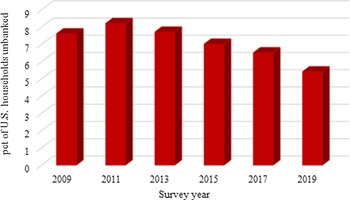
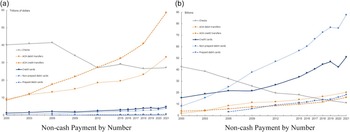


 Open access

