

1. Introduction
Northeast Asia has long been characterised by geopolitical complexities and organisational gaps. In recent years, a crisis-driven approach has been widely used to explain regional cooperation and institution-building efforts in the region. The model of crisis-driven regionalism stems from the critical juncture approach, which originates from the path dependence paradigm of historical institutionalism. This approach emphasises moments of significant change brought about by crises or shocks. During these critical junctures, existing institutional arrangements may become destabilised, opening opportunities for actors to implement new policies or establish institutions with enduring impacts.
Since the 2000s, shared crises have indeed motivated countries in East Asia to adopt cooperative measures in regional institution-building. Notably, the establishment of the ASEAN+3 mechanism in the late 1990s and the launch of the independent China–Japan–Korea (CJK) trilateral summit in 2008 were largely driven by collective efforts to respond to the Asian Financial Crisis (AFC) and the Global Financial Crisis (GFC), respectively. (Calder and Ye, Reference Calder and Ye2010; Beeson, Reference Beeson2011; Jo, Reference Jo2012; Hong, Reference Hong2015; Shin, Reference Shin2015). Additionally, various cross-border challenges – such as environmental protection, natural disasters, and nuclear safety– have encouraged trilateral policy collaboration in these non-traditional security domains. The 2011 East Japan earthquake, in particular, served as a crisis that spurred regular ministerial-level consultations on disaster prevention and relief, as well as policy dialogues on nuclear safety operations (Yoshimatsu, Reference Yoshimatsu2010, Reference Yoshimatsu2016; Cui, Reference Cui2013; Green, Reference Green, Pekkanen, Ravenhill and Foot2014; Zhang, Reference Zhang2018a).
However, this study questions the universal applicability and viability of the crisis-driven approach in explaining Northeast Asia’s institution-building and finds that it may lack academic rigour. Our scepticism originates from two perspectives. First, previous studies supporting crisis-driven regionalism merely focused on crises that incubated regional cooperation in Northeast Asia, while neglecting why certain other types of crises did not. There is a lack of research addressing the necessary conditions that meet the threshold of the crisis-driven approach. Second, given the voluntary nature and non-binding framework of interstate cooperation in Northeast Asia, crises may not always trigger new policy dynamics with the ‘stickiness’ necessary for long-term policy stability and sustainability. A successful critical juncture not only catalyses institution-building during a crisis but also ensures that policy agreements reached during a crisis would not be abandoned once the crisis is resolved. This article addresses the following two questions:
-
1. Why did some crises serve as strong impetuses for regionalism in Northeast Asia, whereas other crises did not? If crises are divided into varying categories, what types of crises are more likely to constitute a historical breakpoint at which states are determined to seek collaboration in Northeast Asia?
-
2. What are the necessary conditions and processes for crises to transform into a well-functioning momentum that can motivate policymakers to transcend geopolitical constraints towards collective actions in Northeast Asia?
Crises do not stimulate regional cooperation directly. Instead, national governments make independent assessments and choices based on their own interests and priorities. By specifying three necessary conditions – pre-crisis activation, in-crisis performance, and post-crisis completion – this study moves beyond simply identifying the presence of a crisis to systematically tracing where and why crisis responses succeed or fail to produce effective regionalism. As an analytical mapping tool, the three-stage framework operationalises the otherwise vague concept of ‘crisis-driven regionalism’ and enables a more precise diagnosis of breakdowns in cooperative processes, particularly in high-tension regions such as Northeast Asia. In doing so, it offers a more rigorous, process-oriented basis for evaluating the prospects of crisis-induced regional cooperation than existing approaches in the literature.
The remainder of this paper is organised as follows. We first endeavour to build on existing critical juncture approaches and develop a more rigorous framework for assessing the applicability and limitations of the model of crisis-driven regionalism in Northeast Asia, a region known for its geopolitical paradox, great power rivalries, and absence of institution-building. The next three sections empirically examine three case studies in Northeast Asia: the GFC, the public health crisis (COVID-19) and the environmental crisis (transboundary air pollution). These three cases are selected for two main reasons. First, the impacts of all three crises have had profound political and economic repercussions, destabilising the status quo in affected countries. The 2008 GFC severely disrupted the three countries’ foreign trade due to declining market demand in the United States. This prompted the three nations to recognise the necessity of diversifying their global trade partners and strengthening intra-regional economic ties in Northeast Asia. COVID-19 has posed a significant challenge to the national governance models of countries around the world. Meanwhile, the issue of transboundary air pollution since the mid-2010s has also had a significant impact on the environmental, economic, industrial, and energy policies of CJK. Environmental pollution has led to public distrust of the government and, to some extent, triggered a legitimacy crisis for the Chinese and Korean governments. (Alkon and Wang, Reference Alkon and Wang2018). Second, all three crises have a transboundary nature that affected all CJK countries. Beyond the 2008 GFC that affected all East Asian states, the latter two endogenous crises share similar origins and transmission mechanisms, beginning in China and subsequently spreading to neighbouring countries. To reassess the viability and limitations of these crises, we collected data from governmental reports and independent international organisations.
2. Critical junctures and crisis-driven regionalism in Northeast Asia: A three-level analysis
2.1 What makes an effective critical juncture? A theoretical review
The critical juncture approach originates from historical institutionalism and highlights that unexpected contingency may help reshuffle political coalitions and interest groups and enable new policies and institutions. It is defined as ‘a period of significant change that typically occurs in distinct ways in different countries and is hypothesised to produce distinct legacies’. (Collier and Collier, Reference Collier and Collier1991: 29) International relations scholars have increasingly employed the critical juncture approach to analyse the evolution of global and regional governance. A critical juncture is normally associated with the instability of international orders or pressing contingencies. Crises and other emergency events call the legitimacy of existing institutional arrangements into question, and therefore reinforce intergovernmental connectedness and help impel the undertaking of a joint interstate response. In this regard, critical junctures act as ‘turning points’ that can be conducive to facilitating international cooperation in moments of contingency (Viola, Reference Viola and Slaughter2019; Johnstone, Reference Johnstone2021). Moreover, crises also stimulate the realignment of domestic social groups and empower political leadership. Political leaders can thus be provided political leverage for manoeuvres, temporarily liberating them from domestic party politics and nationalist antagonism, and display a higher capacity for and more willingness towards international collaboration (Calder and Ye, Reference Calder and Ye2010; Henning, Reference Henning, Miles and Macintyre2013: 174).
However, recent studies have further explored the theoretical logic embedded in a critical juncture and addressed some of the problems and limitations of this approach. Given that crises do not always create windows for change, the deterministic pattern of critical junctures is questionable. Even if institutional changes occur during a crisis, these new institutions may only last through times of contingency and never grow into regularised mechanisms. This study divides the complete critical juncture process into three stages (pre-crisis, in-crisis, post-crisis) and attempts to operationalise the necessary conditions for an effective critical juncture at each stage.
First, the starting point of a critical juncture is an emerging crisis. Being able to identify crises that may potentially activate a critical juncture from those that may not is imperative. Existing studies focus on crisis duration and intensity, arguing that rapid, discontinuous, and macro-level crises are more likely to cause fundamental changes. This is because contingent and significant crises within a relatively short period can lead to the breakdown of the established order in unexpected ways, resulting in political leaders having a greater need to overcome bureaucratic inertia and acquire international assistance (Capoccia and Kelemen, Reference Capoccia and Kelemen2007; Ikenberry, Reference Ikenberry, Fioretos, Falleti and Sheingate2016: 540–541; Collier and Munck, Reference Collier and Munck2022). Moreover, scholars have distinguished the two categories of exogenous and endogenous crises, depending on whether a crisis occurs solely within an agent, state, region, or originates from external shocks. Although the possibility that endogenous path-dependent processes and internal incremental changes activate critical junctures cannot be ruled out, existing institutions may resist internally driven changes because of high compliance costs. In comparison, crises with exogenous origins are more likely to trigger the rebuilding of regional orders and boost regional institutions than those that arise indigenously (Calder and Ye, Reference Calder and Ye2004). Carella and Grazian (Reference Carella and Grazian2022) examined the EU’s stagnating social policy reforms and found that an endogenous critical juncture is less likely to overcome intergovernmental barriers from member states, whereas exogenous crises with higher uncertainties are more suitable for leading to institutional reforms at the EU level.
Second, well-performed critical junctures must promote institutional innovation and substantive policy changes (Calder and Ye, Reference Calder and Ye2010: 40–42; Chin and Stubbs, Reference Chin and Stubbs2011). Crises do not always invoke a critical juncture, as an agent, institution, or state may adhere to their previous path owing to entrenched culture or bureaucratic inertia (Hogan and Doyle, Reference Hogan and Doyle2007; Pierson, Reference Pierson2004). Even if a critical juncture can be triggered, scholars have theoretically identified two types of policy responses: ‘self-reinforcing’ and ‘reactive’ sequences. A ‘self-strengthening’ sequence refers to positive changes designed to address the underlying causes of a crisis. This may involve reforms to existing institutions or institutional productions with wise plans and long-term views. The aim of a ‘self-strengthening’ sequence is to learn lessons from the present crisis and strengthen the capacity of society or the system to cope with future challenges. A critical juncture can proceed effectively when self-reinforcing sequences build resilience and deliver continuous ‘increasing returns’, in which emerging institutional arrangements exhibit cumulative advantages and success breeds further success. By contrast, a ‘reactive sequence’ refers to temporal policy reactions designed to restore the pre-crisis order. It may not address the root causes of crises or seek institutional innovation from a long-term perspective. The outcome of ‘reactive sequences’ can be unstable, as decision-makers may seek out policy backlash once ongoing crises are over. Hence, in-crisis policy responses need to be scrutinised, and the activation of ‘self-reinforcing’ measures is preferred for effective critical junctures (Mahoney, Reference Mahoney2001; Collier and Munck, Reference Collier and Munck2017; Viola, Reference Viola and Slaughter2019; Johnstone, Reference Johnstone2021).
The last factor is the aftermath legacy of critical junctures in post-crisis periods. In this context, ‘legacy’ refers to ‘an enduring, self-perpetuating institutional inheritance of a critical juncture that persists and is stable for a substantial period’ (Collier and Munck, Reference Collier and Munck2017: 6). Well-established critical junctures not only help ease structural constraints during a crisis but also produce outcomes that can be reproduced after the juncture comes to a close (Soifer, Reference Soifer2012: 1573). Thus, the reproduction mechanism has been highlighted as crucial after critical junctures are completed, as they help to ensure that institutional innovations during the crises do not erode in the post-crisis period (Hogen, Reference Hogan2006; Capoccia and Kelemen, Reference Capoccia and Kelemen2007; Soifer, Reference Soifer2012; Collier and Munck, Reference Collier and Munck2022). Therefore, a path dependence can be established between ongoing and prospective crises, as policymakers proceed with self-perpetuating institutional inheritance and enhance their risk prevention capacity. Absent from such policy sustainability and consistency in post-crisis stages, policymakers may seek to reverse efforts and return to initial antecedents before the advent of crises, such that institutional transformations and innovations made during crises may be eclipsed (Mahoney, Reference Mahoney2000; Bell and Fung, Reference Bell and Feng2021).
2.2 Crisis-driven regionalism in Northeast Asia: Identify the crisis, state responses, and legacies
This section connects critical juncture theory to the geopolitical reality of Northeast Asia, a region known for its geopolitical paradox, great power rivalries, and absence of institution-building. This research specifies three variables for the viability of crisis-driven regionalism in Northeast Asia across the pre-crisis, in-crisis, and post-crisis phases.
First, both the origin of the crisis and those who bear responsibility for causing it need to be identified, and exogenous crises that bring symmetrical political, economic, or social shocks to recipient states are more likely to trigger critical junctures than endogenous crises in Northeast Asia. As East Asian regionalism proceeds in the wake of exogenous financial crises and inadequate extra-regional responses, states must seek cooperation with their regional neighbours. This explains how the AFC in 1997 catalysed regionalist efforts in East Asia (Beeson, Reference Beeson2011; Yoshimatsu, Reference Yoshimatsu2014). By contrast, when a crisis takes root within a region, and responses from global institutions are aligned with East Asian preferences, regional institution-building is less likely to be accelerated (Henning, Reference Henning, Miles and Macintyre2013). Endogenous crises that occur within this region may be less likely to trigger joint actions, as they may ignite heated disputes over who is responsible for the crisis and lead to buck-passing situations. CJK trilateral cooperation has grown as a sub-regional product under the auspices of the ASEAN+3 framework. These three countries have extended the ASEAN Way (consensus-making, informality, consultation, and non-intervention) as a shared norm for regional engagement and cooperation in Northeast Asia (Zhang, Reference Zhang2018a). Given that CJK retains a long tradition of statism and safeguards for national sovereignty, crisis-producing states may be reluctant to cooperate with regional counterparts, as such gestures may trap them into a diplomatically passive and inferior status. Moreover, they may even reject information-sharing with crisis-hit states to evade crisis responsibilities, and further reinforce non-intervention principles to justify their non-cooperative stance.
The second variable concerns the state’s policy response to collective action. An effective critical juncture does not produce merely temporary reactive sequences aimed at short-term crisis management; rather, it facilitates self-reinforcing sequences in which states collaborate to transform exogenous crises into opportunities for economic and social development. This study distinguishes two forms of joint responses to common crises: collective action and coordinated effort. Collective action entails shared agendas, formal agreements, and joint policies implemented through regional institutions, reflecting a higher level of political commitment and a greater potential to initiate self-reinforcing dynamics. In contrast, coordinated effort refers to separate national approaches lacking shared plans or binding agreements, where regionalism is limited to minimal communication and loose coordination. In such cases, unstable reactive sequences are more likely, as states prioritise national autonomy and often exhibit fragmented responses, aiming to restore the pre-crisis status quo once recovery is underway. Thus, while common exogenous shocks may prompt the emergence of policy exchange frameworks and cooperative mechanisms, they do not necessarily result in genuine collective action. When a shared crisis leads only to policy dialogue and diplomatic engagement without deeper institutionalisation, its transformative potential remains limited. These efforts risk being dismissed as mere ‘talk shops’, lacking enforceability and binding commitments (Haggard, Reference Haggard, Miles and Macintyre2013: 211–212).
The final variable is the legacy of the critical juncture in the post-crisis period. While state actors establish multilateral and regional institutions during crises, they tend to be slow and selective in granting these institutions authority for problem-solving in subsequent periods. Therefore, for crisis-driven regionalism to be effective, it is crucial to assess whether the nascent regional institutions and collaborative arrangements formed during the previous crisis have been effectively utilised in addressing similar future crises. This requires strong policy consistency and continuity from policymakers in the post-crisis period; otherwise, these institutional innovations may prove short-lived and dissipate once states recover from the crisis. For instance, Pemple (2008) illustrated that the Chiang Mai Initiative (CMI) provided an unsuccessful case due to invisible post-crisis policy legacies. Although it was established as a key outcome of financial cooperation during the AFC in the early 2000s, the CMI was not properly used when Indonesia and Thailand suffered currency crashes in the late 2000s.
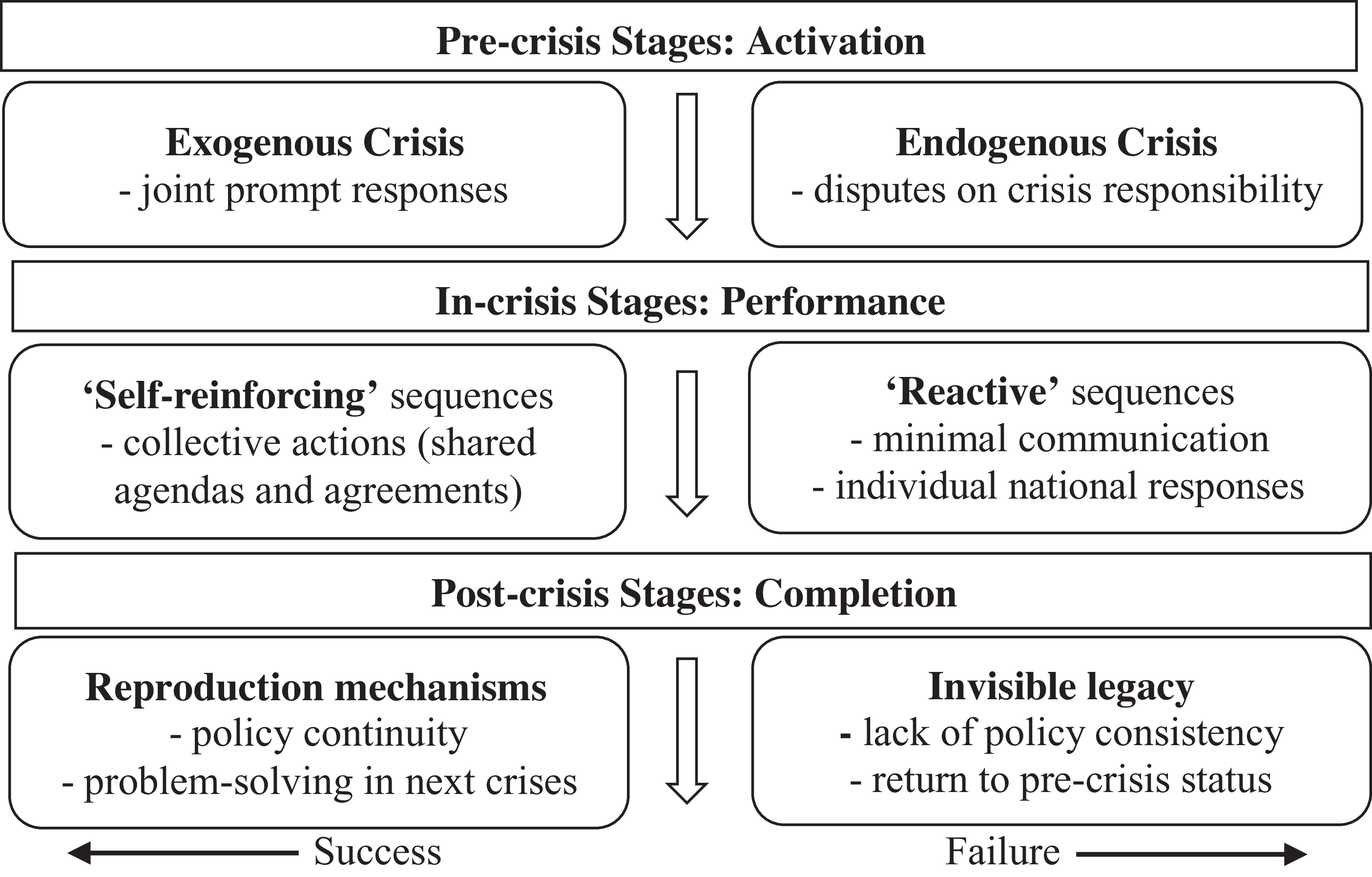
Building on these three variables (Figure 1), this study further selects three recent financial, environmental and public health crises in Northeast Asia – the GFC, transboundary air pollution and the COVID-19 pandemic – for empirical analysis.
Variables influencing the effectiveness of crisis-driven regionalism in Northeast Asia.
Sources: compiled by the author.
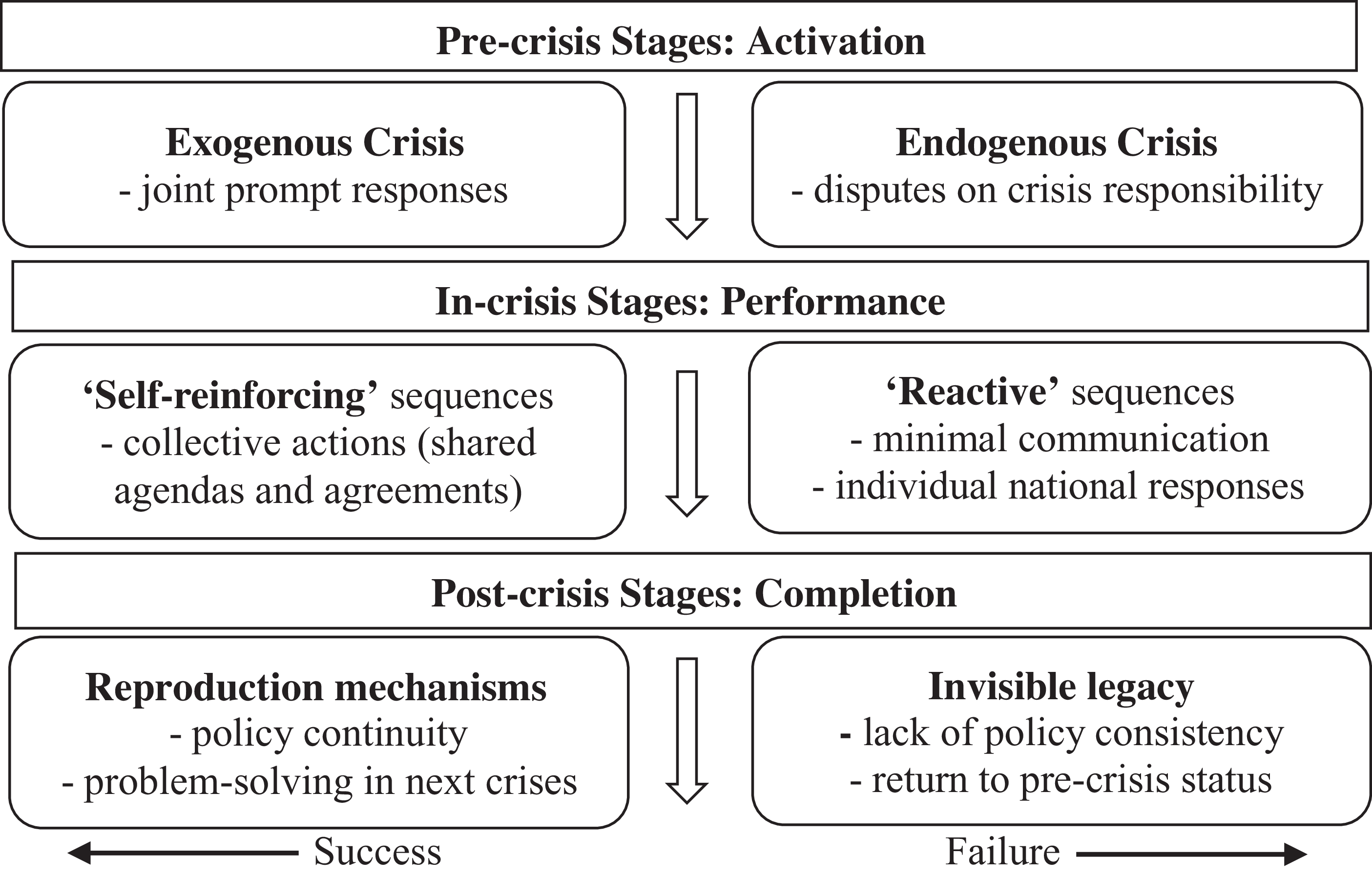
Figure 1 Long description
The flowchart depicts the stages of crisis-driven regionalism in Northeast Asia. It begins with the pre-crisis stages labeled as Activation, which includes Exogenous Crisis with joint prompt responses and Endogenous Crisis with disputes on crisis responsibility. The in-crisis stages are labeled as Performance, featuring 'Self-reinforcing' sequences with collective actions such as shared agendas and agreements, and 'Reactive' sequences with minimal communication and individual national responses. The post-crisis stages are labeled as Completion, which includes Reproduction mechanisms with policy continuity and problem-solving in next crises, and Invisible legacy with lack of policy consistency and return to pre-crisis status. The flowchart indicates success or failure based on the outcomes of these stages.
3 Revisiting the late-2000s global financial crisis: Catalysts for regionalism
3.1 Identifying the crisis: How did it fuel regional institution building
In contrast to the AFC of the late 1990s, the GFC triggered by the Lehman Shock in 2008 did not inflict significant damage on the financial sectors of CJK. However, the economic turmoil originating in the United States severely disrupted the three countries’ export-driven economies by sharply reducing external demand (Oba, Reference Oba and Pempel2013: 113). As a result, Korea’s economic growth dropped from 5% in 2007 to 2.5% in 2008. China, while still maintaining a relatively strong performance, saw a slowdown from 13% in 2007 to 9% in 2008. Japan experienced a similar downturn, with its growth rate falling from 2.4% to just 0.6% over the same period.
Against this backdrop, the inaugural trilateral summit diplomacy in 2008 can be interpreted as a politically motivated development shaped by a convergence of international pressures. Iida (Reference Iida and Pempel2013: 177–179) documented unexpected incidents and various subsequent diplomatic efforts by which the three countries set aside historical and territorial disputes before the summit, ultimately reaching a political consensus to convene the first independent trilateral summit in December 2008. Prior to the initially planned summit in September 2008, a series of unforeseen developments complicated the diplomatic landscape. Tensions escalated when Japan’s Ministry of Education moved to include mandatory content on the Takeshima/Dokdo territorial dispute in its forthcoming middle school curriculum guidelines. This sparked strong public backlash in Korea, ultimately derailing President Lee Myung-bak’s scheduled visit to Japan. Compounding the issue, Japanese Prime Minister Fukuda Yasuo’s sudden resignation in the same month introduced additional uncertainty, resulting in the postponement of the summit. Amid these delays, the outbreak of the GFC served as a pivotal turning point that redirected the diplomatic focus of the three countries. The bankruptcy of Lehman Brothers in September 2008 revived Korea’s painful memories of the 1997 AFC, prompting a shift toward more pragmatic and cooperative engagement. Capitalising on this moment, President Lee Myung-bak proposed an emergency trilateral finance ministers’ meeting, which helped restore momentum and ultimately led to the scheduling of the December summit meeting. Therefore, alongside the alignment of leadership willing to advance trilateralism, the external shock of the GFC served as a catalyst for overcoming bilateral diplomatic stalemates and initiating a new phase of substantive regional cooperation (Zhang, Reference Zhang2025: 79–81).
3.2 In-crisis responses: The inauguration of trilateral cooperation mechanisms and CJKFTA
Moreover, our claim regarding this critical juncture’s success is not only based on the initiation of trilateral summit diplomacy amid external exigency, but more significantly, in the subsequent development of new institutional mechanisms and the execution of collective actions. During the past 25 years of trilateral cooperation (1999–2025), the years surrounding the GFC (2008–2012) are considered a true honeymoon for trilateral diplomacy (Zhang, Reference Zhang2025: 81). The GFC prompted CJK to reassess the limitations of existing regional cooperation frameworks, motivating policymakers to jointly pursue the creation of various self-reinforcing politico-economic mechanisms. These institutional innovations and collective actions were primarily manifested in two key developments: the institutionalisation of trilateral summit diplomacy and the initiation of CJKFTA negotiations.
Trilateral cooperation at the governmental level originally began in 1999, when the three countries held their first summit on the sidelines of the ASEAN+3 framework. However, it was not until 2008 that they established independent and regular trilateral summits, hosted in rotation among the three nations. The first trilateral summit in 2008 produced several outcomes, including the Joint Statement for Tripartite Partnership and the Action Plan for Promoting Trilateral Cooperation, supplemented by two annexes on disaster management and international financial and economic issues.
Moreover, the GFC functioned as a critical juncture that accelerated progress toward the CJKFTA. From a macroeconomic standpoint, a CJK FTA would yield gains for all three economies. Yet the path toward establishing such an arrangement has been marked by considerable hesitation and discontinuity. Since the early 2000s, China has been the primary advocate of promoting a trilateral FTA, whereas Japan adopted a far more cautious position. Tokyo’s reluctance prevented the tripartite joint study – originally conducted among non-governmental experts – from advancing to formal intergovernmental negotiations. This hesitation stemmed from Japan’s strategic dilemma: it sought to deepen economic interdependence with China while simultaneously worrying about intensifying geopolitical rivalry and Beijing’s growing regional influence. As a result, despite seven years of collaborative research and multiple policy assessments outlining prospective benefits and costs, little tangible progress was achieved in the CJK FTA joint studies between 2002 and 2009. A significant shift toward deeper trilateral trade liberalisation occurred only at the end of the 2000s. Once western economies slipped into stagnation, the resulting decline in external demand exposed the structural vulnerability of CJK’s export-oriented economies. The three countries thus recognised the need to reduce their heavy reliance on exports to the United States and Europe and to diversify their trade partnerships. In response, the pursuit of a CJKFTA emerged as a widely supported policy option aimed at enhancing intraregional trade resilience and reducing external dependency. Against this backdrop, the three countries undertook substantive collective action by elevating the previously non-governmental CJKFTA joint study to an official, government-led initiative. This upgraded framework, launched at the second standalone trilateral summit in 2009, brought together scholars, business leaders, and government representatives to formally advance discussions on the proposed free trade agreement. The government-led joint study commenced in 2010 with an initial two-year timeline. At the fourth standalone summit in May 2011, the leaders further agreed to expedite the process and conclude the study by the end of that year, paving the way for the formal launch of the CJKFTA negotiations in 2012.
3.3 CJK trilateral cooperation in post-GFC periods: Institutional legacies and limitations
We adopt a dichotomous approach to evaluate the lasting legacies and sustainable policy outcomes generated by critical junctures in the post-GFC period. A pivotal development in this regard was the establishment of the Trilateral Cooperation Secretariat (TCS) in 2011 – the first intergovernmental organisation jointly founded by CJK. The TCS constituted an enduring institutional legacy of the GFC, while also marking a significant advance in regional institution-building by addressing the long-standing organisational gap in Northeast Asia. Since 2012, tensions in Sino-Japanese and Sino-Korean relations – stemming from territorial disputes, historical controversies, and the deployment of the Terminal High Altitude Area Defense (THAAD) system – have led to a deterioration in diplomatic ties. As a result, the CJK summit diplomacy has experienced significant stagnation. In this context, the TCS has played a vital role in maintaining policy continuity and facilitating working-level consultation and collaboration among the three countries. Despite the overall decline in trilateral political relations, the TCS has remained committed to supporting the cooperative framework by providing administrative coordination, intellectual support, and think-tank-style services to the three governments (Shin, Reference Shin2015; Zhang, Reference Zhang2018b).
On the other hand, post-crisis progress on the CJKFTA has been far less encouraging, as trade negotiations have been repeatedly disrupted by geopolitical tensions among CJK. These tensions include the Sino-Japanese historical and territorial disputes in 2012–2013, the THAAD-related conflict between China and South Korea in 2016–2017, and the Japan–South Korea trade dispute in 2018–2019. As a result, CJKFTA negotiations have suffered repeated delays and have yielded few tangible outcomes in recent years (Zhang, Reference Zhang2019). Along with economic recovery from the GFC, the three countries strived for tighter connections with economic globalisation rather than prioritising trade partnerships with each other (Beeson, Reference Beeson2011; Katada Reference Katada2011). This indicates that, although the GFC persuaded the three countries to prepare for trade negotiations, it could not guarantee an early conclusion of the negotiations in the post-crisis period. Alternatively, in the aftermath of the GFC, the Regional Comprehensive Economic Partnership (RCEP), with its broader geographical scope, gradually supplanted the CJKFTA as the principal mechanism through which East Asian economies pursued deeper regional trade arrangements and sustained growth. Although the conclusion of RCEP negotiations in the early 2020s has, in effect, brought CJK into a multilateral FTA with broader membership, the three countries have yet to resume CJKFTA negotiations with the higher aim of achieving greater economic liberalisation than the RCEP terms or to jointly announce any agenda or timeline for future talks.
4 Transboundary air pollution and environmental crises
4.1 Identifying the crisis: Source–receptor relationships and disputes over pollution responsibilities
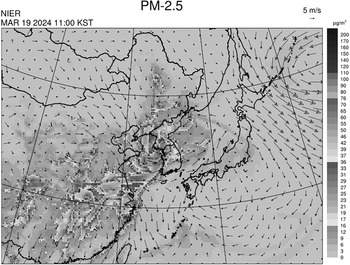
Among all categories of transboundary pollutants in Northeast Asia, particulate matter (PM), including both PM 2.5 and PM 10, generally known as ‘fine dust’, has posed the most serious environmental challenge for this region in recent years. Fine dust pollution in China reached its peak in the mid-to-late 2010s, and has since been steadily alleviated by the Chinese government’s various stringent environmental, energy, and industrial policies. Meanwhile, fine dust pollution has become a widespread issue in Korea and western Japan, where PM pollutants originate from local sources and travel from northern China. In particular, the Korean Peninsula is located downwind of the prevailing air currents over China, and thus appears to be the most severely affected country (Figure 2).
Real-time transmission of transboundary PM pollutants in Northeast Asia (19 March 2024).
Source: Air Korea (2024).
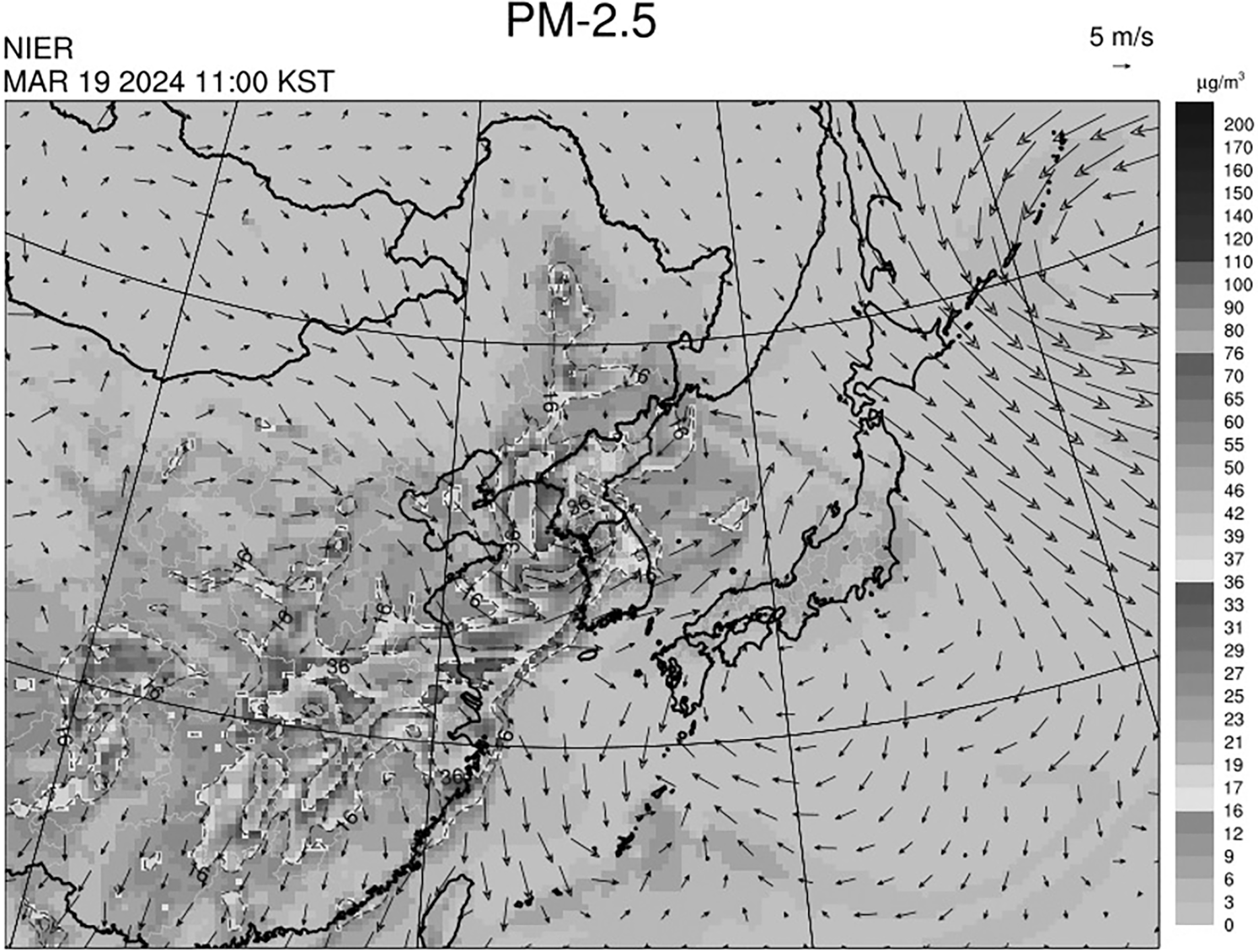
Figure 2 Long description
A heat map titled 'PM-2.5' displays real-time transmission of transboundary particulate matter pollutants in Northeast Asia on March 19, 2024, at 11:00 KST. The map uses a grayscale color gradient to indicate PM-2.5 concentration levels, ranging from 0 to 200 micrograms per cubic meter. Darker areas represent higher concentrations, while lighter areas indicate lower concentrations. Wind vectors are overlaid on the map, showing the direction and speed of wind flow at 5 meters per second. Notable regions with higher PM-2.5 levels are visible in central and eastern parts of the map, with specific values labeled, such as 76 and 61. The map provides a visual representation of air pollution distribution and its transboundary movement across Northeast Asia.
A substantial literature stream has addressed the underdevelopment of regional environmental governance in Northeast Asia, such as the lack of binding environmental agreements among states, weak regional environmental organisations with professional capacity and operational independence, and the absence of a solid scientific community that fosters independent environmental research institutes (Nagy, Reference Nagy2013; Kim, Reference Kim2007; Komori, Reference Komori2010; Lee, Reference Lee2019; Yarime and Li, Reference Yarime and Li2018). Unlike other cross-border environmental risks (e.g. global warming, marine plastic waste, yellow sand, and acid rain) whose sources and diffusion paths are easy to track, environmental experts are confronted with technological barriers in identifying PM origins and diffusion paths. In 2019, the environmental ministries of CJK jointly released a tripartite Long-range Transboundary Pollutants (LTP) report, claiming that China was responsible for 32.1% and 24.6% of the annual PM concentrations in Korea and Japan, respectively (Secretariat of Working Group for LTP Secretariat, 2019). However, the publicisation of government-led joint research did not help mitigate the heated debates over pollution responsibilities, owing to conflicting interpretations of the research outcomes, with China on one side and Japan and Korea on the other. The Chinese government highlights annual PM concentration as the most crucial criterion for measuring pollution responsibilities and thus argues that most PM pollutants in Korea and Japan come from local sources. By contrast, Korean experts suggest the number of ‘heavy pollution days’ (PM2.5 > 75 μg/m3) per year as a key index for monitoring air pollution, and its local emission does not normally reach a high level that may bring harm to people’s health (Zhang, Reference Zhang2024). Although China is responsible for only 32% of Korea’s fine dust pollution as per the annual concentration standard, Korea still blames China as the main ‘polluter’ for Korea’s air quality, responsible for approximately 70% on ‘heavy pollution days’, especially during the winter season (Yonhap News, 2019).
Thus, the scientific ambiguity of the source-receptor (S-R) relationship is considered one of the most decisive factors hindering environmental cooperation among the CJK (Shapiro, Reference Shapiro2019). Moreover, endless debates and ‘buck-passing’ on pollution responsibilities have invoked the politicisation of environmental science (Asuka, Reference Asuka2020; Park, Reference Park2019: 28; Shapiro and Yarime, Reference Shapiro and Yarime2021). Korea and Japan have fallen into a highly disadvantageous position when engaging and negotiating with China, as they can hardly pressurise China, owing to the lack of convincing scientific evidence, unbalanced national power, and asymmetric domestic motivations in resolving the air pollution issue (Lee and Paik, Reference Lee and Paik2020; Zhang, Reference Zhang2023). China has consistently resisted acknowledging itself as a main polluter for fine dust in Korea and Japan, and further interprets their peer pressure as an intervention in China’s domestic affairs.
4.2 In-crisis responses: Regional efforts and lack of joint actions
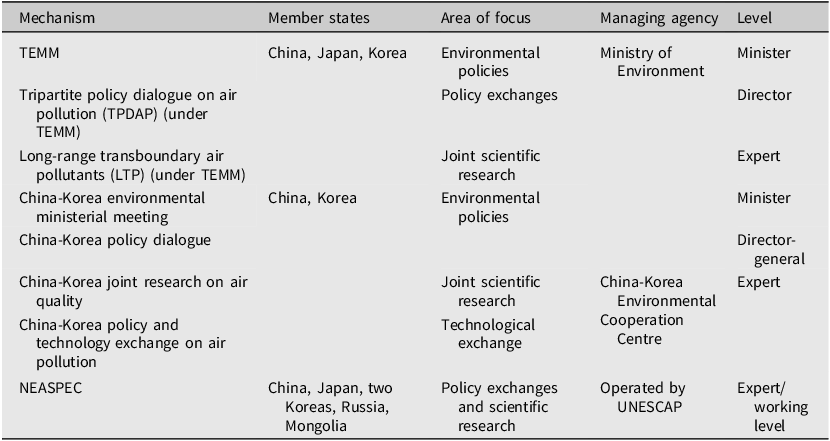
Currently, the atmospheric cooperation frameworks in Northeast Asia coexist in three layers. First, located in Incheon in Korea, the North-East Asian Sub-regional Programme for Environmental Cooperation (NEASPEC) holds the status of an international organisation and has launched the ‘Northeast Asia Clean Air Partnership’ project that primarily focuses on PM2.5 and PM10 on both scientific and policy tracks since 2015. Second, the Trilateral Environmental Minister Meeting (TEMM) is a ministerial-level environmental mechanism that CJK holds on an annual basis. TEMM covers a wide range of subfields, including e-waste, water pollution, sandstorms, maritime pollution, and air pollution. At the 17th TEMM in 2015, three countries highlighted ‘air quality improvement’ as the top priority among nine pivotal areas. Third, China and Korea, standing as key ‘polluting’ and ‘polluted’ countries in this region, have engaged in various bilateral environmental negotiations. In comparison with regional and trilateral environmental frameworks, China–Korea bilateral atmospheric cooperation appears to be more tangible (Zhang, Reference Zhang2023). In early 2015, the two countries began to conduct joint research on air quality. In subsequent years, both governments agreed on the Korea-China Environmental Cooperation Plan 2018–2022 and jointly carried out the ‘blue sky plan’ with scientific, industrial, and technological arms. Since 2018, specific cooperative networks have included the inauguration of the Korea-China Environmental Cooperation Centre in Beijing, the launch of the Korea-China Cooperation Initiative for the Demonstration of Environmental Technologies for Fine Dust Reduction, and an agreement on the Korea-China Policy and Technology Exchange on Air Pollution (Table 1).
Environmental frameworks on transboundary fine dust in Northeast Asia
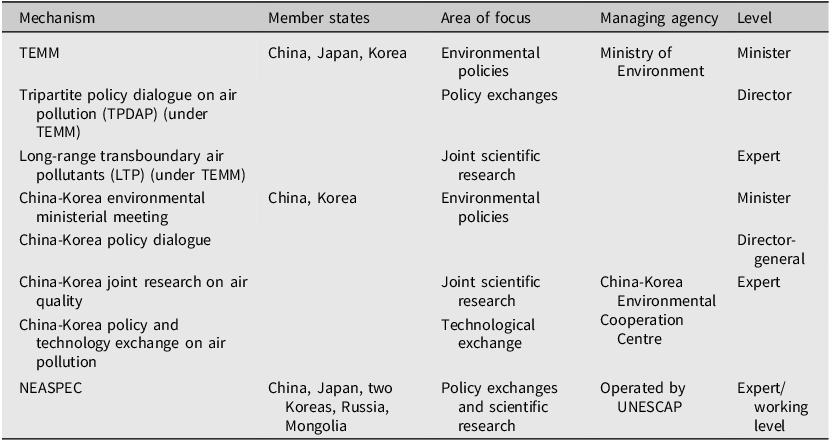
Table 1 Long description
The table compares atmospheric cooperation frameworks in Northeast Asia, detailing mechanisms, member states, areas of focus, managing agencies, and levels. It includes five columns: Mechanism, Member states, Area of focus, Managing agency, and Level. The table has eight rows, each representing different cooperation mechanisms. The mechanisms listed are TEMM, Tripartite policy dialogue on air pollution (TPDAP) under TEMM, Long-range transboundary air pollutants (LTP) under TEMM, China-Korea environmental ministerial meeting, China-Korea policy dialogue, China-Korea joint research on air quality, China-Korea policy and technology exchange on air pollution, and NEASPEC. Member states include China, Japan, Korea, and additional countries for NEASPEC. Areas of focus range from environmental policies to policy exchanges, joint scientific research, and technological exchange. Managing agencies vary, including the Ministry of Environment, Director, Expert, and China-Korea Environmental Cooperation Centre. Levels range from Minister to Director-general to Expert and Expert/working level.
Source: Summarised and compiled by the author.
However, without denying the encouraging progress of transboundary atmospheric cooperation, these bilateral, trilateral, and regional efforts have not been transformed into valid collective actions. In the environmental field, a critical juncture is only considered ‘effective’ if polluting and polluted countries can jointly develop win–win ‘self-reinforcing’ sequences, such as conducting scientific joint research, engaging in technological and industrial exchanges, reaching binding agreements, and adopting common agendas. By contrast, cooperative measures for transboundary air pollution remain in a preliminary stage, as CJK has merely responded to common atmospheric crises via separate domestic approaches without shared plans.
The first barrier is the application of different scientific standards to measure fine dust pollution. Japan and Korea have adopted the National Ambient Air Quality standard and recognise days of 24-hour PM 2.5 concentration beyond 35 μg/m3 as ‘pollution days’, which is much lower than the standards in China (75 μg/m3). The use of varying standards may thus lead to asymmetric policy motivations among the three countries, as Japan and Korea may continue to expect China’s domestic PM reduction while China is already satisfied once daily PM concentration in average drops to less than 75 μg/m3. Moreover, the three countries have each adopted their own national emission inventories with different modelling methodologies and monitoring standards, which creates problems for scientific comparability and compatibility, as well as the accuracy and reliability of each country’s data (Secretariat of Working Group for LTP Secretariat, 2019).
The second weakness of the existing cooperation is its technological and industrial aspects. Since the late 2010s, Korea has hoped to provide China with integrated technologies on dust control and desulphurisation via the ‘blue sky plan’, in exchange for gaining expanded market entry for Korea’s environment-related industries in China (Korea Ministry of Environment, 2018). However, China now appears to be more interested in collaborating with European countries, which possess more advanced environmental technologies than Korea. For this reason, the model of the ‘market for technology’ between China and Korea has been restricted to paper and has not yet materialised as tangible cooperative outcomes (Chu, Reference Chu2022).
The final obstacle to atmospheric cooperation in Northeast Asia is the absence of binding environmental agreements. Non-binding and volunteer-based principles of environmental cooperation in Northeast Asia starkly contrast with instructive European experiences in the 1970s and 1980s, when the United Nations Economic Commission for Europe adopted the Convention on Long-range Transboundary Air Pollution with binding agreements and the principle of ‘common but differentiated responsibilities’ (Yarime and Li, Reference Yarime and Li2018). In 2019, TEMM released an ‘Air Quality Policy Report’, which reviewed progress on CJK trilateral atmospheric cooperation. Although it only covers the three countries’ domestic environmental policies and legal regulations for PM reduction, common environmental agendas or shared timetables among CJK remain invisible in this report (Japan Ministry of Environment, 2019).
Admittedly, air quality in Northeast Asia has steadily improved in recent years. However, such achievements are mainly attributable to each state’s stringent domestic environmental policies, rather than effective regional collaboration. The Korean government has focused on industrial sectors and shut down many coal-fired power plants (Jung, Reference Jung2019). It released the ‘Comprehensive Plan on Fine Dust Management’ in 2019, which aimed to reduce PM emissions by 35.8% by 2022 from the level of 2014. President Moon Jae-in also launched the National Council on Climate and Air Quality in April 2019 and appointed former United Nations Secretary-General Ban Ki-moon as the chairperson. Meanwhile, China adopted rigorous environmental standards on air quality and announced the ‘Air Pollution Prevention and Control Action Plan’ in 2013, targeting various industrial, economic, technological, and legal reforms (Jin et al., Reference Jin, Andersson and Zhang2016). In 2018, the average PM2.5 concentration in 74 major cities fell by 42%, as per the 2013 criteria (Japan Ministry of Environment, 2019). In this regard, Korea and Japan have been unable to urge China towards binding environmental agreements and collective actions, but rather merely expect the ‘positive externality’ from China’s recent domestic environmental achievements, so that transboundary fine dust transmission can be reduced accordingly (Lee and Paik, Reference Lee and Paik2020).
4.3 Weakening linkages in post-crisis periods
Along with CJK’s respective domestic efforts and improvements in air quality since the late 2010s, the three countries have seemingly lost momentum in sustaining environmental collaborations in post-crisis periods. One example is China’s shift in attitude towards the public release of LTP research reports. Although China agreed to publicise the fourth stage (2013–2017) of the LTP project report in 2019 owing to peer pressure from Japan and Korea, it did not expect the research results (i.e. a scientific conclusion on China’s 32% contribution to Korea’s fine dust pollution) to lead to public criticism of China’s pollution responsibilities. Since then, China has adopted a conservative stance and refused to publicise follow-up research reports in subsequent years (Zhang, Reference Zhang2023). This indicates a reversing effect in which China is reluctant to see the continuation and reproduction of environmental frameworks in post-crisis periods, but rather prefers to return to pre-crisis status once it has gradually recovered from the atmospheric shock.
Moreover, the ‘legacy’ of critical junctures implies that common crises can help alter states’ behaviours and urge them towards international collaboration to cope with future risks. Since the spring of 2021, severe sandstorms have plagued northern China and spread to nearby regions, with yellow dust particles affecting air quality from Korea to Japan. When dust arrives, it brings industrial pollutants and even heavy metals, posing considerable health risks and damaging crops and soil. Beyond the existing Tripartite Policy Dialogue on Air Pollution and Tripartite Director-General Meetings on Dust and Sand Storms, the three countries agreed to incorporate Mongolia into their joint research at the 24th TEMM in November 2023 (Korea Ministry of Environment, 2023). In the China–Korea bilateral domain, efforts have been made in terms of joint monitoring, real-time data-sharing, and Korea has planted trees along China’s northern border to halt the desert’s expansion.
Regardless of ongoing progress, Sino–Korean environmental engagements regarding dust storms appear to mirror the past fluctuations in fine dust cooperation. Quarrels over the origin of dust storm pollutants continue to hinder cooperation. Korean experts see that the Gobi Desert in southern Mongolia and northern China has contributed approximately 80% of the sandstorms, while northeastern China has also contributed approximately 18% (Korean Environment Institutes, 2021). Extending Korea’s viewpoint, despite Mongolia being the main polluter, China should also be partially responsible for sandstorms caused by deforestation, desertification, and higher regional temperatures in northern China (South China Morning Post, 2024). By contrast, the Chinese government has refuted the blame from Korean experts and media reports. The Chinese foreign ministry insisted that the sandstorm did not originate in China, and China is just a country that the dust ‘passed through’ (China Ministry of Foreign Affairs, 2021). In addition, full-blown scientific collaboration remains unestablished at present. Despite China and Korea utilising the China-Korea Environmental Cooperation Centre for joint research on dust storms, Korean experts have been dissatisfied with China’s predominance role in setting the research agenda and scientific standards and complained about the loss of environmental leadership vis-à-vis China (Asia Economy, 2023). Thus, despite CJK taking the opportunity provided by transboundary fine dust pollution to establish multilayered frameworks on scientific research and policy exchanges, the yellow dust storm pollution that emerged in 2021 has exposed that cooperative environmentalism remains absent in this region. The unpleasant history of the politicisation of environmental issues has repeated itself, and the three countries have again fallen into dispute on pollution responsibilities and struggled to collaborate through collective actions.
5 COVID-19 challenges and policy responses to the pandemic
5.1 Identifying the crisis: Lack of transparency and concerns over responsibility
Early in 2007, the health ministries of CJK agreed on ‘rapid information sharing, epidemiological investigation, vaccine development, joint simulation exercise and more to pursue influenza-free triangle among the three countries’ by signing a Memorandum of Cooperation for a Joint Response against Pandemic Influenza (Korea Ministry of Foreign Affairs, 2007). In the following years, the three governments further emphasised the need for close cooperation to tackle infectious diseases, given the geographical proximity and rising traffic volume of people and goods moving among them. Against this backdrop, the three health ministries jointly recognised pandemic influenza as a top public health concern and adopted an Action Plan on Joint Preparedness and Response against Pandemic Influenza and Emerging/Re-emerging Infectious Diseases of Common Concern in 2016 (Oh, Reference Oh2022). Based on these agreements, they agreed to conduct joint research projects, emergency contact points, expert and professional exchanges, media-related activities, and table-top exercises.
Despite previous agreements to jointly fight infectious diseases, trilateral efforts towards COVID-19-related information and data-sharing were largely insufficient. Since the initial outbreak of COVID-19, scientists and health organisations worldwide have requested that China provide specific information on COVID-19 (Latinne et al., Reference Latinne, Hu, Olival, Zhu, Zhang, Li, Chmura, Field, Zambrana-Torrelio, Epstein, Li, Zhang, Wang, Shi and Daszak2020; Worobey et al., Reference Worobey, Levy, Malpica Serrano, Crits-Christoph, Pekar, Goldstein, Rasmussen, Kraemer, Newman, Koopmans, Suchard, Wertheim, Lemey, Robertson, Garry, Holmes, Rambaut and Andersen2022). The key objective was to seek greater clarity regarding the origin, timing, and transmission route of COVID-19 (Thakur et al., Reference Thakur, Bhola, Thakur, Patel, Kulshrestha, Ratho and Kumar2022). The World Health Organisation (WHO) also declared identifying the origins of the pandemic to be a priority, as this information was essential for understanding how the pandemic started and spread (WHO, 2021). However, China refused to hold state responsibility for the spread of the pandemic and refuted the ‘lab leak’ conspiracy theory regarding the origins of the virus. China was neither transparent with its own COVID-19 information nor cooperative with international epidemiological research efforts (Associated Press, 2022). In April 2020, China imposed restrictions on publishing academic research on the novel coronavirus. Investigations into the origin of COVID-19 would receive additional scrutiny and require approval from Beijing (CNN, 2020). In July 2021, a director of the Wuhan Institute of Virology (WIV) told reporters not to share the WIV database because of concerns about cyberattacks (Reuters, 2021). These restrictions not only banned relevant publications but also caused considerable disruption to ongoing research (Foreign Policy, 2021). In fact, data on swab samples from the Huanan live-animal market were finally released on 4 March 2023, three years after the outbreak of the pandemic.
Against this backdrop, CJK health ministries have not engaged in meaningful discussions on real-time information exchange regarding viral infection, with insufficient information-sharing being a key factor leading to the absence of timely joint actions. In comparison, ASEAN countries had a far better record of transparency and promptness in the early stages of COVID-19 collaboration. ASEAN countries held their first meeting on 3 February 2020 and jointly responded to contain the spread of COVID-19 in the region (Arnakim and Kibtiah, Reference Arnakim and Kibtiah2021). However, CJK did not engage in any joint efforts or virtual meetings to respond to COVID-19 until 15 May 2020. Although the three governments signed a joint emergency statement on COVID-19, the agreement was superficial and did not contain action plans or collaborative measures (TCS, 2020). Thus, trilateral health cooperation before the critical juncture was extremely limited, owing to China’s relatively uncooperative and defensive stance towards Japan and Korea and its concerns over responsibility for the dispersion to neighbouring countries.
5.2 In-crisis responses: Empty promises for cooperation
In March 2020, WHO declared COVID-19 a health emergency and a global pandemic that required global responses and coordination mechanisms for affected states and institutions. However, CJK responded to COVID-19 using varying approaches with no effective collective actions among the three countries in either the scientific or public health fields during critical junctures (East Asia Forum, 2022). These countries have been hindered from achieving tangible cooperative outcomes.
First, during the early stages of the COVID-19 pandemic, East Asian countries, including CJK, responded relatively well in tackling the COVID-19 pandemic (Wang et al., Reference Wang, Shi, Zhang, Chen, Jiao, yang and Sun2022). According to a COVID-19 tracker document from Johns Hopkins University, the East Asia region flattened the COVID-19 outbreak curve during the first and second years of the pandemic, while the rest of the world struggled to fight COVID-19 (Tashiro et al., Reference Tashiro and Shaw2020; Zhang et al., Reference Zhang, Wang, Chang, Wang, Xu, Yu, Tsamlag, Dong, Wang and Cai2020; Lee et al., Reference Lee, Heo, Seo, Ahn, Jung, Lee and Choi2021). Owing to this relative early success, these three countries had weaker incentives to pursue coordinated or joint responses to the pandemic.
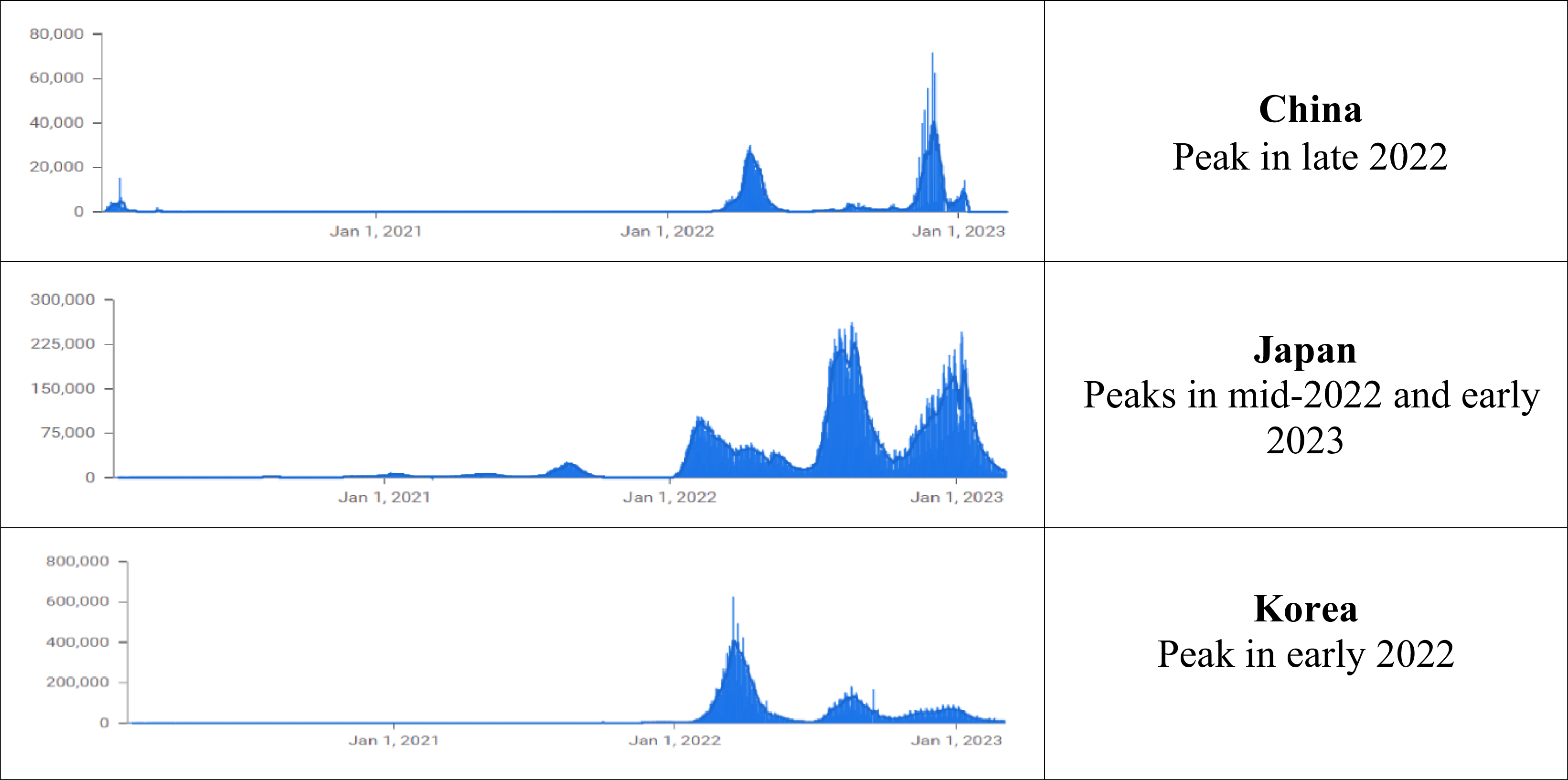
Second, the COVID-19 peak occurred at different times across the three countries despite their geographical proximity. China reached its peak in December 2022. In Japan, the first peak occurred in mid-2021, while the second and third peaks occurred in July 2022 and January 2023, respectively. The highest peak in Korea occurred in March 2022 (Figure 3). China eased its zero-COVID strategy in December 2022 after growing discontent among residents over the policy and its resulting economic costs (CNN, 2022). However, the country soon experienced an unprecedented surge in the number of COVID-19 cases. On 25 December 2022, China’s National Health Commission announced that it would no longer report daily COVID-19 numbers (New York Times, 2022). Compared with China, the overall dynamics of the response to the COVID-19 pandemic were quite different in Japan and Korea. Japan had the highest number of COVID-19 infections in August 2022 due to the spread of the Omicron variant between July and October 2022 (Kohli et al., Reference Kohli, Maschio, Lee and Igarashi2024). On 19 August 2022, the number of new COVID-19 cases worldwide was 837,823, of which Japan accounted for 30% (Japan Ministry of Health, Labor and Welfare, 2022). On 17 March 2022, Korea reached its peak for COVID-19 infections, with 621,328 recorded cases and 429 daily deaths due to the highly contagious Omicron variant (Los Angeles Times, 2022). These differences in timing resulted in the three countries having little pressing need or policy motivation for robust data-sharing and information exchange. Thus, comprehensive cooperation in the public health sectors among the three countries did not occur, as promised.
Confirmed cases of COVID-19 in China, Japan, and Korea.
Source: WHO COVID-19 dashboard, number of COVID-19 cases reports. https://data.who.int/dashboards/covid19/cases.
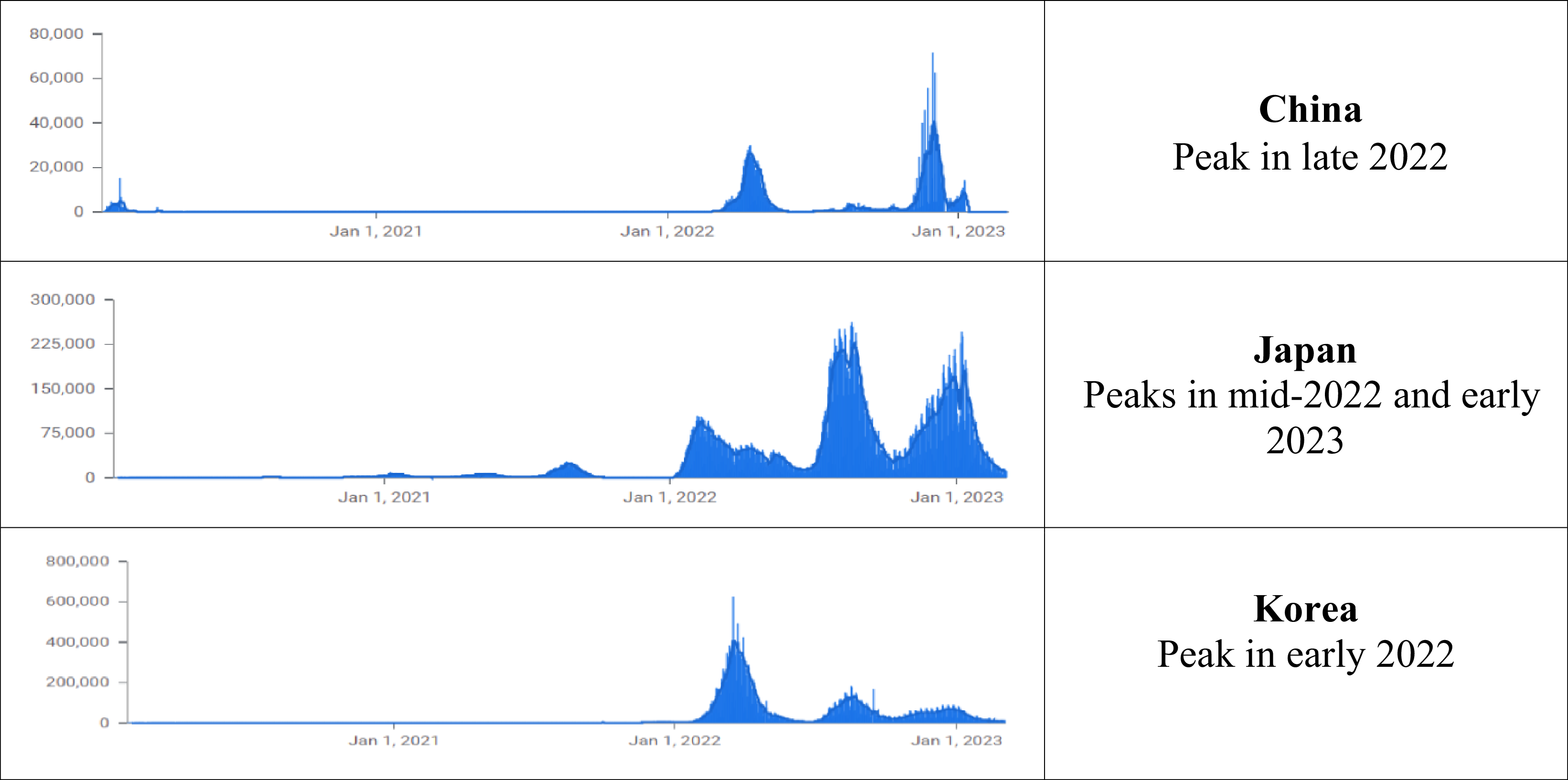
Figure 3 Long description
Three line graphs depict confirmed COVID-19 cases in China, Japan, and Korea from January 1, 2021, to January 1, 2023. The graph for China shows a peak in late 2022, with case numbers rising sharply and then declining. Japan's graph indicates two significant peaks, one in mid-2022 and another in early 2023, with fluctuating case numbers. Korea's graph shows a peak in early 2022, followed by a decline and smaller fluctuations. Each graph has the x-axis labeled with dates and the y-axis labeled with the number of confirmed cases. The data source is the WHO COVID-19 dashboard.
Third, CJK developed and implemented different COVID-19 response strategies based on their initial success in responding to the outbreak (Lu et al., Reference Lee, Heo and Seo2020; Chen et al., Reference Chen, Shi, Zhang, Wang and Sun2021). Until late 2022, China had put its ‘zero-COVID strategy’ in place to reduce the outbreak of infectious disease to zero. Chinese authorities instituted unprecedented measures to contain the virus, putting large cities on complete lockdown between 2020 and 2022 and implementing strict isolation measures nationwide during the pandemic. Japan responded to COVID-19 through a ‘cluster-based approach’, with authorities first initiating strong border controls and limiting overseas travel (Oshitani, Reference Oshitani2020). As the community spread increased, Japan prioritised its policy of restricting large-scale cluster gatherings by avoiding the ‘Three Cs’ (Closed, Crowded, Close Contact). In addition, the widespread use of face masks played a role in slowing down the spread of COVID-19 in Japan (Iwasaki and Grubaugh, Reference Iwasaki and Grubaugh2020). Korea adopted a ‘3T’ strategy (Testing, contact Tracing, and Treating) to respond to COVID-19 (Lee et al., Reference Lee, Heo and Seo2020). The Korean authorities quickly developed COVID-19 diagnostic kits and implemented large-scale testing to help public health officials identify cases and conduct contact tracing (Lee et al., Reference Lee, Heo, Seo, Ahn, Jung, Lee and Choi2021). Korea responded to and suppressed the spread of COVID-19 through robust testing, contact tracing, and isolating confirmed COVID-19 patients and their contacts using the latest digital technology (Heo et al., Reference Heo, Lee, Seo and Choi2020).
5.3 Absence of institutional ‘legacies’ in post-crisis periods
In the past, major health crises such as Middle East respiratory syndrome (MERS) in 2012 contributed to health cooperation for many countries, including CJK (de Wit et al., Reference de Wit, van Doremalen, Falzarano and Munster2016). After the MERS outbreak, CJK strengthened and expanded their cooperation by signing an Action Plan on Joint Preparedness and Response against Pandemic Influenza and Emerging/Re-emerging Infectious Diseases of Common Concern in 2016 and agreed on early warning and epidemiological investigation, diagnosis, and vaccine development, and infectious disease control measures (TCS, 2016). However, unlike MERS, which originated as an exogenous crisis in the Middle East before spreading to East Asia, the COVID-19 pandemic did not lead to tangible joint actions or lasting institutional legacies among the three countries in the post-crisis period.
A telling example comes from the convening of the 16th Tripartite Health Minister Meeting in December 2023, which was the first minister-level consultation on public health among the three countries in the post-COVID-19 era. Despite the three health ministers adopting an MOU on prevention, preparedness, and responses to infectious diseases and reaffirming the principles of cooperation, hardly any policy breakthrough can be found compared with the previous Action Plan in 2016 (TCS, 2023). Cooperative measures in the 2023 MOU, including information sharing, building networks, designating focal points, exchanging experts and officials, conducting joint scientific studies, developing vaccines, and performing risk assessment exercises, appear to simply repeat previous agreements. The MOU stipulates a five-year implementation period; however, it remains unknown whether these vague principles can be further developed into specific action plans with relatively fixed timetables. It also did not include improvement measures related to the domestic laws and regulations in the three countries, which could be a potential obstacle to sharing the latest infectious disease information. Thus, unlike major crises in the past, the COVID-19 pandemic did not create important new initiatives or improve the existing frameworks for trilateral health cooperation.
By contrast, if the three countries truly intended to develop a valid critical juncture and valuable legacies for the COVID-19 crisis, two aspects of in-depth cooperation should have been addressed at the 16th Tripartite Health Minister Meeting in 2023. First, the three countries should have investigated and engaged in introspection regarding the reasons why previous agreements on public health cooperation failed to work effectively during the COVID-19 period. Second, and more importantly, the three countries need to adopt forward-looking perspectives and consider announcing more specific and tangible collaborative measures. For example, the most crucial part of health cooperation is the accurate and timely exchange of information on the latest diseases, as the three countries are deeply interconnected and can quickly transmit the virus across their borders (Javed et al., Reference Javed and Chattu2020). Although CJK have high digital capabilities, solid exchanges of pandemic information (especially in terms of age group, sex, and subregion) and in-depth policy consultations on isolation policies were not achieved at any point during the COVID-19 period. These measures could potentially substantially help in controlling the virus, not only in these three countries but also worldwide. The three countries could also collaborate to manufacture medical supplies and equipment and prevent key components from being subject to export controls.
6 Conclusion
This study examined the viability and applicability of crisis-driven regionalism in Northeast Asia by analysing its triggering conditions and operational mechanisms. Our research addresses a gap in the existing literature, which has largely focused on crises that led to institution-building while overlooking a broader range of crises that do not meet the critical juncture threshold. We argue that crisis-driven regionalism can be more effective as a mapping framework for identifying cooperation phases (activation, performance, completion) than as a deterministic explanation of final outcomes. Therefore, crises do not always translate into effective regional efforts with tangible cooperative outcomes. For crisis dynamics to function effectively in Northeast Asia, specific conditions must be met across the pre-crisis, in-crisis, and post-crisis stages.
First, the source of the crisis plays a significant role. States are more inclined toward regionalist efforts when faced with common exogenous crises than with endogenous ones. In the latter case, crisis-producing states may avoid responsibility by minimising interaction with neighbouring countries and upholding the prevailing norms of sovereignty and non-intervention. Second, we underline a key limit of the crisis-driven regionalism model that it explains ‘how cooperation begins’, but not necessarily ‘why cooperation endures’. Crises alone are not decisive drivers of regional cooperation. Instead, collective actions are essential for the emergence of self-reinforcing sequences during critical junctures. An effective critical juncture is warranted by policy compliance, and states are committed to agreements reached during crises and take corresponding actions. Crises must foster joint actions and shared agendas among all affected states, rather than promoting a ‘talk shop’ form of regionalism in which each state primarily addresses the crisis through individual national responses and domestic efforts. Finally, post-crisis legacies and reproduction mechanisms must be established to ensure policy continuity once the crisis subsides. Without these mechanisms, policymakers may quickly abandon crisis-driven agreements and revert to pre-crisis conditions. Thus, our findings are significant in both theory- and policy-perspectives. This study contributes to theories of international cooperation by examining the conditions under which crisis-driven approaches can serve as catalysts for substantive regional cooperation and sustained policy continuity. Empirically, it also advances understanding of the barriers to regional institution-building in Northeast Asia.
This article draws on three case studies as empirical evidence. The 2008 GFC initially appears to constitute a ‘near-successful’ critical juncture, as it catalysed meaningful institutionalisation of regionalism in Northeast Asia through the launch of the CJK trilateral summit mechanism, the initiation of CJKFTA negotiations, and the establishment of a permanent secretariat providing administrative and think-tank support. Even so, the long-term outcomes of the GFC were uneven, as progress toward a CJKFTA stalled once economic recovery diminished the perceived urgency for cooperation. By contrast, the other two cases – transboundary environmental and public health crises in the realm of non-traditional security – which are generally considered less politically sensitive and more conducive to regional cooperation in Northeast Asia – failed to substantially enhance incentives for cooperative regionalism among all relevant stakeholders. The two cases serve as two counterexamples to crisis-driven regionalism due to intense disputes over crisis responsibility, the absence of collective actions, and unsustainable policy commitments in the post-crisis periods. Amid the crisis, CJK pursued divergent policy choices shaped by their domestic circumstances, instead of establishing a shared regional agenda. We view the most recent CJK tripartite health ministers‘ meeting in the post-COVID period as little more than a ‘talk shop’, since the three countries have yet to sign binding agreements for comprehensive information sharing on infectious diseases. Thus, this study suggests that the situation remains largely uncertain as to whether the three countries have learned sufficient lessons from past environmental and public health crises. Effective cooperation has not been established in key areas such as an emergent mutual notification system, joint scientific research, industrial and technological exchanges, or the creation of a shared policy agenda. The model of crisis-driven regionalism remains underdeveloped, and Northeast Asian states risk repeating the same mistakes of mutual blame and responsibility evasion if similar cross-border crises arise in the future.
This study has several limitations that warrant further investigation. In particular, the three-stage crisis dynamics framework employed here should be understood as only one component of a broader explanation of regional cooperation, rather than as a stand-alone driver. A more comprehensive account of cooperative outcomes requires the inclusion of additional structural and issue-specific factors. Geopolitical factors and Cold War legacy – such as historical and territorial disputes, conflicting national interests, growing geo-economic rivalries, hostile bilateral relations, as well as alliance politics – pose significant structural constraints that hinder the substantive development of security regionalism in Northeast Asia. On the other hand, specific policy domains require different forms and levels of institutional commitment. For instance, factors such as domestic politico-economic priorities, supply chain structures and comparative trade advantages, industrial and sectoral interests, as well as nationalist sentiments have all shaped the trajectory of regional FTA negotiations. In non-traditional security domains (such as environmental protection, infectious disease control, nuclear safety, and disaster rescue and relief), domestic bureaucratic interests and state capacity, together with the development of a sophisticated scientific community, constitute fundamental preconditions for effective regional cooperation. These factors may prove more salient than a simple exogenous–endogenous crisis typology in accounting for the strengths and weaknesses of East Asian regionalism. Future research should therefore identify these issue-specific barriers and examine how crisis-driven dynamics operate within each domain.
Dr. Zhang Muhui is an Associate Professor at the Department of East Asian Studies, Sungkyunkwan University, South Korea. His current research project examines the China-Japan-South Korea trilateral relationship, Sino-Japanese collaboration and rivalry in East Asia, as well as international political economy in East Asia. Before moving to Sungkyunkwan University, he taught at the Graduate School of International Studies, Pusan National University, and served as political affairs officer at Trilateral Cooperation Secretariat among China, Japan, and South Korea. He recently published in Asia & Pacific Policy Studies, Japanese Journal of Political Science, and the Pacific Review.
Dr. Lee Dae Joong is a full-time Graduate of the School of International Studies (GSIS) faculty member at Pusan National University. He researches and teaches International Relations of the Asia-Pacific Region, the Korean Economy, North Korea, and Development. He has worked for the Korean Finance Ministry for over 25 years in economic policy and international economics and has engaged in various government policy advice. He received his BA degree in Economics from UC Berkeley, an MA degree in Economics from Tufts University.

 Open access

