

Introduction
High-resolution nuclear magnetic resonance spectroscopy is an important technique for determining the structure of molecules in solution. The molecular properties that determine an NMR spectrum, namely the chemical shift and the nuclear spin–spin coupling constant, are identical for a molecule and its mirror image. These second-rank tensor properties $\sigma _{\alpha \beta} ^{({\rm N})} $
and
$\sigma _{\alpha \beta} ^{({\rm N})} $
and $J_{\alpha \beta} ^{({\rm NN}{\rm ^{\prime}})} $
, where N and N′ are two nuclei with spin, are even under the parity operator
$J_{\alpha \beta} ^{({\rm NN}{\rm ^{\prime}})} $
, where N and N′ are two nuclei with spin, are even under the parity operator $\hat P$
that inverts the coordinates of all particles in the molecule and therefore converts one enantiomer of a chiral molecule into the other. For chiral sensitivity one looks for properties that are even under time-reversal
$\hat P$
that inverts the coordinates of all particles in the molecule and therefore converts one enantiomer of a chiral molecule into the other. For chiral sensitivity one looks for properties that are even under time-reversal $\hat T$
and odd under
$\hat T$
and odd under $\hat P$
, like the optical rotational strength, which is the imaginary part of the scalar product of electric and magnetic transition dipole moments (Barron, Reference Barron2004). The linear dependence of
$\hat P$
, like the optical rotational strength, which is the imaginary part of the scalar product of electric and magnetic transition dipole moments (Barron, Reference Barron2004). The linear dependence of $\sigma _{\alpha \beta} ^{({\rm N})} $
on an electric field
E
is determined by the third-rank tensor
$\sigma _{\alpha \beta} ^{({\rm N})} $
on an electric field
E
is determined by the third-rank tensor $\sigma _{\alpha \beta \gamma} ^{(1)({\rm N})} $
which is odd under
$\sigma _{\alpha \beta \gamma} ^{(1)({\rm N})} $
which is odd under $\hat P$
and even under
$\hat P$
and even under $\hat T$
. It has been shown (Buckingham, Reference Buckingham2004; Buckingham & Fischer, Reference Buckingham and Fischer2006) that the isotropic part of
$\hat T$
. It has been shown (Buckingham, Reference Buckingham2004; Buckingham & Fischer, Reference Buckingham and Fischer2006) that the isotropic part of $\sigma _{\alpha \beta \gamma} ^{(1)({\rm N})} $
, viz.
$\sigma _{\alpha \beta \gamma} ^{(1)({\rm N})} $
, viz. ${\bar \sigma ^{(1)({\rm N})}}{\varepsilon _{\alpha \beta \gamma}} $
, where ε
α
βγ
is the third-rank skew-symmetric unit tensor and
${\bar \sigma ^{(1)({\rm N})}}{\varepsilon _{\alpha \beta \gamma}} $
, where ε
α
βγ
is the third-rank skew-symmetric unit tensor and ${\bar \sigma ^{(1)({\rm N})}} = (1/6){\varepsilon _{\alpha \beta \gamma}} \sigma _{\alpha \beta \gamma} ^{(1)({\rm N})} $
is a pseudoscalar which vanishes for achiral molecules, leads to a rotating electric polarization perpendicular to the precessing nuclear magnetic moment and to the applied magnetic field
B
(0). Each line in the NMR spectrum of a chiral molecule has an associated positive or negative signal at the same frequency, as occurs in circular dichroism and vibrational circular dichroism (Stephens et al. Reference Stephens, Devlin and Cheeseman2012) but these chirally sensitive spectral lines are yet to be observed in NMR.
${\bar \sigma ^{(1)({\rm N})}} = (1/6){\varepsilon _{\alpha \beta \gamma}} \sigma _{\alpha \beta \gamma} ^{(1)({\rm N})} $
is a pseudoscalar which vanishes for achiral molecules, leads to a rotating electric polarization perpendicular to the precessing nuclear magnetic moment and to the applied magnetic field
B
(0). Each line in the NMR spectrum of a chiral molecule has an associated positive or negative signal at the same frequency, as occurs in circular dichroism and vibrational circular dichroism (Stephens et al. Reference Stephens, Devlin and Cheeseman2012) but these chirally sensitive spectral lines are yet to be observed in NMR.
Computations of ${\bar \sigma ^{(1)({\rm N})}}$
(Buckingham & Fischer, Reference Buckingham and Fischer2006; Lazzeretti et al. Reference Lazzeretti, Soncini and Zanasi2008; Monaco & Zanasi Reference Monaco and Zanasi2011; Pelloni et al. Reference Pelloni, Faglioni and Lazzeretti2013; Zanasi et al. Reference Zanasi, Pelloni and Lazzeretti2007) have shown that its contribution to the electric polarization is likely to be too small for easy detection, even for heavier nuclei such as 13C and 19F. However, a recent Communication (Buckingham, Reference Buckingham2014) showed that there is an additional contribution to the rotating polarization in the case of dipolar molecules; the permanent electric dipole moment μ
(0) contributes a temperature-dependent orientation polarization through the torque exerted on the dipole by the precessing nuclear magnetic moment through the antisymmetric part of
${\bar \sigma ^{(1)({\rm N})}}$
(Buckingham & Fischer, Reference Buckingham and Fischer2006; Lazzeretti et al. Reference Lazzeretti, Soncini and Zanasi2008; Monaco & Zanasi Reference Monaco and Zanasi2011; Pelloni et al. Reference Pelloni, Faglioni and Lazzeretti2013; Zanasi et al. Reference Zanasi, Pelloni and Lazzeretti2007) have shown that its contribution to the electric polarization is likely to be too small for easy detection, even for heavier nuclei such as 13C and 19F. However, a recent Communication (Buckingham, Reference Buckingham2014) showed that there is an additional contribution to the rotating polarization in the case of dipolar molecules; the permanent electric dipole moment μ
(0) contributes a temperature-dependent orientation polarization through the torque exerted on the dipole by the precessing nuclear magnetic moment through the antisymmetric part of $\sigma _{\alpha \beta} ^{({\rm N})} $
. The molecular properties that give the rotating electric polarization associated with precessing nuclear spins following a π/2 pulse are
$\sigma _{\alpha \beta} ^{({\rm N})} $
. The molecular properties that give the rotating electric polarization associated with precessing nuclear spins following a π/2 pulse are ${\bar \sigma ^{(1)({\rm N})}} + {\bar P^{({\rm N})}}/kT$
, where k is the Boltzmann constant, T the absolute temperature, and the pseudoscalar
${\bar \sigma ^{(1)({\rm N})}} + {\bar P^{({\rm N})}}/kT$
, where k is the Boltzmann constant, T the absolute temperature, and the pseudoscalar ${\bar P^{({\rm N})}}$
for nucleus N is (a repeated Greek suffix implies a sum over all three Cartesian components)
${\bar P^{({\rm N})}}$
for nucleus N is (a repeated Greek suffix implies a sum over all three Cartesian components)
 $$\eqalign{&\displaystyle{{{{\bar P}^{({\rm N})}} = {1\over 6}{\Big (}{\varepsilon _{\alpha \beta \gamma }}\mu _\alpha ^{(0)} \sigma _{\beta \gamma }^{({\rm N})} \Big)} } \cr & \hskip 6pt \quad = {1\over 6}\displaystyle{\matrix{\left[ {\mu _z^{(0)} (\sigma _{xy}^{({\rm N})} - \sigma _{yx}^{({\rm N})} ) + \mu _x^{(0)} (\sigma _{yz}^{({\rm N})} - \sigma _{zy}^{({\rm N})} )} \right. \cr \left. {\quad + \mu _y^{(0)} (\sigma _{zx}^{({\rm N})} - \sigma _{xz}^{({\rm N})} )} \right]} }} $$
Computations on the HOOF molecule (Buckingham, Reference Buckingham2014) indicate that at room temperature this orientation polarization is two or three orders of magnitude larger than the distortion polarization due to ${\bar \sigma ^{(1)}}$
, thus improving the prospects of achieving chiral discrimination in NMR spectroscopy.
${\bar \sigma ^{(1)}}$
, thus improving the prospects of achieving chiral discrimination in NMR spectroscopy.
A recent paper (Buckingham et al. Reference Buckingham, Lazzeretti and Pelloni2015) reports results of computations of ${\bar \sigma ^{(1)}}$
and
${\bar \sigma ^{(1)}}$
and $\bar P/kT$
for nine small chiral molecules containing heavier atoms such as 13C, 15N, 17O, 19F, 33S, 77Se and 125Te as well as protons; it confirms the large enhancement due to dipolar orientation.
$\bar P/kT$
for nine small chiral molecules containing heavier atoms such as 13C, 15N, 17O, 19F, 33S, 77Se and 125Te as well as protons; it confirms the large enhancement due to dipolar orientation.
An alternative approach (Buckingham & Fischer, Reference Buckingham and Fischer2006) to the detection of chirally sensitive NMR signals is through the precessing magnetization induced by an applied electric field
E
. In an isotropic sample, this magnetization is proportional to the vector product of the nuclear magnetization and
E
. Like the induced electric polarization, it is dependent on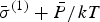 ${\bar \sigma ^{(1)}} + \bar P/kT$
, but the temperature-dependent term now arises from the orientation of the permanent dipole by the electric field; if
E
is a low-frequency field, then even large molecules will be able to respond to its oscillations. In the case of the precessing electric polarization arising from the torque exerted on the molecules through the antisymmetric part of the nuclear magnetic shielding tensor, the molecules need to be able to respond to the precessing nuclear magnetization, i.e. to the NMR frequency. This would be a problem for very large molecules.
${\bar \sigma ^{(1)}} + \bar P/kT$
, but the temperature-dependent term now arises from the orientation of the permanent dipole by the electric field; if
E
is a low-frequency field, then even large molecules will be able to respond to its oscillations. In the case of the precessing electric polarization arising from the torque exerted on the molecules through the antisymmetric part of the nuclear magnetic shielding tensor, the molecules need to be able to respond to the precessing nuclear magnetization, i.e. to the NMR frequency. This would be a problem for very large molecules.
Discussion
Chiral discrimination in high-resolution NMR spectroscopy could be observed through the rotating electric polarization generated by magnetic nuclei precessing in the plane perpendicular to the magnetic field B
(0) following a π/2 pulse (Buckingham, Reference Buckingham2004; Buckingham & Fischer, Reference Buckingham and Fischer2006) or through the magnetization induced by an electric field
E
(Buckingham & Fischer, Reference Buckingham and Fischer2006). In both cases, the signal is determined by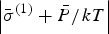 $\left\vert{\bar \sigma ^{(1)}} + \bar P/kT \right\vert$
(Buckingham, Reference Buckingham2014; Buckingham & Fischer, Reference Buckingham and Fischer2006). For dipolar molecules – and that includes all chiral molecules except those of D
n
symmetry – computations show that at room temperature the magnitude of
$\left\vert{\bar \sigma ^{(1)}} + \bar P/kT \right\vert$
(Buckingham, Reference Buckingham2014; Buckingham & Fischer, Reference Buckingham and Fischer2006). For dipolar molecules – and that includes all chiral molecules except those of D
n
symmetry – computations show that at room temperature the magnitude of $\bar P/kT$
is normally much greater than that of
$\bar P/kT$
is normally much greater than that of ${\bar \sigma ^{(1)}}$
(Buckingham, Reference Buckingham2014; Buckingham et al. Reference Buckingham, Lazzeretti and Pelloni2015). The nature of the torque orienting the molecule through the antisymmetric components of
${\bar \sigma ^{(1)}}$
(Buckingham, Reference Buckingham2014; Buckingham et al. Reference Buckingham, Lazzeretti and Pelloni2015). The nature of the torque orienting the molecule through the antisymmetric components of $\sigma _{\alpha \beta} ^{({\rm N})} $
can be understood as follows: the antisymmetric part of
$\sigma _{\alpha \beta} ^{({\rm N})} $
can be understood as follows: the antisymmetric part of $\sigma _{\alpha \beta} ^{({\rm N})} $
can be represented as
$\sigma _{\alpha \beta} ^{({\rm N})} $
can be represented as ${\varepsilon _{\alpha \beta \gamma}} \,\,\sigma _\gamma ^{\ast ({\rm N})} $
where
${\varepsilon _{\alpha \beta \gamma}} \,\,\sigma _\gamma ^{\ast ({\rm N})} $
where $\sigma _{}^{\ast ({\rm N})} $
is a polar vector (Buckingham, Reference Buckingham2014; Jeffreys, Reference Jeffreys1931). Thus for a nucleus N on the symmetry axis of a chiral molecule of C
3 symmetry, there is one non-zero component of
$\sigma _{}^{\ast ({\rm N})} $
is a polar vector (Buckingham, Reference Buckingham2014; Jeffreys, Reference Jeffreys1931). Thus for a nucleus N on the symmetry axis of a chiral molecule of C
3 symmetry, there is one non-zero component of $\sigma _{}^{\ast ({\rm N})} $
(Birss, Reference Birss1966), namely
$\sigma _{}^{\ast ({\rm N})} $
(Birss, Reference Birss1966), namely $\sigma _z^{\ast ({\rm N})} = (\sigma _{xy}^{({\rm N})} - \sigma _{yx}^{({\rm N})} )/2$
where x, y and z are molecule-fixed axes. The antisymmetric shielding contribution to the nuclear shielding spin Hamiltonian
$\sigma _z^{\ast ({\rm N})} = (\sigma _{xy}^{({\rm N})} - \sigma _{yx}^{({\rm N})} )/2$
where x, y and z are molecule-fixed axes. The antisymmetric shielding contribution to the nuclear shielding spin Hamiltonian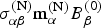 $\sigma _{\alpha \beta} ^{({\rm N})} {\rm m}_\alpha ^{({\rm N})} B_\beta ^{({\rm 0})} $
is
$\sigma _{\alpha \beta} ^{({\rm N})} {\rm m}_\alpha ^{({\rm N})} B_\beta ^{({\rm 0})} $
is ${\varepsilon _{\alpha \beta \gamma}} \,\,\sigma _\gamma ^{\ast ({\rm N})} \,{\rm m}_\alpha ^{({\rm N})} B_\beta ^{({\rm 0})} = {\sigma ^{\ast ({\rm N})}}\cdot ({{\bf m}^{(N)}} \times {{\bi B}^{{\rm (0)}}})$
; if
${\varepsilon _{\alpha \beta \gamma}} \,\,\sigma _\gamma ^{\ast ({\rm N})} \,{\rm m}_\alpha ^{({\rm N})} B_\beta ^{({\rm 0})} = {\sigma ^{\ast ({\rm N})}}\cdot ({{\bf m}^{(N)}} \times {{\bi B}^{{\rm (0)}}})$
; if $\sigma _z^{\ast ({\rm N})} $
is negative there is a lowering of energy when the molecular z-axis is in the direction of the vector product of the nuclear magnetic moment m
(N)and the magnetic field
B
(0), causing the molecule, with its dipole
$\sigma _z^{\ast ({\rm N})} $
is negative there is a lowering of energy when the molecular z-axis is in the direction of the vector product of the nuclear magnetic moment m
(N)and the magnetic field
B
(0), causing the molecule, with its dipole $\mu _z^{(0)} $
, to favour this direction and leading to electric polarization precessing in the plane perpendicular to
B
(0) at right angles to the nuclear magnetization.
$\mu _z^{(0)} $
, to favour this direction and leading to electric polarization precessing in the plane perpendicular to
B
(0) at right angles to the nuclear magnetization.
In the case of the nuclear magnetization induced by an applied electric field E , the energy of the molecule is changed by − μ (0)· E , causing the antisymmetric part of the nuclear shielding tensor to induce magnetization in the direction m (N) × E (Buckingham & Fischer, Reference Buckingham and Fischer2006).
The results of computations of ${\bar \sigma ^{(1)}}$
and
${\bar \sigma ^{(1)}}$
and $\bar P/kT$
(Buckingham, Reference Buckingham2014; Buckingham et al. Reference Buckingham, Lazzeretti and Pelloni2015) give hope that NMR experiments will soon provide chiral discrimination as in other forms of spectroscopy. Estimates of alternating voltages of the order of 1 nV for signals from protons in pure chiral liquids (Buckingham & Fischer, Reference Buckingham and Fischer2006) increase to 1 μV and substantially higher for heavier nuclei because of the dominance of
$\bar P/kT$
(Buckingham, Reference Buckingham2014; Buckingham et al. Reference Buckingham, Lazzeretti and Pelloni2015) give hope that NMR experiments will soon provide chiral discrimination as in other forms of spectroscopy. Estimates of alternating voltages of the order of 1 nV for signals from protons in pure chiral liquids (Buckingham & Fischer, Reference Buckingham and Fischer2006) increase to 1 μV and substantially higher for heavier nuclei because of the dominance of $\bar P/kT$
. The contribution of the rotating dipole depends on the polar molecule being able to follow the precessing nuclear spins, but this should not be a problem for small polar molecules for which dielectric loss occurs at frequencies from 3 to 300 GHz (Hill et al. Reference Hill, Vaughan, Price and Davies1969) but will be a factor for large molecules. Application of a low-frequency electric field
E
and detection of the induced magnetization could obviate this problem as well as providing potentially valuable discrimination through the modulation of
E
.
$\bar P/kT$
. The contribution of the rotating dipole depends on the polar molecule being able to follow the precessing nuclear spins, but this should not be a problem for small polar molecules for which dielectric loss occurs at frequencies from 3 to 300 GHz (Hill et al. Reference Hill, Vaughan, Price and Davies1969) but will be a factor for large molecules. Application of a low-frequency electric field
E
and detection of the induced magnetization could obviate this problem as well as providing potentially valuable discrimination through the modulation of
E
.
Acknowledgements
The author wishes to express his indebtedness to Professor Dr Peer Fischer, Dr Piotr Garbacz, Dr Steffen Krämer and Dr Geert Rikken for their involvement with him in the experimental search for chirally sensitive NMR signals.

 Open access

