

Introduction
In 1999 the Bologna Declaration was signed by a large number of Ministers of Education of European and non-European countries. That year will probably be considered by future historians of the European Higher Education Systems as an important turning point. The aim was to create the conditions for the establishment of a European Higher Education Area, to favour student and teacher mobility, to adopt a common scheme of academic titles, to cooperate in designing models for quality assessment, etc. Ten years later, 46 countries have joined the Bologna Process, which therefore can be considered a success. However, it is hard to predict what the actual outcome of the process will be in the long run, since the European Higher Education systems developed in different historical contexts and maintain (and also will maintain in the future) some of the structural traits of their past. The CAP project offers a unique opportunity to monitor affinities and differences in how the academic profession is organized in different countries and how academic staff interpret their role in the present situation. We selected a restricted number of European countries for which data were available to do a first tentative comparative exercise of data analysis, and we selected a restricted number of topics that the literature on higher education indicates as particularly relevant: gender ratio, timing of the academic career, political and academic engagement, professional identity and job satisfaction. The countries selected are: Finland, Germany, Italy, Norway and the UK. The paper presents some provisional findings that will need to be supplemented by further analysis.
Academic work and gender
Gender distribution according to the academic ranking in our sample reconfirms a clear dominance of male academics at senior level and the reverse situation at medium and, more strongly, at junior level (Table 1).
Academic rank by gender (percentage)

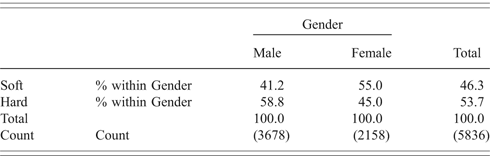
The distribution is reproduced with small differences in all the five systems. The lowest percentage of females at senior level can be found in the UK (10.1%). As expected, female academics work more often in soft disciplines (Finland has the highest percentage with 58.9%), while in hard sciences there is still a predominance of male academics (Table 2).
Discipline of current teaching by gender (percentage)
Timing of the academic career
In general terms, academic careers are estimated to be quite slow compared with careers in the more dynamic industries of the business world. There is however considerable variability across countries due to the conditions characterizing the recent history of higher education systems. The data from the CAP survey allow us to glance at some aspects of the timing of academic careers in five selected West European countries: Finland, Germany, Italy, Norway and the UK.
The age distribution of the national samples reveals some interesting features. Comparing age means (see Table 3) shows a 6.5 years difference between the ‘oldest’ (Italy) and the ‘younger’ sample (Finland), whereas age differences between German, Norwegian and UK respondents are rather minimal. The older age of Italian respondents can clearly be explained by the reduced rate of recruitment during the last 10 to 15 years after the great expansion of the number of teaching staff at universities during the 1970s and 1980s. Recruitment waves mark different cohorts: times of expansion are frequently followed by times of restriction, the doors of higher education institutions open up or close according to the pressure coming from the demand for education by students and their families and the responding public policies. However, the differences largely depend on the ways the academic population has been defined in different countries for the purposes of this survey. In Italy, for instance, it has proved quite impossible to include junior teaching and research staff on temporary part-time appointments in the sample due to the fact that no one knows their number and distribution; in Finland, conversely, the majority of short-term contracts concern younger researchers included in the sample as well as all post-graduate students who are included in the category of academic staff.
Age by country

The Bologna Process will probably in due course produce a homogenisation of the length of European study programmes, at least for well performing full-time students who are headed for the academic profession. The actual population of academics precedes Bologna, and the age when the first academic degree was attained is still linked to previous institutional timing regulations. It should not come as a surprise that UK respondents got their first degree at an earlier age than their fellows in other countries, since Britain had already introduced a first three-year degree when elsewhere four to five years was the prevalent rule (Table 4).
Age at first degree by country

Different national regulations probably also account for a higher dispersion (measured by standard deviation) of figures for Finland and the UK. There are no major differences according to type of discipline: confronting hard (natural sciences and medicine) and soft (humanities and social sciences), the path to the first degree in hard sciences lasts only one year more than in soft sciences due to the fact that, everywhere, medical studies and the training for the medical profession last longer than for other academic compartments.
Further information is available to investigate the timing of academic careers, namely the age at which the first full-time job was acquired (Table 5).
Age at first full-time academic employment by country

It is not surprising to note that, concerning the age of the first full-time appointment, Germany and Italy are placed at the extreme positions: during recent decades academic careers in Germany were probably somehow accelerated by the new openings in the Eastern Länder and also by traditional structural arrangements entailing the fairly frequent use of full-time fixed terms (often renewable) teaching and research contracts at the start and during the first stages of the academic career; in Italy, on the contrary, besides the slow down of recruitment, which – as has been noted before – accounts also in part for the older age of the Italian respondents, a full-time position corresponds to a tenured one because there is no provision for untenured full-time contracts. In the tradition of the German university system, in principle only temporary full-time appointments exist between the completion of the doctorate (Promotion) and the acquisition of a professorship (Professur), whereas in Italy temporary positions are only part-time and do not guarantee a living to the occupants.
Calculating the number of years between the attainment of the first degree and of the first full-time employment, it is again the precocious academic insertion of Germans scholars that appears, compared with the other countries, rather remarkable (Table 6).
Years between first degree and first full-time academic employment by country

German academics need three to four years less than their colleagues to get a full-time job after the attainment of the first degree, because there are institutional opportunities to do so. The same pattern is confirmed, and even strengthened, when we calculate the number of years between the first degree and the actual position, although the gap does not increase substantially, shifting from junior to senior positions. This indicates that German academics accumulate their advantage during the first stages of their career and keep this advantage when they progress toward senior positions. The majority of short-term contracts are reported by younger researchers. Furthermore, all post-graduate students funded by the Finnish Academy of Sciences are included in the category of academic staff. In Finland, the long period between the first degree and full-time employment is caused by the large number of short-term academics (‘project researchers’) working on short-term contracts, which are not considered forms of regular employment.
To attain a junior position starting from the first degree on average one needs slightly more than eight years in Germany, ten years in Italy, 12 in Norway, 13 in Finland and 16 in the UK (Table 7).
Years between first degree and actual position by country

As a matter of fact, calculating the average number of years between the first full-time appointment and the actual position at the time of the survey interview, the figures show that our German colleagues are in line with their counterparts in other countries (see Table 8).
Years between first full-time and actual position by country

Following a different procedure, we arrive at the same conclusions. Calculating the average duration in number of years from the attainment of first degree to the accession at the actual position, it is possible to measure for each national sample the ratio of respondents below and above the average. Labelling the first group ‘anticipators’ and the second ‘laggards’, we get the distribution in Table 9.
Speed of the academic career by country (percentage)

Germany has the largest share of ‘anticipators’ and the UK of ‘laggards’; Italy, Norway and Finland are in between the two polar positions (see Table 9). It should be noted, however, that at German universities (not necessarily in the Fachhochschulen) the number of full-time tenured professors is quite limited compared with the number of research and teaching staff on a fixed terms contract.Reference Kreckel1
The availability of an international research team will help in the next steps of the research project to better interpret the meaning of these findings. In any case, it is clear that the first stages in the career, the time between the completion of a doctoral degree and the attainment of a junior position in an institution of higher education, make for a crucial and delicate transition. It is during this period that a scientific vocation can get strengthened or weakened and that almost irreversible professional choices are to be made. At the present stage we are unable to answer the following questions. Which are the implications of these results for the functioning of the higher education systems? Which institutional arrangements can ease or clog the early stages of the academic profession?
Academic and political engagements
In this paper, we consider academic activities to be those tasks that are outside academic duties toward one’s own higher education institution, meaning membership in scientific boards of national or international agencies, in editorial committees, holding executive positions in professional organizations, acting as peer reviewer for journals and/or research financial bodies and the like. Roughly 40% in our sample do not show any commitment of this sort. The quota of non-active academics is small in Italy (25%), but high in Finland (almost 50%) and in Germany (48%) (Table 10). We do not note any variability according to soft and hard sciences. The differences by country can quite easily be explained by the composition of the national samples, since in both the Finnish and the German samples the share of temporary appointments is quite substantial, whereas these academic activities are more likely performed by tenured academics.
Academic activities by country (percentage)

On the other hand, political activities (membership in political parties, trade unions, voluntary associations, participation in community actions, etc) attract only slightly more than 25% of the interviewed academics, more in the two Nordic countries (nearly 40% in Finland and Norway) and slightly less in the UK, Italy and Germany (Table 11). Hard scientists are slightly less involved than scholars in the soft sciences.
Political activities by country (percentage)

Understandably, academic activities are carried out more at the senior level of the academic career: 86.1% of senior academics perform at least one or more of this kind of activities. In the UK, almost all academic staff are involved in these tasks (97.7%), while senior scholars in Germany (81.0%) are less frequently involved. Again, the involvement in political activities is much lower: it comprises 30.5% of the senior members, with Finland (59.7%), Norway (36.2%) and UK (35.9%) in the highest positions. Senior academics in soft and hard sciences are equally involved in academic activities (86.0%) while as far as political activities are concerned those in soft sciences (32.9%) are slightly more involved than their colleagues in hard sciences (27.7%).
Since seniority and tenure are obviously highly connected, tenured academics are more involved (and in a way compelled to do so) in academic activities (72.5%) than those without a permanent contract (36.3%). This is particularly true in the UK where 78.4% of tenured are involved in one or more academic activities. Germany follows with 76.6%, then Norway (70.2%) and Finland (62.2%).2 Political activities, in contrast, are more popular in Finland (51.3%) and Norway (38.8%), with the UK (32.0%) and Germany (20.4%) in the last positions.
Members of soft and hard sciences are equally involved in academic activities. A tiny difference in favour of the soft sciences can be detected as far as political activities are concerned (34.1% versus 28.5%). The same holds true for political activities that involve more the permanent employed than those who are not guaranteed permanent employment.
Among the countries discussed, Finland shows a relatively higher level of involvement, not only among tenured academics but also among the other categories of guaranteed and non-guaranteed staff members. There may be two reasons to explain this high participation rate. First, practically all Finnish university staff belong to an academic trade union; among professors this figure is lowest, but it is as high as 80%. However, in Nordic countries, membership in a trade union is not normally regarded as a form of political participation, it is rather a practical matter, as it offers protection against unemployment. Furthermore, there is only one academic trade union for each academic group (professors, lecturers and researchers). This means that trade unions are not organised according to political cleavages but according to professions.Reference Välimaa3 Second, perhaps participation in different civil society activities (voluntary associations) is quite popular among academics of Nordic countries. However, there is no empirical evidence to support this assumption.
To sum up, the general picture shows a substantial involvement of academics in different academic activities and less engagement in the political domain. Academic business is particularly relevant at the top of the academic career. Full-time tenured senior members are much more involved in all higher education systems for a number of (understandable) reasons: visibility (if not scientific prestige) makes them points of reference for all kind of roles. Still, comparing the five European systems, a different degree of involvement in academic activities puts British senior academics clearly in the first place. As is well known, UK peer review activities are very popular and the number of scientific journals or editorial committees is much larger than everywhere else. Instead, political activities – even if at a lower level – are more on the professional ‘agenda’ of academic staff in the Nordic countries, particularly in Finland. In those countries, political involvement is a cultural habit and opportunities to become member of voluntary associations devoted to all kind of community activities are manifold. There, senior academics are the most often involved as well, perhaps in part because their tenured position gives them a more secure and protected attitude.
Interestingly enough, no system shows a significant difference between people operating in soft or hard sciences as regards academic activities, while political activities seem to be more frequent among academics in soft than those in hard sciences. According to a well-known stereotype, people in hard sciences do not have the time to become interested in social and political issues, while those in soft sciences have a natural inclination toward those issues. Instead, our data show that, with the partial exceptions of the Nordic countries, involvement in political domain is rather limited even among academics operating in soft sciences.
Identity and sense of belonging
One of the major aspects of the diversification of the academic profession depends on the tendency to differentiate between institutions primarily oriented toward research and institutions almost exclusively concerned with teaching. In the US system, only a few hundreds of the more than 3000 institutions of higher education are classified as research universities. This probably is an unavoidable trend in mass higher education. A rather large variety of institutional arrangements exists to combine research and teaching and of course there is strong resistance to abandon the old Humboldtian model of close relationship between teaching and research. Whereas the existence of pure research institutions is almost universally accepted, the idea is quite widespread, particularly in continental Europe, that teaching should always be combined with research.
Our data suggest that this is still true in general terms, however not to the same extent in every country. Let us take together those respondents who combine teaching and research in different proportions. A low figure can be taken as a proxy measure of the degree of acceptance of institutional differentiation while a high figure means scarce acceptance. The data should be taken with caution since they are not yet weighted and therefore are not reliable to be used in comparisons. In any case, it makes sense that the distribution ranges from the minimum of Norway (52.5% both active in teaching and research) to the maximum of Italy (85.9%), with Finland, Germany and the UK occupying the intermediate positions.
It is worth noting that there are no significant differences according to type of discipline: soft and hard scientists show almost the same preferences concerning the separation/combination of teaching and research. In general terms, those defining themselves more as researchers than as teachers make up the majority in each country. As shown in Table 12, the case of Norway is particularly clear in this respect. This can be explained by the fact that at least one third of the Norwegian sample consists of full-time researchers who do not have any teaching obligations.
Prime interest in teaching or research by country (percentage)

An analogous picture emerges when we explore another dimension of professional identity that traditionally is relevant in the literature.Reference Becher4–Reference Clark6 Do academics feel they belong more to their disciplinary community than to their department or the institution they are working in? These identification poles are of course not mutually exclusive: what is significant is their relative intensity. In fact, there is a connection and a certain coherence between the leaning toward research (as opposed to teaching) and the sense of belonging to one’s own disciplinary community more than to one’s institutional affiliation. Respondents were asked to rank discipline, department and institution from 1 (very important) to 4 (not important at all). Not surprisingly, the ranking is homogeneous in every country: the discipline or field of study is ranked everywhere between important and very important, whereas department and institution are on average less important. We can speak of the existence of a common cross-cultural academic culture, the traits of which show variable intensity according to different national historical conditions. The orientation toward one’s own discipline is stronger in Norway, Finland and Germany and somewhat weaker in the UK and Italy. Departmental affiliation is more important in the Nordic countries, and institutional affiliation seems to be stronger in Finland and in Italy, but the differences are not very large. Interestingly enough, there are no significant differences between soft and hard scientists in the relative importance accorded to the different affiliations (Table 13).
Sense of affiliation to one’s academic discipline, department and institution (mean)

Image of the academic profession and job satisfaction
European academics hold different views about the present conditions of their profession, but their average view is rather problematic and critical. We asked our respondents to evaluate the working conditions in higher education and in research institutions from the time they entered the profession to the present on a five-steps scale, ranging from ‘very much improved’ to ‘very much deteriorated’. A mean value above three indicates a prevalence of a rather pessimistic image. As shown in Table 14, ‘pessimism’ prevails in every country. However, as one could expect, academic and research institutions in Nordic countries are in a better shape in the views of those working in them, whereas Italy, Germany and the UK receive a more critical evaluation. Since these evaluations reflect subjective feelings and opinions, they depend heavily upon the level of aspiration respondents have now or had when they started their careers. With the exception of Italy, research institutions performs slightly better than higher education institutions in providing viable working conditions. Soft scientists are more critical than hard scientists, younger scholars less critical than aged academics. The overall picture, however, conveys a creeping pessimism that is confirmed by other indicators (Table 14).
Perceived change of working conditions in higher education and in research institutes by country (meanFootnote *)

* On a scale from 1 = ‘very much improved’ to 5 = ‘very much deteriorated’.
We also asked our respondents to express agreement or disagreement, again on a five steps scale (ranging from 1 ‘strongly agree’ to 5 ‘strongly disagree’), on a series of statements (see Tables 15–17).
‘This is a poor time for any young person to begin an academic career in my field’

The data show a slight prevalence of critical attitudes concerning young people entering the profession now (Table 15) and a perception of personal strain on the job. Despite these attitudes, the large majority of respondents (68.7%) are satisfied with the professional choice they made (Table 16). As we shall see, the idea and the intention to change jobs is connected with the level of job satisfaction.
‘If I had it to do over again, I would not become an academic’

‘My job is a source of considerable personal strain’

In comparing the views by country we observe a more comprehensive negative attitude among academics in the UK. Reasons for this are several and not unknown. For decades now the growing of mass higher education has reduced the faculty’s political standing together with a decline of salary level and a parallel increase of the workload (Table 17). Already in 1997, over 30% of academic staff under the age of 35 indicated the likelihood of their leaving the profession (as mentioned in the Dearing Report). More than for the salary reduction, academics in the UK (but elsewhere too) care for internal status and career recognition. In this respect, the growing number of part-time teaching staff together with the vanishing of the tenure system has created more anxiety about the professional future.Reference Shattock7 In addition, traditional academic autonomy has been endangered by the increasing role of national government in establishing sets of research priorities. In this way, autonomy – considered a key component of the academic identity – has been substantially affected (Table 18).Reference Henkel8
Attitude toward academic career by country (percentageFootnote *)

* Percentage stating 1 or 2 on a scale from 1 = ‘strongly agree’ to 5 = ‘strongly disagree’
On the basis of the three indicators listed above we tried to calculate a cumulative synthetic index of job satisfaction. A first finding indicates that scholars in the humanities and social sciences show a slightly (but significantly) lower level of satisfaction than their colleagues in the natural sciences, medicine and engineering. It is quite frequent in European universities to find colleagues in the humanities complaining about the processes of marginalization of which they perceive themselves to be the victims. One can formulate the hypothesis that they feel underprivileged in the distribution of resources and threatened first of all by the social scientists perceived as main competitors. The analysis of our data conducted so far does not allow us to test a hypothesis of this kind.
The cross-national comparison indicates that the UK respondents are the least satisfied and the Norwegians (followed by the Germans) are the most satisfied. In Finland it seems that the growing number of temporary employments and their inherent insecurity is one of the causes for stress among the fixed-term employed, while tenured academics complain about the lack of resources. In Norway, scholars complain about the lack of time to carry out research, while in Germany the excessive length of the academic career is underlined. In addition, in all countries (and with special emphasis in some scientific fields) the low salary in the first stage of the academic career is mentioned as a reason for being tempted to choose other professional paths (Table 19).
Satisfaction index by country (percentage)

To tackle a dimension very likely connected with satisfaction, we asked respondents whether they had ever considered the idea of changing jobs. More than half of the respondents did in fact think about a major change in job activity, both inside and outside higher education institutions. Only half of them, however, took concrete actions to realize the project. Not surprisingly, the temptation to look for a job outside higher education is much stronger among hard scientists than among scholars in social sciences and the humanities. The disposition to look for jobs outside the higher education system signals a positive attitude toward mobility between different professional sectors (i.e. a form of horizontal circulation) but also the sheer existence of such opportunities. The willingness to change is a precondition, but the absence of available opportunities will likely have an impact on this disposition (Table 20).
Having considered a major change of your job by country (percentage)

If we consider the willingness to change as an indicator of poor job satisfaction, the highest satisfaction is in Italy and the least in the UK. In fact, as we have just seen, scholars in the UK display the highest level of dissatisfaction. However, the scarce willingness of Italian academics to look for other jobs should probably be interpreted more in terms of the lack or scarcity of opportunities than in terms of high levels of job satisfaction. Both in Finland and Norway, the increase of temporary positions and the non-competitive level of salaries compared with other professions seem to make the choice for the academic career ever more difficult for young scholars.
Concluding remarks
Academics in the UK are more often involved in academic activities than scholars in any other country, and they are the less satisfied. In Nordic countries, academics are more inclined towards political activities, mainly because all staff are enrolled in professional unions: Norwegian and Finnish scholars are relatively more satisfied than the scholars in other countries: for the former, the income is relevant, for the latter, the impact of the (more modest) income is less significant. Different career speed and different academic environments at a local level might be related to these correlations and should be investigated. In all systems the first steps of the career are long and uncertain. Many kinds of fixed-term employment are spreading out. First salaries are modest, both for scholars involved in project contracts and academics who eventually are inserted in tenure tracks. Underpayment and an uncertain future make the academic profession less appealing when compared with other professions in almost every country. Of course, there are differences: some scientific fields have more appealing external competitors at the level of the national and local economy than other disciplines. In addition, the amount of academic duties has been growing in all systems (especially due to the increasing number of students and the growing administrative duties). Therefore, the impression is that the number of dissatisfied academics is increasing and the younger are less satisfied than the older. The academic career is changing everywhere in relation to the new links between university and society. Administrative duties are increasing and the relationship between teaching and research is more and more under question. Research seems to remain central in the self-definition of academic identity (especially in Norway, but in other systems as well). In fact, the main complaint related the fact that new duties claim time that otherwise could be devoted to research activities. The debate on the separation or combination of basic activities remains central and open. Looking back a few decades, one can detect the changing of a profession that used to be characterised by little evaluation, wide autonomy and freedom: now, it is affected by competition, evaluation and accountability. The decline of full-time job opportunities (due to the rise of the university private sector, inter alia) has increased competition. Research evaluation and the new pattern of managerial control, both trends spreading out at different pace in various higher education systems, point in the same direction. Their impact on the professoriate can be detected more easily in some systems than in others.Reference Altbach9 In our case, it seems possible to detect this impact by looking at the deterioration of the academic morale, strongly affecting academics in the UK but also visible in other countries, with Italy at the end of the line. It might also be wise to add that the impact of these changes affects the academy in different ways as regards the disciplines and the ranking of university institutions. Consequently, more detailed analyses will be useful for a better understanding of the process.
Acknowledgement
The authors acknowledge the support of the Fondazione Compagnia di San Paolo.
Alessandro Cavalli is former Professor of Sociology at the University of Pavia, President of CIRSIS (Center for Research on Higher Education Systems) of the same university, President of the Scientific Council of the IARD Institute and Member of the Council of Fondazione per la Scuola. His research focuses mainly on the history of social thought between the 19th and the 20th century, collective memory, youth and education. He has been a member of several evaluation committees in Belgium, Germany, Italy and Portugal. He is editor of Mundus, a journal on history teaching. His recent publications include Giovani a scuola (Young People at School; with G. Argentin. Bologna: Il Mulino 2007) and Deux Pays, deux Jeunesses? (Two countries, two Youths?; with V. Cicchelli and O. Galland. Rennes: Presses Universitaires de Rennes, 2008).
Roberto Moscati is Professor of Sociology of Education at the Department of Sociology and Social Research of the University of Milano-Bicocca. His main interests are related to the comparative analysis of higher education systems, education policy, teaching and learning activities, student life, student education and development, civic culture and national identity. He is Member of the Evaluation Committee at IULM University and at the University of Milano-Bicocca, and Member of the Italian ‘Bologna Promoters’. His most recent publications include L’università di fronte al cambiamento (The University Facing Transformation; edited with M. Vaira. Bologna: Il Mulino, 2008), Gouverner les universités en France et en Italie (Managing the University in France and in Italy; with S. Boffo and P. Dubois. Paris: L’Harmattan, 2008), Dentro e fuori la scuola (Inside/Outside the School; with E. Nigris and S. Tramma. Milano: Bruno Mondadori, 2008) and ‘Transforming a Centralised System of Higher Education: Reform and Academic Resistance in Italy’ (in: A. Amaral, I. Bleiklie, C. Musselin (eds) (2008), From Governance to Identity: A Festschrift for Mary Henkel. Dordrecht: Springer, pp. 131–140).


 Open access

