


The growing frequency of disasters is a global concern due to population growth and societal interconnections,Reference de Ruiter, Couasnon and van den Homberg 1 which significantly impact more lives and properties.Reference Center 2 Additionally, disasters can lead to severe consequences such as death, injury, displacement, and long-term health impacts, and disrupt the economy and social services.Reference Moore and Lakha 3
The Emergency Event Database (EM-DAT) indicates a significant rise in the number of deaths and overall damage from 2015 to 2022. 4 The number of deaths has risen from 33 000 to 38 000, excluding COVID-19, while the overall damage has surged from 87 million to 225 million USD. The urgency of coping with disasters has led to the implementation of strategies by governments, organizations, and individuals to mitigate their negative impacts and enhance future resilience.Reference Nojavan, Salehi and Omidvar 5 The focus of these strategies and measures is to identify and manage the risks, needs, and vulnerabilities before and after the occurrence of disasters. To reduce disaster impacts, Disaster Management (DM) is a systematic approach, involving mitigation, preparedness, response, and recovery phases.Reference Noran 6 , Reference Sawalha 7 Effective coordination and communication among sectors are crucial for efficient management.Reference Kaynak and Tuğer 8
Disasters can significantly impact health and well-being, necessitating the integration of Disaster Health Care Management (DHM) into the disaster management framework.Reference Madanian, Parry and Norris 9 –Reference Zhong, Clark and Hou 11 DHM involves improving treatment protocols and mass casualty management to ensure efficient delivery of health servicesReference Norris, Martinez and Labaka 12 to disaster-affected communities while minimizing risks to health care workers and facilities.Reference Francescutti, Sauve and Prasad 13 However, to enhance the efficiency of health services and to minimize disaster risks, increasing resilience among societies and health care systems is crucial.Reference Biddle, Wahedi and Bozorgmehr 14 Resiliency supports communities in anticipating and adjusting to, and rebounding from disasters, reducing negative impacts.Reference Saunders and Becker 15 Integrating resilience measures within the DM framework reinforces health care protocols and preparedness.Reference Haldane, De Foo and Abdalla 16 This also requires considering the importance of Situational Awareness (SA) during disasters for effective decision-making and response.Reference O’Brien, Read and Salmon 17 SA provides real-time information, enabling authorities to understand conditions, allocate resources efficiently, and adapt strategies, thus enhancing immediate response capabilities and building disaster resilience.Reference Laurila-Pant, Pihlajamäki and Lanki 18 , Reference Zaman and Raihan 19 Consequently, to enhance SA, identifying and monitoring public health perception and concern is essential in DHM, leading to better resiliency.
Communication and information sharing plays an important role in SA. Effective communication and data exchange among health care professionals, authorities, policy makers, and public ensures proper consideration of integrated DHM.Reference Altevogt, Reeve and Wizemann 20 Understanding the community’s needs and expectations is important for inclusive, equitable, and responsive DHM.Reference Levine and Jansson 21
In this regard, technology advancements and utilization, e.g., Social Network (SN) and Artificial Intelligence (AI), can enhance communication and SA for DHM.Reference Parry, Madanian and Norris 22 SN platforms offer vast data on human behavior and communication patterns, enabling authorities to identify patterns, predict occurrences, and optimize response efforts, thereby refining public health systems and increasing community resilience.Reference Anson, Watson and Wadhwa 23 , Reference Acikara, Xia and Yigitcanlar 24 However, the large SN data volume necessitates the application of AI algorithms, capable of swift and precise processing of huge datasets to reveal complex trends and patterns undetectable to human observation with traditional methods.Reference Xu, Liu and Cao 25
SNs integration with everyday life and activities has transformed social interactions and unveiled opportunities to identify gaps in health care services.Reference Xie, Pinto and Zhong 26 Platforms like Facebook, Twitter, Instagram, and LinkedIn have revolutionized information sharing and connectivity, encouraging the emergence of social mining, big data analytics, and computational methodologies.Reference Gupta and Gupta 27 SNs also serve as channels for individuals to express health-related concerns and experiences, highlighting unrecognized issuesReference Chen, Min and Zhang 28 such as health care accessibility, service quality, and support for those with health needs.
SNs facilitate communication between the public and governmental/non-governmental organizations,Reference Dong, Meng and Christenson 29 , Reference Palen and Hughes 30 providing real-time data for health insights.Reference Muniz-Rodriguez, Ofori and Bayliss 31 This is especially useful during health emergencies,Reference Madanian, Airehrour and Samsuri 32 , Reference Madanian, Norris and Parry 33 enhancing community resilience and addressing issues duringReference Yang, Li and Lan 34 or after emergencies.Reference Madanian, Rasoulipanah and Yu 35 Despite SN’s applications in DM, their specific roles and benefits in health care are not fully explored. Further investigation could enhance strategies, response, communication, and support before, during, and after disasters and create new collaboration opportunities in DHM.
The interaction that could arise from the partnership of governments, health care organizations, technology companies, and researchers holds immense potential. Each of these stakeholders holds unique expertise and could collectively unravel innovative solutions that capitalize on the strengths of SNs. By developing and implementing strategies that leverage these platforms, DHM could be elevated to new standards. Therefore, this research aims to investigate how SN can serve as a tool to support DHM operations in monitoring situations, enhancing the quality of decisions to increase resiliency in health care system regarding disasters. The study attempts to identify and examine the current literature in SN data analytics methods and approaches, with the goal of extracting insight of their usage in DHM. Specifically, the study intended to discover how SN data analytics can grant DHM authorities to have access to a variety of opinions and perspectives, real-time information, and expertise.
Research Methodology
A Systematic Literature Review (SLR) was conducted to comprehensively review the background of the field. SLR ensures a comprehensive analysis of the existing knowledge to identify the strengths and limitations of utilizing SNs in DHM, finding the trends and suggesting future research directions. SLR and its analysis allowed the study to gain a deeper understanding of the role and applications of SN in DHM and its revolution over the time. The study conducted a thematicReference Clarke and Braun 36 and qualitative content analysisReference Hsieh and Shannon 37 on the retrieved articles. This analysis involved examining the data for themes and patterns that could provide insights towards the study objectives.
This study searched PubMed, CINAHL, Scopus, SpringerLink, Emerald Insight, IEEE Xplore, ACM Digital Computing, and Google Scholar. The selection of these databases was based on AUT library guidelines 38 – 40 and considering the multi-disciplinary nature of the research. The main areas of this research were classified into “social network,” “disaster management,” and “health care.” Therefore, the following keywords were considered to construct the search strings:
Social Network: “social media” OR “social network*”
Disaster Management: “disaster management” OR “emergency management” OR “mass emergency”
health care: health care OR “public health” OR medical* OR “health care”
The general search query was: “disaster management” OR “emergency management” OR “mass emergency” AND “social media” OR “social network*” AND health care OR “public health” OR medical* OR “health care”. However, a searching query was optimized for each database (see Appendix 1).
The study applied inclusion and exclusion criteria (Table 1) to ensure on relevancy and quality of the studies to be included in this SLR.Reference Lame 41
Inclusion/exclusion criteria

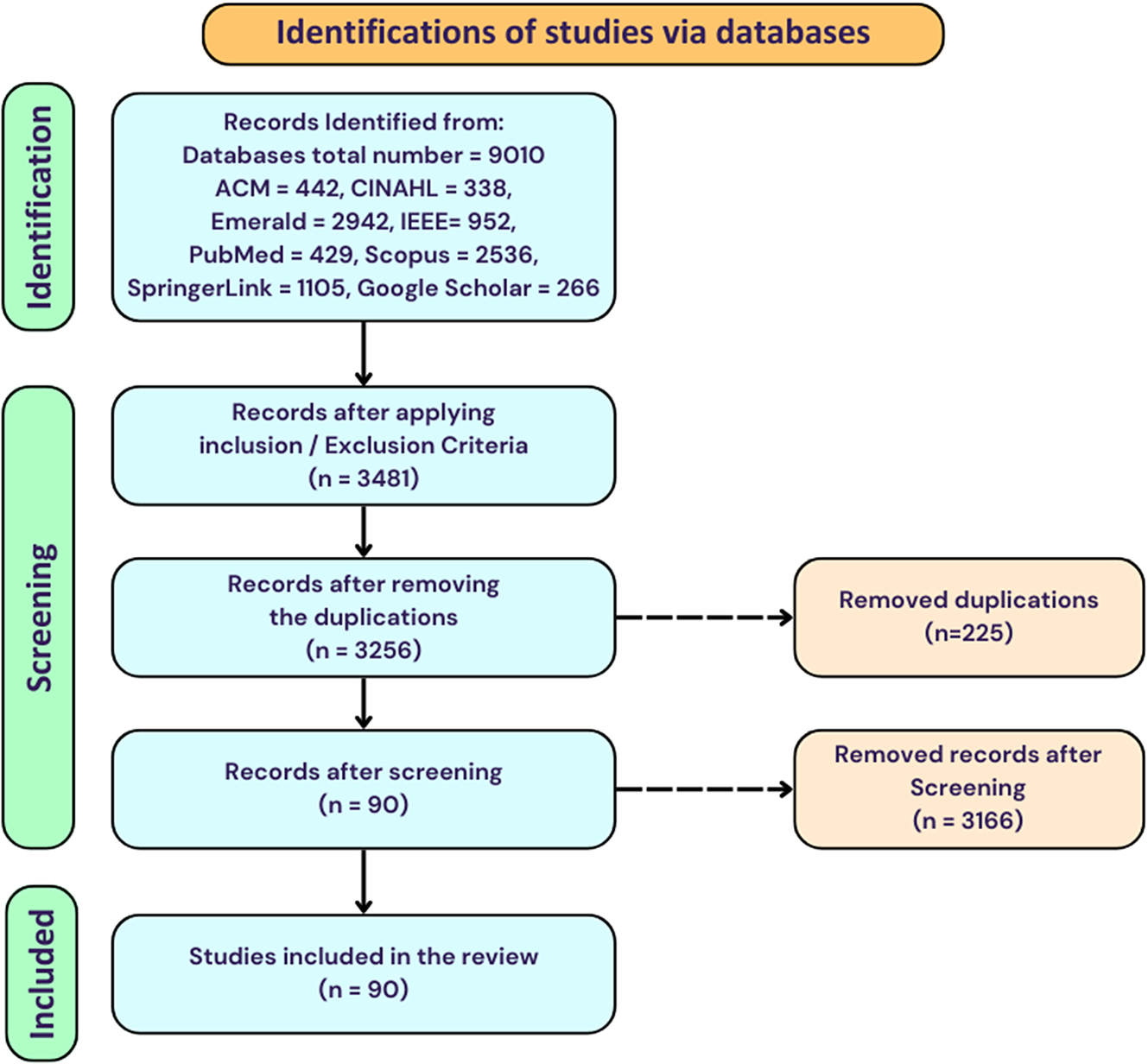
The initial number of articles retrieved was 9010, which was reduced to 3256 after applying the inclusion and exclusion criteria and removing duplicates. These 3256 articles were then subjected to a detailed screening process based on their relevance to the research questions and objectives. This screening involved a thorough review of titles and abstracts, resulting in the elimination of 3166 studies that did not meet the criteria for inclusion. The remaining 90 studies were selected for an in-depth review. These selected studies were then thoroughly examined to provide a detailed analysis of the research questions and objectives of the present study. Figure 1 illustrates the systematic process of identifying and selecting following the PRISMA guidelines.
Identification of studies process.
Findings and Results
The retrieved articles demonstrate a growing interest in using SN in DHM, particularly since the beginning of the COVID-19 pandemic (Figure 2).
The number of publications per year.

To identify and visualize the central elements within the studies in the dataset, this study used Network mapping techniques. As illustrated in Figure 3A, “COVID-19,” “Social Media,” and “Twitter” demonstrate the highest number of connections at the core. This can be interpreted as the substantial pandemic’s influence and the critical role of digital platform in shaping discussions, spreading information, and accelerating research initiatives. COVID-19 stands as a critical node with direct connections to diverse concepts such as “big data utilization,” “pandemic prevention strategies,” “social network analysis,” “data correlation techniques,” “analysis of internet public opinion,” “cooperative governance models,” and “data mining practices.” This shows the multidisciplinary aspect of pandemics, demonstrating the necessity for collaborations among health care, data analytics, public opinion analysis, and governance experts.
(A) Network mapping, (B) Overlay visualization.
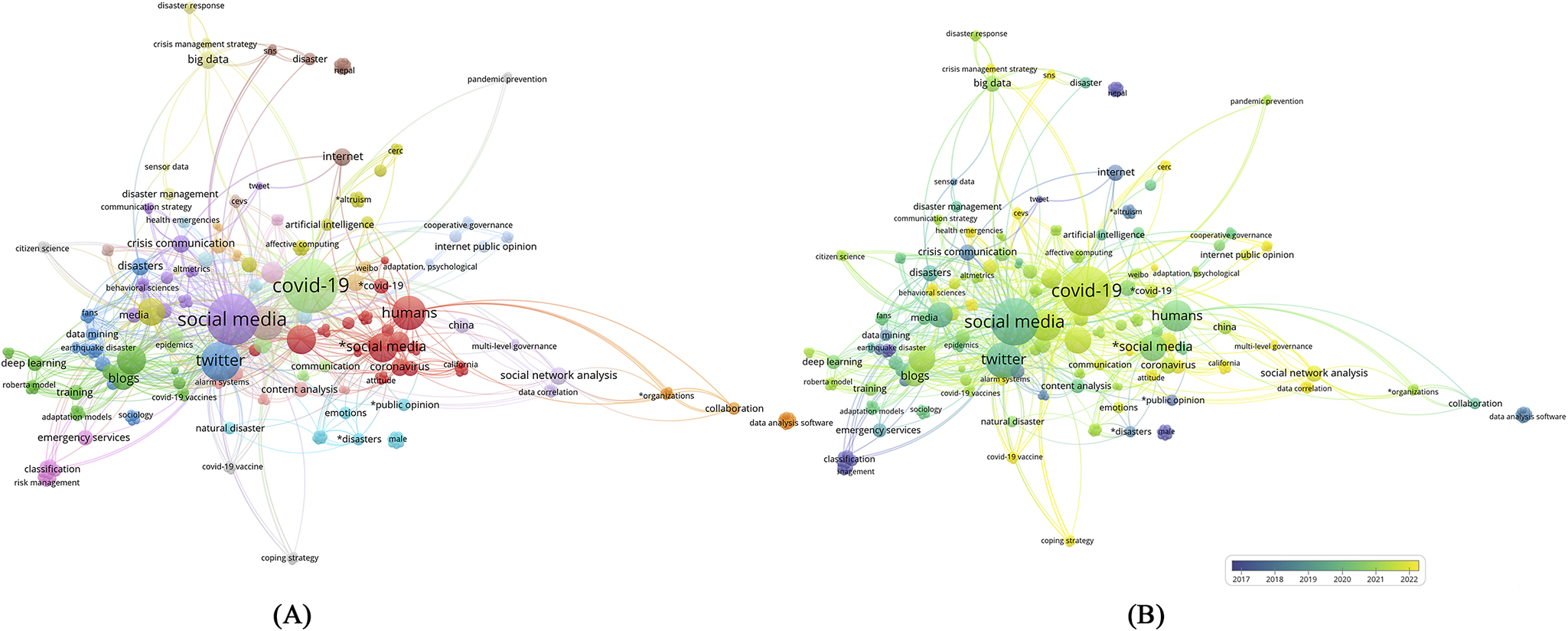
Among SN platforms, Twitter acts as a dynamic hub connecting discussions on natural disasters, content analysis, emotions, public sentiment, and behavioral science. This showcases its role in fostering dialogues about disasters and their diverse consequences, including health-related issues. Moreover, direct links include crisis communication techniques, citizen participation through science programs, coping strategy design, and communication tactics clarify the role of SN platforms as dynamic hubs for disseminating disaster-related information, engaging the public, and strategizing resilience.
The evolution of study interests is illustrated in Figure 3B using a color spectrum from which the changing landscape of DHM research can be clearly seen. Not surprising, COVID-19 has triggered a noticeable rise in research interest in the field. This reflects a reassessment of disaster preparedness and an increased focus on health care resilience, specifically concerning pandemics. These observations highlight how disasters prompt enhanced information sharing, communication, and collaboration across different disciplines.
Social Network Platforms
Twitter identified as the most frequently used SN platform. This could be rooted in Twitter swift communication, broad user base, and API accessibility facilitating comprehensive data extraction for varied SN investigations, notably in emergency contexts.Reference Mittal, Ahmed and Mittal 42 , Reference Seddighi, Salmani and Seddighi 43 Weibo, popular in China, serves as a significant avenue for expressing public opinions, while Instagram and Facebook, globally recognized for content sharing, have been extensively employed in disseminating disaster-related information, accumulating substantial daily views.Reference Gao, Guo and Wu 44 –Reference Mori, Barabaschi and Cantoni 47 Additionally, WhatsApp’s effectiveness in interactive communication during disasters was evident, following by YouTube, WeChat, and Baidu contributed to DHM as leveraged SN platforms.Reference Muswede and Sithole 48 –Reference Zhuang, Zhao and Shao 53
Among media types analyzed in the out dataset, text emerges as the predominant content form due to its rich information content, ideal for linguistic pattern analysis, sentiment examination, and discourse exploration. Its compatibility with processing and categorization enables large-scale analysis and is readily available on SN platforms accompanied by user-generated captions, comments, and hashtags, offering valuable insights into user behavior and opinions. The abundance and ease of processing of text-based content contribute to its extensive utilization in comprehensive SN dataset studies, facilitating in-depth sentiment analysis and effective topic modelling.
Disaster Types
Different types of disasters were identified in the dataset, with the COVID-19 being the primary focus due to its global impact on health care systems and SN platforms’ role in disaster communication.Reference Mori, Barabaschi and Cantoni 47 , Reference Chong and Park 54 –Reference Durowaye, Rice and Konkle 56 The dataset also includes investigations into other infectious disease outbreaks, such as Zika Reference Hagen, Scharf and Neely 57 and Ebola.Reference Lazard, Scheinfeld and Bernhardt 58 , Reference Seltzer, Jean and Kramer-Golinkoff 59 These studies aim to identify patterns in public concerns and facilitate the dissemination of health-related information to the public. Furthermore, SNs were also instrumental during earthquakes, to gain deeper insights into the situation and to enhance relief operations.Reference Basu, Ghosh and Jana 49 , Reference Radianti, Hiltz and Labaka 60 Similarly, during hurricanes and flood SN played a crucial role in disseminating information, communicating risks, and analyzing public sentiments to predict public resilience and aid disaster responders effectively.Reference Wang and Zhuang 61 –Reference Rudra, Goyal and Ganguly 65 Moreover, SN platforms were utilized to monitor environmental hazards, contributing to increase public awareness.Reference Xiong, Hswen and Naslund 66 , Reference Finch, Snook and Duke 67 These platforms were also utilized in addressing a spectrum of other disaster types including typhoons, cyclones, water shortages, and petrochemical accidents.Reference Xiong, Hswen and Naslund 66 , Reference Saleem and Mehrotra 68 –Reference Asif, Khatoon and Hasan 70
Social Network Applications Themes
This study identified 5 primary categories where SNs play a crucial role. These categories and sub-categories are illustrated in Figure 4.
Five main categories of SN applications for DHM.

Communication
As expected, communication emerged as the important role of SNs in DM for across all disaster phases. Authorities leveraged SN to disseminate emergency protocols and disaster preparedness guides to a broad audience, fostering public awareness and readiness for disaster response.Reference Wang and Zhuang 61 , Reference Wang, Hao and Platt 62 SNs offer adaptable communication that accommodate to various demographics, ensuring inclusivity and multilingual content, enhancing trust, participation, and collaboration among different groups and organizations in DHM efforts.Reference Li, Zhou and Luo 96 , Reference Aswani, Kar and Ilavarasan 109 , Reference Amin, Pramestri and Hodge 123 SNs enable coordination among government agencies, emergency response teams, health care organizations, non-profits, and the public in disaster preparedness efforts, increasing resilience and ensuring well-informed populations.Reference Alhassan and AlDossary 121
In disasters, SNs function as critical platforms for immediate, real-time information dissemination.Reference Alhassan and AlDossary 121 Authorities can use SNs for swift sharing updates including evacuation directives, shelter provisions, and availability of emergency services ensuring timely access and minimizing confusion and misinformation. SNs also enable an interactive, 2-way dialogue.Reference Zhong 50 , Reference Onorati and Díaz 94 Affected individuals can use SN platforms to seek assistance, report emergencies, and provide firsthand information. This interactive feedback loop proves invaluable for DHM authorities, enabling them to efficiently strategize and allocate resources by using real-time insights and public inputs. This seamless exchange of information facilitates the swift deployment of resources and targeted responses to the pressing needs of affected communities during crises.Reference Assery, Yuan and Qu 89 , Reference Mir and Sevukan 95 , Reference Fernandez-Luque and Imran 113
SNs are also crucial communication tools during recovery efforts. SNs can promote coordination and collaboration among various entities, including government agencies, emergency response teams, health care institutions, and the public.Reference Hasanah, Suciati and Purwitasari 114 , Reference Alshareef and Grigoras 130 SN platforms enable community-driven initiatives, such as mobilizing volunteers and the coordination of donation drives, fostering solidarity and resilience in affected communities by empowering individuals to actively participate in the recovery process. Additionally, SNs offer an opportunity for shared content analysis and sentiment tracking, providing valuable insights into public awareness and sentiments following the disaster.Reference Yang and Su 74 , Reference Liu, Tu and Zhou 111 By analyzing shared content, authorities gain a deeper understanding of the evolving needs and feelings of the affected population which aids in the formulation of more effective post-disaster communication strategies and developing long-term recovery plans, ensuring targeted, sensitive, and community-aligned efforts.
The role of SNs in DM spans beyond simple information dissemination. It encompasses a spectrum of functions that stimulate public engagement, streamline coordination efforts, and establish feedback mechanisms. This comprehensive involvement significantly amplifies the efficacy of communication strategies throughout all stages of disasters, thereby yielding more efficient and well-coordinated responses and recovery efforts. SN platforms enhance communication strategies during disasters by facilitating rapid dissemination of critical information, encouraging active participation among stakeholders, and facilitating real-time interactions. This enables DHM entities to adapt strategies and allocate resources based on real-time needs and community feedback, increasing resilience and ensuring effective disaster response and recovery initiatives.
Situational Awareness
SA involves the monitoring and comprehension of disasters’ impact on public health through SN platforms.Reference Shan, Zhao, Wei and Liu 45 , Reference Onorati and Díaz 93 , Reference Fissi, Gori and Romolini 122 SNs support real-time understanding of disasters’ impact on the public, serving as crucial data sources for constant monitoring of evolving situations.Reference Yao, Li and Chen 115 , Reference Wukich 124 SNs can be centralized spaces for affected individuals to share personal experiences during disasters, enabling immediate communication and identification of emerging health issues.Reference Madichetty and S 81 , Reference Onorati and Díaz 94 This direct and unfiltered interaction is valuable in swiftly comprehending the evolving health landscape.
Individuals can also use SNs’ platforms to share timely updates regarding their status, access to medical facilities, availability of essential supplies, and other relevant information. Moreover, leveraging data mining and analytics techniques is instrumental in recognizing patterns, trends, and potential focal points of health issues.Reference Chen, Mao and Li 63 , Reference Ghosh, Srijith and Desarkar 99 , Reference Gamal, Ghoniemy and Faheem 100 This approach significantly improves the capacity and focus of responding to health challenges during disasters.
SNs are influential assets in enhancing disaster SA. These platforms facilitate information sharing among impacted populations, providing crucial insights into health needs and challenges during disasters, enabling responders to adapt effectively.
Information Extraction
Information extraction is the process of gathering and analyzing data to understand disaster impacts, assist communities, and inform governments and agencies for preparedness and public health implications.Reference Adamu, Jiran and Gan 92 SN data analytics can highlight specific problems, such as how disaster relief activities might provoke negative views if they are carried out without a thorough grasp of local cultures.Reference Radianti, Hiltz and Labaka 60 Also, by investigating the emotional expressions of SN users before, during, and after disasters, it is possible to determine potential links between DHM activities and disaster impacts.Reference Garske, Elayan and Sykora 77 The analysis helps authorities detect risks, trends, and early warnings; adopt preventative measures; and prepare the public for disasters. Furthermore, during a disaster, it allows authorities to analyze response operations’ effectiveness, make required modifications, and assess damages to prepare for recovery.
From the analysis, it is evident that researchers employed diverse methodologies to analyze SN data for DHM, including AI tools, Content Analysis, Social Network Analysis, and other analysis techniques. The discussion over them is provided in the following subsection.
Machine Learning and Deep Learning
There has been an extensive use of Machine Learning (ML) and Deep Learning (DL) techniques, particularly DL architectures, like Long Short-Term Memory networks (LSTM), for analyzing sequential data in SN data during disasters.Reference Shams, Goswami and Lee 80 , Reference Fernandez-Luque and Imran 113 Stacked LSTM architectures have enabled a more intricate understanding of evolving patterns and sentiments over time, aiding in real-time decision-making.Reference Fan, Wu and Mostafavi 101 Also, the RoBERTa model, a variant of the Bidirectional Encoder Representations from Transformers BERT architecture, excelled in understanding context and semantics within textual data, enabling deeper sentiment analysis and information extraction.Reference Madichetty and S 81 , Reference Andhale, Mane and Vaingankar 90 Utilizing Multi-task Domain Adversarial Attention Networks (MT-DAAN) enabled simultaneous performance sentiment analysis, entity recognition, and trend identification within SN data.Reference Krishnan, Purohit and Rangwala 82 Traditional Machine Learning algorithms like Support Vector Machines (SVM),Reference Adamu, Jiran and Gan 92 , Reference Havas and Resch 98 , Reference Teague, Shatte and Weller 116 K-Nearest Neighbours (KNN),Reference Adamu, Jiran and Gan 92 , Reference Sahoh and Choksuriwong 105 Naive Bayes classifiers,Reference Havas and Resch 98 , Reference Sahoh and Choksuriwong 105 and ensemble methods such as Random Forest, Adaboost, and Gradient Boosting have proven effective in classifying sentiments, identifying relevant topics, and forecasting potential trends during disaster events.Reference Assery, Yuan and Qu 89 , Reference Havas and Resch 98 , Reference Sahoh and Choksuriwong 105 , Reference Teague, Shatte and Weller 116 For instance, SVM has significantly contributed to sentiment classification, distinguishing between positive and negative sentiments in SN data during and after disasters.
NLP and Text Analysis
Natural Language Processing (NLP) and Text Analysis techniques have been essential in dissecting the linguistic trails in SN data, contributing to DHM research. Again, LSTM-based sentiment analysis has enabled the interpretation of emotional expressions, capturing the sentiments of individuals and communities before, during, and after disaster.Reference Wang and Lv 78 Latent Dirichlet Allocation (LDA) topic modelling has been crucial in uncovering latent themes and prevalent topics within massive volumes of disaster-related textual data.Reference Zhong 50 , Reference Xiong, Hswen and Naslund 66 , Reference Wang and Lv 78 , Reference Hoque, Lee and Beyer 97 Additionally, sentiment analysis using Python-based libraries such as NLTK and Snow NLP allows for the extraction of emotions, enabling a deeper understanding of public perceptions and reactions in crisis situations.Reference Taeb, Chi and Yan 84 , Reference Li, Aldosery and Vitiugin 86
Furthermore, BERT, a contextual model understanding, has been leveraged to accurately discern sentiment polarity and emotional expressions. This model is employed with emotion analysis to capture the alterations in public sentiments during different disaster phases.Reference Taeb, Chi and Yan 84 , Reference Gamal, Ghoniemy and Faheem 100 Moreover, Named Entity Recognition (NER) combined with Graph-based clustering effectively identifies and categorizes entities and relationships in SN data.Reference Gamal, Ghoniemy and Faheem 100 , Reference Machmud, Irawan and Karinda 104 This helps disaster response teams to swiftly identify critical information, locations, and sentiment trends, enabling targeted and efficient intervention strategies.
Hybrid Models
The Hybrid Methods adopted in analyzing SN data for DHM involve combining diverse tools and techniques to gain comprehensive insights. Studies have employed combinations of methodologies such as LDA for topic modelling, sentiment analysis, and correlation analysis to reveal complex perspectives in SN data during disaster events.
The integration of NER, BERT, and Graph-based clustering techniques enable extraction of location-specific information, sentiment trends, and relationship mapping.Reference Gamal, Ghoniemy and Faheem 100 This integration can support DM authorities in refining response strategies by considering geographic-specific needs and sentiment analysis. Furthermore, employing a combination of Convolutional Neural Network (CNN) and RoBERTa,Reference Andhale, Mane and Vaingankar 90 Word2Vec, fastText, and LSTMReference Ghosh, Srijith and Desarkar 99 in a unified pipeline has enabled holistic approaches to analyzing SN data. Combining sentiment analysis, entity recognition, and deep contextual understanding, these methods provide a comprehensive view of SN data during disasters, aiding in informed decision-making by authorities and organizations.
Within the dataset, a spectrum of studies extensively reached into content analysis methodologies to examine SN data in DHM contexts. These studies utilized qualitative and quantitative content analysis approaches to analyze textual information in SN posts during disaster events. Qualitative content analysis delved into subjective aspects of SN discussions, uncovering intensity and emotionsReference Hagen, Scharf and Neely 57 , Reference Yang and Su 74 , Reference Pang, Cai and Jiang 75 , Reference Chipidza, Akbaripourdibazar and Gwanzura 103 while quantitative content analysis structured sentiments, frequency, and statistical patterns.Reference Bennett 108 , Reference Aswani, Kar and Ilavarasan 109
Additionally, thematic content analysis emerged as a fundamental tool in categorizing and identifying recurring topics in SN conversations during disasters, offering a comprehensive view of prevalent discussions and priorities.Reference Durowaye, Rice and Konkle 56 Psycho-linguistic analysis decoded emotional cues and linguistic patterns in SN communications, revealing insights into individuals’ mental and emotional states.Reference Wukich 124 Furthermore, 1 study leveraged SAS text miner, showcasing an automated approach to content analysis, aiding in the extraction, categorization, and summarization of information from extensive volumes of data.Reference Lazard, Scheinfeld and Bernhardt 58
Furthermore, the dataset contains studies that extensively explore Social Network Analysis (SNA) techniques, which are not specifically reliant on AI techniques or qualitative/quantitative methods.Reference Hasanah, Suciati and Purwitasari 114 Researchers used various methods, including specialized software like UCINET, to uncover intricate network structures and dynamics in SN data.Reference Wukich and Mergel 71
Moreover, employing semantic analysis techniques deepened the understanding of underlying meanings conveyed through language in SN discussions related to disaster events.Reference Li, Zhou and Luo 96 Dynamic network analysis methods were crucial in tracking changes in network structures over time in SN platforms, offering insights into evolving communication patterns, influence, and interactions. These varied content analysis methodologies provided valuable insights for developing informed DHM strategies without relying on ML techniques.
Location Identification
The utilization of spatiotemporal data derived from SNs significantly enhances the understanding of public health during ongoing disasters. This form of data combines spatial and temporal information, providing a comprehensive view of how health-related issues evolve over both space and time.Reference Abu-Alsaad and Al-Taie 52 , Reference Shams, Goswami and Lee 80 , Reference Gamal, Ghoniemy and Faheem 100 This insight is valuable for assessing the dynamics of a disaster’s impact on public health. For instance, real-time tracking of infection locations and population on SN platforms helps authorities make informed decisions, implement targeted interventions, and provide SA.Reference Shams, Goswami and Lee 80 , Reference Ghosh, Srijith and Desarkar 99
Location identification from SN data in disasters is the process of identifying the location of SN posts related to a disaster event. For example, one research utilized DL to categorize disaster-related tweets from impacted areas,Reference Shams, Goswami and Lee 80 while another employed text analysis to track individuals’ positions during disasters.Reference Abu-Alsaad and Al-Taie 52 These methods show how advanced technologies can extract vital location-specific details from SN data. In separate research, a hybrid ML technique was used to identify disaster-related locations.Reference Gamal, Ghoniemy and Faheem 100 This technique illustrates the interaction between various ML methodologies like NER and advanced models like BERT, to highlight disaster-affected locations.
The utilization of spatiotemporal data from SN platforms aids in understanding health issues’ geographical spread and progression during disasters with advanced analyses and tools demonstrating potential for effective public health interventions.
Disaster Management
The analysis of the studies in the review dataset revealed the significant impact of SN platforms across all phases of DM. SN platforms prove invaluable in prevention by spreading essential information, increasing awareness, and enhancing community preparedness.Reference Zhuang, Zhao and Shao 53 , Reference Arslan, Roxin and Cruz 119 SN platforms aid in the response phase by facilitating communication, coordinating relief efforts, providing real-time updates,Reference Basu, Ghosh and Jana 49 , Reference Finch, Snook and Duke 67 , Reference Alamoodi, Zaidan and Zaidan 72 , Reference Wukich 124 and aiding authorities in decision-making and policy formulation.Reference Zhong 50 , Reference Bukar, Sidi and Jabar 64 , Reference Saleem and Mehrotra 68 , Reference Li, Chandra and Kapucu 107 , Reference Amin, Pramestri and Hodge 123 These networks contribute to SA by extracting information, monitoring initiatives, and detecting hazards and vulnerabilities, crucial for mitigation and preparedness.Reference Yang and Su 74 , Reference Arslan, Roxin and Cruz 119 In relief operations, SN assists in identifying affected areas, connecting aid organizations with communities, and streamlining resource distribution. In the recovery phase, SN remains crucial by helping to allocate resources effectively, identifying vulnerable groups, and assessing evolving community needs and sustainable recovery.Reference Radianti, Hiltz and Labaka 60 , Reference Bukar, Sidi and Jabar 64 , Reference Wukich 124
Discussion and Conclusion
Studies show SN platforms are crucial for authorities to effectively communicate and share essential information during health emergencies, assessing public awareness and planning responses.Reference Han, Wang and Zhang 87 SN platforms foster collaboration and communication between authorities and the public, enhancing disaster risk mitigation and resilience by influencing public perceptions and assessing public awareness and response intentions.Reference Mittal, Ahmed and Mittal 42 , Reference Wang, Hao and Platt 62 , Reference Dutta, Peng and Chen 120 Moreover, SN improves SA, allowing people, organizations, and governments to monitor and comprehend the effects of disasters and facilitate more effective responses to emerging needs.Reference Saleem and Mehrotra 68 , Reference Fissi, Gori and Romolini 122 Through the analysis of SN data, it is possible to address the needs before, during, and after disasters with better efficiency.
AI technologies enable swift implementation of adaptive strategies by analyzing user-generated content on SN platforms, identifying valuable patterns and trends to enhance health care efforts.Reference Xiong, Hswen and Naslund 66 , Reference Saleem and Mehrotra 68 Employing AI models enables the efficient controlling of health care requirements throughout various stages of disasters to analyzing extensive SN data in real-time. The AI-driven analysis detects frequent patterns, emerging trends, public opinions, and the dynamics of the disasters. Ultimately, this leads to the preservation of lives and the reduction of disaster-related consequences in communities.Reference Xiong, Hswen and Naslund 66 , Reference Saleem and Mehrotra 68
Although, SN platforms have provided new approaches for information sharing and networking, they have also accelerated the generation of massive amounts of information.Reference Bennett 131 As a consequence, the rapid pace of information generation has led to information overload, a state where the amount of data overwhelms the capacity to process it effectively.Reference Middleton, Middleton and Modafferi 132 Additionally, the excessive amount of data can strain cognitive abilities, reduce attention spans, and lead to decision fatigue due to the overwhelming amount of choices or data to process.Reference Bermes 133
Moreover, the quick spread of false and inaccurate information on SN platforms has raised concerns about potential harm to individuals and society.Reference BGdS and Maçada 134 False information in DHM can lead to severe consequences, necessitating accurate and timely information for authorities and policy-makers to make informed decisions.Reference Shu, Sliva and Wang 135 Misleading information can intensify disaster impact, undermine public trust in authorities’ response efforts, and contribute to harmful beliefs.Reference Habib, Asghar and Khan 136 This can result in non-compliance with safety measures that can put people in danger. Therefore, the use of reliable, accurate, and up-to-date information in DHM is crucial to prevent the spread of false information and its negative effects.
Additionally, it is important to recognize that SNs cannot fully represent the entire community’s population.Reference Sallam, Dababseh and Eid 137 In fact, individuals who use SN may not be the most vulnerable during disasters, potentially distorting understanding of affected populations, especially the elderly and those without technology access. To better understand disaster-affected populations, a comprehensive approach combining SN data with diverse communication methods, community engagement, traditional media, and field assessments is essential to ensure a better understanding of diverse disaster-affected groups.
Furthermore, some types of disasters, such as earthquakes, hurricanes, or cyber-attacks can cripple communication networks, cutting off access to vital channels like SN platforms.Reference Dargin, Fan and Mostafavi 138 Moreover, displaced individuals might lose their personal technological devices, further limiting their ability to connect via SN.Reference Wang, Li and Yu 139 Disruptions in communication and information dissemination exacerbate challenges in disaster response, highlighting the need for alternative approaches to reach and assist affected communities.
Relying solely on SN for DHM presents a research gap, highlighting the potential for incomplete or inaccurate information due to individuals who are either not active on or lack access to SN platforms. Such oversight can render their concerns and needs invisible within DM frameworks. Future studies should consider the experiences of non-active SN users to fully understand the broader population’s perspectives. To address this issue, efforts should be made to collect information from a variety of sources in order to guarantee a thorough grasp of the situation.
Furthermore, while SN platforms are undeniably valuable in emergency situations, they should not serve as the total means to manage disasters. Effective DHM requires coordinating various resources and strategies, planning, robust communication protocols, preparedness measures, and collaboration among stakeholders. It involves thorough preparation by identifying risks, evaluating disaster impacts on health care, and creating flexible emergency response strategies.
It is critical to understand that SN data analytics is only 1 of several ways that should be employed for an effective DHM. Comprehensive DHM mandates integrating diverse methodologies and data sources beyond SN platforms, including traditional data collection, community engagement, expert consultations, and unpublished data. By embracing a diverse array of resources, DHM efforts can be more resilient and adaptive in addressing the complexities of DM.
It is important to acknowledge that the current study has certain limitations that may be addressed in future research. This study may have overlooked some relevant literature due to selection of keywords and inclusion/exclusion criteria, despite efforts to address these limitations through well-defined research protocols and existing theories. The research underscores the significance of utilizing SNs despite their challenges, paving the way for future research and robust methodologies to enhance disaster decision-making. Future studies should incorporate multiple information sources to improve accuracy and quality, advance scientific knowledge, and aid in informed decision-making processes.
Supplementary material
To view supplementary material for this article, please visit http://doi.org/10.1017/dmp.2024.294.
Author contribution
HRP was the main researcher and responsible for data collection and data analysis, all these tasks were conducted under SM supervision. SM contributed to the research method, reflection on research results, and data interpretation. HRP prepared the first draft of the research which was commented on and enhanced by SM. JU commented on the revised version and enhanced the research question. All authors agreed on the final version.
Appendix
Appendix 1. Modified search queries and the number of the results

Appendix 2. Selected studies for the review


 Open access

