

Introducing bipolar pessimism
Antinatalism is a philosophical position that discourages reproduction. Definitions and justifications vary, but a central pessimistic tenet since David Benatar’s Better Never to Have Been Footnote 1 has been that human (or sentient) existence entails harm (or suffering) which should not be perpetuated by bringing new human (or sentient) lives into existence. Whether or not harm (or suffering) should be perpetuated by encouraging already existing human (or sentient) lives to continue remains unclear if a one-dimensional view of pessimism is assumed. As demonstrated by Julio Cabrera in the context of Benatar’s antinatalism, life’s negative value could entail a prudential or moral obligation to end it.Footnote 2 Cabrera confines this observation to ethical suicide, but further implications are logically possible. Benatar’s philosophy evades this challenge by assuming a two-dimensional view of pessimism: not only life but also death as a state constitute harms.
Given the prevalence of new terminology in this debate, I hesitate to introduce yet another neologism—but for the sake of clarity, I will refer to Benatar’s dual commitment to the badness of both life and death as bipolar pessimism. This term captures the distinctive structure of his view: a pessimism that applies to both the condition of existence and the state of non-existence, leaving us no truly preferable alternative. While this framework provides a foundation for a cautious and internally consistent form of antinatalism, it is also vulnerable to challenges. Not everyone accepts both of Benatar’s key premises, and the rejection of especially the latter can lead to less cautious interpretations of antinatalist and related thought.
In what follows, I will first briefly describe bipolar pessimism as it is introduced in Better Never to Have Been (and supported in Benatar’s other works, but these are not focal here). I will go on to define the scope of the (primarily anthropocentric) antinatalism that bipolar pessimism most spontaneously entails, and to outline its possible normative implications in different theoretical frameworks. I will then show how extending the scope from human beings to all sentient beings (sentiocentrism) results either in an opaque utilitarianism of competing sentiments or a radical form of reproduction-related consequentialism.
Life is bad, and death is bad
Everyday pessimism is characterized by a downbeat attitude and the belief that whatever we do, something will go wrong and success will elude us. Philosophical pessimism goes beyond such mundane concerns and posits that existence itself is fundamentally flawed.Footnote 3 In the works of Arthur Schopenhauer,Footnote 4 Peter Wessel Zapffe,Footnote 5 and Emil Cioran,Footnote 6 life is suffering, nothing has meaning or purpose, human nature is defective, progress is impossible, and optimism is an illusion. G. E. Moore, not an advocate of the view himself, encapsulated its seriousness effectively, observing “the main contention of pessimism” to be “that the existence of human life is on the whole an evil.”Footnote 7 This emphasizes the idea that we are confronted with something that is not merely unpleasant, but also unpredictable, unfair, unkind, cold, cruel, menacing—in terms of figurative agency, treacherous, devious, or conniving.
Most philosophical pessimists have seen death—the end of life—as a relief or even a redeeming aspect of existence. Schopenhauer viewed life as full of suffering, and while he did not romanticise death, he saw it as a release from the relentless striving of existence. Cioran, in his more lyrical take, mused on the futility of existence, the absurdity of hope, the beauty of despair, and the allure of non-being. Philipp Mainländer argued that existence is a cosmic mistake and that death is the universe’s way of correcting the mistake by self-destruction.Footnote 8 These are all instances of what could be called one-dimensional pessimism: life is bad, and death, as its opposite, is not.
Benatar’s bipolar pessimism deviates from this mainstream, postulating that both life and death are bad. As for the former, he maintains that, due to the bigger and smaller adversities existence has to offer, “even the best lives are very bad.”Footnote 9 As for the latter, Better Never to Have Been takes an explicit stand against the Epicurean view that death as non-existence is nothing to be afraid of or concerned about. According to Benatar, this is not true, as “death is sometimes a harm and sometimes a benefit.”Footnote 10 What he means by the statement is elucidated by his wider background narrative.
The existent can have an interest in continuing to exist
Comparing decisions concerning the beginning of life and the end of life, Benatar writes that
there is good reason for setting the quality threshold for a life worth starting higher than the quality threshold for a life worth continuing. This is because the existent can have interests in continuing to exist, and thus harms that make life not worth continuing must be sufficiently severe to defeat those interests. By contrast, the non-existent have no interest in coming to existence. Therefore, the avoidance of even lesser harms—or, in my view, any harm—will be decisive.
Thus, it is because we (usually) have an interest in continuing to exist that death may be thought of as a harm, even though coming into existence is also a harm. Indeed, the harm of death may partially explain why coming into existence is a harm. Coming into existence is bad in part because it invariably leads to the harm of ceasing to exist.Footnote 11
This justification can be logically challenged. While the passage supports Benatar’s limited practical claim—that “death is sometimes a harm and sometimes a benefit”—extending it further appears to be an illicit generalization. The form of the argument is:
-
a) Discontinuing the existence of a being who has interests in it is a harm.
-
b) Human (or sentient) beings can have and usually have interests in their existence.
-
c) Therefore, discontinuing the existence of human (or sentient) beings is a harm.
If human (or sentient) beings can have the relevant interests, it stands to reason that some of them do, others do not. For the ones who do, death is, in this sense, a harm; for the ones who do not, it is not. And as for usually, how is this compatible with Benatar’s statement that “even the best lives are very bad”?
I will not let these observations impede my inquiry. Whether or not the justification holds, bipolar pessimism is a consistent view—and the view that Benatar relies on.
Anti-conceptionism and fetal pro-mortalism
If “even the best lives are very bad,” then creating new human beings is prima facie (presumptively, unless overridden by other factors) irrational or immoralFootnote 12 or both. And if “death may be thought of as a harm,” then ending the lives of human beings may also be thought of as prima facie irrational or immoral or both. This combination would seem to imply that abstinence or extreme caution are the only ways for us to legitimately express our reproductive righteousness.Footnote 13 The termination of already existing lives does not seem to have a place in this arrangement, at least not on a routine basis.Footnote 14
A look at Better Never to Have Been shows, however, a major deviation from this ethos. In addition to his “anti-natal” view that “it is always wrong to have children,” Benatar also defends a “pro-death” view concerning abortion. It is, according to him, always wrong not to terminate an early pregnancy before the fetus develops an interest in the continuation of its existence.Footnote 15 There are, then, two ethically acceptable—indeed highly recommendable or obligatory—methods to make sure that new individuals with interests in their lives are not born: not starting a pregnancy and, if it has already been started, ending it before the relevant interests arise.
The two methods can be called “anti-natal” and “pro-death” and kept conceptually separate. This would respect the conservative ideal that antinatalism does not involve killing.Footnote 16 It could also alleviate the tension between two competing views in the field—Benatar’s condoning abortion and shunning suicide, and Cabrera’s shunning abortion and condoning suicide. The proponents of these two thinkers could agree that abortion and suicide, whatever their moral standing, are not related to antinatalism.
Then, again, the more natural solution could be to bring both methods under the same umbrella term. If antinatalism, following Benatar, posits that “it is always wrong to have children,”Footnote 17 then “anti-conceptionism” (avoiding and preventing conception) and “foetal pro-mortalism”Footnote 18 (terminating early pregnancies) would be its subcategories. Anti-conceptionism would state that it is always wrong to act so that a human life begins. Fetal pro-mortalism would state that it is always wrong to fail to act so that a nascent human life is prevented from beginning.
Ways to practice anti-conceptionism and fetal pro-mortalism
Antinatalism can be an abstract idea, or it can be a concrete practice. If the latter, the specter of anti-conceptionist and fetal-pro-mortalist activities and inactivities is extensive. Possibilities for individuals include:
-
• Not having sex.
-
• Not donating gametes for fertility treatments.
-
• Not having reproductive sex—that is, having sex but only
-
○ without the contact of reproductive organs necessary for conception or
-
○ without the ability to conceive, as in
-
▪ after menopause or
-
▪ after a vasectomy or
-
▪ after tubal ligation or
-
▪ after a hysterectomy or
-
▪ after castration or
-
▪ during chemical castration or
-
-
○ consistently using reliable contraception such as
-
▪ condoms and spermicides or
-
▪ mini-pills or
-
▪ combination pills or
-
▪ intrauterine devices (IUDs).
-
-
-
• Terminating pregnancies by
-
○ emergency contraception or
-
○ medical (chemical) abortion or
-
○ surgical (mechanical) abortion.
-
The line between anti-conceptionist and fetal-pro-mortalist practices runs approximately between mini-pills and combination pills. The former mostly work to prevent the fertilization of the egg in the first place; the latter (like IUDs and “morning-after” emergency contraception) can also prevent the already fertilized egg from attaching to the uterine wall.
Antinatalism, being the view that “it is always wrong to have children,” implies that acting or failing to act in the ways specified in the list is wrong. There is no lightning-bolt act of creation in having children or bringing new human (or sentient) beings into existence—no Creation of Adam, as in Michelangelo’s iconic fresco on the ceiling of the Sistine Chapel. There are only endless small choices, sometimes necessary, sometimes sufficient, for reproduction not to happen.
None of the activities or inactivities mentioned in the list have to be premeditated, intentional, or explicitly ethical. People can be incidentally or voluntarily childless without any particular moral motivation. In this case, it seems that they can behave in antinatalist ways without being card-carrying members of the community, so to speak. But what about the opposite situation? Can people be antinatalists without engaging in any of the listed activities or inactivities? Is antinatalism only in spirit an option? The answer depends on the background moral theory chosen.
What action does bipolar pessimism require?
Moral theories differ in their accounts of what actions and inactions are required, how binding those requirements are, and whether or how they should be enforced. The traditional normative takes are teleological, consequentialist, and deontological; other alternatives include existentialism, emotivism, and universal prescriptivism.Footnote 19
Obey the natural law
The teleological natural law tradition holds that morals and legislation should conform to and support the essential features and aspirations of humanity. In the Aristotelian theory institutionalized by Neo-Thomism in the late nineteenth century, these features and aspirations comprise survival, security, procreation, and the pursuit of knowledge, especially of God. Activities and inactivities contributing to these ends are morally good and merit legal protection. Activities and inactivities hindering their achievement are morally condemnable and subject to legal restrictions.
Followers of Neo-Thomism usually tolerate reproductive abstinence if there are recognized reasons—such as priesthood or chastity—and discourage the donation of gametes for infertility treatments—which are considered unnatural. Since, however, the doctrine is based on the positive value of life and its continuation, everything else in my list of antinatalist actions and inactions is immoral and subject to legal restrictions or prohibitions. Theoretically, the situation could be different with a reverse, anti-life axiology—it would make both anti-conceptionism and fetal pro-mortalism duties to be enforced by law and opinion. But the conceptual framework for a reversal like this is, if anything, only just emerging.Footnote 20
Aim for the best outcome
Utilitarianism, the paragon of consequentialist ethics, maintains that action and inaction should always aim at the greatest net good in terms of human (or sentient) well-being or happiness.Footnote 21 , Footnote 22 A variation of the theory, negative utilitarianism, posits that—since the prevention of suffering has a moral urgency far more intense than the promotion of happiness—the minimization of net bad should be our goal. In either case, the pursuit of the goal can be moderated by respect for individual choices, but inflicting harm on others remains an object of legal and popular censure.
Insofar as proponents of bipolar pessimism believe that existence is a harm and that the manner of bringing it about—by act or omission—is morally irrelevant, all utilitarians should consider resorting to law and public opinion to prevent that harm. In the classical form of the theory, greater benefits can justify lesser harms, but—existence being a harm to the potential individual—any compensating benefits would accrue only to others, raising the question of whether such a sacrifice is warranted. Negative utilitarianism would, even more clearly, support reproductive bans.Footnote 23
Follow the rules set by reason
Kantian ethics, the prime example of deontological moral theory, is more ambiguous than its traditional rivals when it comes to practical prompts to action. We should act only in ways that our reason, as moral agents and human beings, can endorse. This principle has two key corollaries. First, because reason is shared by all moral agents, we should act only in ways that any rational being could also will. Second, because we—and all other known moral agents—are human, we must regard humanity as intrinsically valuable: treating it, in ourselves and in others, always as an end, never merely as a means.
The pessimists who carried on the tradition of subjective idealism argued that, since human life is suffering, no one in their right mind could bring another being into existence. If reason alone were the measure, there would be no new generations. Kantians, by contrast, might appeal to the value of humanity and argue that the survival of the species must override such individual concerns. But in either case, the link between what is right and what should be done remains opaque. We must not treat each other as mere means—but what is the price of doing so? A guilty conscience and peer disapproval may be the only sanctions that do not trespass on our autonomy as persons.
Become the best you
As subjective idealism gravitated toward nihilism, existentialism, psychology, objective idealism, and eventually political activism, its ethical legacy grew increasingly diffuse. Still, a common thread runs through these variations: in one form or another, they all promote the discovery or invention of our true selves. We should release our inner Superman and abandon conventional morality; strive for authenticity by recognizing and denouncing our bad faith; train our reason (ego) to master our whims (id) and servility (superego); or become aware of our class membership and join the revolutionary forces that will liberate us from oppression.
Insofar as this therapeutic turn focused on individuals, it obscured the earlier ethical ideal of being good by benefiting others. When self-realization is primary, other-regarding concerns take a back seat. Conscious of the hardships of human life, nihilists and existentialists seldom celebrated reproduction—but few made opposing it their mission, either. When objective idealism gave way to dialectical materialism and the emancipation of the proletariat became the goal, the plight of others returned to the spotlight. Since the revolution aimed to benefit future generations, however, few paused to question the wisdom of bringing those generations into existence in the first place.
It’s just gut feeling and browbeating, anyway
Between the Marxist conviction that religion and morality are opium for the masses and the sociological observation that conceptions of right and wrong vary across time and place, the stage was set for the great positivist crash of normative ethics. Cultural relativism paved the way for the idea that since codes of conduct differ, none of them can claim universal validity. Emotivism distilled this view: when we say “X is wrong,” we merely express a visceral or home-learned disapproval of X. Prescriptivism added that such statements may also aim to influence: “X is wrong” becomes “I disapprove of X—why don’t you, too?”
The thin concept of morality, popular in the secularized parts of the world, lent support to liberal reproductive policies in the Global North throughout the twentieth century. Since right and wrong were seen as relative concepts, people were to be free to make their own informed and autonomous choices about having—or not havingFootnote 24—children. Public authorities must not coerce them, whether for their own good or in the name of morality itself. Everyone is entitled to contraception, and abortion should be a matter for the pregnant woman to decide.
Moral thinking must have a point
After the Second World War, some philosophers insisted that morality had to mean more than opinion or persuasion. Simone de Beauvoir helped inaugurate the renewed rise of practical ethics by implying that Nazi collaborators deserved retaliatory justice.Footnote 25 R. M. Hare, in turn, argued that even in a world governed by freedom and reason, moral thinking requires a foundation.Footnote 26 His universal prescriptivism blended utilitarian calculation with semi-Kantian principles and strong linguistic intuitions. Proper morality, he maintained, must be universal (applying to everyone), prescriptive (providing reasons for action), and overriding (taking precedence over other considerations).
In Hare’s model, saying “I ought to do (or omit) X” or “It would be wrong of me not to do (or omit) X” implies a personal commitment to doing (or omitting) X. According to Benatar’s definition, then, one cannot be a sincere antinatalist without adhering to the list of anti-conceptionist and fetal-pro-mortalist activities and inactivities. Hare himself, not an antinatalist, defended restrictions on abortion, arguing that coming into existence is a great benefit. Some of his pupils, also not antinatalists, criticized this stance but maintained generally life-affirming views. For them, too, however, genuine morality had to have practical implications.
Theory-neutral antinatalism according to bipolar pessimism
Benatar has consistently maintained that the antinatalism he builds on bipolar pessimism is not dependent on any particular moral doctrine. In his terms, it is theory-neutral. This allows at least two interpretations: either his antinatalism is compatible with all normative moralities, or it is compatible with those that matter the most.
If all the approaches I have described are included, the resulting antinatalism remains confined to reproductive abstinence—preferably promoted through appeals to virtue and chastity. This is dictated by the inclusion of Neo-Thomism, a naturally pronatalist philosophy that prohibits contraceptive measures but harbors a residual aversion to carnal pleasures for their own sake. Proponents of this subdued version of antinatalism might express their ethical stance by disapproving of sexual relations, but urging others to agree could be a step too far in the direction of prescriptivism.
The two theories that matter the most in purely secular ethics have long been consequentialism and deontology. Striking a balance between them might involve, for example, aiming to prevent the harm of coming into existence while refraining from acts that would count as mistreating humanity. The specific action guidance would then depend on how “humanity” and “mistreatment” are defined. One possible dividing line lies between anti-conceptionism (where no human life has yet begun) and fetal pro-mortalism (which requires ending lives already underway).
Antinatalism and something else
Benatar does not draw the line between mini-pills and combination pills, as one might if aiming to protect biological humanity from the moment of conception. He not only condones early abortion but argues that pregnant women would be wrong not to have them performed. Protectable humanity, for him, begins only once the new being develops interests in its own life. Ending it before this point appears as a natural extension of anti-conceptionism. The terminology becomes a little muddled here—not least because Benatar readily accepts the epithet “pro-mortal” for his views on abortion. One way out would be to say that only pious abstinence counts as antinatalism, and that reproduction-related termination of lives, though perhaps equally acceptable, is “something else.”
Sentient bipolar pessimism—A step too far?
On the premises laid out so far, bipolar pessimism applied to reproduction yields a remarkably cautious form of human antinatalism. The belief that procreation is wrong, especially when combined with voluntary childlessness for ethical reasons, is enough. No advocacy—let alone activism—is required. Life is bad, death is bad, and both should be avoided. But telling others? Not necessarily.
Questions accrue, however, when the ethical reasons are examined more closely. Why exactly is procreation wrong? In what sense is life bad? Benatar focuses on Better Never to Have Been on sentience and other conscious interests in answering these questions. But this solution brings new problems in its wake. Once a justification is invoked in one case, it demands application in all other relevantly similar ones. Then the question becomes: what exactly are those? Maintaining the original, subdued position may require a delicate conceptual balancing act. Straying from it may lead to fear-inducing radicalism.
From humanity to sentience
According to Benatar, his argument “applies not only to humans but also to all other sentient beings,” because “coming into existence harms all” of them. He has, later on, increasingly stressed that death, too, can be a greater harm to non-humans than people typically assume. This remains compatible with the bipolarity of his pessimism but extends it well beyond my anthropocentric list of anti-conceptionist and fetal pro-mortal measures.
As long as the badness of human life is defined in terms of generic miserableness—like most philosophical pessimists have done—no detailed calculations, comparisons, or weighing are needed. But once sentience—the ability to experience pleasure and pain—is brought into the picture, the situation changes. Suddenly, there is pressure to be more precise: to explain how and why life is better or worse than death, worth or not worth living, or a reason for preventive action or inaction.
Keeping in mind Benatar’s preference for theory-neutrality, the role of sentience in antinatalism—and in practices related to it—can vary considerably. Traditional moral approaches suggest at least four possible responses.
Natural law repels hedonism
Natural law theories, including Neo-Thomism, cannot easily accommodate a sentiocentric axiology. Human beings, on this view, are destined to pursue survival, shelter, knowledge, and collective continuity. Although pleasure and pain strongly motivate behavior, they cannot be allowed to dictate morality. Granting them such importance would amount to an admission of hedonism—an unbecoming secular and materialist quest.
This is not to say, of course, that Neo-Thomism is indifferent to pain and suffering, human or otherwise. It simply addresses such ills in terms of vulnerability, relationships, compassion, and solidarity, rather than through mechanistic calculations of desire fulfilment. This kind of thinking also permeates commonsense and feminist versions of virtue ethics, and traces of it appear in both deontological and consequentialist approaches. What it rules out, in its conventionalism, is the possibility of opposing human or other sentient reproduction. Natural-law or virtue-ethical antinatalism—if it is even a possibility—is still waiting for its inventor.
The unholy union of utilitarian and Kantian ethics
Classical consequentialism can boast an early engagement with sentiocentrism in Jeremy Bentham’s 1789 dictum on animals: “the question is not, Can they reason? nor, Can they talk? but, Can they suffer?”Footnote 27 Although Bentham did not grant non-human animals the same moral status or legal entitlements as adult humans, he laid the psychological, non-speciesist foundation for ethical assessment. An action or inaction is right if and only if it maximizes the net pleasure and happiness of sentient beings over their pain and suffering. The latter may occur, but the overall good is taken to justify them.
A traditional interpretation of Kantian ethics steadfastly prioritizes human beings as perhaps the only rational decision-makers and moral agents in our known universe. We should not be cruel or inconsiderate toward non-human animals, because doing so corrupts us and dulls our ethical sensibilities. But we should not regard them as our equals, either. The most promising approach may be the one occasionally discerned—and sometimes encouraged—in interspecies moral reflection: deontology, guided by the humanity principle, for human beings; and consequentialism, informed by sentiocentrism, for others.
The possibility of soft antinatalism
Utilitarian analyses on human reproduction can produce tentative, provisional, conditional, or selective solutions. Net good can be maximized by increasing pleasure and happiness or reducing pain and suffering with or without future generations. David Pearce advocates what he calls a soft antinatalism: not having children, at least not for now, and enhancing humans by technological means to achieve new levels of enjoyment without any adjacent displeasures.Footnote 28 Masahiro Morioka, not an antinatalist himself, envisions a painless society.Footnote 29 Aubrey de Grey argues that with the help of biomedical gerontology, humans can live so much longer that new generations are not acutely needed.Footnote 30
Addressing the question of new individuals more directly, John Stuart Mill suggested that people should not have children unless they can guarantee their well-being;Footnote 31 a theme picked up by Rivka Weinberg in her more recent views on responsible parenthood.Footnote 32 Julian Savulescu has famously argued that reproducers should only have the genetically best offspring.Footnote 33 The common denominator in all these is that the greatest good requires procreative regulation. Provided that people are not treated as mere means in the process, this seems to be a fair upshot of the combination of sentiocentrism and theory-neutrality, although the core antinatalist credo of the negative value of births is now considerably diluted.
The inevitability of vegan abolitionism
The conviction that the birth of sentient beings is a harm has one obvious consequence: the condemnation of factory farming in its current form. Humans breed non-humans to satisfy their own culinary preferences, inflicting discomfort, pain, and anxiety on beings who would not otherwise exist, let alone be subjected to these harms. Nothing in utilitarian or Kantian ethics necessitates this: people can be fed without intensive livestock involvement, and no one is treated instrumentally by banning the practice. Scientific experiments can, within this theoretical framework, be a different matter. Utilitarians can argue that human medical needs trump non-human well-being, and Kantians can appeal to the primacy of rational agents.
The trouble with mixing bipolar pessimism and sentiocentrism becomes visible here. After introducing the extension to all sentient beings in Better Never to Have Been, Benatar steers clear of this major implication of his view. The human breeding of animals, he states, is an exception that can be suspended for further consideration because we “breed only a small proportion of all species of sentient animals.”Footnote 34 Given that up to a hundred billion non-humans are killed every year in meat and other animal production,Footnote 35 , Footnote 36 this hardly seems a convincing reason to exclude the dimension—especially as it directly concerns antinatalism as the moral criticism of human-induced sentient births.
The lure of a Kantian animality principle
Some Kantian ethicists have suggested that not only moral agents but also other sentient and living beings should be treated as ends in themselves. Fritz Jahr proposed a form of bioethics based on a modified reading of the humanity principle: “Respect every living being on principle as an end in itself and treat it, if possible, as such!”Footnote 37 Jahr’s formulation includes important caveats—“on principle” and “if possible”— that allow for compatibility with utilitarian considerations. Nevertheless, the normative implication for non-human anti-conceptionism is clear: if a no-birth policy is accepted for humans, there is no excuse for excluding other sentient and living beings from its scope.Footnote 38
It bears repeating that anti-conceptionism for production—and, in this stricter model, also for experimental—animals is not “something else” in an antinatalist morality founded on bipolar pessimism and sentiocentrism. If all sentient existence is a harm that should not be imposed on anyone or anything, then neither humans nor non-humans should be bred. Whether this is a matter of private discontent, public disapproval, or legal regulation is a separate question, but the morality of the antinatalist case should—without any changes to Benatar’s premises—be clear.
The siren call of a more negative ethics
The distinctive feature of Benatar’s view is his insistence that death as a state is bad and that suicide is not advisable except in extreme circumstances involving terminal conditions and acute agony. Other pessimists have disagreed. Julio Cabrera, for instance, argues in his negative ethics that, because of the deep structural badness of being, people should not only abstain from procreation but also be prepared to forsake their lives when there are good altruistic reasons for doing so.Footnote 39 Death as a state is not, for Cabrera, an evil to be avoided.
In his antinatalism, Cabrera concentrates on the immorality of manipulating new human beings into existence and into accepting their subjugated role as the children of their parents.Footnote 40 Harm, understood as discomfort and pain over contentment and pleasure, does not figure in his ethics as it does in Benatar’s. Cabrera’s negative ethics thus provides a purely anthropocentric alternative to sentiocentric bipolar pessimism. It does not address the plight of non-humans as such; and, unrelatedly, because of Cabrera’s view on when human life begins—at conception—it does not support fetal pro-mortalism or abortion.
The urgency of suffering and its prevention
While Cabrera presents a deontological, human-centered alternative to bipolar pessimism, others have explored a strictly consequentialist, beyond-human option. Negative utilitarianism states that the primary goal of right action and inaction is the reduction and elimination of suffering, not the maximization of net happiness. This core tenet has several major implications. Since the dead do not feel anything, they are excluded from the equation—contrary to the view of bipolar pessimists, death as a state cannot be bad. Flowing from this, only present and future sentient beings are worthy of moral consideration. And if sentiocentrism is taken seriously, all of them are equally worthy of moral consideration. This is a distinctly secular approach to ethics: any residual sanctity-of-life concerns—prominent in natural law theories and still lingering in Kantian thought—are absent.
Applied to anti-conceptionism and fetal pro-mortalism, the negative utilitarian approach extends, at least in theory, well beyond the confines of human beings and non-humans in their immediate care. Having children is still wrong, and so are factory farming and most scientific experiments, but now sentient animals in the wild also enter the picture. Given effective, non-painful means of preventing their births, employing them should at least be considered. We may not know all the relevant factors involved, and precaution is, to some extent, wise, but if we can prevent future wildlife pain and anguish by reducing wildlife conceptions and pregnancies, that could easily be our negative-utilitarian duty.
It’s all in the insistence on sentience
As the preceding overview of ethical theories has shown, the combination of bipolar pessimism, sentiocentrism, and theory-neutrality generates a range of interpretations concerning the desirability and proper scope of antinatalist measures. In subsequent publications and interviews, David Benatar has displayed admirable dexterity in addressing the apparent contradictions of Better Never to Have Been, but the fact remains that the book itself provides no ironclad guidance for navigating its more perplexing implications. This may partly explain the divergence and disagreements among contemporary proponents of antinatalism.
A strategic bracketing of sentience, I suggest, could offer considerable relief. Many of the difficulties in applying bipolar pessimism arise from attempts to extend its scope beyond human reproduction. A tentative focus on human lives—and on their goodness or badness in a non-hedonic sense—might offer a useful point of reference for more balanced comparisons across competing readings, and it could foster a more amenable exchange overall.
Toward a new taxonomy of antinatalisms
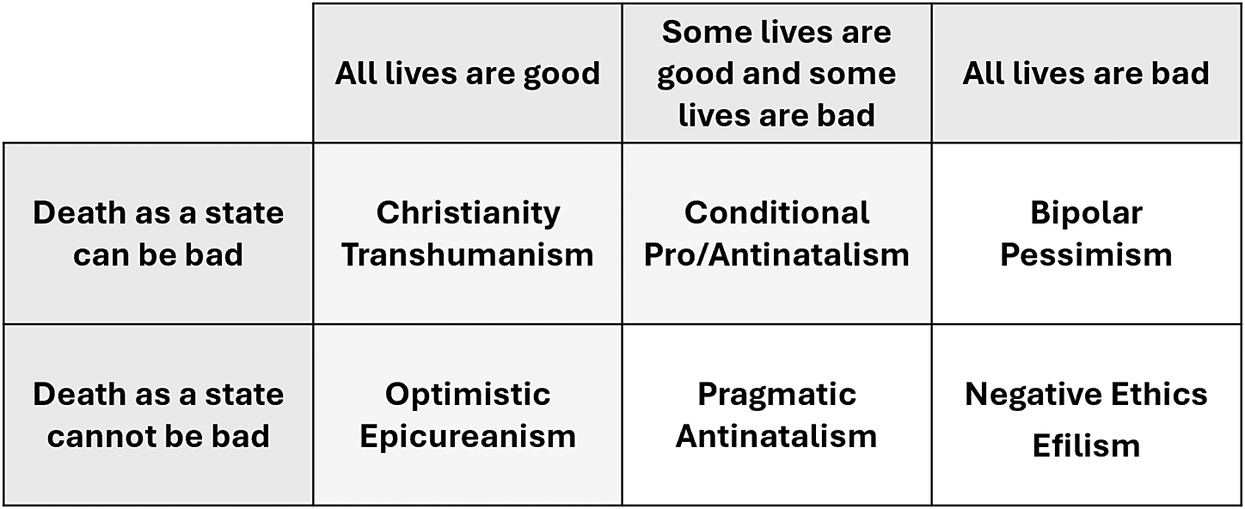
Bipolar pessimism has it that all lives are bad, and death as a state can be bad. The logical alternatives to this are that all lives are good or some lives are good and some lives are bad, and that death as a state cannot be bad. Figure 1 presents the options in a schematic form.
A taxonomy of views on the value of lives and death.

Figure 1. Long description
The matrix has two rows and three columns. The top row labels columns from left to right as All lives are good, Some lives are good and some lives are bad, and All lives are bad. The leftmost column labels rows from top to bottom as Death as a state can be bad and Death as a state cannot be bad. The cell at row one column one contains Christianity and Transhumanism. Row one column two contains Conditional Pro or Antinatalism. Row one column three contains Bipolar Pessimism. Row two column one contains Optimistic Epicureanism. Row two column two contains Pragmatic Antinatalism. Row two column three contains Negative Ethics and Efilism.
When all lives are believed to be good (the left-hand column), there are no directly existence-related grounds for opposing reproduction. Christianity, transhumanism, and optimistic Epicureanism are, therefore, unlikely candidates for antinatalism. Their presence in the grid serves as a reminder of the alternative that life can be seen as a literal or figurative gift from God or Mother Nature, to be cherished despite adversity and setbacks.
In Figure 1, the concepts of good and bad are not defined in terms of pleasure and pain, or happiness and suffering. To avoid unwarranted species exceptionalism, the relevant criterion must be something more distinctly human. Possible candidates include the absence of cosmic meaning, the hegemonic nature of human relationships, and the injustice inherent in the distribution of misery and bliss.
Conditions lead to selective births
Some people see their lives as good, others as bad. If we abide by the liberal rule that individuals are the best judges of their life’s value, then it follows that some lives are good and some are bad. This much is uncontroversial—but then comes the twist. If we can predict which lives are likely to be judged bad by the ones living them, why not prevent those and allow only the ones likely to be judged good? Conditional antinatalism would remove the need for a wholesale ban on human births.
At this point, the second variable of Figure 1 becomes crucial. The defining feature of death as a state is non-existence. The same applies to not being conceived: it, too, is a form of non-existence. Advocating births when life is expected to be good seems to rest on the idea that non-existence is, at least in some cases, worse than existence. The resulting view seeks to prevent some births but promote many others—so many, in fact, that selective pronatalism might be the better name for it. And since the selection would probably follow eugenic, ethnic, or political lines, the social consequences would be dire.
The false promise of axiological asymmetry
Benatar avoids the trap of conditional or selective pronatalism by appealing to the principle of axiological asymmetry. Applied to birth, it holds that while we have a negative duty not to bring bad lives into existence, we do not have a positive duty to bring good ones into being. If accepted, the principle supports the right not to have children against one’s will—but it does little to justify antinatalist choices or policies. It still grants us the right to have children with predictably good lives, if that is our choice.
Since axiological asymmetry only gets us as far as procreative autonomy, the antinatalist work in Better Never to Have Been rests on the assumption that all lives are bad. Or, as Benatar puts it, that “even the best lives are very bad”—regardless of what those living them may think. To prevent this from escalating into full-blown pro-mortalism (“Why don’t we kill ourselves, then?”), Benatar completes his bipolar pessimism by invoking the backstop: death as a state is also bad.
Negative ethics and limited pro-mortalism
Julio Cabrera’s negative ethics holds that suicide may be the right choice when driven by a morally serious reason. In a hedonistic or sentiocentric framework, the mere prevention of further suffering could suffice. Cabrera acknowledges that even if we refrain from procreation, we inevitably cause harm to others simply by living. In a Benatarian framework—if not for the prejudice against death—that might already justify a collective exit.
Does Homo sapiens have a moral duty to go extinct, then? The idea has been defended by Les U. Knight in his voluntary human extinctionism and Patricia MacCormack in her ahumanist philosophy.Footnote 41 , Footnote 42 Others have seen such a requirement as excessive. For Cabrera, the question does not arise: his axiology is not grounded in measurable pleasures and pains. For Benatar, in his sentiocentric guise, it does—but the “death is bad” clause of bipolar pessimism blocks the conclusion by establishing a presumption against suicide and euthanasia. Whether this presumption outweighs the imperative to reduce suffering is another matter. In practice, Benatar’s responses seem to rest on shifting, case-by-case judgments.
Eliminating suffering, eliminating life
Other versions of antinatalism discard the presumption against taking life as a religious or conservative hangover from Neo-Thomist and Kantian traditions. This departure from non-consequentialist morality is a defining feature of efilism, a negative utilitarian form of anti-conceptionism and pro-mortalism.Footnote 43 , Footnote 44
Depending on the interpretation, efilism recommends the elimination of either all suffering or all life. The rhetoric of its proponents emphasizes the former, but the name (the doctrine of “life” spelled backwards) suggests the latter. The emergence of sentiocentric efilism is a logical continuation of Benatar’s pessimism, with the bipolarity sidelined due to the implicit pro-lifeness of the “death is bad” view. A reversely biocentric—following the logic, oibcentric—axiology is currently under construction, and under critical discussion, within the online antinatalist community.Footnote 45
In both forms, efilism can advocate more drastic measures than voluntary anti-conceptionism or fetal pro-mortalism to prevent births. Wild animal populations could be reduced by culling reproductive individuals. Pets could be neutered.Footnote 46 As for humans, if life is a harm, its creation could—other things being equal—be prevented even by liberal legislators. Should the use of contraception be legally required? Should early abortion become a legal duty?Footnote 47
Finding limits
Efilism and its Benatarian proto-version suffer from two infelicities: potential misogyny in the choice of examples and inadequate coverage in the assessment of consequences. The first stems from Better Never to Have Been; the second is a later development.
According to Benatar’s bipolar pessimism, early abortion is a pregnant woman’s rational and moral duty—or, as he writes, “I am recommending that she does abort and that she needs excellent reason not to.” And to emphasize his conviction, he adds: “It should be clear that I do not think that there is any such reason.”Footnote 48 Airing this view in a book on antinatalism—and closely related matters, as the case may be—is hardly scandalous. But the fact that the book devotes an entire chapter to this one method of fetal pro-mortalism, while offering no matching analysis of such means of anti-conceptionism as vasectomies, may indicate a bias. Why target pregnant women, of all people? Why not say that sexually active, hetero-oriented men need an excellent reason—a reason that cannot be found—not to have their vas deferens snipped? As things stand, the focus on abortion seems to send a misogynistic message.
Abortion can also serve as an example of inadequately analyzed consequences. This is not a concern for Benatar, who has consistently maintained that his view is not strictly utilitarian. But for purely outcome-driven approaches, the problem becomes apparent in real-world applications. Not everyone will choose abortion, and in such cases, insisting on the recommendation achieves nothing but outraged feelings and lingering misogyny. The same pattern extends more broadly: reproduction could, in principle, be ended by killing all living beings. But since that—the literal eradication of all life—is not a realistic option, the actual outcome would be something else, probably involving an increase in suffering.Footnote 49
Pragmatic antinatalism as an alternative
Neither of the problems encountered by bipolar pessimism and its efilist successors is insurmountable—provided we give up the unrelenting view that all life is somehow tragically bad. We can acknowledge that our existence lacks cosmic value or redeeming meaning and that, given the choice, we might prefer not to live our lives again. But it is not necessary to insist, against many people’s self-assessment, that everybody’s life is bad and unworthy of living. For antinatalist purposes, it suffices to observe that some lives are bad and that, in creating new ones, we cannot guarantee their value.Footnote 50 , Footnote 51
Pragmatic antinatalism recognizes that life can be good or not, but denies that non-existence could be bad, either after death or before birth. Its place in Figure 1 is bottom center, between optimistic pronatalism and negative ethics or efilism, and below conditional pro- or antinatalism. The Epicurean premise that non-existence cannot be bad pre-empts all future-individual-regarding arguments for procreation: no one benefits from being born or resurrected. Every time we bring someone into existence, we risk giving them a life that is, for them, bad or even intolerable. To avoid that risk, we should abstain from having children.Footnote 52 , Footnote 53 Simple and effective—but it must be emphasized that this is not the view advocated by Benatar or other bipolar pessimists.
Practical implications
Figure 1 outlines three unconditional variants of non-sentiocentric, human-focused antinatalism. Each treats anti-conceptionism as a rational and moral duty: people would need excellent reasons to conceive a new individual, and such reasons are unavailable. Their stance on fetal pro-mortalism depends on when they believe morally protectable human life begins. If moral status begins at conception, then no birth prevention beyond minipills can be justified. If self-awareness—or psychological personhood—is the criterion, then even infanticide might be permissible in principle. Various other thresholds lie in between.
The differences between these views stem from their positions on the value of existence. Bipolar pessimism, negative ethics, and efilism (the right-hand column of Figure 1) hold that all lives are bad, which exposes them to the question: “Why don’t you end it, then?” Benatar appeals to death’s badness as a state to resist this implication; Cabrera insists that moral reasons must guide any decision of ending one’s life; and efilists—like anyone else—can cite the psychological burden of making such a decision. Pragmatic antinatalists, by contrast, are not committed to the view that their own lives are bad, and so need not confront the challenge at all.
Letting go of the sentiocentric extension
While sentiocentrism is bracketed in Figure 1, it remains a natural axiology for antinatalism. If life is painful, we have a strong reason not to create more of it. Unfortunately, the opposite also seems to hold: if life is pleasant, we appear to have reason to create more of it. Perhaps not enough reason to make procreation obligatory—that much of the axiological-asymmetry thesis may be right—but enough to make it permissible. Especially if the absence of pleasure—or the frustration of other interests—renders death a state bad, then comparisons become unavoidable. And those comparisons yield uncertain results.
This is why the most coherent context for Benatar’s bipolar pessimism could be a non-hedonic, human-focused antinatalism, expressed in practice as advocacy for anti-conceptionism and—perhaps indirectly—fetal pro-mortalism. A focus on pain and pleasure complicates decisions around later terminations: how bad would the life be, how bad the death, and where would the net value settle? Benatar leans toward a presumption against killing, but in a sentiocentric framework, its limits are hard to define. The more manageable solution could be to let go of the sentiocentric extension.
Acknowledgments
The research was supported financially by the Ministry of Agriculture and Forestry of Finland, project decision VN/2470/2022 “Justainability.” This research work has received funding from the Horizon Europe, PathFinder European Innovation Council Work Programme under grant agreement No 101098722. Views and opinions expressed are, however, those of the author/s only and do not necessarily reflect those of the European Union or European Innovation Council and SMEs Executive Agency (EISMEA). Neither the European Union nor the granting authority can be held responsible for them.

 Open access

