


Introduction
At the end of the nineteenth century in Europe, Romani people faced racism, social control and limited social integration within both urban and rural contexts. “Gypsies” fell behind in “social progress,” according to official national discourses that attributed traits of itinerancy and barbarism to Romani people and that claimed they were incompatible with modern society.Footnote 1 During the same period, economic, social and cultural modernization efforts transformed not only the labor market, but also available modes of transportation and communication. As European migrations across the Atlantic reached new levels, more than ten million people arrived in Latin America.Footnote 2 Unsurprisingly, many Roma came to view transatlantic migration as one possible response to the complex social conditions they faced. Like other Europeans, they undertook this journey in search of new opportunities, which they occasionally found in the Americas.
Between 1900 and 1950, numerous Romani families – mostly associated with Sinti, Manouche and Roma subgroups – immigrated from Central and Southern Europe. Although many families went to the United States in search of new opportunities, many others tried their luck in Latin America.Footnote 3 They arrived by sea, mainly to ports in Argentina, Chile, Brazil and Uruguay; they came from Italy, Greece and Spain on ships that connected the two continents. Their journey was not as simple as buying tickets, which was already complicated in economic terms; they also faced immigration policies, port controls and maritime inspections that regulated access to the receiving countries on the other side of the Atlantic.
Argentina serves as a prime example of this, as its immigration control policy had been harshly enforcing exclusion criteria since the middle of the nineteenth century. In addition, it had become the final destination for many families who had previously passed through other countries on the continent. One instance of this involves the case of the Serbian Stankovich family, who traveled between Europe and Argentina during the second half of the nineteenth century.Footnote 4 In Chapters 5 and 4 respectively, in this volume, Louis Takács and Adèle Sutre analyze the cases of the Stevanovich and Montes families who traveled to several countries – including Puerto Rico and Cuba – before settling in Argentina.
I will approach the discrimination of Gitanos in the migratory processes between Europe and Argentina from several vectors of analysis. Late-nineteenth through mid-twentieth-century histories will contextualize the reports produced by the Departamento General de Inmigración between 1891 and 1947.Footnote 5 These reports include the prior legislation that was still enforced as well as statistical and quantitative data on newly arrived immigrants. The legal texts came from the Immigration and Colonization Law of 1876, enacted during the government of President Nicolás Avellaneda to regulate immigration to Argentina. The statistical data details place of origin, sex, age, profession, ethnic affiliation, health status, disability, religion and political affiliation. Although scholars have increasingly carried out research on passengers identified as Gitanos among the maritime immigrants to Argentina, a deeper analysis is necessary to understand how the conceptualization of Gitanos as undesirable immigrants intersected with Argentina's immigration policy to produce the denial of their entry.Footnote 6
Beginning in the late nineteenth century, moralistic, eugenic and hygienist discourses spread across the Atlantic and decisively influenced patterns of antigypsyism. Throughout Latin America, not just in Argentina, authorities concerned about the racial characteristics of their nation applied these discourses in particular ways to immigrants. Authorities considered new immigrants in the context of official opposition to miscegenation, their concerns about the presence of Indigenous peoples (whom they considered inferior) and the consolidation of national projects founded on notions of social progress.Footnote 7 This chapter will focus on these issues as a necessary prologue to an analysis of the Argentine rejection of Gitano immigrants, based on the latter’s preliminary identification as an undesirable population in the contemporary immigration process.
This chapter is organized into several sections. In the first, I will briefly review the literature related to the transatlantic immigration of European Gitanos to Latin America. The second section, which deals with Gitano immigration to Argentina, is divided into two parts. First, the evolution of Argentina’s migratory policies will be placed within transatlantic and nationalist frameworks to reveal Argentine attitudes toward race and integration. I will then address the rejection of Gitanos based on the criteria established in the immigration reports. Analysis of these reports will result in an assessment of Gitanos who were refused entry between 1900 and 1950. Finally, the conclusion will summarize the key findings and identify possible roadmaps for future studies. This chapter will show that the classification criteria for accepting or denying immigrants into Argentina influenced Romani immigration on the basis of their ethnic condition, thus reinforcing antigypsyism on both sides of the Atlantic Ocean. I argue that, as a consequence, studies of Romani immigrants should be centered around the logics of their identification.
Fear and Rejection of the Undesirable
Histories of migration and mobility have been approached from many different perspectives. However, the recognition of Romani subalternity requires these histories to respond to their pending debts. Paradoxically, although “Gypsies” have been studied through the clichéd lens of nomadism, historians have seldom concerned themselves with addressing Romani migration, one of the most significant expressions of mobility among human groups in general. Although some scholarship has been published in this regard within the last decade, there is still a lack of research in relation to migration flows – specifically to Latin America – prior to the second half of the twentieth century. For example, Eszter Varsa shares an illustrative reflection made by Martin Fotta, who “argued for the inclusion of the Atlantic space in talking about Romani migration. Not only because Roma were present in Central America before they had reached certain parts of Europe but because this location would enable a comparative perspective on Roma in relation to other racialized groups.”Footnote 8 Fotta has pointed out that the marginalization and social rejection of Romani people in the Americas were not a simple transposition of European experiences. Rather, they were part of a process of interaction that can help us better understand antigypsyism as a transnational phenomenon. The case of Argentina in particular was studied in a similar sense more than a decade ago by Polish historian Aleksandra Pudliszak, on whose research my own work builds.Footnote 9 Yet Argentina is not an exception; it is one of many examples of the transatlantic nature of Romani migrations.Footnote 10 Therefore, in presenting this case, this chapter widens the scope of Romani studies by expanding its transatlantic perspective. In so doing it raises new questions and considerations about transatlantic Romani experiences.Footnote 11
It is worth noting the importance of antigypsyism in relation to Romani migrations from the end of the nineteenth century. Fear, rejection and the marginalization of Romani people have underpinned much of the discrimination against them. Because Roma have been associated with heresy, immorality, crime and delinquency in all its forms, they have become scapegoats of the state and individual citizens. Discrimination against Roma is a transversal phenomenon: frequently, those who share social problems and challenges with Romani people discriminate against them more harshly.Footnote 12
For the above reasons, an analysis of the immigration reports produced by the Argentine government between 1891 and 1947 requires a novel approach to archival sources. Romani anthropologists Iván Periáñez-Bolaño and Cayetano Fernández have analyzed the negative social position of Gitanos in relation to colonial narratives that connected the Romani population to barbarism, anti-progress and disorder.Footnote 13 These narratives have influenced issues ranging from the social control of Gitanos to the limits placed on academic research studying these communities in their own historical contexts. In this respect, I will depart from the construction of the concept of “Gitano” as a sociological category imagined in response to a need to control undesirables. A consideration of the fears of the Argentine government and the attitudes authorities adopted during immigration processes reveals an established a priori mechanism to deal with Gitanos who faced prohibition only by being identified as such. These immigration reports filtered the colonial experience of Argentina’s new nation-building project, which discriminated among immigrants and thus affected Gitanos. Doing so should help us develop a counternarrative through the historical reconstruction of who the Gitanos were, by going beyond a straightforward reading of the documentation created by the same power structures that classified them, rejected them and consequently contributed to the propagation of antigypsy stigmas and social panics. At the same time, adopting a bottom-up social history approach to immigration processes can help us understand how the receiving countries constituted themselves as part of these processes. It also provides us with a new perspective through which to observe the people who undertook the adventure of crossing the Atlantic in search of a better life.
Protect the Nation, Control Immigration
Argentina promoted immigration throughout the second half of the nineteenth century, intending to combat depopulation in the interior and attract workers who could boost the labor market.Footnote 14 At the same time, the country’s immigration policies aimed to nationalize these immigrants and place them at the service of a nation hoping to establish itself as a world power.Footnote 15 The elites promoting this project, however, did not believe this objective should be fulfilled at all costs; authorities took parallel measures to control immigration that were largely influenced by race science and eugenics. Eugenic discourses in Europe gained strength throughout the nineteenth century in the face of the postulates of Social Darwinism. Broadly speaking, this ideology contributed to the belief that society was made up of fit and unfit individuals.Footnote 16 Ideas related to eugenics were rooted in Spain, which ruled Argentina until the beginning of the nineteenth century and whose cultural impact continued throughout the century.Footnote 17 And the Romani population, which represented the most prominent ethnic minority in the Iberian Peninsula, inevitably had to face the results of eugenicist assumptions.Footnote 18
The formative period of eugenic thought began at the end of the nineteenth century and peaked during the interwar period. Beyond the Spanish colonial influence, the Catholic Church also impacted the evolutionist and biological approach on both sides of the Atlantic.Footnote 19 As Eduardo Lautaro Galak points out, two issues must be taken into consideration in the Argentine case. On the one hand, a certain equivalence was established between eugenics and race, thus promoting discourse on racial progress. On the other hand, as opposed to Nazi eugenics that focused on violently eradicating the procreative abilities of those deemed inferior, Argentine eugenics promoted the procreation and perpetuation of a healthy and desirable society whose members embodied recommended aptitudes, such as avoiding delinquency and vagrancy. Such plans were inspired by the proto-criminology of Cesare Lombroso. Nevertheless, in certain cases, especially later in the twentieth century, this did not prevent Argentine eugenics from becoming more closely related to the Nazi model, as seen with the sterilization of prisoners.Footnote 20 In any case, the backdrop is that there was a project to create a white Argentina. This project was not hidden at any time, but on the contrary, it was decisively undertaken with the aim of wiping out the Black and Indigenous populations.Footnote 21 It also influenced migratory controls of the late nineteenth century. It pushed the authorities to classify and prevent the entry into Argentina of those deemed socially undesirable, which thus preemptively managed the progress of the white race and the Argentine nation. Such management considered factors such as one’s medical condition, type of work performed or ethnicity, as we will see below. This can be observed especially in maritime immigration, since ports were the first places where immigrants were screened and assessed regarding their ability to appropriately enrich the nation and thus gain entry to the country.
As Sergio Caggiano argues, all immigrants who arrived in the mid nineteenth century were affected by the “white Argentina” project, where “racism hidden in plain sight” prevailed.Footnote 22 As Caggiano explains, the modern Argentine nation-state suppressed race as a criterion of social classification, precisely to homogenize the culture and establish the narrative of “white Argentina.” What was hidden was the desire to disintegrate and eliminate the cultures, customs and languages of immigrants, as well as of Indigenous and Black people already in the country.Footnote 23 Despite the intention of avoiding racial categorization, these processes of segregation, “invisibilization” and even “barbarization” led to the marginalization and misery of Indigenous and Black people.Footnote 24 Whites even used violence to manage these “Others,” as seen with the massacre of gauchos and Indigenous people by the politician and military man Domingo Faustino Sarmiento in the 1860s. This was later repeated by former President General Julio A. Roca, who led campaigns of conquest toward the interior of the country to extend economic and political power over places where Indigenous resistance prevailed.Footnote 25
Gitano immigrants arrived in the second half of the nineteenth century to an Argentina shaped by these conditions. Not only did they encounter immigration policies structured to facilitate the entry of desirable immigrants, but they faced a differential treatment based on other “races” that already populated the national territory. Immigration control was also influenced by hygienist precepts that sought to protect the nation. The authorities in charge of migratory control worked to avoid the spread of diseases – such as the highly contagious cholera and typhus – as well as vices – such as vagrancy or public disorder. This effort affected Gitanos, who were still portrayed as vagrants and delinquents as well as bearers of diseases they spread through their supposedly incorrigible nomadism.Footnote 26 In this context, immigration authorities treated Gitanos with greater suspicion by associating them with such diseases, even though there was no mention, as we shall see, of sick people among Gitano families who arrived in Argentina.Footnote 27 In this regard, Romani migrations instilled fear and reinforced the negative image of “Gypsies” as dangerous people doing evil throughout the Atlantic world.Footnote 28 In Argentina specifically, the government’s preemptive measures, including port control and the direct identification of Gitanos, prevented their entry with the aim of avoiding those situations that other countries feared, or which the government itself portrayed as threatening.
In the case of Argentina, two phases can be identified in relation to Gitano immigration. In the first phase, Gitanos were not identified as a distinct group; in the second, after 1911 they began to be identified as such. Why the shift in identification, and why were they not identified before? The reasons probably lie in the resurgence of hygienism, as well as nationalist and eugenicist circumstances. During the first phase, under the presidency of Nicolás Avellaneda between 1874 and 1880, the Immigration and Colonization Law of 1876 was enacted. This law, which established regulations regarding immigration and the distribution of immigrants within the nation, proposed favoring immigration to attract labor, especially farmers, but not at all costs. The law forbade ships from transporting the diseased, beggars, criminals, convicts and workers over sixty years old.Footnote 29 According to Article 32 of this law, all those deemed unfit would be deported immediately upon arrival and returned to their ports of origin.Footnote 30 The fundamentals of the 1876 law prevailed in the following decades, when the country’s industrialization and economic development demanded more workers. At the same time, managing the arrival of immigrants fleeing conflicts, wars and famine in Europe remained imperative. In other words, hygienism and the desire to strengthen the nation under specific precepts contributed to tightening Argentina’s already restrictive immigration requirements.
The first report made after the 1876 law that helps frame Gitano experiences, the Report of the General Department of Immigration of 1891, expresses how immigration should serve to improve the demographic conditions of the interior. For this reason, it assigns the largest contingent of workers to these areas.Footnote 31 Fifteen years after the publication of the Immigration and Colonization Law of 1876, the goal remained the same: to promote the growth and improvement of the Argentine nation. Although nothing is said explicitly about Gitanos in this report, nor about discrimination criteria, it does call attention to the need to prevent Europeans with no motivation for work from settling in Buenos Aires, as doing so could generate pockets of poverty among immigrants: “The European villager who stops in the capitals, becomes a consumer, a hoarder, sometimes a businessman skilled in making money, with as much business as he can, and sometimes a victim of poverty.”Footnote 32 The reports that followed, made between 1892 and 1910, provided nothing more than statistical data, although they did emphasize the need to control the arrival of sick people. However, the 1909 Report of the Dirección de Migración mentions that “1,168 permits were granted to enter the country to people whose condition was: sexagenarians, infirm, crippled, deaf and dumb, mute, visually impaired, blind, paralyzed and retarded.”Footnote 33 As stated in the report, they had been allowed to enter despite the fact that “at first sight they were considered a public charge.”Footnote 34 Though unfit for work, they had working families to take care of them and, most importantly, their medical condition could not lead to contagion. In these cases, no eugenic discourse on migration issues appeared.Footnote 35 Thus, until 1910, Gitanos had perhaps been able to travel without any issues, since no racial criterion obliged their identification. The data collected in Table 6.1 reveal Argentine authorities’ prime concern with contagious disease and disability as criteria for immigrant rejection in these years.
| Causes | 1908 | 1909 | 1910 |
|---|---|---|---|
| Trachomatous | 7 | 11 | 21 |
| Tuberculous | 9 | 6 | 8 |
| Insane | 14 | 10 | 6 |
| Syphilitics | – | – | 1 |
| Invalids | 3 | 2 | 1 |
| Blind | 3 | 2 | 1 |
| Sexagenarians | 10 | 7 | 11 |
| Total | 46 | 38 | 49 |
Gitanos as a Paradigm of Undesirable Immigration
May 1910 marked the 100th anniversary of the May Revolution, an important phase of Argentine independence. The centennial celebrations, combined with worker discontent, provoked Argentine elites to demonstrate national legitimacy, especially to European audiences, by emphasizing the nation’s whiteness. Although racism had been common in Argentina throughout the nineteenth century, especially toward Indigenous, Black and Afro-descendant people, a new phase of racist reasoning emerged in the 1910s. Previously, white Argentine elites marginalized Black laborers and even wanted them to disappear.Footnote 36 This was similar to the experiences of the Mapuches and Tehuelches, who had experienced racism as part of Spanish colonial domination and remained impacted by daily interethnic relations with the new settlers.Footnote 37 The project of whitening the nation and extinguishing Black and Indigenous people did not stop in this later period. Estanislao Zeballos, Minister of Justice and Public Instruction in 1908, stated while visiting Harvard University that it was “worth remembering the favorable situation that in Argentina the inferior races, Indians and Blacks, had been almost extinguished during the first century of independence.”Footnote 38 Shortly afterwards, in 1913, Joaquín Víctor González, Zeballos’ successor and later a senator, pointed out “that the country [had] long ago eliminated the degenerative and unadaptable components, such as the Indigenous and the Black … owing to the European race, pure by origin and pure by selection.”Footnote 39 In other words, explicit racist and eugenic discourse was evident in Argentina on the eve of World War I.
In 1911, two years after the report discussed in the previous section, the Gitano population was first identified in immigration records. The data appeared in the Memoria de la Dirección General de Inmigración de 1913, which gathered statistical information on immigrants arriving in Buenos Aires during the previous two years. When Argentine port authorities first identified Gitanos, those coming mainly from Eastern Europe were mentioned.Footnote 40 The evidence is not sufficient to conclude whether Gitanos identified themselves as such to authorities, or rather, if authorities judged individuals as Gitanos based on preconceived assumptions. Considering the previously described processes and discourse, few would have welcomed Gitanos to Argentina at the time. White elites considered them “underdeveloped” and racially inferior, similarly to Blacks and Indigenous people, two groups they bragged about eliminating.
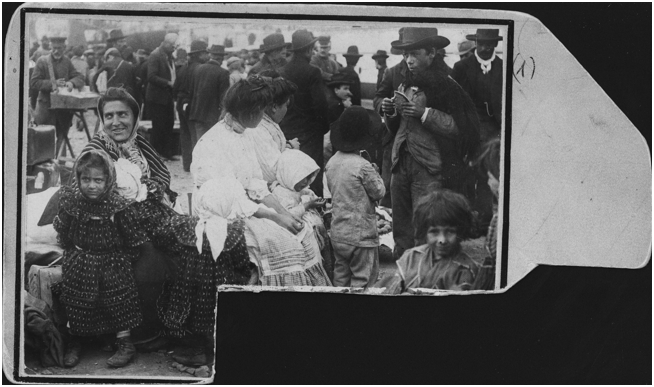
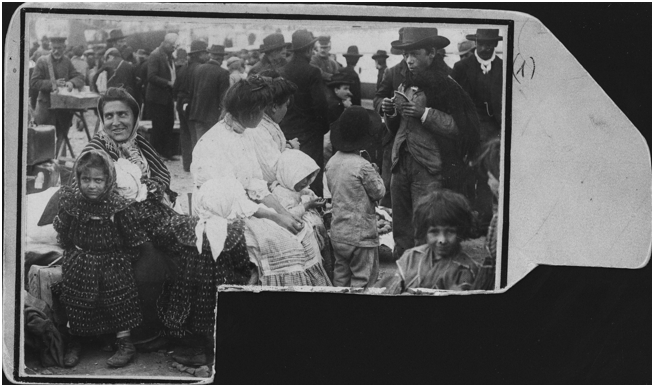
In these two years, médicos de inmigración (immigration doctors) inspected the sick and identified Gitanos on board the ships. They included this information in the maritime inspection reports compiled at the port before passengers disembarked.Footnote 41 This was aimed at preventing suspect individuals from crossing the port borders. They remained on the dock waiting to be returned, as is shown in Figure 6.1, a photograph taken in the port of Buenos Aires. The 1913 report claimed that “the intervention of the employees of the Oficina de Desembarco (Bureau of Landing) was decisive” in preventing undesirable passengers from crossing the border.Footnote 42
Against the backdrop of racism toward Indigenous peoples and people of African descent, only Western Europeans were considered to be desirable immigrants, not Africans, Asians or even Eastern Europeans.Footnote 43 In addition to ethnicity and geographical origin shaping Gitano immigrants’ acceptability for entrance into Argentina, so did prejudices about their assumed delinquency and vagrancy. The latter became criteria that allowed discrimination at arrival. This prejudiced perception of Gitanos influenced, for example, the Memoria de la Dirección General de Inmigración correspondiente a los años 1914–1915 (Report of the General Directorate of Immigration for the years 1914–1915), which stated the following:
The President of the Argentine Nation establishes that they will be considered as:
(a) Physically defective and therefore unfit for work: the blind, the deaf-mute, the paralytic, and those without functioning limbs (both arms, the right arm, both legs) or other vice or defect that diminishes their ability to work.
(b) Insane: idiots, imbeciles, epileptics and those affected by any form of mental disorder.
(c) Beggars: those who had practiced begging in the country of origin, single women with children under ten years of age, Gitanos and other individuals likely to be in the care of public charity.Footnote 44
Those who fell into any of these categories were to be “included in the provisions of article 32 and therefore returned to their port of origin, and the captain subject to the payment of the fines established in article 35 of the law.”Footnote 45 In other words, even Gitanos without disabilities or noncontagious diseases were not allowed to enter. In addition, the fines imposed on boat captains were intended as a deterrent. Forcing increased inspection of vessels could better help to identify such travelers and prevent them from even boarding ships destined for Argentine ports. However, the most interesting thing to note is that the Roma were seen as beggars, with a tendency to live on public charity. Therefore, the Argentine state intended to protect Argentine citizens from accepting this public charge.Footnote 46 In relation to this, Article 32 of the Immigration and Colonization Law of 1876 should be taken into particular account. Although this article only discussed beggars and did not specify Gitanos within this category, it is logical to think that it also affected them. For centuries, Gitanos had been associated with begging and delinquency, but the idea of Gitanos as a specific type of more dangerous beggar was increasingly gaining popularity at the end of the nineteenth century. They were considered a genuine underclass of unworthy poor who were susceptible of becoming a public burden.
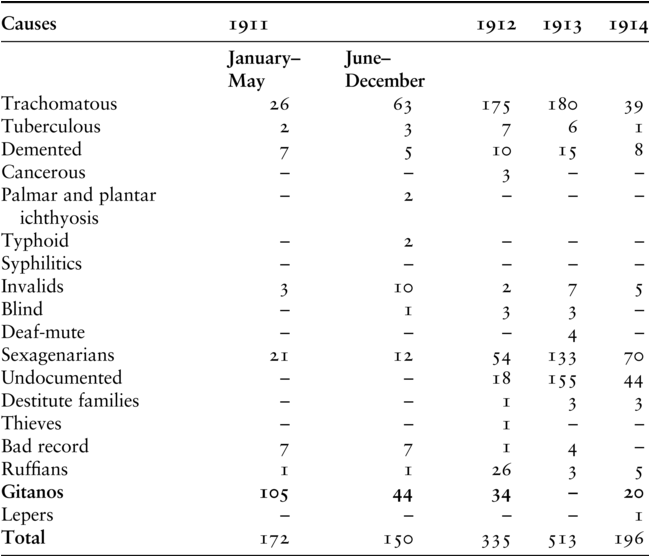
Sanitary prophylaxis in migratory controls also affected Gitanos, who were seen as dirty, lacking in good hygiene habits and able to spread contagion due to their itinerancy.Footnote 47 In this sense, the typhus and cholera epidemics in Argentina probably had a negative influence on the public perception of Gitanos, who already carried these associations with them.Footnote 48 The promulgation of the Law of Social Defense of 1910 could not have had positive results for the Roma either. The legislative apparatus for this law, which was intended to reinforce the objective of achieving a “white Argentina,” was intensified, in part, because the Roma phenotype did not generally coincide with that marked by whiteness. Fear and rejection of the Other resulted in punishments and prohibitions directed toward undesirable would-be immigrants.Footnote 49 As a consequence, numerous Gitano families were identified on ships between 1911 and 1915. They arrived in Buenos Aires and, once inspected, were sent back to their ports of origin in Europe. The Memoria de la Dirección General de Inmigración correspondiente a los años 1914–1915 (Report of the General Directorate of Immigration of the years 1914–1915) includes some statistics in this regard as detailed in Table 6.2.
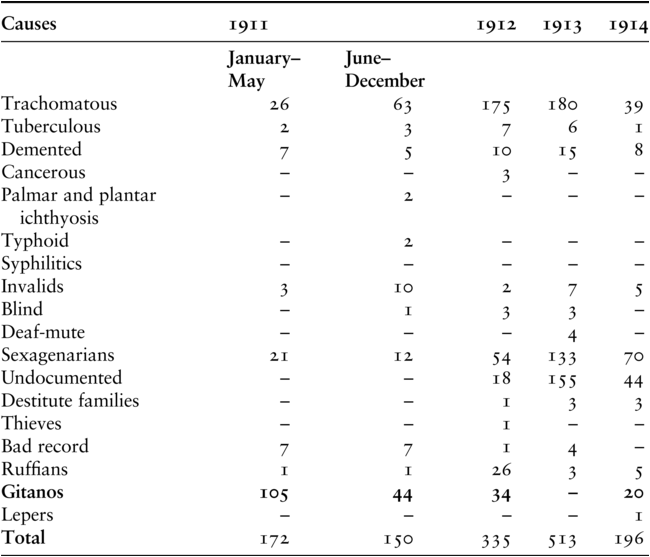
Table 6.2 Long description
The table consists of six columns in total. The first column header is titled, Causes. This is followed by five data columns. The first two data columns are headed January forward slash May and June forward slash December, respectively, both appearing under the year 1911. The remaining three columns correspond to the years 1912, 1913, and 1914.
Trachomatous: 26, 63, 175, 180, 39.
Tuberculous: 2, 3, 7, 6, 1.
Demented: 7, 5, 10, 15, 8.
Cancerous: dash, dash, 3, blank, blank.
Palmar and plantar ichthyosis: blank, 2, blank, blank, blank.
Typhoid: dash, 2, blank, blank, blank.
Syphilitics: blank for all.
Invalids: 3, 10, 2, 7, 5.
Blind: dash, 1, 3, 3, blank.
Deaf-mute: blank, blank, blank, 4, blank.
Sexagenarians: 21, 12, 54, 133, 70.
Undocumented: blank, blank, 18, 155, 44.
Destitute families: blank, blank, 1, 3, 3.
Thieves: dash, dash, 1, blank, blank.
Bad record: 7, 7, 1, 4, blank.
Ruffians: 1, 1, 26, 3, 5.
Gitanos: 105, 44, 34, blank, 20.
Lepers: blank, blank, blank, blank, 1.
TOTAL: 172, 150, 335, 513, 196.
These reports do not specify on what basis these persons were identified as Gitanos. They are documented as such in maritime inspection reports issued by ship captains, but whether or not they self-identified as Gitanos is unknown. My own research reveals that the records from those years only mention Romani passengers aboard the ships Re-Umberto, Silvia, Formosa, Parana, Cap. Arcona and Ravenna, and who were subsequently returned to their ports of departure in Italy, Spain or France. However, it is likely that other ships also transported Gitanos, but their records never survived in the archive. It is also noteworthy that the countries of origin of the known Gitano passengers – typically Austria, Serbia and Bulgaria – differed from the ports or countries from which they departed.
Furthermore, there were Gitano families that obtained other nationalities during the immigration process, such as French and even Mexican.Footnote 50 As shown in Table 6.2, about two hundred Gitanos were identified and returned to their countries of origin between 1911 and 1914. This constitutes a very small percentage of the hundreds of thousands of people arriving each year at the port of Buenos Aires. Although it is impossible to quantify how many Gitanos arrived in Buenos Aires, those who were identified as such were rejected.
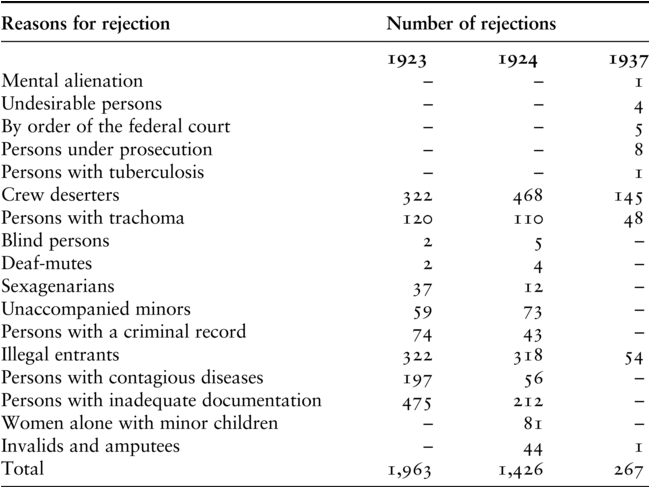
In the following years, the legislation did not change, but the nature of reporting did. According to reports from the years 1923, 1924 and 1937, Gitanos no longer constituted a category as they had for the 1911–15 period. Perhaps this change was connected to the anti-Jewish and anti-labor government of Hipólito Yrigoyen (1916–22).Footnote 51 This new Argentine political orientation may have limited the country’s desirability as a destination for Gitanos. Concern that they may have been perceived as revolutionary agents, anarchists or Bolsheviks from the recently created Soviet Union in 1922 may also have prompted them to make other migratory choices. Alternatively, they could have developed effective passing strategies to enter undetected.Footnote 52 Most likely, Gitanos who continued to arrive were simply no longer recorded as such, being included instead into broader categories such as “undesirable persons” or “illegal entrants” (people sneaking onto ships as stowaways) or identified as caldereros (tinkers), a trade considered typical for Gitanos. The 1923, 1924 and 1937 reports are contained in Table 6.3.
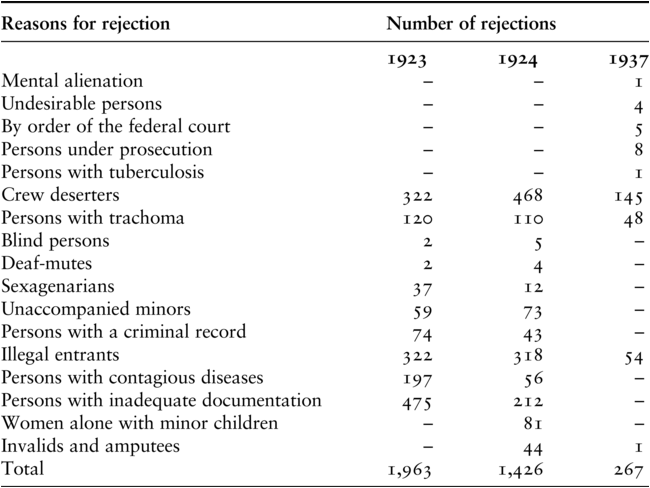
Table 6.3 Long description
The table includes two columns labeled Reasons for Rejection and Number of Rejections which is further categorized into years 1923 and 1924. The data breakdown is as follows.
• 1923. Mental derangement blank. Undesirables blank. Federal justice disposition blank. One-armed blank. Prosecuted blank. Tuberculous blank. Deserting crew members (first entry) blank. Trachomatous 120. Blind 2. Deaf-mute 2. Sexagenarians 37. Minors without family 59. With a bad track record 74. Clandestine 322. Deserting crew members (second entry) 675. Infectious diseases 197. With insufficient documentation 475. Single women with minor children blank. Disabled blank. TOTAL 1963.
• 1924. Mental derangement blank. Undesirables blank. Federal justice disposition blank. One-armed blank. Prosecuted blank. Tuberculous blank. Deserting crew members (first entry) blank. Trachomatous 110. Blind 5. Deaf-mute 4. Sexagenarians 12. Minors without family 73. With a bad track record 43. Clandestine 318. Deserting crew members (second entry) 468. Infectious diseases 56. With insufficient documentation 212. Single women with minor children 81. Disabled 44. TOTAL 1426.
All the above coincided with a complex European political scenario that by the 1930s was impacted by the rise of totalitarianism and the Great Depression. Mussolini’s rule in Italy hindered the maritime departure of Gitanos, many of whom had traveled there from countries like Romania and Hungary, with intention to emigrate. Fascist policies shaped European migration, especially for those economically and administratively deprived, such as Gitanos. According to Leonardo Senkman and Mónica Quijada, immigration policy in Europe had been tightening since the 1920s, which discouraged workers from migrating due to racial and ideological reasons.Footnote 53 This reduced their ability to relocate to Argentina in search of work and a life free from stigma.
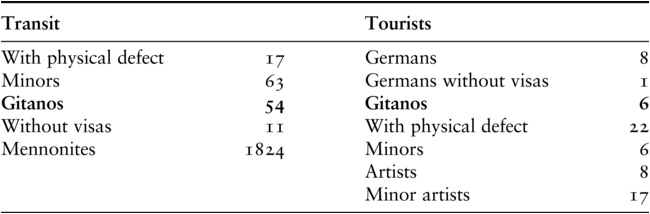
It was not until the end of World War II, after the intensification of persecution that resulted in the genocide of the Sinti and Roma during the Holocaust, that Gitanos were again identified as passengers on ships departing to Argentina. This new attempt to flee Europe after the war was most likely motivated, at least in part, by knowledge of those who had managed to successfully settle in the Americas.Footnote 54 However, during the first government of Juan Domingo Perón (1946–55), immigration officials once again rejected Gitano immigrants; the law had not changed, and neither had negative attitudes toward the Romani population. According to the final immigration report issued in 1947, although World War II had paralyzed migration, after its end Argentine authorities successfully encouraged the growth of immigration motivated by the desire for more laborers.Footnote 55 Although they emphasized “a moral, humanitarian, and neighborly obligation to help others,” there were limits to this stance.Footnote 56 The report’s authors explained that the 1876 law should be revised because “the country needed immigration, without a doubt, but good immigration.”Footnote 57 This limited welcome undoubtedly affected Gitanos, who were reinstated as a distinctive category both as tourists and during transit in 1947 (Table 6.4).
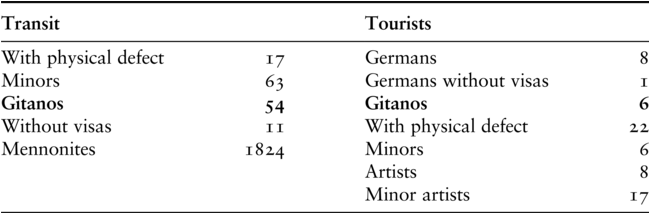
Table 6.4 Long description
The table is divided into two primary categories, Transit and Tourists, with the following numerical data.
Transit.
With physical defect: 17.
Minors: 63.
Gitanos: 54.
Without visas: 11.
Mennonites: 1824.
Tourists.
Germans: 8.
Germans without visas: 1.
Gitanos: 6.
With physical defect: 22.
Minors: 6.
Artists: 8.
Minor artists: 17.
In the decades that followed, Gitanos remained unwelcome in Argentina. The situation only worsened with the rise of social conflicts and new dictatorial regimes during the second half of the twentieth century, none of which brought a positive change to laws affecting the Gitano population.
Conclusions
This chapter has shown that the criteria used by the immigration department of the Argentine government to admit or reject immigrants influenced the ability of Gitanos to enter Argentina. Certain negative ethnic attributes ascribed to Gitanos, such as their itinerant lifestyle or the performance of certain trades, further reinforced their poor image due to the stereotypes and prejudices retained from the past. This fueled existing antigypsyism throughout the Atlantic. When Gitanos were sent back to their ports of origin, the stigma that already weighed on them was reinforced by their status as a population rejected abroad. This contributed to a further deterioration of their social integration in the Americas; they were not wanted on either side of the ocean.
Antigypsyism became even more evident when, in the transition from the nineteenth to the twentieth century, Gitanos were identified in the records as maritime immigrants. In the context of Argentine nation-building, authorities enforced entry criteria, such as ability to work or health conditions, during the same years Gitanos were migrating to Argentina. Although race was not specified among these immigration criteria, racist immigration practices did indeed exist, and Gitanos were at times labeled as an explicit category of people. What remains unclear is whether Gitano migrants who arrived in Argentina from the late nineteenth though the mid twentieth centuries were counted in other categories by immigration officials. Thinking beyond the limits imposed by legislation allows for a consideration of how specific agents (captains, immigration officials, immigration doctors, crew, etc.) identified and affected the trajectories of Gitano migrants, as well as why the categories related to Gitanos changed over these decades. Non-Gitano passengers were allowed entry by passing medical and administrative examinations, while for those identified as Gitanos, ethnicity seemed to be the leading cause of their exclusion. Although the rejection of Gitanos was part of a logic of control that affected the sick, religious minorities and other marginalized people, Gitanos were the only ethnic group specified in Argentina’s migration reports and statistics.
For these reasons, it would be interesting to carry out archival research in reverse order – that is, to examine documentation at the ports of origin to understand how Gitanos were identified there. Determining what criteria were applied to certain individuals at their point of departure that led to their identification as Gitanos in Argentina could shed light on how a person’s status as a Gitano could change during the Atlantic crossing itself. This could have led to overlooking Romani passengers who went unnoticed as such and may have even made possible the paradox of classifying other people as “Gypsies” who were not. In any case, this study of the logics of identification of Gitanos in Argentine ports reveals the stigmatization Romani people faced there as well as the precarity of Romani transatlantic migrations during the early twentieth century.

 Open access