





Introduction
In the stillness of night, fourteen bombs exploded – across the mega-project’s construction offices. It looked like “homemade bombs, about the size of a tin of paint,” according to a Chinese company manager (Yang Reference Yang2012). A resident of a nearby village recalled:
We were sleeping when suddenly—“Donn-nn-nn!” I thought it was just thunder and went back to sleep. The next morning, the Chinese looked terrified. So, I became frightened, too. In the evening, I was taking a bath in the river and saw four–five boats coming, with Burmese soldiers on them. The soldiers told us that our whole village must move out tomorrow.
The Myitsone Dam is the most discussed and researched infrastructure and development project in the history of Burma (Myanmar), as well as an especially often-cited failure of Chinese development-investment abroad. No other village-born movement against resource grabbing under the military dictatorship of Burma has ever “jumped” so many scales and become such an international controversy as the popular resistance against Myitsone Dam. In mid-2011, public outcry within Burma led the then-democratizing government to abruptly suspend the dam’s construction, creating a lasting tension in Burma–China relations.
Existing research tends to focus on the international, Chinese, Burmese, and ethnic Kachin dimensions of the controversy, overlooking the local rural dynamics at the heart of this development conflict. This article shows how the local, village-level resistance laid the groundwork for the broader Kachin and Burmese anti-dam movements and the mega-project’s suspension. Focusing on village perspectives and voices helps us ground this vast international project and controversy in a specific, rural, and repressed place.
Specifically, this article explores what happened before 2011: before the mega-project was suspended and before the local residents were resettled. It makes a case for how local rural histories and specific villages can sway much larger-scale development conflicts, social movements, and international events, yet also shows how much depends on the country’s ruling regime, democracy, and dictatorship.
Locally, the Myitsone Dam was in some ways yet another land grab – one case among countless such land grabs across decades of military dictatorship in Burma, particularly in the post-socialist (post-1988) decades. However, unlike many suppressed cases of land grabs across the country, the Myitsone Dam became an emblem of successful rural resistance. This article tells a rural history of the early, pre-suspension years of the Myitsone mega-project. It thus builds on the ethnographic and political-economic literature in Burma Studies on agrarian change, land grabbing, rural resistance, and rural compliance – specifically during the 1990s–2000s’ post-socialist era, under military dictator Than Shwe (Hudson-Rodd and Sein Htay Reference Hudson-Rodd2008; Malseed Reference Malseed2008, Reference Malseed2009; Okamoto Reference Okamoto2008; Takahashi Reference Takahashi2023; Thawnghmung Reference Thawnghmung2003, Reference Thawnghmung2004). Ethnically and regionally more specifically, this article builds on and contributes to the literature on agrarian change, land grabbing, rural resistance, and rural compliance in ethnic Kachin areas (Dean Reference Dean2023; Doi Ra 2024; Doi Ra et al Reference Doi, Kham, Barbesgaard, Franco and Vervest2021; Faxon Reference Faxon2015; Faxon and Khine Zin Yu Aung Reference Faxon2019; Forsyth and Springate-Baginski Reference Forsyth and Springate-Baginski2022; Kramer, Woods and Armiente Reference Kramer, Woods and Armiente2012; L. Gum Ja Htung 2018; Lahpai Reference Lahpai2016; Roi Nu 2009; Sarma, Rippa, and Dean Reference Sarma, Rippa and Dean2023; Seng Li 2024; Wah Wah and Aung Naing 2023; Wanasanpraikhieo Reference Wanasanpraikhieo2008; Woods Reference Woods2010, Reference Woods2016, Reference Woods2017, Reference Woods2019, Reference Woods2020; Zaw Ban 2018; Zung Ting 2010).
Exploring this story of land grabbing and rural defiance led me to several observations: 1) The village history of the Myitsone project began long before its international prominence, and it continues until now; 2) The village-level narrative includes violence, social divisions, fear, compliance, and life-in-suspension, which contrasts with the often-told story of local and national unity, resistance, and success; 3) Locally, the hydropower project entered a broader and longer wave of land and resource grabs – in the Myitsone area, especially for gold mining; 4) At the village level, people’s land and livelihood concerns were primary, compared to national or environmental concerns; 5) Histories of resistance, repression, and compliance varied greatly across different villages and across different groups of people; 6) Rural resistance and compliance can be quite disconnected from urban politics, and may easily be misread through the ideological concerns of urban elites; 7) The experiences of these villages reflect the broader history of dictatorship and democracy in Burma.
This study combines diverse methods and sources to highlight some lesser-known stories from a specific, rural, and repressed place. I have done ethnographic research among Kachin people since 2010, focusing on ethno-national and environmental struggles, and have lived in Kachin areas altogether for about three years. Partly due to the repressive conditions during fieldwork, I could not spend long periods of time in the Myitsone area itself. To overcome such limitations, this study combines diverse sources: tens of interviews, participant observation, informal conversations, academic publications, theses, activist reports, and journalist coverage. My goal has been to build in my articles a kind of archive of narratives and sources. I did field research, interviews, and media analysis in Kachin Jinghpaw, English, and Chinese languages, without an interpreter.
The article cites interviewees at length – not for claiming that any interviewee has “the correct view,” but for understanding the diverse and contradictory thoughts, experiences, and visions of different people. All interviewees have been anonymized to protect people’s safety and privacy when discussing sensitive topics. The text avoids gender pronouns and contextual information because these social circles are small, and people might otherwise be recognized.
This article is Part 1 of a two-part article series on the rural history of the Myitsone Dam mega-project. It begins by surveying the Myitsone Dam conflict and its research literature. Then, the article traces the Myitsone Dam conflict chronologically, exploring the Myitsone-area residents’ initial encounters with the project, the role of external and internal activism, fear, and violence, and the eventual suspension of the dam’s construction. It concludes by reflecting on distances and scales. The story continues in the Part 2 (Kiik Reference Kiik2025) of this article series.
The Myitsone mega-project
The Myitsone hydropower mega-project was launched amid a military dictatorship, vast natural-resource grabbing, and ethno-political war. Burma is an ethnically diverse country, where the ethnic-majority Bamar (or, Burmese, Burman, Bama) group is about two-thirds of the overall population. The ethnic Bamar nationalist military has ruled Burma in a dictatorship since 1962. Since the Second World War, the Burmese military has clashed against the armed revolutionary movements of Communists, democrats, and more than a dozen ethnic nations (Smith Reference Smith1991). Many of these armed movements have evolved into proto-states that govern certain territories and populations. The Myitsone project’s location in northernmost Burma – between China’s Yunnan, Tibet, and India’s Assam and Arunachal Pradesh – is largely home to Kachin people, a multi-ethnic nation of below a million people. Alongside ethnicity, competing religions shape this place. Almost 90% of Burma’s people are Theravada Buddhists. However, influenced by Western missionaries during the colonial era, Burma’s Kachins are mainly Christians, mostly Baptists and Catholics. During my field research, I have learned that decades of war have led Kachin people largely to distrust the ethnic-majority Bamar people.
Since the early 1960s, people in Kachin areas have lived amid a grinding war between the Burmese military-state and the Kachin Independence Organization (KIO), both of which also seek income from the vast local natural-resource economies. With an army of thousands of soldiers, the KIO has evolved into an ethno-national proto-state that governs various borderland and remote territories and populations (Dean Reference Dean2005). Most Kachins in Burma have, to varying extents, recognized the KIO as a legitimate government. After a 1994 ceasefire, the Burmese and Kachin militaries joined Chinese, Burmese, and Kachin companies to industrialize local rainforest logging, jade, gold, amber, and rare-earth mining, and cash-cropping, thus grabbing lands and resources from local residents (Sadan Reference Sadan2016). The Myitsone mega-dam project emerged amid these ceasefire-era natural-resource grabs. The dam construction and anti-dam resistance also coincided with growing tensions between the Burmese military and the KIO since the late 2000s, which led to war resuming in 2011 (Sadan Reference Sadan2016; Brenner Reference Brenner2015). Around 100,000 Kachin village people have fled their homes and lived until now in displaced people’s camps.
Prepared since the early 2000s, the Myitsone mega-project proposes to build seven huge hydropower stations in northernmost Burma – on rivers that flow from the Himalayan mountain glaciers down through hills and rainforests. These seven mega-dams would culminate with the largest one just downstream from the confluence where two rivers – the Mali Hka (Malikha) and the N’mai Hka (Maykha) – merge into one. The Burmese people consider this confluence the start of Burma’s great mother-river, the Irrawaddy (Ayeyarwady).
The multi-billion-dollar Myitsone hydropower project began as a joint venture of the state-owned China Power Investment (CPI) as the main investor, the Burmese junta’s Ministry of Electric Power – which had first proposed this hydropower development – and the Burmese military-allied business conglomerate Asia World, founded by an ethnic Kokang (Han-Chinese) militia leader and narcotics tycoon. As usual with such partnerships, large bribes allegedly accompanied the project.
This project was China’s largest-ever hydropower project abroad and its largest-ever investment in Burma. Its seven dams together were to have an installed capacity of around twenty gigawatts, nearing the world’s largest power station, China’s Three Gorges Dam. Ninety percent of the electricity generated was to supply southern China’s power grid, while the Burmese government was to receive billions of dollars and some badly needed electricity. Moreover, after 50 years, the facilities would be transferred fully to Burma. The largest dam, the Myitsone Dam, was to be about 140 meters high and 1,300 meters wide. The seven mega-dams’ reservoirs would flood various lowland areas – including the Myitsone confluence – thus displacing tens of villages and about 10,000 people in a sparsely populated region. The Myitsone Dam was sited for construction about 40 km upstream from Myitkyina, the capital city of Burma’s Kachin State, as shown below in Figure 1.
The location of Myitsone Dam and the areas that the Myitsone project’s seven mega-dams would reportedly flood. Source: KDNG 2007:22.

Many observers, scholars, activists, and journalists have shown why and how the Myitsone mega-project emerged, collapsed, and created international controversy. Research has shown how anti-dam resistance first spread in the mid-2000s among ethnic Kachin people, and later, around 2010–2011, among Burma’s ethnic-majority Bamar people. Kachins sought to save and keep control over their ethno-national heartland around the famous Myitsone confluence; Bamars sought to save and keep control over the great Irrawaddy River, on which lowland Burma’s peoples and agriculture have depended for centuries (Kiik Reference Kiik2020a). Both Kachin and lowland-Burmese opponents saw the dam as existentially threatening their nations. The Chinese company had already invested over a billion dollars into the project when, in 2011, anti-dam resistance snowballed in the newly democratizing conditions of Burma and led the Burmese government to one-sidedly halt the dam’s construction. This decision surprised Chinese, Burmese, and worldwide observers, causing much speculation about the foreign policy of the newly reforming Burmese regime.
Much literature on the Myitsone mega-project focuses on its connection to the rise of China – to Beijing’s international politics and investments abroad, especially in hydropower. For example, several China-focused studies explore the Myitsone project’s 2011 suspension as a prominent setback among Beijing’s growing outward development-investments in Asia and beyond (Chan Reference Chan2017; Freeman Reference Freeman2017; Jones and Hameiri Reference Jones and Hameiri2021; Jones and Zou Reference Jones and Zou2017; Kiik Reference Kiik2016, Reference Kiik2024; Transnational Institute 2016; Xue Reference Xue2017; Zou and Jones Reference Zou and Jones2020). The Myitsone project’s fall has attracted particular attention in studies of hydropower policy and of the many Chinese dam projects in its southern neighboring countries (Foran et al. Reference Foran, Kiik, Hatt, Fullbrook, Dawkins, Walker and Chen2017; Freeman Reference Freeman2017; Hennig Reference Hennig2016; Kirchherr Reference Kirchherr2018; Kirchherr et al. Reference Kirchherr, Charles and Walton2016, Reference Kirchherr, Charles and Walton2017a, Reference Kirchherr, Matthews, Charles and Walton2017b; Mogensen Reference Mogensen2017; Yeophantong Reference Yeophantong and Goh2016a, Reference Yeophantong, Blake and Robins2016b; Zhu et al. Reference Zhu, Foran, Fullbrook, Blake and Robins2016). Finally, commentary has focused on the US–China great-powers rivalry over Burma’s foreign policy direction (Sun Reference Sun2012; Kiik Reference Kiik2020b).
In Burma-focused research literature, the suspension of the Myitsone Dam project is often explored as a pivotal moment during the early 2010s when the Burmese military regime was democratizing the country. For example, such research highlights how the lowland-Burmese activists successfully framed the Myitsone Dam as a national concern that then entered the newly freeing public debate at that moment of partial democratization (Kempel Reference Kempel2012; Kiik Reference Kiik2020a; Kirchherr Reference Kirchherr2018; Min Zin 2012; Mostafanezhad et al. Reference Mostafanezhad, Farnan and Loong2023; Yay Chann and Chamchong Reference Chamchong2024). Several studies have explored the debates among Burma’s then political leaders, including how the snowballing anti-dam outcry led the regime to suspend the project (Chan Reference Chan2017; Egreteau Reference Egreteau2024; Foran et al. Reference Foran, Kiik, Hatt, Fullbrook, Dawkins, Walker and Chen2017; Kempel Reference Kempel2012; Su Mon Thazin Aung 2017; Yeophantong Reference Yeophantong and Goh2016a; Zhu et al. Reference Zhu, Foran, Fullbrook, Blake and Robins2016).
Several scholarly and activist studies have focused on the Kachin ethnic nation in northernmost Burma – in whose lands, the Myitsone Dam was to be built. This literature situates this Burmese and Chinese hydropower project and the Kachin anti-dam resistance into broader Kachin society, the Kachin ethno-national movement, and the decades-long war between the Burmese military and the Kachin Independence Organization (Foran et al. Reference Foran, Kiik, Hatt, Fullbrook, Dawkins, Walker and Chen2017; Hedström Reference Hedström2019; Hkawn Ja Aung 2014; Hong Reference Hong2019; Kiik Reference Kiik2016, Reference Kiik2020a, Reference Kiik2020b; Kim Reference Kim2021, Reference Kim2024; O’Connor Reference O’Connor2011).
In contrast to this literature, this study here shifts from broad national and international perspectives to explore the more local roots of the Myitsone conflict – to those few rural villages which first encountered the mega-project. These villages are where the countrywide anti-dam resistance began, has been sustained through two decades, and continues now. Unlike the rich literature on the later ethno-national, state-level, and international controversies, less research has explored the Myitsone area itself, its villages, and internal debates, especially the earliest years of local anti-dam resistance. I have sought to compile and draw on as many diverse sources as possible – including three unpublished theses, two documentary films, and a few lesser-known activist reports – from the past twenty years of the Myitsone struggle (Aung and Limond Reference Aung and Limond2015; Aung Tun Lin and Yao Reference Yao2024; Hkawn Ja Aung 2014; Hong Reference Hong2019, Reference Hong2023; Hpauna Reference Hpauna2006; Kachin Development Networking Group [KDNG] 2007, 2009; Kiik Reference Kiik2024; Kim Reference Kim2021; Transparency and Accountability Network Kachin State [TANKS] 2020).
Below, I build a narrative that tries to expand the diversity of people, voices, and stories that are represented. Beyond drawing on my own ethnographic fieldwork, I rely and build on key academic and activist studies that show how livelihood concerns and suffering have motivated the rural anti-dam resistance. Altogether, I aim to contribute some less-documented histories of resistance, compliance, repression, and division in the Myitsone project area.
Japanese visitors
The resistance against Myitsone Dam has a little-known beginning – involving unexpected visitors from Japan.
The story begins in 2002–2003, at Tanghpre (Tang Hpre), a Kachin farming village of several hundred residents, near where the Mali and N’mai rivers merge after flowing down from the Himalayan foothills through hills and forests. One day, some technicians came and built a little weather station in this village. Recalling these events, a villager told me: “They gave my relative a job: to measure daily rainfall. Also, they left a water-level measuring tool in the river. So, we worried: ‘Something is happening…’.” Soon after, a small group of Japanese engineers and Burmese state engineers came to survey the area. Another village resident recalled: “As the Japanese came with the government, we got no chance to talk with them.” No explanation was given to local residents. Some assumed that the Japanese were tourists (see also Hkawn Ja Aung 2014, 53; Kim Reference Kim2024, 7).
One version of the story of what happened next goes like this: During a later visit, the Japanese and Burmese engineers ate at a local teashop and seemingly forgot a document on their table. The Kachin restaurant owner, who worked for the military government’s local administration, took the document to local Kachin community leaders. An activist commented about him to me: “Even though he worked for the government, he was actively resisting—risked his life.” The documents detailed plans for building a massive hydropower dam. A local elder told me:
Back then, nobody had a chance to speak with foreigners—there were always Burmese spies around. So, we could not ask the Japanese. Then, we got those documents—everything about water level, a sketch map, and so on. We were surprised. We made copies and gave to every Kachin organization. (See also Hkawn Ja Aung 2014, 53; Kim Reference Kim2024, 7).
The information about plans for a huge dam was shocking and began spreading, despite the fear. According to several of my interviewees, someone from the village hurried to Myitkyina city to copy these papers, and then returned to the village immediately – fearing trouble with the Burmese authorities. Some of the involved villagers did not keep the documents – out of fear – and others eventually lost them. In most of Kachin and Burma, this was a time before the Internet, computers, mobile phones, or stable electricity. There was heavy Burmese military-state surveillance. A village activist explained:
You need to worry a lot if you hold those documents. At that time, if you take a photo in a public place, they will arrest and interrogate you immediately. So, no one can hold a camera, and there is no phone signal.
The village leaders and church elders discussed the document and sought support. They shared the information with other residents, but warned people to keep it “confidential,” due to the junta authorities’ violent repression of dissent (Hkawn Ja Aung 2014, 53). Tanghpre’s church and community leaders began informing other churches around the confluence area villages and their head offices in Myitkyina. They warned that the mega-dam would create a massive reservoir that would flood nearby villages, forcing everyone to move. Many found this hard to believe. However, a few activists in Yangon complained on the villagers’ behalf to the Japanese Embassy in Yangon. After this, Kachin activists observed that the project seemed to have been dropped.
Did the Japanese company leave? A few Japanese companies had for decades helped plan and develop smaller and larger hydropower plants in Burma. In the early 2000s, after the junta had set up a hydropower department, it contracted Kansai Electric Power Company (KEPCO) – then a newcomer in Burma – to study the Myitsone project’s feasibility. Reportedly, one villager recalled: “Kansai [company] said that if they finish their term, they can sell the report to any company who will take responsibility for the next step to build the dam” (KDNG 2007, 21). A Kachin activist suggested to me that “Kansai [company] sold their project to CPI [China Power Investment], because they understood that this is a Kachin holy place.” Later, Chinese company sources have claimed that the Japanese company declined the offer to build the mega-dam for three reasons: the militarily powerful KIO opposed the dam; Burma could not consume such a huge amount of electricity; and the Japanese company could not sell this electricity to China (Huang Reference Huang2016). One observer added another reason: the Japanese company supposedly wanted to continue studying the problem of earthquakes from the nearby tectonic faultline, but the junta wanted to move forward faster. In any case, Beijing usually demands that any Japanese or Western actors not work near the China border. The Japanese company’s own website and online materials say nothing about Myitsone Dam now. The company staff whom I communicated with told me that the company never considered building such huge dams and only did a pre-feasibility study, as contracted.
Trying to understand this early history, I found and contacted one of those Japanese engineers who visited Myitsone. He commented that his team would never have been so careless as to “lay documents out on a dinner table, much less leave them behind.” Indeed, I later learned that the documents may have reached the villagers through certain other means. I have also heard and recorded a few different versions of how the documents reached the villagers and what happened next. For now, much of this early history remains vague and needs future research.
The Burmese and Chinese
Beyond this brief Japanese involvement, the Myitsone project came to exemplify the great ambitions of the Burmese junta leaders and of some Chinese state-owned companies.
Publications and discussions on the Myitsone Dam – including my own publications – have tended to overemphasize Chinese influence and underemphasize Burmese influence. This has overshadowed the fact that the exploration of upstream Irrawaddy’s hydropower potential and the Myitsone project were started years earlier by the Burmese junta’s generals, not by the Chinese government or state-owned companies (Jones and Hameiri Reference Jones and Hameiri2021).
In the mid-2000s, the Myitsone mega-project proceeded as a Chinese and Burmese collaboration, again without informing the area’s residents. Soon, a few Chinese and Burmese companies set up offices near the confluence. A local person recalled: “We knew that the Japanese had wanted to build a dam, but that they already gave up. So, when the Chinese suddenly came, everyone was shocked.” With the blessing of the highest-level leaders of China and Burma, the Burmese electricity ministry had signed a deal with China’s state-owned China Power Investment Corporation (CPI).
Several Myitsone residents told me that, even after hearing people talk about some huge dam project, they had thought that nothing much would really happen. Some thought that no dam could be built on such a large and wide river as the Irrawaddy. One person recalled:
We were completely amazed: “Is it possible?” We all thought such a big dam is impossible—because we had never seen anything so big in our lives…
Indeed, the dams and their flooding were to be massive. The largest, the Myitsone Dam, was to be about 140–150 meters high and 1,300 meters wide. The seven dams together would flood over 700 square kilometers. Later, diverse anti-dam discourse and worldwide news media followed a Kachin NGO report in almost always citing this planned submersion as “flooding an area the size of Singapore.”
Exemplifying a disconnect between outside observers and the local rural worlds has been the widespread confusion over the flooding areas. Many sources – including my earlier publications – have mistakenly attributed this “Singapore-sized” flooding area to the Myitsone Dam alone, but it is actually the flooding areas of all the seven dams combined. A widespread tendency has been to ignore the six other mega-dams that were planned besides the Myitsone Dam.
In the late 2000s, Myitsone local residents encountered an influx of newcomers. By 2008, “about 20 Chinese and a handful of Burmese engineers” and a few hundred construction workers of the Asia World Company were working at the project site. Burmese soldiers who were assigned to provide security had taken over a Tanghpre library and were “extorting money from local merchants,” taking things from shops, and taking “vegetables, pigs and chickens from local farms” (Saw Yan Naing 2008). Asia World workers were mostly from lowland Burma, so they could communicate with the villagers in Burmese language. A village activist recalled:
They used to ask villagers questions, such as what the villagers wanted or what the company could do for them. For example, where would you like to build the church, or what do you need to buy for the inside of the church? They were backed by the government, so nobody could speak publicly against them.
Through these years, a wide social gap remained between the Chinese company’s Chinese staff and the Myitsone residents. This gap was increased by a language barrier – the Chinese staff could not speak Burmese or Kachin Jinghpaw languages, and neither could locals speak Chinese. To communicate, the Chinese company staff sometimes came with an interpreter. A village activist recalled: “But usually, they never even talked to the villagers. They also did not hire villagers as workers.”
While relatively few, some locals did gain employment with the mega-project. The work ranged from road construction to ferry driving. Such working stints led to the closest-yet interactions between the locals and the Chinese who were otherwise living in mutually distant social worlds. One Myitsone Kachin youth recalled:
I worked for six months in 2010 with Chinese geologists. I needed the money. They drilled tunnels in the mountains, and we had to look for rock samples, carry boxes, and so on. The Chinese workers, even though they were just workers like us, looked down on us. Once, because I did not know Chinese language and did not understand what a Chinese man wanted, he threw the kettle at me. Another time, my friend got into punching and cursing with a Chinese worker.
But usually, we had very little contact with Chinese laborers. They had their own rooms, worked separately, had different breakfasts, he-he. We had to fetch their lunch boxes when we were drilling in far-away forest. There were also some nice Chinese who understood that we were tired from the hard labor. Some Chinese did not like if we took a nap after lunch, but some let us rest. Wages depended on whether you worked for Asia World or a Chinese person came to hire you. For example, when digging a 4-feet deep ditch, Asia World paid 4000 kyats per meter, but Chinese paid 7000 kyats.
Kachin media reported on tensions between the companies and their local Kachin workers (Lahpai Reference Lahpai2009). Reportedly, the company managers “often warned” the Kachin workers not to report on the project activities to others and treated them “as enemies” of the project.
Thus, the Burmese military regime planned a vast infrastructure development and resource grab. The military was the buffer, mediator, and disconnector between foreigners and locals, between Chinese and Kachins, and between the international project and the local residents.
Divided responses
Residents of the Myitsone confluence area differed in their responses to the looming mega-dam.
Through the mid-2000s, as the prospect of whole villages being forcibly displaced gradually seemed likelier, some people shifted toward resisting the mega-project. Village Catholic and Baptist church leaders helped drive and protect this resistance (Kiik Reference Kiik2024). One large shift was in 2006–7, when the junta made its dam plans public. A few years later, in late 2009, government officials came to five villages near the confluence to announce eviction and relocation. Altogether, about two thousand people would have to move to two yet-to-be-built “model” relocation villages.
A resident told me about tensions rising between the villagers:
Even before the company said a word about relocating, two–three Kachin village chiefs went to look for good places for their houses in the relocation site. Some people saw them and became worried about not getting a good spot and house. There was jealousy and quarreling.
Across the Myitsone-area villages, the junta repressed anyone who questioned its plans. A resident recalled:
Back then, we were under the military’s control. If someone disagreed with the project, the companies would ask the military to investigate these people. The military would call these people in and let them return home only around 2 o’clock at night. Tanghpre village had a committee against the dam project. The military kept calling them in. Finally, the committee became silent. People got trauma.
Ethnicity, connections to this landscape, religion, and livelihood situations all co-shaped people’s responses to the dam and the relocation. Hkawn Ja Aung (2014, 38) describes how some lowland-Burmese people had come to live at Myitsone after being sent there by the Burmese junta – as part of its Buddhist campaigns across the country – to build a Buddhist stupa at the famous river confluence. Other people came to mine gold at the riverbanks. According to Hkawn Ja Aung, most such migrants quickly agreed to resettle for the dam, because they previously had no permanent houses, and by complying early, “got the best places at the new village.” From a local anti-dam activist perspective, the lowland-Burmese migrants “became a restraint” on resisting and organizing, unlike the majority Kachin villagers, whose shared religion, ethnicity, and local roots made them value this place more.
Besides the lowland-Burmese migrants, more likely to agree to relocate were those ethnic Kachins who had arrived more recently to mine gold, or the shifting cultivators who had come down from nearby mountains. Such people had no long-term house, land, or farm. They welcomed the chance to own a home at a resettlement village. A local Kachin resident once explained to me:
Because we all—Bamars, Shans, Kachins—are gold miners, we felt very happy to get houses. “The faster the better!” Some other Kachins were not happy, because they were born and made livelihoods there since long ago. Some even had whole-mountain plantations. Still, many Kachins and most Shan and Burmese migrants thought: “We will get new land, new houses, and support from Chinese.” In our little gold-mining village, 90% supported it. When the Asia World company held meetings, it always went okay. Not many rejections from the public side. The military also came to our village. They asked: “You all accept this dam project?” As miners, we feared the military and police, because if we said something wrong, we might lose the mining work and face difficulty.
The longer-term villagers who resisted the dam project have tended to criticize those recent arrivals who complied with the resettlement. They say that the recent migrants did not have as much to lose from the dam construction as the longer-term residents whose homes and farms were confiscated. The recent arrivals mostly did not contribute to the anti-dam resistance, while the resistors suffered under the military’s repression. Ultimately, the original villagers have accused some recent arrivals of grabbing benefits from the dam project by representing themselves as “locals” or by using their existing connections to powerholders. One village activist commented:
They came to do business here: gold mining, opening restaurants. They were living in the gold mines, in plastic tents. So, of course they are happy to accept a house and land—the dam project brought them a lot of benefits. So, when the companies and the junta were doing their media, they interviewed those people. To make the audience think that everyone was happy to move. But the majority were not like that.
Another local disconnect that the village anti-dam resistors faced was the long-term tension between Catholics and Baptists. Resisting side-by-side the forced resettlement helped bring the two Christian congregations somewhat closer. One village activist recalled:
Catholic and Baptist denominations did not have a good relationship. Even today, for example, intermarriage would never succeed. We do not touch those issues because it is very sensitive. We just look for what we are on the same page about. I tried to be a bridge between the [Catholic] Fathers and the [Baptist] Reverends. They are church members, but they are also villagers, right? How can you separate? We are all the same. We made an agreement not to move from Tanghpre, even if they used force. We fasted and prayed together and did a signature campaign.
Thus, the local divisions and variations in people’s responses to the mega-project were not only about ethnicity but interacted with a range of factors. These factors included the length of residency, socioeconomic class, home ownership, broader economies, religious denominations, sense of community, gender, and age, as we will also see below.
Village and village are different
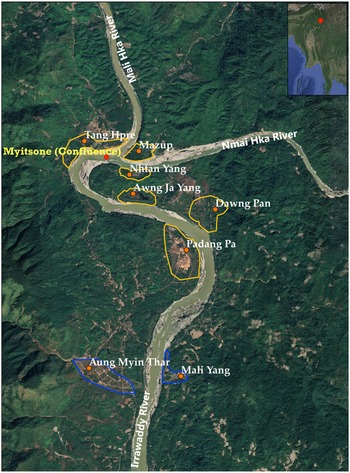
Responses to the mega-project varied greatly between different villages. While some people from Tanghpre village resisted openly, led by administrative and church leaders, people in several other Myitsone-area villages mostly complied. Thus, both Hkawn Ja Aung (2014) and Kim (Reference Kim2021) distinguish Tanghpre from the other villages. Tanghpre and the other villages are mapped on Figure 2 below.
Map of Myitsone villages. The six original villages are upstream, while two “model” relocation villages are downstream. Source: TANKS 2020, 32; modified by an anonymous colleague and the author.

In Tanghpre, some village administrative leaders mediated between the community and the junta administration, as well as helped the resistance. For example, some Tanghpre village heads did not pressure villagers to sign consent forms, as the junta had ordered. Instead, they submitted a protest letter with villagers’ signatures. Risking their own personal safety, they “negotiated with the government for better compensation and a suitable place for their villagers to relocate” (Hkawn Ja Aung 2014, 82). Hkawn Ja Aung (2014, 52) cites resettled Tanghpre residents praising their village heads: they worked “hard for us and our land” and “encouraged us when we were depressed about our situation.”
In contrast to Tanghpre, in other villages, local leaders mostly did not participate in the opposition. When doing interviews, both Hkawn Ja Aung and Kim found that some residents in those other villages sympathized with their village heads. One villager told Hkawn Ja Aung (2014, 52): “our village heads […] just didn’t know how to deal with the government.” Based on people’s previous experience, fear of the military’s violence was widespread. Kim (Reference Kim2021, 173) cites a Mazup village leader: “What could be achieved from opposing? Even if we did not sign [the consent forms], the military would come to our houses and threaten us to move, with their guns.” Kim (Reference Kim2021, 178) further cites a villager:
The village head did not want the dam to be built either, he told me while asking me to sign the consent form. Yet he had to collect our signatures, otherwise he would be in trouble or we could all be punished together.
Among the church leaders, too, Tanghpre led the resistance (Kiik Reference Kiik2024). For example, Tanghpre church leaders held regular anti-dam prayer services, helped anti-dam activists, and provided cover for local anti-dam organizing. Hkawn Ja Aung (2014, 53) emphasizes that Tanghpre’s church leaders forwarded information to the other villages’ church leaders so that they could, during their services, deliver the message to their congregations. Tanghpre church leaders and youths also began signature collecting, for which the junta briefly arrested them. In contrast, Kim (Reference Kim2021, 173) reports that some other Myitsone-area church leaders “were wary of the political activities,” fearing that the military would increase its surveillance, harassment, and arrests. Kim furthermore notes a “tension between Tang Hpre and other affected villages,” wherein the “leaders from other villages distrusted the information provided by Tang Hpre village leaders.” Some local residents have criticized particular church leaders for accepting money from the Chinese company. In some smaller villages, church leaders helped the dam project to organize people to resettle. One activist commented: “They did not really want to, but they knew that they had no other choice.” Eventually, some residents from the other villages did sign petition letters and join anti-dam prayer services, where they could feel “safe in numbers.”
Thus, village and village were not the same. A Tanghpre resident told me that the villages on the eastern riverbank did not organize as widely against the project because they were poorer and “less educated.” Compared to Tanghpre, the road access, education access, and economic situation have long been more difficult on the eastern bank. The eastern side’s villagers have long had to cross the river on a local boat with an unreliable schedule, including to sell their vegetables on the western side.
A non-local Kachin anti-dam activist explained to me these village-to-village disparities: The eastern bank’s villages were “shocked” by the military’s violence, especially as they were just “small villages, with very low-income people, without such social networks as Tanghpre had.” This activist told me:
Tanghpre is bigger and richer. The group of people who resisted had other incomes. Tanghpre has two big churches. The Catholic priest stood firmly; the Baptist church, too. But Mali Yang [on the eastern riverbank] had no business activities, no education, not even water access until [the INGO] World Concern built it in 2003. Not everyone had a boat or a motorbike. And outsiders and activists usually visited only Tanghpre, and encouraged and informed only the people there.
An anti-dam activist from Tanghpre compared the larger Tanghpre village to the confluence area’s other, smaller villages:
When the community is tiny, everyone can know who did what and who will do what. So, [the government and companies] can shut them down immediately. In contrast, Tanghpre people have networks and links, including to the media. So, outside public can see immediately what is happening here. That is why they [the government and companies] did not force us immediately but instead gave us incentives to move. So, we in Tanghpre village had time to organize [anti-dam resistance]. But it would not be appropriate if we went to organize in another village. Even if we are the same church denomination—we are still different villages.
Moreover, the eastern riverbank’s villages were less free to protest because they were ruled by a Burmese military-allied Kachin militia leader, Lasang Awng Wa. The junta had given him this riverside territory after he and a few hundred soldiers split from the KIO in the mid-2000s. This militia helped the junta to pressure the eastern bank’s local residents to sell their lands (Hkawn Ja Aung 2014, 72). A village activist told me:
People there have many barriers. Before going against the company and against the government, they would have to go against [the militia leader] first. But he has helped them a lot, for example, when the church needed donations, then they asked for help from [the militia leader]. So, the opportunity to go against the company was not open to them.
The force of the river itself also continued to divide people and their social worlds. The large Irrawaddy River is the border both between Burmese state townships and between Kachin church districts. An outside activist found the resulting disconnect “sad”:
Even the victims mutually discriminate. Once, we tried to organize everyone affected by the dam for a prayer meeting, but they told me that the other side of the river is another church district, so they will not invite.
When I asked why the western-riverbank organizers had not invited people from the eastern riverbank to their anti-dam event, a Tanghpre activist explained:
We did not invite Mali Yang people because we did not have much connection with them. Our network was smaller back then. It is also a huge risk for us to organize people there, because [the local Burmese-military-allied militia leader] is also there. Some people there also do not want to oppose the Dam because they already got incentives. Look, even people inside Tanghpre did not all agree or unite. We tried our best, but not all the village was interested.
A pivotal event of Tanghpre resistance against the junta’s project came in 2009. In response to the Tanghpre villagers’ protest letter, the junta called two meetings in the village hall, first with CPI and Asia World Company representatives, and later with the Burmese military dictatorship’s regional commander (TANKS 2020). Officials showed the residents maps of the future relocation village and let them select household plots and house models. However, a local women’s leader stood up and requested that the village not be moved. This was a dangerous and extraordinary public display of opposition to the junta’s plans. Grainy video footage of this rare encounter spread in Kachin online circles – mainly only in exile, though, because the military dictatorship had long made the Internet mostly inaccessible to people in Burma.Footnote 1
This video – which is pictured on Figure 3 – shows the woman speaking in polite Burmese:
I would like to respectfully greet the Regional Commander and all the dignitaries who have come here today. I would like to express the feelings that the mothers of the households feel. We cannot easily abandon this place where our ancestors lived, where we have grown various crops, and worked and lived in peace. We cultivate our land for the sustenance of our children and grandchildren, for their education and health, and for their livelihood. Since this has to change now, we can imagine that we might be struggling in terms of livelihoods, if we move to that place and then cannot cultivate crops there. Also, if our children arrive at that place, and there are no crops to eat yet, they will be eating snacks and drinks sold at the shops, and soon they will suffer from health problems day after day.
In late 2009, some Tanghpre village residents risked their safety by appealing publicly to a Burmese military commander, to not be forced to resettle. Source: the video described above.

Responding to this speech, the military commander said that all people must eventually move but may keep cultivating their lands up until the dam reservoir flooding (TANKS 2020). Tanghpre remained the only village to gain such a concession, while other villages had to leave everything without delay.
This event of village public resistance also brings focus onto gender. Commenting on this event, Kim (Reference Kim2021, 177) notes that “in a militarized environment,” “collective action by women appears less threatening to security forces” and women are less likely to be arrested or subjected to violence. Moreover, because female campaigners emphasized protecting families and communities, it “depoliticized the dam issue.” Generally, middle-aged or older men led the public resistance, but Tanghpre came to have a few women take lead publicly (Hong Reference Hong2019, 98; Hong Reference Hong2023). The woman who spoke up at the meeting later continued for years as a prominent female leader in the Myitsone-area anti-dam movement.
Overall, resistance to the forced resettlement remained concentrated in the area’s largest village, which was relatively well-established and best-connected.
Local–central distance
During these early years, the Myitsone anti-dam resistors struggled to bring their village-level problem onto the Kachin ethno-national agenda – they struggled to “jump scales” (N. Smith Reference Smith1992).
Indeed, at first, the village elders could not get central Kachin leaders to help resist the project. They forwarded the dam project documents to the KIO, Kachin Baptist and Catholic Church leaders, cultural leaders, and others. Already in early 2004, the Tanghpre anti-dam residents wrote to the central church leaders, the KIO, and other Kachin organizations, that the construction of a dam “by the Japanese Kansai company” would soon begin and could threaten the whole Kachin nation (KDNG 2007, 2009; Kempel Reference Kempel2012). Crossing a language and political barrier, they also wrote to the Burmese junta’s Northern Commander – they could not write in formal Burmese, so they sought out help to translate from Kachin Jinghpaw language (Hkawn Ja Aung 2014, 54). Their letter appealed to stop the dam project now, before a construction agreement is signed.Footnote 2 Eventually, only the KIO responded, but “not with action” (Hkawn Ja Aung 2014, 56). Instead, as both Hkawn Ja Aung (2014) and Kim (Reference Kim2021; Reference Kim2024) also observe, a local–central disconnect appeared: Myitsone leaders felt disappointed when central Kachin leaders ignored them or told them to accept the “benefit,” compensation, and better transportation.
One Myitsone area elder recalled this sense of isolation and disconnect from Kachin leaders:
Nobody responded. Some said: “It is OK—only your village will be flooded. A Japanese company is coming—good!” Then, I felt truly sad. We tried gathering signatures from all the villagers to say: “We do not like this.” This was military regime time, so we needed to keep secret. Going door-to-door. We sent the signatures to the Northern Commander. But they did not care. Back then, it was only we, the people, alone! It was military regime time—we were afraid. We had no idea what to do. Back then, there were no NGOs, no education. No response.
This Myitsone elder summarized a critical view on why the central Kachin leaders did not help: “One, the regime made everyone feel afraid. Two, the leaders had no knowledge about damming. Three, they neglected the people.”
Indeed, many people from beyond the Myitsone area itself feared the junta’s repression. Consequently, one anti-dam activist explained, “many people did not even know about Myitsone Dam, because it was a very sensitive issue.” Another activist criticized:
Everybody was too scared to stand up. Only after [the Burmese president] suspended the dam did everyone start shouting: “I am against the dam!” Very funny!
An example of how fear among central-level Kachin leaders hindered the resistance was in 2006 – when some dam opponents tried to sue the Myitsone project for violating Kachin cultural heritage. Hkawn Ja Aung (2014, 69) cites Myitsone local church leaders recalling this case:
We didn’t believe the judiciary system of the country. But, at least, we showed our opposition. Two Burmese lawyers helped us to bring the case. We need five various representatives from various organizations such as culture and tradition. We had already asked them to come. But three of them didn’t come and we failed before we confronted in the court. Consequently, the two lawyers lost their careers.
One anti-dam activist who was involved in this court case recalled:
Together with an activist and one Tanghpre pastor, we went to famous Baptist and Catholic leaders to ask for the Japanese dam report back. The Myitsone villagers had hid all these documents, because they were scared of being arrested, and had lost them. We also asked these church leaders for help to draw CPI into court. Lawyers from Mandalay were ready to work for free. We needed a figure person, like a church leader. But they were afraid to sue CPI, speak in front of court. Some did not even dare to visit the Myitsone villages, because the road there had military checkpoints.
Finally, many Myitsone residents and many Kachin people beyond Myitsone could not believe that a dam would be built at this famous river confluence. An activist recalled: “At first, it looked like a dream, like imagination.” A Myitsone youth pointed to general distrust across society:
Back then, there was almost no news media. No Facebook, no Internet. News only spread by someone telling someone. Even then, people would likely not believe each other.
Thus, one Kachin activist suggested to me that, at the time, the anti-dam movement needed to do a lot of ground research and publish on the dam mainly because otherwise “people would not believe us.”
Alliance and triumph?
The rise of a villager–activist alliance helped the village resistance grow and reach a Kachin national level, and later a Burmese national level.
In the late 2000s, connections gradually deepened between the village resistors and outside Kachin national activists. Since 2006, an organization in Myitkyina began mediating between the villagers and outsiders, for example, by forwarding villagers’ reports and information to the outside, and preparing travel, accommodation, and interviews for outsiders. Their goal was “to make the Myitsone issue a national issue” (Hkawn Ja Aung 2014, 65). A then Thailand-based exile Kachin activist group launched cross-border and underground activities, such as fact-finding, report writing, organizing, and both public and closed-door advocacy to urge Kachin leaders to oppose the dam (Hong Reference Hong2019). Tanghpre’s anti-dam residents informed the outside activists and journalists about the goings-on around the Myitsone project area.
The growing networks and alliances of Tanghpre anti-dam villagers helped them resist the dislocation and partly recover their livelihoods. For example, in the late 2000s, Tanghpre resistors formed an activist group, with church leaders’ backing. Supported by lowland-Burmese activists, the village activists helped those Tanghpre residents who still refused to leave the village. Their activities included: arranging daily transportation for children to school, because the school had been moved to the relocation village; setting up water supplies; and, with money from a local NGO, supporting pig rearing (Hkawn Ja Aung 2014, 58). A village activist explained: “The goal was to rebuild the village and to empower people living there.” Hong (Reference Hong2019, 117) observes how these activists worked toward reclaiming the village “at a material as well as at a sensory-affective level.” For example, the activist group organized Tanghpre resistors who had already been relocated “to clear the brush and weed, and plant seasonal crops” at their original village. She cites a group member:
If we leave our old houses with bushes and weeds, the authorities and companies can say this land doesn’t belong to anyone. […] If you plant something on the land, you have to take care of it all the time. That leads people’s feelings to change. [They will think,] this is my house.
As the local village resistance and the broader Kachin resistance networks strengthened each other since the mid-2000s, broader Kachin ethno-national alarm gradually grew over the Myitsone Dam. Despite some ethno-national leaders’ caution, Kachin social networks actively spread anti-dam information, and the church networks continued protecting, blessing, and driving the organizing against Myitsone Dam, as part of their broader social and ethno-national work. By mid-2007, various Kachin leaders increasingly came to resist the dam publicly. The KIO sent a private, diplomatically worded letter both to the junta and Chinese authorities, stating their concerns over the Myitsone Dam’s effects.
Soon, alarm over and opposition against the Myitsone Dam became a common thread across Kachin society, especially in activist and church circles (Kiik Reference Kiik2020a). Warnings about future earthquakes breaking the dam and its reservoir flooding Myitkyina city – 40 km downstream – were especially effective in spreading opposition among the city residents. Together with non-local Kachin activists, Tanghpre village elders promoted another effective framing – the Myitsone confluence as a sacred place (Kiik Reference Kiik2024). Yet, for a few years, this Kachin resistance could not stop the Burmese and Chinese mega-project from proceeding. During 2010–2011, almost all the residents of local villages had been resettled into the two new “model” relocation villages. The early-2010 bombing incident – which this article began with – was a trigger for the Burmese regime to quicken and to enforce this resettlement.
At the same time, other events in 2010–2011 led to the sudden fall of Myitsone Dam. Firstly, tensions were growing between the Burmese military and the KIO, leading to their war resuming in mid-2011. This war effectively halted the dam construction. At the same time, in 2010–2011, some Kachin activists connected with lowland-Burmese activists who, in turn, spearheaded an unprecedented Burmese public outcry to “save” the country’s holy mother-river, the Irrawaddy, from destruction by Chinese “colonists” (Kiik Reference Kiik2020a). Such open protest became gradually possible because the Burmese military had just begun building a new, partly civilian regime. This newly democratizing regime’s leader responded to the snowballing controversy in late 2011 by halting the Myitsone Dam’s construction. This one-sided decision shocked Chinese counterparts and Beijing, creating a lasting tension in Burma–China relations. The suspension became a symbol of the democratization of Burma’s decades-long military dictatorship.
The project’s official suspension was the culmination of a longer history starting from the original source of resistance against the Myitsone Dam – local village residents. This article showed that the rural history of the Myitsone project is longer than the well-known Myitsone Dam story usually told. All of Burma’s anti-dam resistance began at local villages already in late 2002 – much before the 2011 Burmese public outcry and project suspension. It was a story of success – people took great risks to organize against the plans of a violent military dictatorship. It became a massive “scale-jumping” for a village-born social movement. The later and larger Kachin and Burmese anti-dam movements built on and drew support and information from groups of anti-dam residents at the Myitsone villages. However, this study also showed how this story included stumbling, fear, and “falling into the gaps” of the diverse, divided, and repressed social worlds of Myitsone, Kachin, and Burma.
In terms of rural resistance, Myitsone remains a unique case – largely because this river confluence itself is a unique place. Rural resistance in Burma has usually not led to such dramatic results, even during the democratization era of 2010s. The people of Myitsone were joined by non-locals in national uproars both in Kachin and in Burma, as well as by worldwide attention, the kinds of which other comparable land grabs and villager struggles in Kachin and in Burma never receive, and indeed, the villagers of Myitsone at first also did not receive from various distant national leaders. The Kachin and Burmese people and leaders showed unique concern over the future of the Irrawaddy River and of the Myitsone confluence – a “sacred place” and the “beginning of the Irrawaddy” – thus also taking the Myitsone local rural and natural landscape into their hearts (Kiik Reference Kiik2024). Mega-dam projects on the Salween River never gained such countrywide attention, because Salween is a smaller and less central river than the Irrawaddy. The Myitsone mega-project’s six other planned large dams – upstream from the Myitsone Dam – also went largely unnoticed. The six other dams were planned in less populated and much less well-known places than Myitsone. In contrast, the Myitsone villagers and the planned dam happened to be in a special, sacralized place, which helped move distant people to join in resisting the project.
Scales and distances
The story of resistance against the Myitsone Dam begins with rural defiance, autocratic repression, and social divisions. Contrary to the oft-celebrated story of successful activism and “scale-jumping,” the reality in the local villages around Myitsone reveals a more nuanced picture – one of division, ongoing dispossession, and gaps between various scales of resistance.
Initially, the mere concept of constructing a massive dam on the Irrawaddy River seemed unimaginable. The local residents’ response to this potential upheaval – including the demand that several local villages be resettled to make space for the mega-dam’s reservoir – was not monolithic; it was a mixture of resistance and compliance shaped by socioeconomic status, religious affiliations, different village locations, and ethnic backgrounds. The Myitsone mega-project did not encounter a homogeneous “community” but rather a diverse array of interests and perspectives, influenced by factors like village size, connectivity, and pre-existing power dynamics.
The village of Tanghpre, for instance, showed much resistance, helped by its relatively larger size, better connections, and active church leadership. In contrast, smaller, more isolated villages showed varying degrees of acceptance of the mega-project and the forced resettlement. People were often constrained by fear of military reprisals or motivated by the promise of immediate economic benefits. This division shows the importance of intra-community diversity and local agency in shaping resistance movements.
At the village level, livelihood concerns drove people’s actions – whether to defend homes and farmlands or to comply in hopes of securing a new home and stability. These priorities often diverged from the broader nationalist or environmental concerns that dominated national and international anti-dam discussions. Eventually, despite the mega-project’s fall, most of the local land grabs were never reversed.
Existing literature tends to conflate local rural resistance with broader Kachin and Burmese anti-dam movements, but this study distinguishes between these scales and highlights some disconnects between village-level struggles and national-level movements. The initial resistance began as early as 2002–2003, well before the issue gained national prominence in 2011. The local narratives – from village leaders facing repression to church communities fostering covert resistance – provide insights into rural opposition under autocratic regimes. Distinguishing these scales also helps us to notice certain disconnects between rural resistance or compliance and urban or national politics, as well as to notice the variations, scales, and disconnects within rural society.
Such a multi-scale account also helps to nuance the role of ethnicity, which previous research literature has highlighted: while the Kachin identity galvanized much anti-dam resistance, there were divisions and different responses among Kachins, as well as divisions and different responses between Kachins and other ethnicities. For several years, anti-dam Kachin villagers largely did not get the support from their central ethno-national leaders that they expected. This local–central distance inside Kachin society paralleled what I describe elsewhere (Kiik Reference Kiik2020a, 246) as “stalling at the Kachin–Lowland gap” during 2007–2010, when Kachin anti-dam activism could not reach the people of lowland Burma. Finally, in terms of ethnic divisions, the mega-project’s Chinese workers and officials always remained mostly isolated from the local populations, their interactions mediated and buffered by the Burmese military-state.
The sacredness of the Myitsone confluence and the ethical imperative to protect Burma’s national mother-river Irrawaddy resonated far beyond the affected villages. It mobilized widespread national and international support that similar struggles in other places in Burma have not attracted. Thus, the dramatic suspension of the Myitsone Dam in 2011 is a unique case where local rural resistance resonated with concerns in much larger arenas, especially due to the symbolic power and material importance of a great river.
The mega-project was halted, but what happened to the resettled people? Why does this rural struggle still continue now? To trace the rural history of Myitsone Dam further, we need to return to that night when fourteen bombs exploded at the dam construction offices. This two-part article series continues from that pivotal event, in Part 2 (Kiik Reference Kiik2025).
Competing interests
The author declares none.



 Open access

