


The concept of “corporatism” has recently emerged as a central point of reference in research on interest representation. More broadly, this concept has played a central role in the renewed effort to discover more adequate ways of conceptualizing alternative patterns of state–society relations and alternative modes of political domination. Scholars concerned with various world regions have called attention to the tendency toward a corporative ordering of interest politics and of state–society relations around noncompeting groups that are officially sanctioned, closely supervised, and often subsidized by the state.
Corporatism has received particularly widespread attention in analyses of the relationship between the state and organized labor in Latin America. It is argued that Latin American governments have commonly sought to exercise control over labor movements and that within this context of control, the concept of corporatism captures an important aspect of the network of hierarchical relationships through which labor organizations come to be dependent upon and penetrated by the state.Footnote 1
This focus on corporatism provides an important alternative to earlier pluralist perspectives in that it takes as a starting point the role of the state in shaping interest representation. Yet a closer examination of the contexts in which corporative patterns of state–labor relations have emerged in Latin America reveals such a diversity of political relationships and of goals on the part of elites who introduce corporative provisions that it seems reasonable to ask whether all these cases should be grouped under a single concept. While the concept of corporatism may be valuable as a first approximation, it appears to miss much of the give and take of politics.
We propose here a new approach to conceptualizing corporative patterns of state–group relations that will make it possible to deal more adequately with this diversity of power relationships. This approach provides a better basis for analyzing contrasting patterns of state–group relations – including both differences among countries and patterns of change within countries. Though our immediate empirical referent is the relationship between the state and organized labor in Latin America, this modified conceptualization may be extended to the analysis of other types of groups and other regional contexts.
Corporatism
The term “corporatism” has been applied to a wide variety of phenomena, including modes of political participation, types of political action, ideologies, and broad cultural traditions (Rogowski and Wasserspring Reference Rogowski and Wasserspring1971; Wiarda Reference Wiarda1974; Palmer and Middlebrook Reference Palmer, Jay Middlebrook and Chaplin1976).Footnote 2 At the same time, there has emerged a common usage in which systems of interest representation – and more specifically, different patterns of state–group relations – are the central issue. Drawing on the shared usage in this literature,Footnote 3 one may define a system of state–group relations as corporative to the degree that there is (l) state structuring of groups that seeks to produce a system of officially sanctioned, noncompetitive, compulsory interest associations; (2) state subsidy of these groups; and (3) state-imposed constraints on demand-making, leadership, and internal governance.Footnote 4 Corporatism is thus a nonpluralist system of group representation. In contrast to the pattern of interest politics based on autonomous, competing groups and to the total suppression of groups, in the case of corporatism the state encourages the formation of a limited number of officially recognized, noncompeting, state-supervised groups.
This usage has been particularly common in research on state–labor relations in Latin America. Analysts have frequently viewed these relations as involving corporatism, with a widespread use of corporative mechanisms by the state to shape and control labor organizations.Footnote 5 And while there are unquestionably important periods in which state–labor relations in Latin America involve outright repression, as well as a very few cases of a fair degree of pluralism, one may accurately characterize the predominant pattern during much of the twentieth century as corporative.
At the same time, we have argued elsewhere that in Latin America, corporative patterns of state intervention in organized labor have been introduced in the context of a striking diversity of power relationships and policy goals. Corporative provisions have been used in some cases to strengthen the position of workers and unions in relation to employers, whereas in others they have been used to weaken their position. Corporative provisions have sometimes been used by political parties to win workers’ support, and at other times to insulate workers’ associations from involvement with parties as a means of restricting their political power. In some contexts, members of the military elite have seized the government and used corporative provisions to aid labor organizations and mobilize their support, whereas in others, such elites have used these provisions to control labor sharply. Corporative provisions have been promoted by an extraordinary spectrum of governments, ranging from repressive, right-wing governments, through “populist” governments such as the Cárdenas government in Mexico and the first Perón government in Argentina, to Castro’s Cuba (Wiarda Reference Wiarda1974: 4; Collier and Collier Reference Collier, Collier and Malloy1977).
These observations suggest that the concept of corporatism may apply to so many different cases that it often tells one little or nothing. If such a diversity of cases can be found even within just one world region and considering only the relationship between the state and one class group, organized labor, perhaps this concept simply casts too broad a net to be useful.
This problem can be addressed by treating corporatism explicitly as a dimension along which cases may be arrayed. Since “real pluralism” may be relatively rare in the contemporary world, there may be a tendency to find corporatism almost everywhere. But, in fact, systems of interest representation are not identical everywhere; there are major differences in the degree of structuring, subsidy, and constraints introduced by the state. Corporative patterns of state intervention, like pluralism, should thus not be conceived narrowly as either present or absent, but rather as a variable that may assume different values; that is, as a phenomenon that may be present to varying degrees.
Aside from considering corporatism as a continuum, one can approach the very different political contexts in which it appears by disaggregating the concept and considering the different components of corporatism. Since few countries have the full complement of corporative provisions typically identified in the literature on this topic, perhaps different combinations of provisions appear in these different contexts. Though at a high level of aggregation these cases may all be corporative, at a more disaggregated level there may be striking differences among them, as they may consist of quite a few combinations of components.
Inducements versus Constraints
As a first step toward disaggregating corporatism, one may note that some corporative provisions bestow advantages upon the labor organizations that receive them, whereas others do not. The structuring of group representation through provisions that provide for such things as official recognition, monopoly of representation, and compulsory membership – as well as the subsidy of groups – provide important organizational benefits. In this sense these provisions are quite distinct from the constraints, which directly control labor organizations and labor leaders.
The argument that structuring and subsidy are benefits is supported by analysts of political organizations, who suggest that these provisions do in fact address basic organizational needs of labor unions (Bendix Reference Bendix1964: 80–97; Olson Reference Olson1971: chap. 3; Wilson Reference Wilson1973: chap. 3). These include the need to compete successfully with rival groups that seek to represent the same constituency; the need to be recognized as the legitimate representative of their constituency in their dealings with other sectors of society; the need to recruit and retain members; and the need for stable sources of income. Because structuring and subsidy help to meet these needs, they confer significant advantages on the organizations that receive them.
Though structuring and subsidy thus provide important organizational benefits, one must understand the political context in which these provisions appear in order to interpret their significance. Corporative policies toward organized labor in Latin America have been introduced from above by elites, acting through the state, who have used these policies to help them pursue a variety of goals – involving an effort to shape the behavior of the labor movement and/or to win its political support. It therefore seems appropriate, within the Latin American setting, to view structuring and subsidy not simply as benefits but as inducements through which the elite attempts to motivate organized labor to support the state, to cooperate with its goals, and to accept the constraints it imposes. In this context, corporatism may thus be viewed as involving an interplay between inducements and constraints.
This idea of an interplay between inducements and constraints is consistent with standard discussions of the dialectical nature of state–labor relations in Latin America. Goodman (Reference Goodman, Davis and Wolf Goodman1972: 232) has interpreted Latin American labor law, the most important formal expression of the relationship between the state and organized labor, as containing both a “carrot and a stick” for labor. Spalding (Reference Spalding1972: 211) has analyzed the tendency of the state and elite groups in Latin America to “seduce and control” organized labor. The terminology employed in a standard manual of labor relations in the US suggests that the inducement/constraint distinction is salient outside Latin America as well. This manual contrasts provisions in labor law that involve “labor sweeteners” sought by unions with those involving “restrictions” on unions sought by employers (Bureau of National Affairs 1972: 4).
More broadly, Schmitter (Reference Schmitter1974: 92) hinted at this distinction when he suggested, without elaboration, that corporative provisions that we have referred to as constraints may be accepted by groups “in exchange for” the types of provisions we have identified as involving the structuring of groups.
Though one can thus distinguish between inducements and constraints, it is important to emphasize that these are not diametrically opposed phenomena. Analysts of power and influence such as Lasswell and Kaplan (Reference Lasswell and Kaplan1950: 97–98) and Gamson (Reference Gamson1968) distinguish between inducements and constraints, but view both as mechanisms that serve to influence behavior. Constraints are seen as producing compliance by the application, or threat of application, of negative sanctions or “disadvantages.” Inducements, by contrast, involve the application of “advantages” (Gamson Reference Gamson1968: 74–77). In this literature, inducements are also viewed as mechanisms of cooptation. As such, though they involve “advantages,” they also lead to social control.
This dual nature of inducements is evident in the specific mechanisms of structuring and subsidy discussed earlier. These inducements may, like the constraints, ultimately lead to state penetration and domination of labor organizations, for at least three reasons. First, an inducement such as monopoly of representation is by its nature offered to some labor organizations and withheld from others. This provision has commonly been used in Latin America to undermine radical unions and to promote those favored by the government (Silverman Reference Silverman1967: 137–54; Kenworthy Reference Kenworthy1970: 159–60; Harding Reference Harding1973: 71). Second, unions receiving inducements must commonly meet various formal requirements in order to receive them. Finally, the granting of official recognition, monopoly of representation, compulsory membership, or subsidy by the state may make the leadership dependent on the state, rather than on union members, for the union’s legitimacy and viability. This dependency accelerates the tendency for labor leadership to become an oligarchy less responsive to the needs of workers than to the concerns of state agencies or the political elite with which the leaders interact. This dual nature of the inducements explains why high levels of inducements, as well as of constraints, are often instituted by elite actors whose goal is to produce a docile, controlled labor movement.
If both inducements and constraints ultimately lead to control, it remains to be demonstrated that labor organizations do indeed desire to receive the inducements – that these provisions in fact induce labor organizations to cooperate with the state and to accept the constraints. A preliminary examination of the evidence suggests that this often occurs.
A Look at Some Examples
Evidence can often be found at the time of the enactment of a country’s first major law that provides a basis for legalizing unions and that commonly includes a number of inducements and constraints for the unions that become legally incorporated. An important example is found in Argentina. The dominant sector of the Argentine labor movement initially rejected Juan Perón’s initiatives to gain the cooperation and support of the labor movement in the 1940s. Only when Perón began to adopt the program of this sector of the movement, that is, to support the organizational goals of labor as well as their substantive demands on bread and butter issues – in part through a labor law that placed heavy emphasis on inducements – did major sectors of the labor movement begin to accept his offers of cooperation (Silverman Reference Silverman1967: 134–35).
In Mexico the reaction of labor to the first national labor law in 1931 again reflected the dual nature of the law, encompassing both inducements and constraints. Labor leaders objected to certain constraints – the provisions for federal supervision of their records, finances, and membership lists – whereas they accepted the provisions for the recognition of unions – defined here as an inducement. Furthermore, they were dissatisfied over the absence of a provision that is clearly an inducement – compulsory membership (Clark Reference Clark1934: 215; Harker Reference Harker1937: 96).
The debate within the labor movement concerning the passage of the 1924 labor law in Chile reflects this same pattern. The dominant Marxist sector of the labor movement generally accepted the new system, arguing that it had to “use all the social legislation of the capitalist state to fight capitalism itself” (Morris Reference Morris1966: 246). The debate within the labor movement showed that though this sector opposed the constraints contained in the law, it was clearly attracted by the law’s provisions that would help it to extend its organization to new economic sectors and would allow it to receive a state-administered financial subsidy derived from profit-sharing. The inducements contained in the law were thus sufficient to motivate the dominant sector of the labor movement to cooperate with the state.
The 1924 Chilean law is useful for underlining another point as well. Though the inducements offered by the state have often been sufficient to win the cooperation of labor, this has not always been the case. Historically, the anarchists were acutely aware not only of the costs of the constraints that accompany the inducements, but also of the tendency of the inducements themselves to lead to social control. Thus, following the traditional anarchist position regarding the risks of cooptation arising from collaboration with the state, the anarchist sector of the Chilean labor movement rejected the 1924 law completely.
Another example is the 1943 law in Argentina, which was widely opposed by organized labor. At that point, the state was not willing to extend sufficient inducements to win the cooperation of labor, which rejected the constraints. It is noteworthy that the Peronist law of 1945 (noted earlier) provided the necessary level of inducements and was accepted by organized labor, despite its similarly high level of constraints.
These examples suggest that while some groups will resist these inducements, the inducements have, in fact, often served to win the cooperation of labor groups and to persuade them to accept the constraints. Furthermore, the distinction between inducements and constraints is not an analytic point of concern only to social scientists, but rather a vital political issue in the history of state–labor relations in Latin America.
An Operationalization of Inducements and Constraints
Do inducements and constraints occur in distinct patterns in different political contexts? If so, does the analysis of these patterns contribute to understanding the different settings in which corporatism has appeared? To address these questions, we must focus in greater detail on specific corporative provisions that have typically characterized state–labor relations in Latin America.
In the context of state–labor relations, inducements and constraints of course take many forms – including bribery and overt repression. Yet many important inducements and constraints – such as those conventionally referred to in conceptual discussions of corporatism – are found in labor law, which will be used here as a basis for illustrating the interplay between these two dimensions. We hardly need emphasize that law does not, by itself, reflect the full reality of state intervention in labor organizations or labor relations. Laws may not be applied, or they may be applied differentially.
Yet law is important. It is commonly asserted by specialists in organized labor in Latin America that labor law is indeed one of the crucial factors that shape labor movements.Footnote 6 Furthermore, the adoption of laws is a major step in the decision process through which state intervention in labor representation crystallizes. Labor law is a highly visible and concrete policy statement around which political battles are fought, won, and lost, and around which political support is attracted, granted, and withheld. Perhaps especially for the years in which labor law is promulgated or modified, law thus provides a valuable point of reference for analyzing the larger political context. Of course, one must be cautious in using an older law that has been left on the books as a basis for interpreting the politics of a subsequent period. We therefore focus particularly on the years in which laws are adopted – though in some cases, as in the interpretation most notably of Mexico, long periods of stability of law do point to an important continuity in the political context. Despite this caveat, however, law provides a useful source of data for the comparative analysis of the different approaches to shaping labor organizations and labor relations that are grouped together by policy makers in this crucial phase of the policy process. For the analyst concerned with whether different patterns of inducements and constraints appear in different political contexts, law thus represents a valuable source of data.
In order to apply the inducement–constraint distinction in a comparative/longitudinal analysis of state–labor relations, we scored a series of legal provisions corresponding to the different elements in standard definitions of corporatism discussed earlier for twenty Latin American countries for each year over the period 1901 to 1975.Footnote 7 Under the heading of inducements, the scoring focused on provisions regarding registration, right of combination, monopoly of representation, compulsory membership, and subsidy of unions. The heading of constraints included provisions regulating collective bargaining and strikes, other controls on demand-making, controls on leadership, and provisions for state monitoring and intervention in internal union affairs. While these provisions obviously do not include all inducements and constraints that may appear in labor law, they represent a constructive starting point for analyzing this distinction.Footnote 8 Statistical analysis of these provisions indicated that it was appropriate to group them into two overall scales that reflected the degree to which inducements and constraints were present in the labor legislation of each country. These scales are used as the basis of the analysis presented later. Appendices 12.1 and 12.2 explain the scoring of these legal provisions and the construction of the scales. Given the time span of the dataset, the following discussion is focused on the period up to 1975.
Patterns of change in inducements and constraints, 1901–1975.
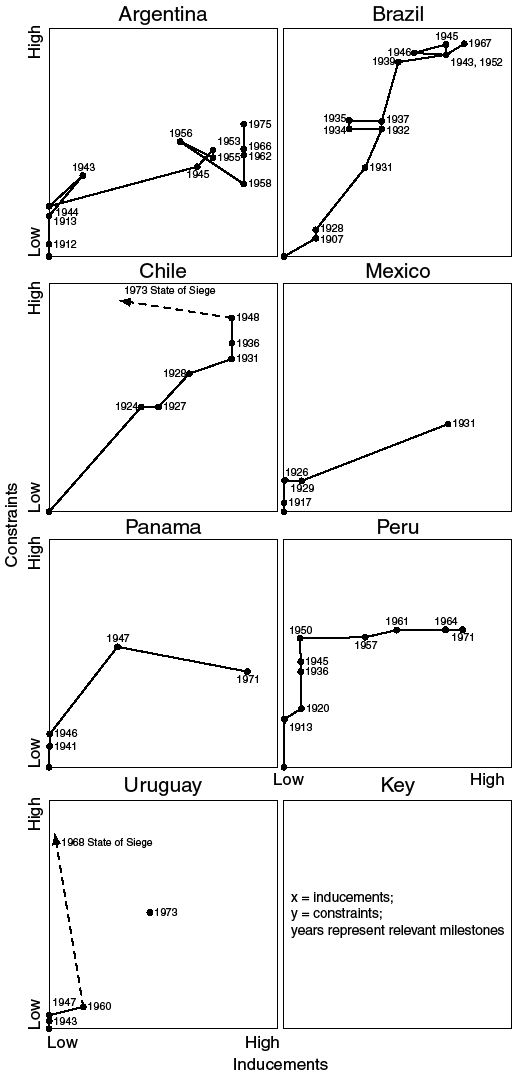
Figure 12.1 Long description
Each graph in the figure shows a fluctuating line, indicating shifts in inducements and constraints over time. Argentina: The line rises and falls multiple times between 1912 and 1975. It starts low, peaks in 1943–1945, drops in 1955–1956, then rises again in 1958, 1962, and 1966. A final shift appears in 1975. Brazil: The line starts low in 1907, rising in 1928 and 1931. It fluctuates between 1932 and 1937, peaks in 1943–1945, stabilizes in 1952, and shifts again in 1967.
Inducements and constraints in selected major laws.
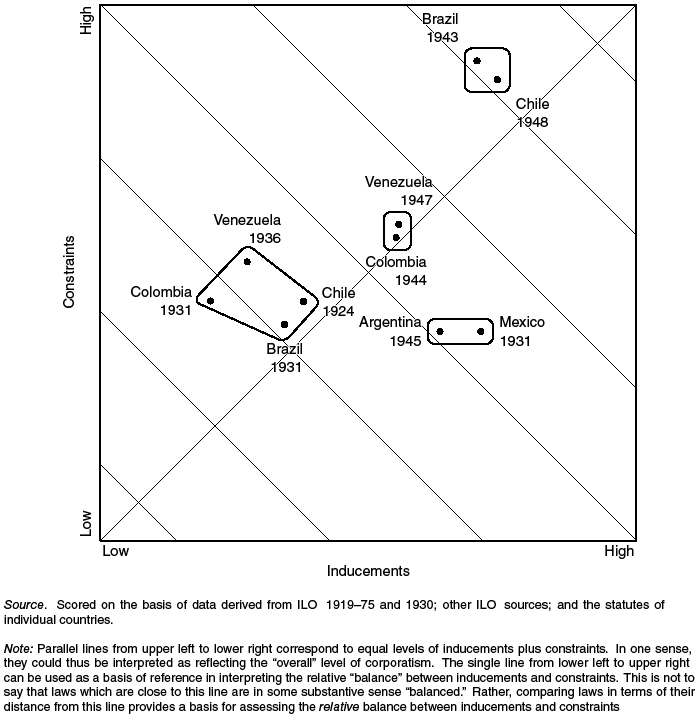
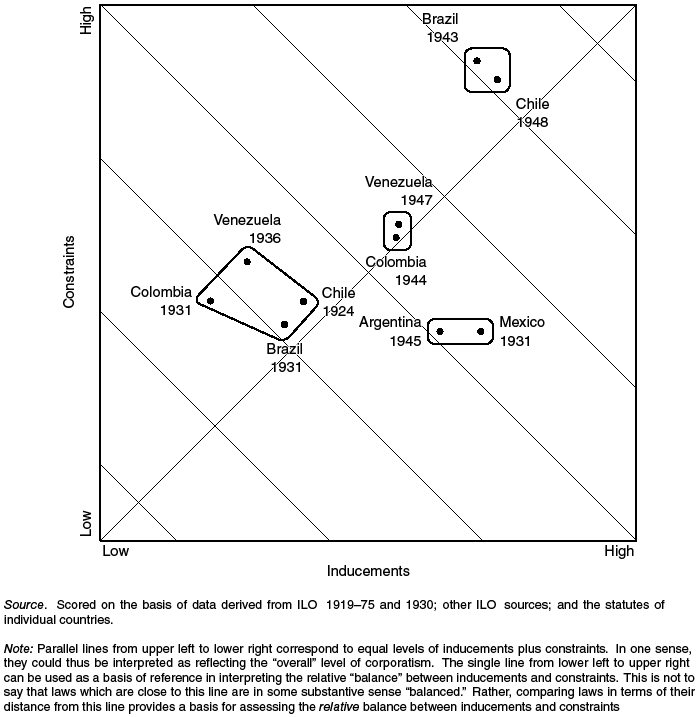
Figure 12.2 Long description
The countries represented on the scatter plot include Brazil (1931,1943), Chile (1924,1948), Colombia (1931,1944), Venezuela (1936,1947), Argentina (1945), and Mexico (1931). The image is a scatter plot with a 2-axis grid, where Colombia (1931), Brazil (1931), Venezuela (1936), and Chile (1924) are plotted enclosed together in the left center. Argentina (1945) and Mexico (1931) are plotted enclosed in the center slightly right below Venezuela (1947) and Colombia (1944), which are also together. Brazil (1943) and Chile (1948) are confined together on the right upper side of the plot.
Contrasting Patterns of Change. The distinct patterns of change in inducements and constraints in Figure 12.1 provide a useful starting point for exploring the relationship between these dimensions and the larger political context. In Argentina, for instance, one finds a volatile pattern of change that reflects frequent shifts in the coalitional position of organized labor – as well as, overall, a relatively greater emphasis on inducements in relation to constraints.Footnote 9 The dramatic shift to a high level of inducements in 1945 has already been noted. The context of this shift was the effort by Perón to gain the support of the large, well-established, and autonomous Argentine labor movement as he attempted to rise from a subordinate position within the military government that came to power in 1943. With the help of labor support, he was elected president in 1946. One of Perón’s most visible acts in his attempt to court labor was the abrogation of the unpopular 1943 law, which was heavily oriented toward constraints. In 1945, a Peronist labor law was introduced, which included a similar level of constraints but which attracted overwhelming labor support in part because of the high level of inducements. Though Perón’s most prolabor period might be said to have ended in 1946 and though Perón became increasingly preoccupied with curbing labor and its demands as early as 1948–49, this policy shift proved quite difficult, since he remained heavily dependent on labor support. This combination of dependence on labor and concern with restraining its demands is reflected in the more “balanced” addition to labor law in 1953. The years following the ouster of Perón in 1955 were characterized by ongoing shifts in labor law that correspond to changes in the political context. For instance, in 1956, the anti-Peronist government that sought to undermine the dominant Peronist segment of the labor movement added constraints and dropped inducements. In 1958, inducements increased and constraints decreased as Peronists bargained with Frondizi over the terms under which they would grant him their electoral support.
The relationship between the state and organized labor in Brazil was different from that in Argentina, and a distinct pattern of labor law has evolved.Footnote 10 Organized labor was relatively weak in Brazil and played a marginal role in the rise to power of Vargas in 1930. In fact, a major concern of the leaders of the “Revolution” of 1930, which brought Vargas to power, was to preempt the emerging labor movement and the “Bolshevik threat” that its connection with the Communist party seemed to imply. Once in power, Vargas sought to dismantle this labor movement and replace it with a state-controlled system of labor representation. Though his labor and welfare policies eventually won him the support of much of the working class, Vargas was not dependent on the working class for political support in the way Perón was in Argentina. Correspondingly, in the framework of a more full-blown corporatist system, Brazil moved to high levels of both inducements and constraints.
Within this overall pattern, there are interesting short-term changes in Brazil. The rise in influence of anti-corporative, liberal groups in the mid 1930s is reflected in a brief reduction in the level of inducements. The earlier level was restored in 1937, and by 1939, under the explicitly corporatist Estado Novo (New State), Brazil moved to an even higher level of both inducements and constraints. By 1943 the Estado Novo was on the defensive and Vargas began laying the groundwork for the more active electoral support that he would need with the introduction of competitive politics after 1945. At this point he assumed a more populist stance, sponsored a political party to mobilize labor support, and introduced a more inducement-oriented labor law. The period following the fall of the Estado Novo in 1945 was characterized by shifting power relationships, which produced, as in Argentina, a “circular” pattern of change in law as provisions for inducements and constraints were promulgated and abrogated. For instance, after the fall of Vargas in 1945, there was a brief reduction of inducements as the new government sought to undermine the dominant sector of the labor movement, which was linked politically to Vargas. These provisions were restored within a few months in the face of protests from labor leaders.
The link between the larger political context and the pattern of inducements and constraints is clear in other cases as well. In Mexico, the labor movement had since an early phase of the Mexican Revolution been an important, though coopted, actor within the dominant national coalition (Brandenburg Reference Brandenburg1964; Everett Reference Everett1967; Stevens Reference Stevens1974; Purcell Reference Purcell1975). Correspondingly, the first major national labor law in 1931 placed heavy emphasis on inducements. Subsequently, labor law, like the dominant political coalition itself, was relatively stable over many years.
The clearest case of a separate elaboration of constraints and inducements and of a dramatic “right-angled” shift from one to the other is Peru. Until the late 1950s, Peruvian labor law had been shaped by a series of conservative governments concerned with curbing the powerful, labor-based APRA party. Labor law was heavily oriented toward constraints, and the 1950 law in Peru was nearer the “high constraint/low inducement” corner of the diagram than any other labor law in Latin America.Footnote 11 Starting in 1957, after APRA entered into an alliance with the Peruvian elite, there occurred a series of increases in inducements, with little further increase in constraints. Another case of a particularly dramatic shift to the inducement side is Panama, which until the 1970s had a constraint-oriented law. In 1971 the populist/nationalist government of Torrijos made a strong appeal for labor support,Footnote 12 and promulgated a law that decreased the level of constraints at the same time that it increased inducement provisions to a level as high as any in Latin America.
Chile is well known for the emergence of a powerful political left that enjoyed crucial support from the working class. However, the standard interpretation of the earlier history of state–labor relations emphasizes the preemptive, cooptive role of the state in attempting to create a weak, dependent labor movement (Morris Reference Morris1966; Peppe Reference Peppe1971; Angell Reference Angell1972; Valenzuela Reference Valenzuela, Valenzuela and Valenzuela1976). Correspondingly, Chile – like Brazil – followed in this earlier period a relatively balanced pattern of inducements and constraints and moved to a high level of each. In 1973, with the fall of Allende and the onset of the violently antilabor policies of the military government, the existing system of inducements and constraints was superseded by a state of siege and a variety of other legal and extralegal measures. Chile shifted to a system that predominantly involved repression, with little use of cooptation during the first years of military rule (ILO 1975). This in effect involves an extreme movement upward and to the left in the diagram. Another example of a dramatic shift of this type is Uruguay. After many years as the most pluralistic system in Latin America with few legal provisions relating to labor organizations, Uruguay adopted in 1973, in the midst of a severe political crisis, a law that had a rough balance of inducements and constraints within the framework of a relatively low overall level of corporatism. However, state–labor relations had in fact been governed almost continuously during the violently antilabor period after 1968 by the legal framework of a state of siege (Handelman Reference Handelman1977: 11).
A Further Comparative Perspective. The comparison of major laws in Argentina, Brazil, Chile, Colombia, Mexico, and Venezuela sheds further light on the relationship between the larger political context and different patterns of inducements and constraints.Footnote 13 Four of these laws (1924 in Chile, 1931 in Brazil and Colombia, and 1936 in Venezuela) were for each country the first major legislation that legalized the trade union movement. These laws were adopted by governments that might be called “conservative modernizers.” In these cases, a multiclass, modernizing coalition came to power, but organized labor did not play a critical role in building the coalition or providing support for it. Instead, the coalition derived its legitimacy largely from other sources. These labor laws tended to be the vehicle through which the government addressed the “social question.” These governments sought to limit the radicalization of the working class by addressing themselves to the worst abuses to which it was subjected and by seeking to integrate labor into the established order within a framework of substantial emphasis on constraints. This grouping includes the laws promulgated under the Liberal party in Colombia, which in 1930 came to power after a long period of Conservative party rule; López Contreras in Venezuela, who came to power after Gómez’s repressive, dictatorial rule; Vargas in Brazil and Alessandri in Chile, both of whom came to power at a point when traditional oligarchic rule had broken down and become discredited.
These four laws did not contain as many provisions for either inducements or constraints as the later laws, and like many early laws placed a greater relative emphasis on constraints than on inducements. Hence, they are located above (i.e., on the constraint side of) the hypothetical line of relative “balance” in Figure 12.2 (see note at bottom of figure).
The second group of cases involving the first major law includes Colombia and Venezuela at a subsequent point in time (1944 and 1946, respectively). Here the labor movement was also weak, but the activation of labor played a more central role in legitimating the ruling coalition. These “populist” coalitions were put together from above by Acción Democrática in Venezuela and the prolabor wing of the Liberal party in Colombia. Both of these parties sought to create and mobilize an organized labor sector, and both were dependent on labor as an essential support group for the government. Correspondingly, the new laws in both countries involved primarily the addition of new inducements, and both countries moved from their earlier position in Figure 12.2 over to the “balance” line, reflecting a greater relative emphasis on inducements in relation to constraints. At the same time that adding inducements is consistent with the greater dependence of these governments on labor, their level of constraints is consistent with the fact that these are far from radical, labor-dominated governments. Rather, they were multiclass coalitions dominated by middle-sector groups that needed the support of labor.
The most inducement-oriented group includes Argentina and Mexico, the two countries that had the strongest labor movements when the major laws were promulgated. While the populists in Colombia and Venezuela were trying to create a labor movement that would form a support group for the party, in Mexico and Argentina the task was to gain or sustain the support of an already existing and relatively powerful labor movement. The early political strength of organized labor in Mexico grew out of the role of the Red Battalions in the Mexican Revolution, the ideology and expectations that derived from the 1917 Constitution, and the subsequent role of labor as a major, though coopted, support group for the early revolutionary governments. The strength of Argentine labor derived from quite different sources. In this case, the major law came late – both chronologically and, even more so, relative to the level of industrialization. As a result, when Perón appeared on the scene, he faced a labor movement that, though subjected to repression, had for many years been developing autonomous associations. Correspondingly, the legal relationships that emerged in these contexts in which organized labor was relatively strong were different from those in the other four countries. One finds relatively low levels of constraints and high levels of inducements.
The final group includes Brazil and Chile, which started out – along with Venezuela and Colombia – in the group of conservative modernizers. Unlike these latter two countries, however, Brazil and Chile did not subsequently have comparable populist periods in the 1940s.Footnote 14 Instead, they continued and further elaborated their earlier efforts to coopt and control the labor movement. Correspondingly, in terms of both inducements and constraints, Brazil and Chile had by the 1940s moved to the highest levels in the region.
Identifying Patterns. On the basis of these findings, it is possible to identify recurring patterns in the relationship between the political context and different combinations of inducements and constraints. Salient features of the political context include the degree of elite concern with winning the political support of organized labor, the degree of concern with controlling labor, and the strength and autonomy of the labor movement.
It appears that a higher level of inducements and a lower level of constraints tend to occur in contexts where the government seeks to gain or retain the political support of labor and in which unions are relatively powerful and/or autonomous. In these cases, labor has a greater capacity to resist the imposition of constraints and/or the state has a greater need to extend inducements in order to gain the support and cooperation of labor.
A higher level of both inducements and constraints is more likely where the government is less concerned with gaining labor’s support and more concerned with controlling labor through creating organizationally viable unions that are coopted by and dependent on the state. This is often done to preempt the emergence of autonomous unions that are not dependent on the state.
A higher level of constraints combined with a lower level of inducements tends to appear, not surprisingly, in contexts where the primary concern of the government is with control, to such an extent that it does not seek even the passive support from organized labor that it may receive in the other cases and does not mind risking the outright opposition of labor. Rather than relying on cooptation, this control is based primarily on direct constraints on unions and is backed by considerable force and repression. This pattern is seen in contexts where labor is strong, as when an extremely antilabor government attempts to deactivate and impose severe controls on a highly developed labor movement.
Most cases do not, of course, fall at the extreme values of either dimension. For the numerous intermediate cases, however, this discussion of patterns nonetheless has pointed to some of the underlying issues that lead countries to position themselves at different points along the dimensions.
In summary, whether one considers patterns of change within countries or comparisons across countries, one may reasonably argue that there is an important relationship between different patterns of inducements and constraints and different political contexts. Whereas with a unitary concept one could only note changes in the overall level of corporatism, this disaggregated approach permits more differentiated observations and comparisons concerning what the government is doing and what is happening to organized labor.
Conceptualizing State–Society Relationships
We have suggested that recent discussions of corporatism have played a central role in the renewed effort to discover more adequate ways of conceptualizing alternative patterns of state–society relations. How does a focus on inducements and constraints contribute to this larger effort?
First, this focus has the advantage of being interactive, of pointing to an implicit or explicit bargain or transaction that is struck at a particular time, reflecting the existing constellation of power relationships and the goals of relevant actors. This idea of a bargain is not intended to imply that the corporatized group, such as labor, is always actively involved in a formal process of bargaining. In many cases, labor is only a passive participant, and the degree to which labor is actively involved is indeed one of the factors that affects the balance that is struck between inducements and constraints.
Second, this interactive approach is dynamic in that it encourages the analyst to look for patterns of change over time. Once one has conceptualized state–group relations in terms of a bargain or transaction that reflects the existing configuration of power relationships and political goals, it becomes obvious that the terms of the bargain may be renegotiated. This tendency is well illustrated by the volatile pattern of change in inducements and constraints in Argentina noted earlier.
Third, because the political role of organized labor has been treated as a central issue in efforts to develop broad typologies of national political systems in Latin America, the distinction between inducements and constraints can make a useful contribution to refining these typologies. For instance, authors such as O’Donnell (Reference O’Donnell1973, Reference O’Donnell1978) argue that the repressive authoritarian governments that emerged in the industrially more advanced countries of Latin America represent a new type of political system – referred to as “bureaucratic-authoritarian.” These systems are seen as involving a complex constellation of characteristics, including the political and economic “exclusion” of organized labor, that is, the exercise of strong control over the organizations and the income of this sector.
Subsequent studies have suggested that while the concept of bureaucratic-authoritarianism made a major contribution, a more adequate analysis can be achieved if this concept is disaggregated and important variations among its component elements are examined separately (D. Collier Reference Collier1978; Cardoso Reference Cardoso and Collier1979; Kaufman Reference Kaufman and Collier1979). The distinction between inducements and constraints provides a useful starting point for carrying out a disaggregated analysis of a crucial feature of bureaucratic-authoritarianism: the approach adopted for controlling organized labor. This may be illustrated through a comparative discussion of four cases – Brazil, Mexico, Chile, and Uruguay – which have been identified as bureaucratic-authoritarian.
In Brazil, the high-inducements/high-constraints pattern persisted. That is to say, the state exercised sharp control over labor organizations, in important measure through attempting to maintain organizationally viable unions that were coopted by and dependent on the state – but that were of virtually no importance as coalition partners for the government. Though important periods of worker protest in both the late 1960s and late 1970s threatened this system of control, it was the predominant approach in the post-1964 bureaucratic-authoritarian period (Erickson Reference Erickson1977).
Mexico was likewise characterized as bureaucratic-authoritarian (O’Donnell Reference O’Donnell1978), yet the distinct pattern of inducements and constraints in Mexico noted in Figure 12.2 persisted through a substantial part of the twentieth century. Wage policy was exclusionary – as reflected in the decline in the real income of workers after 1976. Yet in contrast to Brazil, organized labor remained a crucial partner in the dominant coalition. In exchange for this support, major organizational inducements were extended to labor leaders – for instance, in the post-1976 period – in order to secure cooperation with the wage policies.Footnote 15 Thus, the Mexican system was characterized as involving “two carrots, then a stick” (Smith Reference Smith1979: 57). In Chile and Uruguay, one found a still different pattern, involving a system of pure constraints. Here, the existing labor organizations played no role in the support coalition of bureaucratic-authoritarianism, and there was virtually no reliance – at least in the initial period of military rule – on an effort to maintain a system of organizationally viable, coopted unions.
Different combinations of inducements and constraints were thus found in these countries, and the analysis of the relationship between these two dimensions helps to bring into focus important differences in the pattern of state–labor relations among these four cases. The analysis of differences such as these can play a useful role in achieving a more adequate description and dynamic analysis of the emergence and evolution of “bureaucratic-authoritarianism.”
Yet another issue concerns whether this distinction between inducements and constraints may be applied to the relationship between the state and other types of groups. In light of O’Donnell’s (Reference O’Donnell and Malloy1977) important argument that corporatism is “segmental,” in the sense that it means different things for different class groups, this issue merits attention here. Certain aspects of structuring and subsidy are, of course, especially salient to labor organizations, and one should not assume that the particular inducements considered in this chapter will be equally relevant to all types of groups. For instance, given the economic position of labor unions in society and the organizational requirements for effectively engaging in strikes and collective bargaining, such provisions as subsidy, monopoly of representation, and compulsory membership may be far more relevant to unions than to groups such as business associations. However, though the particular inducements – and constraints – relevant to other types of associations may vary, it seems likely that at a more generic level, the perspective of viewing state–group relations in terms of an interplay between inducements and constraints will be relevant for other types of groups as well.
Finally, though initially formulated with reference to Latin America, this focus on inducements and constraints can contribute to the broader comparative analysis of different patterns of state–society relations. This broader application may be illustrated by examining the relationship between the inducements–constraints distinction and Schmitter’s (Reference Schmitter1974, Reference Schmitter1977) distinction between “state” corporatism and “societal” corporatism. He argues that the Latin American cases considered in this chapter, and more generally other cases of corporatism in the Third World and Southern Europe, involve state corporatism, in that the corporatized groups “are created by and kept as auxiliary and dependent organs of the state which founds its legitimacy and effective functioning on other bases” (Schmitter Reference Schmitter1974: 102–03). Schmitter uses the expression societal corporatism, by contrast, to describe systems of post-pluralist interest representation in advanced industrial societies in which corporative patterns of state–group relations emerged in contexts in which “the legitimacy and functioning of the state [are] primarily or exclusively dependent on the activity” of the corporatized groups. In the first case, interest associations are thus “dependent and penetrated”; in the second case, they are “autonomous and penetrative” (102–03).Footnote 16
The distinction between state and societal corporatism involves the same issues of power relationships and bases of political support that we have used as a basis for distinguishing among Latin American cases. Hence, while as a first approximation it seems appropriate to characterize state–labor relations in Latin America as involving state corporatism, it is useful to go beyond this assertion and treat the distinction between state and societal corporatism not as a dichotomy but as a continuum, with some of the Latin American cases located at least partway along this continuum toward societal corporatism. While Brazil stands out as one of the clearest cases of state corporatism, the discussion of the interplay between control and support in Argentina and Mexico suggest that these cases, at least during certain periods, are nearer to the middle of a state–society continuum.
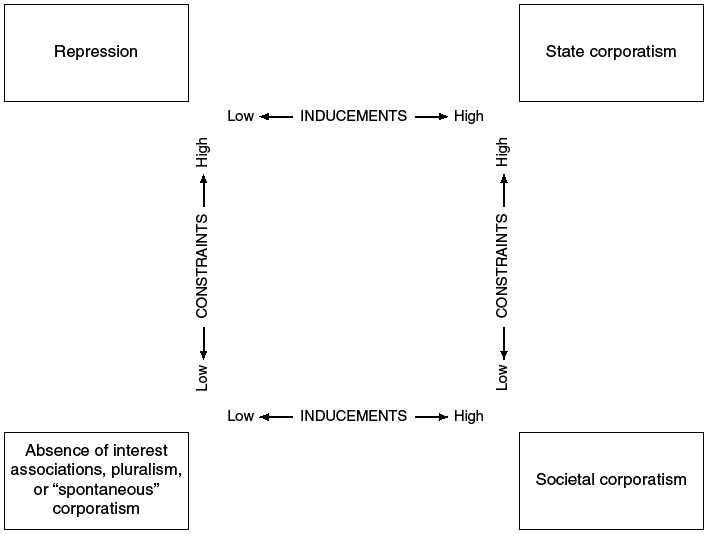
As one moves beyond the variations within Latin America to contexts that involve more nearly pure cases of societal corporatism, one might expect greater emphasis on inducements and less on constraints, since these would be settings in which the state was more dependent on the corporatized groups. These are commonly situations in which the state ratifies patterns of noncompetitive interest representation that emerged “from below” involving strong, autonomous interest groups. In Europe, a major inducement that has appeared in such cases has been the opportunity for certain groups to be represented on functionally organized, semipublic entities such as wage-price councils and economic planning boards.Footnote 17 This contrast between the patterns of inducements and constraints that one might expect in hypothetically “pure” cases of state and societal corporatism is reflected in the right side of Figure 12.3.
Hypothetical relationship between inducements–constraints distinction and broad types of group representation.
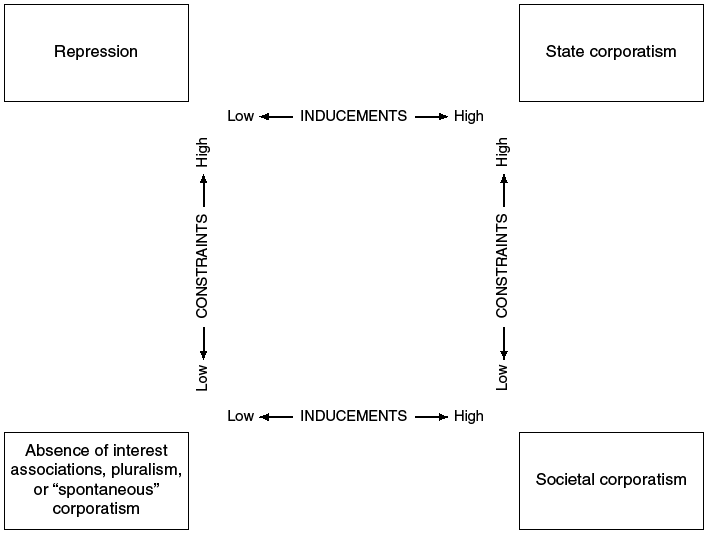
Figure 12.3 Long description
The vertical axis represents “Constraints” ranging from low to high, while the horizontal axis indicates “Inducements,” also ranging from low to high. In the upper left corner, “Repression” is noted, while the upper right corner contains “State Corporatism.” The lower left corner features “Absence of interest associations, pluralism, or ‘spontaneous’ corporatism,” and the lower right corner states “Societal Corporatism.”
The left side of Figure 12.3 suggests the hypothetical relationship between the other two combinations of “extreme” values of inducements and constraints and other types of group representation. High levels of constraints and low levels of inducements by definition involve a situation of outright control or repression of groups – cases of which have already been noted. Low levels of inducements and constraints involve contexts in which the state does not attempt to shape interest politics through these kinds of provisions aimed at interest associations. This pattern may correspond to situations in which interest associations do not exist, to pluralism, or to situations in which pluralism may have been eroded “from below” through the oligarchic tendencies of group interaction but in which the state has not become involved in ratifying or reinforcing this erosion of pluralism. This is a substantial “residual category,” which reflects the obvious fact that a focus on inducements and constraints does not allow one to distinguish among all different patterns of group representation. This focus does, however, provide a useful perspective for looking at variations in the state role in group representation.
In addition to stressing the utility of the distinction between inducements and constraints, we should note the limitations of this perspective as it has been presented here. First, the particular operationalization we have proposed is not intended to encompass all of the inducements and constraints formalized in labor law – not to mention those found in other areas of law or those not embodied in law at all. The purpose of this operationalization is to show that there are certain recurring patterns of inducements and constraints. The particular scoring employed here is not intended to be a definitive assessment of these two dimensions.
Second, the analysis has focused on two crucial actors – the state and labor organizations. Obviously, other actors are closely involved in the interplay of inducements and constraints that we have analyzed – most immediately the workers themselves (as opposed to labor organizations) and employers. What is ultimately called for is a more complex analysis that encompasses all four of these actors. Thus, in one context, the state may extend important benefits to labor organizations to strengthen the position of these organizations and of workers vis-à-vis employers. In another context, both the state and employers may extend inducements to labor organizations in order to secure their aid in enforcing regressive income policies on the workers. At this level, highly complex relationships may be involved. The goal of the present analysis has simply been to propose a conceptual distinction that will make it easier to analyze these more complex patterns.
Finally, this attempt to conceptualize more adequately different patterns of state–society relations is a building block in a larger analytic effort in another sense as well. A more sharply focused description of these relationships should ultimately contribute to a more adequate explanation of differences among countries and change over time within countries. It should help to address questions such as: Why is the pattern of state–labor relations that emerges at the time of the initial “incorporation” of organized labor sustained over many years in some countries, whereas in others it is not? Why have such different systems of labor control emerged in the context of “bureaucratic-authoritarianism,” and what are the implications of these different systems of control for the ability of labor to achieve a more favorable distribution of political power and economic resources?
The answers to these questions can help us to understand certain anomalies in the long-term patterns of change. For instance, Figure 12.2 pointed to similarities in patterns of inducements and constraints at an earlier point in the twentieth century between Argentina and Mexico, on the one hand, and Brazil and Chile, on the other. Yet in a later period, if one examines the degree to which different countries have well-institutionalized systems of labor control, there appears to be a significant regrouping of cases. It might be argued that Mexico and Brazil subsequently had more institutionalized systems of control, whereas Argentina and Chile had less well-institutionalized systems of control. How does one explain this shift? What are the “transformation rules” that account for these changing patterns? The analysis of inducements and constraints will have proved useful if it can help to address questions such as these.

 Open access