

Paternity leave-taking has received increased attention in recent years, as it is believed to have important ramifications for gender equality, although it is far from a panacea (Doucet & McKay, Reference Doucet and McKay2020; Duvander et al., Reference Duvander, Björk Eydal, Brandth, Gíslason, Lammi-Taskula, Rostgaard, Moss, Duvander and Koslowski2019; Kaufman, Reference Kaufman2020). Providing fathers with dedicated time at home during an important transition period following the birth or adoption of a child may promote a more equal division of domestic labour between parents and reduce burdens on mothers (Goldscheider et al., Reference Goldscheider, Bernhardt and Lappegård2015). There is widespread evidence that paid paternity leave policies are associated with greater paternal engagement in childcare activities (Duvander et al., Reference Duvander, Björk Eydal, Brandth, Gíslason, Lammi-Taskula, Rostgaard, Moss, Duvander and Koslowski2019; Haas & Hwang, Reference Haas and Hwang2008; Huerta et al., Reference Huerta, Adema, Baxter, Han, Lausten, Lee and Waldfogel2014). In the USA, fathers are more involved in childcare when they take paternity leave, particularly longer periods of leave, regardless of whether a paid paternity leave policy is used (Petts & Knoester, Reference Petts and Knoester2018).
Nevertheless, we know relatively little about whether paternity leave may facilitate fathers’ involvement in other forms of domestic labour such as housework. While many fathers (and mothers) want to be highly engaged in their children’s lives, housework is generally perceived to be a less desirable, more time-consuming and more tedious form of domestic labour than childcare, and this is especially the case for routine tasks such as cleaning, laundry and dishwashing (Poortman & van der Lippe, Reference Poortman and van der Lippe2009; Sullivan, Reference Sullivan2013). Moreover, while men have increased the amount of time they spend on both housework and childcare over time, gender gaps in routine housework remain larger than gender gaps in childcare (Carlson & Petts, Reference Carlson and Petts2022; Livingston & Parker, Reference Livingston and Parker2019). Thus, to achieve greater gender equality, fathers must take on greater shares of not just childcare activities but routine housework tasks as well. There is some evidence that paternity leave-taking is associated with fathers’ participation in housework, but results are mixed (e.g. Bünning, Reference Bünning2015; Kotsadam & Finseraas, Reference Kotsadam and Finseraas2011; Lee, Reference Lee2023; Meil et al., Reference Meil, Rogero-Garcia, Romero-Balsas and Díaz-Gandasegui2023; Patnaik, Reference Patnaik2019; Schober, Reference Schober2014). Furthermore, research has yet to consider this association within the USA.
The current study aims to more fully consider the association between paternity leave and fathers’ participation in housework, focusing on the US context. We use repeated cross-sectional data on different-gender partnered parents from a recent, large national study to examine the associations between fathers’ leave-taking, the length of their leave, and their shares of and commitments to housework. We also consider the implications of patterns of leave-taking for different household tasks and seek to account for potential selection effects in our regression models. As a result, this study extends knowledge on the potential benefits associated with paternity leave and broader implications of paternity leave for greater gender equality.
Background
Paternity leave in the USA
Since scholars have yet to consider the association between paternity leave-taking and housework in the USA, it is important to first contextualise the unique conditions surrounding US leave-taking. Most countries have a national paid parental leave policy, and most high-income countries have national paternity leave policies that allocate paid leave specifically to fathers; the USA has neither (Blum et al., Reference Blum, Dobrotić, Kaufman, Koslowski and Moss2023). Instead, the USA has unpaid leave for eligible workers through the Family and Medical Leave Act (FMLA); state-level paid family and medical leave policies in thirteenn states plus Washington, DC; and leave policies offered by employers (Blum et al., Reference Blum, Dobrotić, Kaufman, Koslowski and Moss2023). This patchwork system leaves most Americans (approximately 73 per cent) without access to paid parental leave and many without access to unpaid leave (U.S. Bureau of Labor Statistics, 2023). FMLA and state-level policies allow parents to take parental leave within the year following a child’s birth. Although FMLA and state-level policies are gender-neutral (i.e., there is no public maternity or paternity leave policy), some companies do have specific maternity and paternity leave policies. These policies are more likely to offer longer periods of parental leave to mothers than fathers – reflecting the broader gender structure that reinforces gender stereotypes about care and work (Kaufman & Petts, Reference Kaufman and Petts2022).
In addition to lacking access to leave, many US men are fearful of taking leave (Petts, Reference Petts2022). Ideal worker and traditional gender norms combine to reinforce expectations that fathers should be fully devoted to their jobs (Williams, Reference Williams2000), and those who violate these expectations are stigmatised (Coltrane et al., Reference Coltrane, Miller, DeHaan and Stewart2013; Petts, Mize & Kaufman, Reference Petts, Mize and Kaufman2022). Although mothers also experience flexibility stigma in the workplace when prioritising family over work, violations of both workplace and gender norms may lead fathers to experience greater penalties for taking leave than mothers (Butler & Skattebo, Reference Butler and Skattebo2004; Wayne & Cordeiro, Reference Wayne and Cordeiro2003; Weisshaar, Reference Weisshaar2018), although the evidence is mixed (Munsch, Reference Munsch2016; Petts et al., Reference Petts, Mize and Kaufman2022). Regardless, gendered and workplace pressures to prioritise work over family may lead US fathers to either avoid taking paternity leave, or take shorter leaves than they would prefer, to conform to these expectations and avoid workplace penalties (Petts, Reference Petts2022).
Despite the lack of access and the cultural barriers to paid paternity leave, most US adults believe that workers should have access to paid parental leave policies and that paid parental leave should be offered to both mothers and fathers (Li, Knoester & Petts, Reference Li, Knoester and Petts2022; Petts, Knoester & Li, Reference Petts, Knoester and Li2020). Furthermore, the vast majority of US fathers take some time off work after the birth of a child (i.e. take paternity leave) (Petts & Knoester, Reference Petts and Knoester2018; Pragg & Knoester, Reference Pragg and Knoester2017). However, less than half of fathers take paid leave, and relatively few take leave under FMLA (Klerman et al., Reference Klerman, Daley and Pozniak2012; Petts, Knoester & Li, Reference Petts, Knoester and Li2020). Instead, many fathers find other ways to take paternity leave, such as repurposing vacation or personal days (Petts, Reference Petts2022). On average, periods of leave-taking are short for US fathers, with most taking one week or less of leave (Petts et al., Reference Petts, Knoester and Li2020; Pragg & Knoester, Reference Pragg and Knoester2017).
Conceptual framework
Paternity leave and gender equality
In theorising why paternity leave may promote gender equality within families, we focus on time availability and socialisation into domestic labour routines. Time availability theory suggests that time is the key resource used to determine divisions of domestic labour, such that the parent with more available time performs more of these tasks (Blair & Lichter, Reference Blair and Lichter1991; Cunningham, Reference Cunningham2007; Gough & Killewald, Reference Gough and Killewald2011). When applied to paternity leave, dedicated time off work allows fathers to focus on their new child and on being an engaged father and partner. Simply put, fathers have more time available while on leave from paid employment to engage in activities at home. Having this time when a child is born is especially important because the period after birth is a critical time when parents learn how to be parents and develop co-parenting routines (Petts & Knoester, Reference Petts and Knoester2020; Rehel, Reference Rehel2014; Tanaka & Waldfogel, Reference Tanaka and Waldfogel2007).
Indeed, there is extensive US and international evidence suggesting that dedicated time at home following the birth of a child is associated with greater family engagement among fathers. Specifically, fathers who take paternity leave, and particularly fathers who take longer leaves, are more engaged in their child’s lives compared with fathers who do not take paternity leave (Almqvist & Duvander, Reference Almqvist and Duvander2014; Haas & Hwang, Reference Haas and Hwang2008; Huerta et al., Reference Huerta, Adema, Baxter, Han, Lausten, Lee and Waldfogel2014; Petts & Knoester, Reference Petts and Knoester2018; Pragg & Knoester, Reference Pragg and Knoester2017; Tanaka & Waldfogel, Reference Tanaka and Waldfogel2007). Paternity leave-taking is also associated with fathers providing greater co-parenting support to mothers (Petts and Knoester Reference Petts and Knoester2020), more satisfying and stable parental relationships (Kotsadam & Finseraas, Reference Kotsadam and Finseraas2011; Lappegård et al., Reference Lappegård, Duvander, Neyer, Viklund, Anderson and Garðarsdóttir2019; Petts & Knoester, Reference Petts and Knoester2020; Petts, Carlson & Knoester, Reference Petts, Carlson and Knoester2020) and stronger father–child relationships (Petts, Knoester & Waldfogel, Reference Petts, Knoester and Waldfogel2020).
Paternity leave may also help to socialise fathers by increasing their exposure to, and understanding of, the myriad domestic demands at home (Carlson & Petts, Reference Carlson and Petts2022; Shafer et al., Reference Shafer, Milkie and Scheibling2020). The prevalence of traditional gender norms involving expectations that mothers should be primarily responsible for domestic labour (and fathers play a secondary role) may mean that many fathers are largely unaware of everything involved with managing the domestic sphere (Petts, Reference Petts2022; Williams, Reference Williams2000). Indeed, US mothers spend much more time on housework than fathers (Livingston & Parker, Reference Livingston and Parker2019). Being home on paternity leave may help fathers to better understand all the tasks that need to be accomplished at home, and greater exposure may also lead fathers to gain experience with, and confidence in, performing domestic tasks (Petts, Reference Petts2022; Shafer et al., Reference Shafer, Milkie and Scheibling2020).
Increased exposure to domestic demands while on paternity leave may also lead to long-term benefits. Time availability theory suggests that, once fathers return to work after paternity leave, they might have less available time and revert to more traditional divisions of domestic labour. Yet, by gaining a greater awareness of, and confidence in performing, domestic labour, fathers who take leave may be encouraged to maintain higher levels of domestic involvement even after leave ends. Indeed, there is evidence of long-term effects of paternity leave-taking. Within the USA, fathers who take two or more weeks of leave remain more engaged in childcare throughout the first few years of their child’s life (Petts and Knoester Reference Petts and Knoester2018). Similarly, heightened co-parenting support and parental relationship quality associated with paternity leave-taking persist after paternity leave (Kotsadam & Finseraas, Reference Kotsadam and Finseraas2011; Lappegård et al., Reference Lappegård, Duvander, Neyer, Viklund, Anderson and Garðarsdóttir2019; Petts & Knoester, Reference Petts and Knoester2020), and children whose fathers took paternity leave report better relationships with their fathers years afterwards (Petts, Knoester & Waldfogel, Reference Petts, Knoester and Waldfogel2020). Consequently, paternity leave-taking may increase the likelihood that fathers are engaged in domestic tasks and share domestic responsibilities more equally with mothers even after leave ends.
Paternity leave-taking and housework
Given that US fathers commonly believe that fathers should be equally involved in all aspects of domestic labour (Petts, Reference Petts2022), paternity leave-taking may be positively associated with fathers’ participation in housework. Just as paternity leave may provide time for parents to develop more equitable divisions of childcare and expose fathers to childcare needs, it may also expose fathers to housework needs and provide dedicated time for parents to establish more equitable housework routines. Following the arrival of a child, mothers may need to physically recover from birth as well as breastfeed every few hours. With mothers physically limited and their energy devoted to the new child’s needs, fathers may become more aware of housework needs and consequently perform more equitable shares of housework. Qualitative studies on fathers’ roles during breastfeeding also suggest that many fathers take on a greater share of housework tasks to promote equity and provide greater support to mothers while they are breastfeeding (Datta, Graham & Wellings, Reference Datta, Graham and Wellings2012; deMontigny et al., Reference deMontigny, Gervais, Larivière-Bastien and St-Arneault2018). Doing so may help establish a more egalitarian long-term division of housework between mothers and fathers. Thus, we might also anticipate a positive association between paternity leave-taking and US fathers’ participation in housework.
Nonetheless, a positive association between paternity leave and childcare does not necessarily mean the same for paternity leave and fathers’ housework. As Sullivan (Reference Sullivan2013) notes, childcare and housework are distinct forms of domestic labour with differing meanings and gendered expectations. While parenting and childcare may provide meaning and fulfilment for adults, housework does not appear to provide similar rewards. It is little surprise then that fathers tend to be more involved in childcare than housework, and the gap in time spent on domestic labour between mothers and fathers is greater for housework than for childcare (Almqvist & Duvander, Reference Almqvist and Duvander2014; Livingston & Parker, Reference Livingston and Parker2019; Sullivan, Reference Sullivan2013).
In considering gender inequality in housework, scholars focus on feminised routine housework – tasks such as cooking, cleaning, laundry, grocery shopping and dishes – that must be completed regularly, compared with non-routine, masculine tasks such as home maintenance, car repairs and bill payment, which are performed infrequently (Carlson, Miller & Sassler, Reference Carlson, Miller and Sassler2018; Carlson, Reference Carlson2022; Sullivan Reference Sullivan2013). Studies on housework tend to focus on routine tasks given that they are more strongly associated with relationship outcomes owing to their frequency and perceived undesirability (Carlson, Reference Carlson2022; Poortman & van der Lippe, Reference Poortman and van der Lippe2009; Sullivan, Reference Sullivan2013). Among routine tasks, men are most likely to engage in shopping and least likely to engage in laundry and cleaning (Carlson et al., Reference Carlson, Miller and Sassler2018). As with childcare, fathers may engage more in shopping because it is seen as more fulfilling and rewarding (e.g. done outside the home in public) than more isolating and onerous routine housework tasks such as cleaning and laundry (Carlson et al., Reference Carlson, Miller and Sassler2018; Sullivan, Reference Sullivan2013).
Although fathers’ involvement in children’s lives is now widely expected and fathers express a strong desire to be engaged in their children’s lives, men are not held to the same expectations regarding housework (Thébaud, Kornrich & Ruppanner, Reference Thébaud, Kornrich and Ruppanner2021). Given relatively negative perceptions of housework among men and women (Poortman & van der Lippe, Reference Poortman and van der Lippe2009; Sullivan, Reference Sullivan2013), fathers who wish to engage in domestic labour may thus seek to engage in childcare instead of housework. Furthermore, some fathers may avoid housework tasks because they perceive themselves to be less competent at them or think that many routine housework tasks are unmasculine. Other fathers may feign incompetence to get out of doing these tasks (Deutsch, Reference Deutsch2000; Petts, Reference Petts2022). Therefore, we might expect to find only limited evidence, or no evidence, of a positive association between paternity leave-taking and US fathers’ participation in housework.
Although international research provides some evidence of a positive association between paternity leave and fathers’ participation in housework (Bünning, Reference Bünning2015; Kotsadam & Finseraas, Reference Kotsadam and Finseraas2011; Meil, Reference Meil2013; Meil et al., Reference Meil, Rogero-Garcia, Romero-Balsas and Díaz-Gandasegui2023; Patnaik, Reference Patnaik2019), findings are largely mixed. For example, two studies using causal methods to study the effect of parental leave policy reforms (i.e. assessing differences in housework pre/post-reform as opposed to measuring leave-taking directly) reveal no substantive effect of increased access to paternity leave on fathers’ housework (Kotsadam & Finseraas, Reference Kotsadam and Finseraas2011; Schober, Reference Schober2014). Two additional studies suggest that the paternity leave–housework link may be due to selection effects, such that fathers who were predisposed to be more engaged in housework are those who take longer leaves (Doucet & McKay, Reference Doucet and McKay2020; Lee, Reference Lee2023). Moreover, there are conflicting findings among studies that do find a positive association between paternity leave and fathers’ involvement in housework. Almqvist and Duvander (Reference Almqvist and Duvander2014) and Bünning (Reference Bünning2015) find that housework only increased among fathers who took long leaves (i.e. more than two months or one month, respectively), whereas Meil (Reference Meil2013) finds that only leave-taking itself, not length of leave, is positively associated with fathers’ housework. Although mixed findings could stem from methodological differences across studies, results differ even when studies share considerable similarities. For instance, Bünning (Reference Bünning2015) finds a positive association between long leave times and hours spent on housework in a typical weekday, whereas Schober (Reference Schober2014) finds no association despite using similar measures of paid leave and housework. There is also mixed evidence on what housework tasks vary by leave-taking; some studies find that paternity leave is only associated with washing clothes, whereas others find that leave-taking is only associated with cleaning and cooking daily (Kotsadam & Finseraas, Reference Kotsadam and Finseraas2011; Meil, Reference Meil2013). While these studies vary in their methodological approach (survey, causal and qualitative methods), there is no discernible pattern based on rigor or nuance of approach to suggest that mixed findings are the product of variation in study design.
Given the inconsistency in the literature, more research is needed to better understand whether paternity leave-taking is associated with fathers’ engagement in housework, especially within the US context. The present study considers competing hypotheses about whether paternity leave is or is not associated with fathers’ participation in housework. We use survey data that enable us to explicitly test the associations between leave-taking, length of leave and reports of fathers’ time on, and shares of, routine housework. Although this approach restricts our ability to make conclusions about causality (for other approaches, see Bünning, Reference Bünning2015; Kotsadam & Finseraas, Reference Kotsadam and Finseraas2011; Patnaik, Reference Patnaik2019; and Schober, Reference Schober2014), we do incorporate analyses designed to account for selection effects to reduce the likelihood that observed results are driven by selection processes.
Methods
Data
Data come from the institutional review board (IRB)-approved Study on Parents’ Divisions of Labor during COVID-19 (SPDLC). The SPDLC is a longitudinal study of partnered US parents who reside with a biological child; data for the study were collected using Prolific’s online opt-in panel (Peer et al., Reference Peer, Brandimarte, Samat and Acquisti2017). Parents were surveyed in April 2020 (wave 1), November 2020 (wave 2), October 2021 (wave 3) and October 2022 (wave 4). The SPDLC includes both panel (parents are invited to participate in each subsequent wave) and repeated cross-sectional (a new cohort of parents is recruited to participate at each wave) components (Carlson & Petts, Reference Carlson and Petts2023).
We used pooled cross-sectional data from the first four waves of the SPDLC to maximise the sample size of fathers with young children. A total of 4,551 unique parents were surveyed, and a single observation from each participant was used (taken from when the parent first entered the study). We first restricted the sample to fathers in different-gender partnerships (N = 4,245) and excluded cases where fathers were not working when their youngest child was born (N = 177). We then focused on fathers whose youngest child was 3 years old or younger to capture recent incidents of paternity leave-taking (N = 1,682). After listwise deletion removed a small number of cases with missing values on key variables, our final sample size for this study was 1,654.
Paternity leave-taking
Parents reported on whether they and their partners ‘took time off of work when their youngest child was born (e.g., parental leave, maternity leave, etc.)’ and how much time off work they took. Because these questions asked specifically about taking time off work when the child was born (as opposed to taking time off for a new child), it is likely that parents reported on paternity (or maternity) leave-taking as opposed to parental leave, which may extend beyond the immediate period following a child’s birth (Blum et al., Reference Blum, Dobrotić, Kaufman, Koslowski and Moss2023). We first created gendered indicators of leave-taking and used this information to construct two indicators. ‘Paternity leave’ indicates whether fathers took time off work when their youngest child was born (1 = yes). ‘Length of paternity leave’ indicates whether fathers took (a) no leave (reference category), (b) less than one week of leave, (c) one week of leave, (d) two weeks of leave, (e) three to four weeks of leave or (f) more than a month (i.e. five or more weeks) of leave.
Fathers’ participation in housework
Parents were asked separate questions about (a) how various housework tasks were divided between themselves and their partners (1 = I do it all; 5 = My partner does it all), and (b) how much time both they and their partners spent on the same tasks in the week prior to the survey. Parents were asked about participation in preparing and cooking meals, laundry, shopping for groceries and other household needs, washing dishes and house cleaning. We used this information to construct two variables. Fathers’ shares of housework was constructed by first creating gendered indicators of each task (1 = mother does it all; 5 = father does it all) and then using the mean as the indicator of fathers’ shares of routine housework. Fathers’ housework time was constructed by summing the number of hours fathers spent on each of the five housework tasks in the week prior to the survey (top-coded at the ninety-fifth percentile to minimise the influence of extreme outliers). Because time spent on housework tasks was not asked at W1, the sample size for analyses involving this measure is smaller (N = 1,281).
Control variables
Control variables include the respondent’s gender, father’s age, father’s race/ethnicity (White, Black, Latino, Asian or other race), whether the father has a college degree (1 = yes), whether the father is married (compared with cohabiting) and whether there are extended family members residing in the household (1 = yes). Other controls include the age of the youngest child, number of children, household income (1 = less than $1,000/month; 7 = $9,000 a month or more) and relative earnings (respondent earns more, earnings shared equally or partner earns more). We also controlled for the work status of both the father and mother (not working, part-time or full-time), essential worker status of the father and/or mother (1 = yes), flexibility of the work schedules for the father and/or mother (1 = yes flexible) and work-from-home status of the father and mother (exclusively, sometimes and never). To minimise the likelihood that our measures of fathers’ participation in housework were simply picking up on fathers’ involvement more generally, we also included a variable indicating fathers’ shares of childcare. This measure was constructed in a similar way to fathers’ shares of housework, representing the mean response for fathers’ relative participation in routine childcare tasks (see Carlson and Petts Reference Carlson and Petts2023 for the full list of childcare tasks). Finally, we controlled for the survey wave that the parent participated in.
Analytic strategy
Ordinary least squares (OLS) regression models were used to analyse the extent to which paternity leave-taking and length of paternity leave are associated with fathers’ shares of, and time spent on, housework. We then estimated separate models for each of the five routine housework tasks.
To address concerns about selection (i.e. there may be influences that lead fathers to be more likely to take leave and be more involved in housework), we also utilised propensity score matching (PSM) and augmented inverse propensity weighted (AIPW) estimators. Each of these strategies allowed us to control for confounding observed influences on the relationship between paternity leave-taking and fathers’ involvement in housework. PSM models were used to account for selection into paternity leave-taking, and AIPW estimators were used to account for selection into taking different lengths of leave. For these analyses, we focused on confounding factors that are likely unchanged between when leave was taken and when housework was measured: the father’s race, father’s degree, father’s age, marital status and number of children.
Results
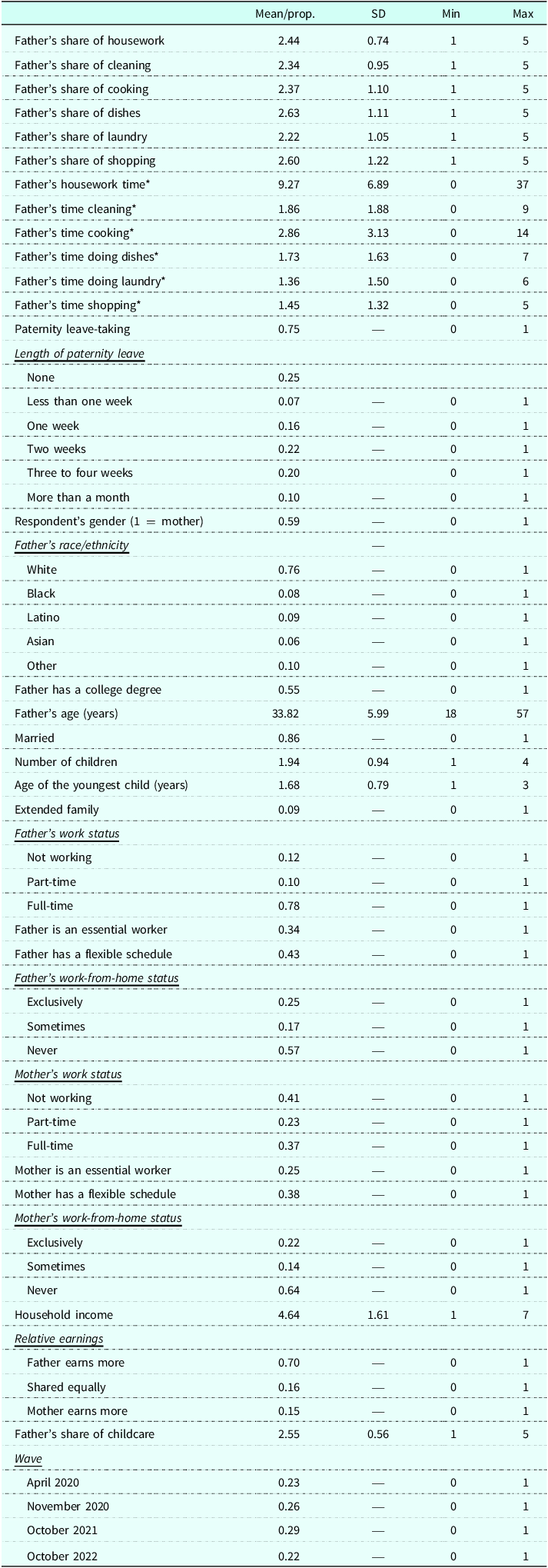
Descriptive statistics are presented in Table 1. Results show that most fathers (75 per cent) in the SPDLC took paternity leave when their youngest child was born, which is consistent with (or slightly less than) estimates from other national studies (Petts & Knoester, Reference Petts and Knoester2018; Reference Petts and Knoester2020). Of fathers who took time off work, approximately 30 per cent took one week of leave or less, consistent with the average length of paternity leave in the USA (Petts et al., Reference Petts, Knoester and Li2020), 30 per cent of fathers took two weeks, and 40 per cent of fathers took three or more weeks of leave. Results also show that fathers spent an average of nine hours a week on housework, similar to national estimates (Livingston & Parker, Reference Livingston and Parker2019). Mothers performed a greater share of housework than fathers, on average.
Descriptive statistics (N = 1,654)
SD, standard deviation, prop., proportion.
*N = 1,281 due to measure not being included in Wave 1.
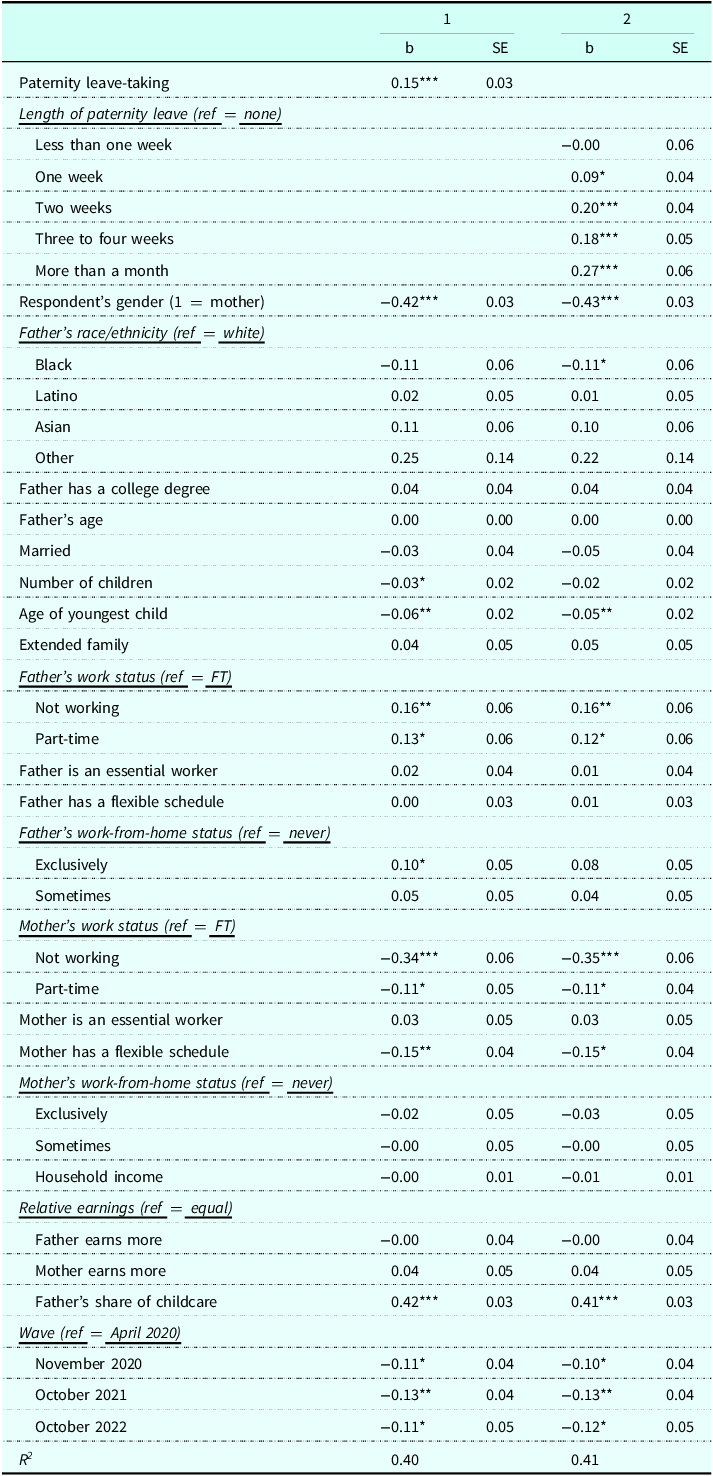
Results from OLS models predicting fathers’ shares of housework are presented in Table 2. In Model 1, paternity leave-taking was associated with fathers performing greater shares of housework (b = 0.15; p < 0.001). This 0.15 scale difference equates to fathers who take paternity leave doing approximately a 4 per cent greater share of housework compared with fathers who did not take leave (0.15/4 = 0.0375). In Model 2, results showed that the positive association between paternity leave-taking and fathers’ shares of housework only appears for fathers who took at least a week off work; fathers who took one week of leave performed approximately 2 per cent greater shares of housework than fathers who did not take leave (b = 0.09; p < 0.05), whereas fathers who took more than one month of leave performed 7 per cent greater shares than fathers who did not take leave (b = 0.27; p < .001). Tests of marginal effects for differences across various lengths of leave offered further evidence that longer leaves are associated with fathers performing greater shares of housework (results not shown); fathers who took two weeks (p < 0.05), three to four weeks (p < 0.10) or more than a month of leave (p < 0.05) performed greater shares of housework than fathers who took only one week of leave.
Results from OLS regression models predicting fathers’ shares of housework (N = 1,654)
SE, standard error; FT, full-time
*p < 0.05.
**p < 0.01.
***p < 0.001.
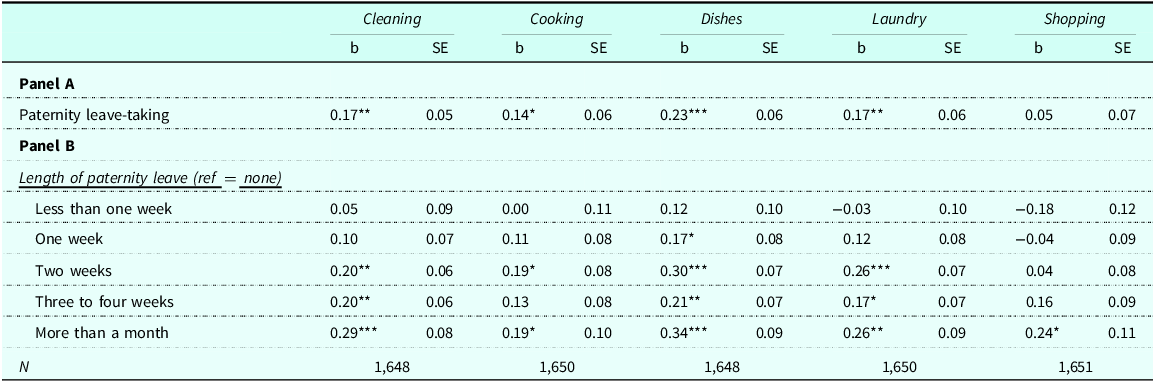
Table 3 presents results from separate models by housework task to assess whether paternity leave-taking may be differentially associated with shares of certain tasks. Results showed a largely consistent pattern of paternity leave-taking and length of paternity leave being positively associated with fathers’ shares of cleaning, cooking, doing dishes and doing laundry. However, any paternity leave-taking was unrelated to fathers’ shares of grocery shopping. In terms of length of leave, only fathers who took more than a month of leave performed greater shares of shopping than fathers who did not take leave.
Results from OLS regression models predicting fathers’ shares of separate housework tasks
Note: All control variables were included in the models but are not shown to conserve space. SE, standard error.
*p < 0.05.
**p < 0.01.
***p < 0.001.
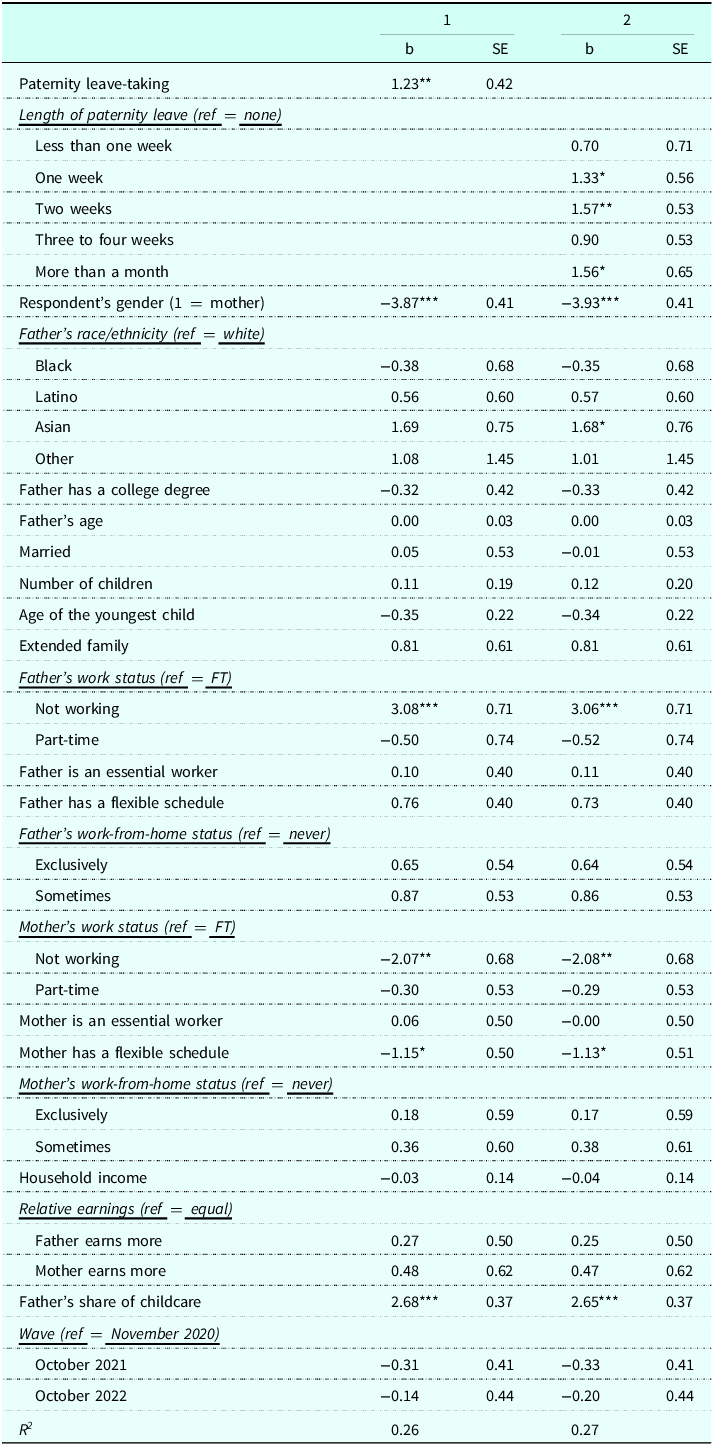
Results from OLS models predicting reports of fathers’ time on housework are presented in Table 4. Similar to results in Table 2, paternity leave-taking was associated with fathers spending more time on housework tasks (Model 1). Also, as shown in Model 2, the positive association between paternity leave-taking and fathers’ housework time only appeared for fathers who took at least a week of paternity leave. But in contrast to results in Table 2 (and marginal effects analyses not shown), we did not find any evidence that taking longer leaves (i.e. longer than a week) is associated with more time spent on housework (results not shown).
Results from OLS regression models predicting fathers’ housework time (N = 1,281)
SE, standard error
*p < 0.05.
**p < 0.01.
***p < 0.001.
Table 5 presents results from separate models by housework task to assess whether paternity leave-taking may be more strongly associated with reports of time spent on certain housework tasks. Similar to results in Table 3, paternity leave-taking was positively associated with time spent cleaning, cooking, doing dishes and doing laundry but was unrelated to time spent grocery shopping. Also, similar to results in Table 4, there was not a clear association between longer paternity leaves and fathers’ time spent on specific housework tasks.
Results from OLS regression models predicting fathers’ housework time separately by housework tasks (N = 1,281)
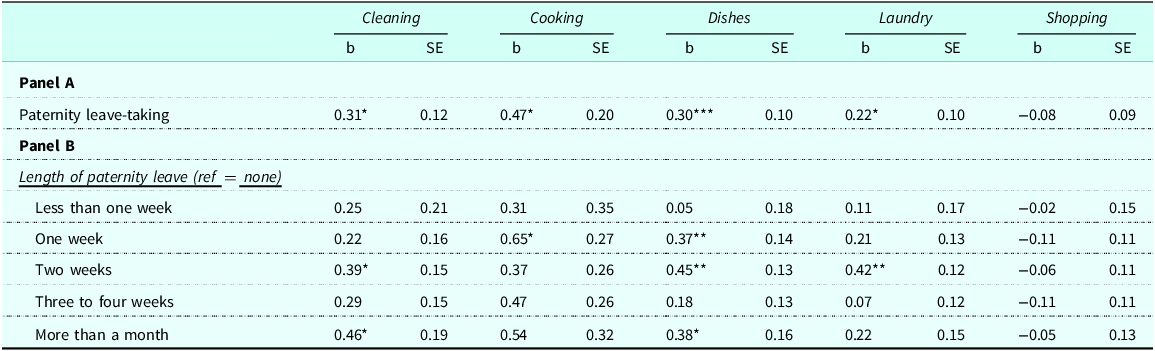
Note: All control variables are included in models but not shown to conserve space. SE, standard error.
*p < 0.05.
**p < 0.01.
***p < 0.001.
Finally, Table 6 presents results from selection models using propensity score matching and augmented inverse propensity weighted estimators to more rigorously account for potential selection effects in predicting the association between patterns of paternity leave-taking and reports of fathers’ participation in housework. Results from these models supported those from OLS models. That is, paternity leave-taking was positively associated with fathers’ shares of housework and fathers’ time spent on housework. These positive associations only appear when fathers took at least one week of leave (i.e. housework patterns were similar for fathers who took less than a week of leave or no leave at all). Also, longer leaves were associated with fathers performing greater shares of housework but were not associated with fathers’ time spent on housework tasks.
Results comparing regression estimates of the associations between paternity leave and fathers’ involvement in housework in OLS and selection models
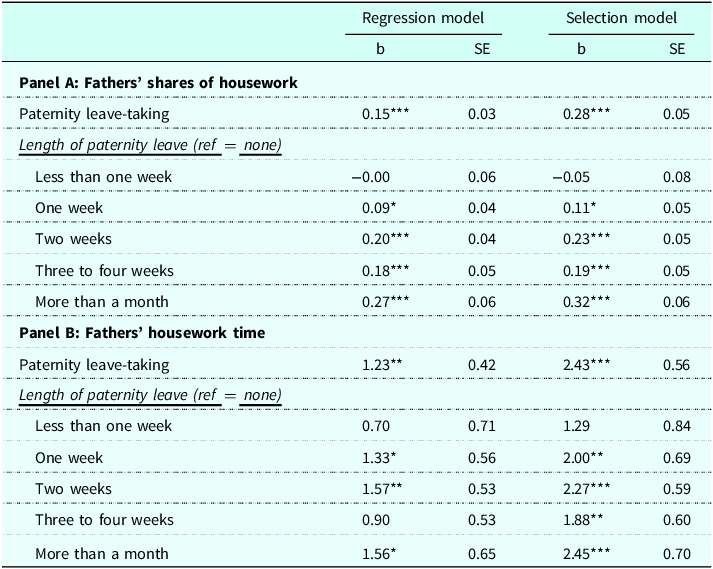
Regression model estimates were replicated from models in Tables 2 and 4. Propensity score matching estimates were used to estimate the influence of paternity leave-taking in selection models. Augmented inverse propensity weighted estimates were used to estimate the influence of length of paternity leave in selection models. Covariates include the father’s race, father’s degree, father’s age, status as married, and number of children. SE, standard error.
*p < 0.05.
**p < 0.01.
***p < 0.001.
Discussion
Paternity leave policies and their consequences have received increased attention in recent years given the belief that such policies can promote greater gender equality by enabling fathers’ engagement in domestic labour and establishing more egalitarian home arrangements (Duvander et al., Reference Duvander, Björk Eydal, Brandth, Gíslason, Lammi-Taskula, Rostgaard, Moss, Duvander and Koslowski2019; Kaufman, Reference Kaufman2020). Although myriad studies illustrate benefits associated with fathers’ leave-taking, the literature overwhelmingly focuses on fathers’ involvement in childcare and related parent–child interactions. Less attention has been placed on the extent to which paternity leave-taking may also encourage fathers to be more involved in housework, and the limited extant international research on this topic has produced mixed evidence. Consequently, the goal of this study was to assess associations between paternity leave-taking and fathers’ involvement in housework within the US context, a national context that has not been previously investigated.
Consistent with some previous studies (Bünning, Reference Bünning2015; Kotsadam & Finseraas, Reference Kotsadam and Finseraas2011; Meil, Reference Meil2013; Meil et al., Reference Meil, Rogero-Garcia, Romero-Balsas and Díaz-Gandasegui2023; Patnaik, Reference Patnaik2019), we found positive associations between paternity leave-taking and US fathers’ shares of, and time spent on, housework. We also found evidence that longer periods of leave are associated with fathers performing a greater share of housework tasks. Taken together, these results largely support time availability theory and the theory of socialisation into domestic labour. Time provided by paternity leave may allow fathers to take more responsibility for housework after the birth of a child when mothers are recovering from childbirth and/or breastfeeding (Datta et al., Reference Datta, Graham and Wellings2012; deMontigny et al., Reference deMontigny, Gervais, Larivière-Bastien and St-Arneault2018; Meil, Reference Meil2013). Moreover, although US paternity leaves are relatively short by international standards and do not provide additional time for fathers to perform housework indefinitely, paternity leave is taken at a critical time where parents first establish parenting routines as well as patterns of how to distribute domestic tasks such as housework in response to changing family dynamics (Petts & Knoester, Reference Petts and Knoester2020; Rehel, Reference Rehel2014; Tanaka & Waldfogel, Reference Tanaka and Waldfogel2007). As such, paternity leave may enable fathers to improve their awareness of family needs, gain greater experience performing housework, and become more confident and comfortable performing these tasks (Pragg & Knoester, Reference Pragg and Knoester2017; Rehel, Reference Rehel2014). Demonstrating a willingness to perform these tasks may potentially help establish more egalitarian divisions of housework, with fathers spending more time on these tasks over the long term (Meil et al., Reference Meil, Rogero-Garcia, Romero-Balsas and Díaz-Gandasegui2023). Importantly, these findings demonstrate that paternity leave may not only enable fathers to enact their desires to be more engaged parents but also provide time for fathers to take on greater shares of less desirable, less rewarding and more tedious domestic labour tasks which are particularly important for promoting greater gender equality.
In contrast to some research (Kotsadam & Finseraas, Reference Kotsadam and Finseraas2011; Meil, Reference Meil2013), we found that the positive association between paternity leave-taking and fathers’ involvement in housework was similar across most housework tasks such as cleaning, cooking, doing dishes and doing laundry. The one exception is that we found essentially no relationship between paternity leave-taking and fathers’ participation in grocery shopping. Although routine housework tasks are often perceived as feminine (Sullivan, Reference Sullivan2013), shopping is the routine housework task that couples are most likely to share (Carlson et al. Reference Carlson, Miller and Sassler2018). Consistent with past research, fathers’ shares of shopping in this study were higher, on average, than their shares of cleaning, cooking or doing laundry (Table 1). This is likely because shopping typically occurs outside the home and is thus more desirable and rewarding than other routine tasks which are done in isolation at home. As such, taking leave may have less impact on the division of shopping, as many fathers may have already shouldered substantial responsibility for this task prior to leave. Conversely, this finding could be due to the unique nature of the pandemic, as there is evidence suggesting that a greater number of fathers reported shopping more during the pandemic, and many became solely responsible for shopping (Carlson, Petts & Pepin, Reference Carlson, Petts and Pepin2022). The exposure risks associated with leaving the house may have led families to perceive grocery shopping as a more ‘dangerous’ (and thus, more masculine) task during the pandemic. Consequently, fathers may have taken more responsibility for shopping during the time period of this study regardless of paternity leave.
Somewhat surprisingly, longer paternity leaves were positively associated with fathers’ shares of housework but were largely unrelated to fathers’ time spent on housework tasks. This may be perceived as not supporting time availability theory, which would suggest that having a longer period of time off work may enable fathers to spend more time on housework post-leave. But, similar results have been found in other studies (Meil, Reference Meil2013). While fathers’ time availability during leave may result in increased domestic contributions, the long-term consequences of longer leaves for a father’s time spent on housework may be limited as the father’s time becomes more constrained after returning to work. Indeed, these results suggest a threshold effect where US fathers who take at least one week of leave are provided with the necessary exposure to the rhythms and demands of their households to socialise them to domestic roles. By gaining experience and familiarity with housework tasks while on leave, fathers who take leave of at least one week continue to perform greater shares of housework after returning to work than they would have had they not received this additional exposure (Carlson & Petts, Reference Carlson and Petts2022; Shafer et al., Reference Shafer, Milkie and Scheibling2020). Additionally, taking paternity leave of one week or more may demonstrate a commitment by fathers to be more engaged in domestic labour. This commitment, along with time for fathers to become more comfortable with housework tasks, appears to foster fathers’ greater participation in housework.
Interestingly, supplemental analyses suggest that, in families where fathers took longer leave (i.e. three or more weeks), mothers spent less time on housework (approximately fifteen hours/week) compared with families where fathers took only one week of leave (approximately seventeen hours/week; p < 0.05). On one hand, fathers’ leave-taking may function to reduce mothers’ domestic responsibilities, resulting in a more equal division of domestic labour and helping maintain mothers’ attachment to the paid labour force (Andersen, Reference Andersen2018; Frodermann, Wrohlich & Zucco, Reference Frodermann, Wrohlich and Zucco2023). This may help contextualise why length of leave is positively associated with fathers’ shares of, but not time spent on, housework. On the other hand, some fathers may take longer leaves in situations where mothers are unable to spend as much time on housework, perhaps owing to health limitations (results were unchanged when we controlled for mothers’ current self-reported health, but we do not have indicators of the mothers’ health at birth). Nonetheless, the positive association between paternity leave-taking and time spent on housework suggests that having some time off work matters even if there are selection effects associated with taking longer leaves.
Although this study finds a positive association between paternity leave and fathers’ involvement in housework in the USA, our results cannot speak to the relative importance of one type of paternity leave policy over others given that the SPDLC does not contain any information on how fathers were able to take time off work when their child was born. Fathers may have taken unpaid leave through FMLA, paid leave using a state or company policy or some other form of paid or unpaid time off (vacation, sick days, etc.). Notably, this limitation is consistent with the policy situation in the USA, where access to both paid and unpaid leave is dependent on what state you live in, your work history and your employer (Kaufman, Reference Kaufman2020). As such, this study provides useful insights into the potential benefits of paternity leave, generally (i.e. not tied to a specific policy context). Notably, time availability theory and the theory of socialisation into domestic labour emphasise the importance of additional time and exposure to domestic labour independent of wage replacement. That is, more time and exposure to domestic needs may enable fathers to be more involved in housework, suggesting that policies that provide longer periods of leave to fathers may be particularly beneficial. Moreover, paid leave may help reduce financial stress and increase the likelihood that fathers take longer periods of paid leave, and future studies should consider the relative effects of paid and unpaid leave on fathers’ involvement in housework.
There are some limitations in this study to acknowledge. First, we used cross-sectional data and, as such, cannot definitively establish causal order or eliminate possible selection effects. The consistency of results from models employing PSM and AIPW estimators help reduce concerns about selection effects, Footnote 1 but we were limited in the covariates we could include in these models given gaps in time between when leave was taken and when data were collected. We also limited our analyses to parents of young children to minimise this time gap between leave-taking and survey participation, as longer time gaps may introduce more factors that could change over time and influence fathers’ participation in housework. Supplementary analyses suggested that results are largely consistent when we used the full sample and when we restricted the sample to fathers of children aged 1 year or younger (Tables A3 and A4 in the online appendix). The exception is that the associations between paternity leave and fathers’ housework time disappeared when the sample was restricted to fathers who had a child aged 1 year or younger (Table A3), which may be due to the smaller sample size and more restrictive sample (all coefficients were in the expected direction). Future research should use prospective, longitudinal data to further assess potential selection effects.
Second, because parents in the SPDLC report on both themselves and their partners, reported estimates come from both mothers and fathers. This may introduce bias in parents’ reports of their own versus their partner’s housework. To assess the extent to which such biases may have affected our results, we controlled for respondents’ gender and also disaggregated the models for mother and father respondents. Results in the online appendix (Table A1 and A2) suggest that the associations between paternity leave-taking and fathers’ shares of housework were almost identical between reports from mothers and fathers. However, there was no association between paternity leave-taking and fathers’ time spent on housework when mothers’ reports were used. This may be due to mothers underreporting fathers’ time spent on housework, mothers being unaware of how much time fathers spent engaged in housework, or fathers who took leave being more likely to overestimate their housework time compared with fathers who did not take leave. Although gender discrepancies in estimates of men’s time spent on domestic labour is common and there is evidence of bias in reports from both mothers and fathers (Lee & Waite, Reference Lee and Waite2005; Press & Townsley, Reference Press and Townsley1998; Yavorsky, Kamp Dush & Schoppe-Sullivan, Reference Yavorsky, Kamp Dush and Schoppe-Sullivan2015), the consistency in results for fathers’ shares of housework suggest that perhaps time spent on housework may be more difficult for partners to estimate than relative shares. Regardless, the overall similarity in findings supports our approach of combining responses from both parents.
Relatedly, given the use of reports from both mothers and fathers, we are unable to fully account for the possibility that fathers’ gender attitudes may contextualise the observed relationships because we have data on the gender attitudes of only the respondents (some of whom are mothers) and not the full sample of fathers. However, results were largely unchanged when controlling for respondents’ gender attitudes in supplemental models, suggesting that the findings are robust to the inclusion of gender attitudes (Table A5).
It is also important to acknowledge that the SPDLC is an opt-in survey and thus may not be representative of the US population. Still, the SPDLC sample of parents looks similar to national estimates across a number of sociodemographic characteristics (Carlson & Petts, Reference Carlson and Petts2023), and estimates of paternity leave-taking reported in this study are similar to other US studies’ estimates (Petts & Knoester, Reference Petts and Knoester2018; Reference Petts and Knoester2020). Also, although the sample may overrepresent socio-economically advantaged individuals, results from opt-in panels have been largely consistent with probability-based samples once sociodemographic characteristics are controlled for (Jeong et al., Reference Jeong, Zhang, Morgan, Ross, Osman, Boynton, Mendel and Brewer2019; Tourangeau et al., Reference Tourangeau, Conrad and Couper2013). Regardless, future research should examine the association between paternity leave and fathers’ involvement in housework using nationally representative data.
Finally, the SPDLC was also collected during the coronavirus disease 2019 (COVID-19) pandemic, which may have shaped the results given that fathers took on greater shares of domestic labour early in the pandemic owing to greater time availability due to unemployment or working remotely (Carlson et al., Reference Carlson, Petts and Pepin2022; Shafer et al., Reference Shafer, Milkie and Scheibling2020). Thus, it may be that fathers’ participation in housework was inflated in these data, and fathers may have been especially motivated to take leave (or longer leave) given the greater awareness and acceptance of work–family policies (including remote work and flexible schedules) during the pandemic. However, we controlled for time-relevant variables in our models, and other studies show that fathers’ increased involvement in domestic labour was short-lived and reverted towards pre-pandemic levels by the end of 2020 (Carlson & Petts, Reference Carlson and Petts2022; Rodríguez Sánchez et al., Reference Rodríguez Sánchez, Fasang and Harkness2021). We also conducted supplemental analyses that excluded the survey conducted during lockdowns (April 2020), and results were largely unchanged (Table A6). While this does not eliminate the possibility that these results were influenced by the pandemic (e.g. greater awareness of domestic needs during the pandemic may have motivated fathers to use their leave to be more engaged in housework), consistency in results across later years of the pandemic – which were more ‘normal’ – increase our confidence that the association between paternity leave-taking and fathers’ participation in housework is not restricted only to the pandemic.
Overall, the current study extends a growing body of literature demonstrating how paternity leave can promote greater gender equality. Using data from the USA collected during the pandemic, the results show a positive association between paternity leave-taking and fathers’ participation in housework. Notably, parents are more likely to report a more egalitarian division of housework when fathers take paternity leave and when fathers take longer periods of leave. Combined with evidence from other country contexts demonstrating a link between paternity leave-taking and fathers’ involvement in housework (Almqvist & Duvander, Reference Almqvist and Duvander2014; Bünning, Reference Bünning2015; Kotsadam & Finseraas, Reference Kotsadam and Finseraas2011; Meil, Reference Meil2013; Meil et al., Reference Meil, Rogero-Garcia, Romero-Balsas and Díaz-Gandasegui2023; Patnaik, Reference Patnaik2019), this study suggests that the benefits of paternity leave seem to extend beyond fathers’ participation in childcare and parental relationship quality. By providing dedicated time at home away from work and greater exposure to domestic needs, paternity leave may enable and encourage fathers to be more engaged in housework tasks and may help facilitate greater gender equality in domestic labour.
Supplementary material
For supplementary material accompanying this paper visit https://doi.org/10.1017/S0047279425100901
Acknowledgements
This study was generously supported by the American Sociological Association Fund for the Advancement of the Discipline (2020) and the National Science Foundation under grant numbers 2148610 and 2148501. Any opinions, findings and conclusions or recommendations expressed in this material are those of the authors and do not necessarily reflect the views of the National Science Foundation.
Competing interests
The authors declare none.


 Open access

