

Introduction
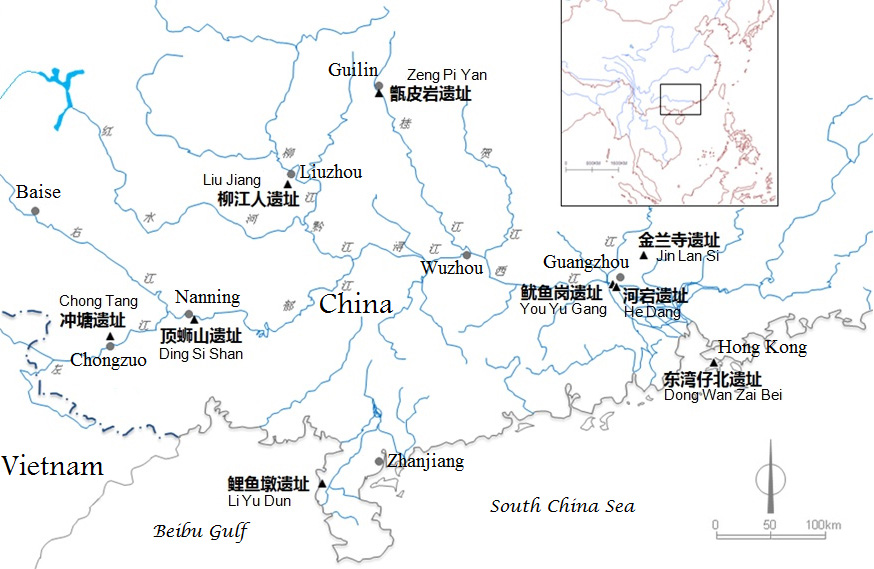
The main prehistoric sites in southern China (© Fa-jun Li).

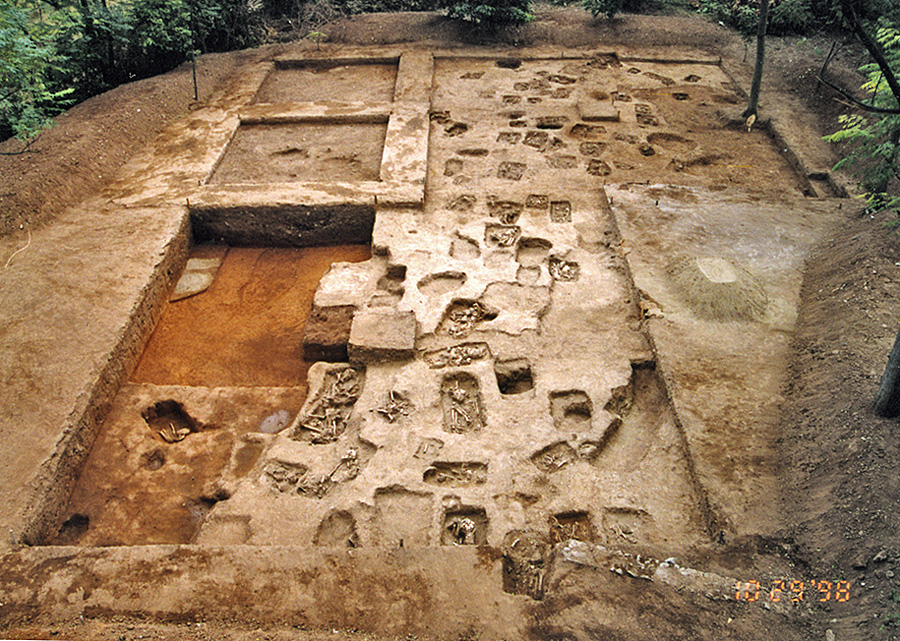
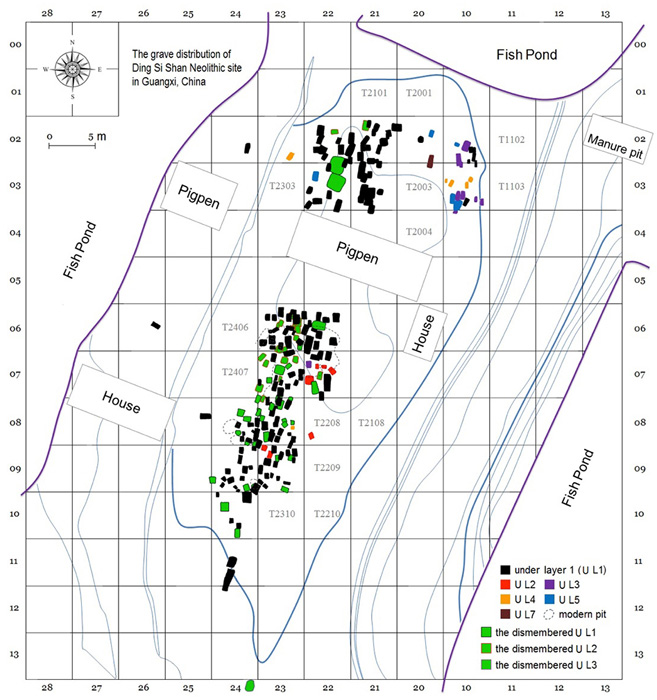
In 1994, archaeologists from the Institute of Cultural Relics Protection of Yongning County discovered a site on a hill called Ding Si Shan (22°43'48"N, 108°28'6"E). The hill is situated c. 3km south of the town of Pumiao in Yongning County, approximately 15km south-east of the city of Nanning (Figure 1). Though the northern and eastern parts of the site had been partially destroyed, around 5000m² of archaeological deposits survived. In 1996 and 1997, a team led by Professor Xian-guo Fu conducted excavations, identifying 149 human burials (Fu et al. 1998). Subsequent excavations in 1998–2000 uncovered a further 182 burials (Figures 2 & 3).
The archaeological deposits comprise seven discrete stratigraphical layers. With the exception of Layer 1, all deposits contained similar artefacts and ecofacts including abundant potsherds and stone, bone and shell implements, all associated with rich midden deposits of shells and other aquatic and terrestrial animal remains.
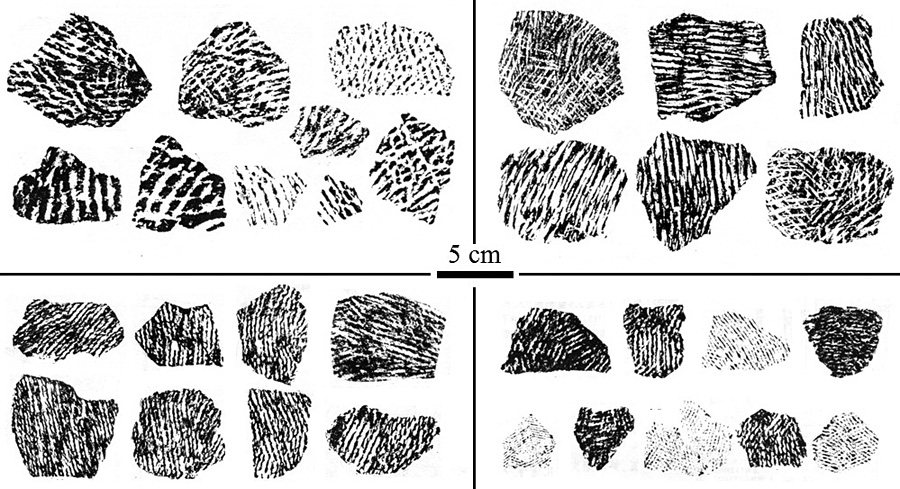
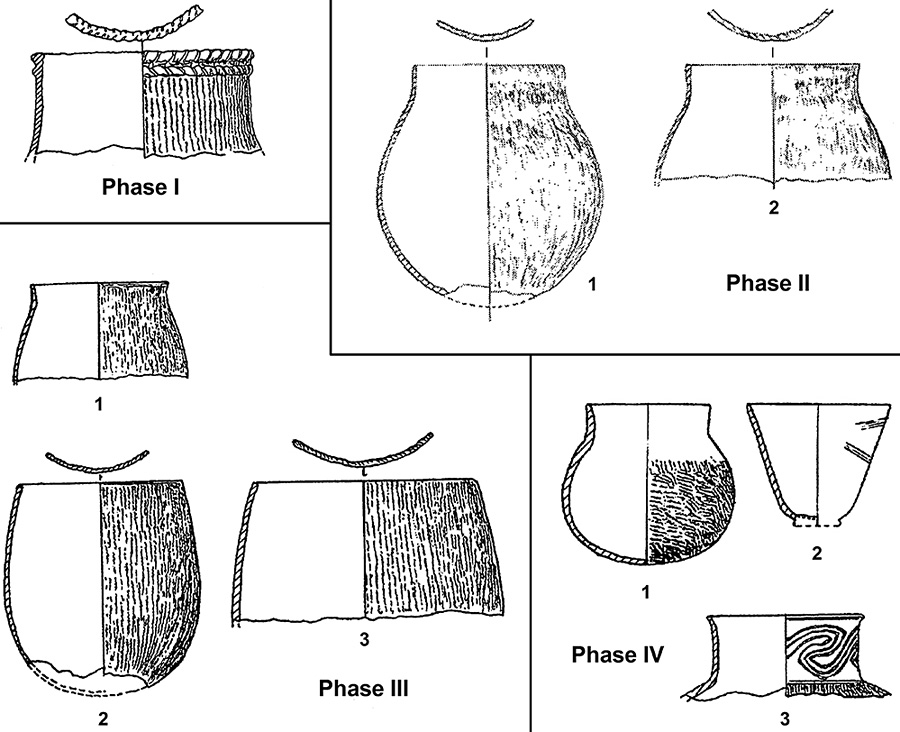
The artefactual evidence defines four cultural phases, I–IV (Reference FuFu 2002), of which Phase I is the oldest. Figure 4 shows the small pottery fragments found in Layer 4 (Phase I), likely representing large, round-bottomed vessel forms (Figure 5). Apart from small potsherds, a single perforated sandstone pebble, 105 small tectite flakes and 36 cores were associated with this phase.
The central area of the second excavation in 1998 (© Xian-guo Fu).

The general layout/plan of burials at Ding Si Shan. 'T2101', for example, stands for the excavation square number of an exploration ditch. Some earlier graves are not depicted since they are covered by the terminal graves in this plan (© Xian-guo Fu & Fa-jun Li).

The pottery decorations of the four phases (© Xian-guo Fu & Fa-jun Li).

Phase II deposits included a small number of burials in simple pits dug into the shell midden, without burial containers. Pottery from this phase was significantly more abundant than from Phase I, although the variety of forms and fabrics was still limited (Figure 4). The majority of the pottery from Layers 5 and 6 comprises large, round-bottomed vessels of either greyish-brown or red colour with cord-marks.
Most of the human burials date to Phase III and, like those of Phase II, comprised simple pits without burial containers, dug into the shell midden. Both the quantity and the variety of artefacts are significantly increased. Finally, Phase IV produced artefacts including, for the first time, wheel-made pottery (Figure 5: Phase IV); no burials were recovered.
A single radiocarbon date on shell from Phase II (ZK-2955) has been calibrated to 11 041–11 965 years BP. We are aware, however, of the problems with accuracy of radiocarbon dates in limestone regions, and consider this date to be too old. Further absolute dating will be conducted to provide a more reliable chronology. Provisional relative dates based on the cultural artefacts, however, indicate a likely date range for the site and associated burials of between 8000–7000 BP. This suggests the site straddles the transition between subsistence strategies based on foraging and the appearance of early incipient farming (Reference FuFu 2002).
The ceramic assemblages of the four phases (© Xian-guo Fu & Fa-jun Li). (Phase I: 12.5%; Phase II, 1 & 2: 10%; Phase III, 1 & 3: 14%; Phase III, 2: 8.75%; Phase IV:20%).

During the early and middle Holocene, the climate appears to have been relatively stable in southern China, with (sub)tropical plants increasingly abundant during the so-called 'Warm Period' between 8000–5000 BP (Zheng et al. 2004). From 10 000 to 6000 BP available land decreased owing to rising sea levels, and the Qiongzhou Strait opened up between the island of Hainan and the mainland (Yao et al. 2009). Interestingly, phytolith analyses on samples recovered from Ding Si Shan have revealed the relatively sudden appearance of large numbers of cultivated rice phytoliths during Phase IV (c. 6000 BP) (Zhao et al. 2005). On the other hand, the zooarchaeological research indicates abundant hunted wild animals throughout the sequence (Reference LvLv 2010; Lv & Fu 2010), revealing that the subsistence of the site's inhabitants was based primarily on hunting and foraging. The stable characteristics of local and regional ecological environments provided a plentiful and sustainable supply of wild resources, which was one of the major factors influencing the relatively late emergence of farming in this area (Zhao et al. 2005).
Grave types and associated human remains
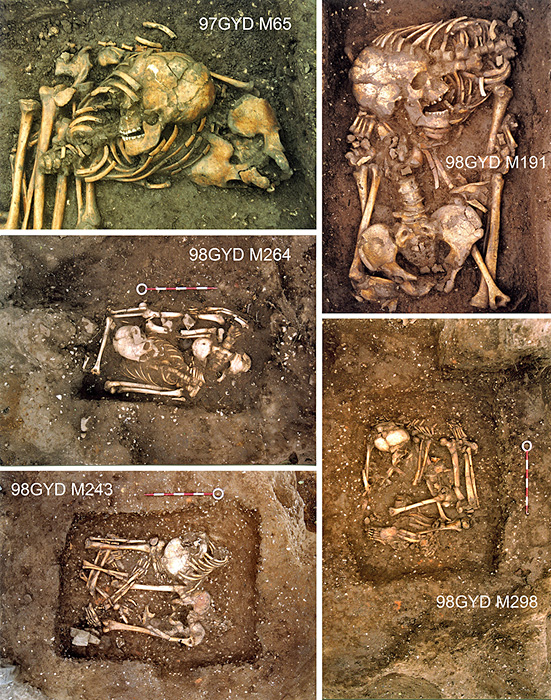
All 331 graves date to phases II and III and the vast majority belong to the latter. These contained either single (n = 281) or multiple (n = 28) burials (a further 22 burials are as yet uncertain). All graves were cut directly into the shell midden and most are small, measuring only 0.45–0.60m in width, and from 0.60–1.35m in length. As a result, bodies were placed in flexed or squatting positions. Although the skeletal remains were generally not well preserved, six burial types can be recognised: 1) supine; 2) extended; 3) supine and flexed; 4) flexed on one side; 5) prone and flexed; and 6) squatting. A seventh type, and perhaps the most remarkable, is a series of bodies (all from Phase III) buried with clear signs of dismemberment (Figure 6). Sixty-four single burials and four multiple burials were of this type (i.e. 21 per cent of the total). Physical anthropological analysis is on-going and we cannot yet present detailed demographic or pathological data. Initial examination, however, shows these to be primary, undisturbed burials, since the joints and even the ribs, toes and fingers were still in situ (see Figure 6) (Reference FuFu 2002).
The dismembered burials at Ding Si Shan (© Xian-guo Fu & Fa-jun Li).

Discussion
The Ding Si Shan assemblage is the best preserved shell midden site discovered in southern China. Its deep cultural deposits, abundant artefacts and remarkable burials provide important information on the chronology, cultural characteristics and burial practices of prehistoric southern China.
Although the physical anthropological analysis is not complete, it is clear that not all the occupants of the Ding Si Shan cemetery were buried in a dismembered state. Data pertaining to sex and specific age at death are as yet unavailable, but most of them are clearly adults. Intriguingly, more than 7000 stone flakes made from tectite have been recovered from the site. Could these be the tools used to dismember the bodies? As yet, however, no obvious cut marks have been observed on the bones. Analysis of microscopic wear patterns would be a valuable approach to explore.
In prehistoric southern China, burial traditions have been generally classified into two types: simple extended and flexed burials. Comparative work undertaken at Ding Si Shan and other sites (Han et al. 1976; Zhang et al. 1977; Reference WuWu 1978; Reference LienLien 1987; Huang & Liu 1988; Han & Dong 1999; Reference FuFu 2002, 2003; Li & Feng 2009; Li et al. 2009; Nguyen & Li 2012) has identified a further contrast between extended burials with tooth ablation and flexed burials with no tooth ablation in the region of southern China bounded by the western part of the Pearl River Delta. We have tentatively called the boundary between these two traditions the 'South China line', with tooth ablation to the east, but not to the west. The six types of burials identified at Ding Si Shan, which lies to the west of the Pearl River Delta, appear to belong mostly to the latter tradition.
In its broader context, Ding Si Shan is located in a region midway between (and potentially connecting) the early Holocene foraging and agricultural communities of North and Southeast Asia. It provides an opportunity, therefore, to explore these potential relationships, particularly in connection to other early adjacent prehistoric cultures—for example, Zeng Pi Yan in southern China and Hoabinhian and Da But sites in northern Vietnam (Reference HighamHigham 1989; Fu 2003; Reference NguyenNguyen 2005; Reference OxenhamOxenham 2006).
At Lang Cao, a Hoabinhian rock shelter, 200 skeletons were excavated within an area of only 25m2 (Reference ColaniColani 1927; Reference HighamHigham 1989). The burial practice is very similar to that found at Ding Si Shan (see Figure 6). At other Hoabinhian sites (e.g. Hang Dang & Moc Long caves), the dead were buried in a crouched position (Reference HighamHigham 1989). Though differing from Lang Cao, very similar practices involving burial of individuals in squatting positions have been identified at Ding Si Shan. Considering both the chronologies and geographical positions of these sites, it is perhaps not unreasonable to assume that they had cultural connections.
Further analyses of the Ding Si Shan evidence are needed to address questions raised by this preliminary work. It will be crucial to match burial practices with the physical anthropological data, in order to explore patterns of bio-cultural development, social status and the origins of specific burial communities. This will be significantly enhanced by the application of biomolecular analyses (stable and radiogenic isotopes and aDNA), in conjunction with 14C dating, to establish whether our preliminary conclusions about the possible 'special nature' of the dismembered individuals found at Ding Si Shan can be supported.
Acknowledgements
The authors would like to express their gratitude to Bounty of Key Laboratory of Evolutionary Systematics of Vertebrates, VIPP, CAS (Nos. 2011LESV013/23000-4299001), State Administration of Cultural Heritage program (Nos. 23000-4129003), Guangdong Planning Office and Social Science program (Nos. 23000-4221005) and National 985 project of the Young Scholar program (Nos. 23000-3161107). The authors would like to thank the peer reviewers for their special comments and observations, which contributed to substantial improvement of this paper.