


Negative beliefs about the self, the world and the future are common during an episode of depression. According to Beck's influential cognitive theory, individuals who hold negative self-schemas when otherwise well are vulnerable to developing depression in the future (Reference BeckBeck, 1967). However, results from studies investigating negative self-schemas and depression have been conflicting. Cross-sectional studies have found a robust association, but negative self-schema scores improve when people with depression recover (Reference Haaga, Dyck and ErnstHaaga et al, 1991; Reference Scott, Williams and BrittlebankScott et al, 1995). One explanation, that negative self-schemas are only elicited during a period of normal lowering of mood (Reference Teasdale and CoxTeasdale & Cox, 2001), is supported by experimental mood induction studies (Reference Kelvin, Goodyer and TeasdaleKelvin et al, 1999). However, as no large prospective study of negative self-schemas has been conducted in non-depressed populations, the need for this modification of cognitive theory is uncertain. In this investigation, we examine whether holding negative self-schemas is an independent risk factor for the onset of depression during pregnancy in a large, representative sample of non-depressed women.
METHOD
We used data collected as part of the Avon Longitudinal Study of Parents and Children (ALSPAC); this study enrolled women resident in Avon, in the west of England, who were in the early stages of pregnancy with an expected date of delivery between 1 April 1991 and 31 December 1992 (further details of the study aims and design are available at http://www.alspac.bris.ac.uk). Ethical approval was obtained from the ALSPAC ethics committee and local ethics committees. A total of 14 541 women were enrolled and 12 003 (82.5%) completed a depression scale at 18 weeks of pregnancy.
Participants completed the Edinburgh Postnatal Depression Scale (EPDS; Reference Murray and CoxMurray & Cox, 1990) as part of a series of postal questionnaires. This scale focuses on the cognitive and affective features of depression rather than somatic symptoms; although it was developed to screen for depression in women following childbirth, it is also useful in women outside the postnatal period (Reference Cox, Chapman and MurrayCox et al, 1996), and is the only self-administered scale to have been validated for use both postnatally and during pregnancy (Reference Murray and CoxMurray & Cox, 1990). The scale can be used either as a continuous score or, when the score exceeds 12, to define a case of depression. A sensitivity of 86% and specificity of 78% when compared with a semi-structured diagnostic interview has been reported in ALSPAC (Reference ThorpeThorpe, 1993). There is a close relationship between changes in the proportion reaching case definitions and mean score in populations, so categorical or continuous approaches to analysis of data such as these can be used interchangeably (Reference Anderson, Huppert and RoseAnderson et al, 1993). As questionnaires were not completed precisely at 18 weeks and 32 weeks of pregnancy, we excluded data from participants who returned the questionnaires less than 8 weeks apart. We included an adjustment for the time between questionnaires in the analyses. Incorporated in the postal questionnaire were three of the six sub-scales of the Crown–Crisp Experiential Index, a validated self-rating inventory (Reference Crisp, Jones and SlaterCrisp et al, 1978); these sub-scales measured free-floating anxiety, depression and somatic anxiety. In this sample the internal consistency of these items exceeded 0.8.
The Interpersonal Sensitivity Measure (Reference Boyce and ParkerBoyce & Parker, 1989) was included with the postal questionnaires on a single occasion, at 18 weeks of pregnancy. This was devised to investigate vulnerability to depression, and includes items relating to negative beliefs about the self. We selected a priori items from this measure that we judged to measure negative self-schemas; G.L. and J.E. chose these items independently and differences were resolved at a consensus meeting. We excluded all items that included words related to mood, such as ‘worry’ or ‘feel’, as these were most likely to be confounded by current mood state. Six of the 36 items were selected in this way (see Table 1). These items relate to Beck's sociotropic schematic subtype, those who value closeness and security in relationships (Reference Beck, Clayton and BarrettBeck, 1983). Each item is rated on a four-point Likert scale: ‘very like me’, ‘moderately like me’, ‘moderately unlike me’ and ‘very unlike me’ (Reference Boyce and ParkerBoyce & Parker, 1989). We summed the scores from the six items to produce a total negative self-schema score that could range between 0 and 18 for each participant. We assessed internal consistency of these items by calculating Cronbach's alpha coefficient. For this we included all those who had completed the six items, whether depressed or not at 18 weeks of pregnancy. We used the derived negative self-schema scale score as the main explanatory variable, and grouped the women into tertiles based on their score on this measure.
Response frequencies for the negative self-schema scale1

| ‘Very like me’ | ‘Moderately like me’ | ‘Moderately unlike me’ | ‘Very unlike me’ | |||||
|---|---|---|---|---|---|---|---|---|
| n | (%) | n | (%) | n | (%) | n | (%) | |
| I avoid saying what I think for fear of being rejected | 840 | (6.5) | 3007 | (23.4) | 3250 | (25.3) | 5748 | (44.7) |
| If others knew the real me they would not like me | 253 | (2.0) | 821 | (6.5) | 2313 | (18.2) | 9334 | (73.4) |
| If other people knew what I am really like they would think less of me | 400 | (3.2) | 1320 | (10.5) | 3930 | (31.3) | 6891 | (54.9) |
| I always expect criticism | 933 | (7.4) | 3006 | (23.8) | 4199 | (33.2) | 4513 | (35.7) |
| I don't like people to really know me | 693 | (5.5) | 1959 | (15.6) | 3857 | (30.7) | 6068 | (48.2) |
| My value as a person depends enormously on what others think of me | 1471 | (11.7) | 3806 | (30.2) | 3782 | (30.0) | 3547 | (28.1) |
Statistical methods
For the main analyses using these prospective data we selected only women who were not depressed (defined as an EPDS score below 13) at 18 weeks of pregnancy. We investigated the onset of depression 14 weeks later, when the women completed the EPDS again at 32 weeks of pregnancy. Onset of depression was defined as a non-case score at 18 weeks of pregnancy becoming a case score at 32 weeks of pregnancy. This definition missed those with onset and recovery of depression between the two measurement times, but we do not consider that this introduced a serious bias, as longer-duration illness would still have been detected.
We used logistic regression analyses to investigate the association between the total score from the negative self-schema scale grouped in tertiles and onset of depression by 32 weeks of pregnancy. We adjusted for EPDS score at baseline and then adjusted for the potential confounding factors shown in Table 2 and also time between measures. These variables were all collected from the self-report postal questionnaires completed by the women at recruitment. As there were more missing data on maternal and paternal history of depression than for other variables we included a ‘missing’ category as a dummy variable in the multivariable analysis for these two variables. As any association could have been due to residual confounding by current mood state, we repeated the analyses with additional adjustment for total score on the Crown–Crisp index, thus attempting to remove the confounding effect of symptoms of both anxiety and depression. We repeated the analyses with depression as a continuous outcome, including all participants whether depressed or not at 18 weeks of pregnancy. This method of analysis produced very similar results and did not alter our conclusions, so for simplicity these results are omitted (further details available from the author upon request). Finally, we tested the stability of negative self-schema in predicting onset of depression over time. We selected women who were not depressed at 18 weeks of pregnancy and investigated the association between negative self-schemas and the onset of postnatal depression at 8 weeks, 8 months, 21 months and 33 months after childbirth.
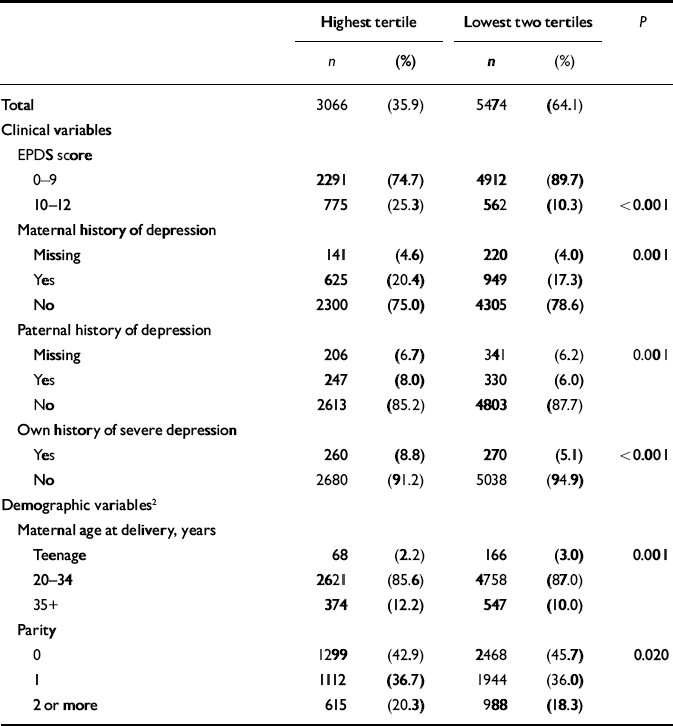
Comparison of participants with scores in the highest tertile on the negative self-schema scale with those in the lowest two tertiles1
| Highest tertile | Lowest two tertiles | P | |||
|---|---|---|---|---|---|
| n | (%) | n | (%) | ||
| Total | 3066 | (35.9) | 5474 | (64.1) | |
| Clinical variables | |||||
| EPDS score | |||||
| 0-9 | 2291 | (74.7) | 4912 | (89.7) | |
| 10-12 | 775 | (25.3) | 562 | (10.3) | <0.001 |
| Maternal history of depression | |||||
| Missing | 141 | (4.6) | 220 | (4.0) | 0.001 |
| Yes | 625 | (20.4) | 949 | (17.3) | |
| No | 2300 | (75.0) | 4305 | (78.6) | |
| Paternal history of depression | |||||
| Missing | 206 | (6.7) | 341 | (6.2) | 0.001 |
| Yes | 247 | (8.0) | 330 | (6.0) | |
| No | 2613 | (85.2) | 4803 | (87.7) | |
| Own history of severe depression | |||||
| Yes | 260 | (8.8) | 270 | (5.1) | <0.001 |
| No | 2680 | (91.2) | 5038 | (94.9) | |
| Demographic variables2 | |||||
| Maternal age at delivery, years | |||||
| Teenage | 68 | (2.2) | 166 | (3.0) | 0.001 |
| 20-34 | 2621 | (85.6) | 4758 | (87.0) | |
| 35+ | 374 | (12.2) | 547 | (10.0) | |
| Parity | |||||
| 0 | 1299 | (42.9) | 2468 | (45.7) | 0.020 |
| 1 | 1112 | (36.7) | 1944 | (36.0) | |
| 2 or more | 615 | (20.3) | 988 | (18.3) | |
RESULTS
Of the 12 003 women who completed the EPDS at 18 weeks of pregnancy, 10 335 (86.1%) were not depressed at that point. Of these, 9525 (92.2%) also completed the EPDS at 32 weeks of pregnancy. We excluded 442 (4.6%) from further analysis because their questionnaires were completed less than 8 weeks apart. Of the remaining 9083 participants, 790 (8.7%, 95% CI 8.1–3) became depressed by 32 weeks of pregnancy. Of those with two EPDS scores, 8540 (94%) also completed all six selected items in the negative self-schema measure, of whom 736 (8.6%, 95% CI 8.0–9.2) had onset of depression between 18 weeks and 32 weeks of pregnancy. Each of the six items together with the response frequencies are shown in Table 1. The distribution of the total negative self-schema score was skewed to the left, with a mean score of 4.58 (s.d.=3.39, median 4, interquartile range 2–7). We found good internal consistency for the six-item measure (Cronbach's α=0.77). This coefficient was calculated from the complete sample without restriction according to EPDS score at 18 weeks (n=12 146).
Comparison of participants scoring in the highest tertile on the six items of the Interpersonal Sensitivity Measure with those in the lowest two tertiles (combined) is shown in Table 2. High scorers were more likely to have higher EPDS scores, children, a family history of depression and a previous history of severe depression, and were older. The risk of depression onset increased with each unit increase in negative self-schema score (OR=1.16, 95% CI 1.14–1.19; P<0.001). Adjusting for EPDS depression score at baseline attenuated the association (OR=1.07, 95% CI 1.05–1.09; P<0.001), but it remained highly statistically significant. There was little further change when also adjusting for other potential confounders (OR=1.07, 95% CI 1.05–1.10; P<0.001, n=7845). To illustrate the size of the effect, a comparison of the proportion becoming depressed in each tertile for the negative self-schema score along with the odds ratios before and after adjustment are shown in Table 3.
Odds ratios of becoming depressed by tertiles of negative self-schema score: unadjusted, adjusted for depression (EDPS) score at 18 weeks (Adjustment 1) and adjusted for other confounders (Adjustment 2)

| n | Prevalence of depression (%) | OR (95% CI) | Adjustment 1 OR (95% CI) | Adjustment 2 OR (95% CI) | |
|---|---|---|---|---|---|
| Negative self-schema score | |||||
| First tertile (0-2) | 2702 | 4.8 | 1.00 | 1.00 | 1.00 |
| Second tertile (3-5) | 2772 | 7.0 | 1.48 (1.18-1.86) | 1.16 (0.91-1.46) | 1.24 (0.96-1.60) |
| Third tertile (6-18) | 3066 | 13.4 | 3.04 (2.48-3.73) | 1.56 (1.26-1.93) | 1.60 (1.27-2.02) |
| P<0.001 | P<0.001 | P<0.001 | |||
| Sample size | 8540 | n=8540 | n=8540 | n=7845 |
We stratified the analysis of the relationship between negative self-schema and depression according to the baseline score on the EPDS. Although the association of negative self-schema score was stronger at higher levels of sub-threshold EPDS score, this interaction was not statistically significant within the logistic regression model (likelihood ratio test, χ2 0.05, d.f.=1, P=0.82). To test whether association was still present in those with minimal baseline depressive symptoms, we repeated the analyses for those women scoring 8 or below on the EPDS at baseline. The results were similar although the association was weaker; the risk of depression onset increased with each unit increase in negative self-schema score (OR=1.11, 95% CI 1.07–1.15; P<0.001). Adjusting for EPDS depression score at baseline attenuated the association (OR=1.06, 95% CI 1.02–1.10; P<0.002), but it remained highly statistically significant. There was little further change when also adjusting for other potential confounders (OR=1.06, 95% CI 1.02–1.11; P=0.002, n=6104). Additional adjustment for mood using the Crown–Crisp index made no substantial difference to the results: the adjusted odds ratio for onset of depression for those in the highest tertile of the six-item negative self-schema score was 1.42 (95% CI 1.11–1.80, P=0.008, n=7540). As the requirement for complete data on these additional measures meant a further 305 cases were excluded, we have not included these results in this paper.
The size of the association between negative self-schema score at baseline (adjusted for baseline depression score) and the later onset of depression at 8 weeks, 8 months, 21 months and 32 months post-partum remained relatively constant. In comparison, the association between baseline depressive symptom score (adjusted for negative self-schema score at this time) and the later onset of depression diminished over time (Table 4).
Odds ratios for onset of depression at various times according to negative self-schema score measured at 18 weeks of pregnancy

| Outcome | Sample size1 n | Women with depression who were not depressed at previous time points n (%) | Not depressed n | Odds ratios | |
|---|---|---|---|---|---|
| Negative self-schema score at 18 weeks of pregnancy2 OR (95% CI) | EPDS score at 18 weeks of pregnancy3 OR (95% CI) | ||||
| Depression onset at 32 weeks of pregnancy | 8539 | 736 (8.6) | 7803 | 1.07 (1.05-1.10) | 1.36 (1.32-1.40) |
| Depression onset 8 weeks post-partum | 7249 | 320 (4.4) | 6929 | 1.07 (1.04-1.11) | 1.21 (1.17-1.26) |
| Depression onset 8 months post-partum | 6505 | 196 (3.0) | 6309 | 1.10 (1.05-1.14) | 1.20 (1.14-1.26) |
| Depression onset 21 months post-partum | 5719 | 207 (3.6) | 5512 | 1.11 (1.07-1.16) | 1.16 (1.11-1.21) |
| Depression onset 33 months post-partum | 5008 | 212 (4.2) | 4796 | 1.10 (1.06-1.14) | 1.18 (1.13-1.23) |
DISCUSSION
This is the first study we are aware of to report that negative self-schemas that are associated with a future onset of depression can be identified in individuals who are otherwise well. Although this association was strongest in women with concurrent depressive symptoms, it was still present after adjusting for mood at the time of rating cognitions and previous depression. We cannot, however, be certain that we have removed any confounding effect of current mood state. We found the association to be stable over time, predicting onset of depression more than 3 years later equally strongly, suggesting that negative self-schemas represent a long-lasting vulnerability to depression rather than being part of the prodrome of a depressive episode. These observations support a crucial component of the cognitive theory of depression, which states that negative self-schemas are stable patterns of thinking that confer long-term vulnerability to developing depression (Reference BeckBeck, 1967). Although this theory has had a strong influence on the development of psychological treatment of depression, to date empirical evidence to support this aspect of the theory has been lacking (Reference Haaga, Dyck and ErnstHaaga et al, 1991).
Methodological issues
This is a large, longitudinal study of women drawn from a representative population with a relatively small proportion of missing data and extensive data on potential confounders. These strengths increase the generalisability of its findings. In this large study we were also able to adjust for a number of confounding variables, the most important of which was the degree of mood disturbance at baseline. The possibility of some residual confounding by mood at the time of rating the cognitions can never be excluded, but the finding that the increased risk associated with negative self-schemas was still present 3 years later suggests that our scale was measuring a relatively stable construct.
One limitation of the study is that we derived a measure of negative self-schemas from a questionnaire designed to measure personality in general, rather than cognitions specifically. However, negative self-schemas constitute one aspect of personality. The items selected are similar to items in the dysfunctional attitude scale relating to vulnerability and need for approval (Reference Beck, Brown and SteerBeck et al, 1991). The six items selected in this study in order to measure negative self-schemas concern the importance attached to other people's opinions of the self; however, a number of potentially important dysfunctional beliefs were not included in the limited measure used in this study (Reference Power, Katz and McGuffinPower et al, 1994). Another limitation is that there might have been some misclassification between cases and non-cases of depression, because we relied on a brief self-report scale for identifying depression rather than a more detailed, observer-rated measure. This misclassification would probably have been a source of random rather than systematic bias, and if anything should have reduced the strength of the association we found. We might also have misclassified individuals with onset of depression between 18 weeks and 32 weeks of pregnancy who have recovered by 32 weeks. Depression is rarely this short-lived and we would have included all the longer-duration episodes as cases. All women were under the potential stress of pregnancy and it is notable that there was a marked rise in self-reported depressive symptoms between the two measures. We have reported this finding previously, and we also found that depressive symptoms did not differ in other ways during pregnancy (Reference Evans, Heron and FrancombEvans et al, 2001). It is possible to argue that these findings might not be generalisable to measuring negative self-schemas at other times, as the potential stress of pregnancy might be required to evoke them. This seems less likely because the association remained following adjustment for anxiety symptoms, but we cannot exclude this possibility.
Neuroticism and negative self-schemas
A number of studies have reported association between other aspects of personality, such as interpersonal sensitivity or neuroticism, and the onset of depression (Reference Boyce, Parker and BarnettBoyce et al, 1991; Reference Kendler, Gardner and PrescottKendler et al, 2002). Some argue that neuroticism can affect cognitions, and one twin study reported that association between low self-esteem and vulnerability to the onset of depression is largely explained by neuroticism (Reference Roberts and KendlerRoberts & Kendler, 1999). It is possible that neuroticism is a vulnerability factor for developing negative self-schemas, but we were unable to examine this relationship using the ALSPAC data.
Cognitive vulnerability to depression
Negative self-schemas are to be distinguished from automatic negative thoughts that arise during a period of depression. This distinction is important if these negative self-schemas represent a true vulnerability to depression rather than just state-dependent symptoms of a depressive episode.
Other prospective studies have found no effect of negative self-schemas (Reference Haaga, Dyck and ErnstHaaga et al, 1991; Reference Lewinsohn, Joiner and RohdeLewinsohn et al, 2001), although one has reported an association with the onset of common mental disorder (Reference Weich, Churchill and LewisWeich et al, 2003). These studies were too small to confidently exclude important association. The cognitive items selected for our study mostly referred to what the participant believed others thought or would think about her. It is likely that other schemas might be identified in large prospective studies that are associated with the onset of depression. Beck (Reference Beck, Clayton and Barrett1983) hypothesised that individuals who attach importance to independence, self-standards and achievement – so-called autonomous individuals – would also be prone to depression. Originally Beck suggested that negative self-schemas might be latent and therefore not directly accessible to questioning. This has been used to explain the negative findings of previous studies. Teasdale has suggested that these negative self-schemas are only evoked in response to a small drop in mood in those prone to depression (Reference TeasdaleTeasdale, 1988). We found that negative self-schemas had an independent association with depression, but are much more common in those who also report depressive symptoms, consistent with Teasdale's hypothesis. It is possible that using mood induction to elicit negative self-schemas (Reference Kelvin, Goodyer and TeasdaleKelvin et al, 1999) or measuring cognitions during natural mood fluctuations (Reference Teasdale and CoxTeasdale & Cox, 2001) would lead to an even stronger association between negative self-schemas and depression.
Implications
Our findings support the hypothesis that individuals who have negative self-schemas are more vulnerable to developing depression. The origins of these negative self-schemas have not been investigated. It is thought that they might arise from adverse experiences, particularly during childhood when social schemas relating to the self are first formed. Understanding how individuals develop these negative self-schemas could lead to preventive interventions that might reduce the population burden of depression.
Clinical Implications and Limitations
CLINICAL IMPLICATIONS
-
▪ Individuals who hold negative self-schemas have an increased risk of becoming depressed.
-
▪ These negative self-schemas are not early symptoms of depression but represent a vulnerability that persists over time.
-
▪ Understanding how negative self-schemas develop should lead to opportunities to prevent depression.
LIMITATIONS
-
▪ Diagnostic interviews could not be used in this study.
-
▪ Measurement of negative self-schemas was not comprehensive or repeated.
-
▪ Personality was not measured in this study and might be a confounding variable for the relationship between negative self-schemas and onset of depression reported here.
Acknowledgements
We are extremely grateful to all the mothers and fathers who took part and. to the midwives for their cooperation and help in recruitment. The whole. ALSPAC study team comprises interviewers, computer technicians, laboratory. technicians, clerical workers, research scientists, volunteers and managers. who continue to make the study possible. Financial support was provided by the. Medical Research Council, the Wellcome Trust, the Department of Health, the. Department of the Environment, and various charitable organisations and. commercial companies. The ALSPAC study is part of the European Longitudinal. Study of Pregnancy and Childhood initiated by the World Health. Organization.




eLetters
No eLetters have been published for this article.