



Introduction
Arctic regions are experiencing unprecedented environmental, social and economic change (Arctic Council, 2016; Intergovernmental Panel on Climate Change [IPCC], 2014). Increasing natural resource extraction and infrastructure development across the Arctic, coupled with a rapidly changing climate, emphasises the importance of effective environmental management and planning. Impact assessment (IA) is an important planning and review tool used by many Arctic jurisdictions for assessing and managing the impacts of resource development (Noble & Hanna, Reference Noble and Hanna2015). However, its effectiveness has been questioned and multiple challenges identified – from coping with climate change, to limited local capacity, to sparse baseline data (Koivurova, Reference Koivurova2008; Noble et al., Reference Noble, Ketilson, Aitken and Poelzer2013; Noble & Hanna, Reference Noble and Hanna2015). A key element of IA is the ability to predict and manage future impacts and project outcomes, meaning that uncertainties are inherent throughout the IA process and often unavoidable (Duncan, Reference Duncan2008). In Arctic environments, however, uncertainty in IA is arguably even more prevalent due in part to rapid environmental and social change, shifting baseline conditions, developments in frontier regions, and overall limited data to assess change and model the impacts of development actions (Arctic Council, 2016; Peletz, Hanna, & Noble Reference Peletz, Hanna and Noble2020).
IA is often presented as an information provision tool (Cashmore, Reference Cashmore2004), intended to support decisions about the nature and significance of project impacts and to facilitate longer-term learning and impact management. Inadequate baseline information in Arctic regions has been identified as a key challenge to the effectiveness of IA (Nunami Stantec Limited, 2018; Arnold, Hanna, & Noble Reference Arnold, Hanna and Noble2019; Wong, Noble, & Hanna, Reference Wong, Noble and Hanna2019). This challenge is exacerbated when known information gaps or uncertainties are not adequately communicated during the IA process (Duncan, Reference Duncan2008; Tennøy, Kværner, & Gjerstad, Reference Tennøy, Kværner and Gjerstad2006; Wood, Reference Wood2008). Larsen, Kørnøv, and Driscoll (Reference Larsen, Kørnøv and Driscoll2013) highlight how the communication and perception of uncertainty in IA vary among different groups and individuals involved in the process, which can lead to challenges and discrepancies in the means of addressing uncertainty. Leung et al. (Reference Leung, Noble, Jaeger and Gunn2016, 90) explain that problems arise in IA as a means to support informed decision-making when there is “a disconnect between the information that is presented (or omitted)… and the use (or neglect) of this information” or when “the neglect of uncertainties leads to unreliable impact predictions or ineffective mitigation measures.”
There have been calls for more stringent requirements regarding the disclosure of information gaps and uncertainties in IA, and for better documentation and communication to inform decision-makers and others and increase confidence in IA processes (Leung, Noble, Gunn, & Jaeger, Reference Leung, Noble, Gunn and Jaeger2015; Lees, Jaeger, Gunn, & Noble, Reference Lees, Jaeger, Gunn and Noble2016; Pavlyuk, Noble, Blakley, & Jaeger, Reference Pavlyuk, Noble, Blakley and Jaeger2017). But further research is needed to understand how information gaps are presented in IA and opportunities to address them (Lees et al., Reference Lees, Jaeger, Gunn and Noble2016), especially in rapidly changing Arctic environments. This paper provides an understanding of the nature and types of gaps in baseline information identified in Arctic IA practice, and the opportunities and challenges to addressing them. The research provides an analysis of IA practice in Canada’s eastern Arctic, under Nunavut’s IA system, with a focus on marine environments. Although based on the Nunavut context, the discussion and implication emerging from this research may be broadly relevant across Arctic IA jurisdictions, and indeed for other locales.
Study area and the regulatory setting
Nunavut is the largest of the four regions in Inuit Nunangat, the geographical, political and cultural region of the Inuit people within Canada (Inuit Tapiriit Kanatami, 2018). As of the 2016 census, the population of Nunavut is 35 944, where 84% identify as Inuit (Statistics Canada, 2017). There are 25 communities, of which 24 are coastal settlements, demonstrating the strong community connection to marine environments (Nunavut Impact Review Board [NIRB], 2018). The Nunavut Impact Review Board (NIRB, or the Board) is the agency responsible for IA in Nunavut. The jurisdiction of the NIRB, and the study area of this research, is the Nunavut Settlement Area and the outer land fast ice zone, as established under the Nunavut Agreement.
The Arctic’s communities and fragile marine environments are particularly vulnerable to climate change (Arctic Council, 2009; IPCC, 2014). Across Nunavut, a decline in sea ice is leading to more navigable Arctic waters, where vessel traffic in the region doubled in 25 years (Dawson, Mussells, Copland, & Carter, Reference Dawson, Mussells, Copland and Carter2017; Pizzolato, Howell, Dawson, Laliberté, & Copland, Reference Pizzolato, Howell, Dawson, Laliberté and Copland2016). Increased shipping is also due to increases in natural resource development, cargo transport, fishing and tourism opportunities, and community resupply needs in the territory (Dawson et al., Reference Dawson, Mussells, Copland and Carter2017; Pizzolato, Howell, Derksen, Dawson, & Copland, Reference Pizzolato, Howell, Derksen, Dawson and Copland2014). Development pressures and an increase in shipping have led to growing community concerns about related environmental and social-economic impacts (Barry et al., Reference Barry, Granchinho, Rusk and Hanna2016). Regulatory processes, such as IA, are responsible for anticipating, managing and ultimately protecting fragile marine ecosystems in a rapidly changing climate, as well as ensuring that sustainable development benefits Nunavut (NIRB, 2018; Nunavut Marine Council [NMC], n.d.).
Nunavut’s IA process was established under the Nunavut Agreement and further outlined in the Nunavut Planning and Project Assessment Act, which came into force in 2015 (Government of Canada and Tungavik Federation of Nunavut, 1993; Government of Canada, 2013). The NIRB is an institution of public government. It has a nine member Board and supporting staff who implement the IA process. Board members are appointed by the Government of Canada and the Government of Nunavut, as well as nominated by Nunavut Tunngavik Incorporated (NTI) – the designated organisation representing Inuit under the lands claim agreement (NIRB, n.d.-a). At present, eight of the nine members of the Board are Inuit.
An important defining quality of the Nunavut process is the role of Inuit Knowledge and Inuit people. A key part of the NIRB mission, and the work of staff, is to ensure that Inuit, and Inuit knowledge of the environment, and concerns and thoughts on impacts are heard throughout the assessment process (NIRB, 2013). Inuit Knowledge has two elements: Inuit Qaujimaningit encompasses local and community-based knowledge, ecological knowledge (both traditional and contemporary) ingrained in the daily life of Inuit people; and Inuit Qaujimajatuqangit – the knowledge, belief system, principles and values at the core of Inuit identity and that guide/govern Inuit society (Peletz et al., Reference Peletz, Hanna and Noble2020 and see also Karetak et al., Reference Karetak, Tester and Tagalik2017). Inuit Knowledge is not ancillary to IA in Nunavut, nor is it a substitute to Western science, but is integral throughout the process. This quality is essential to understanding and identifying impacts, defining the state of the environment and baseline conditions, guiding deliberations and participation, determining the questions that Western science may be asked to answer within an IA, and for making the final decision.
Nunavut’s IA process seeks input from all parties in an IA. In this context, parties includes proponents, government, non-governmental organisations, regulatory agencies, Regional Inuit Associations, hamlets, community organisations, hunter and trapper associations, and the public (NIRB, 2013). These represent a range of interests participating in the process, albeit in different ways and for different purposes, and some may have responsibilities and or authority within the process. The NIRB also provides information (e.g. process guides) designed for the different participants so that they understand the procedures and the project being reviewed, and so that different parties may effectively participate in IA.
The NIRB coordinates its work with the Nunavut Planning Commission, the Nunavut Water Board, and other agencies, to review and assess the impacts of proposed developments (projects). Projects typically subject to IA include roads, mineral exploration, mines, oil and gas development, some tourism facilities, and scientific research projects. For marine areas, an initial review by an agency, and then potentially a full IA process, is triggered when a project proposal involves activities or development related to marine impacts, such as shipping facilities for mines, other marine infrastructure, or offshore resource developments (e.g. oil and gas). Individual ship movements are not subject to the IA process, unless there is an associated land-based activity/facility (Barry et al., Reference Barry, Granchinho, Rusk and Hanna2016).
Nunavut has an integrated approach to project approvals. This involves and coordinates multiple organisations in the review process. The process can appear complex, but simply stated, if the project is in an area with an applicable land use plan, then the Nunavut Planning Commission would determine if the project is compatible with the plan (a Conformity Decision) before the NIRB proceeds with a screening. If the project is not in a plan area, then an Authorizing Agency would decide if a screening by NIRB is required.
But if a project proposal is sent to the Board, then the three-step IA process begins. Screening is the first step. It is where an early identification of potential impacts is done to determine whether a review will be required. The Board then makes a recommendation to the federal government based on the screening. This federal approval is a function of the delegated powers that Nunavut exercises under the authority of Canada’s federal government. If it is determined that a project will not require a review, a certificate of approval might be issued after the screening phase.
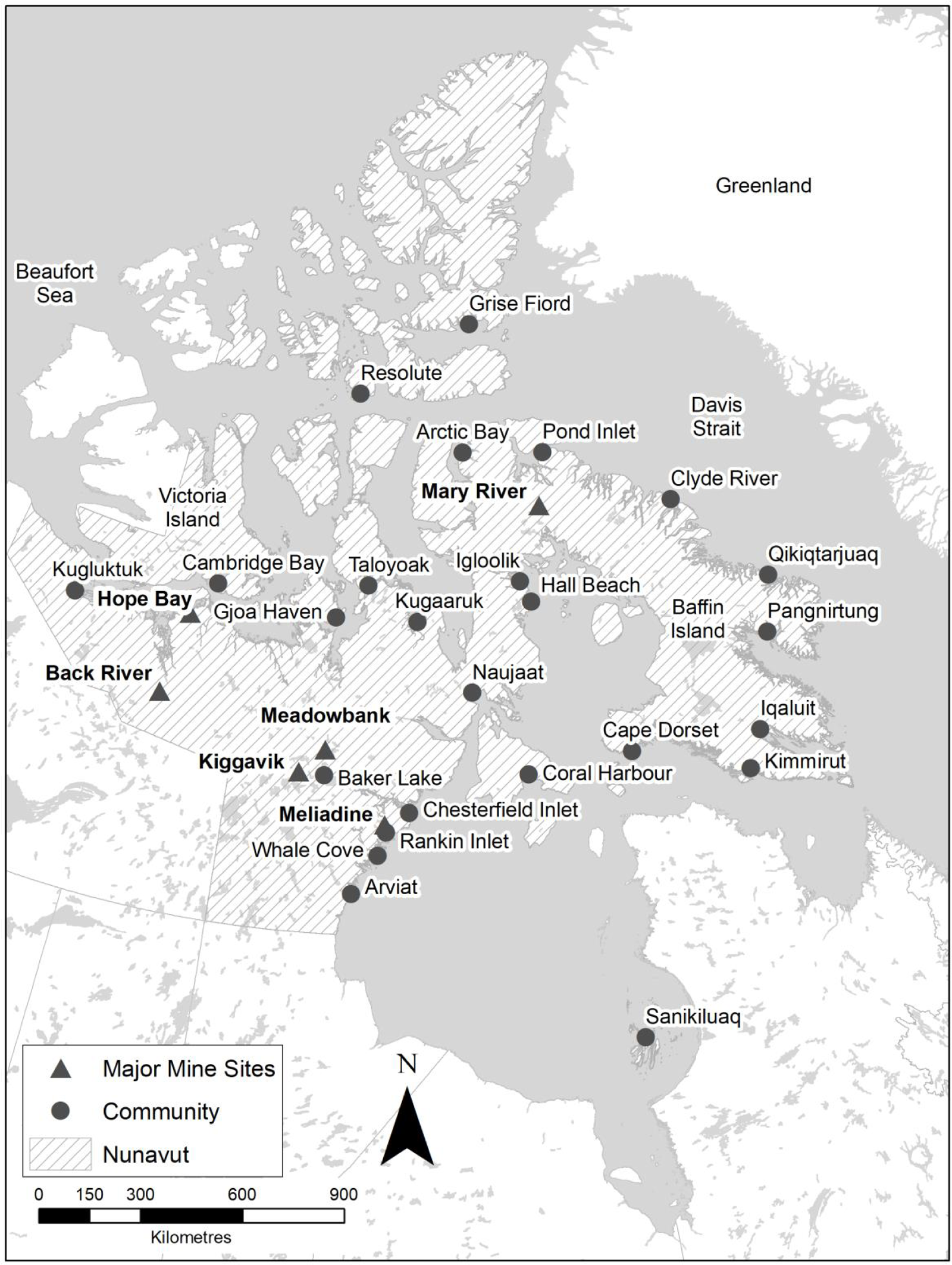
If required for a project, the review would be the second step. It is often done for major development projects, or where there are significant stakeholder and community interests or concerns (Barry et al., Reference Barry, Granchinho, Rusk and Hanna2016). Since the ratification of the Nunavut Agreement in 1996, 11 projects have gone through a complete review (Fig. 1). If a project is referred for a review, then the review itself has three phases: 1) scoping and guidelines creation for the proponent, 2) a draft environmental impact statement is developed and then reviewed by the Board, and 3) the proponent submits a Final Impact Statement (IS) which the Board reviews for compliance, and then the issues a final report. Each phase involves public meetings and input from the parties involved where information and knowledge are gathered from community members, the proponent, the public, intervenors and regulating agencies, to help make an informed decision regarding the project proposal and associated impacts. The review culminates in a final hearing and an associated final report where the Board recommends a decision to the federal government, most often the Minister of Northern Affairs, regarding whether the proposal should proceed, and any terms and conditions which may apply. If approved, a project certificate is granted. In practice, it is rare for a federal minister not to follow the recommendation of a such a board, but it can happen.
Major impact assessment mine projects and communities in Nunavut.
Figure produced by Mathieu Bourbonnais, University of British Columbia.
The final step of the IA process is project monitoring. In other Canadian jurisdictions, monitoring often becomes the responsibility of other agencies after a project is approved. In Nunavut, the Board is responsible for project-specific monitoring for every approved proposal that goes through the IA process. The integration between the review organisation and project monitoring ensures that management plans and mitigation requirements are being undertaken and are effective, and that proponents and agencies are complying to the terms and conditions outlined in the project certificate and licences (Barry et al., Reference Barry, Granchinho, Rusk and Hanna2016).
Method and approach
Document analysis
The analysis of project documentation allowed for the identification of recurring marine-related information needs and provided insight to where and how data gaps or uncertainties are presented in NIRB IA reports. The analysis focused on all complete NIRB project assessments with a proposed marine shipping component (e.g. ore transport, resupply) or marine infrastructure development (e.g. dock or port) – these are all mining projects (Table 1). The IA for the Mary River iron ore mine is the only project with proposed year-round shipping. This is for ore, cargo and fuel resupply. The remaining projects included proposals to transport gold (uranium in the case of Kiggavik) by air, with the only marine shipping component being seasonal for cargo and fuel.
Selected projects and associated marine components.
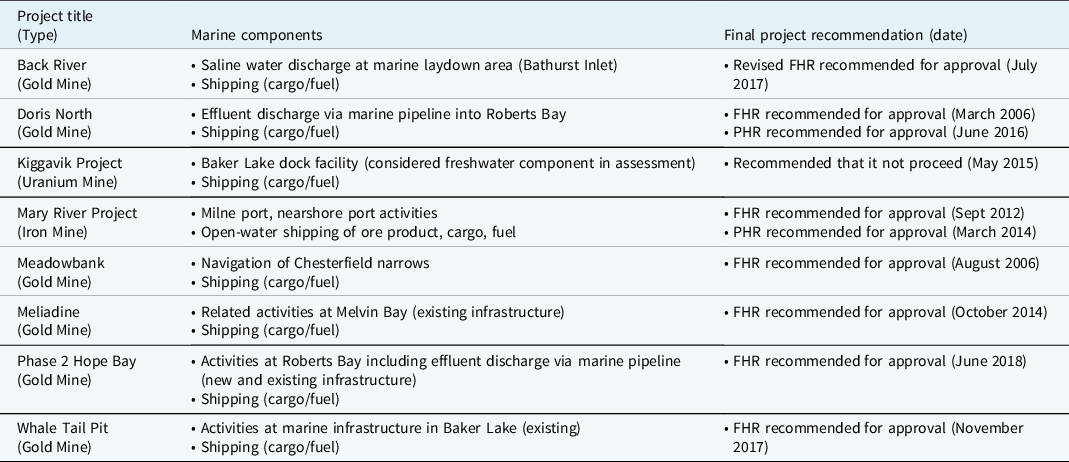
For each project, two types of documents were reviewed: the Final Impact Statement (IS), and the Final or Public Hearing Reports (FHR/PHR). The Final IS is prepared on behalf of the project proponent and is submitted to the NIRB for review. This is a multi-volume document containing the project description, project design details, an outline of consultation practices, baseline information, potential impacts and proposed impact management measures. The FHR is prepared by the NIRB and contains a summary of the entire review process including identified impacts, views and concerns of interested or affected parties, and the Board’s final recommendation to the responsible federal minister, including any terms and conditions of project approval. While a PHR has the same purpose and content of a FHR, it is issued for project amendments that require a complete review. For our work, PHRs were reviewed in instances where the project amendment or expansion influenced the original marine component or included a new and significant marine component. For example, the latter was the case for the Doris North project where the amendment included a proposal to discharge tailings effluent to the marine environment at Roberts Bay. All documents were accessed from NIRB’s public registry at https://www.nirb.ca/.
The documents were imported into NVivo 12 (QSR International Pty Ltd., 2018) to identify instances of, or references to, marine information gaps. These were coded based on three factors: the marine-related topic or component (e.g. marine mammal, marine fish, sea ice or bathymetry); the type of information gap identified; and who identified the gap (e.g. proponent, NIRB or intervenors). The use of pre-defined categories for coding allowed us to identify key elements of interest for categorisation and further analysis (Richards & Morse, Reference Richards and Morse2013). To determine the type of information gap identified, analytic coding was used (Richards & Morse, Reference Richards and Morse2013) whereby gaps were first coded based on the key words used in the text to describe the gap, and then recoded and grouped to identify emergent themes. The final themes were
-
insufficient or incomplete data: gaps attributed to not having enough information to make adequate impact predictions;
-
unavailable or unknown data: gaps attributed to a complete lack of information available, or where no information was known to exist;
-
inadequate methodology: gaps attributed to inadequacies in the design or implementation of baseline studies;
-
uncertain data: gaps attributed to ambiguous information or where consensus was not reached regarding the validity of the information presented;
-
unsuitable data: gaps attributed to information presented that was not suitable to the baseline environment which it attempted to inform.
Focus groups
Focus groups were held to validate and elaborate on the document review results, while providing an important organisational perspective on the challenges associated with meeting information needs in conducting IAs. Challenges were viewed broadly as related to the nature of the information and data, as well as challenges related to addressing the lack of information. Two focus groups were conducted at Cambridge Bay, Nunavut. One focus group involved the eight NIRB Board members, and the second focus group was with Board staff. There are just over 20 staff who provide executive support, communications, finances, administration and technical services (NIRB, n.d.-b).
The focus groups provided an important view into the workings and deliberations of the NIRB. Board members and staff provided unique insight and a better understanding of their roles and shared experiences (Morgan, Reference Morgan1996; Wascher, Reference Wascher2013). Focus groups were audio-recorded and imported into and transcribed in NVivo 12. The transcripts were first coded descriptively to organise and categorise the information, followed by analytic coding to identify emergent themes (Richards & Morse, Reference Richards and Morse2013). These themes were both new, emerging uniquely from the focus groups, as well as those identified earlier in the document review (thus reinforced by the focus groups). Participation in the focus groups was voluntary, and permission was granted from all participants to record the sessions, as per Canadian Tri-Council Policy for the ethical conduct of research.
In addition to the formal focus groups, the researchers also attended Board public meetings, held informal and individual conversations with staff and Board members, met with staff for presentations on the NIRB process, current project assessments, and forward planning for NIRB activities, and attended Board social events. These points of contact added to our understanding of the Board, the central role of Inuit Knowledge in the IA process, and provided opportunities for clarification and expansion of information gained from the document review and the public meetings.
Results
The results highlight that information gaps are mostly linked to data availability, suitability and accessibility, while the challenges to addressing information needs are related to capacity, responsibility and cooperation.
Identification and characterisation of marine baseline information gaps
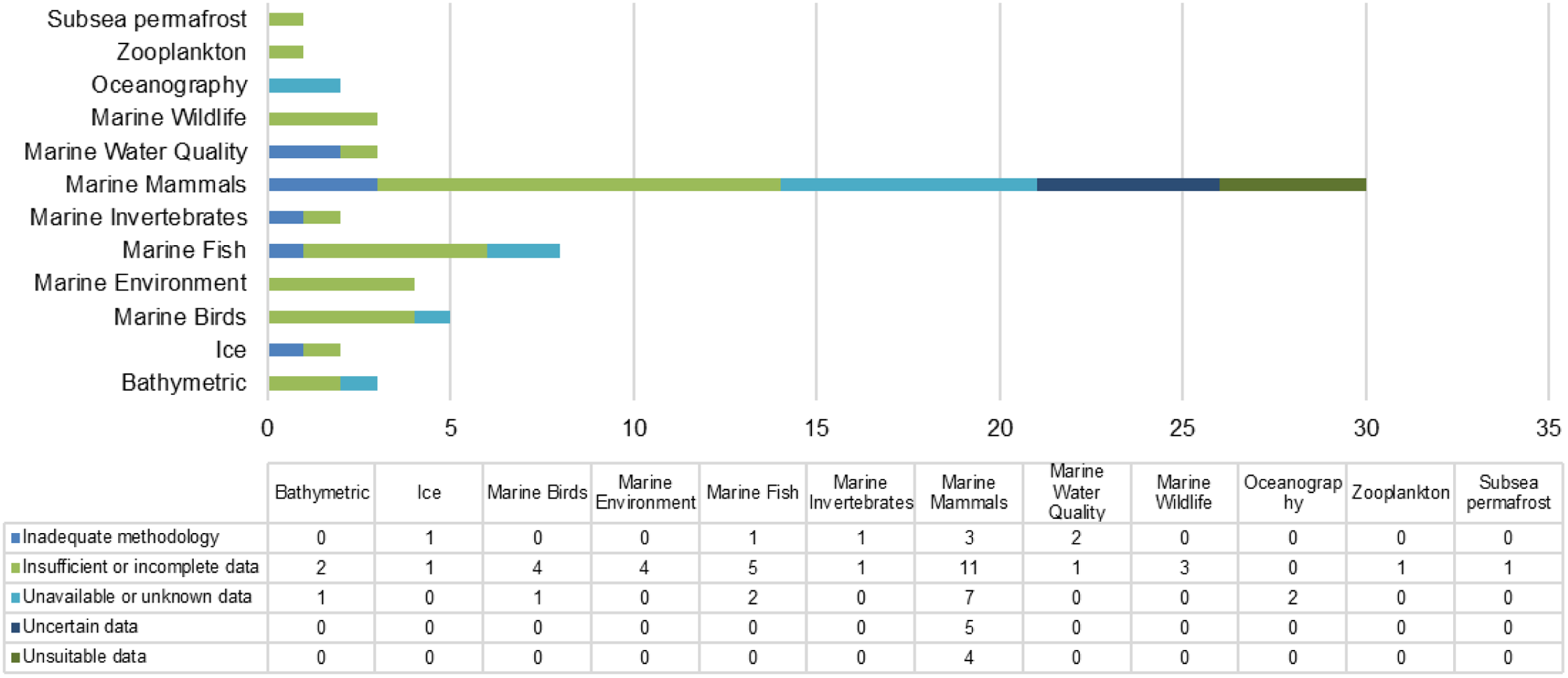
The specific marine components considered in the IAs, and the issues and level of impact concern, varied across projects, meaning that marine-related baseline information gaps also varied. A total of 64 information gaps were identified and coded from project IA documentation, across 11 different marine components. Marine mammals were the most commonly discussed component regarding baseline information gaps in IA (30 gaps), followed by marine fish (8) and marine birds (5). Marine mammals, fish and birds were identified as “valued ecosystem components” in the IAs, meaning that they are considered to be of significant importance and value to communities and ecosystems (NIRB, 2007). Other marine-related issues where information gaps were identified were bathymetry (3), marine water quality (3), sea ice (2), oceanography (2), marine invertebrates (2), marine wildlife (3), zooplankton (1) and subsea permafrost (1). One general topic category could not be coded to a specific component, namely information gaps discussed broadly in relation to “marine environments” (4) (Fig. 2). Even for marine fish and marine birds, only 2 of the 13 identified gaps discussed specific fish or bird species. For example, in the Kiggavik Final Hearing Report, it was highlighted that “[an intervenor] noted that the impacts of shipping through Hudson Strait on marine birds are unknown and baseline information remains limited” (NIRB, 2015, 133). The exception was marine mammals, where 24 of the 30 identified information gaps were discussed in detail regarding the specific groups of marine mammals or individual species – such as information gaps on beluga whale habitat in Chesterfield Inlet (and western Hudson Bay), discussed in the Kiggavik Final IS as an identified gap (Final IS Vol 7a.1, 2014, 8).
Marine baseline information gaps by type and marine component.
How information gaps were presented in IA documents, and by whom they were identified, varied. Most information gaps concerned insufficient or incomplete data (53%), unavailable or unknown data (20%), inadequate methodology (13%), uncertain data (8%), and unsuitable data (6%) (Fig. 3). Information gaps were identified by either the proponent, the NIRB or an intervenor, which can include community members and the public. Information gaps due to insufficient or incomplete data and unavailable or unknown data were most often identified by proponents in the IS, whereas gaps attributed inadequate methodology, uncertain data and unsuitable data were more often identified by intervenors and presented in the Hearing Report. This pattern is expected considering the structure of the IA process. Throughout the IA process, and notably in preparation of the IS, proponents are required to identify baseline conditions and expected to identify where information gaps are present. In contrast, intervenors and the NIRB review the proponents’ submissions and identify issues and concerns with the information presented. This often includes issues with baseline study design, uncertainty regarding the presented information and unsuitability of the data used to inform baselines and predict impacts.
Marine baseline information gaps by type and by group.

In the documents reviewed, 31 of the information gaps were identified by intervenors and presented in Hearing Reports. It can be assumed that intervenors identify a greater number of gaps throughout other phases of the review through technical comments and information requests. The remaining information gaps noted in the Hearing Reports are often the ones that were either significant to the assessment (i.e. involved a lot of discussion, controversy, etc.), or the ones that were not addressed by the proponent, and are relevant to the project recommendation (Fig. 3).
Information availability, suitability and accessibility
Gaps in marine baseline information in the Arctic have been widely discussed in the literature and observed in both the document review and noted by the focus groups. Results show that most of these information gaps are attributed to insufficient or incomplete data and unavailable or unknown data. It was common in sections of the Final IS where environmental baselines were described to include references to data deficiencies as outlined in the literature or in other reports and status acts, including the Species at Risk Act (SARA) and references to the Committee on the Status of Endangered Wildlife in Canada (COSEWIC). For instance, in the baseline information summary of marine mammals in the Mary River project Final IS, it was reported: “The bearded seal has no status under SARA and is listed as Data Deficient by COSEWIC” (Final IS Vol 8.1, 2012, 140), and in the marine fish baseline section of the Phase 2 Hope Bay Project, it was indicated that: “Very little is known about the Bering Wolfish habitat and habits, most of the information was derived from the latest COSEWIC (2002) status report” (Final IS Vol 5.10, 2017, 9).
Similarly, both focus groups described the lack of available (Western or scientific) data as “normal” in Nunavut, despite similar data often being readily available and accessible in other, less remote, jurisdictions. A participant of the staff focus group commented: “In terms of insufficient baseline data, there are even things like basic mapping – in Ontario there would be outrage if there wasn’t mapping of certain areas, but here it’s normal.” This notion of normalcy speaks to the breadth of the issue. This was later echoed by another staff member, noting that: “almost everything up here from a scientific basis is lacking a baseline.” It was further explained that a lack of available information is exacerbated by rapidly changing environmental conditions, including climate change, where data previously collected to describe certain baselines are often no longer accurate due to the unprecedented rate of environmental change in the region. Similar challenges were identified in project IA documentation. For instance, in the Mary River project, the proponent discussed the challenges of undertaking baseline data collection in the Arctic and outlined how the inherent challenges often lead to greater uncertainty in the impact predictions:
“Collection of baseline environmental data in the high arctic has challenges… Further, the lack of basic infrastructure means an increased reliance on helicopters, adding cost and logistical challenges. This is a reality faced by any proponent working in Nunavut or other cold-climate regions. Consequently, baseline data collection is biased to three seasons (spring, summer and fall) for many aspects of the program” (Final IS Vol 2, 2012, 37).
Alongside the lack of available information, further challenges arise when inadequate alternatives or unsuitable data are used to inform baselines and address information gaps. Focus group participants explained that a primary concern of community members is the use of “unsuitable species” in the review as the basis for assessing impacts where information gaps exists, explaining that “[communities] don’t care about a whale in Australia, it is not comparable, but sometimes it is all [that is] available.” This was further observed in IA documentation. As previously highlighted, intervenors often identified gaps in terms of inadequate methodology, uncertain data and unsuitable data. This was the case in the Kiggavik FHR, where NTI and the Kitikmeot Inuit Association identified a gap regarding the unsuitability of species used in the baseline study:
“Beluga whales and ringed seals were the only species used to assess potential interactions. While they are the most common marine mammals in the region they are not necessarily the best for use in assessing some important shipping impacts… Focusing on belugas and ringed seals to the exclusion of other species does not provide a complete assessment of the potential shipping impacts to marine mammals” (FHR, 2015,145).
Likewise, in the Mary River FHR, a comment from the Qikiqtani Inuit Association (QIA) was summarised describing the issues associated with limited baseline data and the use of unsuitable data:
“QIA states that a lack of baseline information and experience drawn from similar project at comparable scale in a similar environment, leads to high level of uncertainty for significance of predicted potential impact and very much highlights the need for [the proponent] to continue to develop baseline information, conduct on-going monitoring of actual effects and develop effective and responsive adaptive management plans” (NIRB, 2012, 109).
The QIA recommended that the proponent continue to conduct baseline studies and effects monitoring. In such instances, information gaps that were presented by intervenors throughout the review were often included in the Hearing Report as a term and condition for project approval.
Further examples of unsuitable data and inadequate methodology being used to inform impact predictions, and the resulting consequences, were raised by focus group participants. During the staff focus group, it was explained that for the review of the Mary River project a regulator developed a model to predict whale strikes from shipping. However, because baseline information regarding whale populations and movement patterns in the area were lacking, the regulator developed the predictive model based on another species from another region. The results of the model predicted an unusually high number of whale strikes. When other reviewers assessed the model, it was noted that the whales were modelled as stationary. It was recounted by staff that in the public hearing when this topic was being addressed, a NIRB Board member commented, with just a hint of sarcasm: “it would be a lot easier to hunt whales if they didn’t move.” In this instance, an absence of information led a party to use an unsuitable methodology (and information) to fill it, resulting in further challenges and adding uncertainty to the IA process. As one NIRB staff member explained that lack of information or data “leads to them using available knowledge, or data, that they rely on that is not suitable for the file they are looking at, and that leads to outlandish claims that we and communities have to deal with.” Other staff participants explained that this can lead to a lack of confidence in the IA process, thus placing greater time and resource demands on the NIRB, as they must address the issues that emerge because of unsuitable data and reconcile community concerns in order to re-establish and maintain their trust and confidence in the IA process.
The accessibility of available information is another challenge. Although information may be gathered and, in principle, available for use, constraints related to accessibility impede the usability of the information. It was noted that community members often comment on not having access to information, or not knowing how to access information. As a result, there is confusion regarding what information regarding a project’s impacts is available:
“The communities don’t hear much and it’s not because the discussions haven’t happened. They haven’t been privy to them and don’t understand the steps made to make them happen and to look at the impacts and understand the appropriate mitigation in those plans that the proponent submits” (staff focus group).
When information is available, there are further challenges related to communicating information in ways that are accessible to communities. The staff focus group noted: “one of the gaps is also not just having this information in a book but getting it across in a way that people can understand it and access it.” Staff participants further noted that a key challenge is getting intervenors and regulators to participate in hearings with community members; “[community members] don’t hear enough from the regulatory agencies sometimes at hearings as [they] would like.” Technical information about marine baselines may be available and may be discussed through technical meetings; however, both NIRB Board and staff members indicated that regulators (e.g. agencies responsible for enforcement or federal or territorial laws and regulations, and policy) are not always making sufficient effort to communicate and transfer the available information to community members, resulting in heightened community concerns about a project’s potential impacts. This places further pressure and responsibility on the NIRB to communicate information from others involved in the process to community members.
Challenges were also raised about transferring and applying knowledge and information from one IA to other project reviews, or to other agencies for use in their processes. Considerable time and effort go into undertaking and completing a NIRB review that, alongside a decision recommendation, produces significant information and contains detailed data that could be of value to others (noted in both focus groups). This was highlighted in the staff focus group:
“The amount of effort that goes into putting a process through a NIRB review, including baseline data collection, community participation, submissions, everything else, it’s an iterative process that culminates in a final hearing report that exhausts all of this in 400 pages. The hearing report is only a very condensed summary of everything coming before that could be a couple thousands of documents and 15000 pages of really valuable knowledge that can be applied to other things too.”
Although all the information collected and produced in a NIRB assessment is available on the public registry, the way that information is organised and presented can limit the usability of the information or data.
Capacity to address information needs
The capacity of regulators in Nunavut, and across the North, is often limited and results in more pressure being placed on proponents to address other responsibilities, such as meeting the basic information needs of regulators. Proponents are often asked to help address the information needs of regulators, in addition to their own IA process requirements: “because of this lack of data, there is a lot more expectation or pressure and responsibility put on the proponent to collect the data as there would be in other jurisdictions” (staff focus group). For example, the monitoring phase of IA, which is regulated and carried out by the NIRB, can shoulder a large portion of the responsibility to secure baseline information and fill information gaps.
Project monitoring related to addressing such baseline information needs is often included in the terms and conditions of the Hearing Reports. Although the Board indicates in the terms and conditions that monitoring responsibility should be shared between proponents and regulators, a member of the staff focus group explained that “the regulators are not fully participating in regulatory activities that fall under their mandate,” and that it is more often the case that greater pressure is placed on the proponents and NIRB to carry out monitoring. Regulators can sometimes take advantage of the monitoring component of the IA process to fulfil their own legislated requirements:
“It’s led to [regulators] trying to endorse adaptive management approaches that help to fill their gaps in research areas that they are responsible for. It is a government responsibility that they have never done anything about regarding research, so the onus is being borne more by proponents because they think they have limitless funds to do these things.” (Board focus group)
Focus group participants emphasised the importance of all agencies and intervenors needing the capacity to take in and address concerns brought to them by communities and other parties during the IA process. It was noted that “when government departments aren’t properly resourced then our [NIRB’s IA] process suffers, and the board’s decision making becomes harder.” Similar observations were raised about resourcing for both proponents and communities to meaningfully engage with each other to address information needs, participants reported that if proponents are “not resourced to come into the communities and engage to inform their own submissions, it becomes that much harder [and] if communities don’t have the resources they need to show up to inform themselves and to take advantage of the process, then everything becomes that much harder.”
Coordination of interests and efforts to address information needs
The importance of coordination to address marine baseline information gaps in IA was repeatedly raised in both focus groups and identified in the document review. However, uncertainty about roles and responsibilities in the IA process was also frequently raised as a concern in both focus groups. The project review process in Nunavut is coordinated across various agencies and involves multiple regulators, intervenors and organisations. “Understanding who does what is a big gap” (staff focus group), which can present major challenges when attempting to resolve information gaps. Participants explained that some regulators and intervenors may participate solely at the beginning of the IA process, and that “we [NIRB] have had to pin them down during our proceedings so that they will continue to participate… where a lot of regulators don’t see it as within their core responsibilities.” But it was also noted that the participation by regulators is often limited due to “competing priorities” and a lack of understanding about what is involved in the IA process, which was a notable challenge for such participation in the later stages of the IA process. All of this places more demands on other parties, including NIRB, to address issues and information needs that may not fall directly under their responsibilities. But as the staff focus group noted, “communities don’t care about nuances of regulations, they just want to know who will address their concerns.”
Not only was coordination of actors’ roles and responsibilities identified as important to addressing information gaps, but also coordination of efforts. In this regard, the NIRB plays a unique role in post-IA monitoring because it coordinates project monitoring programmes. This is in contrast to most IA agencies in Canada’s provinces, which may end their role with the assessment decision. This provides an opportunity for ambient environmental monitoring, required through project approval conditions, and to help address baseline information needs. It was emphasised in our conversations that coordinating and aligning the monitoring requirements set out under project actions with broad-scale regional monitoring initiatives, such as the Nunavut General Monitoring Plan (NGMP, 2013), is essential to filling marine baseline information gaps. The Board focus group, for example, explained that the NIRB “encourage[s] proponents to align with the regional initiatives so that an individual proponent for a mine has responsibilities for fulfilling their obligations, [and] they’re empowered to do so through a regional mechanism.” The coordination of monitoring programs can offer more efficient use of resources to both regional and project-specific monitoring, while also helping to address baselines for the project, and other areas of information need.
The document review also provided examples of coordination and collaboration requirements between proponents, regulators and communities. This is done through working groups to help address baseline gaps. For example, in the PHR of the Mary River project, a term and condition indicated that:
“The Proponent, working with the Marine Environment Working Group, shall consider and identify priorities for conducting the following supplemental baseline assessments… The collection of additional baseline data in Steensby Inlet on walrus, beluga, bearded seal anadromous Arctic Char abundance, distribution ecology and habitat use; and in Milne Inlet on narwhal, bowhead and anadromous Arctic Char abundance, distribution ecology and habitat use” (NIRB, 2014, 193).
The inclusion of baseline data gaps in terms and conditions ensures that the gaps are addressed through the monitoring component of the NIRB IA process. For the Mary River FHR, a comment by Environment Canada (EC) outlined the importance of monitoring to help address information needs:
“EC emphasized the limitations imposed by the unprecedented nature and scale of the Mary River Project and lack of current baseline data on the arctic environment. EC’s view is that these shortcomings underscore the need for a precautionary approach and a rigorous and comprehensive suite of monitoring programs that can address gaps in baseline knowledge” (FHR, 2012, 52).
Discussion
Marine-related information needs and associated uncertainties are, unsurprisingly, common in Nunavut. Identifying data gaps is an important step towards sustainable development and can be used to better guide monitoring programmes (Nunami Stantec Limited, 2018), but this research highlights that the ability to address data gaps is further dependent on how the gaps and uncertainties are presented and communicated, as well as the capacity of participants and community members to understand and interpret the information, and work together to help address gaps.
Challenges associated with information and data availability have been linked to environmental and social change in Arctic regions, where baseline environments are rapidly changing and the ability to understand and predict impacts is met with greater uncertainty (Arctic Council, 2016; Tedsen et al., Reference Tedsen, Riedel, Weingartner, Azzolini, Guillon, Longo and Leonenko2014; Wood, Reference Wood2008). Irrelevant or unsuitable baseline data and methodological errors in data collection and analysis have been identified as contributing to greater uncertainty throughout IA processes (Wood, Reference Wood2008). This was observed in this research. The document review results demonstrate that gaps are most often identified by intervenors and discussed as insufficient and incomplete data, unsuitable data, or as being due to inadequate methodology. It has been identified that regulators and intervenors often seek an unattainable level of certainty in the IA process (Leung et al., Reference Leung, Noble, Gunn and Jaeger2015). This could be manifested by the identification of data gaps and the request for more information by regulators and intervenors, which are demonstrated in the results of this research. However, contrary to much of the literature, the results demonstrated that proponents routinely identified marine baseline data gaps and often discussed the gaps as insufficient and incomplete data or as unavailable data. A lack of disclosure of uncertainties, notably by proponents, in IA has been widely acknowledged (Duncan, Reference Duncan2008; Tennøy et al., Reference Tennøy, Kværner and Gjerstad2006; Wood, Reference Wood2008). Although proponents are identifying information needs and outlining uncertainty in the Nunavut process, the broad and general discussions that they present surrounding data gaps limits the ability to develop effective mitigation and monitoring to work towards addressing the uncertainty. In Nunavut, as in many other settings, there is a need for improved documentation and communication of uncertainty to better inform decision-makers and other parties, develop effective mitigation and monitoring, and increase confidence in the IA process (Lees et al., Reference Lees, Jaeger, Gunn and Noble2016; Leung et al., Reference Leung, Noble, Gunn and Jaeger2015).
In another Canadian context, the Mackenzie Valley in the Northwest Territories, it was been shown that organisational and institutional challenges persist alongside information needs, and that addressing those challenges is essential for supporting and ultimately improving decision-making practices (Arnold et al., Reference Arnold, Hanna and Noble2019). Our results are consistent with those observations. We found three key challenges associated with addressing IA information needs in Nunavut: responsibility, capacity constraints and coordination across key parties.
First, there is often uncertainty regarding who is responsible for addressing information needs, which often results in greater pressure placed on some participants, such as proponents, to address issues that may not fall directly under their legislated responsibilities, or within their capacities. Clear descriptions of roles and responsibilities of regulators and intervenors are integral to an effective regulatory system; however in the North, these responsibilities are not always clearly defined (McCrank, Reference McCrank2008). Likewise, the effective interaction and coordination of different types of capacity have been identified as a key component of effective IA (see Darling, Ogden, & Hickey, Reference Darling, Ogden and Hickey2018). Proponents in Nunavut are often given the task of addressing information needs that may be within the mandates or regulatory responsibilities of government departments or agencies. This has come about because the capacities of departments and agencies are often limited. Similarly, the results show that communities often do not have access to available information, or sufficient resources to meaningfully participate in the IA process and to share their knowledge. But this is not unique to the Nunavut’s regulatory process. A lack of institutional, community and research capacities in the Arctic (and many other locales) have been identified as limiting factors to meaningful stakeholder and community participation (Fidler & Noble, Reference Fidler and Noble2013; McCrank, Reference McCrank2008), and to adaptive management more broadly (Stratos, 2017). Through terms and conditions in the Hearing Reports, the responsibility of addressing information needs is often attached to the monitoring component of the NIRB IA process. Project monitoring is essential for the development of reliable knowledge (Greig & Duinker, Reference Greig and Duinker2011), while meaningful community engagement and participation is key to advance follow-up practices (Arts, Caldwell, & Morrison-Saunders, Reference Arts, Caldwell and Morrison-Saunders2001). An essential quality of monitoring may be getting all communities, agencies and proponents to collaborate through working groups and align project monitoring with regional initiatives, to work together to better address information needs. However, for this to occur and be effective, all parties, including community members, need to be adequately informed and supported (resources and capacities) to ensure that each has the means to meaningfully participate.
Clarifying the roles, responsibilities and expectations of all parties – notably proponents, intervenors, agencies and co-management boards – can help ensure that there is an understanding of responsibilities and expectations by all participants, as well as offer an opportunity to identify and discuss where different types of capacity are lacking. For the public and community organisations, clarity with respect to responsibilities are requisite for understanding the IA process, but also for effective participation.
Second, increasing and building research and institutional capacities among all parties can ensure that knowledge is more effectively communicated to individual participants and synthesised collaboratively across participants in the process (Darling et al., Reference Darling, Ogden and Hickey2018). It is critical that all intervenors first understand their responsibilities and approach them conscientiously, and second take the time to develop a thorough understanding of the project being assessed. Improving capacity can help ensure that key intervenors have the resources, such as funding, time and people with knowledge and skills to fulfil their legislated and regulatory responsibilities without drawing on resources of other parties. This would take some of the pressure off proponents who often assume further monitoring responsibilities because the intervenors responsible for certain monitoring components do not have sufficient resources to fully participate. Intervening organisations will need to have stable funding options and develop capacity building initiatives to ensure that they can effectively participate in monitoring programmes that follow project approval.
Third, supporting the coordination of project-based monitoring with regional and territorial monitoring initiatives, such as the Nunavut General Monitoring Plan, can help address broad information needs, while also reducing some of the demands currently placed on proponents. This has been demonstrated in Nunavut. The gap analysis undertaken as a part of the Baffin Bay and Davis Strait Strategic Environmental Assessment sought to describe the environmental setting and identify gaps in baseline data, to better guide future project assessments (Nunami Stantec Limited, 2018). There are opportunities to aid coordination. Regional-level gap analyses can be coordinated with project-level assessments to identify information needs and outline information priorities.
Regional and strategic initiatives often lead to improved consultation outcomes as broad-level information is more readily available to proponents and communities, which reduces the need to repeatedly consult on the same baseline conditions and issues (Noble et al., Reference Noble, Ketilson, Aitken and Poelzer2013). Furthermore, creating coordinated working groups for project-level assessments, and importantly for monitoring programmes, can further support initiatives to collectively address knowledge gaps relevant to both the project and broader research plans. However, as we see in other contexts, there can be challenges in transferring and applying information from regional initiatives to project-based assessments, and applying information from project-level monitoring to future projects and assessments (Fidler & Noble, Reference Fidler and Noble2013; NIRB, 2018). Identifying and developing means of effectively connecting existing sources of information from both regional and project-level initiatives will be integral to addressing information needs in the future.
Conclusion
The research provides a case-based understanding of how information needs and associated uncertainty are presented and addressed in IA, with a focus on marine-related baseline information needs and uncertainty in the Nunavut IA process. The work also highlights the challenges associated with uncertainty, which is a common challenge in IA, while outlining recommendations to help address information needs in assessment processes.
Our results show that information needs are widespread, and that two overarching challenges are present: challenges broadly related to the nature of the information, such as data availability, suitability and accessibility, and challenges associated with addressing information needs and uncertainty, such as broad capacity constraints, uncertainties regarding responsibility and agencies’ roles, and cooperation among parties. This outcome was expected. While identifying data gaps and uncertainty is important, a key lesson emerging from the Nunavut case is that the actual ability to address gaps and make informed decisions under uncertainty conditions is greatly dependent on how information needs are identified and communicated in the IA process.
The results reinforce previous work outlining a need to develop better guidance for IA parties about the disclosure and communication of uncertainty, as well as how it can be addressed, or to acknowledge that it cannot. This can be supported by clarifying the roles, responsibilities and expectations of all parties, increasing the coordination and collaboration among those involved in IA to help address broad information needs, and identifying and addressing capacity constraints. While the knowledge gained and the recommendations from this research are based on the Nunavut context, they can inform and support IA practice, and addressing information needs across the Arctic, and other jurisdictions.
Acknowledgments
This research was supported by funding from Irving Shipbuilding Inc, the Nunavut Research Institute, and Polar Knowledge Canada through the Northern Scientific Training Program. Accommodation was provided by the Canadian High Arctic Research Station. We are grateful for the important support and contributions of the Nunavut Impact Review Board. The time and feedback provided by the peer reviewers are greatly appreciated.
Conflicts of interest
None.


 Open access

