

Introduction
In knowledge-based economies, education is a key driver of productivity, economic growth and technological innovation. Additionally, education is an important determinant of quality of life at the individual level and enables employment and economic prosperity, while reducing the risk of poverty and social exclusion. Also, a lack of education makes it more difficult to achieve personal development and participate in political and civic activities (Eurostat 2020; Mcmahon & Oketch, Reference McMahon and Oketch2013; Allmendinger & Leibfried, Reference Allmendinger and Leibfried2003). Most welfare states have an active role in promoting education, such as by making education mandatory for certain age groups, subsidising education, making it free or more affordable, or making education more accessible for all. Provision of education also has large benefits at the country level, such as increased economic growth, democratisation, civil rights, political stability and reduced social expenditures and crime rates (Allmendinger & Leibfried, Reference Allmendinger and Leibfried2003; Mcmahon & Oketch, Reference McMahon and Oketch2013; Schwerdt et al., Reference Schwerdt, Wiederhold and Murray2020).
While a large body of research has investigated the association between education and a range of different indicators capturing quality of life at the individual level, this paper will look more closely at literacy, which is a core skill attained through education, also providing an essential basis for further learning, participation in society and quality of life. Rather than reflecting the ability to read and write as such, general literacy is defined through the Programme for the International Assessment of Adult Competencies (PIAAC) as ‘understanding, evaluating, using, and engaging with written text to participate in society, achieve goals, develop one’s knowledge and potential’ (OECD, 2013). While educational attainment can reflect a range of factors, such as socio-economic background, literacy skills capture the aspect of education that is more directly related to fundamental skills. Although the educational level in most OECD countries is quite high, a considerable number of people do not possess sufficient levels of literacy skills to fully participate in society. This does not only apply to people who have limited education or only completed education at primary level, but also to significant numbers of people who completed secondary education (Desjardins et al., Reference Desjardins, Thorn, Schleicher, Quintini, Pellizzari, Kis and Chung2013).
This paper aims to establish to what extent low literacy skills are preventing participation in society, and whether investments in the welfare state are associated with better conditions for individuals with low literacy skills. Policymakers have become increasingly concerned with skills at the individual level (OECD, 2013). The OECD has proposed three strategies governments need to integrate when designing policies for skills development: 1) developing relevant skills, meeting current and emerging needs in both quantity and quality; 2) activating skills, encouraging inactive individuals to enter or re-enter the labour force; and 3) putting skills to effective use, ensuring the best possible match between employees and their jobs when it comes to the skills demanded and supplied, as unused skills tend to wither (OECD, 2013). Through active labour market policies (ALMPs), governments have both the opportunity to develop skills among individuals at insufficient skill levels, but also to help individuals manage with their current skills. Evaluation of ALMPs has mostly been concerned with the impact on unemployment rates; however, this policy domain has a large potential of influencing the life of individuals beyond employment alone. Through help and advice, training and creation of employment, the ALMP programmes can contribute with large improvements in individuals’ functioning in society more generally.
To achieve this paper’s aims, we use the PIAAC data, which is the key cross-national data source on skills and measures literacy skills by assessing abilities stretching beyond reading abilities, or the ability to ‘decode text’ alone, by focusing on a range of cognitive strategies individuals must use when presented with various texts of different types, formats and contexts (OECD, 2013). We define low literacy as having the ability to solve tasks that involve reading short texts, determining the meaning of sentences and locating pieces of information identical to the information given in the question. An individual at this level would not be able to make matches between text and information that are not identical or that require paraphrasing and low-level inference (OECD, 2013).
Taking the definition of literacy from PIAAC as a starting point, we use multilevel analysis of twenty-five OECD countries to establish to what extent the welfare state, and more specifically investment in ALMPs, moderates the negative impact of low literacy skills on participation in society, achievement of goals, and development of knowledge and potential. More specifically, we analyse the extent to which investment in ALMPs are associated with a narrower gap between individuals with low literacy skills and the remaining population when it comes to: 1) labour market participation, measured as the extent to which individuals are unemployed or out of the labour force; 2) quality of life and stagnation, reflected by self-rated poor general health and job dissatisfaction; 3) digital participation, measured by the use of email and internet; and 4) personal development through life-long learning, measured by participation in formal education, informal education and on-the-job training among individuals at age twenty-five and above.
Background and theory
Literacy and participation in society
The literacy skills required to participate in personal, social, political and economic life are becoming increasingly complex, especially with increased digitalisation and development of information and communication technologies. As a result, it is increasingly important to be able to understand text in different formats, expression levels and styles of argumentation to participate in a society that keeps developing based on these technologies (Stromquist, Reference Stromquist2009).
The literature considering the impact that general literacy has on individuals’ life, however, is relatively limited. Clark and Dugdale (Reference Clark and Dugdale2008) present evidence that literacy has a strong association with happiness and success at the individual level in the U.K., where individuals with low literacy skills have a greater likelihood of being unemployed, in low-paid employment and dependent on state benefits, while being less likely to have been promoted or to receive on-the-job training. Low literacy is also associated with poor housing, poor health, depression, social exclusion and low feelings of social cohesion (Clark & Dugdale, Reference Clark and Dugdale2008). Similarly, in the U.S. and more widely in OECD countries, low literacy skills have negative implications for educational achievement, employment, health, wage levels, professional development, informal learning and cultural and civic engagement (Gioia, Reference Gioia2008; Kirsch et al., Reference Kirsch, De Jong, Lafontaine, McQueen, Mendelovits and Monseur2003; Kakarmath et al., Reference Kakarmath, Denis, Encinas-Martin, Borgonovi and Subramanian2018). Individuals are also largely dependent on basic skills, such as literacy and numeracy, to function in modern workplaces. The ability to read documents, communicate in writing, obtain information and make simple numerical operations are minimum requirements for most office jobs and are also increasingly important in manual labour. This is also reflected by lower income levels among individuals with lower basic skills (McIntosh & Vignolest, Reference McIntosh and Vignoles2001). Bynner et al. (Reference Bynner, McIntosh, Vignoles, Dearden, Reed and Van Reenen2001) found that improving basic skills among adults in the U.K. was associated with better performance in the labour market and less unemployment, having fewer physical and mental health issues, becoming more active citizens, obtaining more liberal and less dissimilatory attitudes and having lower probability of having children that struggle at school. As literacy is a crucial factor in the social and educational process that determines the outcomes of adult lives, the benefits of improving literacy are evident at all levels in society (Clark & Dugdale, Reference Clark and Dugdale2008).
Active labour market policy
The welfare state plays a key role in assisting individuals who experience larger struggles in their lives, essentially aiming to promote welfare in the population, ensuring physical and material well-being. This is combined with measures promoting participation and productivity, contributing to the sustainability of the welfare state. An essential part of welfare provision is, according to Esping-Andersen (Reference Esping-Andersen1990), to ‘decommodify’ citizens: referring to ‘the degree to which individuals, or families, can uphold a socially accepted standard of living, independently of market participation’ (Esping-Andersen, Reference Esping-Andersen1990:37). He further argues that social spending is a crucial government responsibility and claims the free market only serves those who are able to perform in it, and that welfare is reduced as people are treated as commodities. Andersen points to spending related to pensions, unemployment and illness as particularly important decommodifying measures (Esping-Andersen, Reference Esping-Andersen1990). In recent years there has been increased interest in the idea of ‘re-commodifying’ individuals, where welfare dependency is seen as a threat to a sustainable welfare state (Pierson, Reference Pierson2001).
This increased focus on ‘re-commodifying’ individuals has led to a growing interest in developing the active aspect of the welfare state as opposed to the passive elements, where social service-related payments often are complemented with assistance, training and other services that are meant to enable social service recipients. Hemerijck (Reference Hemerijck2018), representing the social investment paradigm, argues that traditional redistributing welfare measures should be complemented with ‘cost-efficient ex-ante preventative capacitating interventions’. He argues for a balanced strategy when it comes to policies with functional characteristics he calls flow, stock, or buffer, referring to policies that function to 1) ease the flow in transitions associated with employment and life-course, 2) maintain and increase the quality and stock of human capital and capabilities and 3) ensure that no one falls into deep poverty by providing minimum income protection, which also contributes to buffer business cycles (Hemerijck, Reference Hemerijck2018).
Active labour market policy is defined by the European Commission as: ‘All social expenditures (other than education) which are aimed at improvement of the beneficiaries’ prospects of finding gainful employment or to otherwise increase their earning capacity. This category includes spending on public employment services and administration, labour market training, special programmes for youth when in transition from school to work, labour market programmes to provide or promote employment for unemployed and other persons (excluding young and disabled persons) and special programmes for the disabled’ (EC, 2017). The core aim of ALMPs is therefore to increase employment and help individuals find more suitable employment (EC, 2017). Given that this is the sector within the welfare state with most contact with individuals who are struggling, there can be large potential benefits from ALMP assistance, not only when it comes to employment, but also functioning in society, empowerment and quality of life.
The role of ALMPs in promoting basic capabilities
To understand how ALMPs could help to promote the functioning and participation of people with low literacy skills, we draw on the concept of capabilities. The capability approach was introduced by Amartya Sen, as ‘an intellectual discipline that gives a central role to the evaluation of a person’s achievements and freedoms in terms of his or her actual ability to do the different things a person has reason to value doing or being’ (Sen, Reference Sen and Martinetti2009, 16; Robeyns, Reference Robeyns2017). The capability approach focuses on the health, education and social support an individual can enjoy, their real freedoms to do things such as work, travel and be politically active, and the level of wellbeing obtained through choosing from options open to them (Robeyns, Reference Robeyns2017:8). Literacy skills can be seen as a fundamental ability necessary for developing basic capabilities. Social workers also report that individuals with low literacy skills tend to avoid reporting about their problems and need for extra assistance due to feelings of embracement (Greenberg & Lackey, Reference Greenberg and Lackey2006). This group may therefore have insufficient skills to both function in society and make use of the support systems in place for them.
In theory, the welfare state, and ALMPs in particular, could serve to fill this gap and be the driving force helping people with low literacy skills function fully and participate in society either by giving them opportunities to improve their literacy skills (e.g. through training or learning on the job), or by helping them to participate despite their lack of skills (e.g. by improving their prospects of employment). However, low literacy skills may also pose a crucial barrier to making use of the opportunities offered through ALMPs. A common critique of the social investment approach is that it mostly benefits those already best off, failing to reach the most disadvantaged individuals with the largest needs. This is often referred to as the ‘Matthew effect’. Firstly, participation in ALMPs often requires certain levels of cognitive and non-cognitive skills. Secondly, scarce slots in ALMP programmes are given to individuals with better prospects, often referred to as ‘creaming’. The latter is examined by Bonoli and Liechti (Reference Bonoli and Liechti2018), who found mixed results: access bias is associated with ALMP programmes related to job subsidies and training, and is more common in conservative countries and not in the Nordic countries. Under the social investment approach, it has also become common to let certain benefits be conditional on specific obligations to be fulfilled. Handler (Reference Handler2003) argues that as local office workers are responsible for administrating whether obligations have been fulfilled and deciding which sanctions to impose in the event of non-fulfilment, exclusions are inevitable, where the inability to keep track of obligations and fulfil these represent a serious barrier to actually receiving help, and where agency workers become more concerned with sanctioning individuals who fail to comply than to really try to help the very-hard-to-employ.
In a review article on the relationship between ALMP participation and unemployment, Filges et al. (Reference Filges, Smedslund, Knudsen and Jørgensen2015) find mixed results, with some indication that ALMP participation may increase the chances of finding employment. Card et al. (Reference Card, Kluve and Weber2010) have conducted a review of the literature considering the impact of different types of ALMP services on outcomes such as time in unemployment, employment and earnings. They find that training is associated with positive medium-run effects, however no effect in the short run. They further find subsidised public sector employment programmes to be largely ineffective; however, job search assistance appears to be associated with more positive outcomes, especially in the short run. Escudero (Reference Escudero2018) finds that ALMPs matter at the aggregate level, with a negative impact on the unemployment rate, especially for individuals with low education. A review article, written by Puig-Barrachina et al. (Reference Puig-Barrachina, Giró, Artazcoz, Bartoll, Cortés-Franch, Fernández and Borrell2020), conclude based on thirty-six articles that ALMPs have a positive impact on health and quality of life, with particularly positive associations with mental health. Van der Wel and Halvorsen (Reference Van der Wel and Halvorsen2015) find generous ALMP and welfare arrangements to be associated with higher employment commitment, which is also evident for groups that traditionally have weaker labour market attachments, such as individuals with low education, among others. Voßemer et al. (Reference Voßemer, Gebel, Täht, Unt, Högberg and Strandh2018), on the other hand, find that the effect unemployment has on well-being and health is more negative in countries with higher ALMP spending. They argue the effect of ALMPs can depend on whether job creation measures resemble regular employment and if the individual experiences the training as useful for labour market participation. A negative impact can result from programmes being involuntary, often experienced as paternalistic. Partly in line with this, Wulfgramm (Reference Wulfgramm2011) shows that a German activation programme could offset the detrimental effect of unemployment on life satisfaction, but mostly if the participants see the programme as a good match with their personal skills and their ambitions for future employment.
Hypotheses
Based on the theories and empirical evidence presented above we expect that countries with higher investments in ALMP have a narrower gap based on skill level when it comes to participation in society. Through ALMPs, individuals with low literacy skills who are struggling can get assistance in finding appropriate employment and developing skills needed in the labour market and society. If, however, we fail to identify this relationship, it may indicate that low literacy can be a crucial obstacle to making use of ALMPs, in line with the Matthew effect and the issue of creaming.
Data and methods
Data
We use data from the Programme for International Assessment of Adult Competencies (PIAAC), a survey that includes nationally representative samples of around 250,000 individuals, aged between fifteen and sixty-five, from thirty-one OECD countries, with one cycle of data collected between 2011-2015. The survey focuses on measuring key cognitive and workplace skills that individuals need to participate in society and that economies need to prosper. The survey was conducted face-to-face under the supervision of trained interviewers. A background questionnaire was administered in a computer-aided personal interview format (CAPI), followed by a general literacy, numeracy and problem-solving skills assessment, which was administrated on computer or paper, depending on the computer skills of the respondent. PIAAC uses a multistage adaptive design for testing skills, which ensures that each respondent receives questions at estimated proficiency levels, allowing PIAAC to obtain more reliable information about each individual’s skill level quite rapidly (OECD, 2013). The data-capturing social expenditures are from the OECD Social Expenditure Database. In our analyses, we use data on respondents from twenty-five countries: Austria, Belgium, Canada, Chile, Czech Republic, Denmark, Estonia, Finland, France, Germany, Great Britain, Greece, Ireland, Italy, Japan, South Korea, Netherlands, New Zealand, Norway, Poland, Slovakia, Slovenia, Spain, Sweden, and the United StatesFootnote 1 .
Dependent variables
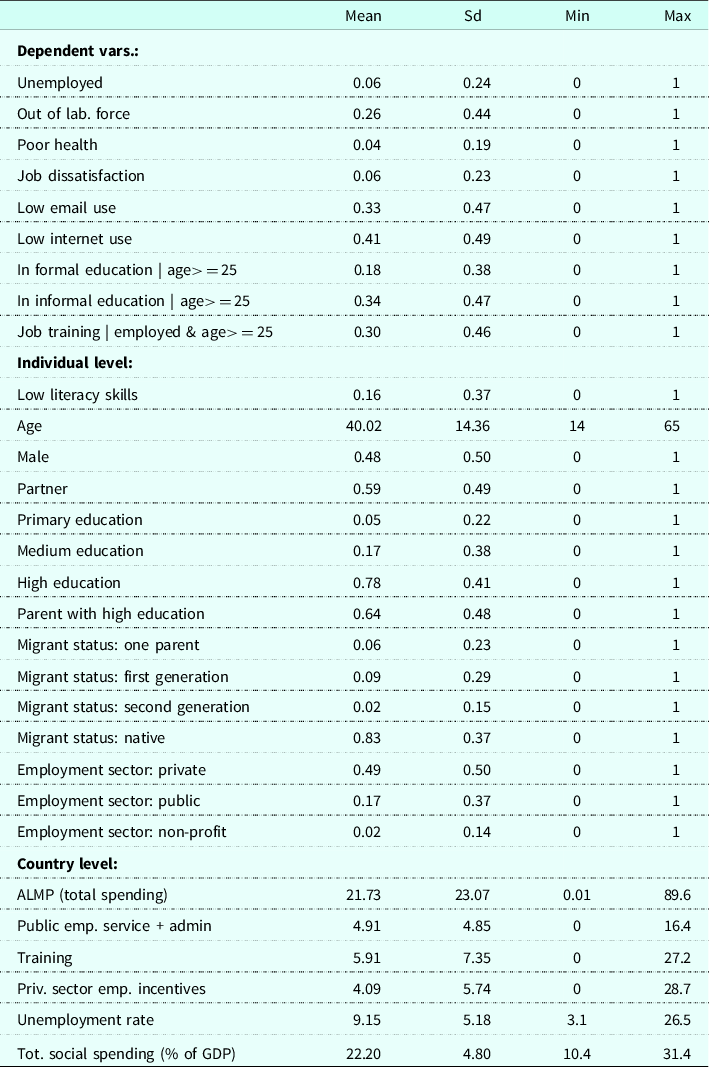
The analyses are conducted on nine dependent variables sorted into four groups of variables, where all variables are recoded into dummy variables. The first group reflects labour market participation and is measured by 1) unemployment (1=not employed but looking for employment and 0=out of the labour force or employed), and 2) out of the labour force (1=not employed and not looking for employment and 0=unemployed or employed). The second group of variables reflects quality of life, measured by 1) self-rated health (1=poor health and 0=fair, good, very good or excellent health), and 2) job dissatisfaction (1=being dissatisfied or extremely dissatisfied with current employment and 0=being satisfied, extremely satisfied or neither satisfied nor dissatisfied with current employment). The third group of dependent variables reflects digital participation and is measured by 1) low email use (1=use email less than once per week and 0=use email at least once per week), and 2) low use of internet to understand issues about the world such as health, finance, environment etc. (1=use internet for this purpose less than once per week and 0=reported use at least once per week). The fourth group of variables reflect participation in lifelong learning, meaning participation in learning activities at age twenty-five and above, with a focus on: 1) formal education (1=currently enrolled in a formal educational programme at any level and 0=not enrolled), 2) informal education (1=participated in open or distance education, seminars, workshops or took private lessons during the last year and 0=no participation in such activities), and 3) on-the-job training (1=attended any on-the-job training during the last year and 0=no participation in such activities). Table 1 provides descriptive statistics for all included variables.
Descriptive statistics
Independent variable
The variable capturing low literacy distinguishes individuals who are only capable of solving tasks at level 1 or below and not tasks at level 2 from the other respondents. Level 1 reflects tasks that require the respondent to read short pieces of text and locate single pieces of information that are identical to the information given in the question. At this level, the participant is expected to be able to recognise basic vocabulary, determine the meaning of sentences and read paragraphs of text. At level 2 the participants are required to make matches between text and information that are not identical, and that may require paraphrasing or low-level inferences (OECD, 2013). The variable for low literacy is therefore coded into a dummy variable =1 if literacy skills <=225 and =0 if >225 (OECD, 2013).
Intervening variables
The OECD labour market policy database groups social expenditures related to ALMP into six underlying categories: 1) public employment services and administration, 2) training, 3) private sector employment incentives, 4) supported and sheltered employment, 5) direct job-creation and 6) start-up incentives. Due to availability of data, this paper will focus on total spending on ALMP as well as three underlying categories: 1) public employment services and administration, 2) training and 3) private sector employment incentives. Spending levels are analysed in terms of purchasing power parity (PPP) per capita in 2015 constant U.S. dollars, where spending levels are given in terms of $10.000.
Control variables
The analyses include control variables both at the individual and national level. At the individual level, the variables capture the respondents’ 1) age, 2) gender (1=male and 0=female), 3) partner (1= lives with partner and 0=does not live with partner), 4) educational level, captured by dummy variables for low education (1=highest education level is primary education) and medium education (1=completed lower secondary school or started upper secondary school but didn’t finish) and with high education as reference category (1=completed education upper secondary school or higher), 5) parents’ education (1=at least one parent has attained upper secondary education and 0=neither has attained education at this level), 6) unemployment (1=unemployed, but looking for work), 7) out of labour force (1=unemployed and not looking for employment) and 8) migrant status, reflected by four dummy variables reflecting a) first-generation migrant, b) second-generation migrant, c) one parent born outside country, where d) native-born is the reference category. At the country level, the control variables included are 1) total social expenditure as percent of GDP; an important control variable as it controls for general welfare generosity and makes sure the estimates are not picking up the effect of other social spending, and 2) other ALMP spending categories when single sub-categories are analysed, which contribute to isolate the effect of the spending category of interest and 3) unemployment rate, which controls for the need for ALMP services, where generous spending can reflect larger social problems, which means that some of the ALMP spending may have to be divided by a greater number of people. ALMP spending levels are included in the analyses in terms of $10.000.
Statistical Analysis
Table 2 presents the relationship between low literacy and the dependent variables individually for each country included in the analysis, as well as for the full sample. From this analysis, we will establish the overall relationship between low literacy and participation within our sample and the variation between countries. The results are obtained through multilevel logistic regression with the variables reflecting indicators of participation as dependent variables, low literacy as independent variable, as well as the control variables mentioned above. All analyses presented in Table 2-7 are performed as multilevel analyses with individuals at level 1 and countries at level 2. Multilevel modelling enables us to estimate the effects of both individual-level characteristics, contextual characteristics at the country-level, as well as the cross-level interactions between these (Snijders & Bosker, Reference Snijders and Bosker2011). Tests for multicollinearity are also conducted. For the models without of the labour force and unemployment as dependent variables, control variables related to sector and employment status are omitted. For the model with job dissatisfaction as dependent variable, the variable reflecting employment status is omitted. The analyses conducted with the lifelong learning variables are performed on a subsample of individuals aged twenty-five and above to capture adult students enrolled in life-long learning activities. Furthermore, the analyses that look at job training and job dissatisfaction are performed on a subsample of employed individuals only. The results are presented as odds ratios throughout all models.
Relationship between low literacy and dependent variables (OR)
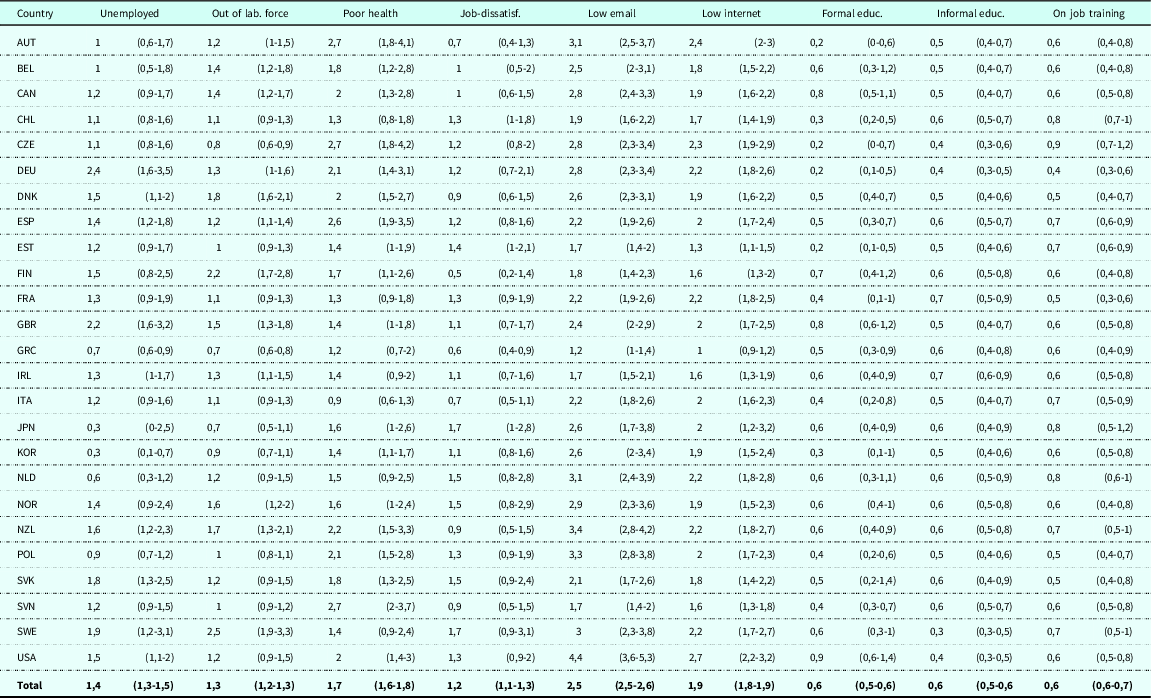
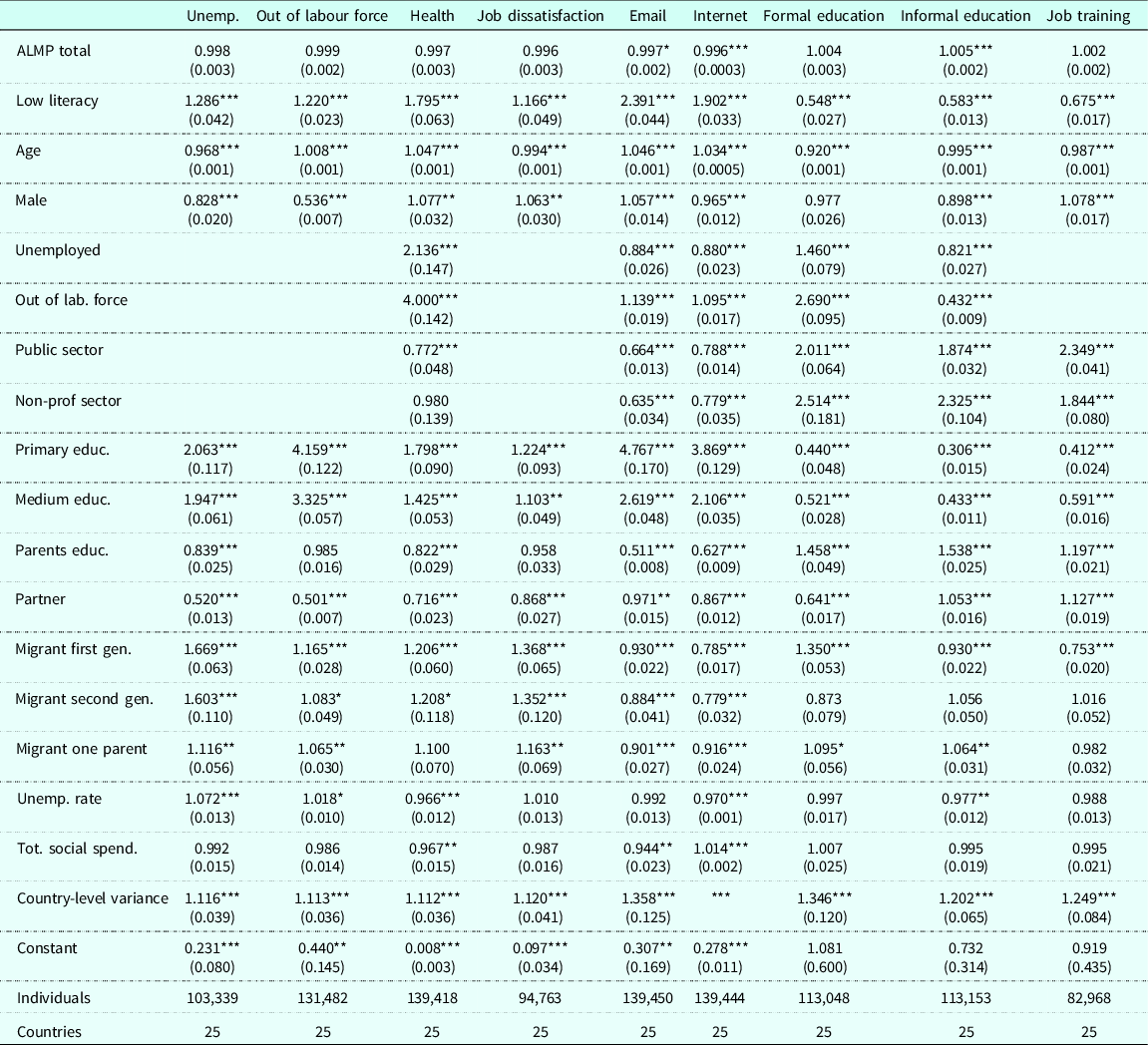
Table 3 presents the relationship between the outcome variables and total ALMP to establish what the relationship looks like for the general population. The inclusion of control variables and subsamples follows the same setup as in Table 2. Tables 4-7 present the main models, one for each group of dependent variables as presented above, where Table 4 reflects labour market participation, Table 5 looks at quality of life, Table 6 looks at digital participation and Table 7 presents analyses of the impact on lifelong learning. An interaction term is included between the dummy variable reflecting low literacy skills and each ALMP variable, capturing the differences in impact from policy initiatives among individuals with low literacy skills compared to those at a more adequate level. A random slope is also included at the lower level of the interaction (i.e. low literacy skills), following Heisig and Schaeffer (Reference Heisig and Schaeffer2019). In Figures 1 through 11 we also present graphs with marginal effects for each of the statistically significant relationships between the ALMPs and the outcome variables identified in the analyses, also illustrating the interaction effect.
Associations between total ALMP expenditure and outcomes
Odds ratios (SE in parentheses).
*** p<0.01, ** p<0.05, * p<0.1.

Graphs and marginal effects (ME) for significant relationships identified in Table 7.
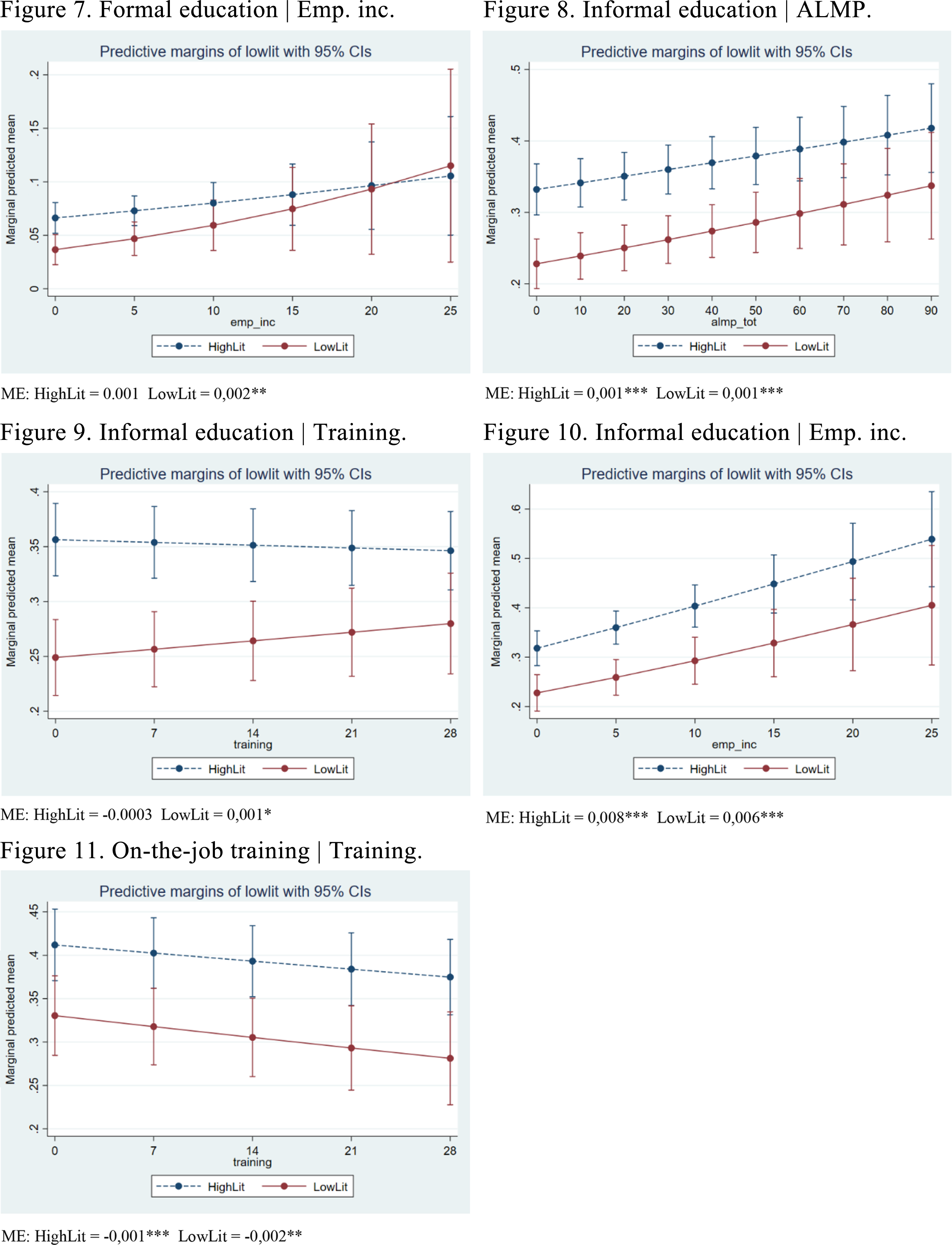
Results
From Table 2 we can see that low literacy skills have a significant association with all the dependent variables included in this paper. Unemployment is overall higher among individuals with low literacy skills (OR=1,41), with the strongest association for Germany (OR=2,4). However, five countries show values below 1, indicating that unemployment is lower among individuals with low literacy skills in these countries, with Japan and Korea showing strongest negative association (OR=0,3). Individuals with low literacy skills are also more likely to be out of the labour force compared to others (OR=1,28), where Sweden shows the strongest association (OR=1,9) and three countries have values below 1, with Greece and Japan showing the strongest negative association (OR=0,7). Poor health is also more prevalent among individuals with low skills (OR=1,71). This is found in all countries except Italy (OR=0,9), with Slovenia and Austria showing the strongest association (OR=2,7). Job dissatisfaction is higher among low-skilled overall (OR=1,20), with the strongest relation found in Sweden (OR=1,7); however, eight countries show values below 1, where the strongest negative association is found in Finland (OR=0,5). Low email use is higher among low skilled (OR=2,53), this is found for all countries, with strongest association in the U.S. (OR=4,4) and the weakest in Greece (OR=1,2). Low internet use to understand the world is also most prevalent among individuals with low literacy skills (OR=1,85), with the strongest association in the U.S. (OR=2,7) and weakest in Greece (1,0). Enrolment in formal education is lower among low skilled (OR=0,56), where Austria, Czech Republic, Germany and Estonia have the strongest negative association (OR=0,2) and Japan the weakest (OR=1,0). Enrolment in informal education is also found to be lower among low-skilled individuals (OR=0,55), with Sweden showing the strongest negative association (OR=0,3) and Ireland and France the weakest (OR=0,7). On the job training among employed individuals is also lower among those with low skill levels (OR=0,63), with strongest negative association in Germany (OR=0,4) and weakest in Czech Republic (OR=0,9).
From Table 3, we can see that ALMP has an association with only three of the nine dependent variables in focus, with a negative association with reporting low use of internet and email, indicating that ALMP can be contributing to making individuals more comfortable with digital appliances. However, the relationship with low email use is only significant at P<0,1. ALMP spending also has a positive association with enrolment in informal education. The control variables are further behaving as one would expect.
From Table 4, we can see how ALMP spending affects labour market participation among individuals with low literacy skills compared to more skilled individuals. The analysis shows that ALMP spending has no impact on unemployment; not for the general population and not specifically for those with low literacy. Individuals that have low literacy skills are, however, more likely to be out of the labour force in countries that have higher spending related to total ALMP, as well as public employment services and private sector employment incentives. This negative effect is not found in the general population. Some spending categories, such as private sector employment incentives, have the goal of creating more employment opportunities, if not for the general population, at least for the more disadvantaged groups. Since we do not see a positive impact of such investment, this may indicate that such spending only works to crowd out private sector employment initiatives already in place. As for the other control variables, we can see that they are behaving expectedly.
Associations between low literacy skills, ALMPs and labour market participation
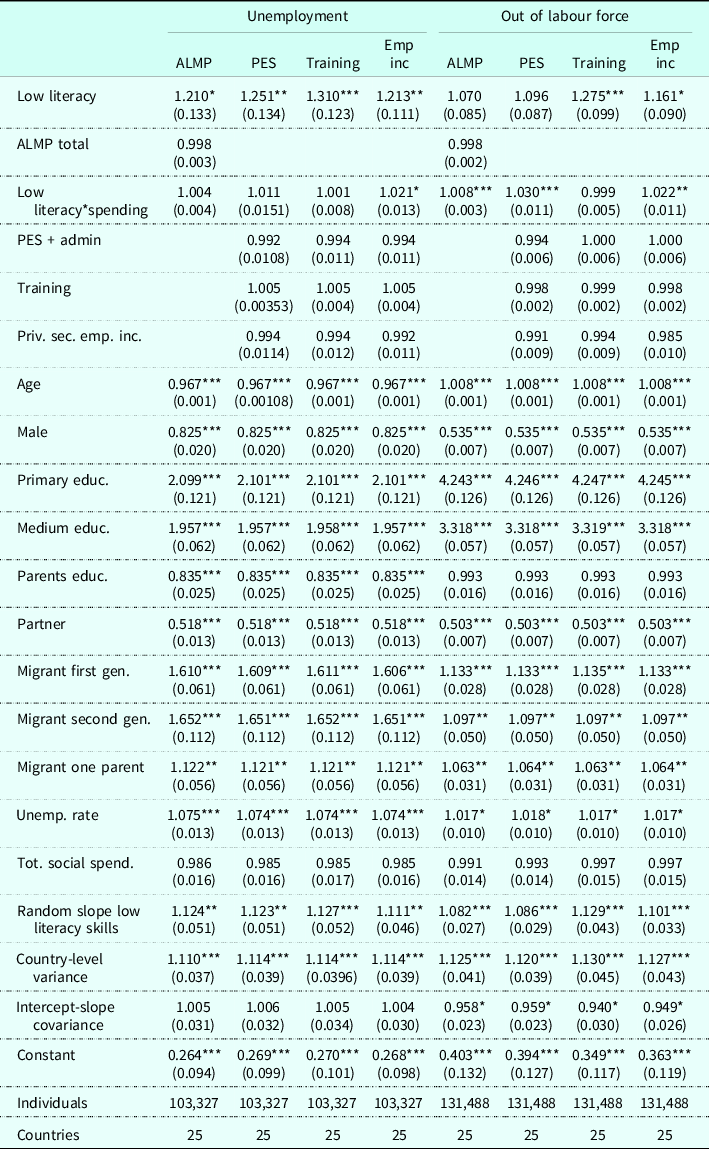
Odds ratios (SE in parentheses).
***p<0.01, **p<0.05, *p<0.1.
From Table 5, looking at the relationship between ALMP spending and the dependent variables reflecting quality of life, we find no association with self-rated poor health, neither for individuals with low literacy skills nor for the general population. ALMP spending related to public employment services, training and employment incentives is, however, associated with reduced probability of reporting dissatisfaction with the current job in the general public, whereas expenditures related to training have an additional effect on individuals with low literacy skills. This indicates that this spending category can be important in closing the gap in job satisfaction that exists based on skill level.
Associations between low literacy skills, ALMPs and quality of life
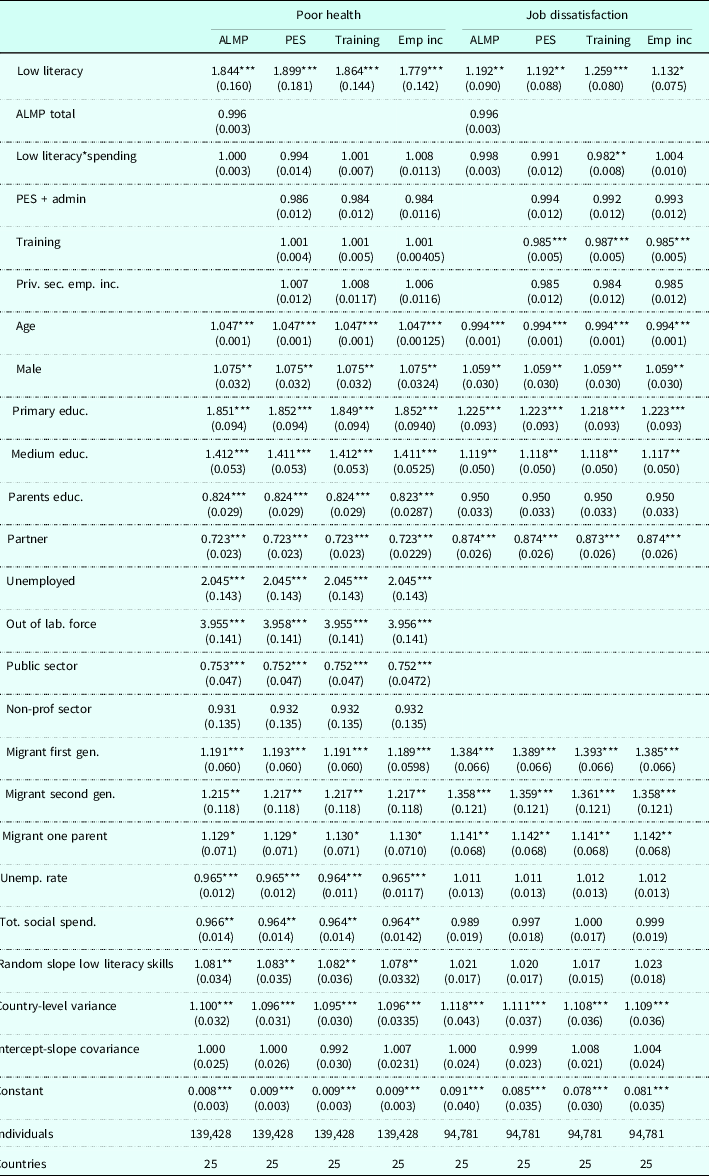
Odds ratios (SE in parentheses).
***p<0.01, **p<0.05, *p<0.1.
When it comes to digital participation, Table 6 shows that larger spending related to training is associated with a reduced probability of reporting low use of internet and email in the general population. Individuals with low literacy skills seem to have a possible extra impact from this when it comes to use of email (p<0,1); however, no extra effect when it comes to use of internet.
Associations between low literacy skills, ALMPs and digital participation
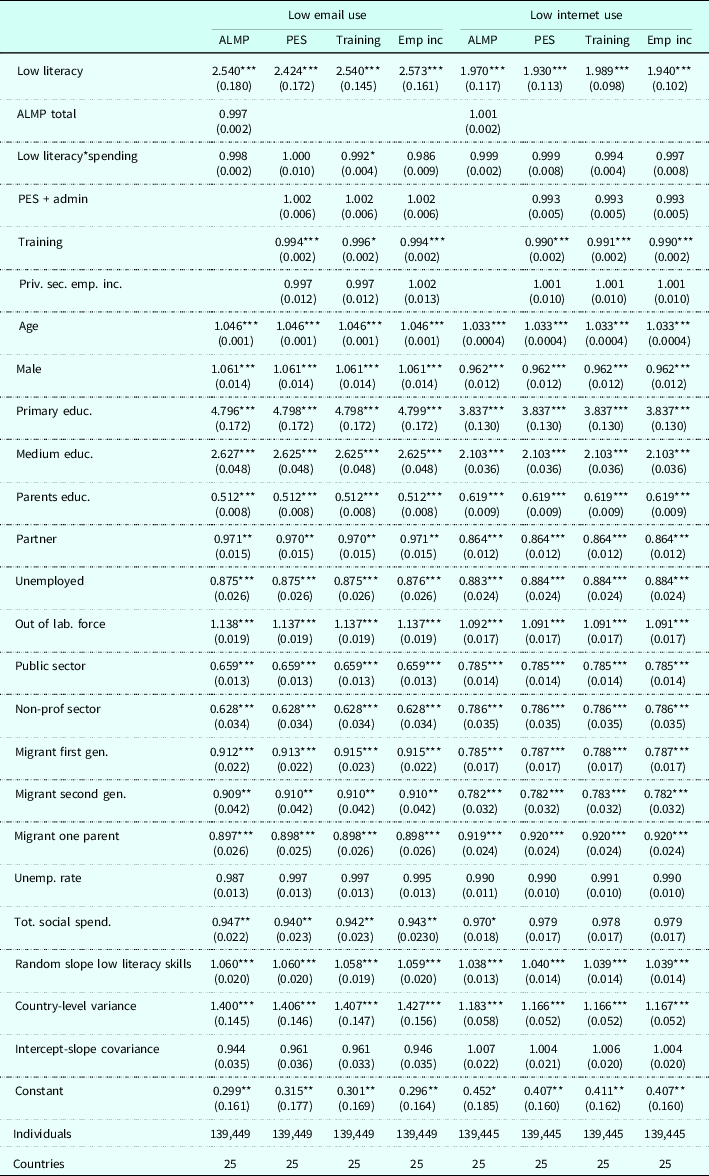
Odds ratios (SE in parentheses).
***p<0.01, **p<0.05, *p<0.1.
Table 7 shows the relationship between ALMP spending and lifelong learning, where we can see that investment in private sector employment incentives is associated with higher enrolment in formal education among individuals with low literacy skills compared with others. The other spending categories have no impact on either group. When it comes to enrolment in informal education, we can see that total ALMP spending is associated with higher enrolment among all individuals, and it appears that spending related to private sector employment incentives is particularly important. For the subsample of individuals with poor literacy skills, the investment in training appears to be particularly important. Investment in training has a negative association with on-the-job training, indicating that when the state invests in training it may reduce employers’ incentive or need to provide this, and a crowding-out effect arises.
Associations between low literacy skills, ALMPs and lifelong learning
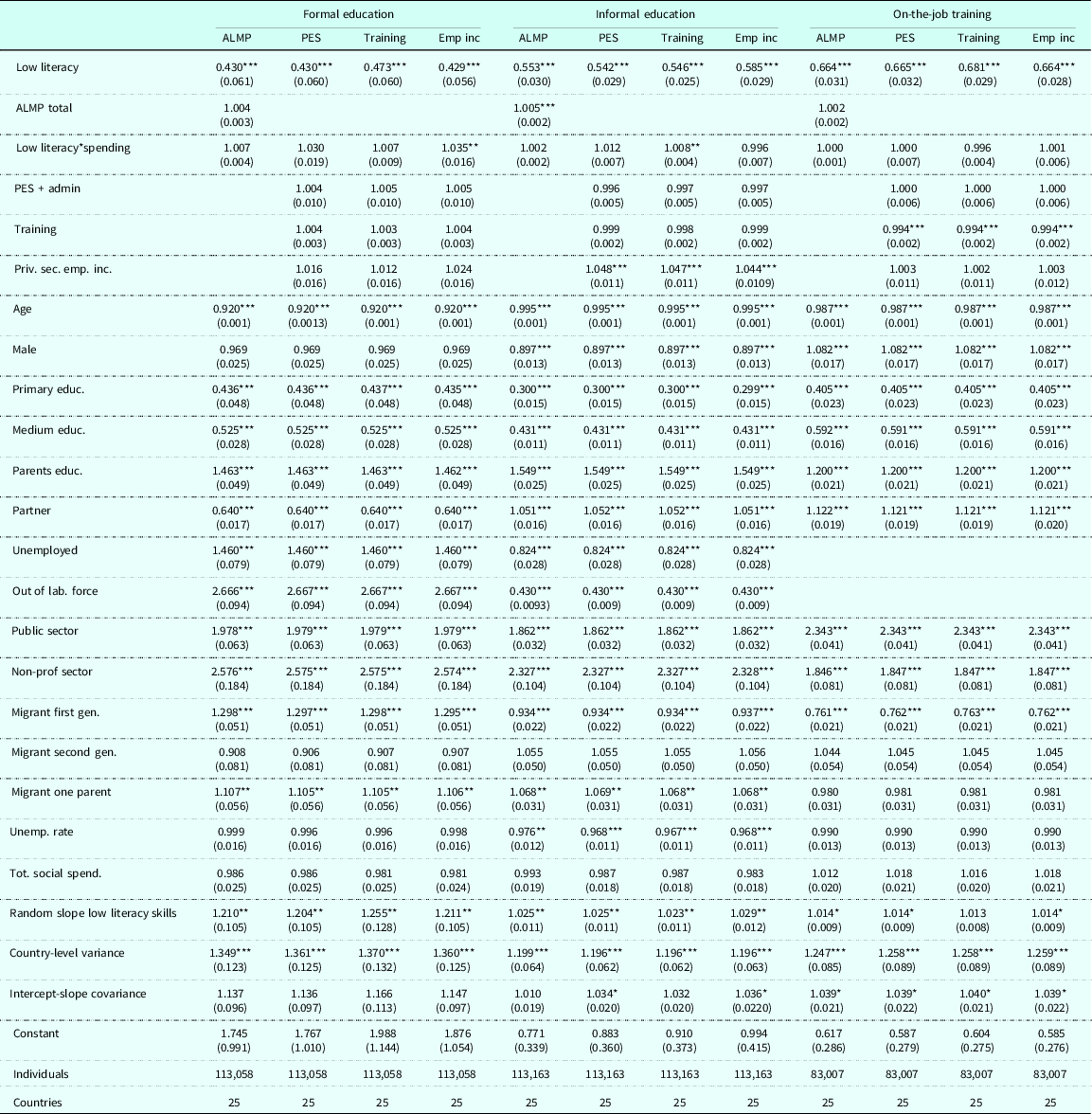
Odds ratios (SE in parentheses).
***p<0.01, **p<0.05, *p<0.1.
Robustness checks
We also performed the analyses with exclusion of outliers, identified by histogramsFootnote 2 , with no significant impact on the overall results. For the analyses investigating poor health, we also ran the analyses. including the category reflecting fair health as poor health, as well as on a subsample of individuals aged forty and above; however, neither of these changes altered our results. For the analyses focusing on unemployment, we also excluded the countries with labour markets that favour individuals with low literacy skills (as shown in Table 2); however, this did not affect the overall results.
Also, we performed analyses focusing on very low literacy skills, defined as below level 1: ‘Tasks at this level require the respondent to read brief texts on familiar topics and locate a single piece of specific information. There is seldom any competing information in the text. Only basic vocabulary knowledge is required, and the reader is not required to understand the structure of sentences or paragraphs or make use of other text features.’ Tables from these analyses are presented in the supplementary material. The findings show that spending related to total ALMP, public employment services and employment incentives are associated with a higher probability of reporting being unemployed among the individuals with very low literacy compared to others, but now the association with being out of labour force is non-significant for all categories. Individuals with very low literacy skills are also more likely to report poor health compared with others when investments in total ALMP are higher. All spending categories are associated with higher enrolment in formal education among those with very low literacy skills compared with others. For this group of individuals spending on training has no extra impact on job dissatisfaction, as is seen among individuals with low literacy.
Discussion and conclusion
Main findings
Although some welfare states have taken full responsibility for the provision of education, little is known about the extent to which the welfare state is able to improve the capabilities of individuals left with insufficient skills to function fully in society. The aim of this paper has therefore been to analyse the relationship between low literacy skills and basic functioning and participation in society, and to examine the role of the welfare state, and more specifically ALMPs, in moderating the negative impact low literacy skills have on labour market outcomes, adult learning, digital participation and quality of life.
Our findings show that low literacy has a significant relationship with all the outcome variables reflecting basic functionings or capabilities at the individual level, where low literacy is associated with more undesired outcomes for all variables. This suggests that literacy skills represent a crucial enabler of capabilities. The analyses investigating the role of ALMPs in this context show that ALMP spending related to training is associated with reduced job dissatisfaction and increased enrolment in informal education among individuals with low literacy skills compared to individuals at higher skill levels. Investment in private sector employment incentives is further found to have a positive association with enrolment in formal education for this group. Total ALMP spending as well as the underlying categories involving public employment services and employment incentives are, however, associated with increased reporting of being out of the labour force for those with low literacy skills compared with others. For individuals with very low literacy skills, such spending is associated with a tendency to be unemployed instead of being out of the labour force. For this group, total ALMP spending is also found to have a negative association with health, with increased reporting of poor health when ALMP spending is high. We also find that all spending categories have a positive association with enrolment in formal education for this group. However, spending related to training has no additional impact on job dissatisfaction beyond that which applies to the whole population, contrary to what is found for individuals with low literacy. For the general population, total ALMP spending is found to be associated with higher enrolment in informal education, while investment in training is associated with fewer reporting job dissatisfaction and low use of email and internet, but also seems to have a negative association with on-the-job training.
An important question to ask in this regard is to what degree individuals with low literacy skills are aware of their entitlements and opportunities when it comes to social services and specifically active labour market services, and to what extent they are able to make use of these services given such awareness. From our data, there is no indication that investment in total ALMP, or any of the sub-categories, works only to benefit individuals with sufficient levels of literacy, which suggests that creaming mechanisms cannot substantially explain our findings. However, there are examples of cases where spending seems to have no impact on the general public but has a negative association with the outcome variables for those with low skills, as is seen for being out of the labour force for individuals with low literacy skills and unemployment and health for individuals with very low literacy. Where we cannot expect ALMPs alone to alter overall employment as this is a product of many factors related to the political economy, successful investments in ALMPs should contribute to make disadvantaged groups do better and therefore reduce skill-based inequality. The negative association with employment may have a similar explanation as the one suggested by Voßemer et al. (Reference Voßemer, Gebel, Täht, Unt, Högberg and Strandh2018), where the individuals with very low literacy skills may reflect a group of individuals who the ALMP services are particularly unhelpful for, and who are left behind as the ALMP services are successful at helping others find employment. The same can be said for the individuals with low literacy skills when it comes to being out of the labour force, where this group seems to be more likely to also stop looking for employment and settle outside the labour force. Our findings show that this even appears to be the case in countries such as Sweden, where welfare state initiatives are generally more comprehensive and inclusive. As individuals at low skill levels do not seem to be better off in terms of labour market participation when ALMP spending is generous, reflecting a core goal of ALMP, this may indicate that those at low skill levels are struggling to make use of welfare services available to them. However, especially in societies where ALMPs are complemented by cash transfers, this may also indicate that cash transfers represent an alternative to ALMPs, especially for people with a weak position in the labour market.
Strengths
This paper fills a substantial gap in the literature: it investigates the relationship between low literacy skills and a range of indicators reflecting capabilities and general functioning in society with a cross-sectional focus on OECD countries, as well as investigating the moderating role of ALMPs. The focus on capabilities is also important when evaluating social policy as it provides an alternative way of identifying poverty based on investigation of what individuals have prospects of doing and being, instead of the traditional focus on monetary measures alone, which do not necessarily ensure a good life. The relationship between income and capabilities has for example been investigated by Laderchi (Reference Laderchi1997), who found income to be an insignificant predictor of basic education, nutrition and health; basic functionings that are essential for a minimum standard of living. A core strength of this paper is therefore that it considers the implications of ALMP services beyond their impact on unemployment levels. The analysis also disentangles multiple dimensions of ALMP spending to get more information about the different types of services, providing more detailed information on how each category can work to influence each outcome variable.
Limitations
It is important to note that the paper aims to make an ecological inference and that the results should be read in that light. We also cannot entirely ensure that our results are independent of other variables correlated with ALMP spending, such as left government partisanship and trade union strength (Cronert, Reference Cronert2019; Vlandas, Reference Vlandas2013). However, at least to some extent this is accounted for in our analysis by controlling for the size of the public sector and distinguishing between different types of ALMPs. When it comes to the reliability of ALMP expenditures as a measure, it does not capture all ALMP spending due to decentralisation of such spending in many countries. Changes in spending levels can therefore reflect a shift in responsibility of ALMPs from central to local government (Clasen et al., Reference Clasen, Clegg and Goerne2016; 25). Some countries have also experimented with contracting out ALMP responsibility to private actors. These providers are paid based on achieving certain outcomes rather than providing certain services. Therefore, it can be difficult to account for the specific content of these services (Clasen et al., Reference Clasen, Clegg and Goerne2016; 26). As for the validity of ALMP expenditures as a measure, there are two central issues: 1) controlling for demand for ALMP and 2) knowing the degree in which the ALMP data actually measures work-related support for individuals looking for employment (Clasen et al., Reference Clasen, Clegg and Goerne2016; 26). To control for the demand for ALMPs, it has been common to control for the unemployment rate. This can, however, be problematic as the unemployment rate is expressed in terms of the ratio of the labour force, where labour force participation varies greatly between countries based on factors such as age distribution, participation of women, part-time employment and varying categorisation of non-employment. ALMP generosity can therefore seem to increase in cases where the unemployment rate is reduced as, for example, a result of an expansion of early retirement. Many individuals involved in ALMP programmes, such as training and job creation measures, also lose their status as unemployed without actually having obtained regular employment (Clasen et al., Reference Clasen, Clegg and Goerne2016; 27). Some of the spending may also be associated with providing alternatives for those not expected to be looking for employment, for example due to incapacity, and some programmes targeted at unemployed individuals may not be included in the ALMP category as they also include individuals at low levels of income (Clasen et al., Reference Clasen, Clegg and Goerne2016; 28). Since the core focus of this paper focuses on ALMP’s wider impact on individuals’ capabilities and participation in society, these issues are of lesser importance. We also operate with unemployment rate data for only one time-unit, so changes in the definition of labour force for each country will not pose a problem for this analysis. A central limitation of our analyses is, however, that we did not have any information on whether and how individual respondents participated in ALMP programmes, and we could therefore not assess directly at the individual level how these programmes affected people with low literacy skills. As far as we know, there are no available data that include both detailed and direct measurements of skills as well as information on participation in ALMPs at the individual level. We therefore argue that it is important to analyse whether individuals with low literacy skills are better off in countries that invest more in ALMPs and that this research provides a more fine-grained understanding of the mechanisms by which social policy affects groups with different skill levels than, to our knowledge, is provided by previously conducted research.
Conclusion
Even though ALMPs do not moderate the negative association between poor literacy skills and labour market participation, individuals at low skill levels appear to benefit to different degrees from ALMPs when it comes to digital participation, formal and informal education and job satisfaction. This indicates that ALMPs can be important contributors to enable capabilities, promote participation in society and increase feelings of empowerment. Overall, the ALMP sub-category that appears to have the largest influence on individuals’ lives is the one related to training, which also reflects the most extensive and expensive of the ALMP programmes. The policy implications from our findings are therefore that countries should give increased attention to developing services that are adapted to individuals with low literacy skills. It is evident that more should be done to specifically help individuals at low skill levels into employment or training, where facilitators need increased awareness of the stigma associated with low skills and the clients’ incentives to hide this, which can pose a central barrier for the success of these programmes. Future research should therefore do further country-level investigation of what specifically is done for individuals at low skill levels, map out their needs, further investigate the prevalence of Matthew effect and creaming in the provision of services and establish how specific policies should be designed to help this group in an optimal way.
Supplementary material
To view supplementary material for this article, please visit https://doi.org/10.1017/S0047279423000417
Competing interests
The authors declare none.


 Open access

