


1. Introduction
The rise of fast fashion has shifted consumption patterns, leading to the overconsumption of clothing that is worn less frequently and retained for shorter periods (on average, only 3,3 years) (WRAP, 2017). The global clothing utilisation has decreased by 36% compared to 2002 (Reference Morlet, Opsomer, Herrmann, Balmond, Gillet and FuchsMorlet et al., 2017), reflecting a ‘single use’ mindset, where items are discarded after only a few wears (Reference GwiltGwilt, 2014; Reference Joy, Sherry, Venkatesh, Wang and ChanJoy et al., 2012; Reference Niinimäki and DurraniNiinimäki & Durrani, 2020). In 2020, 6,95 million tonnes of textile wasted was generated in the European Union, of which 82% was post-consumer waste, estimated at 16kg per person (European Environmental Agency, 2024). A possible explanation for this shift is the fashion industry’s prioritisation of garment quantity over quality. Traditionally, product quality has served as a strategic tool for companies to differentiate themselves (Reference SteenkampSteenkamp, 1990) and foster customer loyalty (Reference Ihza Pratama, Jatmiko and PraharjoIhza Pratama et al., 2023). However, fast fashion has redirected emphasis from quality craftsmanship to mass production and cost reduction, thereby undermining garment quality (Reference CassidyCassidy, 2017; Reference Joy, Sherry, Venkatesh, Wang and ChanJoy et al., 2012). The decline in clothing quality and drop in garment prices influence how consumers value garments and reinforce the perception that garments are not worth engaging in longevity practices such as repairing, reselling, or buying second-hand (Reference Laitala and KleppLaitala & Klepp, 2018; Reference McLaren, Oxborrow, Cooper, Hill and GoworekMcLaren et al., 2015; Reference NiinimäkiNiinimäki, 2023; Reference Wang, Fu and LiWang et al., 2022). Longevity is understood as the extended lifespan and continued use of clothing, supporting the fundamental aims of the Circular Economy (CE) (Ellen MacArthur Foundation, 2024). This highlights broader challenges within the fashion industry, where both garment quality and consumer perceptions hinder sustainable garment use and limit the adoption of circular strategies that increase garment longevity. This study aims to examine how consumers perceive garment quality, how these perceptions align with industry standards, and what impact they have on the long-term use of clothing.
1.1. Literature study
Garment quality can be understood through two dimensions: the objective and subjective quality (Reference Swinker and HinesSwinker & Hines, 2006). Objective quality refers to the standards set by fashion brands and manufacturers during design and production, verified through formal quality control procedures. These standards ensure consistency in garment performance and functionality. (Reference Connor-Crabb and RigbyConnor-Crabb & Rigby, 2019; Reference NawabNawab, 2016; Reference Piippo, Niinimäki and AakkoPiippo et al., 2022). In Belgium, Flanders District of Creativity, a Belgian organisation that supports design and fashion entrepreneurs and brands, in collaboration with VITO, a research institute, and Xandres, a Belgian fashion brand, developed a quality benchmark tool to help brands extend garment lifespans. It identifies eleven common quality defects (discolouration (colour fastness), abrasion, dimensional stability, seam integrity, burst strength, tensile strength, tear strength, pilling, crease resistance, damaged prints, and damaged non-textile components), and sets minimum and target values, each aligned with specific ISO quality control tests. Rather than offering new testing protocols, the framework synthesises internationally recognised quality standards into a unified reference structure designed to guide brands in extending garment lifespans (Flanders District of Creativity, 2023). However, a gap exists between how the industry defines and measures quality and how consumers evaluate it (Reference Connor-Crabb and RigbyConnor-Crabb & Rigby, 2019; Reference Piippo, Niinimäki and AakkoPiippo et al., 2022; Reference Swinker and HinesSwinker & Hines, 2006). Professionals rely on standardised testing to prevent quality failures and premature disposal, while consumers, lacking technical expertise, depend on observable and personally meaningful cues, known as subjective quality. This includes individual interpretations shaped by perceptions, needs, and goals (Reference Aakko and NiinimäkiAakko & Niinimäki, 2022; Reference SteenkampSteenkamp, 1990), but also the context in which these cues are experienced, as perceived quality emerges from the interaction between product attributes and the user’s sensory and situational experience (Reference Stylidis, Wickman and SöderbergStylidis et al., 2020). Subjective quality is assessed at two stages: purchase and use. Initially, consumers form expectations based on quality cues aligned with the 4P-model of marketing (product, price, place of purchase, and promotion) (Reference Jackson and ShawJackson & Shaw, 2009). Over time, personal experiences shape evaluations based on quality attributes (e.g. laundering, comfort) as consumers develop a deeper understanding of the garment’s performance and value (Reference Aakko and NiinimäkiAakko & Niinimäki, 2022). These perceptions may diverge from objective measures, especially among consumers with lower fashion involvement, while those with higher involvement tend to identify more relevant aspects (Reference Gitimu, Workman and RobinsonGitimu et al., 2013). This two‑stage shift from quality cues-based evaluations before purchase to experience‑ and performance‑based assessments during use is not unique to clothing but reflects a broader pattern described in quality perception research across multiple product categories (Reference Golder, Mitra and MoormanGolder et al., 2012; Reference SteenkampSteenkamp, 1990).
Garment quality is crucial for promoting prolonged use and reducing clothing consumption (Reference Laitala and KleppLaitala & Klepp, 2020; Reference Niinimäki, Vezzoli, Kohtala, Srinivasan, Diehl, Fusakul, Xin and SateeshNiinimäki, 2017). First, garments must meet high objective quality standards to ensure durability under frequent washing, drying, and wearing (Flanders District of Creativity, 2023). This is reflected in policy initiatives such as the EU’s Ecodesign for Sustainable Products Regulation (ESPR), which sets requirements for, among others, product durability and reusability (European Commission, 2024). Subjective quality also significantly influences extended garment use (Reference Connor-Crabb and RigbyConnor-Crabb & Rigby, 2019). Consumers who perceive garments as high quality are more likely to adopt maintenance practices, such as reduced washing frequency and air drying, that preserve the objective quality over time (Reference Napper and ThompsonNapper & Thompson, 2016; Reference NiinimäkiNiinimäki, 2023). These practices slow material degradation and delay visible signs of wear (Reference Laitala and KleppLaitala & Klepp, 2020), which in turn influences both reuse potential and disposal decisions. In the second-hand context, perceived quality strongly shapes product value (Reference Sihvonen and TurunenSihvonen & Turunen, 2016), where signs of wear often signal inferior quality, discouraging purchasing due to concerns about performance and longevity (Reference Das, Moons and Du BoisDas et al., 2024). Moreover, technical or quality-related issues are the most common reason for disposal, and consumers report they would keep garments longer if they were of better quality (Reference Laitala and BoksLaitala & Boks, 2012). Reference Wakes, Dunn, Penty, Kitson and JowettWakes et al. (2020) emphasises that disposal decisions should be based on actual performance rather than expectations of garment quality.
1.2. Research aim
Subjective quality is dynamic, evolving as consumers interact with garments and, based on personal use, adjust their expectations formed at purchase (Reference Aakko and NiinimäkiAakko & Niinimäki, 2022; Reference Connor-Crabb and RigbyConnor-Crabb & Rigby, 2019). While industry quality control relies on laboratory testing, consumer expectations and experiences are equally vital in shaping garment longevity (Reference NiinimäkiNiinimäki, 2023; Reference Piippo, Niinimäki and AakkoPiippo et al., 2022; Reference Wakes, Dunn, Penty, Kitson and JowettWakes et al., 2020). This study investigates the gap between objective and subjective quality and explores how insights from subjective quality can inform industry practices to enhance product longevity. It is, however, important to note that garment longevity is also influenced by fashion-driven dynamics and emotional durability (Reference DeLong, Min, Lee and CastoDeLong et al., 2013; Reference Piippo, Niinimäki and AakkoPiippo et al., 2022). Timeless design and personal attachment can extend use independent of garment quality. While these aspects are highly relevant, they fall outside the scope of this study, which focuses specifically on quality-related determinants. The research questions are:
RQ1: How does the gap between objective and subjective garment quality manifest in consumers’ evaluations and explanations?
-
• RQ1A: To what extent do quality expectations reflect measurable aspects of garment quality?
-
• RQ1B: To what extent do quality experiences reflect measurable aspects of garment quality?
RQ2: How can insights into the gap between objective and subjective garment quality inform design strategies that enhance perceived quality and promote garment longevity?
2. Methodology
The data used for this research were primarily collected as part of a broader qualitative study on barriers and motivations in second-hand clothing consumption (Reference Das, Moons and Du BoisDas et al., 2024). During these interviews, participants were also asked to reflect on how they assess garment quality. Although these specific responses were not analysed in the original study, they were systematically retained and now repurposed for the current research focus. The second-hand context encouraged participants to reflect more broadly on garment quality, beyond newly purchased items. Visible signs of wear (e.g. discolouration, pilling) provided tangible aspects on how consumers express objective quality standards, such as tensile strength and abrasion resistance, which are less easily assessed in new garments.
Data was collected using semi-structured interviews, with participants recruited via a structured process. To ensure rich and diverse data, four consumer types were developed based on prior research on second-hand consumer segmentation (Reference Ferraro, Sands and Brace-GovanFerraro et al., 2016; Reference HurHur, 2020; Reference Zaman, Park, Kim and ParkZaman et al., 2019). In a brainstorming session with the authors before participant recruitment, these typologies were merged into four personas:
-
• Fashion shopper (P1): Enjoys shopping sprees, seeks novelty, and values social image.
-
• Frugal Shopper (P2): Resourceful, motivated by budget or sustainability.
-
• Quality Shopper (P3): Prioritises high-quality garments and seeks value for money.
-
• Reluctant Shopper (P4): Shops infrequently, driven by practicality, comfort, and functionality.
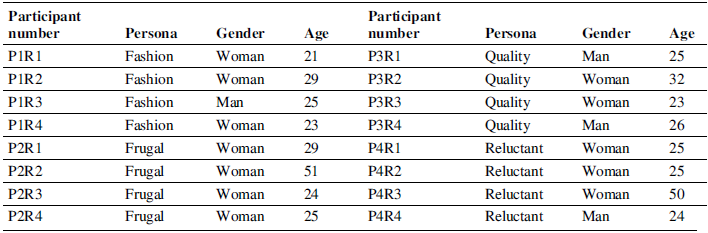
Four participants were recruited per persona, totalling 16 participants. These personas served as heuristic lenses to ensure variation in motivations related to clothing acquisition rather than mutually exclusive consumer types; participants were assigned to the persona that best matched their dominant orientation. Although the personas originate from second‑hand consumption research, the underlying behavioural dimensions (e.g., frugality, novelty seeking, quality orientation, practicality) are relevant across broader garment consumption contexts. Recruitment was conducted via Instagram, chosen for its broad reach and ease of engagement. Interested individuals received an email with study details, informed consent and a link to an online survey (demographics; inclusion criteria, eleven 5-point Likert scale; availabilities). Survey data was used to assign participants to personas and schedule interviews. Data saturation was reached after interviewing the 16 participants. Personal information (e-mail) was stored separately from the interview responses to ensure anonymity. Table 1 provides an overview of the participants, their assigned persona, gender and age. In total, twelve Flemish women and four Flemish men participated in the study.
Overview of participants

Interviews were conducted either online (Microsoft Teams) or offline (on the university campus), based on participant preference, creating a comfortable setting for sharing personal experiences. Each interview lasted approximately one hour. As the data were primarily collected for a broader study on second-hand clothing acquisition, the interview structure was more extensive than required for this paper. The full structure is detailed in Reference Das, Moons and Du BoisDas et al. (2024), published in the Proceedings of the Design Society. Garment quality was explored explicitly by asking participants how they assess quality (“How do you assess the quality of a garment?”), and implicitly, through quality-related insights that emerged spontaneously throughout broader discussions on second-hand barriers (e.g., “In what way do you see that clothing from the past was of higher quality?”). These answers were relevant because they allowed participants to articulate concrete quality cues.
All interviews were audio-recorded and transcribed using Sonix software. Transcripts were reviewed, corrected for inconsistencies, anonymised, and recordings were deleted before analysis. Data analysis was conducted using NVivo software, combining open and closed coding. Responses to the quality-related questions were first coded according to the Clothing Design for Longevity Guide (Flanders District of Creativity, 2023). Responses that did not align with these standards were open-coded to capture additional consumer-assessed quality aspects. Ethical approval was obtained from the Ethics Committee for the Social Sciences and Humanities. The study followed university guidelines, with written informed consent collected via survey and both written and verbal consent prior to interviews. Personal data was stored separately and deleted after interview completion. Transcripts were anonymised, and audio files were deleted post-transcription.
3. Results
When discussing objective standards, participants rarely used technical terminology; instead, they referred to visible garment features. Overall, respondents relied more on perceptual cues (121 references, 16 participants) than on performance-related cues (57 references, 14 participants). Perceptual cues, such as material composition, price, brand, and hand feel, served as heuristics: quick, intuitive indicators not directly linked to objective quality. In contrast, performance cues were aspects that could be associated with objective measures, such as tensile and tear strength, which indicate how garments perform over time. Furthermore, participants often combined multiple perceptual cues in their assessments and their desire for durable garments that can be worn for a long time without signs of wear. This qualitative use bridges subjective impressions and objective quality measures. The next section details how these findings emerged from the data.
3.1. Performance cues
Interviewees referred to various objective quality aspects by describing the visible outcomes of these properties, often using experiential rather than technical terminology. This was especially evident in references to burst strength, tear strength, tensile strength, abrasion resistance, seam integrity, and stability. “Holes and tears” (11 references, 8 interviewees) were commonly cited as indicators of poor quality, without specifying the cause. Two interviewees (P3R1, P3R4) mentioned pulling fabric to test strength. Abrasion (6 references, 5 interviewees) was assessed through signs like thinning or transparency, with one participant (P1R1) describing garments “where a hole can appear at any moment.” Seam integrity (11 references, 6 interviewees) was often described as “fraying,” with preferences for garments without loose threads. While the cause of fraying was unclear, some participants (P3R4, P4R1, P4R2) explicitly checked seams for stitching quality. Seam slippage was not mentioned. Stability (6 references, 4 interviewees) was linked to shrinkage or garments becoming “loose,” with one participant (P3R2) noting twisted side seams, a known sign of poor dimensional stability. Other objective aspects were more aligned with technical terminology: damaged prints (4 references, 3 interviewees), broken components (3 references, 3 interviewees), crease resistance (2 references, 2 interviewees), pilling (5 references, 5 interviewees), and discolouration (11 references, 10 interviewees). Discolouration was correctly associated with fading colours, though some participants also linked stains to poor quality. Overall, discolouration, seam integrity, and holes/tears were the most frequently mentioned performance cues.
3.2. Perceptual cues
Participants frequently assessed garment quality using perceptual cues, elements not directly linked to objective quality standards. In this study, perceptual cues refer to consumers’ subjective interpretations of these fixed product characteristics as signals of expected quality. These included qualitative use (64 references, 16 participants), hand feel (25 references, 13), material (24 references, 9), brand (21 references, 10), price (11 references, 5), construction (15 references, 6), and design (3 references, 2). Among these, qualitative use emerged as the most significant indicator, followed by hand feel, material, and brand.
Qualitative use was described as the garment’s ability to withstand frequent wear without showing signs of wear. This was stated explicitly, such as the desire for long-term use (35 references, 15 participants), and implicitly through concerns about damage (5 references) or worn appearance (24 references). In this context, “damage” and “worn appearance” were treated as perceptual cues because participants used them as general visual impressions of declining quality, rather than as references to specific performance failures or technical standards. For example, P4R3 stated: “I want something I can wear for a long time. Not something I’ll say, ‘get rid of it’ after a month, because I can’t do that.” Similarly, P2R4 noted: “[…] For example, if it breaks within a month or so. That’s not a good purchase.” Some participants (P3R2, P3R4) noted that care practices help preserve quality, enabling long-term use. Hand feel was another key indicator with sturdy (3 references by 2 interviewees), heavy (2 references by 2 interviewees), or pleasant (9 references by 6 interviewees) textures linked to high quality. This perception was closely linked to material preferences, where natural fibres (e.g., cotton, wool) were preferred (P1R2, P2R1, P3R3, P4R2), while synthetic fibres were avoided (5 references by 5 interviewees) due to discomfort (P2R1, P2R2, P4R2) or causing sweat (P1R2, P2R1, P4R1). P4R2 describes this connection clearly: “[…] have a fine, high-quality texture. It’s a cotton T-shirt that feels sturdy. Linen trousers that feel sturdy.” Brand was used as a reference point for quality, based on both reputation and personal experience. Premium brands were consistently associated with higher quality. P1R3 explained: “Usually in second-hand shops, when I see Patagonia or something like that, I usually know it’s okay.” P3R4 added: “I’m also the kind of person who always goes back to that brand, but in the beginning, you always must get to know the brand and see how good the quality is.” Price, however, was similarly linked to quality, but in relation to how well the garment was made, with low-cost garments signalling poor quality and higher-priced items signalling high quality. Brand (P2R1, P3R2, P4R3) and price (P1R3, P3R2) were also linked with construction, where the participants, contrary to cheap brands, expect expensive brands to attach more importance to garment construction, resulting in higher quality. P3R4 reflected: “[…] I think there are still some very beautiful garments being made that I greatly admire. But they are very expensive […] Margiela, for example, I could save up to invest in one piece that meets those same parameters. But then you’re looking at a thousand euros, which is a lot of money.” Lastly, Design was less frequently linked to quality and appeared to have a weaker association in the context of durability or performance, referring here specifically to the garment’s outward stylistic appearance rather than structural or functional design features.
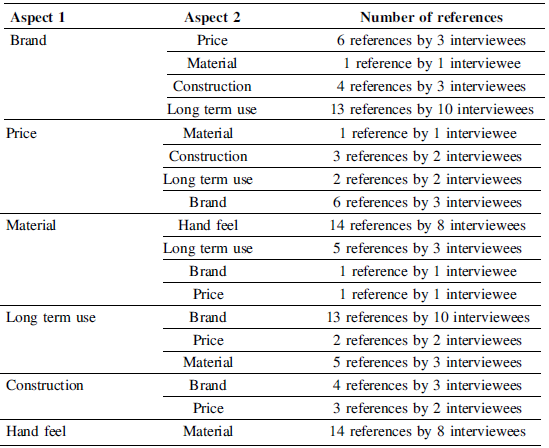
Participants often combined multiple perceptual cues in their assessments. Material (4 combinations), price (4 combinations) and brand (4 combinations) were most frequently mentioned together (see Table 2). Brand and long-term use were closely linked, as illustrated by P4R1: “But especially which brand you buy. I think if you buy Levi’s jeans, for example, you know […] that brand. You know that they make good jeans, and you know that you’ll be able to wear them for a long time.” Premium brands were also believed to use better materials and construction, with leather and denim cited as examples of long-lasting fabrics (P3R1, P3R2, P3R3). As previously stated, hand feel and material were frequently paired, with natural fibres perceived as higher quality due to their tactile properties.
Interestingly, long-term use, a sub-code of qualitative use, served as a bridge between perceptual and performance cues. Interviewees highlight that the goal for high-quality garments is being able to wear them for a long time, without any signs of wear. First, participants don’t want clothing to get damaged after a few wears and are linked with objective quality aspects such as discolouration, seam integrity, and stability. A quote from P3R4 illustrates: “I mainly look at how the seams are stitched […] Then I know right away that it will break easily.” They also expect garments to remain in good condition after repeated use, connecting this with burst, tensile and tear strength, pilling, damaged prints and abrasions. As P4R2 highlights: “I’m mainly talking about whether it feels like it’s been washed a thousand times or not. […] Doesn’t feel worn out.”
Combinations of perceptual quality cues

4. Discussion
Participants identified long-term, qualitative use as a key indicator of garment quality, relying on perceptual (e.g. price, hand feel) and performance (e.g. discolouration, pilling) cues to judge whether a garment could support long-term use. This aligns with industry perspectives, where quality control ensures functional and aesthetic performance for longevity (Flanders District of Creativity, 2023; Reference NawabNawab, 2016). Although consumers and industry use different evaluation methods, qualitative use remains a shared priority. A terminology gap persists, as consumers describe visible outcomes of quality through experiential rather than technical language. While enhancing subjective quality can promote longevity, objective quality, across materials and construction, is still essential and cannot be replaced by perception alone.
4.1. RQ1 – gap between subjective and objective quality
Participants assessed garment quality using a range of criteria that fall into two categories: perceptual cues, which lack a direct link to objective quality standards, and performance cues, which can be associated with such standards. Perceptual cues reflect heuristics: personal expectations or impressions consumers believe signal quality, whereas perceptual cues are visual cues that suggest durability or performance, aligning with objective quality indicators.
4.1.1. RQ1A – perceptual cues to form expectations
When estimating garment quality, participants most often referred to qualitative use, hand feel and material composition. Robust fabrics (e.g. denim, leather) or natural fibres were commonly interpreted as higher quality. This perception appears influenced by expectation-driven biases, such as the halo effect, where favourable associations with durability (Reference Sigaard and LaitalaSigaard & Laitala, 2023) and comfort (Reference Lundblad and DaviesLundblad & Davies, 2016) extend to quality. Beyond intrinsic properties, extrinsic properties such as price and brand shaped quality perceptions, with premium brands and higher-priced garments reflecting superior materials and construction. These perceptual cues acted as heuristics, rather than guarantees: price is not a reliable indicator of quality (Reference Ghaani Farashahi, Easter and Annett-HitchcockGhaani Farashahi et al., 2018), and fibre type alone does not determine objective quality, but depends on how the fabric is produced and garments are assembled (Flanders District of Creativity, 2023). Participants often combined multiple perceptual cues to form a more holistic assessment of garment quality to construct expectations of performance before any quality is demonstrated through use.
4.1.2. RQ1B – performance cues emerging through garment experience
As garments are worn, performance cues emerge and prompt consumers to re-evaluate earlier expectations (Reference Aakko and NiinimäkiAakko & Niinimäki, 2022). Consumers recognise objective quality using visual cues, but their descriptions often use experiential rather than technical terminology (e.g. “holes and tears” for tensile, tear, and burst strength). Terminology aligns more closely with objective quality when referring to visible features like discolouration, pilling, broken components, damaged prints and crease resistance. This reliance on visual cues is unsurprising, as most consumers lack expertise in textile performance, while professionals assess quality more consistently with objective standards (Reference Apeagyei, McLoughlin and OmidvarApeagyei et al., 2013). Visible wear strongly shapes quality perceptions: Damage is interpreted as poor quality, and undermines continued qualitative use, with concerns about neglect or poor self-care leading to premature disposal, even when garments remain functionally wearable (Reference Collett, Cluver and ChenCollett et al., 2013). Reference Laitala, Boks and KleppLaitala et al. (2015) support this, identifying holes and tears as the most common reasons for disposal. Aesthetic deterioration also plays a decisive role, as garments that lose visual appeal evoke negative emotions and are discarded (Reference De Klerk and LubbeDe Klerk & Lubbe, 2008). The desire for qualitative, long-term use without visible deterioration illustrates how consumers connect subjective impressions with objective performance indicators.
4.1.3. RQ2 – design strategies for garment longevity
Consumers initially assess garment quality through perceptual cues that shape their expectations, but over time, shift toward visual indicators linked to objective quality (performance cues). This shift can lead to the premature disposal of garments that remain functional. Reference Wakes, Dunn, Penty, Kitson and JowettWakes et al. (2020) note that extending clothing lifespans requires disposal decisions based on actual, rather than expected quality. Perceived quality can nevertheless promote better care and longer use (Reference NiinimäkiNiinimäki, 2023; Reference Piippo, Niinimäki and AakkoPiippo et al., 2022; Reference Wakes, Dunn, Penty, Kitson and JowettWakes et al., 2020). Supporting longevity, therefore, requires addressing both perceptual and performance cues in garment design and retail, as neglecting either can reduce perceived quality and qualitative use. The findings highlight how material choices, design integrity, construction and communication shape user experience, aligning with design-for-longevity and user-centred design principles. Based on this, we propose design strategies for three key phases: (1) garment design and production, (2) primary retail, and (3) secondary retail, such as second-hand markets, which reflect how subjective quality emerges and evolves: during design and production (qualitative use), in primary retail and use (perceptual cues), and in secondary retail (performance cues).
Garment design and production
-
• Tactile cues in material selection: Given the importance of hand feel, brands can choose materials that convey durability and comfort, such as sturdy denim or soft knitwear. Reference Connor-Crabb and RigbyConnor-Crabb and Rigby, (2019) emphasise focusing on fabric performance on the body (e.g. breathability, thermal regulation) rather than fibre groups (e.g. cotton, polyester).
-
• Transparent communication on quality assurance: Brands can improve consumer understanding by explaining quality assurance processes in relatable terms. Using language that mirrors consumer narratives (e.g., “holes and tears,” “transparency”) supports informed decision-making.
Primary retail and use
-
• Simplifying language in Digital Product Passports (DPP): With DPPs becoming mandatory in the EU by 2027 (GS1 Belgium & Luxemburg, 2025), it is crucial to present objective quality information in consumer-friendly terms. Replacing technical jargon with relatable metrics, like wear resistance or number of use cycles, can enhance trust and comprehension. Future research should explore how ISO technical standards can be translated into accessible, consumer‑friendly terminology and assess their feasibility, operationalisation, and impact on consumer understanding, trust, and garment longevity in practice.
-
• Care instructions for longevity: Frequent washing accelerates performance cues (Reference Laitala and KleppLaitala & Klepp, 2020). Guiding practices like airing garments and line drying can reduce deterioration, encourage mindful care, and delay disposal. Well-maintained garments are more likely to be retained, resold, or repaired (Reference Laitala and KleppLaitala & Klepp, 2018; Reference McLaren, Oxborrow, Cooper, Hill and GoworekMcLaren et al., 2015; Reference NiinimäkiNiinimäki, 2023; Reference Wang, Fu and LiWang et al., 2022). Future research could explore how sustainable washing practices shape the transition from perceptual cues to performance cues assessment in the evaluation of garment quality.
Secondary retail
-
• Reframing wear in second-hand retail: Performance cues often lead to misinterpretations of quality. Retailers can counter this by clearly communicating the garment’s remaining functional value, helping consumers see different performance cues as a sign of continued usability. Future research should explore the effectiveness of such strategies in building trust.
-
• Wear as uniqueness: To reduce stigma around visible wear, second-hand retailers can present performance cues as unique features. Prior research shows that uniqueness adds value to second-hand clothing (Reference Das, Moons and Du BoisDas et al., 2024), and emphasising this may help consumers separate aesthetic imperfections from assumptions about poor quality, extending perceived lifespan.
5. Conclusion
This research examined how the gap between objective and subjective quality appears in consumers’ garment evaluations, using data from 16 semi-structured interviews
-
• Proposition 1: Consumers primarily rely on perceptual cues (e.g. hand feel, material, brand, and price) to form quality expectations before use. These heuristics reflect personal associations and cultural meanings rather than measurable performance indicators.
-
• Proposition 2: During use, evaluations shift to performance cues. Visible signs of wear (e.g. holes, fraying, or discolouration) are taken as indicators of objective quality dimensions (e.g. tensile strength or seam integrity). However, consumers describe these outcomes through accessible, visual language rather than technical terminology, indicating that while objective quality is recognised, its underlying mechanisms remain unclear.
-
• Proposition 3: Qualitative use is a shared priority for consumers and industry, yet they evaluate it differently, highlighting a crucial connection between subjective perceptions and objective quality standards. To bridge this gap, design strategies must address both perceptual and performance cues: during design and production, in primary retail, and in secondary retail. These strategies emphasise the importance of aligning consumer perceptions with actual garment performance to foster longer use and reduce premature disposal. However, true garment longevity also requires high objective quality in materials, design integrity and construction. Strengthening subjective quality can support longer use, but it cannot replace the need for objectively durable garments.
6. Limitations and future research
This study is based on qualitative data from a Flemish sample, which limits the generalizability of its findings. Future research should examine how these results manifest across different cultural contexts and other product categories, either through qualitative approaches or by using quantitative methods. Validating the findings in this way would enable a broader and more diverse sample and enhance the potential for generalisation.Additionally, the proposed design strategies should be empirically tested in future experiments to examine how the communication of quality aspects by brands influences consumer perceptions of garment quality. Additionally, longitudinal studies could further explore how this communication affects actual garment use over time. Moreover, future research could investigate the role of visible quality cues within circular business models, such as second-hand retail and repair services, and assess how these cues influence consumer acceptance and engagement. Lastly, further research is needed to understand how emotional durability and fashion sensitivity contribute to clothing longevity and how these factors interact with garment quality.
Acknowledgement
This research project was funded by VLAIO for the REuse in Style Living Lab, granted by the Flemish government of Belgium and the European Union (grant number VNS.2022.0136).

 Open access

