




INTRODUCTION
The new Brazilian Forest Code set a series of provisions regulating land use on all privately owned areas, including obligations for restoring protected areas that all rural properties must have, known as Permanent Preservation Areas – PPAs and Legal Reserves – LRs (definitions in Box 1). While Brazilian law has required the conservation and restoration of these areas since 1965, compliance has historically been very low due mainly to low enforcement, lack of clear regulations, and the fact that PPAs are often the most humid and fertile areas and hence most useful to farmers. This conundrum is especially relevant for smallholders, or ‘family farmers’ as they are known in Brazil. In order to address this issue, the new Forest Code, passed in 2012, affords a series of special rights and conditions for using PPAs and LRs targeting family farmers, whose farm size can vary legally from 20 to 440 ha (depending on municipal economic indicators).
First, it allows them to use agroforestry systems – including 50% of the area with exotic species – for restoring PPAs, provided the agroforests maintain basic ecological functions and structure similar to the native vegetation. Second, it allows medium to large landholders to use LRs through agroforestry systems as long as annual and fruit crops – including alien tree species – are mixed with native tree species, while at the same time imposing stricter regulations for using PPAs for this category of farmers. Lastly, the new law establishes specific provisions stating that PPAs and LRs can be utilized to meet both environmental and social functions. The new law does not specify, however, how – or what type of – agroforestry can be used in these different contexts, what alien species can be intercropped with native species and which management practices can or should be adopted at different stages of growth.
Box 1: Key Definitions
The definitions adopted for the purpose of this study are those set forth in the Brazilian legal framework (Brazil, 2012)
Agroforestry Systems – AFS: Land use and occupation system in which woody perennials are managed in association with herbaceous, shrubs, trees, crops and forage plants managed in a single management unit, according to spatial and temporal arrangements, with a high diversity of species and interactions among these components.
Permanent Preservation Area – PPA: A protected area, covered or not by native vegetation, with the environmental function of preserving water resources, the landscape and geological stability and biodiversity, facilitating gene flows of fauna and flora, protecting the soil and ensuring the well-being of human populations.
Legal Reserve – LR: A percentage of all private rural properties, which varies according to biome, delimited according to the terms of Article 12, with the function of assuring sustainable economic use of natural resources on rural properties, aid in conserving and rehabilitating ecological processes and promoting biodiversity conservation, as well as shelter and protection for wildlife and native plants.
These knowledge and policy gaps have thus left a wide margin for interpretation, leading to many uncertainties that have discouraged technicians from making recommendations and farmers from adopting AFS in these areas. Meanwhile, environmental enforcement and rural extension agencies tend to take a conservative stance that also discourages farmers from playing a more active role in restoration processes. Moreover, one of the main obstacles for restoring those ‘protected areas’ on private lands in Brazil, especially in the context of smallholders, is the lack of understanding of the economic costs and benefits of forest restoration and the lack of clear regulations on which profitable alien species can be planted to generate additional income and improve the livelihoods of farmers on these areas.
In order to contribute towards filling these knowledge gaps, this study aims to propose agroforestry options suited to different contexts that will enable restoring degraded lands in Brazil while also complying with the provisions of the new forest law. To achieve this aim, it sets out to address the three main questions:
1. Are agroforestry systems suitable for restoring and conserving PPAs and LRs?
2. What are the most suitable types of agroforestry systems, management practices and species for reconciling ecological and social functions?
3. How to determine the most suitable options in designing agroforestry solutions that can be applied to different contexts?
RESEARCH METHODS
In order to tackle the basic question of whether AFS can indeed be a feasible approach to reconciling conservation goals with farmer aspirations and livelihoods needs, we examined evidence in the literature and experiences on the ground. After identifying the provisions in the legal and policy framework pertaining to the use of – and concepts surrounding – agroforestry, we conducted a literature review to shed light on the social, environmental and economic benefits and challenges of using agroforestry systems for the purposes of conservation and restoration. We then engaged multiple stakeholders at three stages through: (1) semi-structured interviews with experts; (2) a national workshop and (3) field visits on previously selected farmer experiences in the Cerrado and Caatinga biomes. The workshop, which was attended by 69 farmers, technicians, experts and policymakers from throughout the country produced a series of recommendations on principles and criteria for species selection and systems design in different contexts. Additionally, 19 farmers’ experiences were analysed in-depth in small groups with the help of technicians, practitioners and/or scientists and later systematized by the authors to draw out key lessons about practical options for reconciling conservation with production. As a next step, a total of 14 experiences led by innovative farmers (some of which were identified during the workshop) were visited by researchers to gain more in-depth knowledge through semi-structured interviews and field observations focusing on the different agroforestry options adopted by farmers and the factors underlying success and challenges. Based on these various inputs, we then developed an analytical framework to propose systems, practices and species suitable to some of the most commonly occurring contexts in these two biomes. Data collection for these three stages was based on a set of 18 guiding questions, focusing mostly on learning lessons from experiences on the ground through dialogue between farmers, practitioners and researchers, which enabled the collective construction of this knowledge.
RESULTS AND DISCUSSION
Potential benefits of agroforestry systems for restoration in Brazil
Widely known as the New Forest Code, Law 12.651 was finally passed in 2012 following several years of intense debates and based on a broad consensus that the old law, which dated back to 1965, was not being enforced and thus needed to be reviewed (Miccolis et al., Reference Miccolis, Andrade and Pacheco2014). While reducing the overall deforested area that needs to be restored by 58%, down from 50 to 21 Mha (Soares-filho et al., Reference Soares-filho, Rajão, Macedo, Carneiro, Costa, Coe, Rodrigues and Alencar2014), the new law also brought opportunities for family farmers complying with environmental regulations to gain access to government rural credit and extension policies and programs (Leite, Reference Leite2014). These new provisions enable family farmers to make economic use of land that before was legally off limits, allowing for activities with ‘low environmental impacts’ and of ‘social interest’ in PPAs. Agroforestry was included under both these categories, provided it ‘maintains the characteristics of the native vegetation’ (Brasil, 2012).
The international literature has widely documented the multiple ecosystem services provided by AFS, thus indicating their suitability for restoring these areas. Besides increasing resilience to climate change (Jacobi et al., Reference Jacobi, Schneider, Bottazzi, Pillco, Calizaya and Rist2013), agroforests can buffer the effects of extreme climate events, lower temperatures and provide alternative sources of food during droughts or floods (Lasco et al., Reference Lasco, Delfino and Espaldon2014). Moreover, AFS are known to modify microclimate (Kandji et al., Reference Kandji, Verchot, Mackensen, Boye, Noordwijk, Tomich, Ong, Albrecht, Palm, Garrity, Okono, Grayson and Parrott2006), hold a high potential for increasing biodiversity (Bhagwat et al., Reference Bhagwat, Willis, Birks and Whittaker2008), contribute to reducing pressures on native forests (Jose, Reference Jose2012) and support the integrity of forest ecosystems (Nair et al., Reference Nair, Nair, Kumar, Showalter and Sparks2010). They are also effective at controlling erosion and landslides and at producing organic matter and cycling nutrients (Souza and Piña-Rodrigues, Reference Souza and Piña-Rodrigues2013), particularly when they resemble natural ecosystems (Nair et al., Reference Nair, Nair, Kumar, Showalter and Sparks2010). Agroforests have also been shown to regulate the quantity and availability of water, improve water quality, increase groundwater recharge and provide riparian buffers (Araújo Filho, Reference Araújo Filho2013; Bargués Tobella et al., Reference Bargués Tobella, Reese, Almaw, Bayala, Malmer, Laudon and Ilstedt2014).
Regarding socio-economic benefits, productive landscapes with multifunctional forests provide promising options for sustaining livelihoods (Bene et al., Reference Bene, Beall and Côté1977; Sinclair, Reference Sinclair, Burley, Evans and Yuongquist2004; Vira et al., Reference Vira, Wildburger and Mansourian2015). They enable diversified production systems because of various intercrops, and reduce risks associated with pests and diseases, while also enabling a wider diversity of products, which reduces the ebb and flow of seasonal harvests (Izac and Sanchez, Reference Izac and Sanchez2001). Moreover, productive landscapes with agroforests can contribute to increasing food production and rural income, especially through forest products such as timber, fruits, seeds and oilseeds (Bene et al., Reference Bene, Beall and Côté1977).
In Brazil, despite the scarcity of scientific literature with balanced assessments about the challenges faced in the wider adoption and dissemination of agroforestry, some authors have recommended AFS as an adequate solution for ecological restoration and recovering degraded lands (Fávero et al., Reference Fávero, Lovo and Mendonça2008; Vieira et al., Reference Vieira, Holl and Peneireiro2009). Recent studies have shown agroforests increase the occurrence of native tree species and promote forest succession (Leite, Reference Leite2014; Moressi et al., Reference Moressi, Padovan and Pereira2014), with characteristics similar to secondary forests. The role of AFS in maintaining and improving soil fertility, especially through the use of high biomass-producing species in nutrient-deficient soils, has also been documented by Vieira and colleagues (Reference Vieira, Holl and Peneireiro2009). Similarly, complex and well-managed AFS increase the litter layer and thus create favourable environments for soil macrofauna (Brasil et al., Reference Brasil, Pires, Cunha, Leal and Leite2010). Here, it is worth underscoring that a substantial portion of Brazil's recently announced international climate change mitigation commitments hinges on highly ambitious targets for restoring degraded areas: 15 million ha of degraded forests and 12 million ha of degraded pastures, and AFS have been classified by the Brazilian government as an eligible form of land use to achieve these targets. While the underlying assumption is that these systems are not intended primarily for harvesting timber and rather for harvesting fruits, nuts and other non-timber forest products, some sustainable harvesting of timber is allowed. Other studies in Brazil have shown that AFS can provide a series of socio-economic benefits by enabling higher yielding systems than conventional forms of exploring natural resources practiced by smallholders, such as slash-and-burn farming (Porro and Miccolis, Reference Porro and Miccolis2011), and by providing more direct financial benefits to farmers as compared to conventional forest restoration methods (MMA and REBRAF, 2005). Despite the scarcity of studies assessing the economic feasibility of agroforests in Brazilian protected areas such as PPAs, some authors point to the high economic potential of such systems in non-protected areas throughout Brazil (Gama, Reference Gama2003; Santos, Reference Santos2010). However, achieving economic success hinges on a series of enabling conditions, namely: adequate planning, administration and the adoption of appropriate management practices. An economic analysis of 77 agroforestry systems in different regions of Brazil shows that the systems with a broader range of species in different successional groups reap the best benefit–cost (B/C) ratio (Hoffmann, Reference Hoffmann2013).
Likewise, different types of systems and practices lead to varying impacts. Some types of simple AFS do not manage to meet restoration criteria as established by Brazilian law due to low levels of biodiversity (MMA and REBRAF, 2005) and structural complexity needed to provide other ecosystem services, while others are clearly quite effective at providing such functions. In this regard, high biodiversity or ‘successional’ agroforests stand as the most advanced option in terms of structure and function. These systems were developed and widely disseminated by an agroforestry farmer and researcher, Ernst Götsch, who has spearheaded and inspired a series of innovative practices throughout different Brazilian biomes (Moressi et al., Reference Moressi, Padovan and Pereira2014; Peneireiro, Reference Peneireiro1999; Schulz et al., Reference Schulz, Becker and Gotsch1994). It is important to underscore that the high species diversity and functional heterogeneity of these successional systems requires intense management, selective weeding and successive pruning, which entails availability of labour as a main input and access to knowledge on management practices.
Despite these challenges, the so-called ‘complex’, ‘highly diversified’ or ‘successional’ agroforests seem most suitable to meeting environmental functions required for PPAs and LRs (Bhagwat et al., Reference Bhagwat, Willis, Birks and Whittaker2008; Souza and Piña-Rodigues, Reference Souza and Piña-Rodrigues2013). Nonetheless, a series of other factors must be taken into account when designing systems so that they are tailored to different contexts, including access to inputs, markets and biophysical conditions.
In order to lay the foundations for developing strategies that cut across different contexts, we brought together innovative farmers, practitioners and policymakers to propose principles and criteria for systems design, management practices and species selection with the aim of conserving water resources, soils and biodiversity while also maintaining and enhancing the livelihoods of farmers, as synthesized in Box 2. Divided up into ecological and social functions, these basic tenets are also intended as guidelines for drafting state-level policies regulating the implementation of the forest code as well as for extension workers and environmental enforcement agencies dealing with farmers on a day-to-day basis.
Box 2: Principles and criteria for agroforests to reconcile conservation with livelihoods
Ecological functions:
i. consider the farm as a whole and its connection with the landscape in order to plan priority areas for restoration;
ii. restrict the use of agro-chemicals and prioritize green manures, animal manure, rock dust and avoid altogether the use of pesticides (insecticides, fungicides and herbicides);
ii. adopt practices aimed at recomposing and maintaining native plant physiognomy, including natural regeneration and dense planting with high biodiversity, and species appropriate to each context (both native and exotic);
iii. optimize light capture through stratification;
iv. ensure that land preparation does not cause negative impacts such as compaction and susceptibility to erosion;
v. use erosion control methods when needed;
vi. keep soil covered permanently;
vii. control factors increasing degradation, including domestic animals (by restricting grazing areas) and adopt fire prevention methods.
Social functions:
i. provide for family farmer livelihoods by contributing to food and nutritional security and sovereignty, and enable income generation;
ii. increase farmer autonomy by reducing dependence on external inputs, prioritize local resources, value traditional knowledge and the collective construction of knowledge;
iii. select species and design systems based on the family's available resources and capacity for managing the system;
iv. choose species based on their socio-environmental multi-functionality (food, ornamental, green manure, medicinal, cultural and spiritual values; biomass production, as ‘placenta’ species that help create the necessary conditions to raise others), water storage capacity;
v. take into account the needs of the family as a whole;
vi. promote agro-biodiversity, prioritizing heirloom seeds;
vii. take into account culture, world view and spiritual concerns in developing agroforests;
viii. engage farmers – and include gender and generation issues – in systems design and species selection.
Building agroforestry options for different contexts
Building on these basic principles and criteria, we examined practices carried out by innovative farmers. At the same time, we characterized some of the most commonly occurring contexts found within the two biomes of the Cerrado and Caatinga to identify the main constraints for agroforestry systems to be win–win solutions for ‘protected areas’ within private properties as defined under Brazilian law (PPAs and LRs).
The key constraints found in these contexts can be divided generally into: biophysical, governance (especially access to policies, government services, such as rural credit, extension) and social aspects, most notably access to resources (especially labour, germplasm and knowledge). The social and governance constraints, often neglected when extension workers are helping farmers to design solutions, can be determining factors in the success or failure of agroforestry-based restoration initiatives. The main biophysical constraints throughout the most widely occurring contexts in the Cerrado are:
• Long dry season (usually lasting around 6 months), which limits crop options in rain-fed systems;
• Torrential downpours and flash flooding during the rainy season, leading to soil erosion and water logging in some soil conditions and annual crop losses.
• Low soil fertility and highly acidic soils with aluminium toxicity, which is aggravated on degraded soils, stemming from overgrazing, mechanized large-scale farming and the extensive and frequent use of fire.
• Low ecological resilience of marginal and degraded lands on protected areas due to the factors above, leading to a predominance of exotic grasses (such as Brachiaria), low counts of natural regenerates, low tree regeneration capacity from seed, predominance of regeneration from roots.
In the Caatinga, where annual rainfall is typically below 800mm, averaging 300mm in some regions, including protracted droughts that sometimes last two or more years without any rainfall, the greatest biophysical constraints are undoubtedly low water availability, high evapotranspiration rates and a very short planting window for annual crops. On the other hand, the low-lying Caatinga soils tend to be more fertile and less acidic than the oxisols of the central plateaus where most of the Cerrado is located.
There are, however, significant differences between family farmers in these two biomes. In the Caatinga, farm sizes are generally much smaller and tend to be more susceptible to extreme weather events, particularly droughts but also flooding, and face higher levels of extreme poverty. Nonetheless, the vast majority of farmers in both biomes face similar social and governance-related constraints, as follows:
• Low access to knowledge and information about innovative and best agricultural and agroforestry practices due to the low quantity and quality of extension services;
• Low access to inputs (especially chemical fertilizers and pesticides) due to their high costs and long distances to towns;
• Low availability of labour, generally restricted to family based labour, which is aggravated by rural to urban migration, particularly of youth and an ageing rural population;
• Scant access to rural credit, especially for agroforestry and ecological agricultural systems;
• Low access – due to high distances – to markets and poor infrastructure;
• Cumbersome and onerous administrative and licensing procedures that make it difficult for farmers to organize themselves in cooperatives and obtain licenses for processing goods.
Based on an analysis of these key constraints, particularly those in which systems design and management options can make a difference, we built a typology of some of the most commonly occurring contexts, with varying levels of different constraints at play in each context. Lastly, we set out to propose agroforestry options suited to these main context types in light of varying farmer objectives, comprised of: agroforestry systems design elements, management practices and species selection criteria. This analytical framework is summarized in Figure 1.
Analytical framework: Options × contexts.
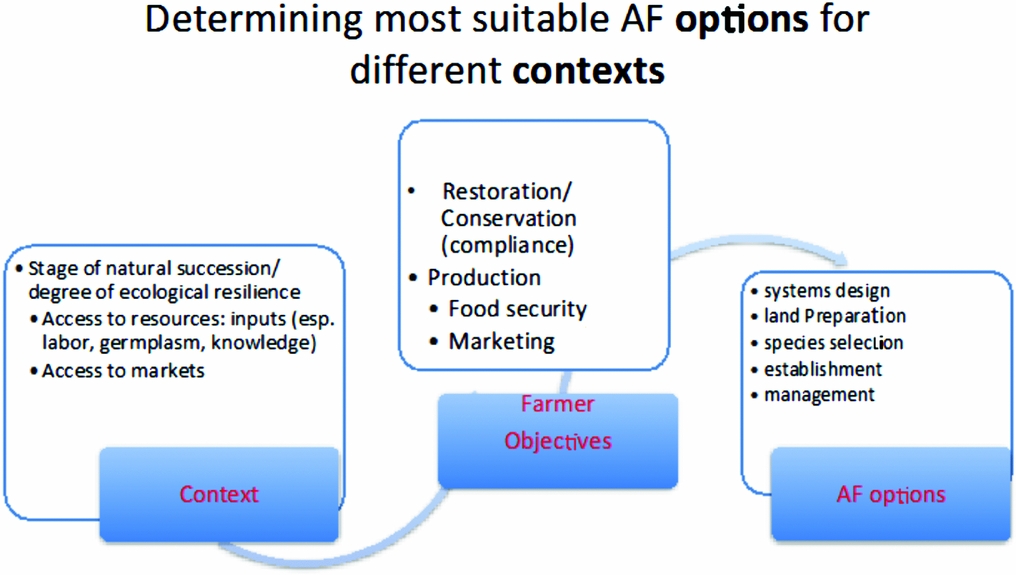
Options × context analytical framework
Given the general lack of scientific literature on putting into practice approaches to upscale agroforestry strategies that can be adapted to a range of different contexts (Coe et al., Reference Coe, Sinclair and Barrios2014), we propose an analytical framework including three main steps to facilitate implementation of an options × contexts approach.
For the sake of simplification, we first broke both the options and contexts down into three manageable components: (1) characterizing the context based on assessment of constraints or factors limiting the development of win–win agroforestry systems (from a socio-environmental standpoint); (2) understanding main farmer objectives given these constraints, from restoration to production, both or somewhere in between; (3) developing systems design elements, management strategies and species selection criteria (Figure 1). It is worth underscoring that, in order to be successful, these three stages in the process need to be performed through participatory approaches whereby the knowledge on constraints and solutions is built jointly with farmers, as suggested in the principles in Box 2.
We first developed a typology of contexts with commonly occurring characteristics vis-à-vis biophysical, social and governance constraints and opportunities. In light of different farmer objectives for each context, we propose options that are not meant to be prescriptive, but rather to provide guidance so they can be adapted and improved depending on the peculiarities of each situation. The basic premises underlying these options are based on the principles and criteria above, on the farmer experiences surveyed in the field, and on guidance from experts and practitioners, as follows:
1. Contexts in which farmers have market access, which are also often associated with greater access to external inputs and knowledge, call for planting more marketable products that can also be more perishable, such as fresh fruits and vegetables. When distance to markets is a huge constraint, farmers are better off focusing on less perishable products that can be stored for long periods of times, such as baru (Dipteryx alata), cashew (Anacardium occidentale) nuts and honey, for instance, or processed with relative ease, such as bananas that can be dried or other fruits that can be processed into jams and jellies. When the necessary labour or infrastructure is not in place for such processing, however, then farmers can focus on crops for their own consumption;
2. Contexts characterized by highly degraded soils, which in the Cerrado are often associated with low ecological resilience and low organic matter contents, require planting species that are highly efficient at biomass production, tolerant to acidity and known to mobilize nutrients deficient in those soils. In such contexts, management practices should be based on systematic concentration of organic matter, be it in rows of more useful species or in ‘islands’ or clusters;
3. Both in the drylands of the Caatinga and Cerrado biomes, where water stress can be a crippling factor, choosing key species with xylopodes (roots structures that store water during the dry season) is essential to ensuring the overall success and resilience of these systems in times of severe water deficits. Evergreen species can also play a key role in reducing the impact of protracted droughts in both biomes;
4. When labour availability is a major constraint, then systems design should focus on low-input systems, low-effort land preparation strategies and management practices, and species that are considered relatively easier to manage. On the other hand, when labour is abundant and soil conditions are favourable, which is often associated with high ecological resilience, then farmers can opt for species more demanding in management but also more lucrative, as well as more high-input and intensely managed systems. While species selection for restoration through agroforestry should be guided by the above principles, first and foremost, it should be based on farmer objectives, aspirations and the socio-cultural importance attached to specific species. This will greatly increase the likelihood that farmers will invest what is often their most precious resource, labour, to manage these systems more actively.
5. While the use of alien, or exotic, species is allowed (provided they only occupy 50% of the area of PPAs for family farmers and 50% of LRs for large landholdings, who are not allowed to use exotic species in PPAs), such species are still frowned upon and generally discouraged by technicians assisting farmers or enforcing environmental regulations. However, as our field studies have shown, many of these species are highly appreciated by farmers due to their multiple functions (prized fruits, N fixation, biomass production, high re-sprouting capacity after radical pruning, fodder production, medicinal properties, among others). In both the Cerrado and Caatinga, these so-called ‘engineer species’, also known as fertilizer species, are capable of modifying properties of degraded ecosystems, affecting their capacity to support native and exotic species that would otherwise not be able to develop in their absence (Badano and Cavieres, 2006). Some examples of such species that can play a key role in soil recovery and restoration of degraded lands are: Mexican sunflower (Tithonia diversifolia), elephant grass (Pennisetum purpureum) and mulberry (Morus nigra) in the Cerrado and palma [pear cactus] (Opuntia ficus-indica), algarroba (Prosopis juliflora) and Agave sp. in the Caatinga, as well as Leucaena sp. and Gliricidia sp., which can be important in both biomes and transition zones. These species have in common a capacity to produce more biomass faster than would otherwise be possible with native species and re-sprout quickly, even after successive pruning. So, planting such species in high densities and frequent pruning adds large amounts of organic matter, thus increasing soil fertility, cation exchange capacity, and water retention. Given these properties, if properly managed, such species can increase yields and enable the establishment of trees requiring more water and nutrients to develop well.
The critical caveat, however, is that some of these species such as Tithonia and Prosopis, for instance, are considered highly invasive and, depending on the context and if not properly managed, can have deleterious effects on the regeneration and restoration of the native vegetation or on the development of cultivated agroforestry species. Thus, such species should be recommended for restoration in contexts characterized by low ecological resilience or degraded soils and/or where there is sufficient labour and knowledge to manage them appropriately and allow native and agroforestry species to also flourish in their presence. Furthermore, it is clear that more knowledge is required on the different contexts in which such species are invasive as opposed to contexts in which they can have positive transformative effects as described above. More attention should also be given to identifying native species with similar potentials.
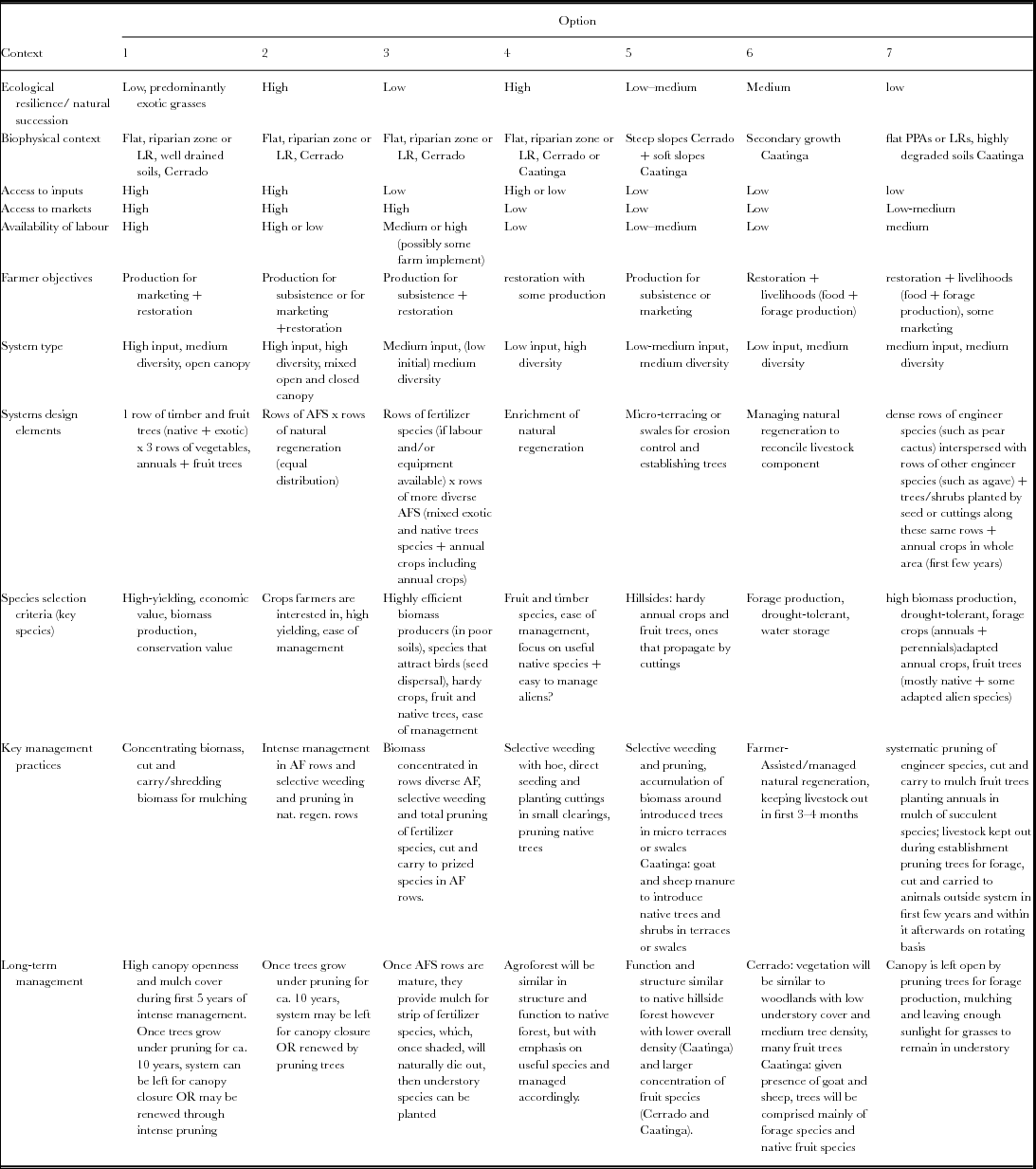
The innovative work on successional agroforestry systems and practices developed by Ernst Götsch was particularly important in inspiring many of the farmers surveyed in this study, be it directly by Götsch himself or indirectly through his pupils. Thus, the practical guidance and lessons learned from these experiences were paramount to the options summarized below (see also Table 1). Among these seven options, five (Options 1, 3, 5, 6 and 7) were derived directly from successful experiences adopted by farmer experiences analysed during the National Workshop and in field visits, and are thus considered highly promising for application on a broader scale. The other two options (2 and 4) are comprised of successful elements of different experiences (such as key species, spatial arrangements and management practices) combined into a single system, and therefore need to be field tested.
Synthesis of options × contexts.
OPTION 1: High-input successional agroforestry systems for the Cerrado: planting in beds with annual crops and vegetables with rows of fertilizer trees and agroforestry species
If there is plenty of available labour, regardless of ecological resilience and stage of natural succession (i.e. even in degraded soils), as well as market access, and the main objective is production for marketing, then conditions are ripe for complex and high-input systems such as this one. The main idea is to employ highly intensive systems that produce mainly vegetables and grains in the first few years to quickly pay for the cost of establishing trees, intercropped with rows of trees for nutrient cycling and mulching and fruit production in following years. One such experience developed by Ernst Götsch and implemented by Juã Pereira in the Federal District has reaped excellent results by intercopping native multipurpose trees (Hymenaea courbaril, Copaifera langsdorffi) and bananas in the same rows every 5 or 6 m with fast-growing exotic species (Eucalyptus sp., Melia azedarach, Mangifera indica), for biomass production through slash-and-mulch. On each row, beds are planted with short-cycle vegetables and annual crops and, after two or three years, a mixed variety of fruit trees (with the same species grouped together in groves), including coffee, papaya and citrus are planted.
OPTION 2: Planting alternate strips of agroforestry and native species
In highly resilient areas, i.e. with a large number of regenerates present, agricultural crops can be planted with fruit-bearing species, including bananas and palm trees, in alternate rows, leaving rows of natural regeneration. The crop selection should focus on those the farmers are already used to planting, such as sweet potatoes, cassava, taro, maize, beans, along with bananas, papaya and other species that can be harvested after these crops finish their cycle. It is also strategic to introduce fertilizer trees to maintain fertility in the agroforestry rows. The width of the agroforestry rows should vary according to the availability of labour to manage them, however, in this context, they should not surpass 50% of the overall area. In the rows of managed natural regeneration, selective weeding and pruning should be carried out and the organic matter should be concentrated around what are considered by farmers the most precious individuals of native trees, or alternatively cut and carried to the agroforestry rows. This sort of management will also ensure that the grasses and shrubs that belong to early successional stages will be managed so as to reduce the amount of fuel for forest fires.
OPTION 3: Planting ‘fertilizer’ and ‘engineer’ species in rows or ‘islands’ (clusters) throughout the area
Given the low level of regenerates and low soil fertility, agroforestry-based restoration in this case can focus on planting rows of high-biomass producing species such as Mexican sunflower (Tithonia diversifolia), and elephant grass (Pennisetum purpureum) that grow well in nutrient-deficient Cerrado soils, interspersed with alternate rows of short-cycle agricultural crops also adapted to such soils, fruit trees and native trees. Once established, the biomass producers must be systematically pruned (generally three times per year suffices) and the organic matter accumulated in the rows of agricultural crops and trees. This same rationale can be used for planting in islands instead of rows, in which case the biomass of the pruned species is used to mulch the islands of trees with agricultural crops. The trees can be planted by seedling and seed in high densities along with some annual crops and fruits such as bananas. Planting in islands or clusters can be done by planting a banana clump in the middle surrounded by annual crops, cassava and a mixture of tree seeds. The accumulation of biomass around islands or clusters improves soil fertility and inhibits weed growth, thus favouring development of the cultivated plants.
OPTION 4: Planting seeds and seedlings for enrichment and managing natural regeneration
In this context, natural regeneration can be managed through selective weeding and pruning and enrichment (increasing plant diversity, introducing more useful/multifunctional species), especially by introducing seeds and cuttings, but also seedlings when labour constraints allow for it. While the main goal is restoration, some food production (with economic potential) is possible through key species such as bananas and fruit-bearing trees and shrubs that will be appreciated by both fauna and humans. Beekeeping might also be an attractive alternative in this context. Management is comprised of selective weeding and pruning of the natural regeneration. If manure is not available on the property or nearby, then food crops need to be hardy varieties adapted to the low soil fertility, such as cowpeas (Vigna unguiculata), bur cucumber (Cucumis anguria), sorghum (Sorghum spp.) and cassava (Manihot esculenta).
OPTION 5: Agroforestry for restoring steep hillsides in terraces or swales in the Cerrado or soft slopes in the Caatinga
In the context of steep slopes or hillsides, the use of swales or micro-terraces can be instrumental in controlling erosion, accumulating nutrients and increasing groundwater recharge. Fast-growing trees, shrubs and grasses can be planted by seed, seedlings or cuttings on the downhill mounds of the swales. The uphill (dug out) portion of these structures must also be covered with organic matter to increase infiltration. Micro-terraces are a much less labour-intensive option for restoring hillsides that are also effective at concentrating water and nutrients and reducing erosion. Legumes and cover crops can be planted on the downhill mounds left after digging planting pits for more valued, water-loving plants and organic matter from pruned native trees can be concentrated in these micro-terraces after planting of tree seeds and sprinkling animal manure or compost. When available, ground rock or lime can also be very useful to reduce acidity in the Cerrado soils. The main difference of this option for the Caatinga is the animal component, including the use of goat and/or sheep manure for seeding native forage trees and shrubs (see Option 7), and the selection of species more adapted to much drier Caatinga conditions, as well as the size of swales or mini-terraces, which can be much smaller since slopes tend to be much less steep.
OPTION 6: Forage agroforestry systems in the Caatinga
Considering the essential role that goat and sheep play for smallholder livelihoods in the Caatinga, forage-producing agroforestry systems are instrumental for maintaining animal health during the middle and end of the dry season and the beginning of the rainy season. During these three to four months, livestock are kept out of the native Caatinga areas set aside for restoration, enabling regeneration from seeds and re-sprouting, which prevents the strong degradation caused by the voracity of the animals on roots, stems and vegetative buds. Agroforestry systems are then planted with lines of pear cactus (Opuntia ficus-indica) every 1–3 m and direct sowing of forage species seeds. Roughly, a dozen native forage trees are planted along with the exotic Gliricidia and Leucaena. The trees are maintained with regular clipping to harvest leaves and small branches to feed the goat and sheep. In order to prioritize biodiversity, more species with a wider variety of functions may be added to the system, including timber and fruit trees. Pear cactus protects and maintains soil humidity for the tree seedlings. Goat and sheep manure is also carried and used as fertilizer in these systems, which increases the amount of seeds from herbs and trees that cover the soil and adds species and functional diversity. This agrosilvopastoral system increasingly adopted in the Caatinga enables growing other crops and pruning of dryland forests for forage (Almeida et al., Reference Almeida, Andrade, Paciullo, Fernandes, Cavalcante, Barbosa and Valle2013).
OPTION 7: Restoring degraded lands in the Caatinga
These systems are aimed at restoring highly degraded lands, including those undergoing desertification. They are comprised primarily of hardy, drought-tolerant engineer species with a high water storage capacity that can also be used for forage, including: pear cactus (Opuntia fícus-indica), Agave spp., combined with legumes such as pigeon peas (Cajanus cajan), cowpeas (Vigna unguiculata) and multipurpose native species such as sabiá (Mimosa caesalpiniifolia), along with other extremely well-adapted native fruits such as umbu (Spondias tuberosa) and cashews (Anacardium occidentale). As in Option 6, the engineer species are planted very densely in rows and pruned systematically or used as forage depending on the farmer objectives (livestock, annual crops or fruit production)
CONCLUSIONS
The combination of inputs gathered during this study confirms that agroforestry systems can indeed provide practical solutions for turning the onus of restoration into a bonus for farmers. Among the myriad of agroforests adopted by farmers in Brazil, medium to high diversity AFS are most suited to the goals of restoring protected areas, however, maintaining livelihoods through such systems entails the adoption of management practices and selection of species that effectively include those who have the highest stake in restoring landscapes. Understanding the extent to which farmers have access to labour, inputs and markets, as well as the challenges and opportunities posed by the biophysical reality of their lands, is crucial to designing systems they will adopt and maintain over time. In practice, this can only be achieved by building this knowledge together with farmers. This study suggests a framework to try to make sense of the myriad of factors and complexities at play in each local context as well as options rooted in innovative farmer-led approaches to restoration. These options are not meant as fixed models to be copied, but rather as guidance for those seeking to build solutions that can be adapted to specific situations yet are flexible enough to be applied across wider scales.
Acknowledgements
This study is part of a partnership between the IUCN (International Union for the Conservation of Nature) and ICRAF (World Agroforestry Centre) funded by ‘Improving the way knowledge on forests is understood and used internationally (KNOWFOR)’ under a grant awarded to IUCN by UK Aid from the UK government. In Brazil, this project is coordinated by ICRAF in partnership with Embrapa (Brazilian Agricultural Research Corporation), ISPN (Institute for Society Population and Nature), IUCN, SFB (Brazilian Forest Service), ISSA (Instituto Salvia) and Mutirão Agroflorestal. It also receives support from the donors to the CGIAR's FTA (Forest Trees and Agroforestry Program).


 Open access

