


Declining health and economic constraints can place the elderly at increased risk of injury, death, and physical and psychological loss during disasters.Reference Ngo 1 , Reference Fernandez, Byard and Lin 2 But aspects of the social environment, including elderly persons’ social capital from informal network ties, can counteract or compound these physiological vulnerabilities. Unfortunately, less is known about the effects of social capital on disaster risk and recovery for this population. Drawing on survey and interview data with residents of Florida, I expand on social capital’s effect on age-related vulnerability to disaster. My analyses highlight differences in disaster-specific social capital available for elderly and nonelderly persons.
Elderly Vulnerability to Disaster
Social vulnerability to disaster is described as “the characteristics of a person or group and their situation that influence their capacity to anticipate, cope with, resist and recover from the impact of a natural hazard.”Reference Wisner, Blaikie and Cannon 3 (p11) When disaster strikes, older individuals are among the most vulnerable and are more likely to be injured and to perish.Reference Peek 4 , Reference Bolin and Klenow 5 This difference is less a function of age but more related to changes associated with aging, including declining economic resources and physical and mental health functioning, and, potentially, less social network support.Reference Perry and Lindell 6
Economic resources are necessary to prepare for and respond to a disaster (for review, see Fotherfill and PeekReference Fothergill and Peek 7 ). Elderly persons with higher socioeconomic status are more likely to report adequate insurance coverage and greater access to federal aid in a disaster.Reference Ngo 1 Overall, elderly poverty rates have declined and are currently below the poverty rates for nonelderly persons. 8
While poverty rates are lower for the elderly than for other age groups, the elderly are more likely to live on fixed incomes, which affects their ability to gather and access resources in an emergency.Reference Durant 9 For example, Bolin and Klenow found that the elderly had more difficulty getting post-disaster loans and more difficulty making up a discrepancy between financial losses and what was covered by insurance than did their younger counterparts.Reference Bolin and Klenow 5 Thus, nearly twice as many elderly respondents as nonelderly respondents reported a drop in their standard of living after a disaster.
Declining health is the most common explanation of elderly disaster vulnerability. Because advancing age is correlated with the likelihood of having chronic health conditions or special needs, elderly individuals may have limited ability to respond to disaster warnings and take protective action (eg, tucking under tables during an earthquake).Reference Peek 4 , Reference Durant 9 Individuals with a physical disability or health condition may have greater difficulty preparing supplies for evacuation, evacuating without assistance, or completing cleanup following an event.Reference Clive, Davis and Hansen 10 These economic and health vulnerabilities may be counteracted by the elderly’s social capital.Reference Wolf, Adger and Lorenzoni 11
Elderly and Disaster-Specific Social Capital
Social capital describes the resources available through social networks.Reference Bourdieu 12 Social capital is important during all phases of disaster. For example, warnings and information flow through social networks, and friends and family assist with preparedness activities.Reference Adger, Hughes and Folke 13 During the immediate response period, friends, family, and neighbors check on the well-being of others, provide life-saving assistance,Reference Quarantelli 14 (p357) , Reference Aguirre, Wenger and Glass 15 and those outside the affected area provide temporary shelter.Reference Elliott, Haney and Sams-Abiodun 16 During recovery, social networks are conduits for resources including childcare,Reference Tobin-Gurley, Peek and Loomis 17 emotional support,Reference Kaniasty and Norris 18 and rebuilding and repair assistance, among many others.Reference Bolin and Klenow 5 , Reference Elliott, Haney and Sams-Abiodun 16 , Reference Hurlbert, Haines and Beggs 19 , Reference Hawkins and Maurer 20
Disaster research shows how network size affects the outcomes for disaster victims. Network size describes the number of persons with whom an individual has a specific type of relationship.Reference Wrzus, Hänel and Wagner 21 , Reference McPherson, Smith-Lovin and Brashears 22 Individuals with small networks have higher rates of psychological and physical trauma, have longer recovery rates, and are more likely to perish in a disaster than those with larger networks.Reference Zhao 23 Individuals with larger social networks generally receive more tangible (eg, debris removal), informational (eg, directions to formal aid resources), and emotional (eg, encouragement) assistance in disasters.Reference Kaniasty and Norris 18 On average in the United States, individuals report that about 3 to 5 persons assisted them before, during, or following a disaster.Reference Peacock, Morrow and Gladwin 24
Yet, social network sizes, in general, decline with age in the United States, even as reduced physical and cognitive abilities leave elderly populations more dependent on others for assistance.Reference Geller 25 The term pattern of neglect has been used to describe findings that indicate elderly individuals were less likely to draw upon family, neighbors, or friends for aid during or after a disaster and were less likely to receive formal assistance from government and community organizations whether that assistance be tangible or emotional.Reference Bolin and Klenow 5 , Reference Kilijanek and Drabek 26 Klinenberg identified the importance of social ties to surviving the Chicago heat wave of 1995, wherein deaths in the disaster were concentrated among isolated, elderly populations.Reference Klinenberg 27
METHODS
In this article, I connected elderly vulnerability and social capital to focus on pre-event perceptions of disaster-specific social capital. Perceived support has been shown to affect individuals’ capacity to cope with traumatic situations even beyond the actual support received from their network.Reference Procidano and Heller 28 , Reference Lowe, Chan and Rhodes 29 Thus, individual perceptions of networks are important, although limited in that it is unknown whether these perceptions become actualized in a disaster. Using quantitative and qualitative measures, I described how perceptions of social capital availability for disaster resources differ between elderly and nonelderly persons.
I followed the tradition of BourdieuReference Bourdieu 12 and LinReference Lin 30 and defined social capital as a social network–based asset, specifically, as the resources available through a social network that can be activated to meet one’s needs. In this case, the needs are related to disaster. This conceptualization focuses on social capital for individual resilience rather than community resilience, and, as argued in the social capital literature,Reference Portes 31 is conceptually distinct from that of social capital based on community groups or civic participation.Reference Chamlee-Wright and Storr 32 - Reference Aldrich and Meyer 34 Based on the literature, I hypothesized that elderly persons would report less social capital than nonelderly persons.
Data were from mailed surveys and in-person interviews conducted in 2012 in 2 Florida counties: Leon and Dixie. Leon and Dixie counties have less migration than other areas of Florida, resulting in more people who have lived many years with coastal hazards. As noted in Table 1, the median number of years living along the coast for respondents was nearly 30 and the median number of coastal storms experienced was 3. Thus, while these individuals provided pre-event perceptions, most were disaster-experienced.
Survey and Interview Participant Demographics

a American Community Survey 2010, percentage of persons 16 years and older in the labor force.
b American Community Survey 2010, percentage of persons 16 years and older unemployed.
Because the 2 counties differed in population density, I used different random sampling strategies for the mailed survey. In Dixie County, the low population density allowed for a random sample of 300 addresses from the county. In Leon County, which had a higher population density, I performed stratified cluster sampling to increase participation of vulnerable populations and gather a more representative sample. I selected 6 Census tracts and then 50 households within each tract based on demographic factors related to social vulnerability.Footnote a Survey Sampling International drew the samples.
I used 4 mailings: a prenotification postcard, the survey, a reminder postcard, and a second survey with a $1 incentive.Reference Dillman 35 After removing undeliverable addresses, 529 addresses remained (275 from Dixie County and 254 from Leon County). Twenty-two households declined to participate. The response rate was 27% with 138 responses. The response rate was low, but comparable to mail survey research.Reference Tourangeau 36 , Reference Kaplowitz, Hadlock and Levine 37 Respondents were representative of the population of each county, except that respondents were older and more likely to have a disability (Table 1). The elderly respondents were 45% women and ranged in age from 65 to 93 years with about 55% of elderly respondents between 65 and 74 years of age. The elderly respondents’ income and employment status were similar to the US elderly population. Eight percent of elderly respondents were below the poverty line, and median household income fell between $30,000 and $45,000, compared to national median elderly family incomes of $48,000 and 9% elderly poverty in 2011. Also, about 15% of the elderly respondents were in the labor force compared to 18% of the US elderly population. The elderly respondents in this study were more highly educated on average than other elderly with 95% having at least a high school diploma compared to 81% nationally.
I measured social capital by using a social network name generator.Reference Knoke and Yang 38 (p21) Respondents listed up to 8 people who they “would turn to for assistance after a hurricane.” Respondents provided the following for each person: relationship, age, and type of disaster assistance that this person could provide (financial or nonfinancial). Financial assistance was defined as monetary assistance, such as helping with evacuation or rebuilding costs, whereas nonfinancial assistance was described as other forms of assistance such as offering labor, childcare, or emotional support. Network size was the total number of social ties each respondent listed in the name generator, which was then specified by resource type (financial or nonfinancial).
The final question on the survey asked for an in-person interview and offered a $10 incentive. I conducted semi-structured interviews with 25 individuals, 9 from Dixie County and 16 from Leon County. Gathering social network data through these open-ended questions allowed me to understand how individuals described certain relationships as important in disaster contexts and what particular traits interviewees used to determine selection for these networks.Reference Hurlbert, Haines and Beggs 19 , Reference Schensul, LeCompte and Cromley 39 The interviews ranged in length from 20 minutes to 2 hours, were digitally recorded, and were transcribed verbatim. I coded and recoded the interview data in 3 stages.Reference Saldaña 40 I performed open coding of basic themes in the data, then examined relationships between these themes and finally identified core concepts and performed selective coding based on these concepts.Reference Charmaz 41 , Reference Strauss and Corbin 42 All names were changed to protect confidentiality.
RESULTS
The findings depicted individuals’ perceptions of their social capital available in disasters. The respondents’ disaster-related social networks ranged in size from 0 to 8 (the maximum range of the name generator), with an average of 3 to 4 persons (Table 2). This finding corresponded with previous research on the size of support networks following a disaster.Reference Peacock, Morrow and Gladwin 24 Elderly and nonelderly survey respondents differed significantly in the overall number of persons listed, with elderly respondents identifying 3.0 persons compared to 4.1 persons listed by nonelderly respondents. This result supported the hypothesis that the elderly would report less social capital.
Perceived Social Capital Resources Available in a DisasterFootnote a
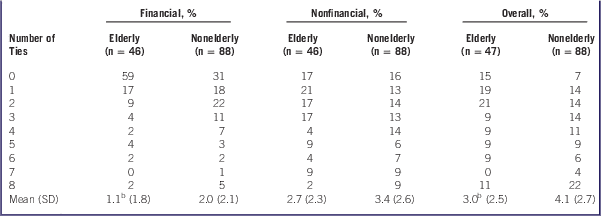
a Note: Of the 138 total responses, only 135 completed the social network name generator.
b P<0.05, t-test for difference of means between elderly and nonelderly.
The interviews provided examples of elderly persons with various network sizes. Rick, a married, elderly man who had custody of his 3-year-old grandson, had an average-sized network for his age group. His network included 2 other elderly persons (his mother and a neighbor) and a neighbor’s nephew:
Maybe my mother. She’s about the only one [I would turn to for disaster assistance]….Well, probably the neighbor [too]. We had a power outage last week, and I know the one lady next door, the generator never kicked on. I had to have her nephew teach me how to run that thing so I could take care of it. That’s about the only people I could think of.
Adelle, a 90-year-old resident of Dixie County who lived alone, was an example of a person with a large social network. Adelle listed 8 people on the survey and in the interview included her 4 children and their spouses, a weekly housekeeper, 2 neighbors, and several fellow church members. But Adelle also recounted a story of a recent accident in her home when she fell from bed and was too injured to reach the phone. She described lying on the floor for several hours before the housekeeper arrived and called 911. She expressed her luckiness that it had been housecleaning day; otherwise, she would have had to wait until one of her sons came to visit. Although Adelle had a large network, her discussion demonstrates the importance of social capital to counteract the physical vulnerability related to aging.
As noted in the above examples, family was central to disaster-related support. But the availability of family may vary by age. For example, Nina, an elderly woman from Dixie County who lived with her special needs adult daughter, explained that since her parents were deceased, she had to evacuate to her brother’s house during a recent storm, “My mother and father had passed away. It’s just my daughter and I, and my brother lived down the street.” This brother passed away after that storm and no other family lived in the area to assist her and her daughter. In contrast, Mitchell, a 30-year-old married father of 2 in Dixie County, had several family members who could assist him, including his mother, mother-in-law, father, and brother, “I’ve also got a brother than lives down in Leesburg. If worse comes to worse and something really bad happens and my dad can’t help me, I’ll call him up.”
These quotes described nonfinancial assistance, such as help starting a generator or assistance getting medical care. Often research on social capital and disaster focuses solely on this type of assistance. My results showed a dramatic difference between network size when resource type was included. Returning to Table 2, financial disaster networks, or the number of individuals able to provide monetary support in a disaster, were much smaller than nonfinancial networks. Specifically, financial networks included, on average, half the number of persons as nonfinancial networks.
The difference between elderly and nonelderly respondents was most pronounced in financial network size. Over half of elderly respondents (59%) reported zero social ties for financial assistance in a disaster compared to less than one-third of nonelderly persons reporting the same. On average, elderly respondents reported 1.1 persons for financial assistance whereas nonelderly respondents reported 2 persons. This result indicates that many elderly persons assume they will rely on savings or insurance, if they have it, governmental disaster aid, aid from other organizations, or go without financial assistance after a disaster.
Some elderly interviewees had the financial means to care for themselves and their children, whereas others were poor and relied on government assistance. Rick and Nelson were contrasting cases of financial needs. Rick, a 68-year-old retired city worker, owned a new motorhome and a 3-bedroom brick home in Leon County. He and his wife, daughter, and son-in-law could live in his motorhome following a disaster as he described in his interview:
Fortunately, now if a hurricane were to come I’d probably plywood up the house windows and we’d get in this motorhome and go north….My daughter and son-in-law live in town. They’d probably follow in their car. There’s plenty of room in the motorhome [for everyone].
After he described all the features of the motorhome that would allow them to survive for several weeks or months, he explained how he would cover fuel and water costs with savings or his credit card. In contrast, Nelson, an elderly resident of Dixie County, indicated he had no one to rely on for financial assistance if a disaster were to strike. He then described an insurance conundrum that left him financially vulnerable and how he expected to receive government support.
Now I’m living in a trailer that if the wind hit me, the trailer would be probably close to demolished. I can’t buy insurance for it. They wanted $1,800 a year on a trailer that I bought for $900. OK? So I have no insurance. I own the trailer, so I can’t buy renters’ insurance. I don’t know where that leaves me. So I’d just be wiped out. I’d go wherever they [emergency officials] tell me to go….
These quotes highlight the diverse experiences of elderly persons in disaster and how a lack of financial networks will have various consequences depending on individual resources.
To quantify how age affected perceptions of disaster resources while controlling for other factors, I used ordinary least squares regression for overall network size (Table 3, models 1 and 2) and logistic regression for financial social capital (Table 3, models 3 and 4). Beginning with model 1, without controlling for other variables, being elderly resulted in an 1.06 reduction in the overall number of ties (P=0.047). Age alone explained 3.4% of the variance in overall disaster network size. With controls for county, poverty, disability, gender, and being a member of a community organization (such as a church or nonprofit), the effect of age grew slightly stronger (−1.13) and remained statistically significant (P=0.036). Of the variables in model 2, being elderly had the largest effect on overall network size, followed by living at or below 150% of the poverty line (−0.99) and being a member of a community organization (0.96). Model 2 predicted 16% of the variation in overall network size.
OLS Regression of Overall Network Size and Logistic Regression of Financial Tie Availability by Age GroupFootnote a
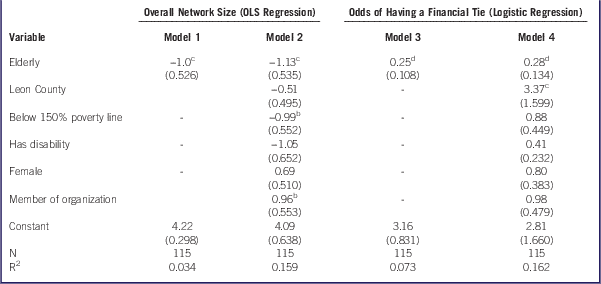
a Note: Odds ratios and pseudo R2 displayed in Models 3 and 4. Due to missing data for income, sample size for these models is reduced to 115.
b P<0.10, c P<0.05, d P<0.01.
Moving to financial disaster networks, because many respondents listed zero individuals who could provide financial assistance, I transformed financial network size into a binary variable and used logistic regression to report the odds ratios of having at least one financial social capital tie. Beginning again with the effect of age alone, elderly individuals were 0.25 times as likely to report having at least one social tie that could provide financial assistance in a disaster. This result was statistically significant (P=0.001). In other words, persons under 65 were 4 times as likely than persons over 65 to report a social tie that could provide financial assistance in a disaster.
Controlling for other variables did not change the effect of age. In model 4, elderly were 0.28 times as likely as nonelderly to report a financial tie when controlling for other potential explanatory variables. Age was again the strongest explanatory variable, followed by county, with individuals living in Leon County over 3 times as likely to report a financial tie than individuals in Dixie County. Being female, poor, and disabled all reduced the likelihood of reporting at least one financial tie, although none of these variables reached statistical significance. Age alone, in model 3, explained about 7% of the variance, whereas model 4 had an R2 of 0.16. These results again supported the hypothesis that the elderly perceive smaller social capital networks for disaster assistance, and this result was most pronounced when considering financial assistance.
DISCUSSION
This research aimed to address a gap in the literature by comparing social capital resources available in a disaster for elderly and nonelderly persons. My results supported the hypothesis that elderly persons perceived fewer social ties that they could rely on in extreme situations, especially for monetary needs. This finding highlights a compounded vulnerability for elderly persons, which is of most concern for low-income elderly persons or those with health conditions.
This research, like all research, had limitations. This sample was from 2 counties, and as such more research is needed to determine how these results compare to other areas of the United States. Further, the small number of minority respondents precluded me from including this variable in the statistical models. The literature shows that the elderly experience and social capital differ based on race, and future research should assess this variation.Reference Elliott, Haney and Sams-Abiodun 16 Finally, this research was based on perceptions of social capital. Research following a disaster is needed to determine if these perceptions are accurate. In support of these findings, these respondents are likely drawing from previous experiences to create their expectations (see Table 1), and the average size of support networks found here is consistent with other scholars’ post-disaster findings.
With these limitations in mind, what explains the age variation in disaster-specific social capital? This finding is possibly due to shrinking of social networks as people age. Elderly persons are less involved with institutions that support social networking, such as workplaces and schools,Reference Gray 43 , Reference Cornwell, Laumann and Schumm 44 which could limit their social resources available in emergencies. My results showed that membership in at least one organization increased the number of ties reported for all persons. Thus, one way to increase disaster-related social capital is to ensure that formal organizations that connect to elderly populations offer disaster information and support and that the leaders of these organizations are aware of the elderly’s specific vulnerability. Organizations such as Meals on Wheels or disability support services that reach homebound and low-income elderly provide an opportunity for building social capital.Reference Fernandez, Byard and Lin 2 Mechanisms that help these organizations undertake disaster planning with their clients should be supported.
Another explanation for these results involves the phenomenon of homophily in social networks and perceptions of elderly fragility. In general, people associate with others who are similar to themselves in demographics, such as race, income, and age.Reference McPherson, Smith-Lovin and Cook 45 This means we would expect that elderly persons’ friends and some family members are also elderly. Being elderly may preclude others from perceiving them as a resource in disaster, particularly nonfinancial resource, due to the physical requirements of placing storm shutters or removing debris, for example. Some interviewees described physical ability as a reason to ask younger and stronger persons for disaster assistance. For example, Henry and Lily, both over 80 years old and living in their own home, recalled a recent routine emergency in which they needed help. Notice how Lily commented on the age of each person as a reason for identifying them as sources of assistance.
When our water pipes froze, people from the church came to see what they could do to help, and we have a friend that lives in the next town. And of course they’re all younger than what we are. At the time our son was not up here, so they came and did what they could to help us….I think our son would probably be the first person I’d call [now]. If I thought that our damage maybe was worse than [near the church], I might call my pastor. He’s a young man too…[while] most of our church is elderly like us.
But physical ability should not affect perceptions about financial assistance. Thus, this reason does not explain why being elderly had such a large effect on financial assistance. Further research is needed to determine why the elderly are much less likely to view social ties as potential sources of financial assistance in a disaster. With increasing numbers of Americans reaching 65 each day, these results point to the importance of understanding the relationship of age and social capital to disaster vulnerability and resilience.
Acknowledgments
Funding for the research was provided through a National Periship Dissertation Fellowship sponsored by the Public Entity Risk Institute, the National Science Foundation, the Natural Hazards Research and Applications Information Center, and Swiss Re. Special thanks to Lori Peek and Ann-Margaret Esnard for comments on drafts of this work and two anonymous reviewers for their feedback.



