


Introduction
Reference Stuart and BullStuart and Bull (1963) reported liquid brine in several holes drilled into an area of thin ice shelf (<50 m thick) near Ross Island. They concluded that the brine had entered the ice shelf by vertical infiltration through the low-density bottom firn. However, Reference Hochstein and RiskHochstein and Risk (1967, p. 42) working in the same area found brine that was underlain by impermeable ice and showed that the observed brine levels were consistently lower than those calculated assuming the brine to be in hydrostatic equilibrium with the sea-water. This led to the conclusion that brine entered the ice shelf by lateral percolation, with vertical infiltration confined to a narrow zone within half a kilometre of the ice front, where bottom melting had exposed permeable firn.
Brine was also reported in the Lazarev ice shelf (Reference DubrovinDubrovin, 1962) at a distance of 1.3km from the ice front and at a depth of 41.5 m, which was 16.5 m below sea-level. Reference Swithinbank and M.Swithinbank (1968, p. 412), Reference SmithSmith (unpublished, p. 67), and Reference CloughClough (1973), describing the results from radio-echo sounding of ice shelves, interpreted echoes from near sea-level as brine layers in ice up to 200 m thick. The layers in the Larsen Ice Shelf described by Smith were apparently continuous over several tens of kilometres and presumably the brine was able to enter the permeable firn by way of the many rifts which locally penetrate the ice shelf. It is difficult to explain brine layers in areas of such thick ice shelf without invoking a lateral percolation mechanism.
Further support for such a mechanism is supplied by liquid brine found in areas of thin ice of the Brunt Ice Shelf, one of the small fringing ice shelves on the east coast of the Weddell Sea (Reference ThomasThomas, 1973). In March 1967 samples from a 10 m drill hole near R7 (Fig. 1) indicated the existence of a 0.2 m thick layer of brine-soaked firn overlaying impermeable ice at a depth of 9 m, or 1.8 m below sea-level. The densities and temperatures measured in the drill hole are shown in Figure 2. Presumably the brine entered the ice shelf from the open water in crack B (Figs. 1 and 3) and then percolated horizontally along the interface between impermeable ice and firn. In the next section we shall examine the effects of an actively flowing, near horizontal layer of brine on heat transport within the ice. Comparison of predicted brine temperatures with those observed gives estimates of the rate of brine flow and the rate of ice accretion beneath the brine layer at any point. In section 3 we shall calculate an independent estimate of flow rate by considering the brine layer as a liquid flowing through a granular bed. Finally, in section 4 we shall use the results from the earlier sections to examine conditions necessary for the existence of brine layers.
Map of part of the Brunt Ice Shelf showing the area of thin ice shelf where brine layers were found. The inset shows the positions of Antarctic ice shelves where brine layers have been reported. The points A and A’ mark the ends of the levelling traverse shown in Figure 3.

Temperature and density profiles in the drill hole at R7. The density of the brine layer is expected to be higher because some drainage occurred during core extraction and prior to density measurements.

Surface elevation profiles across the thin ice shelf near R7. The ends of the levelling traverse AA’ are shown in Figure 1.

2.Heat Flow Across a Brine Layer
In order to simplify the heat-flow problem we make the assumption that the temperature gradient between the upper surface of the ice shelf (at temperature θ S) and brine layer (θ) and that between the lower surface (θ b) and brine layer are linear. In the appendix it is shown that this assumption is justified so long as a multiplicative factor (f ≈ 0.88) is included with the temperature gradient above the brine layer.
We take rectangular axes with x curvilinear in the direction of brine movement (Fig. 4), and with z upwards and assumed to be nearly vertical; the origin is the point at which brine enters the ice shelf, which in our case is at crack B (Fig. 3). We adopt the terminology:
C θ specific heat of brine at temperature θ,
C i specific heat of ice ≈ 2.1 × 10³ J kg−1 deg−1,
C w specific heat of water ≈ 4.2 × 10³ J kg−1 deg−1,
K wthermal conductivity of ice ≈ 2.2 J m1 s−1 deg−1,
C i, C w and ĸ i are assumed to be constants.
k s thermal conductivity of snow or firn,
L latent heat of melting for ice ≈ 3.34 × 10⁵ J kg−1,
D depth of brine layer below ice shelf surface,
H thickness of ice shelf.
We assume that θ s and θ b are constant.
First we must express the specific heat of brine C θ in terms of C w, L and θ.
Horizontal percolation of brine into an ice shelf.

2.1. Specific heat of brine
From Reference SchwerdtlegerSchwerdtfeger (1963, p. 792) the specific heat of a brine and ice mixture is

where σ is the salinity of the mixture, s (= αθ) is the fractional salt content of the liquid brine, and α is a constant (≈ –1.8 × 10⁻² deg−1).
Here we are interested in the specific heat of liquid brine that is cooled at temperatures below the freezing point. Thus we consider the case of zero ice content.
Then

where M s and M w, are the masses of salt and water respectively, and

Thus

So we can re-write Equation (1)

2.2. Heat flow
-
i. The rate of heat transport upwards from unit area of the brine layer into the overlying firn is
(4)
and from Reference YenYen (1965)
with ρ as snow density immediately above the brine layer and β ≈ 3.2 × 10⁻⁶J m 5 s−1 deg−1 kg−2.
-
ii. The rate of heat transport into unit area of brine layer from below is
(5) -
iii. The rate at which heat is released by unit area of the moving brine layer is
(6)



where


For steady slate:

Or

Giving

Or

Where

and

Thus θ reaches a minimum value of

At x = 0, where the brine enters the ice shelf, its temperature is that of the sea-water θ b and, from Equation (8) we also have:

if we assume R 1, and R 2 to be constants, implying that the ice shelf is of constant thickness. This condition is approximately true for the ice shelf near R7, but we could incorporate the effects of varying thickness by having H, D and ρ as functions of x.
With the values measured near R7 in March 1967: H ≈ 28 m; D ≈ 8.8 m; ρ ≈ 570 kg m−3; θ S ≈ —19° C; θ b ≈ — 2° C and θ= —9.5° C, at x = 840 m, Equation (10) was evaluated to give

The relationship between x and θ given by Equation (10) is shown by the solid line in Figure 5A.
Plots of various parameters against distance from expansion crack B (shown in Fig. 1).

To obtain the value of


Substitution in Equation (10) of θ = —6°C at x = 840 m gives a minimum value for


The 1970 θ versus x curve obtained from Equation (10) is shown by the dashed line in figure 5A and, within the limits of observing error, it compares well with the measured temperatures.
2.3. Rate of ice deposition by the brine
The flow rate of brine


Using the relationship between θ and x given by Equation (10) we plot values of

The rate of ice deposition per unit area of ice shelf at any point distance x from the ice front is equal to

The effect of ice deposition is to increase the density of the firn from 570 kg m−3 to about 830 kg m−3 at which value the firn is no longer permeable (Reference SchyttSchytt, 1958, p. 147). The presence of trapped brine probably accounts for the higher density observed (870 kg m−3). The significance of this trapped brine is examined in the appendix.
Thus each metre depth of superimposed ice consists of 260 kg m−2 of ice frozen from brine. Using Equations (9) and (11), the rate of ice deposition


Equation (12) together with the known variation of θ with x gives the plot of

Neglecting the effects of ice creep, the rate at which the interface between ice and brine sinks with respect to sea-level (Si) is determined by the rates of surface accumulation, bottom melting, accretion of superimposed ice, and thickening of the brine layer. At the point where brine enters the ice shelf, the rate of interface sinking is equal to the rate of brine layer thickening and this is found to be between —0,3 ma−1 and +o.2 ma−I depending on whether there is bottom freezing of 1 m ice a−1 or bottom melting of 1 m ice a−1. If, as suggested earlier, brine infiltration had by 1967 only recently become active, then the ice shelf was progressively warmed from within by the brine and we expect conditions to have become steadily more favourable for bottom melting, implying that, at the point where it enters the ice shelf, the brine-layer thickness was initially constant and then slowly increased. At the same time snow accumulation on the surface was sufficient to preserve a fairly constant surface elevation, as shown in Figure 3.
Observations near R7 indicate that the ice shelf develops by rapid accumulation of drift snow on top of thick, multi-year sea ice. Substituting for R 1 and R 2 in Equation (12), we see that the value of


Similar calculations for the ice shelf beneath R7 confirm that, for compatibility with the observed variations in surface elevation (Fig. 3), the brine layer must initially have been of constant thickness and then, between December 1968 and March 1970, increased from 0.2 m to about 2 m in thickness.
3.Percolation model
In section 2 we concluded that the brine flow


The flow velocity u of a fluid passing through a porous material is given by Darcy’s law as

where B 0 the specific permeability of the material and η is the dynamic viscosity of the fluid. For a granular bed the Kármán-Koczeny relationship gives

(Reference Clough and RichardsonCoulson and Richardson, 1966, p. 387–400) where e is the voidage, defined as the proportion of the bed occupied by free space, = (i − ρ/ρ i) and immediately above the brine layer ρ = 570 kg m−3, K is Koczeny’s constant ≈ 4.4, η; ≈: 3 × 10⁻³ kg m−1 s−1 for brine at −10°C, S is the surface per unit volume of granular material, and ∂P/∂x is the pressure gradient along the bed. For spherical grains of diameter d or cubic grams of side d, S = 6/d.
The irregular surface of the ice grains tends to increase S, but this trend is to some extent counteracted by the reduction in surface area due to contact between grains, and for ρ ≈ × 570 kg m−3 we might expect S ≈ 6/d. This may appear somewhat arbitrary, but support for this model is provided by the data of Reference ShimizuShimizu (1970, p. 25), who shows that for snow with density within the range 200–500 kg m−3 the specific permeability can be expressed by:

With ρ = 0.57 Mg m−3 Equation (15) gives

and with S = 6/d, Equation (14) also gives

At lower densities identical results are obtained from Equations (14) and (15) if we assume that S increases from (6/d at ρ = 0.57 Mg m−3 to (12/rf) at ρ = 0.2 Mg m−3. This is indeed the trend that we would expect, since with increasing density the snow grains are rounded off as is shown by figure 12 in Reference ShimizuShimizu (1970).
Thus, for the firn through which the brine is flowing we take

At R7, x = 840 m and d ≈ 1.5 mm. In 1967 the top of the 0.2 m thick brine layer was 1.6 m below sea-level giving an average value of ∂P/∂x ≈ 20 N m−3. The brine flow rate beneath R7 is then u ≈ 400 ma−1 and, with brine density of about 1100 kgm−3,

We have here assumed that the firn is completely saturated with brine. Air trapped within the brine layer would tend to reduce the flow rate. Unfortunately measured densities in the brine layer are misleading since some drainage occurred prior to measurement. However, the density of the ice beneath the brine (870kgm−3) implies that about 15% of the air in the firn is trapped, probably as isolated bubbles. Its effect is to decrease e the effective voidage by about 15%, and to reduce


In 1970 the thickness of the brine layer was not measured, but assuming superimposed ice to be formed at the rate depicted in Figure 5c depression of the ice-brine interface implies a brine thickness at R7 of approximately 2 m. To maintain the 1970 flow rate shown by the dashed line in Figure 5B over a layer of this thickness would require negligible brine slope, and the 1970 measurements, plotted in Figure 5D as brine depths below sea-level, confirm that by then there was no detectable brine slope near R7. Near the ice front, the combined effects of a thinner brine layer due to more rapid ice deposition and of the greater flow rates lead to the increased brine slope shown in Figure 5D.
4.Conclusions
By considering the effects of a horizontally moving brine layer on thermal equilibrium within the ice shelf we have been able to estimate the steady-state flow rate of the brine layer. Measurements in 1967 and 1970 show the brine temperature to be increasing with time, implying that a steady state had not been reached when the first measurements were made. This conclusion is consistent with the flow rate deduced from a percolation model that is shown to be compatible with published measurements of snow permeability.
The heat transport model results in an estimate of the thickness of superimposed ice formed beneath the brine. As might be expected this reaches a maximum at the ice front, where the freezing rate is approximately inversely proportional to the thickness of overlying firn. At the same time the thickness of superimposed ice increases rapidly as the firn density approaches the limit of permeability. For a brine layer to penetrate the ice shelf, the rate of accretion of superimposed ice must be less than the rate at which the ice shelf sinks. Thus, brine layers are unlikely to be active in either very thick or very thin ice shelves.
The effect of increasing density on percolation rates can be deduced from Equation (14). Although S decreases, the influence of the decrease in e results in a smaller percolation rate for a given brine slope. Thus, to maintain an active brine layer in an ice shelf of normal thickness (≈ 200 m) we expect an increased brine slope and, for the 180 m thick Lazarev ice shelf, Reference DubrovinDubrovin (1962) reported an average brine slope of 1 : 75. This is an order of magnitude greater than that recorded on the Brunt Ice Shelf.
Acknowledgements
I thank the British Antarctic Survey for sponsoring this work, and members of the Scott Polar Research Institute for helpful discussions. I also thank an anonymous referee for bringing to my notice the work by Reference ShimizuShimizu (1970).
Appendix
(a)Temperature Gradient in the Firn
The differential equation for one-dimensional conduction of heat in firn moving with respect to a fixed coordinate system with velocity V (Reference Carslaw and JaegerCarslaw and Jaeger, 1959, P.13):

We take z positive upwards from the brine layer and we assume:
-
(a) a linear variation of density with z so that
where the subscript 0 refers to z = 0.
-
(b) the ice shelf is in a steady state so that ∂θ/∂t = 0 and the downward velocity of an ice particle at any point above the brine layer is related to the accumulation rate A by the equation
-
(c) the surface temperature θ s is constant and equal to the mean value. Seasonal variations should be self-cancelling.


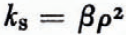
With ks = βρ 2 we can re-write Equation (16):

or

Integration of Equation (17) gives

and

Substituting the values measured at R7:
θs = - 19°C,
ρ = 430 kg m-3,
γ = 16 kg m-4,
A = 1.3 X 10⁻⁵ kg m-2 s-1 (400 kg m-2 a-1),
θo = - 9.5°C,
ρo = 570 kg m-3,
we solve Equation (19) to give ∂θ/∂ρ = −(I/γ) (∂θ/∂z) immediately above the brine layer and thence the θ : z curve shown in Figure 6.
We find

the multiplicative factor being independent of θ s.
In our case

Theoretical temperature/depth profiles above and below the brine layer.

but for |F| < 0.1 we introduce less than 5% error if we write Equation (19) as

Temperature Gradient in Impure Ice
We take z positive upwards from the brine layer. The ice is moving downward with a velocity equal to the rate of ice accretion beneath the brine layer  . Thus ice velocity with respect to the coordinate system is —
 .
.
We assume that:
-
(a) the thermal conductivity of the briny ice is a constant equal to that for pure ice;
-
(b) ice density ρi is a constant;
-
as suggested in section 2.3 approximately 5% by weight of ice formed beneath the brine layer consists of brine at the concentration appropriate to the brine temperature, giving for the salinity of the ice—brine mixture
-
(c) steady state so that
.


The differential equation for heat transfer in a moving medium becomes:

Where C 0 is the specific heat of briny ice and from Equation (1),

which, substituted in Equation (21), gives

Integrating Equation (22) gives:

With ρ ≈ 870 kg m−3 and

To arrive at this result we have assumed the ice salinity to be equal to that of ice formed beneath the brine layer. However, if brine infiltration had, in 1967, only recently become active, then most of the ice shelf probably consisted of desalinated sea ice with but a thin veneer of briny ice formed during the short period of active brine penetration. If this is so then temperature gradients below the brine layer would be more nearly linear as shown in Figure 6.
Significance of Brine Trapped within the Superimposed Ice
From Equation (11) the rate of ice deposition per unit area of ice shelf at distance x from the ice front is

Here we define m as the mass of salt passing in unit time through unit width of the ice shelf at and


Or

and

Equation (9) can now be improved by substituting



