


The Royal College of Psychiatrists (2003) has developed a detailed syllabus for the theoretical and clinical training of senior house officers (SHOs) in psychiatry. This document specifies that trainees must be exposed to the full range of psychiatric presentations in order for them to gain experience in assessment, clinical decision-making and risk management.
Junior doctors in the UK have experienced reductions in hours spent on call with the introduction of the European Working Time Directive (2004; details available at http://www.dh.gov.uk/PolicyAndGuidance/HumanResourcesAndTraining/WorkingDifferently/EuropeanWorkingTimeDirective/fs/en). This has led to a reduction in exposure to emergency psychiatric assessments. Additional factors, such as increasing clinical workload, pressure on mental health services to reduce waiting times, and pressure on National Health Service (NHS) trusts to free beds by discharging patients more quickly, have led to an increase in the number of psychiatric nursing staff deployed to undertake liaison assessments in the UK. These staff provide a valuable service by increasing capacity for urgent assessment, decreasing the time between request and assessment, and facilitating the medical discharge of patients who require a psychiatric opinion. Studies suggest that there is no significant difference in outcome when nurses and junior doctors undertake psychiatric liaison assessments, although the methodology of some of these studies has been questioned (Reference Griffin and BissonGriffin & Bisson, 2003; Reference LeppingLepping, 2003; Reference WestonWeston, 2003; Reference Whyte and BlewittWhyte & Blewitt, 2003).
One concern is that the combined effect of a reduction in junior doctors’ hours and the introduction of nurse liaison assessment services might reduce trainee psychiatrists’ experience of performing self-harm assessments. This paper reports the second part of a retrospective study of emergency psychiatric assessments over a 2-month period.
Method
The case records were examined of all patients aged 16–65 years referred from the community (general practitioner (GP), community mental health teams, police) and other hospital services (e.g. accident and emergency, other medical and surgical services) for psychiatric assessment at Wrexham Maelor Hospital (North East Wales NHS Trust, catchment 280 000) over a 2-month period (December 2002 to January 2003). The following information was recorded: demographic details of patient; date, time and source of referral; date and time of assessment; healthcare professional (consultant, specialist registrar, SHO, liaison or duty psychiatric nurse, approved social worker) undertaking the assessment; and primary diagnosis recorded (ICD–10 criteria; World Health Organization, 1992).
Statistical analyses of data by unpaired t-test, analysis of variance, and χ2 tests were undertaken to compare frequency of assessment for each disorder, with a particular focus on the healthcare professional undertaking the assessments. Data are presented as means (±s.d.) unless otherwise stated.
Results
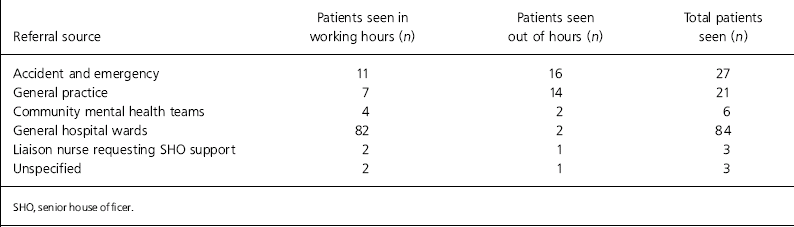
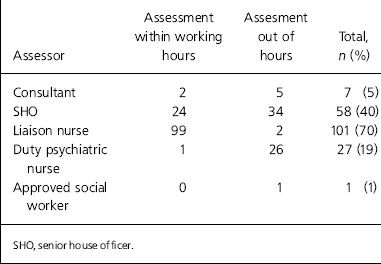
During the sampling period, 144 assessments were undertaken (mean age of patient=34.8 years, s.d.=11.1, n=70 male). Most assessments (75%) were undertaken in normal working hours and mainly involved assessing patients admitted to medical wards following self-harm (58%, Table 1). Significantly more out-of-hours referrals came from the accident and emergency department and GPs than any other sources (χ2=59.7, n=144, d.f.=5, P<0.001). Table 2 shows that, although not mutually exclusive in that more than one professional could carry out an assessment, the majority were carried out by liaison nurses (101 assessments) and SHOs (58 assessments). Consultant psychiatrists carried out only 7 assessments, an approved social worker carried out only 1 assessment and a duty nurse undertook 27 assessments (Table 2). Thus, a liaison nurse was present in 70% of assessments. Almost all of these were undertaken during normal working hours (99%). Conversely, SHOs were involved in only 40% of assessments, and most of these (59%) occurred out of hours.
Source of psychiatric referral and timing of the 144 assessments
| Referral source | Patients seen in working hours (n) | Patients seen out of hours (n) | Total patients seen (n) |
|---|---|---|---|
| Accident and emergency | 11 | 16 | 27 |
| General practice | 7 | 14 | 21 |
| Community mental health teams | 4 | 2 | 6 |
| General hospital wards | 82 | 2 | 84 |
| Liaison nurse requesting SHO support | 2 | 1 | 3 |
| Unspecified | 2 | 1 | 3 |
The assessor and the timing of the 144 emergency assessments
| Assessor | Assessment within working hours | Assesment out of hours | Total, n (%) |
|---|---|---|---|
| Consultant | 2 | 5 | 7 (5) |
| SHO | 24 | 34 | 58 (40) |
| Liaison nurse | 99 | 2 | 101 (70) |
| Duty psychiatric nurse | 1 | 26 | 27 (19) |
| Approved social worker | 0 | 1 | 1 (1) |
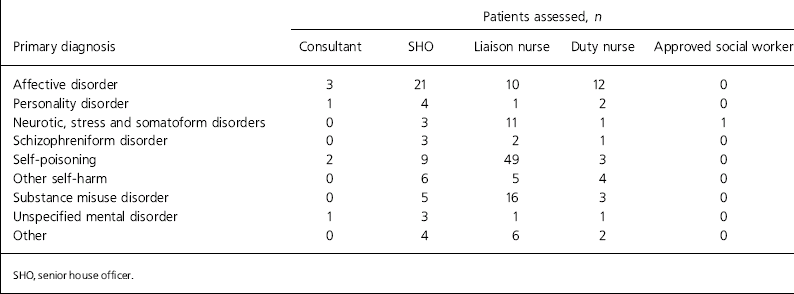
Table 3 shows the primary diagnosis recorded for each assessment grouped according to ICD–10 criteria and the healthcare professional in the assessment. Note that the assessments carried out were not exclusive to each healthcare professional. In some cases, two or more professionals were involved in the assessment. Therefore the sum of assessments across all the healthcare professionals may exceed 144. Few assessments were classified as behavioural disorders with physiological symptoms, mental retardation, non-psychiatric or organic disorders. These data have been grouped to form the category ‘ Other’ in Table 3. The most common reason for requesting psychiatric opinion was self-harm by poisoning (35%), followed by affective disorder (19%). Emergency assessment of psychotic illnesses (e.g. schizophrenia) accounted for only 4% of assessments. Assessment of self-harm was undertaken most often by liaison nurses (98% of all assessments involved a liaison nurse); SHOs were involved in only 18% of all self-poisoning assessments. Most referrals of affective disorder were from GPs; SHOs saw the majority of these patients (78%).
Primary diagnosis and healthcare professional involved in assessments
| Patients assessed, n | |||||
|---|---|---|---|---|---|
| Primary diagnosis | Consultant | SHO | Liaison nurse | Duty nurse | Approved social worker |
| Affective disorder | 3 | 21 | 10 | 12 | 0 |
| Personality disorder | 1 | 4 | 1 | 2 | 0 |
| Neurotic, stress and somatoform disorders | 0 | 3 | 11 | 1 | 1 |
| Schizophreniform disorder | 0 | 3 | 2 | 1 | 0 |
| Self-poisoning | 2 | 9 | 49 | 3 | 0 |
| Other self-harm | 0 | 6 | 5 | 4 | 0 |
| Substance misuse disorder | 0 | 5 | 16 | 3 | 0 |
| Unspecified mental disorder | 1 | 3 | 1 | 1 | 0 |
| Other | 0 | 4 | 6 | 2 | 0 |
Discussion
During the 2-month study period, resident SHO cover was provided by a1 in 8 on-call rota (24 h), whereas two liaison nurses worked normal hours only, i.e. Monday to Friday, 9 a.m.–5 p.m. Each SHO saw an average of seven emergency referrals during the 2-month period, less than one per on-call session. The average number of psychiatric assessments undertaken by the liaison nurse team was 50.5 in the same period. Hence, the exposure of nurses and SHOs to emergency assessments was very different, with significant implications for the opportunity for trainee psychiatrists to gain relevant experience. Trainees spend most of their on-call periods managing routine requests from wards regarding in-patients and ‘clerking’ planned admissions. They also gain experience in assessment of patients in planned out-patient clinic settings. These are all valuable skills to acquire, but they do not confer experience in assessment and management of acute psychiatric emergencies. Furthermore, significant differences exist with respect to the nature of psychiatric problems presenting to each group. For example, the majority of self-harm assessments are not being undertaken by SHOs; in the study period, only 6 self-harm assessments were undertaken (15 including self-poisoning), approximating to 1 per SHO per 2 months, or an annual rate of 6 assessments per year. This is clearly insufficient to gain adequate experience and training in assessing and managing self-harm as recommended by the guidelines for training provided by the Royal College of Psychiatrists (2003) and the National Institute for Clinical Excellence (2004). These are difficult skills to master (Reference Hassan, MacNamara and DavyHassan et al, 1999; Reference Bennewith, Stocks and GunnellBennewith et al, 2002) and represent an important competency for all psychiatrists.
Overall, the results indicate that although the creation of psychiatric nurse liaison posts can benefit service delivery, it can also lead to a serious reduction in core clinical experience for psychiatric SHOs. It is important that training implications of service developments are considered, in this case to allow psychiatric trainees to gain adequate training in all areas of emergency psychiatry. This could be ensured by including periods of attachment for SHOs to self-harm liaison teams. We recommend that Royal College of Psychiatrists’ approval of training schemes requires that trainees are adequately exposed to emergency psychiatry, in particular the assessment and management of self-harm. One method that could assist in the monitoring of such experience is for psychiatric trainees to maintain logbooks of emergency assessments and for these to be regularly reviewed by supervisors and clinical tutors.
A possible limitation of the study is that the 2-month sampling period includes Christmas and New Year, with associated emotional disturbance possibly escalating demand for emergency psychiatric assessments. For example, if more people were presenting to the service with self-harm at Christmas, this might have an impact on the use of liaison services, in particular the activities of liaison nurses. Further examination of patterns of clinical demand and the role of different health professionals in emergency psychiatric assessments across different settings is required.
The impact of service organisation on training extends to other medical disciplines as well. For example, the European Working Time Directive has similarly restricted the emergency experience of surgical trainees, raising concerns about the adequacy of training to equip new consultants with requisite skills for managing acute presentation (Reference Morris-Stiff, Ball and TorkingtonMorris-Stiff et al, 2004). The impact of nurse practitioners on medical practice has been a long-standing issue (Reference Dowling, Barrett and WestDowling et al, 1995). With a drive to focus the work of doctors on clinical tasks that require medical input only, is there a cost of losing general competency? Implications for postgraduate clinical training of SHOs in various disciplines thus need to be carefully considered in the light of employment law as well as current and planned service developments.
Declaration of interest
None.
Acknowledgement
We thank staff of the Mental Health Directorate, North East Wales NHS Trust for assistance with record retrieval.


 Open access


eLetters
No eLetters have been published for this article.