

Introduction
The emergence of third space professionals in higher education has arisen from a modulation of roles that were seen traditionally as providing an ‘administrative’ or ‘support’ function to the academic enterprise. In the case of registry-type functions, these have largely been superseded by online data management, including Frequently Asked Questions (FAQs) and, more recently, the use of artificial intelligence (AI) facilities, for example for minute taking. At the same time, specialist professionals have been appointed from outside the sector, for example, in finance, estates and human resources, as the range of knowledge required to facilitate university activities in contemporary environments has led to a broader range of roles. Staffing patterns have also been influenced by government policy focused on increasing the numbers of students accessing higher education and improving their employability, as well as implementing research selectivity between institutions according to success in attracting external funding. As a result, general registry roles morphed into a spectrum of roles supporting, for example, academic development, research grant capture, community engagement, equality, diversity and inclusion (EDI), student success and the digital environment. At the same time, the concept of ‘administration’ has become devalued, and the term ‘non-academic’ (often used in national data sets), has also been contested as defining a large group of often highly qualified people by what they are not, leading to a sense of exclusion (Preece et al. Reference Preece, Anthony-Edwards, Hodgson, Kenny and Sloan2025; Whitchurch Reference Whitchurch2025). These terms have, therefore, been superseded, by and large, by the concept of ‘professional staff’ in the Anglophone world (Bossu and Brown Reference Bossu and Brown2018; Akerman Reference Akerman2020; Caldwell Reference Caldwell2022).
Furthermore, professional staff tend increasingly to see themselves as working in partnership with academic colleagues as opposed to having a straightforward service function. They, and some staff on academic contracts who find themselves working in a more project-oriented environment, have been referred to as third space professionals in an expanding literature worldwide (Whitchurch Reference Whitchurch2013, Reference Whitchurch, Bossu and Brown2018, Reference Whitchurch2023, Reference Whitchurch2024a, Reference Whitchurch2024b, Reference Whitchurch2025; McIntosh and Nutt Reference McIntosh and Nutt2022; Veles Reference Veles2022; Veles et al. Reference Veles, Carter and Boon2019, Reference Veles, Graham and Ovaska2023; Abegglen et al. Reference Abegglen, Burns and Sinfield2023; Kerridge et al. Reference Kerridge, Poli and Yang-Yoshihara2023; Thorpe and Partridge Reference Thorpe and Partridge2024; Kelly et al. Reference Kelly, Strampel and Lynch2025; Preece et al. Reference Preece, Anthony-Edwards, Hodgson, Kenny and Sloan2025), as well as in three recent special issues of journals: the London Review of Education (2024), the Journal of Learning Development in Higher Education (2025) and Perspectives: Policy and Practice in Higher Education (2026). The concept has its roots in the field of cultural studies and the othering of specific groups in relation to, for example, race, gender and class (Bhabha Reference Bhabha1994; Said Reference Said1978; Sarup Reference Sarup1996), as well as influencing the politics of urban geography (Keith and Pile Reference Keith, Pile, Keith and Pile1993; Routledge Reference Routledge1996; Soja Reference Soja1996). In a higher education context, it has been used to problematize roles and relationships that do not fit precisely into job descriptions and organization charts and have an uneasy fit with either ‘academic’ or ‘professional’ labelling in formal structures. Furthermore, those with professional contracts are increasingly likely to have, or to be working towards, master’s or doctoral qualifications. This has led to roles becoming more complex than implied by the simple academic/non-academic divide used for employment and data collection purposes by government and institutions. Professional staff are now deeply embedded in the social, enterprise and international missions of their universities, across the range of communities in which these institutions operate.
Notwithstanding narratives that focus on so-called ‘administrators’ constraining rather than facilitating academic activity (for example Brew et al. Reference Brew, Boud, Crawford and Lucas2017; Brennan et al. Reference Brennan, Naidoo, Franco, de Lourdes, Machado-Taylor, Soares and Teichler2017; Teichler Reference Teichler, Shin and Teixeira2017), recent years have seen an increasing recognition of more fluid roles for both academic and professional staff (for example, Rosewell and Ashwin Reference Rosewell and Ashwin2018, Watermeyer and Tomlinson Reference Watermeyer and Tomlinson2021, Whitchurch Reference Whitchurch, Bossu and Brown2018, Whitchurch et al. Reference Whitchurch, Locke and Marini2021). Thus, Barry (Reference Barry2022) refers to ‘knowledgeable others’ in the university, de Jong (Reference de Jong2025) to the need for ‘knowledge development’ and Kallenberg (Reference Kallenberg2020) to an appropriate ‘cocktail of skills’ in building up intelligence about, for example, innovative and timely research that will lead to grant capture. It has also been suggested that third space professionals are now deeply embedded in the social and enterprise missions of the university (Wolf and Jenkins Reference Wolf and Jenkins2020; Grant and Kennie Reference Grant and Kennie2024), and that a new mapping of the workforce is needed (Croucher and Woelert Reference Croucher and Woelert2022).
Against this background, the findings of the research project described below suggest that more adaptable employment categorizations, promotion criteria and career pathways are required in order for a significant number of individuals to achieve a sense of place within the university community. This is likely to involve recognition that formal employment structures in higher education institutions are no longer entirely fit for purpose, and that a more organic approach may be needed to fully realize the potentials of both individuals and institutions. Thus, a greater focus on collaborative relationships is likely to be called for in order to modulate structures and mitigate ‘us and them’ attitudes.
The Study from which Examples in this Article are Drawn
This article draws on a project conducted between 2017 and 2020 for the UK Centre for Global Higher Education (CGHE), an international research centre based at the University of Oxford and University College London, funded by the Economic and Social Research Council (UK), the Office for Students (UK) and Research England (UK) (Whitchurch et al. Reference Whitchurch, Locke and Marini2021, Reference Whitchurch, Locke and Marini2023). The project considered trends in the development of the UK workforce. Interviews were conducted initially with 69 individuals employed on academic and professional contracts, including directors of human resources and pro-vice-chancellors, in eight higher education institutions. These were selected on the basis of:
-
regional location, covering all four UK nations (five from England and one each from Scotland, Wales and Northern Ireland);
-
institutional type: three pre-1992 Russell Group universities (leading research-intensive universities); two pre-1992 non-Russell Group universities; two post-1992 universities (former polytechnics prior to the Further and Higher Education Act 1992); and one post-2004 university (former college prior to 2004, when the requirement that non-university institutions held research degree–awarding powers before they could gain university status was dropped in England and Wales); and
-
disciplinary and staff profiles.
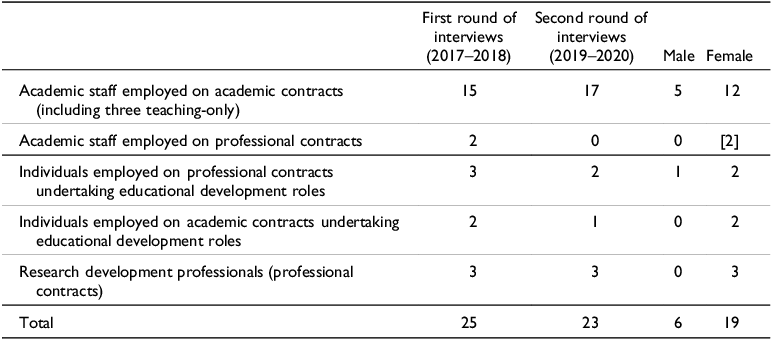
Almost three-quarters (39) of the 53 respondents who did not have senior management roles were re-interviewed two years after the first interview, so that there was a longitudinal element to the study. It became evident from these narratives that almost 50% of this subset of respondents – 25 out of 53 – described significant elements of their role that were outside of the strict parameters of purely academic or professional work. This article focuses on these 25 respondents, 23 of whom agreed to be re-interviewed. These are described in Table 1. As can be seen, the contractual situation was by no means clear cut and, for example, some individuals undertaking academic work had been placed on professional contracts. Others, for example, those with teaching-only contracts, might also undertake some kind of research and/or major project. Although the study was conducted in the UK, it adds to a developing literature in non-anglophone countries on this drift of activity beyond strict academic or professional boundaries (Kossek and Zwiauer Reference Kossek and Zwiauer2012; Schneijderberg and Merkator Reference Schneijderberg, Merkator, Kehm and Teichler2012; Zellweger Moser and Bachmann Reference Zellweger Moser and Bachmann2010; Zinner Reference Zinner2016; Stoltenkamp et al. Reference Stoltenkamp, van de Heyde and Siebrits2017; Bühlmann et al. Reference Bühlmann, Muharremi and Schmidlin2020; Veles Reference Veles2022; Veles et al. Reference Veles, Carter and Boon2019, Reference Veles, Graham and Ovaska2023).
Respondents from the CGHE study categorized as working in third space environments

Notes: (i) The two academic staff employed on professional contracts at the first interview had been transferred to academic contracts by the time of the second interview.
(ii) Six of the eight people employed on professional contracts had doctoral qualifications, including the two who had transferred to academic contracts at the time of the second interview.
(iii) The overall gender balance of all the study participants across the two sets of interviews was 65% female, 35% male. Of those categorized as working in third space, 69% were female, 31% male.
(iv) Ten of those categorized as working in third space were employed in pre-1992 Russell Group universities, five in pre-1992 universities, eight in post-1992 universities and two in the post-2004 university.
Analysis
As a starting point, after the first round of interviews, a biographical profile of interviewees was drawn up, including their current role and future aspirations. From this, descriptive codes were developed, for example, type of contract, key relationships and career trajectory. Further analysis of the emergent data considered respondents according to their positioning in relation to institutional processes and structures. Interpretive codes were then developed for possible latent meanings, such as tension between individuals and their academic colleagues, and between individual aspirations and perceived career opportunities. As a second step in the analysis, an overview was taken of overarching themes, and from these pattern codes were developed, to establish links across respondents’ accounts. These included, for example, expectations of roles and careers, understandings about the value placed on individual activities and possible career moves, including where the narratives told different stories (Miles and Huberman Reference Miles and Huberman1994). The data gathered from both rounds of interviews were further analysed using Creswell’s ‘data analysis spiral’ (Creswell Reference Creswell1998), whereby data are revisited via processes of reading, describing, classifying, interpreting and representing, with continuous links made between these activities. The data were then mapped against possible variables, such as type of institution and the career stage of the individual. This enabled ‘semantic’ (explicit, overt) and ‘latent’ (underlying, implicit) themes to be identified (Braun and Clark Reference Braun and Clarke2013). For senior managers, these themes included their approach to staffing structures and crossover roles, and the extent of their awareness of third space as a concept; for those in third space roles they included facilitators and inhibitors of day-to-day working, key relationships and career aspirations and expectations.
Disturbances to a Sense of Place
The following examples, from the narratives of two groups of participants in the CGHE study, research managers and educational developers, show the ‘stretch’ that is occurring in relation to third space roles and identities, and how this can undermine individuals’ sense of place within an institution.
Research and Impact Managers
The responsibilities of this group of staff included developing funder relationships, advising on grant applications, undertaking impact assessments and statements, engaging with business and industry and conducting networking and training events. Their previous career tracks included work in the museum service, UK Research Councils, the charity sector and non-governmental organizations. All of them had or were undertaking PhDs and felt that this gave them: ‘an edge… when I’m reading through somebody’s [funding] application… and [questioning]…, sample size [or]… the robustness of a project’s research questions…’ (research development manager, post-1992 university 1). To this end they undertook developmental roles such as running grant writing retreats and ‘sandpits’ events for researchers and users to network, meet funders and practise pitching for money. They were also proactive in offering a matching service for individual researchers so as to create synergy between potential partners: ‘it’s us… going out there and saying… we’re going to try and match you up… there’s this opportunity…, we know you’ve got strengths in that, if you spoke to so and so…, you could have this excellent project’ (research development manager, post-1992 university 1). Perhaps most significantly in terms of contributing to the institution’s self-knowledge, people in these types of roles were able to collect feedback from funders on unsuccessful grant applications and compile data on individual and departmental grant capture, thereby building up intelligence for the future and enhancing research capacity. Through local networks they were also able to develop communities of practice, thus: ‘there are other people in my [type of] roles in different faculties that we can bounce ideas off…’ (impact support manager, post-1992 university 1).
However, despite their academic credentials, this group felt a cognitive dissonance whereby academic staff continued to see research managers as being in a service or support role. Thus: ‘When I started, my line manager said to me that, [although] I was not going to put “doctor” around anything, “put it on your things because it will change the way you’re treated,” and… it does [help]…’ (impact and engagement officer 1, post-1992 university 1). Another individual corroborated this, saying that although they were responsible for two ‘research associates’ who were working on gathering data for the Research Excellence Framework, they felt that the research associates had more status than they did as a ‘research manager’, because their titles implied an academic role. Another found that contractual restrictions impeded them from extending their role:
When they hired me for this job, they did it specifically because…. I’ve got… academic experience… I’ve got a monograph… they teach [arts and humanities subject]… on our history course, which they… technically they said I could teach on, but I’m not allowed to… so they could do with it and I could do it, but it’s not in my contract. (Impact and engagement officer 2, post-1992 university 1)
Others corroborated these sentiments, regretting a lack of credit for promotion from academic activity, or funding for conference attendance.
Educational Developers
The educational developers in the study were responsible for enhancing the practice of both teachers and students, including teacher development, academic literacy and blended learning, thus ‘…looking at where are the barriers to academic achievement… and how we can support [students to overcome] that…’ (head of educational development, pre-1992 Russell group university 1). Their work supported broader agendas such as widening participation, employability, equality, diversity and inclusion (EDI), schools and community liaison. Two had doctorates and saw this as raising their status vis-à-vis academic colleagues, thus: ‘… having a PhD carries a degree of credibility when you’re dealing with academic staff…’ (educational developer, pre-1992 Russell group university 2). Furthermore, they saw the value of their roles as stemming from their in-between positioning: ‘there are a lot of things that I get asked to do… they’re not part of my formal job role, but… it then falls to me to do it because I can have that overarching view’ (educational developer, pre-1992 Russell group university 3). This group of professionals was also able to perform an interpretive, go-between role between academic staff and senior management teams: ‘almost buffering academics from what the centre is imposing, but also… feeding [academic points of view] up to the centre as well…’ (head of educational development, pre-1992 Russell group university 2). Again, like their counterparts in research management, extended networks and the professional capital that accrued were seen as valuable attributes in contributing to the development of the institutional knowledge base: ‘I do lots of work for the Higher Education Academy… almost like a quasi-academic’ (senior educational developer, pre-1992 Russell group university 2).
The investment made by educational developers across the institution was illustrated by the following person, who had built up a successful postgraduate teaching programme across a range of staff that fostered collaborative activity:
… we’ve had two senior IT directors take our Postgraduate Diploma [in teaching and learning]…[together with] library and careers [staff]…, [they] get the kind of development that they wouldn’t normally have and… interaction with others across the university, which helps a dialogue across the services… and [with] academic staff, because increasingly, we have people who are from different categories of staff who will be doing some teaching, but they may be employed in a professional capacity to run a really busy area of the university. (Vice-dean, education, pre-1992 university 1)
This type of activity thereby contributed to raising both the professional and academic capital of the institution.
As with the research managers, they felt that their activities gave them a degree of parity with academic colleagues: ‘I do workshops and training with academic staff and professional services staff, so I don’t teach undergraduates, but I do get to use the same skills and creativity’ (educational developer, pre-1992 Russell Group university 3). Moreover, a lack of recognition was seen as an increasingly widespread issue: ‘there is a growing number of people like me, but we don’t quite have a reference group…’ (head of educational development, pre-1992 Russell group university 1). Perhaps most significantly, this sense of displacement also had implications for career futures: ‘there’s only so far you can go [in a career]…, because it’s technically professional services, you’re never going to get to be the [pro-vice-chancellor] for education because that is an academic role…’ (educational developer, pre-1992 Russell Group university 3).
The View from the Top
This section explores the perceptions of senior management team members (eight directors of human resources and eight pro-vice-chancellors) in relation to the positioning of people in roles involving both academic and professional activity. During the interviews, an explanation was given of the term ‘third space’ and how it was being used by practitioners to denote areas of activity not aligned precisely with either academic or professional domain. Their answers revealed varying degrees of understanding of what was meant by it, and how it might be relevant to such staff. Their receptivity to the concept varied between those who found it difficult to think beyond national and local staffing structures, to those who found it of interest but saw it more as an umbrella term implying more flexibility for all employees. Therefore, the views of the senior managers can be summarized as being on a spectrum, ranging from a lack of acknowledgement of the stretching of professional roles to a recognition that roles were becoming more blurred, and a desire for greater flexibility. This reinforces the fact that third space as a concept tends to be recognized primarily by those who see themselves within it, as opposed to those outside it.
From Myopia to the Need for a Flexible Workforce
At one end of the spectrum, the director of human resources at Russell group university 1 saw their role as ‘to reduce the amount of central control and compliance on the university and…, to turn the focus away from professional services’. Professional staff were seen as a single collective entity, defined by employment category rather than the range of activity they might be undertaking, and described as ‘far too expensive, and… very, very inefficient’. Likewise, a pro-vice-chancellor at the same university regarded them as ‘part of the system of control and compliance’. Although they went on to say, ‘[we] now have a lot more student guidance centres, where you’ll learn about employability skills… to try to make the student a more employable student’, they did not make a connection with the fact that staff supporting such activities were likely to have professional contracts. This person was representative of senior managers who were reluctant to acknowledge tensions that might arise, and were evasive in relation to any suggestion that current structures might be inadequate or inappropriate. Three of the eight senior managers could be said to be in this category. They illustrated a myopia in relation to a broader spectrum of roles, or their significance in supporting the university’s overall enterprise.
There was, however, among others, an awareness of ‘a need for a flexible workforce… [for example] where we … need to do research [on HR issues], we quite often employ academics to do it for us…, as data analysts [on professional contracts]’ (director of human resources, pre-1992 university 2). This implies that people in crossover roles at this institution were accommodated within the system on an ad hoc, one-off basis, rather than broader questions being raised about, for example, entitlements in relation to funding for conferences or career futures. Likewise, a pro-vice-chancellor at the same university was aware of crossover activity, but did not see people in these roles as a separate category:
we have people… who are contributing to the teaching mission… they’re all advising students, many of them are giving conference presentations into the work that they’ve done, some are writing [research] applications alongside other colleagues… we’ve got more people who have more awareness of what happens on both sides of that invisible line between academic and professional… we work more across that line now…
The term ‘invisible’ is significant because it obfuscates the identities and expectations of staff with professional contracts who undertake academically oriented work.
At the same time, at different universities, there were some signs of recognition of the input of those in third space roles:
I think there can be huge value in having the right people occupying those spaces, so…, people who are… leading on research support…, for instance, [to] comment on the academic content [of grant proposals]…, they would have… a knowledge of a subject area in which they were working… My experience of… those roles and of people operating in them has been very positive. (Pro-vice-chancellor, Russell Group university 3)
and
I think that some of the most valuable people that we’ve had in a widening participation sense or in a helping the students sense are… academic skills tutors… the contribution of those people is massive and… that’s not… very often recognized. (Pro-vice chancellor, post-1992 university 1)
However, in neither case had practical steps been taken to advance recognition, again focusing on flexibility rather than creating a new category of staff. Therefore: ‘for me, the third space is… the ability to kind of see people being able to cross the divide…’ (pro-vice chancellor, post-1992 university 2), i.e., the ‘divide’ between academic and professional staff remains. Although the director of human resources at post-1992 university 2 described it as being about having ‘people in the right place… the right eggs in the right basket’, this did not appear to involve adding to or relabelling the ‘baskets’, i.e., employment categories. Despite intentions towards greater flexibility, the following case example illustrates the gap in cognition between the senior management team at a Russell Group university, represented by the director of human resources, and one of the four interviewees at that institution deemed to be working in third space.
Case Example
Although the director of human resources at Russell Group university 3 wanted to free up existing staff categories and create more flexibility, they were reluctant to acknowledge the concept of third space, despite the fact that: ‘I think sometimes hanging onto the old boundaries is unhelpful for us’. They went on to say:
Let’s try and define it in a new way… and have a different kind of identification of those labels… One overwhelming trend is flexibility… I think the reality of life today is [that] compartmentalising things… just isn’t helpful any more and the definitions don’t apply. So, I don’t see it so much as a third space, I just think we’re going to have to rethink… what constitutes work and the boundaries… we’ve got to find new ways of describing new career pathways… It’s about understanding the notion of contribution and outputs, rather than activities in institutions…
However, a teacher on a professional contract at the same university, who taught undergraduates in a science subject but also had other responsibilities, did not sense any modification of what seemed to them quite rigid structures. Thus, they were not allowed to supervise doctoral students, despite having a doctorate, and 50% of their responsibilities was for ‘outreach, widening participation and equality and diversity’. However, ‘there’s not currently a career path… I’m deemed to be professional services… despite having a research portion of my permanent contract… and have no means of progression’. In practice they did not have time to carry out research and had no support for conference attendance. Although by the time of the second interview they had been moved onto a teaching-only academic track, there had been ‘absolutely no change in my role whatsoever… it’s very much a title change, as opposed to me being allowed more time to do research’. Furthermore, ‘a lot of the projects that I’m doing at the moment were ones that I was doing [related to EDI agendas]’. As far as career development went, they felt that senior managers ‘seem like they’re making it up as they go along’.
The above narratives demonstrate the way in which a lack of place marker for the role, resulting in a poor fit with institutional structures, somewhere between science teaching and outreach/EDI work, had created practical difficulty for the individual concerned in planning their workload and future career. They saw themselves as having the worst of both worlds because there was neither an academic nor a professional career path within the institution: ‘we are kind of a bit stuffed in both senses, because we can’t apply for promotion like an academic and we can’t move sideways [like someone in mainstream professional services]’. Significantly, they had chosen a mentor with a professional services background, who was responsible for strategy and operations and ‘a… Jack of all trades’, because of ‘tactics… because… I feel like I don’t want to be playing a game and not know the rules…’ There is, therefore, the sense of an obstacle course which required searching for clues as to future possibilities, in an environment where it was difficult to make contacts and obtain answers to questions. It had therefore been largely a question of: ‘right place, right time… I have been lucky enough to get on various committees, such that I’m meeting people that are higher level…’. This mirrored what was seen as a wider institutional gap between senior decision makers and staff in general: ‘there’s a lot of discussions higher up, there are obviously grass roots discussions, but there’s not enough effort to bridge the gap and find out what’s effective…’. These two narratives from the same institution demonstrate the strain arising from an institutional dynamic aimed at maintaining structural order, despite claims of flexibility, and an individual trajectory frustrated by a lack of congruence with existing structures.
Possible Ways Forward in Closing the Gap in Cognition
Although none of the senior management team members interviewed across the project acknowledged the concept of third space as a separate category of staff, some of them had a general sense of a need for greater flexibility of roles. However, they did not seem to be aware of the lack of recognition felt by staff working between professional and academic domains. Crossovers were dealt with on a by-exception basis, rather than via the creation of a distinctive category that was neither academic nor professional. It would seem that the desire for, and lip service paid to, flexibility fitted uneasily with existing structures. Nevertheless, an indication of some progress was described by a director of human resources from Russell Group university 2 by the establishment of job families:
we have worked to try to develop… job family roles…, so an example for that would be… looking at things like research support engineers… recognizing how those sorts of areas are growing and where… a slightly different skillset or emphasis might be required… to allow them to thrive… in the space in which they are best suited… we have a protocol for how staff might move between different set groups in terms of a career. Sometimes as well we’ve got… academic colleagues who might come out into a professional support area, because that might be an area that they want to work in in a different space, so I think it’s about people not feeling pigeonholed, but appreciating that there are a variety of groups and ways in which they can step off.
This can be seen as moving in the right direction, although, again, this protocol did not include a separate employment category that was neither academic nor professional.
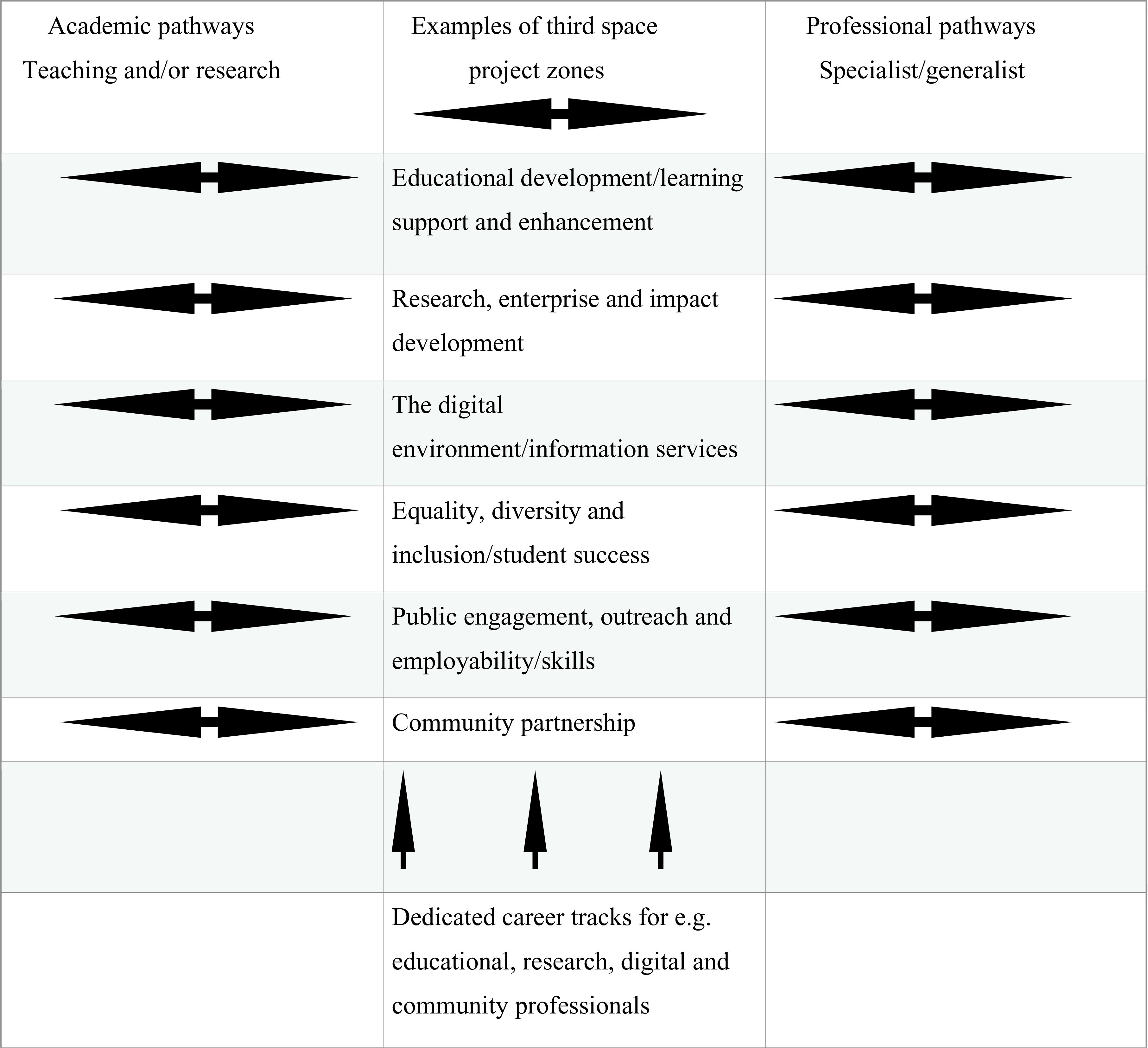
An imperative to modify institutional structures is increasingly recognized in the literature (Baré et al. Reference Baré, Barone and Beard2022; Denney and McIntosh Reference Denney and McIntosh2025; Irwin Reference Irwin2025). This is likely to require supportive leadership and human resource policies that include recognition of third space types of activity for promotion, progression and career development. The following section offers suggestions as to the creation of more flexible structures that recognize individuals who do not fit neatly into existing employment frames. Building on the idea of job families described above, practical steps forward could include the development of project zones that give acknowledgement to the profile of third space staff. These could be permanent, for established activities such as educational and research development, or temporary, as a way of trialling new types of collaboration, but would provide a stronger sense of place than there currently appears to be, gradually accruing recognition for people attached to these zones. Such a scheme would represent a shift from ‘ideal’ concepts of an academic or professional member of staff to one that is more flexible. At the institutional level, the concept of a ‘career climbing frame’ (Strike Reference Strike2010: 88) could be developed to accommodate third space professionals in relation to appropriate project zones in each institution (Figure 1). This would give formal recognition to a range of roles and relationships, offering pathways for progression and permitting crossover with mainstream academic and professional roles as appropriate, on a permanent or temporary basis. Precise nomenclatures and bundles of third space activity could be adjusted to suit the profile of individual institutions, so that they are sympathetic to local initiatives and ways of working.
Career climbing frame, accommodating third space projects and roles.

A deconstruction of standard organograms is likely to be needed, together with the inclusion of bridging structures. These may be to some extent experimental and subject to adjustment in the initial stages. Levels of seniority and titles could be established at institutional level, alongside protocols for people to move in and out of third space zones, according to whether this is at junior, senior or leadership level, with recognition given to the various areas of specialist activity. Within individual job descriptions, a generic person specification might include, for example, people skills, cross-disciplinary experience and tolerance of ambiguity. Recognition and commendation of third space activity for promotion and progression purposes could also be written into annual review processes and promotion criteria. This could include, for instance, specific outcomes and achievements in relation to cross-disciplinary and/or project work, such as success in achieving Athena Swan recognition for women’s careers in science, technology, engineering, mathematics and medicine (STEMM). Such commendations would provide markers of esteem that offered encouragement and recognition along a career pathway. Further possible motivators include study leave and/or financial support for higher degree study, the introduction of a time allowance in workload models for those appropriately qualified to undertake research and teaching, encouragement where appropriate to apply for national teaching awards, the provision of third space mentors and line managers with direct experience of third space activity.
In this scenario, third space professionals could be seen as knowledge practitioners who, in turn, build soft power, influence and capital, which is transferable, both within their institution and in relation to their future careers. In Kallenberg’s ‘patchwork’ university (Kallenberg Reference Kallenberg2016a, Reference Kallenberg2016b), they could be regarded as working across ‘cultures’, ‘islands’ ‘patches’ or ‘archipelagos’ of different types of knowledge, interpreting and synthesizing institutional knowledge. Such a rebalancing of the university’s formal architectures may, inter alia, help to create more ‘supportive working environments’ (Clarke Reference Clarke2015; Clarke et al. Reference Clarke, Kenny and Loxley2015), improving communication and a sense of belonging. Thus, as suggested by Thoenig and Paradeise (Reference Thoenig and Paradeise2016: 320), third space professionals are well placed to ‘build up internal cognitive capital… increasing awareness of new scientific agendas and knowledge frontiers…’.
Furthermore, the examples from the study demonstrate how, in de Jong’s (Reference de Jong2025) terms, both research managers and educational developers are responsible for bespoke ‘knowledge development’ across the core activities of research and teaching. Their contributions could be said to be an example of Mode 3 knowledge building (Carayannis and Campbell Reference Carayannis and Campbell2012) as applied to higher education (Whitchurch Reference Whitchurch2023), using collective experience to enhance the quality and success of the university’s activities. Their accumulated knowledge of local contexts reflects ‘practical wisdom’ (Flyvbjerg et al. Reference Flyvbjerg, Landman and Schram2012) that allows for the co-evolution of different types of knowledge, contributing to a distinctive institutional profile and communicating with students and community partners about what the institution has to offer. In turn, this knowledge supports the creation of ‘professional capital’ (Whitchurch Reference Whitchurch2024b) and ‘collaborative capital’ (Veles Reference Veles2022) between different constituencies across the institution. Those in third space environments could therefore be said to be less defined by structures, frameworks and processes than by the experiential knowledge that they develop via collaborative activity.
Discussion and Conclusion
As evidenced by the narratives, although some senior managers appear to appreciate the need for greater fluidity across roles in higher education, there also appears to be a gap in cognition between the perceptions of those working in what they see as third space environments and those responsible for institutional structures as represented by employment classifications, titles, progression and promotion routes. Although some of these managers might think that the system is flexible enough to meet the university’s needs, there is evidence in the literature, and from the CGHE project, that it is not necessarily meeting the needs and aspirations of individuals. In this sense, those classified as working in third space might be said to be hidden in plain sight. Overall, the project suggests a need to change the narrative so as to recognize spaces and relationships as well as structures, maintaining an element of fluidity between them. New ways of seeing seem to be required in order to offer a sense of place for this group of staff.
Therefore, although the concept of third space might be seen as a useful catchall for professionals who see themselves working in this middle ground, it may or may not achieve official currency as an institutional category of staff. There is also an argument that in practice there is a danger of it becoming ‘no space’ (Hall Reference Hall2022), unless such roles are fully integrated into existing employment classifications. At the same time, the narratives of respondents show that in order to develop an inclusive institutional community, acknowledgement of and support for factors such as input to teaching and research, publications, conference attendance and career progression will need to be incorporated into any reconfiguration of such classifications. Nevertheless, the concept of third space is useful as a generic term to bring together different groups working in between academia and institutional knowledge development, including not only research managers and academic developers, but those developing areas of activity such as, for example, the digital environment; equity, diversity and inclusion; employability; public engagement; and outreach. It provides a space for collective awareness raising, through a growing literature and also via a Third Space blog (https://www.thirdspaceperspectives.com), a Joint Information Systems Committee (JISC) list, as well as for collective lobbying for better recognition. As knowledge brokers in relation to the prime functions of the university, teaching and research, those who work in third space environments might be said to be at the heart of its raison d’être. They are thereby contributing to the fulfilment of its prime purposes and to their university’s own self-learning with the aim of continuous improvement. However, it seems that those who succeed in developing a career in third space environments do so in spite of, rather than because of, the structures that they find themselves in. Taken overall, recognition for third-space professionals, and their work supporting institutional capacity and knowledge building, seems to be work in progress.
Data Availability
The data upon which this article draws is deposited in the UK Data Archive.
Acknowledgements
This article draws on a study entitled The Future Higher Education Workforce in Locally and Globally Engaged HEIs. The support of the Economic and Social Research Council (UK), the Office for Students (UK) and Research England (UK) (grant reference ES/M010082/1) are gratefully acknowledged, along with support from the Centre for Global Higher Education (CGHE) at UCL Institute of Education, London, UK.
Competing interests
The author declares no conflict of interests.
Celia Margaret Whitchurch is Honorary Associate Professor at the UCL Institute of Education. Her research interests focus on academic and professional roles and careers, and on third space environments in higher education. She is the author of over 50 publications, including Challenging Approaches to Academic Career-making (2023) (with William Locke and Giulio Marini); Reconstructing Relationships in Higher Education: Challenging Agendas (2017) (with George Gordon); and Reconstructing Identities in Higher Education: The Rise of Third Space Professionals (2013). She was Founding Editor of Perspectives: Policy and Practice in Higher Education from 1998 to 2008, Editor of Higher Education Quarterly from 2008 to 2018, and is currently Assistant Editor of the London Review of Education.

 Open access

