





1. Introduction
Hypergraph matching problems can be used to model various central questions in combinatorics and consequently have been studied for many years. Notably, Frankl and Rödl [Reference Frankl and Rödl11], as well as Pippenger [Reference Pippenger and Spencer17], proved that any $k$
-uniform hypergraph (
$k$
-uniform hypergraph ( $k$
fixed) on
$k$
fixed) on $n$
vertices, in which each vertex belongs to roughly
$n$
vertices, in which each vertex belongs to roughly $d$
edges and any pair of vertices belongs to at most
$d$
edges and any pair of vertices belongs to at most $o_d(d)$
edges, contains a matching covering
$o_d(d)$
edges, contains a matching covering $(1-o_d(1))n$
vertices. These theorems have undoubtedly had a vast number of applications.
$(1-o_d(1))n$
vertices. These theorems have undoubtedly had a vast number of applications.
More recently, Delcourt and Postle [Reference Delcourt and Postle7], as well as Glock, Joos, Kim, Kühn, and Lichev [Reference Glock, Joos, Kim, Kühn and Lichev12], generalised this result by introducing so-called conflict-free matchings. Here a conflict is a set of disjoint edges which is forbidden to be a subset of the matching. The main contribution in [Reference Delcourt and Postle7, Reference Glock, Joos, Kim, Kühn and Lichev12] is as follows: under the same conditions as Frankl, Rödl, and Pippenger, and under sensible conditions on the set of conflicts, one can find an almost-perfect matching that avoids all conflicts. This can again be applied to a number of problems, such as high-girth decompositions, problems considered by Brown, Erdős, and Sós [Reference Brown, Erdős and Sós4] and various questions in generalised Ramsey theory [Reference Bal, Bennett, Heath and Zerbib1, Reference Bennett, Heath and Zerbib3, Reference Gomez-Leos, Heath, Parker, Schwieder and Zerbib13, Reference Joos and Mubayi14, Reference Lane and Morrison16].
The unfortunate drawback of these theorems is that they deal only with almost-perfect matchings, whereas in many applications it is desirable to obtain perfect matchings or at least almost-perfect matchings that cover a specified vertex subset entirely. Delcourt and Postle describe a setup in which this obstacle can be overcome in a particular setting. Specifically, they consider hypergraphs which are bipartite in the sense that the vertex set can be partitioned into two parts $A$
and
$A$
and $B$
with each edge containing exactly one vertex from
$B$
with each edge containing exactly one vertex from $A$
(and they assume that the vertex degrees in
$A$
(and they assume that the vertex degrees in $A$
are slightly higher than in
$A$
are slightly higher than in $B$
), in which case they find a conflict-free matching covering all vertices of
$B$
), in which case they find a conflict-free matching covering all vertices of $A$
(the matching is A-perfect). The primary limitation of the bipartite hypergraphs in [Reference Delcourt and Postle7] is the fact that edges are only allowed to contain exactly one vertex from
$A$
(the matching is A-perfect). The primary limitation of the bipartite hypergraphs in [Reference Delcourt and Postle7] is the fact that edges are only allowed to contain exactly one vertex from $A$
, whereas in several applications this is not the case.
$A$
, whereas in several applications this is not the case.
Our main contribution is to obtain a stronger theorem in a more general setup: we work with a ‘tripartite’ hypergraph for which the vertex set has a partition into three sets $P,Q,R$
, and we seek a
$P,Q,R$
, and we seek a $P$
-perfect matching (see Fig. 1). The edge set is divided into two parts: edges containing
$P$
-perfect matching (see Fig. 1). The edge set is divided into two parts: edges containing $p$
vertices from
$p$
vertices from $P$
and
$P$
and $q$
vertices from
$q$
vertices from $Q$
, and edges containing one vertex from
$Q$
, and edges containing one vertex from $P$
and
$P$
and $r$
vertices from
$r$
vertices from $R$
. In this setup we prove the existence of a
$R$
. In this setup we prove the existence of a $ P$
-perfect matching, avoiding conflicts which may consist of both types of edges (almost all vertices in
$ P$
-perfect matching, avoiding conflicts which may consist of both types of edges (almost all vertices in $P$
are covered by edges of the first type and a few vertices in
$P$
are covered by edges of the first type and a few vertices in $P$
are covered by edges of the second type). The proof generalises a ‘two-stage method’ for constructions in generalised Ramsey theory, first introduced by Bennett, Cushman, Dudek, and Prałat [Reference Bennett, Cushman, Dudek and Prałat2] and subsequently used to prove various other results in this area; our theorem simplifies all such proofs significantly so that all technical computations are no longer needed, and mostly back-of-the-envelope calculations are sufficient.
$P$
are covered by edges of the second type). The proof generalises a ‘two-stage method’ for constructions in generalised Ramsey theory, first introduced by Bennett, Cushman, Dudek, and Prałat [Reference Bennett, Cushman, Dudek and Prałat2] and subsequently used to prove various other results in this area; our theorem simplifies all such proofs significantly so that all technical computations are no longer needed, and mostly back-of-the-envelope calculations are sufficient.
This framework also turns out to be useful in other settings, including high-girth coverings and designs; these applications are discussed further in Section 2. We expect that there will be further applications in future.
1.1 Tripartite matching theorem
Given two hypergraphs $ \mathcal{H}$
and
$ \mathcal{H}$
and $ \mathcal{C}$
, say that
$ \mathcal{C}$
, say that $ \mathcal{C}$
is a conflict hypergraph for
$ \mathcal{C}$
is a conflict hypergraph for $ \mathcal{H}$
if
$ \mathcal{H}$
if $ V(\mathcal{C}) = E(\mathcal{H})$
, and in this case call the edges of
$ V(\mathcal{C}) = E(\mathcal{H})$
, and in this case call the edges of $ \mathcal{C}$
conflicts. Say that a set of edges
$ \mathcal{C}$
conflicts. Say that a set of edges $ E \subseteq \mathcal{H}$
is C-free if it does not contain any conflict from
$ E \subseteq \mathcal{H}$
is C-free if it does not contain any conflict from $ \mathcal{C}$
. Suppose that we are given the following setup:
$ \mathcal{C}$
. Suppose that we are given the following setup:
-
(S1) integers $ \ell \ge 2, d \gt 0, p \ge 1, q \ge 0, r \ge 1$
with
$ p + q \ge 2$
and real
$ \varepsilon \gt 0$
;
$ \ell \ge 2, d \gt 0, p \ge 1, q \ge 0, r \ge 1$
with
$ p + q \ge 2$
and real
$ \varepsilon \gt 0$
; -
(S2) disjoint sets
$ P, Q, R$
with
$ d^{\varepsilon } \le |P| \le |P \cup Q| \le \exp (d^{\varepsilon ^3})$
; -
(S3) hypergraph
$ \mathcal{H}_1$
whose edges consist of
$ p$
vertices from
$ P$
and
$ q$
vertices from
$ Q$
; -
(S4) hypergraph
$ \mathcal{H}_2$
whose edges consist of a single vertex from
$ P$
and
$ r$
vertices from
$ R$
; -
(S5) conflict hypergraph
$ \mathcal{C}$
for
$ \mathcal{H}_1$
; -
(S6) conflict hypergraph
$ \mathcal{D}$
for
$ \mathcal{H} \, :\!= \, \mathcal{H}_1 \cup \mathcal{H}_2$
.






Two matchings $ \mathcal{M}_1 \subseteq \mathcal{H}_1$
and
$ \mathcal{M}_1 \subseteq \mathcal{H}_1$
and $ \mathcal{M}_2 \subseteq \mathcal{H}_2$
in the hypergraph
$ \mathcal{M}_2 \subseteq \mathcal{H}_2$
in the hypergraph $ \mathcal{H}$
, whose union forms a
$ \mathcal{H}$
, whose union forms a $ P$
-perfect matching
$ P$
-perfect matching $ \mathcal{M}$
; here
$ \mathcal{M}$
; here $ p = 2, q = 4, r = 2$
.
$ p = 2, q = 4, r = 2$
.

Assume that $ \mathcal{H}$
satisfies suitable degree conditions, and further that both
$ \mathcal{H}$
satisfies suitable degree conditions, and further that both $ \mathcal{C}$
and
$ \mathcal{C}$
and $ \mathcal{D}$
satisfy suitable boundedness conditions, all of which are specified in Section 3 in terms of
$ \mathcal{D}$
satisfy suitable boundedness conditions, all of which are specified in Section 3 in terms of $ d$
and
$ d$
and $ \varepsilon$
.
$ \varepsilon$
.
Theorem 1.1.
Given $ p, q, r, \ell$
as above, there exists
$ p, q, r, \ell$
as above, there exists $ \varepsilon _0 \gt 0$
such that for all
$ \varepsilon _0 \gt 0$
such that for all $ \varepsilon \in (0, \varepsilon _0)$
, there exists
$ \varepsilon \in (0, \varepsilon _0)$
, there exists $ d_0$
such that given the above setup, the following holds for all
$ d_0$
such that given the above setup, the following holds for all $d \ge d_0$
: there exists a
$d \ge d_0$
: there exists a $ P$
-perfect
$ P$
-perfect $ \mathcal{C} \cup \mathcal{D}$
-free matching
$ \mathcal{C} \cup \mathcal{D}$
-free matching $ \mathcal{M} \subseteq \mathcal{H}$
. Furthermore, at most
$ \mathcal{M} \subseteq \mathcal{H}$
. Furthermore, at most $ d^{-\varepsilon ^4} |P|$
vertices of
$ d^{-\varepsilon ^4} |P|$
vertices of $ P$
belong to an edge in
$ P$
belong to an edge in $ \mathcal{H}_2 \cap \mathcal{M}$
.
$ \mathcal{H}_2 \cap \mathcal{M}$
.
The proof of Theorem 1.1, given in Section 5, consists of two stages, as mentioned: we first apply Theorem 4.2, a variant of the original conflict-free hypergraph matching theorem [Reference Glock, Joos, Kim, Kühn and Lichev12], to the hypergraph $ \mathcal{H}_1$
in order to obtain a
$ \mathcal{H}_1$
in order to obtain a $ \mathcal{C}$
-free matching
$ \mathcal{C}$
-free matching $ \mathcal{M}_1$
covering all but at most a
$ \mathcal{M}_1$
covering all but at most a $ d^{-\varepsilon ^3}$
fraction of the vertices of
$ d^{-\varepsilon ^3}$
fraction of the vertices of $ P$
with edges from
$ P$
with edges from $ \mathcal{H}_1$
. In the proof of Theorem 4.2 (which we apply as a black box), this matching is chosen randomly one edge at a time, and accordingly can be thought of as ‘pseudorandom’ in an appropriate sense; specifically, we are able to show that certain weight functions on edge sets have roughly their ‘expected’ value when summed over
$ \mathcal{H}_1$
. In the proof of Theorem 4.2 (which we apply as a black box), this matching is chosen randomly one edge at a time, and accordingly can be thought of as ‘pseudorandom’ in an appropriate sense; specifically, we are able to show that certain weight functions on edge sets have roughly their ‘expected’ value when summed over $ \mathcal{M}_1$
. To extend
$ \mathcal{M}_1$
. To extend $\mathcal{M}_1$
to a
$\mathcal{M}_1$
to a $ P$
-perfect matching, for each vertex
$ P$
-perfect matching, for each vertex $ x \in P$
which is not already covered, we randomly choose some edge from
$ x \in P$
which is not already covered, we randomly choose some edge from $ \mathcal{H}_2$
to cover
$ \mathcal{H}_2$
to cover $ x$
and use the Lovász Local Lemma to show that with non-zero probability the resulting set
$ x$
and use the Lovász Local Lemma to show that with non-zero probability the resulting set $ \mathcal{M}_2$
of edges is indeed a matching, and the union
$ \mathcal{M}_2$
of edges is indeed a matching, and the union $ \mathcal{M}$
of our two matchings is
$ \mathcal{M}$
of our two matchings is $ \mathcal{D}$
-free. In order to apply the local lemma, we use the aforementioned weight functions to bound the number of potential conflicts which could be introduced when choosing an edge from
$ \mathcal{D}$
-free. In order to apply the local lemma, we use the aforementioned weight functions to bound the number of potential conflicts which could be introduced when choosing an edge from $ \mathcal{H}_2$
to cover each
$ \mathcal{H}_2$
to cover each $ x \in P$
.
$ x \in P$
.
1.2 Notation
Write $ [i, n] = \{ i, \ldots , n \}$
, so
$ [i, n] = \{ i, \ldots , n \}$
, so $ [n] = [1, n]$
. Unless otherwise stated we identify hypergraphs with their edge sets, writing
$ [n] = [1, n]$
. Unless otherwise stated we identify hypergraphs with their edge sets, writing $ e \in \mathcal{G}$
to mean
$ e \in \mathcal{G}$
to mean $ e \in E(\mathcal{G})$
. Given a set of vertices
$ e \in E(\mathcal{G})$
. Given a set of vertices $ U \subseteq V(\mathcal{G})$
in a hypergraph
$ U \subseteq V(\mathcal{G})$
in a hypergraph $ \mathcal{G}$
, write
$ \mathcal{G}$
, write $ d_{\mathcal{G}}(U)$
for the degree of
$ d_{\mathcal{G}}(U)$
for the degree of $ U$
in
$ U$
in $ \mathcal{G}$
, that is the number of edges of
$ \mathcal{G}$
, that is the number of edges of $ \mathcal{G}$
containing
$ \mathcal{G}$
containing $ U$
; in the cases
$ U$
; in the cases $ U = \{ u \}$
and
$ U = \{ u \}$
and $ U = \{ u, v \}$
, where
$ U = \{ u, v \}$
, where $ U$
consists of one or two vertices, we just write
$ U$
consists of one or two vertices, we just write $ d_{\mathcal{G}}(u)$
and
$ d_{\mathcal{G}}(u)$
and $d_{\mathcal{G}}(u, v)$
, respectively. We omit the subscript if
$d_{\mathcal{G}}(u, v)$
, respectively. We omit the subscript if $ \mathcal{G}$
is obvious from context. Write
$ \mathcal{G}$
is obvious from context. Write $ \Delta _j(\mathcal{G})$
for the maximum degree
$ \Delta _j(\mathcal{G})$
for the maximum degree $ d_{\mathcal{G}}(U)$
among sets
$ d_{\mathcal{G}}(U)$
among sets $ U \subseteq V(\mathcal{G})$
of
$ U \subseteq V(\mathcal{G})$
of $ j$
vertices. Given a subset of the vertices
$ j$
vertices. Given a subset of the vertices $ V \subseteq V(\mathcal{G})$
, write
$ V \subseteq V(\mathcal{G})$
, write $\Delta _{V}(\mathcal{G})$
for the maximum degree
$\Delta _{V}(\mathcal{G})$
for the maximum degree $ d_{\mathcal{G}}(u)$
of any single vertex
$ d_{\mathcal{G}}(u)$
of any single vertex $ u \in V$
, and similarly
$ u \in V$
, and similarly $ \delta _V(\mathcal{G})$
for the minimum degree; assume
$ \delta _V(\mathcal{G})$
for the minimum degree; assume $ V = V(\mathcal{G})$
if not specified. Given
$ V = V(\mathcal{G})$
if not specified. Given $ j \in \mathbb{N}$
, write
$ j \in \mathbb{N}$
, write $ G^{(j)} \, :\!= \, \{ E \in \mathcal{G} \, : \, |E| = j \}$
for the subhypergraph of
$ G^{(j)} \, :\!= \, \{ E \in \mathcal{G} \, : \, |E| = j \}$
for the subhypergraph of $ \mathcal{G}$
containing only those edges of size
$ \mathcal{G}$
containing only those edges of size $ j$
.
$ j$
.
We omit ceiling and floor symbols whenever they do not affect the argument. We refer readers to the Glossary section at the end of the paper for a summary of more specific notation which appears throughout the paper.
1.3 This paper
We start by outlining two significant applications of Theorem 1.1 in Section 2. We then complete the formal statement in Section 3 by listing the various conditions required on our hypergraph and conflicts. In Section 4, we state our prerequisites, in particular Theorem 4.2, a variant of the main theorem from [Reference Glock, Joos, Kim, Kühn and Lichev12], as well as a more complicated but weaker set of conditions, for which we will in fact prove our main theorem. Finally, the proof itself is given in Section 5, which begins with a more detailed outline.
2. Applications
We briefly discuss here two applications of Theorem 1.1.
2.1 Conflict-free coverings and large girth designs
For a hypergraph $\mathcal{H}$
, we call a set of edges
$\mathcal{H}$
, we call a set of edges $\mathcal{M}\subseteq \mathcal{H}$
a covering of
$\mathcal{M}\subseteq \mathcal{H}$
a covering of $\mathcal{H}$
if all vertices belong to some edge in
$\mathcal{H}$
if all vertices belong to some edge in $\mathcal{M}$
and say it is perfect if each vertex belongs to exactly one edge. In the setting of Frankl, Rödl, and Pippenger, the existence of almost-perfect matchings and almost-perfect coverings (coverings in which most vertices belong to exactly one edge) is equivalent and one object can easily be transformed into the other one. However, it is not obvious that just greedily adding edges to turn an almost-perfect matching into an almost-perfect covering can be done without introducing conflicts; Theorem 2.1, which follows easily from Theorem 1.1, resolves this problem. It represents the natural analogue of Theorem 4.1, providing a covering in place of a matching.
$\mathcal{M}$
and say it is perfect if each vertex belongs to exactly one edge. In the setting of Frankl, Rödl, and Pippenger, the existence of almost-perfect matchings and almost-perfect coverings (coverings in which most vertices belong to exactly one edge) is equivalent and one object can easily be transformed into the other one. However, it is not obvious that just greedily adding edges to turn an almost-perfect matching into an almost-perfect covering can be done without introducing conflicts; Theorem 2.1, which follows easily from Theorem 1.1, resolves this problem. It represents the natural analogue of Theorem 4.1, providing a covering in place of a matching.
Theorem 2.1.
Fix $ \ell , k \ge 2$
. There exists
$ \ell , k \ge 2$
. There exists $ \varepsilon _0$
such that for all
$ \varepsilon _0$
such that for all $ \varepsilon \in (0, \varepsilon _0)$
, there exists
$ \varepsilon \in (0, \varepsilon _0)$
, there exists $ d_0$
such that for all
$ d_0$
such that for all $ d \ge d_0$
the following holds. Suppose
$ d \ge d_0$
the following holds. Suppose $ \mathcal{H}$
is a
$ \mathcal{H}$
is a $ k$
-graph on
$ k$
-graph on $ n \le \exp (d^{\varepsilon ^3})$
vertices. Assume that
$ n \le \exp (d^{\varepsilon ^3})$
vertices. Assume that $ (1 - d^{-\varepsilon })d \le \delta (\mathcal{H}) \le \Delta (\mathcal{H}) \le d$
and
$ (1 - d^{-\varepsilon })d \le \delta (\mathcal{H}) \le \Delta (\mathcal{H}) \le d$
and $ \Delta _2(\mathcal{H}) \le d^{1 - \varepsilon }$
. Let
$ \Delta _2(\mathcal{H}) \le d^{1 - \varepsilon }$
. Let $ \mathcal{C}$
be a
$ \mathcal{C}$
be a $ (d, \ell , \varepsilon )$
-bounded conflict hypergraph for
$ (d, \ell , \varepsilon )$
-bounded conflict hypergraph for $ \mathcal{H}$
. Then there is a
$ \mathcal{H}$
. Then there is a $ \mathcal{C}$
-free covering
$ \mathcal{C}$
-free covering $ \mathcal{M} \subseteq \mathcal{H}$
such that all but
$ \mathcal{M} \subseteq \mathcal{H}$
such that all but $ d^{-\varepsilon ^5}n$
vertices are covered exactly once, and no vertex is covered more than twice.
$ d^{-\varepsilon ^5}n$
vertices are covered exactly once, and no vertex is covered more than twice.
One of the original motivations for studying hypergraph matchings, and in particular conflict-free matchings, was the problem of finding almost-perfect Steiner systems of large girth. In general, a partial $ (m, s, t)$
-Steiner system is a collection
$ (m, s, t)$
-Steiner system is a collection $ \mathcal{S}$
of subsets of
$ \mathcal{S}$
of subsets of $ [m]$
, each of size
$ [m]$
, each of size $ s$
, such that every subset of
$ s$
, such that every subset of $ [m]$
of size
$ [m]$
of size $ t$
is contained in at most one element of
$ t$
is contained in at most one element of $ \mathcal{S}$
; it is approximate if it has size
$ \mathcal{S}$
; it is approximate if it has size $ (1 - o(1)) (\begin{smallmatrix} m \\ t \end{smallmatrix}) / (\begin{smallmatrix} s \\ t \end{smallmatrix}) $
. The girth of
$ (1 - o(1)) (\begin{smallmatrix} m \\ t \end{smallmatrix}) / (\begin{smallmatrix} s \\ t \end{smallmatrix}) $
. The girth of $ \mathcal{S}$
is the smallest integer
$ \mathcal{S}$
is the smallest integer $ g \ge 2$
such that some set of
$ g \ge 2$
such that some set of $ (s - t) g + t$
vertices induces at least
$ (s - t) g + t$
vertices induces at least $ g$
sets in
$ g$
sets in $ \mathcal{S}$
.
$ \mathcal{S}$
.
Recently, Delcourt and Postle [Reference Delcourt and Postle8] proved the existence of perfect $ (m, s, t)$
-Steiner systems of large girth, via a new refined absorption method. Their result provides a common generalisation of the existence conjecture for designs originating from the 1800s and Erdős’ conjecture from 1973 on the existence of high-girth Steiner triple systems. Our main result, Theorem 1.1, is a crucial tool in their proof (Theorem 2.10 in [Reference Delcourt and Postle8]). As noted earlier, our proof method uses the main result of [Reference Glock, Joos, Kim, Kühn and Lichev12] which employs the random greedy process. On the other hand, Delcourt and Postle’s proof (to appear in a forthcoming version of [Reference Delcourt and Postle7]) of their Theorem 2.10 from [Reference Delcourt and Postle8] uses the nibble method. A simpler version of Theorem 1.1, without conflicts, is also used by Delcourt and Postle [Reference Delcourt and Postle9], as well as by Delcourt, Postle, and Kelly [Reference Delcourt, Kelly and Postle5, Reference Delcourt, Kelly and Postle6] in other applications of their refined absorption method.
$ (m, s, t)$
-Steiner systems of large girth, via a new refined absorption method. Their result provides a common generalisation of the existence conjecture for designs originating from the 1800s and Erdős’ conjecture from 1973 on the existence of high-girth Steiner triple systems. Our main result, Theorem 1.1, is a crucial tool in their proof (Theorem 2.10 in [Reference Delcourt and Postle8]). As noted earlier, our proof method uses the main result of [Reference Glock, Joos, Kim, Kühn and Lichev12] which employs the random greedy process. On the other hand, Delcourt and Postle’s proof (to appear in a forthcoming version of [Reference Delcourt and Postle7]) of their Theorem 2.10 from [Reference Delcourt and Postle8] uses the nibble method. A simpler version of Theorem 1.1, without conflicts, is also used by Delcourt and Postle [Reference Delcourt and Postle9], as well as by Delcourt, Postle, and Kelly [Reference Delcourt, Kelly and Postle5, Reference Delcourt, Kelly and Postle6] in other applications of their refined absorption method.
Conflict-free hypergraph matchings can also be used to find approximate systems for a much more general class of quasirandom hypergraphs, where, for example, we restrict the choice of elements of $ \mathcal{S}$
to a randomly chosen subset of
$ \mathcal{S}$
to a randomly chosen subset of $ (\begin{smallmatrix} [m] \\ s \end{smallmatrix}) $
; see Theorem 1.4 of [Reference Glock, Joos, Kim, Kühn and Lichev12]. The following analogous covering result can be easily deduced from our Theorem 2.1. Given real numbers
$ (\begin{smallmatrix} [m] \\ s \end{smallmatrix}) $
; see Theorem 1.4 of [Reference Glock, Joos, Kim, Kühn and Lichev12]. The following analogous covering result can be easily deduced from our Theorem 2.1. Given real numbers $ a, b, c$
, we write
$ a, b, c$
, we write $ a = b \pm c$
to mean
$ a = b \pm c$
to mean $ b - c \le a \le b + c$
.
$ b - c \le a \le b + c$
.
Theorem 2.2.
For all $ c_0 \gt 0, \ell \ge 2$
and
$ c_0 \gt 0, \ell \ge 2$
and $ s \gt t \ge 2$
, there exists
$ s \gt t \ge 2$
, there exists $ \varepsilon _0 \gt 0$
such that for all
$ \varepsilon _0 \gt 0$
such that for all $ \varepsilon \in (0, \varepsilon _0)$
, there exists
$ \varepsilon \in (0, \varepsilon _0)$
, there exists $ m_0$
such that the following holds for all
$ m_0$
such that the following holds for all $ m \ge m_0$
and
$ m \ge m_0$
and $ c \ge c_0$
. Let
$ c \ge c_0$
. Let $ G$
be a
$ G$
be a $ t$
-graph on
$ t$
-graph on $ m$
vertices and let
$ m$
vertices and let $ \mathcal{K}$
be a collection of sets of size
$ \mathcal{K}$
be a collection of sets of size $ s$
which induce cliques in
$ s$
which induce cliques in $ G$
such that any edge is contained in
$ G$
such that any edge is contained in $ (1 \pm m^{-\varepsilon })c m^{s - t}$
elements of
$ (1 \pm m^{-\varepsilon })c m^{s - t}$
elements of $ \mathcal{K}$
.
$ \mathcal{K}$
.
Then, there exists a subset $ \mathcal{S} \subseteq \mathcal{K}$
such that every edge of
$ \mathcal{S} \subseteq \mathcal{K}$
such that every edge of $ G$
is contained in at least one element of
$ G$
is contained in at least one element of $ \mathcal{S}$
, the proportion of edges of
$ \mathcal{S}$
, the proportion of edges of $ G$
contained in more than one element of
$ G$
contained in more than one element of $ \mathcal{S}$
is
$ \mathcal{S}$
is $ o_m(1)$
, none are contained in more than two, and any subset of
$ o_m(1)$
, none are contained in more than two, and any subset of $ \mathcal{S}$
of size
$ \mathcal{S}$
of size $ j$
, where
$ j$
, where $ j \in [2, \ell ]$
, whose elements have pairwise intersections of size at most
$ j \in [2, \ell ]$
, whose elements have pairwise intersections of size at most $ t - 1$
, spans more than
$ t - 1$
, spans more than $ (s - t)j + t$
points.
$ (s - t)j + t$
points.
2.2 Generalised Ramsey numbers
Given graphs $ G$
and
$ G$
and $ H$
, and
$ H$
, and $ q \in \mathbb{N}$
, define the generalised Ramsey number
$ q \in \mathbb{N}$
, define the generalised Ramsey number $ r(G, H, q)$
to be the minimum number of colours needed to colour the edges of
$ r(G, H, q)$
to be the minimum number of colours needed to colour the edges of $ G$
in such a way that every copy of
$ G$
in such a way that every copy of $ H$
receives at least
$ H$
receives at least $ q$
distinct colours. Bennett, Cushman, Dudek, and Prałat [Reference Bennett, Cushman, Dudek and Prałat2] showed that
$ q$
distinct colours. Bennett, Cushman, Dudek, and Prałat [Reference Bennett, Cushman, Dudek and Prałat2] showed that $ r(K_n, K_4, 5) = 5n/6 + o(n),$
answering a question of Erdős and Gyárfás, by introducing the aforementioned two-stage method in which they first colour most of the edges of
$ r(K_n, K_4, 5) = 5n/6 + o(n),$
answering a question of Erdős and Gyárfás, by introducing the aforementioned two-stage method in which they first colour most of the edges of $ K_n$
using a modified triangle removal process (requiring complicated technical analysis) and then complete this to a full colouring using the Lovász Local Lemma. Joos and Mubayi [Reference Joos and Mubayi14] simplified this method greatly by encoding the first stage as a suitable conflict-free hypergraph matching problem and applying the main theorem from [Reference Glock, Joos, Kim, Kühn and Lichev12] as a black box and demonstrated its versatility further by showing that
$ K_n$
using a modified triangle removal process (requiring complicated technical analysis) and then complete this to a full colouring using the Lovász Local Lemma. Joos and Mubayi [Reference Joos and Mubayi14] simplified this method greatly by encoding the first stage as a suitable conflict-free hypergraph matching problem and applying the main theorem from [Reference Glock, Joos, Kim, Kühn and Lichev12] as a black box and demonstrated its versatility further by showing that $ r(K_n, C_4, 3) = n / 2 + o(n)$
. This approach has subsequently been used to prove various similar and more general results [Reference Bal, Bennett, Heath and Zerbib1, Reference Bennett, Heath and Zerbib3, Reference Gomez-Leos, Heath, Parker, Schwieder and Zerbib13, Reference Joos and Mubayi14, Reference Lane and Morrison16].
$ r(K_n, C_4, 3) = n / 2 + o(n)$
. This approach has subsequently been used to prove various similar and more general results [Reference Bal, Bennett, Heath and Zerbib1, Reference Bennett, Heath and Zerbib3, Reference Gomez-Leos, Heath, Parker, Schwieder and Zerbib13, Reference Joos and Mubayi14, Reference Lane and Morrison16].
Our main theorem (Theorem 1.1) formalises this two-stage method in a single statement, from which all of these colouring results follow; another main contribution of this paper is to consolidate all of the calculations required for the second stage, so that applications need only focus on constructing appropriate hypergraphs and conflicts satisfying our conditions. This massively simplifies the proofs of all existing results, since it now suffices to only check the orders of magnitude of the numbers of different types of conflicts. For example, one may obtain a concise proof of the following result which was stated (without proof) very recently by Bal, Bennett, Heath, and Zerbib [Reference Bal, Bennett, Heath and Zerbib1]. Given $ k \ge 2$
, write
$ k \ge 2$
, write $ K_n^k$
for the complete
$ K_n^k$
for the complete $ k$
-graph on
$ k$
-graph on $ n$
vertices, and
$ n$
vertices, and $ C_{\ell }^k$
for the
$ C_{\ell }^k$
for the $ k$
-uniform tight cycle of length
$ k$
-uniform tight cycle of length $ \ell$
; that is, edges
$ \ell$
; that is, edges $ e_1, \ldots , e_{\ell }$
on vertices
$ e_1, \ldots , e_{\ell }$
on vertices $ v_1, \ldots , v_{\ell }$
such that
$ v_1, \ldots , v_{\ell }$
such that $ e_i = \{ v_i, \ldots , v_{i + k - 1} \}$
(modulo
$ e_i = \{ v_i, \ldots , v_{i + k - 1} \}$
(modulo $ \ell$
) for each
$ \ell$
) for each $ i \in [\ell ]$
.
$ i \in [\ell ]$
.
Theorem 2.3.
For all $ k \ge 2$
and
$ k \ge 2$
and $ \ell \ge k + 2$
, we have
$ \ell \ge k + 2$
, we have $ r(K_n^k, C_{\ell }^k, k + 1) \le n / (\ell - k) + o(n)$
.
$ r(K_n^k, C_{\ell }^k, k + 1) \le n / (\ell - k) + o(n)$
.
We remark that the factor $\ell -k$
above is best possible assuming a well-known conjecture about the Turán number of tight paths in hypergraphs.
$\ell -k$
above is best possible assuming a well-known conjecture about the Turán number of tight paths in hypergraphs.
The proofs of Theorems 2.1, 2.2 and 2.3 are fairly routine and short. For the convenience of the reader we provide them in the arXiv version of this paper in the appendix [Reference Joos, Mubayi and Smith15].
3. Conditions for the main theorem
We now specify the conditions on $ \mathcal{H}, \mathcal{C}$
, and
$ \mathcal{H}, \mathcal{C}$
, and $ \mathcal{D}$
required for Theorem 1.1 to hold, thus completing its formal statement. Throughout this section, we work in the setup from Section 1.1, recalling (S 1)–(S 6).
$ \mathcal{D}$
required for Theorem 1.1 to hold, thus completing its formal statement. Throughout this section, we work in the setup from Section 1.1, recalling (S 1)–(S 6).
3.1 Degree conditions on
$ \mathcal{H}$

We require that the hypergraph $ \mathcal{H} = \mathcal{H}_1 \cup \mathcal{H}_2$
with
$ \mathcal{H} = \mathcal{H}_1 \cup \mathcal{H}_2$
with $\mathcal{H}_1,\mathcal{H}_2\neq \emptyset$
satisfies the following conditions.
$\mathcal{H}_1,\mathcal{H}_2\neq \emptyset$
satisfies the following conditions.
-
(H1)
$ (1 - d^{-\varepsilon })d \le \delta _P(\mathcal{H}_1) \le \Delta (\mathcal{H}_1) \le d$
; -
(H2)
$ \Delta _2(\mathcal{H}_1) \le d^{1 - \varepsilon }$
; -
(H3)
$\Delta _{R}(\mathcal{H}_2) \le d^{\varepsilon ^4} \delta _{P}(\mathcal{H}_2)$
; -
(H4)
$ d(x, v) \le d^{-\varepsilon } \delta _{P}(\mathcal{H}_2)$
for each
$ x \in P$
and
$ v \in R$
.






This means that $ \mathcal{H}_1$
is essentially regular for vertices in
$ \mathcal{H}_1$
is essentially regular for vertices in $ P$
and has small codegrees, although vertices in
$ P$
and has small codegrees, although vertices in $ Q$
are allowed to have much lower (but not higher) degrees. Meanwhile in
$ Q$
are allowed to have much lower (but not higher) degrees. Meanwhile in $ \mathcal{H}_2$
, every vertex in
$ \mathcal{H}_2$
, every vertex in $ P$
must have degree at least a
$ P$
must have degree at least a $ d^{-\varepsilon ^4}$
proportion of the maximum degree in
$ d^{-\varepsilon ^4}$
proportion of the maximum degree in $ R$
, and few edges in common with any particular vertex in
$ R$
, and few edges in common with any particular vertex in $ R$
. These conditions are used to ensure that we may choose an edge of
$ R$
. These conditions are used to ensure that we may choose an edge of $ \mathcal{H}_2$
containing each
$ \mathcal{H}_2$
containing each $ x \in P$
such that the set of edges chosen do not overlap.
$ x \in P$
such that the set of edges chosen do not overlap.
3.2 Boundedness conditions on
$ \mathcal{C}$

The conflicts of $ \mathcal{C}$
consist only of edges from
$ \mathcal{C}$
consist only of edges from $ \mathcal{H}_1$
and are avoided directly by Theorem 4.2, so require the same boundedness conditions as in [Reference Glock, Joos, Kim, Kühn and Lichev12]; the conditions we present here are not the most general possible, but suffice for most applications. For any edge
$ \mathcal{H}_1$
and are avoided directly by Theorem 4.2, so require the same boundedness conditions as in [Reference Glock, Joos, Kim, Kühn and Lichev12]; the conditions we present here are not the most general possible, but suffice for most applications. For any edge $ e \in \mathcal{H}_1$
, we write
$ e \in \mathcal{H}_1$
, we write $ N^{(2)}_C (e) \, :\!= \, \{ f \in \mathcal{H}_1 \, : \, \{ e, f \} \in \mathcal{C} \}$
. Given
$ N^{(2)}_C (e) \, :\!= \, \{ f \in \mathcal{H}_1 \, : \, \{ e, f \} \in \mathcal{C} \}$
. Given $ \ell \ge 2$
and
$ \ell \ge 2$
and $ d, \varepsilon \gt 0$
, say that
$ d, \varepsilon \gt 0$
, say that $ \mathcal{C}$
is
$ \mathcal{C}$
is $(d, \ell , \varepsilon )-{bounded}$
if
$(d, \ell , \varepsilon )-{bounded}$
if
-
(C1)
$ 2 \le |C| \le \ell$
for all
$ C \in \mathcal{C}$
; -
(C2)
$ \Delta (\mathcal{C}^{(j)}) \le \ell d^{j - 1}$
for all
$ j \in [2, \ell ]$
; -
(C3)
$ \Delta _{j'}(\mathcal{C}^{(j)}) \le d^{j - j' - \varepsilon }$
for all
$ j \in [2, \ell ]$
and
$ j' \in [2, j - 1]$
; -
(C4)
$ |\{ f \in N_{\mathcal{C}}^{(2)}(e) \, : \, v \in f \}| \le d^{1 - \varepsilon }$
for all
$ e \in E(\mathcal{H}_1)$
and
$ v \in V(\mathcal{H}_1)$
; -
(C5)
$ |N_{\mathcal{C}}^{(2)}(e) \cap N_{\mathcal{C}}^{(2)}(f)| \le d^{1 - \varepsilon }$
for all disjoint
$ e, f \in E(\mathcal{H}_1)$
.


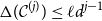









Note that, in many applications, all conflicts of $ \mathcal{C}$
have size at least 3, so conditions (C4) and (C5) are vacuously true. For further intuition behind conditions (C1)–(C5), we refer the reader to the proof overview (Section 1.1) in [Reference Glock, Joos, Kim, Kühn and Lichev12].
$ \mathcal{C}$
have size at least 3, so conditions (C4) and (C5) are vacuously true. For further intuition behind conditions (C1)–(C5), we refer the reader to the proof overview (Section 1.1) in [Reference Glock, Joos, Kim, Kühn and Lichev12].
3.3 Boundedness conditions on
$ \mathcal{D}$

Since it may be the case that the conflicts of $ \mathcal{D}$
consist only of edges from
$ \mathcal{D}$
consist only of edges from $ \mathcal{H}_2$
, or of two parts from
$ \mathcal{H}_2$
, or of two parts from $ \mathcal{H}_1$
and
$ \mathcal{H}_1$
and $ \mathcal{H}_2$
, they must satisfy a new set of conditions to be avoided. We extend our previous notation by writing
$ \mathcal{H}_2$
, they must satisfy a new set of conditions to be avoided. We extend our previous notation by writing $D^{(j_{1},j_{2})}$
for the set of conflicts in
$D^{(j_{1},j_{2})}$
for the set of conflicts in $ \mathcal{D}$
consisting of
$ \mathcal{D}$
consisting of $ j_1$
edges from
$ j_1$
edges from $ \mathcal{H}_1$
and
$ \mathcal{H}_1$
and $ j_2$
edges from
$ j_2$
edges from $ \mathcal{H}_2$
. Similarly, we now write
$ \mathcal{H}_2$
. Similarly, we now write
 \begin{equation} \Delta _{j^{'}_{1},j^{'}_{2}} (\Delta ) \, :\!= \,\max \left \{ d_{\mathcal{D}}(F_1 \cup F_2) \, : \, F_1 \in {\left(\begin{smallmatrix} \mathcal{H}_1 \\ j_1' \end{smallmatrix}\right)}, F_2 \in {\left(\begin{smallmatrix} \mathcal{H}_2 \\ j_2' \end{smallmatrix}\right)} \right \}. \end{equation}
Given a vertex $ x \in P$
, write also
$ x \in P$
, write also $D_{x}$
for the set of conflicts in
$D_{x}$
for the set of conflicts in $ \mathcal{D}$
containing
$ \mathcal{D}$
containing $ x$
in their
$ x$
in their $ \mathcal{H}_2$
-part, and likewise
$ \mathcal{H}_2$
-part, and likewise $D_{x,y}$
for those containing both
$D_{x,y}$
for those containing both $ x$
and
$ x$
and $ y$
. Then say that
$ y$
. Then say that $ \mathcal{D}$
is
$ \mathcal{D}$
is $(d, \ell , \varepsilon )$
-simply bounded if the following hold for all
$(d, \ell , \varepsilon )$
-simply bounded if the following hold for all $ x, y \in P$
, and
$ x, y \in P$
, and $ j_1 \in [0, \ell ], j_2 \in [2, \ell ]$
.
$ j_1 \in [0, \ell ], j_2 \in [2, \ell ]$
.
-
(D1)
$ 2 \le |D \cap \mathcal{H}_2| \le |D| \le \ell$
for each conflict
$ D \in \mathcal{D}$
; -
(D2)
$ |\mathcal{D}^{(j_1, j_2)}_x| \le d^{j_1 + \varepsilon ^4} \delta _{P}(\mathcal{H}_2)^{j_2}$
; -
(D3)
$ \Delta _{j', 0}(\mathcal{D}^{(j_1, j_2)}_x) \le d^{j_1 - j' - \varepsilon } \delta _{P}(\mathcal{H}_2)^{j_2}$
for each
$ j' \in [j_1]$
; -
(D4)
$ |\mathcal{D}^{(j_1, j_2)}_{x, y}| \le d^{j_1 - \varepsilon } \delta _{P}(\mathcal{H}_2)^{j_2}$
.






Referring to the brief proof outline in Section 1.1, the bound in (D2) can be understood heuristically as follows. For $ D \in \mathcal{D}_x$
to be contained in
$ D \in \mathcal{D}_x$
to be contained in $ \mathcal{M}$
, all edges of
$ \mathcal{M}$
, all edges of $ D \cap \mathcal{H}_1$
must be chosen in
$ D \cap \mathcal{H}_1$
must be chosen in $ \mathcal{M}_1$
and all edges of
$ \mathcal{M}_1$
and all edges of $ D \cap \mathcal{H}_2$
must be chosen in
$ D \cap \mathcal{H}_2$
must be chosen in $ \mathcal{M}_2$
; note in particular that, for the latter to be possible, all vertices
$ \mathcal{M}_2$
; note in particular that, for the latter to be possible, all vertices $ y \in P \cap \bigcup (D \cap \mathcal{H}_2)$
must be left uncovered by
$ y \in P \cap \bigcup (D \cap \mathcal{H}_2)$
must be left uncovered by $ \mathcal{M}_1$
. Under the heuristic that edges are chosen roughly uniformly and independently by Theorem 4.2, the probability of the
$ \mathcal{M}_1$
. Under the heuristic that edges are chosen roughly uniformly and independently by Theorem 4.2, the probability of the $ j_1$
edges of
$ j_1$
edges of $ D \cap \mathcal{H}_1$
all being contained in
$ D \cap \mathcal{H}_1$
all being contained in $ \mathcal{M}_1$
is roughly
$ \mathcal{M}_1$
is roughly $ d^{-j_1}$
. Under the heuristic that
$ d^{-j_1}$
. Under the heuristic that $ \mathcal{M}_1$
covers vertices of
$ \mathcal{M}_1$
covers vertices of $ P$
roughly uniformly, the probability that even one vertex
$ P$
roughly uniformly, the probability that even one vertex $ y \in P \cap \bigcup (D \cap \mathcal{H}_2) \setminus \{ x \}$
is left uncovered is roughly
$ y \in P \cap \bigcup (D \cap \mathcal{H}_2) \setminus \{ x \}$
is left uncovered is roughly $ d^{-\varepsilon ^3}$
. Therefore, after choosing
$ d^{-\varepsilon ^3}$
. Therefore, after choosing $ \mathcal{M}_1$
, we expect there to be at most
$ \mathcal{M}_1$
, we expect there to be at most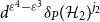 $ d^{\varepsilon ^4 - \varepsilon ^3} \delta _P(\mathcal{H}_2)^{j_2}$
conflicts
$ d^{\varepsilon ^4 - \varepsilon ^3} \delta _P(\mathcal{H}_2)^{j_2}$
conflicts $ D \in \mathcal{D}_x$
which pose a threat when choosing
$ D \in \mathcal{D}_x$
which pose a threat when choosing $ \mathcal{M}_2$
. Ignoring issues of dependence, each of the remaining
$ \mathcal{M}_2$
. Ignoring issues of dependence, each of the remaining $ j_2$
edges of
$ j_2$
edges of $ D$
are then included in
$ D$
are then included in $ \mathcal{M}_2$
with probability at most
$ \mathcal{M}_2$
with probability at most $ \delta _P(\mathcal{H}_2)^{-1}$
, so in total we expect at most
$ \delta _P(\mathcal{H}_2)^{-1}$
, so in total we expect at most $ d^{\varepsilon ^4 - \varepsilon ^3} = o(1)$
conflicts from
$ d^{\varepsilon ^4 - \varepsilon ^3} = o(1)$
conflicts from $ \mathcal{D}_x$
to be contained in
$ \mathcal{D}_x$
to be contained in $ \mathcal{M}$
. Intuitively, (D3) and (D4) behave similarly to (C3), to ensure that conflicts are ‘well spread-out’ in the hypergraph, which avoids the number of potential conflicts being dominated by rare events with large effects.
$ \mathcal{M}$
. Intuitively, (D3) and (D4) behave similarly to (C3), to ensure that conflicts are ‘well spread-out’ in the hypergraph, which avoids the number of potential conflicts being dominated by rare events with large effects.
We may now formally re-state Theorem 1.1.
Theorem 3.1.
Given $ p, q, r, \ell$
satisfying (S 1), there exists
$ p, q, r, \ell$
satisfying (S 1), there exists $ \varepsilon _0 \gt 0$
such that for all
$ \varepsilon _0 \gt 0$
such that for all $ \varepsilon \in (0, \varepsilon _0)$
, there exists
$ \varepsilon \in (0, \varepsilon _0)$
, there exists $ d_0$
such that, for all
$ d_0$
such that, for all $d \ge d_0$
, given
$d \ge d_0$
, given $ \mathcal{H}, \mathcal{C}, \mathcal{D}$
satisfying (S 2)–(S 6), the following holds. Assume that
$ \mathcal{H}, \mathcal{C}, \mathcal{D}$
satisfying (S 2)–(S 6), the following holds. Assume that $ \mathcal{H}$
satisfies (H 1)–(H 4),
$ \mathcal{H}$
satisfies (H 1)–(H 4), $ \mathcal{C}$
is
$ \mathcal{C}$
is $ (d, \ell , \varepsilon )$
-bounded, and
$ (d, \ell , \varepsilon )$
-bounded, and $ \mathcal{D}$
is
$ \mathcal{D}$
is $ (d, \ell , \varepsilon )$
-simply bounded. Then there exists a
$ (d, \ell , \varepsilon )$
-simply bounded. Then there exists a $ P$
-perfect
$ P$
-perfect $ \mathcal{C} \cup \mathcal{D}$
-free matching
$ \mathcal{C} \cup \mathcal{D}$
-free matching $ \mathcal{M} \subseteq \mathcal{H}$
. Furthermore, at most
$ \mathcal{M} \subseteq \mathcal{H}$
. Furthermore, at most $ d^{-\varepsilon ^4} |P|$
vertices of
$ d^{-\varepsilon ^4} |P|$
vertices of $ P$
belong to an edge in
$ P$
belong to an edge in $ \mathcal{H}_2 \cap \mathcal{M}$
.
$ \mathcal{H}_2 \cap \mathcal{M}$
.
We actually prove Theorem 3.1 for a slightly more general set of conditions, given in Section 4.3, which in particular allow for conflicts $ D$
with
$ D$
with $ j_2 = |D \cap \mathcal{H}_2| = 1$
; in many applications, however, this type of conflict does not occur.
$ j_2 = |D \cap \mathcal{H}_2| = 1$
; in many applications, however, this type of conflict does not occur.
4. Preparation for the proof
In this section, we begin by deducing our required variant of the conflict-free hypergraph matchings theorem of [Reference Glock, Joos, Kim, Kühn and Lichev12], as well as giving the more general set of conditions under which we prove Theorem 3.1. We then proceed with the proof itself in Section 5.
4.1 The conflict-free hypergraph matchings theorem
To state the theorem we need, we must first make a further definition; assume $ \ell$
is a given integer, as in Section 1.1. Recalling that we write
$ \ell$
is a given integer, as in Section 1.1. Recalling that we write $ \mathcal{H}$
to refer to
$ \mathcal{H}$
to refer to $ E(\mathcal{H})$
, and given
$ E(\mathcal{H})$
, and given $ j \in \mathbb{N} \cup \{ 0 \}$
, Footnote
1
say that
$ j \in \mathbb{N} \cup \{ 0 \}$
, Footnote
1
say that $ w\colon \ {(\begin{smallmatrix} \mathcal{H} \\ j \end{smallmatrix})} \to [0, \ell ]$
is a
$ w\colon \ {(\begin{smallmatrix} \mathcal{H} \\ j \end{smallmatrix})} \to [0, \ell ]$
is a $j$
-uniform
$j$
-uniform $\ell$
-test for
$\ell$
-test for $ \mathcal{H}$
if
$ \mathcal{H}$
if $ w(E) = 0$
whenever
$ w(E) = 0$
whenever $ E \in {(\begin{smallmatrix} \mathcal{H} \\ j \end{smallmatrix})}$
is not a matching. Write
$ E \in {(\begin{smallmatrix} \mathcal{H} \\ j \end{smallmatrix})}$
is not a matching. Write $ w(X) \, :\!= \,\sum _{x \in X} w(x)$
for
$ w(X) \, :\!= \,\sum _{x \in X} w(x)$
for $ X \subseteq {(\begin{smallmatrix} \mathcal{H} \\ j \end{smallmatrix})}$
, and
$ X \subseteq {(\begin{smallmatrix} \mathcal{H} \\ j \end{smallmatrix})}$
, and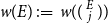 $ w(E) \, :\!= \, w({(\begin{smallmatrix} E \\ j \end{smallmatrix})})$
for general
$ w(E) \, :\!= \, w({(\begin{smallmatrix} E \\ j \end{smallmatrix})})$
for general $ E \subseteq \mathcal{H}$
.
$ E \subseteq \mathcal{H}$
.
Given a vertex $ v$
in a hypergraph
$ v$
in a hypergraph $ \mathcal{H}$
, the link of
$ \mathcal{H}$
, the link of $ v$
in
$ v$
in $ \mathcal{H}$
is the hypergraph
$ \mathcal{H}$
is the hypergraph $\mathcal{H}_{-v} = \{ E \setminus \{ v \} \, : \, E \in \mathcal{H}, v \in E \}$
on vertex set
$\mathcal{H}_{-v} = \{ E \setminus \{ v \} \, : \, E \in \mathcal{H}, v \in E \}$
on vertex set $ V(\mathcal{H}) \setminus \{ v \}$
, that is the set of all partial edges which are completed by
$ V(\mathcal{H}) \setminus \{ v \}$
, that is the set of all partial edges which are completed by $ v$
to form an edge of
$ v$
to form an edge of $ \mathcal{H}$
. Now say that a pair of edges
$ \mathcal{H}$
. Now say that a pair of edges $ e, f \in \mathcal{H}$
is an
$ e, f \in \mathcal{H}$
is an $(\varepsilon , C)$
-conflict-sharing pair (or just
$(\varepsilon , C)$
-conflict-sharing pair (or just $ \varepsilon$
-conflict-sharing pair since
$ \varepsilon$
-conflict-sharing pair since $ \mathcal{C}$
is usually obvious from context) if
$ \mathcal{C}$
is usually obvious from context) if $ |(\mathcal{C}_{-e})^{(j')} \cap (\mathcal{C}_{-f})^{(j')}| \gt d^{j' - \varepsilon }$
for some
$ |(\mathcal{C}_{-e})^{(j')} \cap (\mathcal{C}_{-f})^{(j')}| \gt d^{j' - \varepsilon }$
for some $ j' \in [\ell - 1]$
. Then given a conflict hypergraph
$ j' \in [\ell - 1]$
. Then given a conflict hypergraph $ \mathcal{C}$
for
$ \mathcal{C}$
for $ \mathcal{\mathcal{H}}$
, a
$ \mathcal{\mathcal{H}}$
, a $ j$
-uniform
$ j$
-uniform $ \ell$
-test function
$ \ell$
-test function $ w$
for
$ w$
for $ \mathcal{H}$
, and
$ \mathcal{H}$
, and $ d, \varepsilon \gt 0$
, we say that
$ d, \varepsilon \gt 0$
, we say that $ w$
$ w$ $is (d, \varepsilon , C)-trackable$
if
$is (d, \varepsilon , C)-trackable$
if
-
(W1)
$ w(\mathcal{H}) \ge d^{j + \varepsilon }$
; -
(W2)
$ w(\{ E \in {(\begin{smallmatrix} \mathcal{H} \\ j \end{smallmatrix})} \,\, :\, E \, \supseteq E' \}) \le w(\mathcal{H}) / d^{j' + \varepsilon / 2}$
for all
$ j' \in [j - 1]$
and
$ E' \in {(\begin{smallmatrix} \mathcal{H} \\ j' \end{smallmatrix})}$
; -
(W3)
$ w(E) = 0$
for any
$ E \in {(\begin{smallmatrix} \mathcal{H} \\ j \end{smallmatrix})}$
with
$ e,f \in E$
for some
$ 2 \varepsilon$
-conflict-sharing pair
$ e, f \in \mathcal{H}$
; -
(W4)
$ w(E) = 0$
for all
$ E \in {(\begin{smallmatrix} \mathcal{H} \\ j \end{smallmatrix})}$
which are not
$ \mathcal{C}$
-free.


We will make use of trackable test functions in our proof to bound the number of mixed conflicts whose $ \mathcal{H}_1$
-part is chosen in the first matching, meaning that their
$ \mathcal{H}_1$
-part is chosen in the first matching, meaning that their $ \mathcal{H}_2$
-part needs to be avoided in the second matching. For some intuition behind conditions (W 1)–(W 4), we refer the reader again to [Reference Glock, Joos, Kim, Kühn and Lichev12], specifically the explanation of their conditions (Z1)–(Z4) in Section 3. We may now state the original theorem, a simplified variant of the main result from [Reference Glock, Joos, Kim, Kühn and Lichev12]. Note that the absence of conflict-sharing pairs in the matching is not given by any of the theorem statements in the original paper, but follows from the proof, in which such pairs are added as conflicts of size 2.Footnote
2
$ \mathcal{H}_2$
-part needs to be avoided in the second matching. For some intuition behind conditions (W 1)–(W 4), we refer the reader again to [Reference Glock, Joos, Kim, Kühn and Lichev12], specifically the explanation of their conditions (Z1)–(Z4) in Section 3. We may now state the original theorem, a simplified variant of the main result from [Reference Glock, Joos, Kim, Kühn and Lichev12]. Note that the absence of conflict-sharing pairs in the matching is not given by any of the theorem statements in the original paper, but follows from the proof, in which such pairs are added as conflicts of size 2.Footnote
2
Theorem 4.1.
For all $ k, \ell \ge 2$
, there exists
$ k, \ell \ge 2$
, there exists $ \varepsilon _0 \gt 0$
such that for all
$ \varepsilon _0 \gt 0$
such that for all $ \varepsilon \in (0, \varepsilon _0)$
, there exists
$ \varepsilon \in (0, \varepsilon _0)$
, there exists $ d_0$
such that the following holds for all
$ d_0$
such that the following holds for all $ d \ge d_0$
. Suppose
$ d \ge d_0$
. Suppose $ \mathcal{H}$
is a
$ \mathcal{H}$
is a $ k$
-graph on
$ k$
-graph on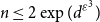 $ n \le {2} \exp (d^{\varepsilon ^3})$
vertices with
$ n \le {2} \exp (d^{\varepsilon ^3})$
vertices with $ (1 - d^{-\varepsilon }) d \le \delta (\mathcal{H}) \le \Delta (\mathcal{H}) \le d$
and
$ (1 - d^{-\varepsilon }) d \le \delta (\mathcal{H}) \le \Delta (\mathcal{H}) \le d$
and $ \Delta _2(\mathcal{H}) \le d^{1 - \varepsilon }$
and suppose
$ \Delta _2(\mathcal{H}) \le d^{1 - \varepsilon }$
and suppose $ \mathcal{C}$
is a
$ \mathcal{C}$
is a $ (d, \ell , \varepsilon )$
-bounded conflict hypergraph for
$ (d, \ell , \varepsilon )$
-bounded conflict hypergraph for $ \mathcal{H}$
. Suppose also that
$ \mathcal{H}$
. Suppose also that $ \mathcal{Y}$
is a set of
$ \mathcal{Y}$
is a set of $ (d, \varepsilon / {10}, \mathcal{C})$
-trackable
$ (d, \varepsilon / {10}, \mathcal{C})$
-trackable $ \ell$
-test functions for
$ \ell$
-test functions for $ \mathcal{H}$
of uniformity at most
$ \mathcal{H}$
of uniformity at most $ \ell$
with
$ \ell$
with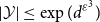 $ |\mathcal{Y}| \le \exp (d^{\varepsilon ^3})$
. Then, there exists a
$ |\mathcal{Y}| \le \exp (d^{\varepsilon ^3})$
. Then, there exists a $ \mathcal{C}$
-free matching
$ \mathcal{C}$
-free matching $ \mathcal{M} \subseteq \mathcal{H}$
of size at least
$ \mathcal{M} \subseteq \mathcal{H}$
of size at least $ (1 - d^{-2\varepsilon ^3})\frac {n}{k}$
with
$ (1 - d^{-2\varepsilon ^3})\frac {n}{k}$
with $ w(\mathcal{M}) = (1 \pm d^{-\varepsilon ^3}) d^{-j} w(\mathcal{H})$
for all
$ w(\mathcal{M}) = (1 \pm d^{-\varepsilon ^3}) d^{-j} w(\mathcal{H})$
for all $ j$
-uniform
$ j$
-uniform $ w \in \mathcal{Y}$
. Furthermore,
$ w \in \mathcal{Y}$
. Furthermore, $ \mathcal{M}$
contains no
$ \mathcal{M}$
contains no $ (\varepsilon / 2, \mathcal{C})$
-conflict-sharing pairs.
$ (\varepsilon / 2, \mathcal{C})$
-conflict-sharing pairs.
In order to prove Theorem 3.1, we require a slight extension, for which we make another definition; we say a $ j$
-uniform test function
$ j$
-uniform test function $is (d, \varepsilon , C)$
-semi-trackable if it satisfies the alternative conditions
$is (d, \varepsilon , C)$
-semi-trackable if it satisfies the alternative conditions
-
(W1*)
$ w(\mathcal{H}) \le d^{j + 2 \varepsilon }$
; -
(W2*)
$ w(\{ E \in {(\begin{smallmatrix} \mathcal{H} \\ j \end{smallmatrix})} \, : \, E \supseteq E' \}) \le \varepsilon ^{-1} d^{j - j'}$
for all
$ j' \in [j - 1]$
and
$ E' \in {(\begin{smallmatrix} \mathcal{H} \\ j' \end{smallmatrix})} $
;




as well as (W3) and (W4). Observe also here that, if (W1) holds, then (W2 $^*$
) implies (W2), so we will usually just check (W2*) when proving that test functions are trackable.
$^*$
) implies (W2), so we will usually just check (W2*) when proving that test functions are trackable.
For such functions, it is not in general possible to guarantee the same estimate $ w(\mathcal{M}) = (1 \pm d^{-\varepsilon ^3}) d^{-j} w(\mathcal{H})$
, because the heuristically expected value is too small and therefore subject to outlying events; for a simple example, let
$ w(\mathcal{M}) = (1 \pm d^{-\varepsilon ^3}) d^{-j} w(\mathcal{H})$
, because the heuristically expected value is too small and therefore subject to outlying events; for a simple example, let $ v \in V(\mathcal{H})$
, choose
$ v \in V(\mathcal{H})$
, choose $ Z$
to be some set of size
$ Z$
to be some set of size $ d(v) / 2$
of edges that contain
$ d(v) / 2$
of edges that contain $ v$
, and take
$ v$
, and take $ w$
as the indicator function of
$ w$
as the indicator function of $ Z$
, then (heuristically, imagining
$ Z$
, then (heuristically, imagining $ \mathcal{M}$
to be appropriately pseudorandom), the expected value of
$ \mathcal{M}$
to be appropriately pseudorandom), the expected value of $ w(\mathcal{M})$
is (approximately)
$ w(\mathcal{M})$
is (approximately) $ 1 / 2$
but clearly we cannot guarantee concentration close to
$ 1 / 2$
but clearly we cannot guarantee concentration close to $ 1 / 2$
since
$ 1 / 2$
since $ w$
takes values in
$ w$
takes values in $ \{ 0, 1 \}$
. It is however obvious in this case that
$ \{ 0, 1 \}$
. It is however obvious in this case that $ w(\mathcal{M})$
can be bounded from above, namely by
$ w(\mathcal{M})$
can be bounded from above, namely by $ 1$
. More generally, we might hope that for semi-trackable test functions, we can make use of the bound on
$ 1$
. More generally, we might hope that for semi-trackable test functions, we can make use of the bound on $ w(\mathcal{H})$
to guarantee that at least
$ w(\mathcal{H})$
to guarantee that at least $ w(\mathcal{M})$
is not too large; indeed, this turns out to be possible.
$ w(\mathcal{M})$
is not too large; indeed, this turns out to be possible.
Theorem 4.2.
Assume the setup of Theorem 4.1
, but allow $ \mathcal{Y}$
to contain also some
$ \mathcal{Y}$
to contain also some $ (d, \varepsilon / {10}, \mathcal{C})$
-semi-trackable
$ (d, \varepsilon / {10}, \mathcal{C})$
-semi-trackable $ \ell$
-test functions. Then there exists a
$ \ell$
-test functions. Then there exists a $ \mathcal{C}$
-free matching
$ \mathcal{C}$
-free matching $ \mathcal{M} \subseteq \mathcal{H}$
of size at least
$ \mathcal{M} \subseteq \mathcal{H}$
of size at least $ (1 - d^{-\varepsilon ^3})\frac {n}{k}$
, containing no
$ (1 - d^{-\varepsilon ^3})\frac {n}{k}$
, containing no $ (\varepsilon / 2, \mathcal{C})$
-conflict-sharing pairs, with
$ (\varepsilon / 2, \mathcal{C})$
-conflict-sharing pairs, with $ w(\mathcal{M}) = (1 \pm d^{-\varepsilon ^3}) d^{-j} w(\mathcal{H})$
for all
$ w(\mathcal{M}) = (1 \pm d^{-\varepsilon ^3}) d^{-j} w(\mathcal{H})$
for all $ j$
-uniform trackable
$ j$
-uniform trackable $ w \in \mathcal{Y}$
and
$ w \in \mathcal{Y}$
and $ w(\mathcal{M}) \le d^{\varepsilon / {4}}$
for all semi-trackable
$ w(\mathcal{M}) \le d^{\varepsilon / {4}}$
for all semi-trackable $ w \in \mathcal{Y}$
.
$ w \in \mathcal{Y}$
.
Proof.
Our strategy will be to extend $ \mathcal{H}$
using some new dummy vertices and edges, allowing us to extend
$ \mathcal{H}$
using some new dummy vertices and edges, allowing us to extend $ w$
to a new test function
$ w$
to a new test function $ w'$
which agrees with
$ w'$
which agrees with $ w$
on
$ w$
on $ \mathcal{H}$
, but is also positive on sufficiently many subsets of the new edges to satisfy (W 1). We then obtain the usual estimate for the value of
$ \mathcal{H}$
, but is also positive on sufficiently many subsets of the new edges to satisfy (W 1). We then obtain the usual estimate for the value of $ w'(\mathcal{M})$
, which in particular gives us the required crude upper bound for
$ w'(\mathcal{M})$
, which in particular gives us the required crude upper bound for $ w(\mathcal{M})$
.
$ w(\mathcal{M})$
.
Let $ S$
be a set of
$ S$
be a set of $ m$
new vertices, disjoint from
$ m$
new vertices, disjoint from $ V(\mathcal{H})$
, with
$ V(\mathcal{H})$
, with $ m$
chosen such that
$ m$
chosen such that $ (1 - d^{-\varepsilon }) d \le {(\begin{smallmatrix} m - 1 \\ k - 1 \end{smallmatrix})} \le d$
, noting that this is possible for
$ (1 - d^{-\varepsilon }) d \le {(\begin{smallmatrix} m - 1 \\ k - 1 \end{smallmatrix})} \le d$
, noting that this is possible for $ \varepsilon \lt (k - 1)^{-1}$
. Note that
$ \varepsilon \lt (k - 1)^{-1}$
. Note that $ m \le k d^{1/(k - 1)}$
and
$ m \le k d^{1/(k - 1)}$
and $ d^{\varepsilon } \le m \le n$
since
$ d^{\varepsilon } \le m \le n$
since $ d \le {(\begin{smallmatrix} n-1 \\ k - 1 \end{smallmatrix})} $
. Let
$ d \le {(\begin{smallmatrix} n-1 \\ k - 1 \end{smallmatrix})} $
. Let $ \mathcal{K}$
be the complete
$ \mathcal{K}$
be the complete $ k$
-graph on vertex set
$ k$
-graph on vertex set $ S$
, and define
$ S$
, and define $ \mathcal{H}'$
to be the (disjoint) union of
$ \mathcal{H}'$
to be the (disjoint) union of $ \mathcal{H}$
with
$ \mathcal{H}$
with $ \ell$
vertex-disjoint copies of
$ \ell$
vertex-disjoint copies of $ \mathcal{K}$
, say
$ \mathcal{K}$
, say $ \mathcal{K}_1, \ldots , \mathcal{K}_{\ell }$
on vertex sets
$ \mathcal{K}_1, \ldots , \mathcal{K}_{\ell }$
on vertex sets $ S_1, \ldots , S_{\ell }$
, respectively. Then, by definition,
$ S_1, \ldots , S_{\ell }$
, respectively. Then, by definition, $ \mathcal{H}'$
is essentially regular as required for Theorem 4.1, and
$ \mathcal{H}'$
is essentially regular as required for Theorem 4.1, and $ \Delta _2(\mathcal{K}) \le m^{k - 2} \le k^{k - 2} d^{1 - 1 / (k - 1)} \le d^{1 - \varepsilon }$
, as we can choose
$ \Delta _2(\mathcal{K}) \le m^{k - 2} \le k^{k - 2} d^{1 - 1 / (k - 1)} \le d^{1 - \varepsilon }$
, as we can choose $ \varepsilon _0 \lt (k - 1)^{-1} / 2$
.
$ \varepsilon _0 \lt (k - 1)^{-1} / 2$
.
For each $ i \in [\ell ]$
, choose any subset
$ i \in [\ell ]$
, choose any subset $ T_i \subseteq S_i$
of size
$ T_i \subseteq S_i$
of size $ t \, :\!= \, 2 d^{\varepsilon / {5}}$
and enumerate its vertices arbitrarily as
$ t \, :\!= \, 2 d^{\varepsilon / {5}}$
and enumerate its vertices arbitrarily as $ v_1^i, \ldots , v_t^i$
. For each
$ v_1^i, \ldots , v_t^i$
. For each $ j \in [\ell ]$
, define
$ j \in [\ell ]$
, define
 \begin{align*} \mathcal{Z}_j \, :\!= \, \left \{ \{ e_1, \ldots , e_j \}\in {(\begin{smallmatrix} \mathcal{H}' \\ j \end{smallmatrix})} \,: \, \exists s \in [t] \text{ such that } e_i \cap T_i = \{ v_s^i \} \ \forall i \in [j] \right \} \subseteq {(\begin{smallmatrix} \mathcal{H}' \\ j \end{smallmatrix})}. \end{align*}
We claim that the indicator function $ \unicode {x1D7D9}(\mathcal{Z}_j)$
is a
$ \unicode {x1D7D9}(\mathcal{Z}_j)$
is a $ (d, \varepsilon / {5}, \mathcal{C})$
-trackable
$ (d, \varepsilon / {5}, \mathcal{C})$
-trackable $ \ell$
-test function, for each
$ \ell$
-test function, for each $ j \in [\ell ]$
.
$ j \in [\ell ]$
.
Clearly every element of $ \mathcal{Z}_j$
is a matching. For (W 1), observe that
$ \mathcal{Z}_j$
is a matching. For (W 1), observe that $ d^{j + \varepsilon / {5}} \le |\mathcal{Z}_j| \le 2 d^{j + \varepsilon / {5}}$
, since there are
$ d^{j + \varepsilon / {5}} \le |\mathcal{Z}_j| \le 2 d^{j + \varepsilon / {5}}$
, since there are $ t=2 d^{\varepsilon / {5}}$
possible choices of
$ t=2 d^{\varepsilon / {5}}$
possible choices of $ s$
, and then at least
$ s$
, and then at least $ (1 - d^{-\varepsilon / 3}) d$
(and at most
$ (1 - d^{-\varepsilon / 3}) d$
(and at most $ d$
) choices for each edge
$ d$
) choices for each edge $ e_i$
. Indeed, the number of choices for
$ e_i$
. Indeed, the number of choices for $ e_i$
is exactly the number of edges containing
$ e_i$
is exactly the number of edges containing $ v_s^i$
but no other element of
$ v_s^i$
but no other element of $ T_i$
; by (H 2), the number of edges containing
$ T_i$
; by (H 2), the number of edges containing $ v_s^i$
and any other element
$ v_s^i$
and any other element $ u \in T_i$
is bounded by
$ u \in T_i$
is bounded by $ 2 d^{\varepsilon / {5}} \cdot d^{1 - \varepsilon } \le 2 d^{1 - \varepsilon / {5}}$
, so the desired bound follows.
$ 2 d^{\varepsilon / {5}} \cdot d^{1 - \varepsilon } \le 2 d^{1 - \varepsilon / {5}}$
, so the desired bound follows.
For (W 2 $^*$
), note that given a set
$^*$
), note that given a set $ E' \in {(\begin{smallmatrix} \mathcal{H}' \\ j' \end{smallmatrix})} $
for some
$ E' \in {(\begin{smallmatrix} \mathcal{H}' \\ j' \end{smallmatrix})} $
for some $ j' \in [j - 1]$
, which belongs to some set
$ j' \in [j - 1]$
, which belongs to some set $ E \in \mathcal{Z}_j$
, the choice of
$ E \in \mathcal{Z}_j$
, the choice of $ s \in [t]$
is fixed by
$ s \in [t]$
is fixed by $ E'$
, as are
$ E'$
, as are $ j'$
of the edges of
$ j'$
of the edges of $ E$
. Hence
$ E$
. Hence $ \unicode {x1D7D9}(\mathcal{Z}_j)(\{ E \in {(\begin{smallmatrix} \mathcal{H} \\ j \end{smallmatrix})} \, : \, E \supseteq E' \}) \le d^{j - j'}$
. The conditions (W 3) and (W 4) are trivial since there are no conflicts containing edges from
$ \unicode {x1D7D9}(\mathcal{Z}_j)(\{ E \in {(\begin{smallmatrix} \mathcal{H} \\ j \end{smallmatrix})} \, : \, E \supseteq E' \}) \le d^{j - j'}$
. The conditions (W 3) and (W 4) are trivial since there are no conflicts containing edges from $ \mathcal{H}' \setminus \mathcal{H}$
.
$ \mathcal{H}' \setminus \mathcal{H}$
.
Now we may define, for eachFootnote
3 $ j \in [\ell ]$
and each
$ j \in [\ell ]$
and each $ j$
-uniform semi-trackable
$ j$
-uniform semi-trackable $ w \in \mathcal{Y}$
, a new test function
$ w \in \mathcal{Y}$
, a new test function $ w'\colon \ {(\begin{smallmatrix} \mathcal{H}' \\ j \end{smallmatrix})} \to [0, 1]$
by
$ w'\colon \ {(\begin{smallmatrix} \mathcal{H}' \\ j \end{smallmatrix})} \to [0, 1]$
by $ w'(E) \, :\!= \, w(E) + \unicode {x1D7D9}(\mathcal{Z}_j)(E)$
for
$ w'(E) \, :\!= \, w(E) + \unicode {x1D7D9}(\mathcal{Z}_j)(E)$
for $ E \subseteq \mathcal{H}$
, and
$ E \subseteq \mathcal{H}$
, and $ w'(E) \, :\!= \, 0$
otherwise, and observe that
$ w'(E) \, :\!= \, 0$
otherwise, and observe that $ w'$
is
$ w'$
is $ (d, \varepsilon / {10}, \mathcal{C})$
-trackable. Indeed,
$ (d, \varepsilon / {10}, \mathcal{C})$
-trackable. Indeed, $ w'(\mathcal{H}') = w'(\mathcal{H}) \ge |\mathcal{Z}_j| \ge d^{j + \varepsilon / {5}}$
so (W 1) is satisfied, and (W 2) follows from (W 2
$ w'(\mathcal{H}') = w'(\mathcal{H}) \ge |\mathcal{Z}_j| \ge d^{j + \varepsilon / {5}}$
so (W 1) is satisfied, and (W 2) follows from (W 2 $^*$
) for
$^*$
) for $ w$
and
$ w$
and $ \unicode {x1D7D9}(\mathcal{Z}_j)$
, using the fact that
$ \unicode {x1D7D9}(\mathcal{Z}_j)$
, using the fact that $ {(\varepsilon ^{-1} + 1)} d^{j - j'} \le d^{-j' - \varepsilon / {10}} w'(\mathcal{H})$
. The remaining conditions (W 3) and (W 4) for
$ {(\varepsilon ^{-1} + 1)} d^{j - j'} \le d^{-j' - \varepsilon / {10}} w'(\mathcal{H})$
. The remaining conditions (W 3) and (W 4) for $ w'$
follow immediately from the fact that they hold for
$ w'$
follow immediately from the fact that they hold for $ w$
and
$ w$
and $ \unicode {x1D7D9}(\mathcal{Z}_j)$
. Note that
$ \unicode {x1D7D9}(\mathcal{Z}_j)$
. Note that $ \mathcal{C}$
is also
$ \mathcal{C}$
is also $ (d, \ell , \varepsilon )$
-bounded for
$ (d, \ell , \varepsilon )$
-bounded for $ \mathcal{H}'$
by definition. Since also
$ \mathcal{H}'$
by definition. Since also $ w'(\mathcal{H}) \le 3 d^{j + \varepsilon / {5}}$
, applying Theorem 4.1 to
$ w'(\mathcal{H}) \le 3 d^{j + \varepsilon / {5}}$
, applying Theorem 4.1 to $ \mathcal{H}'$
with each
$ \mathcal{H}'$
with each $ w$
replaced by the corresponding
$ w$
replaced by the corresponding $ w'$
gives us a
$ w'$
gives us a $ \mathcal{C}$
-free matching
$ \mathcal{C}$
-free matching $ \mathcal{M}' \subseteq \mathcal{H}'$
containing no
$ \mathcal{M}' \subseteq \mathcal{H}'$
containing no $(\varepsilon /2, \mathcal{C})$
-conflict-sharing pairs such that
$(\varepsilon /2, \mathcal{C})$
-conflict-sharing pairs such that $ w'(\mathcal{M}') = (1 \pm d^{-\varepsilon ^3}) d^{-j} w'(\mathcal{H}') \le 4 d^{\varepsilon / {5}}$
.
$ w'(\mathcal{M}') = (1 \pm d^{-\varepsilon ^3}) d^{-j} w'(\mathcal{H}') \le 4 d^{\varepsilon / {5}}$
.
Let $ \mathcal{M} \, :\!= \, \mathcal{M}' \cap \mathcal{H}$
. Then
$ \mathcal{M} \, :\!= \, \mathcal{M}' \cap \mathcal{H}$
. Then $ w(\mathcal{M}) \le w'(\mathcal{M}') \le d^{\varepsilon / {4}}$
as required. Clearly
$ w(\mathcal{M}) \le w'(\mathcal{M}') \le d^{\varepsilon / {4}}$
as required. Clearly $ \mathcal{M}$
is
$ \mathcal{M}$
is $ \mathcal{C}$
-free and contains no conflict-sharing pairs. Since
$ \mathcal{C}$
-free and contains no conflict-sharing pairs. Since $ |V(\mathcal{H}')| \le (\ell + 1) |V(\mathcal{H})|$
, it follows that
$ |V(\mathcal{H}')| \le (\ell + 1) |V(\mathcal{H})|$
, it follows that $ \mathcal{M}$
covers all but a
$ \mathcal{M}$
covers all but a $ d^{-\varepsilon ^3}$
-fraction of
$ d^{-\varepsilon ^3}$
-fraction of $ \mathcal{H}$
.
$ \mathcal{H}$
.
4.2 The Lovász Local Lemma
We now state our other prerequisite, the well-known Lovász Local Lemma, a version of which was originally introduced by Erdős and Lovász [Reference Erdős and László10]. The form we use is an immediate corollary to the general form proved by Spencer [Reference Spencer18].
Lemma 4.3.
Let $ \mathfrak{A} = \{ A_1, \ldots , A_n \}$
be a finite set of events in a probability space, and suppose that, for each
$ \mathfrak{A} = \{ A_1, \ldots , A_n \}$
be a finite set of events in a probability space, and suppose that, for each $ i \in [n]$
, there exists a set
$ i \in [n]$
, there exists a set $ \mathfrak{B}(i) \subseteq [n]$
such that
$ \mathfrak{B}(i) \subseteq [n]$
such that $ A_i$
is mutually independent from
$ A_i$
is mutually independent from $ \{ A_j \, : \, j \in [n] \setminus \mathfrak{B}(i) \}$
. Suppose also that for each
$ \{ A_j \, : \, j \in [n] \setminus \mathfrak{B}(i) \}$
. Suppose also that for each $ i \in [n]$
we have
$ i \in [n]$
we have $ \mathbb{P}[A_i] \lt 1 / 2$
and
$ \mathbb{P}[A_i] \lt 1 / 2$
and $ \sum _{j \in \mathfrak{B}(i)} \mathbb{P}[A_j] \le 1 / 4$
. Then
$ \sum _{j \in \mathfrak{B}(i)} \mathbb{P}[A_j] \le 1 / 4$
. Then $ \mathbb{P}[A_1^C \cap \cdots \cap A_n^C] \gt 0$
.
$ \mathbb{P}[A_1^C \cap \cdots \cap A_n^C] \gt 0$
.
4.3 More general conditions
We prove Theorem 3.1 using slightly weaker conditions than those given in Section 1.1, allowing the case $ j_2 {= |D \cap \mathcal{H}_2|} = 1$
, and giving more freedom to high-degree vertices in
$ j_2 {= |D \cap \mathcal{H}_2|} = 1$
, and giving more freedom to high-degree vertices in $ P$
. Given a set of edges
$ P$
. Given a set of edges $ E \subseteq \mathcal{H}$
, write
$ E \subseteq \mathcal{H}$
, write
 \begin{align*} V_{P} (E) \, :\!= \, \{ y \in P \, : \, y \in e \text{ for some } e \in E \cap \mathcal{H}_2 \} \end{align*}
for the set of vertices of $ P$
found in edges of
$ P$
found in edges of $ \mathcal{H}_2$
in
$ \mathcal{H}_2$
in $ E$
. A limitation of conditions (D 1)–(D 4) is that the number of conflicts is governed uniformly by the the minimum degree in
$ E$
. A limitation of conditions (D 1)–(D 4) is that the number of conflicts is governed uniformly by the the minimum degree in $ \mathcal{H}_2$
. Intuitively, given some conflict
$ \mathcal{H}_2$
. Intuitively, given some conflict $ E \in \mathcal{D}$
, if the vertices in
$ E \in \mathcal{D}$
, if the vertices in $ V_P(E)$
have much higher degrees in
$ V_P(E)$
have much higher degrees in $ \mathcal{H}_2$
, then it should be easier to avoid
$ \mathcal{H}_2$
, then it should be easier to avoid $ E$
because we have more flexibility when choosing edges of
$ E$
because we have more flexibility when choosing edges of $ \mathcal{H}_2$
which are used to cover the vertices of
$ \mathcal{H}_2$
which are used to cover the vertices of $ V_P(E)$
in
$ V_P(E)$
in $ \mathcal{M}_2$
. As such, we can afford to have more conflicts involving vertices of
$ \mathcal{M}_2$
. As such, we can afford to have more conflicts involving vertices of $ P$
with higher degrees in
$ P$
with higher degrees in $ \mathcal{H}_2$
; this motivates the following quantity, which allows us to weight these conflicts accordingly when bounding their number.
$ \mathcal{H}_2$
; this motivates the following quantity, which allows us to weight these conflicts accordingly when bounding their number.
We define the unavoidability of $ E$
to be
$ E$
to be
 \begin{equation} A(E) \, :\!= \, \prod _{y \in V_P(E)} d_{\mathcal{H}_2}^{-1}(y), \end{equation}
and extend this definition to a conflict hypergraph $ {\mathcal{G}}$
by taking the sum over all conflicts, that is
$ {\mathcal{G}}$
by taking the sum over all conflicts, that is $ A({\mathcal{G}}) \, :\!= \, \sum _{E \in {\mathcal{G}}} A(E).$
This has a natural interpretation. Suppose we select for each vertex
$ A({\mathcal{G}}) \, :\!= \, \sum _{E \in {\mathcal{G}}} A(E).$
This has a natural interpretation. Suppose we select for each vertex $ v \in P$
one edge in
$ v \in P$
one edge in $ \mathcal{H}_2$
containing
$ \mathcal{H}_2$
containing $ v$
independently and uniformly at random. Then
$ v$
independently and uniformly at random. Then $ A({\mathcal{G}})$
is the expected number of conflicts in
$ A({\mathcal{G}})$
is the expected number of conflicts in $ {\mathcal{G}}$
of which all edges are selected.
$ {\mathcal{G}}$
of which all edges are selected.
Given $ j_1', j_2' \in [\ell ]$
and sets
$ j_1', j_2' \in [\ell ]$
and sets $ C \in {(\begin{smallmatrix} \mathcal{H}_1 \\ j_1' \end{smallmatrix})} $
and
$ C \in {(\begin{smallmatrix} \mathcal{H}_1 \\ j_1' \end{smallmatrix})} $
and $ D \in {(\begin{smallmatrix} \mathcal{H}_2 \\ j_2' \end{smallmatrix})} $
, write
$ D \in {(\begin{smallmatrix} \mathcal{H}_2 \\ j_2' \end{smallmatrix})} $
, write $ \mathcal{G}_{[C,D]} \, :\!= \, \{ E \in {\mathcal{G}} \, : \, C \cup D \subseteq E \}$
. Then we may define
$ \mathcal{G}_{[C,D]} \, :\!= \, \{ E \in {\mathcal{G}} \, : \, C \cup D \subseteq E \}$
. Then we may define
 \begin{equation} \Delta ^A _{j'_{1},j'_{2}}(\mathcal{G}) \, :\!= \,\max _{C \in {(\begin{smallmatrix} \mathcal{H}_1 \\ j_1' \end{smallmatrix})} , D \in {(\begin{smallmatrix} \mathcal{H}_2 \\ j_2' \end{smallmatrix})}} A({\mathcal{G}}_{[C, D]}), \end{equation}
which can be thought of as analogous to the maximum $ (j_1', j_2')$
-degree
$ (j_1', j_2')$
-degree $ \Delta _{j_1', j_2'}(\mathcal{G})$
(recalling the Definition (3.1)), but with each conflict weighted by its unavoidability. Say that
$ \Delta _{j_1', j_2'}(\mathcal{G})$
(recalling the Definition (3.1)), but with each conflict weighted by its unavoidability. Say that $ \mathcal{D}\, is (d, \ell , \varepsilon , \delta )$
-mixed-bounded if the following hold for all
$ \mathcal{D}\, is (d, \ell , \varepsilon , \delta )$
-mixed-bounded if the following hold for all $ x, y \in P$
and
$ x, y \in P$
and $ j_1 \in [0, \ell ], j_2 \in [\ell ]$
.
$ j_1 \in [0, \ell ], j_2 \in [\ell ]$
.
-
(E1)
$ |D \cap \mathcal{H}_2| \ge 1$
and
$ |D| \in [2, \ell ]$
for each conflict
$ D \in \mathcal{D}$
; -
(E2)
$ A(\mathcal{D}^{(j_1, j_2)}_x) \le d^{j_1 + \delta }$
; -
(E3)
$ \Delta ^A_{j', 0}(\mathcal{D}^{(j_1, j_2)}_x) \le d^{j_1 - j' - \varepsilon }$
for each
$ j' \in [j_1]$
; -
(E4)
$ A(\mathcal{D}^{(j_1, j_2)}_{x, y}) \le d^{j_1 - \varepsilon }$
whenever
$ j_2 \ge 2$
; -
(E5)
$ \Delta _{0, 1}(\mathcal{D}^{(j_1, 1)}_x) \le \ell d^{j_1}$
; -
(E6)
$ \Delta _{j', 1}(\mathcal{D}^{(j_1, 1)}_x) \le d^{j_1 - j' - \varepsilon }$
for each
$ j' \in [j_1 - 1]$
.





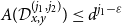




Observe that the conditions (E 2), (E 3), (E 4) are analogous to (D 2), (D 3), (D 4), except conflicts are now weighted by their unavoidability; in particular, for a conflict $ E \in \mathcal{D}^{(j_1, j_2)}$
, it is always the case that
$ E \in \mathcal{D}^{(j_1, j_2)}$
, it is always the case that $ A(E) \le \delta _{P}(\mathcal{H}_2)^{-j_2}$
, so
$ A(E) \le \delta _{P}(\mathcal{H}_2)^{-j_2}$
, so $ (d, \ell , \varepsilon )$
-simply bounded implies
$ (d, \ell , \varepsilon )$
-simply bounded implies $ (d, \ell , \varepsilon , \varepsilon ^4)$
-mixed-bounded. Indeed, (D 2), (D 3), (D 4) imply (E 2), (E 3), (E 4), respectively, using the fact that
$ (d, \ell , \varepsilon , \varepsilon ^4)$
-mixed-bounded. Indeed, (D 2), (D 3), (D 4) imply (E 2), (E 3), (E 4), respectively, using the fact that $A(E) \le |E| \delta _P (\mathcal{H}_2)^{-j_2}$
for every
$A(E) \le |E| \delta _P (\mathcal{H}_2)^{-j_2}$
for every $E \subseteq \mathcal{D}^{(j_1,j_2)}$
. If (D 1) holds then so does (E 1), and in this case both of the conditions (E 5) and (E 6) are vacuous. Note also that conditions (E 5) and (E 6) are stronger versions of (E 2) and (E 3) in the case that
$E \subseteq \mathcal{D}^{(j_1,j_2)}$
. If (D 1) holds then so does (E 1), and in this case both of the conditions (E 5) and (E 6) are vacuous. Note also that conditions (E 5) and (E 6) are stronger versions of (E 2) and (E 3) in the case that $ j_2 = 1$
, requiring small degrees and codegrees for every individual edge
$ j_2 = 1$
, requiring small degrees and codegrees for every individual edge $ e \in \mathcal{H}_2$
, rather than just for the sum over all such
$ e \in \mathcal{H}_2$
, rather than just for the sum over all such $ e$
containing a particular vertex
$ e$
containing a particular vertex $ x \in P$
.
$ x \in P$
.
In a similar fashion, we may also weaken the degree conditions (H 3) and (H 4) slightly. Define analogously the unavoidability of a vertex $ v \in R$
to be
$ v \in R$
to be
 \begin{align*} A(v) \, :\!= \, \sum _{x \in P} \frac {d_{\mathcal{H}_2}(x, v)}{d_{\mathcal{H}_2}(x)} \text{.} \end{align*}
Then we may require only that for all $ x \in P$
and
$ x \in P$
and $ v \in R$
,
$ v \in R$
,
-
(H3′)
$ A(v) \le d^{\varepsilon ^4}$
(and in particular
$ \delta _{P}(\mathcal{H}_2) \ge 1$
); -
(H4′)
$ d_{\mathcal{H}_2}(x, v) \le d^{-\varepsilon } d_{\mathcal{H}_2}(x)$
.


Recalling that each edge of $ \mathcal{H}_2$
contains exactly one vertex of
$ \mathcal{H}_2$
contains exactly one vertex of $ P$
, note that by definition
$ P$
, note that by definition $A(v) \delta _{P}(\mathcal{H}_2) \le \sum _{x \in P} d(x, v) = d_{\mathcal{H}_2}(v)$
so (H3) implies (H1′), and clearly (H4) implies (H2′). Observe furthermore that (H1′) and (H2′) together imply that
$A(v) \delta _{P}(\mathcal{H}_2) \le \sum _{x \in P} d(x, v) = d_{\mathcal{H}_2}(v)$
so (H3) implies (H1′), and clearly (H4) implies (H2′). Observe furthermore that (H1′) and (H2′) together imply that $ \delta _{P}(\mathcal{H}_2) \ge d^{\varepsilon }$
; indeed, by (H1′) we must have
$ \delta _{P}(\mathcal{H}_2) \ge d^{\varepsilon }$
; indeed, by (H1′) we must have $ d_{\mathcal{H}_2}(x) \ge 1$
for every
$ d_{\mathcal{H}_2}(x) \ge 1$
for every $ x \in P$
, so there is some
$ x \in P$
, so there is some $ v \in R$
with
$ v \in R$
with $ d_{\mathcal{H}_2}(x, v) \ge 1$
, and then by (H2′) this means
$ d_{\mathcal{H}_2}(x, v) \ge 1$
, and then by (H2′) this means $ d_{\mathcal{H}_2}(x) \ge d^{\varepsilon }$
.
$ d_{\mathcal{H}_2}(x) \ge d^{\varepsilon }$
.
5. Proof of theorem 3.1
We assume the setting described in Theorem 3.1 and devote the entirety of this section to its proof. However, write $ \mathcal{D}'$
in place of
$ \mathcal{D}'$
in place of $ \mathcal{D}$
and assume that it is a
$ \mathcal{D}$
and assume that it is a $ (d, \ell , \varepsilon , \varepsilon ^4)$
-mixed-bounded conflict hypergraph. Introduce new constants
$ (d, \ell , \varepsilon , \varepsilon ^4)$
-mixed-bounded conflict hypergraph. Introduce new constants $ \ell ', \Gamma , i^\ast \in \mathbb{N}$
according to the hierarchy
$ \ell ', \Gamma , i^\ast \in \mathbb{N}$
according to the hierarchy $ 0 \lt 1/d \ll \varepsilon \ll 1/\ell ' \ll 1/\Gamma \ll 1/i^* \ll 1/\ell , 1/k$
.
$ 0 \lt 1/d \ll \varepsilon \ll 1/\ell ' \ll 1/\Gamma \ll 1/i^* \ll 1/\ell , 1/k$
.
5.1 Proof outline
Recall our two-stage proof method outlined in Section 1.1. We first apply Theorem 4.2 to $ \mathcal{H}_1$
to give a conflict-free matching
$ \mathcal{H}_1$
to give a conflict-free matching $ \mathcal{M}_1 \subseteq \mathcal{H}_1$
covering most of the vertices of
$ \mathcal{M}_1 \subseteq \mathcal{H}_1$
covering most of the vertices of $ P$
. We then extend this to a covering of
$ P$
. We then extend this to a covering of $ P$
by randomly choosing, for each vertex
$ P$
by randomly choosing, for each vertex $ x \in P$
which is not already covered by
$ x \in P$
which is not already covered by $ \mathcal{M}_1$
, some edge from
$ \mathcal{M}_1$
, some edge from $ \mathcal{H}_2$
to cover
$ \mathcal{H}_2$
to cover $ x$
; call the resulting set of edges
$ x$
; call the resulting set of edges $ \mathcal{M}_2 \subseteq \mathcal{H}_2$
. Using the Lovász Local Lemma, we show that with non-zero probability
$ \mathcal{M}_2 \subseteq \mathcal{H}_2$
. Using the Lovász Local Lemma, we show that with non-zero probability $ \mathcal{M}_2$
is indeed a matching, and the full matching
$ \mathcal{M}_2$
is indeed a matching, and the full matching $ \mathcal{M} \, :\!= \, \mathcal{M}_1 \cup \mathcal{M}_2$
is conflict-free. This approach presents several challenges which must be overcome.
$ \mathcal{M} \, :\!= \, \mathcal{M}_1 \cup \mathcal{M}_2$
is conflict-free. This approach presents several challenges which must be overcome.
Firstly, Theorem 4.2 requires $ \mathcal{H}_1$
to be essentially vertex-regular, but (H 1) provides no lower bound on the degrees of vertices in
$ \mathcal{H}_1$
to be essentially vertex-regular, but (H 1) provides no lower bound on the degrees of vertices in $ Q$
. We solve this in Section 5.2 by adding dummy vertices and edges to increase the vertex degrees in
$ Q$
. We solve this in Section 5.2 by adding dummy vertices and edges to increase the vertex degrees in $ Q$
. Secondly, it need not be the case that the randomly chosen edges of
$ Q$
. Secondly, it need not be the case that the randomly chosen edges of $ \mathcal{M}_2$
form a matching. We solve this in Section 5.3 by simply adding non-disjoint pairs of edges in
$ \mathcal{M}_2$
form a matching. We solve this in Section 5.3 by simply adding non-disjoint pairs of edges in $ \mathcal{H}_2$
as additional conflicts of size 2, replacing
$ \mathcal{H}_2$
as additional conflicts of size 2, replacing $ \mathcal{D}'$
by a larger conflict hypergraph
$ \mathcal{D}'$
by a larger conflict hypergraph $ \mathcal{D}$
, and thus forcing
$ \mathcal{D}$
, and thus forcing $ \mathcal{M}_2$
to be a matching.
$ \mathcal{M}_2$
to be a matching.
The next challenge is to ensure that we can choose $ \mathcal{M}_2$
such that
$ \mathcal{M}_2$
such that $ \mathcal{M}$
is conflict-free. The conflicts we must avoid are of the form
$ \mathcal{M}$
is conflict-free. The conflicts we must avoid are of the form $ C \cup D$
, where two conditions hold:
$ C \cup D$
, where two conditions hold: $ C \subseteq \mathcal{M}_1$
and no edge in
$ C \subseteq \mathcal{M}_1$
and no edge in $ D$
contains a vertex of
$ D$
contains a vertex of $ P$
which has already been chosen in
$ P$
which has already been chosen in $ \mathcal{M}_1$
. If the second condition does not hold, we say that
$ \mathcal{M}_1$
. If the second condition does not hold, we say that $ D$
is blocked. In order to ensure that no such
$ D$
is blocked. In order to ensure that no such $ D$
is contained in
$ D$
is contained in $ \mathcal{M}_2$
, we seek to bound from above the total number of unblocked potential conflicts involving a given vertex
$ \mathcal{M}_2$
, we seek to bound from above the total number of unblocked potential conflicts involving a given vertex $ x \in P$
in some edge of
$ x \in P$
in some edge of $ D \subseteq \mathcal{H}_2$
; since most vertices of
$ D \subseteq \mathcal{H}_2$
; since most vertices of $ P$
are already covered by
$ P$
are already covered by $ \mathcal{M}_1$
, this significantly reduces the number of conflicts we need to consider. In Section 5.4, we define test functions to track the number of partial conflicts appearing in the matching
$ \mathcal{M}_1$
, this significantly reduces the number of conflicts we need to consider. In Section 5.4, we define test functions to track the number of partial conflicts appearing in the matching $ \mathcal{M}_1$
, as well as the number of those which are blocked; by taking the difference of these two values we later obtain the desired bound.
$ \mathcal{M}_1$
, as well as the number of those which are blocked; by taking the difference of these two values we later obtain the desired bound.
The final challenge to overcome is that this approach to blocking conflicts fails when $ j_2 = 1$
, since the conflicts contain no other edges of
$ j_2 = 1$
, since the conflicts contain no other edges of $ \mathcal{H}_2$
which might be blocked. We therefore require the stricter bound
$ \mathcal{H}_2$
which might be blocked. We therefore require the stricter bound $ \ell d^{j_1}$
in (E 5) on the number of such conflicts of a given size
$ \ell d^{j_1}$
in (E 5) on the number of such conflicts of a given size $ j_1$
containing a given edge
$ j_1$
containing a given edge $ e \in \mathcal{H}_2$
. Under the assumption that edges in
$ e \in \mathcal{H}_2$
. Under the assumption that edges in $ \mathcal{H}_1$
appear in the matching
$ \mathcal{H}_1$
appear in the matching $ \mathcal{M}_1$
‘pseudorandomly with probability
$ \mathcal{M}_1$
‘pseudorandomly with probability $ d^{-1}$
’ in some suitable sense, this allows the ‘expected number’ of potential conflicts (of any size) for each
$ d^{-1}$
’ in some suitable sense, this allows the ‘expected number’ of potential conflicts (of any size) for each $ e$
to be up to
$ e$
to be up to $ \ell ^2$
; so choosing
$ \ell ^2$
; so choosing $ e$
purely at random still will not suffice. To overcome this, we observe that, assuming that the Poisson paradigm applies to our concept of pseudorandomness, there should be a constant proportion (specifically, at least
$ e$
purely at random still will not suffice. To overcome this, we observe that, assuming that the Poisson paradigm applies to our concept of pseudorandomness, there should be a constant proportion (specifically, at least $ \exp (\!\!-\ell ^2)$
) of the edges
$ \exp (\!\!-\ell ^2)$
) of the edges $ e$
containing any given vertex
$ e$
containing any given vertex $ x$
with no potential conflicts arising from
$ x$
with no potential conflicts arising from $ \mathcal{M}_1$
. Hence for each vertex
$ \mathcal{M}_1$
. Hence for each vertex $ x \in P$
we may restrict our random choice of
$ x \in P$
we may restrict our random choice of $ \mathcal{M}_2$
to only these safe edges. We encode this ‘pseudorandom’ behaviour in a further set of test functions, defined in Section 5.5.
$ \mathcal{M}_2$
to only these safe edges. We encode this ‘pseudorandom’ behaviour in a further set of test functions, defined in Section 5.5.
In Section 5.6, we apply Theorem 4.2 to obtain our matching $ \mathcal{M}_1$
, randomly choose
$ \mathcal{M}_1$
, randomly choose $ \mathcal{M}_2$
, and use the previously defined test functions to bound the number of potential conflicts in each case, so that
$ \mathcal{M}_2$
, and use the previously defined test functions to bound the number of potential conflicts in each case, so that $ \mathcal{M}_2$
is conflict-free with non-zero probability.
$ \mathcal{M}_2$
is conflict-free with non-zero probability.
5.2 Regularising
$ \mathcal{H}_1$

First, in order to apply Theorem 4.2 to the hypergraph $ \mathcal{H}_1$
, we need to ensure that all vertices in
$ \mathcal{H}_1$
, we need to ensure that all vertices in $ \mathcal{H}_1$
have degree roughly
$ \mathcal{H}_1$
have degree roughly $ d$
, rather than just those in
$ d$
, rather than just those in $ P$
; since we only require a
$ P$
; since we only require a $ P$
-perfect matching and make no statement about which vertices of
$ P$
-perfect matching and make no statement about which vertices of $ Q$
are covered, we can achieve this by simply adding dummy edges to boost the degrees of vertices in
$ Q$
are covered, we can achieve this by simply adding dummy edges to boost the degrees of vertices in $ Q$
.
$ Q$
.
Assume that $ q \gt 0$
(otherwise we may skip this step), and let
$ q \gt 0$
(otherwise we may skip this step), and let $ m \, :\!= \, |Q|$
. For each vertex
$ m \, :\!= \, |Q|$
. For each vertex $ v \in Q$
, let
$ v \in Q$
, let $ d' \, :\!= \, d - d_{\mathcal{H}_1}(v)$
and add
$ d' \, :\!= \, d - d_{\mathcal{H}_1}(v)$
and add $ d'$
new edges, each containing
$ d'$
new edges, each containing $ v$
and a set of
$ v$
and a set of $ k - 1$
new vertices, such that each new vertex is only ever contained in one edge. Refer to the set of new vertices as
$ k - 1$
new vertices, such that each new vertex is only ever contained in one edge. Refer to the set of new vertices as $ Q'$
and the set of new edges as
$ Q'$
and the set of new edges as $ \mathcal{E}_Q$
. Add further new vertices until
$ \mathcal{E}_Q$
. Add further new vertices until $ Q'$
contains
$ Q'$
contains $ |Q| dm$
vertices. Next, let
$ |Q| dm$
vertices. Next, let $ \mathcal{F}'$
be a binomial random
$ \mathcal{F}'$
be a binomial random $ k$
-graph with vertex set
$ k$
-graph with vertex set $ Q'$
and expected degree
$ Q'$
and expected degree $ (1 - d^{-\varepsilon } / 2) d$
. It is routine to show that, with high probability,
$ (1 - d^{-\varepsilon } / 2) d$
. It is routine to show that, with high probability, $ (1 - d^{-\varepsilon })d \le d_{\mathcal{F}'}(v) \le d - 1$
and
$ (1 - d^{-\varepsilon })d \le d_{\mathcal{F}'}(v) \le d - 1$
and $ d_{\mathcal{F}'}(u, v) \le d^{1 - \varepsilon }$
for all distinct
$ d_{\mathcal{F}'}(u, v) \le d^{1 - \varepsilon }$
for all distinct $ u, v \in Q'$
; take
$ u, v \in Q'$
; take $ \mathcal{F}$
to be a graph satisfying these properties. Note that each
$ \mathcal{F}$
to be a graph satisfying these properties. Note that each $ v \in Q'$
belongs to at most one edge in
$ v \in Q'$
belongs to at most one edge in $ \mathcal{E}_Q$
, so in total
$ \mathcal{E}_Q$
, so in total $ d_{\mathcal{H}}(v) \le d$
. Define the hypergraph
$ d_{\mathcal{H}}(v) \le d$
. Define the hypergraph $ \mathcal{H}_1' \, :\!= \, \mathcal{H}_1 \cup \mathcal{E}_Q \cup \mathcal{F}$
, which we will use in place of
$ \mathcal{H}_1' \, :\!= \, \mathcal{H}_1 \cup \mathcal{E}_Q \cup \mathcal{F}$
, which we will use in place of $ \mathcal{H}_1$
later in the proof.
$ \mathcal{H}_1$
later in the proof.
5.3 Ensuring a matching in
$ \mathcal{H}_2$

Let $ \mathcal{E} \, :\!= \, \{ \{ e, f \} \subseteq \mathcal{H}_2 \, : \, \emptyset \ne e \cap f \subseteq R \}$
be the conflict hypergraph containing as conflicts all pairs of edges in
$ \mathcal{E} \, :\!= \, \{ \{ e, f \} \subseteq \mathcal{H}_2 \, : \, \emptyset \ne e \cap f \subseteq R \}$
be the conflict hypergraph containing as conflicts all pairs of edges in $ \mathcal{H}_2$
that overlap (only) in
$ \mathcal{H}_2$
that overlap (only) in $ R$
. We show that
$ R$
. We show that $\mathcal{E}$
is a
$\mathcal{E}$
is a $ (d, \ell , \varepsilon {/2}, {2}\varepsilon ^4)$
-mixed-bounded hypergraph by verifying that it satisfies (E 1)-(E 6). Note that in particular this implies that
$ (d, \ell , \varepsilon {/2}, {2}\varepsilon ^4)$
-mixed-bounded hypergraph by verifying that it satisfies (E 1)-(E 6). Note that in particular this implies that $ \mathcal{D} \, :\!= \, \mathcal{D}' \cup \mathcal{E}$
is
$ \mathcal{D} \, :\!= \, \mathcal{D}' \cup \mathcal{E}$
is $ (d, \ell , \varepsilon {/3}, {3} \varepsilon ^4)$
-mixed-bounded; indeed, (E 1) is trivial, the bounds in conditions (E 2), (E 3), (E 4) are additive and the bounds in (E 5) and (E 6) are unaffected by
$ (d, \ell , \varepsilon {/3}, {3} \varepsilon ^4)$
-mixed-bounded; indeed, (E 1) is trivial, the bounds in conditions (E 2), (E 3), (E 4) are additive and the bounds in (E 5) and (E 6) are unaffected by $ \mathcal{E}$
.
$ \mathcal{E}$
.
Indeed, the condition (E 1) is clear and (E 3), (E 5), and (E 6) are trivial. For (E 2), note that we need only consider the case $(j_1, j_2)=(0,2)$
and suppose that
$(j_1, j_2)=(0,2)$
and suppose that $ D = \{ e, f \}$
is a conflict containing
$ D = \{ e, f \}$
is a conflict containing $ x \in P$
; say
$ x \in P$
; say $ x \in e$
, and let
$ x \in e$
, and let $ v \in e \cap f \cap R$
and
$ v \in e \cap f \cap R$
and $ y \in f \cap P$
, noting that
$ y \in f \cap P$
, noting that $x \ne y$
. The number of such conflicts
$x \ne y$
. The number of such conflicts $ D$
, given
$ D$
, given $ x, v, y$
, is exactly
$ x, v, y$
, is exactly $ d_{\mathcal{H}_2}(x, v) d_{\mathcal{H}_2}(y, v)$
. Moreover, recalling definitions (4.1) and (4.2), as
$ d_{\mathcal{H}_2}(x, v) d_{\mathcal{H}_2}(y, v)$
. Moreover, recalling definitions (4.1) and (4.2), as $|e \cap P|=|f \cap P|=1$
, we have
$|e \cap P|=|f \cap P|=1$
, we have $ A(D) = d_{\mathcal{H}_2}(x)^{-1} d_{\mathcal{H}_2}(y)^{-1}$
, so we obtain
$ A(D) = d_{\mathcal{H}_2}(x)^{-1} d_{\mathcal{H}_2}(y)^{-1}$
, so we obtain
 \begin{align*} A(\mathcal{E}_x) = \sum _{D \in \mathcal{E}_x} A(D) \le \sum _{v \in R} \sum _{y \in P} \frac {d_{\mathcal{H}_2}(x, v) d_{\mathcal{H}_2}(y, v)}{d_{\mathcal{H}_2}(x) d_{\mathcal{H}_2}(y)} = \sum _{v \in R} \frac {d_{\mathcal{H}_2}(x, v)}{d_{\mathcal{H}_2}(x)} A(v) \le {r} \cdot d^{\varepsilon ^4}, \end{align*}
which suffices, using the fact that $ A(v) \le d^{\varepsilon ^4}$
by (H1′), and noting that we allow the case
$ A(v) \le d^{\varepsilon ^4}$
by (H1′), and noting that we allow the case $ y = x$
in the sum, as we seek only an upper bound. For (E 4), observe that similarly
$ y = x$
in the sum, as we seek only an upper bound. For (E 4), observe that similarly
 \begin{align*} A(\mathcal{E}_{x, y}) \le \sum _{v \in R} \frac {d_{\mathcal{H}_2}(x, v)}{d_{\mathcal{H}_2}(x)} \frac {d_{\mathcal{H}_2}(y, v)}{d_{\mathcal{H}_2}(y)} \stackrel {(\text{H4}^{\prime})}{\le } d^{-\varepsilon } \sum _{v \in R} \frac {d_{\mathcal{H}_2}(x, v)}{d_{\mathcal{H}_2}(x)} = {r} d^{-\varepsilon }, \end{align*}
which suffices. The rest of the proof will show that all of the conflicts in $ \mathcal{D}$
can indeed be avoided when choosing
$ \mathcal{D}$
can indeed be avoided when choosing $ \mathcal{M}_2$
.
$ \mathcal{M}_2$
.
5.4 Tracking mixed conflicts: the case
$ j_2 \ge 2$

In this section, we define a set of test functions and show that they are either trackable or semi-trackable. These will be useful in Section 5.6.4 for showing that the expected number of unblocked conflicts can be appropriately bounded from above such that the Lovász Local Lemma can be used to avoid them.
For the remainder of this section, we fix $ j_1 \in [0, \ell ]$
and
$ j_1 \in [0, \ell ]$
and $ j_2 \in [2, \ell ]$
, and consider only conflicts with
$ j_2 \in [2, \ell ]$
, and consider only conflicts with $ j_1$
and
$ j_1$
and $ j_2$
edges from
$ j_2$
edges from $ \mathcal{H}_1$
and
$ \mathcal{H}_1$
and $ \mathcal{H}_2$
, respectively; for ease of notation, let
$ \mathcal{H}_2$
, respectively; for ease of notation, let $ \mathcal{G} = \mathcal{D}^{(j_1, j_2)}$
(recalling the notation from Section 3.3). For
$ \mathcal{G} = \mathcal{D}^{(j_1, j_2)}$
(recalling the notation from Section 3.3). For $i \in [2]$
, we write
$i \in [2]$
, we write $ Ei(\mathcal{G}) \, :\!= \, \{ E \cap \mathcal{H}_i \, : \, E \in \mathcal{G} \}$
for the set of
$ Ei(\mathcal{G}) \, :\!= \, \{ E \cap \mathcal{H}_i \, : \, E \in \mathcal{G} \}$
for the set of $ \mathcal{H}_i -parts$
of conflicts in
$ \mathcal{H}_i -parts$
of conflicts in $ \mathcal{G}$
.
$ \mathcal{G}$
.
5.4.1 Defining test functions
We extend our previous notation from Section 4.3 by writing $ \mathcal{G}_{[C]} = \mathcal{G}_{[C, \emptyset ]}$
,
$ \mathcal{G}_{[C]} = \mathcal{G}_{[C, \emptyset ]}$
, $ \mathcal{G}_{[C],x} = (\mathcal{G}_{[C]})_{x}$
and
$ \mathcal{G}_{[C],x} = (\mathcal{G}_{[C]})_{x}$
and $ \mathcal{G}_{[C],x,y} = (\mathcal{G}_{[C]})_{x, y}$
, for any
$ \mathcal{G}_{[C],x,y} = (\mathcal{G}_{[C]})_{x, y}$
, for any $ C \subseteq \mathcal{H}_1$
and
$ C \subseteq \mathcal{H}_1$
and $ x, y \in P$
. For the remainder of this section, fix a vertex
$ x, y \in P$
. For the remainder of this section, fix a vertex $ x \in P$
. We first define
$ x \in P$
. We first define $ w_x\colon \ {(\begin{smallmatrix} \mathcal{H}_1 \\ j_1 \end{smallmatrix})} \to \mathbb{R}_{\ge 0}$
by
$ w_x\colon \ {(\begin{smallmatrix} \mathcal{H}_1 \\ j_1 \end{smallmatrix})} \to \mathbb{R}_{\ge 0}$
by
 \begin{align*} w_{x}(C) \, :\!= \, A(\mathcal{G}_{[C], x}), \end{align*}
recalling (4.1). Given a matching $ \mathcal{M}_1 \subseteq \mathcal{H}_1$
containing
$ \mathcal{M}_1 \subseteq \mathcal{H}_1$
containing $ C$
(but not covering
$ C$
(but not covering $ x$
), if we choose
$ x$
), if we choose $ \mathcal{M}_2 \subseteq \mathcal{H}_2$
randomly, then the function
$ \mathcal{M}_2 \subseteq \mathcal{H}_2$
randomly, then the function $ w_x(C)$
represents the expected number of conflicts from
$ w_x(C)$
represents the expected number of conflicts from $ \mathcal{G}$
present in
$ \mathcal{G}$
present in $ \mathcal{M} = \mathcal{M}_1 \cup \mathcal{M}_2$
which have
$ \mathcal{M} = \mathcal{M}_1 \cup \mathcal{M}_2$
which have $ C$
as their
$ C$
as their $ \mathcal{H}_1$
-part and contain
$ \mathcal{H}_1$
-part and contain $ x$
in their
$ x$
in their $ \mathcal{H}_2$
-part. As such,
$ \mathcal{H}_2$
-part. As such, $ w_x(\mathcal{M}_1)$
represents the expected number of conflicts containing
$ w_x(\mathcal{M}_1)$
represents the expected number of conflicts containing $ x$
in their
$ x$
in their $ \mathcal{H}_2$
-part for which the
$ \mathcal{H}_2$
-part for which the $ \mathcal{H}_1$
-part is covered by
$ \mathcal{H}_1$
-part is covered by $ \mathcal{M}_1$
.
$ \mathcal{M}_1$
.
Next, in order to ensure that the test functions we define are trackable, we make an intermediate definition. Say that a set of edges $ E \subseteq \mathcal{H}$
is is testable if it satisfies the following conditions:
$ E \subseteq \mathcal{H}$
is is testable if it satisfies the following conditions:
-
•
$ E \cap \mathcal{H}_1$
is a matching; -
•
$ E$
is
$ \mathcal{C}$
-free; -
•
$ E$
contains no
$ \varepsilon / 2$
-conflict-sharing pairs of edges (as defined in Section 4.1).


Say that $ E$
is untestable if it is not testable.Footnote
4
We may (and do henceforth) assume without loss of generality that all of the conflicts in
$ E$
is untestable if it is not testable.Footnote
4
We may (and do henceforth) assume without loss of generality that all of the conflicts in $ \mathcal{D}$
are testable. Indeed, letting
$ \mathcal{D}$
are testable. Indeed, letting $ \overline {\mathcal{D}} \subseteq \mathcal{D}$
be the set of all testable conflicts, it is clear that
$ \overline {\mathcal{D}} \subseteq \mathcal{D}$
be the set of all testable conflicts, it is clear that $ \overline {\mathcal{D}}$
is also
$ \overline {\mathcal{D}}$
is also $ (d, \ell , \varepsilon /3, 3\varepsilon ^4)$
-mixed-bounded. Furthermore, if we are able to find a matching
$ (d, \ell , \varepsilon /3, 3\varepsilon ^4)$
-mixed-bounded. Furthermore, if we are able to find a matching $ \mathcal{M}_2 \subseteq \mathcal{H}_2$
such that
$ \mathcal{M}_2 \subseteq \mathcal{H}_2$
such that $ \mathcal{M} = \mathcal{M}_1 \cup \mathcal{M}_2$
is
$ \mathcal{M} = \mathcal{M}_1 \cup \mathcal{M}_2$
is $ \overline {\mathcal{D}}$
-free, with
$ \overline {\mathcal{D}}$
-free, with $ \mathcal{M}_1 \subseteq \mathcal{H}_1$
obtained from Theorem 4.2, then
$ \mathcal{M}_1 \subseteq \mathcal{H}_1$
obtained from Theorem 4.2, then $ \mathcal{M}_1$
may not contain any untestable set, which in particular means that
$ \mathcal{M}_1$
may not contain any untestable set, which in particular means that $ \mathcal{M}$
is also
$ \mathcal{M}$
is also $ \mathcal{D}$
-free. Similarly we may assume that
$ \mathcal{D}$
-free. Similarly we may assume that $ w_x(C) = 0$
for any
$ w_x(C) = 0$
for any $ C$
containing
$ C$
containing $ x$
, because if
$ x$
, because if $ C$
is covered by
$ C$
is covered by $ \mathcal{M}_1$
then no edge containing
$ \mathcal{M}_1$
then no edge containing $ x$
can be chosen in
$ x$
can be chosen in $ \mathcal{M}_2$
.
$ \mathcal{M}_2$
.
We may now define further $ w_x'\colon \ {(\begin{smallmatrix} \mathcal{H}_1 \\ j_1 + 1 \end{smallmatrix})} \to \mathbb{R}_{\ge 0}$
by
$ w_x'\colon \ {(\begin{smallmatrix} \mathcal{H}_1 \\ j_1 + 1 \end{smallmatrix})} \to \mathbb{R}_{\ge 0}$
by
 \begin{align*} w^\prime _x(C^\prime) \, :\!= \, \unicode {x1D7D9}(C^{\prime} \text{ testable}) \sum _{e \in C^{\prime}} \sum _{y \in (e \cap P) \setminus \{ x \}} A(\mathcal{G}_{[C^{\prime} \setminus \{ e \}], x, y}). \end{align*}
Observe that the function $ w_x'(C')$
represents the sum, over each possible partition
$ w_x'(C')$
represents the sum, over each possible partition $ C' = C \cup \{ e \}$
, of the expected number of those conflicts counted by
$ C' = C \cup \{ e \}$
, of the expected number of those conflicts counted by $ w_x(C)$
whose
$ w_x(C)$
whose $ \mathcal{H}_2$
-part shares some vertex
$ \mathcal{H}_2$
-part shares some vertex $ y \in P \setminus \{ x \}$
with the edge
$ y \in P \setminus \{ x \}$
with the edge $ e \in \mathcal{H}_1$
. In particular this means
$ e \in \mathcal{H}_1$
. In particular this means $ w_x'(\mathcal{M}_1)$
represents the expected number of those conflicts counted by
$ w_x'(\mathcal{M}_1)$
represents the expected number of those conflicts counted by $ w_x(\mathcal{M}_1)$
whose
$ w_x(\mathcal{M}_1)$
whose $ \mathcal{H}_2$
-part shares some vertex
$ \mathcal{H}_2$
-part shares some vertex $ y \in P$
with some edge
$ y \in P$
with some edge $ e \in \mathcal{M}_1$
. In our proof, we will consider the quantity
$ e \in \mathcal{M}_1$
. In our proof, we will consider the quantity $ w_x(\mathcal{M}_1) - w_x'(\mathcal{M}_1)$
, which counts the number of conflicts (containing
$ w_x(\mathcal{M}_1) - w_x'(\mathcal{M}_1)$
, which counts the number of conflicts (containing $ x$
in their
$ x$
in their $ \mathcal{H}_2$
-part) for which the
$ \mathcal{H}_2$
-part) for which the $ \mathcal{H}_1$
-part is contained in
$ \mathcal{H}_1$
-part is contained in $ \mathcal{M}_1$
, and the
$ \mathcal{M}_1$
, and the $ \mathcal{H}_2$
-part is at risk of being contained in
$ \mathcal{H}_2$
-part is at risk of being contained in $ \mathcal{M}_2$
. By bounding this quantity from above, we can ensure that all such conflicts can be avoided when choosing
$ \mathcal{M}_2$
. By bounding this quantity from above, we can ensure that all such conflicts can be avoided when choosing $ \mathcal{M}_2$
. Observe also that both function definitions still make sense when
$ \mathcal{M}_2$
. Observe also that both function definitions still make sense when $ j_1 = 0$
, in which case
$ j_1 = 0$
, in which case $ w_x$
is defined only on the empty set, and
$ w_x$
is defined only on the empty set, and $ w_x'$
is defined on single edges.
$ w_x'$
is defined on single edges.
5.4.2 Ignoring untestable sets
The goal of this section is to prove (5.1) below. For any given $ C \in E_1(\mathcal{G})$
, and any vertex
$ C \in E_1(\mathcal{G})$
, and any vertex $ y \in P$
not contained in an edge of
$ y \in P$
not contained in an edge of $ C$
, we write
$ C$
, we write $ b_{C,y} \, :\!= \, |\{e \in \mathcal{H}_1 \, : \, y \in e \text{ and } C \cup e \text{ is testable} \}|,$
and claim that
$ b_{C,y} \, :\!= \, |\{e \in \mathcal{H}_1 \, : \, y \in e \text{ and } C \cup e \text{ is testable} \}|,$
and claim that
 \begin{equation} (1 - d^{-\varepsilon / 3}) d \le b_{C, y} \le d. \end{equation}
In other words, restricting to testable sets only removes a negligible proportion of the total number of edges $ e$
containing
$ e$
containing $ y$
for which
$ y$
for which $ w_x'(C \cup \{ e \})$
would otherwise be positive. Indeed, we estimate
$ w_x'(C \cup \{ e \})$
would otherwise be positive. Indeed, we estimate $ b_{C, y}$
by bounding from above the number of
$ b_{C, y}$
by bounding from above the number of $ e \in \mathcal{H}_1$
such that
$ e \in \mathcal{H}_1$
such that $ y \in e$
but
$ y \in e$
but $ C \cup e$
is untestable. Firstly, for an
$ C \cup e$
is untestable. Firstly, for an $ \mathcal{H}_1$
-part
$ \mathcal{H}_1$
-part $ C$
of size
$ C$
of size $ j_1$
, observe that
$ j_1$
, observe that $ C$
covers in total
$ C$
covers in total $ k j_1$
vertices
$ k j_1$
vertices $ z$
, and for each of these there are at most
$ z$
, and for each of these there are at most $ \Delta _2(\mathcal{H}_1)$
edges
$ \Delta _2(\mathcal{H}_1)$
edges $ e \in \mathcal{H}_1$
with
$ e \in \mathcal{H}_1$
with $ y, z \in e$
. Thus the total number of
$ y, z \in e$
. Thus the total number of $ e \in \mathcal{H}_1$
with
$ e \in \mathcal{H}_1$
with $ y \in e$
for which
$ y \in e$
for which $ C \cup e$
is not a matching is at most
$ C \cup e$
is not a matching is at most $ j_1 k d^{1 - \varepsilon }$
by (H 2). Secondly, by (C 3), the number of such
$ j_1 k d^{1 - \varepsilon }$
by (H 2). Secondly, by (C 3), the number of such $ e$
for which
$ e$
for which $ C \cup e$
contains a conflict from
$ C \cup e$
contains a conflict from $ \mathcal{C}$
is at most
$ \mathcal{C}$
is at most
 \begin{align*} \sum _{j = 2}^{\ell } \sum _{F \in {(\begin{smallmatrix} C \\ j - 1 \end{smallmatrix})}} \Delta _{j - 1}(\mathcal{C}^{(j)}) \le \ell 2^{j_1} d^{1 - \varepsilon }, \end{align*}
where $ F$
represents a subset of
$ F$
represents a subset of $ C$
for which
$ C$
for which $ F \cup e$
is a conflict of size
$ F \cup e$
is a conflict of size $ j$
.Footnote
5
Thirdly, we bound the number of
$ j$
.Footnote
5
Thirdly, we bound the number of $ e$
for which
$ e$
for which $ C \cup e$
contains a conflict-sharing pair.Footnote
6
For each edge
$ C \cup e$
contains a conflict-sharing pair.Footnote
6
For each edge $ f \in \mathcal{H}_1$
and
$ f \in \mathcal{H}_1$
and $ j \in [\ell ]$
, let
$ j \in [\ell ]$
, let $ P_f^j \, :\!= \, \{ e \in \mathcal{H}_1 \, : \, |(\mathcal{C}_e)^{(j)} \cap (\mathcal{C}_f)^{(j)}| \ge d^{j - \varepsilon / 2} \}.$
Observe that by definition we may rewrite
$ P_f^j \, :\!= \, \{ e \in \mathcal{H}_1 \, : \, |(\mathcal{C}_e)^{(j)} \cap (\mathcal{C}_f)^{(j)}| \ge d^{j - \varepsilon / 2} \}.$
Observe that by definition we may rewrite
 \begin{align*} \sum _{e \in P_f^j} |(\mathcal{C}_e)^{(j)} \cap (\mathcal{C}_f)^{(j)}| = \sum _{C' \in (\mathcal{C}_f)^{(j)}} \sum _{e \in P_f^j} \unicode {x1D7D9}(C' \cup e \in \mathcal{C}^{(j + 1)}) \le \sum _{C' \in (\mathcal{C}_f)^{(j)}} |\{ e \in \mathcal{H}_1 \, : \, C' \cup e \in \mathcal{C}^{(j + 1)} \}|, \end{align*}
and applying conditions (C 2) and (C 3), we obtain that
 \begin{align*} \sum _{C' \in (\mathcal{C}_f)^{(j)}} |\{ e \in \mathcal{H}_1 \, : \, C' \cup e \in \mathcal{C}^{(j + 1)} \}| \le \Delta (\mathcal{C}^{(j)}) \Delta _{j}(\mathcal{C}^{(j + 1)}) \le d^{j + 1 - \varepsilon }, \end{align*}
where the second expression is the product of the number of choices for $ C'$
given
$ C'$
given $ f$
and the number of choices for
$ f$
and the number of choices for $ e$
given
$ e$
given $ C'$
. Then, by the definition of
$ C'$
. Then, by the definition of $ P_f^j$
, we see that
$ P_f^j$
, we see that
 \begin{equation} |P_f^j| \le d^{\varepsilon / 2 - j} \sum _{e \in P_f^j} |(\mathcal{C}_e)^{(j)} \cap (\mathcal{C}_f)^{(j)}| \le d^{1 - \varepsilon / 2}. \end{equation}
Hence, summing over each $ f \in C$
and
$ f \in C$
and $ j \in [\ell ]$
, this means that in total there are at most
$ j \in [\ell ]$
, this means that in total there are at most $ j_1 \ell d^{1 - \varepsilon / 2}$
edges
$ j_1 \ell d^{1 - \varepsilon / 2}$
edges $ e \in \mathcal{H}_1$
for which
$ e \in \mathcal{H}_1$
for which $ C \cup \{ e \}$
contains a conflict-sharing pair. We finish by subtracting the three bounds we have obtained from (H 1) to see that (5.1) holds.
$ C \cup \{ e \}$
contains a conflict-sharing pair. We finish by subtracting the three bounds we have obtained from (H 1) to see that (5.1) holds.
5.4.3 Estimating values of test functions
In this section we use (5.1) to show that ignoring untestable sets in the definition of $ w_x'$
does not significantly affect the value of
$ w_x'$
does not significantly affect the value of $ w_x'(\mathcal{H}_1)$
, compared to what its value would be if they were included. Specifically, we evaluate
$ w_x'(\mathcal{H}_1)$
, compared to what its value would be if they were included. Specifically, we evaluate $ w_x(\mathcal{H}_1)$
and
$ w_x(\mathcal{H}_1)$
and $ w_x'(\mathcal{H}_1)$
and show that
$ w_x'(\mathcal{H}_1)$
and show that $ w_x'(\mathcal{H}_1) \approx (j_2 - 1) d w_x(\mathcal{H}_1)$
. Recalling the definition of
$ w_x'(\mathcal{H}_1) \approx (j_2 - 1) d w_x(\mathcal{H}_1)$
. Recalling the definition of $ V_P(\cdot )$
from Section 4.3, begin by rewriting
$ V_P(\cdot )$
from Section 4.3, begin by rewriting
 \begin{align*} w_x'(\mathcal{H}_1) &= \sum _{C \in {(\begin{smallmatrix} \mathcal{H}_1 \\ j_1 \end{smallmatrix})}} \sum _{e \in \mathcal{H}_1 {\setminus C}} \unicode {x1D7D9}(C \cup e \text{ testable}) \sum _{y \in (e \cap P) \setminus \{ x \}} A(\mathcal{G}_{[C], x, y})\\ &= \sum _{C \in {(\begin{smallmatrix} \mathcal{H}_1 \\ j_1 \end{smallmatrix})}} \sum _{e \in \mathcal{H}_1 {\setminus C}} \unicode {x1D7D9}(C \cup e \text{ testable}) \sum _{y \in (e \cap P) \setminus \{ x \}} \sum _{D \in E_2(\mathcal{G}_{[C], x})} \unicode {x1D7D9}(y \in V_P(D)) A(D) \\ &= \sum _{C \in {(\begin{smallmatrix} \mathcal{H}_1 \\ j_1 \end{smallmatrix})} } \sum _{D \in E_2(\mathcal{G}_{[C], x})} A(D) \sum _{y \in V_P(D) \setminus \{ x \}} |\{e \in \mathcal{H}_1 {\setminus C} \, : \, y \in e \text{ and } C \cup e \text{ testable} \}|\\ &= \sum _{E \in \mathcal{G}_x} A(E) \sum _{y \in V_P(E) \setminus \{ x \}} b_{{E \cap \mathcal{H}_1},y}. \end{align*}
Note here that $ E = C \cup D$
and recall that
$ E = C \cup D$
and recall that $ \mathcal{G} \, :\!= \, \mathcal{D}^{(j_1, j_2)}$
, so there is an obvious bijection between the set of pairs
$ \mathcal{G} \, :\!= \, \mathcal{D}^{(j_1, j_2)}$
, so there is an obvious bijection between the set of pairs $ C, D$
in the sum and the set
$ C, D$
in the sum and the set $ \mathcal{G}_x$
. Now observe that by definition
$ \mathcal{G}_x$
. Now observe that by definition $ w_x(\mathcal{H}_1) = A(\mathcal{G}_x) = \sum _{E \in \mathcal{G}_x} A(E)$
. Therefore, recalling that
$ w_x(\mathcal{H}_1) = A(\mathcal{G}_x) = \sum _{E \in \mathcal{G}_x} A(E)$
. Therefore, recalling that $ |V_P(E) \setminus \{ x \}| = j_2 - 1$
and applying each of the two bounds in (5.1) to the inner sum above, we obtain that
$ |V_P(E) \setminus \{ x \}| = j_2 - 1$
and applying each of the two bounds in (5.1) to the inner sum above, we obtain that
 \begin{equation} (1 - d^{-\varepsilon / 3}) (j_2 - 1) d w_x(\mathcal{H}_1) \le w_x'(\mathcal{H}_1) \le (j_2 - 1) d w_x(\mathcal{H}_1). \end{equation}
We use these estimates in Section 5.6.4 to ensure that the choice of $ \mathcal{M}_1$
leaves very few unblocked potential conflicts, by showing that
$ \mathcal{M}_1$
leaves very few unblocked potential conflicts, by showing that $ (j_2 - 1) w_x(\mathcal{M}_1) \approx w_x'(\mathcal{M}_1)$
, so that most potential conflicts are in fact blocked; this will give an upper bound on the expected number of unblocked conflicts containing
$ (j_2 - 1) w_x(\mathcal{M}_1) \approx w_x'(\mathcal{M}_1)$
, so that most potential conflicts are in fact blocked; this will give an upper bound on the expected number of unblocked conflicts containing $ x$
which are present in
$ x$
which are present in $ \mathcal{M}_1$
.
$ \mathcal{M}_1$
.
5.4.4 Checking test function conditions
In order to use Theorem 4.2 to track the values of $ w_x$
and
$ w_x$
and $ w_x'$
, we must first scale them appropriately so that they take values in the interval
$ w_x'$
, we must first scale them appropriately so that they take values in the interval $ [0, \ell ']$
. In order to do this, define
$ [0, \ell ']$
. In order to do this, define $ \alpha _{x} \, :\!= \, \max \{ \alpha _x\prime , \alpha _x\prime \prime \},$
where
$ \alpha _{x} \, :\!= \, \max \{ \alpha _x\prime , \alpha _x\prime \prime \},$
where
 \begin{align*} \alpha _x' \, :\!= \, \max _{j' \in [j_1]} d^{j' - j_1} \Delta ^A_{j', 0}(\mathcal{G}_x), \text{ and } \alpha _x'' \, :\!= \, d^{-j_1} \max _{y \in P} A(\mathcal{G}_{x, y}), \end{align*}
recalling the definitions in (4.1) and (4.2). Note that $ \alpha _x \le d^{-\varepsilon {/3}}$
by (E 3) and (E 4). We show now that either both of the functions
$ \alpha _x \le d^{-\varepsilon {/3}}$
by (E 3) and (E 4). We show now that either both of the functions $ \alpha _x^{-1} w_x$
and
$ \alpha _x^{-1} w_x$
and $ \alpha _x^{-1} w_x'$
are
$ \alpha _x^{-1} w_x'$
are $ (d, \varepsilon / {10}, \mathcal{C})$
-trackable, or the function
$ (d, \varepsilon / {10}, \mathcal{C})$
-trackable, or the function $ \alpha _x^{-1} w_x$
is
$ \alpha _x^{-1} w_x$
is $ (d, \varepsilon / {10}, \mathcal{C})$
-semi-trackable. Observe that we need not consider the case
$ (d, \varepsilon / {10}, \mathcal{C})$
-semi-trackable. Observe that we need not consider the case $ \alpha _x = 0$
, since in this case
$ \alpha _x = 0$
, since in this case $ w_x = w_x' = 0$
are trivially trackable.
$ w_x = w_x' = 0$
are trivially trackable.
Firstly, the case $ j' = j_1$
in
$ j' = j_1$
in $ \alpha _x'$
ensures that
$ \alpha _x'$
ensures that $ \alpha _x^{-1} w_x(C) \le 1 {\le \ell '}$
for all
$ \alpha _x^{-1} w_x(C) \le 1 {\le \ell '}$
for all $ C \in {(\begin{smallmatrix} \mathcal{H}_1 \\ j_1 \end{smallmatrix})} $
. Also
$ C \in {(\begin{smallmatrix} \mathcal{H}_1 \\ j_1 \end{smallmatrix})} $
. Also $ \alpha _x^{-1} w_x'(C') \le \alpha _x^{-1} (j_1 + 1) p \Delta ^A_{j_1, 0}(\mathcal{G}_x) \le (j_1 + 1) p {\le \ell '}$
by the definition of
$ \alpha _x^{-1} w_x'(C') \le \alpha _x^{-1} (j_1 + 1) p \Delta ^A_{j_1, 0}(\mathcal{G}_x) \le (j_1 + 1) p {\le \ell '}$
by the definition of $ \alpha _x'$
, recalling that
$ \alpha _x'$
, recalling that $ \ell ' \ll 1/\ell , 1/k$
. Clearly both
$ \ell ' \ll 1/\ell , 1/k$
. Clearly both $ \alpha _x^{-1} w_x$
and
$ \alpha _x^{-1} w_x$
and $ \alpha _x^{-1} w_x'$
are zero on any set of edges which is not a matching, recalling the assumption that all conflicts in
$ \alpha _x^{-1} w_x'$
are zero on any set of edges which is not a matching, recalling the assumption that all conflicts in $ \mathcal{G}$
are testable., so they are indeed both
$ \mathcal{G}$
are testable., so they are indeed both $ \ell '$
-test functions (which are
$ \ell '$
-test functions (which are $ j_1$
-uniform and
$ j_1$
-uniform and $ (j_1 + 1)$
-uniform, respectively).
$ (j_1 + 1)$
-uniform, respectively).
Observe that conditions (W 3) and (W 4) for $ \alpha _x^{-1} w_x$
are immediate from the assumption that no element of
$ \alpha _x^{-1} w_x$
are immediate from the assumption that no element of $ \mathcal{G}$
contains a conflict from
$ \mathcal{G}$
contains a conflict from $ \mathcal{C}$
or conflict-sharing pair, and they both hold for
$ \mathcal{C}$
or conflict-sharing pair, and they both hold for $ \alpha _x^{-1} w_x'$
by definition. We prove that both functions satisfy (W 2). Given
$ \alpha _x^{-1} w_x'$
by definition. We prove that both functions satisfy (W 2). Given $ j' \in [0, \ell ]$
and
$ j' \in [0, \ell ]$
and $ E \in {(\begin{smallmatrix} \mathcal{H}_1 \\ j' \end{smallmatrix})} $
, write
$ E \in {(\begin{smallmatrix} \mathcal{H}_1 \\ j' \end{smallmatrix})} $
, write $ \mathcal{Z}^{(j)}_E \, :\!= \, \{ Z \in {(\begin{smallmatrix} \mathcal{H}_1 \\ j \end{smallmatrix})} \, : \, Z \supset E \}$
for each
$ \mathcal{Z}^{(j)}_E \, :\!= \, \{ Z \in {(\begin{smallmatrix} \mathcal{H}_1 \\ j \end{smallmatrix})} \, : \, Z \supset E \}$
for each $ j \in [j', \ell ]$
. Then for
$ j \in [j', \ell ]$
. Then for $ j' \in [j_1 - 1]$
, we have
$ j' \in [j_1 - 1]$
, we have $ \alpha _x^{-1} w_x(\mathcal{Z}_E^{(j_1)}) = \alpha _x^{-1} A(\mathcal{G}_{[E], x}) \le d^{j_1 - j'}$
by the definition of
$ \alpha _x^{-1} w_x(\mathcal{Z}_E^{(j_1)}) = \alpha _x^{-1} A(\mathcal{G}_{[E], x}) \le d^{j_1 - j'}$
by the definition of $ \alpha _x'$
, so (W 2) holds for
$ \alpha _x'$
, so (W 2) holds for $ w_x$
.
$ w_x$
.
For $ \alpha _x^{-1} w_x'$
, let
$ \alpha _x^{-1} w_x'$
, let $ j' \in [j_1 + 1 - 1] = [j_1]$
, consider a sum over
$ j' \in [j_1 + 1 - 1] = [j_1]$
, consider a sum over $ C' = C \cup \{ e \}$
with
$ C' = C \cup \{ e \}$
with $ E \subseteq C'$
, and split into two cases depending on whether
$ E \subseteq C'$
, and split into two cases depending on whether $ E \subseteq C$
. Specifically, write
$ E \subseteq C$
. Specifically, write
 \begin{equation} w_x'(\mathcal{Z}_E^{(j_1 + 1)}) \le \sum _{C' \in \mathcal{Z}_E^{(j_1 + 1)}} \sum _{e \in C'} \sum _{y \in (e \cap P) \setminus \{ x \}} A(\mathcal{G}_{[C' \setminus \{ e \}], x, y}) \le S_1 + S_2, \end{equation}
where
 \begin{align*} S_1 \, :\!= \, \sum _{C \in \mathcal{Z}_E^{(j_1)}} \sum _{e \in \mathcal{H}_1} \sum _{y \in (e \cap P) \setminus \{ x \}} A(\mathcal{G}_{[C], x, y}), \end{align*}
and
 \begin{align*} S_2 \, :\!= \, \sum _{e \in E} \sum _{C \in \mathcal{Z}_{E \setminus \{ e \}}^{(j_1)}} \sum _{y \in (e \cap P) \setminus \{ x \}} A(\mathcal{G}_{[C], x, y}). \end{align*}
Firstly for the case $ E \subseteq C$
, we may rearrange sums to see that
$ E \subseteq C$
, we may rearrange sums to see that
 \begin{align*} S_1 &= \sum _{C \in \mathcal{Z}_E^{(j_1)}} \sum _{e \in \mathcal{H}_1} \sum _{y \in P \setminus \{ x \}} \sum _{D \in E_2(\mathcal{G}_{[C], x})} \unicode {x1D7D9}(y \in V_P(D), y \in e) A(D)\\ &= \sum _{C \in \mathcal{Z}_E^{(j_1)}} \sum _{D \in E_2(\mathcal{G}_{[C], x})} A(D) \sum _{y \in V_P(D) \setminus \{ x \}} d_{\mathcal{H}_1}(y). \end{align*}
We can bound this from above by
 \begin{equation} S_1 \le (j_2 - 1) d \sum _{C \in \mathcal{Z}_E^{(j_1)}} \sum _{D \in E_2(\mathcal{G}_{[C], x})} A(D) = (j_2 - 1) d w_x(\mathcal{Z}_E^{(j_1)}) \le (j_2 - 1) \alpha _x d^{j_1 - j' + 1}, \end{equation}
using the fact that $ d_{\mathcal{H}_1}(y) \le d$
and
$ d_{\mathcal{H}_1}(y) \le d$
and $ |V_P(D) \setminus \{ x \}| = j_2 - 1$
, and then the definition of
$ |V_P(D) \setminus \{ x \}| = j_2 - 1$
, and then the definition of $ w_x$
and the condition (W 2
$ w_x$
and the condition (W 2 $^*$
) for
$^*$
) for $ w_x$
.
$ w_x$
.
For the case that $ e \in E$
, we in fact split into two subcases, according to whether
$ e \in E$
, we in fact split into two subcases, according to whether $ j' \gt 1$
. If
$ j' \gt 1$
. If $ j' \gt 1$
, then we can rearrange and use (W 2) for
$ j' \gt 1$
, then we can rearrange and use (W 2) for $ w_x$
similarly to see that
$ w_x$
similarly to see that
 \begin{equation} S_2 \le \sum _{e \in E} \sum _{C \in \mathcal{Z}_{E \setminus \{ e \}}^{(j_1)}} p A(\mathcal{G}_{[C], x}) = p \sum _{e \in E} w_x(\mathcal{Z}_{E \setminus \{ e \}}^{(j_1)}) \le j' p \alpha _x d^{j_1 - j' + 1}. \end{equation}
If however $ j' = 1$
, then
$ j' = 1$
, then $ E = \{ e \}$
and we are summing over all possible
$ E = \{ e \}$
and we are summing over all possible $ C \in {(\begin{smallmatrix} {H}_1 \\ j_1 \end{smallmatrix})} $
, which is why we need the definition of
$ C \in {(\begin{smallmatrix} {H}_1 \\ j_1 \end{smallmatrix})} $
, which is why we need the definition of $ \alpha _x''$
to give
$ \alpha _x''$
to give
 \begin{equation} S_2 = \sum _{y \in (e \cap P) \setminus \{ x \}} A(\mathcal{G}_{x, y}) \le p \alpha _x d^{j_1 {-j' + 1}}. \end{equation}
Plugging the bounds (5.5), (5.6), and (5.7) back into (5.4) gives $ \alpha _x^{-1} w_x'(\mathcal{Z}_E^{(j_1 + 1)}) \le C_{\ell , k} d^{j_1 + 1 - j'}$
for some constant
$ \alpha _x^{-1} w_x'(\mathcal{Z}_E^{(j_1 + 1)}) \le C_{\ell , k} d^{j_1 + 1 - j'}$
for some constant $ C_{\ell , k}$
depending only on
$ C_{\ell , k}$
depending only on $ \ell$
and
$ \ell$
and $ k$
, as required for (W 2
$ k$
, as required for (W 2 $^*$
).
$^*$
).
Hence if $ \alpha _x^{-1} w_x(\mathcal{H}_1) \le d^{j_1 + \varepsilon / {5}}$
, then
$ \alpha _x^{-1} w_x(\mathcal{H}_1) \le d^{j_1 + \varepsilon / {5}}$
, then $ \alpha _x^{-1} w_x$
is
$ \alpha _x^{-1} w_x$
is $ (d, \varepsilon / {10}, \mathcal{C})$
-semi-trackable. If instead
$ (d, \varepsilon / {10}, \mathcal{C})$
-semi-trackable. If instead $ \alpha _x^{-1} w_x(\mathcal{H}_1) \ge d^{j_1 + \varepsilon / {5}}$
, then by the estimate (5.3) we have
$ \alpha _x^{-1} w_x(\mathcal{H}_1) \ge d^{j_1 + \varepsilon / {5}}$
, then by the estimate (5.3) we have $ \alpha _x^{-1} w_x'(\mathcal{H}_1) \ge d^{j_1 + 1 + \varepsilon / {10}}$
so (W 1) holds for both functions. In this case, the condition (W 2
$ \alpha _x^{-1} w_x'(\mathcal{H}_1) \ge d^{j_1 + 1 + \varepsilon / {10}}$
so (W 1) holds for both functions. In this case, the condition (W 2 $^*$
) implies (W 2), so they are both
$^*$
) implies (W 2), so they are both $ (d, \varepsilon / {10}, \mathcal{C})$
-trackable.
$ (d, \varepsilon / {10}, \mathcal{C})$
-trackable.
5.5 Tracking mixed conflicts: the case
$ j_2 = 1$

In this section, we suppose $ j_2 = 1$
, noting that
$ j_2 = 1$
, noting that $ j_1 \ge 1$
by (E 1) and define a further set of test functions; these are used in Section 5.6.2 to show that such conflicts can be avoided. We fix
$ j_1 \ge 1$
by (E 1) and define a further set of test functions; these are used in Section 5.6.2 to show that such conflicts can be avoided. We fix $ x \in P$
for the remainder of this se
$ x \in P$
for the remainder of this se
ction, and for ease of notation we write $ N_{x} \, :\!= \, \{ e \in \mathcal{H}_2 \, : \, x \in e \}$
and
$ N_{x} \, :\!= \, \{ e \in \mathcal{H}_2 \, : \, x \in e \}$
and $ d_{x} \, :\!= \,d_{\mathcal{H}_2}(x) = |N_x|$
. Furthermore, in this section, we define
$ d_{x} \, :\!= \,d_{\mathcal{H}_2}(x) = |N_x|$
. Furthermore, in this section, we define $ \mathcal{G} \, :\!= \, \cup _{j_1 \in [\ell ]} \mathcal{D}^{(j_1, 1)}$
, noting that we now consider only
$ \mathcal{G} \, :\!= \, \cup _{j_1 \in [\ell ]} \mathcal{D}^{(j_1, 1)}$
, noting that we now consider only $ j_2 = 1$
, but for all values of
$ j_2 = 1$
, but for all values of $ j_1$
together.
$ j_1$
together.
5.5.1 Defining test functions
Recall that we fixed a constant $ i^* \in \mathbb{N}$
with
$ i^* \in \mathbb{N}$
with $ 1/i^* \ll 1/\ell$
. Let
$ 1/i^* \ll 1/\ell$
. Let $ m \in [i^*]$
,
$ m \in [i^*]$
, $ s' \in [m \ell ]$
,
$ s' \in [m \ell ]$
, $ s \in [s']$
, and consider any collection
$ s \in [s']$
, and consider any collection $ \overline {C} \, :\!= \, \{ C_t \}_{t \in [m]}$
of
$ \overline {C} \, :\!= \, \{ C_t \}_{t \in [m]}$
of $ m$
edge sets
$ m$
edge sets $ C_t \subseteq \mathcal{H}_1$
, each with size
$ C_t \subseteq \mathcal{H}_1$
, each with size $ |C_t| \in [\ell ]$
, such that
$ |C_t| \in [\ell ]$
, such that $ \sum _{t \in [m]} |C_t| = s'$
but
$ \sum _{t \in [m]} |C_t| = s'$
but $ |\bigcup _{t \in [m]} C_t | = s$
. Let
$ |\bigcup _{t \in [m]} C_t | = s$
. Let $ \mathcal{P}(\overline {C}) \, :\!= \, (|\bigcap _{t \in T} C_t|)_{T \subseteq [m]}$
encode the sizes of the
$ \mathcal{P}(\overline {C}) \, :\!= \, (|\bigcap _{t \in T} C_t|)_{T \subseteq [m]}$
encode the sizes of the $ C_t$
and their intersections, and let
$ C_t$
and their intersections, and let $\mathcal{P}^\ast _{m,s,s'}$
be the set of all possible values of
$\mathcal{P}^\ast _{m,s,s'}$
be the set of all possible values of $ \mathcal{P}(\overline {C})$
. We consider
$ \mathcal{P}(\overline {C})$
. We consider $ \overline {C}$
to be unordered, and identify elements in
$ \overline {C}$
to be unordered, and identify elements in $ \mathcal{P}^*_{m, s, s'}$
which arise from different orderings of the same
$ \mathcal{P}^*_{m, s, s'}$
which arise from different orderings of the same $ \overline {C}$
, thus ensuring that
$ \overline {C}$
, thus ensuring that $ \mathcal{P}(\overline {C})$
is still well defined. Given
$ \mathcal{P}(\overline {C})$
is still well defined. Given $ \mathcal{P} \in \mathcal{P}^*_{m, s, s'}$
and a set
$ \mathcal{P} \in \mathcal{P}^*_{m, s, s'}$
and a set $ E \subseteq \mathcal{H}_1$
of size
$ E \subseteq \mathcal{H}_1$
of size $ |E| = s$
, write
$ |E| = s$
, write $C(E, \mathcal{P})$
for the set of all such collections
$C(E, \mathcal{P})$
for the set of all such collections $ \overline {C}$
with
$ \overline {C}$
with $ \bigcup _{t \in [m]} C_t = E$
and
$ \bigcup _{t \in [m]} C_t = E$
and $ \mathcal{P}(\overline {C}) = \mathcal{P}$
. We may now define a function
$ \mathcal{P}(\overline {C}) = \mathcal{P}$
. We may now define a function $\overline {w}^{m,s,s'}_{x} \colon \ {(\begin{smallmatrix} \mathcal{H}_1 \\ s \end{smallmatrix})} \to \mathbb{R}_{\ge 0}$
by
$\overline {w}^{m,s,s'}_{x} \colon \ {(\begin{smallmatrix} \mathcal{H}_1 \\ s \end{smallmatrix})} \to \mathbb{R}_{\ge 0}$
by
 \begin{align*} \overline {w}_x^{m, s, s'}(E) \, :\!= \, d_x^{-1} \sum _{\mathcal{P} \in \mathcal{P}^*_{m, s, s'}} \sum _{\overline {C} \in C(E, \mathcal{P})} \sum _{e \in N_x} \prod _{t = 1}^{m} \unicode {x1D7D9}(C_t \cup e \in \mathcal{G}). \end{align*}
Given a matching $ \mathcal{M}_1 \subseteq \mathcal{H}_1$
containing
$ \mathcal{M}_1 \subseteq \mathcal{H}_1$
containing $ E$
(but not covering
$ E$
(but not covering $ x$
), if we choose
$ x$
), if we choose $ e \in N_x \subseteq \mathcal{H}_2$
randomly, then the function
$ e \in N_x \subseteq \mathcal{H}_2$
randomly, then the function $ \overline {w}_x^{m, s, s'}(E)$
represents the expected number of collections
$ \overline {w}_x^{m, s, s'}(E)$
represents the expected number of collections $ \overline {C} \in \bigcup _{\mathcal{P} \in \mathcal{P}^*_{m, s, s'}} C(E, \mathcal{P})$
for which
$ \overline {C} \in \bigcup _{\mathcal{P} \in \mathcal{P}^*_{m, s, s'}} C(E, \mathcal{P})$
for which $ C_t \cup e$
is a conflict from
$ C_t \cup e$
is a conflict from $ \mathcal{G}$
for every
$ \mathcal{G}$
for every $ t \in [m]$
. As such
$ t \in [m]$
. As such $ \overline {w}_x^{m, s, s'}(\mathcal{M}_1)$
represents the expected number of
$ \overline {w}_x^{m, s, s'}(\mathcal{M}_1)$
represents the expected number of $ m$
-sets of
$ m$
-sets of $ \mathcal{H}_1$
-parts
$ \mathcal{H}_1$
-parts $ C_1, \ldots , C_m$
present in
$ C_1, \ldots , C_m$
present in $ \mathcal{M}_1$
such that
$ \mathcal{M}_1$
such that $ \sum _{t \in [m]} |C_t| = s'$
but
$ \sum _{t \in [m]} |C_t| = s'$
but $ |\bigcup _{t \in [m]} C_t| = s$
and each part individually forms a conflict with the randomly chosen
$ |\bigcup _{t \in [m]} C_t| = s$
and each part individually forms a conflict with the randomly chosen $ \mathcal{H}_2$
-edge
$ \mathcal{H}_2$
-edge $ e \in N_x$
. We are interested in the value of
$ e \in N_x$
. We are interested in the value of $ \overline {w}_x^{m, s, s'}(\mathcal{M}_1)$
, but the function
$ \overline {w}_x^{m, s, s'}(\mathcal{M}_1)$
, but the function $ \overline {w}_x^{m, s, s'}$
itself may not technically be trackable, so we define further
$ \overline {w}_x^{m, s, s'}$
itself may not technically be trackable, so we define further
 \begin{align*} w^{m,s,s'}_{x}(E) \, :\!= \,\unicode {x1D7D9}(E \text{ is testable}) \overline {w}_x^{m, s, s'}(E), \end{align*}
which approximates $ \overline {w}_x^{m, s, s'}$
and is trackable, as we will show.
$ \overline {w}_x^{m, s, s'}$
and is trackable, as we will show.
5.5.2 Checking trackability
We again define a normalising constant $ \beta _x$
, analogously to
$ \beta _x$
, analogously to $ \alpha _x$
, by
$ \alpha _x$
, by $ \beta _{x} \, :\!= \,\max \{ \beta _x', \beta _x'' \},$
where
$ \beta _{x} \, :\!= \,\max \{ \beta _x', \beta _x'' \},$
where
 \begin{align*} \beta _x' \, :\!= \, \max _{j_1 \in [\ell ]} \max _{j' \in [j_1 - 1]} d^{j' - j_1} \Delta _{j', 1}(\mathcal{G}_x^{(j_1, 1)}), \text{ and } \beta _x'' \, :\!= \, d_x^{-1} \max _{j_1 \in [\ell ]} \Delta _{j_1, 0}(\mathcal{G}_x^{(j_1, 1)}). \end{align*}
Note again that $ \beta _x' \le d^{-\varepsilon {/3}}$
by (E 6). Likewise, observe that
$ \beta _x' \le d^{-\varepsilon {/3}}$
by (E 6). Likewise, observe that $ A(E) = d_x^{-1}$
for any
$ A(E) = d_x^{-1}$
for any $ E \in \mathcal{G}_x^{(j_1, 1)}$
, so
$ E \in \mathcal{G}_x^{(j_1, 1)}$
, so $ \Delta ^A_{j_1, 0}(\mathcal{G}_x^{(j_1, 1)}) = d_x^{-1} \Delta _{j_1, 0}(\mathcal{G}_x^{(j_1, 1)})$
, from which it follows that
$ \Delta ^A_{j_1, 0}(\mathcal{G}_x^{(j_1, 1)}) = d_x^{-1} \Delta _{j_1, 0}(\mathcal{G}_x^{(j_1, 1)})$
, from which it follows that $ \beta _x'' \le d^{-\varepsilon {/3}}$
by the
$ \beta _x'' \le d^{-\varepsilon {/3}}$
by the $ j' = j_1$
case of (E 3). We now fix
$ j' = j_1$
case of (E 3). We now fix $ m, s, s'$
and aim to prove that the function
$ m, s, s'$
and aim to prove that the function $\beta _x^{-1} w_x^{m, s, s'}$
is either
$\beta _x^{-1} w_x^{m, s, s'}$
is either $ (d, \varepsilon / {10}, \mathcal{C})$
-trackable or
$ (d, \varepsilon / {10}, \mathcal{C})$
-trackable or $ (d, \varepsilon / {10}, \mathcal{C})$
-semi-trackable. By the definition of
$ (d, \varepsilon / {10}, \mathcal{C})$
-semi-trackable. By the definition of $ \beta _x''$
, we have that
$ \beta _x''$
, we have that
 \begin{align*} \overline {w}_x^{m, s, s'}(E) \le d_x^{-1} \sum _{\mathcal{P} \in \mathcal{P}^*_{m, s, s'}} \sum _{\overline {C} \in C(E, \mathcal{P})} d_{\mathcal{G}_x^{(|C_1|, 1)}}(C_1) \le d_x^{-1} \Gamma ^2 d_x \beta _x'' \le \beta _x \ell ', \end{align*}
recalling that $ 1/\ell ' \ll 1/ \Gamma \ll 1/i^*$
and thus noting that
$ 1/\ell ' \ll 1/ \Gamma \ll 1/i^*$
and thus noting that $ |\mathcal{P}^*_{m, s, s'}| + |C(E, \mathcal{P})| \le \Gamma$
. We hence see that
$ |\mathcal{P}^*_{m, s, s'}| + |C(E, \mathcal{P})| \le \Gamma$
. We hence see that $ \beta _x^{-1} w_x^{m, s, s'} \le \beta _x^{-1} \overline {w}_x^{m, s, s'}$
is an
$ \beta _x^{-1} w_x^{m, s, s'} \le \beta _x^{-1} \overline {w}_x^{m, s, s'}$
is an $ \ell '$
-test function and observe also that
$ \ell '$
-test function and observe also that $ \beta _x^{-1} w_x^{m, s, s'}$
satisfies (W 3) and (W 4) by the definition of testability.
$ \beta _x^{-1} w_x^{m, s, s'}$
satisfies (W 3) and (W 4) by the definition of testability.
Next, we verify that $ \beta _x^{-1} \overline {w}_x^{m, s, s'}$
satisfies (W 2). To this end, let
$ \beta _x^{-1} \overline {w}_x^{m, s, s'}$
satisfies (W 2). To this end, let $ F \subseteq \mathcal{H}_1$
be an edge set of size
$ F \subseteq \mathcal{H}_1$
be an edge set of size $ j' \in [s - 1]$
, and recall that
$ j' \in [s - 1]$
, and recall that $ \mathcal{Z}_F^{(s)} = \{ Z \in {(\begin{smallmatrix} \mathcal{H}_1 \\ s \end{smallmatrix})} \, : \, Z \supset F \}$
. Given
$ \mathcal{Z}_F^{(s)} = \{ Z \in {(\begin{smallmatrix} \mathcal{H}_1 \\ s \end{smallmatrix})} \, : \, Z \supset F \}$
. Given $ \mathcal{P} \in \mathcal{P}^*_{m, s, s'}$
, let
$ \mathcal{P} \in \mathcal{P}^*_{m, s, s'}$
, let $\mathcal{F}(F, \mathcal{P})$
be the set of all collections
$\mathcal{F}(F, \mathcal{P})$
be the set of all collections $ \overline {F} \, :\!= \, \{ F_t \}_{t \in [m]}$
of
$ \overline {F} \, :\!= \, \{ F_t \}_{t \in [m]}$
of $ m$
subsets
$ m$
subsets $ F_t \subseteq F$
such that
$ F_t \subseteq F$
such that $ \bigcup _{t \in [m]} F_t = F$
and there exists some collection
$ \bigcup _{t \in [m]} F_t = F$
and there exists some collection $ \overline {C} \subseteq 2^{\mathcal{H}_1}$
with
$ \overline {C} \subseteq 2^{\mathcal{H}_1}$
with $ \mathcal{P}(\overline {C}) = \mathcal{P}$
and
$ \mathcal{P}(\overline {C}) = \mathcal{P}$
and $ C_t \cap F = F_t$
for every
$ C_t \cap F = F_t$
for every $ t \in [m]$
. Note that any collection
$ t \in [m]$
. Note that any collection $ \overline {C}$
with
$ \overline {C}$
with $ F \subseteq \bigcup \overline {C}$
uniquely determines some such
$ F \subseteq \bigcup \overline {C}$
uniquely determines some such $ \overline {F} \in \mathcal{F}(F, \mathcal{P}(\overline {C}))$
. Given
$ \overline {F} \in \mathcal{F}(F, \mathcal{P}(\overline {C}))$
. Given $ \overline {F} \in \mathcal{F}(F, \mathcal{P})$
and
$ \overline {F} \in \mathcal{F}(F, \mathcal{P})$
and $ e \in N_x$
, we aim to bound
$ e \in N_x$
, we aim to bound $ q(\overline {F}, \mathcal{P}) \, :\!= \, \sum _{e \in N_x} q(\overline {F}, \mathcal{P}, e)$
, where we define
$ q(\overline {F}, \mathcal{P}) \, :\!= \, \sum _{e \in N_x} q(\overline {F}, \mathcal{P}, e)$
, where we define $ q(\overline {F}, \mathcal{P}, e)$
as the number of collections
$ q(\overline {F}, \mathcal{P}, e)$
as the number of collections $ \overline {C} = \{ C_t \}_{t \in [m]}$
with
$ \overline {C} = \{ C_t \}_{t \in [m]}$
with $ \mathcal{P}(\overline {C}) = \mathcal{P}$
for which
$ \mathcal{P}(\overline {C}) = \mathcal{P}$
for which $ F_t = C_t \cap F$
and
$ F_t = C_t \cap F$
and $ C_t \cup e \in \mathcal{G}$
for every
$ C_t \cup e \in \mathcal{G}$
for every $ t \in [m]$
.
$ t \in [m]$
.
Suppose we have already chosen $ C_1, \ldots , C_{t-1}$
such that their intersections are compatible with
$ C_1, \ldots , C_{t-1}$
such that their intersections are compatible with $ \mathcal{P}$
, and for every
$ \mathcal{P}$
, and for every $ t' \in [t-1]$
we have
$ t' \in [t-1]$
we have $ F_{t'} \subseteq C_{t'}$
and
$ F_{t'} \subseteq C_{t'}$
and $ C_{t'} \cup e \in \mathcal{G}$
. Write
$ C_{t'} \cup e \in \mathcal{G}$
. Write $ C_t' \, :\!= \, C_1 \cup \cdots \cup C_{t-1} \cup F$
and let
$ C_t' \, :\!= \, C_1 \cup \cdots \cup C_{t-1} \cup F$
and let $ a_t$
and
$ a_t$
and $ a_t'$
denote the desired sizes of
$ a_t'$
denote the desired sizes of $ C_t \cap C_t'$
and
$ C_t \cap C_t'$
and $ C_t \setminus C_t'$
, respectively, noting that these are uniquely determined by
$ C_t \setminus C_t'$
, respectively, noting that these are uniquely determined by $ \mathcal{P}$
and
$ \mathcal{P}$
and $ \overline {F}$
. If
$ \overline {F}$
. If $ a_t, a_t' \gt 0$
, then to choose
$ a_t, a_t' \gt 0$
, then to choose $ C_t$
given
$ C_t$
given $ e$
, we have at most
$ e$
, we have at most $ 2^s$
choices for
$ 2^s$
choices for $ C_t \cap C_t'$
, each yielding at most
$ C_t \cap C_t'$
, each yielding at most $ \Delta _{a_t, 1}(\mathcal{G}^{(a_t + a_t', 1)})$
choices for
$ \Delta _{a_t, 1}(\mathcal{G}^{(a_t + a_t', 1)})$
choices for $ C_t \setminus C_t'$
, so by the definition of
$ C_t \setminus C_t'$
, so by the definition of $ \beta _x'$
we obtain at most
$ \beta _x'$
we obtain at most $ 2^s \beta _x' d^{a_t'}$
total choices for
$ 2^s \beta _x' d^{a_t'}$
total choices for $ C_t$
. If
$ C_t$
. If $ a_t = 0$
, then the number of choices for
$ a_t = 0$
, then the number of choices for $ C_t$
given
$ C_t$
given $ e$
is at most
$ e$
is at most $ \ell d^{a_t'}$
by (E 5). If
$ \ell d^{a_t'}$
by (E 5). If $ a_t' = 0$
, then the number of choices for
$ a_t' = 0$
, then the number of choices for $ C_t$
is at most
$ C_t$
is at most $ 2^s$
, and this is compatible with most
$ 2^s$
, and this is compatible with most $ \Delta _{a_t, 0}(\mathcal{G}^{(a_t, 1)}) \le \beta _x'' d_x$
choices for
$ \Delta _{a_t, 0}(\mathcal{G}^{(a_t, 1)}) \le \beta _x'' d_x$
choices for $ e$
, by the definition of
$ e$
, by the definition of $ \beta _x''$
. Note that by definition it is always the case that
$ \beta _x''$
. Note that by definition it is always the case that $ \sum _{t \in [m]} a_t' = s - j'$
, and without loss of generality we may assume that
$ \sum _{t \in [m]} a_t' = s - j'$
, and without loss of generality we may assume that $ a_1 \ne 0$
, so that the number of choices for
$ a_1 \ne 0$
, so that the number of choices for $ (C_1, e)$
is at most
$ (C_1, e)$
is at most $ 2^s \beta _x d^{a_1'} d_x$
in all cases. As such we obtain that
$ 2^s \beta _x d^{a_1'} d_x$
in all cases. As such we obtain that $ q(\overline {F}, \mathcal{P}) \le \Gamma \beta _x d^{s - j'} d_x$
, recalling that
$ q(\overline {F}, \mathcal{P}) \le \Gamma \beta _x d^{s - j'} d_x$
, recalling that $ 1/\Gamma \ll 1/i^*$
. Observe also that
$ 1/\Gamma \ll 1/i^*$
. Observe also that $ |\mathcal{P}^*_{m, s, s'}| + |\mathcal{F}(F, \mathcal{P})| \le \Gamma$
. We may thus bound
$ |\mathcal{P}^*_{m, s, s'}| + |\mathcal{F}(F, \mathcal{P})| \le \Gamma$
. We may thus bound
 \begin{align*} \overline {w}_x^{m, s, s'}(\mathcal{Z}_F^{(s)}) = d_x^{-1} \sum _{\mathcal{P} \in \mathcal{P}^*_{m, s, s'}} \sum _{\overline {F} \in \mathcal{F}(F, \mathcal{P})} q(\overline {F}, \mathcal{P}) \le \Gamma ^3 \beta _x d^{s - j'}. \end{align*}
Therefore $ \beta _x^{-1} w_x^{m, s, s'}(\mathcal{Z}_F^{(s)}) \le \beta _x^{-1} \overline {w}_x^{m, s, s'}(\mathcal{Z}_F^{(s)}) \le \varepsilon ^{-1} d^{s - j'}$
, which implies that
$ \beta _x^{-1} w_x^{m, s, s'}(\mathcal{Z}_F^{(s)}) \le \beta _x^{-1} \overline {w}_x^{m, s, s'}(\mathcal{Z}_F^{(s)}) \le \varepsilon ^{-1} d^{s - j'}$
, which implies that $ \beta _x^{-1} w_x^{m, s, s'}$
satisfies (W 2). Note that it is always the case that at least one of (W 1) and (W 1
$ \beta _x^{-1} w_x^{m, s, s'}$
satisfies (W 2). Note that it is always the case that at least one of (W 1) and (W 1 $^*$
) holds, so
$^*$
) holds, so $ \beta _x^{-1} w_x^{m, s, s'}$
is either
$ \beta _x^{-1} w_x^{m, s, s'}$
is either $ (d, \varepsilon / {10}, \mathcal{C})$
-trackable or
$ (d, \varepsilon / {10}, \mathcal{C})$
-trackable or $ (d, \varepsilon / {10}, \mathcal{C})$
-semi-trackable.
$ (d, \varepsilon / {10}, \mathcal{C})$
-semi-trackable.
5.5.3 Ignoring untestable sets
In this subsection, we again fix $ m, s, s'$
and claim that
$ m, s, s'$
and claim that
 \begin{equation} \text{if } \quad \overline {w}_x^{m, s, s'}(\mathcal{H}_1) \ge d^{s - \varepsilon ^3}, \quad \text{ then } \quad (1 - d^{-\varepsilon / {5}}) \overline {w}_x^{m, s, s'}(\mathcal{H}_1) \le w_x^{m, s, s'}(\mathcal{H}_1) \le \overline {w}_x^{m, s, s'}(\mathcal{H}_1). \end{equation}
Note that in particular, in this case, we have that $ \beta _x^{-1} w_x^{m, s, s'}$
satisfies (W 1), so is trackable.
$ \beta _x^{-1} w_x^{m, s, s'}$
satisfies (W 1), so is trackable.
Indeed, the upper bound is trivial, so we proceed to prove the lower bound. Start by writing $ w_x^{m, s, s'}(E) \ge \overline {w}_x^{m, s, s'}(E) - f(E) - g(E) - h(E)$
where
$ w_x^{m, s, s'}(E) \ge \overline {w}_x^{m, s, s'}(E) - f(E) - g(E) - h(E)$
where
 \begin{align*} f(E) & \, :\!= \, \unicode {x1D7D9}(E \text{ not a matching}) \overline {w}_x^{m, s, s'}(E), \\ g(E) & \, :\!= \, \unicode {x1D7D9}(E \text{ contains a conflict in } \mathcal{C}) \overline {w}_x^{m, s, s'}(E), \\ h(E) & \, :\!= \, \unicode {x1D7D9}(E \text{ contains a conflict-sharing pair}) \overline {w}_x^{m, s, s'}(E). \end{align*}
We first bound $ f(\mathcal{H}_1)$
from above by considering the number of choices of
$ f(\mathcal{H}_1)$
from above by considering the number of choices of $ \overline {C} = \{ C_t \}_{t \in [m]}$
for which
$ \overline {C} = \{ C_t \}_{t \in [m]}$
for which $ E = \bigcup _{t \in [m]} C_t$
is not a matching. Given
$ E = \bigcup _{t \in [m]} C_t$
is not a matching. Given $ \mathcal{P} \in \mathcal{P}^*_{m, s, s'}$
and
$ \mathcal{P} \in \mathcal{P}^*_{m, s, s'}$
and $ e \in N_x$
, we aim to bound
$ e \in N_x$
, we aim to bound $ q(\mathcal{P}, e)$
, which we define as the number of collections
$ q(\mathcal{P}, e)$
, which we define as the number of collections $ \overline {C} = \{ C_t \}_{t \in [m]}$
for which
$ \overline {C} = \{ C_t \}_{t \in [m]}$
for which $ C_t \cup e \in \mathcal{G}$
for every
$ C_t \cup e \in \mathcal{G}$
for every $ t \in [m]$
,
$ t \in [m]$
, $ \mathcal{P}(\overline {C}) = \mathcal{P}$
, and there exist
$ \mathcal{P}(\overline {C}) = \mathcal{P}$
, and there exist $ e_1 \in C_1, e_2 \in C_2$
with some vertex
$ e_1 \in C_1, e_2 \in C_2$
with some vertex $ v \in e_1 \cap e_2$
; note that this case suffices without loss of generality, since we regard
$ v \in e_1 \cap e_2$
; note that this case suffices without loss of generality, since we regard $ \overline {C}$
as unordered.
$ \overline {C}$
as unordered.
Let $ a_1'$
and
$ a_1'$
and $ a_2'$
be the sizes of
$ a_2'$
be the sizes of $ C_1$
and
$ C_1$
and $ C_2 \setminus C_1$
, respectively, which are prescribed by
$ C_2 \setminus C_1$
, respectively, which are prescribed by $ \mathcal{P}$
. There are at most
$ \mathcal{P}$
. There are at most $ \ell d^{a_1'}$
choices for
$ \ell d^{a_1'}$
choices for $ C_1$
by (E 5), then at most
$ C_1$
by (E 5), then at most $ a_1' (p+q)$
choices for
$ a_1' (p+q)$
choices for $ v \in \bigcup C_1$
,
$ v \in \bigcup C_1$
, $ d$
choices for
$ d$
choices for $ e_2 \in \mathcal{H}_1$
with
$ e_2 \in \mathcal{H}_1$
with $ v \in e_2$
, and
$ v \in e_2$
, and $ 2^{a_1'} \beta _x' d^{a_2' - 1}$
choices for
$ 2^{a_1'} \beta _x' d^{a_2' - 1}$
choices for $ C_2 \subseteq \mathcal{H}_1$
with
$ C_2 \subseteq \mathcal{H}_1$
with $ e_2 \in C_2$
and
$ e_2 \in C_2$
and $ C_2 \cup e \in \mathcal{G}$
.Footnote
7
$ C_2 \cup e \in \mathcal{G}$
.Footnote
7
As in the previous section, suppose that $ 3 \le t \le m$
and we have already chosen
$ 3 \le t \le m$
and we have already chosen $ C_1, \ldots , C_{t-1}$
such that their intersections are compatible with
$ C_1, \ldots , C_{t-1}$
such that their intersections are compatible with $ \mathcal{P}$
. Similarly, let
$ \mathcal{P}$
. Similarly, let $ a_t$
and
$ a_t$
and $ a_t'$
be the desired sizes of
$ a_t'$
be the desired sizes of $ C_t \cap (C_1 \cup \cdots \cup C_{t-1})$
and
$ C_t \cap (C_1 \cup \cdots \cup C_{t-1})$
and $ C_t \setminus (C_1 \cup \cdots \cup C_{t-1})$
, respectively, as determined by
$ C_t \setminus (C_1 \cup \cdots \cup C_{t-1})$
, respectively, as determined by $ \mathcal{P}$
. As before, we see that the number of choices for
$ \mathcal{P}$
. As before, we see that the number of choices for $ C_t$
is at most
$ C_t$
is at most $ 2^s \Delta _{a_t, 1}(\mathcal{G}^{(a_t + a_t', 1)}) \le 2^s \ell d^{a_t'}$
, in all cases, by (E 5) and (E 6). Hence, noting that
$ 2^s \Delta _{a_t, 1}(\mathcal{G}^{(a_t + a_t', 1)}) \le 2^s \ell d^{a_t'}$
, in all cases, by (E 5) and (E 6). Hence, noting that $ \sum _{t \in [m]} a_t' = s$
, we obtain that
$ \sum _{t \in [m]} a_t' = s$
, we obtain that $ q(\mathcal{P}, e) \le \Gamma \beta _x' d^s$
. This in particular means that
$ q(\mathcal{P}, e) \le \Gamma \beta _x' d^s$
. This in particular means that
 \begin{align*} f(\mathcal{H}_1) = d_x^{-1} \sum _{\mathcal{P} \in \mathcal{P}^*_{m, s, s'}} \sum _{e \in N_x} q(\mathcal{P}, e) \le \Gamma ^2 \beta _x' d^{s}. \end{align*}
Therefore, since $ \beta _x \le d^{-\varepsilon {/3}}$
, and by the assumption that
$ \beta _x \le d^{-\varepsilon {/3}}$
, and by the assumption that $ \overline {w}_x^{m, s, s'}(\mathcal{H}_1) \ge d^{s - \varepsilon ^3}$
, we obtain that
$ \overline {w}_x^{m, s, s'}(\mathcal{H}_1) \ge d^{s - \varepsilon ^3}$
, we obtain that
 \begin{align*} f(\mathcal{H}_1) \le d^{- \varepsilon / {4}} \overline {w}_x^{m, s, s'}(\mathcal{H}_1). \end{align*}
By the very same argument, but using instead the degree conditions on $ \mathcal{C}$
and the bound from (5.2) on the number of
$ \mathcal{C}$
and the bound from (5.2) on the number of $ \varepsilon / 2$
-conflict-sharing pairs
$ \varepsilon / 2$
-conflict-sharing pairs $ \{ e, f \}$
given any fixed edge
$ \{ e, f \}$
given any fixed edge $ e \in \mathcal{H}_1$
, respectively, we obtain that
$ e \in \mathcal{H}_1$
, respectively, we obtain that $ g(\mathcal{H}_1) \le d^{-\varepsilon / 2} \overline {w}_x^{m, s, s'}(\mathcal{H}_1)$
and
$ g(\mathcal{H}_1) \le d^{-\varepsilon / 2} \overline {w}_x^{m, s, s'}(\mathcal{H}_1)$
and $ h(\mathcal{H}_1) \le d^{-\varepsilon / 3} \overline {w}_x^{m, s, s'}(\mathcal{H}_1).$
Hence the lower bound in (5.8) follows by subtracting these three bounds.
$ h(\mathcal{H}_1) \le d^{-\varepsilon / 3} \overline {w}_x^{m, s, s'}(\mathcal{H}_1).$
Hence the lower bound in (5.8) follows by subtracting these three bounds.
5.5.4 Useful estimates
We finish this section by computing two bounds which we will need in Section 5.6.2. First, we bound the order of magnitude of our test functions, specifically
 \begin{equation} \overline {w}_x^{m, s, s'}(\mathcal{H}_1) \le \Gamma ^2 d^{s}. \end{equation}
Indeed, we use a similar counting argument to the previous sections. Fix $ \mathcal{P} \in \mathcal{P}^*_{m, s, s'}$
and
$ \mathcal{P} \in \mathcal{P}^*_{m, s, s'}$
and $ e \in N_x$
, and attempt to count the number of collections
$ e \in N_x$
, and attempt to count the number of collections $ \overline {C} = \{ C_t \}_{t \in [m]}$
with
$ \overline {C} = \{ C_t \}_{t \in [m]}$
with $ \mathcal{P}(\overline {C}) = \mathcal{P}$
and
$ \mathcal{P}(\overline {C}) = \mathcal{P}$
and $ C_t \cup e \in \mathcal{G}$
for every
$ C_t \cup e \in \mathcal{G}$
for every $ t \in [m]$
. For each
$ t \in [m]$
. For each $ t \in [m]$
, let
$ t \in [m]$
, let $ a_t$
and
$ a_t$
and $ a_t'$
be the sizes of
$ a_t'$
be the sizes of $ C_t \cap (C_1 \cup \cdots \cup C_{t-1})$
and
$ C_t \cap (C_1 \cup \cdots \cup C_{t-1})$
and $ C_t \setminus (C_1 \cup \cdots \cup C_{t-1})$
, respectively, as prescribed by
$ C_t \setminus (C_1 \cup \cdots \cup C_{t-1})$
, respectively, as prescribed by $ \mathcal{P}$
. Suppose now that we have chosen sets
$ \mathcal{P}$
. Suppose now that we have chosen sets $ C_1, \ldots , C_{t-1}$
compatible with
$ C_1, \ldots , C_{t-1}$
compatible with $ \mathcal{P}$
. If
$ \mathcal{P}$
. If $ a_t = 0$
then we have at most
$ a_t = 0$
then we have at most $ \ell d^{a_t'}$
choices for
$ \ell d^{a_t'}$
choices for $ C_t$
by (E 5). If
$ C_t$
by (E 5). If $ a_t' = 0$
then we have at most
$ a_t' = 0$
then we have at most $ 2^s$
choices for
$ 2^s$
choices for $ C_t$
. Otherwise we have at most
$ C_t$
. Otherwise we have at most $ 2^s d^{a_t' - \varepsilon {/3}}$
choices for
$ 2^s d^{a_t' - \varepsilon {/3}}$
choices for $ C_t$
by (E 6). Since
$ C_t$
by (E 6). Since $ \sum _{t \in [m]} a_t' = s$
by definition, we obtain in total at most
$ \sum _{t \in [m]} a_t' = s$
by definition, we obtain in total at most $ \Gamma d^s$
choices for the collection
$ \Gamma d^s$
choices for the collection $ \overline {C}$
. Thus we may bound
$ \overline {C}$
. Thus we may bound
 \begin{align*} \overline {w}_x^{m, s, s'}(\mathcal{H}_1) \le d_x^{-1} \sum _{\mathcal{P} \in \mathcal{P}^*_{m, s, s'}} \sum _{e \in N_x} \Gamma d^{s} \le \Gamma ^2 d^s, \end{align*}
as required, recalling that $ 1/\Gamma \ll 1/i^*$
.
$ 1/\Gamma \ll 1/i^*$
.
Secondly, given $ m \in [i^*]$
and
$ m \in [i^*]$
and $ s \in [m \ell - 1]$
, we claim further that
$ s \in [m \ell - 1]$
, we claim further that
 \begin{equation} \hat {w}_x^{m, s}(E) \, :\!= \, \sum _{s' = s + 1}^{m \ell } \overline {w}_x^{m, s, s'}(E) \le d^{s - \varepsilon / {4}}. \end{equation}
Indeed, consider following the argument above when $ s \lt s'$
, in which case there must exist some
$ s \lt s'$
, in which case there must exist some $ t \in [m]$
with
$ t \in [m]$
with $ a_t \ne 0 \ne a_t'$
. We therefore obtain the improved bound
$ a_t \ne 0 \ne a_t'$
. We therefore obtain the improved bound
 \begin{align*} \overline {w}_x^{m, s, s'}(\mathcal{H}_1) \le \Gamma ^2 d^{s - \varepsilon {/3}}, \end{align*}
from which the desired result follows.
5.6 Constructing the matching
We are now ready to construct the matching in two stages, as described previously.
5.6.1 Obtaining
$ \mathcal{M}_1$

We start by applying Theorem 4.2 to the hypergraph $ \mathcal{H}_1'$
defined in Section 5.2. Since
$ \mathcal{H}_1'$
defined in Section 5.2. Since $ \mathcal{H}_1'$
may have many more vertices than
$ \mathcal{H}_1'$
may have many more vertices than $ \mathcal{H}_1$
, we need to ensure that only are a small proportion of the vertices in
$ \mathcal{H}_1$
, we need to ensure that only are a small proportion of the vertices in $ P$
are left uncovered. To do this,simply define another 1-uniform test function (for
$ P$
are left uncovered. To do this,simply define another 1-uniform test function (for $ \mathcal{H}_1'$
)
$ \mathcal{H}_1'$
)
 \begin{align*} {w1}(e) \, :\!= \,\unicode {x1D7D9}(e \in \mathcal{H}_1). \end{align*}
For any matching $ \mathcal{N} \subseteq \mathcal{H}_1'$
, the value
$ \mathcal{N} \subseteq \mathcal{H}_1'$
, the value $ p w_1(\mathcal{N})$
is equal to the number of vertices of
$ p w_1(\mathcal{N})$
is equal to the number of vertices of $ P$
covered by
$ P$
covered by $ \mathcal{N}$
. Note that
$ \mathcal{N}$
. Note that $ w_1$
is a
$ w_1$
is a $ (d, \varepsilon / {10}, \mathcal{C})$
-trackable
$ (d, \varepsilon / {10}, \mathcal{C})$
-trackable $ \ell '$
-test function since (H 1) and the fact that
$ \ell '$
-test function since (H 1) and the fact that $ |P| \ge d^{\varepsilon }$
(recalling (S 2)) imply that
$ |P| \ge d^{\varepsilon }$
(recalling (S 2)) imply that $w_1(\mathcal{H}_1)=|\mathcal{H}_1|\gt |P|d/2p\gt d^{1+\varepsilon /2}$
, and (W 2)–(W 4) hold trivially. Observe also that for every other test function
$w_1(\mathcal{H}_1)=|\mathcal{H}_1|\gt |P|d/2p\gt d^{1+\varepsilon /2}$
, and (W 2)–(W 4) hold trivially. Observe also that for every other test function $ w$
that we have defined previously on subsets of
$ w$
that we have defined previously on subsets of $ \mathcal{H}_1$
, we may extend
$ \mathcal{H}_1$
, we may extend $ w$
to subsets of
$ w$
to subsets of $ \mathcal{H}_1'$
by setting
$ \mathcal{H}_1'$
by setting $ w(E) = 0$
for all
$ w(E) = 0$
for all $ E$
with
$ E$
with $ E \not \subseteq \mathcal{H}_1$
, without affecting whether
$ E \not \subseteq \mathcal{H}_1$
, without affecting whether $ w$
is trackable or semi-trackable.
$ w$
is trackable or semi-trackable.
We may therefore apply Theorem 4.2 to the hypergraph $ \mathcal{H}_1'$
, the set of all test functions we have defined, and the conflict hypergraph
$ \mathcal{H}_1'$
, the set of all test functions we have defined, and the conflict hypergraph $ \mathcal{C}$
, with
$ \mathcal{C}$
, with $ \ell '$
in place of
$ \ell '$
in place of $ \ell$
, to obtain a matching
$ \ell$
, to obtain a matching $ \mathcal{M}_1' \subseteq \mathcal{H}_1'$
. Since all of our test functions are zero on
$ \mathcal{M}_1' \subseteq \mathcal{H}_1'$
. Since all of our test functions are zero on $ \mathcal{H}_1' \setminus \mathcal{H}_1$
, this induces a
$ \mathcal{H}_1' \setminus \mathcal{H}_1$
, this induces a $ \mathcal{C}$
-free matching
$ \mathcal{C}$
-free matching $ \mathcal{M}_1 \subseteq \mathcal{H}_1$
such that, for each of the
$ \mathcal{M}_1 \subseteq \mathcal{H}_1$
such that, for each of the $ j$
-uniform test functions
$ j$
-uniform test functions $ w$
which we have defined, we have
$ w$
which we have defined, we have $ w(\mathcal{M}_1) = (1 \pm d^{-\varepsilon ^3}) d^{-j} w(\mathcal{H}_1)$
if
$ w(\mathcal{M}_1) = (1 \pm d^{-\varepsilon ^3}) d^{-j} w(\mathcal{H}_1)$
if $ w$
is trackable, and
$ w$
is trackable, and $ w(\mathcal{M}_1) \le d^{\varepsilon / {4}}$
if
$ w(\mathcal{M}_1) \le d^{\varepsilon / {4}}$
if $ w$
is semi-trackable. In particular, applied to
$ w$
is semi-trackable. In particular, applied to $ w_1$
, this means that
$ w_1$
, this means that $ {|\mathcal{M}_1| = |\mathcal{M}_1' \cap \mathcal{H}_1|} \ge (1 - d^{-\varepsilon ^3}) d^{-1} |\mathcal{H}_1| \ge (1 - d^{-\varepsilon ^3}) (1 - d^{-\varepsilon }) |P| / p$
by the degree condition (H 1). Hence at most
$ {|\mathcal{M}_1| = |\mathcal{M}_1' \cap \mathcal{H}_1|} \ge (1 - d^{-\varepsilon ^3}) d^{-1} |\mathcal{H}_1| \ge (1 - d^{-\varepsilon ^3}) (1 - d^{-\varepsilon }) |P| / p$
by the degree condition (H 1). Hence at most $ {(1 - (1 - d^{-\varepsilon ^3}) (1 - d^{-\varepsilon }))|P| \le } d^{-\varepsilon ^3 / 2} |P|$
vertices of
$ {(1 - (1 - d^{-\varepsilon ^3}) (1 - d^{-\varepsilon }))|P| \le } d^{-\varepsilon ^3 / 2} |P|$
vertices of $ P$
are left uncovered by
$ P$
are left uncovered by $ \mathcal{M}_1$
. Write this set as
$ \mathcal{M}_1$
. Write this set as $ P' \, :\!= \, \{ x_1, \ldots , x_M \}$
for
$ P' \, :\!= \, \{ x_1, \ldots , x_M \}$
for $ M \le d^{-\varepsilon ^3}|P|$
.
$ M \le d^{-\varepsilon ^3}|P|$
.
5.6.2 Restricting to safe edges
As discussed, in order to avoid conflicts in the case $ j_2 = 1$
, we restrict to a smaller set of safe edges for each vertex in
$ j_2 = 1$
, we restrict to a smaller set of safe edges for each vertex in $ P'$
when choosing
$ P'$
when choosing $ \mathcal{M}_2$
. Recalling that
$ \mathcal{M}_2$
. Recalling that $ N_x = \{ e \in \mathcal{H}_2 \, : \, x \in e \}$
and
$ N_x = \{ e \in \mathcal{H}_2 \, : \, x \in e \}$
and $ d_x = |N_x|$
, we show now that for each
$ d_x = |N_x|$
, we show now that for each $ x \in P'$
, there exists a subset
$ x \in P'$
, there exists a subset $ N^{s}_{x} \subseteq N_x$
of safe edges such that if
$ N^{s}_{x} \subseteq N_x$
of safe edges such that if $ C \cup e \in \mathcal{D}$
is a conflict with
$ C \cup e \in \mathcal{D}$
is a conflict with $ C \in {(\begin{smallmatrix} \mathcal{M}_1 \\ j_1 \end{smallmatrix})} $
for some
$ C \in {(\begin{smallmatrix} \mathcal{M}_1 \\ j_1 \end{smallmatrix})} $
for some $ j_1 \in [\ell ]$
and
$ j_1 \in [\ell ]$
and $ e \in N_x$
, then
$ e \in N_x$
, then $ e \not \in N_x^s$
.
$ e \not \in N_x^s$
.
We use the inclusion–exclusion principle to bound the number of safe edges from below, showing that we can choose $ N_x^s$
of positive density; that is, we ensure that
$ N_x^s$
of positive density; that is, we ensure that $ |N_x^s| \ge \lambda d_x$
, for some constant
$ |N_x^s| \ge \lambda d_x$
, for some constant $ \lambda \gt 0$
to be specified, so that restricting to
$ \lambda \gt 0$
to be specified, so that restricting to $ N_x^s$
does not significantly limit our choice of edges for
$ N_x^s$
does not significantly limit our choice of edges for $ \mathcal{M}_2$
. To do this, we need to estimate the number of
$ \mathcal{M}_2$
. To do this, we need to estimate the number of $ m$
-sets
$ m$
-sets $ \{ C_1, \ldots , C_{m} \}$
such that each
$ \{ C_1, \ldots , C_{m} \}$
such that each $ C_{t} \subseteq \mathcal{M}_1$
forms a conflict with the same edge
$ C_{t} \subseteq \mathcal{M}_1$
forms a conflict with the same edge $ e$
. This is possible because
$ e$
. This is possible because $ \mathcal{M}_1$
is sufficiently pseudorandom, in an appropriate sense, which we show using the test functions
$ \mathcal{M}_1$
is sufficiently pseudorandom, in an appropriate sense, which we show using the test functions $ w_x^{m, s, s'}$
, defined in Section 5.5. For the remainder of this section, we again write
$ w_x^{m, s, s'}$
, defined in Section 5.5. For the remainder of this section, we again write $ \mathcal{G} = \bigcup _{j \in [\ell ]} \mathcal{D}^{(j, 1)}$
for simplicity, recalling our notation from Section 3.3. Fix
$ \mathcal{G} = \bigcup _{j \in [\ell ]} \mathcal{D}^{(j, 1)}$
for simplicity, recalling our notation from Section 3.3. Fix $ x \in P'$
and recall that
$ x \in P'$
and recall that $ i^* \in \mathbb{N}$
satisfies
$ i^* \in \mathbb{N}$
satisfies $ 1/i^* \ll 1 / \ell$
.
$ 1/i^* \ll 1 / \ell$
.
For each $ C \subseteq \mathcal{H}_1$
, start by defining
$ C \subseteq \mathcal{H}_1$
, start by defining $ B_C \, :\!= \, \{ e \in N_x \, : \, C \cup e \in \mathcal{G} \}$
to be the set of edges in
$ B_C \, :\!= \, \{ e \in N_x \, : \, C \cup e \in \mathcal{G} \}$
to be the set of edges in $ \mathcal{H}_2$
containing
$ \mathcal{H}_2$
containing $ x$
which complete a conflict with
$ x$
which complete a conflict with $ C$
, and for each
$ C$
, and for each $ m \in [i^*]$
, recalling the definition of
$ m \in [i^*]$
, recalling the definition of $ E_i(\cdot )$
from Section 5.4, set
$ E_i(\cdot )$
from Section 5.4, set
 \begin{align*} a_m \, :\!= \, \sum _{e \in N_x} {(\begin{smallmatrix} |E_1(\mathcal{G}_{[\emptyset , e]}) \cap 2^{\mathcal{M}_1} | \\ m\end{smallmatrix})} \end{align*}
as the sum over all $ e \in N_x$
of the numbers of
$ e \in N_x$
of the numbers of $ m$
-sets of partial conflicts (of any sizes) in
$ m$
-sets of partial conflicts (of any sizes) in $ \mathcal{M}_1$
, all of which form a conflict with
$ \mathcal{M}_1$
, all of which form a conflict with $ e$
. Define
$ e$
. Define $ N_x^s \, :\!= \, \{ e \in N_x \, : \, E_1(\mathcal{G}_{[\emptyset , e]}) \cap 2^{\mathcal{M}_1} = \emptyset \}$
to be the set of safe edges. We may assume that
$ N_x^s \, :\!= \, \{ e \in N_x \, : \, E_1(\mathcal{G}_{[\emptyset , e]}) \cap 2^{\mathcal{M}_1} = \emptyset \}$
to be the set of safe edges. We may assume that $ i^*$
is chosen to be odd, so by the inclusion–exclusion principle, we obtain that
$ i^*$
is chosen to be odd, so by the inclusion–exclusion principle, we obtain that
 \begin{equation} |N_x^s| = \left | N_x \setminus \bigcup _{C \subseteq \mathcal{M}_1} B_C \right | \ge d_x - a_1 + a_2 - a_3 + \cdots - a_{i^*}. \end{equation}
We now aim to show that this is suitably close to an exponential series, which guarantees that a constant proportion of the edges of $ N_x$
belong to
$ N_x$
belong to $ N_x^s$
.
$ N_x^s$
.
Fix $ m \in [i^*]$
then, considering all of the possible sizes and intersections of a set of
$ m \in [i^*]$
then, considering all of the possible sizes and intersections of a set of $ m$
conflicts, we see by the definition of
$ m$
conflicts, we see by the definition of $ w_x^{m, s, s'}$
in Section 5.5.1 that
$ w_x^{m, s, s'}$
in Section 5.5.1 that
 \begin{equation} a_m = d_x \sum _{s' \in [m \ell ]} \sum _{s \in [s']} w_x^{m, s, s'}(\mathcal{M}_1). \end{equation}
We first claim that
 \begin{equation} w_x^{m, s, s'}(\mathcal{M}_1) = (1 \pm d^{-\varepsilon ^3 / 2}) d^{-s} \overline {w}_x^{m, s, s'}(\mathcal{H}_1) \pm d^{-\varepsilon ^3 / 2} \end{equation}
for every $ s' \in [m \ell ]$
and
$ s' \in [m \ell ]$
and $ s \in [s']$
. Indeed, we must consider three cases. Firstly, if
$ s \in [s']$
. Indeed, we must consider three cases. Firstly, if $ \beta _x^{-1} w_x^{m, s, s'}$
is semi-trackable, then Theorem 4.2 tells us that
$ \beta _x^{-1} w_x^{m, s, s'}$
is semi-trackable, then Theorem 4.2 tells us that $ w_x^{m, s, s'}(\mathcal{M}_1) \le \beta _x d^{\varepsilon / {4}} \le d^{-\varepsilon / {12}}$
, recalling that
$ w_x^{m, s, s'}(\mathcal{M}_1) \le \beta _x d^{\varepsilon / {4}} \le d^{-\varepsilon / {12}}$
, recalling that $ \beta _x \le d^{-\varepsilon / 3}$
. Secondly, if
$ \beta _x \le d^{-\varepsilon / 3}$
. Secondly, if $ \beta _x^{-1} w_x^{m, s, s'}$
is trackable but
$ \beta _x^{-1} w_x^{m, s, s'}$
is trackable but $ \overline {w}_x^{m, s, s'}(\mathcal{H}_1) \lt d^{s - \varepsilon ^3}$
, then we obtain that
$ \overline {w}_x^{m, s, s'}(\mathcal{H}_1) \lt d^{s - \varepsilon ^3}$
, then we obtain that $ w_x^{m, s, s'}(\mathcal{M}_1) = (1 \pm d^{-\varepsilon ^3}) d^{-s} w_x^{m, s, s'}(\mathcal{H}_1) \le 2 d^{-s} \overline {w}_x^{m, s, s'}(\mathcal{H}_1) \le 2 d^{- \varepsilon ^3}$
. Since
$ w_x^{m, s, s'}(\mathcal{M}_1) = (1 \pm d^{-\varepsilon ^3}) d^{-s} w_x^{m, s, s'}(\mathcal{H}_1) \le 2 d^{-s} \overline {w}_x^{m, s, s'}(\mathcal{H}_1) \le 2 d^{- \varepsilon ^3}$
. Since $ d^{-s} \overline {w}_x^{m, s, s'}(\mathcal{H}_1) \le d^{-\varepsilon ^3}$
in both of these cases, it is certainly true that
$ d^{-s} \overline {w}_x^{m, s, s'}(\mathcal{H}_1) \le d^{-\varepsilon ^3}$
in both of these cases, it is certainly true that $ w_x^{m, s, s'}(\mathcal{M}_1) = d^{-s} \overline {w}_x^{m, s, s'}(\mathcal{H}_1) \pm d^{-\varepsilon ^3 / 2}$
. Finally, if
$ w_x^{m, s, s'}(\mathcal{M}_1) = d^{-s} \overline {w}_x^{m, s, s'}(\mathcal{H}_1) \pm d^{-\varepsilon ^3 / 2}$
. Finally, if $ \beta _x^{-1} w_x^{m, s, s'}$
is trackable and
$ \beta _x^{-1} w_x^{m, s, s'}$
is trackable and $ \overline {w}_x^{m, s, s'}(\mathcal{H}_1) \ge d^{s - \varepsilon ^3}$
, then the estimate from Theorem 4.2, combined with (5.8), gives us that
$ \overline {w}_x^{m, s, s'}(\mathcal{H}_1) \ge d^{s - \varepsilon ^3}$
, then the estimate from Theorem 4.2, combined with (5.8), gives us that $ w_x^{m, s, s'}(\mathcal{M}_1) = (1 \pm d^{-\varepsilon ^3 / 2}) d^{-s} \overline {w}_x^{m, s, s'}(\mathcal{H}_1)$
, so (5.13) holds in all cases. Plugging (5.13) into (5.12) and recalling (5.10), we obtain that
$ w_x^{m, s, s'}(\mathcal{M}_1) = (1 \pm d^{-\varepsilon ^3 / 2}) d^{-s} \overline {w}_x^{m, s, s'}(\mathcal{H}_1)$
, so (5.13) holds in all cases. Plugging (5.13) into (5.12) and recalling (5.10), we obtain that
 \begin{align} a_m &= (1 \pm d^{-\varepsilon ^3 / 2}) d_x \sum _{s' \in [m \ell ]} \sum _{s \in [s']} d^{-s} \overline {w}_x^{m, s, s'}(\mathcal{H}_1) \pm d^{-\varepsilon ^3 / 2} d_x \nonumber \\[3pt] &= (1 \pm d^{-\varepsilon ^3 / 2}) d_x \sum _{s' \in [m \ell ]} d^{-s'} \overline {w}_x^{m, s', s'}(\mathcal{H}_1) \pm d^{-\varepsilon ^3 / 3} d_x. \end{align}
In order to approximate this value, for each $ e \in N_x$
and
$ e \in N_x$
and $ j \in [\ell ]$
, define
$ j \in [\ell ]$
, define $ \gamma _{e, j} \, :\!= \, d^{-j} |\mathcal{G}_{[\emptyset , e]}^{(j, 1)}| \le \ell$
(by (E 5)). Then set
$ \gamma _{e, j} \, :\!= \, d^{-j} |\mathcal{G}_{[\emptyset , e]}^{(j, 1)}| \le \ell$
(by (E 5)). Then set $ \gamma _e \, :\!= \, \sum _{j \in \ell } \gamma _{e, j} \le \ell ^2,$
as an estimate for the total number of partial conflicts completed by
$ \gamma _e \, :\!= \, \sum _{j \in \ell } \gamma _{e, j} \le \ell ^2,$
as an estimate for the total number of partial conflicts completed by $ e$
, of any size, which we expect to appear in
$ e$
, of any size, which we expect to appear in $ \mathcal{M}_1$
. For each
$ \mathcal{M}_1$
. For each $ s' \in [m \ell ]$
, write
$ s' \in [m \ell ]$
, write $ \mathcal{Q}_{m, s'}$
for the set of sequences
$ \mathcal{Q}_{m, s'}$
for the set of sequences $ \mathbf{b} = (b_j)_{j \in [\ell ]}$
with
$ \mathbf{b} = (b_j)_{j \in [\ell ]}$
with $ \sum _{j \in [\ell ]} b_j = m$
and
$ \sum _{j \in [\ell ]} b_j = m$
and $ \sum _{j \in [\ell ]} j b_j = s'$
. Considering the number of ways to choose
$ \sum _{j \in [\ell ]} j b_j = s'$
. Considering the number of ways to choose $ m$
conflicts containing
$ m$
conflicts containing $ e$
with the sum of sizes of
$ e$
with the sum of sizes of $ \mathcal{H}_1$
-parts equal to
$ \mathcal{H}_1$
-parts equal to $ s'$
, we see that we may write
$ s'$
, we see that we may write
 \begin{equation} \sum _{s \in [s']} d_x \overline {w}_x^{m, s, s'}(\mathcal{H}_1) = \sum _{\mathbf{b} \in \mathcal{Q}_{m, s'}} \sum _{e \in N_x} \prod _{j \in [\ell ]} {\left(\begin{smallmatrix} |\mathcal{G}_{[\emptyset , e]}^{(j, 1)}| \\ b_j \end{smallmatrix}\right)} = d^{s'} \sum _{e \in N_x} \sum _{\mathbf{b} \in \mathcal{Q}_{m, s'}} \prod _{j \in [\ell ]} \frac {\gamma _{e, j}^{b_j}}{b_j!} \pm d^{s'-1/2} d_x, \end{equation}
where the error term is obtained using the fact that $ {(\begin{smallmatrix} n \\ k \end{smallmatrix})} = n^{k} / k! \pm f(n)$
for a polynomial
$ {(\begin{smallmatrix} n \\ k \end{smallmatrix})} = n^{k} / k! \pm f(n)$
for a polynomial $ f$
of degree at most
$ f$
of degree at most $ k - 1$
, as well as the fact that
$ k - 1$
, as well as the fact that $ |\mathcal{G}_{[\emptyset , e]}^{(j, 1)}| \le \ell d^j$
by (E 5). Recalling (5.9), we see that all summands with
$ |\mathcal{G}_{[\emptyset , e]}^{(j, 1)}| \le \ell d^j$
by (E 5). Recalling (5.9), we see that all summands with $ s \lt s'$
contribute lower order terms to (5.16), so in fact
$ s \lt s'$
contribute lower order terms to (5.16), so in fact
 \begin{equation} d_x \overline {w}_x^{m, s', s'}(\mathcal{H}_1) = d^{s'} \sum _{e \in N_x} \sum _{\mathbf{b} \in \mathcal{Q}_{m, s'}} \prod _{j \in [\ell ]} \frac {1}{b_j!} \gamma _{e, j}^{b_j} \pm 2 d^{s'-1/2} d_x. \end{equation}
Plugging (5.17) into (5.15) gives
 \begin{equation} a_m = (1 \pm d^{-\varepsilon ^3 / 2}) \sum _{s' \in [m \ell ]} \sum _{e \in N_x} \sum _{\mathbf{b} \in \mathcal{Q}_{m, s'}} \prod _{j \in [\ell ]} \frac {\gamma _{e, j}^{b_j}}{b_j!} \pm d^{-\varepsilon ^3 / 4} d_x. \end{equation}
Now observe by the multinomial theorem that
 \begin{equation} \gamma _e^m = \left ( \sum _{j \in [\ell ]} \gamma _{e, j} \right )^{m} = m! \sum _{s' \in [m \ell ]} \sum _{\mathbf{b} \in \mathcal{Q}_{m, s'}} \prod _{j \in [\ell ]} \frac {\gamma _{e, j}^{b_j}}{b_j!}. \end{equation}
Hence, plugging (5.19) into (5.18), we obtain the estimate
 \begin{equation} a_m = (1 \pm d^{-\varepsilon ^3 / 2}) \sum _{e \in N_x} \frac {\gamma _e^m}{m!} \pm d^{-\varepsilon ^3 / 4} d_x. \end{equation}
For $ x \in \mathbb{R}$
, define
$ x \in \mathbb{R}$
, define $ S(x) = \sum _{m = 0}^{i^*} {(\!\!-x)}^{m} / m!$
. Now plugging (5.20) into (5.11) gives
$ S(x) = \sum _{m = 0}^{i^*} {(\!\!-x)}^{m} / m!$
. Now plugging (5.20) into (5.11) gives
 \begin{equation} |N_x^s| \ge \sum _{e \in N_x} 1 - \gamma _e + \frac {1}{2!} \gamma _e^2 - \cdots - \frac {1}{i^*!} \gamma _e^{i^*} \pm i^* d^{-\varepsilon ^3 / 4} d_x \ge \sum _{e \in N_x} S(\gamma _e) - d^{-\varepsilon ^3 / 5} d_x. \end{equation}
To bound $ \sum _{e \in N_x} S(\gamma _e)$
from below, let
$ \sum _{e \in N_x} S(\gamma _e)$
from below, let $ \delta \, :\!= \, \exp (\!\!-\ell ^2) / 3 \gt 0$
, then recalling that
$ \delta \, :\!= \, \exp (\!\!-\ell ^2) / 3 \gt 0$
, then recalling that $ 1/i^* \ll 1/\ell$
, we see that for every
$ 1/i^* \ll 1/\ell$
, we see that for every $ 0 \le x \le \ell ^2$
, we have
$ 0 \le x \le \ell ^2$
, we have $ S(x) = \exp (\!\!-x) \pm \delta .$
The choice of such an
$ S(x) = \exp (\!\!-x) \pm \delta .$
The choice of such an $ i^*$
, depending only upon
$ i^*$
, depending only upon $ \ell$
, is possible by the uniform convergence of the exponential series on the interval
$ \ell$
, is possible by the uniform convergence of the exponential series on the interval $ [0, \ell ^2]$
. Then, since
$ [0, \ell ^2]$
. Then, since $ 0 \le \gamma _e \le \ell ^2$
for every
$ 0 \le \gamma _e \le \ell ^2$
for every $ e \in N_x$
, we obtain
$ e \in N_x$
, we obtain
 \begin{align*} \sum _{e \in N_x} S(\gamma _e) \ge \sum_{e \in N_x} \exp (\!\!-\gamma _e) - d_x \delta \ge d_x \exp \left ( -\frac {1}{d_x} \sum _{e \in N_x} \gamma _e \right ) - d_x \delta \ge d_x (\exp (\!\!-\ell ^2) - \delta ) \end{align*}
by convexity of the exponential function and the bound on $ \gamma _e$
. Substituting this back into (5.21), we see that
$ \gamma _e$
. Substituting this back into (5.21), we see that $ |N_x^s| \ge d_x (\exp (\!\!-\ell ^2) - 2 \delta) \ge d_x \exp (\!\!-\ell ^2) / 3.$
Hence we may take
$ |N_x^s| \ge d_x (\exp (\!\!-\ell ^2) - 2 \delta) \ge d_x \exp (\!\!-\ell ^2) / 3.$
Hence we may take $ \lambda = \lambda _{\ell } \, :\!= \, $ $ \exp (\!\!-\ell ^2) / 3 \gt 0$
.
$ \exp (\!\!-\ell ^2) / 3 \gt 0$
.
5.6.3 Choosing
$ \mathcal{M}_2$

We may now proceed to choose the edges of $ \mathcal{M}_2$
randomly from the sets we have defined. Recall that
$ \mathcal{M}_2$
randomly from the sets we have defined. Recall that $ P' = \{ x_1, \ldots , x_M \}$
is the subset of
$ P' = \{ x_1, \ldots , x_M \}$
is the subset of $ P$
not yet covered by
$ P$
not yet covered by $ \mathcal{M}_1$
and define
$ \mathcal{M}_1$
and define $ \mathcal{H}_2' \, :\!= \, \mathcal{H}_2[P' \cup R]$
. For each
$ \mathcal{H}_2' \, :\!= \, \mathcal{H}_2[P' \cup R]$
. For each $ i \in [M]$
, choose an edge
$ i \in [M]$
, choose an edge $ e_i$
uniformly at random from the set
$ e_i$
uniformly at random from the set $ N^s_{x_i}$
, so each possible edge
$ N^s_{x_i}$
, so each possible edge $ e \in N^s_{x_i}$
is taken with probability
$ e \in N^s_{x_i}$
is taken with probability
 \begin{equation} \mathbb{P}[e_i = e] \le (\lambda d_{\mathcal{H}_2}(x_i))^{-1}. \end{equation}
Recall also that (H 1’) and (H 2’) together imply that $ d_{\mathcal{H}_2}(x_i) \ge d^{\varepsilon }$
, so
$ d_{\mathcal{H}_2}(x_i) \ge d^{\varepsilon }$
, so $ |N^s_{x_i}| \ge \lambda d^{\varepsilon } \gt 0$
. Set
$ |N^s_{x_i}| \ge \lambda d^{\varepsilon } \gt 0$
. Set $ \mathcal{M}_2 \, :\!= \, \{ e_1, \ldots , e_m \}$
and take
$ \mathcal{M}_2 \, :\!= \, \{ e_1, \ldots , e_m \}$
and take $ \mathcal{M} \, :\!= \, \mathcal{M}_1 \cup \mathcal{M}_2$
to be the combination of our matching in
$ \mathcal{M} \, :\!= \, \mathcal{M}_1 \cup \mathcal{M}_2$
to be the combination of our matching in $ \mathcal{H}_1$
with these new edges chosen from
$ \mathcal{H}_1$
with these new edges chosen from $ \mathcal{H}_2$
. We now use Lemma 4.3 to ensure that
$ \mathcal{H}_2$
. We now use Lemma 4.3 to ensure that $ \mathcal{M}$
is
$ \mathcal{M}$
is $ \mathcal{D}$
-free; recall that by excluding the conflicts added in Section 5.3, this will also ensure that
$ \mathcal{D}$
-free; recall that by excluding the conflicts added in Section 5.3, this will also ensure that $ \mathcal{M}_2$
is a matching.
$ \mathcal{M}_2$
is a matching.
For each $ j_2 \in [2, \ell ]$
, define bad events
$ j_2 \in [2, \ell ]$
, define bad events $ B_D \, :\!= \, \{ D \subseteq \mathcal{M}_2 \}$
for each
$ B_D \, :\!= \, \{ D \subseteq \mathcal{M}_2 \}$
for each $ D \in {(\begin{smallmatrix} \mathcal{H}_2' \\ j_2\end{smallmatrix})} $
which could appear as the
$ D \in {(\begin{smallmatrix} \mathcal{H}_2' \\ j_2\end{smallmatrix})} $
which could appear as the $ \mathcal{H}_2$
-part of a conflict in
$ \mathcal{H}_2$
-part of a conflict in $ \mathcal{D}^{(j_1, j_2)}$
for some
$ \mathcal{D}^{(j_1, j_2)}$
for some $ j_1 \in [0, \ell ]$
, that is
$ j_1 \in [0, \ell ]$
, that is $ D \in E_2(\mathcal{D}_{[C, \emptyset ]}^{(j_1, j_2)})$
for some
$ D \in E_2(\mathcal{D}_{[C, \emptyset ]}^{(j_1, j_2)})$
for some $ C \in {(\begin{smallmatrix} \mathcal{M}_1 \\ j_1 \end{smallmatrix})} $
.Footnote
8
Let
$ C \in {(\begin{smallmatrix} \mathcal{M}_1 \\ j_1 \end{smallmatrix})} $
.Footnote
8
Let $ \mathfrak{A}$
be the set of all such events, for any
$ \mathfrak{A}$
be the set of all such events, for any $ (j_1, j_2)$
, which we aim to avoid. Note that, for each event
$ (j_1, j_2)$
, which we aim to avoid. Note that, for each event $ B_D \in \mathfrak{A}$
, we have
$ B_D \in \mathfrak{A}$
, we have $ \mathbb{P}[B_D] \le \lambda ^{-1} d^{-\varepsilon } \lt 1/2$
, so in order to apply Lemma 4.3, it suffices to show that we also have
$ \mathbb{P}[B_D] \le \lambda ^{-1} d^{-\varepsilon } \lt 1/2$
, so in order to apply Lemma 4.3, it suffices to show that we also have $ \sum _{A \in \mathfrak{B}(D)} \mathbb{P}[A] \le 1 / 4,$
where
$ \sum _{A \in \mathfrak{B}(D)} \mathbb{P}[A] \le 1 / 4,$
where $ \mathfrak{B}(D) \, :\!= \, \{ B_{D'} \in \mathfrak{A} \, : \, D' \in E_2(\mathcal{D}_x) \text{ for some } x \in V_P(D) \}$
, recalling the definition of
$ \mathfrak{B}(D) \, :\!= \, \{ B_{D'} \in \mathfrak{A} \, : \, D' \in E_2(\mathcal{D}_x) \text{ for some } x \in V_P(D) \}$
, recalling the definition of $ V_P(\cdot )$
from Section 4.3; since the event
$ V_P(\cdot )$
from Section 4.3; since the event $ B_D$
depends only upon the edge choices for the vertices
$ B_D$
depends only upon the edge choices for the vertices $ x \in V_P(D)$
, it is mutually independent from the set of all events
$ x \in V_P(D)$
, it is mutually independent from the set of all events $ B_{D'}$
for which
$ B_{D'}$
for which $ V_P(D) \cap V_P(D') = \emptyset$
.
$ V_P(D) \cap V_P(D') = \emptyset$
.
Now fix some $ j_1 \in [0, \ell ]$
,
$ j_1 \in [0, \ell ]$
, $ j_2 \in [2, \ell ]$
, and
$ j_2 \in [2, \ell ]$
, and $ x \in P'$
, and again write
$ x \in P'$
, and again write $ \mathcal{G} \, :\!= \, \mathcal{D}^{(j_1, j_2)}$
for ease of notation. Further write
$ \mathcal{G} \, :\!= \, \mathcal{D}^{(j_1, j_2)}$
for ease of notation. Further write $ \mathcal{G}^{\mathcal{M}_1} \, :\!= \, \{ C \cup D \in \mathcal{G} \, : \, C \subseteq \mathcal{M}_1 \text{ and } D \subseteq \mathcal{H}_2' \}.$
Because
$ \mathcal{G}^{\mathcal{M}_1} \, :\!= \, \{ C \cup D \in \mathcal{G} \, : \, C \subseteq \mathcal{M}_1 \text{ and } D \subseteq \mathcal{H}_2' \}.$
Because $ |V_P(D)| = j_2 \le \ell$
, and there are at most
$ |V_P(D)| = j_2 \le \ell$
, and there are at most $ \ell ^2$
choices for
$ \ell ^2$
choices for $ j_1$
and
$ j_1$
and $ j_2$
, it is (more than) sufficient to show that
$ j_2$
, it is (more than) sufficient to show that
 \begin{equation} \sum _{D \in E_2(\mathcal{G}^{\mathcal{M}_1}_x)} \mathbb{P}[D \subseteq \mathcal{M}_2] \le d^{-\varepsilon ^3 / 3}. \end{equation}
Given $ C \in {(\begin{smallmatrix} \mathcal{H}_1 \\ j_1 \end{smallmatrix})} $
, say that an
$ C \in {(\begin{smallmatrix} \mathcal{H}_1 \\ j_1 \end{smallmatrix})} $
, say that an $ \mathcal{H}_2$
-part
$ \mathcal{H}_2$
-part $ D \in E_2(\mathcal{G}_{[C], x})$
is blocked if
$ D \in E_2(\mathcal{G}_{[C], x})$
is blocked if $ V_P(D) \not \subseteq P'$
, that is some vertex
$ V_P(D) \not \subseteq P'$
, that is some vertex $ y \in V_P(D)$
is already covered by
$ y \in V_P(D)$
is already covered by $ \mathcal{M}_1$
. Note that such conflicts can be ignored as they will never be present in
$ \mathcal{M}_1$
. Note that such conflicts can be ignored as they will never be present in $ \mathcal{M}$
, because no edge containing
$ \mathcal{M}$
, because no edge containing $ y$
is chosen in
$ y$
is chosen in $ \mathcal{M}_2$
; the remainder of the proof is therefore concerned with bounding unblocked conflicts. We define
$ \mathcal{M}_2$
; the remainder of the proof is therefore concerned with bounding unblocked conflicts. We define $ \mathcal{B}(C, x) \, :\!= \, \{ D \in E_2(\mathcal{G}_{[C], x}) \, : \, D \text{ is blocked} \}$
and
$ \mathcal{B}(C, x) \, :\!= \, \{ D \in E_2(\mathcal{G}_{[C], x}) \, : \, D \text{ is blocked} \}$
and $ \mathcal{U}(C, x) \, :\!= \, \{ D \in E_2(\mathcal{G}_{[C], x}) \, : \, D \text{ is not blocked} \}.$
Then by definition
$ \mathcal{U}(C, x) \, :\!= \, \{ D \in E_2(\mathcal{G}_{[C], x}) \, : \, D \text{ is not blocked} \}.$
Then by definition
 \begin{equation} E_2(\mathcal{G}^{\mathcal{M}_1}_x) = \bigcup _{C \in {(\begin{smallmatrix} \mathcal{M}_1 \\ j_1 \end{smallmatrix})}} \mathcal{U}(C, x). \end{equation}
Furthermore, observe that by (5.22), and the independence of edge choices for distinct vertices of $ P'$
, we have
$ P'$
, we have
 \begin{equation} \mathbb{P}[D \subseteq \mathcal{M}_2] \le \prod _{y \in V_P(D)} (\lambda d_{\mathcal{H}_2}(y))^{-1} = \lambda ^{-j_2} A(D) \end{equation}
for any (unblocked) $ D \in {(\begin{smallmatrix} \mathcal{H}_2' \\ j_2 \end{smallmatrix})} $
. Hence to show (5.23), using (5.24) and (5.25), it is enough to prove that
$ D \in {(\begin{smallmatrix} \mathcal{H}_2' \\ j_2 \end{smallmatrix})} $
. Hence to show (5.23), using (5.24) and (5.25), it is enough to prove that
 \begin{equation} \sum _{C \in {(\begin{smallmatrix} \mathcal{M}_1 \\ j_1 \end{smallmatrix})} } A(\mathcal{U}(C, x)) \le d^{-\varepsilon ^3 / 3}. \end{equation}
We now prove (5.26) using the test functions we have defined, as discussed previously.
5.6.4 Bounding unblocked conflicts
We consider first the case that the function $ \alpha _x^{-1} w_x$
is
$ \alpha _x^{-1} w_x$
is $ (d, \varepsilon / {10}, \mathcal{C})$
-semi-trackable, so Theorem 4.2 tells us that
$ (d, \varepsilon / {10}, \mathcal{C})$
-semi-trackable, so Theorem 4.2 tells us that $ \alpha _x^{-1} w_x(\mathcal{M}_1) \le d^{\varepsilon / {4}}.$
By the definition of
$ \alpha _x^{-1} w_x(\mathcal{M}_1) \le d^{\varepsilon / {4}}.$
By the definition of $ w_x$
and the bound
$ w_x$
and the bound $ \alpha _x \le d^{-\varepsilon {/3}}$
, this means that
$ \alpha _x \le d^{-\varepsilon {/3}}$
, this means that
 \begin{align*} \sum _{C \in {(\begin{smallmatrix} \mathcal{M}_1 \\ j_1 \end{smallmatrix})}} A(\mathcal{G}_{[C], x}) = w_x(\mathcal{M}_1) \le \alpha _x d^{\varepsilon / {4}} \le d^{-\varepsilon / {12}}, \end{align*}
which in particular is sufficient for (5.26).
Assume instead that both of the functions $ \alpha _x^{-1} w_x$
and
$ \alpha _x^{-1} w_x$
and $ \alpha _x^{-1} w_x'$
are
$ \alpha _x^{-1} w_x'$
are $ (d, \varepsilon / {10}, \mathcal{C})$
-trackable. In order to obtain (5.26), we rewrite
$ (d, \varepsilon / {10}, \mathcal{C})$
-trackable. In order to obtain (5.26), we rewrite
 \begin{equation} \sum _{C \in {(\begin{smallmatrix} \mathcal{M}_1 \\ j_1 \end{smallmatrix})} } A(\mathcal{U}(C, x)) = \sum _{C \in {(\begin{smallmatrix} \mathcal{M}_1 \\ j_1 \end{smallmatrix})} } A(\mathcal{G}_{[C], x}) - \sum _{C \in {(\begin{smallmatrix} \mathcal{M}_1 \\ j_1 \end{smallmatrix})} } A(\mathcal{B}(C, x)), \end{equation}
and use $ w_x$
and
$ w_x$
and $ w_x'$
to estimate the two sums, respectively.
$ w_x'$
to estimate the two sums, respectively.
Firstly, by definition and the conclusion of Theorem 4.2, we have that
 \begin{equation} \sum _{C \in {(\begin{smallmatrix} \mathcal{M}_1 \\ j_1 \end{smallmatrix})} } A(\mathcal{G}_{[C], x}) = w_x(\mathcal{M}_1) = (1 \pm d^{-\varepsilon ^3}) d^{-j_1} w_x(\mathcal{H}_1) \le (1 + d^{-\varepsilon ^3}) d^{-j_1} A(\mathcal{G}_x). \end{equation}
To obtain a lower bound for the second term in (5.27), start by observing that, given $ D \in E_2(\mathcal{G}_x)$
, we have
$ D \in E_2(\mathcal{G}_x)$
, we have $ |V_P(D) \setminus P'| \le (j_2 - 1) \unicode {x1D7D9}(V_P(D) \setminus P' \ne \emptyset ) = (j_2 - 1) \unicode {x1D7D9}(D \text{ blocked})$
. Therefore,
$ |V_P(D) \setminus P'| \le (j_2 - 1) \unicode {x1D7D9}(V_P(D) \setminus P' \ne \emptyset ) = (j_2 - 1) \unicode {x1D7D9}(D \text{ blocked})$
. Therefore,
 \begin{align} \sum _{C \in {(\begin{smallmatrix} \mathcal{M}_1 \\ j_1 \end{smallmatrix})} } A(\mathcal{B}(C, x)) &= \sum _{C \in {(\begin{smallmatrix} \mathcal{M}_1 \\ j_1 \end{smallmatrix})} } \sum _{D \in E_2(\mathcal{G}_{[C], x})} A(D) \unicode {x1D7D9}(D \text{ blocked}) \nonumber \\ &\ge \frac {1}{j_2 - 1} \sum _{C \in {(\begin{smallmatrix} \mathcal{M}_1 \\ j_1 \end{smallmatrix})} } \sum _{D \in E_2(\mathcal{G}_{[C], x})} A(D) |V_P(D) \setminus P'|\nonumber \\ &= \frac {1}{j_2 - 1} \sum _{C \in {(\begin{smallmatrix} \mathcal{M}_1 \\ j_1 \end{smallmatrix})} } \sum _{D \in E_2(\mathcal{G}_{[C], x})} A(D) \sum _{y \in V_P(D) \setminus \{ x \}} \sum _{e \in \mathcal{M}_1} \unicode {x1D7D9}(y \in e) \nonumber \\ &= \frac {1}{j_2 - 1} w_x'(\mathcal{M}_1). \end{align}
To see the penultimate equality, note that $ y \in P \setminus P'$
if and only if there is exactly one edge
$ y \in P \setminus P'$
if and only if there is exactly one edge $ e \in \mathcal{M}_1$
containing
$ e \in \mathcal{M}_1$
containing $ y$
. For the final equality, recall the definition of
$ y$
. For the final equality, recall the definition of $ w_x'$
in Section 5.4.1 and note further that if
$ w_x'$
in Section 5.4.1 and note further that if $ C \cup e \subseteq \mathcal{M}_1$
, then
$ C \cup e \subseteq \mathcal{M}_1$
, then $ C \cup e$
cannot contain any conflict-sharing pair or conflict from
$ C \cup e$
cannot contain any conflict-sharing pair or conflict from $ \mathcal{C}$
.
$ \mathcal{C}$
.
Now by Theorem 4.2 and the estimate (5.3), we see that
 \begin{equation} w_x'(\mathcal{M}_1) = (1 \pm d^{-\varepsilon ^3}) d^{-j_1 - 1} w_x'(\mathcal{H}_1) \ge (j_2 - 1) (1 - d^{-\varepsilon ^3 / 2}) d^{-j_1} w_x(\mathcal{H}_1). \end{equation}
Hence, combining ( 5.32’) and ( 5.33), we obtain the bound
 \begin{equation} \sum _{C \in {(\begin{smallmatrix} \mathcal{M}_1 \\ j_1 \end{smallmatrix})} } A(\mathcal{B}(C, x)) \ge (1 - d^{-\varepsilon ^3 / 2}) d^{-j_1} A(\mathcal{G}_x). \end{equation}
We finish by plugging ( 5.34) and (5.28) back into (5.27) to obtain
 \begin{align*} \sum _{C \in {(\begin{smallmatrix} \mathcal{M}_1 \\ j_1 \end{smallmatrix})} } A(\mathcal{U}(C, x)) \le 2 d^{-\varepsilon ^3 / 2} d^{-j_1} A(\mathcal{G}_x) \le d^{-\varepsilon ^3 / 3}, \end{align*}
by (E 2), as required for (5.26). Note that all of the arguments made here still work for $ j_1 = 0$
, when
$ j_1 = 0$
, when $ w_x$
is defined simply on the empty set.
$ w_x$
is defined simply on the empty set.
Acknowledgments
We are grateful to Michelle Delcourt and Luke Postle for helpful comments and for informing us about some references. We would also like to thank the referees for their extensive and helpful comments.
Glossary
-
$N_{\mathcal{C}}^{(2)}(e)$
-
set of edges forming a conflict of size two with
$ e$
-
$d_{\mathcal{G}}(u, v)$
-
codegree of vertices
$ u$
and
$ v$
in hypergraph
$ \mathcal{G}$
-
$\Delta _V(\mathcal{G})$
-
maximum degree of all vertices in
$ V \subseteq V(\mathcal{G})$
-
$N_{\mathcal{C}}^{(2)}(e)$
-
set of edges forming a conflict of size two with
$ e$
-
$d_{\mathcal{G}}(u, v)$
-
codegree of vertices
$ u$
and
$ v$
in hypergraph
$ \mathcal{G}$
-
$\Delta _V(\mathcal{G})$
-
maximum degree of all vertices in
$ V \subseteq V(\mathcal{G})$
-
$\mathcal{G}^{(j)}$
-
subhypergraph of
$ \mathcal{G}$
consisting of edges of size
$ j$
-
$\mathcal{D}^{(j_1, j_2)}$
-
conflicts consisting of
$ j_1, j_2$
edges from
$ \mathcal{H}_1, \mathcal{H}_2$
, respectively -
$ j_1, j_2$
-
maximum codegree among edge sets consisting of
$ j_1, j_2$
edges from
$ \mathcal{H}_1, \mathcal{H}_2$
, respectively -
$\mathcal{D}_x$
-
conflicts containing vertex
$ x$
in their
$ \mathcal{H}_2$
-part -
$\mathcal{D}_{x, y}$
-
conflicts containing both
$ x$
and
$ y$
in their
$ \mathcal{H}_2$
-part -
$ \mathcal{C}$
-
-free contains no conflict from
$ \mathcal{C}$
-
$ j$
-
-uniform
$ \ell$
-test function
$ [0, \ell ]$
-valued function on sets of
$ j$
edges which is non-zero only for matchings -
$\mathcal{H}_{-v}$
-
link hypergraph (all sets whose union with
$ v$
form an edge in
$ \mathcal{H}$
) -
$ (\varepsilon , \mathcal{C})$
-
-conflict-sharing pair two edges with large link hypergraph in
$ \mathcal{C}$
-
$ (d, \ell , \varepsilon )$
-
-bounded conflict hypergraph satisfying (C 1)–(C 5)
-
$ (d, \ell , \varepsilon )$
-
-simply bounded conflict hypergraph satisfying (D 1)–(D 4)
-
$ (d, \varepsilon , \mathcal{C})$
-
-trackable test function satisfying (W 1)–(W 4)
-
$ (d, \varepsilon , \mathcal{C})$
-
-semi-trackable test function satisfying (W 1
$^*$
), (W 2
$^*$
), (W 3), (W 4) -
$V_P(E)$
-
all vertices of
$ P$
covered by
$ \mathcal{H}_2$
-part of
$ E$
-
$A(E)$
-
unavoidability of edge set
$ E$
-
${\mathcal{G}}_{[C, D]}$
-
conflicts in
$ \mathcal{G}$
containing
$ C, D$
in their
$ \mathcal{H}_1, \mathcal{H}_2$
-parts, respectively -
$\Delta _{j_1', j_2'}^A({\mathcal{G}})$
-
maximum codegree weighted by unavoidability
-
$ (d, \ell , \varepsilon , \delta )$
-
-mixed-bounded conflict hypergraph satisfying (E 1)–(E 6)
-
$A(v)$
-
unavoidability of vertex
$ v$
-
$\ell ', \Gamma , i^*$
-
constants used in proof
-
$E_i(\mathcal{G})$
$ \mathcal{H}_i$
-
-parts of conflicts in
$ \mathcal{G}$
-
$\mathcal{G}_{[C]}$
-
conflicts of
$ \mathcal{G}$
containing edge set
$ C$
in their
$ \mathcal{H}_1$
-part -
$\mathcal{G}_{[C], x}$
-
conflicts containing edge set
$ C$
and vertex
$ x$
in their
$ \mathcal{H}_1, \mathcal{H}_2$
-parts, respectively -
$\mathcal{G}_{[C], x, y}$
-
conflicts containing edge set
$ C$
and vertices
$ x, y$
in their
$ \mathcal{H}_1, \mathcal{H}_2$
-parts, respectively -
$w_x$
-
test function used to count all potential conflicts containing
$ x$
-
$w_x'$
-
test function used to count blocked potential conflicts containing
$ x$
testable edge set which is a conflict-free matching with no conflict-sharing pairs
-
$b_{C, y}$
-
edges containing
$ y$
which could block conflicts containing
$ C$
-
$\alpha _x$
-
scaling constant for test functions
$ w_x, w_x'$
-
$N_x$
-
edges in
$ \mathcal{H}_2$
containing vertex
$ x$
-
$d_x$
-
size of
$ N_x$
-
$\mathcal{P}(\overline {C})$
-
encoding of all intersections of a collection
$ \overline {C}$
of edge sets -
$\mathcal{P}^*_{m, s, s'}$
-
all possible
$ \mathcal{P}(\overline {C})$
for
$ m$
sets with sum of sizes
$ s'$
and union size
$ s$
-
$\overline {w}_x^{m, s, s'}$
-
function used to count
$ m$
-sets of potential conflicts with common
$ \mathcal{H}_2$
-part of size 1 -
$w_x^{m, s, s'}$
-
restriction of
$ \overline {w}_x^{m, s, s'}$
to testable sets -
$\beta _x$
-
scaling constant for test functions
$ \overline {w}_x^{m, s, s'}, w_x^{m, s, s'}$
-
$\mathcal{Z}_E^{(j)}$
-
all edge sets of size
$ j$
containing edge set
$ E$
-
$w_1$
-
test function used to count vertices in
$ P$
left uncovered by
$ \mathcal{M}_1$
-
$N_x^s$
-
edges in
$ \mathcal{H}_2$
containing
$ x$
which do not form a conflict with
$ j_2 = 1$


Funding statement
The research leading to these results was partially supported by the Deutsche Forschungsgemeinschaft (DFG, German Research Foundation) – 428212407 (F. Joos and Z. Smith).


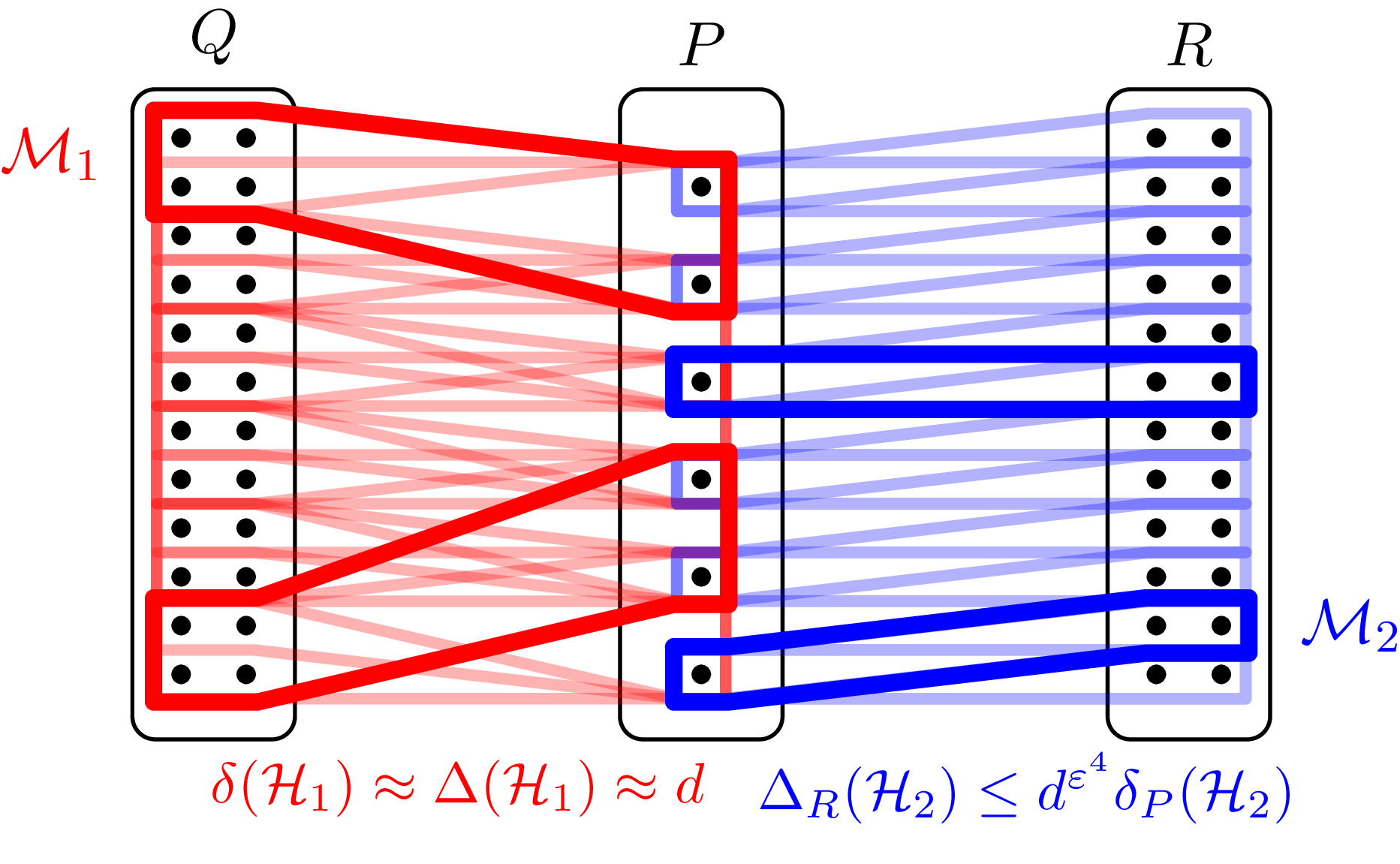


 Open access

