




Introduction
Rationale
Globally, Shiga toxin-producing Escherichia coli (E. coli; STEC) are foodborne pathogens of public health importance (FAO and WHO, 2019). A subset of STEC, enterohemorrhagic E. coli (EHEC), are known to cause severe disease in humans such as hemorrhagic colitis and hemolytic uremic syndrome (Caprioli et al., Reference Caprioli, Morabito, Brugère and Oswald2005). The Center for Disease Control and Prevention (CDC) estimates that out of approximately 265,000 human illnesses each year, approximately 3,600 patients are hospitalized and subsequently 30 deaths are attributed to these pathogens in the United States (CDC, 2016). EHEC causes severe human disease in part due to the intimate attachment of the bacterium to the host cell, mediated by intimin, which is encoded by an eae gene, in addition to at least one Shiga toxin gene (stx 1 and/or stx 2). Cattle are a known reservoir of STEC and EHEC as they harbor these pathogens in their gastrointestinal tracts and shed them in their feces (Bettelheim, Reference Bettelheim2000; Pihkala et al., Reference Pihkala, Bauer, Eblen, Evans, Johnson, Webb and Williams2012). When the source of illness was known, beef products were the most frequently attributed source of STEC-associated human illness worldwide (FAO and WHO, 2019).
Cattle feces contaminate cattle hides in the production environment, during transport or in lairage, increasing the potential for cross-contamination of beef carcasses, and subsequent beef products, at the harvest facility (Loneragan and Brashears, Reference Loneragan and Brashears2005; Fox et al., Reference Fox, Renter, Sanderson, Nutsch, Shi and Nagaraja2008; Jacob et al., Reference Jacob, Renter and Nagaraja2010; Ekong et al., Reference Ekong, Sanderson and Cernicchiaro2015). Therefore, cattle fecal, hide, and carcass STEC and EHEC prevalence estimates are a proxy for the potential risk at slaughter (Renter et al., Reference Renter, Smith, King, Stilborn, Berg, Berezowski and McFall2008), whereas concentration estimates quantify the risk these pathogens represent at harvest. In the last decade, EHEC of public health importance has been categorized into ‘O157’ and ‘non-O157’ serogroups. Each year in the United States, the CDC has estimated that O157 and non-O157 pathogens are responsible for approximately 95,400 and 169,600 human illnesses, respectively (CDC, 2016). Whereas E. coli O157, specifically E. coli O157:H7, has been widely researched over the last 30 years, including the publication of systematic reviews for E. coli O157 prevalence in cattle in North America (Ekong et al., Reference Ekong, Sanderson and Cernicchiaro2015) and globally (Islam et al., Reference Islam, Musekiwa, Islam, Ahmed, Chowdhury, Ahad and Biswas2014), research regarding non-O157 serogroups, and specifically the ‘top 6’, including O26, O45, O103, O104, O111, O121, and O145, has only been prominent during the last decade. As a result, there is limited information about key risk factors, geographic distribution, and serogroup-specific estimates of the top 6 in cattle prior to harvest.
Prevalence and concentration estimates of non-O157 pathogens are crucial to assess the distribution and load of bacteria in the cattle reservoir and to implement targeted mitigation strategies for lowering the risk of these foodborne pathogens in the beef supply. Therefore, our overarching goal was to compile evidence on global estimates of prevalence and concentration of non-O157 serogroups in the cattle reservoir.
Objective
The objective was to gather, integrate, and interpret scientific data on the prevalence and concentration of the top 6 non-O157 serogroups (O26, O45, O103, O104, O111, O121, and O145) and virulence genes (stx 1, stx 2, and eae) in fecal, hide, and carcass samples of pre- and peri-harvest adult cattle globally using a systematic review of the literature and meta-analysis. Meta-regression models were employed to evaluate the sources contributing to the variability of the prevalence estimates obtained.
Methods
Protocol
The systematic review methodology employed was in accordance with procedures outlined by O'Connor and Sargeant (Reference O'Connor and Sargeant2014). Preferred Reporting Items for Systematic Reviews and Meta-Analyses Protocol (PRISMA and PRISMA-P) guidelines (Liberati et al., Reference Liberati, Altman, Tetzlaff, Mulrow, Gøtzsche, Ioannidis, Clarke, Devereaux, Kleijnen and Moher2009; Moher et al., Reference Moher, Shamseer, Clarke, Ghersi, Liberati, Petticrew, Shekelle and Stewart2015; Page et al., Reference Page, McKenzie, Bossuyt, Boutron, Hoffmann, Mulrow, Shamseer, Tetzlaff, Akl, Brennan, Chou, Glanville, Grimshaw, Hróbjartsson, Lalu, Li, Loder, Mayo-Wilson, McDonald, McGuinness, Stewart, Thomas, Tricco, Welch, Whiting and Moher2021) were followed for reporting purposes.
Eligibility criteria
Peer-reviewed, primary research published in English that reflected the inclusion criteria (Table 1) was considered eligible. Non-peer-reviewed, gray literature, and peer-reviewed literature pertaining to experimental studies, in vitro experiments, simulation studies, or non-primary research (e.g. literature reviews, short communications) were excluded.
Inclusion and exclusion criteria for eligibility (relevance screening) of articles for the present systematic review of the literature

a Initially, the search was restricted to articles produced in North America; however, given the low number of articles, we expanded the search to include articles available in English from peer-reviewed literature and cattle populations worldwide.
The research question was: What is the prevalence and concentration of the top 6 non-O157 serogroups (O26, O45, O103, O104, O111, O121, and O145) and virulence genes (stx 1, stx 2, and eae) in fecal, hide, and carcass samples of pre- and peri-harvest adult cattle globally? The initial protocol was modified from a restricted search of North America to include all regions worldwide. Specific components of the research question included:
Population (P): Healthy, pre- and peri-harvest adult cattle (older than 8 months of age). Pre-harvest cattle were defined as cattle in their production environments before being sold or shipped to slaughter. Peri-harvest was defined as the time after cattle leave the farm until after stunning and hide removal, but prior to the application of any carcass interventions.
Outcomes (O): Prevalence and concentration of non-O157 serogroups (O26, O45, O103, O111, O121, and O145) and associated virulence genes (stx 1, stx 2, and eae) in fecal, hide, and carcass samples. Prevalence and concentration data were extracted according to three different outcome classifications, depending on the virulence gene combination: (1) ‘serogroup’ refers to samples that tested positive for an E. coli serogroup gene of interest (O26, O45, O103, O111, O121, or O145), (2) ‘STEC’ refers to samples that tested positive for a specific E. coli O serogroup and at least one Shiga toxin (stx 1 and/or stx 2) gene, and (3) ‘EHEC’ refers to samples that tested positive for an E. coli O serogroup, at least one Shiga toxin gene, and the intimin (eae) gene.
Information sources
Electronic databases accessed through the Kansas State University Library on 21 March 2019 included Agricola, Web of Science, and PubMed. Retrieved titles and abstracts were imported into a bibliographic management program (EndNoteX9, Clarivate Analytics). In addition, reference lists of articles considered to be landmark publications on the subject were also reviewed (i.e. hand-searched) for inclusion.
Search
In order to generate a complete list of all primary literature relevant to our research question, search terms were created to account for the population and outcomes of interest. The search algorithm used included the following terms: ‘(Beef OR Dairy OR Cattle OR Cow) AND (Escherichia coli OR STEC OR Shiga toxin OR Shiga toxin producing OR non-O157) AND (hide OR fecal OR carcass) AND (prevalence OR concentration)’.
The search was restricted to articles published 01 January 2000 to 21 March 2019, with the assumption that diagnostic protocols used in articles published prior to year 2000 were generally less sensitive than the methods currently used. No language restrictions were set on the original search; however, after the retrieval of full-text articles, articles were excluded if they were not available in English due to budgetary constraints. Duplicate articles were removed using the EndNoteX9 software (EndNoteX9, Clarivate Analytics) as well as manually checked after importing from online databases due to miscellaneous spaces or typos that did not promote the use of automated removal of duplicates.
Study selection
The title and abstract of articles identified through electronic databases and hand searches were screened for eligibility by a trained reviewer (DD) based on preset inclusion and exclusion criteria (Table 1). A second reviewer (NC) validated the first reviewer's work. If the abstract did not include enough details to assess eligibility, full-text articles were retrieved and the entire article was screened. If the abstract, or article, was deemed eligible based on our criteria, full-text articles were retrieved and subjected to the risk of bias assessment.
Data extraction protocols and tools were developed, pre-tested by all reviewers (DD, NC, and MS), and implemented for each step of the review process using spreadsheets created in Microsoft Excel. Data were extracted from all articles that met four key risk of bias assessment quality criteria (see ‘Risk of bias in individual studies’ for further details).
Data collection process
A data extraction spreadsheet tool was developed in Microsoft Excel, where each column represented a variable when extracting data from the full papers. The data extraction form was pre-tested by all reviewers using a sample of ten full-text articles. Data extraction was performed independently by two reviewers (DD and NC or MS). Disagreements were resolved by consensus or a third reviewer's input. Data were extracted for the different non-O157 E. coli O serogroups of interest (O26, O45, O103, O111, O121, and O145) reported at various hierarchical levels (e.g. sample, animal, pen, feedlot, and/or processing plant). Outcomes of interest were further classified into three outcome classifications – serogroup, Shiga toxin-producing E. coli (STEC), or EHEC – to assess the prevalence of specific serogroup and virulence gene combinations.
In the event that articles presented information on prevalence or concentration for different outcome classifications or O groups, the data were extracted in individual rows as unique events (hereafter defined as a ‘study’) in the data extraction form. Therefore, an article (a peer-reviewed publication describing prevalence or concentration of non-O157 in cattle fecal samples eligible for data extraction) could contain more than one study. Each study reflected one outcome classification (e.g. serogroup O26, STEC O45, EHEC O103), at a single time point (e.g. day, month, season, or year), as classified by a laboratory method, representing one cattle type, at different hierarchical levels (e.g. pen or feedlot) for a specified matrix (e.g. fecal, hide or carcass).
If data from a study were not explicitly presented but enough information was available (e.g. prevalence and number of samples tested), reviewers conducting the data extraction imputed the required values (e.g. number of positive samples). In addition, if the authors stated that they tested for serogroups or virulence genes of interest but did not detect them, it was recorded as a data point equal to zero for the respective outcome classification with the provided denominator. Conversely, if authors did not mention specific serogroups of interest, it was assumed that they were not tested for and data were neither extracted nor assigned a zero. Additionally, retrieved articles presenting hide prevalence or concentration data for non-O157 serogroups detected in commercial plants following hide wash interventions (e.g. cabinet wash or chemical application), or articles that did not state clearly at which stage of the harvest process the hide/carcass sample was collected, were excluded from this review. Experimentally inoculated fecal, hide, or carcass studies were also excluded from this review. Although considered a peri-harvest intervention, articles reporting hide prevalence data after the application of bacteriophage in lairage pens or water post-stunning were deemed eligible and data were extracted. Authors were not contacted to identify additional studies or inquire about additional information, only the full-text articles were considered.
Data items
Publication information extracted from each article and study included first author, title, and year of publication. Key study characteristics extracted were as follows: region (Africa, Asia, Australia/Oceania, Europe, Middle-East, North America, South America), time of harvest (pre-harvest or post-harvest), cattle type (beef, dairy, beef and dairy, or unknown), outcome classification (serogroup, STEC, or EHEC), non-O157 O gene of interest (O26, O45, O103, O111, O121, or O145), diagnostic methodology (culture, culture + immunomagnetic separation (IMS), polymerase chain reaction (PCR) only, or other), specimen matrix (fecal, hide, or carcass), specimen type (pen-floor, rectal grab, rectal swab, cecal, unknown, or sponge sample), number of positive samples, number of samples tested, prevalence or proportion positive, and hierarchical level of data reported (sample, animal, pen, feedlot, or processing plant). For specimen type, rectal grab samples typically referred to samples collected pre-harvest and also included peri-harvest samples obtained from fecal material removed from the rectum prior to evisceration, as these were considered similar specimen types a priori. Additional data that were extracted, if provided, included month(s) study was conducted, year(s) study was conducted, season, country of study, breed, age, stage of production (e.g. finishing period at calving), study design (e.g. cross-sectional or longitudinal; as determined by reviewers), and repeated measures (yes or no).
Study risk of bias assessment
A set of seven quality criteria (Table 2) was designed, based on guidelines described by Sargeant et al. (Reference Sargeant, Rajic, Read and Ohlsson2006) and Higgins et al. (Reference Higgins, Thomas, Chandler, Cumpston, Li, Page and Welch2019). These criteria were modified from the risk of bias assessment used by Ekong et al. (Reference Ekong, Sanderson and Cernicchiaro2015). The purpose of the risk of bias assessment was to evaluate internal and external validity, and overall study design and execution, prior to extracting data from relevant articles by evaluating criteria (C) representing three domains (Sanderson et al., Reference Sanderson, Tatt and Higgins2007). The key domains evaluated include (1) design-specific sources of bias (C1 or C6), (2) appropriateness of population based on inclusion criteria (C2, C3 or C4), and (3) methods for measuring outcome variables (C5, C6 or C7). Sample size calculation (C1) and cattle type (C2), represented internal validity-related factors; whereas animal production setting (C3) and study catchment area (C4) served as external validity criteria. Criteria for measuring the outcome included a clear depiction of the number of positives, number of samples tested, and/or the ability to calculate a prevalence (C5) for a specified period of time (C6), and for a specific serogroup (C7).
Risk of bias assessment criteria
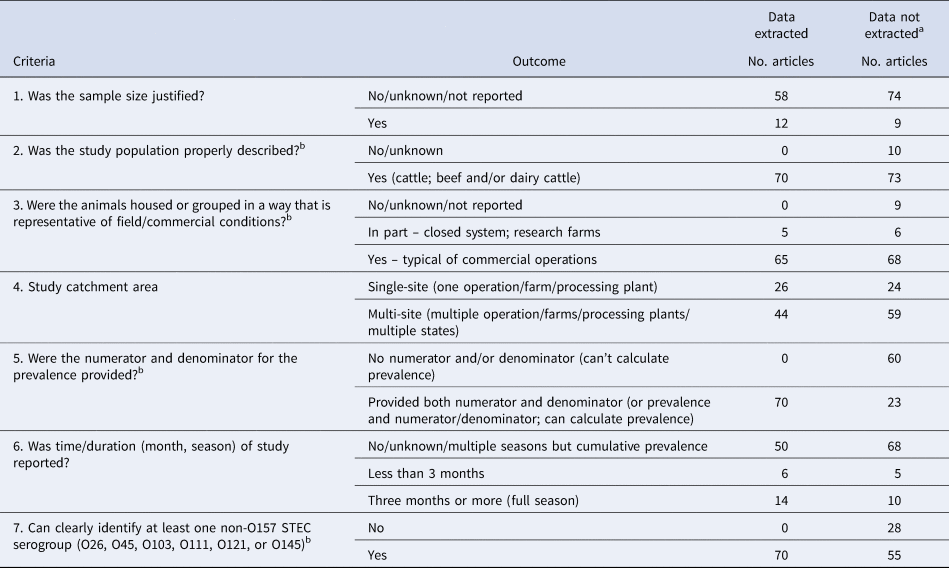
a There were 168 articles deemed relevant for the risk of bias assessment. In total, 70 articles met the risk of bias assessment criteria and data were extracted, 83 articles failed the risk of bias assessment and data were not extracted. Additionally, upon further reviewing the full-text articles that were eligible for the risk of bias assessment, 15 articles did not meet the inclusion criteria (e.g. study type) and were excluded.
b Articles that did not meet criteria 2, 3, 5, or 7 were excluded and were not considered for data extraction.
Four criteria (C2, C3, C5, and C7) were deemed crucial to meet internal and external validity characteristics and needed to proceed with data extraction. Articles failing to meet one or more of these criteria were excluded. In some instances, cattle type (C2) was not explicitly stated, but if there was enough information (e.g. breed, age, diet, and housing) provided to indicate that the study population referred to healthy, adult cattle, the article was still considered for data extraction. If authors stated a specific breed or production purpose, reviewers assigned the breed to a cattle type category (e.g. beef or dairy). Criterion 3 posed a challenge regarding articles published from countries where animal production practices were not familiar to the reviewers; therefore, unless the authors specifically stated that the animals were housed in a research farm, it was assumed that animals were housed in representative field conditions for that region.
The protocol for assessing risk of bias (Table 2) was pre-tested on a set of ten abstracts that were reviewed for relevance by two reviewers (DD and NC) to determine reproducibility. For all retrieved full-text articles, two reviewers (DD and MS or NC) independently evaluated the risk of bias (Table 2). Disagreements were resolved by consensus or a third reviewer's input.
Summary measures
For analysis purposes, data on fecal prevalence and calculated standard errors were logit transformed using R version 3.6.1. Numerators with a zero value were assigned a value of 0.5 prior to the logit transformation. The final pooled logit results (including their 95% confidence intervals) obtained from the meta-analysis models were back-transformed and expressed as percentages.
Synthesis of results
Hide and carcass prevalence and concentration data for all matrices were summarized using qualitative methods. Fecal prevalence results presented at the sample-level were analyzed quantitatively using meta-analysis. Using EpiTools (Sergeant, Reference Sergeant2015), prevalence estimates obtained from pooled fecal samples were adjusted to compute individual sample-level prevalence estimates using the pooled prevalence calculator for fixed pool size and assuming a perfect test; otherwise, only crude estimates were used in the analysis.
Meta-analysis
Data were separated into two datasets prior to analysis: (1) worldwide data by outcome classification, and (2) North American (Canada, Mexico, and USA) data by outcome classification. Random-effects meta-analyses were fitted to estimate the prevalence of non-O157 serogroup, STEC, and EHEC outcome classifications in cattle fecal samples, using the inverse variance method. All data were analyzed using R version 3.6.1 using the meta package (version 4.9-9; Balduzzi et al., Reference Balduzzi, Rücker and Schwarzer2019) unless otherwise stated.
Meta-analyses and subgroup analyses were used to determine serogroup-specific fecal prevalence estimates for each outcome classification (function ‘metaprop’), in the: (1) worldwide dataset by region, (2) worldwide dataset by O gene, (3) North American dataset by O gene, and (4) North American dataset by country. Following a logit transformation, the following specifications were used for each model: DerSimonian–Laird estimator for between-study variance (τ2; DerSimonian and Laird, Reference DerSimonian and Laird1986), and Hartung–Knapp adjustment for random effects (Knapp and Hartung, Reference Knapp and Hartung2003; Viechtbauer, Reference Viechtbauer2010a). The final pooled logit results (including their 95% confidence intervals) obtained from the meta-analysis models were back-transformed and expressed as percentages.
Between-study heterogeneity was quantified using the Cochrane's χ2 test of homogeneity (Q) and the I 2 statistic (Higgins et al., Reference Higgins, Thomas, Chandler, Cumpston, Li, Page and Welch2019). Cochrane's Q statistic was used to evaluate whether the variation between studies exceeds that expected by chance and is used to compute the I 2 statistic; I 2 = [Q − degrees of freedom/Q ] × 100 (Higgins et al., Reference Higgins, Thomas, Chandler, Cumpston, Li, Page and Welch2019). P-values <10% (P < 0.10) indicated significant between-study heterogeneity. The Higgins' I 2 statistic represents the percentage of the total variability in a set of effect sizes due to true heterogeneity rather than chance (Higgins et al., Reference Higgins, Thomas, Chandler, Cumpston, Li, Page and Welch2019). Using the scale suggested by Higgins et al. (Reference Higgins, Thomas, Chandler, Cumpston, Li, Page and Welch2019), I 2 values between 30–60, 50–90, and 75–100% may indicate moderate, substantial, and considerable heterogeneity, respectively. Causes of heterogeneity were explored using subgroup analysis and meta-regression techniques.
Additional analyses
Meta-regression
Uni-variable and multi-variable meta-regression models were built (using ‘metareg’) to examine the contribution of specific variables to the between-study heterogeneity of the worldwide and North American pooled fecal prevalence estimates obtained for each outcome classification. Explanatory variables of interest were: time of harvest (pre- or peri-harvest), cattle type (beef, dairy, beef and dairy, or unknown), laboratory method (PCR only, culture, culture + IMS, other), specimen type (cecal, rectal grab, pen-floor, rectal swab, or unknown), and region (Asia, Australia/Oceania, Europe, North America, or South America). Initially, uni-variable meta-regression models were fit to explore the association between each of the explanatory variables and the fecal prevalence for each outcome classification.
Variables with P < 0.10 in the uni-variable screen were included in the multi-variable meta-regression models. Based on our causal web diagram constructed a priori, specimen type is an intervening variable through harvest time and therefore, either specimen type or harvest time, not both, were eligible for inclusion in the multi-variable model (Supplementary Material, Appendix A Fig. 1). There were no plausible interactions between variables of interest based on our causal diagram and therefore no interactions were evaluated. A backward elimination procedure was followed for removal of non-significant variables. Variables with P-values ≤5% (P ≤ 0.05) were deemed significant and were kept in the multi-variable meta-regression models. The final pooled logit regression coefficients and their 95% confidence intervals were back-transformed.
Risk of bias across studies
Although subjective, funnel plots allow visual interpretation of whether the association between prevalence estimates and a measure of study size (e.g. standard error) is greater than what may be expected to occur by chance (Sterne et al., Reference Sterne, Gavaghan and Egger2000). To assess potential publication bias, we generated funnel plots using the function ‘funnel’. A formal asymmetry test (using ‘metabias’ and ‘lingreg’) was used to evaluate the presence of small study effects for non-O157 serogroup, STEC, and EHEC outcome classifications worldwide and for specific serogroups in North America (Egger et al., Reference Egger, Smith, Schneider and Minder1997). This regression-based test for detection of skewness determined whether the intercept deviated significantly from zero in a weighted regression of standardized prevalence estimates (on a logit scale) against their precision (e.g. standard error) (Egger et al.,Reference Egger, Smith, Schneider and Minder1997; Steichen, Reference Steichen1998). P-values <5% (P < 0.05) indicated funnel plot asymmetry.
Results
Study selection
The number of research articles retrieved at each step of the process is presented in Fig. 1. Initially, a total of 3241 articles were obtained from three electronic databases. Of the articles initially retrieved, 1063 were duplicates and 1952 were excluded based on the title and abstract screening. Two hundred and sixteen full-text articles were retrieved; however, 65 articles were excluded as they did not meet our inclusion criteria (Table 1). A total of 168 articles were subjected to the risk of bias assessment (Table 2) and 98 articles were subsequently excluded. Data were extracted from 70 articles.
Flow chart of study selection for meta-analysis eligibility.

Study characteristics
In this systematic review, of the 70 articles retrieved, 65 articles reported the fecal prevalence of non-O157 serogroups and virulence genes in pre- and peri-harvest cattle. Few articles were retrieved for hide (n = 8) and carcass (n = 4) matrices worldwide. Five articles provided prevalence data for more than one matrix of interest: fecal and hide (n = 1; Midgley and Desmarchelier, Reference Midgley and Desmarchelier2001), hide and carcass (n = 2; Svoboda et al., Reference Svoboda, Dudley, Debroy, Mills and Cutter2013; Stromberg et al., Reference Stromberg, Baumann, Lewis, Sevart, Cernicchiaro, Renter, Marx, Phebus and Moxley2015) and fecal, hide, and carcass (n = 2; Thomas et al., Reference Thomas, McCann, Collery, Logan, Whyte, McDowell and Duffy2012; Stromberg et al., Reference Stromberg, Lewis, Aly, Lehenbauer, Bosilevac, Cernicchiaro and Moxley2016b). Concentration data were scarce for all matrices. Three articles presented fecal concentration data (Murphy et al., Reference Murphy, McCabe, Murphy, Buckley, Crowley, Fanning and Duffy2016; Shridhar et al., Reference Shridhar, Noll, Shi, An, Cernicchiaro, Renter, Nagaraja and Bai2016, Reference Shridhar, Noll, Cull, Shi, Cernicchiaro, Renter, Bai and Nagaraja2017) and one article presented hide and carcass concentration data (Thomas et al., Reference Thomas, McCann, Collery, Logan, Whyte, McDowell and Duffy2012). Due to limited data, hide and carcass prevalence data and concentration data for all matrices were not subjected to meta-analysis. Fecal prevalence data, however, were analyzed using meta-analysis and meta-regression models.
Risk of bias within studies
Articles that were eligible for data extraction following the risk of bias assessment are tabulated by criteria in Table 2. The majority of data extracted were from articles presenting data for cattle housed in commercial farming conditions typical of their respective region (92.9%; 65/70) rather than research farms (7.1%; 5/70). Less than 20% of articles (12/70; 17.1%) included a sample size justification in the manuscript. The majority of articles (62.9%; 44/70) represented a study design that included multiple sites, whereas 37.1% (26/70) were conducted at a single site. The length of the study was not known for the majority (71.4%; 50/70) of the articles as only cumulative prevalence estimates were presented. For articles that presented study duration (28.6%; 20/70), six studies (30.0%; 6/20) reported to last less than three months whereas 14 studies (70.0%; 14/20) reported to last longer than three months.
Results of individual studies
Fecal prevalence and concentration
Fecal prevalence data for non-O157 serogroups and associated virulence genes of interest were extracted from 65 articles from seven regions (Africa, n = 3; Asia, n = 11; Australia/Oceania, n = 6; Europe, n = 17; Middle East, n = 1; North America, n = 21; South America, n = 6) worldwide. Although data from these 65 articles were eligible for inclusion in the worldwide fecal prevalence meta-analysis, due to limited data per respective outcome classification in each region, five articles and subsequently three regions were excluded from the worldwide meta-analysis by outcome classification: Africa (n = 3; serogroup: Musa et al., Reference Musa, Kazeem, Raji and Useh2012; EHEC: El-Gamal and El-Bahi, Reference El-Gamal and El-Bahi2016; STEC: Adamu et al., 2018), Middle East (EHEC, n = 1; Mohammed et al., Reference Mohammed, Stipetic, Salem, McDonough, Chang and Sultan2015), and South America (serogroup, n = 1; Vicente et al., Reference Vicente, do Amaral and de Mello Figueiredo Cerqueira2005). Additionally, three articles were excluded from the worldwide fecal prevalence meta-analysis because they only presented farm-level, rather than sample-level, fecal prevalence data (n = 2; Australia/Oceania: McAuley et al., Reference McAuley, McMillan, Moore, Fegan and Fox2014; Middle East: Rehman et al., Reference Rehman, Rashid, Singh, Sambyal and Reshi2014) or contained redundant data with previously published literature (n = 1; North America: Shridhar et al., Reference Shridhar, Noll, Shi, An, Cernicchiaro, Renter, Nagaraja and Bai2016). Therefore, 57 articles were eligible for inclusion in the worldwide fecal prevalence meta-analysis by region. The sample denominator extracted from these 57 articles ranged from ten to 78,705 fecal samples. In two articles (Dargatz et al., Reference Dargatz, Bai, Lubbers, Kopral, An and Anderson2013; Stanford et al., Reference Stanford, Johnson, Alexander, McAllister and Reuter2016), sample-level prevalence estimates were obtained from pooled fecal samples (range = 785–78,705) using EpiTools pooled prevalence calculator (Sergeant, Reference Sergeant2015). All other extracted data were unadjusted prevalence estimates (range = 10–6086 fecal samples).
With respect to outcome classifications, most articles presented data for both EHEC and STEC classifications (n = 16), followed by EHEC only (n = 15), STEC only (n = 8), serogroup only (n = 8), STEC and serogroup (n = 1), and EHEC and serogroup (n = 1). Eight articles presented data for all outcome classifications, EHEC, STEC, and serogroup. Articles included in the worldwide fecal prevalence meta-analysis are reported by key study variables in Table 3. Fecal prevalence data were synthesized using meta-analyses to obtain worldwide fecal prevalence estimates by region (see Synthesis of Results), whereas fecal concentration data were much more limited and their results are presented below.
List of the articles included in the worldwide meta-analysis of fecal prevalence across all outcome classifications by key study variables
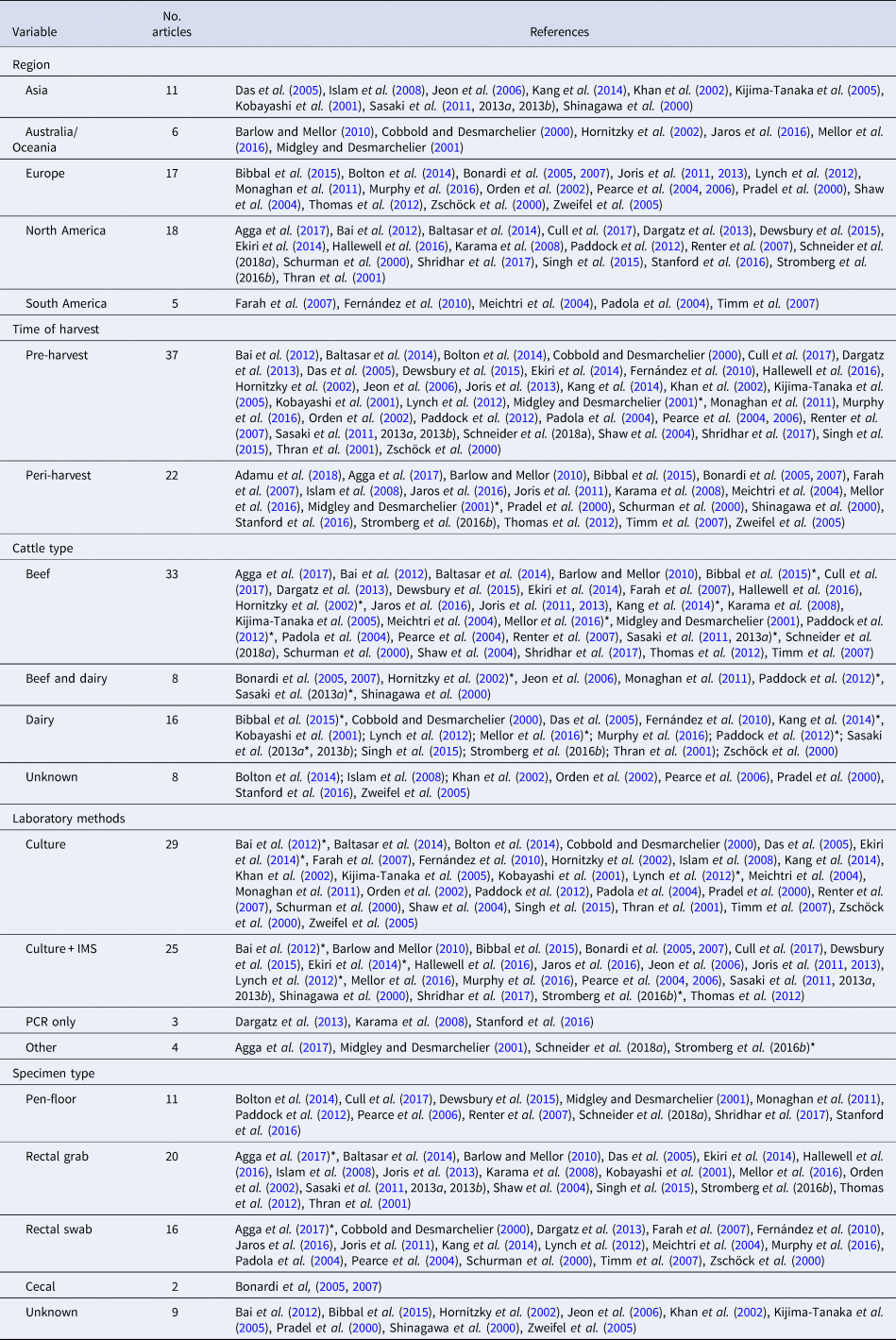
*Indicates article is present in more than one category within variable (e.g. time of harvest, cattle type, etc.).
In addition to the worldwide results, we further explored fecal prevalence estimates in North America. Fecal prevalence estimates, however, were largely represented by data from the USA (n = 13; Thran et al., Reference Thran, Hussein, Hall and Khaiboullina2001; Bai et al., Reference Bai, Paddock, Shi, Li, An and Nagaraja2012; Paddock et al., Reference Paddock, Shi, Bai and Nagaraja2012; Dargatz et al., Reference Dargatz, Bai, Lubbers, Kopral, An and Anderson2013; Baltasar et al., Reference Baltasar, Milton, Swecker, Elvinger and Ponder2014; Ekiri et al., Reference Ekiri, Landblom, Doetkott, Olet, Shelver and Khaitsa2014; Dewsbury et al., Reference Dewsbury, Renter, Shridhar, Noll, Shi, Nagaraja and Cernicchiaro2015; Singh et al., Reference Singh, Sha, Lacher, DelValle, Mosci, Moore, Scribner and Manning2015; Stromberg et al., Reference Stromberg, Lewis, Aly, Lehenbauer, Bosilevac, Cernicchiaro and Moxley2016b; Agga et al., Reference Agga, Arthur, Hinkley and Bosilevac2017; Cull et al., Reference Cull, Renter, Dewsbury, Noll, Shridhar, Ives, Nagaraja and Cernicchiaro2017; Shridhar et al., Reference Shridhar, Noll, Cull, Shi, Cernicchiaro, Renter, Bai and Nagaraja2017; Schneider et al., 2018a). Canada was represented by five studies (n = 5; Schurman et al., Reference Schurman, Hariharan, Heaney and Rahn2000; Renter et al., Reference Renter, Bohaychuk, VanDonkersgoed and King2007; Karama et al., Reference Karama, Johnson, Holtslander, McEwen and Gyles2008; Hallewell et al., Reference Hallewell, Reuter, Stanford, Topp and Alexander2016; Standford et al., 2016), however, no data were obtained from Mexico. Fecal prevalence data by O gene for each outcome classification, obtained from North America, represented by the USA and Canada, were synthesized using meta-analyses (see Synthesis of Results).
Fecal concentration data for non-O157 serogroups of interest were limited (Murphy et al., Reference Murphy, McCabe, Murphy, Buckley, Crowley, Fanning and Duffy2016; Shridhar et al., Reference Shridhar, Noll, Shi, An, Cernicchiaro, Renter, Nagaraja and Bai2016, Reference Shridhar, Noll, Cull, Shi, Cernicchiaro, Renter, Bai and Nagaraja2017). Two articles represented beef cattle in the USA (Shridhar et al., Reference Shridhar, Noll, Shi, An, Cernicchiaro, Renter, Nagaraja and Bai2016, Reference Shridhar, Noll, Cull, Shi, Cernicchiaro, Renter, Bai and Nagaraja2017) and one represented lactating dairy cattle in Ireland (Murphy et al., Reference Murphy, McCabe, Murphy, Buckley, Crowley, Fanning and Duffy2016). These three articles utilized a variety of laboratory methods for quantification, including real-time PCR, multiplex quantitative PCR (mqPCR), and spiral plating (SP). Murphy et al. (Reference Murphy, McCabe, Murphy, Buckley, Crowley, Fanning and Duffy2016) reported concentration data for O26 in two Irish dairy herds, represented by 40 lactating cows per herd, sampled via recto-anal mucosal (RAM) swabs, longitudinally over the course of one year. Three (0.6%) of 529 RAM swabs subjected to quantitative real-time PCR were classified as EHEC O26 high-shedding positives (defined as ≥104 CFU/swab; Murphy et al., Reference Murphy, McCabe, Murphy, Buckley, Crowley, Fanning and Duffy2016).
The remaining two articles (Shridhar et al., Reference Shridhar, Noll, Shi, An, Cernicchiaro, Renter, Nagaraja and Bai2016, 2017) presented fecal concentration data for all non-O157 serogroups of interest, from fed beef cattle housed in commercial US feedlots sampled prior to harvest, and quantified utilizing mqPCR and SP methods. Five-hundred and seventy-six pen-floor fecal samples were subjected to mqPCR; the proportion of samples harboring super-shedding concentrations (≥104 CFU/gram of feces) were 7.1, 6.4, 5.0, and 0.4%, for O45 and O103, O121, O26, O145 and O111, respectively (Shridhar et al., Reference Shridhar, Noll, Shi, An, Cernicchiaro, Renter, Nagaraja and Bai2016). Similar trends were observed for the top 6 serogroups in another observational feedlot study comparing SP and mqPCR methods (Shridhar et al., Reference Shridhar, Noll, Cull, Shi, Cernicchiaro, Renter, Bai and Nagaraja2017) where the most frequently quantified serogroups at high-shedding concentrations were O103 (SP: 7.5%, 86/1152; mqPCR: 18.2%, 210/1152) and O26 (SP: 1.6%, 18/1152; mqPCR: 6.9%, 80/1152). The proportion of quantifiable samples for the top 6 serogroups ranged from undetected to 7.5% for the SP method and 0.4–18.2% for mqPCR (Shridhar et al., Reference Shridhar, Noll, Cull, Shi, Cernicchiaro, Renter, Bai and Nagaraja2017).
Hide prevalence and concentration
Data on non-O157 serogroup and virulence gene prevalence and concentration were limited for cattle hides and are reported descriptively for all outcome classifications (Table 4). Eight articles containing hide prevalence data were retrieved from five countries (Australia, Honduras, Ireland, Nicaragua, and the USA). A single article presented hide concentration data (Thomas et al., Reference Thomas, McCann, Collery, Logan, Whyte, McDowell and Duffy2012).
Hide prevalence data extracted with key study characteristics

a Laboratory methods presented in this table are how authors extracted and categorized data for analysis; for full laboratory method protocols used refer to the original manuscript referenced. If category was ‘Other’, method of detection was stated in parenthesis.
b Sample numerators and prevalence estimates were estimated from Fig. 1 (Chaves et al., Reference Chaves, Miller, Maradiaga, Calle, Thompson, Jackson, Jackson, Garcia, Echeverry, Ruiz and Brashears2013) to report estimates by region.
c Schneider et al. (2018b) data are also presented by season, for presentation purposes authors chose to present by region.
d The sample denominator for Stromberg et al. (Reference Stromberg, Baumann, Lewis, Sevart, Cernicchiaro, Renter, Marx, Phebus and Moxley2015) differed between the Other (NeoSeek™) method and Culture + IMS methods extracted by 100, due to inadequate DNA for 100 samples collected.
Two articles, represented by five studies, reported data for non-O157 serogroups O26, O103, O111, and O145. These non-O157 serogroups were detected on peri-harvest beef cattle hides ranging from undetected to 27.1%. The two serogroups most frequently detected from beef cattle hides were serogroups O26 and O103, with reported prevalence estimates of 6.0 and 27.1%, respectively. Furthermore, Thomas et al. (Reference Thomas, McCann, Collery, Logan, Whyte, McDowell and Duffy2012) quantified serogroup O103 on cattle hides at harvest yielding estimates for six samples, out of the 130-sample subset tested, between 10 and 110 CFU/cm2, the other 124 samples contained colony counts too low to estimate by direct plating methods (Table 4).
Hide prevalence estimates were obtained for all six non-O157 STEC of interest from three articles. Represented by 11 studies, non-O157 STEC hide prevalence estimates in peri-harvest beef cattle ranged from undetected to 0.3%. Only STEC O26 and O103 were detected on cattle hides. Other non-O157 STEC (O45, O111, O121, and O145) were tested for but not detected on peri-harvest cattle hides.
Seven articles containing hide prevalence data, representing 55 studies, presented non-O157 EHEC hide prevalence data. Prevalence estimates reported ranged from undetected to 47.0, 57.5, 35.9, 29.3, 46.0, and 49.0% for EHEC O26, O45, O103, O111, O121, and O145, respectively.
Carcass prevalence and concentration
Data on pre-intervention carcass prevalence and study characteristics are presented in Table 5. Four articles reported top 6 prevalence data and a single article (Thomas et al., Reference Thomas, McCann, Collery, Logan, Whyte, McDowell and Duffy2012) presented concentration data for pre-intervention carcasses. Serogroup prevalence estimates for the top 6 ranged from undetected to 13.8% on peri-harvest beef carcass samples. Serogroup O111 was not detected on peri-harvest carcasses in any of the retrieved articles. Thomas et al. (Reference Thomas, McCann, Collery, Logan, Whyte, McDowell and Duffy2012) reported a serogroup O103 carcass prevalence of 5.5%, but did not detect quantifiable concentrations of serogroup O103 on the corresponding cattle carcasses. Moreover, Thomas et al., Reference Thomas, McCann, Collery, Logan, Whyte, McDowell and Duffy2012 presented STEC prevalence data on pre-intervention beef carcasses where STEC O26, O103, O111, and O145 were undetected and STEC O45 and O121 were not tested for. Three articles (Thomas et al., Reference Thomas, McCann, Collery, Logan, Whyte, McDowell and Duffy2012; Stromberg et al., Reference Stromberg, Baumann, Lewis, Sevart, Cernicchiaro, Renter, Marx, Phebus and Moxley2015, 2016b) presented data for non-O157 EHEC. The top 6 EHEC prevalence on pre-intervention cattle carcasses ranged from undetected to 4.0%; EHEC O111 and O121 were not detected.
Carcass prevalence data extracted with key study characteristics

a Laboratory methods presented in this table are how authors extracted and categorized data for analysis; for full laboratory method protocols used refer to the original manuscript referenced. If category was ‘Other’, method of detection was stated in parenthesis.
Synthesis of results
Worldwide meta-analysis of fecal prevalence by outcome classification and O gene
Pooled fecal prevalence estimates significantly differed among regions worldwide for the top 6 serogroups, STEC, and EHEC outcome classifications (Table 6). The worldwide serogroup meta-analysis was comprised of 18 articles, representing 165 studies. Studies from four regions, Asia, Australia/Oceania, Europe, and North America, were included in the analysis. Due to limited data, South America was not included in the worldwide serogroup meta-analysis. The estimated worldwide pooled non-O157 serogroup prevalence was 4.7% (95% confidence interval (CI) = 3.4–6.3%). Pooled fecal prevalence was highest for North America (6.4%, 95% CI = 3.7–10.8%) with respect to the serogroup outcome classification. The most prevalent serogroup reported worldwide was O103 (11.4%, 95% CI = 4.7–25.2%) followed by O45 (7.9%, 95% CI = 3.2–18.1%), O26 (6.6%, 95% CI = 4.2–10.4%), O121 (2.7%, 95% CI = 0.9–7.6%), O111 (1.6%, 95% CI = 0.8–2.9%), and O145 (1.3%, 95% CI = 0.5–3.6%). The worldwide STEC fecal prevalence meta-analysis included 33 articles, representing 191 studies. The estimated worldwide STEC pooled fecal prevalence was 0.7% (95% CI = 0.5–0.8%), with Australia/Oceania (1.3%, 95% CI = 0.7–2.5%) yielding the highest regional estimate worldwide. In this review, STEC O26 (1.0%, 95% CI = 0.7–1.4%) and STEC O103 (0.8%, 95% CI = 0.5–1.4%) were the most frequently detected STEC globally. The global prevalence estimates for STEC O45, STEC O111, STEC O121, STEC O145 were 0.4 (95% CI = 0.2–0.8%), 0.4 (95% CI = 0.2–0.5%), 0.7 (95% CI = 0.3–1.4%) and 0.7% (95% CI = 0.4–1.2%), respectively. Worldwide EHEC pooled fecal prevalence estimates were summarized from 40 articles, representing 369 studies. The pooled EHEC fecal prevalence estimate was 1.0% (95% CI = 0.8–1.1%) with the highest observed regions in this review being Europe (1.3%, 95% CI = 1.0–1.7%) and North America (1.2%, 95% CI = 0.9–1.5%). Globally, as noted in global STEC prevalence, EHEC O26 (1.3%, 95% CI = 0.9–1.8%) and EHEC 0103 (1.4%, 95% CI = 1.0–2.1%) were the most prevalent. Followed by EHEC O45 (0.9%, 95% CI = 0.5–1.8%), EHEC O111 (0.9%, 95% CI = 0.6–1.4%), EHEC O121 (0.4%, 95% CI = 0.3–0.6%), EHEC O145 (0.9%, 95% CI = 0.6–1.3%). In the present study, North America yielded the highest pooled fecal prevalence estimates for the serogroup outcome, and second highest worldwide for the STEC and EHEC outcomes – North America data were further evaluated by O gene for each outcome classification and by country. As there was evidence of between-study heterogeneity (I 2 statistic) in this worldwide meta-analysis, meta-regression analyses were conducted for all outcome classifications by key variables of interest.
Pooled serogroup, STEC, and EHEC fecal prevalence estimates by region obtained from random-effects meta-analysis models

a Only one article retrieved presented data at the serogroup level for South America; therefore, South America was excluded from the serogroup meta-analyses and meta-regression analyses.
*The P value presented demonstrates the statistical significance of heterogeneity using the Cochrane's Q statistic method. The null hypothesis is there is ‘no heterogeneity’ with a χ2 distribution and n–1 degrees of freedom, where n is number of studies (Dohoo et al., Reference Dohoo, Martin and Stryhn2009).
North America meta-analysis of fecal prevalence by O gene
Overall, North American pooled fecal prevalence estimates were 6.4, 1.1, and 1.2% for the serogroup, STEC, and EHEC outcome classifications, respectively (Table 7). Serogroup-specific estimates were estimated from eight articles including 73 studies. The most prevalent serogroups reported were O103 (19.6%, 95% CI = 5.6–50.2%) and O26 (15.1%, 95% CI = 4.1–42.7%) whereas the least prevalent was O111 (1.0%, 95% CI = 0.2–5.8%). Estimates for STEC fecal prevalence in North America were obtained from eight articles, including 79 studies. Similar to the serogroup-specific estimates, STEC O103 (1.6%, 95% CI = 0.7–3.7%) was the most prevalent O gene, whereas STEC O111 (0.6%, 95% CI = 0.3–1.3%) was the least prevalent. Meta-analysis for EHEC fecal prevalence in North America included ten articles representing 170 studies. As observed for the serogroup and STEC outcome classifications, fecal prevalence estimates remained highest for EHEC O103 (2.8%, 95% CI = 1.6–4.9). The lowest fecal prevalence estimate obtained was EHEC O121 (0.5%, 95% CI = 0.3–0.8%) in North America. Heterogeneity among North American studies were explored through meta-regression analyses for all outcomes by key variables of interest: time of harvest, cattle type, laboratory methods, and specimen type.
Pooled serogroup, STEC, and EHEC cattle fecal prevalence estimates in North America by O gene obtained from random-effects meta-analysis models

*The P-value presented demonstrates the statistical significance of heterogeneity using the Cochrane's Q statistic method. The null hypothesis states that there is ‘no heterogeneity’ with a χ2 distribution and n–1 degrees of freedom, where n is number of studies (Dohoo et al., Reference Dohoo, Martin and Stryhn2009).
North America meta-analysis of fecal prevalence by country
To further explore fecal prevalence in North American cattle, random-effects meta-analyses were conducted to obtain pooled fecal prevalence estimates for the USA and Canada for each outcome classification. Meta-analysis for serogroup fecal prevalence in the USA and Canada included six and two articles representing 61 and 12 studies, respectively. Top 6 serogroup prevalence for the USA and Canada were 4.8% (95% CI = 2.6–8.4%) and 9.4% (95% CI = 1.7–38.8%), respectively. Fecal prevalence estimates for the serogroup outcome classification did not significantly differ by country (P = 0.40). Estimates obtained for STEC fecal prevalence in the USA and Canada were extracted from six and two articles representing 74 and five studies, respectively. Whereas, estimated fecal prevalence for the top 6 STEC in pre- and peri-harvest cattle was significantly higher (P < 0.05) in the USA (1.3%, 95% CI = 0.9–1.8%) compared to Canada (0.2%, 95% CI = 0.1–0.4%). EHEC-specific estimates were estimated from eight and two articles representing 166 and four studies, from the USA and Canada, respectively. As observed for STEC, fecal EHEC prevalence was significantly (P < 0.05) higher in the USA (1.2%; 95% CI = 1.0–1.6%) compared to Canada (0.1%; 95% CI = 0.0–0.3%). Although there was evidence of between-study heterogeneity in these models, due to the limited number of studies per country, meta-regression analyses were not attempted for outcome classifications by country within North America.
Additional analysis
Meta-regression
Worldwide meta-regression analyses of fecal prevalence by outcome classification. There was evidence of considerable between-study heterogeneity in the worldwide random-effects meta-analysis model, based on the I 2 statistic for all outcome classifications. Worldwide serogroup uni-variable meta-regression analyses identified region, time of harvest, cattle type, laboratory methods, and specimen type as factors significantly (P < 0.10) contributing to between-study heterogeneity of non-O157 serogroup fecal prevalence estimates in cattle worldwide (Table 8). In the multi-variable model, region, cattle type, laboratory methods, and specimen type were significant (P < 0.05) factors contributing to between-study heterogeneity of non-O157 serogroup prevalence estimates in cattle worldwide. The covariates included in the multi-variable meta-regression model explain 42.1% (pseudo R 2) of between-study heterogeneity in the worldwide serogroup fecal prevalence meta-analysis.
Uni-variable and multi-variable meta-regression models for non-O157 serogroup fecal prevalence in cattle worldwide

a South America was not included in these analyses as only one article presented data.
b Time of harvest was not significant (P-value < 0.05) in the multi-variable model.
c Beef and dairy cattle fecal prevalence were estimated and reported separately for each cattle type (Paddock et al., Reference Paddock, Shi, Bai and Nagaraja2012).
d Bai et al. reported fecal prevalence data using two methodologies categorized as Culture and Culture + IMS (Bai et al., Reference Bai, Paddock, Shi, Li, An and Nagaraja2012).
Worldwide STEC uni-variable meta-regression models identified all factors (region, time of harvest, cattle type, and specimen type) except laboratory methods to contribute significantly (P < 0.10) to between-study heterogeneity (Table 9). In the multi-variable meta-regression model, all factors except time of harvest remained significant (P < 0.05) contributing to between-study heterogeneity. This multi-variable model explained 36.9% (pseudo R 2) of the between-study heterogeneity of the STEC outcome classification worldwide.
Uni-variable and multi-variable meta-regression models for non-O157 STEC fecal prevalence in cattle worldwide

a Time of harvest and laboratory method variables were not significant (P value < 0.05) in the multi-variable model.
b Two articles presented data for more than one cattle type. Kang et al. reported data on beef and dairy cattle separately (Kang et al., Reference Kang, Hwang, Kwon, Kim, Kim and Park2014) and Hornitzky et al. presented data for beef cattle and a combination of dairy and beef cattle (Hornitzky et al., Reference Hornitzky, Vanselow, Walker, Bettelheim, Corney, Gill, Bailey and Djordjevic2002).
c Ekiri et al. (Reference Ekiri, Landblom, Doetkott, Olet, Shelver and Khaitsa2014) reports data using two separate methods, categorized as Culture and Culture + IMS.
With respect to the EHEC classification, evidence of heterogeneity was identified between studies of all regions with the exception of Asia and Australia/Oceania (I 2 = 0.0%). All of the factors were identified as contributing significantly (P < 0.10) to between-study heterogeneity in the uni-variable meta-regression analyses (Table 10). Region, cattle type, laboratory methods, and specimen type remained as significant factors contributing to between-study heterogeneity in the multi-variable model. Covariates in the multi-variable meta-regression models explained 44.3% (pseudo R 2) of the between-study heterogeneity for the EHEC outcome classification worldwide.
Uni-variable and multi-variable meta-regression models for non-O157 EHEC fecal prevalence in cattle worldwide

a Time of harvest was not significant (P-value < 0.05) in the multi-variable model and Midgley and Desmarchelier present EHEC fecal prevalence data for both pre-harvest and peri-harvest times of harvest (Midgley and Desmarchelier, Reference Midgley and Desmarchelier2001).
b Three articles presented data for more than one cattle type category, two articles presented dairy for beef and dairy separately (Bibbal et al., Reference Bibbal, Loukiadis, Kérourédan, Ferré, Dilasser, Peytavin de Garam, Cartier, Oswald, Gay, Auvray and Brugère2015; Mellor et al., Reference Mellor, Fegan, Duffy, McMillan, Jordan and Barlow2016) and one article presented data for beef and dairy in combination, and for dairy and beef cattle types separately.
c Stromberg et al. presented prevalence estimates from two different methodologies, categorized as Culture and Culture + IMS (Stromberg et al., 2016b).
d Two specimen types, Rectal swab and Rectal grab, were collected and prevalence estimates reported separately in Agga et al. (Reference Agga, Arthur, Hinkley and Bosilevac2017).
North America meta-regression analyses of fecal prevalence by outcome classification. In the uni-variable meta-regression model, cattle type, laboratory method, and specimen type significantly (P < 0.10) contributed to the between-study heterogeneity in the serogroup outcome classification for North America (Table 11). Only laboratory method and specimen type remained in the multi-variable meta-regression model as contributing significantly (P < 0.05) to between-study heterogeneity. These covariate multi-variables explained 44.0% (pseudo R 2) of between-study heterogeneity in North American serogroup prevalence outcome.
Uni-variable and multi-variable meta-regression models for non-O157 serogroup cattle fecal prevalence in North America

a All variables were subjected to a uni-variable screen and significant variables (P < 0.1) were evaluated in a backward stepwise multi-variable model. Variables not significant at P < 0.05 were removed from the multi-variable model.
b Data for two cattle types, beef and dairy, were extracted independently for one article (Paddock et al., Reference Paddock, Shi, Bai and Nagaraja2012).
c Bai et al. presented prevalence estimates from two different methodologies, categorized as Culture and Culture + IMS (Bai et al., Reference Bai, Paddock, Shi, Li, An and Nagaraja2012).
For the STEC outcome classification, uni-variable meta-regression analyses identified time of harvest, cattle type, and specimen type as variables contributing significantly (P < 0.10) to between-study heterogeneity (Table 12). In the multivariable meta-regression, time of harvest and cattle type remained significant (P < 0.05) and accounted for 26.3% (pseudo R 2) of between-study heterogeneity in North American STEC prevalence outcome.
Uni-variable and multi-variable meta-regression models for non-O157 STEC cattle fecal prevalence in North America

a All variables were subjected to a uni-variable screen and significant variables (P < 0.1) were evaluated in a backward stepwise multi-variable model. Variables not significant at P < 0.05 were removed from the multi-variable model.
b Bai et al. presented prevalence estimates from two different methodologies, categorized as Culture and Culture + IMS (Bai et al., Reference Bai, Paddock, Shi, Li, An and Nagaraja2012).
Time of harvest, cattle type, and laboratory methods were contributing significantly (P < 0.10) to between-study heterogeneity in uni-variable meta-regression analyses for EHEC fecal prevalence in North America (Table 13). However, time of harvest and laboratory methods were the only variables significant (P < 0.05) in the multi-variable meta-regression accounting for 33.7% (pseudo R 2) of between-study heterogeneity in North America EHEC fecal prevalence outcome.
Uni-variable and multi-variable meta-regression models for non-O157 EHEC cattle fecal prevalence in North America

a All variables were subjected to a uni-variable screen and significant variables (P < 0.1) were evaluated in a backward stepwise multi-variable model. Variables not significant at P < 0.05 were removed from the multi-variable model.
b Stromberg et al. presented prevalence estimates from two different methodologies, categorized as Culture and Culture + IMS (Stromberg et al., 2016b).
c Two specimen types, Rectal swab and Rectal grab, were collected and prevalence estimates reported separately in Agga et al. (Reference Agga, Arthur, Hinkley and Bosilevac2017).
Risk of bias across studies
Asymmetry in the funnel plots for serogroup, STEC, and EHEC outcomes, worldwide and in North America, indicated potential publication bias was present (i.e. risk of bias across studies; data not shown). Bias coefficients using the Egger's test indicated that small study effects were present in worldwide and North America fecal prevalence meta-analyses. Bias coefficients (P-values) for serogroup, STEC, and EHEC worldwide prevalence outcomes were 0.53 (P = 0.54), −1.54 (P < 0.01), and −2.60 (P < 0.01), respectively. Similar to the worldwide meta-analysis, bias coefficients (P-values) for North America fecal prevalence for serogroup, STEC, and EHEC outcomes were 1.93 (P = 0.31), −2.69 (P < 0.01), and −3.93 (P < 0.01), respectively, indicate the presence of small study effects. Bias coefficients from the Egger test indicate that fecal prevalence estimates from smaller studies were lower than the fecal prevalence estimates from the larger studies for STEC and EHEC outcomes, but not for the serogroup outcome classification in both the worldwide and North America fecal prevalence meta-analyses.
Discussion
Summary of evidence
Following a systematic review process, we identified 70 relevant articles that met the risk of bias assessment on prevalence and concentration of non-O157 STEC in different bovine matrices worldwide and data were extracted. Most of the retrieved articles in this review represented non-O157 STEC and EHEC prevalence data in cattle feces. Results from the worldwide meta-analyses for non-O157 STEC (range = 0.3–1.3%) and EHEC (range = 0.2–1.3%) fecal outcomes indicated that cattle harbor and shed these organisms in regions across the globe at relatively low frequencies. Although concentration data were limited, when detected and reported in fecal and hide matrices, STEC and EHEC concentrations were at high-shedding concentrations (≥104 CFU/gram or ≥104 CFU/cm2) albeit for a limited number of cattle sampled. Likely, based on the limit of detection of available diagnostic methods for quantification, we are better at detecting samples with higher concentrations than those with a lower load. This review included a single article reporting quantification on pre-intervention carcasses, and there were no top 6 serogroups detected. Although limited in this review, concentration data offer a crucial piece of information when evaluating food safety risk along the beef continuum. In the literature, it has been documented that even at extremely low concentrations, fewer than ten cells, of pathogenic E. coli can induce human illness (Hara-Kudo and Takatori, Reference Hara-Kudo and Takatori2011) thus demonstrating the pathogenicity of these organisms and their threat to public health via the cattle reservoir.
The pooled fecal prevalence estimates from the worldwide meta-analysis models significantly varied by region with non-O157 serogroup, STEC, and EHEC estimates being the highest in North America. Further, top 6 STEC and EHEC estimates of fecal prevalence were significantly greater in cattle in the USA compared to Canada, thus demonstrating variation between countries within the region. It is likely that prevalence estimates will vary also between countries in other regions.
In this review, the most prevalent EHEC O group in North American cattle feces was O103, which is the second most frequently reported non-O157 O group associated with culture-confirmed human STEC infections (15.6%) in the USA (CDC, 2018). Although we cannot directly attribute these clinical human STEC infections to cattle feces or contaminated beef, our data support cattle as a reservoir of these foodborne pathogens associated with human illness and demonstrate the potential threat of these non-O157 STEC of clinical importance to public health and food safety. From this review, limited conclusions can be drawn from hide and carcass results reported due to the low number of articles retrieved and the large variation between articles. Though peri-harvest hide and carcass prevalence and concentration data are the most crucial, as they are the best indicators of the contamination burden before carcasses are subjected to antimicrobial interventions at the harvest facility, these were the most limited data, regardless of the region (Brichta-Harhay et al., Reference Brichta-Harhay, Guerini, Arthur, Bosilevac, Kalchayanand, Shackelford, Wheeler and Koohmaraie2008; Arthur et al., Reference Arthur, Keen, Bosilevac, Brichta-Harhay, Kalchayanand, Shackelford, Wheeler, Nou and Koohmaraie2009; Stephens et al., Reference Stephens, McAllister and Stanford2009).
Limitations of the body of literature
In this review, the main limitations when reviewing the body of literature retrieved included lack of standardization of the case definition, unclear numerator or denominators for prevalence, unspecified study population, and a wide array of sample collection and laboratory methodologies employed. Firstly, there is no clear and consistent case definition for STEC and EHEC reported in the literature. Therefore, outcome classifications were categorized by reviewers based on non-O157 O gene and virulence gene profiles leading to our outcome classifications for serogroup, STEC, and EHEC. Articles retrieved in the search included combined estimates of ‘STEC’ or ‘non-O157 STEC’ which included O groups not of interest or did not allow for data to be extracted by O gene; as a result, these articles did not meet the risk of bias assessment criteria and were excluded. Excluding these articles may have biased our overall non-O157 STEC estimates obtained; however, our objective was to obtain estimates of the most prevalent O groups (or top 6), rather than other non-O157 groups. Conversely, in some articles, when researchers reported serotypes, data were extracted for serogroup, STEC, and EHEC by O gene rather than serotype.
During the risk of bias assessment, many articles were excluded because a numerator or denominator was not reported (criterion 5 in the risk of bias assessment) and crude prevalence could not be calculated. In some instances, fecal samples from cattle of different ages were combined into one estimate and we could not identify a numerator and denominator for our population age group of interest (i.e. adult cattle). Additionally, in some cases, fecal samples from multiple ruminant species were combined and the numerator and denominator for each species could not be determined, thus values could not be extracted. Although these articles contain information that may be relevant to our research question, we could not distinguish and accurately attribute it to our target population.
There are several methodologies utilized to sample, isolate, and quantify STEC in cattle feces, hides, and carcasses. Sample collection methods and actual sample specimens collected varied between studies, especially for fecal sampling. The types of fecal specimen data extracted in this review included pen-floor, rectal grab, rectal swab, cecal, and unreported. For the hide and carcass matrices, samples were typically collected with sponges; however, the surface area swabbed, stage of harvest, and media used were not consistent among studies. Many laboratory detection methods for isolation and quantification of STEC in these matrices exist. In this review, we chose to exclude articles published before the year 2000 in an attempt to minimize the variability in laboratory methods and their corresponding sensitivity of detection.
Specifically, we wanted to incorporate studies that employed an IMS step, as this procedure has improved the sensitivity of culture-based methods (Chapman et al., Reference Chapman, Wright and Siddons1994; Cernicchiaro et al., Reference Cernicchiaro, Cull, Paddock, Shi, Bai, Nagaraja and Renter2013). However, the majority of articles relied on culture and/or molecular testing, and only 25 of the 57 articles included in the worldwide fecal prevalence meta-analysis reported using IMS. Additionally, whereas IMS has demonstrated an increased sensitivity, available culture methods are not equivalent in terms of detection, hence broadly categorizing laboratory methods as done in this study may contribute to the heterogeneity observed (Stromberg et al., 2016a). Nevertheless, publication year did not necessarily reflect study year as some of the studies published in early 2000 were conducted in mid or late 1990s, and as such, some of their diagnostic protocols are not comparable to the ones currently used. We did not correct for these anomalies, but we did categorize laboratory methodology to account for the different methods employed the best way we could while still attempting to deduce any methodological differences. The variability in methodology for sample collection and laboratory testing creates challenges when trying to compare prevalence estimates retrieved from studies worldwide. For example, in this review, articles where researchers reported the utilization of detection methods considered standard (e.g. culture, IMS, and PCR), the top 6 EHEC prevalence on peri-harvest cattle hides ranged from undetected to 5.0% (Thomas et al., Reference Thomas, McCann, Collery, Logan, Whyte, McDowell and Duffy2012; Stromberg et al., Reference Stromberg, Baumann, Lewis, Sevart, Cernicchiaro, Renter, Marx, Phebus and Moxley2015, 2016b). Articles reporting the use of more recent technology, such as the BAX® System (DuPont Qualicon, Wilmington, DE, USA) or NeoSeek™ STEC detection and identification test (Neogen, Lansing, MI, USA), reported a wider range (undetected to 57.6%) of top 6 EHEC peri-harvest cattle hide prevalence (Chaves et al., Reference Chaves, Miller, Maradiaga, Calle, Thompson, Jackson, Jackson, Garcia, Echeverry, Ruiz and Brashears2013; Stromberg et al., Reference Stromberg, Baumann, Lewis, Sevart, Cernicchiaro, Renter, Marx, Phebus and Moxley2015, 2016b; Schneider et al., 2018b). In this review, top 6 EHEC hide prevalence estimates seem to be highly variable and numerically higher compared to the other outcome classifications (i.e. serogroup and STEC), which may be due to the laboratory methodologies used to obtain these estimates. For example, in two articles (Stromberg et al., Reference Stromberg, Baumann, Lewis, Sevart, Cernicchiaro, Renter, Marx, Phebus and Moxley2015, 2016b) where researchers compared two laboratory methodologies – ‘Other (NeoSeek™)’ and ‘culture + IMS’ – prevalence estimates for the top 6 EHEC ranged from undetected to 5.0% and 0.5 to 49.0% for ‘culture + IMS’ and ‘Other (NeoSeek™)’, respectively. Whereas data were reported descriptively for hide prevalence, the variability between these two methodologies (i.e. ‘culture + IMS’ and ‘Other (NeoSeek™)) is clear as they yield very different prevalence estimates when testing the same samples. Due to the numerous detection methods reported in the 70 articles retrieved, at the sacrifice of losing methodological details that may explain the variability in prevalence estimates and between-study heterogeneity observed, laboratory methodologies employed had to be broadly categorized for analysis. Therefore, when trying to evaluate laboratory methodologies employed as a potential variable contributing to between-study heterogeneity, categorization of these methods into wider categories such as culture, culture + IMS, PCR only, or other, likely oversimplified the complexities of the laboratory methodology employed. In this review, we found that the type of laboratory methods significantly explained some of the between-study heterogeneity in uni-variable and multi-variable meta-regression models for the top 6 fecal EHEC. Because apparent prevalence estimates are directly impacted by the accuracy of the detection protocols used, the estimates of the present analysis may be biased; however, given the diversity of detection protocols employed and their different accuracy, it will be difficult to predict the directionality of the potential bias. Sources of between-study heterogeneity were not evaluated for hide and carcass prevalence data.
Limitations of the review
Key limitations of this study include only peer-reviewed literature was considered, limited data used to populate some analyses may not yield reliable estimates, unexplained heterogeneity remains in our models, and several forms of bias are plausible. Non-primary research (literature reviews, short communications, abstract-only, conference proceedings), non-peer reviewed, and gray literature were not included in this systematic review. In addition to electronic databases, we hand searched reference lists of peer-reviewed papers and 17 articles were identified in the hand search that were not found in the electronic search. By limiting this review to only consider peer-reviewed literature, we were not able to include data that were not yet published at the time of our search (March 2019) but were pertinent to our research question such as Cernicchiaro et al. (Reference Cernicchiaro, Oliveira, Hoehn, Noll, Shridhar, Nagaraja, Ives, Renter and Sanderson2020) and other studies discussed internally and/or at conferences but not yet published. While this limited our sample size of eligible articles, the articles that were included in this review underwent a rigorous peer-review process and are more likely representative of final, accurate estimates, which may or may not be the case for preliminary data shared at conferences. Additional concerns with the inclusion of non-primary research, non-peer reviewed, and gray literature would be the possibility of including redundant estimates from research that was presented at a conference and later published. If our hypothesis is accurate, that the inclusion of gray literature leads to overrepresentation/repetition of certain data, our model estimates likely would not change, but the measures of variability (e.g. standard errors, confidence intervals) may be smaller; however, these values would be artifactual (given by a larger number of studies being represented in the data).
In total, 70 articles were retrieved worldwide; however, when considering articles by outcome classification, across three matrices, and by region, data were especially limited for some subgroup analyses. Due to the small number of studies included in some of the subgroup analyses and meta-regression models, estimates should be interpreted with caution (Higgins and Thompson, Reference Higgins and Thompson2004; Higgins et al., Reference Higgins, Thomas, Chandler, Cumpston, Li, Page and Welch2019). Similarly, very few articles reported model-adjusted prevalence estimates after accounting for the hierarchical structure of the data or the study design features. Except those cases, the precision of the estimates may be underestimated. To avoid such methodological differences, only raw data were extracted as well as sole information from the respective organizational level (e.g. sample-level). Additionally, given the structure of our dataset, there is also a hierarchical structure to consider: we have extracted data from studies nested within articles, and articles within region for each matrix and outcome. Whereas a multi-level (three-level meta-analysis) model would likely not have a large impact on the coefficients we obtained, the standard errors associated with the estimates would be smaller as the hierarchy and correlation of studies within articles would be accounted for. As region, considered an important source of variability, was accounted for in subgroup analysis and, given the scarcity of articles retrieved for analysis, we chose to fit a simpler, more parsimonious model acknowledging our standard errors may be underestimated for the fecal prevalence estimates obtained.
The most significant and novel aspect of this review was the exploration of sources of between-study heterogeneity of serogroup, STEC, and EHEC fecal prevalence estimates on a global scale. For the worldwide meta-analysis, between-study heterogeneity was evaluated for key variables of interest. Cattle type, specimen type, and region were all significant variables in multi-variable meta-regressions for serogroup, STEC, and EHEC outcome classifications for global fecal prevalence (P ≤ 0.05). It is likely that the differences in animal and farm management and production systems among different regions contributed to the between-study heterogeneity. Although the exact management/production systems were not directly reported and extracted, we classified the study population by type (beef or dairy) to attempt to measure these differences. Eight articles presented estimates for beef and dairy combined, whereas in another eight articles we could not determine if they were beef and/or dairy cattle. This lack of separation between cattle production type for 16 articles may have limited the ability to detect potential management and production system differences, if present, for beef and dairy cattle in this review. In addition, we grouped the extracted fecal prevalence data into geographical regions to minimize variability and account for regional differences in production systems. Although reasons for combining estimates within region are intuitive, analyses of North America demonstrated significant differences in observed STEC and EHEC fecal prevalence estimates between the USA and Canada. In addition to North America, four other regions were included in the worldwide analysis, with the following countries within each region: Asia (Bangladesh, India, Japan, Korea, South Korea), Australia/Oceania (Australia, New Zealand), Europe (Belgium, France, Germany, Ireland, Italy, Scotland, Spain, Switzerland), and South America (Argentina and Brazil). Therefore, by combining estimates within region, we may have masked some local differences, of unknown sources, that are present in the real-world. Although North America was the only region further explored, it is plausible countries within other regions in this review could also be significantly different in terms of apparent prevalence.
Variables, in addition to region, such as specimen type, laboratory method and time of harvest, explained some of the between-study heterogeneity observed in global and North American fecal prevalence meta-analyses. However, additional factors and their potential interactions may further explain the observed variability among studies and prevalence estimates. Season, age, and diet are factors that are known to influence E. coli O157 fecal shedding in cattle and have been well-established in peer-reviewed literature (Barkocy-Gallagher et al., Reference Barkocy-Gallagher, Arthur, Rivera-Betancourt, Nou, Shackelford, Wheeler and Koohmaraie2003; Edrington et al., Reference Edrington, Callaway, Ives, Engler, Looper, Anderson and Nisbet2006; Callaway et al., Reference Callaway, Carr, Edrington, Anderson and Nisbet2009; Ekiri et al., Reference Ekiri, Landblom, Doetkott, Olet, Shelver and Khaitsa2014). Whereas the seasonality of the top 6 has been recently evaluated (Ekiri et al., Reference Ekiri, Landblom, Doetkott, Olet, Shelver and Khaitsa2014; Dewsbury et al., Reference Dewsbury, Renter, Shridhar, Noll, Shi, Nagaraja and Cernicchiaro2015; Schneider et al., 2018a), the limited number of studies precluded us from evaluating season in this review. Recently, our group (Cernicchiaro et al., Reference Cernicchiaro, Oliveira, Hoehn, Noll, Shridhar, Nagaraja, Ives, Renter and Sanderson2020) published a study evaluating associations between season, processing plants, and hide cleanliness scores with prevalence and concentration on beef cattle hides in the USA for non-O157 STEC. This research demonstrated the seasonality of non-O157 STEC, by O group, as well as differences observed between plants and with quantification data on cattle hides presented. Unfortunately, this study was published after our search was conducted and therefore was not eligible to be included in this review. Though these newly published data are extremely valuable, data remain limited to comprehensively assess all potential pertinent risk factors and potential underlying complex interactions for shedding as well as synthesizing estimates for hide and carcass prevalence and concentration.
Overall, heterogeneity in this study could not be attributed to a particular source of bias. In addition to publication bias, many other sources of selection bias such as those associated with geographic region could be present, along with differences in study quality and design, true heterogeneity, and chance (Egger et al., Reference Egger, Smith, Schneider and Minder1997; Sterne et al., Reference Sterne, Gavaghan and Egger2000, 2011; Chan et al., Reference Chan, Hróbjartsson, Haahr, Gøtzsche and Altman2004; Higgins et al., Reference Higgins, Thomas, Chandler, Cumpston, Li, Page and Welch2019; O'Connor et al., Reference O'Connor, Sargeant and Wang2014). It is possible that empirical data produced in certain geographical locations are published in local reporting systems or journals in the native language rather than in international journals. Becuase articles written in languages other than English were excluded, there is potential for language bias as valuable data available in other languages would have been missed. In summary, we attempted to control for internal and external validity factors that could have biased our estimates during the risk of bias assessment step and acknowledge other limitations previously discussed which could potentially lead to bias.
Conclusions
This study, the first of its kind, gathered and synthesized estimates of prevalence and concentration of top 6 non-O157 serogroup, STEC, and EHEC in fecal, hide, and carcass samples from pre- and peri-harvest cattle from countries across the globe. Furthermore, this study identified important knowledge gaps in published literature for hide and carcass prevalence data, in addition to concentration data for all matrices. Peri-harvest hide and carcass prevalence and concentration data – arguably the most important data for mitigating beef adulteration – were the most limited. In addition to summarizing measures of pathogen frequency and concentration, this study identified some of the factors responsible for between-study heterogeneity, such as region, cattle type, and specimen type, for cattle fecal prevalence worldwide. Although this review summarizes all relevant data currently available, future research is needed to obtain additional hide and carcass prevalence data as well as quantification of these pathogens in all matrices of interest. The synthesized estimates of prevalence from this review could be integrated into a quantitative microbial risk assessment model to assess the potential risks attributable to non-O157 STEC in the beef chain. Similarly, this evidence is highly valued in expert panels such as the ones convened by the Food and Agriculture Organization of the United Nations, the World Health Organization, as well as the Codex Alimentarius Commission when developing guidelines on various food safety topics (e.g. Microbiological Risk Assessment Series).
With robust estimates of frequency and quantity of these foodborne pathogens in these cattle matrices, we could better identify primary targets for pre- and peri-harvest intervention methods to optimize STEC mitigation strategies to reduce adulteration of beef products worldwide.
Supplementary material
The supplementary material for this article can be found at https://doi.org/10.1017/S1466252321000153.
Protocol
The initial study protocol for this project is not publicly accessible.
Availability of data, code, and other supplementary materials
The supplementary material containing the causal diagram can be found in Appendix A. The supplementary material containing the methodology and results for the outlier and influential diagnostics performed for this study can be found in Appendix B with the attached annotated R code and datafile.
Acknowledgments
The authors thank Monica Anderson for help with retrieving full-text articles.
Author contributions
DD was the graduate student responsible for the study with direct oversight by NC, conducted all steps of the research under her guidance, performed the data analysis, and drafted the manuscript. NC was responsible for obtaining funding, identifying the research team, providing a protocol, training graduate student (DD), directly involved in all methodology, reviewed the data analysis, assisted with the interpretation of results, and manuscript preparation. MS contributed intellectual input throughout the systematic review process, directly involved with the risk of bias assessment and the data extraction processes, and provided input on manuscript drafts. AD contributed extensively to R coding, data analysis, and manuscript preparation. PE contributed to the risk of bias assessment, data extraction template, and provided input on manuscript drafts. All co-authors have read and approved the final manuscript draft.
Financial support
This project was supported by the Agriculture and Food Research Initiative Grant No. 2012-68003-30155 from the USDA National Institute of Food and Agriculture, Prevention, Detection and Control of Shiga Toxin-Producing Escherichia coli (STEC) from Pre-Harvest Through Consumption of Beef Products Program–A4101, and the College of Veterinary Medicine, at Kansas State University.
Conflict of interest
No competing financial interests or conflicts exist for any of the authors.


 Open access

