




1. Introduction
Given its geographical position, the maritime industry is crucial to the United Kingdom’s (UK) economy, with 95% of all national imports and exports transported by sea (Department for Transport [DfT], 2018). Furthermore, the industry indirectly supports 822,000 jobs and contributes indirectly approximately £28.7 billion (i.e. 1.36% of the UK’s GDP) (Centre for Economics and Business Research, 2019). However, accompanying the economic benefits are understandable concerns about safety with 1,530 marine casualties and incidents, with 14 related fatalities in UK waters reported in 2021 (MAIB, 2022). Furthermore, accidents are unevenly distributed in these waters, and ports present a particularly vulnerable location, with their narrow concentration of maritime traffic. Given the importance of safety, an accurate picture of the state of safety of the country’s ports, i.e. not just simple accident counts but accident rates given the vessel traffic at the ports, is not readily available. This is all the more surprising since data from the Automatic Identification System (AIS) tracking vessel locations by transceivers or satellite signals are readily available on vessels in UK waters.
Whilst there are several sources of accident data, e.g. the International Maritime Organisation and the UK’s Maritime Accident Investigation Board (MAIB), there are well-known criticisms of the use of accident data in maritime risk analysis. Both accident and incident data are often unreliable or under-reported, which undermines statistical analysis (Hassel et al., Reference Hassel, Asbjornslett and Hole2011), particularly minor accidents. Quality issues relate to such items as missing fields (Zhang et al., Reference Zhang, Sun, Chen and Cheng2021) or incorrect positioning (Mazaheri et al., Reference Mazaheri, Montewka, Kotilainen, Sormunen and Kujala2014). A second key limitation of accident data is its inherent infrequency. Furthermore, due to the infrequency of accident occurrence, collecting a sufficient sample might require multiple years of accident data to be collated. During that period, the conditions, technologies and behaviours of vessels which led to these accidents change, and therefore, the representativeness of the training data to future predictions becomes less strong (Guikema, Reference Guikema2020). For example, new technologies such as AIS, changes in Bridge Resource Management and training, or implementation of new risk control measures such as pilotage or traffic lanes would change the risk profile of that waterway.
The Marine Accident Investigation Branch (MAIB) data have been used in other publications that provide insights into various aspects of maritime safety, accident analysis and regulatory effectiveness. Baker and McCafferty (Reference Baker and McCafferty2005) review 100 accident reports from the MAIB, to study human elements in ship design and operation. Tirunagari (Reference Tirunagari2015) also use MAIB reports to extract causal relations and analyse marine accidents. Zheng (Reference Zhengn.d.) explores the effectiveness of various national marine accident investigation agencies, including the MAIB. Carter and Williams (Reference Carter and Williams2019) use historic MAIB data to statistically analyse ship accidents and fatalities on UK passenger ships. Loughney et al. (Reference Loughney, Wang and Matellini2024) use MAIB data to statistically analyse ship to platform collisions.
There have been several reviews that provide either a general overview of the use of AIS data or focus on specific topics in maritime research, e.g. Rawson and Brito (Reference Rawson and Brito2022) and Yang et al. (Reference Yang, Yang, Li and Zhang2024). These reviews highlight the potential for the use of AIS and also certain limitations. For example, Rawson and Brito (Reference Rawson and Brito2022) highlight that AIS data have been used for the following purposes:
-
1. to predict the risk of vessel transits and particularly collision situations (e.g. Liu et al. (Reference Liu, Wang, Cai, Liu and Liu2020);
-
2. to predict vessel speed and heading in a port approach channel (Tsou, Reference Tsou2018);
-
3. to model non-accident events such as near misses might reasonable be used in lieu of historical accidents (Du et al., Reference Du, Goerlandt and Kujala2020).
Adding dynamic movement data such as AIS has computational and representation challenges. Given the low frequency of accident occurrence, several years of data would be required to obtain enough positive samples, necessitating massive AIS datasets which are costly to obtain, challenging to handle and time consuming to analyse. Even though AIS offers several advantages in providing far greater resolution and details of vessel movements, significant limitations have been highlighted by many authors e.g. Iphar et al. (Reference Iphar, Ray and Napoli2020) and Yang et al. (Reference Yang, Wu, Wang, Jia and Li2019). These include limitations of:
-
1. reception range and coverage between vessels and terrestrial receiving stations or message collision in busy areas such as the North Sea;
-
2. transmitted data can be false, with one study finding that 8% of AIS transmissions contained some form of error, including vessel identity, length, position, type or draught (Harati-Mokhtari et al., Reference Harati-Mokhtari, Brooks, Wall and Wang2007).
This paper therefore assesses the safety of the UK’s largest ports by analysing marine casualties (accidents) by vessel type, which are normalised for movements using the AIS data. By such an analysis, the factors that cause vessel transits to occur in an unsafe manner can be identified. We conclude this paper by conducting interviews with industry professionals to validate the results and get further insight into potential data limitations, and to assess the impact on port safety of factors not included in the MAIB or AIS data, such as port geometries and channel complexities.
2. Literature review
This section provides a brief overview of the main stakeholders and regulations relating to maritime safety in the UK, appropriate data sources, as well as the relevant literature relating to the maritime safety at ports.
2.1. Overview of the maritime industry in the UK
Maritime safety in the UK involves numerous different institutions and regulations to ensure that safety and environmental concerns are appropriately addressed. Given the nature of the maritime industry, a global framework is required. From a regulatory perspective, the UK’s safety standards are largely dependent on its national legislations and local regulations. UK legislation requires all accidents to be reported, with few exceptions, and these are subsequently investigated by the MAIB which is an independent unit within the Department for Transport. The MAIB investigates both marine accidents involving UK vessels worldwide and all vessels in UK territorial waters.
Maritime safety in the UK is overseen by a combination of national legislation and local regulations, reflecting the country’s commitment to both international standards set by the International Maritime Organization (IMO) and specific national needs post-Brexit.
The primary institutions tasked with accident reporting/safety investigations are the MAIB (focused primarily on investigating marine accidents and incidents), the Maritime and Coastguard Agency (MCA) (concerned with shipboard and coastal activities, particularly from an occupational health and safety perspective), and the Health and Safety Executive (HSE) (conducts investigations related to the Health and Safety Act of 1974, largely focusing on occupational accidents involving offshore structures). These institutions operate within a framework that encourages collaboration with maritime industry stakeholders such as port/coast authorities, vessel operators and non-governmental organisations like the Royal National Lifeboat Institution (RNLI). This collaborative approach enhances local maritime navigational safety regulations and practices. Figure 1 illustrates the organisational and regulatory framework of maritime safety institutions within the UK, which have been separated into three categories according to their main responsibilities: main stakeholders, regulations and accident reporting/safety investigations. The figure focuses on the roles, responsibilities and the cooperative nature of maritime safety governance in the UK, referring to UK territorial waters, covering up to 12 nautical miles from the UK shore, where these organisations exercise their safety responsibilities.
Combined operation amongst maritime safety institutions in the United Kingdom.

From a human-factors perspective, the organisational framework shown in Figure 1 demonstrates both strengths and potential limitations. While the division of responsibilities between institutions ensures that different aspects of maritime safety are covered, it also means that information can become fragmented across agencies. This fragmentation may create bottlenecks in accident reporting and data sharing, which can slow down the implementation of safety improvements. In practice, the quality of maritime safety depends not only on formal regulations, but also on effective communication, collaboration, and mutual understanding between the institutions and stakeholders involved. Human factors such as organisational culture, information flow, and the clarity of roles and responsibilities are therefore critical in determining whether this framework supports or hinders safety improvements. This is particularly relevant in relation to the ‘ideal database’ discussed in Section 3.1.1, since better integration and accessibility of data across stakeholders could mitigate some of these human-factor-related challenges.
2.2. MAIB database
In the MAIB database, accidents or casualties are defined as ‘an unexpected event that may result in property damage and does result in an injury or illness to an employee’. Incidents are also unexpected and unwanted occurrences, but they do not result in an illness or injury (Govindasamy, Reference Govindasamy2019), and there is no requirement to report marine incidents to the MAIB. A further MAIB categorisation occurs into Occupational Accidents (OA) – accidents with individuals are harmed onboard a ship; and Casualties with a Ship (CS) – accidents having a consequence on a ship (e.g. two vessels colliding) or on its equipment/cargo. There are four severity categories of casualties/incidents assigned by MAIB (2016): Very serious (events that cause a loss of life), Serious (events that cause very serious/ permanent injuries, partial loss of ship or less severe pollution), Less serious (all other marine casualties) and Marine incident.
The reporting of accidents depends upon practices at specific ports, and individual and organisational responsibilities. As Manole et al. (Reference Manole, Majumdar and Nalty2021) argue, there is a major problem with underreporting for less serious accidents and incidents in the UK. Underreporting was further studied by Corrigan et al. (Reference Corrigan, Kay, Ryan, Ward and Brazil2019), who carried out 161 interviews in an unnamed port and highlighted that 51% of respondents agreed that incidents were underreported within port organisations. Due to the large underreporting of marine incidents, and subsequent inconsistency and incoherence, they will not be used further in this analysis. This does not mean that they are not as important as accidents in statistical risk analysis, however, the available data on marine incidents were deemed unreliable for accurate analysis.
2.3. AIS database
The AIS is an automatic electronic tracking system based on transceivers used by vessels to broadcast their position and identification messages. Originating in Sweden in the early 1990s for navigation safety and collision avoidance, AIS was adopted by the IMO in 1998. Coastal stations and ships can receive messages from ships worldwide. As Fujino and Claramont (Reference Fujino and Claramunt2023) state, AIS data are the dominant contributor to maritime big data and offer useful resources for discovering maritime trends and patterns.
As previously mentioned, the AIS tracks vessel locations by transceivers or satellite signals. Whilst the MAIB provides accident data along with possible contributing factors, the AIS system helps identify ships, track their routes and exchange information under certain circumstances. The IMO has implemented regulations which oblige all ships to use AIS except for commercial vessels below 300 gross tonnage (GT), recreational and fishing vessels, and military or governmental vessels. All ships under that group will use Class-A AIS, while all other ships which use AIS for voluntary purposes will use Class-B AIS. Data from both classes will be used for the analysis outlined in this paper. This publicly available data possess very limited data fields, and only the following: vessel type, vessel movement (date, time and route) and the average vessel density within a 2 km grid resolution is obtainable (Marine Management Organisation [MMO], 2014; MMO, 2017). These are outlined in Section 2.4.
2.4. Vessel types
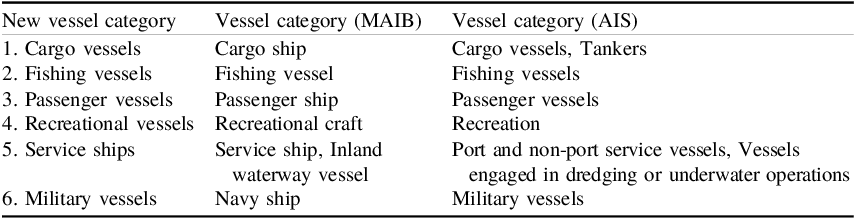
While ten vessel categories group all UK vessels using AIS data, these differ from the eight vessel categories in MAIB’s categorisation. Table 1 describes the six vessel categories considered in the paper that merge the vessel categories in the MAIB and AIS datasets, with the category ‘High-speed crafts’ being ignored in the current paper due to its low presence in both datasets.
New vessel categories

2.5. Previous research on maritime safety
While there is considerable research on maritime safety, this section summarises the relevant research on navigational accidents from different perspectives, based on different navigational accident causation factors: environmental factors (seasonality, weather, visibility, sea state), vessel-related factors (vessel type, size, length, age), port and channel complexity (channel geometry, traffic density), human factors, and safety culture.
The important relationship between seasonality and weather or visibility has been widely studied. Bye and Aalberg (Reference Bye and Aalberg2018) used normalised accident data from Norwegian waters to determine that low visibility and darkness were main factors for accident causation. Pak et al. (Reference Pak, Se-Woong, Yang and Yeo2015), after interviewing 21 captains and studying port safety from a navigational perspective in Korean ports, concluded that weather and sea conditions were more severe accident causation factors than factors such as traffic volume, vessel sizes and vessel types. Ghasemi et al. (Reference Ghasemi, Pelot and Rezaee2016) found a seasonality relationship amongst the accidents caused. Fan et al. (Reference Fan, Li and Yin2014) developed a safety index after testing a hypothesis relating accident causation factors and accidents from a dataset of 130,000 vessels and determined that there was no relationship with seasonality.
Vessel-related factors such as the size or age, or the type of vessel, have also been investigated. Fan et al. (Reference Fan, Li and Yin2014) found that older vessels and smaller vessel sizes decrease accident probability. The same study also concludes that tankers, container ships and bulkers were the safest, while general cargo ships and passenger vessels were the least safe. Aalberg and Bye (Reference Bye and Aalberg2018) studied similar factors and determined that cargo and fishing vessels have much higher chances of an accident occurring. Their research also proved that shorter vessel lengths, higher ages and smaller gross tonnages increase accident rates. Jin et al. (Reference Jin, Kite-Powell, Sollow, Talley and Thunberg2002) also concluded that smaller fishing vessels have much fewer accidents.
Regarding port and channel complexity, Pak et al. (Reference Pak, Se-Woong, Yang and Yeo2015) observed how navigationally complex, shallow and narrow channels, and high traffic density present a special hazard for captains in ports. Aalberg and Bye (Reference Bye and Aalberg2018) also found a relationship between high traffic density and accident causation. Kotilainen et al. (Reference Kotilainen, Kujala, Mazaheri, Montewka and Sormunen2014) performed similar research, but only related shallow channels to grounding accidents. The results indicate a direct relationship between grounding accidents and waterway complexity. However, traffic density and grounding accidents were unrelated with a 95% level of confidence.
The differences in findings with the previous research can be explained by:
-
1. the presence of other factors, not studied, that may have contributed to the accidents and their severity;
-
2. the fact that only accidents in a particular area/environment were considered; and
-
3. the data used do not fully represent reality.
Studying only a limited number of factors can be due to data availability issues, as not all the desired factors are recorded, the records are inconsistent or they are hard to quantify/measure (e.g. fatigue or the reasons behind unintentional human errors). Hence, this paper will conduct a data quality assessment to minimise the impact of such limitations. Aside from environmental conditions and vessel characteristics, the human aspect must also be considered. Jin et al. (Reference Jin, Kite-Powell, Sollow, Talley and Thunberg2002) proved the large impact of the human factor and safety culture within vessel organisations on maritime accidents. Basterrechea et al. (Reference Basterrechea, Maruri, Sánchez and Sotés2021), Baker and McCafferty (Reference Baker and McCafferty2005) and Berg et al. (Reference Berg, Julkaisuia, Koulutus, Lappalainen, Storgard and Yliopiston2013) concluded from their analysis that the human factor is responsible for approximately 80% of maritime accidents. Chauvin et al. (Reference Chauvin, Clostermann, Langard, Lardjane and Morel2013) studied more in detail the human factor by analysing 27 vessel collisions. Their analysis determined that decision making represents the main unsafe act, corresponding to 85% of the collisions analysed by the author, while misperception of vessels, perhaps from unfavourable weather conditions, accounts for the remaining 15% of the collisions.
Analyses of the maritime accidents involving people working aboard Norwegian and foreign vessels in Norwegian waters and Norwegian vessels in foreign waters by Nævestad et al. (Reference Nævestad, Phillips, Elvebakk, Bye and Antonsen2015) indicated that injuries at docks seem to represent a potentially high-risk situation. Nearly a third of the injuries aboard the ships they studied occurred at dock with crew aboard the ship. Safety culture in shipping companies and maritime stakeholders is also a key component of maritime safety according to Berg (Reference Berg2013), who claims that maritime transport is 25 times riskier than the aviation industry when the accident death rates for the distance travelled are compared, and that safety culture is what needs the largest improvement. He concluded that the reporting culture and effective port-wide communications lacked trust, confidence and clear messages.
2.6. The use of AIS for analysing port congestion and performance
The phenomenon of congestion can happen in different places within a port, such as the berth and load discharge points, which cause queuing and therefore increase vessel waiting time (Pruyn et al., Reference Pruyn, Kana and Groeneveld2020). Peng et al. (Reference Peng, Bai, Yang, Yuen and Wu2022) studied port congestion using AIS data for 3,957 container ship movements and then proposed a model that predicts congestion in ports, based on different factors including congestion propagation effects. There are various studies on port congestion, however, as concluded by Peng et al. (Reference Peng, Bai, Yang, Yuen and Wu2022), these mainly use port authority databases (at a regional level), making their findings inconsistent and inapplicable for other ports, or for national or even international statistics. Pruyn et al. (Reference Pruyn, Kana and Groeneveld2020) studied port congestion with more accurate methods, using AIS data along with vessel characteristics from Lloyd’s list, then implement a congestion prediction model for short- and long-term.
Port performance has been widely measured using big data, with different aims: to measure port congestion and performance for determining the impact of a port congestion index on the economics of the shipping market (Bai et al., Reference Bai, Jia and Mingqi2021) and to analyse various port performance aspects. These aspects include: how ship location is related to port connectivity (Yang et al., Reference Yang, Wu, Wang, Jia and Li2019) and spatial-temporal dynamics of the volume of traffic in a port (Zhang et al., Reference Zhang, Meng and Fwa2019). Additionally, Chen et al. (Reference Chen, Zhang, Xiaojuan, Wang, Shijian, Zhaohui and Pan2016) studied port performance indicators for container ports, by using both AIS and maritime open data. One such indicator is traffic volume, which will also be considered in this paper.
In Figure 2, the AIS derived vessel routes and density grid are shown for the port of Liverpool for illustrative purposes. The orange lines represent each of the vessel tracks for one year. The red rectangles show the less traffic-dense locations, aiming to demonstrate how the grid is structured. For each of these rectangles, an average yearly traffic density is available. The yellow circles show MAIB’s data and the pink ones show RNLI’s data. ‘QGIS-LTR’ has been the software used to represent the current shapefiles.
AIS data obtained from the UK government for the port of Liverpool.

3. Methodology
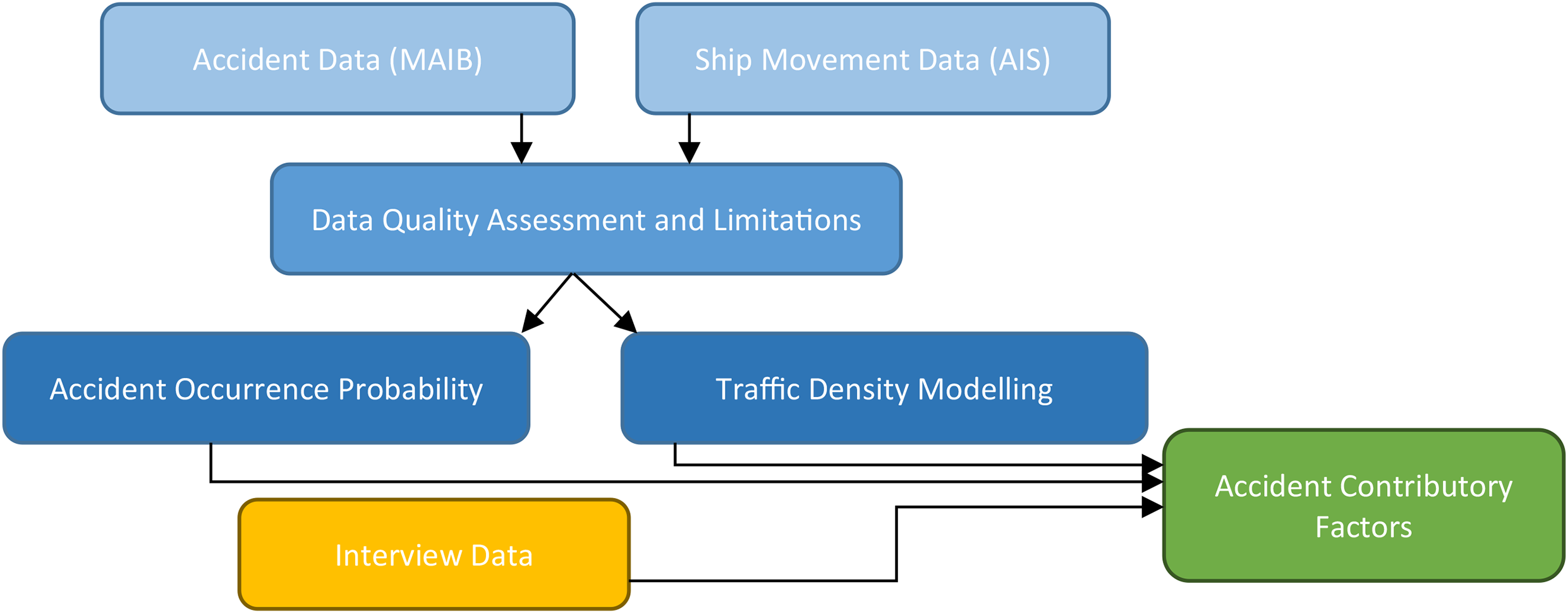
Figure 3 summarises the methodology being followed in this paper. MAIB and AIS data are used to model traffic densities in and around different UK ports, and to determine the probability of accidents occurring in these ports. These findings along with insights from industry professionals help us understand the different factors contributing to accidents in UK ports, while understanding the potential limitations, data improvements and areas of concern.
Flow chart illustrating methodology employed.

3.1. Data Quality Assessment (DQA)
The MAIB and AIS databases are the main data sources used in the analysis. High-quality data are essential in ensuring a high level of confidence in the results and this is assessed according to three different types of assessments: quantitative, qualitative and narrative. Each of these assessments considers different dimensions to determine both the capabilities and limitations of the database. Eight dimensions analysed in the current study have been selected from prior research (Cai and Zhu, Reference Cai and Zhu2015; DAMA UK, 2013; Lee et al., Reference Lee, Pipino and Wang2003; Psyllou, Reference Psyllou2018): Accessibility, Accuracy, Consistency, Completeness, Credentials, Interpretability, Relevance and Timeliness. Finally, a narrative assessment is performed using narrative dimensions similar to Psyllou’s (Reference Psyllou2018). The MAIB’s DQA is split between OA and CS due to the large differences observed in the reporting of different factors.
3.1.1. Ideal databases
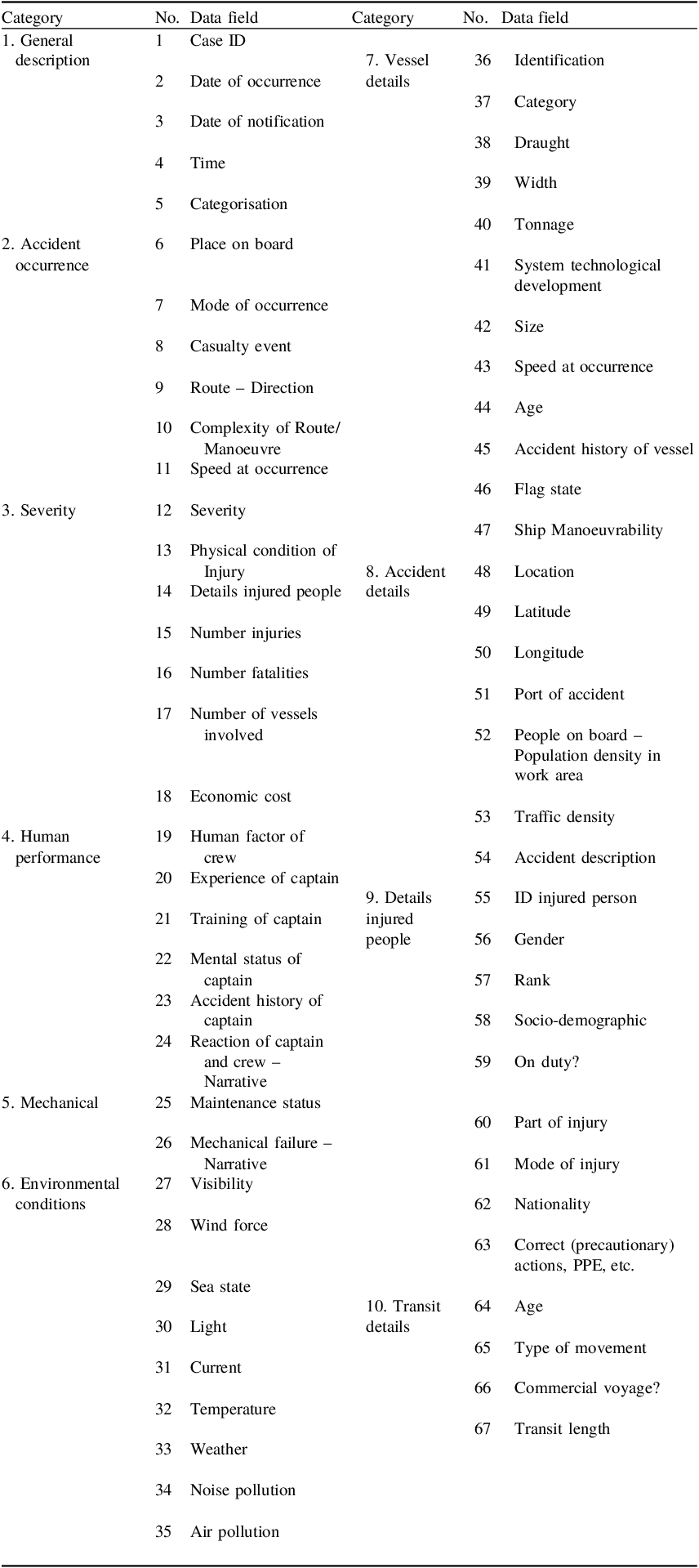
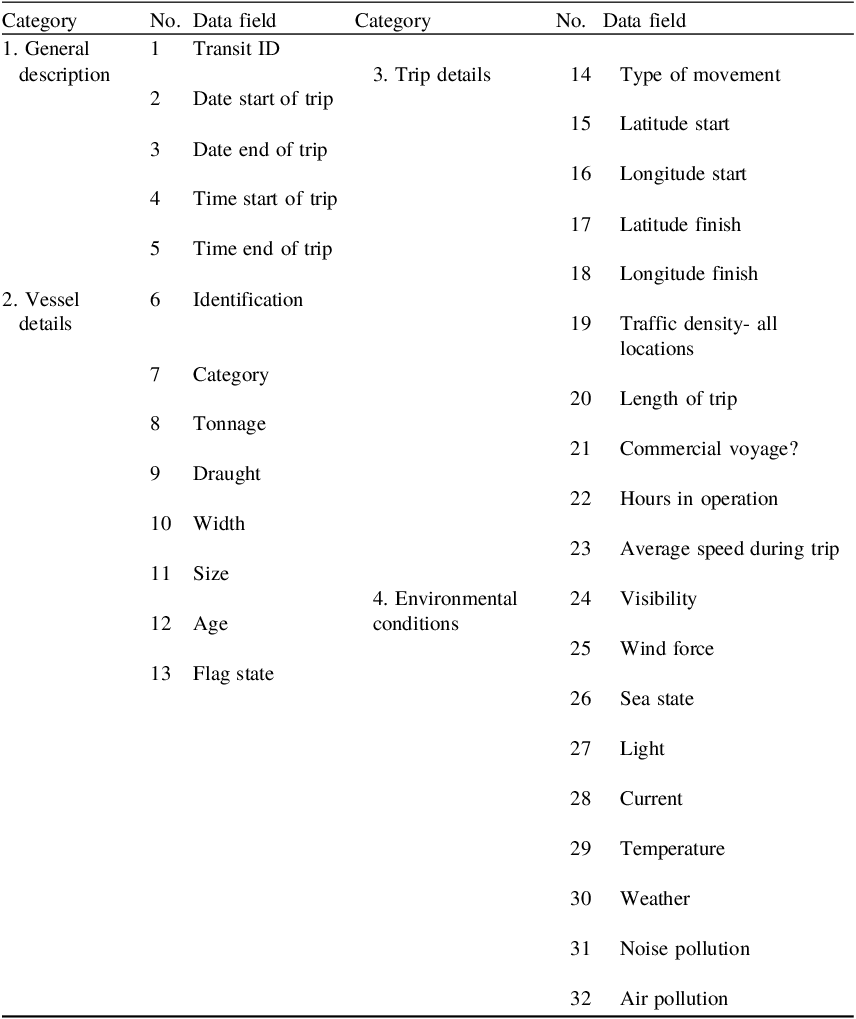
The categories and data fields that would ideally be obtained from MAIB and AIS (referred to as ideal databases) are shown in Tables 2 and 3. These provide the information desired from both data providers, which is used as reference for the calculation of the data quality dimensions that assess how suitable the actual data obtained from our sources is for our desired analysis. These have been based on previous research findings and the authors’ experience on further factors that can affect maritime accidents. Full description and categorisation of the data fields can be found in Appendices A and C.
The categories and data fields that would ideally be obtained from the Marine Accident Investigation Branch of the United Kingdom

The categories and data fields that would ideally be obtained from the AIS

3.2. Data cleaning
The MAIB’s database containing the accidents between 2013 and 2019 is analysed, i.e. before the onset of Covid which altered maritime trade greatly. The following actions have been taken to provide a clean, qualitative data set using MAIB data.
-
Marine Incidents have been removed.
-
Data fields are reported for every vessel and injured individual involved. When analysing accident frequencies, only one vessel/ individual will be considered.
-
All the cells containing entries such as ‘Unknown’, ‘Not Available’, ‘Not Investigated’, ‘0’ (when applicable), blanks, ‘00:00’, ‘00:01’, ‘23:59’, or other unreliable information, are viewed as unknown/unreported information.
Observing the research conducted on navigational maritime accidents by previous authors, Figure 4 has been created to summarise the potential factors investigated in the current paper.
Navigational maritime accident causation factors.

The eight different factors outlined in Figure 4 will be studied in this paper. MAIB’s accident database will be used to analyse ‘vessel-related factors’, while MAIB’s database and that of the RNLI will be combined to analyse environmental factors. Then, the logistic and port engineering factors, as well as the time of causation, vessel type and vessel size factors will be analysed after combining the UK’s AIS, MAIB and RNLI data. The port and channel factors will also be analysed based on interviews with industry professionals, since the AIS, MAIB and RNLI data do not provide details on port geometry and complexity.
Kinematic parameters, which can contribute to the occurrence of accidents, such as the ship’s velocity through the water, were not considered in the analysis despite their importance, because we could not obtain this information and relate it to each accident in the MAIB dataset. Other studies that consider kinematic parameters are: Chen et al. (Reference Chen, Li and Mou2021), presenting a method for real-time risk analysis of ship collisions using velocity obstacles, giving insights into safe navigation by maintaining the velocity of a ship outside certain risk areas; Paulauskas et al. (Reference Paulauskas, Filina-Dawidowicz and Paulauskas2023), who discuss kinematic parameters that influence the risk of collisions in narrow channels; and Wang et al. (Reference Wang, Perera and Batalden2023), who use kinematic motion models to estimate ship state and support decision-making processes for ship manoeuvring and accident prevention.
3.3. Binary logit model to predict different accident causation factors
Discrete choice models can be used to predict behaviours by observing previous decision makers’ decisions. A binary logit model will be used to predict accident occurrences based on different variables. The vessel density will be found with AIS data, which provides the date and time at which a specific vessel type made a movement. Accident occurrences are obtained from MAIB’s database. In using a binary logit model, the error components are assumed to be identically and independently distributed according to a Weibull distribution. Also, accident occurrence is considered deterministic (i.e. the accidents occur or do not occur) and the data fields are assumed to be representative of reality after performing the data cleaning. The current model uses AIS data from 2015, 2016 and 2017, and accident data from 2013 to 2019 to represent the population of vessel movements and accidents, respectively. It is assumed that vessel movements are similar throughout the years.
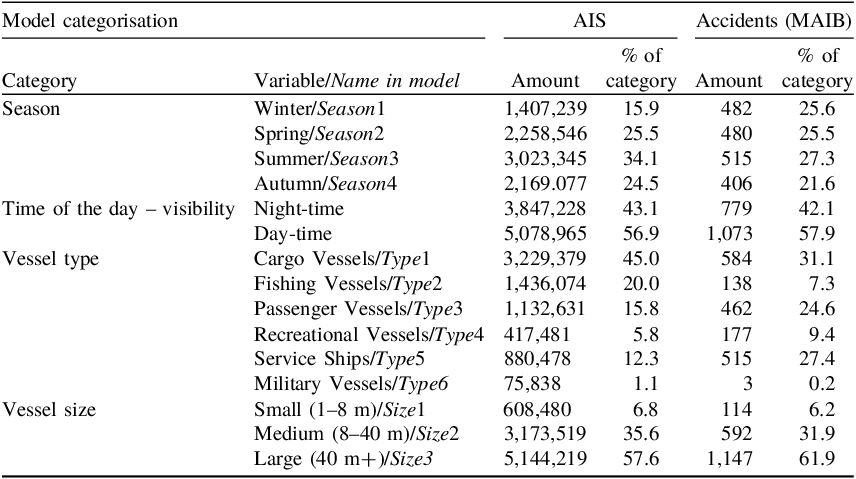
The different variables under consideration for accident causation are: seasonality, type of vessel, vessel length and visibility (day-time (7–22 h) or night-time (22–7 h)). Seasonality and visibility can be inferred from the date and time given in both databases. The vessel categories from both databases will be converted into the merged vessel categories found in Table 3. Finally, vessel length is a continuous variable given in both datasets which is converted into three different categories (small (<8 m), medium (8–40 m) and large (40 m+)). The variables in the model will have a value of 0 or 1, depending on whether an accident had such variable characteristics (value of 1) or not (value of 0). The model categorisation and the presence of the variables in each of the databases has been represented in Table 4.
AIS and MAIB samples and variables used

Two models are analysed. Model I will consider all vessel types, while Model II will only consider the vessel types best captured by MAIB’s and AIS’ databases, which are vessel types 1, 3 and 5 from Table 1 (Cargo, Passenger and Service ships, respectively). Table 5 shows the sample sizes and number of parameters estimated for each model.
Binary Logit Models performed

3.3.1. Binary logit model development
The deterministic utility functions used to predict accident occurrence in Model I are shown below. As expected, Model II will exclude the respective variables and parameters for vessel types 2, 4 and 6 (fishing, recreational and military vessels, respectively). The $\beta $
terms are the attributes which represent the sensitivity of its corresponding variable with respect to the variable of the dimension which is not being considered.
$\beta $
terms are the attributes which represent the sensitivity of its corresponding variable with respect to the variable of the dimension which is not being considered. $AS{C_{acc}}$
represents the Alternative Specific Constant.
$AS{C_{acc}}$
represents the Alternative Specific Constant.
 $$\eqalign{ & V\left( {accident} \right) = AS{C_{acc}} + {\beta _{Season1}} \times Season1 + {\beta _{Season2}} \times Season2 + {\beta _{Season3}} \times \cr & Season3 + {\beta _{Nighttime}} \times Nighttime + {\beta _{Type1}} \times Type1 + {\beta _{Type2}} \times Type2 + {\beta _{Type3}} \times \cr & Type3 + {\beta _{Type4}} \times Type4 + {\beta _{Type5}} \times Type5 + {\beta _{Type6}} \times Type6 + {\beta _{Size1}} \times Size1 + {\beta _{Size2}} \times Size2 \cr} $$
 $$V\left( {No\,accident} \right) = 0{\rm{\;}}$$
Maximum likelihood estimation has been used to find the attributes by running the model in Biogeme software. The goodness-of-fit must be checked. A corrected version of McFadden’s log likelihood goodness-of-fit method which considers the impact of the number of degrees of freedom will be calculated. The formula used is
 $${\bar \rho ^2} = 1 - {\rm{\;}}{{logL\left( \beta \right) - n} \over {logL\left( 0 \right)}}$$
where $n$
represents the number of degrees of freedom in the model. A value close to 1 will prove a high accuracy of the model. Attributes’ accuracy will also be checked with the t-test, by testing the hypothesis that the value obtained is significantly different from 0. As the number of observations is approximately 7 million, the t-values found must be larger than 1.96 to have at least 95% confidence on each attribute.
$n$
represents the number of degrees of freedom in the model. A value close to 1 will prove a high accuracy of the model. Attributes’ accuracy will also be checked with the t-test, by testing the hypothesis that the value obtained is significantly different from 0. As the number of observations is approximately 7 million, the t-values found must be larger than 1.96 to have at least 95% confidence on each attribute.
Finally, the probabilities will be calculated for accident occurrence under the different season, vessel size, time of the day and vessel type variables, after substituting the respective variable values (1 for yes, 0 for no) in the deterministic functions:
 $$P\left( {accident} \right) = {{{e^{V\left( {accident} \right)}}} \over {{e^{V\left( {accident} \right)}} + {e^{V\left( {No\,accident} \right)}}}}$$
3.4. Impact of traffic density on accident causation
As mentioned in Section 2.3, AIS data allow for an accurate representation of traffic vessel density within UK territorial waters. Traffic density and accidents will be related in the UK’s 12 largest ports. These ports were chosen according to different metrics, such as the traffic density or accident rate metrics calculated with AIS’ and MAIB’s data in multiple UK ports, or those shared by the UK’s Department for Transport which include the tonnage handled or the vessel arrivals per port. These 12 ports are represented in Figure 5 using orange stars, while the green dots highlight the UK maritime accidents during the study period.
Distribution of UK port accidents and accident density for the 12 selected ports.

3.4.1. Traffic density and number of accidents around selected ports
The direct relationship between traffic density and accidents was studied in the twelve ports, where traffic densities were calculated. First, the location of the centre of the port in the coast was found. Then, over 240,000 2 km2 grid cells which cover UK waters were modelled and given their respective coordinates. AIS grid cell locations were different for different years, so alternative approaches have been taken to locate the grid cells. Once all cells were located, the individual analysis for each of the ports was completed as follows.
Two different types of traffic vessel densities have been calculated in each of the ports: the maximum vessel density of the port, which considers the port’s 5 grid cells with the highest traffic density; and the average traffic vessel density of the port, which considers all of the transited grid cells around the port. Using the same model which finds the limiting coordinates of the 450 km2 around the port’s centre, the number of accidents were calculated for each of the years between 2013 and 2017 using the MAIB’s database.
For each port, an area of 450 km2 around the centre of the port was considered. The 2 km2 grid cells surrounding the port were identified with their respective annual traffic densities. Since it was desired to calculate traffic densities in UK ports and their immediate vicinity, the 2×2 km spatial resolution does not affect the results as no 2 ports that have been studied are that close to each other to have duplicate inputs. Selecting such a large area has enabled high-risk locations, capturing interactions between vessels entering or exiting the port. The grid cells where the traffic density is 0 or close to 0, representing land or inaccessible locations, have been removed. For the Port of London, to account for its larger dimensions, a much greater area of approximately 95 km along the River Thames, which congregated all port locations that are part of the Port of London, was chosen.
3.4.2. Accident to traffic density correlation
For each year, the ratio of accidents to traffic density was calculated in each port:
 $$Accident - \;Density\;metric = {{Total\;number\;of\;accidents\;in\;that\;year} \over {Yearly\;traffic\;density\;\;\;\left( {Maximum\;or\;Average} \right)}}$$
Having calculated each year’s metric, the average was determined for comparative purposes across the 12 ports. To achieve greater confidence in the results, the current metrics were first calculated for all vessel types, and then for only cargo, passenger and service ships, which are best represented by the used databases. Each of the grid cells also contained the average weekly traffic density for each vessel type, enabling the average weekly densities for each vessel type at each port to be calculated. These densities will provide an understanding of the main vessel types transiting in the ports and, subsequently, the main operations at each port.
3.5. Interviews with industry professionals
Semi-structured interviews were conducted with six industry professionals who were harbour masters, safety managers and directors within the UK or European maritime sector as well as institutions researching maritime safety. The questionnaire is outlined in Appendix D. They were interviewed about topics that were still uncertain after studying the databases.
-
1. Data quality (AIS, MAIB and RNLI databases).
-
2. Port related factors: geometry (channel depth, width, complexity).
-
3. Possible engineering-related improvements to improve safety on the ports.
-
4. The importance of Safety Management Systems within ports to reduce accident rates.
-
5. How vessel- or engineering-related factors impact accident rates and whether any regulations should be introduced to change current trends.
The concepts of credibility, dependability, transferability and confirmability have been considered to ensure the trustworthiness of the interviewees’ answers (Bengtsson, Reference Bengtsson2016). Credibility ensures that no reliable data are left out, dependability accounts for the variation of interviewees opinions during the process, transferability expresses if answers can be extrapolated to everyone in their status, and confirmability expresses the answers’ objectivity and neutrality. All of them have been considered acceptable as all questions and answers have been checked by a third party, responses do not change with time, all answers are contrasted and are not assumed representative of the whole port/maritime population, and all responses are definitive and objective. The interview findings will be mentioned in the discussion section (Section 5), along with the main results from data analysis.
4. Results
4.1. Data quality assessment
4.1.1. MAIB’s database
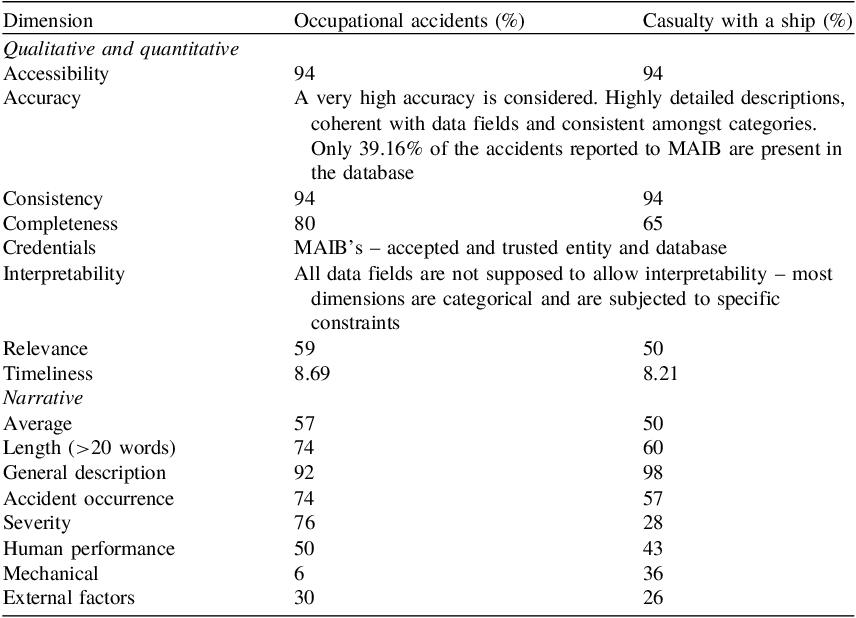
Table 6 summarises the scores for the DQA dimensions. Full details of the individual scores for each of the data fields can be found in Appendix A.
Data Quality Assessment results for MAIB’s database

As observed from the scores in Table 6, all quantitative and qualitative dimensions are over 50%, which proves the validity and quality of the database. Although some of the narrative dimensions’ scores fall below 50%, the average score for these is above 50%. The relevance dimension of the database receives the lowest score, because of the high number of data fields required in the ideal database, as a high accuracy of the results was sought. In reality, however, some of the factors that we would ideally include in the analysis are not recorded and cannot be obtained from other sources. The accuracy dimension, although not scored quantitatively, brings up a problem about the small percentage of accidents (39.16%) which appear in MAIB’s database when compared with the total number of accidents reported to MAIB (Appendix B). Furthermore, not all accidents are reported to the MAIB. Despite the deficiencies of the current database, it is assumed to provide a sufficiently accurate sample.
The validity of the data has also been consulted with industry professionals. Regarding the MAIB database, all participants agreed that accident reporting is accurate and consistent for specific vessel categories, such as UK merchant vessels over 100 GT, but inaccurate for non-UK vessels, as well as UK military, recreational and fishing vessels. It has also been mentioned that ports send annual or individual reports to the MAIB, depending on the seriousness of a particular incident. Indeed, the MAIB’s 2017 annual report shows how only 13.5% of the accidents were reported to the MAIB when compared with the insurance provider Scottish Boatowners (MAIB, 2018). The participants have also mentioned the underreporting of minor incidents and near misses, which can be recorded by individual ports, but the information is not shared with the MAIB. For one particular port, it has been mentioned that their internal accident and incident database was ten times bigger than the proportion of accidents they reported to the MAIB. However, underreporting differs between ports, some reporting more to the MAIB than others.
Considering the input from the interviewed participants and the vessel categories used in the current report, accurate insights will only be achieved by analysing Cargo, Merchant and Service ships, and only for the marine casualties, not the marine incidents. Hence, the data used in this paper have been filtered accordingly to achieve a higher accuracy of the results.
4.1.2. AIS database
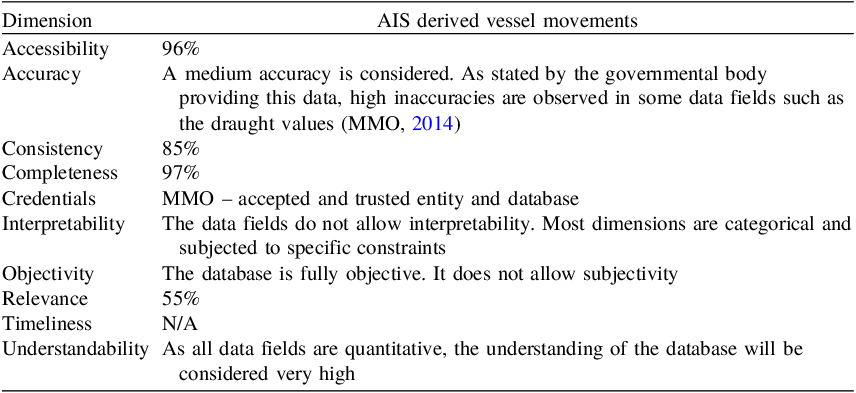
Table 7 outlines the results for AIS’ data quality assessment.
Data Quality Assessment results for AIS’ database

The individual scores for the different dimensions of all data fields in the AIS database can be found in Appendix C. As all scores are above 50%, a high accuracy is assumed from the current database. Like the MAIB database’s DQA, the relevance score is the lowest due to the ideal database’s high requirements. Section 2.3 has already highlighted the limitations relating to how many smaller recreational or fishing vessels do not have AIS incorporated. It was also mentioned by industry professionals that the use of AIS data in areas with high recreational usage will be inaccurate. Therefore, differentiation is needed of the vessel types by not only considering the large underreporting of accidents from recreational, fishing and military vessels in the MAIB’s database, but also from low AIS usage of smaller recreational and fishing vessels. Hence, these vessel categories will be removed from the analysis.
4.2. Statistical analysis of accidents in UK ports
This section uses statistical tests to relate causation factors to accident severity, aiming to identify what factors lead to more serious occurrences. The current section studies an accident database and not the whole vessel population. This means that any statistical figure obtained will not necessarily represent a causation pattern for accident occurrence. For example, if a third of all accidents occurred under sunny/clear conditions and 95% of all vessel movements occur under sunny/clear weather conditions, what should be deduced is that movements under other types of weather conditions are potentially more dangerous. Comparisons against the whole vessel population is also considered.
Most accidents occur during day-time, however, during night-time (22–7 h), accidents can be more serious. This is proven by a 99% confidence level that there is a relationship between accident severity and the time of the day. However, there is no relationship between seasonality and accident severity. Regarding the impact of environmental conditions on accident severity, poor visibility, a rather good sea state, moderate wind conditions and clear weather were found to be the conditions when an accident occurrence is most prone to happen. Furthermore, accident severity was determined to be related to visibility, sea state and wind force, such that a higher accident severity is directly correlated with worse visibility, a higher wave height and bad weather conditions. Accident severity and wind force are also directly correlated, but less significant. The relationship between vessel types and accident severity has also been tested. Cargo vessels and service ships seem to cause most ship casualties; however, cargo, passenger and service ships represent the main vessel types where most occupational accidents occur. Both categories show a strong correlation with accident severity.
For casualties with a ship (CS), collision, contact, grounding/stranding and loss of control are the most common accident types, and account for over 85% of all CS events. Vessel-specific parameters such as age, tonnage, length, material and flag state were also tested against accident severity. It is found that steel is the most common vessel material and UK registered vessels seem to have more severe accidents than non-UK flagged vessels. As expected, a strong correlation is found between accident severity and vessel material or flag state. There is also a high direct relationship between vessel age and accident severity (i.e. the older the vessel, the higher the accident severity). However, vessel length and tonnage do not have a large correlation with accident severity. The occupational accidents, however, are determined to be mostly caused by human-related factors, in most cases under working conditions.
4.3. Analysis of accident and AIS data in a logit model
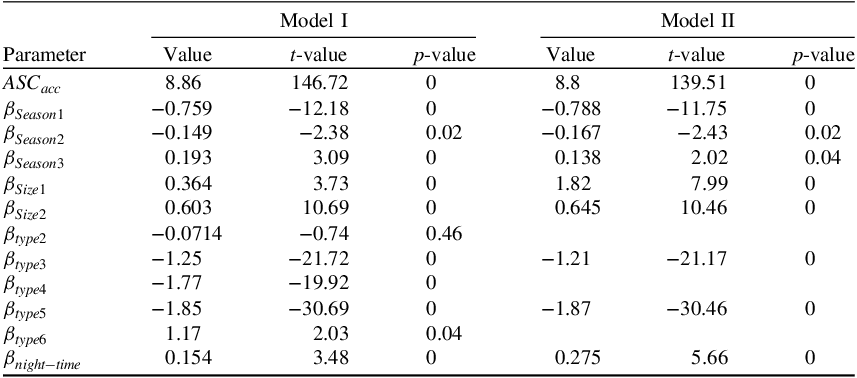
The attribute values and their corresponding p-values have been found for each of the models.
The attributes from the table above will be used to find the probabilities of an accident occurring. The lower the coefficient for each category, the higher the probability for an accident occurrence and vice versa. These were calculated with reference to one of the parameters in each category, for which the value is zero (Season 4, Size 3, Type 1, Day-time). Season 1, Vessel Type 5 (service ships), Size 3 (largest vessel size group, >40 m) and transits during day-time represent in both models the lowest coefficients. It is important to note the low p-values (i.e. the high confidence of the attribute values) except for Vessel Type 2 (fishing vessels). Table 9 highlights the accuracy of the model with the corrected goodness-of-fit parameter being around 0.4, which is considered strong for multinomial logit models.
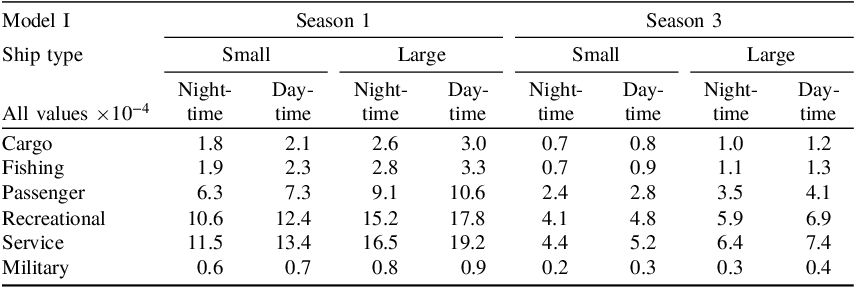
Using the parameter values from Table 8, the probabilities are calculated for different variables under consideration. For illustrative purposes, Table 10 indicates those variables which give the highest and lowest accident probabilities for each model. All probability values observed must be multiplied by 10−4. It is important to note that these values are not accident rates, as only AIS data from 3 years are used and accident data for seven years are considered. Hence, the current data only serve for comparison purposes amongst the different variables.
Attributes found after maximum likelihood estimation

Accuracy of both models

Accident probabilities for Model I

Model I results show that large service ships during day-time and Season 1 have a 27 times greater probability for an accident occurring than a cargo vessel during night-time in Season 3. The other probabilities can be compared accordingly for the different variables. It is important to note the limitations of the data used: smaller vessels are underrepresented by AIS data, and fishing, recreational and military vessels are largely underreported in accidents.
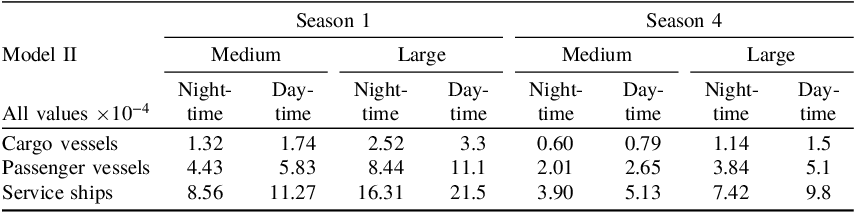
As explained in the methodology, to avoid the vessel type related inconsistencies, Model II has been created, where only Cargo, Passenger and Service ships are analysed. Although small vessels have been considered in Model II’s analysis, the comparison will be performed between medium and large vessels, which are best represented by AIS data, see Table 11.
Accident probabilities for Model II

Under the current model, the comparison between large service ships during daytime and season 1, and medium cargo vessels during night-time and season 4 show a more than quadruple risk of an accident occurring in the former scenario. The remaining values can be compared for illustrative purposes. These tables indicate that day-time movements, during the winter season, for larger sized vessels, and especially the vessel category of service ships, increase largely the accident occurrence.
The impact of port-related factors on accidents was asked to industry professionals, as this information could not be obtained from the data. They highlighted the channel’s depth, traffic density and the sea state or wind force protection of the port. Port-related factors are believed to be managed well with regular Hydrographic surveys. When asked about what could be done to reduce accident rates, the participants’ answers were focused on the human factor, rather than to regulations tackling the riskier factors analysed in the current paper.
4.4. Impact of vessel densities in UK’s largest ports on accident causation
The highest traffic densities occur in the coast and in the English Channel. Unsurprisingly, almost all accidents occur in the ports and in locations with the highest traffic densities, especially the South-East region of the UK. Nevertheless, the vessel densities in the highly transited English Channel do not see numerous accidents and traffic density only has a large impact on accident occurrences in space limited locations such as ports. These findings are also obtained by analysing the MAIB and AIS data.
The number of accidents between 2013 and 2019 in each of the ports, calculated using the methodology explained in Section 3.4, is shown in Figure 6. The current method captures more accidents in each of the ports than MAIB’s port classification. Using MAIB’s port classification, there is a significant correlation between accident severity and port location, proving that other port-related factors, such as port geometry, which have not been considered in this paper and are not recorded by the MAIB, can contribute to accidents and increase severity.
Accidents occurred in each of the 12 UK ports considered.

Figure 7 indicates each port’s average vessel density between 2013 and 2017, and highlights a clear direct relationship between each port’s traffic density and number of accidents.
Vessel Traffic Densities in the 12 UK ports considered.

To better understand the impact of traffic density on accident rates, Figure 8 indicates the accident to traffic density metrics. For all vessel types, Plymouth, London and Milford Haven have the highest accident rates when considering average vessel densities in the ports. When maximum densities are considered, Milford Haven is no longer in this category. This large difference in the rate indicates that Milford Haven possesses very localised areas with high traffic density. The same phenomenon can be observed in the Edinburgh port, where the accident to density metric becomes close to zero when considering the maximum vessel density (the red stars in Figure 8). Conversely, the ports of Felixstowe, Glasgow and Dover have the safest metrics. When only vessel types 1, 3 and 5 (cargo, passenger and service ships) are analysed, large differences in the accident to density relationships can be found in the ports which have mostly fishing, recreational and/ or military vessels, such as the port of Plymouth.
Accident to Traffic density metrics for the 12 UK ports considered.

When comparing each port’s accident to density metric with its traffic density, no clear relationship can be found, meaning that a higher traffic vessel density does not imply a higher accident rate. The types of vessels which arrive and depart from the 12 ports under consideration are represented as a percentage in Figure 9. The ports which possess the highest accident to density metrics contain mostly cargo vessels and service ships, and in the case of Plymouth, a high percentage are military vessels. Conversely, the ports which contain mostly passenger vessels are the safest.
Vessel Traffic in the 12 UK ports considered.

Other statistical tests have been employed to find the relationships between different factors and accident severity, with the objective to identify which factors lead to the most unwanted situations. It is important to note that the current section studies an accident database and not the whole vessel population. This means that any statistical figure obtained will not necessarily represent a causation pattern for accident occurrence. For example, if a third of all accidents occurred under sunny/ clear conditions, and 95% of all vessel movements occur under sunny/ clear weather conditions, what should be deducted is that movements under other types of weather conditions are potentially more dangerous. Comparisons against the whole vessel population will be done in Sections 4.3 and 4.4.
5. Discussion
This paper has analysed 1,914 accidents that occurred in the UK between 2013 and 2019 to gain a better understanding of the major factors which lead to navigational accidents around the country’s ports. To the best of the authors’ knowledge, this is the first paper to normalise the UK’s accident data by using almost 9 million vessel movements derived from AIS data, and also the first to relate the UK’s accidents with traffic densities in ports. Similar approaches were taken by Guedes et al. (Reference Guedes, Silveira and Teixeira2013) normalising Portugal’s AIS data, by Aalberg and Bye (Reference Bye and Aalberg2018) normalising Norwegian AIS data for statistical analysis, and by Kotilainen et al. (Reference Kotilainen, Kujala, Mazaheri, Montewka and Sormunen2014) relating grounding frequencies to traffic density in the Gulf of Finland. Interestingly, when normalised data are used in the analysis, the results obtained in this paper are closely related to the findings discussed in the literature review. These shared accident causation factors amongst the different authors’, after analysing different national databases, indicate both just how international the maritime industry really is and how the challenges identified require a global effort from international regulatory institutions such as the IMO. One example of the effectiveness of such international regulations was MARPOL’s regulation 19 introduced in 1993 to prevent oil tanker spillage, where all tankers of 5,000 dwt and more were required to be fitted with double hulls (IMO, 2021). Since then, oil spillage has been reduced by approximately 500% (ITOPF, 2020).
A strong relationship between accident causation and seasonality was found, with the winter season being more prone to accidents than the other seasons. This agrees with Ghasemi et al. (Reference Ghasemi, Pelot and Rezaee2016). The research of one interview participant on seasonality also shows how the winter season increases the risk of accident occurrence. The time-of-day factor has also been analysed to show the relationship between visibility and accident causation. Accident severity during night-time has been found to be much higher than during day-time.
The age of the larger vessels was found to be the determining vessel-related factor in leading to more severe accidents. Better maintenance and updating of the vessels’ technology or of regulations to limit vessel ages for some vessel categories may well be able to largely reduce the severity of the accidents that occur. This finding relates to Fan et al. (Reference Fan, Li and Yin2014) or Jin et al. (Reference Jin, Kite-Powell, Sollow, Talley and Thunberg2002), where smaller vessels sizes decreased accident rates. Nonetheless, when relating the ports’ accident to traffic density rates with different vessel types, ports with more passenger vessel arrivals were seen to have lower accident to traffic density rates than under the presence of cargo or service ships. This demonstrates how larger vessels do not necessarily increase accident causation. However, vessel types have been largely related to accident causation. Previous research determined that cargo, fishing and passenger vessels were the least safe (Aalberg and Bye, Reference Bye and Aalberg2018; Fan et al., Reference Fan, Li and Yin2014). In contrast, this paper finds that in UK waters, both cargo and fishing vessels are the safest alongside military vessels. Service ships, recreational vessels and passenger vessels have been found to be the least safe.
The ports of London, Plymouth and Milford Haven had the highest accident rates when comparing traffic density with the accidents in each port. However, the ports of Felixstowe, Glasgow and Dover had the lowest accident rates. A rising accident rate due to increased traffic densities within the ports was not observed, a finding similar to that of Kotilainen et al. (Reference Kotilainen, Kujala, Mazaheri, Montewka and Sormunen2014). More precisely, traffic density has been observed to be directly proportional to the total number of accidents occurring in ports. Also, when traffic density and accident causation has been mapped in UK waters, it can be concluded that most accidents occur in very confined spaces with high traffic densities such as ports. Hence, the English Channel, which possesses UK’s highest traffic densities, but is not space restricted, or other locations with lower traffic densities, barely saw any accidents.
Regulations are already in place to mitigate the navigational risks which are identified in this paper. When analysing occupational accidents, whether by interviewing industry professionals about the determining factors for accident occurrences or by assessing the research from Basterrechea et al. (Reference Basterrechea, Maruri, Sánchez and Sotés2021), Baker and McCafferty (Reference Baker and McCafferty2005) or Berg et al. (Reference Berg, Julkaisuia, Koulutus, Lappalainen, Storgard and Yliopiston2013), solutions converge with the requirement to improve human factors to reduce accidents. Hence, to decrease navigational accident rates, not only must individual solutions for each of the factors identified be found, but also human factor directed solutions must be implemented. Some options in the short term can involve introducing better training techniques with simulators, expanding awareness of a vessel or port’s Safety Management System (SMS) to all stakeholders, or increasing the usage of technological machinery which can help the human factor make decisions with more certainty. Arguably, in the long term, a safe introduction of autonomous vessels in our seas presents a good solution to reduce the possibility of human errors. Manole and Majumdar (Reference Manole and Majumdar2023) discuss how new autonomous ships will have positive effects on maritime safety as approximately 77% of the maritime accidents studied could be prevented with the introduction of autonomy. They conclude that autonomous vessels will overall reduce the frequency of human-related accidents by diminishing the number of human-dependent actions, even though new human-related accidents are expected to occur, but which are expected to be considerably less that the current numbers.
Regarding data quality and limitations, the MAIB and AIS databases were determined to be qualitatively and quantitatively accurate. Their relevance score was moderately low, meaning that more relevant data fields could have been extracted to allow a more in-depth analysis of their respective categories. Considering the importance of data normalisation, the lower number of data fields available from the AIS when compared with MAIB’s database has limited the analysis of the accident causation factors with normalised data. Further deficiencies were found in both databases after interviewing industry professionals. The MAIB’s database was found to be complete and relevant only for marine accidents (not for low severity incidents and near misses), and for specific vessel types (cargo, passenger and service ships). Since marine incident reporting was found incomplete, and the proportion of reported incidents differ considerably amongst ports, they were removed from our analysis. The interviewed participants also highlighted the low reporting requirement for non-UK vessels or the UK military and recreational vessels. Additionally, data for fishing vessels are also extremely low, which is proved by MAIB’s 2017 annual report showing how only 13.5% of the fishing accidents were reported to MAIB, compared with the insurance provider Scottish Boatowners (MAIB, 2018). Major safety improvements could be achieved with increased incident reporting rates to better identify the major accident causation risks. Despite limited information available from UK’s AIS data, the current database was considered highly accurate except for smaller recreational or fishing crafts, which, in many cases, did not have the AIS incorporated. For these reasons, for the data analysis, the vessel types considered took into account the large underreporting of accidents from recreational, fishing and military vessels in MAIB’s database, and also the low AIS usage of smaller recreational and fishing vessels, these vessel types being removed for more accurate results.
AIS data have certain deficiencies which are worth noting. The MMO project 1042 conducted in Southampton’s port found that approximately 2% of the AIS recorded vessels were incorrectly identified (MMO, 2014). The same project tried validating AIS vessels’ characteristics using Lloyds List and determined that 37% of the vessels were not matched, and an average of 13% of the ship types and 14% of the vessel draughts required correction. Furthermore, as previously mentioned, not all vessels use the AIS system in the UK. However, Almkov et al. (Reference Almkov, Bye, Kleiven, Kongsvik, Walls, Revie and Bedford2016) argue that AIS data are observable, quantifiable, transparent, sensitive compatible and invulnerable to manipulation in contrast to accident databases. However, data fields are susceptible to the correct input of data in the system from vessel operators. Almkov et al. (Reference Almkov, Bye, Kleiven, Kongsvik, Walls, Revie and Bedford2016) claim that for accident data to be comparable over time and for distinct categories, the data must be normalised. Henceforth, recognising the advantages of AIS data, this paper considers it a good database by which to normalise UK’s maritime accident data.
Data normalisation allows a more accurate understanding of safety trends. Nevertheless, the available AIS data are still limited and it does not allow the analysis of many data fields from its ideal database. IMO regulations should be introduced to oblige the input of more data fields, such as those found in the AIS ideal database, and enforce all vessels to have AIS installed. Using AIS data with more data fields and from a higher percentage of the vessel population would present a large improvement in the confidence of the findings obtained. Furthermore, the application of a proactive perspective to maritime safety could bring new insights into the strengths and weaknesses relating to the safety of the maritime industry.
6. Conclusion
Ports are critical to a nation’s economy and the United Kingdom especially relies upon maritime trade for its prosperity. This paper attempts to assess the safety of the UK’s largest ports by analysing 1,914 marine casualties (accidents) within UK waters from 2013 to 2019 and employed nearly 9 million vessel movements from AIS data for normalisation, a novel approach in the context of UK port safety studies. After an initial check of the quality of such data, our findings highlight several critical factors influencing accident rates including vessel type, size or age, time of occurrence, seasonality and environmental conditions. Seasonal variations indicated a higher incidence during the winter months, aligning with findings regarding reduced visibility and increased navigational challenges. Furthermore, the importance of ports such as London, Plymouth or Milford Haven, where merchant traffic is most abundant, can be seen to have more frequent and severe accidents. Despite strong regulations already in place to mitigate the accident risks, more than 1,000 maritime accidents still occur annually in UK territorial waters.
Our research contributes significantly to the existing maritime safety literature by providing a nuanced analysis that contrasts with and expands upon existing studies. On one side, our findings echo those from international studies, such as Guedes et al. (Reference Guedes, Silveira and Teixeira2013), Aalberg and Bye (Reference Bye and Aalberg2018), and Kotilainen et al. (Reference Kotilainen, Kujala, Mazaheri, Montewka and Sormunen2014), highlighting universal challenges in maritime safety that necessitate a concerted effort at the global level. On the other side, this research contradicts prior studies concerning vessel types and sizes involved in accidents. For instance, while previous research often suggested larger vessels inherently carry higher risk, our data analysis reveals that, in UK waters, different types of vessels (particularly cargo, large fishing vessels and military vessels) seem to actually be safer than smaller types of vessels, and play a more complex role in safety than size alone. This challenges prevailing understandings within maritime risk assessments and highlights the complex interplay of various factors that contribute to maritime accidents. These findings suggest a need to re-evaluate current understandings of risk associated with vessel types and sizes.
Seasonal variations in accident rates were also noted, with a marked increase during winter, corroborating the findings of Ghasemi et al. (Reference Ghasemi, Pelot and Rezaee2016). The visibility challenges associated with night-time conditions were also found to significantly increase accident severity, pointing to the critical nature of these environmental factors. From a regulatory perspective, while existing measures such as MARPOL’s regulation 19 have markedly reduced incidents like oil spillages, our findings suggest that further adaptations in maritime regulations could enhance safety. Specifically, updating technology and maintenance practices, along with revising regulations to limit the operational lifespan of older vessels, could mitigate risks significantly.
Given the findings, several recommendations emerge.
-
Regulatory Adjustments: enhance vessel maintenance regulations and update technology requirements, particularly for older vessels which have been linked to higher accident severity.
-
Training and Awareness: implement advanced simulation-based training for crews to better prepare them for adverse conditions, particularly during high-risk seasons.
-
Data Normalisation: extend the fields included in AIS data collection to enable more detailed analysis and insights into accident causation linked to different vessel types and operational conditions. This will also be useful for employing more advanced accident prediction methods.
-
Human Factors: increase focus on human factors engineering by integrating more automated systems to aid decision-making processes and reduce human error.
Future research that can expand this study could focus on investigating the impact of autonomous vessels on maritime safety, exploring how automation can reduce human error. New autonomous technologies have already been developed and are being tested; however, despite the expectancy that these will reduce human errors and decrease the number of accidents, addressing new risks is mandatory before these ships start populating our waters. In the meantime, research can be done to assess the effectiveness of different crew training methods that aim to reduce human errors. Further research in these areas could significantly advance the safety protocols and technologies employed in the maritime industry, leading to safer waterways globally.
Supplementary material
The supplementary material for this article can be found at https://doi.org/10.1017/S0373463325101380.
Competing interests
The authors declare none.








 Open access

