

1. Introduction
Petrogenetic studies on various types of pegmatites and aplites are quite common in the recent literature and are reported from many countries worldwide (e.g. London, Reference London2005, Reference London2008, Reference London2014a; Simmons & Webber, Reference Simmons and Webber2008; Nabelek et al. Reference Nabelek, Whittington and Sirbescu2010; Cerný et al. Reference Cerný, London and Novak2012; London & Morgan, Reference London and Morgan2012; Thomas et al. Reference Thomas, Davidson and Beurlen2012; Dill, Reference Dill2015; Thomas & Davidson, Reference Thomas and Davidson2015). Pegmatitic bodies in most places are small in volume, but are texturally and mineralogically diverse. In recent years, the subjects of occurrence, origin and generation, crystallization history, classification, geological evolution, and ore-forming processes, which result in the generation of rare metals as well as industrial minerals and gemstones, have been the main target of the science of pegmatology (e.g. London, Reference London2008, Reference London2018). Semi-precious gemstones, such as some varieties of garnet, tourmaline and beryl, are reported from many places northwest of the Sanandaj–Sirjan zone (SSZ) (Nouri et al. Reference Nouri, Stern and Aziziin press), but sapphire occurs only in the Hamedan region. So far, only in a Persian paper (Sheikhi-Gheshlaghi & Ahmadi, Reference Sheikhi-Gheshlaghi and Ahmadi2015) have sapphire-bearing pegmatites (SBPs) been reported to exist in the region, but with no discussion of their possible genetic link with other pegmatites and associated granitoids. The region can be potentially important for the exploration of sapphire-bearing pegmatite dykes as sources for gem quality deposits. In other areas in the NW SSZ (i.e. Boroujerd and Qorveh) the occurrence of SBPs has not been reported yet.
The SSZ is a major tectono-stratigraphic unit in Iran that occurs between the Zagros fold-thrust belt (to the SW) and Central Iran zone (to the NE). The SSZ is mainly composed of Upper Palaeozoic to Mesozoic meta-sedimentary sequences, which have been deformed during Mesozoic and Cenozoic tectonic events. For this zone, only a few published studies of pegmatites/aplites exist (e.g. Sepahi et al. Reference Sepahi, Salami, Lentz, McFarlane and Maanijou2018). In some places the SSZ pegmatites intrude plutonic and metamorphic complexes, but in most places they are simple granitic pegmatites, and those with syenitic composition, especially sapphire-bearing ones, are uncommon. Petrogenesis of this rare sapphire-bearing syenitoid pegmatite is virtually unknown because similar pegmatites have not been reported from Iran and are very rare elsewhere in the world. Sapphire is reported from diverse lithologies, but in pegmatites it is not a common mineral. Therefore, this study focuses on a sapphire-bearing pegmatite within the SSZ, which is of particular interest because of its unique geochemical and petrological characteristics and also its potential as a key for gemstone exploration in this zone.
In recent decades, geologists have attributed the magmatic activities to the geotectonic environment of the regions. The ore composition and type of ore body as well as mineralogy are related to the geological environment and geodynamic setting of the pegmatite. In this regard, granitoids and related granitic pegmatites are significant in the interpretation of ancient geodynamic regimes. Also, type of host rock lithology, shape and structures, chemical and mineralogical qualifiers are important for the applied and genetic economic geological classification of pegmatites. On the other hand, the link between geology and mineralogy of pegmatites can be made by studying the chemical composition, mineral assemblage and structural geology of these rocks (Dill, Reference Dill2015, Reference Dill2016).
Granitoids and related granitic pegmatites occur in various geodynamic settings from anorogenic to orogenic systems. Northwest of the SSZ, a spectrum of granitoid types is present in plutonic bodies (i.e. I-, S-, M- and A-type granitoids). In the majority of the plutonic bodies of the SSZ, substantial parts are granitoids, but small volumes of granitic pegmatites also occur (see Section 4.c below).
Many recent studies on the petrogenesis and geochronology of plutonic rocks of the Hamedan region exist (e.g. Shahbazi et al. Reference Shahbazi, Siebel, Pourmoafee, Ghorbani, Sepahi, Shang and Vousoughi-Abedini2010; Mahmoudi et al. Reference Mahmoudi, Corfu, Masoudi, Mehrabi and Mohajjel2011; Chiu et al. Reference Chiu, Chung, Zarrinkoub, Mohammadi, Khatib and Iizuka2013; Sepahi et al. Reference Sepahi, Salami, Lentz, McFarlane and Maanijou2018; Yang et al. Reference Yang, Chen, Liang, Xin, Aghazadeh, Hou and Zhang2018; Zhang et al. Reference Zhang, Chen, Yang, Hou and Aghazadeh2018a, b), but SBPs have not been the target of these earlier research efforts (i.e. geochronology and zircon geochemistry of these rocks have not been studied earlier). The whole-rock geochemical compositions of the SBPs are unique (Table 1), plotting in fields quite different on geochemical compositional discrimination diagrams so that selecting a single name for them is very difficult, although they resemble some syenitic rocks in their mineral and chemical compositions.
Whole-rock chemical compositions of the studied granitoids and pegmatite samples

* All Fe is assumed to be Fe3+. LOI = loss on ignition; nd = not detected.
The study of pegmatites reveals further information about the geological evolution of the region and the SSZ as an important tectono-stratigraphic unit of the Zagros orogen, Iran. In spite of smaller volumes of granitic pegmatites in contrast to other granitoid rocks, they can yield significant geological, petrological and geodynamic information about the studied region. Most previously investigated pegmatites that occur in the northwest of the SSZ are mildly peraluminous to metaluminous (e.g. S Salami, unpub. PhD, Bu-Ali Sina University, Hamedan, Iran, 2017), but our study reveals that SBPS of the region are extremely peraluminous without any distinct genetic relationship with other pegmatites and host granitoids.
Although most pegmatites commonly have simple quartzo-feldspathic mineralogy, they have diverse minor minerals and in many places also contain minerals suitable for U–Pb geochronology, such as monazite and zircon. A number of characteristics of zircon, such as high U–Th concentrations, its occurrence in various lithologies, its refractory nature in metamorphic and magmatic conditions and its resistance to physical and chemical weathering, make zircon most suitable for robust geochronology and thus a good tool for interpreting diverse earth processes (e.g. Kirkland et al. Reference Kirkland, Smithies, Taylor, Evans and McDonald2015; Gao et al. Reference Gao, Zheng and Zhao2016). Also, in recent years geochemical compositions of zircon have been used for fractionation studies to estimate redox conditions of magmas (e.g. Ballard et al. Reference Ballard, Palin and Campbell2002; Shen et al. Reference Shen, Hattori, Pan, Jackson and Seitmuratova2015) for geochemical exploration. Several methods of zircon geochronology exist, but in this study, zircon geochronology and geochemistry have been performed on selected polished thin-sections of three pegmatite samples by laser ablation inductively coupled plasma mass spectrometry (LA-ICP-MS) (Table 2). In this paper, U–Pb zircon geochronology has been performed on the sapphire-bearing syenitoid pegmatites in order to compare their ages with those of other previously dated pegmatites and associated host granitoids. Also, whole-rock lithogeochemistry and zircon geochemistry are presented to help formulate a petrogenetic interpretation, as well as add further insight into the geological evolution of the Hamedan region as a significant part of the SSZ.
LA-ICP-MS data of analysed zircon grains used for U–Pb dating

nd = not detected.
2. Geological setting
The Zagros orogen is midway in the Alpine–Himalayan orogenic system and extends from NW to SE Iran. It includes three parallel belts (from SW to NE): the Zagros fold-and-thrust belt, the Sanandaj–Sirjan zone (SSZ) and the Urumieh–Dokhtar Magmatic Belt (Arc) (Alavi, Reference Alavi1994, Reference Alavi2004). The SSZ (including the study area) is a NW–SE-trending plutono-metamorphic belt that is 150–200 km wide and more than 1500 km long, is nearly parallel to the Zagros main thrust fault and has low- to high-grade metamorphic rocks intruded by mafic (gabbroic) to felsic (granitic) plutons. The tectono-magmatic history of the SSZ is related to the opening and closure of the Neo-Tethys Ocean from the Permo-Triassic to Cenozoic time interval. The SSZ has been considered as a typical active continental margin with significant magmatism in the Mesozoic (e.g. Takin, Reference Takin1972; Ghasemi & Talbot, Reference Ghasemi and Talbot2006; Mehdipour-Ghazi & Moazzen, Reference Mehdipour-Ghazi and Moazzen2015; Hassanzadeh & Wernicke, Reference Hassanzadeh and Wernicke2016). This magmatic arc was formed by subduction of Neo-Tethyan oceanic crust beneath the central Iranian micro-continent south of the Eurasian supercontinent. In this tectono-magmatic unit, several plutonic complexes (Fig. 1) crop out and their major lithologies are granitic in composition. The Alvand plutonic complex, comprising various plutonic rocks from mafic to felsic, occurs in the Hamedan region (Fig. 2). This plutonic complex (so-called Alvand Batholith) crops out over an area of nearly 400 km2 and consists of a variety of plutonic rocks, such as olivine gabbro, gabbro, norite, gabbro-norite, diorite, tonalite, granodiorite, monzogranite, syenogranite, and leucocratic granitoids intruded by aplitic to pegmatitic dykes. Granitoids and associated pegmatites/aplites of this complex are significant for the interpretation of the geological evolution of the region and adjacent areas in the SSZ (e.g. Sepahi et al. Reference Sepahi, Salami, Lentz, McFarlane and Maanijou2018).
Localities of major plutonic bodies in the Sanandaj–Sirjan zone, Zagros orogen, Iran (modified after Moazzen et al. Reference Moazzen, Moayyed, Modjarrad and Darvishi2004 and Sepahi & Athari, Reference Sepahi and Athari2006). SQ: Saqqez, SD: Sanandaj, QV: Qorveh, AM: Almogholagh, HD: Hamedan (Alvand), ML: Malayer, BJ: Boroujerd, AR: Arak, AS: Astaneh, AZ: Azna, AG: Aligoudarz, MT: Muteh (Hasanrobat), KG: Kolah-Ghazi, SJ: Sirjan and SK: Siah Kouh.

Lithotectonic map of Iran (modified from Stocklin & Setudenia, Reference Stocklin and Setudenia1972) and simplified geological map of the Hamedan region (modified after Sepahi et al. Reference Sepahi, Salami, Lentz, McFarlane and Maanijou2018). Ar = Artiman, Do = Darreh-Omar, Kh = Khakou, Kn = Kohnoush, Mb = Mobarakabad, Sr = Serkan. Dark green triangles: sampling localities.

The various rocks of the Alvand plutonic complex (Hamedan) have been previously dated. Valizadeh & Cantagrel (Reference Valizadeh and Cantagrel1975) reported 63–90 Ma ages for these rocks, based on a 40K–39Ar geochronological method on their micas, including 89.1 ± 3.0 Ma for the norites, 63.8 ± 3.0 Ma for the porphyritic granites and ~83 Ma for the pegmatites. J Braud (unpub. PhD, Univ. Paris, 1987) determined a similar age of 64 ± 2 Ma for the granites, based on the 40K–39Ar method. According to the K–Ar method, with ages determined by Baharifar et al. (Reference Baharifar, Moinevaziri, Bellon and Piqué2004) using amphibole, biotite and muscovite, the Alvand plutonic complex ages are from 70 to 135 Ma, with 81.8 ± 1.9 Ma for the porphyritic granites, 74.7 ± 1.8 Ma for the pegmatites (in the Zamanabad area), 73.2 ± 3.1 Ma for the quartz diorites and 135.2 ± 3.1 Ma for the diorites. Valizadeh & Cantagrel (Reference Valizadeh and Cantagrel1975) determined 68–89 Ma ages for the complex rocks using the 87Rb–86Sr isochron method, including 78–89 Ma for the norites, 68 ± 2 Ma for the porphyritic granites and 104.3 ± 3.0 Ma for the pegmatites. Recent U–Pb data give different results that indicated a Middle–Late Jurassic (150–170 Ma) age for plutonic rocks and aplitic–pegmatitic rocks (e.g. Shahbazi et al. Reference Shahbazi, Siebel, Pourmoafee, Ghorbani, Sepahi, Shang and Vousoughi-Abedini2010; Mahmoudi et al. Reference Mahmoudi, Corfu, Masoudi, Mehrabi and Mohajjel2011; Chiu et al. Reference Chiu, Chung, Zarrinkoub, Mohammadi, Khatib and Iizuka2013; Sepahi et al. Reference Sepahi, Salami, Lentz, McFarlane and Maanijou2018; Yang et al. Reference Yang, Chen, Liang, Xin, Aghazadeh, Hou and Zhang2018; Zhang et al. Reference Zhang, Chen, Yang, Hou and Aghazadeh2018a, b).
Petrological properties of aplitic–pegmatitic dykes, which cross-cut the plutonic and metamorphic rocks of the Hamedan region, resemble ithium–caesium–tantalum (LCT) pegmatites. Common LCT pegmatitic rocks of the region belong to muscovite (MS) and muscovite-rare-element (MSREL) classes (cf. Cerný & Ercit, Reference Cerný and Ercit2005). They commonly contain quartz, feldspar and mica, with minor tourmaline, garnet, beryl and spodumene (see Sepahi et al. Reference Sepahi, Salami, Lentz, McFarlane and Maanijou2018). Also, regional and contact metamorphic rocks of the region are diverse, varying from low- to high-grade. They are mainly metapelitic in composition, but interlayers of metapsammites, metacarbonates, metabasites and calc-silicates occur as well. The metamorphic age of the metamorphic rocks is Early–Middle Jurassic (around 160–180 Ma; Sepahi et al. Reference Sepahi, Jafari, Osanai, Shahbazi and Moazzen2019). The main lithologies include slate, phyllite, mica schist, garnet–mica schist, garnet–andalusite–mica schist, garnet–andalusite–sillimanite–mica schist, garnet–staurolite–mica schist, Al2SiO5-bearing and cordierite-bearing migmatite, amphibolite, andalusite–cordierite hornfels, and cordierite–K-feldspar hornfels. Metamorphism is low pressure / high temperature (andalusite–sillimanite geotherm; Abukuma or Buchan type), although in some places moderate-pressure metamorphism (kyanite geotherm; Barrovian type) is recorded by the development of index minerals such as kyanite (e.g. Sepahi et al. Reference Sepahi, Whitney and Baharifar2004, Reference Sepahi, Jafari and Mani-Kashani2009).
3. Results
3.a. Sampling and technical details
One part of this study is to ascertain the age of syenitoid pegmatites in the Hamedan region, using zircon U–Pb geochronology. For this purpose, 150 samples were collected from fresh lithologies of outcrops (63 pegmatites, 53 granitoids and 34 metamorphic rocks). Eighty thin-sections and ten polished thin-sections were prepared and studied with an optical microscope. Ultimately, three samples from SBPs with polished thin-sections were chosen for zircon U–Pb LA-ICP-MS geochronology and zircon trace element studies. Fusion ICP-MS and ICP emission spectrometry (ICP-ES) analyses of large whole rock samples were done. Major elements analyses were measured using ICP-ES with the lithium metaborate/tetraborate fusion method in Acme Analytical Laboratories (Acme Labs) in Canada. The detection limits for major elements varied from 0.01 to 0.1 wt %. Loss on ignition (LOI) was determined on the dried samples heated at 1000 °C. For trace and rare earth element (REE) analyses, 0.2 g samples were mixed with 1.5 g LiBO2 and dissolved in 100 ml 5% HNO3. Trace element and REE analyses were completed with an ICP-MS in Acme Labs in which detection limits range from 0.1 to 10 ppm for trace elements and from 0.01 to 0.5 ppm for REE.
For X-ray fluorescence (XRF) mapping of polished thin-sections, we used a Bruker benchtop M4 Tornado μ-XRF instrument (see Flude et al. Reference Flude, Haschke and Storey2017). This system has a Rh X-ray tube, dual silicon-drifted detectors (SDDs), and polycapillary optics giving an X-ray beam with a nominal spot size of 20 μm and similar steps allowing for element mapping of a full polished thin-section at a similar pixel resolution of roughly 20 μm. Detailed imaging of zircon was carried out using 5 μm increment steps with spot size of 20 μm (resolution ~10 μm) and much longer integration times (20 ms) per 20 μm spot. All maps were collected at 50 kV and 400 uA.
U–Pb LA ICP-MS geochronology of 30 µm thick polished thin-sections was conducted following standard procedures. Optical identification of accessory minerals by the polarizing microscope was followed by detailed micro-XRF maps (noted above) showing the size and distribution of zircon. In this study, an Australian Scientific Instruments (formerly Resonetics) M-50-LR193 nm ArF excimer laser ablation system coupled to Agilent 7700x quadrupole ICP-MS was used for U–Pb geochronology on polished thin-sections (see McFarlane & Luo, Reference McFarlane and Luo2012). Crater diameter was 24 µm for zircon dating. Data reduction was done using Iolite™ and VizualAge™. Data output and assessment of accuracy were done using quality-control standards (e.g. Plesovice zircon). Concordia diagrams were drawn by ISOPLOT/EX 3.75 software (Ludwig, Reference Ludwig2003). LA ICP-MS for dating and trace element geochemistry was done on zircon grains from three selected polished thin-sections with a total of 69 analysed spots: SMV-1 (n = 30), SMV-131 (n = 23) and SMV-131-b (n = 16).
3.b. Field observations
Pegmatites and aplites of the Hamedan region occur in the interior, marginal and exterior areas of the plutonic bodies. Where they exist exterior to the plutons, their host rocks are schists and hornfels of the Hamedan metamorphic complex (e.g. Sepahi et al. Reference Sepahi, Salami, Lentz, McFarlane and Maanijou2018). Pegmatites of the region occur as pods and dykes that intrude the various plutonic and metamorphic rocks. Widths of dykes are a few centimetres to more than 3 m. They are closely associated with aplites in single dykes or as separate pegmatites without aplites. Where they occur in composite dykes, the aplites commonly occur in the marginal zone (Fig. 3a), but in some places the aplite layers alternate with pegmatite layers in a single dyke (Fig. 3b). Layered aplites occur in some outcrops. Where hosts of pegmatites are metamorphic rocks, they occur nearly parallel to the schistosity of the host rocks. Tourmaline-bearing pegmatites are the most frequent variety of pegmatites in the region (Fig. 3c). SBPs are rare (Fig. 3d), but occur south of Khakou (south of Hamedan). There is no evidence of silica-deficient rock units, such as ultramafites and meta-carbonates, in accidental and/or tectonic contact with the sapphire-bearing pegmatitic dyke (i.e. granitoids and meta-pelitic hornfels occur adjacent to the dyke).
(a) The aplites in marginal zone of dykes; (b) alternation of aplite layers with pegmatite layers in a single dyke; (c) tourmaline-bearing pegmatite; (d) sapphire-bearing pegmatites.

3.c. Petrography
Various types of igneous and metamorphic rocks crop out in the region. The igneous rocks are mostly granitoids, including quartz monzonite, granodiorite, monzogranite, syenogranite, and pegmatite and aplite. Also, a small volume of leucocratic granitoids occur in the region. Gabbroid and dioritic rocks also occur in the region (Sepahi, Reference Sepahi2008; Sepahi et al. Reference Sepahi, Salami, Lentz, McFarlane and Maanijou2018). The metamorphic sequence comprises various types of regional and contact metamorphic rocks. Petrography of the major rock units is presented briefly below.
3.c.1. Granitoids
The granitoids vary from granodiorite to monzogranite and syenogranite. In the Khakou area, igneous rocks with intermediate compositions, such as quartz monzonite, are also visible. Petrography of granitoid rocks is as follows.
Quartz monzonite is more abundant in the Khakou area (south Hamedan). This rock is composed of plagioclase, K-feldspar, quartz, biotite, muscovite and zircon (Fig. 4a). Anhedral-granular texture, myrmekite and perthite are its dominant characteristics.
Photomicrograph of selected granitoid rocks: (a) quartz monzonite, (b) granodiorite, (c) monzogranite, (d) syenogranite, (e) CBP, (f) aplite (mineral name abbreviations according to Whitney & Evans, Reference Whitney and Evans2010).

Granodiorite consists of plagioclase, quartz, K-feldspar, biotite, muscovite, apatite, ilmenite and titanite (Fig. 4b). The granodiorite also has fine-grained enclaves enriched in mica, garnet and spinel. Its dominant texture is subhedral-granular. Myrmekite is also present.
The other type of granitoid is mesocratic monzogranite that is observable in several parts of the Alvand plutonic complex. Its main minerals are quartz, plagioclase, orthoclase and microcline. Biotite, muscovite, tourmaline, titanite and zircon are the typical accessory minerals, and sericite is a secondary replacement that is locally developed in the feldspars. Subhedral granular and graphic and granophyric textures, myrmekite and perthite are the most important characteristics of the monzogranite (Fig. 4c).
The syenogranite is holo-leucocratic and consists of quartz, K-feldspar, plagioclase, biotite, muscovite and zircon. Secondary chlorite partially replaces the rare ferromagnesian phases. Anhedral to subhedral granular are the main textures (Fig. 4d). Perthite and myrmekite are also common in this rock.
3.c.2. Pegmatite and aplite
The pegmatites and aplites intrude the granitoids that are hosted by cordierite-bearing hornfelsic schists and garnet–staurolite schist.
3.c.2.1. Pegmatite
The pegmatites can be divided into two groups, including SBPs and tourmaline–muscovite-bearing varieties. The SBPs are observed only SE of the Khakou area (south Hamedan); they are leucocratic, light grey and coarse-grained. They contain blue corundum (sapphire) with diameters of a few millimetres to more than 1 cm (Figs. 4e, 5). The sapphire crystals are commonly partially converted to sericite and biotite. K-feldspar (microcline and orthoclase, locally perthitic), sodic plagioclase and zircon have a dominantly subhedral-granular texture. In some parts of these rocks, tourmaline also occurs. The other group of pegmatites includes leucocratic milky-coloured pegmatites containing large crystals of tourmaline and muscovite, but do not have sapphire. They contain quartz, K-feldspar, plagioclase, muscovite, biotite, tourmaline, garnet, chlorite, zircon and apatite. Subhedral granular and graphic–granophyric textures and perthite are their main textural characteristics.
Close-up of sapphire-bearing pegmatite.

3.c.2.2. Aplite
The leucocratic and light-grey aplites are less abundant than the pegmatites and occur in some places, such as the Khakou area (south Hamedan). These aplites are composed of quartz, K-feldspar (microcline and orthoclase), plagioclase, biotite, muscovite, garnet and tourmaline (Fig. 4f) with anhedral granular texture and perthite.
3.c.3. Metamorphic rocks
The metamorphic rocks can be divided into two categories: (1) the contact metamorphic rocks and (2) the regional metamorphic rocks (see also Sepahi et al. Reference Sepahi, Whitney and Baharifar2004).
3.c.3.1. Contact metamorphic rocks
These rocks crop out in several parts of the metamorphic aureole of the Alvand plutonic complex. The contact metamorphic rocks include various types of hornfels, such as chlorite–mica hornfels, staurolite–mica hornfels, and cordierite–orthoclase hornfels that were metamorphosed to the albite–epidote and hornblende hornfels facies.
3.c.3.2. Contact metamorphic rocks in the SW Hamedan area
In the Kohnoush area (SW Hamedan), chlorite–mica hornfels occurs as massive, dark grey, fine-grained rock containing biotite as the dominant mineral; it was metamorphosed to the albite–epidote hornfels facies (Supplementary Fig. 1a in Supplementary Material available online at https://doi.org/10.1017/S0016756820000023). Its main minerals are granoblastic quartz, biotite, muscovite, plagioclase and chlorite. Sericite and many opaque minerals are secondary.
Granoblastic staurolite–mica hornfels is a massive grey rock with quartz, plagioclase, staurolite and mica (muscovite and biotite) as the main minerals (Supplementary Fig. 1b in Supplementary Material available online at https://doi.org/10.1017/S0016756820000023). Sericite (resulting from alteration of biotite) and tourmaline are the secondary phases.
Cordierite–orthoclase hornfels is a dark-grey to black massive rock, containing cordierite, quartz, orthoclase and micas (biotite and muscovite) as the main minerals. Sericite is the only secondary mineral. The biotite locally converts to sericite. This rock shows spotted porphyroblastic texture with cordierite porphyroblasts typical of hornblende–hornfels facies (Supplementary Fig. 1c in Supplementary Material available online at https://doi.org/10.1017/S0016756820000023).
3.c.3.3. Contact metamorphic rocks in the south Hamedan and west/northeast Tuyserkan areas
The Khakou area (south Hamedan) hornfelses include cordierite hornfels and andalusite hornfels. The cordierite hornfelses have porphyroblastic texture due to formation of cordierite and garnet porphyroblasts. Quartz, biotite, muscovite, cordierite and garnet are its main minerals. The andalusite hornfelses show migmatitic structures with quartz and feldspathic leucosomes in some parts. Biotite, andalusite, spinel, orthoclase and tourmaline are the most important minerals in them. Porphyroblastic texture is dominant. The other characteristic of these rocks is the occurrence of symplectic andalusite–spinel rim intergrowth (Supplementary Fig. 1d in Supplementary Material available online at https://doi.org/10.1017/S0016756820000023). Garnet–staurolite hornfels shows foliation and primary bedding. These rocks have fine-grained staurolite, quartz and biotite.
3.c.3.4. Regional metamorphic rocks
These rocks include slate, phyllite and schist. Slate mostly has a slaty texture, but a spotted texture is observable in some parts. The slates consist of biotite, sericite, quartz, and opaque minerals (iron oxides). Phyllites cropping out in the Kohnoush area (SW Hamedan) are dark-grey to black, and consist of quartz, chlorite, mica and graphite (Supplementary Fig. 1e in Supplementary Material available online at https://doi.org/10.1017/S0016756820000023). Garnet–andalusite schist and garnet–staurolite schist occur in many places. The garnet–andalusite schist is composed of garnet, quartz, biotite, andalusite, cordierite and spinel. The garnet–staurolite schist consists of garnet, staurolite, biotite and muscovite (Supplementary Fig. 1f in Supplementary Material available online at https://doi.org/10.1017/S0016756820000023).
3.d. Whole-rock geochemistry
In addition to chemical properties of SBPs, the geochemical characteristics of some other pegmatites and associated granitoids of the region are examined and have been compiled from other publications, such as Sepahi (Reference Sepahi2008), Shahbazi et al. (Reference Shahbazi, Siebel, Pourmoafee, Ghorbani, Sepahi, Shang and Vousoughi-Abedini2010), Aliani et al. (Reference Aliani, Maanijou, Sabouri and Sepahi2012) and Sepahi et al. (Reference Sepahi, Salami, Lentz, McFarlane and Maanijou2018). Whole-rock geochemistry of 28 large samples from the Hamedan area, including 19 granitoid samples, 3 SBP samples (with nearly syenitic composition) and 6 other pegmatite samples (with granitic composition), were determined (Table 1).
The samples are plotted on a TAS (total alkalis vs SiO2) diagram (Cox et al. Reference Cox, Bell and Pankhurst1979; Middlemost, Reference Middlemost1994) in Figure 6. The granitoids plot in the field of granite and granodiorite on the Cox et al. (Reference Cox, Bell and Pankhurst1979) plutonic rock classification diagram. The SBP samples have different compositions from the other pegmatites and lie near the syenite field (because of their lower SiO2), whereas the other pegmatites show similarities with granitoids (Fig. 6a). As presented in Table 1, the silica contents of SBPs are significantly lower than those of other pegmatites and granitoids, although their alumina contents are substantially higher. On the TAS diagram (Fig. 6b; Middlemost, Reference Middlemost1994), the SBPs are plotted on the foid monzosyenite field and the other pegmatites lie in the granite field. The amounts of molar A/CNK (molar Al2O3/(CaO + Na2O + K2O)) ratio (Shand, Reference Shand1943) of the SBPs vary from 2.00 to 2.26, although other pegmatites show lower ratios of 1.01–1.27 (Fig. 7a). Therefore, all pegmatites are peraluminous, but the SBPs are much more peraluminous than the others, which is consistent with their higher contents of Al-rich minerals, such as sapphire and muscovite.
Plot of chemical composition of the studied samples on chemical classification diagrams. (a) Cox et al. (Reference Cox, Bell and Pankhurst1979), (b) Middlemost (Reference Middlemost1994).

Plot of chemical composition of the studied samples in (a) Shand (Reference Shand1943), (b) Chappell & White (Reference Chappell and White1992) diagrams.

In the I- and S-type granites discriminating plot illustrated in Figure 7b (Chappell & White, Reference Chappell and White1992), all samples fall in the S-type field. The S-type affinity of these granites and pegmatites of the Alvand plutonic complex has been confirmed earlier by Sepahi (Reference Sepahi2008), Aliani et al. (Reference Aliani, Maanijou, Sabouri and Sepahi2012) and Sepahi et al. (Reference Sepahi, Salami, Lentz, McFarlane and Maanijou2018).
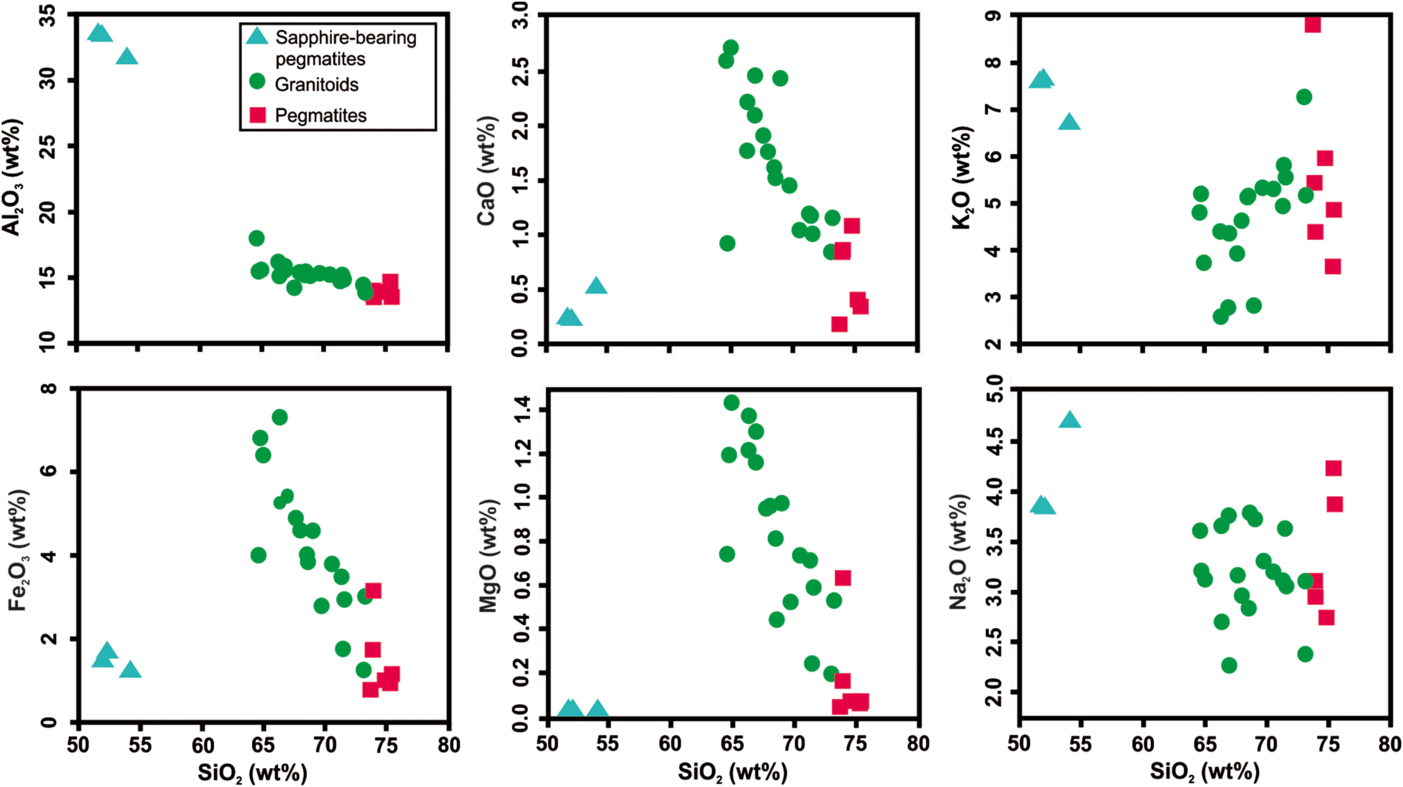
Using the Harker diagrams, the SBPs show different geochemical trends from the other pegmatites and the granitoids in both major (Fig. 8) and trace elements (see Supplementary Fig. 3 in Supplementary Material available online at https://doi.org/10.1017/S0016756820000023), probably due to their different sources. With increasing SiO2 as a factor indicating fractional crystallization progress, values of Al2O3, Fe2O3t, CaO and MgO are decreasing and K2O and Na2O increase. Zirconium and Hf show descending trends with increasing SiO2 values (Supplementary Fig. 2 in Supplementary Material available online at https://doi.org/10.1017/S0016756820000023), indicating early crystallization of zircon due to decreasing T. An increasing trend of Rb against SiO2 is consistent with late crystallization of K-feldspar and biotite. A descending trend for Sr is compatible with early crystallization of more calcic plagioclase (e.g. Cerný et al. Reference Cerný, Meintzer and Anderson1985; Alfonso et al. Reference Alfonso, Melgarejo, Yusta and Velasco2003). Moreover, the following positive correlations are evident due to similar geochemical behaviours of the elements: Ba vs Sr, Rb vs K2O, Sr vs CaO, and Cs vs Rb (Supplementary Fig. 3 in Supplementary Material available online at https://doi.org/10.1017/S0016756820000023).
Harker diagrams of major oxides vs SiO2 for the studied samples.
The chondrite-normalized REE spider diagram shows enrichment of light rare earth elements (LREE) against heavy rare earth elements (HREE) in all samples (Supplementary Fig. 4a in Supplementary Material available online at https://doi.org/10.1017/S0016756820000023). This relative enrichment in LREE values and depletion in HREE values (LREE/HREE ratio) is more evident for SBPs than in other pegmatites and granitoids. A negative Eu anomaly in granitoids is more pronounced than in the pegmatites. As a result of the sodic composition of plagioclase and lack of calcic plagioclase and thus deficiency of CaO and Sr values, in which Eu commonly substitutes, most samples exhibit a Eu anomaly. Eu/Eu* in granitoids is in the range 0.19–1.87, in CPBs 0.84–1.90 and in other pegmatites 0.38–6.27 (Table 1). The upper limit of the Eu/Eu* ratio for CPBs is notably lower than the upper limit in other pegmatites. The multi-element spider diagram shows negative anomalies for Ba, Nb, Sr, P and Ti that can be attributed to arc-related calc-alkaline magmas that produced the studied samples (Supplementary Fig. 4b in Supplementary Material available online at https://doi.org/10.1017/S0016756820000023). Niobium concentrates in refractory parts of the source rocks during melting in subduction zones and leads to a negative anomaly. The negative anomaly of Ti is typically attributed to fractional crystallization of titanite, ilmenite and other Ti-bearing minerals, such as magnetite and biotite and probably muscovite. Positive anomalies of Rb and K that have similar geochemical behaviour are probably due to their relative incompatibility rather than the late crystallization of muscovite and K-feldspar. Negative anomalies of Sr and Ba (with similar geochemical behaviour) can be caused by their concentration in plagioclase in early stages of crystallization. Crystallization of apatite during early-stage crystallization of magma leads to negative anomaly of P in the fractionated rock samples.
The Zr/Hf and Nb/Ta ratios of the studied granitoids and pegmatites (for granitoids, average Zr/Hf = 36.84 and average Nb/Ta = 13.53; for SBPs, average Zr/Hf = 30.41 and average Nb/Ta = 15.54; for other pegmatites, the average Zr/Hf = 27.76 and average Nb/Ta = 5.62) are similar to those ratios for continental crust, and this is in accordance with the S-type affinity of these rocks (Fig. 9; for data references see fig. 8 in Yang et al. Reference Yang, Lentz, Chi and Thorne2008).
Plot of Zr/Hf vs Nb/Ta ratios for the studied pegmatites and granitoids.

3.e. Discrimination of tectonic setting
Frequently used tectonic discrimination diagrams are presented for the samples: (1) Maniar & Piccoli (Reference Maniar and Piccoli1989) and (2) Pearce et al. (Reference Pearce, Harris and Tindle1984). In the Maniar & Piccoli (Reference Maniar and Piccoli1989) diagrams (Supplementary Fig. 5a, b in Supplementary Material available online at https://doi.org/10.1017/S0016756820000023), most samples tend to plot in the field of orogenic granitoids (IAG = Island Arc Granitoids + CAG = Continental Arc Granitoids + CCG = Continental Collision Granitoids), although a few samples plot in the anorogenic field (RRG = Rift-Related Granitoids + CEUG = Continental Epirogenic Uplift Granitoids). In the Pearce et al. (Reference Pearce, Harris and Tindle1984) diagrams (Supplementary Fig. 6a, b in Supplementary Material available online at https://doi.org/10.1017/S0016756820000023), most samples tend to plot in the orogenic fields (VAG = Volcanic Arc Granites + Syn-COLG = Syn-Collision Granites (or S-type)) (Christiansen & Keith Reference Christiansen and Keith1996), but a few samples are in the anorogenic field (WPG = Within Plate Granites). On the basis of results obtained from tectonic discrimination diagrams, a convergent tectonic regime can be considered to occur at the time of magmatic activity in the region. Such a tectonic environment can be commonly inferred for the LCT pegmatites and associated granitoids (Hanson, Reference Hanson2016).
3.f. Geochronology
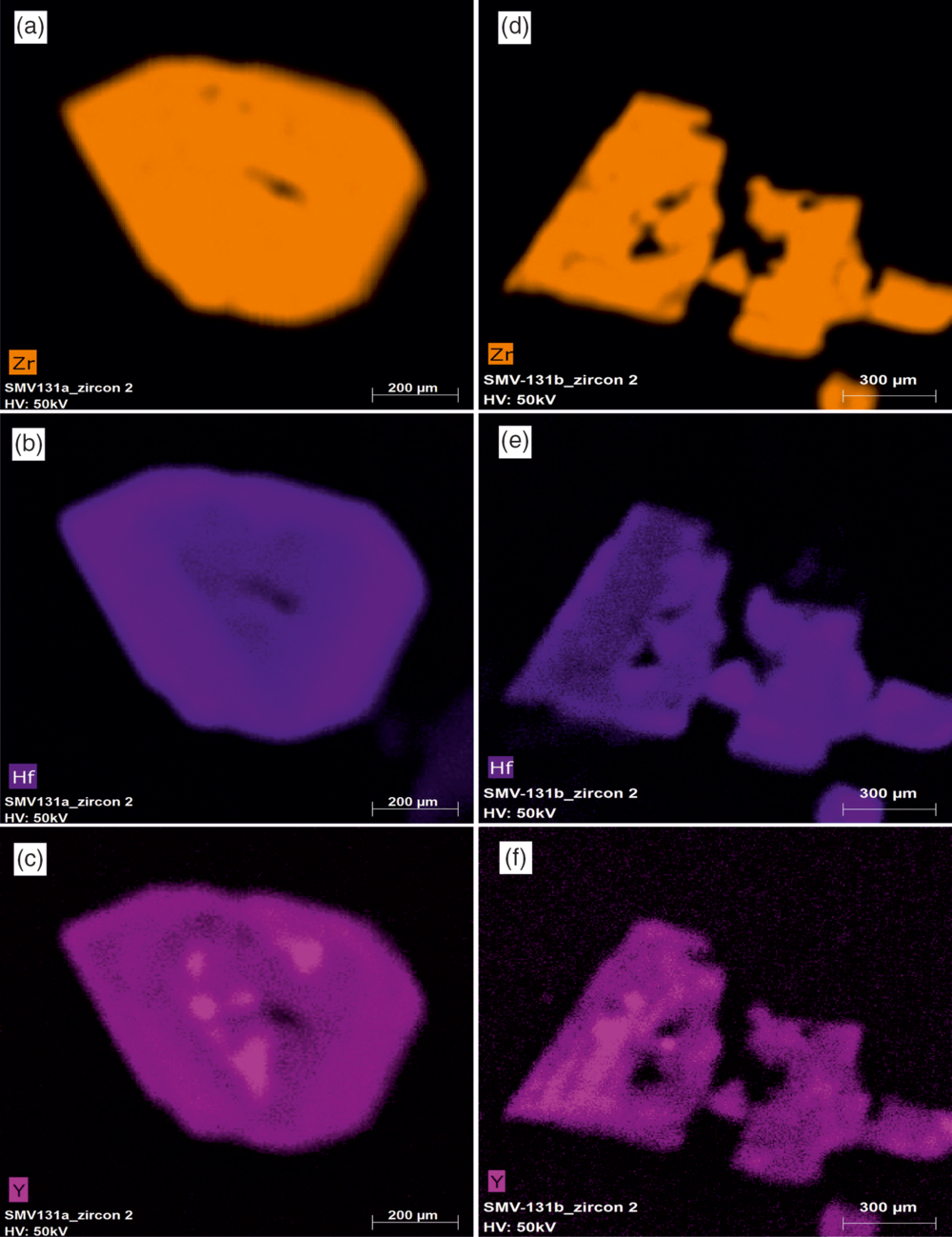
Because of the existence of geochronological data for plutonic rocks and other pegmatites (e.g. Shahbazi et al. Reference Shahbazi, Siebel, Pourmoafee, Ghorbani, Sepahi, Shang and Vousoughi-Abedini2010; Sepahi et al. Reference Sepahi, Salami, Lentz, McFarlane and Maanijou2018), only SBPs are selected for zircon geochronology in this study. After petrographic studies and µXRF mapping, the suitable zircon grains in SBPs were chosen for geochronological and zircon trace-element geochemical studies. µXRF maps of the zircon grains (Fig. 10) show that some grains are zoned euhedral and others are anhedral. On the Concordia diagram for the SMV-1 sample (Fig. 11a), the weighted mean age is 168 ± 1 Ma with mean square weighted deviation (MSWD) = 0.0115 and a concordance probability of 0.91. The Th/U ratios in its zircons are 0.12–2.44. For the SMV-131 sample, the Concordia diagram (Fig. 11b) shows that the weighted mean age is 166 ± 1 Ma with MSWD = 10.0 and concordance probability of 0.002. The Th/U ratios for the zircons in this sample are 0.05–2.27. The weighted mean age on the Concordia diagram is 164 ± 1 Ma for the SMV-131b sample (Fig. 11c) with MSWD = 1.4 and concordance probability of 0.24. Its zircon Th/U ratios change from 0.09 to 1.54. Combined Concordia for samples SMV-131 and SMV131-b is shown in Figure 11d, which indicates a weighted mean age of 165 ± 1 Ma with MSWD = 9.0 and concordance probability of 0.003.
Micro-XRF maps from zircon grains of sapphire-bearing pegmatites.
Concordia diagrams showing calculated U–Pb ages for sapphire-bearing pegmatite samples.

3.g. Zircon geochemistry and thermometry
Zircon is an accessory mineral found in diverse lithologies, such as felsic igneous rocks (e.g. Gao et al. Reference Gao, Zheng and Zhao2016), and is host to a variety of trace elements. In addition to Zr, Si and O, minor amounts of Hf and Y and trace amounts of more than 30 elements are reported in zircon (see Table 3). Compositionally, zircon contains c. 67.2 wt % ZrO2 and 32.8 wt % SiO2 with an additional 0.7–8.3 wt % HfO2 (with an average of ~2 wt %) and Y between 0.1 and 1.0 wt %. Hafnium concentrations in zircon can be elevated in evolved rocks due to magmatic differentiation. REE, Th and U are other important elements taking part in the composition of zircon. In most places, unaltered zircon grains have less than 1 wt % ∑REE + Y (e.g. Hoskin & Schaltegger, Reference Hoskin and Schaltegger2003; Harley & Kelly, Reference Harley and Kelly2007; Breiter et al. Reference Breiter, Lamarão, Borges and Dall’Agnol2016).
Trace element concentrations of zircon grains and calculated Ti-in-zircon crystallization temperatures

nd = not detected.
The contents of significant trace elements of the zircon grains of SBPs are as follows: Hf values are 3585–17 200 ppm; U from as low as 105 to as high as 13 580 ppm; Th from c. 29 to 5148 ppm; Ta from as low as 0.24 to 25.59 ppm; Nb is very variable from 1.46 to 2820 ppm; Y is high in the range 345–4764 ppm, Sc has a narrow range of 244.6–376.6 ppm, Ti also has a narrow range of 5.2–26.2 ppm, and P values change from as low as 1 to as high as 518 ppm. Iron values vary from as low as 9 to as high as 2390 ppm, Al contents are quite variable from 1 to 6360 ppm, Na amounts range from 1 to 4640 ppm, and B contents are between 7 and 124 ppm. ∑REE is in the range 267–2534 ppm, including ∑LREE from 3 to 1522 ppm and ∑HREE from 189 to 2325 ppm. The amounts of other measured elements, such as Sn, W, Mn, Cr, V, Mg, Li and Be, are quite low (Table 3).
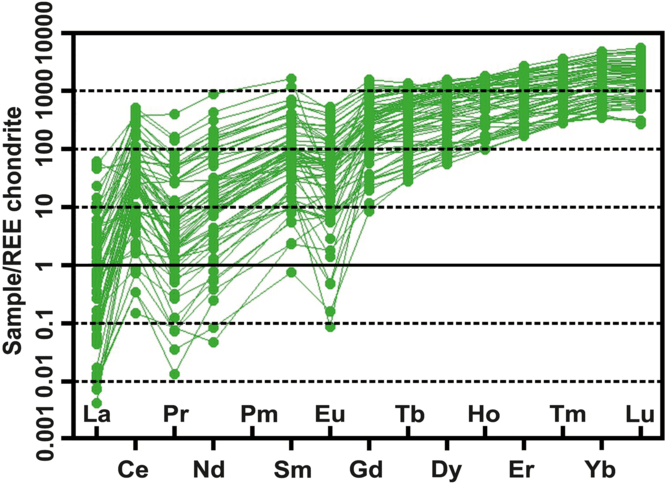
Relative to chondrite values, zircons are strongly HREE-enriched and LREE-depleted, so that in chondrite-normalized spider diagrams there is significant enrichment in HREE against LREE. The trivalent LREE are generally incompatible in the zircon structure so that the absolute abundances of the LREE in igneous zircon are sub-ppm to ppm level. However, this is not the case for Ce, which can be both trivalent and tetravalent, and Ce4+ acts compatibly like HREE, so it is abundant in zircon (e.g. Hoskin & Schaltegger, Reference Hoskin and Schaltegger2003; Trail et al. Reference Trail, Watson and Tailby2012; Nardi et al. Reference Nardi, Formoso, Müller, Fontana, Jarvis and Lamarão2013). Among the REE, Ce and Eu have multiple valence states in magmatic environments, so they can partition differently into zircon structure depending on magma oxidation state (e.g. Ballard et al. Reference Ballard, Palin and Campbell2002; Trail et al. Reference Trail, Watson and Tailby2012; Shen et al. Reference Shen, Hattori, Pan, Jackson and Seitmuratova2015). On the basis of the Excel spreadsheet by Smythe & Brenan (Reference Smythe and Brenan2016), log fO2 ~ −15 and ∆FMQ ~ −0.3 estimated for zircons from SBPs. These values mean that a relatively oxidizing environment existed when zircon crystallized from the melt. In the chondrite-normalized spider diagram of the zircons, a positive Ce anomaly is evident (Fig. 12; Ce/Ce* = 1.15–68.06). This reflects the oxidized condition of magma from which the zircon grains crystallized. The divalent Eu cannot easily be substituted for tetravalent Zr, so there is typically a negative Eu anomaly in chondrite-normalized spider diagrams of zircon grains (Fig. 11; Eu/Eu* = 0.001–0.56). These REE features are typical of zircons of magmatic origin.
Chondrite-normalized REE spider diagrams of the studied zircon grains (normalized to Boynton (Reference Boynton and Henderson1984) values).
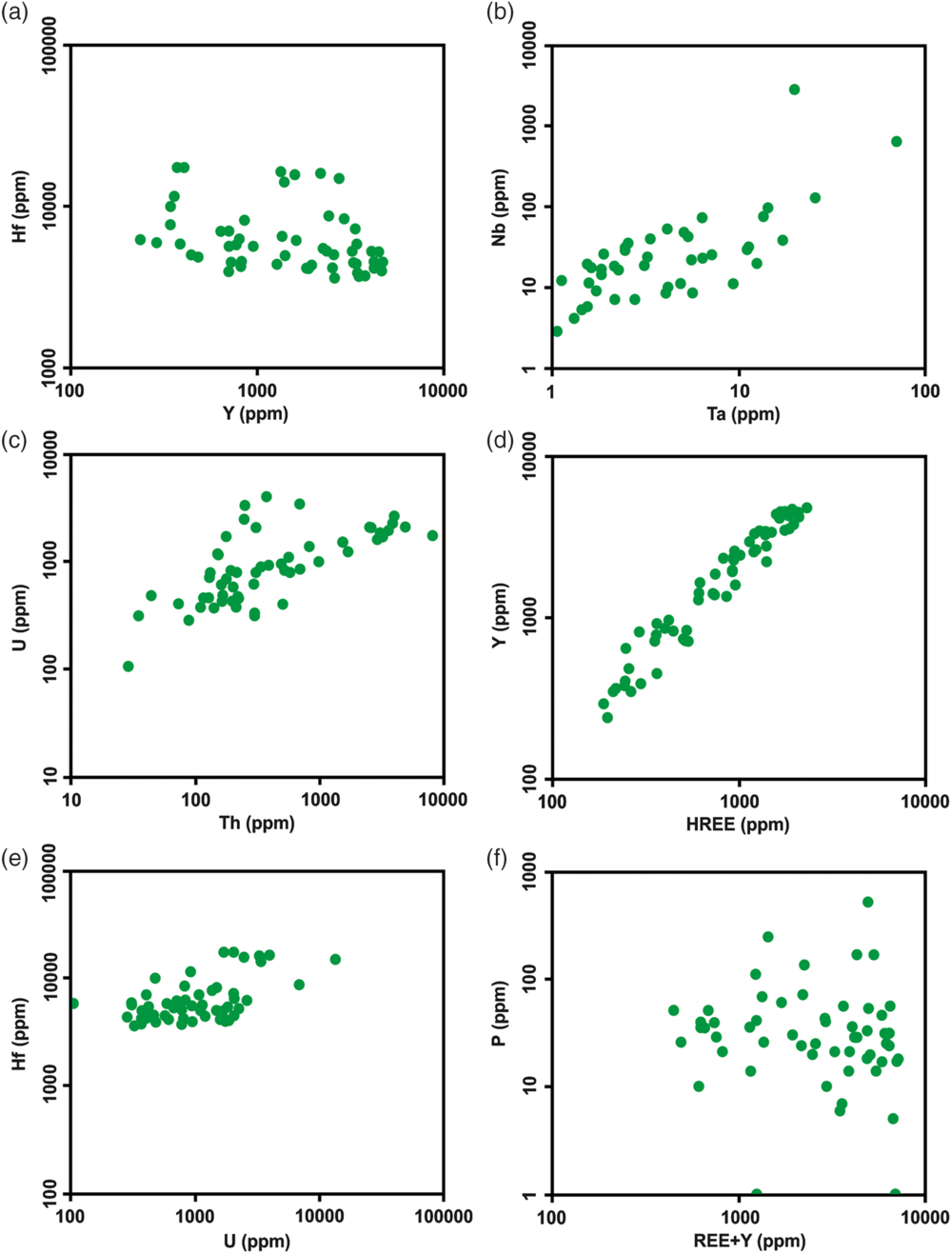
There is no visible negative or positive correlation between Hf and Y values in the zircons (Fig. 13a). Niobium and Ta values show positive correlation (Fig. 13b). Also, U and Th have positive correlation (Fig. 13c). There is a good positive correlation between Y and HREE (Fig. 13d). Hafnium and U also show a positive correlation (Fig. 13e). The diagram of P against REE + Y shows no visible correlation (Fig. 13f).
Distribution of common important trace elements pairs in composition of the studied zircon grains: (a) Hf vs Y; (b) Nb vs Ta; (c) U vs Th; (d) Y vs HREE; (e) Hf vs U; (f) P vs REE + Y.
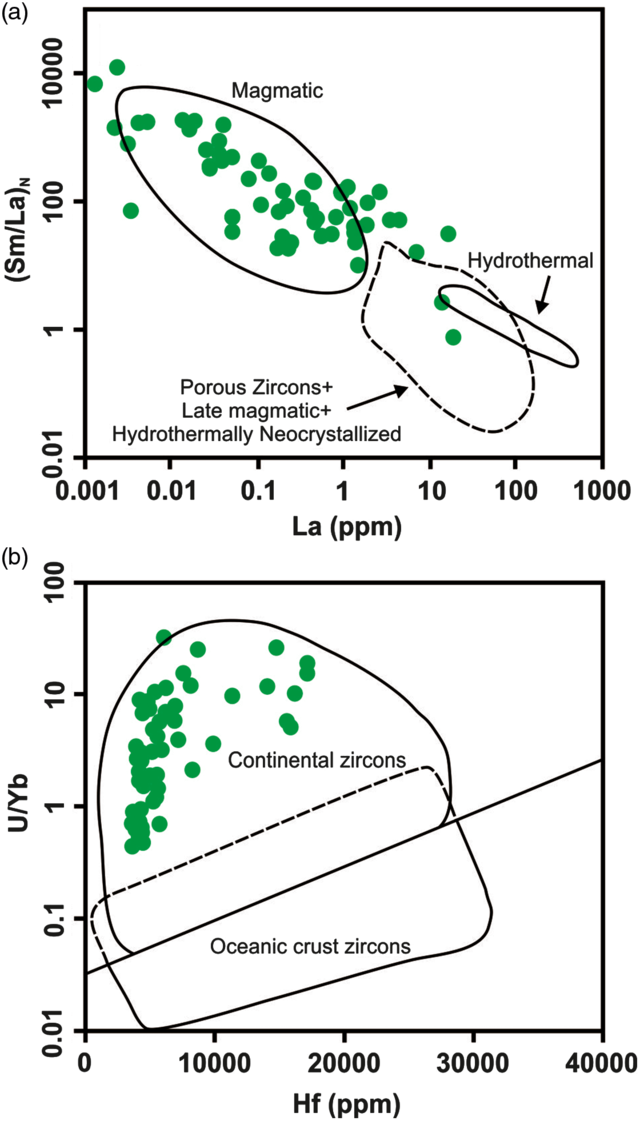
The geochemical characteristics of zircon grains reveal a magmatic origin for zircons of SPBs (Fig. 14a; (Sm/La)N vs La diagram). The values of La, (Sm/La)N and Th/U ratios are consistent with a magmatic origin of these zircons (average La < 1.5, (Sm/La)N > 100 and Th/U > 0.7). Also, the studied zircon grains have chemical affinity similar to continental crust zircons (Fig. 14b; U/Yb vs Hf and U/Yb vs Y diagrams; see also Grimes et al. Reference Grimes, John, Kelemen, Mazdab, Wooden, Cheadle, Hanghøj and Schwartz2007).
(a) (Sm/La)N vs La diagram, which indicates a magmatic origin for zircon grains of SBPs (see also Babazadeh et al. Reference Babazadeh, Ghorbani, Cottle and Bröcker2019 and references therein). (b) U/Yb vs Hf diagram, which reveals that zircons of SBPs have characteristics of continental zircons.
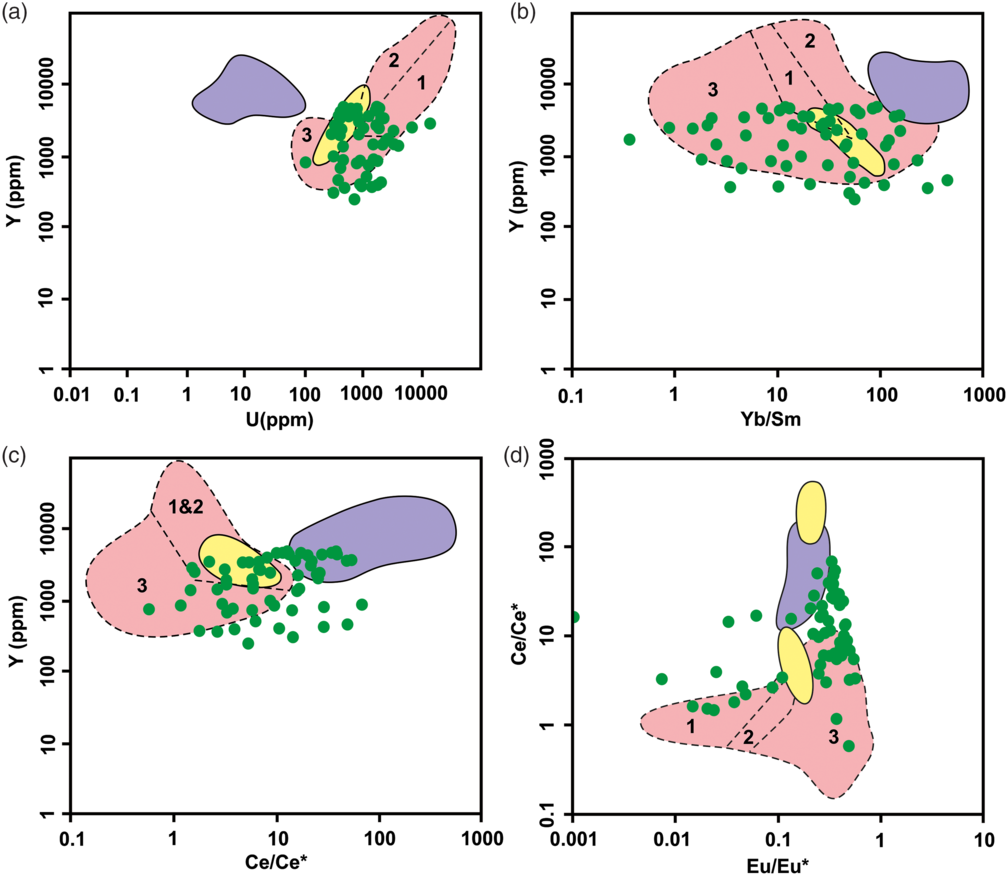
The correlations between rock type and the trace element compositions of zircon from a wide range of igneous rocks can be shown with a series of discriminant plots. The fields for zircons of some rock types are very distinct, but those for grains of other origins overlap to different degrees in most plots. A single plot is sufficient for the discrimination of zircons from some rocks, but comparison of several plots can identify zircons from some other igneous rocks (see fig. 6 in Belousova et al. Reference Belousova, Griffin, O’Reilly and Fisher2002). In Figure 15, the compositions of the studied zircons are compared with the field of zircons of granitoids from other locations worldwide. Y–U, Y–(Yb/Sm), Y–(Ce/Ce*), (Ce/Ce*)–(Eu/Eu*), Y/(Nb/Ta) and Nb–Ta diagrams are useful for comparing the composition of the studied zircons with zircons in other granitoids (Fig. 15). In these diagrams, chemical compositions of some zircon grains plot in the field of previously studied zircon grains of the granitoids and pegmatites of the other places of the world, and of course, some others do not plot in these fields.
Plot of chemical compositions of the studied zircon grains for comparison with other zircons of granitoids and pegmatites of other localities (drawn fields after Belousova et al. Reference Belousova, Griffin, O’Reilly and Fisher2002): (a) Y vs U; (b) Y vs Yb/Sm; (c) Y vs Ce/Ce*; (d) Ce/Ce* vs Eu/Eu*. Yellow fields: syenite pegmatites; purple field: nepheline syenite and syenite pegmatites; pink fields: granitoids – (1) aplites, leucogranites; (2) granites; (3) granodiorites and tonalites.
Titanium content of zircon has been an important petrogenetic tool in recent years. Therefore, Ti-in-zircon thermometry has been considered in many recent publications in the literature (e.g. Fu et al. Reference Fu, Page, Cavosie, Fournelle, Kita, Lackey, Wilde and Valley2008 and references therein; Hofmann et al. Reference Hofmann, Baker and Eiler2014). Regardless of some limitations to its usage, it can be applied to estimate crystallization temperatures of igneous zircons. Common limitations for Ti-in-zircon thermometry include variation of TiO2 or SiO2 activity, pressure effect, resetting of Ti concentration by subsolidus alteration or diffusion (subsolidus resetting of Ti compositions) and accuracy of the thermometer calibration (errors in calibration).
Watson & Harrison (Reference Watson and Harrison2005) and Watson et al. (Reference Watson, Wark and Thomas2006) experimentally calibrated the titanium concentration in zircon as a function of temperature of formation and the activity of TiO2. The theoretical calculations of Harrison et al. (Reference Harrison, Aikman, Holden, Walker, McFarlane, Rubatto and Watson2005) and further experiments of Ferry & Watson (Reference Ferry and Watson2007) suggest the substitution:
 $${\rm{Ti}}{{\rm{O}}_{\rm{2}}}{\rm{ + ZrSi}}{{\rm{O}}_{\rm{4}}}{\rm{ = ZrTi}}{{\rm{O}}_{\rm{4}}}{\rm{ + Si}}{{\rm{O}}_{\rm{2}}}$$
 $${\rm{rutile + zircon = T}}{{\rm{i}}^{{\rm{IV}}}}{\rm{ - zircon + quartz}}$$
In the absence of rutile, Ti can participate in the composition of other minerals in minor and trace amounts. According to Watson et al. (Reference Watson, Wark and Thomas2006), the following equations can be used to estimate the temperature of zircon considering its Ti content:
 $${\rm{Log }}\,\left( {T{i_{\rm{zircon}}}} \right) = \left[ {\left( {6.01 \pm {\rm{ }}0.03} \right)} \right] - \left[ {\left( {5080 \pm 30} \right)/T\left( K \right)} \right]$$
 $${{\rm{T}}^{\rm{o}}}{{\rm{C}}_{{\rm{zircon}}}} = {\rm{ }}\left[ {\left( {5080{\rm{ }} \pm {\rm{ }}30} \right)/\left( {\left( {6.01 \pm {\rm{ }}0.03} \right){\rm{ }}\,- {\rm{log}}{\rm{ }}\left( {Ti} \right)} \right)} \right] - 273$$
On the basis of these equations, temperatures from ~683 to ~828 °C were obtained for crystallization of zircon in SBPs with an average temperature of ~755° ± 73 °C. Details of temperatures calculated for each point of analyses are given in Table 3.
The results of Ti-in-zircon thermometry are compared with zircon and monazite saturation temperatures. Zircon saturation temperatures calculated using the Watson & Harrison (Reference Watson and Harrison1983) model considering bulk rock Zr concentration as magma composition are calculated (Tables 1, 4). T zircon for granitoids is in the range 644–870 °C with an average of 804 °C, for SBPs it is in the range 614 to 635° C with an average of 622 °C and for the other pegmatites it is in the range 614 to 832 °C with an average of 688 °C. Monazite saturation temperatures using bulk rock ∑LREE composition (La + Ce + Pr + Nd + Sm + Gd) as melt composition in the Montel (Reference Montel1993) equation are also calculated (Tables 1, 4). T monazite for granitoids ranges from 702 to 869 °C with an average of 810 °C, for SBPs it ranges from 735 to 770 °C, with an average of 748 °C, and for other pegmatites it is between 580 and 843 °C, with an average of 673 °C. Comparison of the results of Ti-in-zircon thermometry with zircon and monazite saturation temperatures indicates that T monazite for CPBs (average = 748 °C) is near the temperature obtained by Ti-in-zircon thermometry (average = 755 °C).
Zircon and monazite saturation temperatures for various granitoids, SBPs and other pegmatites

Hafnium contents of zircon grains are 3585–17 200 ppm, and Zr/Hf ratios are 23–117 (Table 3). Therefore, on the basis of the data for granitic and pegmatitic zircons in the database presented in Wang et al. (Reference Wang, Griffin and Chen2010), the studied zircon grains have a similar range of Zr/Hf ratios in comparison to other granitic zircons reported in the literature, although they have Zr/Hf ratios in the range which is reported for early crystallized zircons. Histograms of Zr/Hf ratios vs number of zircon grains for SBPs are shown in Supplementary Figure 7 in the Supplementary Material available online at https://doi.org/10.1017/S0016756820000023. In contrast to zircons studied by Kirkland et al. (Reference Kirkland, Smithies, Taylor, Evans and McDonald2015), our zircons have a similar range of Th/U ratios (0.1–4), but in the case of Zr/Hf ratios some are similar and the others are quite a bit higher (20–120).
4. Discussion
In recent years, the interpretation of various geological aspects, such as geochronology, petrogenesis and tectonic setting of the SSZ of Zagros orogen, has been topical. Examinations of the petrogenesis and geochronology of granitoids and related pegmatites help to decipher some geological enigmas of the region (e.g. Shahbazi et al. Reference Shahbazi, Siebel, Pourmoafee, Ghorbani, Sepahi, Shang and Vousoughi-Abedini2010; Hassanzadeh & Wernicke, Reference Hassanzadeh and Wernicke2016; Sepahi et al. Reference Sepahi, Salami, Lentz, McFarlane and Maanijou2018). In this regard, we have considered an enigmatic type of pegmatite (CPBs) to reveal its possible petrogenetic and geochronological connection with other pegmatites and granitoids of this study area and adjacent areas. In the following three subsections, we use data obtained in this study, together with the results of similar studies on pegmatites and associated granitoids of the region, to provide some helpful data for interpreting the tectono-magmatic history of the SSZ.
4.a. Significance of obtained age data
As noted earlier in Section 2, older data have been obtained by 40 K–39Ar and 87Rb–86Sr methods, giving Late Cretaceous ages for the Alvand plutonic complex (e.g. Valizadeh & Cantagrel, Reference Valizadeh and Cantagrel1975; J Braud, unpub. PhD, Univ. Paris, 1987). Using the same method (40 K–39Ar), similar Late Cretaceous ages have been obtained (e.g. Baharifar et al. Reference Baharifar, Moinevaziri, Bellon and Piqué2004), but recent U–Pb geochronological studies have yielded Middle Jurassic ages (e.g. Shahbazi et al. Reference Shahbazi, Siebel, Pourmoafee, Ghorbani, Sepahi, Shang and Vousoughi-Abedini2010; Mahmoudi et al. Reference Mahmoudi, Corfu, Masoudi, Mehrabi and Mohajjel2011; Chiu et al. Reference Chiu, Chung, Zarrinkoub, Mohammadi, Khatib and Iizuka2013; see also Section 3.f). Gabbroic rocks formed at 166.5 ± 1.8 Ma, granodiorites–monzogranites between 163.9 ± 0.9 Ma and 161.7 ± 0.6 Ma, and leucocratic granitoids between 154.4 ± 1.3 and 153.3 ± 2.7 Ma (Shahbazi et al. Reference Shahbazi, Siebel, Pourmoafee, Ghorbani, Sepahi, Shang and Vousoughi-Abedini2010). Isotope dilution thermal ionization mass spectrometry (ID-TIMS) U–Pb zircon geochronology by Mahmoudi et al. (Reference Mahmoudi, Corfu, Masoudi, Mehrabi and Mohajjel2011) gave an age of ~165 Ma for phases of the Alvand granite pluton. Also, Chiu et al. (Reference Chiu, Chung, Zarrinkoub, Mohammadi, Khatib and Iizuka2013) have obtained zircon U–Pb ages of 165.1 ± 2.0 and 163.9 ± 1.8 Ma. According to Sepahi et al. (Reference Sepahi, Salami, Lentz, McFarlane and Maanijou2018), zircon and monazite U–Pb geochronology yielded ages in the range 162–172 Ma for pegmatites and an age as young as 154.1 ± 3.7 Ma for an allanite-bearing pegmatite sample from the Alvand plutonic complex. Also, Yang et al. (Reference Yang, Chen, Liang, Xin, Aghazadeh, Hou and Zhang2018) and Zhang et al. (Reference Zhang, Chen, Yang, Hou and Aghazadeh2018a, b) have estimated Jurassic ages for most of these plutonic rocks by zircon U–Pb geochronology. In this study, we have also obtained Jurassic ages for the pegmatites. Also, in neighbouring regions (in the Qorveh–Aligoudarz plutonic belt of the Sanandaj–Sirjan zone (Mohajjel & Fergusson Reference Mohajjel and Fergusson2014), the main plutonic suites have Middle Jurassic ages (e.g. Ahmadi-Khalaji et al. Reference Ahmadi-Khalaji, Esmaeily, Valizadeh and Rahimpour-Bonab2007; Esna-Ashari et al. Reference Esna-Ashari, Tiepolo, Valizadeh, Hassanzadeh and Sepahi2012). Yajam et al. (Reference Yajam, Montero, Scarrow, Ghalamghash, Razavi and Bea2015) attributed the age of major plutonic rocks of the Qorveh region in the NW of the Hamedan region to the upper Jurassic. Therefore, we can attribute major plutonic activity and pegmatite generation in this region and adjacent regions in the northwest of SSZ to the Jurassic. The metamorphic events also have an age range of 160–180 Ma (Middle Jurassic) (Sepahi et al. Reference Sepahi, Jafari, Osanai, Shahbazi and Moazzen2019), so an overlap of ages is evident between metamorphism and plutonism in the region. According to Sepahi (Reference Sepahi2008) and Sepahi et al. (Reference Sepahi, Salami, Lentz, McFarlane and Maanijou2018), plutonism and metamorphism of the region occurred concurrently due to subduction-related tectono-magmatic activities at a continental arc geodynamic regime. Metamorphism slightly pre-dates plutonism, but was intensified by it later (i.e. regionally metamorphosed rocks underwent contact metamorphism later).
4.b. Genetic implications
4.b.1. Geochemical constraints
AA Sepahi (unpub. PhD, Tarbiat Moallem Univ. Tehran, 1999; Reference Sepahi2008) and Sepahi et al. (Reference Sepahi, Salami, Lentz, McFarlane and Maanijou2018) have found a genetic link between major pegmatitic dykes and granitoids of the region on the basis of field, petrographic and geochemical characteristics of these rocks. Also, we found that major pegmatitic rocks (mildly peraluminous samples) may have a genetic link with these granitoids, except for sapphire-bearing syenitoid pegmatites that are the focus of this study. These rocks contain a low content of silica in comparison to other pegmatites and granitoids. They even plot in the field of silica-undersaturated rocks in some diagrams. Also, they are extremely peraluminous (Al2O3 > 30 wt %, A/CNK > 2) and in geochemical and tectonic discrimination diagrams do not show any genetic link with granitoids of the region (see Section 3.d; Fig. 6; Supplementary Figs 3, 4 in Supplementary Material available online at https://doi.org/10.1017/S0016756820000023). Therefore, they cannot be fractionated equivalents of these granitoids and other common mildly peraluminous pegmatites of the region. They may be generated from magma originated from partial melting of meta-sedimentary rocks of the region. On the other hand, they have the same age as granitoids of the region and may be formed in the same dynamothermal regime as well.
4.b.2. Possible corundum (sapphire) origin
The various geological aspects of corundum deposits (especially of the sapphire variety) from different countries worldwide (such as Madagascar, Tanzania, Kenya, Malawi, Nigeria, USA, Brazil, Russia, Afghanistan, Pakistan, India, Sri Lanka, Myanmar, Vietnam, China, Cambodia, Thailand, Australia, France, West Pacific, Colombia, Canada, Greenland, Norway, Greece and Slovakia) have been studied in detail in recent years (e.g. Giuliani et al. Reference Giuliani, Fallick, Garnier, France-Lanord, Ohnenstetter and Schwarz2005, Reference Giuliani, Fallick, Rakotondrazafy, Ohnestetter, Andriamamonjy, Ralantoarison, Rakotosamizanany, Razanatseheno, Offant, Garnier, Dunaigre, Schwarz, Mercier, Ratrimo and Ralison2007, Reference Giuliani, Fallick, Ohnenstetter and Pegere2009, Reference Giuliani, Ohnenstetter, Fallick, Groat and Fagan2014; Graham et al. Reference Graham, Sutherland, Zaw, Nechaev and Khanchuk2008; Simonet et al. Reference Simonet, Fritsch and Lasnier2008; Sutherland et al. Reference Sutherland, Duroc-Danner and Meffre2008; Uher et al. Reference Uher, Giuliani, Szakall, Fallick, Strunga, Vaculovic, Ozdin and Greganova2012).
Also, the origin and usage of corundum has been the subject of some recent publications. A lot of classifications have been proposed for corundum deposits by different authors based on various features such as the lithology of the host rocks, the morphology of corundum, the geological context of the deposits, the genetic processes responsible for corundum formation, the type of deposit and the nature of the corundum host rock, and the oxygen isotopic composition of corundum (Giuliani et al. Reference Giuliani, Ohnenstetter, Fallick, Groat and Fagan2014 and references therein).
According to Simonet et al. (Reference Simonet, Fritsch and Lasnier2008), corundum deposits can be classified into two major groups (primary and secondary). Primary deposits are either igneous or metamorphic and secondary ones are either sedimentary (detritic) or igneous (xenocrystic). Primary igneous deposits commonly occur in syenitic rocks. In these rocks corundum is always associated with rocks depleted in silica and enriched in alumina because, in the presence of excess silica, Al is preferentially incorporated into aluminosilicate minerals such as feldspars and micas (Giuliani et al. Reference Giuliani, Ohnenstetter, Fallick, Groat and Fagan2014). Metamorphic corundum can be metamorphic (sensu stricto), metasomatic and anatectic in origin (Giuliani et al. Reference Giuliani, Ohnenstetter, Fallick, Groat and Fagan2014). Thus, many metamorphic rocks (such as skarn, marble, gneiss and migmatite) and igneous rocks (such as kimberlite, alkali basalt, lamprophyre and syenite) may contain corundum.
On the basis of this classification scheme, two possible origins can be assumed for corundum in the studied pegmatite: igneous and metasomatic. As mentioned above, desilication may be a possible process in the petrogenesis of these rocks, but source and evidence for desilication were not observed. There are no signs of metasomatism in nearby sapphire-bearing syenitoid pegmatitic dykes (absence of silica-deficient rocks such as ultramafites and meta-carbonates in accidental and/or tectonic contact with sapphire-bearing dyke); therefore an igneous origin for sapphire in this rare dyke is probable (i.e. country rocks are granitoids and meta-pelitic over-saturated rocks, not ultramafites, foid-bearing under-saturated rocks and/or metacarbonates). On the basis of the geochemical features, it is obvious that sapphire-bearing rocks of the region are not a direct product of differentiation of host granitoids and other pegmatites. According to Giuliani et al. (Reference Giuliani, Ohnenstetter, Fallick, Groat and Fagan2014), corundum is a typical mineral of pegmatite in syenitic rocks and has been reported in these rocks from Russia, Canada, India and Norway. Simonet et al. (Reference Simonet, Paquette, Pin, Lasnier and Fritsch2004) studied the Tula corundum deposit hosted by dykes of syenite, in Garba Tula, Kenya. In this deposit corundum is formed by direct crystallization from a magmatic melt as an accessory mineral phase. Corundum of the studied SBPs may have a similar origin. However, it should be noted that gemstone production of sapphire from syenite pegmatites is small, although gems were extracted from these rocks in Russia, Canada, India and Norway (Giuliani et al. Reference Giuliani, Ohnenstetter, Fallick, Groat and Fagan2014). This issue reveals the importance of the rare pegmatites presented here in our research.
4.b.3. The importance of zircon geochemistry
The chemical affinities of zircon grains of the SBPs show some similarities to and some differences with zircon grains of syenites, granitoids and pegmatites elsewhere in the world (Fig. 13). As is visible in Figure 13, some samples plot outside fields indicated for zircons studied by Belousova et al. (Reference Belousova, Griffin, O’Reilly and Fisher2002). The differences are most probably due to the unique composition of these rocks, especially those that have low silica and high alumina contents in contrast to their other known equivalents. Also, early crystallization of zircon grains may affect its geochemical affinity, such as Zr/Hf ratios as well as contents of various trace elements in the composition of zircon (see Section 3.g). On the whole, the studied zircon grains show characteristics of magmatic zircons in contrast to hydrothermal zircons, although some grains plot outside the field of previously studied magmatic zircons. Pronounced positive Ce anomalies in zircons are in accordance with this result. In diagrams for distinguishing the environment of generation for zircons, nearly all studied zircons plot in the field of continental zircons (Fig. 12; Grimes et al. Reference Grimes, John, Kelemen, Mazdab, Wooden, Cheadle, Hanghøj and Schwartz2007).
4.c. Geodynamics remarks
Pegmatites intrude plutonic and metamorphic host rocks in many parts of the SSZ, Iran. Their outcrops are hosted by several plutonic complexes such as Boroujerd, Alvand (Hamedan) and Qorveh (Fig. 1). Masoudi (unpub. PhD, Univ. Leeds, 1997), Masoudi et al. (Reference Masoudi, Yardley and Cliff2002) and Ahmadi-Khalaji et al. (Reference Ahmadi-Khalaji, Esmaeily, Valizadeh and Rahimpour-Bonab2007) have studied the petrology and geochronology of pegmatites and associated plutonic and metamorphic rocks from the Boroujerd area in the SSZ. These authors attributed pegmatite development to Mesozoic magmatism. Recently, Salami (unpub. PhD, Bu-Ali Sina Univ., Hamedan, 2017) and Sepahi et al. (Reference Sepahi, Salami, Lentz, McFarlane and Maanijou2018) carried out petrological and geochronological studies on pegmatites and aplites of three main areas in the SSZ (i.e. the Boroujerd, Hamedan and Qorveh areas; Fig. 1). These researches revealed the importance of Mesozoic plutonism and pegmatite genesis in the northwest of the SSZ. The studied pegmatites mainly belong to the LCT class of pegmatites, and mineralogically they are MSREL pegmatites. These types of pegmatites that contain boron-rich minerals, such as tourmaline in most places, are related to S-type granitoids having an anatectic origin. Sepahi (unpub. PhD, Tarbiat Moallem Univ. Tehran, 1999; Reference Sepahi2008) found a genetic relationship between pegmatites–aplites and granitoids (granite–granodiorite) of the Alvand plutonic complex in the Hamedan region.
Northwest of SSZ a spectrum of granitoid types is present including I-, S-, M- and A-type. Plutonic bodies, of which substantial parts are granitoids, occur in many localities, such as Hasanrobat (Muteh) (Alirezaei & Hassanzadeh, Reference Alirezaei and Hassanzadeh2012), Aligoudarz (Esna-Ashari et al. Reference Esna-Ashari, Tiepolo, Valizadeh, Hassanzadeh and Sepahi2012), Azna (Moazzen et al. Reference Moazzen, Moayyed, Modjarrad and Darvishi2004), Boroujerd (Ahmadi-Khalaji et al. Reference Ahmadi-Khalaji, Esmaeily, Valizadeh and Rahimpour-Bonab2007), Malayer (Samen) (Ahadnejad et al. Reference Ahadnejad, Valizadeh, Deevsalar and Rezaei-Kahkhaei2011), Alvand (Hamedan) (Sepahi Reference Sepahi2008; Shahbazi et al. Reference Shahbazi, Siebel, Pourmoafee, Ghorbani, Sepahi, Shang and Vousoughi-Abedini2010), Almogholagh (Shahbazi et al. Reference Shahbazi, Siebel, Ghorbani, Pourmoafee, Sepahi, Vousoughi-Abedini and Shang2015) and Qorveh (Yajam et al. Reference Yajam, Montero, Scarrow, Ghalamghash, Razavi and Bea2015). Granitic pegmatites and aplites are not volumetrically large in some of these bodies, but they can be important in the interpretation of the tectono-magmatic history of the region as their host granitoids.
Most granitoids of the Alvand plutonic complex are I-type (including M-type) and S-type, but in adjacent regions, such as Qorveh, A-type granitoids also occur (Sepahi, unpub. PhD, Tarbiat Moallem Univ. Tehran, 1999; Sarjoughian et al. Reference Sarjoughian, Kananian, Haschke and Ahmadian2016). Granitic pegmatites of the region also have various typologies as their associated granitoids. Both the LCT and niobium–yttrium–fluorine (NYF) family of pegmatites occur northwest of the SSZ, indicating complex geodynamic processes in this zone (Salami, unpub. PhD, Bu-Ali Sina Univ., Hamedan, 2017). Also, the aluminium saturation index (ASI) of pegmatites varies from peraluminous to metaluminous and peralkaline. Therefore, this zone must have been affected by various stages of compression and extension during Mesozoic time to produce different types of magmas, from subalkaline to alkaline and peralkaline. These magmas have resulted in diverse plutonic rocks, especially granitoids and granitic pegmatites, after solidification at different levels in the crust. The LCT pegmatites that occur in orogenic belts have commonly originated from reworking or exhumation of continental crust in high-grade metamorphic terrains.
Among various tectono-magmatic events in the SSZ, plutonism in the Jurassic (giving rise to the formation of granitoids and granitic pegmatites) is volumetrically significant in the northwestern parts of this zone (especially in the Hamedan region; e.g. Shahbazi et al. Reference Shahbazi, Siebel, Pourmoafee, Ghorbani, Sepahi, Shang and Vousoughi-Abedini2010; Sepahi et al. Reference Sepahi, Salami, Lentz, McFarlane and Maanijou2018). As noted in some publications, both compressional and extensional tectonic regimes are considered to have caused such magmatism in the region (e.g. Shahbazi et al. Reference Shahbazi, Siebel, Ghorbani, Pourmoafee, Sepahi, Vousoughi-Abedini and Shang2015; Sarjoughian et al. Reference Sarjoughian, Kananian, Haschke and Ahmadian2016). The studied pegmatites and their host granitoids show signatures of rocks formed in orogenic systems, so we emphasize that Jurassic magmatism of the region has been induced during orogenesis.
5. Conclusions
Notable pegmatitic and aplitic rocks in the region have field, petrographic and geochemical features that indicate the existence of a genetic link between them and granitoids of the region. Most granitoids and pegmatites are mildly peraluminous, but a rare type of silica-undersaturated syenitoid pegmatite is unexpectedly extremely peraluminous (A/CNK > 2) and does not show any genetic link with other pegmatites and granitoids. Corundum in the syenitoid pegmatites has an igneous origin, because there are no signs of desilication based on field and petrographic studies. The U–Pb geochronology indicates a Middle Jurassic age (~165 Ma) for SBPs; an age similar to granitoids and other pegmatites. These rocks and associated granitoids have most probably been generated in an orogenic system.
Zircon geochemistry shows that zircon grains are rich in notable incompatible elements, such as Hf (up to 17 200 ppm), U (up to 13 580 ppm), Th (up to 5148 ppm), Y (up to 4764 ppm) and ∑REE (up to 2534 ppm), with a distinct positive correlation between Y and HREE contents. The Zr/Hf ratio of zircons is accordant with early crystallization from magma. Also, there is a negative correlation between Hf and Y and HREE values, but Nb–Ta, U–Th and Hf–U element pairs show a positive correlation. Zircons show a distinct Ce positive anomaly possibly due to a relatively oxidized condition of the magma from which zircon crystallized. Ti-in-zircon thermometry yields a temperature range of ~683 to ~828 °C (avg 755 ± 73 °C) for crystallization of zircon grains. The T zircon for the sapphire-bearing syenitoid pegmatites is in the range 614–635 °C with an average of 622 °C, similar to the other pegmatites’ T zircon ranging from 614 to 832 °C (avg. 688 °C). These lower fractionation temperatures are consistent with crystallization temperatures of other magmatic zircons in pegmatites of previously published studies. Zircons have properties of continental zircons.
Acknowledgements
We thank Lorence G. Collins for editing an earlier version of the manuscript. We acknowledge Acme Analytical Laboratories, Vancouver, Canada, for ICP-MS and ICP-ES analyses on whole rock samples. Also, we appreciate the micro-XRF and LA-ICP-MS lab of the University of New Brunswick for carrying out precise analyses on zircon grains. David Lentz and Chris McFarlane are supported by NSERC Discovery grants.
Supplementary material
To view supplementary material for this article, please visit https://doi.org/10.1017/S0016756820000023



