

The decennial reallocation of congressional seats and redrawing of district boundaries following the completion of the US Census have long been a contentious issue. The term “gerrymandering,” describing the partisan exploitation of the redistricting process, was coined in 1812. As control of state legislatures changed hands, new maps would often be drawn mid-cycle. If the existing maps suited the controlling party’s desires, the need to create new maps could simply be ignored. For example, during the 20-year period from 1872 to 1892, Ohio districts were redrawn seven times, yet in 1951, a headline read, “Ohio House passes first redistricting in 38 years” (Troy Reference Troy2019). As Engstrom (Reference Engstrom2013, 2) states, “Gerrymandering roiled state legislatures across the country, and profoundly shaped the tumult of 19th-century politics and policy.”
Over 200 years after the first gerrymander, partisan mapmaking remains a prevalent and contentious feature of American politics. Today, the consequences of redistricting are not limited to electoral outcomes – they may also shape how citizens view the legitimacy and fairness of democratic governance at the state level. One potential solution to gerrymandering is to empower independent commissions instead of state legislatures to craft new district lines. In the most recent cycle, seven states relied on independent commissions for drawing congressional districts, but state legislatures remain the predominant method of redistricting.Footnote 1
Political science research has extensively analyzed how different redistricting institutions shape the competitiveness and partisan makeup of state and federal elections (e.g., Carson, Crespin, and Williamson Reference Carson, Crespin and Williamson2014; Edwards et al. Reference Edwards, Crespin, Williamson and Palmer2017; Henderson, Hamel, and Goldzimer Reference Henderson, Hamel and Goldzimer2018; Williamson Reference Williamson2019, Reference Williamson2024). However, the potential impact of redistricting practices – such as the use of independent commissions versus partisan legislatures – on public attitudes has received far less attention. The debate over whether procedural fairness or partisan outcomes most influence mass evaluations is particularly acute at the subnational level, where state governments serve as institutional laboratories for democratic innovation.
Therefore, this article poses the following research question: What is the relationship between how states draw district lines and citizens’ satisfaction with democracy? Using unique survey data and an original survey experiment, we examine how citizens respond to information and cues about redistricting procedures that mimic real-world institutional variation across the American states. We show that individuals react strongly to the perceived impartiality or partisanship in district line-drawing. Our findings suggest that the institutional choices states make may have ramifications not only for election outcomes but also for the perceived legitimacy of the democratic process itself.
The determinants of public attitudes and the variable effects of redistricting
Democratic satisfaction has long been conceptualized as individuals’ evaluations of regime performance, capturing how effectively a political system’s institutions operate in practice (Singh and Carlin Reference Singh and Carlin2015). This concept is distinct from abstract support for democratic principles or support for specific political actors (Linde and Ekman Reference Linde and Ekman2003). Importantly, support for democracy can be rooted in either outcome-based satisfaction – such as supporting winning candidates (Anderson and Guillory Reference Anderson and Guillory1997; Brunell Reference Brunell2006) – or in perceptions of procedural fairness and institutional legitimacy. Recent work highlights factors ranging from short-term confidence in institutions (Kölln and Aarts Reference Kölln and Aarts2021) to economic performance (Kestilä-Kekkonen and Söderlund Reference Kestilä-Kekkonen and Söderlund2017), as well as the long-term structure of political institutions (Anderson and Guillory Reference Anderson and Guillory1997; Singh Reference Singh2014).
While cross-national research has illuminated the broad impact of institutional design, the United States presents a unique opportunity to study how subnational institutional diversity – especially in redistricting – might shape citizen attitudes. Even within this majoritarian national framework, satisfaction with democracy and trust in government vary markedly across states and localities (Seabrook Reference Seabrook2017; VanDusky-Allen and Utych Reference VanDusky-Allen and Utych2021). We argue that at least some of this within-country variation is caused by subnational political institutions. Specifically, changes to the mechanisms by which states draw district lines – such as the adoption of independent redistricting commissions – may affect not only electoral outcomes but also perceived fairness and legitimacy of the maps they produce, which could also diminish overall evaluations of the state of democracy.
Past research illustrates that different redistricting methods can lead to predictably different election outcomes. Dating back to the nineteenth century, unified partisan control of the redistricting process resulted in maps with significant partisan bias, determining the majority in the House of Representatives (Engstrom Reference Engstrom2006). More recently, Carson, Crespin, and Williamson (Reference Carson, Crespin and Williamson2014) demonstrate that states where extra-legislative redistricting entities are responsible for drawing maps tend to have more competitive elections. Similarly, both historically (Carson, Engstrom, and Roberts Reference Carson, Engstrom and Roberts2006) and in modern elections (Cottrill Reference Cottrill2012; Williamson Reference Williamson2019, Reference Williamson2024), different redistricting methods have influenced candidate quality, the number of open seats, and the number of uncontested elections. Edwards et al. (Reference Edwards, Crespin, Williamson and Palmer2017) additionally found that independent redistricting commissions produce notably different maps as they adhere better to traditional principles like compactness and respect for existing boundaries. Extending this line of research, Nelson (Reference Nelson2023) demonstrates that districts drawn by independent commissions are 2.25 times more likely to be competitive and reduce incumbent party wins by 52% compared with legislative redistricting. Building on these insights, Hayes (Reference Hayes2024) emphasizes that independent commissions are especially effective in producing maps that balance group representation, such as geographic and racial/ethnic communities, which further enhances electoral competition and legitimacy.
However, an unresolved debate remains about the net impact of these procedures on mass attitudes and regime legitimacy. Some scholars argue that more uncompetitive, gerrymandered districts create more “winners,” potentially improving attitudes via representation (Brunell Reference Brunell2006, Reference Brunell2008); others warn that perceived partisan manipulation undermines legitimacy and satisfaction by violating core democratic norms. In this study, we focus on the direct effects of the redistricting process itself – separate from outcome-based satisfaction – by examining how procedural cues about who draws district lines affect public perceptions of fairness, trust, and overall support for the democratic system.
The effect of redistricting on citizen political attitudes
Borrowing from the literature on comparative politics, Anderson and Guillory (Reference Anderson and Guillory1997, 77) conclude that “citizen satisfaction with democracy… is influenced by whether people belong to the political majority or minority.” Singh, Karakoç, and Blais (Reference Singh, Karakoç and Blais2012) similarly argue that “the inclusion of one’s selected party in government is the most important factor for satisfaction with democracy.” In the United States, Anderson and Lo Tempio (Reference Anderson and Lo Tempio2002) find that trust in government is strongly related to whether a voter supported the winning presidential or congressional candidate. Together, this “outcome-based” tradition suggests that mass satisfaction may be rooted in being represented by one’s preferred party.
However, another line of research contends that satisfaction and legitimacy may flow as much from perceptions of procedural fairness as from outcomes. If citizens view the process by which legislative districts are drawn as biased, manipulated, or illegitimate – even if their preferred party wins – they may still register dissatisfaction, mistrust, or alienation. Thus, redistricting can influence democratic satisfaction through both outcome-based (winner/loser) channels and process-based (fairness/legitimacy) channels. Importantly, recent experimental evidence from McLaughlin et al. (Reference McLaughlin, Olson, Barron, Ashton, Blum, Finocchiaro and Crespin2025) underscores that perceptions of partisan loss and the fear of losing influence often act as more powerful motivators of opposition than the pursuit of partisan gains. This suggests that public support for reform is profoundly shaped not only by normative principles but also by emotional and strategic concerns.
This tension between outcome-based and process-based roots of satisfaction is especially salient for state-level redistricting in the United States, where institutional rules about who draws lines (legislature, commission, or other) actively vary across states. While pro-reform advocates argue that shifting from legislature-led to commission-based redistricting promotes fairness and trust by limiting overt partisanship, others (e.g., Brunell Reference Brunell2006) argue that even heavily gerrymandered maps might increase satisfaction by creating more consistent “winning” districts. In short, does substantive representation outweigh process legitimacy, or vice versa?
In this work, we expect that different redistricting methods will produce differing attitudes among citizens within the United States. Winburn (Reference Winburn2008) argues that imposing additional constraints on gerrymandering can remove some partisanship from the process. As Williamson (Reference Williamson, Jamie and Lynch2020) demonstrates, many states do impose additional constraints on the mapmaking process, such as fostering competition, adhering to existing political boundaries, or maximizing compactness. As such, redistricting commissions are likely to engender more positive attitudes toward the political system, regardless of whether voters realized that a commission was responsible.
The mechanisms underlying these different effects may be both direct and indirect: redistricting institutions can shape attitudes by making the electoral process seem more – or less – fair, and by determining whether substantive representation translates into seat outcomes. If public narratives around a state’s redistricting reform emphasize non-partisanship, commissions, or procedural constraint, they may boost perceived legitimacy, even if aggregate electoral results change little. Conversely, highly partisan, legislature-led processes may erode public trust, even for individuals whose party wins.
A second causal pathway from commission-based redistricting to democratic system support runs through perceived electoral fairness. Previous studies demonstrate that individual-level evaluations of procedural fairness are among the most important predictors of overall satisfaction with the democratic process (Farrell and McAllister Reference Farrell and McAllister2006). However, in the United States, perceived gerrymandering is often used as an argument by both political observers and elites to question the overall fairness of national and statewide elections. In this context, independent commissions can change the frame around elections, even if they do not necessarily change the outcomes. In addition to the previously mentioned constraints like maximizing competition or compactness, most commissions are staffed with an even balance of ideologically diverse individuals who must reach a consensus in order to enact new maps. Given these considerations, people should be significantly less likely to conclude that a given party had an unfair advantage if the underlying electoral map was drawn by an independent commission.
Importantly, while some scholars find the American public is poorly informed about redistricting institutions and procedures (Fougere, Ansolabehere, and Persily Reference Fougere, Ansolabehere and Persily2010; Panagopoulos Reference Panagopoulos2013), broad attitudes toward election fairness and democracy may nonetheless be shaped by high-profile reforms or controversies. The expansion of redistricting commissions, continued polarization, and ongoing court battles all highlight the need to re-examine the psychological and attitudinal consequences of redistricting institutions. Additionally, absent specific knowledge, respondents have relied on partisanship to inform their attitudes toward things like redistricting practices. Evidence indicates that partisanship exerts a substantial influence on attitudes toward electoral reform, with both Democratic and Republican supporters more inclined to favor policies that advance their party’s electoral chances (Biggers Reference Biggers2019; Biggers and Bowler Reference Biggers and Bowler2022). Experimental findings show that supporters of both parties tend to be more supportive of reforms – whether related to redistricting or voting procedures – when these reforms are framed as benefiting their own party or undermining the opposition (Biggers Reference Biggers2019; Biggers and Bowler Reference Biggers and Bowler2022). Moreover, individuals strongly identified with a political party are often willing to support or accept proposals that, in effect, reduce electoral fairness if they believe it will help their side win (McCarthy Reference McCarthy2022). Recent research by McLaughlin (Reference McLaughlin2025) further underscores that voters’ support for reform is significantly influenced by partisan self-interest, particularly the desire to prevent their party’s losses, even at the expense of democratic principles.
The relationship between partisanship and perceptions of fairness, however, is nuanced and complex. Indeed, as Virgin (Reference Virgin2023) illustrates, political actors are not always motivated entirely by partisanship. While partisan incentives are influential, evidence shows that priming perceptions of procedural fairness can weaken or modify these effects – support for reforms often diminishes if individuals believe the process is unfair, but fairness can also elevate support regardless of partisan interests (Biggers and Bowler Reference Biggers and Bowler2023). Importantly, introducing party labels into scenarios tends to increase the likelihood of partisans choosing maps aligned with their bias; nonetheless, a clear majority of citizens across all party lines prefer nonpartisan or fair maps when these are explicitly presented (McCarthy Reference McCarthy2022). Although partisanship remains a dominant factor, citizens also recognize the importance of procedural justice, which can temper partisan biases and shape attitudes more broadly. Overall, the evidence underscores that partisan self-interest influences electoral reform support significantly, but the effect is mediated by perceptions of fairness.
Taken together, these theoretical perspectives bring us to the central empirical question: How do citizens react – attitudinally and psychologically – to information about redistricting institutions, and are perceptions of fairness more important than substantive outcomes in shaping their attitudes? Our experimental approach is designed to adjudicate this dispute by presenting respondents with cues about state-level redistricting institutions and measuring their attitudinal responses along both fairness/process and outcome-based lines. Specifically:
Hypothesis 1: As the perception that redistricting is manipulated for partisan advantage increases, citizens’ perceptions of the fairness, responsiveness, and legitimacy of the political system should decrease.
Hypothesis 2: Exposure to information that congressional district lines are drawn by an independent commission, rather than a state legislature, will significantly reduce the perception that gerrymandering is prevalent.
These hypotheses reflect the theoretical distinction between process legitimacy and outcome satisfaction and are tested using experimentally assigned treatments that mimic the institutional diversity present across the American states.
Observational analysis: the impact of redistricting legitimacy on democratic satisfaction
Data and methods
To examine how perceptions of redistricting influence citizens’ attitudes toward democracy, we conducted a nationally representative survey experiment with data collected via Qualtrics from March 31 to April 13, 2021. Prior to running the survey, we obtained an IRB exemption for this project from our respective institutions. The sample included 1,846 respondents, recruited to reflect US demographic composition, enabling us to make inferences about broad public attitudes toward state-level redistricting institutions.
We first investigate the impact of the perceived legitimacy of the redistricting process in a respondent’s home state on democratic satisfaction in the United States. Following our theoretical framework, we expect that those who are less convinced of the fairness or transparency of the redistricting process will also express lower levels of satisfaction with the functioning of democracy more broadly. In order to investigate this core claim, we rely on observational data collected in the context of our survey. Our main dependent variable is overall democratic satisfaction in the United States. We asked respondents how satisfied they are “with the way democracy works in the United States,” a standard survey question. Respondents could choose from four answer options: (1) Not at all satisfied (12.0% of respondents), (2) Not very satisfied (35.2%), (3) Fairly satisfied (44.2%), and (4) Very satisfied (8.6%).
Our primary independent variable is satisfaction with the congressional district drawing process. To measure this, we asked subjects how satisfied they are with the way congressional districts are drawn in their state. Answer options ranged from (1) Not at all satisfied to (4) Very satisfied. The estimated mean for this variable is 2.51. In our statistical analysis below, we account for a broad set of control variables commonly employed in the literature on political attitudes (Bruneau and Saxe Reference Bruneau, Emile and Rebecca2010; Singh Reference Singh2014). Specifically, we control for age, gender (female = 1), education, income, ideology, race (white = 1), ethnicity (Hispanic = 1), news consumption, political interest, and political knowledge.
Results
The key results from our analysis are reported in Table A1 in the Appendix. Our ordered logistic regression model suggests that those who are more dissatisfied with the redistricting process in their home state are significantly less likely to report high levels of democratic satisfaction in the United States. The coefficient for our main independent variable is negative and statistically significant (p < 0.01), which suggests that the perceived legitimacy of redistricting in a respondent’s home state has a strong correlation with people’s broader perceptions of democratic quality.
In order to estimate substantive effect sizes, we calculated the predicted probability that a given respondent falls into the upper half of our dependent variable (i.e., they score a 3 or a 4 on our democratic satisfaction scale). Holding all other variables at their observed values, a subject who is “not at all satisfied” with the redistricting process in their home state has a 25.6% probability of expressing satisfaction with democracy in the United States. However, as people’s scores on our main independent variable increase, so do the corresponding estimates for high democratic satisfaction. Indeed, among subjects who are very satisfied with redistricting in their state, the predicted probability of falling into the upper half of our dependent variable is 84.5%. These estimates suggest that the perceived legitimacy of redistricting in a given state has a statistically significant and substantively important effect on democratic system support across the United States. Having established this relationship, the next section turns to a key question: What shapes perceptions of redistricting legitimacy in the first place?
Experimental analysis: the impact of redistricting methods on perceived map legitimacy
Data and methods
In what follows, we investigate the determinants of how citizens evaluate the fairness and credibility of the redistricting process in a given state. To this end, we rely on data from an experiment embedded into our survey. Respondents first received a brief introduction explaining they would evaluate a hypothetical state in the United States, with no reference to any particular real state, to prevent prior knowledge or partisan biases from confounding responses. This approach aligns with established experimental methodologies (Tomz and Weeks Reference Tomz and Weeks2020).
Respondents then learned that the state’s voters are evenly split politically, and that the state contains four congressional districts, two of them held by Democrats and two of them held by Republicans. Importantly, this experimental setup allows us to hold electoral outcomes constant and to investigate how changes in perceptions of fairness shape voters’ political attitudes.
Following this introduction, respondents were randomly assigned to view one of two maps (see Figure 1). One map displayed districts of relatively uniform size and shape, with straight boundaries (“square map”), serving as a neutral baseline. The other map displayed districts with irregular shapes and serpentine boundaries, which prior research suggests heuristically signals gerrymandering (Ladewig Reference Ladewig2018). Participants also received one of several cues indicating whether the districts were drawn by (a) a non-partisan, independent commission, (b) the Democratic-controlled legislature, or (c) the Republican-controlled legislature. A control group received no such cue (see Figure 2).
Maps of hypothetical state redistricting plans.

Summary of experimental groups.

This manipulation enables us to test whether perceived process fairness and institutional cues influence attitudes independently of the map’s shape or actual electoral outcomes. It is worth noting that our treatments do not include a bipartisan plan option. While bipartisan redistricting processes are occasionally employed, the dearth of split state governments – only 12 states as of 2025 – and the frequent court interventions in the absence of such plans suggest that this scenario is less common. Indeed, in the most recent round of redistricting, only one state (Maine) was drawn by a split legislature.Footnote 2 To maintain clarity, simplicity, and sufficient sample sizes across treatment groups, we focused on the more typical partisan and independent commission scenarios. Future research might explore the impact of bipartisan plans in more depth.
Following the map presentation, respondents rated the likelihood that the map would give an unfair partisan advantage – an indicator of perceived gerrymandering – using a 4-point scale from (1) not at all likely to (4) very likely. Next, respondents answered three questions assessing the perceived legitimacy of the map presented to them: (a) how effectively the map ensures representatives heed constituents’ concerns, (b) how fairly elections are conducted, and (c) how effectively the map ensures that voters are offered a genuine choice. Response options for all items were on a 4-point Likert scale, with higher values indicating more positive perceptions. Factor analysis confirmed these three items loaded onto a single latent dimension of “perceived map legitimacy,” which we extracted for subsequent analysis. All factor loadings are above 0.90 (Cronbach’s alpha is 0.91).
Results
Perceived gerrymandering reduces perceived map legitimacy
We first examine whether the shape of district lines influences perceptions of partisan gerrymandering. Focusing on experimental Groups 1 and 2, we estimate the difference in respondents’ likelihood judgments about whether their presented map would unfairly advantage one political party over another. The key results, summarized in Table A2 in the Appendix, indicate that respondents who were shown the distorted map are significantly more likely to perceive that the map would give an unfair partisan advantage. Specifically, the coefficient for our “Treatment” indicator is statistically significant (p < 0.05), controlling for a range of socio-demographic and attitudinal variables.
Descriptively, 61.9% of respondents in the distorted map condition rated the likelihood of unfair advantage as “fairly likely” or “very likely,” compared to 53.7% in the baseline Group 1. This confirms that the shape manipulation effectively influences perceptions of gerrymandering, providing a baseline for causal inference. Model 1.2 then demonstrates that a map with irregular, serpentine boundaries is perceived as gerrymandered by a large majority of respondents. According to our theoretical framework, such perceptions should, in turn, negatively impact the perceived legitimacy of those maps. We test this in Model 1.3, which finds that exposure to the distorted map significantly reduces scores on our latent “map legitimacy” construct.
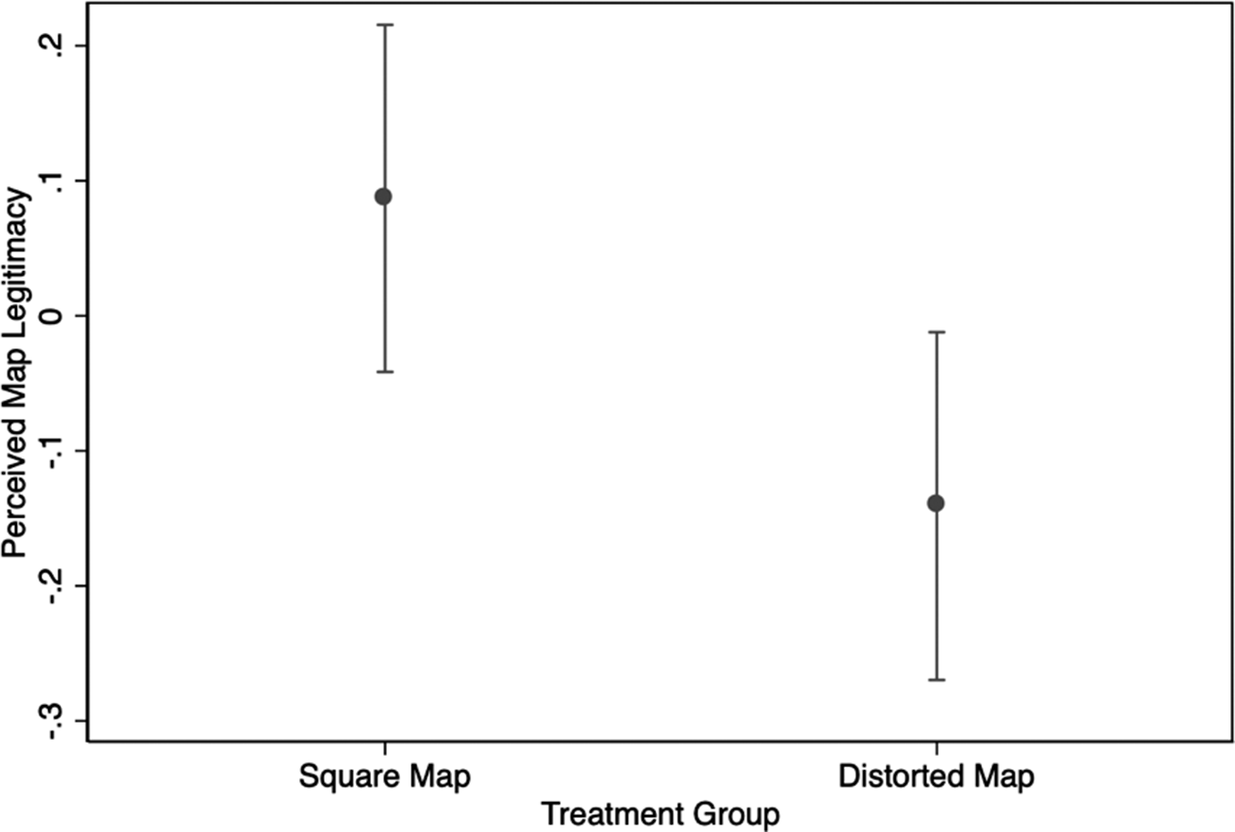
As shown in Figure 3, respondents in experimental Group 2 (who viewed the gerrymandered map) score lower on this latent variable than those in Group 1 (p < 0.05). This provides causal evidence that perceiving gerrymandering, driven by district shape, diminishes citizens’ evaluations of the political system’s legitimacy.
Perceived map legitimacy by treatment group.

Finally, a follow-up analysis (Model 1.4) tests whether this effect varies by partisanship. The results indicate no statistically significant interaction – perceptions of gerrymandering reduce perceived map legitimacy across Democrats, Republicans, and Independents equally. This suggests that the effect of gerrymandering perceptions on attitudes is largely party-neutral and underscores its broad influence on public perceptions of the democratic process.
Commissions reduce perceived gerrymandering
So far, our analysis demonstrates that perceptions of gerrymandering negatively influence the perceived legitimacy of congressional maps. Our next step is to assess whether cues indicating that district lines are drawn by independent commissions – rather than partisan legislatures – can reduce perceived bias and thus improve attitudes about the democratic process.
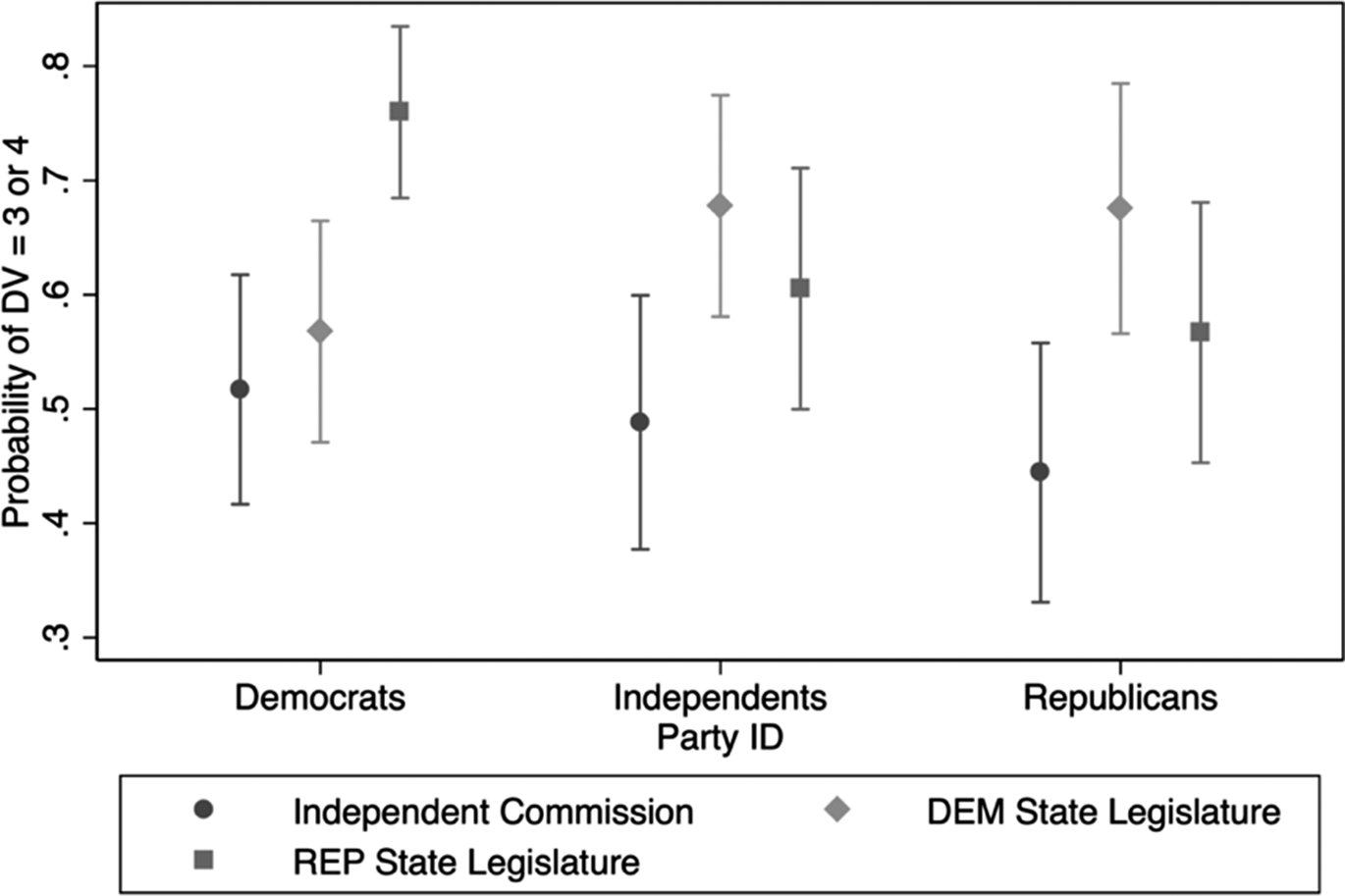
Model 1.5 (see Table A3 in the Appendix) estimates the effects of different redistricting institutions on perceptions of partisan bias, measured via an ordinal scale representing how strongly respondents believe a map favors one party over another. To explore whether partisanship influences these perceptions, the model includes interaction terms between the treatment condition (i.e., independent commission, partisan legislature, and no cue) and respondents’ political party affiliation. Figure 4 visualizes the predicted probabilities: the likelihood that respondents perceive the map as significantly biased in favor of one party (“fairly likely” or “very likely”).
Predicted probability of perceived gerrymandering.

The findings reveal three key insights:
First, both Democrats and Republicans are significantly less likely (p < 0.05) to perceive maps drawn by independent commissions as gerrymandered than maps produced by out-party-controlled legislatures. Specifically, the probability that Democrats believe the map is biased drops from 76.0% (when the map is drawn by Republicans) to 51.7% (when drawn by a non-partisan commission). Similarly, Republicans’ perceived bias drops from 67.5% to 44.4% under the same conditions. This indicates that non-partisan commissions increase perceptions of fairness broadly across partisan divides.
Second, the analysis shows that neither Democrats nor Republicans see commissions as significantly reducing the perception of bias relative to in-party-controlled legislatures, suggesting that perceptions are heavily influenced by partisanship and cueing. This underscores a key point: perceptions of partisan bias are highly context-dependent, but commissions are viewed more favorably by minority parties and independents.
Third, among independents, the predicted probability that maps are perceived as biased decreases from 67.7% (Democratic-controlled maps) to 48.8% (commission-led maps), with a statistically significant difference (p < 0.05). However, independents see no significant difference between maps drawn by Republicans and those by commissions (p = 0.12).
In sum, these results support our hypothesis that independent redistricting commissions are generally perceived as less biased than partisan-controlled maps – an attitude that could foster broader legitimacy and trust in the electoral process.
Commissions increase perceived map legitimacy
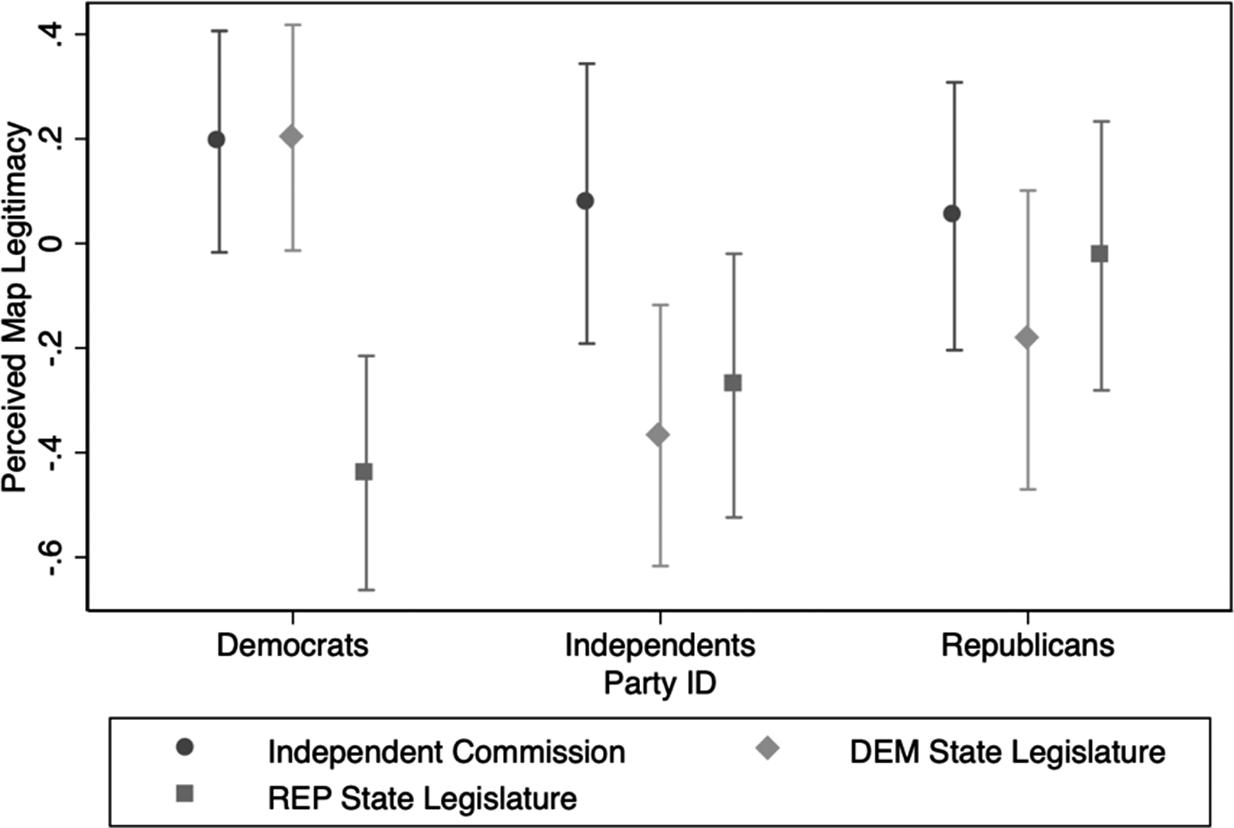
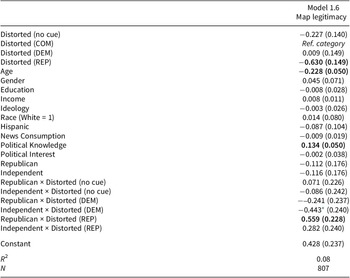
To examine the impact of redistricting institutions on citizens’ evaluations of their political system, we estimated the effects of different redistricting practices on our latent “map legitimacy” variable. As with prior analyses, we tested whether these effects vary across partisanship using an interactive Model 1.6 (found in Table A4 in the Appendix), which revealed a statistically significant interaction between the treatment condition and respondent party ID. The estimated conditional effects are visualized in Figure 5.
Perceived map legitimacy by party ID.

Figure 5 illustrates that, relative to a process led by the Republican Party, commission-led redistricting increases Democrats’ perception of map legitimacy (p < 0.05). This suggests that the specific process used to draw district lines has tangible effects on how credible and legitimate citizens find their political system. Interestingly, Democrats’ perceptions do not significantly change when the redistricting authority shifts from their preferred party to an independent commission (p = 0.96). This suggests that when Democrats see the process as non-partisan, they are just as satisfied as when their own party is in charge, suggesting that non-partisan procedures are viewed as equally, if not more, legitimate.
For Independents, the redistricting method also influences attitudes (p < 0.05). When districts are drawn by an independent commission rather than by a Democratic or Republican-controlled legislature, Independents report significantly more positive perceptions of map legitimacy. Specifically, their scores increase when the process is non-partisan, demonstrating that independents are especially responsive to neutral institutional cues.
In contrast, perceived map legitimacy among Republican respondents is unaffected by the redistricting process (p > 0.05). Although Republicans are less likely to view maps drawn by the out-party as gerrymandered, this does not translate into higher overall scores support in our measure, indicating that partisan trust is more complex and may depend on other factors beyond procedural cues. Though speculative, we suspect that this finding is partly driven by recent political developments. For instance, Democratic legislators have recently championed the implementation of independent redistricting commissions, which could influence how partisans interpret redistricting narratives. Furthermore, recent redistricting cycles have seen multiple instances of Republican gerrymanders that some observers have suggested could be decisive in determining partisan control of a closely divided chamber.Footnote 3 Therefore, given the advantage enjoyed by Republicans in the current electoral environment, respondents from that party may have a vested interest in maintaining the status quo. Such dynamics lend additional credence to our hypothesis that perceptions about the redistricting process – rather than maps alone – are central to shaping individual attitudes toward government and democracy.
Taken as a whole, our findings suggest that institutional cues – particularly independent commissions – can bolster perceptions of perceived legitimacy of district maps. Such perceptions are crucial, as they influence the broader legitimacy and durability of democratic regimes, especially in polarized environments.
Perceived fairness and gerrymandering threat as moderators of attitudes
In our final step, we analyze conditional treatment effects. Specifically, we investigate whether individuals’ perceptions of the fairness of redistricting institutions and the threat posed by gerrymandering modify the effect of institutional cues on perceived map legitimacy. To achieve this goal, we employ two independent variables, which we use as moderators:
(1) A 5-point measure indicating agreement that “Independent commissions are less likely to favor one political party over another” (with 1 = Strongly Disagree, 5 = Strongly Agree).
(2) A latent construct derived from responses to four statements assessing the perceived threat of gerrymandering. Specifically, we asked subjects to indicate their level of agreement with the following four statements: (1) When congressional districts are drawn to favor one political party, the citizens of that state lose their constitutional right to fair representation. (2) When congressional districts are drawn to favor one political party, the citizens of that state lose their freedom to choose their own leaders. (3) When congressional districts are drawn to favor one political party, politicians don’t need to pay close attention to their constituents. (4) When congressional districts are drawn to favor one political party, politicians get to choose their own voters instead of the voters choosing them. Higher scores on each of these indicators signal a stronger perception that gerrymandering undermines democracy. Using factor analysis, these four items were combined into a single latent variable representing perceived threat. For more details on the construction of this variable, see the Appendix.
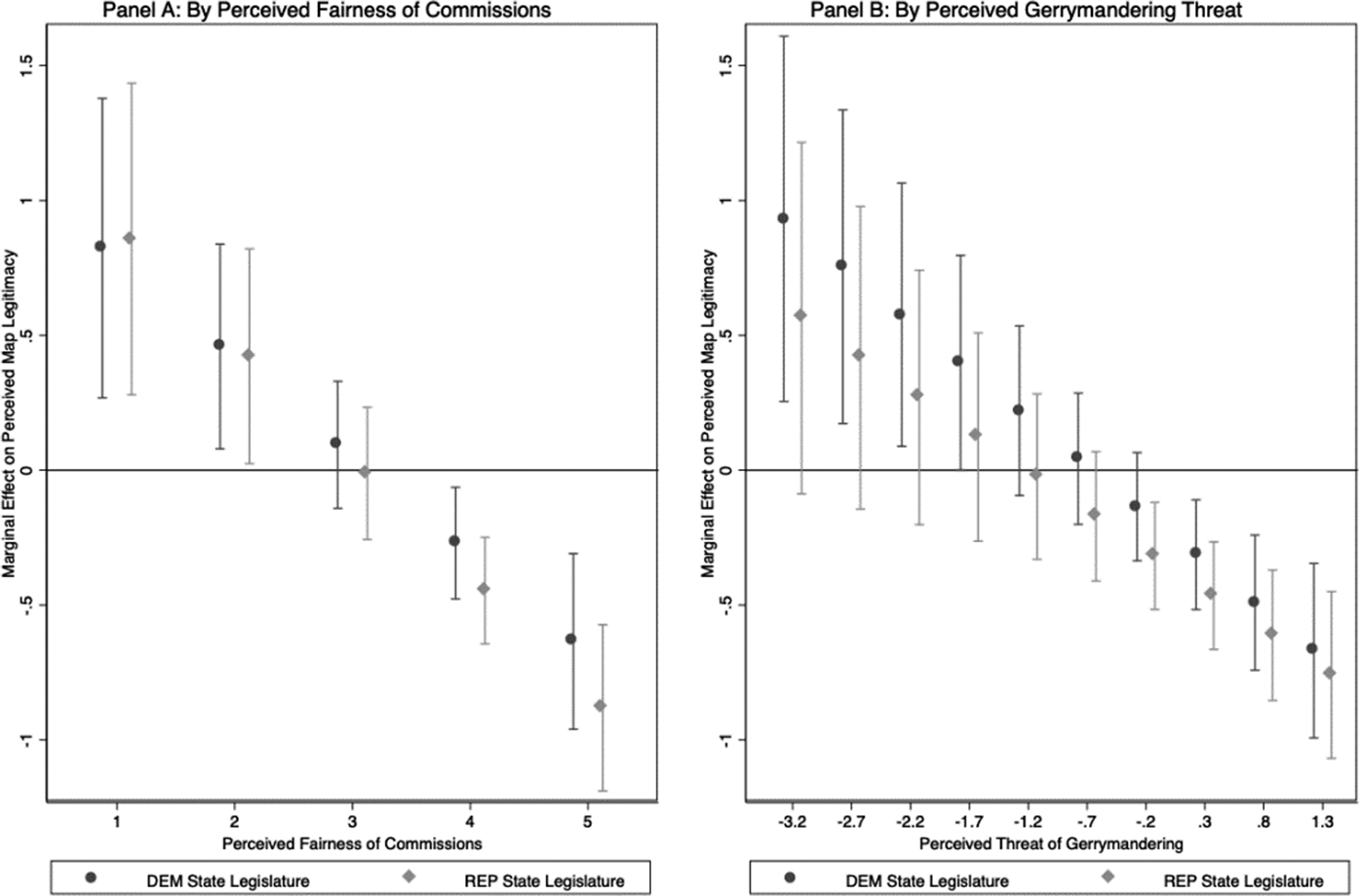
Our main hypothesis is that the effect of our experimental treatment – specifically, whether redistricting is perceived as partisan or impartial – will vary depending on these perceptions. To test this, we re-estimated Model 1.6, incorporating interactions between the treatment indicator and each moderator (Models 1.7 and 1.8 in Table A5 in the Appendix). Figure 6 presents the estimated marginal effects: the difference in perceived map legitimacy associated with legislature-led redistricting versus a commission, across the full range of perceptions.
Marginal effect of legislature-led redistricting.

The results support our expectations. In Panel A (Model 1.7), there is a conditional relationship between our experimental treatment and the measure that captures people’s views about the fairness-inducing effect of independent commissions. In particular, we find that legislature-led redistricting has a significant negative effect on perceived map legitimacy for individuals who consider independent commissions to increase the fairness of elections in the United States (i.e., respondents who score a “4” or a “5” on this moderator variable). By contrast, subjects who reject the claim that commissions level the electoral playing field seem to prefer legislature-led redistricting, expressing a slight increase in map legitimacy if they read that “their” map was created by their state’s elected representatives.
In Panel B (Model 1.8), individuals perceiving a high threat from gerrymandering are more negatively affected by legislature-led redistricting, with support declining sharply at higher threat levels (p < 0.05). By contrast, at the low end of this latent measure (i.e., for respondents who do not consider gerrymandering to be problematic), we see no such negative effect. Overall, these findings confirm that perceptions of fairness and threat shape how redistricting cues influence attitudes toward democracy.
Discussion
Taken together, our survey experiment yields four principal findings. First, individuals are more likely to perceive “distorted” maps as gerrymandered, even after controlling for other variables. Second, perceptions of the prevalence of gerrymandering exert a substantial negative effect on mass evaluations of the political process, regardless of partisan identity. Third, our results show that independent commissions influence attitudes about the electoral process for supporters of minority parties. Specifically, Democrats, Republicans, and Independents are more inclined to believe that a given electoral map creates a level political playing field if the districts are drawn by a non-partisan panel rather than an out-party-controlled legislature – even when the same maps are produced. Fourth, our work indicates that commissions also shape perceptions of democratic quality. Thus, the choice of redistricting institution has meaningful consequences for public attitudes toward the legitimacy and fairness of the political system.
Overall, our findings underscore the importance of institutional design and public perceptions. They suggest that reforming redistricting procedures to emphasize neutrality and fairness can have significant positive effects on citizens’ trust and confidence in democratic institutions, even among partisans and supporters of the out-party.
Conclusion
We set out to examine how the redistricting practices employed by states influence citizen perceptions and the legitimacy of American democracy. We began by contextualizing redistricting as a deeply political institution that varies across states – ranging from partisan legislatures to independent commissions – and explored the critical question of how these institutional arrangements shape public attitudes. Drawing on a randomized survey experiment, our findings demonstrate that perceptions of partisan gerrymandering are widespread and strongly negatively correlated with citizens’ evaluations of democratic legitimacy.
Our results reveal that voters often rely on visible heuristics – most notably, district shapes – to assess the fairness of maps. These perceptions, although sometimes detached from map objective reality, have tangible effects: irregular, “gerrymandered” district boundaries evoke negative perceptions of electoral fairness and government responsiveness across partisan lines. However, when respondents are informed that districts are drawn by non-partisan commissions, their perceptions of bias and unfairness diminish, regardless of partisanship. This underscores the importance of institutions perceived as neutral, which can mitigate the corrosive effects of partisan redistricting on public attitudes.
Critically, we find that perceptions matter. Irrespective of voters’ partisan identity, perceived gerrymandering dampens the perceived legitimacy of maps, which, in turn, negatively impacts democratic system support. Support among minorities and independents notably increases when districts are perceived to be drawn by fair, impartial bodies. These insights align with our broader argument that the legitimacy of democratic institutions depends not solely on electoral outcomes but heavily on public perceptions of fairness, transparency, and procedural integrity.
While our findings are suggestive and valuable, they are also subject to limitations. Most notably, the survey experiment was conducted within a hypothetical context. Respondents’ processing of the survey questions may be influenced by the fact that they are assessing a fictitious state, which could weaken the external validity of some results. People likely possess weak “priors” about the quality of democracy in this scenario, making their attitudes more malleable than they would be in real-world settings. Additionally, public ignorance about redistricting processes is widespread; most citizens are generally unaware of who draws district boundaries and the specifics of redistricting procedures. As a consequence, the effects we observe – where perceptions are influenced by explicit information about redistricting actors – are likely to represent the upper bound of what could be achieved. In actual contexts where such knowledge is limited, these perceptual effects would probably be smaller. Despite these constraints, the findings carry important policy implications: reforming redistricting processes to emphasize transparency and neutrality can significantly enhance public trust and support for democratic institutions.
Finally, our work connects to larger debates in political science and state politics. It underscores that perceptions of fairness, shaped by the institutional design of districting, are fundamental to sustaining democratic legitimacy. As gerrymandering continues to threaten electoral responsiveness and public confidence, promoting independent, non-partisan redistricting processes emerges as a critical step toward safeguarding democracy – not only by changing the map but also by restoring the public’s trust in the legitimacy of political institutions.
In sum, our research highlights that in an era marked by heightened political polarization and institutional distrust, the perceived fairness of redistricting practices is central to the resilience and legitimacy of American democracy.
Data availability statement
Replication materials are available on SPPQ Dataverse at https://doi.org/10.7910/DVN/NERMNN (Williamson and Justwan Reference Williamson and Justwan2025).
Funding statement
The authors received no financial support for the research, authorship, and/or publication of this article.
Competing interests
The authors declared no potential competing interests with respect to the research, authorship, and/or publication of this article.
Appendix
Full regression results for observational analysis
Ordered logistic regression estimates of Democratic satisfaction

Note: Coefficients are presented with standard errors in parentheses. Bolded entries are significant at p < 0.05.
Full regression results for experimental analysis
Ordered logistic regression estimates of perceived gerrymandering

Note: Coefficients are presented with standard errors in parentheses. Bolded entries are significant at p < 0.05.
Ordered logistic regression estimates of perceived gerrymandering

Note: Coefficients are presented with standard errors in parentheses. Bolded entries are significant at p < 0.05.
Linear regression estimates of map legitimacy

Note: Coefficients are presented with standard errors in parentheses. Bolded entries are significant at p < 0.05.
Linear regression estimates of map legitimacy

Note: Coefficients are presented with standard errors in parentheses. Bolded entries are significant at p < 0.05.
Construction of the “Threat from Gerrymandering” variable
The models in this article contain a predictor that captures people’s views about the dangers of gerrymandering. In this section, we present the factor analysis procedure that was used to generate the variables used in the statistical analysis. This procedure reveals that a one-factor solution fits the data very well.
Factor loadings

Scree plot of eigenvalues

Construction of the “Perceived Map Legitimacy” variable
One of the main dependent variables in our experimental analysis is the perceived legitimacy of the map assigned to a given respondent. In order to tap into this dimension, our questionnaire contained three separate survey items.
Factor loadings

Scree plot of eigenvalues

Ryan Williamson is an Assistant Professor at the University of Wyoming.
Florian Justwan is an Associate Professor at the University of Idaho.






 Open access

