


Introduction
Despite the growing interest in African civil society and the enduring legacy of colonialism (Gyimah-Boadi, Reference Gyimah-Boadi1996; Mati, Reference Mati2020; Orvis, Reference Orvis2001), studies focusing on its historical progress are still scarce. As far as it is studied, urbanisation and industrialisation in Africa determined the emergence of new social movements, in particular voluntary associations (Mazrui & Wondji, Reference Mazrui, Wondji and Wondji2010). However, colonial governments discouraged civic groups, with the settlers being the protagonists of formal associations (Makumbe, Reference Makumbe1998). Moreover, the institutional models promoted and recognised by law were European. These did not consider local culture (Hilson et al. Reference Hilson, Neunsinger and Patmore2017) and were also the only type of associations nurtured by the State the ones submitted to the colonial interests (Mati, Reference Mati2020).
Research on contemporary civil society in Angola highlights the unequal access to citizenship (Abreu, Reference Abreu2006) and the State’s propensity to encourage socially oriented associations at the expense of those that promote political participation (Pacheco, Reference Pacheco, Vidal and Chabal2009) as the most critical limitations to its development and civic intervention. Although the overall assumption is that the long colonial legacy prompted this trend, there is no long-term survey on associational life in the former Portuguese colonies.
This study focuses on the relationship between associationism and colonialism, taking Angola as a case study, the largest Portuguese former colony, from its origin, in the mid-nineteenth century until its decolonisation in 1974. Considering the legal framework, the bylaws of the legally recognised associations, and the colonial research on “indigenous associations”, it provides an overview of associational life’s long-term evolution in a colonial setting. First, it highlights the main legal initiatives regulating the phenomenon. Secondly, it is organised diachronically, revealing continuities and ruptures along three political regimes—the constitutional monarchy, the First Republic and the Dictatorship. Finally, it argues that the colonial situation decisively shaped associational life in these settings, not only by banning the majority of the native people from the public sphere but also by nurturing associations submitted to the colonial interests and policies and repressing all expressions of politicised collective action. Nevertheless, associations were important “points of resistance” (Balandier, Reference Balandier1955).
Literature Review
Previous research on the former Portuguese colonies has addressed different topics concerning legally recognised associations. Among the most studied tendencies, the origin of African nationalism in the form of nativist associations stands out (Andrade, Reference Andrade1966; Freudenthal, Reference Freudenthal2013; Guimarães, Reference Guimarães2002; Nascimento, Reference Nascimento1999; Rocha, Reference Rocha1991; Santos, Reference Santos1968; Sousa, Reference Sousa2012). Studies of settler and migrant communities’ associations from other national origins are also available, stating that associational life in these settings was meant to cover the lack of public welfare and to promote social integration (Melo, Reference Melo2004; Pimenta, Reference Pimenta2013).
The most relevant case study concerning associational life evolution in a Portuguese colony is Lourenço Marques (Maputo). Studies focused on the emergence of the workers’ movement during the First Republic (Capela, Reference Capela2009), civil society resistance to the Dictatorship (Neves, Reference Neves2008), and urban sociability (Pimenta, Reference Pimenta2013). It underlines racial segregation within associationism, but references to indigenous associations are scarce since the primary sources used are usually the officially recognised bylaws and the associative press.
Some authors have looked into Portuguese post-WWII ethnographical surveys, considering the Luanda case study, namely those focusing on the musseques, which were called the urban suburbs where the African population was concentrated. These studies reveal that indigenous associational life, namely sports and cultural clubs, were seen by colonial science as potential instruments to ensure the “westernisation” and social control of the new urban population (Curto, Reference Ramada Curto and Da Cruz2021). In contrast, for the contemporary Angolan writers and the postcolonial scientists, the musseques were the cradle of a new national culture, Angolanity (Moorman, Reference Moorman2008).
To critically engage with colonial knowledge and to complement the portrayal of Angolan associational life evolution, it was necessary to consider the context of the production of such surveys and studies. Research on indigenous associations in this period was framed by a broader agenda of administrative rationalisation and modernisation experienced in the colonial settings and a transnational interest in the classification, analysis and reform of indigenous institutions, arising from new developmental directives advocated by institutions like the UN, UNESCO or FAO (Cooper & Packard, Reference Cooper and Packard1997). At this juncture, it was necessary to demonstrate that the Portuguese colonial regime was aware of the populations under its rule problems and committed to social progress (Abrantes, Reference Abrantes2012).
During this period, Portuguese academics came into contact with the post-WWII literature on voluntary associations’ upsurge in “developing” societies. According to this trend, the associations formed by the so-called detribalised urban populations were understood in the light of a process of late modernisation (Little, Reference Little1957). Indigenous associations were described as “intermediary institutions”, which were central in linking traditional peasant social relations with modern economic requirements (Eisenstadt, Reference Eisenstadt1956; Geertz, Reference Geertz1962). The tendency to overemphasise the relationship between African associations and tribal ties found its greatest exponents in the concept of “supertribalization”. According to Rouch, contrary to expectations, the survey of migratory movements in Ghana towards Accra between 1950 and 1951 revealed the community ties strengthening (Rouch, Reference Rouch1956).
Contemporaneously, however, these theses were subject to criticism, starting with Balandier. The researcher argued that the associational life in a colonial situation, like any other social phenomenon, could not be compared with the same phenomenon in a European context, thus neglecting the impacts of the colonial process (Balandier, Reference Balandier1951).
The latter highlights the role of colonial authorities in perpetuating and sanctioning tribal ties was highlighted (Wallerstein, Reference Wallerstein1960). On the other hand, it was argued that African associations in the cities were the basis of new kinds of social ties, voluntary and oriented to meet the needs of urban life, with class solidarities becoming increasingly important (Gluckman, Reference Gluckman1960).
Methods
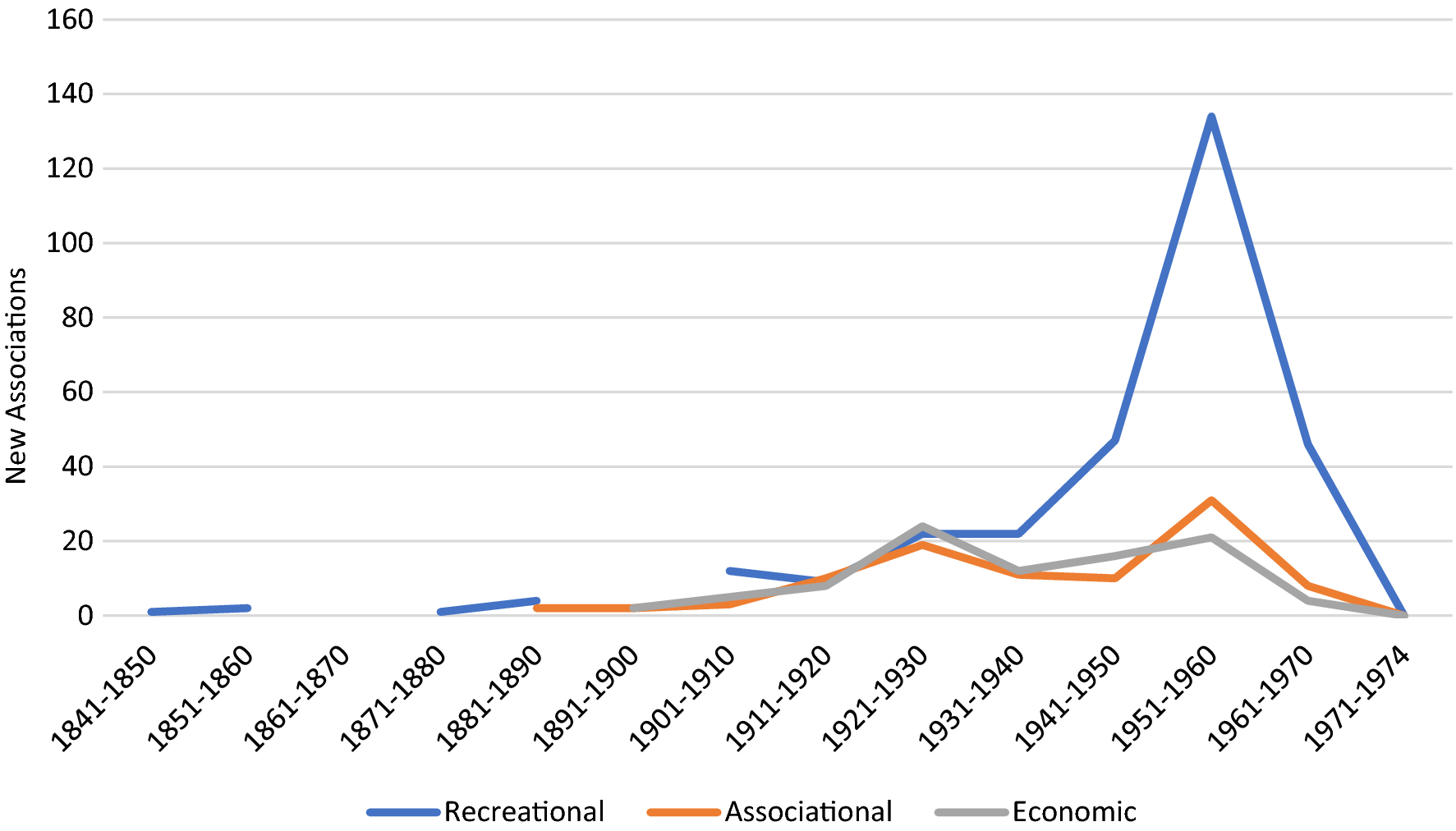
The present survey on the Luanda case study considers the emergence and evolution of legally recognised associations. All the associations’ bylaws published in Angola's Official Bulletin between 1845 and 1975, totalling 490, were exhaustively analysed. A simple quantitative analysis, reflected in Fig. 1, provided relevant information on the general growth of the associations’ different typologies. However, the qualitative analysis of their bylaws allowed for a deeper understanding of how the legal framework shaped associational life and the strategies used to overcome constraints and take advantage of opportunities.
Associational life evolutional considering Economic Associations (employers, unions, corporative and cooperative), Recreational (Culture and Recreational, Religious and Sportif), Associational (Civic, Mutuals and Regionalists)

To understand associational life progress in a colonial setting, it was first necessary to consider the specificities of the regulatory regimes and their evolution in permissiveness or restrictiveness in the first instance. Moreover, a more detailed of different types of provisions acknowledged more complex trends. Finally, it was considered the institutional context of these regulatory regimes, related to governance, how the legal framework was enforced and amended, formation, requirements for legal recognition and registration, operations, activities allowed or prohibited, and resources, funding restrictions, tax exemptions and accountability (DeMattee, Reference DeMattee2019).
Both sources, bylaws and legislation, provide relevant information on the evolution of associational life in a colonial setting but ignore the associations not legally recognised. To consider associations founded among the native people, it was necessary to analyse another type of testimonies, the ethnographical studies. As mentioned, the indigenous associational life became a relevant research topic during the global decolonisation process following WWII (Abrantes, Reference Abrantes2012). Prominent among these investigations was the Study Mission on Associative Movements in Africa, created by decree 16,158 of February 6, 1956. This comprehensive field survey resulted in three volumes published between 1956 and 1959, coordinated by Silva e Cunha, a Higher Institute of Social Sciences and Overseas Policy professor who would later become Minister of Overseas Territories. After Cunha, several of his students devoted part of their dissertations and surveys to indigenous associational life, as will be shown.
Finally, since the legal framework does not represent the only constraint imposed on free associationism, especially during the Dictatorship, the investigation processes carried out by the political police (PIDE) on Angolan associations were also analysed. This latter research was fundamental to clarify how the colonial situation, combined with the totalitarian nature of the colonising State, shaped local associational life during the longest European Dictatorship.
To conclude, it is not an understatement to emphasise that the main limitation of this study is related to the sources used, considering their contexts of production, subordinated to colonial interests. To complement its gaps, it is necessary to explore local archives and verify the existence of other research on these realities that are not disseminated on an international scale. We recognise, however, that the collected data, not having been analysed systematically, allowed us to create a general characterisation and periodisation that should be considered to evaluate the specificities of the historical development of civil society in colonial settings.
Angola Case Study
In general, no study considers the long-term evolution of associative life and its relationship with colonial policies in any former Portuguese colony. Nevertheless, these contexts are relevant case studies as they were among the first territories to be colonised and the last to achieve independence, ensuring a long-term portrait of the colonial encounter. Over this long period, colonial policies were also conceived and applied differently by distinct political regimes, revealing diverse impacts and trends in associational life.
Although effective Portuguese colonisation was only possible from the late nineteenth century, the history of the colonial process in Angola was dramatically linked to the slave trade. During the modern era, commercial urban centres have developed, notably Luanda and Benguela, giving rise to a miscenized elite. At the dawn of the nineteenth century, these elites were called “civilised” and later “assimilated”, that is, Christianised, with European cultural habits and who competed with the Lusodescendant minority in overseas administration and on whom the colonial authorities relied on ensuring their territorial presence (Silva, Reference Silva2009). The natives and mestizos are thus considered to enjoy civil and political rights analogous to the settlers, unlike the rest of the so-called indigenous population (Marzano, Reference Marzano2013: 30).
The revolution and the liberal regime in the nineteenth century embodied humanist ideas of equality, reflected in the extension of the new legal framework to all colonial territories. However, as will be clarified, it recognised a cultural boundary between ‘civilised’ and ‘uncivilised’ people by ‘contemporising’ with the local ‘uses and customs’ rather than ensuring full citizenship to the native populations (Silva, Reference Silva2009).
The rise of democratic ideas in the early twentieth century was met with great expectations among the colonists and the ‘assimilated’ native elites. However, despite the parallel rise of racist ideologies, the colonial provinces achieved political representation in the republican parliament from the Republican Revolution on October 5, 1910. This political conjuncture induced the expansion of the public space in the form of new associations, newspapers, and social and cultural movements, such as trade unionism or nativism. We saw the climax of this trend in the post-war years (Pereira, Reference Pereira2019).
In the metropolis, the military coup of May 28, 1926, can be explained as the conservative reaction to this social mobilisation and coercive policies were immediately imposed on civic participation. In 1933, a regime named Estado Novo was implemented, based on creating corporative institutions organising workers, employers, rural people and fishermen, as well as organisations under State control to frame youth, leisure or sports activities (Rosas, Reference Rosas2015).
In the former colonies, this process was complemented with the legal recognition of the duality between civilised and indigenous populations through the indigeneity regime. This regime lasted until 1961, distinguishing the majority of the indigenous population from the settlers and a tiny minority of natives, called “assimilated”. (Silva, Reference Silva2009), shaping all spheres of economic, social and political life within these settings (Neto, Reference da ConceiçãoNeto2017). In the same year, started the war of independence that lasted until the Carnation Revolution on April 25, 1974, in Portugal, and the subsequent decolonisation.
Associations’ Regulatory Regime in Former Portuguese Colonies
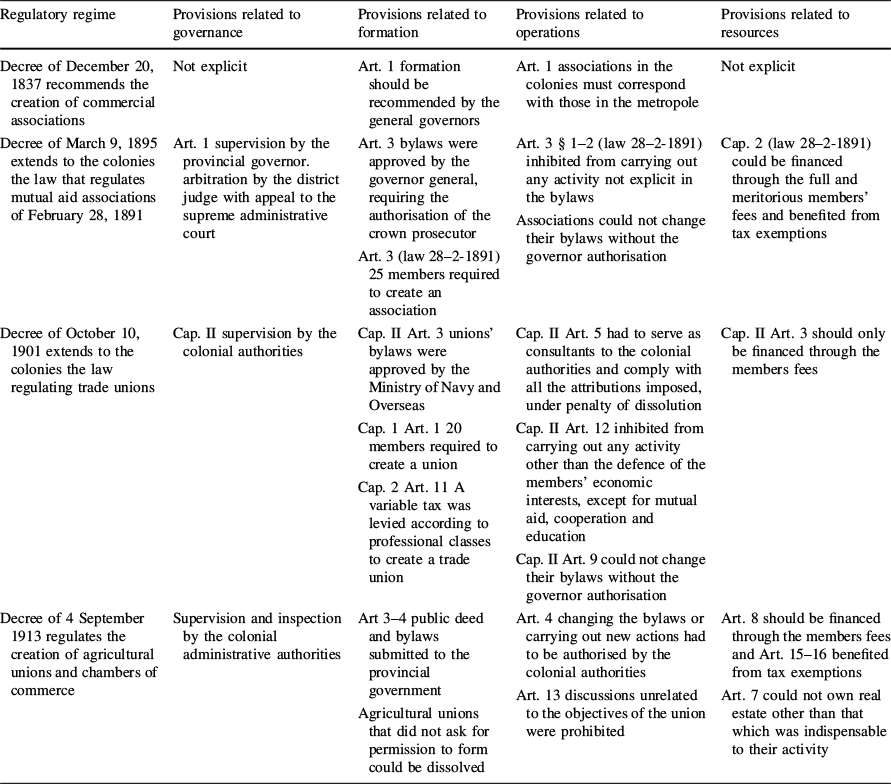
The political and legal constraints on associational life in the former Portuguese colonies evolve over the different political regimes’ onset in the metropole during the nineteenth and twentieth centuries. Most of the associations’ regulatory regime was implemented during the constitutional monarchy by extending to the former colonies the legal regulation of commercial associations, mutual societies, and trade unions. The Republican regime maintained this legal framework, extending the law regulating the agricultural unions and the commerce chambers.
As Table 1 synthesises, the regulatory regime that lasted until 1935 was not entirely permissive but endorsed a political space for the rise of associational life among settlers and ‘assimilated’ natives. The laws’ detailed analyses highlight the provisions related to governance and reveal that only welfare associations could rely on a specific dispute resolution body, being the other typologies submitted to the colonial authorities’ supervision and inspection without any standard definition. Provisions related to operations also reveal that the colonial authorities nurtured actions committed to the economic exploitation of the new territories and the settlers’ social welfare, not allowing for any deviation from these goals. As mentioned in the preamble of the trade union legislation, on October 10, 1901, the intention was to “strengthen the new colonial power and with it the creation of public wealth and the prestige of the Portuguese name”.
Associations' regulatory regime during the constitutional monarchy and the first republic

Regulatory regime |
Provisions related to governance |
Provisions related to formation |
Provisions related to operations |
Provisions related to resources |
|---|---|---|---|---|
Decree of December 20, 1837 recommends the creation of commercial associations |
Not explicit |
Art. 1 formation should be recommended by the general governors |
Art. 1 associations in the colonies must correspond with those in the metropole |
Not explicit |
Decree of March 9, 1895 extends to the colonies the law that regulates mutual aid associations of February 28, 1891 |
Art. 1 supervision by the provincial governor. arbitration by the district judge with appeal to the supreme administrative court |
Art. 3 bylaws were approved by the governor general, requiring the authorisation of the crown prosecutor Art. 3 (law 28–2-1891) 25 members required to create an association |
Art. 3 § 1–2 (law 28–2-1891) inhibited from carrying out any activity not explicit in the bylaws Associations could not change their bylaws without the governor authorisation |
Cap. 2 (law 28–2-1891) could be financed through the full and meritorious members’ fees and benefited from tax exemptions |
Decree of October 10, 1901 extends to the colonies the law regulating trade unions |
Cap. II supervision by the colonial authorities |
Cap. II Art. 3 unions’ bylaws were approved by the Ministry of Navy and Overseas Cap. 1 Art. 1 20 members required to create a union Cap. 2 Art. 11 A variable tax was levied according to professional classes to create a trade union |
Cap. II Art. 5 had to serve as consultants to the colonial authorities and comply with all the attributions imposed, under penalty of dissolution Cap. II Art. 12 inhibited from carrying out any activity other than the defence of the members’ economic interests, except for mutual aid, cooperation and education Cap. II Art. 9 could not change their bylaws without the governor authorisation |
Cap. II Art. 3 should only be financed through the members fees |
Decree of 4 September 1913 regulates the creation of agricultural unions and chambers of commerce |
Supervision and inspection by the colonial administrative authorities |
Art 3–4 public deed and bylaws submitted to the provincial government Agricultural unions that did not ask for permission to form could be dissolved |
Art. 4 changing the bylaws or carrying out new actions had to be authorised by the colonial authorities Art. 13 discussions unrelated to the objectives of the union were prohibited |
Art. 8 should be financed through the members fees and Art. 15–16 benefited from tax exemptions Art. 7 could not own real estate other than that which was indispensable to their activity |
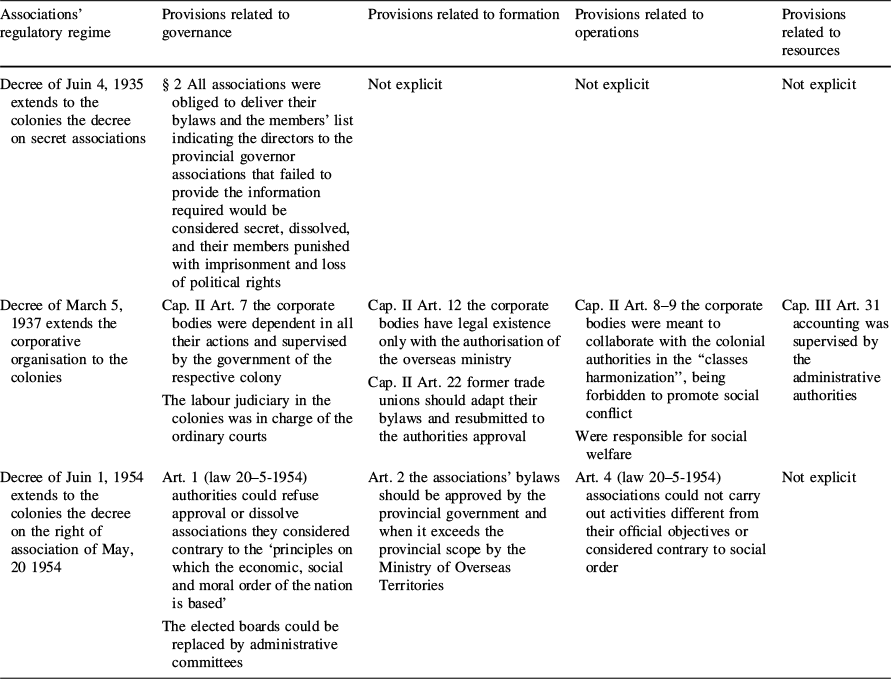
This regulatory regime and institutional framework changed dramatically during the Dictatorship, becoming far more restrictive, as Table 2 illustrates, particularly the provisions concerning governance. Nevertheless, the colonial authorities did not neglect the potential of associations as instruments of social control and substitutes for the Welfare State. From the 1930s, several charitable associations were granted the status of public utility institutions. State support was given, even creating special taxes for this purpose.
Associations’ regulatory regime during the dictatorship

Associations’ regulatory regime |
Provisions related to governance |
Provisions related to formation |
Provisions related to operations |
Provisions related to resources |
|---|---|---|---|---|
Decree of Juin 4, 1935 extends to the colonies the decree on secret associations |
§ 2 All associations were obliged to deliver their bylaws and the members’ list indicating the directors to the provincial governor associations that failed to provide the information required would be considered secret, dissolved, and their members punished with imprisonment and loss of political rights |
Not explicit |
Not explicit |
Not explicit |
Decree of March 5, 1937 extends the corporative organisation to the colonies |
Cap. II Art. 7 the corporate bodies were dependent in all their actions and supervised by the government of the respective colony The labour judiciary in the colonies was in charge of the ordinary courts |
Cap. II Art. 12 the corporate bodies have legal existence only with the authorisation of the overseas ministry Cap. II Art. 22 former trade unions should adapt their bylaws and resubmitted to the authorities approval |
Cap. II Art. 8–9 the corporate bodies were meant to collaborate with the colonial authorities in the “classes harmonization”, being forbidden to promote social conflict Were responsible for social welfare |
Cap. III Art. 31 accounting was supervised by the administrative authorities |
Decree of Juin 1, 1954 extends to the colonies the decree on the right of association of May, 20 1954 |
Art. 1 (law 20–5-1954) authorities could refuse approval or dissolve associations they considered contrary to the ‘principles on which the economic, social and moral order of the nation is based’ The elected boards could be replaced by administrative committees |
Art. 2 the associations’ bylaws should be approved by the provincial government and when it exceeds the provincial scope by the Ministry of Overseas Territories |
Art. 4 (law 20–5-1954) associations could not carry out activities different from their official objectives or considered contrary to social order |
Not explicit |
On the other hand, new corporative institutions were created, meant to replace free associationism and extend State control to all spheres of social life, from welfare to leisure. From 1937, the National Trade Unions, under the authorities’ auspices, with their providence funds, were meant to replace free trade unions and mutuals. The application of this regime to the colonies was slow and partial. According to the decree of March 5, 1937, the fundamental bases of the colonial corporative power were established, but “very general bases were adopted, and the necessary elasticity was left” so that “the reality and experience of economic life” could determine “the solutions that practice would advise”. Two years later, a report on the law’s impact concluded that “the corporate order in our empire reflected very different needs from those in Europe”, namely “in Africa, manual labour is black, and capital is white”, therefore, “a conflict between capital and labour would somehow represent a conflict of sovereignty”, so the 1937 decree “recognises this fact, excluding the indigenous people from the corporate organisation, that is to say, the great mass of manual labour in the colony”. The colonial reality was reflected by adapting pre-existing associations, bringing together traders, farmers and industrialists, and employees in commerce and industry, with only “an act of discipline, integration and efficiency” being necessary.
There was also an attempt to instrumentalise the associations in education, culture and sport to stimulate nationalism and social discipline. Delegations of the Portuguese Youth, the regime’s official youth organisation, were established in 1936. In 1942, the General Directorate of Physical Education, Sports and School Health was created, and, in 1956, the Provincial Councils of Physical Education was created. However, considering the small colonisation scale, it was impossible to extend these effectively totalitarian framework policies to the colonies (Domingos, Reference Domingos2009).
Despite this evolution in the provisions directly related to associations, one of the most impactful features of the colonial institutional framework was the existence of a legal duality which impeded access to full citizenship for most of the indigenous population. This was a long-term trend. The emergence of a legally enshrined racist regime goes back to the liberal constitutions when applied to the “overseas provinces”. According to the civil code of 1867, part of the indigenous populations could remain subject to their “uses and customs” (Silva, Reference Silva2009).
During the republican period, the idea that indigenous populations should assume a different legal statute was turned into different proposals which gave origin to the indigenous regime (Melo, Reference Melo1910). The Dictatorship only formalised a de facto status attributed to the colonised populations, clarifying racial discrimination in a juridical duality, distinguishing natives and citizens (Silva, Reference Silva2009). The Political, Civil and Criminal Statute of the Indigenous of Angola and Mozambique, in 1926, presupposed a formal definition of rights (and the lack of them) (Silva, Reference Silva2009). This new legal framework was guided by the idea, provided in the Decree 12.533 of October 23, 1926, that “due to a lack of practical significance, it was neither possible nor desirable to attribute rights related to European institutions to the indigenous people”. It also made the situation of the “Europeanised” Africans and mestizos ambiguous and threatening, submitted to the subjectivity of colonial officials (Marzano, Reference Marzano2013).
Urban development gave rise to new problems, including the exponential growth of a new social stratum, designated at the time as “detribalised populations”, stood out. The 1954 revision of the Indigenous Statute revealed this new concept, meaning the indigenous people no longer integrated into traditional political organisations. Article 21 gave jurisdiction over “detribalised populations” to the colonial administrative authorities without civil and political rights vis-à-vis Portuguese institutions.
Modern African associations emerged therefore among these detribalised populations. Moreover, ethnographic and community studies reveal that local authorities tolerate informal associations, namely mutual aid and recreational, cultural and sporting associations (Soares, Reference Soares1961). On September 6, 1961, the indigenous statute was finally extinguished, but there were no significant changes in de facto status of the indigenous people.
Finally, it has to be underlined that along with this regulatory regime, the primary control mechanism remained surveillance and repression. In 1954, the Angolan delegation of the political police (PIDE) was created, with functions identical to those carried by similar services on the mainland. Sub-delegations and posts were also created in the different districts and urban agglomerations, aiming to make research, collection, compilation and exploitation of information effective. This surveillance network paid special attention to the native associations and also counted on the collaboration of the remaining police forces.Footnote 1 The political police monitored all the associations through a network of informants who denounced those elements that challenged Portuguese sovereignty to the authorities. These denunciations led to the removal of elected leaders and the imposition of administrative commissions.Footnote 2 As the liberation war continued, associations’ repression also worsened, leading to the official extinction of several associations.Footnote 3 Repression was especially violent concerning the poor indigenous populations living in the urban suburbs.Footnote 4 In addition to the massive and arbitrary arrests, other instruments of control inhibited any type of collective activity—transit passes, strict closing times for commercial establishments, control of roads and streets, among others.Footnote 5
Associational Life Long-Term Evolution
Based on the legal framework described, 490 associations were officially recognised between 1845 and 1974, with their statutes published in Angola's Official Bulletin, according to the typological distribution illustrated in Fig. 1.
The evolution of legally recognised associational life in Angola went through three phases resembling the same phenomenon in the metropolis. It emerged in the mid-1800s in parallel with the first legislation recognising and framing associationism. The First Republic, as mentioned, was a period of associationism expansion. During the Dictatorship, associational life was deeply constrained by the regime’s corporative strategies, which did not prevent the post-WWII growth of associational life in parallel with the main cities’ development.
Associational Life During the Constitutional Monarchy
Although later, the first voluntary associations formalised in Angola, as in Portugal, were the economic societies. The Luanda’s Commercial Association, with bylaws approved on August 20, 1864, is considered the oldest. Drawing from the mentioned objectives, it geared towards political demands, “representing and asking the government for the measures that depend on it to improve and increase trade in this market throughout the province”.
Simultaneously, the local appropriation of new ideas linked with the Enlightenment and the French Revolution set off the upsurge of civic associations dedicated to beneficence, instruction, and scientific and literary progress alongside political intervention. This process was connected to the freemasons involved in the 18th-century Brazilian revolts’ deportation to Angola. They organised Masonic lodges, which came to include natives, giving rise to a local Freemasonry called Kuribeka (Freudenthal, Reference Freudenthal2013, Ribeiro, Reference Ramada Curto and Da Cruz2017).
At the dawn of the twentieth century, we witnessed the creation of the first workers’ associations was created, taking advantage of the legal opportunity opened by the extension of the law of May 9, 1891, regulating mutualism in the then colonies. The pioneering Benevolent Association of Luanda's Commercial Employees, with statutes approved on August 3, 1901, stands out. Aimed “to develop the instruction of the associates using study classes and the creation of a reading room”, alongside the “beneficence for the associates” when ill and bearing the costs of their funerals.
Regarding membership, the historiography of associationism in the different colonial contexts under Portuguese rule has highlighted the pioneering role of the local elites, the so-called Creole elites. No explicitly racist clauses were identified in the analysed bylaws from this period. According to the ones of Moçamedense Society approved on April 7, 1890, they could become associates “all Portuguese individuals” with “good moral behaviour, social position and in the enjoyment of their civil and political right”.
Finally, although scarce, testimonies of associations were also created among the indigenous populations during this period. The Angolan writer Óscar Ribas described recreational societies, mainly devoted to traditional dance and music, and assistance societies, taking on the visitation of the sick and participation in funerals and suffrages for the soul, rarely medical and medicinal help. These later associations were exclusively female but included a male member “simply to guide and maintain respect”. They were not governed by written bylaws but had secret greetings allowing the mutual identification of members. Among the oldest confraternities mentioned are the “Akuá-Ilundu” (xingiladorasFootnote 6), the “Akuá-Mbonze” (sweet potato vendors) and the “Akuá-Makanha” (tobacco vendors), founded in the 1880s (Ribas, Reference Ribas1965: 31–38).
Associational Life During the First Portuguese Republic
During the First Republic, there was an associational life upsurge in the African colonial settings, similar to what occurred in the metropolis. In these contexts, however, associationism sought to respond to specific purposes, namely the settlers’ assistance and social integration, ensuring access to networks of sociability and belonging and mitigating the absence of public welfare (Domingos, Reference Domingos2009). The associational life during this period evolved following four trends: civic associations came to include recreational and sporting purposes; proliferation of trade unions, similarly to what occurred in the “metropolis” but with specific features; the same concerning employers’ associations; and finally, the African elites founded the first nativist associations.
As the primary heirs of the enlightenment tradition, the republicans were convinced of their “civilising mission” and fought for the “assimilation” of liberal and democratic values by the local populations. They combined these aims with charitable, instructive and recreational purposes, paving the way to a vast diversity of associations of instruction, recreation and sports, most of all with a propagandist vocation. The purpose of 1913 Lusitanian Group, with bylaws approved on July 18, 1913, was “to deeply root in this colony a sincere love of the Portuguese homeland, opposing a barrier to all propaganda tending to instil in the minds of settlers and natives the separatist idea” to which was added the aim of establishing mutual aid, a library and providing amusements for the members. Members could be people of any race, provided they were Portuguese citizens.
During the republican regime, associations similar to the pioneering associations of employees in commerce and industry spread throughout most of the population nuclei of the colony. The official mutualist nature, contrasting with revolutionary trade unionism dominant in the metropolis, can be interpreted as a strategy to ensure official recognition since the analysis of its bulletins proves their role in the imposition of weekly rest, working hours, and other labour demands. As mentioned, employers’ associations also multiplied in the same period, spreading to all population centres. The analysis of their bylaws indicates that political pressure for more significant public investment in the colonised territories was their central aim.
Unlike Mozambique, where associational life was organised mainly along racial lines, in Angola, class identities were dominant (Pimenta, Reference Pimenta2013). In this period, however, the increase in the number of settlers in Angola and the emergence of racist doctrines led Africans to organise themselves in racially based associations, steered by the native elite in defence of their rights of citizenship and social position (Marzano, Reference Marzano2013). Other official objectives gave these institutions’ political purposes, such as promoting the professional, intellectual and physical improvement of the Africans and their associates. Beneficence was also present in purposes such as founding boarding schools to protect and educate underprivileged children.
Óscar Ribas’ study continues to be the most pertinent information regarding indigenous associations. According to the author, several recreational associations were created during the inter-war period, mainly on the initiative of civil servants, artisans and specialised workers, and, more rarely, women. In the same period, the latter dedicated themselves more to the foundation of spiritual associations. Two sub-types can now be distinguished: associations devoted to spiritual help at the hour of death and mutualist associations dedicated to medical, medicinal and funerary aid. Unlike the former, the latter maintains a professional basis (Ribas, Reference Ribas1965: 31–38).
Associational Life During the Dictatorship
As explained in the legal and political framework, the totalitarian institutions of the Portuguese Dictatorship could not wholly control associational life in the colonies. However, settlers’ and assimilated elites’ associationism was constrained and partially integrated into the colonial strategy. In this period, different trends were observed in associative repertoires, clearly related to State intervention. The civic associations gave way to a predominantly charitable model to benefit from State support and avoid political repression. For the same reasons, workers’ associations, based on communities of origin, and even natives’ associations strategically include more purposes related to beneficence.
Associations, including those with social purposes, became public utility institutions supported by the State in their charitable activities. All types of associations created in this period favoured moral and material aid to the members who needed it, helping them in adversity, sickness, repatriation and funeral expenses. The annual reports published in the press support this thesis and reveal that their charitable funds were also subsidised by public assistance.
This growing official tutelage and integration were remarkably accurate in what concerns professional associations, which began to be considered institutions of public utility in the early 1930s, and from June 6, 1943, were forced to become corporate trade unions under State control with compulsory ingression. As a result, the National Trade Union of Employees of Commerce and Industry of the Province of Angola, and its district sections, took over the assets and public benefits of the predecessors’ voluntary associations.
The Dictatorship clarified the nature of domination based on racial criteria and suppressed any movement of an emancipatory nature. Strategically, mutualism and beneficence became, together with instruction and cultural progress, the motto for the organisation of the local elites in defence of citizenship. Rigorously supervised by the authorities, these associations continued to fight for nativist interests. However, their discourse had to change radically, emphasising the African elites’ civility, morality and patriotism as ways of preserving and forcing the recognition of their full citizenship and combating the ongoing process of “indigenisation”.
After the coup of May 28, 1926, the “African associations” commonly included the praise and promotion of national integration in their statutes. This praise of Portuguese sovereignty was the basis for claiming more significant investment in the then colonies to satisfy their national interests, needs, and aspirations (Liga Nacional Africana, 1938).
Like the other associations, African associations invariably included purposes related to social assistance and protection as a survival strategy. This strategy ensured the recognition and financial support of the colonial authorities. Nevertheless, these institutions were not spared from police surveillance and repression, as revealed by the information services processes, which in some cases led to the associations’ closure. Footnote 7
As mentioned, knowledge of indigenous associations is more prolific in this period, particularly from the 1950s. However, the collected data were subordinated to the main objective of identifying potential threats to Portuguese sovereignty. In this way, the prophetic-messianic movement drew more attention from ethnographic missions than any other form of native associational life.
In the campaigns conducted in Angola between 1956 and 1958, the researchers focused mainly on mystical-religious associations, even though “concrete information about their actual existence is scarce”. Descriptions based on police reports referred only to ephemeral experiences. On the other hand, research on mutuals and cooperatives was neglected, even when it was acknowledged that “these associations were widespread among the indigenous peoples of Angola, mainly in the agglomerations near urban centres” (Cunha, Reference Cunha1959b: 17–75). References to cultural, recreational and sportive associations were nearly non-existent.
Surveys from the 1960s within the scope of “community development” projects reveal a more comprehensive range of typologies of indigenous associations. For example, the Luanda administration was aware of a vast set of recreational groups of natives dedicated to participating in Carnival festivities and sporting groups. Both had a complementary mission to ensure mutual help in sickness and funerals (Soares, Reference Soares1961). Within the information provided by colonial research, it is worth highlighting the studies focusing specifically on women’s associations, revealing their considerable number (Fernandes, Reference Fernandes1966; Pereira, Reference Pereira1962) and professional basis. Such associations brought together washerwomen, fruit sellers and fishmongers in Luanda. Another type of association created among the indigenous peoples was the excursionist associations, which hired buses and organised visits to native villages (Soares, Reference Soares1961).
Concerning its dissemination, the available data were published by Bettencourt in 1965, according to which existed in the suburbs of Luanda 59 sports clubs and 78 turmas and danças (music and dance clubs). Colonial authorities and scholars considered the latter a reflection of the tribal culture and the same football clubs due to the acculturation process (Bettencourt Reference Bettencourt1965).
It is also important to underline that Portuguese colonial science followed the evolutionist trend of presenting indigenous associations as “intermediary” institutions typical of “developing” societies (Little, Reference Little1957). It contradicted, however, contemporary theories of “supertribalization”, a concept meant to highlight the alleged propensity of indigenous people to preserve and reinforce tribal ties in the new urban settings growing in the colonial territories (Rouch, Reference Rouch1956). After three years of fieldwork in Angola, Mozambique and Guinea, Cunha concluded that “those who live integrated into the tribe still find the necessary protection against the security of the outside world in traditional associations. However, new societies emerge as tribal solidarity becomes weaker to perform this function” (Cunha, Reference Cunha1959b). Later, Soares also argued that the new voluntary associations among the indigenous populations were a result of “the need to transcend ethnic pluralism, so that new units, new harmonious syntheses can be organised to replace the syncretic sets created by colonisation (…). The detribalised, in their fear of individualism, seek to build new social solidarity based on the bonds of language, religion, kinship and colour”. Finally, Bettencourt, first assistant of the Institute of Scientific Research of Angola, in 1965, stated that “in general, the relations and interactions of the differentiated groups are defined by work relations and by relations of a sporting, religious and educational nature” (Bettencourt Reference Bettencourt1965).
On the other hand, this research confirms that this progressive integration excluded relations between Europeans and Africans, confirming the thesis of Balandier defending the predominance of the racial border imposed by the colonial situation in the configuration of the new urban social ties. As mentioned, some colonial scholars, like Bettencourt, inspired by foreigner literature, claimed that some types of associations, namely sportive, favoured inter-racial relations (Bettencourt, Reference Bettencourt1965). Considering the political and legal framework described, it was unlikely that the processes of acculturation propagated took place in the former Portuguese colonies, where the indigenous regime reinforced the racial boundaries. Regarding sports, only non-indigenous people could be club members and sportsmen (Monteiro, Reference Monteiro1973). This constraint favoured the upsurge of clandestine clubs among the indigenous population (Soares, Reference Soares1961). Even after the indigenous statute extinction in the 1970s, only twenty out of about seventy clubs in Luanda were officially recognised (Pinto, Reference Pinto1962).
This informality might explain the colonial authorities’ procedure towards indigenous associations at the end of the Portuguese domination. The analysed processes of police surveillance, whose incidence in the indigenous neighbourhoods was remarkable, reveal that any form of association between local populations was something to be mistrusted. Reports on the “political-subversive panorama” from 1964 to 1967 warned about the dangers in the demographic movement from the countryside to Luanda, considering that the suburbs were potential foci of subversion. The police reports also mention that “in the absence of other means of escape, groups are formed, and parties are organised” in which “offences and crimes are the consequence”.Footnote 8
Given this colonial representation and the unofficial nature of these institutions, it is impossible to detail their internal norms. The sources under analysis, however, includes some information on this subject. The available descriptions point to organisational strategies adapted to the informal nature imposed on the indigenous associations as collecting funds when needed instead of periodic fees. For example, “the football groups do not maintain an organised system of dues, but when it becomes necessary to make any immediate expenditure, the money always appears, almost by magic arts, in the exact amount” (Soares, Reference Soares1961). As Rita-Ferreira admitted, considering the case of Mozambique, these informal practices were connected to “the absence of a specific legal framework to facilitate the formation and functioning of these rudimentary groupings” (Ferreira, Reference Ferreira1968).
Additionally, during the colonial war, repression and control of the “detribalised” populations in the cities, as pointed out, have contributed to further inhibiting local associational life. The police were particularly aware of this association appropriation as an organisational resource for the liberation movements. Some evidence confirm this perception. For example, the Coba Youth Club, according to the inspectors, served as a cover for the Popular Movement for the Liberation of Angola (MPLA), “taking advantage of the natural possibilities of the sports club”.Footnote 9
Conclusion
The most striking observation from this analysis was that the colonial legacy decisively shaped the nature of associational life in these settings. This is not a novelty. As David Sogge argues, the existence of a confined and depoliticised political space for associational life in Angola is a colonial legacy (Sogge, Reference Sogge2009). Cesaltina Abreu also underlines, as a critical colonial inheritance, the inequality in access and exercise of citizenship, making visible the different conditions and opportunities for access to the public space of a reduced civic public and the majority of a primordial public (Abreu, Reference Abreu2006). Fernando Pacheco finally points out the tendency to conceive civil society as purely geared towards providing aid and social services rather than political intervention, a perspective that the civil war helped to reinforce (Pacheco, Reference Pacheco, Vidal and Chabal2009). This legacy is also visible in other African settings, where the colonial State treated white settlers as citizens and allowed them to form associations to advance their interests while denying natives and other racial groups such rights. The domination strategy also involved fostering organisations that supported colonial policies to the detriment of any form of politicised collective action (Mati, Reference Mati2020). These and other authors sustain that postcolonial regimes perpetuated this dichotomy, represented in terms of political and developmental civil society. The first is considered benign and the second harmful, as is reflected in legal provisions such as the Law of Associations 14/91 in Angola, regulated on December 31, 2002, delimiting associations’ field of action to social support and humanitarian aid.
The historically collected data enable this thesis to be completed with a deeper understanding of the long-term evolution of the relationship between colonialism and civil society. On the other hand, considering the associations not officially recognised, it also illustrates the “points of resistance” to which Balandier had already drawn attention (Balandier, Reference Balandier1955), mitigating the theses according to which the Portuguese authoritarian regime was impeditive to any expression of civic participation (Gonçalves, Reference Gonçalves2002). Finally, these data reinforce recent surveys on indigenous populations’ resistance, such as the one by Nuno Domingos on football and sportive clubs (Domingos, Reference Domingos2020). In addition, formal and informal anti-colonial formations in confrontational relationships with the colonial State were also identified in other colonial regimes (Mati, Reference Mati2020).
Only after WWII did indigenous associational life attract the attention of colonial academic and political elites, giving rise to an important field of research. It is thus possible to glimpse African agency and strategies about the possibilities for self-organisation under colonial regimes. Similar to settlers, the native populations opted for the tolerated typologies. Despite this tolerance, the impossibility of making the associations official determined specific procedures appropriated to the imposed informality. This is another colonial legacy still identified in global studies (Swaan & Linden, Reference de Swaan and van der Linden2006).
Funding
Open access funding provided by FCT|FCCN (b-on). This article results from a research project funded by the Foundation for Science and Technology (CEECIND/00764/2017). The author certifies that they have no affiliations with or involvement in any organisation or entity with any financial interest or non-financial interest in the subject matter or materials discussed in this manuscript.

 Open access

