





Introduction
Successful language comprehension is a cognitively challenging process that requires a number of different but interrelated processes such as vocabulary knowledge and retrieval (Verhoeven & van Leeuwe, Reference Verhoeven and van Leeuwe2008), syntactic (Oakhill & Cain, Reference Oakhill and Cain2011), and semantic processing (Torgesen, Reference Torgesen2000), as well as discourse and pragmatic integration. Syntactic and semantic processing of sentences is crucial to successful language comprehension; syntactic complexity renders the task of processing oral or written language demanding, especially for speakers with compromised language skills, who may struggle with processing a piece of linguistic input on many levels to reach the final goal of comprehension. Individuals with less developed language skills, such as young children or children with language or Reading Difficulties (RDs), need to spend more cognitive resources on basic processes like visual or auditory processing, decoding, and lexical retrieval, compared to typical experienced speakers, which causes higher level processes like sentence processing to become a greater challenge.
Children with RDs or dyslexia often present specific limitations in reading tasks with respect to decoding, comprehension, or both, which is often attributed to limitations that go beyond reading and are relevant to phonological processing (e.g., Goswami, Reference Goswami2015), semantic recognition of words, and nonwords (Verhoeven et al., Reference Verhoeven, Reitsma and Siegel2011), visual–spatial abilities (Franceschini et al., Reference Franceschini, Gori, Ruffino, Pedrolli and Facoetti2012), working memory (e.g., Kibby et al., Reference Kibby, Marks, Morgan and Long2004), or syntactic awareness (e.g., Leikin, Reference Leikin2002). Specifically, low comprehension or processing appears to be evident in complex sentences with syntactic dependencies (e.g., clauses with reflexive pronouns, object relative clauses, passive voice) (Scott & Balthazar, Reference Scott and Balthazar2013), or sentences with inflectional markers, such as tense and agreement markers (Rice, Reference Rice, Levy and Schaeffer2003).
The present paper aims to investigate the way syntactic complexity affects online sentence processing by children with less developed or compromised language skills. The study examines the effects of increasing complexity caused by the morphological, lexical, and syntactic aspects of verbs on the way sentences are processed when cognitive or linguistic resources are limited, or less developed.
Voice morphology and argument structure alternations in Greek
Typically, the term “voice” refers to verbal morphology marking an alternation in the syntactic realization of a verb’s semantic arguments. Voice alternations in this sense are tantamount to argument structure alternations. A well-studied voice alternation is the one between active (ACT) and non-active (NACT) verbs, which in English corresponds to an alternation between ACT and passive syntax, as exemplified in (1):

Whereas in the ACT structure, the Agent is realized as the syntactic subject and the Patient as the syntactic object, in the passive structure, the subject is the Patient and the Agent, if overtly expressed, is realized as a by-phrase. In English, passive voice is expressed periphrastically, via an auxiliary and a nonfinite participial form of the lexical verb, while in Greek, passives are formed synthetically, via specific morphology which appears directly on the verb, as shown in (2).
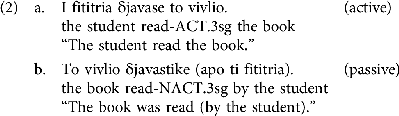
Marking voice alternations through verbal morphology appears to be a common pattern across languages. In Greek, voice involves a morphological alternation between ACT and NACT suffixation on the verb, while NACT morphology is used in a number of syntactic structures like passives, anticausatives, reflexives, and reciprocals (see among others Tsimpli, Reference Tsimpli1989, 2006; Alexiadou & Anagnostopoulou, Reference Alexiadou, Anagnostopoulou, Alexiadou, Anagnostopoulou and Everaert2004).Footnote 1 In addition to the well-known ACT/passive alternation, in our paper, we will be concerned with two more syntactic alternations. The first is between ACT (or causative) and anticausative verbs. Anticausative verbs refer to events that take place spontaneously, without the involvement of an agent or cause. In Greek, the causative/anticausative alternation is often (though not always) realized through an ACT/NACT morphological alternation as in (e.g., 3) (Alexiadou & Anagnostopoulou, Reference Alexiadou, Anagnostopoulou, Alexiadou, Anagnostopoulou and Everaert2004, Theophanopoulou-Kontou, Reference Theophanopoulou-Kontou, Pavlidou and Tzitzilis2000). In (3a), the verb zesteno (“to make warm”) appears with ACT morphology in a causative transitive context, whereas in (3b), the anticausative construction features NACT morphology on the verb.Footnote 2
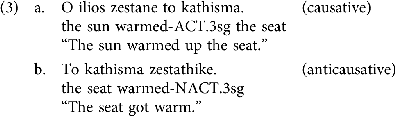
Anticausatives as in (3b) are prime examples of unaccusative syntax, where the argument in subject position was originally merged in object position. Anticausatives are structurally similar to passives in that in both cases the underlying object has moved to subject position. However, the anticausative differs crucially from the passive in terms of the number of arguments that are syntactically projected; whereas in passives (even those with no by-phrase, i.e., so-called short passives), there is evidence of an implicit external argument, and thus the valency (the number of arguments) of the transitive/ACT verb has not been affected, in the anticausative the only argument syntactically present is the surface subject. The evidence that no implicit external argument is present in anticausatives, as opposed to passives, was first discussed by Manzini (Reference Manzini1983), Roeper (Reference Roeper1987), and others. The evidence involves the inability of anticausative verbs to license agentive by-phrases, agent-oriented adverbs (like carefully or on purpose) and to control the subject of an infinitival clause (as in *The boat sank in order to collect the insurance vs. The boat was sunk in order to collect the insurance). All three differences point to the conclusion that in passives, but not in anticausatives, the external argument of the corresponding transitive/ACT verb is syntactically projected.
The second alternation that will be discussed in this paper concerns reflexive and reciprocal verbs, associated with ACT/transitive verbs.Footnote 3 Examples are given in (4) and (5), respectively.

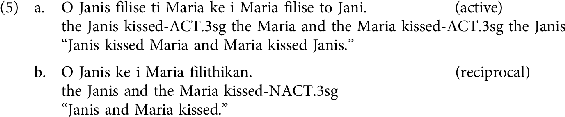
Both reflexives and reciprocals are similar to anticausatives in partaking in an alternation that reduces the valency of the verb, although there are crucial semantic (and possibly syntactic) differences. In the reflexive variant (4b), the sole argument of the verb, realized as the syntactic subject, is interpreted as both the Agent and the Patient of the verbal action. In the reciprocal variant (5b), the single argument is semantically plural, and the interpretation is that the individuals included in the plurality act upon with each in the manner designated by the verb. The ACT variants in (4a) and (5a) are transitive, that is, dyadic rather than monadic predicates.
Based on the above, it is evident that the use of NACT voice morphology in Greek is quite widespread. Also, due to its highly syncretic nature, (i.e., its occurrence in different semantic-syntactic environments), NACT verbs often yield ambiguous interpretations. Such ambiguity is possible between passive and reflexive (e.g., 6), passive and anticausative (e.g., 7), as well as passive and reciprocal (e.g., 8) readings, although in most cases, the two interpretations are not equally possible or expected.Footnote 4

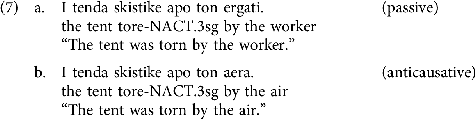

Given the high degree of syncretism of Greek NACT voice morphology, it is reasonable to ask what kind of challenge it presents to young readers. Before we see how we set about inquiring into this, we will briefly summarize existing knowledge about the acquisition and the (adult) processing of voice morphology and transitivity alternations.
Acquisition and processing of voice and transitivity alternations across languages
Studies on the production and interpretation of passive structures in early language have shown that, although these structures appear in children’s speech from the age of 3 (Budwig, Reference Budwig1990; Tomasello et al., Reference Tomasello, Brooks and Stern1998), their interpretation tends to be reliable only after the age of 5 (Maratsos et al., Reference Maratsos, Fox, Becker and Chalkley1985; de Villiers, Reference de Villiers and Slobin1985; Borer & Wexler, Reference Borer, Wexler, Roeper and Williams1987; Fox & Grodzinsky, Reference Fox and Grodzinsky1998). Several explanations have been put forward to account for the attested difficulties, some of which argue for immature A-chain formation, inappropriate thematic mapping, reduced input frequency (see Borer & Wexler, Reference Borer, Wexler, Roeper and Williams1987; Fox & Grodzinsky, Reference Fox and Grodzinsky1998; Tomasello, Reference Tomasello2003, respectively). However, while some studies have shown that full passives (including the by-phrase) are produced later than short/truncated passives (without by-phrase) (Horgan, Reference Horgan1978), full passives can be produced in appropriate discourse contexts by children as young as 3 (Crain et al., Reference Crain, Thornton and Murasugi1987). Overall, cross-linguistic studies have shown that the time of acquisition of transitivity alternations varies.
Additionally, Fox and Grodzinsky (Reference Fox and Grodzinsky1998) suggested that in early acquisition, children use heuristics to interpret full passives by assigning an agentive thematic role from the preposition by. Thus, good performance is observed in actional passives, which tend to have an agent subject, while poor performance is elicited in non-actional verb passives since the external argument is a theme. In contrast, Pinker et al. (Reference Pinker, Lebeaux and Frost1987), and Messenger et al. (Reference Messenger, Branigan, McLean and Sorace2012) report no dissociation between verb types (actional vs. non-actional), suggesting that children younger than 5 years can produce and comprehend passive structures.
In atypical populations, argument structure has also been found to cause difficulties in both production and comprehension. Several studies have confirmed that argument structure complexity does present children with SLI (Grela & Leonard, Reference Grela and Leonard2000; de Jong, Reference de Jong1999) and dyslexia with a challenge (Wilsenach, Reference Wilsenach2006; Nation et al., Reference Nation, Marshall and Altmann2003). Specifically, Nation et al. (Reference Nation, Marshall and Altmann2003) showed that poor comprehenders are able to adequately construct their initial sentence representations, but they fail to integrate, elaborate, and link new information into their developing representations of the text due to processing limitations, related to memory, difficulties in allocation of attentional resources, or difficulties suppressing irrelevant information (see also Vender, Reference Vender2017).
With respect to voice in particular, children with dyslexia or RDs often exhibit difficulties in the interpretation and production of NACT morphology (e.g., Wiseheart et al., Reference Wiseheart, Altmann, Park and Lombardino2009; Reggiani, Reference Reggiani2010; but see Stein et al. (Reference Stein, Cairns and Zurif1984), who reported that poor readers performed as well as skilled readers on both reversible and nonreversible passive sentences). Such difficulties have been associated with genuine syntactic deficits (e.g., Leikin, Reference Leikin2002) or a maturation delay (see Francis et al., Reference Francis, Shaywitz, Stuebing, Shaywitz and Fletcher1996; Stanovich et al., Reference Stanovich, Nathan and Valarossi1986 for a discussion). In the latter case, it is assumed that RDs result from a delayed acquisition of reading-related skills although poor readers follow the same developmental trajectory as typical readers. Therefore, it is predicted that, poor readers eventually will catch up to their peers.
Evidence from Greek (acquisition/processing)
With respect to the acquisition of voice in Greek, several studies have confirmed that passives are acquired late (Terzi & Wexler, Reference Terzi, Wexler and Hirotani2002; Driva & Terzi, Reference Driva, Terzi, Gavarro and Freitas2008, Marinis, Reference Marinis, Belikova, Meroni and Umeda2007; Zombolou et al., Reference Zombolou, Varlokosta, Alexiadou and Anagnostopoulou2010; Terzi et al., Reference Terzi, Marinis, Kotsopoulou and Francis2014; Andreopoulos, Reference Andreopoulos2012). Specifically, Terzi and Wexler (Reference Terzi, Wexler and Hirotani2002) showed that young typically developing (TD) children (M = 3.9) performed well in a picture verification task with adjectival passives but scored very low on verbal passives, with worse performance attested in the non-actional verbs. Similar performance was yielded in older age groups as well (till the age of 5.6). Driva and Terzi (Reference Driva, Terzi, Gavarro and Freitas2008) replicated these findings while extending the age range of the target groups (3.9–6.6), suggesting that the interpretation of passives is not mastered early in Greek (see also Zombolou et al., Reference Zombolou, Varlokosta, Alexiadou and Anagnostopoulou2010).
On the other hand, Tsimpli (Reference Tsimpli and Unsworth2006) noticed that Greek monolingual children are sensitive to voice morphology, even at the age of 3. Presuming that passives mature late, similar difficulties would be predicted for reflexive verbs since they share the same NACT morphology with passives. Tsimpli noticed that monolingual children make use of the morphological cues and related transitivity changes to guide their interpretative choices, indicating that reflexive and passive readings are available to children of preschool age. However, a number of them erroneously allowed a “non-target” passive reading in reflexive verbs. This preference decreased in the older groups of learners and became more adult-like (showing evidence of emerging verb classes), only in the early school years. These findings were confirmed by Fotiadou and Tsimpli (Reference Fotiadou2010), who showed that although passives are available early, they are not fully acquired even at the age of 6. Fotiadou and Tsimpli (Reference Fotiadou2010) additionally showed that Greek children aged 3–6 years old acquire reflexives earlier than passives, supporting an unergative analysis of reflexives (see Tsimpli, Reference Tsimpli and Unsworth2006).
In a recent study, Terzi et al. (Reference Terzi, Marinis, Kotsopoulou and Francis2014) assessed 20 children with high-functioning autism and 20 TD children (5.6–8.0 years old, M = 6.9) on the comprehension of short passive sentences and sentences with reflexive verbs with either a reflexive or passive reading, using a sentence-picture matching task. Although the TD children performed low in the interpretation of passives (70%), in the condition of reflexive verbs with a reflexive interpretation they performed at ceiling (99%). Interestingly, TD children also performed almost at ceiling in the condition of reflexive verbs with a passive reading (95%), contrary to the passive condition. These findings are also in line with Andreopoulos (Reference Andreopoulos2012), who administered the same protocol in two older groups of TD children (first graders M = 6.7 and second graders M = 7.8) and noticed that, even at the age of 7.8, Greek-speaking children are more prone to committing errors in the interpretation of passives than on reflexive verbs (even with passive reading) (see also Terzi (Reference Terzi, Grohmann, Matsuya and Remberger2021) for a relevant discussion).
Additionally, although the acquisition of the verbal passives is delayed, children do not have similar difficulties in all structures that involve NP movement. Anticausative structures with ACT morphology are unaccusatives, and although they are derivationally similar to passives (they involve NP movement), it can be assumed that they are less problematic possibly due to the fact that they lack an external argument (see Alexiadou & Anagnostopoulou, Reference Alexiadou, Anagnostopoulou, Alexiadou, Anagnostopoulou and Everaert2004 and Alexiadou et al., Reference Alexiadou, Anagnostopoulou and Schäfer2015 for proposals on the different structures of marked and unmarked anticausatives vis-à-vis passives). However, an agentivity effect was not confirmed by Zombolou et al. (Reference Zombolou, Varlokosta, Alexiadou and Anagnostopoulou2010), who showed that the presence of an agent did not make a difference for the younger children’s production of anticausative verbs with NACT morphology in Greek. According to the same authors, anticausatives are in fact acquired earlier than passives in Greek and are typically associated with the ACT and not with the NACT form in Greek.
The present study: aims, research questions, and hypotheses
The present study aims to investigate the effect of voice morphology and argument structure on sentence processing during reading by Greek-speaking children with and without RDs. Given that Greek is highly syncretic in the expression of argument structure, the present study addresses the effect of this morphological syncretism on the processing of NACT morphology.
The study aims to investigate the way in which NACT morphology affects the syntactic complexity of a sentence, given its implications for verb argument structure and its high syncretic nature in Greek. Based on the assumption that syntactic complexity significantly affects acquisition and online processing, it is expected that the morphological processing of NACT suffixation and its impact on syntactic processing will be differently affected in our experimental groups. Thus, in the present study we seek to address four main research questions:
-
(1) How do children with RDs process verbs with NACT morphology compared to Age-Matched (AM) and younger TD children?
-
(2) How do the morphosyntactic properties of NACT verbs affect the processing of passive structures in children with RDs, compared to AM and younger TD children?
-
(3) How do the morphological and lexical properties of NACT verbs (i.e., reflexive, reciprocal, and anticausative) affect the processing of sentences in children with RDs, compared to AM and younger TD children?
-
(4) Are processing patterns exhibited by the RDs group attributed to slow maturation, so that they resemble those found in younger children?
To address the above questions, the experimental design of the study includes two within-group independent variables: Verb Type (Active, Passive, Reflexive, Reciprocal and Anticausative) and Post-Verbal PP (defined differently for each verb type), each of which will be examined in combination with the variable of Group (RDs, BRs, and AM controls).
Each of the first three research questions was approached through within-group and between-group analyses, so a set of specific questions were formed for each of them. To answer research question 1 (RQ1), we first attempt to determine whether the three groups are able to successfully process NACT morphology. To address this question and test the effect of Verb Category, we first compare each group’s RTs on NACT and ACT verbs (Segment 3) and additionally, we contrast their total sentence RTs in passive, reflexive, reciprocal, anticausative to ACT structures. Successful processing of NACT morphology should lead to similar processing patterns across verb types, especially with no different RTs on passive verbs compared to ACT. Additionally, the question of whether the three groups differ on how they process NACT compared to ACT morphology is explored. This is done through testing interactions between Group and Verb Type in RTs on NACT and ACT verbs (Segment 3). Pairwise between-group comparisons will reveal specific differences among the three groups, which may reveal developmental effects (BRs vs. AM) or effects of reading difficulties (RDs vs. AM) on processing.
With respect to research question 2 (RQ2) (How do the morphosyntactic properties of NACT verbs affect the processing of passive structures in children with RDs, compared to AM and younger TD children?), the following specific questions will be explored: first, we seek to determine whether the three groups are able to successfully process passive syntax by integrating the morphosyntactic characteristics of passive verbs in the processing of the following phrase. We will address this question by testing the effects of Post-Verbal PP through comparisons of RTs on different types of PPs following passive verbs (i.e., an Agent by-phrase, a Non-agent by-phrase, or Another PP). Successful processing of a passive verb should activate a passive mental representation and lead to forming expectations about the role of the by-phrase that follows, causing differential processing of the different types of by-phrases and PPs used in the experiment (Segment 4). Additionally, the question of whether the three groups process passive structures the same way is addressed by exploring interactions between the variables of Group and Post-Verbal PP after passive verbs. Again, possible developmental differences (between BRs and AM controls) or effects of RDs on children’s ability to syntactically analyze passive structures are explored.
To explore research question 3 (RQ3) (How do the morpholexical features of NACT verbs (i.e., reflexive, reciprocal, and anticausative) affect the processing of sentences in children with RDs, compared to AM and younger TD children?), we first ask whether children are able to integrate the morpholexical features of NACT verbs in the syntactic analysis of the sentence, which will be investigated by exploring the effects of Post-Verbal PP (Segment 4) through comparisons of RTs on the PPs after reflexive, reciprocal, and anticausative verbs with those after passive ones. This question will also be addressed by analyzing the processing of prototypical and non-prototypical uses of reflexive, reciprocal, and anticausative verbs. Successful activation of the morpholexical features of the verb and integration of these features in the processing of the following segment should cause differences between PPs that lead to prototypical and non-prototypical interpretations. Additionally, the question of whether the three groups are equally able to process the lexical characteristics of NACT verbs is addressed by exploring interactions between Group and Post-Verbal PP, as well as between-group effects, both in reflexives, reciprocals, and anticausative structures as opposed to passive ones, and in prototypical versus non-prototypical uses of the verbs.
Finally, to address research question 4 (RQ4) (Are processing patterns exhibited by the RDs group attributed to slow maturation, so that they resemble those found in younger children?), comparisons between RDs and BRs will be conducted on all conditions to establish whether children with RDs encounter problems that are also found in younger children. Differential patterns between the two groups will provide evidence against the hypothesis that any sentence processing problems found in RDs should be attributed to slow maturation. In answering this question, we will attempt to combine findings from all conditions to reach an assumption on whether language representations or processing mechanisms are affected in children with RDs.
Methodology
Participants
Three groups of children participated in the present study; (a) a group of 30 students (20 males, 10 females) formally diagnosed with Reading Difficulties (RDs group), aged 11–12 years old (M = 11.4, SD: 0.8), (b) an Age-Matched group (AM control group) of 28 students without RDs (19 males, 9 females, M = 11.56, SD: 0.46), and (c) a language-matched group of 28 novice/Beginning Readers (BR group) without RDs (11 males, 17 females), aged 7–9 years old (M = 7.98, SD:1). General selection criteria for all groups included monolingual acquisition of Greek, normal vision, and absence of history of frank neurological, metabolic, or genetic impairment, chronic Otitis Media or orofacial abnormalities (e.g., cleft palate), psychological or emotional disturbance or other language, and developmental impairments.
Children with reading difficulties (RDs group) were selected for inclusion based on a formal clinical diagnosis of specific learning difficulties provided by certified speech and language pathologists, which confirmed that children faced specific difficulties with reading, decoding, and/or comprehension, with no other language or cognitive impairment. All participants were screened on a subset of cognitive assessment tasks (part of a large neuropsychological assessment tool; Economou et al., in progress),Footnote 5 which included assessment of working memory through a Digit Span Task (WAIS-III (Wechsler, Reference Wechsler1997), phonological working memory through a Non-Word Repetition Task, and language development through a Word and Sentence Repetition Task. Sentence repetition is considered to be indicative of children’s language skills and, in particular, syntactic development (see Klem et al., Reference Klem, Melby-Lervåg, Hagtvet, Lyster, Gustafsson and Hulme2015; Theodorou et al., Reference Theodorou, Kambanaros and Grohmann2017; Devescovi & Caselli, Reference Devescovi and Caselli2007; Berry-Luterman & Bar, Reference Berry-Luterman and Bar1971). Screening participants for syntactic development was considered critical for the purposes of the present study, as it aimed to investigate children’s skills of syntactic processing of complex structures.
The two groups of children with typical reading development (AM controls and BRs) were selected based on specific matching criteria; the AM control group was selected based on chronological age, so that the group mean age matched that of the RDs group mean age. The reason for recruiting an AM group was to determine differential patterns of sentence processing in children with dyslexia/RDs compared to their peers. The BRs group were initially selected based on age, to ensure that they would be less exposed to formal literacy training (which is why the term BRs was used), so that they would be more likely to have more or less equivalent reading skills to those of the RDs group. However, as more general language abilities (which go beyond reading) were targeted in the study, the BR children were matched to the children of the RDs group on their scores in the language development and memory tasks (p = .945), so that balanced language and cognitive skills were ensured. Given that language difficulties in struggling readers are often attributed to slow maturation, we decided to address that issue by recruiting a group of BRs as well, so as to compare RDs to younger children with similar language skills. Both BR and AM control children were recruited on the condition that no history of language or learning difficulties had been reported for them by a teacher or parent. The demographic and neuropsychological data of all participants are presented in Appendix A (Tables A1 and A2 respectively). With respect to the cognitive tasks, as expected, AM controls performed significantly better in the composite scores of cognitive tasks compared to both BR and RD groups (see Table A2 in the Appendix) (BR vs. controls: t(55) = –3.990; p < .001/RD vs. AM controls: t(56) = –4.179; p < .001). However, the difference between the two experimental groups was not sufficiently large to reach significance (p = .945).
Participants were recruited in the greater Ioannina and Patras area in Greece, through public primary schools that agreed to participate in the project. The study was approved by the Ethics Committee of the (Greek) Ministry of Education (Φ15/2799/24536/Δ1) and informed consents were obtained from children’s parents.
Materials and procedure
An online self-paced reading task was designed and administered to the three groups to evaluate the difficulties children encounter while processing sentences in real time. A total of 140 sentences with NACT and 70 sentences with ACT morphology were assessed, in addition to 290 filler sentences, which consisted of 180 embedded sentences, 90 sentences with discourse anaphors, and 20 sentences with deponent verbs. Fillers were used exclusively to distract participants and were not further analyzed. The experimental conditions were formed to test the variable Verb Type, comprising of 4 groups of sentences with different types of NACT verbs as surfaced in passive (PASS, 60 items), reflexive (REFL, 30 items), reciprocal (RECIPR, 20 items), and anticausative structures (ANTIC, 30 items), and 1 group of sentences with verbs in active voice (ACT, 70 items). Animate subjects were used across conditions, with the exception of anticausative structures where only inanimate subjects were used. Additionally, inanimate subjects were used in half of the passive sentences, allowing us a direct comparison with anticausative ones. Verbs were selected according to the criteria of Zombolou (Reference Zombolou2004) and the complete list of them is provided in Appendix B. In addition to the manipulation of verb type, sentences were manipulated in terms of the syntactic properties of the PP following the verb, leading to the formation of three sub-conditions in each verb type condition. This manipulation was made to enable the investigation of the syntactic implications of verbal morphology with argument structure. Specifically, to explore the processing and interpretation of the by-phrase, passive verbs were followed by three different types of PPs: an Agent by-phrase (9a), a Non-agent by-phrase (9b), or Another PP (9c). To test possible lexical effects of REFL verbsFootnote 6 on sentence structure, items in the REFL condition contained three types of PPs: the PP “by himself”, leading to the prototypical reflexive meaning (10a), an Agent by-phrase, leading to a Non-prototypical passive reading (10b), or a neutral PP with no association to a passive or a reflexive reading (10c). Similarly, structures with reciprocal and anticausative verbs contained PPs leading to the prototypical reciprocal (11a) or anticausative meaning (12a), or a passive reading (see 11b and 12b, respectively). Each sub-condition included 10 sentences.
For presentation purposes, sentences were segmented into five reading areas: Segment 1: “NP1”, Segment 2: “Intervening PP”, Segment 3: “Verb”, Segment 4: “Post-verbal PP”, and Segment 5: “Post-critical region”, as illustrated in the examples below (slashes indicate separate segments). Segments 3 and 4 were both considered critical, as they contain the core information that is relevant to processing the structures in question. Specifically, Segment 3, which presented the verb of the sentence (ACT or NACT), required processing of the lexical and morphological characteristics of the verb, while Segment 4, presenting the prepositional phrase that followed, required assigning a syntactic role to the phrase based on the requirements imposed by the argument structure of the preceding verb. The experimental conditions were matched on item length (N of characters), while verbs were additionally controlled for frequency based on the Hellenic National Corpus (ILSP, http://hnc.ilsp.gr/; Hatzigeorgiou et al., Reference Hatzigeorgiou, Gavrilidou, Piperidis, Carayannis, Papakostopoulou and Spiliotopoulou2000).Footnote 7
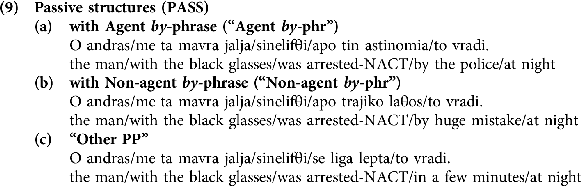
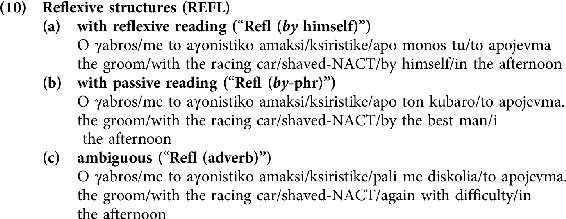

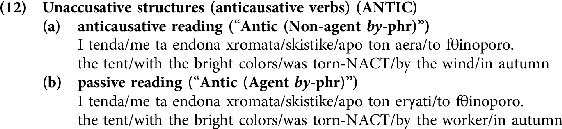

Sentences within each condition were similar but differed only in the critical regions (Segment 3 and Segment 4). Plausibility ratings were also collected to ensure sentence acceptability prior to testing. Specifically, 100 undergraduate students, aged 18–24 years old (M=18.42, SD: 2.84), were instructed to evaluate the acceptability of the stimuli in a Likert scale of 1–5, with 1 being the score for an unacceptable sentence and 5 for a fully acceptable one. Sentences with ratings that fell more than 1 SD under the mean rating per condition were modified and a second norming took place. All experimental materials were divided into four separate lists for the RD and the AM control groups using a Latin Square design, creating four different experimental sets, each containing one version of the experimental sentences (so that no sentence was viewed in two versions within the same session), while eight different lists were created for the younger group of BR, to prevent fatigue. In total, all groups of children viewed all items shown in four or eight experimental sessions. All items were randomized and presented in a set order. Participants were presented with all lists, on separate days.
All testing was done individually, in a quiet room at primary schools (e.g., headmaster’s office), with children seated at a comfortable distance from a computer screen. Initially, participants were given detailed instructions about the experiment and six practice trials were used to familiarize them with the task. The self-paced reading task was run on a laptop using E-prime 3.0 Professional software (Psychology Software Tools, Pittsburgh, PA, USA), which recorded reading/response times (RTs) at every segment and accuracy data for the post-stimulus question that followed the presentation of each sentence. All stimuli were visually presented to the participants in a centered noncumulative display, meaning that every segment appeared in the center of the display screen and only one segment was visible at a time.Footnote 8 Participants were instructed to silently read sentences phrase-by-phrase and press the Space key to display consecutive segments of text in the center of the screen. The last segment appeared with a full stop to indicate the end of the sentence. At the end of each sentence, participants were asked to answer a simple post-stimulus distractor question as quickly and as accurately as possible by choosing between two options. Participants had to press one of the two pre-specified color-coded keys: either the “A” key on the LEFT side, or the “L” key on the RIGHT side of the QWERTY keyboard. The side of each response key on the keyboard corresponded to the side of the mapped response option on the screen. Post-stimulus questions were included to ensure participants would pay attention to the presented materials.Footnote 9 For this reason, only sentences with correct responses in the post-stimulus questions were further analyzed.
Finally, all participants were given the option to take as many breaks as they needed (although no more than two breaks were ever required in practice) and were informed that they could stop the experiment at any time. Therefore, no experimental session would continue if the child felt overwhelmed or too tired. The average duration of testing was around 15 min.
Measurements and analyses
After raw data were collected, response latencies of four areas were extracted and included in the analyses for each sentence: (a) Verb (Segment 3), (b) postverbal segment (Segment 4), (c) post-critical segment (Segment 5), and (d) total reading time, which was defined as the sum of the RTs of all individual segments of the sentence. Mean RTs and standard deviations were calculated for all measurements included in the analyses. Sentences with RTs above 6000 ms or below 150 ms on individual segments were excluded as non-reliable. These outliers were in all cases fewer than 1% of the total counts of each category. Analyses were restricted to correct trials only, as trials with incorrect responses are typically indicative of attention shifts or partial processing of the sentence. Because the experiment aimed to test parsing strategies required for successful sentence comprehension (Breznitz & Leikin, Reference Breznitz and Leikin2001), instances, where an incorrect response to the post-stimulus question was selected due to attention shifts or memory limitations, were not considered informative with respect to the experimental aims. Rates of incorrect trials were low (correct responses: 16.314/19.779; 82.48%) and presumably not representative of typical sentence processing. Between-group comparisons of the excluded items rate revealed no significant differences between BRs and children with RDs (p = .11), while the two groups differed significantly from the AM controls (BRs vs. AM: p = .001; RDs vs. AM: p = .001), differences that could be attributed to lower attention span in these two groups compared to AM controls.
To test for main effects within groups, comparisons were conducted to establish the effects of Verb Type (PASS, ACT, REFL, ANTIC, RECIPR), and Post-Verbal PP (comparisons for each Verb Type separately). All within-subjects variables were tested against the variable of Group for interactions. Differences and main effects were tested for statistical significance using General Linear Models (GLM), followed by Bonferroni corrected post hoc pairwise comparisons to examine differences across groups. Statistical significance was set at p = .05 and the analysis were carried out with the use of SPSS v23.0.
Results
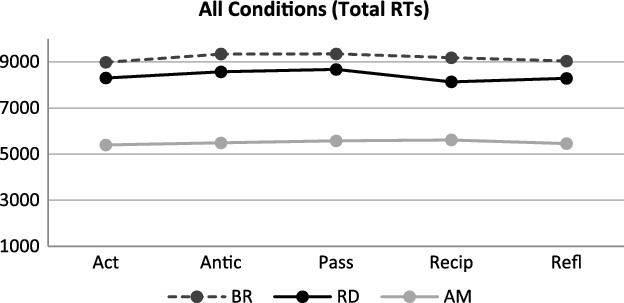
Beginning with RQ1, a presentation of the three groups’ performance in all conditions, total reading times, and RTs on the verb (Segment 3) was analyzed across verb categories and are presented in Figures 1 and 2. An overall analysis of the three groups’ total RTs revealed a main effect for Group (F(2)=812.608; p <.001), and a main effect of Verb Type (F(4)=3.411; p=.009), but no interaction between Group and Verb Type (F(8)=.575; p=.799).
Total mean RTs across sentence types and groups.
RTs on the verb (Segment 3) across sentence types and groups.
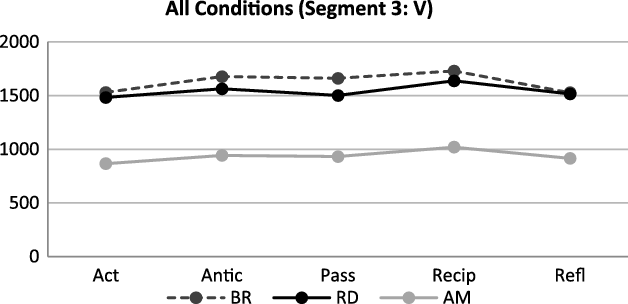
Within-group comparisons (RQ1) revealed no significant effect of Verb Type on total reading times (Figure 1) for any of the three groups (for BR: F(4)= 1.696; p =.148, for RD F(4)=2.333; p = .053; for AM: F(4)=.448; p = .774). On Segment 3 (Verb, Figure 2), analyses revealed a main effect of Verb Type (F(4)=11.873; p <.001), although no interaction was found between Group and Verb Type (F(8)=1.250; p =.265). Within-group comparisons revealed that the RD group performed significantly faster in the Active morphology category compared to Reciprocals (t(14565)=3.139; p =.017), while the BR group performed significantly faster in the Active morphology category compared to Anticausatives (t(14565)=3.471; p = .005), Passives (t(14565)=3.788; p =.002), and Reciprocals (t(14565)=34.078; p <.001). Additionally, the BR group performed significantly faster in the Reflexive category compared to Anticausatives (t(14565)=3.034; p =.024), Passives (t(14565)=3.118; p =.018), and Reciprocals (t(14565)=3.668; p =.002). Notably, the AM group showed no significant differences across categories, although they performed marginally faster in the Active morphology category compared to Reciprocals (t(14565)=3.240; p =.052). Regarding RQ1, therefore, these findings are a preliminary indication that the BR group faces difficulties with NACT morphology, compared to ACT, with the exception of reflexives, which seemed to be processed almost as fast as ACT verbs. Neither of the other two groups exhibited such effects.
Between-group analyses revealed that the RD group exhibited slower total reading times (Figure 1) compared to AM controls (F(2)=812.608; η2= .101; p <.001) but at the same time slightly faster, but still statistically significant compared to BRs (F(2)=812.608; η2= .101; p <.001). So, regarding RQ1, these findings indicate that developmental effects are present since the AM group outperformed across categories (Actives, Passives, Reflexives, Reciprocals, and Anticausatives) and exhibited faster RTs compared to both BR and RD groups (AM vs. BRs: (F(2)=812.608; η2= .101; p <.001); AM vs. RD (F(2)=812.608; η2= .101; p <.001)).
To address the second RQ2, the following paragraphs present the three groups’ performance in each category separately to investigate how our three experimental groups process structures with NACT morphology. Beginning with passive structures, Figure 3 presents RTs in Segment 3 (Verb), Segment 4 (PP), and Segment 5 (final phrase) of sentences with an Agent by-phrase, a Non-agent by-phrase, and with Other PP:

Passive constructions across groups.
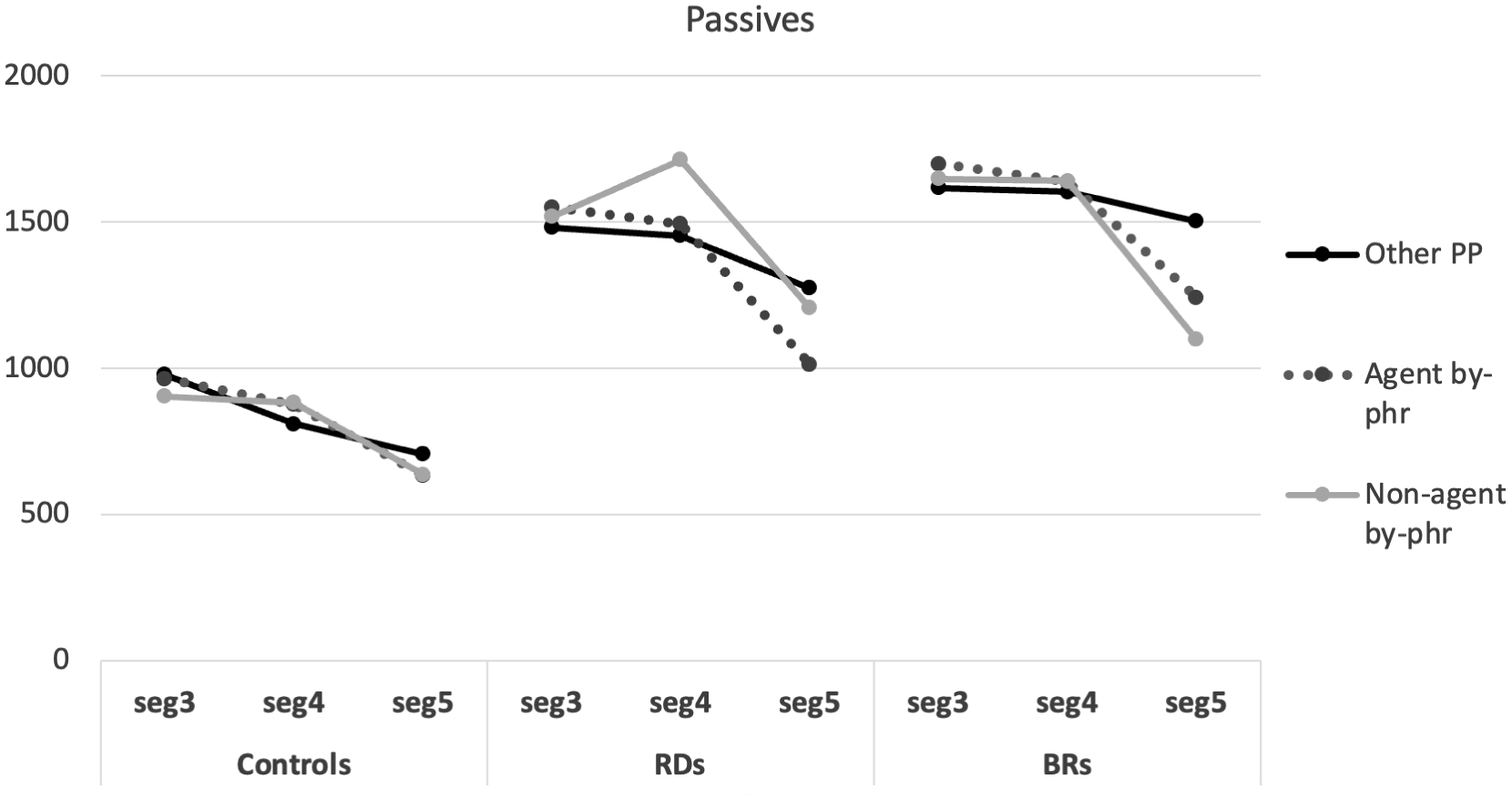
Statistical analysis of RTs on Segment 3 revealed a main effect of Group (F(2)=125.33; η2= .086; p <.001), but no effect of Category (F(2)=.787; η2= .001; p=.456) and no interaction between Group and Category (F(4)=.306; η2= .000; p=.784). Within-group analyses revealed no significant differences for any of the three groups on Segment 3 (for AMs, F(2)=.422; η2= .000; p =.656; for BRs, F(2)=.567; η2= .000; p =.567; for BRs, F(2)=.382; η2= .000; p =.682). However, between-group comparisons showed that AM controls’ RTs were faster than the other two groups, indicating more developed processing skills (AM vs. BRs: F(2)=125.33; η2= .086; p <.001 and AM vs. RDs: F(2)=125.33; η2= .086; p <.001).
On Segment 4, analysis of RTs revealed a main effect of Group (F(2)=174.33; η2= .116; p <.001). Within-group comparisons (RQ2) revealed significant differences only for RD group (F(2)=5.366; η2= .004; p =.005). The RD group were slower in the Non-agent by-phrase (Main effect of Category: F(2)=3.052; η2= .002; p =.047), compared to the other two conditions (Other PP: t(2667)=2.916; p =.11, Agent by-phr: t(2667)=2.873; p =.12), possibly revealing an expectation for an agent phrase after encountering the word by following a passive verb, leading to a processing delay and a reanalysis of the whole PP when the NP following is not an agent, similar to a garden-path effect. This indicates that the children with RDs were able to process the passive verb sufficiently enough to form syntactic expectations for the by-phrase that follows, an ability not observed in the BR group; no differences were attested among the three types of PPs in the BR group (F(2)=.118; η2= .000; p =.889). Between-group comparisons revealed that the AM controls’ RTs were faster than the other two groups, indicating more developed processing skills (AM vs. BRs: F(2) = 174.33; η2= .116; p <.001), AM vs. RDs: F(2) = 174.33; η2= .116; p <.001).
Moving to RQ3 and beginning with Reflexives, structures with reflexive verbs followed by an Agent by-phrase (passive reading) were compared to those with a phrase with reflexive meaning (by himself), or an adverb (ambiguous reading). Additionally, structures with reflexive verbs were compared to sentences with passive verbs. The results are shown in Figure 4.

Reflexive constructions across groups.
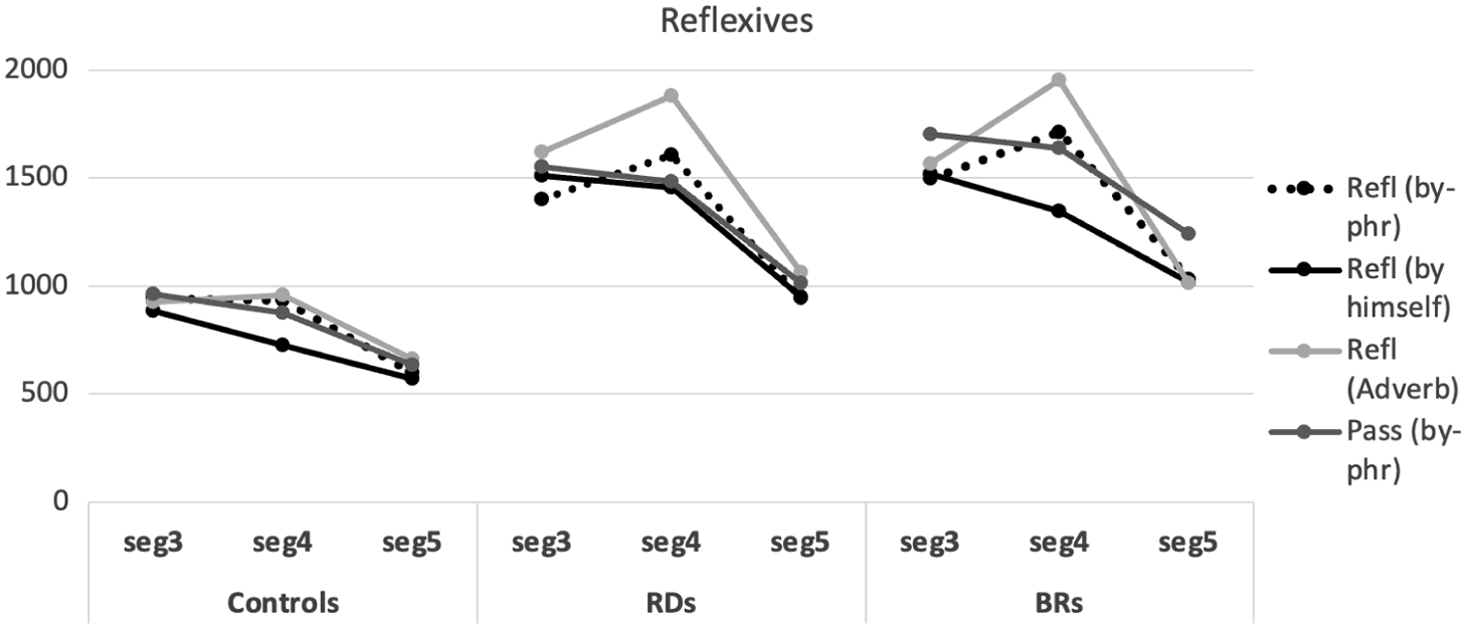
Statistical analyses of RTs on Segment 3 revealed a main effect of Group (F(2)=157.88; η2= .085; p <.001) and Category (F(3)=3.318; η2= .003; p =.019) but no interaction between Group and Verb Type (F(6)=1.297; η2= .003; p =.255). On that segment (i.e., the verb), only the BR group exhibited a significant delay on passive verbs (in the Pass by-phr. condition) compared to reflexives with by-phrase (t(3421)=2.637; p =.050). The delay could be attributed to the low frequency of the NACT form of the verbs of this category, contrary to reflexive verbs, which are more frequently encountered in their NACT form (see Fotiadou, Reference Fotiadou2010). This difference was not confirmed in either of the two older groups, suggesting that both RDs and AM controls were able to adequately process NACT morphology in both reflexive and passive verbs. Between-group comparisons revealed that in Segment 3 AM controls performed faster compared to BRs and to RDs (F(2)=157.88; η2= .085; p <.001), but no other significant between-group effects were found.
Looking at Segment 4 (PP following the V, RQ3), a main effect of Category, F(3)= 25.227; η2= .022; p <.001, and a Group*Category interaction were found, F(6)= 2.825; η2= .005; p=.010. Within-group analyses showed that the BR group was significantly faster in the prototypical reflexive condition (Refl (by himself)) compared to both conditions with a passive reading (i.e., Refl(by himself) vs. Refl (by-phr): (t(3405)=4.132; p <.001); Refl(by himself) vs. Pass(by-phr): (t(3405)=3.861; p=.001) on Segment 4. However, BRs processed the two conditions with passive reading (i.e., Pass (by-phr) and Refl (by-phr) similarly, irrespective of the verb type and contrary to the RD group, who found the Refl (by-phr) condition more difficult than the Pass (by-phr) one (in Segment 4). This suggests that children with RDs have strong expectations for a reflexive interpretation after encountering a reflexive verb, so that when a typically reflexive (i.e., self-care) verb is used as a passive (i.e., when an Agent by-phrase follows the verb), it causes significant delay, even compared to a typical passive sentence. On the other hand, BRs do not differentiate between the two structures with a passive reading but do recognize the difference with an explicitly reflexive sentence, which is significantly easier.
Both the RD and BR groups were significantly slower in the Refl (Adverb) condition compared to the other reflexive conditions (for the RD group, F(3)=10.740; η2= .009; Refl (Adverb) vs. Refl (by-phr): t(3405)=3.069; p =.013; Refl (Adverb) vs. Refl (by himself): t(3405)=4.885; p <.001; Refl (Adverb) vs. Pass (by-phr): t(3405)=5.160; p <.001; for the BR group; Refl (Adverb) vs. Refl (by-phr): t(3405)=2.685; p =.044; Refl (Adverb) vs. Refl (by himself): t(3405)=6.991; p <.001; Refl (Adverb) vs. Pass (by-phr): t(3405)=4.049; p <.001). The use of an adverb after the reflexive verb does not eliminate the passive reading of the verb, causing some kind of ambiguity, since both passive and reflexive readings are plausible. Although the reflexive is considered the “default” reading of this category of verbs (i.e., verbs of personal care are more frequently used as reflexives than passivesFootnote 10 ), this ambiguity created by the adverbial could be causing the processing delay evident on that segment in both experimental groups (RDs and BRs) and the AM controls, as the latter also seems to process the prototypical REFL (by himself) sentences significantly faster than the REFL (Adverb) ones (t(3405)=2.742; p =.037), which are processed exactly like the REFL (by-phr) in Segment 4. This pattern indicates that, although the verbs included in the reflexive category (i.e., verbs of self-care) are strongly biased toward a reflexive reading, the existence of explicit cues toward either a reflexive, or a passive reading in the sentence significantly reduces processing load. This issue is discussed further in the Discussion section. Finally, pairwise between-group comparisons revealed that the AM controls performed faster compared to BRs and to RDs (F(2)=233.79; η2= .121; p <.001), but no other significant between-group effects were attested (F(2)=233.79; η2= .121; p= .571).
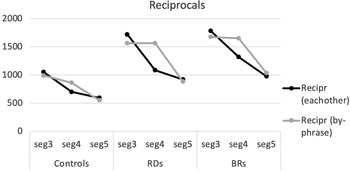
Moving to Reciprocal verbs, Figure 5 presents the three groups’ performance in sentences where reciprocal verbs are followed by an Agent by-phrase (eliciting, thus, a passive reading), or by a by-phrase with a prototypical reciprocal reading (i.e., by each other).

Reciprocal constructions across groups.
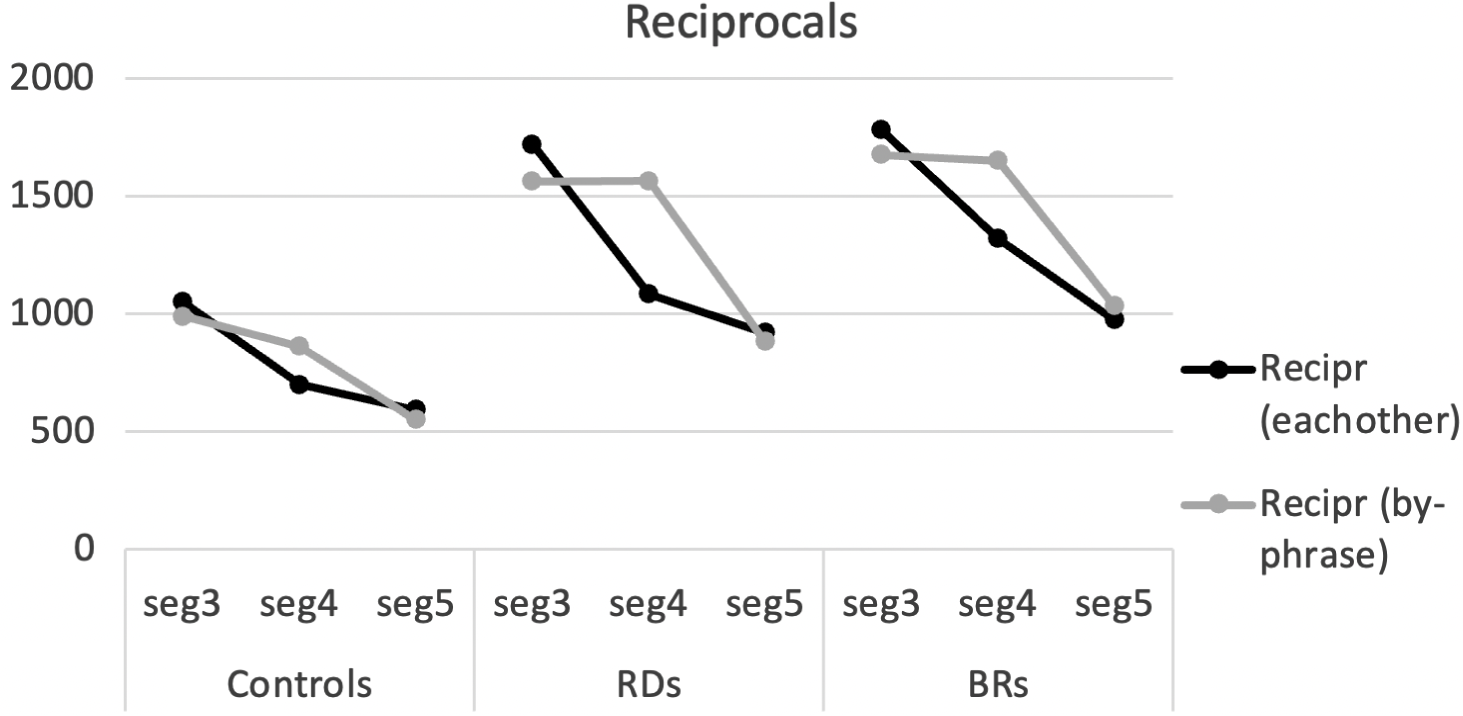
A main effect of Group (F(2)=91.027; η2= .115; p <.001) and Category (F(1)=51.582; η2= .035; p <.001), as well as a significant interaction between Group and Category was attested in Segment 4 (F(2)=4.228; η2= .006; p =.015). The AM controls performed faster compared to BRs (F(2)=91.027; η2= .115; p <.001). Within-group analyses for the two experimental groups (RDs and BRs) showed that they exhibited similar performance; both were slower in the condition with the passive reading (agent by-phrase) compared to the condition with the prototypical reciprocal meaning (with the each other phrase) (for RD group, t(1403)=6.053; p <.001, for BR group, t(1403)=4.202; p <.001). It seems, thus (regarding RQ3), that both groups were able to process the lexical and morphological properties of the verb (despite the NACT morphology) and form expectations about the following constituent, which was more difficult for them when it led to a passive reading of the verb, compared to the expected, reciprocal one. Again, the AM control group did not present any such effects, suggesting that at that age syntactic processing is so automatic that it makes very few demands on the system to differentiate between those conditions; sentence parsing is less automatic in both RDs and BRs due to constrains in processing demands.
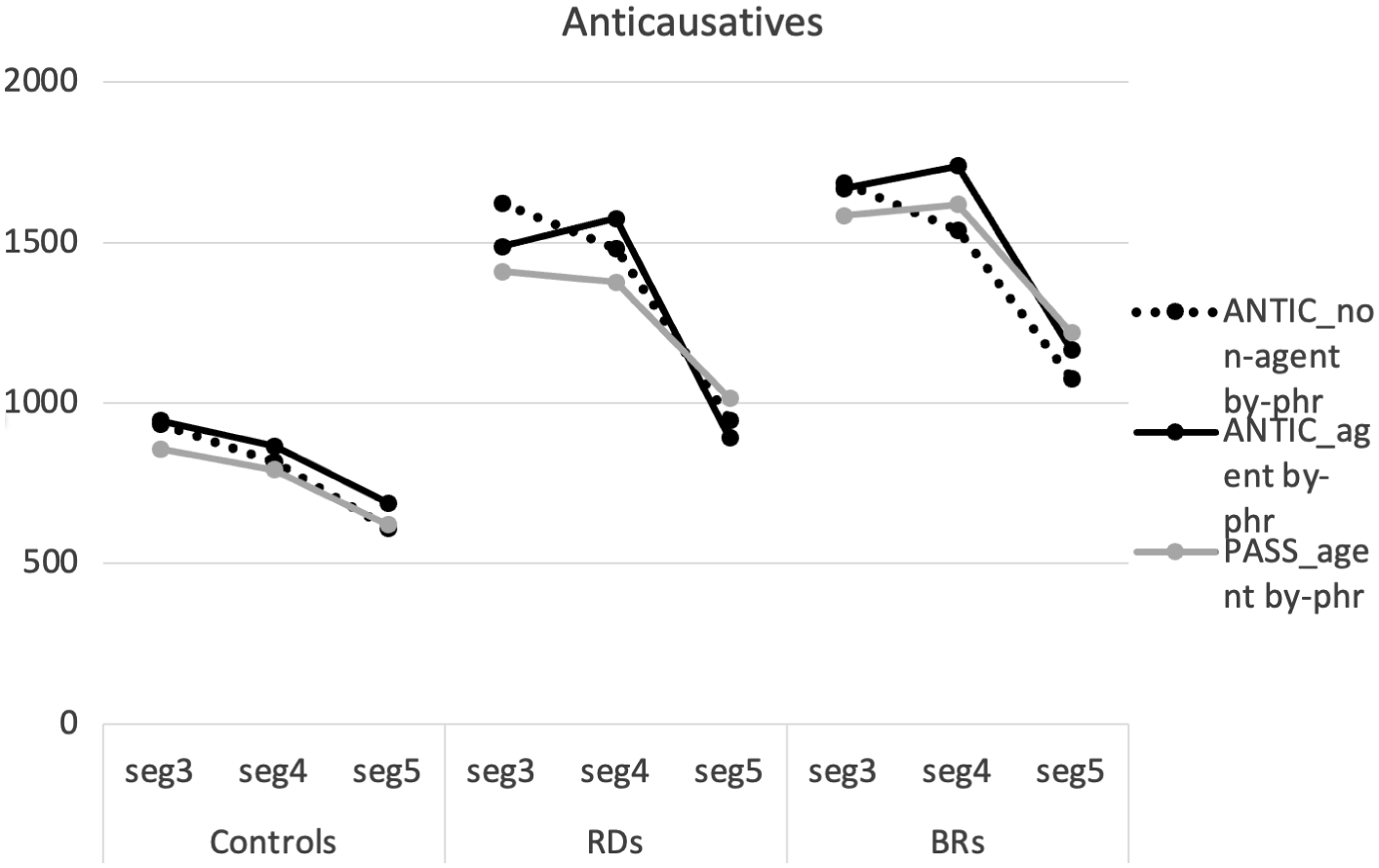
Finally, Figure 6 presents group performances in sentences where anticausative verbs are either followed by an Agent by-phrase (eliciting, thus, a passive reading), or by a Non-agent by-phrase (eliciting the prototypical anticausative reading). The results were also compared to passive verbs with an Agent by-phrase.

Both BRs and RDs groups exhibited significant effects in anticausative conditions. In Segment 3, the AM controls performed better compared to BRs (F(2)= 127.01; η2= .106; p <.001). Within-group comparisons on Segment 3 (the Verb) revealed a significant difference only for RDs between Passive and Anticausative Verbs (in the Non-agent by-phrase condition) (t(2133)=2.507; p =.037), with the passives noting faster RTs.
In Segment 4, a main effect of Group (F(2)=147.32; η2= .122; p <.001) and Category (F(1)=4.037; η2= .004; p =.018) were attested, but no interaction between Group and Category (F(2)=.904; η2= .002; p =.523) was confirmed. Specifically, in Segment 4, BRs read sentences with anticausative verbs faster in the condition with the anticausative reading (Antic(Non-agent by-phrase)) compared to the condition with the passive reading (Antic(Agent by-phrase)) (t(1432)=2.172; p=.03). No significant effects were found for the RDs or the AM control group.
Anticausative constructions across groups.
Discussion
This study was undertaken to explore the role of voice morphology and argument structure in sentence processing by Greek-speaking children with and without RDs and novice/BRs without RDs. Using a self-paced reading task, we demonstrated that the various uses of NACT morphology affect the way children with RDs and BRs process sentences, and also that the produced effects were different across the experimental groups. In the following paragraphs, we summarize the main findings and attempt an interpretation with respect to the four research questions of the study.
Beginning with the ACT/NACT alternation, contrary to the older children of the study (AM controls and RDs), younger children (7–9 years old) showed an advantage for ACT morphology; significantly faster reaction times were yielded in ACT compared to passive verbs (Segment 3), in line with previous studies suggesting that passives are acquired late (Terzi & Wexler, Reference Terzi, Wexler and Hirotani2002; Driva & Terzi, Reference Driva, Terzi, Gavarro and Freitas2008, Marinis, Reference Marinis, Belikova, Meroni and Umeda2007; Zombolou et al., Reference Zombolou, Varlokosta, Alexiadou and Anagnostopoulou2010; Terzi et al., Reference Terzi, Marinis, Kotsopoulou and Francis2014; Andreopoulos, Reference Andreopoulos2012). In fact, BRs exhibited longer reading times on all NACT categories (with the exception of reflexives) compared to ACT verbs, indicating difficulty in the processing of NACT morphology. Reflexive verbs, however, were also faster than all other NACT categories for BRs (i.e., passives, anticausatives, and reciprocals), despite their NACT morphology. This finding can probably be attributed to the very high frequency of self-care verbs with NACT morphology as reflexives, much higher in child speech compared to that of the other three categories, especially passives. This finding can also be taken to indicate that reflexive structures are processed like actives, providing support to theoretical claims that posit for a different derivation of reflexives compared to passives.Footnote 3 As for RDs and AM controls, neither group exhibited systematic effects of NACT morphology, indicating that they were both able to successfully process NACT verbs. Finally, as expected, between-group analyses revealed developmental effects in the processing of the target structures. The AM control group showed more developed processing skills compared to BRs (and RDs), since faster total reaction times were yielded across conditions (Actives, Passives, Reflexives, Reciprocals, and Anticausatives), while children with RDs were slower than AM controls, with similar reaction times with the BRs group in all syntactic structures.
Therefore, answering RQ1, the findings show that children with RDs exhibit similar skills of processing NACT verbs morphologically to those presented by their peers, while younger controls (BR) appeared to face greater difficulties with NACT compared to ACT verbs. These difficulties seemed to be compensated for by the lexical properties of reflexive verbs, which were read as fast as actives by children of the BRs group.
With respect to RQ2, which explores the ability of each group to process passive structures, children’s performance was examined in sentences with an Agent, a Non-agent by-phrase, or with Other PP in Segment 4. Children with RDs were significantly slower in Non-agent by-phrases compared to both Agent by-phrases and Other PPs, an effect we attribute to a strong expectation for an agent, which is formed when encountering the preposition apo (=by) after a passive verb, forcing children to reanalyze the segment and produce longer RTs in this condition. In the Other PP condition, on the other hand, the preposition used does not lead to any structural expectations regarding the role of the PP and does not cause reanalysis, so the PP is processed almost as fast as an Agent by-phrase. This expectation for an agent phrase shown by children with RDs indicates successful integration of the morphosyntactic properties of the passive verb in processing the following constituents. Contrary to the RDs group, BRs exhibited no difference in processing different by-phrases, indicating the lack of structural expectations for an agentive by-phrase after the passive verb, suggesting underdeveloped skills of integrating the morphosyntactic properties of passivized verbs in the structure processed. Finally, the AM control group was considerably (more than 500ms) faster than the other two groups and seemed to process all three conditions in exactly the same way, indicating more developed, automatized syntactic processing skills.
Based on the above, our data suggest that the presence of a Non-agentive by-phrase after a passive verb increases syntactic complexity compared to an agentive one (in line with Liversedge et al., Reference Liversedge, Pickering, Branigan and van Gompel1998; Thompson et al., Reference Thompson, Ferreira and Scheepers2018), which may incur processing delays to children with compromised language or processing skills. This complexity increase, however, does not impact on processing by TD children, as the data from the AM control group indicates, because their processing system is more developed and less affected by complexity. In fact, the AM controls appeared to be really fast in processing all segments of the passive sentences tested. Finally, the findings reveal a crucial difference between children with RDs and BRs; the former were sensitive to the morphosyntactic characteristics of passivized verbs and were able to build a syntactic representation of passive structures and form structural expectations, while the latter appeared to be less able to morphologically process passive verbs and use them to analyze passive syntax.Footnote 11 However, despite the fact that these findings show that children with RDs do build syntactic representations of passive sentences, the question of whether they are able to successfully process passive syntax online can be fully answered only by combining these findings with those on other NACT verbs. Therefore, RQ2 is revisited later on.
Moving to the findings that are relevant to RQ3 which addresses children’s ability to morphologically and syntactically process reflexive, reciprocal, and anticausative verbs, all groups presented effects related to the lexical properties of these verbs. Specifically, young BRs exhibited significantly faster RTs on reflexives compared to passive verbs on the verb segment (Segment 3). Although this finding cannot be directly attributed to morphological processing, as NACT morphology is used in both categories, the fact that reflexive verbs were the only NACT verbs that were processed almost as fast as ACT ones (see Figure 2) can only be attributed to the lexicalization of these verbs, due to their very high frequency, especially compared to passives. The fact that passives (along with all other NACT verb categories) were significantly slower for BRs implies the existence of an immature system of processing NACT morphology, which seems to mature by the age of the two older groups of the study (10–11 years). Notably, our data suggest that the difficulties young Greek children encounter are not limited to reflexive verbs (as discussed in the relevant literature that we cite) but are caused by all types of NACT verbs. Their immature system of processing NACT morphology affects children’s early reading abilities.
In Segment 4, where the processing of the verb argument structure is reflected, two interesting findings emerged. The first relates to the difference between the condition with a prototypical reflexive interpretation (REFL(by himself)) and the one with a non-prototypical, passive reading (REFL(by-phr)), which was significant for all three groups of the study. The youngest group (BRs) was significantly slower while processing agent by-phrases after reflexive verbs, exactly like passive verbs (PASS(by-phr) Condition), compared to the phrase “by himself” in prototypical reflexive structures, which appeared to be processed much faster. The BR group thus, consistently found passive structures difficult, regardless of the type of verb (passive or self-care, “reflexive”), revealing underdeveloped processing (or representation) of passive syntax. Note that both Andreopoulos (Reference Andreopoulos2012) and Terzi et al. (Reference Terzi, Marinis, Kotsopoulou and Francis2014) reported that TD children (5–8 years old) perform lower in the interpretation of passives, compared to their ceiling performance in the interpretation of reflexive verbs with a passive or reflexive reading (see also Terzi (Reference Terzi, Grohmann, Matsuya and Remberger2021) for similar findings). Although our data seems to contradict this finding, it is possible that the nature of the task used in those studies (i.e., offline sentence-picture matching task) may have masked the impact of a non-prototypical, passive interpretation of reflexive verbs on processing speed. Additionally, because the stimulus sentences used in Terzi et al. (Reference Terzi, Marinis, Kotsopoulou and Francis2014)’s comprehension task did not include by-phrases, it is not clear whether children processed reflexive verbs as passive, even when they selected a picture corresponding to a passive reading. As an anonymous reviewer noted, because a reflexive reading was not available in the pictures presented in the Terzi et al. (Reference Terzi, Marinis, Kotsopoulou and Francis2014) study, it is unclear which representation children used to correctly interpret reflexive verbs. For instance, the authors (p.38) claim that children do not necessarily interpret the agents of the action, that is, the persons who perform the action in the target pictures of this condition, as agents. Instead, they may consider the agents as sources, or even ignore them, despite the fact that they are present in the pictures. This argumentation is also in line with Zombolou et al. (Reference Zombolou, Varlokosta, Alexiadou and Anagnostopoulou2010) and Driva and Terzi (Reference Driva, Terzi, Gavarro and Freitas2008), who have shown that the presence of an agent does not make a difference in children’s performance in the production of anticausative verbs or in the comprehension of short versus long passives respectively. In fact, we could equally assume that at this early stage children of the BR group disregard agents, which is also supported by their processing patterns of PPs after passive verbs (Figure 3), suggesting underdeveloped processing (or representation) of passive syntax.
The RDs group, on the other hand, found passive structures with reflexive verbs (i.e., REFL(by-phr)) significantly harder than both typical reflexive (i.e., REFL(by himself) and typical passive ones (i.e., PASS(by-phr)), which could be attributed to an expectation built for a reflexive reading of self-care verbs and reanalysis when an Agent by-phrase is encountered. In other words, the non-prototypical use of reflexive verbs in passive structures increases the complexity of the sentence, which impacts on processing for children with RDs so much that they find passive structures with reflexive verbs even harder than typical passive ones. In fact, the increased complexity of the non-prototypical use of reflexive verbs as passive affects children with RDs more intensely than AM controls, who also show a prototypicality effect but process the two passive conditions (i.e., REFL(by-phr) and PASS(by-phr)) similarly.
The second finding that emerged in the processing of the argument structure of reflexive verbs involves the way structures with no explicit cues toward a reflexive or a passive reading were processed. Specifically, it was found that the condition with an adverb following the reflexive verb yielded slower reaction times compared to the prototypical reflexive condition (REFL(by himself)) by all three groups of the study. Note that the use of an adverb after the reflexive verb does not eliminate a passive reading, and although self-care verbs are lexically biased (when in NACT form) toward a reflexive reading, and thus not really ambiguous, the present findings indicate that both passive and reflexive readings are equally plausible. It, therefore, seems that both interpretations (reflexive and passive) are active during processing: one owed to the lexical, the other to the morphological features (i.e., NACT suffixation) of the verb.
Similar findings were obtained in structures with reciprocal and anticausative verbs. The experimental groups seem to exploit lexical knowledge of the argument structure of verbs to process sentences. Just like in reflexive verbs, both RDs and BRs were faster in prototypically reciprocal meaning (V + each other), compared to the passive reading condition (i.e., V + agent by-phrase), contrary to the AM control group who did not present similar effects. Likewise, both groups read sentences with anticausative verbs faster in prototypically anticausative structures (ANTIC(Non-agent by-phrase)) compared to sentences with a passive reading (ANTIC (Agent by-phrase)). This finding is in line with earlier findings reported by Zombolou et al. (Reference Zombolou, Varlokosta, Alexiadou and Anagnostopoulou2010), who showed that anticausatives are acquired earlier than passives in Greek and are typically associated with the ACT and not with the NACT form in Greek. Given that the AM control group did not exhibit similar performance, we claim that at the age of 11–12, syntactic processing has become more automatic and makes very few demands on the system to differentiate between those conditions; sentence parsing is less automatic in both RDs and BRs due to processing constraints.
Revisiting RQ2 about RDs children’s ability to process passive syntax, a combination of the findings from passive structures with patterns found in other verbs with NACT morphology leads to a more complete picture. We showed that these children were able to form syntactic representations of passive structures, which caused garden-path effects on Non-agent by-phrases following passive verbs. However, the fact that RDs children were slower in processing agent by-phrases in typical passive structures compared to Post-Verbal PPs in typical reflexive, reciprocal, and anticausative ones is an indication that passive structures are a greater challenge for them than they are for AM controls. This means that children with RDs had greater difficulty with the syntactic analysis of typical passive structures compared to typical reflexive, reciprocal, and anticausative ones, a difficulty that was manifested in slower processing of agent by-phrases, rather than in inability to process these structures (as was shown in BRs). In that sense, although children with RDs seem to maintain syntactic representations of passives, their processing mechanism of accessing these representations appears to be less automatic and more vulnerable to syntactic complexity.
With respect to RQ3, based on the findings presented, all groups appeared to be significantly affected by the lexical properties of NACT verbs (although in some more than others) when processing the following constituent. The lexical effect of reflexive verbs, in particular, was evident even in the AM controls’ data (which otherwise showed no evidence for any of the effects explored in this study), indicating that self-care verbs are strongly lexically biased toward a reflexive interpretation, possibly due to the high frequency of these verbs in such structures. Additionally, the two other groups seemed to use the lexical properties of these verbs to compensate for the difficulties each of them faces; BRs were able to alleviate their difficulties with morphologically processing of NACT verbs, as their fast processing of reflexives indicates, while both RDs and BRs were able to mitigate difficulties in processing the syntax of NACT verbs as indicated by their processing of typical reflexive, reciprocal and anticausative structures faster than passive ones.
Answering RQ4 about the attested problems in children with RDs and whether their difficulties are attributed to slow maturation, our findings do not provide any indication that the processing or syntactic skills (or maturity) of the RDs group are similar or equivalent to those of younger controls (BR). On the contrary, the RDs children were found to have more developed morphological and syntactic processing skills as well as representations, since RDs were able to successfully process NACT morphology and were guided by its morphosyntactic properties when analyzing the following PP, which was not the case for BRs unless the verb provided lexical cues for the analysis of the structure. Therefore, developmental differences appeared to be present between the RDs and the BRs groups, despite the fact that the two groups were matched on general language and cognitive ability. This indicates that the specific difficulties encountered by children with RDs in sentence processing or comprehension cannot be attributed to a maturation language delay.
Finally, regarding the nature of the difficulties faced by children with RDs and whether they stem from a representational or a processing deficit, we showed that the RDs group was able to process NACT morphology, form syntactic expectations based on the properties of NACT verbs, and process the following structure (PP) based on these properties. However, we also showed that they still have difficulties that relate to the syntactic processing of Post-Verbal PPs in passive contexts (i.e., agentive by-phrases) compared to other uses of NACT verbs that are lexically defined as non-passive, so syntactic processing is not spared. They were slower in typical passives compared to typical reflexives, reciprocals, and anticausatives in Segment 4, which shows that the same structure is more accessible to them when the verb contains lexical characteristics that aid the processing of the PP compared to when the structure is typically passive. In other words, passive syntax was more demanding for them compared to non-passive ones (i.e., reflexive, reciprocal, etc.). However, this difficulty caused slower processing rather than an inability to process the structure, as their expectations for agents showed. Therefore, we argue that syntactic representations are intact in the children’s grammar but the mechanism of accessing these representations is affected and more vulnerable to syntactic complexity. In other words, we argue for processing, rather than representation problems in RDs.
The present findings provide an interesting insight into the sentence processing skills of children with RDs, compared to TD children. Contrary to recent studies suggesting that children with RDs exhibit immature performance similar to that of younger controls (BR) in the interpretation of passive structures (Reggiani, Reference Reggiani2010), our findings suggest that these children have developed lexical, morphological, and syntactic representations similar to their peers but are more prone to be affected by processing complexity. The complexity factors that were found to affect RD performance in this study mainly relate to structural ambiguity (see reflexive verbs), as well as the extent to which a given structure matches the syntactic predictions formed by the parser, based on the prototypical argument structure of the verb, as this is defined by its lexical or morphosyntactic characteristics. Children with reading difficulties were strongly guided by these predictions and were significantly delayed when these predictions were not applicable to the sentences presented.
One could reasonably claim that the reported differences in performance might be associated with differences in the development of cognitive abilities. In fact, several studies have supported the idea that syntactic representations are not vulnerable in children with RDs, but their implementation is hindered by working memory limitations (Robertson & Joanisse, Reference Robertson and Joanisse2010; Gottardo et al., Reference Gottardo, Stanovich and Siegel1996). However, the two experimental groups of our study overlapped in performance on measures of neuropsychological testing (including a Digit Span, a Memory Span Task, a Sentence Repetition Task, and a Non-Word Repetition Task) and resembled AM controls’ performance. Therefore, we claim that verbal working memory limitations are not at the root of the RDs or core syntactic difficulties presented by children with dyslexia or reading disorders (contra Robertson & Joanisse, Reference Robertson and Joanisse2010, among others); the differences we observed between the two experimental groups are independent of limitations in memory resources. Instead, our findings point toward a general processing difficulty in RDs rather than syntactic knowledge limitations.
Conclusions
The present study demonstrated the susceptibility to NACT morphology of children with RDs and young BRs in sentence processing. In line with previous studies, our data show that BRs experience greater processing delays when processing NACT structures, indicating that they have not yet fully grasped the morphosyntactic properties of NACT suffixation. However, our results are not in line with the growing amount of evidence pointing to morphosyntactic deficits of individuals with RDs, since we demonstrated that children with RDs are sensitive to the morphological distinctions of verbs, as well as to their syntactic and lexical properties, showing (a) evidence that the language processor successfully engages in prediction based on these properties and (b) preference for default/prototypical readings. The data presented here also point toward the assumption that children with RDs retain intact morphological and syntactic representations of structures that involve NACT verbs (i.e., passive, reflexive, reciprocal, and anticausative) but their processing mechanism is weak and vulnerable to increased syntactic complexity. Finally, the attested patterns appear to be independent of working memory skills, since they do not appear to be affected by working memory, neither can they be attributed to slow maturation.
Acknowledgments
The work reported here is part of a larger, multi-site project that has received funding from the European Union’s Horizon 2020 research and innovation program under grant agreement No. 731724. The authors would like to thank all the participants and their families. Additionally, we thank George Dimakopoulos for his assistance and guidance on the statistical analysis. Lastly, we are grateful to four anonymous reviewers for their constructive comments, which helped us improve the quality of this paper. An earlier version of this work has been presented at the Experimental Psycholinguistic conference, June 26–28, 2019, Palma de Mallorca and at the 14 th International conference of Greek Linguistics (ICGL14), September 6–8, 2019, Patras, Greece.
Appendix A. Participants: Demographic and neuropsychological information
Participants’ demographic data

Participant’s neuropsychological data
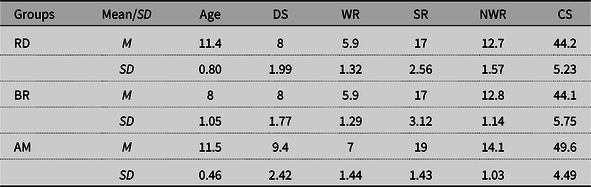
Notes: RDs, Reading Difficulties; AM, Age-Matched Group; BRs, Beginning Readers; DS, Digit Span; WR, Word Repetition; SR, Sentence Repetition; NWR, Non-Word Repetition; CS, Composite Score.
Appendix B. Verbs included in experimental items
Passives: aγorastike (was bought), anakinoθike (was announced), apoliθike (was fired), γraftike (was written), δimosieftike (was published), δiavastike (was read), ekδoθike (was published), ekfoniθike (was spoken), edopistike (was detected), eksetastike (examined), metaferθike (was moved), metafrastike (was translated), paraδoθike (was delivered), puliθike (was sold), sinelifθi (was arrested), timoriθike (was punished), ipoγrafike (was signed), hrimatoδotiθike (was funded), hrisimopiiθike (was used).
Reflexives: kureftike (had a haircut), lustike (was washed), mudzuroθike (was smudged), diθike (was dressed), ksiristike (was shaved), pliθike (was washed), skepastike (was covered), skupistike (was wiped), htenistike (was combed), ziγistike (was weighed).
Reciprocals: aγapiθikan (loved/were loved), agaljastikan (hugged/were hugged), vristikan (belched/were belched), γarγaliθikan (tickled/were tickled), katavrehtikan (splashed/were splashed), kitahtikan (looked at each other), buγeloθikan (they were buzzed), pjastikan (caught/were caught), filiθikan (kissed/were kissed), htipiθikan (hit/were hit).
Anticausatives: anapoδoγiristike (was turned around), gkremistike (was shattered), erimoθike (was desolated), skistike (was torn), zestaθike (was warmed up), katastrafike (was destroyed), leroθike (was soiled), potistike (was watered), tsalakoθike (was crumpled), fotistike (was illuminated).




 Open access

