

Introduction
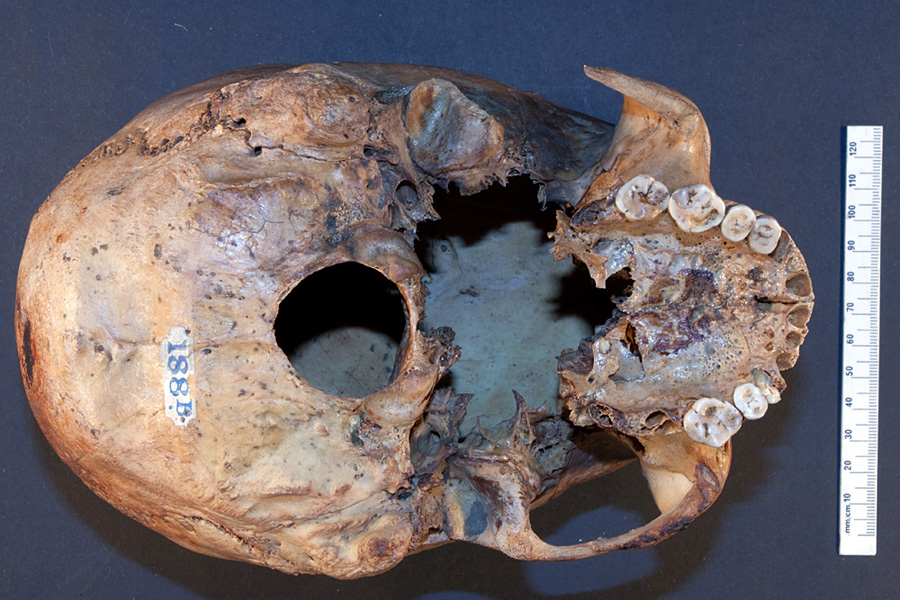
A rare example of a nasopharyngeal carcinoma (NHM PA HR 9591). The cancer has caused considerable destruction to the base of the skull (© Natural History Museum, London 2011. All rights reserved).

When the first Archaeological Survey of Nubia (ASN) began in 1907 it was one of the largest palaeopathological projects to have ever been undertaken. Some 7500 bodies were excavated from a 140km stretch of the Nile between Aswan and Wadi es-Sebua, allowing an assessment of the pathologies suffered by the people of Lower Nubia for the first time (Smith & Jones 1910). Although such projects have become more common, the ASN remains one of the most important in terms of both its size and the artefacts uncovered. A team of anatomists led by Sir Grafton Elliot Smith completed detailed studies of the bodies excavated for the first year, but were unable to maintain this for the subsequent three years of the survey. Consequently, although a palaeoepidemiological evaluation of the region over a 5000-year period was intended, this was never finished and the survey's conclusions went unpublished.
In contrast to many excavations of the time, the best-preserved human and animal remains were retained for future study; many of the human remains were brought to the UK by Grafton Elliot Smith, forming several dedicated collections. The Royal College of Surgeons in London received the most important collection, a group comprising human skeletal material and mummified remains showing the range of pathologies found. Other collections were produced to demonstrate the anatomical variation seen in skeletal material from the region. A number of rare pathological examples (e.g. Figure 1) found during the ASN's excavations have been the subject of considerable interest from palaeopathologists over the last century (e.g. Brothwell & Sandison 1967). Despite this interest, the survey itself and the remaining portion of human osteological material were left in relative anonymity.
A new approach to an old collection
The importance of older palaeopathological collections, such as the ASN collection, has long been recognised given that many come from cemeteries that are no longer accessible or are in areas that are not conducive to research for various reasons. The recent controversies related to the retention and study of human remains in many countries, including the UK and Egypt, has also had an impact, causing researchers to refocus on earlier, more accessible collections. The importance of the first ASN is likely to be recognised more clearly in the future for two reasons: as a comparative collection for the new excavations being undertaken in Sudan and as an almost unique series of burials from a region that occupies an important geographical position on the boundary between Egypt and Nubia. The centenary of the survey's completion, therefore, seems an appropriate occasion to re-evaluate the collection, raise awareness of its significance, and in so doing help ensure its continued survival.
Since the formation of the ASN collections, the material has become increasingly dispersed as collections were subdivided or transferred to other institutions, increasing the likelihood of artefacts becoming separated from their original provenance (Reference Molleson, Davies and WalkerMolleson 1993). For example, the bombing of the Royal College of Surgeons in 1941 led to the destruction of a significant part of their collection and damage to much of the rest (Reference DobsonDobson 1963). The UK was not the only repository for the human remains from the ASN collection; material is also known to reside in Egypt, the USA and Australia. The current project intends to locate the various collections of ASN material and draw them back together to recreate a 'virtual' collection. Using archival records, published reports, articles, and the known collections as a starting point, the project hopes to discover what happened to the ASN material following excavation and how much is now available to researchers. In addition, attempts will be made to reassign the provenance of specimens that have become removed from their original records. A new palaeopathological survey of the collection will also be conducted.
The Archaeological Survey of Nubia's database of human remains
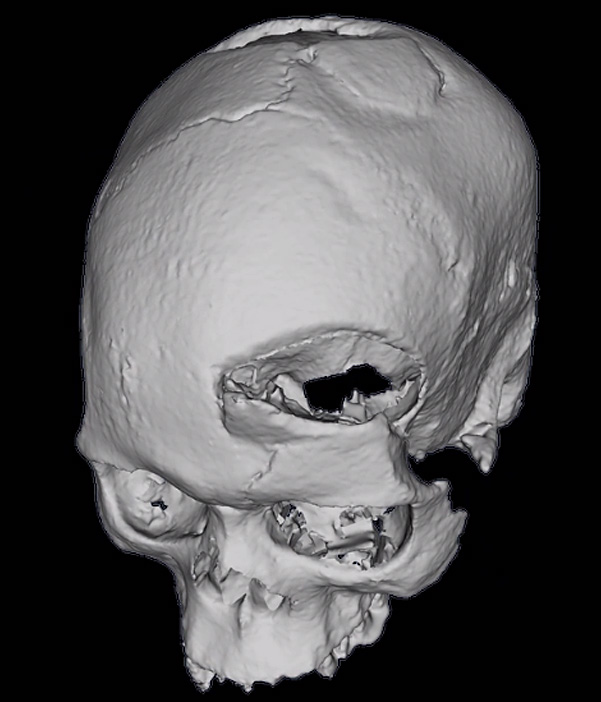
An online database has been set up recreate the Archaeological Survey of Nubia human remains collection, using information obtained on the surviving available material: see http://www.knhcentre.manchester.ac.uk/research/nubiaproject/database.aspx. This database, which is continually updated, will include information on the available ASN human remains in their current state. Descriptions of each body or skeletal component together with any available contextual information, details of current location and a full bibliography are included. The database also records any research undertaken on each body, allowing others to use the data in the future. The results of studies including imaging techniques (e.g. Figure 2), analytical techniques and osteological assessment will all be made available online.
A morphometric laser scan of a male skull demonstrating both blunt and sharp force trauma from cemetery 92 at Aman Duad (NHM PA HR 9575) (© Natural History Museum, London 2011. All rights reserved).

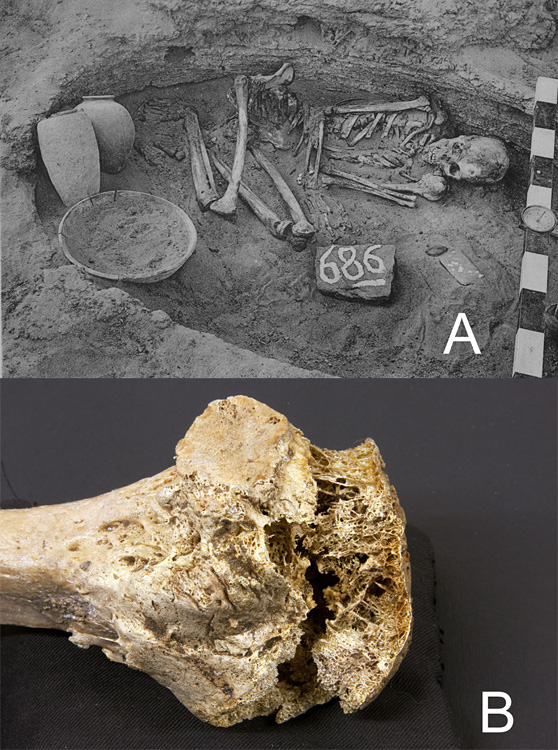
An A-group male found with a benign giant cell tumour of the humerus (cemetery 89, Koshtamna). A) The tumour is clearly visible upon excavation (Firth 1912, Plate 21d). B) The left humerus and scapula are now in the Natural History Museum, London (NHM PA HR 9512) (© Natural History Museum, London 2011. All rights reserved).

As well as providing a method to help preserve the collection, this database provides access to an important collection for researchers unable to visit the repositories and to the general public who are increasingly interested in such work. The ability to produce full contextual records for the majority of bodies also increases the part the collection can play in palaeoepidemiological studies of the area. This has been made possible by the considerable amount of information preserved in the published excavation records for this survey (e.g. Figure 3) — a testament to the dedication of the original archaeologists and anatomists who worked on the collection. It is hoped that the project will allow their valuable contribution to palaeopathology to be recognised, and that it will now be possible for future researchers to continue the project started a century ago.
Acknowledgments
The authors would like to express their gratitude to The Wellcome Trust for supporting this research [WT090575MA]. Special thanks are due to Rob Kruszynski at the Natural History Museum, London for his continued help and support throughout the project.