





For a coherent
${\mathcal D}_X$
 -module
${\mathcal M}$
-module
${\mathcal M}$
 on a complex manifold X, its singular support
$SS{\mathcal M}$
on a complex manifold X, its singular support
$SS{\mathcal M}$
 is defined as a closed conical subset of the cotangent bundle [Reference Sato, Kawai and Kashiwara10], [Reference Hotta, Takeuchi and Tanisaki7]. Inspired by the analogy between
${\mathcal D}_X$
is defined as a closed conical subset of the cotangent bundle [Reference Sato, Kawai and Kashiwara10], [Reference Hotta, Takeuchi and Tanisaki7]. Inspired by the analogy between
${\mathcal D}_X$
 -modules on complex manifolds and étale sheaves on algebraic varieties, Beilinson proved that every constructible sheaf
${\mathcal F}$
-modules on complex manifolds and étale sheaves on algebraic varieties, Beilinson proved that every constructible sheaf
${\mathcal F}$
 on a smooth scheme X over a field has a singular support
$SS{\mathcal F}$
on a smooth scheme X over a field has a singular support
$SS{\mathcal F}$
 and that its irreducible components have the same dimension as X in [Reference Beilinson3]. This means that constructible sheaves are holonomic as the title of his article says although he did not explicitly define the holonomicity.
Following his construction, we introduce the holonomicity for étale sheaves, without assuming a priori that they are constructible. We prove conversely that holonomic sheaves are in fact constructible. One may consider this as an étale analogue of a theorem of Kashiwara [Reference Kashiwara9] asserting that for a holonomic
${\mathcal D}_X$
 -module
${\mathcal M}$
-module
${\mathcal M}$
 on a complex manifold X, the
${\mathbb C}_X$
on a complex manifold X, the
${\mathbb C}_X$
 -module
${\mathcal E}\mathit {xt}^i_X({\mathcal M},{\mathcal O}_X)$
-module
${\mathcal E}\mathit {xt}^i_X({\mathcal M},{\mathcal O}_X)$
 is constructible for every i, which is an important ingredient of the Riemann–Hilbert correspondence. We expect a similar notion of holonomicity for étale sheaves on rigid varieties could be defined and would give a good substitute for the deficient notion of constructibility in this context.
The contents of the sections are summarized as follows. In the brief Section 1, we recall the fact that a closed conical subset of a vector bundle is determined by its base and its projectivization. In Sections 2 and 3, we study two properties of morphisms relative to a closed conical subset C of the cotangent bundle, largely following [Reference Beilinson3]. The notion of C-transversality applies when C is a subset for the target of a morphism
$h\colon W \to X$
 , while C-acyclicity applies when C is a subset for the source of a morphism
$f\colon X \to Y$
, while C-acyclicity applies when C is a subset for the source of a morphism
$f\colon X \to Y$
 . Both notions enter the definition of the micro support of a sheaf
${\mathcal F}$
. Both notions enter the definition of the micro support of a sheaf
${\mathcal F}$
 ; in [Reference Beilinson3], they are both referred to as transversality. In Section 4, we extend the definition of micro support given in [Reference Beilinson3] to sheaves that are not necessarily constructible; in [Reference Beilinson3], constructibility is assumed. In Section 5, we prove the existence of the singular support of
${\mathcal F}$
; in [Reference Beilinson3], they are both referred to as transversality. In Section 4, we extend the definition of micro support given in [Reference Beilinson3] to sheaves that are not necessarily constructible; in [Reference Beilinson3], constructibility is assumed. In Section 5, we prove the existence of the singular support of
${\mathcal F}$
 , defined as the smallest closed conical subset on which
${\mathcal F}$
, defined as the smallest closed conical subset on which
${\mathcal F}$
 is micro supported, without assuming constructibility. The proof follows that of [Reference Beilinson3] and relies on the Radon transform. Finally, in Section 6, we prove the main result: if
$\dim SS{\mathcal F} \leqq \dim X$
is micro supported, without assuming constructibility. The proof follows that of [Reference Beilinson3] and relies on the Radon transform. Finally, in Section 6, we prove the main result: if
$\dim SS{\mathcal F} \leqq \dim X$
 and if every fibre of
${\mathcal F}$
and if every fibre of
${\mathcal F}$
 is constructible, then
${\mathcal F}$
is constructible, then
${\mathcal F}$
 itself is constructible. The proof proceeds by induction on
$\dim X$
itself is constructible. The proof proceeds by induction on
$\dim X$
 and ultimately reduces to the fact that a sheaf micro supported on the zero section is locally constant.
The authors thank Tong Zhou for, after an earlier version of this article, asking if the singular support exists without the constructibility assumption and the anonymous referee for suggesting removing the perfectness assumption in an earlier version. This work was done during the second author’s stay at IHES in September 2024. He thanks the first author and the institute for the hospitality. The work was partially supported by Kakenhi 24K06683.
1 Closed conical subsets
Definition 1.1. Let X be a scheme and V be a vector bundle on X. We say that a closed subset C of V is conical if it is stable under the action of the multiplicative group
${\mathbf G}_m$
 .
.
The intersection B of a closed conical subset C with the
$0$
 -section, regarded as a closed subset of X, is called the base of C. The projectivization
${\mathbf P}(C) \subset {\mathbf P}(V)$
-section, regarded as a closed subset of X, is called the base of C. The projectivization
${\mathbf P}(C) \subset {\mathbf P}(V)$
 is defined to be the image of the complement
 by the canonical projection
 from the complement of the
$0$
from the complement of the
$0$
 -section.
Lemma 1.2. Let X be a scheme and C be a closed conical subset of a vector bundle V on X.
1. C equals the union of the base B and the inverse image of the projectivization
${\mathbf P}(C)$
 by
by
 .
.
2.
$U=\{x\in X\mid C_x=\varnothing \} \subset U'=\{x\in X\mid C_x\subset \{0\}\}$
 are open subsets of X.
Proof. 1. Since C is conical,
 equals the inverse image of
${\mathbf P}(C)$
equals the inverse image of
${\mathbf P}(C)$
 .
.
2. U is the complement of B and
$U'$
 is the complement of the image of
${\mathbf P}(C)$
is the complement of the image of
${\mathbf P}(C)$
 by the projection
${\mathbf P}(V)\to X$
by the projection
${\mathbf P}(V)\to X$
 .
.
2 C-transversality
Let k be a field and X a smooth scheme over k. The covariant vector bundle
$T^*X$
 associated to the locally free
${\mathcal O}_X$
associated to the locally free
${\mathcal O}_X$
 -module
$\Omega ^1_{X/k}$
-module
$\Omega ^1_{X/k}$
 is called the cotangent bundle of X. For a smooth subscheme Z of X, the conormal bundle
$T^*_ZX$
is called the cotangent bundle of X. For a smooth subscheme Z of X, the conormal bundle
$T^*_ZX$
 associated to the conormal sheaf
$N_{Z/X}$
associated to the conormal sheaf
$N_{Z/X}$
 is canonically identified with
$\mathrm {Ker}(T^*X\times _XZ \to T^*Z)$
is canonically identified with
$\mathrm {Ker}(T^*X\times _XZ \to T^*Z)$
 . In particular for
$Z=X$
. In particular for
$Z=X$
 , the
$0$
, the
$0$
 -section of
$T^*X$
-section of
$T^*X$
 is denoted by
$T^*_XX$
is denoted by
$T^*_XX$
 .
.
Lemma 2.1. Let X be a smooth scheme over k. Let
$C\subset T^*X$
 be a closed conical subset satisfying
$\dim C\leqq \dim X$
be a closed conical subset satisfying
$\dim C\leqq \dim X$
 . Then there exists a dense open scheme
$U\subset X$
. Then there exists a dense open scheme
$U\subset X$
 such that the restriction
$C_U$
such that the restriction
$C_U$
 is a subset of the
$0$
is a subset of the
$0$
 -section
$T^*_UU$
-section
$T^*_UU$
 .
.
Proof. Since
$\dim C\leqq \dim X$
 , the projectivization
${\mathbf P}(C)$
, the projectivization
${\mathbf P}(C)$
 has dimension strictly less than
$\dim X$
has dimension strictly less than
$\dim X$
 . Hence it follows from Lemma 1.2.
Definition 2.2 [Reference Beilinson3, 1.2]
Let
$h\colon W\to X$
 be a morphism of smooth schemes over a field k and C be a closed conical subset of the cotangent bundle
$T^*X$
be a morphism of smooth schemes over a field k and C be a closed conical subset of the cotangent bundle
$T^*X$
 .
.
1. Let w be a point of W. We say that h is C-transversal at w, if the intersection of the inverse image
$C_w\subset T^*X\times _Xw$
 of C with the kernel
$\mathrm {Ker}(T^*X\times _Xw \to T^*W\times _Ww)$
of C with the kernel
$\mathrm {Ker}(T^*X\times _Xw \to T^*W\times _Ww)$
 inside
$T^*X\times _Xw$
inside
$T^*X\times _Xw$
 is a subset
$\{0\}$
is a subset
$\{0\}$
 .
.
2. We say that h is C-transversal if h is C-transversal at every point of W.
The condition that h is C-transversal means that the intersection of the inverse image
$h^*C\subset T^*X\times _XW$
 of C with the kernel
$\mathrm {Ker}(T^*X\times _XW \to T^*W)$
of C with the kernel
$\mathrm {Ker}(T^*X\times _XW \to T^*W)$
 inside
$T^*X\times _XW$
inside
$T^*X\times _XW$
 is a subset of the
$0$
is a subset of the
$0$
 -section.
Lemma 2.3. Let
$h\colon W\to X$
 be a morphism of smooth schemes over a field k and C be a closed conical subset of the cotangent bundle
$T^*X$
be a morphism of smooth schemes over a field k and C be a closed conical subset of the cotangent bundle
$T^*X$
 .
.
1. [Reference Beilinson3, Example 1.2 (i)] h is smooth if and only if h is
$T^*X$
 -transversal.
2. If C is a subset of the
$0$
 -section, then h is C-transversal.
3. If
$C'$
 is a closed conical subset of
$T^*X$
is a closed conical subset of
$T^*X$
 containing C as a subset and if h is
$C'$
containing C as a subset and if h is
$C'$
 -transversal, then h is C-transversal. Consequently, if h is smooth, then h is C-transversal.
4. [Reference Beilinson3, Lemma 1.2 (i)] The subset
$\{w\in W\mid h$
 is C-transversal at
$w\}$
is C-transversal at
$w\}$
 is an open subset of W.
5. Let
$Z\subset X$
 be a closed subscheme smooth over k and assume that C is the conormal bundle
$T^*_ZX\subset T^*X$
be a closed subscheme smooth over k and assume that C is the conormal bundle
$T^*_ZX\subset T^*X$
 . Then the following conditions are equivalent:
(1) h is C-transversal.
(2)
$V=Z\times _XW$
 is smooth over k and the codimension of the immersion
$V\to W$
is smooth over k and the codimension of the immersion
$V\to W$
 equals that of
$Z\to X$
equals that of
$Z\to X$
 .
.
Proof. 1. h is
$T^*X$
 -transversal if and only if
$W\times _XT^*X\to T^*W$
-transversal if and only if
$W\times _XT^*X\to T^*W$
 is an injection. This means that
$h^*\Omega ^1_{X/k}\to \Omega ^1_{W/k}$
is an injection. This means that
$h^*\Omega ^1_{X/k}\to \Omega ^1_{W/k}$
 is a locally split injection.
2. and 3. Clear from the definition and 1.
4. It suffices to apply Lemma 1.2.2 to the closed conical subset
$h^*C\cap \mathrm {Ker}(W\times _XT^*X \to T^*W))$
 of
$W\times _XT^*X$
of
$W\times _XT^*X$
 .
.
5. Condition (1) means that
$T^*_ZX\times _XW\to T^*W$
 is an injection. In other words,
${\mathcal N}_{Z/X}\otimes _{{\mathcal O}_Z} {\mathcal O}_V$
is an injection. In other words,
${\mathcal N}_{Z/X}\otimes _{{\mathcal O}_Z} {\mathcal O}_V$
 is locally a direct summand of
$\Omega ^1_{W/k} \otimes _{{\mathcal O}_W}{\mathcal O}_V$
is locally a direct summand of
$\Omega ^1_{W/k} \otimes _{{\mathcal O}_W}{\mathcal O}_V$
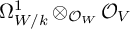 . This is equivalent to condition (2).
In the next lemma, we regard the closed subset
$h^*C$
 as a closed subscheme.
Lemma 2.4 [Reference Beilinson3, Lemma 1.2 (ii)]
Let
$h\colon W\to X$
 be a morphism of smooth schemes over k and let
$C\subset T^*X$
be a morphism of smooth schemes over k and let
$C\subset T^*X$
 be a closed conical subset. Assume that
$h\colon W\to X$
be a closed conical subset. Assume that
$h\colon W\to X$
 is C-transversal. Then,
$W\times _XT^*X \to T^*W$
is C-transversal. Then,
$W\times _XT^*X \to T^*W$
 is finite on
$h^*C$
is finite on
$h^*C$
 .
.
Under the assumption in Lemma 2.4, we define a closed conical subset
$h^\circ C\subset T^*W$
 to be the image of
$h^*C$
to be the image of
$h^*C$
 . Recall that
$h^*C$
. Recall that
$h^*C$
 is the inverse image of
$C\subset T^*X$
is the inverse image of
$C\subset T^*X$
 by
$T^*X\times _XW\to T^*X$
by
$T^*X\times _XW\to T^*X$
 .
.
Lemma 2.5. Let
$g\colon U\to X$
 be a morphism of smooth schemes over k and let
$C\subset T^*X$
be a morphism of smooth schemes over k and let
$C\subset T^*X$
 be a closed conical subset. Assume that g is C-transversal. Then for a morphism
$h\colon W\to U$
be a closed conical subset. Assume that g is C-transversal. Then for a morphism
$h\colon W\to U$
 of smooth schemes over k, the following conditions are equivalent:
(1)
$g\circ h$
 is C-transversal.
(2) h is
$g^\circ C$
 -transversal.
Proof. We consider the composition
$(g\circ h)^*C \subset T^*X\times _XW \to T^*U\times _UW \to T^*W$
 . The assumption implies that the intersection
$(g\circ h)^*C \cap \mathrm {Ker}( T^*X\times _XW \to T^*U\times _UW)$
. The assumption implies that the intersection
$(g\circ h)^*C \cap \mathrm {Ker}( T^*X\times _XW \to T^*U\times _UW)$
 is a subset of the 0-section. Since
$h^*(g^\circ C) \subset T^*U\times _UW$
is a subset of the 0-section. Since
$h^*(g^\circ C) \subset T^*U\times _UW$
 is the image of
$(g\circ h)^*C$
is the image of
$(g\circ h)^*C$
 , the intersection
$(g\circ h)^*C \cap \mathrm {Ker}( T^*X\times _XW \to T^*W)$
, the intersection
$(g\circ h)^*C \cap \mathrm {Ker}( T^*X\times _XW \to T^*W)$
 is a subset of the 0-section if and only
$h^*(g^\circ C) \cap \mathrm {Ker}( T^*U\times _UW \to T^*W)$
is a subset of the 0-section if and only
$h^*(g^\circ C) \cap \mathrm {Ker}( T^*U\times _UW \to T^*W)$
 is a subset of the 0-section.
Definition 2.6. Let
$g\colon X'\to X$
 be a morphism of smooth schemes over k.
1. Let
$C'\subset T^*X'$
 be a closed conical subset and let
$B'\subset X'$
be a closed conical subset and let
$B'\subset X'$
 be the base of
$C'$
be the base of
$C'$
 . We say that g is proper on
$B'$
. We say that g is proper on
$B'$
 if the restriction of g on
$B'$
if the restriction of g on
$B'$
 regarded as a closed subscheme of
$X'$
regarded as a closed subscheme of
$X'$
 is proper.
Assume that g is proper on
$B'$
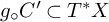
 . We define a closed conical subset
$g_\circ C'\subset T^*X$
. We define a closed conical subset
$g_\circ C'\subset T^*X$
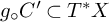 to be the image by
$X'\times _XT^*X\to T^*X$
to be the image by
$X'\times _XT^*X\to T^*X$
 of the inverse image of
$C'$
of the inverse image of
$C'$
 by the canonical morphism
$X'\times _XT^*X \to T^*X'$
by the canonical morphism
$X'\times _XT^*X \to T^*X'$
 .
.
2. Let
$h\colon W\to X$
 be a morphism of smooth schemes over k and
$V'\subset V=X'\times W$
be a morphism of smooth schemes over k and
$V'\subset V=X'\times W$
 be an open subscheme. We say that h and g are transversal on
$V'$
be an open subscheme. We say that h and g are transversal on
$V'$
 if
$V'$
if
$V'$
 is smooth over k and if the morphism
${\mathcal O}_W\otimes _{{\mathcal O}_X}^L {\mathcal O}_Z \to {\mathcal O}_V$
is smooth over k and if the morphism
${\mathcal O}_W\otimes _{{\mathcal O}_X}^L {\mathcal O}_Z \to {\mathcal O}_V$
 is an isomorphism on
$V'$
is an isomorphism on
$V'$
 .
.
If
$i\colon Z\to X$
 is a closed immersion of smooth schemes over k and if
$C\subset T^*Z$
is a closed immersion of smooth schemes over k and if
$C\subset T^*Z$
 is a closed conical subset, then
$i_\circ C\subset T^*X$
is a closed conical subset, then
$i_\circ C\subset T^*X$
 is the inverse image of C by the canonical surjection
$T^*X|_Z\to T^*Z$
is the inverse image of C by the canonical surjection
$T^*X|_Z\to T^*Z$
 regarded as a subset of
$T^*X$
regarded as a subset of
$T^*X$
 . Condition (2) in Lemma 2.3.5 means that the morphism
$h\colon W\to X$
. Condition (2) in Lemma 2.3.5 means that the morphism
$h\colon W\to X$
 is transversal to the immersion
$i\colon Z\to X$
is transversal to the immersion
$i\colon Z\to X$
 .
.
Lemma 2.7. Let
$g\colon X'\to X$
 be a morphism of smooth schemes over k and let
$C'\subset T^*X'$
be a morphism of smooth schemes over k and let
$C'\subset T^*X'$
 be a closed conical subset. Assume that g is proper on the base
$B'\subset X'$
be a closed conical subset. Assume that g is proper on the base
$B'\subset X'$
 of
$C'$
of
$C'$
 and define
$C=g_\circ C'$
and define
$C=g_\circ C'$
 . Let
$h\colon W\to X$
. Let
$h\colon W\to X$
 be a morphism of smooth schemes over k. Assume that h is
$g_\circ C'$
be a morphism of smooth schemes over k. Assume that h is
$g_\circ C'$
 -transversal.
1. There exists an open neighbourhood
$V' \subset V= X' \times _XW$
 of the inverse image
$\mathrm {pr}_1^{-1}(B')$
of the inverse image
$\mathrm {pr}_1^{-1}(B')$
 such that g and h are transversal on
$V'$
such that g and h are transversal on
$V'$
 .
.
2. Let
$V'\subset V$
 be an open subset as in 1. Then, the restriction of the projection
$h'\colon V'\to X'$
be an open subset as in 1. Then, the restriction of the projection
$h'\colon V'\to X'$
 is
$C'$
is
$C'$
 -transversal and
$h^\circ g_\circ C'$
-transversal and
$h^\circ g_\circ C'$
 equals
$g^{\prime }_\circ h^{\prime \circ } C'$
equals
$g^{\prime }_\circ h^{\prime \circ } C'$
 for
$g'\colon V'\to W$
for
$g'\colon V'\to W$
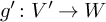 .
.
Proof. 1. By decomposing h into
$W\to X\times W\to X$
 , it suffices to consider the case where h is an immersion by Lemma 2.5. Since the immersion
$h\colon W\to X$
, it suffices to consider the case where h is an immersion by Lemma 2.5. Since the immersion
$h\colon W\to X$
 is
$g_\circ C'$
is
$g_\circ C'$
 -transversal, the intersection
$\mathrm {Ker}(T^*X\times _XX'\to T^*X')\times _{X'}V \cap \mathrm {Ker}(T^*X\times _XW\to T^*W) \times _WV$
-transversal, the intersection
$\mathrm {Ker}(T^*X\times _XX'\to T^*X')\times _{X'}V \cap \mathrm {Ker}(T^*X\times _XW\to T^*W) \times _WV$
 is a subset of the 0-section on a neighbourhood
$V'$
is a subset of the 0-section on a neighbourhood
$V'$
 of
$ \mathrm {pr}_1^{-1}(B')\subset V$
of
$ \mathrm {pr}_1^{-1}(B')\subset V$
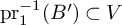 . Namely, the restriction of
$(T^*X\times _XX'\to T^*X')\times _{X'}V'$
. Namely, the restriction of
$(T^*X\times _XX'\to T^*X')\times _{X'}V'$
 on
$\mathrm {Ker}(T^*X\times _XW\to T^*W) \times _WV'$
on
$\mathrm {Ker}(T^*X\times _XW\to T^*W) \times _WV'$
 is a locally split injection and the assertion follows.
2. Similarly as in the proof of 1, we may assume that
$h\colon W\to X$
 is an immersion. Then, further, we have a commutative diagram

of exact sequences where the left vertical arrow is an isomorphism. Hence the C-transversality of h implies the
$C'$
 -transversality of
$h'\colon V'\to X'$
-transversality of
$h'\colon V'\to X'$
 and the equality
${h^\circ g_\circ C' =g^{\prime }_\circ h^{\prime \circ } C'}$
and the equality
${h^\circ g_\circ C' =g^{\prime }_\circ h^{\prime \circ } C'}$
 follows.
Lemma 2.8. Let X be a smooth scheme over a field k and let
$W\subset Z\subset X$
 be closed subschemes smooth over k. Let
$s\colon T^*Z\to T^*X|_Z$
be closed subschemes smooth over k. Let
$s\colon T^*Z\to T^*X|_Z$
 be a linear section of the canonical surjection
$T^*X|_Z\to T^*Z$
be a linear section of the canonical surjection
$T^*X|_Z\to T^*Z$
 .
.
1. Locally on a neighbourhood of
$W\subset X$
 , there exists a closed subscheme
$V\subset X$
, there exists a closed subscheme
$V\subset X$
 smooth over k such that
$W\to Z\times _XV$
smooth over k such that
$W\to Z\times _XV$
 is an isomorphism,
$\mathrm {codim}_XV= \mathrm {codim}_ZW$
is an isomorphism,
$\mathrm {codim}_XV= \mathrm {codim}_ZW$
 and
$T^*_VX|_W\subset T^*X|_W$
and
$T^*_VX|_W\subset T^*X|_W$
 equals the image
$s(T^*_WZ)$
equals the image
$s(T^*_WZ)$
 by the section s.
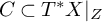
2. Let
$C\subset T^*X|_Z$
 be a closed conical subset. Let
$h\colon W\to Z$
be a closed conical subset. Let
$h\colon W\to Z$
 be the closed immersion and let
$h'\colon V\to X$
be the closed immersion and let
$h'\colon V\to X$
 be a closed immersion as in 1. If h is
$s^{-1}(C)$
be a closed immersion as in 1. If h is
$s^{-1}(C)$
 -transversal, then
$h'$
-transversal, then
$h'$
 is C-transversal on a neighbourhood of the image of W.
Proof. 1. Let
${\mathcal I}\subset {\mathcal O}_Z$
 and
${\mathcal J}\subset {\mathcal O}_X$
and
${\mathcal J}\subset {\mathcal O}_X$
 be the ideal sheaves defining
$W\subset Z$
be the ideal sheaves defining
$W\subset Z$
 and
$W\subset X$
and
$W\subset X$
 . Then the section
$s\colon T^*Z\to T^*X|_Z$
. Then the section
$s\colon T^*Z\to T^*X|_Z$
 induces a section
$T^*_WZ\to T^*_WX$
induces a section
$T^*_WZ\to T^*_WX$
 on sub vector bundles, namely
${\mathcal I}/{\mathcal I}^2 \to {\mathcal J}/{\mathcal J}^2$
on sub vector bundles, namely
${\mathcal I}/{\mathcal I}^2 \to {\mathcal J}/{\mathcal J}^2$
 . Locally on W, we take a basis of
$s({\mathcal I}/{\mathcal I}^2) \subset {\mathcal J}/{\mathcal J}^2$
. Locally on W, we take a basis of
$s({\mathcal I}/{\mathcal I}^2) \subset {\mathcal J}/{\mathcal J}^2$
 . By taking its lifting to
${\mathcal J}$
. By taking its lifting to
${\mathcal J}$
 , we define a closed subscheme
$V\subset X$
, we define a closed subscheme
$V\subset X$
 . Then, for the conormal sheaf, we have an isomorphism
${\mathcal N}_{V/X}\otimes _{{\mathcal O}_V} {\mathcal O}_W\to {\mathcal N}_{W/Z}$
. Then, for the conormal sheaf, we have an isomorphism
${\mathcal N}_{V/X}\otimes _{{\mathcal O}_V} {\mathcal O}_W\to {\mathcal N}_{W/Z}$
 . Hence after shrinking V if necessary, V is smooth over k and
$\mathrm {codim}_XV= \mathrm {codim}_ZW$
. Hence after shrinking V if necessary, V is smooth over k and
$\mathrm {codim}_XV= \mathrm {codim}_ZW$
 . The isomorphism
${\mathcal N}_{V/X}\otimes _{{\mathcal O}_V} {\mathcal O}_W\to {\mathcal N}_{W/Z}$
. The isomorphism
${\mathcal N}_{V/X}\otimes _{{\mathcal O}_V} {\mathcal O}_W\to {\mathcal N}_{W/Z}$
 means the equality
$T^*_VX|_W=s(T^*_WZ)$
means the equality
$T^*_VX|_W=s(T^*_WZ)$
 .
.
2. Since
$V\cap Z=W$
 , the equality
$T^*_VX|_W=s(T^*_WZ)$
, the equality
$T^*_VX|_W=s(T^*_WZ)$
 implies that the section s induces a bijection
$s^{-1}(C)\cap \mathrm {Ker}(T^*Z|_W\to T^*W) \to C\cap \mathrm {Ker}(T^*X|_V\to T^*V)$
implies that the section s induces a bijection
$s^{-1}(C)\cap \mathrm {Ker}(T^*Z|_W\to T^*W) \to C\cap \mathrm {Ker}(T^*X|_V\to T^*V)$
 .
.
3 C-acyclicity
Definition 3.1 [Reference Beilinson3, 1.2]
Let X be a smooth scheme over a field k and C be a closed conical subset of the cotangent bundle
$T^*X$
 .
.
1. We say that a morphism
$f\colon X\to Y$
 of smooth schemes over k is C-acyclic if the inverse image of C by the canonical morphism
$X\times _YT^*Y\to T^*X$
of smooth schemes over k is C-acyclic if the inverse image of C by the canonical morphism
$X\times _YT^*Y\to T^*X$
 is a subset of the
$0$
is a subset of the
$0$
 -section.
2. Let
$h\colon W\to X$
 and
$f\colon W\to Y$
and
$f\colon W\to Y$
 be morphisms of smooth schemes over k. We say that
$(h,f)$
be morphisms of smooth schemes over k. We say that
$(h,f)$
 is C-acyclic if
$h\colon W\to X$
is C-acyclic if
$h\colon W\to X$
 is C-transversal and if
$f\colon W\to Y$
is C-transversal and if
$f\colon W\to Y$
 is
$h^\circ C$
is
$h^\circ C$
 -acyclic.
We say that
$(h,f)$
 is universally C-acyclic over k if for every morphism
$g\colon Y'\to Y$
is universally C-acyclic over k if for every morphism
$g\colon Y'\to Y$
 of smooth schemes over k and for the commutative diagram

with cartesian square, there exists a neighbourhood
$U'\subset W'$
 of the inverse image
$h^{\prime -1}(B)$
of the inverse image
$h^{\prime -1}(B)$
 of the base B of C such that g is transversal to f on
$U'$
of the base B of C such that g is transversal to f on
$U'$
 and the pair
$(h',f')$
and the pair
$(h',f')$
 is C-acyclic on
$U'$
is C-acyclic on
$U'$
 .
.
To avoid using the same terminology for different notions, we modified Beilinson’s original terminology in [Reference Beilinson3].
Lemma 3.2. Let X be a smooth scheme over a field k and C be a closed conical subset of
$T^*X$
 .
.
1. Let
$h\colon W\to X$
 and
$f\colon W\to Y$
and
$f\colon W\to Y$
 be morphisms of smooth schemes over k. We identify
$T^*(X\times Y)$
be morphisms of smooth schemes over k. We identify
$T^*(X\times Y)$
 with
$T^*X\times T^*Y$
with
$T^*X\times T^*Y$
 and regard
$C\times T^*Y$
and regard
$C\times T^*Y$
 as a closed conical subset of
$T^*(X\times Y)$
as a closed conical subset of
$T^*(X\times Y)$
 . Then, the following conditions are equivalent:
(1) The pair
$(h,f)$
 is C-acyclic.
(2) The morphism
$(h,f)\colon W\to X\times Y$
 is
$C\times T^*Y$
is
$C\times T^*Y$
 -transversal.
If these equivalent conditions are satisfied, then the morphism
$f\colon W\to Y$
 is smooth on a neighbourhood of
$h^{-1}(B)$
is smooth on a neighbourhood of
$h^{-1}(B)$
 .
.
2. Let
$f\colon X\to Y$
 be a morphism of smooth schemes over k and assume that C is the
$0$
be a morphism of smooth schemes over k and assume that C is the
$0$
 -section
$T^*_XX$
-section
$T^*_XX$
 . Then
$f\colon X\to Y$
. Then
$f\colon X\to Y$
 is C-acyclic if and only if f is smooth.
Proof. 1. (1)
$\Rightarrow $
 (2): Let
$(a,b)$
(2): Let
$(a,b)$
 be a point of the intersection
$\bigl (h^*C\times _W (T^*Y\times _YW)\bigr ) \cap \mathrm {Ker}((T^*X\times _XW)\times _W (T^*Y\times _YW) \to T^*W)$
be a point of the intersection
$\bigl (h^*C\times _W (T^*Y\times _YW)\bigr ) \cap \mathrm {Ker}((T^*X\times _XW)\times _W (T^*Y\times _YW) \to T^*W)$
 . Then,
$b\in T^*Y\times _YW$
. Then,
$b\in T^*Y\times _YW$
 is in the inverse image of
$-dh(a)\in h^\circ C$
is in the inverse image of
$-dh(a)\in h^\circ C$
 and the
$h^\circ C$
and the
$h^\circ C$
 -acyclicity of f implies that
$b=0$
-acyclicity of f implies that
$b=0$
 . Further the C-transversality of h implies
$a=0$
. Further the C-transversality of h implies
$a=0$
 .
.
(2)
$\Rightarrow $
 (1): Since the injection
$T^*X\times _XW \to (T^*X\times _XW)\times _W (T^*Y\times _YW)$
(1): Since the injection
$T^*X\times _XW \to (T^*X\times _XW)\times _W (T^*Y\times _YW)$
 to the first factor maps
$h^*C \cap \mathrm {Ker}(T^*X\times _XW \to T^*W)$
to the first factor maps
$h^*C \cap \mathrm {Ker}(T^*X\times _XW \to T^*W)$
 to
$\bigl (h^*C\times _W (T^*Y\times _YW)\bigr ) \cap \mathrm {Ker}((T^*X\times _XW)\times _W (T^*Y\times _YW) \to T^*W)$
to
$\bigl (h^*C\times _W (T^*Y\times _YW)\bigr ) \cap \mathrm {Ker}((T^*X\times _XW)\times _W (T^*Y\times _YW) \to T^*W)$
 , the
$C\times T^*Y$
, the
$C\times T^*Y$
 -transversality of
$(h,f)$
-transversality of
$(h,f)$
 implies the C-transversality of h. If
$b\in T^*Y\times _YW$
implies the C-transversality of h. If
$b\in T^*Y\times _YW$
 is in the inverse image of
$dh(a)\in h^\circ C$
is in the inverse image of
$dh(a)\in h^\circ C$
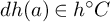 for
$a\in h^* C$
for
$a\in h^* C$
 , then
$(-a,b)$
, then
$(-a,b)$
 is contained in
$\bigl (h^*C\times _W (T^*Y\times _YW)\bigr ) \cap \mathrm {Ker}((T^*X\times _YW)\times _W (T^*Y\times _YW) \to T^*W)$
is contained in
$\bigl (h^*C\times _W (T^*Y\times _YW)\bigr ) \cap \mathrm {Ker}((T^*X\times _YW)\times _W (T^*Y\times _YW) \to T^*W)$
 and is
$0$
and is
$0$
 .
.
If
$f\colon W\to Y$
 is
$h^\circ C$
is
$h^\circ C$
 -acyclic, then
$\mathrm {Ker}(W\times _YT^*Y\to T^*W)|_{h^{-1}(B)}$
-acyclic, then
$\mathrm {Ker}(W\times _YT^*Y\to T^*W)|_{h^{-1}(B)}$
 is a subset of the
$0$
is a subset of the
$0$
 -section.
2. The morphism f is
$T^*_XX$
 -acyclic if and only if f is
$T^*Y$
-acyclic if and only if f is
$T^*Y$
 -transversal. Hence the assertion follows from Lemma 2.3.1.
Lemma 3.3. Let
$h\colon W\to X$
 and
$f\colon W\to Y$
and
$f\colon W\to Y$
 be morphisms of smooth schemes over k and C be a closed conical subset of
$T^*X$
be morphisms of smooth schemes over k and C be a closed conical subset of
$T^*X$
 .
.
1. [Reference Beilinson3, Example 1.2 (i)] The following conditions are equivalent:
(1)
$(h,f)$
 is
$T^*_XX$
is
$T^*_XX$
 -acyclic.
(2)
$f\colon W\to Y$
 is smooth.
2. [Reference Beilinson3, Example 1.2 (ii)] The following conditions are equivalent:
(1)
$(h,f)$
 is
$T^*X$
is
$T^*X$
 -acyclic.
(2)
$(h,f)\colon W\to X\times Y$
 is smooth.
Proof. 1. Since h is
$T^*_XX$
 -transversal by Lemma 2.3.2 and
$h^\circ T^*_XX=T^*_WW$
-transversal by Lemma 2.3.2 and
$h^\circ T^*_XX=T^*_WW$
 , condition (1) means that
$f\colon W\to Y$
, condition (1) means that
$f\colon W\to Y$
 is
$T^*_WW$
is
$T^*_WW$
 -acyclic. This is equivalent to (2) by Lemma 3.2.2.
2. By Lemma 3.2.1, condition (1) means that
$(h,f)\colon W\to X\times Y$
 is
$T^*X\times T^*Y$
is
$T^*X\times T^*Y$
 -transversal. This is equivalent to (2) by Lemma 2.3.1.
Lemma 3.4. Let
$g\colon U\to X$
 be a smooth morphism of smooth schemes over k and let
$C\subset T^*X$
be a smooth morphism of smooth schemes over k and let
$C\subset T^*X$
 be a closed conical subset. Let
$g^\circ C$
be a closed conical subset. Let
$g^\circ C$
 be as defined before Lemma 2.5. Then for a pair of morphisms
$h\colon W\to U$
be as defined before Lemma 2.5. Then for a pair of morphisms
$h\colon W\to U$
 and
$f\colon W\to Y$
and
$f\colon W\to Y$
 of smooth schemes over k, the following conditions are equivalent:
(1)
$(g\circ h,f)$
 is C-acyclic.
(2)
$(h,f)$
 is
$g^\circ C$
is
$g^\circ C$
 -acyclic.
Proof. By Lemma 3.2.1, the conditions are equivalent to the conditions: (1)
${(g\times 1_Y)\circ (h,f)}$
 is
$C\times T^*Y$
is
$C\times T^*Y$
 -transversal, and (2)
$(h,f)$
-transversal, and (2)
$(h,f)$
 is
$(g\times 1_Y)^\circ (C\times T^*Y)$
is
$(g\times 1_Y)^\circ (C\times T^*Y)$
 -transversal, respectively. Hence they are equivalent by Lemma 2.5.
Lemma 3.5. Let
$g\colon X'\to X$
 be a morphism of smooth schemes over k and let
$C'\subset T^*X'$
be a morphism of smooth schemes over k and let
$C'\subset T^*X'$
 be a closed conical subset. Assume that g is proper on the base
$B'\subset X'$
be a closed conical subset. Assume that g is proper on the base
$B'\subset X'$
 of
$C'$
of
$C'$
 and define
$g_\circ C'$
and define
$g_\circ C'$
 as in Definition 2.6. Let
$f\colon X\to Y$
as in Definition 2.6. Let
$f\colon X\to Y$
 be a morphism of smooth schemes over k. Then, the following conditions are equivalent:
(1) f is
$g_\circ C'$
 -acyclic.
(2)
$f\circ g$
 is
$C'$
is
$C'$
 -acyclic.
Proof. Since
$g_\circ C'\subset T^*X$
 is defined as the image of the inverse image of
$C'$
is defined as the image of the inverse image of
$C'$
 by
$T^*X\times _XX'\to T^*X'$
by
$T^*X\times _XX'\to T^*X'$
 , either of the conditions means that the inverse image of
$C'$
, either of the conditions means that the inverse image of
$C'$
 by
$T^*Y\times _YX'\to T^*X'$
by
$T^*Y\times _YX'\to T^*X'$
 is a subset of the
$0$
is a subset of the
$0$
 -section.
Lemma 3.6. Let

be a commutative diagram of smooth schemes of finite type over k. Let
$C\subset T^*X$
 be a closed conical subset. Assume that g is smooth. If
$(h,f)$
be a closed conical subset. Assume that g is smooth. If
$(h,f)$
 is C-acyclic, then
$(h,f')$
is C-acyclic, then
$(h,f')$
 is C-acyclic.
Proof. Since the inverse image of
$h^\circ C$
 by
$T^*Y\times _YW\to T^*W$
by
$T^*Y\times _YW\to T^*W$
 is a subset of the
$0$
is a subset of the
$0$
 -section and since
$T^*Y'\times _{Y'}Y\to T^*Y$
-section and since
$T^*Y'\times _{Y'}Y\to T^*Y$
 is an injection, the inverse image of
$h^\circ C$
is an injection, the inverse image of
$h^\circ C$
 by
$T^*Y'\times _{Y'}W\to T^*W$
by
$T^*Y'\times _{Y'}W\to T^*W$
 is a subset of the
$0$
is a subset of the
$0$
 -section.
Lemma 3.7. Let
$g\colon X'\to X$
 be a morphism of smooth schemes over k. Let
$C'\subset T^*X'$
be a morphism of smooth schemes over k. Let
$C'\subset T^*X'$
 be a closed conical subset and assume that g is proper on the base
$B'$
be a closed conical subset and assume that g is proper on the base
$B'$
 of
$C'$
of
$C'$
 . Let
$C=g_\circ C'$
. Let
$C=g_\circ C'$
 . Let
. Let

be a commutative diagram of separated morphisms of schemes of finite type over k with cartesian square. Assume that W and Y are smooth over k and that
$(h,f)$
 is C-acyclic.
Then, there exists an open neighbourhood
$U' \subset W'$
 of
$h^{\prime -1}(B')$
of
$h^{\prime -1}(B')$
 smooth over k on which
$(h',f')$
smooth over k on which
$(h',f')$
 is
$C'$
is
$C'$
 -acyclic.
Proof. By Lemma 2.7, there exists an open neighbourhood
$U' \subset W'$
 of
$h^{\prime -1}(B')$
of
$h^{\prime -1}(B')$
 such that g and h are transversal on
$U'$
such that g and h are transversal on
$U'$
 and
$h^\circ g_\circ C'=g'|_{U'\circ } h^{\prime \circ } C'$
and
$h^\circ g_\circ C'=g'|_{U'\circ } h^{\prime \circ } C'$
 . Since f is
$h^\circ g_\circ C'$
. Since f is
$h^\circ g_\circ C'$
 -acyclic,
$f'$
-acyclic,
$f'$
 is
$h^{\prime \circ } C'$
is
$h^{\prime \circ } C'$
 -acyclic by Lemma 3.5.
Lemma 3.8. Let
$h\colon W\to X$
 and
$f\colon W\to Y$
and
$f\colon W\to Y$
 be morphisms of smooth schemes of finite type over k. Let
$C\subset T^*X$
be morphisms of smooth schemes of finite type over k. Let
$C\subset T^*X$
 be a closed conical subset. If
$(h,f)$
be a closed conical subset. If
$(h,f)$
 is C-acyclic, then
$(h,f)$
is C-acyclic, then
$(h,f)$
 is universally C-acyclic.
Proof. Let
$g\colon Y'\to Y$
 be a morphism of smooth schemes over k and consider the commutative diagram (3.1). By Lemma 3.2.1,
$f\colon W\to Y$
be a morphism of smooth schemes over k and consider the commutative diagram (3.1). By Lemma 3.2.1,
$f\colon W\to Y$
 is smooth on a neighbourhood
$U\subset W$
is smooth on a neighbourhood
$U\subset W$
 of
$h^{-1}(B)$
of
$h^{-1}(B)$
 . Hence the morphism g is transversal to f on the inverse image
$U'\subset W'$
. Hence the morphism g is transversal to f on the inverse image
$U'\subset W'$
 of U. To show that
$(h',f')$
of U. To show that
$(h',f')$
 is C-acyclic on
$U'$
is C-acyclic on
$U'$
 , it suffices to show that

is an isomorphism further by Lemma 3.2.1. By the factorization
$Y'\to Y\times Y'\to Y$
 , it suffices to prove the cases where
$Y'\to Y$
, it suffices to prove the cases where
$Y'\to Y$
 is smooth and
$Y'\to Y$
is smooth and
$Y'\to Y$
 is an immersion respectively. Since the morphism
$f\colon W\to Y$
is an immersion respectively. Since the morphism
$f\colon W\to Y$
 is transversal to
$g\colon Y'\to Y$
is transversal to
$g\colon Y'\to Y$
 in the second case, the assertion follows.
4 Micro support
Let
$f\colon X\to S$
 be a morphism of schemes. Let
$x\to X$
be a morphism of schemes. Let
$x\to X$
 and
$t\to S$
and
$t\to S$
 be geometric points and let
$S_{(s)}$
be geometric points and let
$S_{(s)}$
 be the strict localization of S at the image
$s=f(x)$
be the strict localization of S at the image
$s=f(x)$
 of x. A specialization
$s\gets t$
of x. A specialization
$s\gets t$
 means a lifting of
$t\to S$
means a lifting of
$t\to S$
 to
$t\to S_{(s)}$
to
$t\to S_{(s)}$
 .
.
In this article, we assume that a prime number
$\ell $
 is invertible on the considered scheme X and let
$\Lambda $
is invertible on the considered scheme X and let
$\Lambda $
 denote a finite field of characteristic
$\ell $
denote a finite field of characteristic
$\ell $
 . By abuse of terminology, an object
${\mathcal F}$
. By abuse of terminology, an object
${\mathcal F}$
 of
$D^+(X,\Lambda )$
of
$D^+(X,\Lambda )$
 will be called a sheaf and it is called constructible if the cohomology sheaf
${\mathcal H}^q{\mathcal F}$
will be called a sheaf and it is called constructible if the cohomology sheaf
${\mathcal H}^q{\mathcal F}$
 is constructible for every
$q \in {\mathbf Z}$
is constructible for every
$q \in {\mathbf Z}$
 and is 0 except for finitely many q. We say that a sheaf
${\mathcal F}$
and is 0 except for finitely many q. We say that a sheaf
${\mathcal F}$
 is locally constant if every cohomology sheaf
${\mathcal H}^q{\mathcal F}$
is locally constant if every cohomology sheaf
${\mathcal H}^q{\mathcal F}$
 is locally constant.
Definition 4.1. Let
$f\colon X\to S$
 be a morphism of schemes and
${\mathcal F}$
be a morphism of schemes and
${\mathcal F}$
 be a sheaf on X. We say that f is locally acyclic relatively to
${\mathcal F}$
be a sheaf on X. We say that f is locally acyclic relatively to
${\mathcal F}$
 or
${\mathcal F}$
or
${\mathcal F}$
 -acyclic for short if for each geometric point
$x\to X$
-acyclic for short if for each geometric point
$x\to X$
 and
$t\to S$
and
$t\to S$
 and each specialization
$s=f(x)\gets t$
and each specialization
$s=f(x)\gets t$
 , the canonical morphism
${\mathcal F}_x\to R\Gamma (X_{(x)}\times _{S_{(s)}}t, {\mathcal F})$
, the canonical morphism
${\mathcal F}_x\to R\Gamma (X_{(x)}\times _{S_{(s)}}t, {\mathcal F})$
 is an isomorphism.
We say that f is universally
${\mathcal F}$
 -acyclic, if for every morphism
$S'\to S$
-acyclic, if for every morphism
$S'\to S$
 , the base change of f is locally acyclic relatively to the pull-back of
${\mathcal F}$
, the base change of f is locally acyclic relatively to the pull-back of
${\mathcal F}$
 .
.
The local acyclicity is an étale local property on X by definition.
For geometric points
$s,t$
 of S and a specialization
$t\to S_{(s)}$
of S and a specialization
$t\to S_{(s)}$
 , let
$i\colon X_s\to X\times _SS_{(s)}$
, let
$i\colon X_s\to X\times _SS_{(s)}$
 and
$j\colon X_t\to X\times _SS_{(s)}$
and
$j\colon X_t\to X\times _SS_{(s)}$
 denote the canonical morphisms. Then, the local acyclicity is equivalent to the condition that the canonical morphism
$i^*{\mathcal F}_{X\times _SS_{(s)}}\to i^*j_*j^*{\mathcal F}_{X\times _SS_{(s)}}$
denote the canonical morphisms. Then, the local acyclicity is equivalent to the condition that the canonical morphism
$i^*{\mathcal F}_{X\times _SS_{(s)}}\to i^*j_*j^*{\mathcal F}_{X\times _SS_{(s)}}$
 is an isomorphism for each
$s,t$
is an isomorphism for each
$s,t$
 and
$s\gets t$
and
$s\gets t$
 . In fact, the morphism
${\mathcal F}_x\to R\Gamma (X_{(x)}\times _{S_{(s)}}t, {\mathcal F})$
. In fact, the morphism
${\mathcal F}_x\to R\Gamma (X_{(x)}\times _{S_{(s)}}t, {\mathcal F})$
 in Definition 4.1 is the stalk at x of
$i^*{\mathcal F}_{X\times _SS_{(s)}}\to i^*j_*j^*{\mathcal F}_{X\times _SS_{(s)}}$
in Definition 4.1 is the stalk at x of
$i^*{\mathcal F}_{X\times _SS_{(s)}}\to i^*j_*j^*{\mathcal F}_{X\times _SS_{(s)}}$
 .
.
Theorem 4.2. Let X be a scheme and
${\mathcal F}$
 be a sheaf on X.
1. We consider the following conditions:
(1)
${\mathcal F}$
 is locally constant.
(2) Every smooth morphism
$f\colon X\to Y$
 is
${\mathcal F}$
is
${\mathcal F}$
 -acyclic.
(3) The identity
$1_X\colon X\to X$
 is
${\mathcal F}$
is
${\mathcal F}$
 -acyclic.
We have (1)
$\Rightarrow $
 (2)
$\Rightarrow $
(2)
$\Rightarrow $
 (3). If X is a locally noetherian scheme and if, for every geometric point x of X, the stalk
${\mathcal F}_x$
(3). If X is a locally noetherian scheme and if, for every geometric point x of X, the stalk
${\mathcal F}_x$
 is constructible, then the three conditions are equivalent.
2. [Reference Deligne4, Corollaire 2.16] If X is a scheme over k, then the morphism
$X\to \mathrm {Spec}\, k$
 is universally
${\mathcal F}$
is universally
${\mathcal F}$
 -acyclic.
Proof. 1. The implication (1)
$\Rightarrow $
 (2) is the local acyclicity of smooth morphisms [Reference Artin2, Théorème 2.1] and (2)
$\Rightarrow $
(2) is the local acyclicity of smooth morphisms [Reference Artin2, Théorème 2.1] and (2)
$\Rightarrow $
 (3) is clear. The implication (3)
$\Rightarrow $
(3) is clear. The implication (3)
$\Rightarrow $
 (1) is [Reference Artin1, Proposition 2.13 (i)].
Lemma 4.3. Let

be a commutative diagram of schemes of finite type over k. Let
${\mathcal F}'$
 be a constructible sheaf on
$X'$
be a constructible sheaf on
$X'$
 and
$B'\subset X'$
and
$B'\subset X'$
 be its support. Assume that g is proper on
$B'$
be its support. Assume that g is proper on
$B'$
 and let
${\mathcal F}=g_*{\mathcal F}'$
and let
${\mathcal F}=g_*{\mathcal F}'$
 . We consider the following conditions:
(1) f is
${\mathcal F}$
 -acyclic over S.
(2)
$f'$
 is
${\mathcal F}'$
is
${\mathcal F}'$
 -acyclic over S.
We have the implication (2)
$\Rightarrow $
 (1). If g is finite on B, then these conditions are equivalent.
Proof. Let
$s,t$
 be geometric points of Y and
$t\to Y_{(s)}$
be geometric points of Y and
$t\to Y_{(s)}$
 be a specialization and consider the cartesian diagram

where the vertical arrows are induced by
$g'$
 . Since g is assumed proper on the support
$B'$
. Since g is assumed proper on the support
$B'$
 of
${\mathcal F}'$
of
${\mathcal F}'$
 , the vertical arrows in the commutative diagram

are isomorphisms. If (2) is satisfied, then the upper horizontal arrow is an isomorphism. Hence the lower horizontal arrow is an isomorphism and (1) holds. Conversely, if g is finite on B and if the lower horizontal arrow is an isomorphism, the upper horizontal arrow is an isomorphism before taking
$g^{\prime }_{s*}$
 and (1) holds.
Definition 4.4. Let X be a smooth scheme over a field k. Let
${\mathcal F}$
 be a sheaf on X and let
$C\subset T^*X$
be a sheaf on X and let
$C\subset T^*X$
 be a closed conical subset. We say that
${\mathcal F}$
be a closed conical subset. We say that
${\mathcal F}$
 is micro supported on C, if for every C-acyclic pair
$(h,f)$
is micro supported on C, if for every C-acyclic pair
$(h,f)$
 of morphisms
$h\colon W\to X$
of morphisms
$h\colon W\to X$
 and
$f\colon W\to Y$
and
$f\colon W\to Y$
 of smooth schemes over k, the morphism f is
$h^*{\mathcal F}$
of smooth schemes over k, the morphism f is
$h^*{\mathcal F}$
 -acyclic.
If
${\mathcal F}$
 is micro supported on
$C\subset C'$
is micro supported on
$C\subset C'$
 , then
${\mathcal F}$
, then
${\mathcal F}$
 is micro supported on
$C'$
is micro supported on
$C'$
 by Lemma 3.2.1 and Lemma 2.3.3 (cf. [Reference Beilinson3, 1.3]).
Lemma 4.5. Let X be a smooth scheme over a field k and let
${\mathcal F}$
 be a sheaf on X.
1. (cf. [Reference Beilinson3, Lemma 2.1 (iii)]) Assume that for every geometric point x of X, the stalk
${\mathcal F}_x$
 is constructible. Then the following conditions are equivalent:
(1)
${\mathcal F}$
 is locally constant.
(2)
${\mathcal F}$
 is micro supported on the
$0$
is micro supported on the
$0$
 -section
$T^*_XX$
-section
$T^*_XX$
 .
.
2. (cf. [Reference Beilinson3, Lemma 1.3]) Every sheaf
${\mathcal F}$
 is micro supported on
$T^*X$
is micro supported on
$T^*X$
 .
.
3. Let
$C\subset T^*X$
 be a closed conical subset on which
${\mathcal F}$
be a closed conical subset on which
${\mathcal F}$
 is micro supported and
$U\subset X$
is micro supported and
$U\subset X$
 be an open subset. If
$C_U$
be an open subset. If
$C_U$
 is empty, then the restriction
${\mathcal F}_U$
is empty, then the restriction
${\mathcal F}_U$
 is
$0$
is
$0$
 .
.
Conversely,
${\mathcal F}=0$
 is micro supported on
$\varnothing $
is micro supported on
$\varnothing $
 .
.
4. Let
$h\colon W\to X$
 and
$f\colon W\to Y$
and
$f\colon W\to Y$
 be morphisms of smooth schemes over k. Let
$C\subset T^*X$
be morphisms of smooth schemes over k. Let
$C\subset T^*X$
 be a closed conical subset on which
${\mathcal F}$
be a closed conical subset on which
${\mathcal F}$
 is micro supported. If
$(h,f)$
is micro supported. If
$(h,f)$
 is C-acyclic, then f is universally
$h^*{\mathcal F}$
is C-acyclic, then f is universally
$h^*{\mathcal F}$
 -acyclic.
Note that in the convention of [Reference Beilinson3], a sheaf is assumed constructible.
Proof. 1. By Lemma 3.3.1, a pair
$(h,f)$
 of morphisms
$h\colon W\to X$
of morphisms
$h\colon W\to X$
 and
$f\colon W\to Y$
and
$f\colon W\to Y$
 of smooth schemes over k, is
$T^*_XX$
of smooth schemes over k, is
$T^*_XX$
 -acyclic if and only if f is smooth.
(1)
$\Rightarrow $
 (2): If f is smooth and
${\mathcal F}$
(2): If f is smooth and
${\mathcal F}$
 is locally constant, then f is
$h^*{\mathcal F}$
is locally constant, then f is
$h^*{\mathcal F}$
 -acyclic by Theorem 4.2.1 (1)
$\Rightarrow $
-acyclic by Theorem 4.2.1 (1)
$\Rightarrow $
 (2).
(2).
(2)
$\Rightarrow $
 (1): Since the pair
$(1_X,1_X)$
(1): Since the pair
$(1_X,1_X)$
 is
$T^*_XX$
is
$T^*_XX$
 -acyclic, the condition (2) implies that the identity
$1_X$
-acyclic, the condition (2) implies that the identity
$1_X$
 is
${\mathcal F}$
is
${\mathcal F}$
 -acyclic. By Theorem 4.2.1 (3)
$\Rightarrow $
-acyclic. By Theorem 4.2.1 (3)
$\Rightarrow $
 (1), this implies that
${\mathcal F}$
(1), this implies that
${\mathcal F}$
 is locally constant.
2. Suppose that a pair
$(h,f)$
 of morphisms
$h\colon W\to X$
of morphisms
$h\colon W\to X$
 and
$f\colon W\to Y$
and
$f\colon W\to Y$
 of smooth schemes over k, is
$T^*X$
of smooth schemes over k, is
$T^*X$
 -acyclic. Then
$(h,f)\colon W\to X\times Y$
-acyclic. Then
$(h,f)\colon W\to X\times Y$
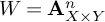
 is smooth by Lemma 3.3.2. Since the question is étale local on W, we may assume that
$W={\mathbf A}^n_{X\times Y}$
is smooth by Lemma 3.3.2. Since the question is étale local on W, we may assume that
$W={\mathbf A}^n_{X\times Y}$
 . Then, we have a cartesian diagram

By Theorem 4.2.2, the morphism
$W\to {\mathbf A}^n_Y$
 is
${\mathcal F}_W$
is
${\mathcal F}_W$
 -acyclic for the pull-back
${\mathcal F}_W$
-acyclic for the pull-back
${\mathcal F}_W$
 of
${\mathcal F}$
of
${\mathcal F}$
 . Since
${\mathbf A}^n_Y\to Y$
. Since
${\mathbf A}^n_Y\to Y$
 is smooth, the composition
$W\to Y$
is smooth, the composition
$W\to Y$
 is also
${\mathcal F}_W$
is also
${\mathcal F}_W$
 -acyclic by [Reference Illusie8, Corollaire 2.7].
3. Since the pair
$(1,0)$
 of the identity
$1\colon U\to U$
of the identity
$1\colon U\to U$
 and the
$0$
and the
$0$
 -mapping
$U\to {\mathbf A}^1$
-mapping
$U\to {\mathbf A}^1$
 is C-acyclic, the constant morphism
$0\colon U\to {\mathbf A}^1$
is C-acyclic, the constant morphism
$0\colon U\to {\mathbf A}^1$
 is
${\mathcal F}$
is
${\mathcal F}$
 -acyclic. Hence we have
${\mathcal F}=0$
-acyclic. Hence we have
${\mathcal F}=0$
 .
.
If
${\mathcal F}=0$
 , every pair
$(h,f)$
, every pair
$(h,f)$
 of morphisms
$h\colon W\to X$
of morphisms
$h\colon W\to X$
 and
$f\colon W\to Y$
and
$f\colon W\to Y$
 of smooth schemes over k is
${\mathcal F}$
of smooth schemes over k is
${\mathcal F}$
 -acyclic.
4. Since
$(h,f)$
 is universally C-acyclic by Lemma 3.8, the assertion follows.
Lemma 4.6 (cf. [Reference Beilinson3, Lemma 2.1 (iv)])
Let X be a smooth scheme over a field k and
${\mathcal F}'\to {\mathcal F}\to {\mathcal F}"\to $
 be a distinguished triangle of sheaves on X. Suppose that
${\mathcal F}$
be a distinguished triangle of sheaves on X. Suppose that
${\mathcal F}$
 and
${\mathcal F}'$
and
${\mathcal F}'$
 are micro supported on C and on
$C'$
are micro supported on C and on
$C'$
 respectively. Then
${\mathcal F}"$
respectively. Then
${\mathcal F}"$
 is micro supported on
$C" =C\cup C'$
is micro supported on
$C" =C\cup C'$
 .
.
Proof. Let
$h\colon W\to X$
 and
$f\colon W\to Y$
and
$f\colon W\to Y$
 be morphisms of smooth schemes over k such that the pair
$(h,f)$
be morphisms of smooth schemes over k such that the pair
$(h,f)$
 is
$C"$
is
$C"$
 -acyclic. Then, since
$C,C'\subset C"$
-acyclic. Then, since
$C,C'\subset C"$
 , the pair
$(h,f)$
, the pair
$(h,f)$
 is C-acyclic and
$C'$
is C-acyclic and
$C'$
 -acyclic. Hence f is
$h^*{\mathcal F}$
-acyclic. Hence f is
$h^*{\mathcal F}$
 -acyclic and
$h^*{\mathcal F}'$
-acyclic and
$h^*{\mathcal F}'$
 -acyclic. By the distinguished triangle
$ {\mathcal F}'\to {\mathcal F}\to {\mathcal F}"\to $
-acyclic. By the distinguished triangle
$ {\mathcal F}'\to {\mathcal F}\to {\mathcal F}"\to $
 , f is
$h^*{\mathcal F}"$
, f is
$h^*{\mathcal F}"$
 -acyclic.
Lemma 4.7. Let X be a smooth scheme over a field k and let
${\mathcal F}$
 be a sheaf on X.
1. (cf. [Reference Beilinson3, Lemma 2.2 (i)]) Assume that
${\mathcal F}$
 is micro supported on C. If a morphism
$g\colon V\to X$
is micro supported on C. If a morphism
$g\colon V\to X$
 of smooth schemes over k is C-transversal, then the pull-back
$g^*{\mathcal F}$
of smooth schemes over k is C-transversal, then the pull-back
$g^*{\mathcal F}$
 is micro supported on
$g^\circ C$
is micro supported on
$g^\circ C$
 .
.
2. Let
$(j_i\colon U_i\to X)_{i\in I}$
 be an étale covering and let
$C_i\subset T^*U_i$
be an étale covering and let
$C_i\subset T^*U_i$
 be a family of closed conical subsets such that the pull-backs
${\mathcal F}_{U_i}$
be a family of closed conical subsets such that the pull-backs
${\mathcal F}_{U_i}$
 are micro supported on
$C_i$
are micro supported on
$C_i$
 . We identify
$T^*U_i$
. We identify
$T^*U_i$
 with
$T^*X\times _XU_i$
with
$T^*X\times _XU_i$
 and consider the image of
$C_i\subset T^*U_i=T^*X\times _XU_i $
and consider the image of
$C_i\subset T^*U_i=T^*X\times _XU_i $
 as a subset
$ \mathrm {Im}(C_i) \subset T^*X$
as a subset
$ \mathrm {Im}(C_i) \subset T^*X$
 . Then,
${\mathcal F}$
. Then,
${\mathcal F}$
 is micro supported on the closure
$C=\overline { \bigcup _{i\in I} \mathrm {Im}(C_i)}$
is micro supported on the closure
$C=\overline { \bigcup _{i\in I} \mathrm {Im}(C_i)}$
 of the union of the images.
3. Let
$U\subset X$
 be an open subset and
 be the complement. Assume that
${\mathcal F}$
be the complement. Assume that
${\mathcal F}$
 is micro supported on
$C\subset T^*X$
is micro supported on
$C\subset T^*X$
 and that the restriction
${\mathcal F}_U$
and that the restriction
${\mathcal F}_U$
 is micro supported on
$C'\subset T^*U$
is micro supported on
$C'\subset T^*U$
 . Then,
${\mathcal F}$
. Then,
${\mathcal F}$
 is micro supported on the union
$\overline {C'}\cup C|_Z\subset T^*X$
is micro supported on the union
$\overline {C'}\cup C|_Z\subset T^*X$
 .
.
Proof. 1. Let
$h\colon W\to V$
 and
$f\colon W\to Y$
and
$f\colon W\to Y$
 be morphisms of smooth schemes over k such that the pair
$(h,f)$
be morphisms of smooth schemes over k such that the pair
$(h,f)$
 is
$g^\circ C$
is
$g^\circ C$
 -acyclic. Then,
$(gh,f)$
-acyclic. Then,
$(gh,f)$
 is C-acyclic by Lemma 3.4 (2)
$\Rightarrow $
is C-acyclic by Lemma 3.4 (2)
$\Rightarrow $
 (1). Hence f is locally acyclic relatively to
$(gh)^*{\mathcal F}=h^*(g^*{\mathcal F})$
(1). Hence f is locally acyclic relatively to
$(gh)^*{\mathcal F}=h^*(g^*{\mathcal F})$
 .
.
2. Let
$h\colon W\to X$
 and
$f\colon W\to Y$
and
$f\colon W\to Y$
 be morphisms of smooth schemes over k such that the pair
$(h,f)$
be morphisms of smooth schemes over k such that the pair
$(h,f)$
 is C-acyclic. Then, for every
$i\in I$
is C-acyclic. Then, for every
$i\in I$
 , the pair of
$h_i\colon W_i=W\times _XU_i\to U_i$
, the pair of
$h_i\colon W_i=W\times _XU_i\to U_i$
 and
$f_i\colon W_i\to Y$
and
$f_i\colon W_i\to Y$
 is
$j_i^\circ C$
is
$j_i^\circ C$
 -acyclic by Lemma 3.4 (2)
$\Rightarrow $
-acyclic by Lemma 3.4 (2)
$\Rightarrow $
 (1). Further it is
$C_i$
(1). Further it is
$C_i$
 -acyclic since
$C_i\subset j_i^\circ C$
-acyclic since
$C_i\subset j_i^\circ C$
 by Lemma 2.3.3. Hence
$f_i$
by Lemma 2.3.3. Hence
$f_i$
 is locally acyclic relatively to
$h_i^*({\mathcal F}_{U_i})=(h^*{\mathcal F})_{W_i}$
is locally acyclic relatively to
$h_i^*({\mathcal F}_{U_i})=(h^*{\mathcal F})_{W_i}$
 for every
$i\in I$
for every
$i\in I$
 . Since
$(W_i\to W)_{i\in I}$
. Since
$(W_i\to W)_{i\in I}$
 is an étale covering, f is
$h^*{\mathcal F}$
is an étale covering, f is
$h^*{\mathcal F}$
 -acyclic.
3. Let
$h\colon W\to X$
 and
$f\colon W\to Y$
and
$f\colon W\to Y$
 be morphisms of smooth schemes over k and assume that
$(h,f)$
be morphisms of smooth schemes over k and assume that
$(h,f)$
 is
$\overline {C'}\cup C|_Z$
is
$\overline {C'}\cup C|_Z$
 -acyclic. Then,
$(h,f)$
-acyclic. Then,
$(h,f)$
 is
$\overline {C'}$
is
$\overline {C'}$
 -acyclic on U and is C-acyclic on a neighbourhood V of Z. Hence f is
$h^*{\mathcal F}$
-acyclic on U and is C-acyclic on a neighbourhood V of Z. Hence f is
$h^*{\mathcal F}$
 -acyclic on
$X=U\cup V$
-acyclic on
$X=U\cup V$
 .
.
Lemma 4.8 (cf. [Reference Beilinson3, Lemma 2.5])
Let X be a smooth scheme over a field k and let
${\mathcal F}$
 be a sheaf on X. Let
$i\colon Z\to X$
be a sheaf on X. Let
$i\colon Z\to X$
 be a closed immersion. Assume that
${\mathcal F} =i_*{\mathcal F}_Z$
be a closed immersion. Assume that
${\mathcal F} =i_*{\mathcal F}_Z$
 is supported on Z and is micro supported on a closed conical subset
$C\subset T^*X$
is supported on Z and is micro supported on a closed conical subset
$C\subset T^*X$
 .
.
1. (cf. [Reference Beilinson3, Lemma 2.3]) The sheaf
${\mathcal F}$
 is micro supported on
$C|_Z$
is micro supported on
$C|_Z$
 .
.
2. Assume that Z is smooth over k and that
$C=C|_Z$
 is a subset of
$T^*X|_Z$
is a subset of
$T^*X|_Z$
 . Let
$s\colon T^*Z\to T^*X|_Z$
. Let
$s\colon T^*Z\to T^*X|_Z$
 be a section of the surjection
$T^*X|_Z\to T^*Z$
be a section of the surjection
$T^*X|_Z\to T^*Z$
 . Then,
${\mathcal F}_Z$
. Then,
${\mathcal F}_Z$
 is micro supported on
$s^{-1}(C)$
is micro supported on
$s^{-1}(C)$
 . Define
$C_Z\subset T^*Z$
. Define
$C_Z\subset T^*Z$
 to be the closure of the image of C by the surjection
$T^*X|_Z\to T^*Z$
to be the closure of the image of C by the surjection
$T^*X|_Z\to T^*Z$
 . Then,
${\mathcal F}_Z$
. Then,
${\mathcal F}_Z$
 is micro supported on
$C_Z$
is micro supported on
$C_Z$
 .
.
3. (cf. [Reference Beilinson3, Lemma 2.2 (ii)]) Assume that
${\mathcal F}_Z$
 is micro supported on a closed conical subset
$C_Z\subset T^*Z$
is micro supported on a closed conical subset
$C_Z\subset T^*Z$
 . Then
${\mathcal F}$
. Then
${\mathcal F}$
 is micro supported on
$i_\circ C_Z$
is micro supported on
$i_\circ C_Z$
 .
.
Proof. 1. Let
$h\colon W\to X$
 and
$f\colon W\to Y$
and
$f\colon W\to Y$
 be morphisms of smooth schemes over k such that the pair
$(h,f)$
be morphisms of smooth schemes over k such that the pair
$(h,f)$
 is
$C|_Z$
is
$C|_Z$
 -acyclic. Then, by Lemma 2.3.4, there exists an open neighbourhood U of Z such that the pair of
$h_U\colon W\times _XU\to X$
-acyclic. Then, by Lemma 2.3.4, there exists an open neighbourhood U of Z such that the pair of
$h_U\colon W\times _XU\to X$
 and
$f_U\colon W\times _XU\to Y$
and
$f_U\colon W\times _XU\to Y$
 is C-acyclic. Hence
$f_U$
is C-acyclic. Hence
$f_U$
 is
$(h^*{\mathcal F})_{W\times _XU}$
is
$(h^*{\mathcal F})_{W\times _XU}$
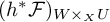 -acyclic. For the complement
 , the restriction
$(h^*{\mathcal F})_{W\times _XV}$
, the restriction
$(h^*{\mathcal F})_{W\times _XV}$
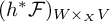 is
$0$
is
$0$
 since
${\mathcal F} =i_*{\mathcal F}_Z$
since
${\mathcal F} =i_*{\mathcal F}_Z$
 . Hence
$f_V\colon W\times _XV\to Y$
. Hence
$f_V\colon W\times _XV\to Y$
 is
$(h^*{\mathcal F})_{W\times _XV}$
is
$(h^*{\mathcal F})_{W\times _XV}$
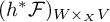 -acyclic. Since
$U\cup V=X$
-acyclic. Since
$U\cup V=X$
 , f is
${\mathcal F}$
, f is
${\mathcal F}$
 -acyclic.
2. First, we show that
${\mathcal F}_Z$
 is micro supported on
$s^{-1}(C)$
is micro supported on
$s^{-1}(C)$
 . Let
$h\colon W\to Z$
. Let
$h\colon W\to Z$
 and
$f\colon W\to Y$
and
$f\colon W\to Y$
 be morphisms of smooth schemes over k such that the pair
$(h,f)$
be morphisms of smooth schemes over k such that the pair
$(h,f)$
 is
$s^{-1}(C)$
is
$s^{-1}(C)$
 -acyclic. We show that we may assume h is an immersion. We consider the commutative diagram

For the section
$\widetilde s=s\times 1\colon T^*Z\times T^*W=T^*(Z\times W) \to T^*X|_Z\times T^*W=T^*(X\times W)|_{Z\times W}$
 extending s, we have
$\mathrm {pr}_1^\circ (s^{-1}(C)) =\widetilde s^{-1}(\mathrm {pr}_1^\circ C)$
extending s, we have
$\mathrm {pr}_1^\circ (s^{-1}(C)) =\widetilde s^{-1}(\mathrm {pr}_1^\circ C)$
 . Since the projection
$Z\times W\to Z$
. Since the projection
$Z\times W\to Z$
 is smooth, we may replace
$h\colon W\to Z$
is smooth, we may replace
$h\colon W\to Z$
 ,
$X\supset Z$
,
$X\supset Z$
 and C by
$(h,1)\colon W\to Z\times W$
and C by
$(h,1)\colon W\to Z\times W$
 ,
$X\times W \supset Z\times W$
,
$X\times W \supset Z\times W$
 and
$\mathrm {pr}_1^\circ C$
and
$\mathrm {pr}_1^\circ C$
 , by Lemma 4.7.1. Thus we may assume that h is an immersion.
Since the assertion is local on X, by Lemma 2.8.1, we may extend the immersion
$(h,f)\colon W\to Z\times Y$
 to an immersion
$(h',f')\colon V\to X\times Y$
to an immersion
$(h',f')\colon V\to X\times Y$
 transversal to the immersion
$Z\times Y\to X\times Y$
transversal to the immersion
$Z\times Y\to X\times Y$
 such that the restriction
$T^*_V(X\times Y)|_W$
such that the restriction
$T^*_V(X\times Y)|_W$
 of the conormal bundle is the image of
$T^*_W(Z\times Y)$
of the conormal bundle is the image of
$T^*_W(Z\times Y)$
 by the section
$s|_W\times 1\colon T^*Z|_W\times _W (T^*Y\times _YW) \to T^*X|_W\times _W (T^*Y\times _YW)$
by the section
$s|_W\times 1\colon T^*Z|_W\times _W (T^*Y\times _YW) \to T^*X|_W\times _W (T^*Y\times _YW)$
 .
.
We consider the cartesian diagram

Since
$T^*_V(X\times Y)|_W$
 is the image of
$T^*_W(Z\times Y)$
is the image of
$T^*_W(Z\times Y)$
 by the section, the
$s^{-1}(C)$
by the section, the
$s^{-1}(C)$
 -acyclicity of
$(h,f)\colon W\to Z\times Y$
-acyclicity of
$(h,f)\colon W\to Z\times Y$
 implies the C-acyclicity of
$(h',f')\colon V\to X\times Y$
implies the C-acyclicity of
$(h',f')\colon V\to X\times Y$
 by Lemma 3.2.1 and Lemma 2.8.2, after shrinking V if necessary. Since
${\mathcal F}$
by Lemma 3.2.1 and Lemma 2.8.2, after shrinking V if necessary. Since
${\mathcal F}$
 is micro supported on C, this implies that
$f'\colon V\to Y$
is micro supported on C, this implies that
$f'\colon V\to Y$
 is
$h^{\prime *}{\mathcal F}$
is
$h^{\prime *}{\mathcal F}$
 -acyclic. This means that
$f\colon W\to Y$
-acyclic. This means that
$f\colon W\to Y$
 is
$h^*{\mathcal F}_Z$
is
$h^*{\mathcal F}_Z$
 -acyclic since
$h^{\prime *}{\mathcal F}$
-acyclic since
$h^{\prime *}{\mathcal F}$
 is the direct image of
$h^*{\mathcal F}_Z$
is the direct image of
$h^*{\mathcal F}_Z$
 by the closed immersion
$W\to V$
by the closed immersion
$W\to V$
 . Hence
${\mathcal F}_Z$
. Hence
${\mathcal F}_Z$
 is micro supported on
$s^{-1}(C)$
is micro supported on
$s^{-1}(C)$
 .
.
We show that
${\mathcal F}_Z$
 is micro supported on
$C_Z$
is micro supported on
$C_Z$
 . Since the assertion is local on Z, we may assume that there exists a section
$s\colon T^*Z\to T^*X|_Z$
. Since the assertion is local on Z, we may assume that there exists a section
$s\colon T^*Z\to T^*X|_Z$
 . Then, since
$s^{-1}(C)\subset C_Z$
. Then, since
$s^{-1}(C)\subset C_Z$
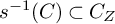 , the assertion follows.
3. Let
$h\colon W\to X$
 and
$f\colon W\to Y$
and
$f\colon W\to Y$
 be morphisms of smooth schemes over k such that the pair
$(h,f)$
be morphisms of smooth schemes over k such that the pair
$(h,f)$
 is
$i_\circ C$
is
$i_\circ C$
 -acyclic. By Lemma 4.5.3, the support of
${\mathcal F}$
-acyclic. By Lemma 4.5.3, the support of
${\mathcal F}$
 is a subset of the base B of C. By Lemma 2.7 and Lemma 3.5, there exists an open neighbourhood
$V'\subset V=Z\times _XW$
is a subset of the base B of C. By Lemma 2.7 and Lemma 3.5, there exists an open neighbourhood
$V'\subset V=Z\times _XW$
 of the inverse image of B such that
$V'$
of the inverse image of B such that
$V'$
 is smooth over k, that the pair of
$h'\colon V'\to Z$
is smooth over k, that the pair of
$h'\colon V'\to Z$
 and the composition
$f'\colon V'\to W\to Y$
and the composition
$f'\colon V'\to W\to Y$
 is C-acyclic. Hence
$f'$
is C-acyclic. Hence
$f'$
 is
$h^{\prime *}{\mathcal F}$
is
$h^{\prime *}{\mathcal F}$
 -acyclic. Since
$V'$
-acyclic. Since
$V'$
 contains the inverse image of the support of
${\mathcal F}$
contains the inverse image of the support of
${\mathcal F}$
 , the morphism f is
$h^*i_*{\mathcal F}$
, the morphism f is
$h^*i_*{\mathcal F}$
 -acyclic.
Lemma 4.9. Let
$g\colon X'\to X$
 be a morphism of smooth schemes over k. Assume that g is proper on the base of a closed conical subset
$C' \subset T^*X'$
be a morphism of smooth schemes over k. Assume that g is proper on the base of a closed conical subset
$C' \subset T^*X'$
 . Let
${\mathcal F}'$
. Let
${\mathcal F}'$
 be a constructible sheaf on
$X'$
be a constructible sheaf on
$X'$
 . If
${\mathcal F}'$
. If
${\mathcal F}'$
 is micro supported on
$C'$
is micro supported on
$C'$
 , then
$Rg_*{\mathcal F}'$
, then
$Rg_*{\mathcal F}'$
 is micro supported on
$C=g_\circ C'$
is micro supported on
$C=g_\circ C'$
 .
.
Proof. Let
$h\colon W\to X$
 and
$f\colon W\to Y$
and
$f\colon W\to Y$
 be morphisms of smooth schemes over k such that
$(h,f)$
be morphisms of smooth schemes over k such that
$(h,f)$
 is C-acyclic. Let

be the cartesian diagram. Then, by Lemma 3.7, there exists an open regular neighbourhood
$U'\subset W'=W\times _XX'$
 of the inverse image of
$B'$
of the inverse image of
$B'$
 where h is transversal to g and
$(h',fg')$
where h is transversal to g and
$(h',fg')$
 is
$C'$
is
$C'$
 -acyclic. Hence the assertion follows from Lemma 4.3.
5 Singular support and Radon transform
Definition 5.1 [Reference Beilinson3, 1.3]
Let X be a smooth scheme over a field k and
${\mathcal F}$
 be a sheaf on X. We say that a closed conical subset
$C\subset T^*X$
be a sheaf on X. We say that a closed conical subset
$C\subset T^*X$
 is the singular support of
${\mathcal F}$
is the singular support of
${\mathcal F}$
 if for every closed conical subset
$C'\subset T^*X$
if for every closed conical subset
$C'\subset T^*X$
 , the inclusion
$C\subset C'$
, the inclusion
$C\subset C'$
 is equivalent to the condition that
${\mathcal F}$
is equivalent to the condition that
${\mathcal F}$
 is micro supported on
$C'$
is micro supported on
$C'$
 . If the singular support of
${\mathcal F}$
. If the singular support of
${\mathcal F}$
 exists, it is denoted by
$SS{\mathcal F}$
exists, it is denoted by
$SS{\mathcal F}$
 .
.
Following Beilinson’s argument in [Reference Beilinson3], we will prove the existence of singular support for any sheaf without assuming constructibility by reducing to the case where X is the projective space
${\mathbf P}^n$
 and using the Radon transform in the case
$X={\mathbf P}^n$
and using the Radon transform in the case
$X={\mathbf P}^n$
 . For the sake of convenience and completeness, we give the detail.
Lemma 5.2. Let X be a smooth scheme over k and let
${\mathcal F}$
 be a sheaf on X.
1. Let
$U\subset X$
 be an open subscheme. Assume that
$C\subset T^*X$
be an open subscheme. Assume that
$C\subset T^*X$
 is the singular support of
${\mathcal F}$
is the singular support of
${\mathcal F}$
 . Then,
$C|_U$
. Then,
$C|_U$
 is the singular support of
${\mathcal F}|_U$
is the singular support of
${\mathcal F}|_U$
 .
.
2. Let
$(U_i)$
 be an open covering of X and
$C_i \subset T^*U_i$
be an open covering of X and
$C_i \subset T^*U_i$
 be the singular support of
${\mathcal F}|_{U_i}$
be the singular support of
${\mathcal F}|_{U_i}$
 . Then,
$C=\bigcup _iC_i \subset T^*X$
. Then,
$C=\bigcup _iC_i \subset T^*X$
 is the singular support of
${\mathcal F}$
is the singular support of
${\mathcal F}$
 .
.
Proof. 1. The restriction
${\mathcal F}|_U$
 is micro supported on
$C|_U$
is micro supported on
$C|_U$
 by Lemma 4.7.1. We show that
$C|_U$
by Lemma 4.7.1. We show that
$C|_U$
 is the smallest. Let
$C'\subset T^*U$
is the smallest. Let
$C'\subset T^*U$
 be a closed conical subset on which
${\mathcal F}|_U$
be a closed conical subset on which
${\mathcal F}|_U$
 is micro supported and
 be the complement. Then
${\mathcal F}$
be the complement. Then
${\mathcal F}$
 is micro supported on
$\overline {C'}\cup C|_Z$
is micro supported on
$\overline {C'}\cup C|_Z$
 by Lemma 4.7.3. Since C is the smallest, we have
$C\subset \overline {C'}\cup C|_Z$
by Lemma 4.7.3. Since C is the smallest, we have
$C\subset \overline {C'}\cup C|_Z$
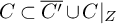 and
$C|_U\subset (\overline {C'}\cup C|_Z)|_U=C'$
and
$C|_U\subset (\overline {C'}\cup C|_Z)|_U=C'$
 .
.
2. For every
$i,j$
 , the restrictions
$C_i|_{U_i\cap U_j}$
, the restrictions
$C_i|_{U_i\cap U_j}$
 and
$C_j|_{U_i\cap U_j}$
and
$C_j|_{U_i\cap U_j}$
 are the singular support of
${\mathcal F}|_{U_i\cap U_j}$
are the singular support of
${\mathcal F}|_{U_i\cap U_j}$
 and are the same by 1. Hence the union
$C=\bigcup _iC_i$
and are the same by 1. Hence the union
$C=\bigcup _iC_i$
 is a closed conical subset of
$T^*X$
is a closed conical subset of
$T^*X$
 . Since
$C_i=C|_{U_i}$
. Since
$C_i=C|_{U_i}$
 ,
${\mathcal F}$
,
${\mathcal F}$
 is micro supported on C by Lemma 4.7.1.
We show that C is the smallest. Let
$C'\subset T^*X$
 be a closed conical subset on which
${\mathcal F}$
be a closed conical subset on which
${\mathcal F}$
 is micro supported. Then, for each i, we have
$C_i\subset C'|_{U_i}$
is micro supported. Then, for each i, we have
$C_i\subset C'|_{U_i}$
 . Hence we have
$C\subset C'$
. Hence we have
$C\subset C'$
 .
.
Proposition 5.3. Let
$i\colon X\to P$
 be a closed immersion of smooth schemes over k and let
${\mathcal F}$
be a closed immersion of smooth schemes over k and let
${\mathcal F}$
 be a constructible sheaf on X. Let
$C_P\subset T^*P$
be a constructible sheaf on X. Let
$C_P\subset T^*P$
 be a closed conical subset and assume that
$C_P$
be a closed conical subset and assume that
$C_P$
 is the singular support of
$i_*{\mathcal F}$
is the singular support of
$i_*{\mathcal F}$
 . Then the following holds.
1.
$C_P$
 is a subset of
$T^*P|_X$
is a subset of
$T^*P|_X$
 .
.
2. Define
$C\subset T^*X$
 to be the closure of the image of
$C_P$
to be the closure of the image of
$C_P$
 by the surjection
$T^*P|_X\to T^*X$
by the surjection
$T^*P|_X\to T^*X$
 . Then C is the singular support
$SS{\mathcal F}$
. Then C is the singular support
$SS{\mathcal F}$
 and we have
$C_P=i_\circ C$
and we have
$C_P=i_\circ C$
 .
.
Proof. 1. Let
 be the complement. Since
${\mathcal F}|_U=0$
be the complement. Since
${\mathcal F}|_U=0$
 is micro supported on
$\varnothing $
is micro supported on
$\varnothing $
 by Lemma 4.5.3,
${\mathcal F}$
by Lemma 4.5.3,
${\mathcal F}$
 is micro supported on
$C_P|_X\subset T^*P$
is micro supported on
$C_P|_X\subset T^*P$
 by Lemma 4.7.3. Since
$C_P$
by Lemma 4.7.3. Since
$C_P$
 is the smallest, we have
$C_P=C_P|_X \subset T^*P|_X$
is the smallest, we have
$C_P=C_P|_X \subset T^*P|_X$
 .
.
2. By Lemma 4.8.2,
${\mathcal F}$
 is micro supported on C. We show that C is the smallest. Assume that
${\mathcal F}$
is micro supported on C. We show that C is the smallest. Assume that
${\mathcal F}$
 is micro supported on a closed conical subset
$C'\subset T^*X$
is micro supported on a closed conical subset
$C'\subset T^*X$
 . Then, since
$i_*{\mathcal F}$
. Then, since
$i_*{\mathcal F}$
 is micro supported on
$i_\circ C'$
is micro supported on
$i_\circ C'$
 by Lemma 4.8.3, we have
$C_P\subset i_\circ C'$
by Lemma 4.8.3, we have
$C_P\subset i_\circ C'$
 . By taking the closure of the image by the surjection
$T^*P|_X\to T^*X$
. By taking the closure of the image by the surjection
$T^*P|_X\to T^*X$
 , we obtain
$C\subset C'$
, we obtain
$C\subset C'$
 .
.
Since
$i_*{\mathcal F}$
 is micro supported on
$i_\circ C$
is micro supported on
$i_\circ C$
 , we have
$C_P\subset i_\circ C$
, we have
$C_P\subset i_\circ C$
 . We show the other inclusion
$i_\circ C\subset C_P$
. We show the other inclusion
$i_\circ C\subset C_P$
 . Since the assertion is local, we may assume that there exists a section
$s\colon T^*X\to T^*P|_X$
. Since the assertion is local, we may assume that there exists a section
$s\colon T^*X\to T^*P|_X$
 of the surjection
$T^*P|_X\to T^*X$
of the surjection
$T^*P|_X\to T^*X$
 . Since
${\mathcal F}$
. Since
${\mathcal F}$
 is micro supported on
$s^{-1}(C_P)$
is micro supported on
$s^{-1}(C_P)$
 by Lemma 4.8.2, we have
$C\subset s^{-1}(C_P)$
by Lemma 4.8.2, we have
$C\subset s^{-1}(C_P)$
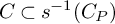 . Hence we have
$i_\circ C\subset C_P$
. Hence we have
$i_\circ C\subset C_P$
 .
.
We recall the Radon transform and the Legendre transform. Let
$V={\mathbf A}^{n+1}$
 and let
${\mathbf P}={\mathbf P}(V)$
and let
${\mathbf P}={\mathbf P}(V)$
 be the projective space of dimension n parametrizing lines in V. The dual projective space
${\mathbf P}^\vee = {\mathbf P}(V^\vee )$
be the projective space of dimension n parametrizing lines in V. The dual projective space
${\mathbf P}^\vee = {\mathbf P}(V^\vee )$
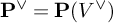 is the moduli space of hyperplanes in
${\mathbf P}$
is the moduli space of hyperplanes in
${\mathbf P}$
 .
.
By the exact sequence
$0\to \Omega ^1_{{\mathbf P}/k}(1) \to {\mathcal O}_{\mathbf P}\otimes V^\vee \to {\mathcal O}_{\mathbf P}(1)\to 0$
 of locally free
${\mathcal O}_{\mathbf P}$
of locally free
${\mathcal O}_{\mathbf P}$
 -modules, we define a closed subscheme
$Q={\mathbf P}(T^*{\mathbf P}) \subset {\mathbf P}\times {\mathbf P}^\vee $
-modules, we define a closed subscheme
$Q={\mathbf P}(T^*{\mathbf P}) \subset {\mathbf P}\times {\mathbf P}^\vee $
 of codimension 1. This equals the universal family of hyperplanes since it is defined by the tautological section
$\Gamma ({\mathbf P}\times {\mathbf P}^\vee , {\mathcal O}(1)\boxtimes {\mathcal O}(1)) =V^\vee \otimes V$
of codimension 1. This equals the universal family of hyperplanes since it is defined by the tautological section
$\Gamma ({\mathbf P}\times {\mathbf P}^\vee , {\mathcal O}(1)\boxtimes {\mathcal O}(1)) =V^\vee \otimes V$
 corresponding to the identity
$1\in \mathrm {End}(V)$
corresponding to the identity
$1\in \mathrm {End}(V)$
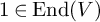 . Let
$q\colon Q\to {\mathbf P}$
. Let
$q\colon Q\to {\mathbf P}$
 and
$q^\vee \colon Q\to {\mathbf P}^\vee $
and
$q^\vee \colon Q\to {\mathbf P}^\vee $
 be the restrictions of the projections
${\mathbf P}\times {\mathbf P}^\vee \to {\mathbf P}$
be the restrictions of the projections
${\mathbf P}\times {\mathbf P}^\vee \to {\mathbf P}$
 and
${\mathbf P}\times {\mathbf P}^\vee \to {\mathbf P}^\vee $
and
${\mathbf P}\times {\mathbf P}^\vee \to {\mathbf P}^\vee $
 . By symmetry,
$Q\subset {\mathbf P}\times {\mathbf P}^\vee $
. By symmetry,
$Q\subset {\mathbf P}\times {\mathbf P}^\vee $
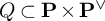 is identified with
${\mathbf P}(T^*{\mathbf P}^\vee )$
is identified with
${\mathbf P}(T^*{\mathbf P}^\vee )$
 .
.
The conormal bundle
$L_Q=T^*_Q({\mathbf P}\times {\mathbf P}^\vee ) \subset (T^*{\mathbf P}\times T^*{\mathbf P}^\vee )|_Q$
 is a line bundle. Since
$1\in \mathrm {End}(V) =V^\vee \otimes V$
is a line bundle. Since
$1\in \mathrm {End}(V) =V^\vee \otimes V$
 regarded as a global section of
${\mathcal O}(1)\boxtimes {\mathcal O}(1)$
regarded as a global section of
${\mathcal O}(1)\boxtimes {\mathcal O}(1)$
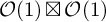 is the bilinear form defining
$Q \subset {\mathbf P}\times {\mathbf P}^\vee $
is the bilinear form defining
$Q \subset {\mathbf P}\times {\mathbf P}^\vee $
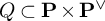 , the morphism
$N_{Q/({\mathbf P}\times {\mathbf P}^\vee )} \to \Omega ^1_{({\mathbf P}\times {\mathbf P}^\vee )/ {\mathbf P}^\vee } \otimes _{{\mathcal O}_{{\mathbf P}\times {\mathbf P}^\vee }} {\mathcal O}_Q = \Omega ^1_{{\mathbf P}/k} \otimes _{{\mathcal O}_{\mathbf P}} {\mathcal O}_Q$
, the morphism
$N_{Q/({\mathbf P}\times {\mathbf P}^\vee )} \to \Omega ^1_{({\mathbf P}\times {\mathbf P}^\vee )/ {\mathbf P}^\vee } \otimes _{{\mathcal O}_{{\mathbf P}\times {\mathbf P}^\vee }} {\mathcal O}_Q = \Omega ^1_{{\mathbf P}/k} \otimes _{{\mathcal O}_{\mathbf P}} {\mathcal O}_Q$
 defines a tautological sub invertible sheaf on
$Q={\mathbf P}(T^*{\mathbf P})$
defines a tautological sub invertible sheaf on
$Q={\mathbf P}(T^*{\mathbf P})$
 . In other words, the tautological sub line bundle
$L \subset T^*{\mathbf P}\times _{\mathbf P}Q$
. In other words, the tautological sub line bundle
$L \subset T^*{\mathbf P}\times _{\mathbf P}Q$
 is the image of
$L_Q$
is the image of
$L_Q$
 by the first projection
$\mathrm {pr}_1\colon (T^*{\mathbf P}\times T^*{\mathbf P}^\vee )|_Q \to T^*{\mathbf P}\times _{\mathbf P}Q$
by the first projection
$\mathrm {pr}_1\colon (T^*{\mathbf P}\times T^*{\mathbf P}^\vee )|_Q \to T^*{\mathbf P}\times _{\mathbf P}Q$
 . By symmetry, the image by the second projection equals the tautological sub line bundle
$L^\vee $
. By symmetry, the image by the second projection equals the tautological sub line bundle
$L^\vee $
 on
$Q={\mathbf P}(T^*{\mathbf P}^\vee )$
on
$Q={\mathbf P}(T^*{\mathbf P}^\vee )$
 .
.
Since the conormal bundle
$L_Q$
 is the kernel of the surjection
$(T^*{\mathbf P}\times T^*{\mathbf P}^\vee )|_Q\to T^*Q$
is the kernel of the surjection
$(T^*{\mathbf P}\times T^*{\mathbf P}^\vee )|_Q\to T^*Q$
 , the intersection
$q^\circ T^*{\mathbf P} \cap q^{\vee \circ }T^*{\mathbf P}^\vee \subset T^*Q$
, the intersection
$q^\circ T^*{\mathbf P} \cap q^{\vee \circ }T^*{\mathbf P}^\vee \subset T^*Q$
 equals the image of the tautological bundle
$L\subset T^*{\mathbf P}\times _{\mathbf P}Q$
equals the image of the tautological bundle
$L\subset T^*{\mathbf P}\times _{\mathbf P}Q$
 . By symmetry, the intersection also equals the image of the tautological bundle
$L^\vee \subset T^*{\mathbf P}^\vee \times _{{\mathbf P}^\vee }Q$
. By symmetry, the intersection also equals the image of the tautological bundle
$L^\vee \subset T^*{\mathbf P}^\vee \times _{{\mathbf P}^\vee }Q$
 .
.
Let
$C\subset T^*{\mathbf P}$
 denote a closed conical subset. We define the Legendre transform
$C^\vee \subset T^*{\mathbf P}^\vee $
denote a closed conical subset. We define the Legendre transform
$C^\vee \subset T^*{\mathbf P}^\vee $
 to be
$q^\vee _\circ q^\circ C$
to be
$q^\vee _\circ q^\circ C$
 . We consider projectivizations
${\mathbf P}(C) \subset {\mathbf P}(T^*{\mathbf P})$
. We consider projectivizations
${\mathbf P}(C) \subset {\mathbf P}(T^*{\mathbf P})$
 and
${\mathbf P}(C^\vee ) \subset {\mathbf P}(T^*{\mathbf P}^\vee )$
and
${\mathbf P}(C^\vee ) \subset {\mathbf P}(T^*{\mathbf P}^\vee )$
 as closed subsets of Q. Let
$C^+\subset T^*{\mathbf P}$
as closed subsets of Q. Let
$C^+\subset T^*{\mathbf P}$
 denote the union of C and the
$0$
denote the union of C and the
$0$
 -section.
Proposition 5.4. Let
$C\subset T^*{\mathbf P}$
 be a closed conical subset. Let
$E={\mathbf P}(C) \subset Q={\mathbf P}(T^*{\mathbf P})$
be a closed conical subset. Let
$E={\mathbf P}(C) \subset Q={\mathbf P}(T^*{\mathbf P})$
 be the projectivization. Let
$L_Q=T^*_Q({\mathbf P}\times {\mathbf P}^\vee ) \subset (T^*{\mathbf P}\times T^*{\mathbf P}^\vee )|_Q$
be the projectivization. Let
$L_Q=T^*_Q({\mathbf P}\times {\mathbf P}^\vee ) \subset (T^*{\mathbf P}\times T^*{\mathbf P}^\vee )|_Q$
 be the conormal line bundle.
1. The projectivization
$E={\mathbf P}(C) \subset Q$
 is the complement of the largest open subset where
$(q,q^\vee )$
is the complement of the largest open subset where
$(q,q^\vee )$
 is C-acyclic.
2. The Legendre transform
$C^\vee $
 equals the union of the image of
$L|_E \subset q^\circ T^*{\mathbf P} \cap q^{\vee \circ }T^*{\mathbf P}^\vee \subset T^*Q$
equals the union of the image of
$L|_E \subset q^\circ T^*{\mathbf P} \cap q^{\vee \circ }T^*{\mathbf P}^\vee \subset T^*Q$
 and its base. We have
${\mathbf P}(C) ={\mathbf P}(C^\vee )$
and its base. We have
${\mathbf P}(C) ={\mathbf P}(C^\vee )$
 .
.
3. We have
$C^{\vee \vee } \subset C^+$
 .
.
Proof. 1. The kernel
$\mathrm {Ker}((T^*{\mathbf P}\times T^*{\mathbf P}^\vee )|_Q\to T^*Q)$
 equals the conormal bundle
$L_Q$
equals the conormal bundle
$L_Q$
 and the first projection induces an isomorphism
$L_Q\to L\subset T^*{\mathbf P}\times _{\mathbf P}Q$
and the first projection induces an isomorphism
$L_Q\to L\subset T^*{\mathbf P}\times _{\mathbf P}Q$
 to the tautological bundle. By this isomorphism, the intersection
$(C\times T^*{\mathbf P}^\vee )|_Q \cap L_Q$
to the tautological bundle. By this isomorphism, the intersection
$(C\times T^*{\mathbf P}^\vee )|_Q \cap L_Q$
 is identified with
${q^*C\cap L}$
is identified with
${q^*C\cap L}$
 . Hence
$(q,q^\vee )$
. Hence
$(q,q^\vee )$
 is C-acyclic on
$U\subset Q$
is C-acyclic on
$U\subset Q$
 if and only if the restriction
$(q^*C\cap L)|_U$
if and only if the restriction
$(q^*C\cap L)|_U$
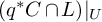 is a subset of the
$0$
is a subset of the
$0$
 -section. Since the projectivization
$E={\mathbf P}(C)\subset {\mathbf P}(T^*{\mathbf P})$
-section. Since the projectivization
$E={\mathbf P}(C)\subset {\mathbf P}(T^*{\mathbf P})$
 equals
${\mathbf P}(q^* C\cap L)\subset {\mathbf P}(L)=Q$
equals
${\mathbf P}(q^* C\cap L)\subset {\mathbf P}(L)=Q$
 , the assertion follows.
2. The Legendre transform
$C^\vee $
 is the image of the intersection
$q^\circ C\cap q^{\vee \circ }T^*{\mathbf P}^\vee \subset T^*Q$
is the image of the intersection
$q^\circ C\cap q^{\vee \circ }T^*{\mathbf P}^\vee \subset T^*Q$
 by
$q^{\vee \circ }T^*{\mathbf P}^\vee \to T^*{\mathbf P}^\vee $
by
$q^{\vee \circ }T^*{\mathbf P}^\vee \to T^*{\mathbf P}^\vee $
 . We identify the intersection
$q^\circ T^*{\mathbf P} \cap q^{\vee \circ }T^*{\mathbf P}^\vee \subset T^*Q$
. We identify the intersection
$q^\circ T^*{\mathbf P} \cap q^{\vee \circ }T^*{\mathbf P}^\vee \subset T^*Q$
 with the tautological line bundle
$L\subset T^*{\mathbf P}\times _{\mathbf P}Q$
with the tautological line bundle
$L\subset T^*{\mathbf P}\times _{\mathbf P}Q$
 . Then, the intersection
$q^\circ C\cap q^{\vee \circ }T^*{\mathbf P}^\vee \subset T^*Q$
. Then, the intersection
$q^\circ C\cap q^{\vee \circ }T^*{\mathbf P}^\vee \subset T^*Q$
 is identified with
$q^* C\cap L$
is identified with
$q^* C\cap L$
 . Since the projectivization
$E={\mathbf P}(C)\subset {\mathbf P}(T^*{\mathbf P})$
. Since the projectivization
$E={\mathbf P}(C)\subset {\mathbf P}(T^*{\mathbf P})$
 equals
${\mathbf P}(q^* C\cap L) \subset {\mathbf P}(L)=Q$
equals
${\mathbf P}(q^* C\cap L) \subset {\mathbf P}(L)=Q$
 , the closed conical subset
$q^* C\cap L$
, the closed conical subset
$q^* C\cap L$
 equals
$L|_E$
equals
$L|_E$
 outside the
$0$
outside the
$0$
 -section.
Since
$L|_E$
 is identified with
$L^\vee |_E$
is identified with
$L^\vee |_E$
 inside
$T^*Q$
inside
$T^*Q$
 , we have
${\mathbf P}(C^\vee )= {\mathbf P}(L^\vee |_E) =E\subset {\mathbf P}(T^*{\mathbf P}^\vee )=Q$
, we have
${\mathbf P}(C^\vee )= {\mathbf P}(L^\vee |_E) =E\subset {\mathbf P}(T^*{\mathbf P}^\vee )=Q$
 .
.
3. By 2 and symmetry, we have
${\mathbf P}(C) ={\mathbf P}(C^{\vee }) ={\mathbf P}(C^{\vee \vee })$
 . Hence we have
$C^{\vee \vee }\subset C^+$
. Hence we have
$C^{\vee \vee }\subset C^+$
 .
.
Lemma 5.5. Let
$C \subset T^*{\mathbf P}$
 be a closed conical subset and
$E={\mathbf P}(C) \subset Q= {\mathbf P}(T^*{\mathbf P})$
be a closed conical subset and
$E={\mathbf P}(C) \subset Q= {\mathbf P}(T^*{\mathbf P})$
 be its projectivization. Let

be a commutative diagram of smooth schemes over k with cartesian square. Let
$C^{\vee +} =C^\vee \cup T^*_{{\mathbf P}^\vee } {\mathbf P}^\vee \subset T^*{\mathbf P}^\vee $
 be the union of the Legendre transform with the
$0$
be the union of the Legendre transform with the
$0$
 -section and suppose that
$(h,f)$
-section and suppose that
$(h,f)$
 is
$C^{\vee +}$
is
$C^{\vee +}$
 -acyclic.
1. The morphism f is smooth on W and the pair
$(qh',f')$
 is C-acyclic on the complement
 .
.
2. On a neighbourhood of
$E_W$
 , the pair
$(qh',f')$
, the pair
$(qh',f')$
 is
$T^*{\mathbf P}$
is
$T^*{\mathbf P}$
 -acyclic.
Proof. 1. Since
$(h,f)$
 is
$C^{\vee +}$
is
$C^{\vee +}$
 -acyclic and
$C^{\vee +}$
-acyclic and
$C^{\vee +}$
 contains the
$0$
contains the
$0$
 -section, the morphism
$f\colon W\to Y$
-section, the morphism
$f\colon W\to Y$
 is smooth. By Proposition 5.4.1,
$(q,q^\vee )$
is smooth. By Proposition 5.4.1,
$(q,q^\vee )$
 is C-acyclic outside E. Hence
$(qh',q^\vee _W)$
is C-acyclic outside E. Hence
$(qh',q^\vee _W)$
 is C-acyclic outside
$E_W$
is C-acyclic outside
$E_W$
 by Lemma 3.8 and
$(qh',f')$
by Lemma 3.8 and
$(qh',f')$
 is C-acyclic outside
$E_W$
is C-acyclic outside
$E_W$
 by Lemma 3.6.
2. By the description of
$C^\vee $
 in Proposition 5.4.2 and by the open condition Lemma 2.3.4 and Lemma 3.2.1, the
$C^{\vee }$
in Proposition 5.4.2 and by the open condition Lemma 2.3.4 and Lemma 3.2.1, the
$C^{\vee }$
 -acyclicity of
$(h,f)$
-acyclicity of
$(h,f)$
 implies the
$T^*{\mathbf P}$
implies the
$T^*{\mathbf P}$
 -acyclicity of
$(qh',f')$
-acyclicity of
$(qh',f')$
 on a neighbourhood of
$E_W\subset Q_W$
on a neighbourhood of
$E_W\subset Q_W$
 .
.
We define the naive Radon transform
$R{\mathcal F}$
 to be
$q^\vee _*q^*{\mathcal F}$
to be
$q^\vee _*q^*{\mathcal F}$
 and the naive inverse Radon transform
$R^\vee {\mathcal G}$
and the naive inverse Radon transform
$R^\vee {\mathcal G}$
 to be
$q_*q^{\vee *}{\mathcal G}$
to be
$q_*q^{\vee *}{\mathcal G}$
 . Since we use only the naive Radon transform, we drop the adjective ‘naive’ in the sequel. We will refine in Proposition 5.9, after studying the difference between
$R^\vee R{\mathcal F}$
. Since we use only the naive Radon transform, we drop the adjective ‘naive’ in the sequel. We will refine in Proposition 5.9, after studying the difference between
$R^\vee R{\mathcal F}$
 and
${\mathcal F}$
and
${\mathcal F}$
 , the following elementary property.
Lemma 5.6. Assume that
${\mathcal F}$
 is micro supported on C.
1. The Radon transform
$R{\mathcal F}$
 is micro supported on
$C^\vee $
is micro supported on
$C^\vee $
 .
.
2.
$R^\vee R{\mathcal F}$
 is micro supported on
$C^+$
is micro supported on
$C^+$
 .
.
Proof. 1. By Lemma 4.7.1 and Lemma 4.9, the Radon transform
$R{\mathcal F}=q^\vee _*q^*{\mathcal F}$
 is micro supported on the Legendre transform
$C^\vee =q^\vee _\circ q^\circ C$
is micro supported on the Legendre transform
$C^\vee =q^\vee _\circ q^\circ C$
 .
.
2. By 1,
$R^\vee R{\mathcal F}$
 is micro supported on
$C^{\vee \vee }\subset C^+$
is micro supported on
$C^{\vee \vee }\subset C^+$
 .
.
Lemma 5.7. We consider the commutative diagram

where
$\delta _{\mathbf P} \colon {\mathbf P}\to {\mathbf P}\times {\mathbf P}$
 is the diagonal immersion.
1. The closed immersion
$i=((q,q^\vee ),(q^\vee ,q))$
 induces isomorphisms

2. Let
$p\colon {\mathbf P}\to \mathrm {Spec}\, k$
 and
$p^\vee \colon {\mathbf P}^\vee \to \mathrm {Spec}\, k$
and
$p^\vee \colon {\mathbf P}^\vee \to \mathrm {Spec}\, k$
 denote the projections. Then, we have a distinguished triangle

Proof. 1. The immersion i induces a morphism

and we have isomorphisms
$R^sp^\vee _*\Lambda \to \Lambda (-t)[-2t]$
 for
$s=2t, 0\leqslant t\leqslant n$
for
$s=2t, 0\leqslant t\leqslant n$
 and
$R^sp^\vee _*\Lambda =0$
and
$R^sp^\vee _*\Lambda =0$
 otherwise. The restriction of the closed immersion
$ i\colon Q\times _{{\mathbf P}^\vee }Q \to {\mathbf P}\times {\mathbf P}^\vee \times {\mathbf P}$
otherwise. The restriction of the closed immersion
$ i\colon Q\times _{{\mathbf P}^\vee }Q \to {\mathbf P}\times {\mathbf P}^\vee \times {\mathbf P}$
 on the diagonal
${\mathbf P}\subset {\mathbf P}\times {\mathbf P}$
on the diagonal
${\mathbf P}\subset {\mathbf P}\times {\mathbf P}$
 is the sub
${\mathbf P}^{n-1}$
is the sub
${\mathbf P}^{n-1}$
 -bundle
$Q \subset {\mathbf P}\times {\mathbf P}^\vee $
-bundle
$Q \subset {\mathbf P}\times {\mathbf P}^\vee $
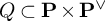 . On the complement
 ,
$Q\times _{{\mathbf P}^\vee }Q$
,
$Q\times _{{\mathbf P}^\vee }Q$
 is a sub
${\mathbf P}^{n-2}$
is a sub
${\mathbf P}^{n-2}$
 -bundle. Hence (5.3) induces an isomorphism of cohomology sheaves except for degree
$s=2(n-1)$
-bundle. Hence (5.3) induces an isomorphism of cohomology sheaves except for degree
$s=2(n-1)$
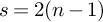 and induces an isomorphism
$\delta _{{\mathbf P}*} p^*R^{2(n-1)}p^\vee _*\Lambda \to R^{2(n-1)}(q\times q)_*\Lambda _{ Q\times _{{\mathbf P}^\vee }Q}$
and induces an isomorphism
$\delta _{{\mathbf P}*} p^*R^{2(n-1)}p^\vee _*\Lambda \to R^{2(n-1)}(q\times q)_*\Lambda _{ Q\times _{{\mathbf P}^\vee }Q}$
 .
.
2. This follows from the isomorphisms (5.1).
Next, we consider the diagram

Proposition 5.8. 1. We have a canonical isomorphism

2. The isomorphism (5.5) induces a distinguished triangle

Proof. 1. By the cartesian diagram

we have
$R^\vee R{\mathcal F}= Rq_*q^{\vee *}Rq^\vee _*q^*{\mathcal F}$
 . By the proper base change theorem, we have a canonical isomorphism
$Rq_*q^{\vee *}Rq^\vee _*q^*{\mathcal F} \to R(q\circ \mathrm {pr}_2)_* (q\circ \mathrm {pr}_1)^*{\mathcal F}$
. By the proper base change theorem, we have a canonical isomorphism
$Rq_*q^{\vee *}Rq^\vee _*q^*{\mathcal F} \to R(q\circ \mathrm {pr}_2)_* (q\circ \mathrm {pr}_1)^*{\mathcal F}$
 . In the notation of (5.4), the latter is identified with
$R(\mathrm {pr}_2\circ (q\times q))_* (\mathrm {pr}_1\circ (q\times q))^*{\mathcal F}$
. In the notation of (5.4), the latter is identified with
$R(\mathrm {pr}_2\circ (q\times q))_* (\mathrm {pr}_1\circ (q\times q))^*{\mathcal F}$
 . This is identified with
$R\mathrm {pr}_{2*}(\mathrm {pr}_{1*}{\mathcal F} \otimes R(q\times q)_*\Lambda _{Q\times _{{\mathbf P}^\vee }Q})$
. This is identified with
$R\mathrm {pr}_{2*}(\mathrm {pr}_{1*}{\mathcal F} \otimes R(q\times q)_*\Lambda _{Q\times _{{\mathbf P}^\vee }Q})$
 by the projection formula.
2. This follows from the isomorphism (5.5) and the distinguished triangle (5.2).
Proposition 5.9. For a sheaf
${\mathcal F}$
 on
${\mathbf P}$
on
${\mathbf P}$
 and a closed conical subset
$C\subset T^*{\mathbf P}$
and a closed conical subset
$C\subset T^*{\mathbf P}$
 , we have implications (1)
$\Rightarrow $
, we have implications (1)
$\Rightarrow $
 (2)
$\Rightarrow $
(2)
$\Rightarrow $
 (3)
$\Rightarrow $
(3)
$\Rightarrow $
 (4).
(4).
(1)
${\mathcal F}$
 is micro supported on C.
(2)
$q^{\vee }$
 is universally
$q^*{\mathcal F}$
is universally
$q^*{\mathcal F}$
 -acyclic outside
$E={\mathbf P}(C)$
-acyclic outside
$E={\mathbf P}(C)$
 .
.
(3) The Radon transform
$R{\mathcal F}$
 is micro supported on
$C^{\vee +}$
is micro supported on
$C^{\vee +}$
 .
.
(4)
${\mathcal F}$
 is micro supported on
$C^+$
is micro supported on
$C^+$
 .
.
Proof. (1)
$\Rightarrow $
 (2): The pair
$(q,q^\vee )$
(2): The pair
$(q,q^\vee )$
 of
$q\colon Q\to {\mathbf P}$
of
$q\colon Q\to {\mathbf P}$
 and
$q^\vee \colon Q\to {\mathbf P}^\vee $
and
$q^\vee \colon Q\to {\mathbf P}^\vee $
 is C-acyclic outside
$E={\mathbf P}(C)$
is C-acyclic outside
$E={\mathbf P}(C)$
 by Proposition 5.4.1. Hence (1) implies that
$q^\vee $
by Proposition 5.4.1. Hence (1) implies that
$q^\vee $
 is universally
$q^*{\mathcal F}$
is universally
$q^*{\mathcal F}$
 -acyclic on the complement
 by Lemma 4.5.4.
(2)
$\Rightarrow $
 (3): Assume that a pair of morphisms
$h\colon W\to {\mathbf P}^\vee , f\colon W\to Y$
(3): Assume that a pair of morphisms
$h\colon W\to {\mathbf P}^\vee , f\colon W\to Y$
 is
$C^{\vee +}$
is
$C^{\vee +}$
 -acyclic and show that f is
$h^*R{\mathcal F}$
-acyclic and show that f is
$h^*R{\mathcal F}$
 -acyclic. We consider the commutative diagram

with cartesian square as in Lemma 5.5. Since
$q^\vee $
 is proper, it suffices to show that
$f'$
is proper, it suffices to show that
$f'$
 is
$h^{\prime *}q^*{\mathcal F}$
is
$h^{\prime *}q^*{\mathcal F}$
 -acyclic by Lemma 4.3.
By (2),
$q^\vee _W$
 is
$(qh')^*{\mathcal F}$
is
$(qh')^*{\mathcal F}$
 -acyclic on the complement
 . By Lemma 5.5.1, the morphism
$f\colon W\to Y$
. By Lemma 5.5.1, the morphism
$f\colon W\to Y$
 is smooth on W. Hence
$f'$
is smooth on W. Hence
$f'$
 is
$(qh')^*{\mathcal F}$
is
$(qh')^*{\mathcal F}$
 -acyclic on
 by [Reference Illusie8, Corollaire 2.7].
By Lemma 5.5.2, the pair
$(qh',f')$
 is
$T^*{\mathbf P}$
is
$T^*{\mathbf P}$
 -acyclic on a neighbourhood of
$E_W\subset Q_W$
-acyclic on a neighbourhood of
$E_W\subset Q_W$
 . Since
${\mathcal F}$
. Since
${\mathcal F}$
 is micro supported on
$T^*{\mathbf P}$
is micro supported on
$T^*{\mathbf P}$
 by Lemma 4.5.2,
$f'$
by Lemma 4.5.2,
$f'$
 is
$(qh')^*{\mathcal F}$
is
$(qh')^*{\mathcal F}$
 -acyclic on a neighbourhood of
$E_W$
-acyclic on a neighbourhood of
$E_W$
 . Thus
$f'$
. Thus
$f'$
 is
$(qh')^*{\mathcal F}$
is
$(qh')^*{\mathcal F}$
 -acyclic as required.
(3)
$\Rightarrow $
 (4) By (3) and (1)
$\Rightarrow $
(4) By (3) and (1)
$\Rightarrow $
 (3),
$R^\vee R{\mathcal F}$
(3),
$R^\vee R{\mathcal F}$
 is micro supported on
$(C^{\vee +}) ^{\vee +}= C^+$
is micro supported on
$(C^{\vee +}) ^{\vee +}= C^+$
 . Since
$p^*p_*{\mathcal F}$
. Since
$p^*p_*{\mathcal F}$
 is micro supported on the 0-section
$T^*_{\mathbf P}{\mathbf P}$
is micro supported on the 0-section
$T^*_{\mathbf P}{\mathbf P}$
 , by the distinguished triangle in Proposition 5.8.2,
${\mathcal F}$
, by the distinguished triangle in Proposition 5.8.2,
${\mathcal F}$
 is also micro supported on
$C^+$
is also micro supported on
$C^+$
 .
.
Corollary 5.10. Let
${\mathcal F}$
 be a sheaf on
${\mathbf P}$
be a sheaf on
${\mathbf P}$
 . Let
$E\subset Q={\mathbf P}(T^*{\mathbf P})$
. Let
$E\subset Q={\mathbf P}(T^*{\mathbf P})$
 be the complement of the largest open subset on which
$q^\vee $
be the complement of the largest open subset on which
$q^\vee $
 is universally
$q^*{\mathcal F}$
is universally
$q^*{\mathcal F}$
 -acyclic. Then the closed conical subset
$C\subset T^*{\mathbf P}$
-acyclic. Then the closed conical subset
$C\subset T^*{\mathbf P}$
 corresponding to the base
$B=\mathrm {supp}\, {\mathcal F}$
corresponding to the base
$B=\mathrm {supp}\, {\mathcal F}$
 and the projectivization
$E \subset {\mathbf P}(T^*{\mathbf P})$
and the projectivization
$E \subset {\mathbf P}(T^*{\mathbf P})$
 is the singular support
$SS{\mathcal F}$
is the singular support
$SS{\mathcal F}$
 of
${\mathcal F}$
of
${\mathcal F}$
 .
.
Proof. By Proposition 5.9 (2)
$\Rightarrow $
 (4),
${\mathcal F}$
(4),
${\mathcal F}$
 is micro supported on
$C^+$
is micro supported on
$C^+$
 . Hence
${\mathcal F}$
. Hence
${\mathcal F}$
 is micro supported on
$ C=C^+|_B$
is micro supported on
$ C=C^+|_B$
 by Lemma 4.8.1.
Assume that
${\mathcal F}$
 is micro supported on
$C' \subset T^*{\mathbf P}$
is micro supported on
$C' \subset T^*{\mathbf P}$
 . Then, by Proposition 5.9 (1)
$\Rightarrow $
. Then, by Proposition 5.9 (1)
$\Rightarrow $
 (2), we have
${\mathbf P}(C')\supset E={\mathbf P}(C)$
(2), we have
${\mathbf P}(C')\supset E={\mathbf P}(C)$
 since E is the smallest. Since the base of
$C'$
since E is the smallest. Since the base of
$C'$
 contains
$B=\mathrm {supp}\, {\mathcal F}$
contains
$B=\mathrm {supp}\, {\mathcal F}$
 as a subset, we have
$C'\supset C$
as a subset, we have
$C'\supset C$
 .
.
Theorem 5.11. Let X be a smooth scheme over a field k and
${\mathcal F}$
 be a sheaf. Then the singular support
$SS{\mathcal F}$
be a sheaf. Then the singular support
$SS{\mathcal F}$
 of
${\mathcal F}$
of
${\mathcal F}$
 exists.
Proof. By Lemma 5.2, the assertion is local on X. Hence, we may assume that X is affine and is a closed subscheme of
${\mathbf A}^n$
 . By Proposition 5.3, we may assume that
$X={\mathbf A}^n$
. By Proposition 5.3, we may assume that
$X={\mathbf A}^n$
 . Further by Lemma 5.2, we may assume that
$X={\mathbf P}^n$
. Further by Lemma 5.2, we may assume that
$X={\mathbf P}^n$
 . This case is proved in Corollary 5.10.
Corollary 5.12. Let X be a smooth scheme over a field k and
${\mathcal F}$
 be a sheaf. Let
$k'$
be a sheaf. Let
$k'$
 be an extension of k and
${\mathcal F}'$
be an extension of k and
${\mathcal F}'$
 be the pull-back of
${\mathcal F}$
be the pull-back of
${\mathcal F}$
 on the base change
$X'=X_{k'}$
on the base change
$X'=X_{k'}$
 . Then, we have
$SS {\mathcal F}'\subset (SS {\mathcal F})_{k'}$
. Then, we have
$SS {\mathcal F}'\subset (SS {\mathcal F})_{k'}$
 and if
$k'$
and if
$k'$
 is an algebraic extension of k, we have
$SS {\mathcal F}'= (SS {\mathcal F})_{k'}$
is an algebraic extension of k, we have
$SS {\mathcal F}'= (SS {\mathcal F})_{k'}$
 .
.
Proof. We may assume that
$X={\mathbf P}$
 is a projective space and it suffices to show the inequality
$E'\subset E_{k'}$
is a projective space and it suffices to show the inequality
$E'\subset E_{k'}$
 or the equality
$E'=E_{k'}$
or the equality
$E'=E_{k'}$
 of the projectivizations
$E={\mathbf P}(SS {\mathcal F})$
of the projectivizations
$E={\mathbf P}(SS {\mathcal F})$
 and
$E'={\mathbf P}(SS {\mathcal F}')$
and
$E'={\mathbf P}(SS {\mathcal F}')$
 . Since the complement
 is the largest open subset on which
$p^\vee \colon Q\to {\mathbf P}^\vee $
is the largest open subset on which
$p^\vee \colon Q\to {\mathbf P}^\vee $
 is universally
$p^*{\mathcal F}$
is universally
$p^*{\mathcal F}$
 -acyclic and similarly for
 , we have
 . Further if
$k'$
. Further if
$k'$
 is an algebraic extension, we have
 .
.
Theorem 5.13 [Reference Beilinson3, 1.3]
Let X be a smooth scheme over a field k. If
${\mathcal F}$
 is a constructible sheaf, then every irreducible component of
$SS{\mathcal F}$
is a constructible sheaf, then every irreducible component of
$SS{\mathcal F}$
 has the same dimension as X.
6 Holonomic sheaves are constructible
Definition 6.1. Let X be a smooth scheme over a field k and let
${\mathcal F}$
 be a sheaf on X. We say that
${\mathcal F}$
be a sheaf on X. We say that
${\mathcal F}$
 is holonomic if the following conditions (1) and (2) are satisfied:
(1) There exists a closed conical subset
$C\subset T^*X$
 such that
$\dim C\leqq \dim X$
such that
$\dim C\leqq \dim X$
 and
${\mathcal F}$
and
${\mathcal F}$
 is micro supported on C.
(2) For every geometric point x, the stalk
${\mathcal F}_x$
 is constructible.
Since the singular support
$SS{\mathcal F}$
 exists in general, condition (1) is equivalent to
$\dim SS{\mathcal F}\leqq \dim X$
exists in general, condition (1) is equivalent to
$\dim SS{\mathcal F}\leqq \dim X$
 . To emphasize that we also impose condition (2), we say that
${\mathcal F}$
. To emphasize that we also impose condition (2), we say that
${\mathcal F}$
 is quasi-holonomic if only the first condition (1) is satisfied, although we will not use this notion.
Lemma 6.2. Let X be a smooth scheme over a field k and let
${\mathcal F}$
 be a sheaf on X.
1. Assume that
${\mathcal F}$
 is holonomic. Then, there exists a dense open scheme
$U\subset X$
is holonomic. Then, there exists a dense open scheme
$U\subset X$
 such that
${\mathcal F}_U$
such that
${\mathcal F}_U$
 is locally constant.
2. Let
$(U_i\to X)_{i\in I}$
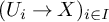 be a finite family of étale morphisms and suppose that it is an étale covering of an open neighbourhood of the support of
${\mathcal F}$
be a finite family of étale morphisms and suppose that it is an étale covering of an open neighbourhood of the support of
${\mathcal F}$
 . Then the following conditions are equivalent:
(1)
${\mathcal F}$
 is holonomic.
(2)
${\mathcal F}_{U_i}$
 is holonomic for every
$i\in I$
is holonomic for every
$i\in I$
 .
.
3. Let
$i\colon X\to P$
 be a closed immersion of smooth schemes over k. Then, the following conditions are equivalent:
(1)
${\mathcal F}$
 is holonomic.
(2)
$i_*{\mathcal F}$
 is holonomic.
4. Let
${\mathcal F}'\to {\mathcal F}\to {\mathcal F}"\to $
 be a distinguished triangle of sheaves on X. If
${\mathcal F}$
be a distinguished triangle of sheaves on X. If
${\mathcal F}$
 and
${\mathcal F}'$
and
${\mathcal F}'$
 are holonomic, then
${\mathcal F}"$
are holonomic, then
${\mathcal F}"$
 is holonomic.
Proof. 1. There exists a dense open scheme
$U\subset X$
 such that
${\mathcal F}_U$
such that
${\mathcal F}_U$
 is micro supported on the
$0$
is micro supported on the
$0$
 -section by Lemma 2.1 and an easy case of Lemma 4.7.1. By Lemma 4.5.1 (1)
$\Rightarrow $
-section by Lemma 2.1 and an easy case of Lemma 4.7.1. By Lemma 4.5.1 (1)
$\Rightarrow $
 (2),
${\mathcal F}_U$
(2),
${\mathcal F}_U$
 is locally constant.
2. By Lemma 4.8.1, we may assume that
$(U_i\to X)_{i\in I}$
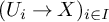 is an étale covering.
(1)
$\Rightarrow $
 (2): If
${\mathcal F}$
(2): If
${\mathcal F}$
 is micro supported on
$C\subset T^*X$
is micro supported on
$C\subset T^*X$
 and if
$\dim C\leqq \dim X$
and if
$\dim C\leqq \dim X$
 , then
${\mathcal F}_{U_i}$
, then
${\mathcal F}_{U_i}$
 is micro supported on
$C_{U_i}\subset T^*U_i$
is micro supported on
$C_{U_i}\subset T^*U_i$
 by Lemma 4.7.1 and
$\dim C_{U_i}\leqq \dim U_i$
by Lemma 4.7.1 and
$\dim C_{U_i}\leqq \dim U_i$
 for every
$i\in I$
for every
$i\in I$
 .
.
(2)
$\Rightarrow $
 (1): Suppose
${\mathcal F}_{U_i}$
(1): Suppose
${\mathcal F}_{U_i}$
 is micro supported on
$C_i\subset T^*U_i$
is micro supported on
$C_i\subset T^*U_i$
 and
$\dim C_i\leqq \dim U_i$
and
$\dim C_i\leqq \dim U_i$
 for every
$i\in I$
for every
$i\in I$
 . Then,
${\mathcal F}$
. Then,
${\mathcal F}$
 is micro supported on
$C=\overline {\bigcup _{i\in I}\mathrm {Im}(C_i)} \subset T^*X$
is micro supported on
$C=\overline {\bigcup _{i\in I}\mathrm {Im}(C_i)} \subset T^*X$
 by Lemma 4.7.2. Since I is finite, we have
$C = \bigcup _{i\in I}\overline {\mathrm {Im}(C_i)}$
by Lemma 4.7.2. Since I is finite, we have
$C = \bigcup _{i\in I}\overline {\mathrm {Im}(C_i)}$
 and
$\dim C =\max _{i\in I}\dim C_i\leqq \dim X$
and
$\dim C =\max _{i\in I}\dim C_i\leqq \dim X$
 .
.
3. (1)
$\Rightarrow $
 (2): If
${\mathcal F}$
(2): If
${\mathcal F}$
 is micro supported on
$C\subset T^*X$
is micro supported on
$C\subset T^*X$
 and if
$\dim C\leqq \dim X$
and if
$\dim C\leqq \dim X$
 , then
$i_*{\mathcal F}$
, then
$i_*{\mathcal F}$
 is micro supported on
$i_\circ C\subset T^*P$
is micro supported on
$i_\circ C\subset T^*P$
 by Lemma 4.8.3 and
$\dim i_\circ C\leqq \dim P$
by Lemma 4.8.3 and
$\dim i_\circ C\leqq \dim P$
 .
.
(2)
$\Rightarrow $
 (1): Suppose that the singular support
$C_P=SS i_*{\mathcal F}$
(1): Suppose that the singular support
$C_P=SS i_*{\mathcal F}$
 satisfies
$\dim C_P\leqq \dim P$
satisfies
$\dim C_P\leqq \dim P$
 . By Lemma 5.3.2, the singular support
$C=SS{\mathcal F}$
. By Lemma 5.3.2, the singular support
$C=SS{\mathcal F}$
 exists and
$C_P=i_\circ C$
exists and
$C_P=i_\circ C$
 . Hence, we have
$\dim C=\dim C_P-\mathrm {codim}_PX \leqq \dim X$
. Hence, we have
$\dim C=\dim C_P-\mathrm {codim}_PX \leqq \dim X$
 .
.
4. Suppose that
${\mathcal F}$
 and
${\mathcal F}'$
and
${\mathcal F}'$
 are micro supported on C and
$C'$
are micro supported on C and
$C'$
 respectively and that
$\dim C,\dim C'\leqq \dim X$
respectively and that
$\dim C,\dim C'\leqq \dim X$
 . By Lemma 4.6,
${\mathcal F}"$
. By Lemma 4.6,
${\mathcal F}"$
 is micro supported on
$C"=C\cup C'$
is micro supported on
$C"=C\cup C'$
 and we have
$\dim C"\leqq \dim X$
and we have
$\dim C"\leqq \dim X$
 .
.
Theorem 5.13 states that every constructible sheaf is holonomic as the title of the article [Reference Beilinson3] says. We have a partial converse.
Theorem 6.3. Let X be a smooth scheme of finite type over a field k and
${\mathcal F}$
 be a sheaf on X. If
${\mathcal F}$
be a sheaf on X. If
${\mathcal F}$
 is holonomic, then
${\mathcal F}$
is holonomic, then
${\mathcal F}$
 is constructible.
Without condition (2) in Definition 6.1, we have an obvious counterexample where
$X=\mathrm {Spec}\, k$
 . Condition (2) is not enough for the converse since
${\mathcal F}=\bigoplus _{x: \mathrm {closed\ points\ of}\ X} \Lambda _x$
. Condition (2) is not enough for the converse since
${\mathcal F}=\bigoplus _{x: \mathrm {closed\ points\ of}\ X} \Lambda _x$
 satisfies (2) but its micro support is the whole
$T^*X$
satisfies (2) but its micro support is the whole
$T^*X$
 .
.
Proof. We prove the theorem first assuming that k is perfect by induction on
$\dim X$
 . If
$X=\varnothing $
. If
$X=\varnothing $
 , the assertion is clear. By Lemma 6.2.1, the largest open subset
$U\subset X$
, the assertion is clear. By Lemma 6.2.1, the largest open subset
$U\subset X$
 on which
${\mathcal F}$
on which
${\mathcal F}$
 is constructible is nonempty. To prove the equality
$X=U$
is constructible is nonempty. To prove the equality
$X=U$
 by contradiction, we assume that the complement
 is not empty. Since k is assumed perfect, after shrinking X if necessary, we may assume that Z is smooth over k.
Let
$j\colon U\to X$
 be the open immersion,
$i\colon Z\to X$
be the open immersion,
$i\colon Z\to X$
 be the closed immersion and consider the distinguished triangle
$j_!j^*{\mathcal F}\to {\mathcal F} \to i_*i^*{\mathcal F}\to $
be the closed immersion and consider the distinguished triangle
$j_!j^*{\mathcal F}\to {\mathcal F} \to i_*i^*{\mathcal F}\to $
 . Since
$j_!j^*{\mathcal F}$
. Since
$j_!j^*{\mathcal F}$
 is constructible, it suffices to show that
$i_*i^*{\mathcal F}$
is constructible, it suffices to show that
$i_*i^*{\mathcal F}$
 is constructible. By Theorem 5.13,
$j_!j^*{\mathcal F}$
is constructible. By Theorem 5.13,
$j_!j^*{\mathcal F}$
 is holonomic. Hence by Lemma 6.2.4,
$i_*i^*{\mathcal F}$
is holonomic. Hence by Lemma 6.2.4,
$i_*i^*{\mathcal F}$
 is also holonomic. Since replacing
${\mathcal F}$
is also holonomic. Since replacing
${\mathcal F}$
 by
$i_*i^*{\mathcal F}$
by
$i_*i^*{\mathcal F}$
 does not change U, we may assume that
${\mathcal F}=i_*{\mathcal F}_Z$
does not change U, we may assume that
${\mathcal F}=i_*{\mathcal F}_Z$
 for
${\mathcal F}_Z=i^*{\mathcal F}$
for
${\mathcal F}_Z=i^*{\mathcal F}$
 . Since
$i_*{\mathcal F}_Z$
. Since
$i_*{\mathcal F}_Z$
 is holonomic,
${\mathcal F}_Z$
is holonomic,
${\mathcal F}_Z$
 is also holonomic by Lemma 6.2.3. Since
$\dim Z<\dim X$
is also holonomic by Lemma 6.2.3. Since
$\dim Z<\dim X$
 ,
${\mathcal F}_Z$
,
${\mathcal F}_Z$
 is constructible. This contradicts the assumption that U is the largest.
We show the general case. Let
$k'$
 be a perfect closure of k. Then, by Corollary 5.12, the pull-back
${\mathcal F}'$
be a perfect closure of k. Then, by Corollary 5.12, the pull-back
${\mathcal F}'$
 on the base change
$X_{k'}$
on the base change
$X_{k'}$
 is holonomic. Hence by the perfect case,
${\mathcal F}'$
is holonomic. Hence by the perfect case,
${\mathcal F}'$
 is constructible. Since the canonical morphism
$X_{k'}\to X$
is constructible. Since the canonical morphism
$X_{k'}\to X$
 is a homeomorphism,
${\mathcal F}$
is a homeomorphism,
${\mathcal F}$
 is also constructible.
We may extend Definition 6.1 to sheaves on singular schemes as follows.
Lemma 6.4. Let X be a scheme of finite type over a field k and
${\mathcal F}$
 be a sheaf on X.
1. Let
$i\colon X\to P$
 and
$i'\colon X\to Q$
and
$i'\colon X\to Q$
 be closed immersions to smooth schemes over k. Then, the following conditions are equivalent:
(1)
$i_*{\mathcal F}$
 is holonomic.
(2)
$i^{\prime }_*{\mathcal F}$
 is holonomic.
2. The following conditions are equivalent:
(1) For every étale morphism
$U\to X$
 and every closed immersion
$i\colon U\to P$
and every closed immersion
$i\colon U\to P$
 to a smooth scheme over k,
$i_*({\mathcal F}|_U)$
to a smooth scheme over k,
$i_*({\mathcal F}|_U)$
 is holonomic.
(2) There exists an étale covering
$(U_j\to X)_{j\in J}$
 and a family of closed immersions
$i^{\prime }_j\colon U_j\to Q_j$
and a family of closed immersions
$i^{\prime }_j\colon U_j\to Q_j$
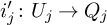 to smooth schemes over k, such that
$i^{\prime }_{j*}({\mathcal F}|_{U_j})$
to smooth schemes over k, such that
$i^{\prime }_{j*}({\mathcal F}|_{U_j})$
 is holonomic for every j.
Proof. 1. It suffices to show (1)
$\Rightarrow $
 (2). By replacing Q by
$P\times Q$
(2). By replacing Q by
$P\times Q$
 , we may assume that there exists a smooth morphism
$Q\to P$
, we may assume that there exists a smooth morphism
$Q\to P$
 compatible with i and
$i'$
compatible with i and
$i'$
 . Since
$i'$
. Since
$i'$
 induces a section of a smooth morphism
$Q\times _PX\to X$
induces a section of a smooth morphism
$Q\times _PX\to X$
 and since the question is local on X by Lemma 6.2.2, we may assume that there exists a closed subscheme
$Q'$
and since the question is local on X by Lemma 6.2.2, we may assume that there exists a closed subscheme
$Q'$
 of Q containing X and étale over P by [Reference Grothendieck6, Chapitre 0IV (15.1.16) a)⇔c)] and [Reference Grothendieck6, Théorème (17.6.1) a)⇔c′)]. By Lemma 6.2.3, replacing Q by
$Q'$
of Q containing X and étale over P by [Reference Grothendieck6, Chapitre 0IV (15.1.16) a)⇔c)] and [Reference Grothendieck6, Théorème (17.6.1) a)⇔c′)]. By Lemma 6.2.3, replacing Q by
$Q'$
 , we may assume that there exists an étale morphism
$h\colon Q\to P$
, we may assume that there exists an étale morphism
$h\colon Q\to P$
 compatible with i and
$i'$
compatible with i and
$i'$
 . Since
$X\to Q$
. Since
$X\to Q$
 induces an open immersion
$X\to X\times _PQ$
induces an open immersion
$X\to X\times _PQ$
 , after shrinking Q, we may assume that
$X\to X\times _PQ$
, after shrinking Q, we may assume that
$X\to X\times _PQ$
 is an isomorphism. If
$i_*{\mathcal F}$
is an isomorphism. If
$i_*{\mathcal F}$
 is micro supported on
$C\subset T^*P$
is micro supported on
$C\subset T^*P$
 and
$\dim C\leqq \dim P$
and
$\dim C\leqq \dim P$
 , then
$i^{\prime }_*{\mathcal F}$
, then
$i^{\prime }_*{\mathcal F}$
 is micro supported on
$h^*C\subset T^*Q$
is micro supported on
$h^*C\subset T^*Q$
 by Lemma 4.7.1 and
$\dim h^*C =\dim C\leqq \dim P=\dim Q$
by Lemma 4.7.1 and
$\dim h^*C =\dim C\leqq \dim P=\dim Q$
 .
.
2. The implication (1)
$\Rightarrow $
 (2) is clear.
(2)
$\Rightarrow $
 (1): Since X is quasi-compact, we may assume that J is finite. By [Reference Grothendieck6, Corollaire (18.4.7)], for each
$j\in J$
(1): Since X is quasi-compact, we may assume that J is finite. By [Reference Grothendieck6, Corollaire (18.4.7)], for each
$j\in J$
 , there exist an open covering
$(U_{jh}\to U\times _XU_j)_{h\in H_j}$
, there exist an open covering
$(U_{jh}\to U\times _XU_j)_{h\in H_j}$
 , closed immersions
$i_{jh}\colon U_{jh}\to P_{jh}$
, closed immersions
$i_{jh}\colon U_{jh}\to P_{jh}$
 to schemes étale over P and closed immersions
$i^{\prime }_{jh}\colon U_{jh}\to Q_{jh}$
to schemes étale over P and closed immersions
$i^{\prime }_{jh}\colon U_{jh}\to Q_{jh}$
 to schemes étale over
$Q_j$
to schemes étale over
$Q_j$
 . Then since
$U_{jh}\to U_j\times _{Q_j}Q_{jh}$
. Then since
$U_{jh}\to U_j\times _{Q_j}Q_{jh}$
 is an open and closed immersion,
$i^{\prime }_{jh*}({\mathcal F}|_{U_{jh}})$
is an open and closed immersion,
$i^{\prime }_{jh*}({\mathcal F}|_{U_{jh}})$
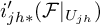 is holonomic for every
$j,h$
is holonomic for every
$j,h$
 by Lemma 6.2.2. Hence
$i_{jh*}({\mathcal F}|_{U_{jh}})$
by Lemma 6.2.2. Hence
$i_{jh*}({\mathcal F}|_{U_{jh}})$
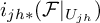 is also holonomic by 1. Since
$(P_{jh}\to P)_{j\in J,h\in H_j}$
is also holonomic by 1. Since
$(P_{jh}\to P)_{j\in J,h\in H_j}$
 is an étale covering of the support of an open neighbourhood of the image
$i(U)$
is an étale covering of the support of an open neighbourhood of the image
$i(U)$
 ,
$i_*({\mathcal F}|_U)$
,
$i_*({\mathcal F}|_U)$
 is holonomic by Lemma 6.2.2.
Definition 6.5. Let
${\mathcal F}$
 be a sheaf on a scheme X of finite type over a field k. We say that
${\mathcal F}$
be a sheaf on a scheme X of finite type over a field k. We say that
${\mathcal F}$
 is holonomic if the equivalent conditions in Lemma 6.4.2 are satisfied.
Proposition 6.6. Let
${\mathcal F}$
 be a sheaf on a scheme X of finite type over a field k. Then, the following conditions are equivalent:
(1)
${\mathcal F}$
 is constructible.
(2)
${\mathcal F}$
 is holonomic.
Proof. Since the question is local on X, we may assume that there exists a closed immersion
$i\colon X\to P$
 to a smooth scheme over k. Then
$i_*{\mathcal F}$
to a smooth scheme over k. Then
$i_*{\mathcal F}$
 is constructible if and only if it is holonomic by Theorem 5.13 and Theorem 6.3.
We have the following corollary since the corresponding properties are known for constructible sheaves [Reference Fu5].
Corollary 6.7. Let
${\mathcal F}$
 be a sheaf on a scheme X of finite type over a field k.
1. Let
$f\colon X\to Y$
 be a morphism of schemes of finite type over k. If
${\mathcal F}$
be a morphism of schemes of finite type over k. If
${\mathcal F}$
 is holonomic, then
$f_*{\mathcal F}$
is holonomic, then
$f_*{\mathcal F}$
 is holonomic. Further if f is separated, then
$f_!{\mathcal F}$
is holonomic. Further if f is separated, then
$f_!{\mathcal F}$
 is holonomic.
2. Let
$h\colon W\to X$
 be a morphism of schemes of finite type over k. If
${\mathcal F}$
be a morphism of schemes of finite type over k. If
${\mathcal F}$
 is holonomic, then
$h^*{\mathcal F}$
is holonomic, then
$h^*{\mathcal F}$
 is holonomic. Further if h is separated, then
$h^!{\mathcal F}$
is holonomic. Further if h is separated, then
$h^!{\mathcal F}$
 is holonomic.
Competing interests
The authors declare none.
Data availability statement
None.


 Open access

