




Introduction
The on-going Russo-Ukrainian war has resulted in a renewed global interest in the safety and security of the Nordic and Baltic states. Finland being a new member and Sweden being a prospective member of the North Atlantic Treaty Organization (NATO; Brussels, Belgium) may drastically change the regional military and political landscape.
Geographically and historically, there are both similarities and differences between the Nordic (Denmark, Finland, Iceland, Norway, and Sweden) and Baltic (Estland, Latvia, and Lithuania) states. 1–3
The first and second World Wars affected the individual countries differently, but the Nordic countries continued to share much of the social and economic development after 1945. The Baltic countries were occupied by the Soviet Union until 1991, when the Nordic-Baltic relations again intensified. 4
The past 20 years have seen growing differences within the region with regards to social inequality, migration, and trends in certain types of violent crime. In this aspect, Sweden has had a quicker increase in income inequality, together with a considerably higher migration, and the highest rate of crime-related shootings and bombings. 5–7
Climate change and the competition between the Great Powers have put the region in the geopolitical spotlight with hybrid warfare activities. 8
For example, Russia’s annexation of Crimea in 2014 was a trigger that radically changed the perception of security in the Baltic countries. Since then, there rises the future possibility of a hybrid war progressing into conventional war and a repeat of the Crimea scenario throughout the Baltic regions. The threat from Russia’s policy relying upon the strategic concept of rebuilding the sphere of influence in the countries of the former Union of Soviet Socialist Republics is what connects the internal security of many countries. 9,10
The objective of this study was to identify and characterize all documented terrorist attacks in the eight states forming the Nordic-Baltic region as reported to the Global Terrorism Database (GTD) from 1970 through 2020.
Methods
A database search of the GTD was performed by using the Preferred Reporting Items for Systematic Reviews and Meta-Analyses (PRISMA) standard. Reference Moher, Liberati, Tetzlaff, Altman and PRISMA11
The GTD is an open-source database containing over 209,000 global terrorism incidents that occurred in the period from 1970-2020. The GTD is maintained by the National Consortium for the Study of Terrorism and Responses to Terrorism (START) at the University of Maryland (Baltimore, Maryland USA). 12,13
The GTD defines a terrorist attack as follows: “The threatened or actual use of illegal force and violence by a non-state actor to attain a political, economic, religious, or social goal through fear, coercion, or intimidation.” 12
To be considered for inclusion in the GTD, the following three attributes must all be present:
-
1. The incident must be intentional;
-
2. The incident must entail some level of violence or immediate threat of violence; and
-
3. The perpetrators of the incidents must be subnational (ie, state terrorism is not included).
Additionally, to be included in the database, two out of three of the following criteria must be present:
-
1. The act must be aimed at attaining a political, economic, religious, or social goal;
-
2. There must be evidence of an intention to coerce, intimidate, or convey some other message to a larger audience than the immediate victims; and/or
-
3. The action must be outside the context of legitimate warfare activities.
An extensive description of their origin and the data collection methodology can be found in the GTD codebook on the START web site. 12,13
The full dataset of the GTD was searched for terrorist attacks that occurred in Denmark, Estonia, Finland, Iceland, Latvia, Lithuania, Norway, and Sweden: the so-called Nordic-Baltic Eight. The Faroe Islands are not listed in the GTD. As the Baltic states only proclaimed and gained independence in September 1991, incidents prior to this date are lacking. The authors searched for incidents in the capitals of the three Baltic states prior to independence, but likewise, there were no extra entries. Due to the loss of index cards from 1993 in the GTD database, the full data of incidents from this year are unavailable. However, country-level statistics for 1993, including the number of incidents, the number of fatalities, and the number of injuries, are available in the appendix of the GTD Codebook. 13
Cases in which there was insufficient information on the number of fatalities/injured and/or the target type were further explored using reviews of gray literature. Even if this resulted in no extra information on casualty number, it was decided to include the incidents as there was still information about the types of targets, perpetrator, attack, and/or weapon.
Finally, incidents coded as “Doubt Terrorism Proper” were excluded. 13
Data collected per incident included temporal and spatial factors, location (country, world region), type of target, attack and weapon type, perpetrator type, number of casualties, and value of property damage.
Each entry was reviewed manually by the lead researcher (HDC) for inclusion or exclusion. A second author (DB) reviewed each entry, as well as the excluded incidents. In case of doubt or discrepancies, a third and fourth author (LM/DT) advised on the final decision. All collected data were exported into Excel spreadsheets (Microsoft Corporation; Redmond, Washington USA) and analyzed descriptively. Chi-squared tests were applied to evaluate the trends of incidents over time and the differences in casualties, conducted with a significance level of P <.05.
Results
From 1970 through 2020, the GTD contained 286 incidents that occurred in one of the eight Nordic-Baltic states. After manual review of the incidents, 14 incidents that were probably not terrorism-related and one duplicate were excluded. An additional 27 entries were found in the separate list of incidents that happened in 1993, available in the GTD Codebook. A final number of 298 incidents was considered eligible for further analysis (Table 1).
PRISMA Selection of Incidents in the GTD, Two Exclusion Steps, and Final Set of Entries from 1993 from a Separate List in the GTD Codebook

Abbreviations: PRISMA, Preferred Reporting Items for Systematic Reviews and Meta-Analyses; GTD, Global Terrorism Database.
Events per Country
With 149 (50%) out of 271 attacks, the most frequently affected country was Sweden (Table 1). Denmark ranked second with 47 (15.8%) attacks, followed by Norway with 27 (9.0%) attacks (Table 1), all Nordic states. The total number of incidents that occurred in the Nordic states was 250. The three Baltic states accounted for only 48 terrorist incidents.
Events per Year and Decade
The number of incidents per year are shown in Figure 1. The years with the most incidents were, in declining order, 2015 (n = 49), 1993 (n = 27), 1992 (n = 24), 2017 (n = 22), and 2016 (n = 19).
Number of Incidents per Year from 1970 through 2020.
Note: There were no registered incidents in 1970.

There was a distinct pattern between the Nordic and Baltic states. Because the Baltic states have only been independent since 1991, there were no entries for the first two decades. In these countries, most incidents were registered in the nineties. This contrasts with the Nordic states where most incidents occurred in the last decade (2011-2020), 2015 through 2017 being the most eventful (Table 2; Figure 1). The highest number of attacks per year in one country was observed in Sweden in 2015 (n = 35), dominated by a series of attacks against immigrants or (planned) facilities for housing refugees.
Number of Terrorist Attacks per Decade and per Country
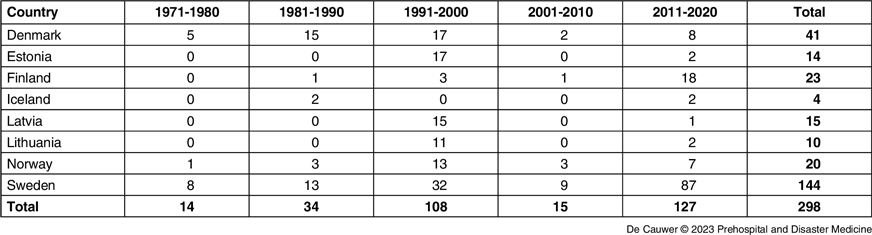
A chi-square test to evaluate the difference in the number of attacks per decade showed a significant difference in the number of attacks: X 2 = 1002; P <.00001 (Appendix A).
Number of Victims
During the five decades of this analysis, 298 incidents resulted in 113 fatalities and 277 injuries. Four perpetrators were killed during an incident, and three other assailants were injured (Table 3). The two incidents listed in the GTD causing the most casualties occurred the same day in Norway (July 22nd, 2011) when Anders Breivik first lit the fuse in his vehicle-borne improvised explosive device, parked in Oslo, killing eight people and injuring another 15. Afterwards, an even more devastating attack occurred when the same assailant opened fire on a Youth Camp on the Island of Utøya. This second attack caused 69 fatalities, including teenagers. Another 60 people were injured. 14,15
Number of Fatalities and Injured per Country, 1970-2020

Attack Types and Weapon Types
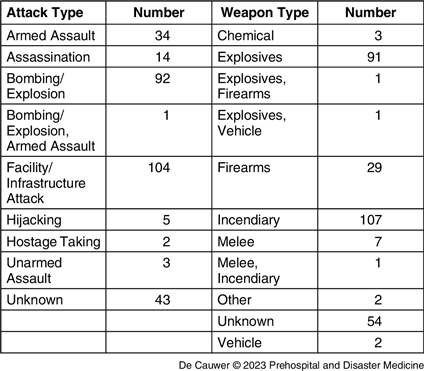
Facility/infrastructure attacks were the most frequently identified attack type (n = 104; 35.0%), followed by bombings and explosions (n = 92; 30.9%); Table 4. As a result of this, the predominant weapon types were incendiary (n = 107; 35.9%), explosives (n = 91; 30.5%), and firearms (n = 29; 9.7%). Other weapon types were less common (Table 4).
Number of Incidents per Attack Type and Weapon Type for All Eight Countries
In only three incidents, chemical poisoning was used. In one attack in Stockholm, Sweden in 1979, the ambassador to Zaire was killed, possibly by political enemies of the ambassador, who was the brother of Zaire’s President Mobutu Sese Seko. 16
Two other attacks – causing no victims - were related to the Jaffa orange poisoning with mercury, where ultimately 31 poisoned oranges were found in six European countries. The attack was claimed in the name of the Arab Revolutionary Army, a pro-Palestine terror group. 17–19
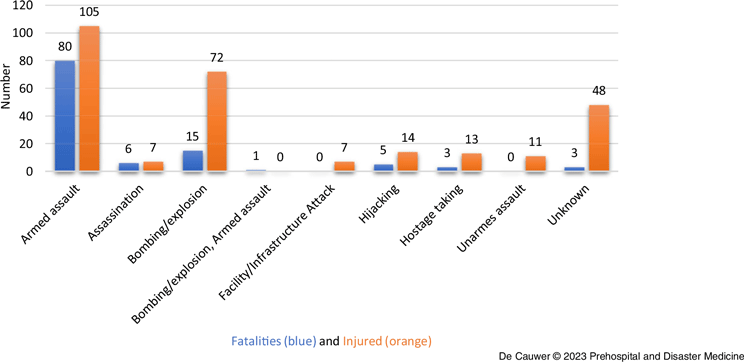
Armed assaults were responsible for most of the casualties, followed by bombings/explosions (Figure 2). The number of casualties per weapon type correlated with the attack type: the use of firearms caused the most casualties, while explosives caused the second highest human toll (Figure 3). As previously mentioned, in the Utøya armed assault type attack, firearms were used causing an unprecedented number of casualties in the Nordic-Baltic states.
Fatalities and Injured per Attack Type.
Fatalities and Injured per Weapon Type.

Target Type and Perpetrator Type
In this series, very different factions were active, aiming at different targets (Table 5). Private citizens and property were the most frequent target, followed by governmental targets, both diplomatic and general, religious figures/institutions, and business. Other target types were less frequent (Table 5).
Target Type and Perpetrator Type
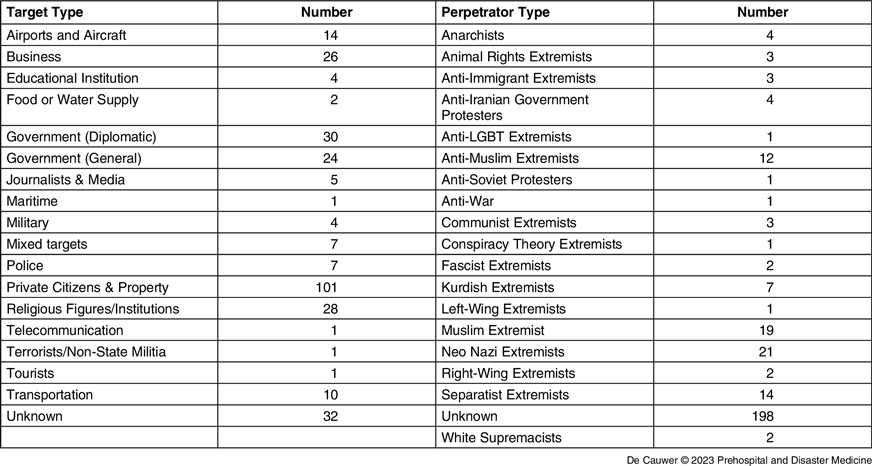
Abbreviation: LGBT, lesbian, gay, bisexual, and transgender.
Further manual analyses of the targets revealed that 29 houses of worship were attacked. Diplomatic targets consisted mainly of embassies.
The predominant targets were immigrants and refugee shelters (n = 64 incidents). Thirteen entries were from politicians and political parties. Two cartoonists and one writer were targeted.
Foreign targets listed in this series represented Jewish, Turkish, Kurdish, British, Iranian, American, and German assets.
Telecommunication masts were the newest target in 2020 as revealed in an earlier study on COVID-19-related terrorist attacks. Reference De Cauwer, Barten and Tin20 In this series, only one such an attack in Finland, probably related to a conspiracy theory regarding the link between 5G radio waves and the COVID-19 pandemic, was listed.
In this series, only one hospital was targeted. In fact, in 1987, a lone wolf detonated one pipe bomb in the basement of Glostrup Hospital, and police removed a non-detonated bomb in Herlev Hospital, Denmark. 21
Various perpetrator groups and concomitant motives were mentioned in the GTD. These are listed in Table 5. Unfortunately, in 198 (66.4%) incidents, perpetrators were unknown.
Right-wing assailants were predominant in those incidents a perpetrator was registered, and accounted for 27 incidents: 19 in Sweden, five in Norway, two in Latvia, and one in Lithuania. Muslim extremists were active in Sweden (nine incidents), Denmark (six incidents), Norway (three incidents), and Lithuania (one incident). Kurdish extremists were active in Norway, Sweden, Denmark, and Finland, and mainly targeted Turkish assets/embassies. Anarchists were only active in Norway in 1995 in a series of four incidents. The three attacks by animal rights extremists occurred in Sweden, Finland, and Iceland.
Of these attacks of different perpetrator types, 36 attacks were carried out by lone actors.
Discussion
The Nordic-Baltic Eight score low on the 2021 Global Terrorism Index (GTI). The GTI is a composite measure made up of four indicators: incidents, fatalities, injuries, and property damage. World-wide, Afghanistan (9.11) and Iraq (8.51) have the top scores. In Europe, Greece, the United Kingdom, Germany, France, and Russia show the highest scores (all >4.0). Of the Nordic-Baltic Eight, Sweden (1.66), Norway (1.11), and Finland (1.01) have the highest scores, followed by Lithuania (0.83) and Denmark (0.29). Three Nordic-Baltic states even have a score of 0.0 (Estonia, Latvia, and Iceland). 22
The three Baltic states share a tumultuous history of being occupied by other nations, declaring independence after the first World War, and being re-occupied by the Soviet Union following the second World War until September 1991. The absence of registered incidents in these countries in the first two decades of the GTD listings could be a result of lower press freedom and open reporting of incidents during Russian government. An analogue study on Eastern European terrorism faced the same difficulties, as all information contained in the GTD reflects what is reported in multiple independent open-access sources. Reference Tin, Barten, Goniewicz, Burkle and Ciottone23
In the Baltic states, terrorist activity declined in the last two decades, resulting in the current low scores on the GTI.
The 2011 Norway attacks, which killed 77 victims, is considered by many to be a turning point in the resurgence of white supremacy terrorism in Western countries. Reference Tin, Barten, De Cauwer, Mortelmans and Ciottone24
The Nordic states are no exception to this. Even more, right-wing assailants play an important role in this series. Immigrants and refugee shelters (n = 64 incidents) were a major target type.
In 2022, the yearly terror threat assessment from Nationellt Centrum för Terrorhotbedömning ([National Center for Terror Threat Analysis] NCT) in Sweden showed that the major threats were from right-wing and Islamic extremists. The report also stated that the risk of terror attacks may increase due to the increasing polarization in society.
There is greater diversity in Sweden compared to other included countries. Mass refugees have been welcomed to Sweden already in the seventies from Vietnam, the eighties from Chile, the nineties from former Yugoslavia, and in 2015 from Afghanistan.
Mass migration in the nineties created violence between the same nationals and also reactions from right-wing factions. The migration of a massive group of young Afghanis in 2015 was the second largest in Europe after Germany (around 150,000 persons). This also created open discussion among people and promoted a new right-wing party in the parliament.
Not surprisingly, in Sweden, 2015 ranked sky high in the GTD by a series of attacks against immigrants or (planned) facilities for housing refugees.
In tandem with this trend, there has been growing social inequality, and during the last decade, a dramatic increase in certain types of violent crime like shootings and bombings. The NCT report also mentions the risk of terror attacks within the hybrid warfare paradigm in Sweden.
An interesting fact is that Sweden has by far the most people travelling to join Jihadi terrorist groups from 2012-2016. It is estimated that this also relates to large immigration from the Middle East and Africa in the past two decades. On the other hand, a Jihadi-inspired lone actor killed five and injured 14 in a vehicle attack in central Stockholm in 2017. 6,7,25
During Christmas time in 2010, Sweden also saw an Islamic terrorist attack in the form of a suicide bomber in central Stockholm. The suicide bomber only killed himself, but according to experts from the United States Federal Bureau of Investigation (FBI; Washington, DC USA), the bomb had the potential to kill at least 40 people. 26
Looking at the results of the terrorism index of other countries, the common point is the diversity in people, culture, and religion. Diversity and an increasing number of refugees in an economically severe situation create a fertile soil for all kinds of extremism, both right-wing and Islamic. It also opens up for influence of other states within the hybrid warfare paradigm. 5,8,9,Reference Bornschier, Fuchs and Klingemann27–Reference Boreus, Wodak, KhosraviNik and Mral29 Although the Nordic-Baltic Eight score low on the GTI, prehospital emergency services and emergency departments in this area should closely monitor the changing patterns of target types and perpetrator types. This includes evaluating the internal sociocultural unrest (eg, the development of gun violence among young males in Sweden), and increasing polarization in society with regards to immigration and criminality. Reference Sturup, Rostami and Mondani30
Recent studies revealed a gradual increase in attacks against COVID-19-related and health care-related targets. Reference De Cauwer, Barten and Tin20,Reference Ulmer, Barten and De Cauwer31,Reference McNeilly, Jasani, Cavaliere, Alfalasi and Lawner32
These events, and the apparent increase of secondary attacks aimed at emergency systems, pose a world-wide future risk for Emergency Medical Service systems and hospitals. Reference Schmeitz, Barten and van Barneveld33
External risks also require equal attention (eg, the Russian hybrid war, the fake news, anti-government and anti-science narrative, and the rising concerns of cyberattacks against hospitals). Counter-Terrorism Medicine will gain influence and importance, as the threats show a steady uptrend. Reference Granholm, Tin and Ciottone34–37
Limitations
The GTD is the most comprehensive, up-to-date, open access, and reliable database of terrorist incidents. Reference Ritchie, Hassel, Appel and Roser38
The database, and therefore also this study, are however subject to several limitations. The data of events in the earlier decades are not complete and under-reported in the period from 1970-1989. 13,Reference de Almeida and von Schreeb39 The rise in the number of attacks since 2000 could be partly explained by this.
The loss of data in 1993 has no significant role on the results of this series for the Nordic states. As the nineties were roaring in the Baltic states, that gained independency just at the start of the decade, the loss of data from 1993 could be worse as it most likely lacks a number of incidents. The unavailability of data prior to 1991 from the Baltic states was already discussed earlier.
All information contained in the GTD reflects what is reported in multiple independent open-access sources. Therefore, not all incidents may be included in the GTD. Only high-quality sources are used. This creates a possible selection bias and is no guarantee as what the validity of the database information is concerned. 12,13
Furthermore, an under-estimation of the consequences of a terrorist incident might result from the GTD’s standard practice to report the lowest number of casualties when news articles provide conflicting information. 13
Trends over time should be interpreted with caution because of these limitations. 13
Conversely, the GTD is a key source for global data on terrorism incidents and is evaluated as the most complete record of terrorist attacks in recent decades. Reference Ritchie, Hassel, Appel and Roser38
Attempted but unsuccessful attacks are included in the GTD. However, threats, conspiracies, or the planning of attacks are not. State terrorism, although showing an increase in recent years, is not listed in the GTD. Reference De Cauwer and Somville36
Conclusion
Terrorist attacks in the Nordic-Baltic Eight are less frequent than in other countries or regions. Sweden accounted for the majority of terrorist attacks (50%). Every country had its own unique incident characteristics, related to the sociocultural, geographical, and political history, evolving during the 51-year period of this study sample, with serious turmoil in the early nineties in the Baltic states and the rise of right-wing extremism in the Nordic states. It is anticipated that the number of public health emergencies will increase due to climate change, regional wars, and mass migration.
Conflicts of interest/funding
The author(s) declare none. The authors state no financial disclosure.
Appendix A. Number of Incidents per Decade, 1971-2020.

Note: The result is significant at P <.05.


 Open access

