


Introduction
The welfare state is one of the most profoundly transforming institutions of modern industrial democracies, with social investment policies changing both the nature and principal recipients of state assistance (Garritzmann et al. Reference Garritzmann, Busemeyer and Neimanns2018). The inclusion of family and care policies into the welfare state raises a question of how widespread – and/or gendered – is support for social provision. This paper argues that the answer to this question depends – at least partly – on whether one is a parent or not, and whether one is a mother or a father.
Current scholarship offers increasing evidence that parents differ from people without children regarding their social policy attitudes (Banducci et al. Reference Banducci, Elder, Greene and Stevens2016; Busemeyer & Neimanns Reference Busemeyer and Neimanns2017; Eagly et al. Reference Eagly, Beall and Sternberg2004; Elder & Greene Reference Elder and Greene2006, Reference Elder and Greene2007, Reference Elder and Greene2011, Reference Elder and Greene2012). Mothers, in comparison to fathers and individuals without children, are consistently more supportive of the welfare state, while the evidence of fathers’ social policy attitudes differing from men without children is more contested (Banducci et al. Reference Banducci, Elder, Greene and Stevens2016; Elder & Greene Reference Elder and Greene2006, Reference Elder and Greene2007, Reference Elder and Greene2011, Reference Elder and Greene2012). Yet the exact relationship between parenthood and support for social policies has been difficult to fully establish, because it can vary across genders, specific welfare policy areas and the age of the children. Furthermore, as past conclusions are all drawn from studies covering one point in time, it has been difficult to draw causal inferences about the possible dynamic effects that having children has on individuals’ policy preferences. Similarly, cross‐sectional design has prevented past studies from examining individual‐level change over time, nor have most studies been able to account for the age of the children.
This paper takes a dynamic approach by examining the effect of parenthood on attitudes towards welfare state spending across two waves of panel data from the Swiss Household Panel Study. The time sensitive method allows us not only to address the issue of endogeneity but also to explore whether the impact parenthood has on individuals’ social policy attitudes is linear and/or stable over time. We argue that the varying stages of parenthood – measured by the age of the child – are likely to expose parents to different experiences, social networks and information – all of which can impact their policy preferences. Due to the gendered nature of parenthood and to contribute to the existing literature on gender, parenthood and the welfare state (Banducci et al. Reference Banducci, Elder, Greene and Stevens2016; Elder & Greene Reference Elder and Greene2006, Reference Elder and Greene2007, Reference Elder and Greene2012), we also explore differences in attitude change and policy preferences between women and men.
We ground our empirical analysis on two influential social theories: adult socialisation theory and the theory of self‐interest. Both theories explain change in attitudes as a product of changes in one's life. While adult socialisation theory expects new parents to change their beliefs and attitudes, due to them being socialised into new roles as mothers and fathers (Mortimer & Simmons Reference Mortimer and Simmons1978; Rosow Reference Rosow1974), the rational choice self‐interest perspective assumes the change in attitudes to be driven by change in individuals’ perceived self‐interests (Green & Gerken Reference Green and Gerken1989; Ponza et al. Reference Ponza, Duncan, Corcoran and Groskind1988; Tedin et al. Reference Tedin, Matland and Weiher2001). The fundamental difference between the two theoretical schools is the extent and time dependence of that change. The time and gender sensitive approach, combined with focus on individual policy areas, allows us to empirically assess and compare the strength of these two perspectives.
Overall, we find that becoming a parent increases an individual's support for government spending on day‐care, education, health care and social aid. We also find evidence of a gender gap in attitudinal change as well as in support for social policies. For example, mothers do not only have a higher likelihood to demand additional day‐care spending, in comparison to fathers, but women also change their policy preferences relatively earlier. While support for day‐care provision is the highest among parents of pre‐school children, demands for more spending on education increase as the children grow older. At the same time, parents differ less from non‐parents in their support for other welfare state policies, such as retirement and unemployment benefits. Given the time‐dependent and policy‐specific nature of the attitude change, our results provide more support for self‐interest than adult socialisation theory.
The results hold broad implications for theories of the welfare state and how parenthood and its varying stages – influenced by gendered household and labour market divisions – help explain political attitudes. While social investment policies targeted at parents with young children are, overall, well supported, the fluctuating rates of support to specific social programmes by men and women suggest that parents are not a homogeneous group that parties could target with uniform electoral pledges. As a result, building widespread electoral support for expanding a broad range of social investment policies is likely to be challenging in a context where, first and foremost, self‐interest appears to drive (or depress) individuals’ support for specific policies.
Parenthood and changing attitudes towards social policies
Only a fraction of studies examining social policy preferences focus on change in attitudes. Yet, there are events in one's life that are likely to trigger shifts in policy preferences: having a child is one such change. Becoming a parent does not only involve the learning of and socialisation into a new role, it also entails direct financial, emotional and time commitments (Edin & Kefalas Reference Edin and Kefalas2005; Warren & Tyagi Reference Warren and Tyagi2004). Therefore, it is reasonable to expect that if anything at all could change citizens’ policy preferences, it would be such a profound change in one's life. Moreover, the costs and challenges faced by parents are certain to happen. Due to the magnitude and certainty of change children bring to individuals’ lives, the mechanisms behind parents’ potential attitude changes cannot be explained with one single social theory.
On the one hand, self‐interest theory offers a compelling reasoning for why personal experience may change individuals’ policy preferences. According to this theoretical perspective, citizens’ views on specific policies are derived from an assessment of their self‐interest (Green & Gerken Reference Green and Gerken1989; Ponza et al. Reference Ponza, Duncan, Corcoran and Groskind1988; Tedin et al. Reference Tedin, Matland and Weiher2001), which is likely to be reinforced by one's personal experiences (Egan & Mullin Reference Egan and Mullin2012). Welfare state scholars see self‐interest as the key predictor of support for the welfare state. People who are more likely to depend on welfare state benefits are pro‐welfare state policies, while those who contribute more than receive in benefits are against. Thus, income (Meltzer & Richard Reference Meltzer and Richard1981), social mobility (Benabou & Ok Reference Benabou and Ok2001), social risks (Hacker et al. Reference Hacker, Rehm and Schlesinger2013) and health (Wendt et al. Reference Wendt, Kohl, Mischke and Pfeifer2009) have been found to affect individual support for social provision.
With regard to parenthood, the self‐interest perspective would assume a change in individuals’ policy preferences because, by becoming parents, their interests have changed. Having and raising children adds extra financial burdens and increases the need for additional safety nets (Duff Reference Duff2014; Elder & Greene Reference Elder and Greene2012). Certain social policies, such as subsidised child‐care and maternity/paternity benefits, are directly targeted towards parents of small children. Hence, individuals likely change their opinion about such policies once they anticipate the need for them. But parenthood can make individuals aware of and dependent on a wider set of welfare state provisions, most importantly, access to health care services and education. As such, parents would not only act based on their own self‐interest but also in the interest of their children. Furthermore, if parents’ demands for social intervention are dependent on self‐interest, their support for specific policies should vary in time: demands for more spending on day‐care should go up when parents benefit from that type of social provision and subsequently decrease once their individual need for such services disappears.
Besides the indisputable additional financial and time pressures faced by mothers and fathers, parenthood also involves a unique socialising and learning experience. Adult socialisation theories, therefore, offer further justifications for our expectations. Empirical research presents consistent evidence of how varying experiences in adulthood, such as getting married, entering the labour market and growing older, affect citizens’ attitudes (Andersen & Cook Reference Andersen and Cook1985; Weisberg Reference Weisberg1987). Similarly, becoming a parent is likely to alter one's social networks (Gallagher & Gerstel Reference Gallagher and Gerstel2001; Nomaguchi & Milkie Reference Nomaguchi and Milkie2003), with new mothers and fathers spending more time with other mothers and fathers, compared to people with no children. Through socialisation, new parents learn the role of behaving like mothers and fathers and, at the same time, the group (all parents) conveys the values, norms, beliefs and attitudes, which further group goals, to its members (Mortimer & Simmons Reference Mortimer and Simmons1978; Rosow Reference Rosow1974). Furthermore, parenthood is a prescribed adult role, which is accompanied by a sense of legitimacy, and certain rights and privileges (Sieber Reference Sieber1974). As such, the mechanisms of socialisation can make new parents face both internal and external pressures to adjust their political attitudes in order to fit the prototype of a ‘good parent’. While past research on public perceptions of the relative deservingness of “needy” groups has focused on the elderly, the sick and disabled, the unemployed and immigrants (van Oorschot Reference van Oorschot2006; Jensen & Petersen Reference Jensen and Petersen2017), children and their parents are also likely to be considered both by themselves and by society as relatively deserving of state support. Ultimately, the support for children (and their parents) can be seen as social investment into the future human capital (Garritzmann et al. Reference Garritzmann, Busemeyer and Neimanns2018; Häusermann et al. Reference Häusermann, Kurer and Schwander2016). Therefore, parents may perceive their demands for more social spending not so much as furthering their own self‐interests, but as being good parents looking out for their children.
Importantly, adult socialisation theory assumes the social roles one acquires to have long‐term effects on attitudinal disposition (Gallagher & Gerstel Reference Gallagher and Gerstel2001; Nomaguchi & Milkie Reference Nomaguchi and Milkie2003). As social interaction works via social influence and learning (Kohler et al. Reference Kohler, Behrman and Watkins2001), we argue that the varying stages of parenthood are likely to expose parents to different experiences, social networks and information; all of which could impact their specific policy preferences. For example, young adults without children are reported to have less knowledge of policies related to parental leave, benefits and day‐care provision than young parents (Adams et al. Reference Adams, Snyder and Sandfort2002; Meyers et al. Reference Meyers, Heintze and Wolf2002). Similarly, once the children are close to school age or going to school, parents of children in that age group, compared to other parents and people with no children, likely know more of the shortcomings in school place provisions, curriculum design, etc. Hence, this theory expects a change in an individual's attitudes once the individual is learning and experiencing the new role. While adult socialisation theory, similarly to self‐interest theory, can explain support for specific policy preferences, it does not expect the support to fade away as the direct need for specific policies disappears (Gallagher & Gerstel Reference Gallagher and Gerstel2001; Nomaguchi & Milkie Reference Nomaguchi and Milkie2003).
The elaborations above lead us to hypothesise that (H1) parenthood increases individuals’ demands towards the welfare state. However, there is a slight difference in the way in which the two theoretical approaches explain attitude change towards specific social services and how time‐persistent the change is expected to be. As such, we provide two alternative hypotheses: (H2a) based on self‐interest theory, parenthood increases support for only those policies that are specifically targeted at the child and/or parents and only at times when they directly benefit from it; and (H2b) relying on adult socialisation theory, parenthood increases support for social policies more broadly and the change in attitudes is stable over time.
Motherhood and fatherhood: Varying experience, varying effect?
Attitudes towards social spending and welfare state policies have been characterised by one of the longest‐standing and widest gender gaps (Andersen Reference Andersen, Norrander and Wilcox1997). While the ‘traditional gender gap’ saw women voting to the right of men (Inglehart & Norris Reference Inglehart and Norris2000), increased participation on the labour market and higher risk of divorce have moved women to support activist government across a range of social policies (Iversen & Rosenbluth Reference Iversen and Rosenbluth2006). Past research suggests that mothers, more often than women without children, show higher levels of support towards social policies (Elder & Greene Reference Elder and Greene2006, Reference Elder and Greene2007, Reference Elder and Greene2012). Contrarily, fatherhood is shown to induce more conservative values, especially regarding the role of government and matters of law and order (Elder & Greene Reference Elder and Greene2006, Reference Elder and Greene2007, Reference Elder and Greene2012). Moreover, the impact of children on women's social policy preferences has grown stronger over time (Elder & Greene Reference Elder and Greene2006), contributing to the widening gender gap on policy attitudes (Kaufmann & Petrocik Reference Kaufmann and Petrocik1999; Shapiro & Mahajan Reference Shapiro and Mahajan1986). But which mechanisms explain why parenthood has a varying impact on mothers’ and fathers’ policy positions in a condition where the arrival of a baby should affect the entire household?
We theorise that due to the gendered nature of parenthood, gender difference in the magnitude of attitudinal change is – at least partly – explained by the varying extent to which adult socialisation theory and self‐interest theory explain the shift in women's and men's policy preferences. Despite women's increased labour market participation and the greater sharing of parental responsibilities between men and women, gender differences in child‐caring persist (Musick et al. Reference Musick, Meier and Flood2016; Sayer, et al. Reference Sayer, Bianchi and Robinson2004). Mothers remain the primary caregivers even in families where both parents are in full‐time employment (Bianchi Reference Bianchi2000; Musick et al. Reference Musick, Meier and Flood2016). As such, socialisation into the new role of a parent should be more profound for women than for men. Indeed, feminist socialisation scholars argue that mothering is likely to generate more social attitudes on a range of issues (Deitch Reference Deitch and Mueller1988; Ruddick Reference Ruddick1980, Reference Ruddick1989; Sapiro Reference Sapiro1983; Shapiro & Mahajan Reference Shapiro and Mahajan1986; Welch & Hibbing Reference Welch and Hibbing1992) as well as an impulse to think more about the future (Greenlee Reference Greenlee2014). Therefore, due to the strong socialisation experience, mothers should not only endorse policies that directly increase the well‐being of their children but develop, in general, a more supportive stance towards welfare state interventions. Similarly, the impulse of thinking about the future should manifest in mothers anticipating their children's needs earlier and subsequently changing their attitudes towards social spending before the fathers.
At the same time, being a good father continues to be less associated with direct caring responsibilities. Instead, the gendered societal expectations still imply that fathering mostly entails working outside the home and providing economically for the family (Townsend Reference Townsend2010). These expectations are further reinforced by workplace attitudes resulting in men perceiving a request for leave and/or flexible hours undermining their masculine credibility among managers and co‐workers (Pedulla & Thébaud Reference Pedulla and Thébaud2015; Rudman & Mescher Reference Rudman and Mescher2013; Vandello et al. Reference Vandello, Hettinger, Bosson and Siddiqi2013). This often results in men spending little time with their families, with new fathers sometimes increasing their paid working hours (Burns & Schlozman Reference Burns and Schlozman2001; Lundberg & Rose Reference Lundberg and Rose2002). As a result, most fathers are less exposed to the caring and nurturing role traditionally associated with motherhood and thereby experience weaker socialisation effects compared to their female partners. This means that the argument put forward by adult socialisation theory may be less applicable for men in comparison to women.
The self‐interest perspective likely explains both mothers’ and fathers’ potential attitude changes, albeit in varying ways. As women continue to be more involved in immediate caring responsibilities (Musick et al. Reference Musick, Meier and Flood2016), the state's investment in policies, such as paid maternity leave and subsidised child‐care, designed to ease the time and financial costs of new mothers, are more directly in mothers’ self‐interest. New fathers, at the same time, are less likely to experience the loss of individual income and reduced labour market opportunities (Pedulla & Thébaud Reference Pedulla and Thébaud2015; Rudman & Mescher Reference Rudman and Mescher2013). Although an expanded welfare state should ease the burden of their working wives, men's payslips are diminished by such policies (Iversen & Rosenbluth Reference Iversen and Rosenbluth2006). There is also no evidence from dualisation literature that men would align their policy preferences to maximise overall household welfare (Häusermann et al. Reference Häusermann, Kurer and Schwander2016). Contrarily, as affordable and good quality childcare is designed to benefit women's labour market participation and income – next to tackling early childhood inequalities (Jenson Reference Jenson, Bonoli and Natali2012) – men may perceive these policies as something mostly in the interest of mothers, rather than themselves and their children.
However, as the children grow older, both the societal expectations surrounding ‘good’ motherhood and fatherhood, and the first‐hand experiences with child‐related public services may become more similar. Once mothers return to the labour market, the pressures for fathers to participate in child‐caring responsibilities increase. We argue that this increased involvement provides fathers with additional information of the state of varying services affecting families and children. Furthermore, increased educational spending is an investment solely into the child, rather than also into either of the parent – there is no differential to the extent to which increased educational spending serves mothers’ or fathers’ self‐interest. Therefore, when the child is approaching school age, it is difficult to theorise why changes in welfare state support would be stronger among mothers than fathers, either based on self‐interest or adult socialisation theories.
The theoretical discussion above leads us to hypothesise that (H3) both adult socialisation and self‐interest theories expect there to be a larger gender gap in attitudinal change for care related in comparison to education‐related policies. Regarding the time dependence and time persistence of the attitude change, we hypothesise that (H4) due to stronger socialisation experience, motherhood brings about an earlier and more stable change in women's demand for more welfare state provision than fatherhood does for men.
Research design
We test the hypotheses outlined above in the Swiss context because of the unique availability of individual level longitudinal data. The Swiss Household Panel (SHP) follows the same households and individuals over time since 1999 (Tillmann et al. Reference Tillmann, Voorpostel, Kuhn, Lebert, Ryser, Lipps, Wernli and Antal2016)Footnote 1 and includes questions on attitudes towards government spending on different social programmes, such as child‐care, education, unemployment benefits, health care and overall social spending in 2011 and again in 2014. As most household panel studies do not include questions about citizens’ policy preferences, we are restricted to testing the hypotheses in the Swiss context.
While the Swiss fertility rate at 1.52 children per woman is comparable to the European average (OECD 2014), at the federal level, family policies in Switzerland are more similar to Anglo‐American countries than to most continental EU member states. Swiss federal government expenditure on child‐care and pre‐school programmes, at 0.2 per cent of the GDP, is the lowest in the OECD. Child‐care costs in Switzerland are thus comparable to Luxembourg, the Netherlands, New Zealand, Slovenia, Ireland and the United Kingdom. In all of these countries, the average cost of child‐care for a 2‐year old amounts to more than half of the household income (OECD 2014). In addition, 14‐week paid maternity leave (80 per cent of mother's previous income) – one of the shortest in Europe – was not introduced until 2005, and there is no paternity leave at the federal level (Ray et al. Reference Ray, Gornick and Schmitt2010). The main remedies for combining work and family life is women's part‐time employment (Widmer & Ritschard Reference Widmer and Ritschard2009) and social tax deductions for married couples, single parent families and children (FDF 2016). While women's labour market participation rate of 79 per cent is one of the highest in Europe, 46 per cent of working Swiss women are employed part time, in comparison to 10 per cent of the men (OECD 2017), indicating that the experience of fatherhood is likely to differ from that of motherhood. Moreover, the share of all children born to parents who are not married nor living in a legal partnership is one of the lowest in Europe, at 17 per cent (OECD 2014). Partly reflective of all that is the relatively high average age for first‐time mothers, 30.4, compared to the EU average of 28.7 (Eurostat 2015).
In terms of public spending on education, Switzerland is ranked close to the OECD average with 1.5 per cent of the GDP (OECD 2015). The Swiss federal constitution guarantees 9 years of free compulsory schooling (primary and lower secondary education) for every child, but the funding of education or training in the post‐compulsory education falls on parents’ shoulders.
Common theories of policy attitudes suggest Switzerland to be a most likely case to test attitudinal change due to parenthood. Both the regime hypothesis, which states that social cleavages between beneficiaries and contributors are more pronounced in countries with selective programmes (Esping‐Andersen Reference Esping‐Andersen1990) and the thermostatic model of social policy attitudes – stating that people react thermostatically to government spending asking for more (less) spending when the current level is low (high) (Wlezien Reference Wlezien1995) – would lead us to expect that the low levels of social spending in child‐care and the high fees in post‐compulsory education increase support for further spending among Swiss, especially among parents who are aware of these shortages. These theories suggest that if we do not find any effect of parenthood on social spending in Switzerland, it is unlikely we will find it in other countries. Yet, recent comparative research on social policy presents a different expectation. Busemeyer and Neimanns (Reference Busemeyer and Neimanns2017) show that support for specific policies, such as day‐care, from groups not directly benefitting from them is the lowest if the said service is already well‐funded. As day‐care provision is not well‐funded in Switzerland, Reference Elder and GreeneBusemeyer and Neimann’s (2017) findings would lead us to expect to see smaller differences in policy support dependent on parenthood in Switzerland than in more generous countries in Northern Europe. In terms of gender differences, building on social insurance theory predicting that support for social policies is highest among those who are at risk of needing those social policies (Hacker et al. Reference Hacker, Rehm and Schlesinger2013), we would expect the highest gender difference in attitudinal change in parenthood in countries like Switzerland (see also Banducci et al. Reference Banducci, Elder, Greene and Stevens2016).
Sample
Using the SHP respondents’ answers in the 2011 and 2014 waves, we can estimate how individuals’ policy preferences changed between those two time points. Having data on respondents’ and their household members’ socio‐economic characteristics and life events, we estimate the extent to which parenthood and its different stages account for these changes. This allows us to rule out the possibility that any positive correlation between parenthood and support for social spending is an artefact of self‐selection into parenthood of those with a greater sense of social solidarity.
The sample includes adults who were older than 25 in 2014 – most of who had finished education and had entered the labour market, but younger than 55 – who may have had children but were not yet thinking of retirement. We restrict the sample to respondents who had never had a child and respondents whose first child was born since they were first interviewed by the SHP (since 1999 for SHP I, 2002 for SHP II). The SHP registers each newborn as a new sample member and records their date of birth and their parents. However, not all children born before the parents joined the study are SHP sample members and we cannot accurately identify their date of birth.
The final sample consists of 1,477 unique respondents (3,562 observations) – 758 women and 719 men. Table A1Footnote 2 compares the age and gender distributions in the sample to the ones of the permanent resident population in 2014 (according to the Swiss Federal Statistical OfficeFootnote 3). Women are slightly over‐represented in our sample (51.32 per cent compared to 49.51 per cent in the population). The 50–55 age group is underrepresented, while the 40–44 and 45–49 are slightly over‐represented, for both female and male samples. Overall, women and the 45–49 age group are over‐represented in the new SHP III sample (2013) and in the entire SHP sample (2014). Our sample has a slightly higher average household income than the full SHP III sample in 2014, but the difference is not statistically significant. In terms of employment status, there are almost no differences between the shares of full‐time, part‐time, or unemployed in the two samples (see Table A2). Although these numbers do not confirm that our sample is fully representative of the Swiss population, it shows that it is not biased in terms of the main demographics.
Parenthood
Intensive coding efforts and management of different SHP data files was required to generate the parenthood variable. First, we identified children born in the SHP households and their date of birth. Matching children with their parents, we created parent‐specific variables with the date of birth of each respondent's children. Using these variables, we calculated the number of children each respondent had at the time of the interview and each child's age.Footnote 4 We confirmed our estimates with the SHP‐recorded number of children.
We distinguish between non‐parents, parents‐to‐be and parents. Non‐parents are respondents who never had a child. Parents‐to‐be are respondents who had a child within 2 years after the interview. Parents are respondents who had at least one child born. The age of their first‐born is used to distinguish between different stages of parenthood: (a) 0–2; (b) 3–5; (c) 6–8; (d) 9–11; and (e) 12–14. The final variable is a polychotomous variable with seven categories: 0, non‐parents (the baseline); 1, parents‐to‐be; 2, newborn; 3, kindergarten; 4, early primary school; 5, primary school; 6, lower secondary school.
These stages coincide with different needs and experiences which, we hypothesise, drive changes in social policy preferences. For example, parents who did not have a child in 2011 but had one in 2014, are coded 1 in 2011 and 2 in 2014; thus, measuring the effect of having a baby between the two waves. Likewise, those who had a child younger than 24 months in 2011 are coded 2 in 2011 and 3 in 2014; thus, measuring the attitude change when parents are returning to work and/or looking for kindergartens. The baseline – respondents who had not had any children – represents the perfect counterfactual: any changes in their attitudes between 2011 and 2014 cannot be attributed to parenthood but instead to contextual changes that should affect all respondents.
Compulsory primary education in Switzerland starts at the age of six/seven. As such, we code as four parents with children between 6‐ and 8‐years old – who just start school – and as five parents with children between 9 and 11 years old – who have been in primary school for at least 3 years.Footnote 5 Compared to when their child was in kindergarten, parents with children in early primary school need to provide school materials, arrange after‐school child‐care, etc. Parents with children in primary school do not experience any new costs compared to parents with children in early primary school, but they have been already socialised into the educational system. Parents of lower secondary school children might, in addition, worry about the continuation of schooling in non‐compulsory education, which is not publicly funded. This separation of the schooling intervals into smaller stages is especially important in models of support for government spending on education.
The sample includes 53.5 per cent non‐parents and 3.2 per cent parents‐to‐be in 2014. 7.2 per cent of respondents became parents for the first time in 2014, 10.6 per cent had a pre‐school child, 9.8 per cent their first child in early primary school, 7.9 per cent in general school and 7.5 per cent in secondary education. For 36.4 per cent of parents, this is the first and only child, 45.4 per cent have another younger child and 18.2 per cent have two or three other younger children. It is important to measure changes in social policy attitudes of first‐time parents as the socialisation theory would predict that second‐time parents are already socialised into parenting roles and have aligned their policy preferences with their social role. While we cannot exclude parents with multiple children from our sample due to reductions in sample size, we control for the expectation or presence of additional children.
Support for social policies
To measure individuals’ social policy attitudes, we use survey items asking about support for social spending. Due to its increased sectional and time variation, relative measures of demand for social spending are more suitable for longitudinal analysis than other normative measures of social policy preferences (Wlezien Reference Wlezien1995).
The SHP respondents are asked: ‘The government spends money in different sectors. Could you please tell me, for the following sectors, if you wish the government would spend more, less or the same amount?’ Both, social and non‐social sectors are listed, but due to the focus of the research, we use exclusively social sector items: day‐care, education and research, health care, unemployment benefits, retirement benefits and social aid. Generic support for the welfare state is measured by a survey item: “Are you in favour of a diminution or in favour of an increase of the Confederation social spending?”Footnote 6
All survey items include three response categories: more/in favour of an increase, same, or less/in favour of a diminution, respectively. We group responses of same and less/in favour of a diminution together to measure our outcome of interest: demand for more social spending. The recoding strategy also eases the interpretation and estimation of the findings, especially in models of support for education and retirement spending as less than 4 per cent of respondents wished the government to spend less.
Control variables
We include socio‐economic characteristics correlated with demand for social spending, the likelihood of having a child, and different stages of parenthood: age, education, employment status, income, partnership, and health status. We control for age to separate the effect of ageing from that of having an (older) child. Education and income are expected to negatively correlate with both support for the welfare state and having children, with educated and wealthy people being more financially secure and more likely to have fewer children than individuals with fewer monetary and educational resources.Footnote 7 Having a partner, either married or not, compared to being a single parent is expected to be differently associated with parents’ need for child‐related social services. Personal health is strongly linked to ageing as well as the likelihood of procreating and dependence on social provision.
We also account for the role of values and ideological predispositions in an individual's decision to have a child and their social policy preferences. As such, we include ideological self‐placement on the left‐right scale and distinguish between respondents with no denomination, Protestants, Catholics and of other religions, as well as between Germans and non‐Germans (Italians or French).Footnote 8
To measure the effect of late stages of parenthood on first‐time parents’ social policy preferences separately from having a younger child who either needs day‐care or education, we include two dichotomous variables: (1) whether parents are pregnant again or have at least one other child younger than 4 years old; and (2) whether parents have at least one other younger child 5 years or older.
Results
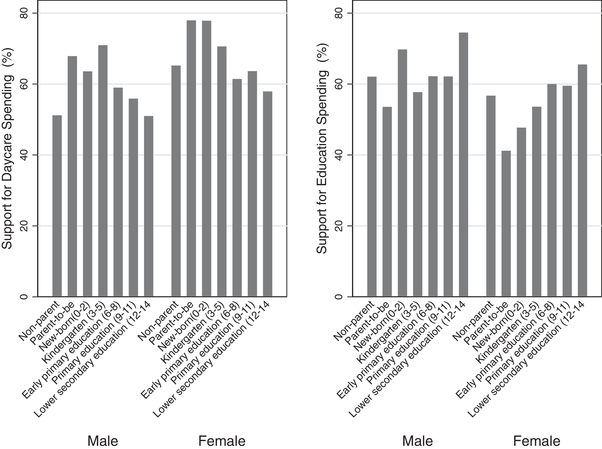
We examine first the distribution of preferences across non‐parents, parents‐to‐be and parents at varying stages of parenthood. Figure 1 shows the percentage of men and women, at varying stages of parenthood, who support increased spending on day‐care and education. Among men, fathers of a first child younger than 6 show the strongest support for day‐care, with 71 per cent of fathers wanting increased spending compared to 51 per cent of non‐fathers. Fathers of children already in education, that is older than 6, support day‐care spending in similar proportions as non‐fathers (56 per cent and 51 per cent, respectively). When it comes to education, fathers with children in secondary school want increasing government spending in the largest proportions (75 per cent, respectively, compared to 62 per cent among non‐fathers and 54 per cent of fathers‐to‐be).
Support for day‐care and education spending among men and women at different stages of parenthood.
Note: Support for day‐care or education spending is calculated as the percentage of respondents who indicated that they want increased social spending on day‐care or education, accordingly.
Source: SHP 2011 and 2014.

The patterns of women's policy demands are slightly different. Mothers‐to‐be and mothers of a new born (78 per cent in both groups) are the most supportive of child‐care spending. In comparison, 66 per cent of childless women and only 58 per cent of mothers with children attending secondary school demand additional child‐care spending. This trend reverses when it comes to preferences towards education policies: mothers’ support increases with every stage of parenthood, reaching the highest level when children are in secondary school (66 per cent). Mothers‐to‐be express the lowest level of support for educational spending (41 per cent), even lower than women without children (57 per cent).
Overall, parents are more supportive than non‐parents of government spending on social policies affecting young families, but only at certain stages of parenthood. Had we grouped all parents into one category, irrespective of the age of their child, the differences would have been noticeably smaller or non‐existent. 67 per cent of mothers and 62 per cent of fathers support further day‐care spending compared to 66 per cent of women and 52 per cent of men without children. For expansion of education spending, 56 per cent of mothers and 64 per cent of fathers are in favour compared to 56 per cent of women and 62 per cent of men without children (see Figure A1 in Online Appendix). At the same time, there are little substantial differences in support for other policies, that is unemployment, health, pension, social assistance or overall social spending, between non‐parents and parents. The only notable difference is the lowest support for most of these policies among parents‐to‐be (see Figures A2 and A3 in Online Appendix). We hypothesise that this could be partially explained by the younger age of parents‐to‐be or it could be the result of a spillover of their increased support for day‐care. If parents‐to‐be perceive a trade‐off between social spending on different policies, they may adjust their preferences for other policies accordingly.
The comparisons in all these figures (F1, A2 and A3 in Online Appendix) are unconditional – they do not account for any individual‐level differences between parents and non‐parents. We thus turn to inferential statistical analysis for testing our hypotheses while also controlling for possible confounders:

These are probit models – adequate for the nature of our dependent variables – of individuals’ (latent) social policy preferences in 2014. The model includes the stage of  for each individual i and a vector of control variables
  . Taking advantage of the two survey waves, we include respondents’
  as a predictor to estimate the differences between non‐parents and parents at different stages in 2014 while accounting for their social policy preferences in 2011. As the
  variable changes between the two waves for all respondents except for non‐parents (baseline), including the lagged dependent variable means that the coefficients of the categories of parenthood (
 ) indicate the change in social preferences as respondents’ transition between parenthood stages relative to being without children. We calculate standard errors clustered by cantons to account for the fact that observations within the same canton are not independently distributed.
We first estimate separate models of preferences for each of the seven policies and for overall social spending to test the first two hypotheses: whether parenthood increases demands towards the welfare state and, more specifically, towards family‐targeted policies, and whether the change in attitudes is stable over time. At this stage, we estimate separate models with the female and male samples, based on the assumption that there are significant differences between men and women with children, for example, their employment status, that could mediate the effect of parenthood on preferences differently for men and women.
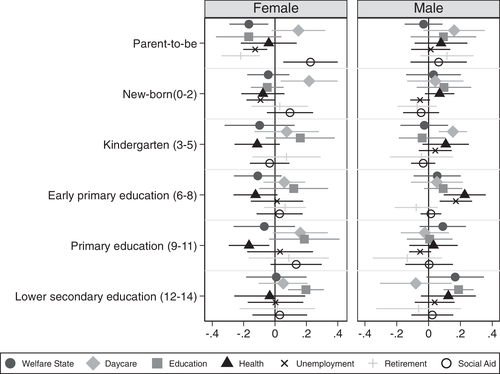
Figure 2 presents the average marginal effects of parenthood stages from the probit models of support for government spending for different social policies.Footnote 9 Marginal effects are calculated as the difference in parents’ probability of policy support at a specific parenthood stage compared to non‐parents’ probability of policy support, at the observed value of all the other covariates.
Average marginal effects of parenthood on social policies preferences.
Note: Average marginal effects calculated at the observed‐value of all other regressors. Baseline category is non‐parents. Standard errors clustered by canton. 95 per cent confidence intervals are plotted.

The data suggest that parenthood does not affect support for the welfare state overall, rather it has isolated effects on demand for spending on particular social policies (Figure 2). Transitions to different stages of parenthood have positive effects, which meet the required level of statistical significance (p > 0.05), on women's demand for day‐care, education, and social aid; and on men's demand for day‐care, education, health and unemployment spending. The negative statistically significant effects are on women's demand for health, retirement and overall welfare state spending.
We find support for H2a: parents’ demands for child‐related policies are substantially higher when they directly benefit from it. Mothers of a newborn (0–2) are by 21.7 percentage points more likely than childless women to demand higher spending on day‐care. The attitudinal change is observable even before the child is born, with mothers‐to‐be being 14.9 percentage points more likely to demand increased day‐care spending (coefficient however is not statistically significant). As the child outgrows the toddler stage, mothers’ preferences for day‐care spending are indistinguishable from non‐mothers’ demands. Compared to mothers, fathers demand more day‐care spending when the child goes to kindergarten: fathers of a child between 3‐ and 5‐years‐old are by 15.2 percentage points more likely to support higher day‐care spending than childless men. Similarly to the results found in the women's sample, the difference between fathers and childless men dissolve when the child starts school.
In terms of education, mothers and fathers of children in lower secondary education demand more spending, at statistically significant levels, than non‐parents (19.7 and 18.8 percentage points, respectively). As upper secondary education is not publicly funded in Switzerland, parents would have strong incentives to demand more government spending as the child approaches that stage. When comparing the support among mothers with a child in kindergarten and mothers with a newborn, the marginal effects are 21 percentage points apart and statistically significant, indicating a strong increase in women's demand for increased educational spending early on. Fathers, instead, change their policy preferences when the child leaves kindergarten and enters primary education, thus partly supporting H4. More precisely, predicted probabilities of fathers with a child in early primary school and fathers with a child in secondary school are 13.2 and 22.9 percentage points higher than of fathers with their first child in kindergarten (differences are statistically significant). Mothers with a child in secondary school are significantly more likely to ask for more educational spending than mothers with toddlers (24.7 percentage points) and mothers‐to‐be (36.5 percentage points). What we cannot test due to data limitations, is whether the increased support for education declines after children finish school.
We also detect that non‐parents differ from parents at certain stages of parenthood in terms of support for other social policies. And, once again, there are notable gender differences. Mothers‐to‐be are less supportive of unemployment, pensions, and the welfare state in general (12.6, 21.9 and 16.7 percentage points, respectively) but more supportive of social aid (22.6 percentage points) than women with no children. Mothers of children in primary education want less health spending compared to women without children. Interestingly, fathers with a child in early education demand increased health care spending more than men without children (22.6 percentage points difference, respectively). We control for both respondents’ age and health satisfaction, which means that the significant effects are not driven by men's reliance on health care services as they get older or sicker. What we cannot test is whether these increased demands are due to worrying about their kid's well‐being or men's increased interest in maintaining their own health. The results show that fathers with a child entering education demand also higher spending on unemployment compared to non‐fathers (17.1 percentage points difference), indicating that at that stage of parenthood fathers might worry about their ability to provide for their children.
In a nutshell, we find some support for the hypotheses that parenthood increases support for the welfare state (H1) but mostly for the family‐related policies and only when parents (or their children) directly benefit from them as the changed attitudes are not stable in time (H2a). Our findings indicate a trade‐off between education and day‐care spending: when demand for educational spending is higher, demand for day‐care is lower and vice versa. With few exceptions (social aid among mothers and unemployment and health among fathers), support for other social programmes (retirement, unemployment and health) drops. These findings suggest that parents, especially mothers, may consider social spending a zero‐sum game, with government resources limited and trade‐offs necessary between different social programmes.
While women and men experience the same attitudinal change for education‐related policies, there is a gender gap when it comes to care‐related policies, with women showing an earlier and stronger change in preferences (H3 and H4). However, based on these models, we cannot say whether these differences are indeed statistically significant. To do so, we estimate the models of demand for day‐care and educational spending with the full sample and the polychotomous variable of parenthood interacted with gender:

We include canton fixed effects  ) and estimate the standard errors clustered by household to account for the fact that most men and women in the sample share a household.
Using the above equation, we calculate the gender gap in attitudinal change as the differences in the average marginal effects of parenthood on support for social policies among women compared to men, holding all other predictors at their observed values:

We distinguish the gender gap in attitudinal change from the overall gender gap, which is the difference in the predicted support for social policies between women and men at different stages of parenthood.
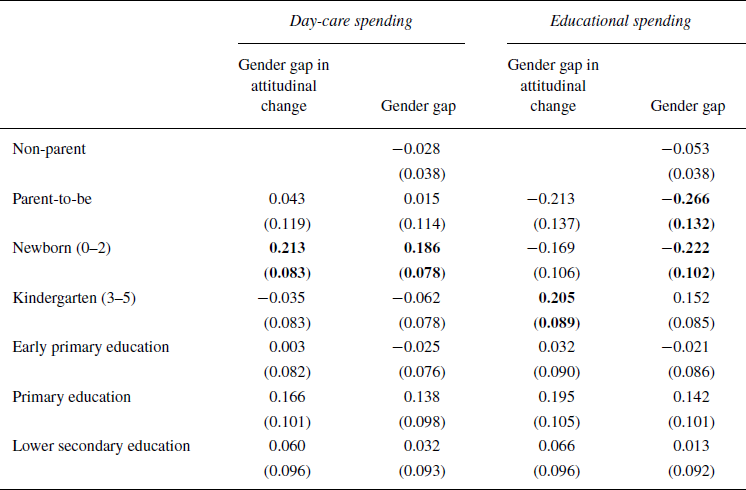
Table 1 presents the gender gap in attitudinal change at different stages of parenthood as well as the gender gap in social policy preferences at those stages. As predicted, there is a substantive gender gap in preference change for day‐care spending among parents with a newborn, which is due to the fact that women's demand for these policies increases substantially before and after childbirth. Having a baby increases women's probability by 21.3 percentage points more than it changes men's support for further day‐care spending (p < 0.05). As a result, there is also a substantive gender gap in support for day‐care spending among parents with toddlers (0–2 age): mothers are by 18.6 percentage points more likely than men to ask for additional spending (p < 0.05). Nevertheless, the gap disappears or becomes statistically insignificant at later stages of parenthood and it is not observable among non‐parents or parents‐to‐be in our sample.
Gender gap in support and attitudinal change in support for day‐care and educational spending

Estimates in bold are statistically significant at p < 0.05; delta method standard errors in parentheses.
Note: Gender gap in support is calculated as the average marginal effects of gender at different stages of parenthood. Gender gap in attitudinal change is calculated as the difference in the average marginal effects of each stage of parenthood among women compared to men. All other predictors are at their observed value.
In line with H3, we find no statistically significant gender gap in attitudinal change for educational spending at later stages of parenthood, when the child enters school. There is however a statistically significant gender gap in attitudinal change among parents with a child in kindergarten. Sending the first child to kindergarten increases women's probability by 20.5 percentage points more than men's probability of supporting further educational spending (p < 0.05). That is likely because while women become more supportive of education at that stage of parenthood, men's support for education declines as their support for day‐care increases. The gender gap in support for education is observed when children are younger: mothers with toddlers and mothers‐to‐be are by 22.2 and 26.6 percentage points, respectively, less likely than fathers with toddlers and fathers‐to be to support additional educational spending. This gap is most probably a spillover consequence of women's lower support for education but higher demand for care‐related policies at the early stages of parenthood.
Robustness checks
As an alternative estimation strategy, we use fixed effects logit models. The effects of parenthood on support for day‐care and education are consistent with our previous results in the female samples but not in the male samples (see Online Appendix for the estimated predictors and discussion). Due to data limitations, we cannot know whether the non‐findings are due to controlling for individual time‐invariant characteristics and changes in parents’ socio‐economic situation between the two waves, or whether they are the result of the reduced sample size of parents (i.e., men's sample is reduced from 554 to 120 respondents).
As a second robustness test, we estimate the effects of parenthood on support for day‐care and education while controlling for the heterogeneity in social provisions across cantons. The effects of parenthood among both women and men remain robust (see Online Appendix for the estimated predictors and discussion).
Discussion
This paper has focused on a contested issue in welfare state and policy attitudes literature – change in individuals’ policy preferences. By testing how a natural event in families’ lives, childbirth, influences citizens’ support for specific social policies, we do not only contribute to the scholarship on attitude change but also move the literature on parenthood and social policy preferences beyond simple comparisons of parents versus non‐parents. Thanks to applying a dynamic approach, we have been able to surpass the potential issue of self‐selection into parenthood and to account for how the age of a child affects parents’ policy attitudes. Moreover, the additional focus on specific social programmes targeted at parents and their children has allowed us to present more nuanced results.
We find that, overall, parents are more supportive of child‐related policies than people without children, while there are no differences between parents and non‐parents when it comes to more general support for social provision. This finding contests the prevalent understanding, based on adult socialisation theory, that parenthood induces, overall, more liberal attitudes on a range of issues (Gallagher & Gerstel Reference Gallagher and Gerstel2001; Ruddick Reference Ruddick1980, Reference Ruddick1989). More importantly, we detect that individuals’ support for social spending fluctuates at different stages of parenthood, with parents adjusting their demands for specific policies dependent on their need for them. Our results, therefore, provide stronger support for the hypothesis derived from the self‐interest perspective (H2a) than from adult socialisation theory (H2b).
We theorised that the gendered nature of parenthood may affect the extent, the timing and the stability of preference change in men and women. We find some support for these gendered hypotheses. For example, our results support the assumption (H3) that parenthood divides mother's and father's attitudes on day‐care spending while it appears to bring them closer together when it comes to the desired level of educational investment. These gender differences provide further support for the self‐interest theory. As mothers, more often than fathers, remain primarily involved in the immediate caring and nurturing responsibilities of young children, their chances for achieving successful family and working life balance depend more directly on the provision of accessible day‐care services. Moreover, as opposed to educational spending, day‐care policies can be seen as an investment both into the child and the parent – usually the mother – who is the most involved in caring responsibilities. Therefore, fathers of young children could consider such policies less in their own self‐interest (and perhaps, in some cases, even less so in the interest of their children). These findings, thus, also talk to the dualisation literature, examining the extent to which household members align (or do not align) their policy preferences with each other to maximise overall household welfare (Häusermann et al. Reference Häusermann, Kurer and Schwander2016).
At the same time, we find limited support for the expectation that, due to gender differences in socialisation into parenthood, having a child prompts an earlier and more stable change in women's than men's policy preferences (H4). While mothers, in comparison to fathers, change their attitudes of state investment in day‐care when the children are younger, that change in preferences is not stable in time. In fact, women of young children appear strongly rational in their social spending attitudes, seeing government's social policies as a zero‐sum game. The fact that mothers‐to‐be and mothers of young children (0‐2) are the most supportive of day‐care spending and the least supportive of further investment in education, suggests a spillover effect. This finding is further amplified by mothers of school‐age children being the least supportive of increased day‐care spending, even less so than women without children. Hence, instead of generating increased support for all types of social programmes (Greenlee Reference Greenlee2014; Sapiro Reference Sapiro1983), motherhood appears to encourage women to focus their demands for policies they (and their children) need the most at any given point in time.
Yet, we need to consider how potentially context specific these findings are. Common theories of policy attitudes suggest that context matters, with individuals living in less generous welfare regimes holding different social policy preferences from the ones in more generous states. The Swiss relatively meagre welfare provision, especially regarding child‐care, limits the generalisability of these findings to countries with comparable social policies and fertility rates, such as Anglo‐American countries, the Netherlands and Ireland. Future research testing similar hypotheses with data from countries with higher levels of gender equality, parental benefits and state‐subsidised child‐care is needed to further our knowledge of the impact different stages of parenthood have on men's and women's welfare state attitudes in various contexts.
This points to the need for national longitudinal survey studies to record individuals’ preferences on specific social policies. To our knowledge, the SHP is the only one and we hope it will continue including these survey items in future waves. Additional data points would allow for further within‐subject comparison of varying parenthood stages and accounting for the parenting experience of different cohorts, as well as for testing within‐household differences and varying gendered effects in dual‐earner vs. single earner households. New waves will also provide data on parents with children older than 15‐years‐old and, as such, extend the analysis to changes in parents’ social policy preferences when children become independent.
We successfully measured the causal effect of parenthood on welfare state attitudes by comparing within‐subject attitudinal changes among first‐time parents to attitudinal changes of respondents who had no children in both waves. This allowed us to circumvent previous studies’ limitations, due to cross‐sectional data usage, that the difference between parents and non‐parents could be due to unobservable characteristics – such as stronger underlying social solidarity – that influenced their social policy preferences and selection into parenthood. Yet, the difference in the effects of varying parenthood stages is still estimated cross‐sectionally (e.g., when the child is born compared to when the child enters school) as we have only two time‐points. In addition, we control for respondents’ own income as well as changes in household income but, due to data constraints, cannot account for partners’ employment status, their health or parenting involvement, which could condition mothers’ and fathers’ dependence on social policies.
Despite these limitations, the results highlight the relevance of parenthood in social science research on public attitudes, political issues, gender equality, welfare state development and women's political representation. By identifying significant positive changes after childbirth but only when parents and their children need support, we provide empirical evidence that social policy preferences are a factor of changing self‐interests. These results have broad implications to the future of the welfare state (especially in countries with relatively meagre social investment provision) – as citizens’ attitudes depend strongly on their time‐dependent needs, it is likely difficult to build large‐scale electoral support for expanding a range of social investment policies at any one point in time.
Acknowledgements
The authors thank the participants of the North East Research Development (NERD) Group and the editors and the anonymous reviewers of this journal for their helpful comments and suggestions.
Support for the initial stages of this research was provided to Diana Burlacu by the 15 NORFACE partners and the European Commission (ERA‐Net Plus funding, grant agreement number 618106) through the HEALTHDOX Project (462‐14‐070). This study has been realised using the data collected by the Swiss Household Panel (SHP), which is based at the Swiss Centre of Expertise in the Social Sciences FORS. The project is financed by the Swiss National Science Foundation.
Online Appendix
Additional supporting information may be found in the Online Appendix section at the end of the article:
Table A1. Comparison of the permanent resident population and our SHP 2014
Table A2. Comparison of the SHP III sample and our SHP sample in 2014
Table A3. Descriptive Statistics – Waves 2011 & 2014
Table A4. Probit models of Support for Day‐Care and Education Spending
Table A5. Probit models of Support for Spending on Different Social Policies
Figure A1. Support for day‐care and education spending across parents and non‐parents
Figure A2. Social Policy Preferences among Men
Figure A3. Social Policy Preferences among Women
Table B1. Conditional Logit Models of Support for Day‐Care and Education
Table B2. Probit Models of Support for Day‐Care and Education with Canton‐level Predictors
Replication Files


 Open access

