

INTRODUCTION
In most settings, the ability of paramedics to provide a high level of out-of-hospital care is supported by a physician delegation and medical oversight model. A variety of delegation models and infrastructure of supporting organizations may exist, but common among them are physician medical directors (usually emergency medicine specialists) who oversee and direct paramedic practice. This is accomplished using, for example, medical directives or guidelines and, where these are limited, some form of live voice contact where appropriate. Ensuring the delivery of high-quality arms-length out-of-hospital care is therefore dependent on a functional relationship and an optimal culture of support and communication between paramedics and physician groups.
In Ontario, Canada, paramedicine requires that physician medical directors oversee paramedic practice and delegate controlled medical acts to paramedics. This delegation and physician medical oversight program occurs through a number of regional “base hospitals” supported by the Ontario Ministry of Health and Long Term Care, Emergency Health Services Branch. 1 Each base hospital includes one regional and multiple local medical directors, a number of educators, quality-assurance specialists, auditors, and other staff who, in addition to medical oversight, are responsible for entry to practice certification and recertification, monitoring of practice standards, and more (see the Ontario Ministry of Health Base Hospital Roles and Responsibilities 1 for a full summary and details). While some variation exists, a set of provincial medical directives, developed by all base hospitals in the province along with the Ministry of Health, define paramedic practice in the province. 2 Importantly, a distinction is seldom made between medical directors and base hospital programs, as both are inextricably linked in Ontario’s system of physician medical oversight.
The interaction between paramedics and physician medical oversight is complex but also important for the provision of safe and effective care by paramedics.Reference Munk, White and Perry 3 Errors in paramedicine may be underreported,Reference Hobgood, Bowen, Brice, Overby and Tamayo-Sarver 4 , Reference Vilke, Tornabene and Stepanski 5 and this is likely to be exacerbated should the professional relationships between paramedics and physician medical oversight be strained. For instance, as medical directors (and their associated programs) are in many ways responsible for the availability, delivery, and delegation of care in paramedic systems, paramedics may experience a tension between seeking additional guidance when needed (or revealing errors) and potential disciplinary action (even when base hospitals are explicit about eliminating or minimizing such action). Also, the arms-length model may pose a barrier for continued professional development by limiting contact with the expertise of physicians. Should these and other challenges exist, aims at optimizing delivery of care may be limited or at least threatened. However, high-functioning systems provide the opportunity for safety and advances in quality. Therefore, the objective of this study was to explore and understand the professional relationship between paramedics and physician medical oversight as viewed by front-line paramedics, as it exists as part of their daily work.
METHODS
Overview
Active front-line paramedics (including advanced and primary care paramedics [ACPs and PCPs]) from four municipal paramedic services representing rural and urban practice environments and three distinct base hospitals in Ontario were invited to complete an online survey. The survey targeted features of the professional relationship derived from common voluntary and obligatory interactions with medical directors and base hospitals. Our study was reviewed and approved by the Centennial College Research Ethics Board (REB #125) in Toronto, Ontario, Canada.
Survey
The survey was designed to investigate multiple aspects of paramedic perceptions of physician medical oversight in their daily work. The survey tool was authored by two of the investigators. Our content validation process focused on common aspects of the relationship, including interactions with the base hospital physicians when communicating directly with paramedics on the scene during patient contacts (referred to as “patching”), and the use of written medical directives, education, auditing, and personal interactions. This led to the inclusion of both quantitative (e.g., Likert-type scale statements) and qualitative (i.e., open-ended free-text questions) data facilitating a more in-depth, complementary, and complete data collection strategy.Reference Östlund, Kidd, Wengström and Rowa-Dewar 6 The survey was pilot-tested with paramedics from a non-participating region and revised based on feedback received. A copy of the survey is included in Appendix A.
Participants
All participants were recruited from Ontario, were active paramedics (advanced or primary care paramedics), and to be included must have been in good standing with one of the regional base hospital systems in the province. As such, all were practicing under a set of medical directives and structures governed by the Ontario Ministry of Health, Emergency Health Services Branch. We recognized that, while participants may not have been aware of the intricacies of the medical oversight system, their ongoing interactions as they existed without further elaboration was precisely the group we were interested in surveying.
Data collection
Recruitment began by contacting paramedic service managers and sharing the study objective and supporting rationale. We then asked for permission to distribute the survey to paramedics using their email distribution lists. We used a modified DillmanReference Dillman 7 method for web-based surveys and included a total of five contacts via email. The first contact was from the paramedic service informing recipients of the upcoming survey. Three days after this initial contact, the invitation to participate in the survey was emailed to the paramedics using a communication prepared by the research team. At one, two, and four weeks after the initial contact, follow-up emails were sent to non-respondents. An option to opt out of follow-up messages was included in all communications. Informed consent was obtained electronically prior to data collection. The survey was prepared using SurveyGizmo (SurveyGizmo, Boulder, CO, USA) and included as a link in the email communication. All data were collected electronically and exported for analysis.
Analysis
For all Likert-type scale responses, we employed descriptive statistics to analyze and report results. For all open-ended questions or questions involving text, data were analyzed using inductive thematic analysis. Borrowing from descriptive qualitative research,Reference Sandelowski 8 this method of analysis involves openly coding statements (while staying close to the data and limiting inferences) and then inductively grouping codes into categories or themes, which are then reported. Both data sets were then considered in relation to one another (where appropriate) to further explore the relationships between paramedics and their delegating base hospital medical directors and base hospitals. We allowed the data to present convergent or divergent ideas as appropriate.
RESULTS
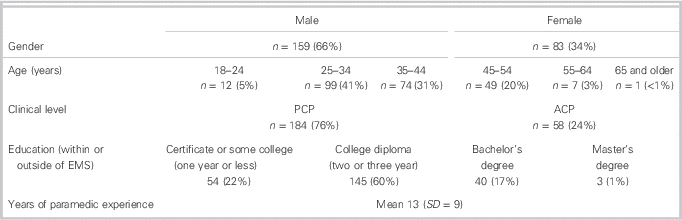
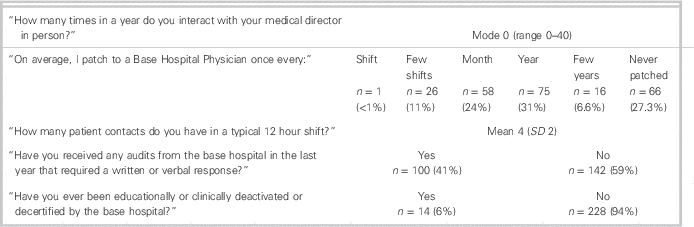
A total of 504 paramedics were invited to participate, and 242 completed the survey (48% response rate). Most respondents were primary care paramedics (n=184, 76%) and male (n=159, 66%), with a mean amount of paramedic experience of 13 (SD=9) years. See Table 1 for a summary of complete demographic results. When paramedics were asked about interactions with their base hospital by “patch” (telephone support during an active clinical case), 31% (n=75) reported doing so on average once a year, 24% (n=58) reported doing so on a monthly basis, and 27% (n=66) reported having never patched (only paramedics who responded that they had participated in a patch were asked questions regarding these interactions with base hospital physicians). Some 41% (n=100) of all respondents said that they had received an audit raising concerns regarding their patient care within the past year, requiring at least a written or verbal response. See Table 2 for a summary of their interactions with physician medical oversight.
Demographics
Quantitative medical oversight interaction information
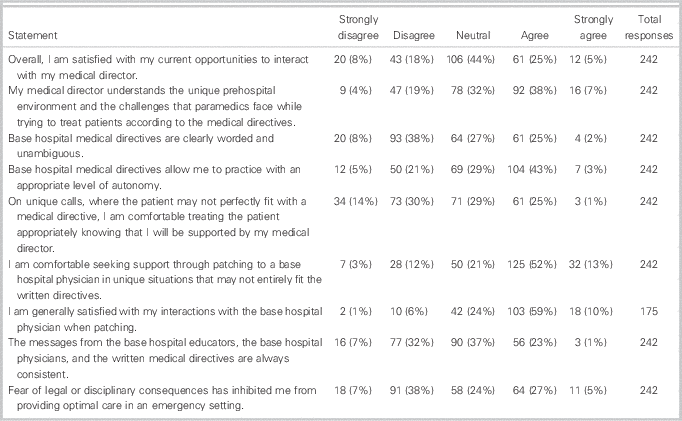
Paramedics were asked about their relationship with physician medical oversight as it relates to autonomy, understanding of the challenges of working in and out of the hospital environment, and satisfaction regarding their opportunities to interact with the medical director. These Likert-type question responses are presented in full in Table 3. The largest proportion of respondents (n=104, 43%) agreed that they had an appropriate level of autonomy. Most (n=92, 38%) agreed that their medical director understood the challenges of working in a prehospital environment, but most (n=106, 44%) were neutral about their degree of satisfaction with their opportunities to interact with their medical director. The largest proportion of respondents (n=93, 38%) disagreed that medical directives were clearly worded, and the largest proportion (n=73, 30%) did not believe they would be supported by their medical director if they had to deviate from established medical directives. On the topic of optimizing care even if it meant deviating from existing medical directives, results were mixed with most paramedics (n=91, 38%), indicating that a fear of legal or disciplinary consequences had not inhibited them from providing what they perceived as optimal patient care. However, 75 (31%) felt the opposite—that the care they provided (at one time or another) had been inhibited by these concerns.
Likert-type scale question survey responses
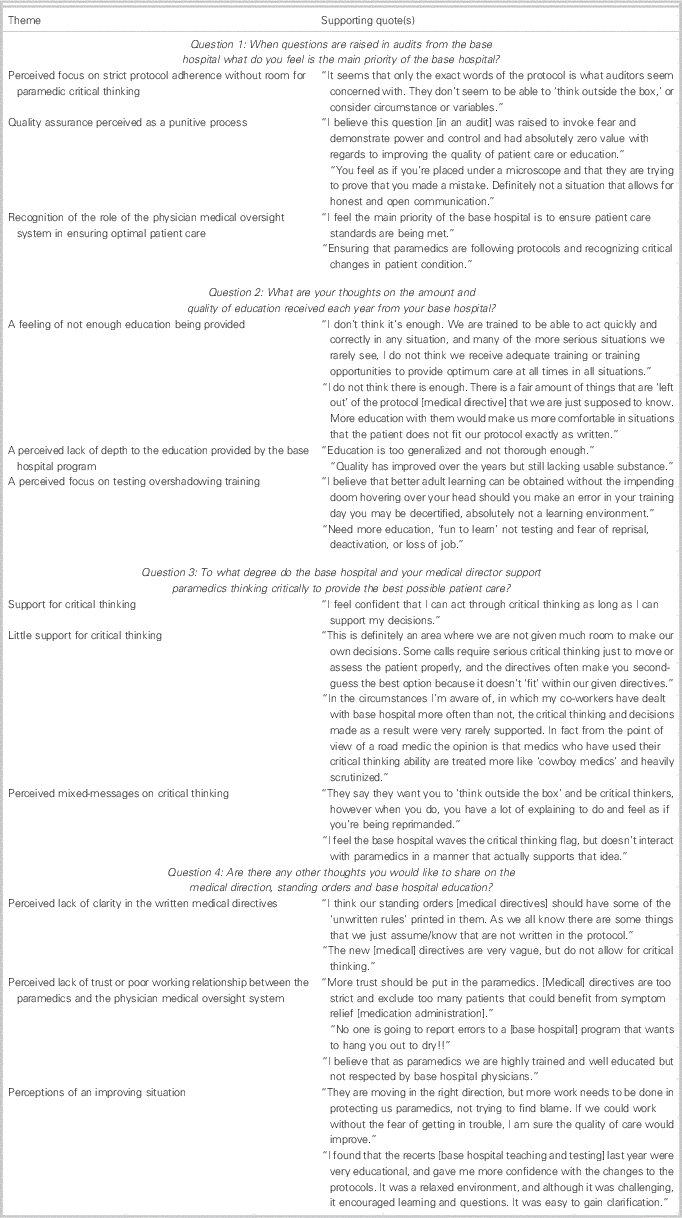
When asked specifically about perceptions regarding the degree to which base hospital support paramedics were thinking critically, that is, to deviate from medical directives when appropriate to optimize patient care, again, the responses were mixed, with some suggesting that there was such support and others articulating the opposite. Further, some discussed the presence of mixed messages where critical thinking was said to be supported but not so in practice.
When asked openly about relationships with medical directors or base hospitals, a number of themes emerged. First, paramedics suggested that the priorities of the base hospital when inquiring about patient care in quality-assurance audits were generally grounded in clarification requests regarding actions during patient contacts. However, while respondents suggested that the base hospital’s interests in conducting these quality-assurance audits were attempts to ensure patient safety, concerns were expressed that these audits were overly focused on strict protocol adherence without much room for critical thinking. Further, the process of responding to audits was generally perceived as a punitive process.
We also asked respondents to share their thoughts on the amount and quality of education received each year from their respective base hospital. Responses were again mixed, with some suggesting that the education was adequate or sufficient, while others appeared to express an interest in or desire to have greater opportunities to learn more, especially as it related to patient interactions that might not align neatly with existing medical directives. Still others suggested that the quality of the education was problematic and that existing formats blurred teaching and learning with assessment of competence during the same session.
Finally, when asked to share any other thoughts on medical direction, medical directives, and base hospital education, two dominant themes emerged. First, some challenges regarding insufficient clarity or poor alignment with practice when considering rigid medical directives were again reported. Second, comments provided reflected a perceived lack of trust or poor working relationship for some (between the paramedics and the physician medical oversight system) as well as an effort to improve on this issue. See Table 4 for a summary of these findings and supportive quotes.
Major themes and supporting quotes
DISCUSSION
The field of paramedicine is advancing rapidly, with a health care community and public who demand more of the profession. In many settings, optimizing care by paramedics involves the delegation of controlled medical acts and medical oversight. This has led to a model where physician medical directors and their associated programs rely on and work closely with paramedics. A high-functioning relationship serves to optimize practice and perhaps provide a model for other jurisdictions, while a challenged or strained relationship may offer opportunities for problematic practice implications, especially if undetected. As such, this study explored the perceived relationship between paramedics and physician medical directors, as reported by paramedics. Our results suggest that paramedics generally have a positive professional relationship with their medical directors and base hospitals but have difficulty with some facets of the delegation and medical oversight model. Specifically, limitations associated with the application of medical directives and concerns regarding support for actions when deviating from medical directives (which is perceived to be a barrier to optimizing careReference Bigham, Bull and Morrison 9 ). Further, opportunities to develop clinically could be improved.
Medical oversight programs have the difficult task of developing and implementing care programs that provide the highest level of care across a diverse set of clinicians and settings. This typically means finding a balance along a continuum between complete autonomy and overly prescriptive or restrictive structures. This complex clinical model seems to be a source of tension, with some having difficulty resolving the challenges of adhering to established medical directives and finding ways to optimize care. Further, this tension may be exacerbated when one considers issues of trust and support, as reported by our respondents, when deviations from established medical directives are considered. This suggests that there may be events when paramedics (we can assume at times correctly and others incorrectly) would argue that clinical care might have been optimized by deviating from (in this case) restrictive medical directives. The challenge for medical oversight groups is in establishing a system that can allow and even encourage such practices, while promoting or ensuring safety. In an effort to address this issue, medical oversight groups may consider and advocate for the role of clinical guidelines over more prescriptive medical directives. Emphasizing the need for greater clinical reasoning and decision making in paramedicine in terms of ability and autonomy has been highlighted elsewhere.Reference Bigham, Bull and Morrison 9 Transitioning in this way has obvious implications for practice, including the competence of the clinicians and some of the inherent limitations of applying guidelines.Reference Mercuri, Sherbino and Sedran 10 Until these issues are resolved, there will be a perception that there is a barrier to optimizing care in an otherwise safe model.
Despite the significant efforts by medical oversight groups to promote an education-based culture, perceptions of a punitive quality-assurance system persist. This may have implications for the degree of error or near-miss reporting that exists (or does not exist) with medical oversight groups. The Institute of Medicine has previously identified error reporting as a key component of establishing a safety culture, saying that there is currently a lack of awareness of the extent of errors in health settings because “the vast majority of errors are not reported because personnel fear they will be punished.” 11 Further, the Pan-Canadian Patient Safety in EMS Advisory Group advocate for a “culture of support and engagement of the providers without fear of punishment to focus attention on system issues rather than individuals.”Reference Bigham, Bull and Morrison 9 Given the context of practice for paramedics and the persistence of this issue, careful attention to it should continue to be a priority.
This punitive culture seems to have some consistency with issues affecting clinical development. Paramedics viewed the medical directors and base hospitals as a source of continuing medical education. However, issues were raised regarding access to medical directors for this reason, inconsistencies in the educational program, difficulty finding clarity in medical directives, and a continuing medical education model that was often perceived as being focused on testing instead of educational value. For many paramedics, continued medical education is associated with base hospital programs, and, as such, some careful review of educational strategies or any unintended curriculum may be warranted.
LIMITATIONS
There are limitations associated with this study. The response rate was 48%, and as a result it is difficult to generalize our results to all settings. Further, it is possible that our respondents may be more engaged and perhaps more critical than non-respondents and/or had more negative interactions with physician medical oversight than non-respondents. Unfortunately, we are unable to compare our results (including demographics) with other similar studies (since none are available) or existing base hospital data (e.g., deactivation rates) since data of this kind are not publicly available. Therefore, we cannot entirely exclude the possibility of respondent bias. Of the paramedics who participated in this study, only three of the seven land regional base hospital programs in Ontario were represented. Our survey results may not be generalizable to other oversight models in other regions or nations. Our study was exploratory and therefore does not claim to capture all features of the paramedic/base hospital relationship, but it does draw on vital features related to development of expertise, patient care, and safety. We also employed pilot testing to refine our survey but did not engage in formal validation, though other exploratory studies have been successful in providing useful results with similar survey design conventions.Reference Pronovost, Weast and Holzmueller 12 Further research should broaden these preliminary results to include other base hospital programs and medical oversight models. Finally, we must emphasize that this study examined paramedics’ perceptions and not that of the physicians or medical oversight groups. Having both groups involved in future research will shed further light on this complicated practice model.
CONCLUSIONS
Paramedics’ perceptions of medical oversight in their daily work were varied. Positive views were expressed in areas including autonomy, medical directors’ understanding of prehospital care challenges, and interactions with medical oversight physicians during real-time medical support (i.e., patching). Areas of concern included the perception of ambiguous medical directives, a lack of support for critical thinking (specifically when deviating from medical directives might optimize care), and a mutual lack of trust between the physician medical oversight system and paramedics. Quality-assurance programs were viewed as necessary, but punitive. Continuing medical education offered from medical oversight physicians and programs was valued, but some respondents perceived a focus on testing that threatened the educational efforts. These perceptions may have implications for the system of care and should be explored further.
Acknowledgements: We are grateful to the paramedic services that participated and the paramedics who responded to the survey and made this project possible. We are also grateful to David Plummer and Craig Beers for their assistance. This study was presented as a poster presentation at the 2013 Paramedics Australasia Conference.
Conflict of Interest: None to declare.
SUPPLEMENTARY MATERIAL
To view supplementary material for this article, please visit http://dx.doi.org/10.1017/cem.2017.36



