

Introduction: kinship beyond biology and the role of alloparental care
The concept of kinship in human societies has frequently been constrained by a biological framework, which has tended to prioritize genetic ties as the basis for social relationships. This assumption, which is deeply embedded in modern interpretations of family structures, has shaped our understanding of social bonds in prehistoric times. For example, in the interpretation of burial contexts, particularly those involving children and adults, there is a tendency to assume that individuals buried together are biologically related. Archaeological models typically assume that the nuclear family represents the primary unit of social organization, thereby overlooking the possibility that relationships of care, which transcend biological ties, may have played a central role in social structures. This restricted perspective ignores the growing body of evidence from various disciplines that indicates human societies have historically relied on more complex and diverse forms of kinship that extend well beyond genetic relationships.
While the family is a universal institution, its conceptualization, structure and boundaries vary considerably between societies. This is influenced by a complex interplay of geographical, temporal and cultural factors. In contemporary discourse, there has been a marked tendency to restrict the concept of the family to a narrow Western, biologically focused ideal, which includes only individuals with close genetic relationships. Nevertheless, an increasing body of ethnographic evidence suggests that kinship is not solely determined by biology. As Carsten (Reference Carsten and Carsten2000; Reference Carsten2004) asserts, the concept of kinship encompasses not only those who are genetically related, but also individuals with whom one shares substantial social and emotional bonds. From this perspective, it is more accurate to contrast kinship with biological relatedness, rather than opposing ‘social’ to ‘biological’. This broader understanding of kinship emphasizes the importance of caregiving practices, such as allomaternal care, in the formation of social bonds, and underlines the fluidity of kinship systems and their capacity to incorporate new members throughout the life cycle (e.g. Meyer et al. Reference Meyer, Ganslmeier, Dresely, Alt, Kolár and Trampota2012).
The term ‘allomaternal care’ is used to describe a practice whereby individuals who are not members of the immediate biological family, and who may be unrelated to the child in question, are involved in the care and upbringing of children. This form of cooperative parenting is not exclusive to humans; however, it is particularly noteworthy for its intensity and scope across cultures. The extended period of childhood dependency and the relatively short intervals between births place significant demands on childcare, particularly on the mother. This necessitates the involvement of other community members in raising children (Sear & Mace Reference Sear and Mace2008). In societies where the extended family system is not the norm, alternative caregiving structures emerge to ensure the survival and well-being of the young. This phenomenon is observed across a range of societies, including hunter-gatherer groups, horticultural societies and pastoral communities. To illustrate, the Efé community in the Democratic Republic of Congo demonstrates a notable degree of allomaternal care, with an average of 14 individuals involved in the care of a newborn. This care is provided by both related and unrelated individuals, underscoring the significant role of the extended family in ensuring the well-being of children (Ivey Reference Ivey2000).
Cross-cultural studies further demonstrate that alloparenting is most frequently—but not exclusively—carried out by matrilateral kin. Maternal grandmothers and maternal aunts consistently emerge as key caregivers across both patrilineal and matrilineal societies (Sear & Mace Reference Sear and Mace2008; Sear et al. Reference Sear, Mace and McGregor2000). However, caregiving responsibilities are not limited to maternal relatives: paternal kin, affinal kin, and even unrelated members of the community may also contribute, particularly in non-unilineal contexts. While women provide the majority of alloparental care in many cases, men—including maternal uncles and older brothers—also play important roles (Hrdy Reference Hrdy2009; Meehan Reference Meehan2008). Moreover, the age of caregivers is highly variable: elderly women, adolescent girls and in some societies juvenile boys, are all engaged in childcare to different extents. This diversity highlights that cooperative childrearing cannot be reduced to a single kin category, but instead reflects flexible strategies embedded in local kinship and residence systems.
The significance of alloparental care extends beyond the immediate survival benefits that it provides. The available evidence indicates that cooperative caregiving practices have a positive impact on child health, nutrition and cognitive development. Furthermore, they contribute to the social cohesion of communities (Meehan Reference Meehan2008; Voorhees et al. Reference Voorhees, Reag and Gabora2020). In the case of the Mandinka in Gambia, the presence of alloparental caregivers from the maternal side has been demonstrated markedly to reduce the probability of infant mortality (Sear et al. Reference Sear, Mace and McGregor2000). Similarly, the practice of milk kinship, in which a woman who breastfeeds a child becomes a kin figure, serves to illustrate the flexibility of social kinship. In 19 documented groups, women who acted as wet-nurses due to the biological mother’s death or illness were regarded as part of the child’s extended family (Hewlett & Winn Reference Hewlett and Winn2014).
These studies also demonstrate that the quantity and quality of care received is closely related to postmarital residence patterns. Infants residing in matrilocal households are more likely to have access to care provided by individuals beyond their biological mothers. A pertinent illustration can be seen in the practices of the Ngandu, a Central African horticulturalist group. In these groups, over a quarter of individuals involved in the care of children are not biologically related to them. Furthermore, the place of residence is closely related to the care children receive, and this can be observed in both directions. On the one hand, children who reside near their maternal family receive considerably more care from other women who are not their mothers. On the other hand, young girls who stay in their maternal residence provide care to other children 14 times more often than when they live in their paternal residence (Meehan Reference Meehan2008).
These ethnographic examples underscore the significance of non-biological kinship and caregiving networks in shaping social structures. Children are not just the responsibility of their biological parents, but of a broader network of individuals who share in their upbringing. This dynamic has profound implications for how we interpret the past, especially in archaeological contexts. When studying burial practices, it is crucial to recognize that the individuals buried together may not always be biologically related, but could instead represent a community of caregivers who played essential roles in the child’s life.
Care and kinship in infant burials: evidence from the archaeological funerary record
In the study of infant burials, it is essential to recognize first that not all children were interred. The limited number of child burials that have been excavated indicates the existence of a selective process. Furthermore, during the late prehistoric period, the children who were buried were often interred with others in double or multiple graves, while individual burials were relatively uncommon. This observation gives rise to a fundamental question: why are infants not buried alone, as might be expected for individuals who were not yet fully integrated into society?
The practice of burying infants alongside other individuals raises the possibility of two distinct interpretations. One explanation is that the burial of infants in double or multiple graves was a result of convenience or necessity (e.g. Carrol Reference Carroll2018; Murphy & Le Roy Reference Murphy and Le Roy2017). In this case, after a child’s death, instead of digging a separate tomb for the child, the grave of the last person who died in the community might have been reused. This practice would imply a pragmatic approach to burial, where the immediate needs of the community—such as the labour required for digging a new grave—led to the reuse of an already existing one. In this interpretation, there would be no presumed biological or social relationship between the individuals buried together. The infant, in this case, would be buried without any special consideration or preparation, and we would not expect to find signs of care or affection, such as specific body positioning or grave goods accompanying the child. The grave would simply represent a ‘space’ for the child within the community’s broader burial customs, with no particular social or familial significance assigned to the relationship between the individuals buried together.
An alternative interpretation suggests that the death of the child was considered significant, and the child was intentionally buried with someone who had a meaningful relationship with them, whether a biological parent, a close relative, or even a caregiver who had a role in the child’s upbringing (e.g. Beck Reference Beck and Osterholtz2016; Rebay-Salisbury Reference Rebay-Salisbury2016). This interpretation posits that the community made a deliberate decision to bury the child alongside an individual with whom they had a social or emotional connection. In this case, we would expect to find more deliberate care taken in the burial practices. For example, the body of the child may be positioned carefully in relation to the adult, perhaps in a manner that suggests an intimate relationship, or we might find grave goods that could symbolize care and affection, marking the child’s importance within the community. This type of burial practice would indicate that the community viewed the child not only as part of the biological family, but also as part of a broader network of social bonds that included those responsible for their care.
In addition to the arrangement and even interaction of the bodies in the tomb and the presence of specific grave goods, as will be discussed in the following section, the most effective tool currently available for detecting both biological and social kinship is aDNA analysis. Advances in computational methods now allow us to identify genetic relatedness at varying degrees of precision, even in low-coverage genomes (Alaçamlı et al Reference Alaçamlı, Naidoo and Güler2024; Ringbauer et al. Reference Ringbauer, Huang and Akbari2023; Rohrlach et al. Reference Rohrlach, Tuke, Popli and Haak2025). Nevertheless, the reliability of such results is strongly dependent on coverage and preservation: in practice, robust relationships are generally detected up to the third or fourth degree (e.g. parent–child, siblings, grandparent–grandchild, uncle–niece), while more distant kinship links beyond the fifth degree remain less certain. Despite these limitations, aDNA has been instrumental in revealing extended families in collective burials, including half-siblings and cousins (Armit et al. Reference Armit, Fischer and Koon2023; Mittnik et al. Reference Mittnik, Olalde, Cavazzuti, Haak, Nicolis, Kulcsár and Heyd2025). When integrated with isotopic and osteological data, these findings help to trace not only biological ties, but also the social configurations that structured caregiving practices.
As with strontium isotopes, multi-sequencing of different dental elements allows for the precise reconstruction of an individual’s mobility patterns during childhood, a period during which dental development is particularly active. This approach enables the detection of individuals who spent their childhood in a different location, as well as children who were born in a particular site, spent part of their childhood elsewhere, and later returned to be buried in their place of birth. This phenomenon, which is becoming increasingly prevalent in the archaeological record (e.g. Armit et al. Reference Armit, Fischer and Koon2023; Hrnčíř & Laffoon Reference Hrnčíř and Laffoon2019; Parasayan et al. Reference Parasayan, Laurelut and Bôle2024), may be indicative of the practice of a temporary child-care or training system, such as fostering.
Isotopic reconstruction of diet can also indirectly reveal information about non-biological kinship and the care provided to children (e.g. Couvrat et al. Reference Couvrat, Bédécarrats and Guihou2024). For example, the burial of individuals who are not biologically related but exhibit comparable dietary profiles may indicate that they were reared in the same household or fed by the same caregiver. Conversely, genetically related individuals with significantly different diets may have spent their childhoods in separate families or received care, specifically dietary care, from different individuals. This method is of particular value when used in conjunction with other bioarchaeological data, as it can assist in the reconstruction of not only the immediate environment in which children were raised, but also the broader social and cultural practices related to food sharing and caregiving. Such is the case, for instance, with so-called non-specific stress markers, which include enamel hypoplasia lines and various types of cribra. Although the precise cause of these defects in bone or dental enamel remains uncertain, their presence in multiple individuals from the same burial may indicate a shared dietary and/or caregiving environment. This is particularly evident in the enamel hypoplasia lines, which also permit the determination of the age at which these episodes occurred, resulting in the improper fixation of the enamel.
In addition to the biological characteristics of the individuals themselves, one of the most effective instruments at the disposal of archaeologists for gaining insight into the complex social structures of past communities is the integrated application of social anthropology and ethnoarchaeology. These disciplines assist in identifying and clarifying the various forms of non-biological kinship that have existed across cultures, with a particular focus on individuals who contribute to the care of children throughout their different life stages. The use of comprehensive databases such as eHRAF enables researchers to explore patterns of childcare, kinship and social organization across a wide spectrum of societies, from small hunter-gatherer groups to complex state systems. This analysis offers significant insights into key variables, including primary infant care, feeding practices, and the socialization processes that facilitate cultural transmission and skill development. Furthermore, it enables us to identify which women are typically responsible for providing different types of care and to what age groups they tend, whether based on gender or specific stages of childhood.
Nevertheless, establishing a connection between caregiving practices and the burial rituals of children, especially within non-biological kinship groups, presents a significantly more complex challenge. In general, the anthropological and ethnoarchaeological data available on the funerary practices of different communities is already more limited in comparison to data on daily life activities. When the focus is narrowed to funerary practices for children, the available data becomes even more scarce. Furthermore, the extant information is frequently focused on exclusionary rites for children who die before attaining a specific milestone or rite of passage. As a result, these children do not receive the same funerary treatment as other members of the community (Ucko Reference Ucko1969, 270–71). Information on children who receive comparable funerary treatment is scarce, particularly in cases where graves are reused, or ‘family’ tombs or burial vaults are used.
In any case, it is essential to include the variable of gender in our archaeological contexts, particularly in the case of child burials. In some cases, the gender of children is indicated in the tomb in a manner similar to that used for adults, through the position and orientation of the body or even the association with gender-specific objects. Nevertheless, in numerous cases, the lack of such funerary traditions requires the use of alternative techniques. Until recently, the identification of the biological sex of immature individuals was dependent on costly and, on occasion, unsuccessful DNA analyses. However, in recent years, peptide analysis has emerged as a highly effective alternative for this purpose (Rebay-Salisbury et al. Reference Rebay-Salisbury, Janker and Pany-Kucera2020). The analysis of a small sample of dental enamel, which is typically well preserved in archaeological contexts, allows for the detection of the hormones AMELY and AMELX, thereby determining the biological sex (Stewart et al. Reference Stewart, Molina and Issa2016).
Project SKIN: Social Kinship and Cooperative Care in Recent Prehistory Iberia
The SKIN Project was designed to investigate the interplay between biological relatedness and social caregiving in child–adult burials. Its primary aim is to test whether the individuals buried together were linked by close genetic ties, or whether their associations instead reflect caregiving relationships and social bonds that transcend biological kinship. The project integrates multiple methodologies, including aDNA analysis to establish degrees of relatedness, peptide-based sex identification and isotopic studies of mobility and diet to reconstruct shared life histories and caregiving environments. These bioarchaeological approaches are complemented by archaeothanatological analysis of body positioning and treatment within the grave, and by systematic comparison with cross-cultural ethnographic data on child-rearing practices.
The initial phase of SKIN focuses on the Copper Age (third millennium bc) in the interior of Iberia, where multiple child–adult burials are particularly common. By combining these lines of evidence, SKIN seeks to address key questions: Were the children buried with women and men who had cared for them in life, regardless of genetic ties? Do recurring patterns of female association with children reflect broader trends in alloparental care? And how were children incorporated into funerary practices as members of households or communities rather than solely through biological parenthood?
This period, also referred to in Iberian prehistory as the Copper Age, represents an optimal time for such an investigation, as it marks a notable societal transition reflected in funerary practices. In the final stages of the Neolithic period, collective funerary rituals obscured specific practices related to children. However, with the turn of the millennium, the appearance of individualized tombs enabled the formation of associations between individuals and their grave goods. During this period, most children were buried alongside other individuals, with single burials being an exceptionally rare occurrence, representing only 9 per cent of the total (Herrero-Corral Reference Herrero-Corral, Murphy and Le Roy2023). The most common type of child burial comprises two or more children accompanied by two or more adults. Regarding the sex of the accompanying adults, in 54 per cent of cases both sexes are present in the same tomb. In the remaining cases, there are adults of only one sex, with females predominating (20 per cent) over males (9 per cent). If we consider some of these multiple child–adult tombs to be the result of care for these children (whether during their lifetime or for the afterlife), the fact that they are more often associated with women than men is consistent with findings in social and cultural anthropology, where caregiving, particularly alloparental care, is predominantly provided by women.
The following case studies from Copper and Bronze Age Iberia illustrate the potential of this approach. A woman and child were intentionally buried together in a clear association in the double burial discovered in ‘Funerary Area 2’ at Camino de las Yeseras (Madrid). This grave contained the remains of a woman aged 20–30 years and a girl of between one and five years old, who were carefully buried together at the same time within a small niche that forms part of a complex funerary structure. They were accompanied by their respective Bell Beaker ceramic offerings (Liesau et al. Reference Liesau, Blasco, Ríos and Flores2015). Genetic analysis demonstrated that the girl was not genetically related to the woman or any of the other individuals analysed at the site (Olalde et al. Reference Olalde, Brace and Allentoft2018, supplementary data). The most striking finding, however, is that new genetic studies conducted at the Bell Beaker site of Alburg in Germany (Sjögren et al. Reference Sjögren, Olalde and Carver2020) identified a woman who is a second-degree relative of the girl (Mittnik et al. Reference Mittnik, Olalde, Cavazzuti, Haak, Nicolis, Kulcsár and Heyd2025). The precise nature of the relationship between the girl and the woman at Camino de las Yeseras remains uncertain. However, it is evident that a significant connection existed between them, as evidenced by their joint burial. The inclusion of the girl in this context serves to reinforce her status as a member of the Bell-Beaker elite, while also emphasizing the association or bond that was established with the woman through this funerary practice.
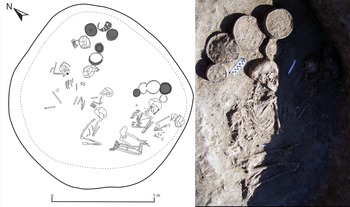
A further case study, with a chronology comparable to that of the previous example (2573–2473 cal. bc), is that of the pre-Bell Beaker grave 54 at Humanejos (Madrid). This structure contains the bodies of eight non-adult individuals who were buried successively (Fig. 1). The oldest was approximately 15 years of age, while the remaining individuals were distributed into three age groups: three between 7 and 8 years of age, and four younger than 5 years. The arrangement of the bodies, which followed the same north–south axis with their heads to the east and feet to the west, and the preservation of most anatomical connections, allow us to estimate that not much time passed between the introduction of the different individuals. It is noteworthy that the last body to be placed in the tomb is the oldest individual, who also has an associated assemblage of grave goods comprising six smooth ceramic vessels and a necklace made of four variscite beads. Moreover, the body, which was perfectly preserved with all its anatomical connections intact, exhibited evidence of reddish pigmentation on the chest region. The biological sex of all individuals was identified through peptide-based analysis, resulting in seven males and one female (Herrero-Corral et al. Reference Herrero-Corral, Garrido-Pena and Rebay-Salisbury2025). The sole female, actually the final individual to be interred in the tomb and the one with the majority of the grave goods, was a juvenile around 15 years of age. This fact makes it impossible that she was the biological mother of all the younger children in the grave, although she could in principle have been the mother of the infant aged 18 months to 2 years. At present, no aDNA data are available for this burial, so we cannot establish whether the individuals were biological siblings or otherwise genetically related. It therefore remains open whether the presence of the young female represents a person who cared for these children during life, or whether she was included in the tomb as a symbolic ‘maternal’ figure for the afterlife before the structure was closed. While aDNA could in the future provide additional information on biological sex and kinship ties, peptide analysis has proven to be a reliable and minimally destructive alternative, particularly valuable when DNA preservation is uncertain.
Plan of the multiple grave 54 from Humanejos (Madrid, Spain) and detail of the juvenile female individual and her associated grave goods. (Plan: Raúl Flores; photograph: Sara Genicio.)

It is also worth noting that there are instances where genetic relationships between mothers and their children have been observed. One illustrative example is the triple burial from the Bronze Age (1918–1772 cal. bc) at Los Tolmos (Soria). The grave contained the bodies of two adults, originally placed symmetrically in a back-to-back position with their pelvises in contact (Fig. 2). The initial osteological analysis identified the remains as those of a male and a female, as well as a perinatal individual who had died at approximately 37–39 weeks of gestation (Esparza et al. Reference Esparza, Palomo and Velasco2017). The perinatal remains were situated between the two adults, though in closer proximity to the younger woman (estimated to be between 20 and 25 years of age). The interpretation of this burial as a nuclear family underwent genetic analysis, which yielded unexpected results. The presumed father was, in fact, another woman, aged 30–40 years, who was not genetically related to the other two individuals. Instead, the younger woman and the perinatal individual were identified as mother and child (Palomo et al. Reference Palomo, Esparza and Gomes2024). At present, no evidence of more distant genetic relatedness between the two women (such as third-degree kinship or shared maternal lineage) has been reported. Such possibilities cannot be excluded, but remain untested with the available data. Future work using higher-resolution aDNA analyses may help clarify whether their association was based on extended kinship or on social relationships of care.
Simultaneous triple grave from Los Tolmos (Soria, Spain) and human skeletal remains of the perinatal individual (Esparza et al. Reference Esparza, Palomo and Velasco2017).
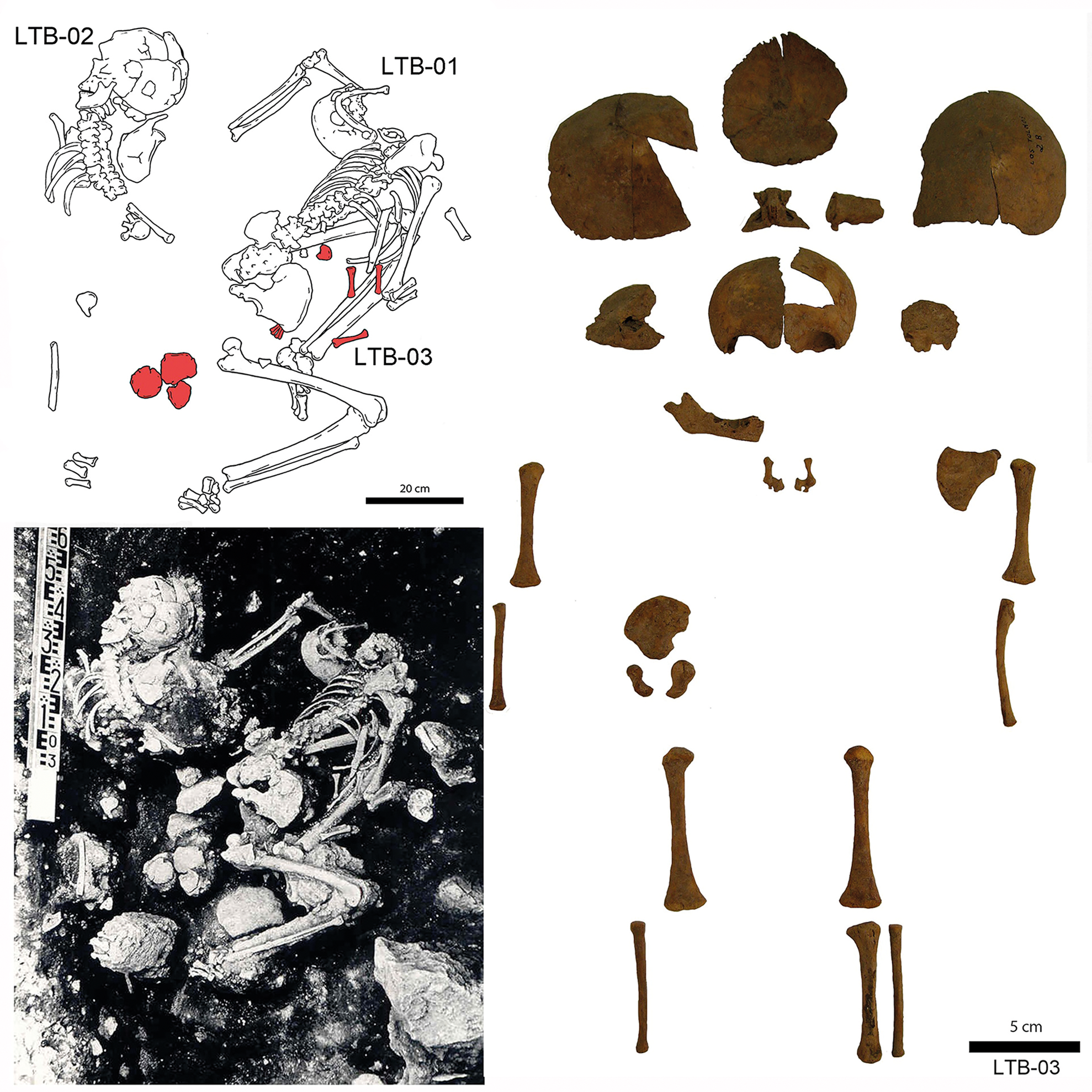
Two potential scenarios have been put forth by researchers to explain the circumstances of the deaths of these three individuals. The first suggests that the young woman and her child perished during childbirth, while the second proposes that both women met their end accidentally from the same cause, though no skeletal evidence of trauma or disease was found. In any case, the joint burial of these two women in such an unconventional grave, which is associated with the death of a pregnant woman and a full-term infant, suggests a connection that extends beyond biological kinship. Furthermore, the analysis of carbon and nitrogen isotopes in the skeletal remains indicated that they had shared a similar diet, at least in the year preceding their deaths (Esparza et al. Reference Esparza, Palomo and Velasco2017). This finding suggests the possibility of cohabitation. Additionally, the archaeothanatological analysis of the remains concluded that the two women decomposed together in the same secondary empty space, likely enclosed by a shared covering—which may have been made of plants—that kept the bodies in close association.
These examples highlight the challenge of drawing a strict boundary between kin and non-kin in burial contexts. Ethnographic evidence shows that individuals who assume caregiving roles, even in the absence of close genetic relatedness, are frequently incorporated into the category of ‘family’ through the act of care itself (e.g. Carsten Reference Carsten and Carsten2000; Hewlett & Winn Reference Hewlett and Winn2014). In this sense, care should not be seen as existing beyond kinship, but rather as one of the key practices through which kinship is created and recognized. This perspective reinforces the idea that prehistoric co-burials may represent social kinship as much as biological relatedness, and that caregiving roles themselves could define who was considered part of the child’s family.
Concluding remarks
The examples presented in this study offer a mere glimpse into the multifaceted and complex nature of kinship and childcare practices in Later Prehistory. These examples illustrate how familial and social bonds were constructed and expressed in ways that often extended beyond the boundaries of simple biological relationships. Moving forward, integrating multiple analytical approaches—including genetic studies, strontium isotope analyses and dietary reconstructions—will be critical for unravelling the full scope of prehistoric kinship dynamics. It is equally important to incorporate insights from social and cultural anthropology in order to avoid projecting present-day notions of family onto ancient contexts. As the SKIN project illustrates, only by embracing the full spectrum of kinship systems, including those based on social relationships through care, can we begin to appreciate the depth and richness of human community in prehistory.
Acknowledgements
This research was supported by the European Commission under the program HORIZON MSCA-2021-PF-01 (101062307) ‘SKIN. Social Kinship and Cooperative Care. Approaching relatedness in Later Prehistory through the analysis of women and children buried together’.

 Open access

