

Folly, where the values of another age, another art, another morality are put into question, and also, where all the forms, even the most distant, of the human imagination, are mixed up, troubled, and strangely compromised by one another in a common chimera.Footnote 1
Writing at the perigee of what could be called the modern era (mid-fifteenth century–mid-twentieth century), Michel Foucault historicized madness in civilization as a “nouvelle incarnation du mal” that came to replace the socio-cultural role of leprosy – a periphery that denotes a center – between the fourteenth and seventeenth centuries as leprosy was eradicated from Europe.Footnote 2 A “nouvelle incarnation de l’homme,” Cervantes’ DQ situated the first modern novelistic character at that “obscure limit, indeterminate but constant, that passes between those who are fools and those who are not.”Footnote 3 Through the use of an original protagonist, in the DQ Cervantes placed the periphery at the center of the modern novelistic plot. As Lukàcs observed, the modern European novel as a literary genre is generated by a protagonist who occupies a fundamental divide between interior and exterior. For Cervantes, this was not a simple movement of inversion. In the DQ the boundary between folly and reason, drawn by the limits of language itself, destabilizes the gesture of putting the outside in or turning the inside out.Footnote 4 There is little question that this unsettling revolves around the mad knight errant, dQ. But this study shifts the focus away from the Knight of the Lions to his maker. Not to Cide Hamete Benengeli, nor to the archivists of La Mancha, not even to the translator or the unwieldly narrator. This study is interested in AQ, a modern author, the author of dQ. He is a special kind of maker caught up in a special kind of making: poiesis. This study of poetic practice and the conception of the first modern European novel is interested in AQ, the poet, and in the poet who made him, Miguel de Cervantes.
Hero or fool? is the question that society asks of the poet, and finally the question that the poet must ask of themselves.Footnote 5 At once poet and pseudonym (AQ and dQ), Cervantes’ most infamous literary character takes up the limits of language, again and again, as the site of articulation by way of which the intimate lyric interior attempts to become legible within the socialized history of a human life.Footnote 6 While the modern European novel has habitually been studied and theorized as a version of the classical literary genre of epic poetry, this study seeks to demonstrate that the modern European novel—what makes it possible and what makes possible its dialectic with madness—is actually a form of lyric poetry which problematizes the role of the human interior within the social whole or “common chimera.”Footnote 7
At the same time that madness took up an exiled center within the domains of reason and truth in European thought, the figura of the poet went underground.Footnote 8 Once central to the structure of court patronage, during the final decades of the sixteenth century the practice of lyric poetry began to disappear from spheres of socio-political power.Footnote 9 Coincident with the rise of proto-capitalism, religious extremism, urban economic sprawl, and the growing efficacy of the Cartesian cogito, over the course of the seventeenth and eighteenth centuries the gradual devaluation of the lyric human interior, as an exiled space of unreason, recast the figura of the poet as madman, a figure whose very raison d’être was viewed as folly.Footnote 10 At the same time, lyric life did not disappear from the spheres of human experience and its cultures. In literature the lyric entered the space of novelistic fiction in the form of an indeterminate human interior whose internal–external dynamism generated novel plots. While not all novelistic protagonists are as explicitly mad as in the Cervantine model, this creative tension between the poetic and the prosaic, between unreason and reason, lies at the heart of the novel as genre. Interior and exterior, it is also a dialectic between lyric temporality (sempiternity) and the historical time of narrative. This slow transition from lyric to novel began midway through the sixteenth century with the pastoral prosimetric works of Sannazaro, Montemayor, Gálvez de Montalvo, and Cervantes; in these, the figura of the poet was progressively transformed into the modern character of the novel.Footnote 11
In his 1915 Theory of the Novel, Gyorgy Lukács inferred this lyric struggle in modern novelistic fiction as a rift between the interior and the exterior, which he called transcendental homelessness, particularly in his analysis of the DQ. But he consistently misidentified lyric struggle as epic impulse.Footnote 12 In epic the hero’s many conflicts never threaten his own status as an exemplar within his own particular social order. When Odysseus descends to Hades, it is not the inner hell of Robert Lowell, but a collectively recognized underworld.Footnote 13 When dQ enters the Cave of Montesinos, he goes alone as a sole witness to “the other side.”Footnote 14 In epic, the hero may be a negative or positive exemplar, but he is never peripheral to that “obscure limit”. In lyric, the “I” of the speaker is only ever-at-stake. Beginning in Queen Mab’s dream world of vision and the ineffability of sempiternal interior experience, the lyric of the sixteenth century begins on the other side of language (which is always historical) with the ineffable.Footnote 15 It is significant that Foucault also situated the rift between image and text at this early modern juncture.Footnote 16 From Cervantes’ AQ to Defoe’s Robinson Crusoe to Flaubert’s Madame Bovary, these eponymously titled exemplars of modern novelistic fiction all tell the story of the lyric interior as an order other than the one it is meant to engage.Footnote 17 Formally speaking, the modern novel as a literary genre concerns itself with that “obscure, indeterminate, and constant limit” between individual interiority and shared communal history, which Leo Spitzer called “linguistic perspectivism,” and which is the content and the action of lyric poetry.Footnote 18
That the first modern novel, the DQ, was born of sixteenth-century poetry has been known for some time. As early as 1924, Ramón Menéndez Pidal had intervened in discussions initiated by Adolfo Castro on the Entremés de los romances, as a source text for the premises of the DQ.Footnote 19 The anonymous interlude, which pertains largely to chapters 4, 5, and 7 of the first part of the DQ, has seen considerable debate over the identity of the author (Cervantes and Lope de Vega, among others) and the primacy of the source (whether the DQ draws on the Entrémes or vice versa).Footnote 20 While it is curious to consider the possibility of Cervantes and Lope de Vega intertwined in yet another story, given the commonalities between the Galatea and the Dorotea discussed in Chapter 5, this study makes no pretense of determining either the author or the primacy of the Entremés. More importantly, the shared premise takes the reader so little way into Cervantes’ DQ that it would be imprudent to suggest that the modern novel is generated from the interlude. What is interesting here is that the Entremés de los romances was not comprised of libros de caballeria (romances of chivalry) but of romances (narrative ballads). The romance was a type of narrative poetry written in verse. Its origins were medieval and folk, but during the 1580s, its revival was brought about by an erudite group of poets known as los modernos, which included Cervantes, Lope de Vega, Liñán de Riaza, and many of their peers.Footnote 21 Just as romances inspired Lope’s new theatre (such as El caballero de Olmedo), Cervantes may have drawn upon, authored, or inspired the Entremes de los romances. Many of the stories from libros de caballería which dQ recalls in the early chapters are in fact taken from popular romances. Casually then, one could conjecture that the DQ came from a theatrical interlude which itself came from (narrative) poems. This, however, does not answer the question of lyric poetry and the modern novel but rather attests to the shared thematic or topographical content across various genres of poetry in sixteenth-century Castile. The interlude constructed out of ballads may provide the content of the burlesque, but it does not transform the burlesque into a novel. Cervantes the Poet: The Don Quijote, Poetic Practice, and the Conception of the First Modern Novel attends to the practice of lyric poetry and the figura of the poet in the culture of Pastoral Petrarchism during the 1560s, 1570s, and 1580s in the Habsburg territories, Europe, and the Mediterranean in order to examine the conception of the first modern novel through the early works of Cervantes. This poetry developed the lyric subjectivity of the speaker both in the rime sparse of individual verse poems and within the fabric of prosimetric narrative fiction. From this introduction of lyric subjectivity into narrative fiction, the modern novel was organically conceived.
As a modern poet, Cervantes was the first among many to make famous the history of a lyric life in prose. But he was not only a poet of modern prose fiction. He was also, and primarily, a poet of the sixteenth century who lived through the foreclosure of his own lyric practice within the poetics of Pastoral Petrarchism.Footnote 22 This form of Petrarchism, writ within literary conceptions of classical Arcadia in which poets assigned pastoral pseudonyms to themselves and to their beloveds, produced new poetic figurations of the Petrarchan lover and beloved within a highly conventionalized and idyllic state of nature, which Cervantes in the Galatea refers to as a tercia naturaleza, and which Elias Rivers has called the “pastoral paradox of natural art.”Footnote 23 While Petrarchism has often been dismissed as a collection of uninspired and recycled tropes, images, motifs, and verse forms, within the mid-sixteenth-century practice of Pastoral Petrarchism, the immediate particularities of each poet’s lived experience (real or feigned) reinvigorated literary form with the novedades of contemporary life. The figura of the poet, Petrarch, became for Cervantes and his peers a model by which to sketch their own literary lives and afterlives. From Petrarch’s lady Laura to Montemayor’s Diana, Gálvez de Montalvo’s Fílida, Cervantes’ Silena, AQ’s Aldonza Lorenzo, and dQ’s Dulcinea, the path to an immortal life in letters ran by way of the beloved.
Whether blunt satire or tragic irony, the thematic of the Cervantine oeuvre has typically been reduced to the burlas y veras of picaresque prose fiction, another genre to which the modern novel has been attributed.Footnote 24 Dubbed ingenio lego, Cervantes has come to be known as a master of Spanish Realism. As such, the forty-year literary career that he cultivated as a pastoral poet prior to the publication of the DQ (Part 1, 1605) rests on the other side of Lethe in formations of Golden Age literary history. Situated at the transition from the Renaissance to the Baroque: (the pitfalls of periodization notwithstanding), most of Cervantes’ literary career occupied a curious midway point in the ‘siglo’ de oro, which is generally taken to run from the poetry of Garcilaso in the early sixteenth century to the works of Calderón de la Barca and Juana Inés de la Cruz in the late seventeenth. While Foucault, and more recently Rodrigo Cacho Casal, have been careful to distinguish between the hidden secrets of signs in Renaissance texts and their arbitrary play in those of the “Classical” and Baroque, subsequent readings of Cervantes’ DQ and Velázquez’s Las Meninas have tended to collapse this complex period of transition, a transition in the very understanding of meaning and madness, into a single conceptual plane.Footnote 25 Cervantes’ literature is about literature. Velázquez’s painting is about painting. This compression of the internal machinations in Renaissance and Baroque Iberian culture, and Cervantes’ novel within it, into a single era continues to obscure the lyric origins of modernity’s favorite and most mysterious poet: Cervantes.
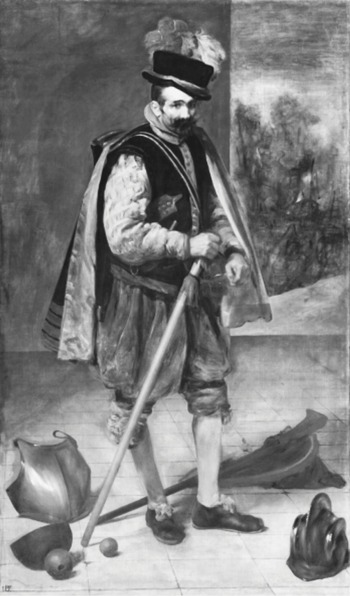
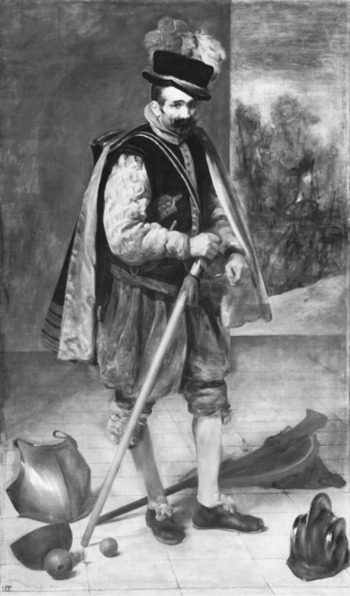
Housed in the Museo del Prado, Velázquez’s portrait of El bufón don Juan de Austria (oil on canvas, 210 cm × 123 cm, ca. 1632), completed some sixteen years after Cervantes’ death, offers an alternative and unlikely metonymy in miniature for the trajectory of his literary career and its first period of posthumous reception.Footnote 26 Velázquez’s painting of a jester – whose satiric identity was modeled on the illegitimate and ill-fated step-brother of Philip II, the “hero” of the Battle of Lepanto, Don Juan de Austria (1545–1578) – active in the court of Philip IV (r. 1621–1640), illustrates the transformation of early modern Spanish poetics metonymically from Don Juan de Austria in the court of Isabel de Valois (1560–1568) to el bufón don Juan in the court of Philip IV (1560–1632).Footnote 27 Like a worn-out rhapsode, Velázquez’s bufón looks out from his theatrical attire, the iconography of armas in which he is cloaked and which forms the backdrop of his portrait, as if to convey his exhaustion with the scene. Like AQ el Bueno come home to die at the close of the DQ II, the weary visage of the bufón points beyond the figure of the jest toward the lyric life of the actor himself. What kind of life could this have been? This palace scene, as is known, would have been enveloped in the practices of a hyperbolic religious fanaticism which sought to collapse the ontology of representation and represented into a single phenomenon.Footnote 28 The political paranoia of palace life in the 1630s would have imbued this military burlesque with a degree of uncomfortable reality. “If folly leads everyone into a blindness where each is lost, the fool, to the contrary, calls each to their truth.”Footnote 29
Like a riddle of reason, his self-denial, submerged in the madness of his socio-religious and political moment, renders the bufón a figure of truth whose gaze questions the viewer’s very place in a shared chimera. This candor that Velázquez details in the eyes of his subject arrests the viewer in a confrontation with an incredulous actor who has quit his own scene. Lyrically speaking, what is at stake in Velázquez’s portrait is neither a tragic nostalgia for the age of Don Juan nor the satiric comedy of an unhinged Baroque court, but rather the figure of an actor at the crossroads of human immediacy and authorial distance, history and allegory, mimesis and poiesis, for whom the semiotics of his attire are called into question by the corporeal gesture of his visage. His sorrowful countenance introduces a human immediacy to the core of his theatrical burlesque and therefore throws the dialectic between reason and folly into question.
Cervantes the Poet: The Don Quijote, Poetic Practice, and the Conception of the First Modern Novel takes seriously the body of poetic work produced prior to the publication of the DQ through a recontextualization of that work within the various circles of poetic practice in which and for whom Cervantes wrote.Footnote 30 While both philological and theoretical studies of Cervantes tend to cast him as a novelist of the seventeenth-century Spanish Baroque, this study resituates the author of the DQ within the very milieu of the original Don Juan (just two years his senior) and the poetics of Pastoral Petrarchism patronized by Isabel de Valois and in other European courts during the second half of the sixteenth century.Footnote 31 Miguel de Cervantes Cortinas (Saavedra was a pseudonym) was fifty-seven years old when the first part of the DQ went to print in January of 1605. He was sixty-eight when Part II was published late in 1615. After completing his Byzantine Romance, the Persiles y Sigismunda, he died on April 22, 1616, a day prior to Shakespeare. This study of the nearly forty-year literary career (1567–1605) that Cervantes cultivated as a poet and pastoral novelist seeks to resituate the author of the first modern European novel at several crossroads in his conception of modern fiction. Most of the authors who pertained to the circles of poets with and for whom he wrote during the decades of the 1560s, 1570s, and 1580s – Jorge de Montemayor, Diego Hurtado de Mendoza, Francisco de Figueroa, Pedro Laínez, Luis Gálvez de Montalvo, Antonio Veneziano, Pedro de Padilla, Gabriel López Maldonado, Luis de Vergara, Pedro Liñán de Riaza, Félix Lope de Vega, Luis de Góngora, and others – were lyric poets practiced in Pastoral Petrarchism. While Cervantes did not live to see the court of Philip IV and its bufón, his literary career ran a striking distance from the court of Isabel de Valois and Philip II (in which he was a contemporary of don Juan) to that of Philip III and the Duke of Lerma (ca. 1567–1616).
Where studies in literary context have frequently focused on a single political moment, language, and culture (that of Philip III), this study allows for Cervantes’ early texts, or sets of texts, to indicate particular sites of poetic production that often complicate traditional notions of nation, temporality, and influence (complications friendly to Barbara Fuchs’ notion of imperium studies).Footnote 32 Relying primarily on sixteenth-century manuscript collections of poetry, paratextual materials of sixteenth-century printings of original works and translations, and archival correspondence between poets and patrons, this study gives shape to a period of literary development in early modern poetics as generative of the conception of the first modern novel.Footnote 33 Bringing together the many poets with and for whom Cervantes wrote, this book posits an alternative literary continuum on the terms expressed in these texts.Footnote 34 Cervantes’ early poetry for Isabel de Valois (Habsburg court, 1560s), his poetry for Bartolomeo Ruffino di Chiambery and Antonio Veneziano (Italian territories and Algiers, 1570s), and his early encomiastic poetry and pastoral prosimetrum (Madrid, 1580s) each supply a unique context and literary community which together may be considered within the larger scope of Pastoral Petrarchism as the primary mode of poetic practice in Spain and its Mediterranean territories during the second half of the sixteenth century. Countering the authorial figuration of Cervantes as a nationalist, realist novelist of the Spanish empire, this study brings to light the history of Cervantes as a Mediterranean poet of diverse lexical and cultural variety within the “transnational” practice of Pastoral Petrarchism.Footnote 35
That Cervantes’ status as a poet of the sixteenth century has been somewhat belied should come as little surprise. The history of derisive comments on the topic date to the author’s own self-deprecative asides in the front matter and body of several of his texts.Footnote 36 Early in the seventeenth century, increasingly venomous rivalries with Lope de Vega and Quevedo tended to cast him to the periphery of the circles of younger poets who reached the heights of their careers during the final decade of Cervantes’ life. This somewhat marginalized status was visible in Cervantes’ late narrative poem the Viaje del Parnaso (1614), a work that in many ways updated the lyric outlook given in the “Canto de Calíope” in Book VI of the Galatea (1585) some thirty years earlier. However, to take these disingenuous asides and spurious attacks at face value would be to ignore Cervantes’ reputed status as a poet, evident in the decision of López de Hoyos to publish him as the featured poet of the 1569 exequies for Isabel, in Antonio Veneziano’s decision to transcribe and include Cervantes’ 1579 octavas in his own autograph manuscript collection of poetry, and in the laudatory sonnet of Gálvez de Montalvo, amongst others, in the 1585 publication of the Galatea. López de Hoyos was the official court chronicler in 1569. In 1579 Veneziano was poet laureate of Palermo; his ransom from Algiers had been paid by the city. In 1585 Gálvez de Montalvo, himself a lauded poet and pastoral novelist, was in the service of Philip II’s favored minister, the Roman nobleman Ascanio Colonna (likely patron of the Academia Imitatoria, to whom the Galatea was dedicated). When in the early 1580s Cervantes returned to Madrid to lament the state of the eclogue in Spain in the prologue to the Galatea, his dismay at the fallen status of the poet underscored his position as an established poet at that time.Footnote 37 As celebration and commemoration, the Galatea gave voice to a lyric culture soon to be swept from the pages of literary history. The final festivity of the text remembers the already deceased Meliso (pastoral pseudonym for Diego Hurtado de Mendoza). A master of a literary lexicon in decline, with the exception of a few rime sparse, between 1589 and 1605 Cervantes disappeared from lyric culture.
It was during this period of errant silence that Cervantes as a poet of Pastoral Petrarchism began to reimagine the tropes and forms of his literary formation within a new prose fiction.Footnote 38 Some of his earliest novelas, which Francisco Rico has dated to the decade of the 1590s, attempt to do just that.Footnote 39 It should not be forgotten that most of Cervantes’ protagonists, who appear in the many prose works that he published during the first decades of the seventeenth century, continue to express their inmost narrative drives in lyric verse. Although “retired” in the prosaic life of the novelist, Cervantes did not abandon the figura of the poet.Footnote 40 During the final decade of the sixteenth century the lyric went underground in the work of Cervantes. When in the opening decade of the seventeenth century the lyric reemerged in his prose work, it took the shape of a divided figure, AQ/dQ, poet and pseudonym, modern madman. Safely grounded in the quotidian topography of contemporary prose, the DQ situated the mad modern poet at the heart of the modern subject, a mysterious and exiled center, an unknown core, around whose folly human existence organized its reason and its truth linguistically. If in the DQ Cervantes offered his reader an insight into the interior of the madman, he was able to do so because he knew the figura of the poet. A thinly veiled restaging of the pastoral prosimetrum in chivalric garb, the lyric underpinnings at work in the narrative structure of the DQ would have been immediately recognizable to his literary contemporaries had not most of them already been dead by 1605. By the time the DQ I went to print, Montemayor, Hurtado de Mendoza, Figueroa, Laínez, Gálvez de Montalvo, Veneziano, and Padilla had all died. Only the youngest generation of Pastoral Petrarchists, Pedro Liñán de Riaza, Félix Lope de Vega, and Luis de Góngora, survived – a generation which Cervantes never successfully joined. This is the second, and perhaps more significant, reason that Cervantes’ status as a poet has so far been brushed over, if not outright denied. Contemporary reading practices in literary criticism are still determined by the very shift in the figura of the poet that rendered Pastoral Petrarchism obsolete and turned lyric practice into folly, the very shift which the DQ dramatizes. To get inside the forbidden center of a text composed by a Renaissance poet for a Baroque world – a center around which Cervantes drew the cercle sacré of madness – we will have either to occupy the site of madness or to recover the literary lexicon that the novel puts into action. In terms of “linguistic perspectivism,” this is the same thing.Footnote 41
While Cervantes’ status as a poet and the importance of the Spanish pastoral have been marginalized, several of the most distinguished scholars to have treated the Cervantine oeuvre have made overtures in the direction of such a revaluation.Footnote 42 On April 9, 1945, in a letter to Ramón Menéndez Pidal, Américo Castro lamented the way in which scholarship had overlooked the pastoral in Cervantes’ oeuvre as a key to the author’s work.Footnote 43 In 1947 Alberto Blecua, following an exhibition at the National Library of Madrid, advocated for a reconsideration of Cervantes as poet in “La poesía lírica de Cervantes.”Footnote 44 The quadricentennial of the publication of the Galatea also led to significant contributions to scholarship on Cervantes’ early pastoral prosimetrum, championed by Juan Bautista Avalle-Arce.Footnote 45 In 1974 and 2016 collections of Cervantes’ poetry appeared in substantial critical editions.Footnote 46 Recent attention to early modern Spanish poetry has seen article contributions from Felipe Valencia, Leah Middlebrook, and Marsha Collins.Footnote 47 However, the culture of Pastoral Petrarchism, Cervantes’ status within it, and the decisive role that this forgotten literary history played in the conception of the first modern European novel remains to be studied. This book explores the rich linguistic fabrics of late sixteenth-century poetic practice in order to understand how lyric subjectivity became the generative force for novelistic plots in the DQ as modern literary genre. It recovers the role of erotic subjectivity in the practices of the pastoral courts which fostered the literary becoming of Miguel de Cervantes, and shows how lyric subjectivity produced narrative emplotment in the modern novel: a formal mode of infinite diversity.
Chapter 1 recovers the pastoral precedents for the culture that directly precipitated Cervantes’ first poems within the court of Isabel de Valois (Queen of Spain, 1560–1568), where literary art forms and forms of cultural practice became intertwined in complex mimetic processes. From Theocritus, Vergil, Horace, Ovid, Petrarch, Boccaccio, Poliziano, Sannazaro to Garcilaso de la Vega, Juan Boscán, and Jorge de Montemayor, the retreat of the pastoral was understood to be a device employed to encode and allegorize the private life and lived experience of the court which made poiesis possible.Footnote 48 Drawing on archival records (relaciones) of life in the court (Biblioteca de la Real Academia de Historia, Madrid), the remarkable diary kept by one of the queen’s ladies-in-waiting (National Library of St. Petersburg), as well as histories of her reign, this chapter explores how the frequent and often improvisational imitation of various literary genres, including the romance of chivalry, by members of the court, was caught up in the erotic entanglements that became the content of pastoral literature.Footnote 49 At the confluence of literary allegory and contemporary history, through the exchange of motes in the terrero, the palace became pastoral.
Chapter 2 treats the early Italianate verse poetry that Cervantes wrote for Isabel in 1567 and 1568, when the poet was around twenty years old, as serious works composed within the cultural and literary context of their making. In his first sonnet, Cervantes’ speaker develops a conceptual play between the speaking-ingenio and the lofty-lady through the use of an exalted apostrophe, a key feature of Pastoral Petrarchism that would inflect the subsequent decades of the author’s literary career.Footnote 50 The only known copy of this sonnet was preserved in a late sixteenth- and early seventeenth-century manuscript collection of predominantly pastoral and erotic lyric and narrative poetry pertaining to the Habsburg court, now housed in the Bibliothèque Nationale de France, Richelieu.Footnote 51 This chapter examines and draws upon the manuscript collection as a whole in order to reconstruct the literary world in which and for whom Cervantes wrote, as it was understood by the early modern compiler, a primary source on readership, reception, and genre. Ms. Espagnole 373 also recontextualizes the poetry that Cervantes composed the following year, in 1568, to mark the untimely death of Isabel on October 3.Footnote 52 This chapter considers Cervantes’ relationship to Giulio Acquaviva while the papal legate was present in the Habsburg court in the fall of 1568, his journey to Rome, and the Sigura affair.Footnote 53
Chapter 3 explores how over the course of the sixteenth century an exemplary amorous biography, a type of vita poetica or literary hagiography, was attributed to el divino Francesco Petrarca such that imitatio applied not only to the figures and tropes of the Trionfi and Canzoniere, but also to the figura of the poet itself as a model or exemplar for the life of the poet.Footnote 54 Over a period of roughly two centuries (1374–1575), Petrarch’s lasting fame took on the form of vernacular literary immortality against the backdrop of ancient authors such as Homer and Vergil. From the 1535 alleged rediscovery of Laura’s grave and Alessandro Piccolomini’s 1540 pilgrimage to Petrarch’s tomb, to the various sixteenth-century translations of Petrarch’s poetry into other vernaculars, as well as commentaries on Petrarch made by lyric poets in the front matter to publications, in manuscript poems, and in pastoral fiction, the literary afterlife of the figura of the poet took shape. This chapter reconstructs the figura of the poet, Petrarch, as it was imagined, articulated, imitated, and reinvented by sixteenth-century poets writing in Castilian.Footnote 55 By the middle of the sixteenth century the Castilianized ingenio (ingenium) had come to define the figura of the poet.Footnote 56 This chapter works to elaborate on a lacuna (between Garcilaso and Góngora) of roughly sixty years which is not only crucial to an informed understanding of Cervantes’ work but which is also much needed in studies of early modern poetics.
Chapter 4 resituates the Pastoral Petrarchism of Cervantes and his peers within the erotic philosophy of the sixteenth century, particularly in Judah Abravanel’s Dialoghi d’Amore ([Leone Ebreo], Rome, 1535).Footnote 57 That Cervantes was a deep reader of Abravanel is evident in his mention of the philosopher in the prologue to the DQ I. Less remarked upon, but far more foundational, was Abravanel’s influence on Tirsi and Lenio’s debate on love in Book IV of the Galatea.Footnote 58 By 1569, Cervantes was serving in the court of the young Neapolitan nobleman Giulio Acquaviva in Rome, where Vicenzo Orsini’s gardens at Bomarzo were one of many private pastoral courts cultivated by various Italian noblemen throughout the region.Footnote 59 Within pastoral poetics, the beloved, as the embodiment of beauty, was often conceived of as the summa belleza or summum bonum in the natural world (an encounter with the formal by way of the sensuous). In light of Abravanel’s influence on early modern poetics, this chapter studies Cervantes’ octavas for the Sicilian poet and fellow captive Antonio Veneziano that Cervantes wrote from solitary confinement in Algiers and sent to Veneziano in 1579 in response to Veneziano’s own songbook, the Celia. They survive in Veneziano’s autograph manuscript (Biblioteca centrale della Regione Siciliana, Palermo) along with Veneziano’s sonnet response. This chapter concludes with Cervantes’ earliest dramaturgical works, the Trato de Argel (likely composed in Algiers or shortly upon his return to Madrid, ca. 1575–1582), in which Cervantes developed the concept of “love as faith” within the confluence of Islamic and Christian beliefs in which erotic faith transposed the religious.Footnote 60 Through attention to this voicing of lyric subjectivity by the summa belleza, the Trato de Argel evidences early figurations of the intersubjectivity and female desire necessary for character formation in Cervantes’ subsequent fiction, such as in the Galatea.
Chapter 5 reconstructs the site of production for Cervantes’ prosimetric pastoral novel, the Galatea (1585), and investigates the way in which Cervantes disguised himself and members of his own literary milieu as shepherd-poets under pastoral pseudonyms in his text. It employs paratextual sources (front matter, dedications, prologues, and laudatory sonnets) to reconstruct the “urban-pastoral” milieu to which Cervantes returned in 1580. Drawing on early manuscript annotations (ms. 2.856, Biblioteca Nacional, Madrid) that identify Cervantes as the “Lauso” of the Galatea, in conjunction with earlier scholarship on the Galatea as a roman à clef, this chapter proposes an additional decoding of the prose work through attention to the use of biographical names (and their pseudonyms) for poets associated with the river Tajo in the “Canto de Calíope” (Book VI of the Galatea).Footnote 61 With the decline of literary circles in both royal and private noble courts, literary life migrated from the Alcázar to the barrio de las letras. In addition to the established poets of Isabel’s reign – Figueroa, Laínez, Gálvez de Montalvo, Gómez de Tapia, and Cervantes – several new poets – López Maldonado, Pedro de Padilla, Vargas Manrique, Liñán de Riaza, Juan Rufo Gutiérrez, Lope de Vega, and Luis de Góngora – joined this milieu of “urban pastoralists.” The encomiastic poetry that Cervantes wrote at this time participates in literary attitudes amongst a network of authors working in Madrid contemporary to Cervantes’ composition of the Galatea, in which the figura of the poet became a literary character. These ingenious shepherds of the Galatea were also “gathered together” in the “logos” amoenus of the opening leaves of López Maldonado’s Cancionero (Madrid) of 1586.
The final chapter, Chapter 6, examines the force of lyric subjectivity as narrative emplotment in the Galatea. At the confluence of verse and prose, allegory and history, mimesis and poiesis, this chapter treats the Galatea and other contemporary works, beginning with the 1582 transition from verse to prose in Pedro de Padilla’s Églogas pastoriles (Seville). While the Galatea has frequently been dismissed in scholarship as a partially formed and immature work, or reinterpreted through standard approaches to the DQ, this chapter studies the chronotopic dynamism of Cervantes’ first prose fiction through the narrative emplotment of Lauso’s lyric interior. It is attuned to the sophisticated narrative architecture of an unprecedented capacity to juggle multiple lyric temporalities within a single narrative landscape.Footnote 62 The Galatea lent novelistic immediacy to the timeless retreat of the pastoral through the use of lyric subjectivity. As a meditation on the nature of love and lyric subjectivity inherent in Pastoral Petrarchism, the Galatea transformed the figura of the poet into the modern literary character, a transformation that was most fully developed in Lauso. As a roman à clef, the Galatea not only pertained to the fábulas of Cervantes’ literary milieu, but also wove a tapestry of narrativized lyric intersubjectivity necessary to the conception of the first modern novel.Footnote 63
In closing, the Coda engages prior theories of the novel which have unwittingly touched on lyric subjectivity as the motor of the genesis of modern fiction qua the DQ. It returns to Leo Spitzer’s seminal article “Linguistic Perspectivism in the DQ” (1948), in which negotiation of lexicons also invokes Mikhail Bakhtin’s understanding of heteroglossia and polysemy in the Dialogic Imagination (1930s and 1940s, published 1975), and Lukács’ understanding of a rift between interiority and exteriority as transcendental homelessness in the Theory of the Novel (1915).Footnote 64 While several of the insights in their work hold true, their observations often unwittingly point toward the lyric, rather than epic, features of the novel as a modern literary genre. Their insights show that novelistic fiction is everywhere impossible without the lyric subjectivity at work in the practice of sixteenth-century Pastoral Petrarchism, in particular in the Galatea. In his conception of the modern novel, Cervantes preserves lyric subjectivity as narrative emplotment through the transformation of the figura of the poet into the modern madman AQ/dQ. This figura of the poet as modern madman is not particular to the DQ but in fact inhabits the “center” of the modern subject.Footnote 65 As such, the DQ allows us to consider the foundational division of the modern subject: reason and madness. For some time now, subjectivity and the modern subject have come in for considerable criticism. Most formulations and critiques of the modern subject implicitly retain the Cartesian tendency toward the erasure and evacuation of lived, emotive, and affective experience. The lyric subjectivity of the figura of the poet, and perhaps lyric subjectivity at large, is not a subjectivity of erasure but of integration, an embodied and affected “I” whose chronotopic dynamism reveals the heterogeneity at work in even the most “totalizing” of narratives. In consonance with postmodern and postcolonial critiques of the sov(reign)ty of the modern subject as the subject of reason, the Coda considers the efficacy of the subject of unreason as an ethical and as a productive actor within us.