




Introduction
Out-of-hospital cardiac arrest (OHCA) remains a major global public health challenge and a leading cause of preventable mortality. Reference Baldi, Wnent and Caputo1–Reference Berdowski, Berg and Tijssen3 Survival depends critically on early recognition and the immediate initiation of high-quality bystander cardiopulmonary resuscitation (CPR) during the prehospital phase, before the arrival of Emergency Medical Services. Reference Baldi, Wnent and Caputo1,Reference Merchant, Topjian and Panchal2,Reference Greif, Cheng and Abelairas-Gómez4,Reference Hasselqvist-Ax, Riva and Herlitz5 Delays in CPR initiation or interruptions in chest compressions during the early phase of resuscitation reduce coronary perfusion pressure and are associated with decreased rates of return of spontaneous circulation (ROSC). Reference Paradis, Martin and Rivers6–Reference Berg, Sanders and Kern8 Clinical studies have further demonstrated that poorer CPR quality, including suboptimal compression depth and compression rate, is associated with worse survival and neurological outcomes. Reference Stiell, Brown and Nichol9,Reference Christenson, Andrusiek and Everson-Stewart10 Accordingly, strengthening the capacity of lay responders and community members to deliver guideline-consistent CPR is a fundamental component of prehospital emergency response systems and community disaster resilience. Reference Merchant, Topjian and Panchal2,Reference Greif, Cheng and Abelairas-Gómez4,Reference Cheng, Nadkarni and Mancini11
International resuscitation guidelines define high-quality CPR as maintenance of an adequate compression rate (100-120 compressions/minute), sufficient compression depth (≥50 mm in adults), complete chest recoil, minimal interruptions, and avoidance of excessive ventilation. Reference Kleinman, Brennan and Goldberger12,Reference Olasveengen, Semeraro and Ristagno13 Adherence to these performance metrics is closely associated with improved hemodynamics and survival outcomes across diverse prehospital settings. Reference Paradis, Martin and Rivers6,Reference Stiell, Brown and Nichol9,Reference Christenson, Andrusiek and Everson-Stewart10,Reference Wik, Kramer-Johansen and Myklebust14,Reference Abella, Alvarado and Myklebust15 Despite the wide-spread dissemination of CPR training programs, consistent attainment of guideline-adherent performance remains challenging. Reference Cheng, Nadkarni and Mancini11,Reference Abella, Alvarado and Myklebust15–Reference Abella, Sandbo and Vassilatos18 Layperson CPR skills deteriorate over time, and periodic refresher training is recommended to maintain competence. Reference Cheng, Nadkarni and Mancini11,Reference Yang, Yen and McGowan16 However, many community training programs, workplace courses, and public preparedness initiatives cannot guarantee repeated instruction or structured booster sessions. Unlike conventional manikin-based training, which typically requires sequential practice under direct instructor supervision, simplified CPR training devices may facilitate simultaneous hands-on practice for large groups of learners. Reference Greif, Cheng and Abelairas-Gómez4,Reference Cheng, Nadkarni and Mancini11 In traditional classroom settings, a single full-body manikin is often shared among multiple participants, limiting individual hands-on time and reducing overall practice density. Reference Wik, Kramer-Johansen and Myklebust14 In contrast, compact feedback-enabled training kits can be distributed simultaneously to multiple learners, substantially increasing the frequency of compression practice within a fixed instructional period. In addition, integrated audiovisual feedback enables learners to self-correct compression rate, depth, and recoil without continuous instructor guidance, potentially reducing instructor dependency while maintaining performance-oriented feedback during skill acquisition. Reference Cheng, Nadkarni and Mancini11,Reference Meaney, Bobrow and Mancini19 These characteristics may be particularly advantageous for large-cohort training, community CPR programs, and disaster preparedness initiatives in which instructor resources and equipment availability are limited. Reference Greif, Cheng and Abelairas-Gómez4,Reference Cheng, Nadkarni and Mancini11,Reference Nishiyama, Iwami and Murakami17
The 2021 International Liaison Committee on Resuscitation (ILCOR; Belgium) systematic review on self-directed learning and feedback-based training reported that practice-intensive and feedback-enabled modalities can improve CPR performance compared with no-feedback approaches. Reference Greif, Cheng and Abelairas-Gómez4 Similarly, studies of low-cost and simplified training models have demonstrated that basic chest compression skills can be acquired using low-fidelity or resource-efficient devices without compromising compression rate and depth during initial learning. Reference Cheng, Nadkarni and Mancini11,Reference Nishiyama, Iwami and Murakami17,Reference Yeung, Meeks and Edelson20 More recent educational research has highlighted the potential of scalable or technology-enabled training approaches, including virtual reality and feedback-assisted modalities, to improve CPR skill attainment and training efficiency in large learner populations. Reference Greif, Cheng and Abelairas-Gómez4,Reference Nas, Thannhauser and Konijnenberg21,Reference Nas, Thannhauser and Van Geuns22 However, much of the existing literature has focused on comparisons between training modalities or long-term retention of CPR skills rather than on the speed with which learners achieve guideline-consistent performance during early skill acquisition. Reference Cheng, Nadkarni and Mancini11,Reference Anderson, Sebaldt and Lin23
In real-world prehospital and disaster contexts, particularly during large-scale public training initiatives or in resource-limited environments, opportunities for repeated instruction may be limited. In such settings, an educational model associated with earlier attainment of guideline-consistent CPR performance during a single instructional exposure may be particularly relevant. Earlier attainment of guideline-consistent compression performance may reduce the likelihood of ineffective compressions during a learner’s first real cardiac arrest encounter, particularly when refresher training has not occurred.
Therefore, the present study aimed to evaluate whether a scalable, feedback-enabled CPR training model was associated with earlier attainment of guideline-recommended compression metrics during early skill acquisition compared with conventional instruction. A quasi-experimental design was used to compare CPR performance between instructional formats, and mixed-effects regression modeling was applied to evaluate both initial performance and longitudinal changes across repeated assessments. It was hypothesized that the scalable, feedback-enabled training model would be associated with earlier attainment of guideline-consistent compression performance compared with conventional instruction.
Methods
Study Design and Setting
This nonrandomized, quasi-experimental before-and-after study was conducted at Gifu University School of Medicine (Gifu, Japan) as part of the mandatory fourth-year Basic Life Support (BLS) curriculum.
Participants
Students who received conventional CPR instruction during the 2014-2015 teaching cycles comprised the CONV group, whereas students who received revised instruction incorporating a simplified, feedback-enabled CPR training kit during the 2016-2017 teaching cycles comprised the SIM group. Group allocation was determined by teaching cycle, and no individual-level randomization was performed. The present analysis was retrospectively conducted using prospectively collected routine educational performance data. All CPR performance data were originally collected as part of standardized curricular assessments. The study was reported in accordance with the TREND statement for nonrandomized intervention studies. Reference Des Jarlais, Lyles and Crepaz24
Ethics
This study was conducted in accordance with the Declaration of Helsinki. Ethical approval was obtained from the Medical Ethics Committee of the Gifu University Graduate School of Medicine (approval no.: 2025-065). The requirement for informed consent was waived because of the retrospective nature of the analysis.
Interventions
Cardiopulmonary resuscitation education followed a structured two-phase curriculum delivered to all fourth-year medical students.
Phase 1: Initial Instructional Session (Intervention Phase)
During the initial instructional session, students received standardized theoretical instruction based on international resuscitation guidelines. Educational objectives, instructional duration, and instructor qualifications were consistent across teaching cycles. The same core instructor team supervised the sessions throughout the study period. In addition, the assessment environment, testing equipment, and assessment procedures were standardized across instructional periods.
In the CONV group, hands-on practice was performed using full-body CPR training manikins routinely used in the institutional BLS curriculum (Resusci Anne; Laerdal Medical, Stavanger, Norway). Approximately 20 students practiced sequentially using a single manikin under direct instructor supervision. Instructor-provided feedback was available, and a SkillGuide feedback device (Laerdal Medical; Stavanger, Norway) was used to support performance monitoring during practice.
In the SIM group, students practiced using a simplified, compact CPR training kit (Scooman-2; Athena Industries Co., Ltd., Japan). One training kit was provided for every one-to-two students, enabling simultaneous hands-on practice and increasing practice density during the instructional session. The Scooman-2 is a portable, box-type chest compression training device designed for rapid deployment in large-group educational settings. The device simulates thoracic resistance and provides integrated auditory and visual feedback during chest compressions. A mechanical “click” sound indicates adequate compression depth (≥50 mm) and correct hand placement, whereas a visual indicator confirms complete chest recoil. Its compact structure and minimal setup requirements facilitate efficient implementation in classroom-based or large-cohort educational environments. Apart from incorporation of the simplified training kit during this initial instructional phase, no other planned structural differences existed between the groups.
Phase 2: Formal BLS Training Session
Two months after the initial instructional session, students in both groups participated in a formal BLS training session conducted according to international resuscitation guidelines. This phase was identical for both groups and was not considered part of the intervention.
Outcome Measures
All CPR performance data were automatically recorded at each assessment using the Resusci Anne QCPR integrated software platform (Laerdal Medical; Stavanger, Norway). The following parameters were recorded: chest compression rate (compressions/minute), chest compression depth (mm), complete chest recoil (%), and correct hand placement (%). Performance targets were defined according to international resuscitation guidelines Reference Merchant, Topjian and Panchal2,Reference Greif, Cheng and Abelairas-Gómez4 as follows: compression rate, 100-120 compressions/minute; compression depth, ≥50 mm in adults; and complete chest recoil, defined as full release between compressions. These performance targets are consistent with the 2020 American Heart Association (AHA; Dallas, Texas USA) and 2021 European Resuscitation Council (ERC; Niel, Belgium) resuscitation guidelines, which maintain the same recommended thresholds for compression rate (100-120 compressions/minute) and compression depth (≥50 mm).
The primary outcome was attainment of the guideline-recommended compression rate (100-120 compressions/minute). Compression rate was selected as the primary outcome because it is a core guideline-defined CPR quality metric, is readily measurable during standardized assessment, and demonstrated sufficient variability to evaluate early skill attainment. In contrast, compression depth and hand placement demonstrated relatively high baseline attainment or ceiling effects within this dataset. Secondary outcomes included attainment of target compression depth (≥50 mm) and complete chest recoil. Complete chest recoil was defined as full release between compressions as recorded by the QCPR assessment system. All assessments were conducted using the same high-fidelity manikin platform in both groups.
No formal adjustment for multiplicity was performed. Accordingly, confidence intervals for secondary outcomes should be interpreted as exploratory.
Data Collection
Demographic characteristics and prior CPR training history were obtained from institutional educational records. Overall CPR performance was evaluated at three pre-defined assessment time points:
-
• Assessment 1 (Pre-BLS Assessment): Conducted immediately before the formal BLS training session. This assessment occurred two months after the initial instructional session and reflected early skill retention following the instructional phase.
-
• Assessment 2 (Immediate Post-BLS Assessment): Conducted immediately after completion of the formal BLS training session.
-
• Assessment 3 (Delayed Follow-Up Assessment): Conducted beginning two months after completion of the BLS training session and extending up to one year thereafter, depending on curricular scheduling. The interval between BLS training and Assessment 3 was recorded for each participant and compared between groups.
Statistical Analyses
Baseline characteristics are presented as medians with interquartile ranges (IQRs) for continuous variables and as frequencies with percentages for categorical variables. Baseline characteristics were summarized descriptively without formal hypothesis testing.
The primary outcome was attainment of the guideline-recommended compression rate (100-120 compressions/minute). Generalized linear mixed-effects models with a logit link function were used to account for repeated measurements within individuals across the three assessment time points (Assessment 1, Assessment 2, and Assessment 3). Fixed effects included instructional group (conventional [CONV] versus simplified [SIM]), assessment time point (categorical), and the interaction between group and assessment time point (group × assessment interaction), with adjustment for sex and previous CPR training experience, the latter treated as a continuous variable. A random intercept for each participant was included to account for within-subject correlation. Effect estimates are reported as odds ratios (ORs) with 95% confidence intervals (CIs). For the primary outcome, a single omnibus P value was derived from the group × assessment interaction term in the mixed-effects model to evaluate overall differences in longitudinal performance trajectories between groups.
Secondary outcomes included attainment of target compression depth (≥50 mm) and complete chest recoil. Analyses of secondary outcomes used the same mixed-effects model structure and were considered exploratory. P values are not presented for exploratory secondary outcomes, and interpretation is based on effect estimates and confidence intervals. The widths of the 95% confidence intervals were not adjusted for multiplicity and should not be interpreted as substitutes for formal hypothesis testing. Continuous CPR performance metrics were summarized descriptively as medians with IQRs.
All statistical analyses were performed using R version 4.4.3 (R Foundation for Statistical Computing; Vienna, Austria).
Results
Characteristics of Study Participants
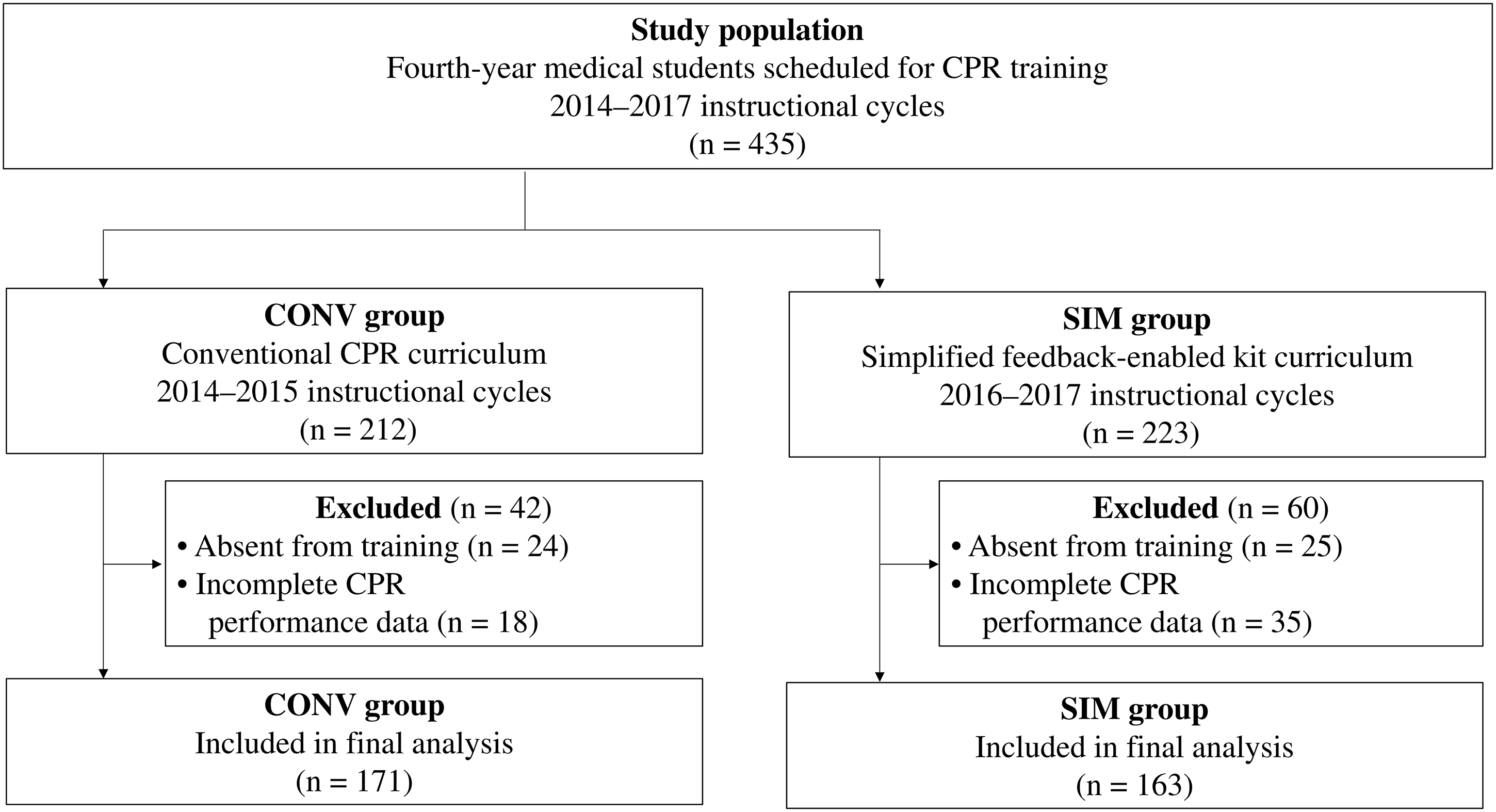
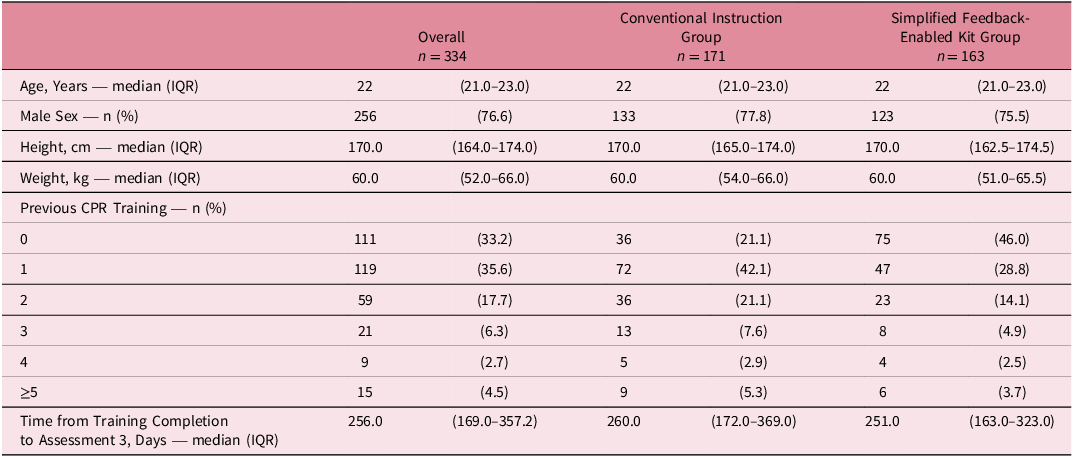
A flow diagram of participant selection is shown in Figure 1. A total of 435 fourth-year medical students were enrolled in the CPR curriculum during the study period (CONV, n = 212; SIM, n = 223). After exclusion of students who were absent from training sessions or had incomplete performance data (CONV, n = 42; SIM, n = 60), 334 participants were included in the final analysis (CONV, n = 171; SIM, n = 163). Baseline characteristics were generally comparable between groups (Table 1), although the SIM group included fewer participants with prior CPR training experience than the CONV group. The median interval between completion of formal BLS training and Assessment 3 was similar between groups; however, the follow-up interval demonstrated broad variability in both groups (Table 1 and Supplementary Figure 1).
Participant Flow Diagram.
Note: Fourth-year medical students who underwent scheduled CPR training at Gifu University School of Medicine during the 2014-2017 study period were grouped according to instructional cycle in this nonrandomized historical cohort design. The CONV group received the conventional CPR curriculum during the 2014-2015 instructional cycles, whereas the SIM group received the revised curriculum incorporating the simplified feedback-enabled CPR training kit during the 2016-2017 instructional cycles. Students who were absent from training sessions or had incomplete CPR performance data because of technical recording errors were excluded. Overall, 334 students were included in the final analysis: 171 in the CONV group and 163 in the SIM group.
Abbreviations: CPR, cardiopulmonary resuscitation; CONV, conventional instruction group; SIM, simplified feedback-enabled kit group.

Baseline Characteristics of Participants

Table 1. Long description
A table comparing baseline characteristics of participants in two groups, Conventional Lecture Group and Simplified Feedback-Enabled Kit Group. The table has 10 rows and 6 columns. Column headers are Overall, n = 334, Conventional Lecture Group, n = 171, and Simplified Feedback-Enabled Kit Group, n = 163. Row labels are Age, Years — median (IQR), Male Sex — n (%), Height, cm — median (IQR), Weight, kg — median (IQR), Previous CPR Training — n (%), and Time from Training Completion to Assessment 3, Days — median (IQR). Row 1: Age, Years — median (IQR), Overall, 22 (21.0-23.0), Conventional Lecture Group, 22 (21.0-23.0), Simplified Feedback-Enabled Kit Group, 22 (21.0-23.0). Row 2: Male Sex — n (%), Overall, 256 (76.6), Conventional Lecture Group, 133 (77.8), Simplified Feedback-Enabled Kit Group, 123 (75.5). Row 3: Height, cm — median (IQR), Overall, 170.0 (164.0-174.0), Conventional Lecture Group, 170.0 (165.0-174.0), Simplified Feedback-Enabled Kit Group, 170.0 (162.5-174.5). Row 4: Weight, kg — median (IQR), Overall, 60.0 (52.0-66.0), Conventional Lecture Group, 60.0 (54.0-66.0), Simplified Feedback-Enabled Kit Group, 60.0 (51.0-65.5). Row 5: Previous CPR Training — n (%), Overall, 0, 111 (33.2), Conventional Lecture Group, 0, 36 (21.1), Simplified Feedback-Enabled Kit Group, 0, 75 (46.0). Row 6: Previous CPR Training — n (%), Overall, 1, 119 (35.6), Conventional Lecture Group, 1, 72 (42.1), Simplified Feedback-Enabled Kit Group, 1, 47 (28.8). Row 7: Previous CPR Training — n (%), Overall, 2, 59 (17.7), Conventional Lecture Group, 2, 36 (21.1), Simplified Feedback-Enabled Kit Group, 2, 23 (14.1). Row 8: Previous CPR Training — n (%), Overall, 3, 21 (6.3), Conventional Lecture Group, 3, 13 (7.6), Simplified Feedback-Enabled Kit Group, 3, 8 (4.9). Row 9: Previous CPR Training — n (%), Overall, 4, 9 (2.7), Conventional Lecture Group, 4, 5 (2.9), Simplified Feedback-Enabled Kit Group, 4, 4 (2.5). Row 10: Previous CPR Training — n (%), Overall, ≥5, 15 (4.5), Conventional Lecture Group, ≥5, 9 (5.3), Simplified Feedback-Enabled Kit Group, ≥5, 6 (3.7). Row 11: Time from Training Completion to Assessment 3, Days — median (IQR), Overall, 256.0 (169.0-357.2), Conventional Lecture Group, 260.0 (172.0-369.0), Simplified Feedback-Enabled Kit Group, 251.0 (163.0-323.0).
Note: Data are presented as median (IQR) or number (%).
Abbreviations: CPR, cardiopulmonary resuscitation; IQR, interquartile range.
Primary Outcome: Attainment of Target Compression Rate (100-120 compressions/minute)
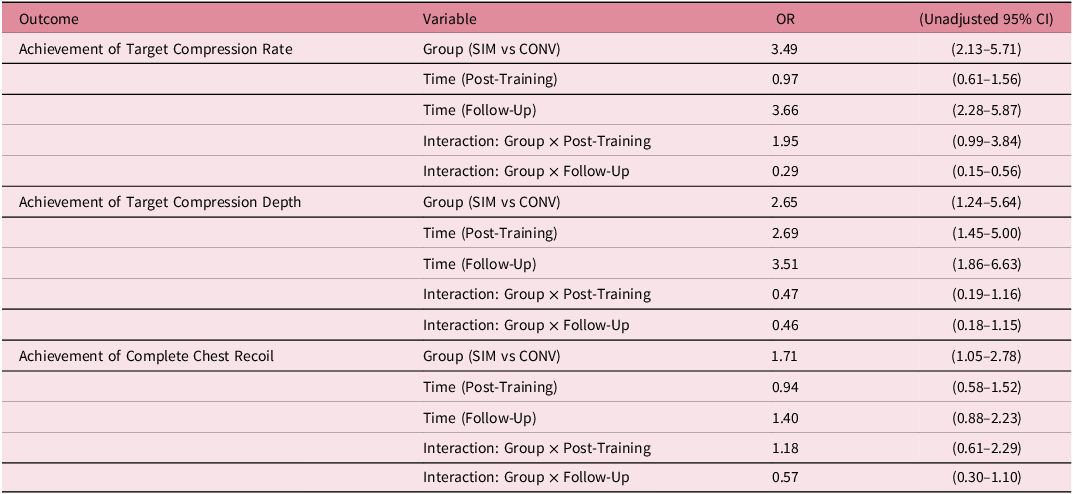
Mixed-effects logistic regression analysis demonstrated differences between groups over time in attainment of the guideline-recommended compression rate (Table 2). The omnibus group × assessment interaction for the primary outcome was statistically significant (P < 0.001). At Assessment 1 (Pre-BLS Assessment), participants in the SIM group demonstrated higher odds of achieving the target compression rate compared with those in the CONV group (OR, 3.49; 95% CI, 2.13–5.71). At Assessment 2 (Immediate Post-BLS Assessment), the group × post-training interaction term did not provide clear evidence of attenuation of the early between-group difference relative to Assessment 1 (interaction term: OR, 1.95; 95% CI, 0.99–3.84). By Assessment 3 (Delayed Follow-Up Assessment), the group × follow-up interaction term indicated attenuation of the early between-group difference, with compression rate attainment largely converging between groups (interaction term: OR, 0.29; 95% CI, 0.15–0.56).
Mixed-Effects Logistic Regression Results

Table 2. Long description
The table presents the results of a mixed-effects logistic regression analysis, comparing the achievement of target compression rate, compression depth, and complete chest recoil between two groups (SIM vs CONV) over three assessments: Pre-BLS Assessment, Immediate Post-BLS Assessment, and Delayed Follow-Up Assessment. The table has three main sections, each focusing on a different outcome: Achievement of Target Compression Rate, Achievement of Target Compression Depth, and Achievement of Complete Chest Recoil. Each section includes rows for Group, Time (Post-Training and Follow-Up), and Interaction terms (Group x Post-Training and Group x Follow-Up). The columns are labeled Outcome, Variable, OR, and (Unadjusted 95% CI). Row-wise data: Achievement of Target Compression Rate: Group (SIM vs CONV) OR 3.49 (Unadjusted 95% CI 2.13-5.71), Time (Post-Training) OR 0.97 (Unadjusted 95% CI 0.61-1.56), Time (Follow-Up) OR 3.66 (Unadjusted 95% CI 2.28-5.87), Interaction: Group x Post-Training OR 1.95 (Unadjusted 95% CI 0.99-3.84), Interaction: Group x Follow-Up OR 0.29 (Unadjusted 95% CI 0.15-0.56). Achievement of Target Compression Depth: Group (SIM vs CONV) OR 2.65 (Unadjusted 95% CI 1.24-5.64), Time (Post-Training) OR 2.69 (Unadjusted 95% CI 1.45-5.00), Time (Follow-Up) OR 3.51 (Unadjusted 95% CI 1.86-6.63), Interaction: Group x Post-Training OR 0.47 (Unadjusted 95% CI 0.19-1.16), Interaction: Group x Follow-Up OR 0.46 (Unadjusted 95% CI 0.18-1.15). Achievement of Complete Chest Recoil: Group (SIM vs CONV) OR 1.71 (Unadjusted 95% CI 1.05-2.78), Time (Post-Training) OR 0.94 (Unadjusted 95% CI 0.58-1.52), Time (Follow-Up) OR 1.40 (Unadjusted 95% CI 0.88-2.23), Interaction: Group x Post-Training OR 1.18 (Unadjusted 95% CI 0.61-2.29), Interaction: Group x Follow-Up OR 0.57 (Unadjusted 95% CI 0.30-1.10).
Note: Odds ratios (OR) were estimated from adjusted mixed-effects logistic regression models including instructional group, assessment time point, group × assessment interaction, sex, and previous CPR training experience, with a participant-level random intercept. The widths of the 95% confidence intervals (CI) have not been adjusted for multiplicity, and they should not be used in place of hypothesis testing. Thus, “Unadjusted 95% CI” refers to the absence of multiplicity adjustment for confidence interval widths, not to unadjusted odds-ratio estimates.
Abbreviations: CPR, cardiopulmonary resuscitation; SIM, simplified feedback-enabled kit group; CONV, conventional instruction group.
Overall, the early between-group difference in attainment of the target compression rate was substantially attenuated by delayed follow-up.
Secondary Outcomes
Attainment of Target Compression Depth (≥50 mm)—At Assessment 1, participants in the SIM group demonstrated higher odds of achieving the target compression depth compared with those in the CONV group (OR, 2.65; 95% CI, 1.24–5.64). Within the reference group (CONV), the odds of achieving target compression depth were higher at Assessment 2 (OR, 2.69; 95% CI, 1.45–5.00) and Assessment 3 (OR, 3.51; 95% CI, 1.86–6.63) relative to Assessment 1. The interaction terms at Assessment 2 (OR, 0.47; 95% CI, 0.19–1.16) and Assessment 3 (OR, 0.46; 95% CI, 0.18–1.15) were compatible with attenuation of the initial between-group difference, although the confidence intervals were wide.
Attainment of Complete Chest Recoil—At Assessment 1, participants in the SIM group demonstrated higher odds of achieving complete chest recoil compared with those in the CONV group (OR, 1.71; 95% CI, 1.05–2.78). The interaction terms at Assessment 2 (OR, 1.18; 95% CI, 0.61–2.29) and Assessment 3 (OR, 0.57; 95% CI, 0.30–1.10) did not provide clear evidence of between-group differences in temporal trends.
Continuous Performance Metrics
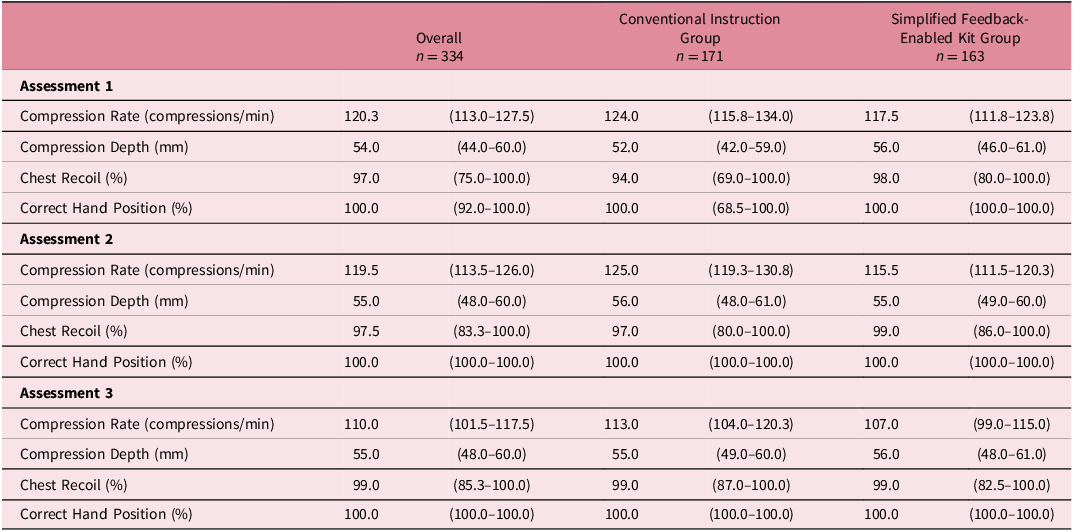
Median chest compression rate, compression depth, recoil percentage, and correct hand placement at each assessment are summarized in Table 3. At Assessment 1, the median compression rate in the CONV group exceeded the recommended target range (124.0 compressions/minute; IQR, 115.8–134.0), whereas the median compression rate in the SIM group remained within the guideline-recommended range (117.5 compressions/minute; IQR, 111.8–123.8). Similar patterns were observed at Assessment 2. By Assessment 3, median compression rates in both groups were within the target range. Median compression depth exceeded the recommended threshold (≥50 mm) at all assessments in both groups.
Median Chest Compression Rate, Depth Values, Recoil Percentage, and Correct Hand Placement at Each Assessment

Table 3. Long description
A table comparing chest compression metrics across two groups and three assessments. The table has 12 rows and 7 columns. The columns are labeled Overall, Conventional Lecture Group, and Simplified Feedback-Enabled Kit Group, with sub-columns for each assessment. The rows are labeled with different metrics: Compression Rate (compressions/min), Compression Depth (mm), Chest Recoil (percent), and Correct Hand Position (percent). Each cell contains median values and interquartile ranges for the respective metrics and groups. The table shows data for three assessments, with each assessment having its own set of values for the metrics. Notable trends include variations in compression rates and depths across the assessments and groups, with some values exceeding recommended thresholds.
Note: Data are presented as median (IQR).
Discussion
In this study, a scalable, feedback-enabled CPR training model was associated with earlier attainment of guideline-consistent compression performance compared with conventional instruction. Because Assessment 1 was conducted approximately two months after the initial instructional session and immediately before formal BLS training, this finding should be interpreted as reflecting early skill retention after the initial instructional phase rather than immediate post-instruction performance. The interaction observed for compression rate suggests that this early advantage was substantially attenuated at delayed follow-up, consistent with convergence of performance after repeated training. From a prehospital and disaster preparedness perspective, this distinction may be particularly relevant in settings in which only a single instructional exposure is feasible.
High-quality bystander CPR is a major determinant of survival following OHCA. Reference Merchant, Topjian and Panchal2,Reference Hasselqvist-Ax, Riva and Herlitz5 Adherence to recommended compression rate, depth, and recoil has been consistently associated with improved coronary perfusion pressure, ROSC, and survival outcomes. Reference Paradis, Martin and Rivers6,Reference Stiell, Brown and Nichol9,Reference Christenson, Andrusiek and Everson-Stewart10,Reference Wik, Kramer-Johansen and Myklebust14,Reference Abella, Alvarado and Myklebust15,Reference Meaney, Bobrow and Mancini19 Population-level improvements in bystander CPR provision have also been associated with increased survival in national registry analyses. Reference Hasselqvist-Ax, Riva and Herlitz5,Reference Gräsner, Wnent and Herlitz25 Therefore, strengthening early adherence to guideline-consistent CPR performance during an initial training exposure may have important public health implications, particularly in communities with limited opportunities for recurrent training.
The observed early advantage in the scalable kit group is consistent with previous evidence supporting feedback-enabled and practice-intensive training modalities. Systematic reviews have demonstrated that audiovisual feedback devices improve compression rate and depth during both training and resuscitation attempts. Reference Greif, Cheng and Abelairas-Gómez4,Reference Cheng, Nadkarni and Mancini11,Reference Yeung, Meeks and Edelson20 In addition, studies evaluating low-cost or simplified manikins have reported short-term compression quality comparable to that achieved with standard commercial training devices during initial skill acquisition. Reference Nishiyama, Iwami and Murakami17,Reference Yeung, Meeks and Edelson20
An important contribution of the present study is the educational structure enabled by the simplified training model. Conventional CPR training commonly relies on sequential practice using a limited number of manikins under direct instructor supervision, which restricts individual hands-on practice time. Reference Greif, Cheng and Abelairas-Gómez4,Reference Cheng, Nadkarni and Mancini11 In contrast, the simplified kit used in this study enabled near-simultaneous hands-on practice for most learners. In the conventional instructional setting, approximately 20 students shared a single manikin, whereas the simplified model provided one training kit for every one-to-two students. This structure increased practice density within the same instructional period, allowing participants to perform more repeated compression attempts during the early learning phase.
In addition, the integrated audiovisual feedback may have reduced reliance on continuous instructor correction by providing immediate performance cues during early CPR training. The present study extends previous work by modeling within-subject learning trajectories across repeated assessments. The combination of increased practice density and real-time feedback may help explain the observed association with earlier attainment of guideline-consistent CPR performance during early skill acquisition. Reference Greif, Cheng and Abelairas-Gómez4,Reference Cheng, Nadkarni and Mancini11,Reference Yeung, Meeks and Edelson20
The practical importance of early performance gains becomes more apparent when considered in the context of skill decay. Overall CPR skill deterioration has been documented within months after initial training in both laypersons and health care providers. Reference Cheng, Nadkarni and Mancini11,Reference Yang, Yen and McGowan16 In structured academic programs in which refresher sessions are incorporated into the curriculum, different instructional formats may ultimately yield similar long-term outcomes. However, in community-based courses, workplace training programs, or disaster preparedness initiatives, repeated instruction cannot be assumed. In such single-session training environments, the likelihood of achieving guideline-consistent compression parameters during initial training may be more relevant than long-term convergence. Accordingly, earlier attainment of guideline-consistent compression performance may help strengthen the first links in the chain of survival at the population level. Reference Greif, Cheng and Abelairas-Gómez4,Reference Cheng, Nadkarni and Mancini11
From an implementation perspective, scalable and resource-efficient training models may be particularly relevant in disaster-prone or resource-limited environments. Large-scale emergencies and mass-casualty incidents can expose limitations in community responder capacity, instructor availability, and training infrastructure. Reference Greif, Cheng and Abelairas-Gómez4 Educational approaches that enable simultaneous hands-on practice with minimal logistical burden may support broader dissemination of essential CPR competence. By reducing equipment constraints while maintaining real-time feedback, simplified feedback-enabled training approaches may contribute to strengthening community-level emergency preparedness.
Limitations
This study has several limitations. First, the study was nonrandomized and used historical instructional cycles, introducing the potential for cohort-related and temporal confounding. Although learning objectives, instructor qualifications, and assessment criteria remained consistent across instructional periods, unmeasured differences between teaching cycles cannot be excluded. Temporal changes in educational exposure, familiarity with resuscitation concepts, or informal CPR training opportunities may also have contributed to the observed differences. Second, the distribution of prior CPR training differed between cohorts, likely reflecting temporal changes in CPR exposure among medical students. The direction of this potential bias is uncertain because students with less prior CPR exposure may have differed in both baseline skill level and responsiveness to feedback-enabled practice. Although other baseline characteristics were generally comparable, residual confounding remains possible.
Third, because students with absences or incomplete performance recordings were excluded from analysis, selection bias related to nonrandom missingness cannot be fully excluded. Fourth, the study data were collected from 2014 through 2017. However, the core CPR performance metrics and guideline targets examined in this study have remained stable across successive international guideline updates, supporting the on-going relevance of compression rate, depth, and recoil as indicators of CPR quality. Reference Greif, Cheng and Abelairas-Gómez4 In addition, the educational principles evaluated in this study – namely increased hands-on practice density and immediate performance feedback – remain consistent with current resuscitation education strategies. Fifth, Assessment 3 was conducted at variable intervals after BLS training because of curricular scheduling constraints, which may have influenced long-term retention outcomes. Although the median interval between training completion and Assessment 3 was similar between groups, the follow-up window was broad in both groups, and individual variability in follow-up duration may still have affected skill retention.
Sixth, the study population consisted of medical students in an academic setting, which may limit generalizability to lay populations. Nevertheless, early skill acquisition may be particularly important in nonacademic, single-session training contexts, including community CPR courses and disaster preparedness programs. Accordingly, the relevance of these findings to community-based and disaster-preparedness settings should be considered hypothesis-generating and requires validation in layperson populations. Seventh, because the simplified training model incorporated both increased practice density and integrated audiovisual feedback, the independent contribution of each component could not be determined. The findings should therefore be interpreted as reflecting the combined effect of the overall educational approach rather than any single intervention component.
Finally, dichotomization of CPR performance metrics according to guideline thresholds may have obscured the direction and magnitude of deviations, including excessively rapid compression rates. To address this limitation, continuous performance metrics were also summarized descriptively. In addition, confidence intervals were not adjusted for multiplicity and should not be interpreted as substitutes for formal hypothesis testing; secondary outcome analyses should therefore be considered exploratory.
Conclusions
A simplified, feedback-enabled CPR training model was associated with earlier attainment of guideline-consistent compression performance compared with conventional instruction. Although the between-group differences diminished after repeated training, earlier skill attainment may be particularly relevant in settings in which opportunities for refresher instruction are limited. Scalable, feedback-enabled training approaches warrant further evaluation as potentially resource-efficient strategies to support acquisition of essential resuscitation skills in community-based and disaster-preparedness settings.
Supplementary Material
The supplementary material for this article can be found at https://doi.org/10.1017/S1049023X26108991.
Acknowledgements
The authors thank Dr. Tetsuya Fukuta, Dr. Kodai Suzuki, Dr. Takahito Miyake, Dr. Ryo Kamidani, and Dr. Tomotaka Miura for their assistance in data collection and support for this study. They also sincerely thank the medical students at the Gifu University School of Medicine for their enthusiastic participation and cooperation in this study. The authors would like to acknowledge Editage (www.editage.com) for the English-language editing.
Author Contributions
All authors have read and approved the final manuscript and agree to be accountable for all aspects of the work. Conceptualization: SN, KS, and HO; Data Curation: SN, KH, and KS; Formal Analysis and Statistical Methodology: AS and NT; Supervision and Critical Revision of Study Design and Interpretation: SK and TY; Writing – Original Draft: SN; Writing – Review and Editing: SN, KS, KH, AS, NT, SK, TY, and HO. SN and KS contributed equally to this work.
Competing Interests
The authors declare none.
Use of AI Technology
No artificial intelligence (AI) tools were used in the preparation, writing, or editing of this manuscript.


 Open access

