




Introduction
Maize (Zea mays L.) is the staple cereal widely grown in Africa and the main component of food aid interventions (Jama et al., Reference Jama, Kimani, Harawa, Mavuthu and Sileshi2017; Leonardo et al., Reference Leonardo, van de Ven, Udo, Kanellopoulos, Sitoe and Giller2015). It is also increasingly being used as a livestock feed (Onasanya et al., Reference Onasanya, Aiyelari, Onasanya, Oikeh, Nwilene and Oyelakin2009) and in industrial applications, as its kernel starch content is 77% (Asim et al., Reference Asim, Hussain, Ali, Farooq, Khan and Shah2017). Maize ranks second on global scale after wheat in total production and third among the cereals (Asim et al., Reference Asim, Hussain, Ali, Farooq, Khan and Shah2017). Although maize productivity and production remained low and variable in the past, there have been clear signs of improvement in recent decade (Abate et al., Reference Abate, Shiferaw, Menkir, Wegary, Kebede, Tesfaye, Kassie, Bogale, Tadesse and Keno2015; Rockström and Falkenmark, Reference Rockström and Falkenmark2000). According to the Global Yield Gap Atlas (GYGA, 2021), the water-limited yield potential of maize is in the range of 6–13.9 Mg ha−1 across nine major maize producing countries in SSA. Yet, actual yields are still below 5 t ha−1 (FAO, 2016), thus limiting maize’s numerous uses. Yield gaps with the recommended rate of inorganic fertilizer are significantly higher on farmers’ fields compared with research stations (Sileshi et al., Reference Sileshi, Akinnifesi, Debusho, Beedy, Ajayi and Mong’omba2010). Across sub-Saharan Africa, mean yields were about 3.9 t ha−1 in maize grown with the recommended rate of inorganic fertilizer but around 1.4 t ha−1 when grown without external nutrient inputs (Sileshi et al., Reference Sileshi, Akinnifesi, Debusho, Beedy, Ajayi and Mong’omba2010).
In Ethiopia, maize is the second (following teff) most common cereal crop in land area cultivated, with an estimated area of 2.1 million ha, but ranks first in production estimated at 8.4 million tons per year (CSA, 2018). The national average yield is 3.9 t ha−1 (CSA, 2018), which is lower than the experimental yield of over 4.9 t ha−1 (FAO, 2016) and the water-limited yield potential of 13.9 t ha−1 in Ethiopia (GYGA, 2021). The low yields have been attributed partly to the limited use of external inputs and low soil nutrient status – especially nitrogen (N), phosphorus (P), potassium (K) and sulphur (S) – as a result of decades of mono-cropping and excessive leaching of soil nutrients (Law Ogbomo and Law Ogbomo, 2009). Using crop-modelling, an increase in maize yield of 2.5–9.2 t ha−1 was reported due to soil fertility improvement from poor to near optimal condition in the Blue Nile basin of Ethiopia (Erkossa et al., Reference Erkossa, Awulachew and Aster2011). These statistics emphasise that it is important to apply adequate and balanced amounts of nutrient to replenish the soils and enhance crop productivity.
Current fertilizer use in Ethiopia is based on a blanket recommendation of 100 kg ha−1 diammonium phosphate (18-46-0) and 100 kg urea ha−1 (46-0-0) for all crops (IFPRI, 2010). Evidently, the nutrients in this blanket recommendation are not well balanced agronomically, and the continuous use of this recommendation has gradually exhausted soil nutrient reserves. Therefore, neither yields nor profits can be sustained using imbalanced application of fertilizers, as the practice results in accelerating deficiencies and imbalances of soil nutrients (Agegnehu and Amede, Reference Agegnehu and Amede2017; IFPRI, 2010). At present, N, P, S, boron (B) and zinc (Zn) deficiencies are widespread in Ethiopian soils, whereas some soils are also deficient in K, copper (Cu), manganese (Mn) and iron (Fe) (Dibabe et al., Reference Dibabe, Bekele and Assen2007; EthioSIS, 2016). The recent soil fertility map of Ethiopia shows deficiency of 86 N, 99 P, 7 K, 92 S, 65 B and 53% Zn (EthioSIS, 2016). Responses of maize to N and P have been widely documented in maize-growing areas of Ethiopia, but little has been done to establish the scale of response to K, S and micronutrient deficiencies. In addition, little effort has been made to establish dose–responses and a more balanced nutrient management strategy in maize production on different soil types (Mbah et al., Reference Mbah, Muoneke and Okpara2007). To enhance the nutrient recovery and optimize fertilizer use efficiency, the blanket fertilizer recommendations need to be replaced with context-specific nutrient management that also matches with the socioeconomic circumstances of farmers. Better matching of fertilizer application to agroecological zones, soil types and farmer management practices can increase productivity and enhance food security.
Nutrient use efficiency (NUE), or grain production per unit of available nutrient in the soil, is important for profitability and environmental sustainability. For example, cereal NUE is composed of the efficiency of N uptake and the conversion of total crop N uptake to grain (Fageria and Baligar, Reference Fageria and Baligar2005). Application of excess N is normally a major cause of low NUE (Meisinger et al., Reference Meisinger, Schepers, Raun, Schepers and Raun2008), with an average recovery of about 38% of applied N for cereal production. NUE may be low, even with low N application rates, because of limited plant growth due nutrient imbalances and other biotic or abiotic constraints, possibly including deficiencies of P and other essential nutrients (Bekunda et al., Reference Bekunda, Galloway, Syers, Scholes, Bationo, Waswa, Kihara and Kimetu2007). Low fertilizer use efficiency can also result from inappropriate fertilizer recommendations that should account for the cash constraints and risks affecting resource-poor farmers.
Despite the number of studies conducted on the effect of inorganic fertilizer and organic inputs on maize yield, information is lacking on the variation in nutrient dose–responses with soil types and agroecological zones in Ethiopia. Therefore, this study was conducted with two specific objectives: (1) to determine the variability in maize yield response to N, P, K and S rates as well as the agronomically optimum rates of each nutrient across the two agroecological zones and soil types and (2) to quantify the agronomic use efficiency of N, P and K for each soil type.
Materials and Methods
Site description
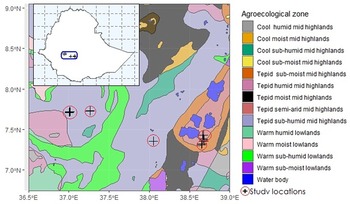
Nutrient response trials were conducted on 29 farmers’ fields in the maize-growing areas of Oromia and Southern Nations, Nationalities and Peoples Region (SNNPR) (Figure 1) for three consecutive years (2014–2016). In Oromia, the study was conducted in Arsi-Negele, Omonada and Kerssa districts, while in SNNPR it was conducted in Halaba district. Based on the current agroecological zonation of Ethiopia, Arsi-Negele is a warm, moist lowlands (M2), whereas Omonada and Kerssa districts fall under the warm, sub-humid mid-highlands (SH3) zone. In the SNNPR, the study sites were located in Halaba district, which falls under the warm moist lowlands (M2). The M2 is characteristic of the Rift Valley of Ethiopia. The elevation ranges from 1600 to 2200 m asl, and the mean annual temperature varies between 16 and 20 °C. On the other hand, in SH3, the altitude ranges between 2000 and 2800 m asl, and the mean annual temperature varies between 16° and 21 °C. The growing period in SH3 (181–240 days) is longer than in M2 (146–160 days). The mean rainfall received at Arsi Negele was 835 mm (range 760–888 mm) (Table 1). The mean rainfall received at Kersa was 1511 (range 1482–1530 mm), while it was 1379 mm (range 1317–1506 mm) at Omonada (Table 1).
Study sites located in the two regions of the country. Whiskers (+) represent the study locations.

Characteristics of the study sites in terms of agroecological zone, soil types and selected soil chemical properties of the study sites

M2: Warm moist lowlands, SH3: Warm, sub-humid mid-highlands.
The major soil types of the experimental sites are Andosol and Nitisols (Table 1). Andosols are young soils developed in volcanic deposits that have a high potential for agricultural production (IUSS Working Group WRB, 2015; Jones et al., Reference Jones, Breuning-Madsen, Brossard, Dampha, Deckers, Dewitte, Gallali, Hallett, Jones and Kilasara2013). They are generally fertile soils, particularly in intermediate or basic volcanic ash, and they are not exposed to excessive leaching. Andosols have favourable properties for cultivation, development of plant roots and water storage, but they are prone to P fixation and erosion (IUSS Working Group WRB, 2015; Jones et al., Reference Jones, Breuning-Madsen, Brossard, Dampha, Deckers, Dewitte, Gallali, Hallett, Jones and Kilasara2013). Nitisols are deep, well-drained, reddish soils with diffuse horizontal boundaries and are among the most productive soils in the humid tropics (IUSS Working Group WRB, 2015). These soils are widely used by smallholder farmers for food crop production in Ethiopia. The deep and porous solum and the stable soil structure of Nitisols permit deep rooting, making these soils quite resistant to erosion t (IUSS Working Group WRB, 2015). The good workability of Nitisols, their good internal drainage and good water-holding properties are complemented by chemical (fertility) properties (IUSS Working Group WRB, 2015). In the study areas, Andosol had higher pH, exchangeable K and available P than the Nitisols (Table 1). Both soils had SOC and total N content higher than what is considered the critical concentration of 20 g kg−1 for SOC and 2 g kg−1 for N (Hazelton and Murphy, 2001; Musinguzi et al., Reference Musinguzi, Tenywa, Ebanyat, Tenywa, Mubiru, Basamba and Leip2013).
Treatments and experimental designs
The experiment was designed in such a way that responses to N, P, K or S rates individually could be determined under balanced application of the other macronutrients and micronutrients. The treatments consisted of six rates of N (0, 46, 92, 138, 184 and 230 kg N ha−1), P (0, 10, 20, 30, 40 and 50 kg P ha−1), S (0, 10, 20, 30, 40 and 50 kg S ha−1) and eight rates of K (0, 17, 33, 50, 66, 83, 100 and 116 kg K ha−1) combined with balanced application of the remaining nutrients. For determining response to N, each of the N rates was combined with 30 kg P ha−1, 83 kg K ha−1, 30 kg S ha−1, 2 kg Zn ha−1 and 0.5 kg B ha−1. Similarly, when determining response to P, each of the six P rates was combined with 92 kg N ha−1, 83 kg K ha−1, 30 kg S ha−1, 2 kg Zn ha−1 and 0.5 kg B ha−1. Likewise, the eight K rates were combined with 92 kg N ha−1, 30 kg P ha−1, 30 kg S ha−1, 2 kg Zn ha−1 and 0.5 kg B ha−1 when determining response to K. To determine the response to S, each of the six S rates was combined with 92 kg N ha−1, 30 kg P ha−1, 83 kg K ha−1, 2 kg Zn ha−1 and 0.5 kg B ha−1. That way, each of the nutrient rates had a balanced application of the other nutrients as shown in Supplementary Table S1. Sulphur, zinc and boron were selected because of their deficiencies in the selected locations based on the EthoSIS nutrient map. N was applied in two splits (i.e., half at planting and half at 45 days after planting), whereas full doses of each of P, K, S, Zn and B were applied in rows close to the crop rows at planting. Nitrogen was applied in the form of urea, P as triple superphosphate (TSP), K as potassium chloride (KCl), S as calcium sulphate (CaSO4), Zn as zinc sulphate (ZnSO4) and B as borax. The other crop management practices were followed as per the recommendation for maize.
The plot size on all the experimental sites was 5.1m x 3.75 m (∼19 m2). Following variety recommendations for specific areas, maize variety BH-661 (average yield potential 9,000 kg ha−1) was used as the test crop on Nitisols in SH3, but M-II (average yield potential 4,700 kg ha−1) and Shone (average yield potential 5,700 kg ha−1) were used in M2 on Andosols. All maize varieties were planted with intra- and inter-row spacing of 25 and 75 cm, respectively. The treatments were laid out in randomised complete blocks design with three replicates per farm.
Data collection
Soil sampling and analysis
Composite soil samples were collected from 0 to 20 cm depth before planting from all experimental sites using an auger. Five representative sub-samples from each l site were mixed in plastic bags to make one composite sample per site that making a total of four composite samples following the standard soil sampling procedures. Potentiometric method using a glass calomel combination electrode was used to measure pH of the soils in water suspension in a 1:2.5 (soil: water ratio) (Van Reeuwijk, Reference Van Reeuwijk1993). The Walkley and Black (Reference Walkley and Black1934) wet digestion method was used to determine soil organic carbon (OC) content. Total nitrogen content of the soil was determined by the wet oxidation procedure of the Kjeldahl method (Bremner and Mulvaney, Reference Bremner, Mulvaney, Page, Miller and Keeney1982). Available P was determined using the standard Olsen et al. (Reference Olsen, Cole, Watanabe and Dean1954) extraction methods. The absorbance of available P extracted was measured using spectrophotometer after colour development. Exchangeable K was determined after percolating and extracting the soil samples by 1N ammonium acetate solution at pH 7 in which exchangeable K+ in the leachate was measured by Flame Photometer (Okalebo et al., Reference Okalebo, Gathua and Woomer2002).
Crop sampling and measurements
Harvesting took place from mid-October to mid-November depending on the specific growing condition of each area. To measure total above-ground biomass and grain yields, the central four rows of each plot were harvested at ground level. Grain yield and above-ground total biomass yields were then recorded. After threshing, seeds were cleaned and weighed, and seed moisture content was measured using a gravimetric method. Total biomass (on dry matter basis) and grain yields (adjusted to a moisture content of 12.5%) were converted to kg ha−1 before statistical analysis.
Statistical analysis
Linear mixed modelling
Linear mixed modelling (LMM) was applied to determine variations in yield with the different levels of N, P, K and S by soil type and agroecology combining study locations and years. The LMM (implemented via PROC MIXED of the SAS system) was chosen for the different levels of analyses because it allows modelling of hierarchical or clustered data arising from observational studies through inclusion of both fixed and random effects. The mixed modelling approach was also chosen to account for imbalance in terms of sample size and confounding of responses by uncontrolled variables. The fixed effects in the model were agroecological zone (AEZ), soil type, nutrient rate and their interactions, with location as the random effect. The initial model was of the following form:
 $$\;Y = \;\mu + AEZ + soil + rate + year + AEZ*rate + soil*rate + location + \varepsilon $$
where μ is the grand mean yield (kg ha−1), AEZ is agroecological zone, soil is the soil type of the location according to the World Reference Base (WRB) classification system, rate is the rate of application (kg ha−1) for the nutrient under study and ϵ is the error term. In many cases, however, sample sizes were not adequate to accommodate this model. In addition, for most sites, there was also one soil type for a given AEZ, thus creating confounding between these two variables. Consequently, analyses were done for soil type and AEZ separately using the following models:
For soil type:
 $$Y = \;\mu + soil + rate + year + soil*rate + location + year + \varepsilon $$
For agroecological zones:
 $$Y = \;\mu + AEZ + rate + year + AEZ*rate + location + year + \varepsilon $$
The variations in yield with fixed effects were considered significant when p ≤ 0.05. Least square estimates and their 95% confidence intervals (CI) were used for statistical inference. This is because the 95% CI functions as a very conservative test of hypothesis, and it also attaches a measure of uncertainty to sample statistic (du Prel et al., Reference du Prel, Röhrig and Blettner2009). The means two or more levels of a fixed effect were considered to be significantly different from one another only if their 95% CI were nonoverlapping.
Dose–response modelling
Dose–response models were applied to determine the optimum rates of N, P, K and S on Andosols and Nitisols. The least square estimates of yield from the linear mixed model (equation 2) above were used for dose–response modelling. For this purpose, various nutrient response functions including the Mitscherlich-type functions, asymptotic and von Liebig type (linear plateaux) functions were compared and used as deemed appropriate (Sileshi, Reference Sileshi2021). The Mitscherlich function is given as
 $$Y = a\left( {1 - b*exp\left( { - cX} \right)} \right)$$
where a is the predicted maximum yields, b represents the proportional nutrient deficiency and c is a parameter which controls the steepness of the relationship between X and Y (Sileshi, Reference Sileshi2021; Sorensen, Reference Sorensen1983). When multiplied by 100, b represents the percentage deficiency of the nutrient in question (Sorensen, Reference Sorensen1983). Another modification of the Mitscherlich function is given as
 $$Y = a\left( {1 - exp\left( { - c\left( {X + b} \right)} \right)} \right)$$
where a is the predicted maximum yields, b represents the inherent soil nutrient (in kg ha−1) available in the soil at the start of the experiment and c is defined as in equation 4a.
The asymptotic function is given as
 $$Y = a - bc^X, $$
where Y is the predicted yield, a is the asymptotic yield (i.e., predicted maximum yield), b is the amplitude (i.e., estimated yield increase due to nutrient application), c is the curvature coefficient and X is the nutrient rate applied.
The linear-plateau function implies a region of linear response followed by a plateau given as follows:
 $$Y = \left\{ {\matrix{ {{b_0} + {b_1}X + \varepsilon \;if\;X \lt {X_{max}}} \cr {{Y_{max}} + \varepsilon \;if\;X \ge {X_{max}}} \cr } } \right.\;$$
where b 0 is the intercept and b 1 is the slope of the line, Y max is the plateau yield and X max is the ‘join point’, which represents the critical point after which increasing nutrient rates can no longer increase yields (Sileshi, Reference Sileshi2021).
Estimating agronomic efficiency (AE)
The agronomic efficiency of N (AEN), P (AEP), K (AEK) and S (AES) were determined on Andosols and Nitisols separately. According to Snyder and Bruulsema (Reference Snyder and Bruulsema2007), AE answers the question ‘How much productivity improvement was gained by the use of a given nutrient input?’, For each of the N, P, K or S rates applied, AE was computed as follows:
 $$AE = {{G{Y_{f - }}G{Y_u}} \over Q}$$
where GYf is the grain yield of the plot (kg ha−1) that received the nutrient in question, GYu is the grain yield (kg ha−1) of the plot where the nutrient was omitted and Q is the quantity of N, P, K or S applied (kg ha−1). Among the dose–response models compared, the Mitscherlich and asymptotic function gave more accurate estimates indicated by narrower 95% CLs than the linear-plateaux function. The linear-plateaux model also failed to provide a valid estimate of the agronomic optimum rate for N and K on Andosols. It also underestimated the optimum rates for all nutrients on Nitisols. Therefore, inferences about the dose–response predictions were all based on the Mitscherlich and asymptotic functions.
Results
Response to N rate
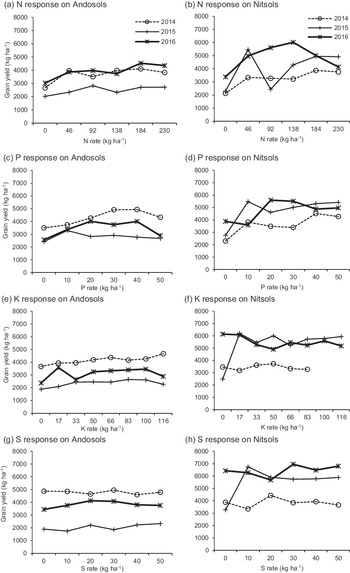
Mean grain yield and total above-ground biomass significantly varied with year (p < 0.001), N application rates (p < 0.001) and the interaction effect of N rate and soil type (p = 0.009) (Figure 2; Supplementary Table S2; Supplementary Figure S1). Year, N rate and the soil type by year interaction effect accounted for about 30% of the explained variation in grain yield response to N (Supplementary Table S3). Interannual variations in yield response were lower on Andosols (Figure 2a) than on Nitisols (Figure 2a).
Interannual variations in grain yield (kg ha−1) with nitrogen (N), phosphorus (P), potassium (K) and sulphur (S) application rates on Andosols and Nitisols.

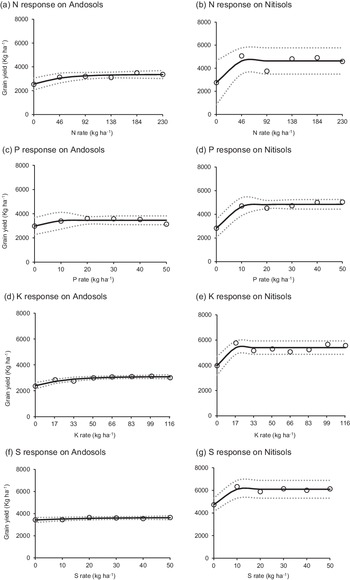
The maximum yields predicted using the dose–response models were lower on Andosols (3474 kg ha−1) than on Nitisols (4630 kg ha−1). However, the dose–response trends on Andosols (Figure 3a) had narrower confidence bands than on Nitisols (Figures 3b). The agronomic optimum N rates were estimated at 184 and 46 kg N ha−1 on Andosols and Nitisols, respectively (Table 2). The maximum yield increases due to N application were 950 and 1870 kg ha−1 on Andosols and Nitisols, respectively (Table 2), with the corresponding yield increments of 44.2 and 83.7% relative to the zero N input (Supplementary Table S3). Using the Mitscherlich model (equation 4), the percentage deficiency of N on Nitisols (40.4%) was 1.5 times more than on Andosols (27.2%) (Table 2). On both Andosols and Nitisols, the highest agronomic efficiency of N (AEN) was recorded with 46 kg N ha−1, but N was less efficiently used on Andosols than Nitisols (Figure 4a).
Yield response of maize to nitrogen (N), phosphorus (P), potassium (K) and sulphur (S) application rates on Andosols and Nitisols. Circles represent measured yield, while black solid lines and grey dotted lines represent the predicted yields and their 95% confidence limits, respectively.

Predicted maximum yields (kg ha−1), amplitudes (kg ha−1) and the agronomically optimum nutrient rate (kg ha−1) using the asymptotic, Mitscherlich and linear-plateaux functions

NE = not estimable; na = not available.
* The maximum yield is called asymptotic and plateaux yield in asymptotic and linear-plateaux models, respectively.
† Optimum nutrient rate represents the join point in linear-plateaux models.
‡ Amplitude represents the yield increase due to nutrient application.
Figures in parentheses represent Andosols and Nitisols significantly differ when their 95% CLs are non-overlapping.
Agronomic use efficiency of nitrogen, phosphorus, potassium and sulphur in maize.

As in grain yields, the highest total biomass yields were obtained with application of 184 kg N ha−1 on Andosols and 46 kg N ha−1 Nitisols, respectively (Supplementary Figure S1). The corresponding yield increments were about 15 and 60% over the zero N input rate. The harvest index significantly varied with year (p = 0.013) and N rate (p < 0.001), but not with soil type. On both Andosols and Nitisols, the highest harvest index was recorded with application of 184 kg N ha−1 (Supplementary Table S4).
Response to P rate
Maize grain yields did not significantly vary with year and soil type, but it varied with P rate and the interaction effect of year, rate and soil type (p < 0.001) (Figure 2; Supplementary Table S2). Yields showed greater increases with P rates on Nitisols (57–75%) than on Andosols (15–30%) (Supplementary Table S2). The predicted maximum yields recorded on Andosols (3461 kg ha−1) were lower than on Nitisols (4962 kg ha−1), and these were achieved with 30 and 40 kg P ha−1 on Andosols and Nitisols, respectively (Table 2). The percentage deficiency of P was estimated to be two times more on Nitisols (40.1%) than Andosols (20.3%) (Table 2). The P dose–response trends on Andosols (Figure 3c) are also different from the trends on Nitisols (Figures 3d). Across the different P rates, agronomic efficiency of P was significantly and consistently lower on Andosols than Nitisols (Figure 4b).
Application of P at different rates also had a significant (p < 0.05) effect on maize total biomass on Nitisols, but not on Andosols. The highest total biomass yields were obtained with the application of 30 kg P ha−1 on Andosols and 40 kg P ha−1 on Nitisols, respectively. The corresponding yield increments with these rates over the zero P input were 12 and 55% (Supplementary Figure S1). A similar trend was observed with agroecological zone (Supplementary Figure S2). The harvest index significantly varied only with year (Supplementary Table S4). On both Andosols and Nitisols, the highest harvest index was recorded with application of 10 and 50 kg P ha−1, respectively (Supplementary Table S4).
Response to K rate
Maize grain yield significantly varied with year (p = 0.012), K application rates (p < 0.001), soil type (p < 0.001) and the various interaction effects (p < 0.05) (Figure 2; Supplementary Table S2). Soil type, K rate and the soil type by year interaction effect accounted for about 41% of the explained variation in grain yield response to K (Supplementary Table S3). Yield increment with K rates was lower on Andosols (14–29%) than on Nitisols (26–44%) (Supplementary Table S3). Interannual variations in yield were much lower on Andosols (Figure 2c) than on Nitisols (Figure 2c). The K dose–response was almost flat on Andosols (Figure 3e), while it revealed a clear trend on Nitisols consistent with Mitscherlich-type response (Figure 3f). The predicted maximum yields on Andosols (3397 kg ha−1) were significantly lower than those on Nitisols (5581 kg ha−1). The agronomic optimum K rates achieving this yield level on Andosols could not be estimated, while the corresponding value was 17 kg K ha−1 on Nitisols (Table 2). The predicted yield gains due to K application were 701 and 1425 kg ha−1 on Andosols and Nitisols, respectively (Table 2). The highest agronomic efficiency of K (AEK) was recorded with 17 kg K ha−1 on Nitisols. Across the different K rates, AEK was significantly lower on Andosols than Nitisols (Figure 4a).
As in grain yield, total biomass was significantly lower on Andosols than on Nitisols (Supplementary Figure S1). The highest total biomass yields were obtained with the application of 83 kg K ha−1 on Andosols and 17 kg K ha−1 on Nitisols, respectively (Supplementary Figure S1c). A similar trend was observed with agroecological zone (Supplementary Figure S2c). The harvest index significantly varied (p < 0.05) with all variables (Supplementary Table S4). The harvest index was generally higher on Andosols than Nitisols. The highest recorded with application of 50 kg K ha−1 on Andosols and 33 kg K ha−1 on Nitisols (Supplementary Table S4).
Response to S rate
Maize grain yield significantly varied (p < 0.012) with year and the three-way interaction effects of year x S rate x soil, but note with the other factors (Supplementary Table S2). Soil type, year and the soil type by year interaction effect accounted for about 50% of the explained variation in grain yield response to S (Supplementary Table S3). Yield increment with S rates was much lower on Andosols (0.5–6.2%) than on Nitisols (24–34%) (Supplementary Table S3). The dose–response was flat on Andosols (Figure 3f), while the response on Nitisols was consistent with Mitscherlich-type response (Figure 3g). The predicted maximum yield on Andosols (3639 kg ha−1) was significantly lower than on Nitisols (6094 kg ha−1). The agronomic optimum S rates to achieve these yields are 30 and 10 kg S ha−1 on Andosols and Nitisols, respectively (Table 2). The maximum yield increases due to S application were 212 and 1368 kg ha−1 on Andosols and Nitisols, respectively (Table 2). The percentage deficiency of S was estimated to be 3.9 times more on Nitisols (22.4%) than Andosols (5.8%) (Table 2), and hence applied S was less efficiently utilised on Andosols than Nitisols (Figure 4d).
As in grain yield, total biomass was significantly lower on Andosols than on Nitisols (Supplementary Figure S1d). The highest total biomass yields were obtained with the application of 20 kg S ha−1 on Andosols and 10 kg S ha−1 on Nitisols, respectively (Supplementary Figure S1d). A similar trend was observed with agroecological zone (Supplementary Figure S2d). Across S rates, the harvest index was generally higher on Andosols than Nitisols. The highest harvest index was recorded with application of 30 kg S ha−1 on Andosols and 20 kg S ha−1 on Nitisols (Supplementary Table S4).
Discussion
Response to N rate
From this analysis, it is evident that N followed by P is the nutrient most limiting for the productivity of maize, but much more on the Nitisols than Andosols. Examination of the yield gain (amplitude in Table 2) revealed that maize yield response to N is higher than all the other nutrients. Earlier studies (e.g., Adediran and Banjoko, Reference Adediran and Banjoko1995) have found that on soils with low N and P and high K status, a high yield response can be obtained from the application of N and P fertilizers. The predicted maximum yields recorded in this study were below the water-limited yields of maize especially on Andosols. Under appropriate crop management, most improved varieties of maize have attainable yields of up to 13 900 kg ha−1 in Ethiopia (GYGA, 2021). The yield increments on Andosols (29–44%) and Nitisols (36–84%) obtained with the different N rates are also generally lower than those reported in other studies. A study by Jama et al. (Reference Jama, Kimani, Harawa, Mavuthu and Sileshi2017) conducted across sites in southern Africa recorded yield increments of 75–100%, as compared with the control. Kaizzi et al. (Reference Kaizzi, Byalebeka, Semalulu, Alou, Zimwanguyizza, Nansamba, Musinguzi, Ebanyat, Hyuha and Wortmann2012) also reported an increase in maize grain yield by 120% with N application, compared with the control with no N input. Several studies have concluded that growing maize without N fertilizer results in the loss of land productivity and profitability (Jama et al., Reference Jama, Kimani, Harawa, Mavuthu and Sileshi2017; Kaizzi et al., Reference Kaizzi, Byalebeka, Semalulu, Alou, Zimwanguyizza, Nansamba, Musinguzi, Ebanyat, Hyuha and Wortmann2012; Kogbe and Adediran, Reference Kogbe and Adediran2003; Zheng et al., Reference Zheng, Zhang, Liu, Zhou, Lu, Zhang, Yang, Li and Chen2016).
The predicted maximum yields on Andosols were lower than expected with the N rates applied implying that constrains other than N, P, K, S, Zn and B are probably limiting yields. Yield response to N was lower on Andosols than Nitisols partly because the relative N deficiency was 67% lower on Andosols than on Nitisols (Table 2). The dose–response predicted that only N rates in excess of 230 kg N ha−1 can achieve higher yields. This implies that opportunities exist for increasing the productivity of maize on Andosols if other yield-limiting factors are addressed. One possible constraint is moisture stress. Water-limited potential yield is often a function of available moisture because nutrient availability depends on available moisture. The quantity of nutrients required by a crop to achieve its water-limited potential yield is also a function of seasonal rainfall. The rainfall received during the cropping season was generally higher (>1300 mm) on Nitisol sites compared to the Andosol sites (835–901 mm). The significant variation yield response to N with the interaction effects of year, soil types and N rate emphases the role that soil properties, rainfall and nutrient management plays (Saıdou et al., Reference Saıdou, Janssen and Temminghoff2003; Wang et al., Reference Wang, Sun, Zhang, Xu and Shangguan2018). Low response to N fertilizer may be caused by erratic distribution of rainfall, especially in warm moist lowland areas such as the Rift Valley of Ethiopia. Crops use N fertilizer more efficiently when rainfall is adequate. Even in normal years, sub-optimal rainfall during critical stages of crop growth (i.e., the period immediately before and after anthesis) may significantly reduce N uptake and use efficiency (Calvino et al., Reference Calvino, Andrade and Sdras2003).
The fact that maize responded much more to the application of N on Nitisols than on Andosols is consistent with earlier work suggesting that Andosols are less responsive to N application owing to their high inherent fertility (Sileshi et al., Reference Sileshi, Kihara, Tamene, Vanlauwe, Phiri and Jama2021). This is also evident from the less efficient utilisation of the applied N. The higher yield response on Nitisols is partly because the applied N was more efficiently utilised on Nitisols, which had higher deficiency of N than on Andosols. This emphasises the role that soil types plays in the spatial variations in N use efficiency and yields. The results are also consistent with the growing body of literature demonstrating the role of soil types in the spatial variations in yields of cereals including maize (Jama et al., Reference Jama, Kimani, Harawa, Mavuthu and Sileshi2017; Sileshi et al., Reference Sileshi, Akinnifesi, Debusho, Beedy, Ajayi and Mong’omba2010, Reference Sileshi, Kihara, Tamene, Vanlauwe, Phiri and Jama2021; Tremblay et al., Reference Tremblay, Bouroubi, Bélec, Mullen, Kitchen, Thomason, Ebelhar, Mengel, Raun, Francis, Vories and Ortiz-Monasterio2012), wheat (Wang et al., Reference Wang, Sun, Zhang, Xu and Shangguan2018) and barley (Agegnehu et al., Reference Agegnehu, Liben, Molla, Feyissa, Bekele, Getaneh, Mulatu and Grando2011; Shewangizaw et al., Reference Shewangizaw, Gurumu, Agegnehu, Eshetu, Assefa, Hadgu, Seid, Tibebe, Sileshi and Tamene2021). On both soils, AEN declined with increase in N application rates. Other studies have reported similar trends in AEN with increasing N rates applied to maize in Uganda (Kaizzi et al., Reference Kaizzi, Byalebeka, Semalulu, Alou, Zimwanguyizza, Nansamba, Musinguzi, Ebanyat, Hyuha and Wortmann2012) and barley and wheat in Ethiopia (Agegnehu et al., Reference Agegnehu, Nelson and Bird2016; Shewangizaw et al., Reference Shewangizaw, Gurumu, Agegnehu, Eshetu, Assefa, Hadgu, Seid, Tibebe, Sileshi and Tamene2021). Elsewhere, Islam et al. (Reference Islam, Gaihre, Shah, Singh, Sarkar, Satter, Sanabria and Biswas2016) reported that increasing N rates reduced NUE. Meisinger et al. (Reference Meisinger, Schepers, Raun, Schepers and Raun2008) indicated that most components of NUE were estimated to be higher at the economically optimum N rate compared with higher N rates, confirming the findings. Generally, surplus N fertilizer application not only leads to lower N use efficiency but also elevates the risk of N losses to the environment (Hu et al., Reference Hu, Xia, Chen, Qiao, Liu, Jun Fan and Li2019). Thus, over-application of N should be avoided. Instead, the N requirements for maize need to be based on expected yield and nutrient levels in soils.
Response to P rate
Maize grain and biomass yield responses to P were generally lower on Andosols than Nitisols. Yield response to P was also much lower on Andosols than Nitisols partly because available P concentrations were much higher (Table 1), and the relative P deficiency was 50% lower on Andosols than Nitisols (Table 2). The agronomic efficiency of P was also much lower on Andosols. This can be linked to the very high P fixation capacity on Andosols, which is caused by active aluminium (Al) and iron (Fe) and their amorphous clay (allophane) mineralogy (Batjes, Reference Batjes2011). With the balanced application of other nutrients, agronomic maximum grain yields were achieved with 30 kg P ha−1 on Andosols and 40 kg P ha−1 on Nitisols. Generally, further application of P beyond these rates did not result in significant yield increments. Indeed, AEP declined with increase in P application rates beyond 20 kg P ha−1 on both soil types. Similarly, Kogbe and Adediran (Reference Kogbe and Adediran2003) showed that application of 17.4 kg P ha−1 was optimum in the Savanna zones of Nigeria, but yield depression at higher rates. The lower response to P on Andosols may also be ascribed to soil moisture, which is a key constraint for crop production in the Rift Valley of Ethiopia. Soil moisture critically affects the availability of P. As Funk and Brown (Reference Funk and Brown2009) indicated, the reduction in rainfall during the main growing season could result in moisture stress and, consequently, reduce crop P uptake and its use efficiency.
Response to K rate
Unlike N and P, grain yield response to K significantly varied with all main effects and interaction effects indicating that responses to K are more context-specific. This is consistent with the EthioSIS soil map, where only 7% of Ethiopian soils are deficient in K. Yield response to K was lower on Andosols than Nitisols partly because exchangeable K concentrations were much higher (Table 1), and the relative K deficiency was lower on Andosols (Table 2). As a result, the optimum K rate could not be estimated for the range of K rates applied, but the dose–response models predicted that grain yields higher than 3397 kg ha−1 can only be achieved with K rates of 235–252 kg ha−1. However, such high levels can have unintended consequences as they can lead to K-induced Mg or Ca deficiency (Rhodes et al., Reference Rhodes, Miles and Hughes2018; Rietra et al., Reference Rietra, Heinen, Dimkpa and Bindraban2017; Xu et al., Reference Xu, He, Pampolino, Qiu, Zhao and Zhou2019). However, modest applications of K are necessary to off-set K removed by crop off-take even on Andosols. Application of K is shown to increase N use efficiency of maize (Rutkowska et al., Reference Rutkowska, Pikuła and Stępień2014), and K is critical especially under moisture stress conditions due to the vital role it plays in crop tolerance to drought and other abiotic and biotic stresses (Amanullah and Irfanullah, Reference Amanullah and Irfanullah2016; Wang et al., Reference Wang, Zheng, Shen and Guo2013). Specifically, the application of K has been shown to minimise effects of water stress on maize (Amanullah and Irfanullah, Reference Amanullah and Irfanullah2016). Therefore, we recommend the maintenance approach of K management even on non-responsive soils (e.g., Andosols) where yields may show no significant improvement due to K applications.
Response to S rate
Maize grain yield and total above-ground biomass did not significantly respond to S application on Andosols. This appears to be due to the adequate indigenous supply of S on Andosols, where the estimated deficiency was only 6.8% for the observed yield. On the other hand, 24–34% increase in yield was recorded on Nitisols; the highest increment being with 10 kg S ha−1. The response of maize to S fertilizer at low dose may be attributed to the deficiency of S on the Nitisols. However, increasing application rates above 10 kg S ha−1 did not result in significant increases on both soils types. Elsewhere, Naseem et al. (Reference Naseem, Ahmed, Baber, Akram and Tareen2014) reported that application of S up to 60 kg ha−1 increased grain yield by 43% as compared with the control without S input. According to Korb et al. (Reference Korb, Jones and Jacobsen2005), a high-test level (SO4-S > 5–10 mg kg−1) in the upper 15 cm guarantees adequate S supply for crops. Itanna (Reference Itanna2005) also indicated that surface samples of four of the five soils studied, with the exception of the Nitisol, have soluble sulphate concentration which is adequate for crop production. In the 0–25 cm soil, sulphate concentrations were 8.1 mg kg−1 in vitric Andosols and 1.8 mg kg−1 in haplic Nitisols in Ethiopia (Itanna, Reference Itanna2005) indicating insufficient sulphate concentrations for plant growth on Nitisols (Korb et al., Reference Korb, Jones and Jacobsen2005).
Overall, the highest AEN, AEP, AEK and AES were recorded with the lowest rates, but the efficiency of all nutrients was significantly higher on Nitisols than on Andosols. Nutrients were less efficiently utilised on the Andosol probably because they were inherently more fertile (higher N content, exchangeable K and available P) than the Nitisols (Table 1). These differences are also consistent with the higher deficiencies on Nitisols revealed by the Mitscherlich model. These observations emphasise the point that fertilizer recommendations for maize need to sufficiently soil-specific.
Conclusions
Based on the various analyses, it is concluded that balanced application of N, P, K and S together with Zn and B achieves greater yield increments on Nitisols than Andosols. It is also concluded that balanced application of 46 kg N ha−1, 40 kg P ha−1, 17 kg K ha−1, 10 kg ha−1 S, 2 kg Zn ha−1 and 0.5 kg B ha−1 could be recommended for maize on Nitisols in the study area. While this recommendation may apply to Andosol, further research is needed since the productivity of Andosols appears to be limited by constrains other than N, P, K, S, Zn and B. It is further concluded that the predicted maximum yields are far below the water-limited yields of maize in Ethiopia. This suggests that opportunities exist to bridge the yield gap through appropriate crop, soil and water management practices. Increased productivity may be achieved by shifting the emphasis from simply increasing the quantity of inorganic fertilizer to a more efficient and effective use of fertilizers. We recommended that NUE be increased on farmers’ fields through better targeting of nutrients to address specific soil constraints, applying fertilizers at the right time and adopting good agronomic practices. We also recommend a shift from the blanket fertilizer recommendations to site-specific nutrient management based on good understanding of the variations in crop response with soil type and agroecology and appropriate soil and plant analyses.
Supplementary Material
To view supplementary material for this article, please visit https://doi.org/10.1017/S0014479722000035
Acknowledgements
The authors thank the Ethiopian Institute of Agricultural Research, Oromia, Amhara and Tigray research institutes for funding this research and generating the data. This research was financed by the Supporting Soil Health Interventions in Ethiopia funded by the Bill and Melinda Gates foundation and managed by the Deutsche Gesellschaft für Internationale Zusammenarbeit (GIZ) and CGIAR Excellence in Agronomy 2030 (Incubation Phase), which is funded by the Bill & Melinda Gates Foundation.
Funding Support
The authors thank the Ethiopian Institute of Agricultural Research (EIAR), South Agricultural Research Institute (SARI) and the Agricultural Transformation agency (ATA) for providing logistic and financial support for this work. CIAT and GIZ are acknowledged for their support of the workshops organized for the write up. This work was supported, in whole or in part, by the Bill & Melinda Gates Foundation [INV-005460]. Under the grant conditions of the Foundation, a Creative Commons Attribution 4.0 Generic License has already been assigned to the Author Accepted Manuscript version that might arise from this submission.



 Open access

