


In our courts, a populist-oriented praxis of applying the law is appearing, [which] systematically tends to agree with ‘the common people’,” “twisting” and “over-interpreting” legal texts or “resorting directly to principles of the constitutional order” to “avoid applying the [letter of the] law. The courts have become vigilantes.”
— José María Ruiz Soroa (Reference Soroa and María2016)Judicial populism … is increasingly the norm of Pakistani judicial behaviour, shaped by a legal culture that rewards symbolic defiance and anti-elitism over adherence to procedure and precedent.
— Yasser Kureshi (Reference Kureshi2019)[Recently], we have been witnessing various cases of judicial populism … [which consists of] doing justice in the form that popular sentiment demands in the specific case, behavior that is valued by citizens who applaud the judge or prosecutor for their brave and “progressive” attitude … [but] it is something very serious because it destroys the Principle of Objectivity.
— Jorge Schaulson (Reference Schaulson2021)Populism has [now] penetrated the courts … insist[ing] there are clear, correct answers to complex, debatable problems and treat[ing] disagreement as illegitimate. Judicial populist rhetoric disparages the negotiations and compromises of democratic institutions.
— Anya Bernstein and Glen Staszewski (Reference Bernstein and Staszewski2021b)Introduction
The preceding quotes, from observers of Spain, Pakistan, Chile, and the United States respectively, all identify “judicial populism” as a problematic and unwelcome phenomenon. Although populism in the electoral sphere, ascendant around the world over the past decade, has defenders (see, for example, Canovan Reference Canovan1999; LaClau Reference Laclau2005; de la Torre Reference de la Torre2007; Mouffe Reference Mouffe2018; Mansbridge and Macedo Reference Mansbridge and Macedo2019; Tushnet and Bugariç Reference Tushnet and Bugarič2021) as well as numerous critics (see, for example, Mudde Reference Mudde2004; Müller Reference Müller2016; Finchelstein and Urbinati Reference Finchelstein and Urbinati2018; Galston Reference Galston2018), judicial populism is generally held out as an indefensible betrayal of professional ethics (Ferrajoli Reference Ferrajoli2021) and an affront to the rule of law and/or democracy (Hübner Mendes and Zaiden Benvindo Reference Hübner Mendes and Benvindo2019; Kureshi Reference Kureshi2019; Bencze Reference Bencze2020, Reference Bencze2021, Reference Bencze2022; Harel and Kolt Reference Harel and Kolt2020; Bernstein and Staszewski Reference Bernstein and Staszewski2021a; Meinel Reference Meinel2023). However, as the opening quotes suggest, critics use the judicial populist label for divergent phenomena and find it objectionable for different reasons. It thus remains unclear whether and how judicial populism could be a useful construct and when and why the behavior it describes should be of concern.
In this article, I make two contributions to the emerging socio-legal debate on judicial populism. First, taking a deductive approach, I develop a framework for conceptualizing and measuring judicial populism that enables its empirical identification across time, jurisdictions, and issue areas, in relative rather than absolute or categorical terms. To do so, I draw from works on judicial activism and from the broader literature on (political) populism that identify these concepts, respectively, as gradational rather than binary (see, for example, Cohn and Kremnitzer Reference Cohn and Kremnitzer2005; Moffitt Reference Moffitt2016; Meijers and Zaslove Reference Meijers and Zaslove2021). Building on insights from authors such as Jan Jagers and Stefaan Walgrave (Reference Jagers and Walgrave2007), Benjamin Moffitt (Reference Moffitt2016), and Daniele Caramani (Reference Caramani2017), I argue that, particularly in the judicial sphere, populism is best understood as a form of political communication or performance, one that departs from technocratic norms and methods to present judges and their rulings as proximate and responsive to ordinary people. My broader contention is that judicial populism is analytically distinct from judicial activism and that elements of both judicial populism and judicial activism may be present to different degrees and in different combinations in any given instance(s) of judicial behavior. To illustrate this, I elaborate a grid matrix with an X axis (of activism) that runs from maximal restraint/deference to maximal creativity/dominance in the content of judicial rulings (the “what”) and a Y axis (of populism) that runs from maximally removed and technocratic to maximally proximate and publicly oriented in the performance or communication of the judicial role (the “how”). I submit that this two-dimensional framework both facilitates more precise characterization and opens up more potential for comparison of “populist” (and other kinds of) judicial behavior than do existing works on the subject.
Second, and with reference to this conceptual schema, I weigh in on normative debates on judicial populism, arguing that judicial populism per se is not necessarily at odds with democracy and the rule of law. Based on a pluralist and deliberative conception of democracy and taking cues from the normative debate over judicial restraint versus activism, I contend that some measure of populist behavior, locating judges near the “virtuous middle” of the technocracy/populism continuum, may actually be positive for a democratic rule of law. It is when judicial populism becomes extreme, betraying principles of pluralism and deliberative engagement between actors and institutions, that judges can be rightfully accused of acting undemocratically.
Importance of the inquiry
Populism is a buzzword today, inside and outside of scholarly circles. Over the past two decades, as rising inequality and demographic shifts have fueled economic and/or status insecurity, citizens of many democracies have become frustrated with their political system, setting the stage for the emergence of leaders who make direct appeals to the people and denounce the actors and institutions of the liberal democratic establishment as hopelessly corrupt, out of touch, and narrowly self-serving (Canovan Reference Canovan1999; Mounk Reference Mounk2018). Such populist leaders gain support by positioning themselves as outsiders to established political parties, and, in the name of the people, they often launch attacks on, and may seek to weaken or capture, mediating and arbitrating institutions (Weyland Reference Weyland2001; Mudde Reference Mudde2004; de la Torre Reference de la Torre2007; Hawkins Reference Hawkins2009; Müller Reference Müller2016; Kosař, Baroš and Dufek Reference Kosař, Baroš and Dufek2019; Tushnet and Bugarič Reference Tushnet and Bugarič2021; Isacharoff Reference Isacharoff2023). Although not all those making populist appeals are aspiring autocrats, a set of populist moves has been identified by some as part of the “autocrat’s playbook,” leading to democratic erosion from within, using the very language and tools of the system against it (Müller Reference Müller2016; Levitsky and Ziblatt Reference Levitsky and Ziblatt2018; Naim Reference Naím2022). This association with democratic backsliding has turned populism into the go-to label for political behavior that critics want to cast in a negative light. As Jan-Werner Müller (Reference Müller2016, 7) puts it, “all kinds of political anxieties get articulated in talk about ‘populism.’” It is thus not surprising that the term has appeared among analysts of judges as well.
But if populism has negative connotations in the sphere of electoral politics, it is particularly damning when applied to judges. Despite the massive and well-documented expansion of the formal powers of courts in the past thirty to fifty years around the world (Tate and Vallinder Reference Tate and Vallinder1995; Hirschl Reference Hirschl2008; Feoli Reference Feoli2015a), indicating an acceptance that judges have a central role to play in democracy (Stone Sweet Reference Stone Sweet2000; Ginsburg Reference Ginsburg2003), the idea that unelected judges might appeal directly to, and act in the name of, the people is still anathema to many. To be sure, the specter of “activist judges” supplanting the people and their elected representatives has long loomed over debates about the proper judicial role in democracy (Kmiec Reference Kmiec2004; Pereira Coutinho, La Torre, and Smith Reference Smith, Coutinho, Torre and Smith2015; Roux Reference Roux2021). A loaded term like “populism” applied to courts and judges suggests professional impropriety on a grand and dangerous scale. It is thus important to specify what judicial populism is, to determine what distinguishes it from other judicial behaviors, and to consider if and why it should trouble those who care about democracy.
To date, scholarly analysts have used the term “judicial populism” to describe forms of judicial behavior in a variety of particular contexts, ranging from India to Brazil in the global South (Arguelhes Reference Arguelhes2017; Bhuwania Reference Bhuwania2017; Hübner Mendes and Zaiden Benvindo Reference Hübner Mendes and Benvindo2019)Footnote 1 and from Germany and Hungary to Israel and the United States in the global North (Bencze Reference Bencze2020, Reference Bencze2021, Reference Bencze2022; Harel and Kolt Reference Harel and Kolt2020; Bernstein and Staszewski Reference Bernstein and Staszewski2021a; Meinel Reference Meinel2023). While there is overlap in the behavior that several of these authors discuss, there are also significant differences, even incompatibilities, among their accounts. The two greatest commonalities in these analyses are judicial claims to represent popular opinion or the abstract “popular will” in decisions (all of the cited authors except Bernstein and Staszewski Reference Bernstein and Staszewski2021a) and the relaxation or abandoning of legal rules, procedures, and/or methods (Bhuwania Reference Bhuwania2017; Bencze Reference Bencze2020, Reference Bencze2021, Reference Bencze2022; Hübner Mendes and Zaiden Benvindo Reference Hübner Mendes and Benvindo2019; Harel and Kolt Reference Harel and Kolt2020).
Anuj Bhuwania (Reference Bhuwania2017, 17), for example, documents the rise in judicial claims to “ventriloquize ‘the people’” beginning in the 1970s in India; Alon Harel and Noam Kolt (Reference Harel and Kolt2020, 761) point to an open “mirror[ing of] public opinion” in Israeli High Court decisions since the early 2000s; and Florian Meinel (Reference Meinel2023, 127) notes “an astonishing prominence in the [Merkel] Court’s reasoning” of the “diffuse concept of the popular will (Volksville)” to set the court “itself up as the true representative of the people against parliamentary representation” in Germany. Writing on Hungary under Viktor Orbán, Mátyás Bencze (Reference Bencze2022, 47) notes that judges have “deliberately deviate[d] from the law or from established judicial practice in order to satisfy the presumed expectations of ‘ordinary people,’” while Conrado Hübner Mendes and Juliano Zaiden Benvindo (Reference Hübner Mendes and Benvindo2019) emphasize the way in which appeals to “social sentiment” in anti-corruption cases in Brazil are used to “ground[] the flexibilization of constitutional guarantees.”
Yet the specific judicial behaviors that these authors label as populist diverge in important ways as well. For example, while Bencze (Reference Bencze2020, Reference Bencze2021, Reference Bencze2022) describes judicial populism as popular pandering veiled by legal formalism, others point to an open incorporation of public sentiment in judicial reasoning (Bhuwania Reference Bhuwania2017; Hübner Mendes and Zaiden Benvindo Reference Hübner Mendes and Benvindo2019; Harel and Kolt Reference Harel and Kolt2020). And whereas the Brazilian authors say judicial populism involves direct personal appeals to the public by individual judges (Arguelhes Reference Arguelhes2017; Hübner Mendes and Zaiden Benvindo Reference Hübner Mendes and Benvindo2019), Florian Meinel (Reference Meinel2023) highlights the invocation of the abstract popular will to justify decisions that effectively empower bureaucrats in Germany. Meanwhile, Anya Bernstein and Glen Staszewski (Reference Bernstein and Staszewski2021a, 38) use the term to characterize decisions of the US Supreme Court (and other prominent legal arguments) that assert “objectively correct results,” using Manichean imagery, denying pluralism, and marginalizing representative and mediating institutions in a bid to “assert legitimacy through indisputable, inherent rightness rather than reasoned persuasion.”Footnote 2 They thus recast conventional judicial claims “to eliminate discretion and reach objectively correct results through neutral methods” (38)—what others call “legalism” (Shklar Reference Shklar1986; Bencze Reference Bencze2021)—as “populist,” emphasizing parallels with contemporary authoritarian populism in the political sphere.
Beyond these descriptive and definitional variations, two other issues make evident the need for more systematic conceptual and normative inquiry. First, although many of these works refer to works in the burgeoning general literature on populism to reflect on the phenomenon they identify in the judicial sphere, none seeks to develop a general concept of judicial populism to apply beyond the specific empirical context they describe. Second, while most of these analysts argue that judicial populism, as they have defined it, is at odds with the rule of law, constitutionalism, and/or democracy,Footnote 3 their normative assessment tends to precede the conceptual labeling—that is, they identify a set of “inappropriate” or problematic judicial decisions and then proceed to argue that these are manifestations of judicial populism. This precludes the possibility that there might be instances or forms of populist judicial behavior, independently defined and identified, that are not necessarily threatening to the rule of law and democracy. In what follows, then, I approach the conceptualization of judicial populism deductively, seeking to provide a generalizable framework that might orient future empirical and normative work thereon.
Starting with, and departing (orthogonally) from, judicial activism
Long before analysts and commentators began decrying “judicial populism,” much ink was spilled over “judicial activism” (Canon Reference Canon1982; Holland Reference Holland1991; Campbell Reference Campbell2003; Kmiec Reference Kmiec2004; Cohn and Kremnitzer Reference Cohn and Kremnitzer2005). Judicial activism is a term “used often, usually pejoratively, and by proponents of a variety of political and constitutional positions” (Smith Reference Smith, Coutinho, Torre and Smith2015, 22), to describe judicial behavior deemed to “transcend[] or significantly depart[] from the acceptable boundaries of [the judicial] role” (Sánchez-Uribarri Reference Sánchez-Uribarri, Hausseger and Sánchez-Uribarri2023, 190). From the perspective of a traditional (legal formalist) separation of powers, in which legislation and adjudication are conceived as separate functions reserved for the legislature and the judiciary respectively, “activist” judges are those who eschew strict adherence to the formal text of the law and legal precedent and thereby “use [the] judicial office to legislate under the guise of adjudicating” (Pereira Coutinho, La Torre, and Smith Reference Smith, Coutinho, Torre and Smith2015, vi).
Concern with judicial activism increased in the late twentieth and early twenty-first centuries as the formal roles of courts expanded around the world (Tate and Vallinder Reference Tate and Vallinder1995; Hirschl Reference Hirschl2004). This, along with a more general proliferation of litigation in many societies, presented judges with many more opportunities to influence policy and heightened the expectations of individual litigants and the general public that courts would be responsive to their claims for justice (Friedman and Pérez-Perdomo Reference Friedman and Pérez-Perdomo2003; Feoli Reference Feoli2016). As Marco Feoli (Reference Feoli2016, 86) points out, however, this jurisdictional extension into areas traditionally under the exclusive purview of other branches or institutions—what he calls the “judicialization of politics” and what others might call “judicial empowerment”—may facilitate, but does not by itself produce or equate to, judicial activism. Rather, judicial activism concerns the way in which judges themselves get involved in public affairs—that is, it is about judicial behavior in the face of the opportunities presented by the legal and political structures.
Numerous scholars have sought to specify what constitutes activist judicial behavior, many of them seeking to do so in a “value-free” or “neutral” manner (Cohn and Kremnitzer Reference Cohn and Kremnitzer2005; Lindquist and Cross Reference Lindquist and Cross2010)—that is, in a way that might allow analysts to identify “activist” decisions regardless of their subjective content and implications. Such conceptualizations invariably include the exercise of judicial discretion in ways that seek to change or construct rules (Smilov Reference Smilov2004) rather than striving for stability in the interpretation of the law (Canon Reference Canon1982). Some also highlight a judicial focus on outcomes, or substantive policy, rather than on process (Canon Reference Canon1982). In addition, most conceptions of judicial activism encompass the assertion of judicial interpretive authority over that of other branches and agencies, including elected bodies and officials (Canon Reference Canon1982; Kmiec Reference Kmiec2004).Footnote 4
Authors seeking to come up with a definition that can apply across jurisdictions (within and beyond specific countries) have tended to combine elements of interpretive innovation or law altering, on the one hand, and a willingness to challenge or overrule decisions by other political actors, on the other. Daniel Smilov (Reference Smilov2004, 187), for example, argues for a synthetic conception of activism, which he articulates as a “lack of deference to democratically elected bodies in discretionary judicial judgments.” Marco Feoli (Reference Feoli2015b, 183), for his part, states that judicial activism is manifest in decisions that “establish meanings that do not arise from the literalness of the norms, and that can include the definition of public policies or the invalidation of decisions or public policies designed by other state organs”, with its essential element being the “imposition of the judicial vision against the grain of the other powers” (Feoli Reference Feoli2016, 88). In sum, a broadly applicable definition of judicial activism includes discretionary rule making and the assertion of judicial authority to supplant the perspectives of elected officials in the legislative/policy-making process.
Several authors emphasize that judicial activism should not be conceived as a binary category that applies to any decision or judge that does not display its opposite, judicial restraint. Judicial restraint is generally defined as an approach in which judges minimize their own exercise of discretion in legal interpretation and grant maximal respect and leeway to legislators and other state actors (Posner Reference Posner2012) unless the law explicitly (textually) prohibits the actions or decisions of the latter (Campbell Reference Campbell2003). However, judicial decisions, and judicial behavior more broadly,Footnote 5 are complex and sometimes internally contradictory; they “can be activist in one respect and restrained in another” (Cohn and Kremnitzer Reference Cohn and Kremnitzer2005, 338). With this in mind, a number of analysts (Canon Reference Canon1982; Smilov Reference Smilov2004; Lindquist and Cross Reference Lindquist and Cross2010; Feoli Reference Feoli2016) argue against “monolithic definitions” of judicial activism in favor of multifaceted concepts “that serve, in their totality, as a basis for a complex assessment of the nature of a decision and its position on [an] activism/restraint continuum” (Cohn and Kremnitzer Reference Cohn and Kremnitzer2005, 338).Footnote 6 To be sure, over the past forty years, a variety of analysts have proposed and carried out coding systems for different features of judicial activism, allowing for a comparison of individual justices, decisions, and/or courts across time and issue areas, revealing empirical truths that are often obscured in more normatively motivated, haphazard, and/or self-interested assessments (Canon Reference Canon1982; Lindquist and Cross Reference Lindquist and Cross2010; Feoli Reference Feoli2016).Footnote 7
As we seek to define judicial populism, then, we must acknowledge that many accounts of judicial “populism,” whether editorial or academic, include references to some elements that have appeared in previous analyses of judicial “activism.” Indeed, several authors cited in the epigraphs and in the previous section include in their descriptions or critiques of judicial populism discretionary departure from established rules or precedents to achieve particular (popular) outcomes—essentially, legislating from the bench (Ruiz Soroa Reference Soroa and María2016; Bhuwania Reference Bhuwania2017; Hübner Mendes and Zaiden Benvindo Reference Hübner Mendes and Benvindo2019; Kureshi Reference Kureshi2019; Harel and Kolt Reference Harel and Kolt2020) and/or the assertion of judicial authority to supplant decisions of other branches of government (Arguelhes Reference Arguelhes2017; Bhuwania Reference Bhuwania2017; Hübner Mendes and Zaiden Benvindo Reference Hübner Mendes and Benvindo2019; Kureshi Reference Kureshi2019; Bernstein and Staszewski Reference Bernstein and Staszewski2021a). The question, then, is when and why does activist behavior merit the particular label of “judicial populism”? Is it when such behavior reaches some (extreme) threshold on a restraint/activism continuum?
My claim is that judicial populism is best understood not as “a more aggressive form of judicial activism” (Kureshi Reference Kureshi2019) but, rather, as a set of style or performance elements of judicial behavior that may combine with high degrees of judicial activism but is conceptually independent therefrom. Otherwise put, if “judicial activism has broken away and sprinted towards populism,” the direction of that sprint has been orthogonal to the judicial activism continuum (Paracha Reference Paracha2020). To build this claim, I turn now to a brief discussion of some key works in the general literature on populism.
Learning and borrowing from the literature on populism
Recent years have seen a surge of scholarly interest in populism in current politics around the globe. Yet, as with previous populist waves, there remains much disagreement over how best to conceptualize it. Scholars have defined populism, alternatively, as an ideology, a strategy, a discourse or rhetoric, a political logic, and a political style (Moffitt Reference Moffitt2016). Some seek to identify a set of “minimum core” characteristics so as to come up with necessary and sufficient elements of populism (see, for example, Weyland Reference Weyland2001; Mudde Reference Mudde2004),Footnote 8 while others argue that there can be degrees or gradations of populism (Moffitt Reference Moffitt2016, 46; Müller Reference Müller2016, 40).
Across works, several elements emerge repeatedly. At its most basic, “stripped from all pejorative and authoritarian connotations,” all agree that populism involves “appealing to and identifying with the people” (Jagers and Walgrave Reference Jagers and Walgrave2007, 322). Beyond this thinnest “common denominator,” many definitions of populism include a Manichean conception of the “pure people” versus the “corrupt elite,” in which leaders champion the former against the latter (Mudde Reference Mudde2004; Müller Reference Müller2016). In such a moralized binary view, the interests of the people are often presented as unitary and, thus, easily represented by a single leader or party (Meijers and Zaslove Reference Meijers and Zaslove2021). As such, populism is often defined as anti-pluralist (Müller Reference Müller2016; Caramani Reference Caramani2017; Norris Reference Norris2020). In addition, populism tends to be characterized by personalistic leadership and by unmediated communication and connection between leaders and citizens (Weyland Reference Weyland2001; Müller Reference Müller2016). Seeking to display proximity to average people (Jagers and Walgrave Reference Jagers and Walgrave2007, 322; Ostiguy Reference Ostiguy, Kaltwasser, Taggart, Espejo and Ostiguy2017), populists use simple, direct, everyday, or folksy language and appeals to common sense (Oliver and Rahn Reference Eric and Rahn2016). And in their bid to challenge the elite, populists tend to loosen or find ways to circumvent institutional procedures and structures (Weyland Reference Weyland2001; Isacharoff Reference Isacharoff2023) and will often violate socio-cultural and political-cultural norms (Moffitt Reference Moffitt2016; Oliver and Rahn Reference Eric and Rahn2016), in what Pierre Ostiguy (Reference Ostiguy, Kaltwasser, Taggart, Espejo and Ostiguy2017, 73) sums up as a “flaunting of the ‘low.’” Whichever combination of characteristics analysts emphasize, most agree that populism is more about a claim to authority and an approach to governance than it is about particular policies. It can thus combine with a variety of substantive political ideas and policies or “host ideologies”—right or left, conservative or progressive, constitutional or anti-constitutional (Ostiguy Reference Ostiguy, Kaltwasser, Taggart, Espejo and Ostiguy2017; Tushnet and Bugarič Reference Tushnet and Bugarič2021).
With this form-over-content distinction in mind, several authors juxtapose populism with technocracy, pointing to the ways in which they mirror each other (Müller Reference Müller2016; Kosař, Baroš, and Dufek Reference Kosař, Baroš and Dufek2019). Daniele Caramani (Reference Caramani2017, 55) contends that “populism and technocracy offer alternative forms of representation to representative government as practiced through political parties.” As she explains, technocrats emphasize their distinctiveness from average citizens and prize responsibility over responsiveness in policy making, whereas populists claim to reflect or embody the people and seek to maximize responsiveness (62).Footnote 9 Both tend to minimize or deny the existence of fundamental political disagreements and, therefore, the importance of horizontal exchange between competing parties or different institutional actors.Footnote 10 Conceptualizing populism as a political style that is gradational rather than binary, Benjamin Moffitt (Reference Moffitt2016, 47), too, notes that the opposite of populism is not pluralism but technocracy and argues that analysis should focus on “the way that political actors present themselves along [a] technocratic-populist scale.” On the technocratic end of the scale, actors direct themselves to experts and specialists, seek to display “good manners” (proper, dry, formal, and official), and “aim for and perform stability or measured progress” (46, 47). On the populist end, actors appeal to “the people” and common sense, violate aesthetic norms through informal, colorful, or crude language and dress, and “invoke and perform crisis breakdown or threat” in order that they might justify swift and sweeping action (46–47). Pierre Ostiguy (Reference Ostiguy, Kaltwasser, Taggart, Espejo and Ostiguy2017, 82) makes a similar distinction between “high” and “low” appeals in politics but separates “socio-cultural” and “political-cultural” components, with the “political-cultural” axis capturing a continuum between claims that “favor formal, impersonal, legalistic, institutionally mediated models of authority” and are “close to Weber’s legal-rationalism” and those that are more “personalistic” and “immediate”—“charismatic” in Weberian terms—seeking “to shorten the distance between the legitimate authority and the people.”
I submit that conceiving of populism in terms of public presentation, performance, or style of political communication whose maximum value is on the opposite end of a spectrum from technocracy (Jagers and Walgrave Reference Jagers and Walgrave2007; Oliver and Rahn Reference Eric and Rahn2016; Ostiguy Reference Ostiguy, Kaltwasser, Taggart, Espejo and Ostiguy2017) is particularly useful to an effort to conceptualize judicial populism. As Moffitt (Reference Moffitt2016, 48) argues, such a conception permits its application to unelected figures who claim to speak for “the people” rather than limiting it to those who seek electoral support. While he refers specifically to journalists (as do Jagers and Walgrave Reference Jagers and Walgrave2007), the schema is very relevant for judges. Lacking powers of purse and sword, judges rely on persuasion to garner compliance (Garoupa and Ginsburg Reference Garoupa and Ginsburg2015, 2), and in their artful use of language to persuade their audiences (rhetoric), they engage in “the equivalent of a dramatic performance,” one in which they make “symbolic claims about the source of legitimate authority and where power should rightfully lie” (Norris Reference Norris2020, 3). Traditionally, judges have been trained to understand and present their role as technocratic: judges are experts in the law, and, thanks to this expertise as well as to the insulation from electoral politics that they enjoy, they claim to be able to take an “objective” approach to legal interpretation and to serve as a “neutral” third party in disputes that come before them (Shapiro Reference Shapiro1981; Guarnieri and Pederzoli Reference Guarnieri and Pederzoli2001). Their authority and their claim to legitimacy have conventionally been linked to their image as “removed from the people” (Gargarella Reference Gargarella2002; Sourdin and Zariski Reference Sourdin, Zariski, Sourdin and Zariski2018) and to their alleged status as above or beyond politics (Hilbink Reference Hilbink2007; La Torre Reference La Torre, Coutinho, Torre and Smith2015). But to the extent that they move away from this and begin to communicate and “justif[y] [their] actions by appealing to and identifying with the people,” the more they might merit the “populist” label (Jagers and Walgrave Reference Jagers and Walgrave2007, 322).
In sum, the broader literature on populism offers two important insights for conceptualizing judicial populism. First, thinking of populism as a communication style, performance, or presentation is particularly useful in a sphere, like the judicial, where the actors are not in competition to build or maintain electoral support and are generally not “poll-driven” (Müller Reference Müller2016, 2).Footnote 11 Second, considering populism as the polar opposite of technocracy, which is the mode in which judges classically present themselves and their work to the public, suggests another continuum, which is distinct from, and orthogonal to, the judicial activism continuum discussed above, on which judicial behavior might be located. Building on these insights, I now proceed with the elaboration of my conceptual claim: while judges may be more or less activist, their behavior should only be deemed populist if and when it eschews professional distance and technocratic framing in favor of a “conspicuous exhibition of closeness to ordinary citizens” (Jagers and Walgrave Reference Jagers and Walgrave2007, 322).
Putting it together: conceptual schema and development of the argument
Having (briefly) reviewed the literature on the concepts of judicial activism, on the one hand, and populism, on the other, I now turn to the construction of my framework for conceptualizing and empirically identifying “judicial populism.” As noted above, my basic argument is that judicial populism is better understood not as an extreme form of judicial activism but, rather, as judicial performance that departs from technocratic procedural and communicational norms in favor of public proximity and orientation. Neither judicial activism nor judicial populism is categorical; rather, they are both a matter of degree, and, as analytically distinct behaviors, they may manifest in different combinations.
To illustrate this, I present a conceptual schema, in the form of a grid matrix, in which the X axis, a judicial activism continuum, moves from maximal restraint and deference on the left to maximal creativity and an assertion of dominance on the right, and the Y axis, a judicial populism continuum, flows from a maximally removed and formal legal presentation on the bottom to one that presents as maximally proximate and oriented to the public on the top (Figure 1). One might think of the location on the X axis capturing what judges produce—that is, the substance of their decisions, while the Y-axis coordinate describes how they present themselves and their decisions—that is, the performance of their role both on and off the bench.
Schematic diagram indicating the orthogonal axes of judicial activism (X axis) and judicial populism (Y axis)

I begin with the horizontal axis. As noted above, a number of scholars have developed criteria for measuring and comparing degrees of judicial activism within and among courts (Canon Reference Canon1982; Lindquist and Cross Reference Lindquist and Cross2010; Feoli Reference Feoli2015b, Reference Feoli2016). My objective here is not to endorse or propose any particular set of indicators, much less offer a specific rating and weighting scheme. Rather, I offer a potential set of indicators that could be the basis for locating a judicial decision/set of decisions or a judge/set of judges, relative to each other, in the left to right (directional, not political) space—that is, on the X axis of the grid below.
Table 1 draws from Margit Cohn and Mordechai Kremnitzer (Reference Cohn and Kremnitzer2005), who merely provide “parameters and guidelines” for a hypothetical quantitative assessment, and Marco Feoli (Reference Feoli2015b), who used the indicators in the top five cells of the right-hand column to code a large sample of decisions of the Costa Rican and Colombian constitutional courts during the period 1989–2010. In practice, any such measurement exercise, of course, requires familiarity with the legal text that the judge or court is charged with interpreting, the arguments made by petitioners, and a careful and contextually informed reading of the decision(s).Footnote 12 One might come up with additional or alternative indicators to those in Table 1, but the general idea is that judicial activism can be empirically identified and measured and that decisions or sets of decisions scoring lower would place them somewhere in the left hand side of the Figure 1 grid, indicating lesser “imposition of the judicial vision against the grain of the other powers” (Feoli Reference Feoli2016, 88), while those scoring higher would appear on the right hand side, demonstrating more “plow[ing] of new ground” in legal interpretation (Posner Reference Posner2012) or the “substitution of judgment” over that of other state actors, past or present (Yung Reference Yung2011, 11–12).Footnote 13
Sample indicators for assessing the content of judicial decisions (X axis)

Source: Table constructed by the author with content in left column and bottom row from Cohn and Kremnitzer Reference Cohn and Kremnitzer2005, 353, and content in right column (except the bottom cell) from Feoli Reference Feoli2015b, 133–35, both modestly adapted.
As I noted above, however, judges can be activist, even extremely so, without ever qualifying as populist. In order to identify and measure populist judicial behavior, then, we need to use criteria that are distinct from, but might be combined with, those used to assess degrees of judicial activism. Unlike for judicial activism, though, we have no set of “parameters and guidelines” to build on (as in Cohn and Kremnitzer Reference Cohn and Kremnitzer2005), much less full-blown analyses based on systematic coding, such as those of Feoli (Reference Feoli2015b), Lindquist and Cross (Reference Lindquist and Cross2010), or Yung (Reference Yung2011). Indeed, as noted above, existing accounts of judicial populism are single-country studies whose broader applicability is unclear. To develop criteria for assessing judicial populism across cases, we can draw some inspiration from scholars who have proposed approaches to measuring populism in the political sphere. The most relevant are those that define populism in ideational, discursive, or rhetorical terms and consider it to be a continuous rather than a dichotomous variable (see, for example, Jagers and Walgrave Reference Jagers and Walgrave2007; Hawkins Reference Hawkins2009; Oliver and Rahn Reference Eric and Rahn2016; Norris Reference Norris2020; Meijers and Zaslove Reference Meijers and Zaslove2021).Footnote 14 Pippa Norris’s (Reference Norris2020) model is particularly interesting as it allows for the plotting of units (in her case, political parties from 163 countries) by populism scores in combination with other unit characteristics (for example, economic and social values) relative to each other.
Although such works provide useful guides, my proposal is not to import one of these approaches to the analysis of judicial behavior. Judges are not simply politicians in robes, and so judicial populism should not be defined and measured in the same way as populism among political leaders and parties. Rather, as I argued above, it makes sense to conceive of populism in the judicial sphere as a performance or style of communication whose antipode is not pluralism (as in the political sphere, per Norris Reference Norris2020) but technocracy. And while technocracy and populism may be ideal-type performances, following Moffitt (Reference Moffitt2016, 46), I submit that both are gradational concepts that fall at the opposite ends of a single continuum and, in practice, can be combined by actors who selectively draw from the “populist toolbox” (48). Like judicial activism, then, I propose that judicial populism be conceived as multifaceted, allowing “for a complex assessment of the nature of [judicial behavior] and its position on a … continuum” (Cohn and Kremnitzer Reference Cohn and Kremnitzer2005, 338)—not the same continuum as judicial activism (the X axis in Figure 1) but, rather, a continuum that runs from most technocratic to most populist (the Y axis).
What specific indicators might be used to assess the nature of the performative behavior of judges or courts on such a continuum? Moffitt (Reference Moffitt2016, 49; emphasis in original) urges analysts of populism to consider “how the activity of interpellating … ‘the people’ actually occurs. … What do populist leaders actually do when they claim to speak for or embody ‘the people’? Who are the audiences for these performances? What stages do they take place upon?” As he further explains, an “emphasis on performance shifts the focus from forms of representation to the actual mechanisms of representation,” such as televised appearances, rallies, speeches, language and dress, thus reminding us of “the very important … role of presentation in re-presentation.” Borrowing and building on this theatrical metaphor, I propose an approach that considers six elements of judicial behavior, on and off the bench: the type of legitimacy claim advanced; the explicit audience addressed; the spotlighting (or not) of individual actors (judges); the stage(s) or venues on/through which judges speak; whether they follow a method of sticking closely to the formal procedural script or improvising therefrom; and the tone or tenor of their decisions or off-the-bench statements or actions (see Table 2). As with the judicial activism indicators suggested above (Table 1), I offer these in a first, tentative proposal for identifying populist judicial behaviors and comparing them across judges, courts, or decisions. Fewer or more components might be offered in a future elaboration of this approach.Footnote 15
Proposed elements and indicators for assessing judicial performance (Y axis)

Eventually, a coding scheme based on these elements would enable a comprehensive assessment of the performance of judges or courts, similar to what might be done on the content of decisions using the criteria in Table 1. Because, as noted above, traditional professional expectations and training for judges are highly technocratic (Sourdin and Zariski Reference Sourdin, Zariski, Sourdin and Zariski2018), a reasonable expectation would be that, in many times and places, judges present themselves and their rulings in ways that are captured by the criteria in the technocratic column of Table 2. Regardless of the content of their decisions (more restraintist or more activist), maximally technocratic judicial performances involve the assertion that the “source of legitimate authority” is the law (Norris Reference Norris2020, 3) and that decisions are driven purely by legal considerations and are directed to what Randy Barnett (Reference Barnett1987, 286) calls “the electorate of law”—that is, “judges, scholars, lawyers, clerks, law students, and philosophers, living and dead.” They are presented impersonally in the voice of the court or court majority (or a dissenting minority), both on and off the bench, and are communicated exclusively through official or professional outlets (this could include a court spokesperson or press office or an institutional website). They hew closely to established procedural norms and protocols at every step, maintaining formality and projecting an image of consummate professionalism, and they convey distance and remove from broader social and political debates and commitments. To the extent that judicial performances strongly display these characteristics and include few to no elements from the populist column of Table 2, they would plot in the bottom area of the grid in Figure 1. By contrast, as the frequency and intensity of elements from the populist column of Table 2 increase in judicial performances, such that judges broadcast a portrait of the judicial role that is proximate, responsive, and directed to the people, “playing to the public gallery” in specific, identifiable ways (Saeed Reference Saeed2019), the higher they would locate in the vertical space (or Y axis) of my proposed grid, indicating more strongly populist behavior.
It is important to keep in mind, however, that, just as judicial decisions “can be activist in one respect and restrained in another” (Cohn and Kremnitzer Reference Cohn and Kremnitzer2005, 338), judicial performances might be technocratic in one respect and populist in another, even within a single element/row of Table 2. To be sure, technocratic understandings and expectations are so entrenched in most judicial systems that even the most populist judges are unlikely to abandon them altogether (see, for example, Guinier Reference Guinier2009). Concerned with being “persuasive and authoritative” across audiences, including “the parties before them, the legal community, and the public as a whole,” judges may combine technocratic and populist elements in different ways or at different moments (Garoupa and Ginsburg Reference Garoupa and Ginsburg2015, 2). Their motivations for doing so may be sincere or strategic; the framework proposed here is agnostic as to the “true reasons” behind judicial behavior as well as to whether decisions actually respond to popular demand, need, or interest. Indeed, as Maurits Meijers and Andrej Zaslove (Reference Meijers and Zaslove2021, 379) point out, conceptualizing populism as a continuous construct, rather than in “all or nothing” terms, allows us to sidestep the thorny, and normatively loaded, question of whether populism is sincere or strategic. In other words, it helps us avoid building in a normative judgment to the definition and measurement of populism itself.
Empirical application: some illustrations
Having constructed this two-dimensional framework and established, in the abstract, what elements or indicators of judicial activism and judicial populism might be, we can begin to identify combinations of each in real-world examples, locating them on the grid in an approximate manner. It should go without saying that any precise “plotting” would require the elaboration of a coding schema, applied systematically to the behavior of specific judges in a particular legal context in a definitive time frame, all of which is far beyond the scope of this article. In this section, then, I attempt merely to illustrate—first, with some examples of globally well-known judges and courts and, second, with examples from Chile—the potential utility of this framework for comparing and distinguishing between different forms of judicial behavior in relative, rather than absolute, terms (see Figure 2).
Schematic diagram illustrating the approximate location of judges/courts on orthogonal axes of judicial activism (X axis) and judicial populism (Y axis). Globally well-known examples in blue/dark circles (1–10). Examples from Chile in rose/light circles (11–13).

Selected global examples
We can begin with examples that would fall in the bottom left quadrant (A), where judges, generally, render narrow rulings based on established understanding of legal texts and defer to interpretations and implementation by other decision makers (legislators, executives). The language they use in their decisions is mostly dry and technical (“legalese”) and directed to “the electorate of law” referenced above (Barnett Reference Barnett1987, 286). The procedures they follow in and outside the courtroom are “by the book” with minimal direct interaction with the media. The traditional profile for the civil law judge fits well here: functioning almost mechanically as the “mouthpiece of the law” (Merryman and Pérez-Perdomo Reference Merryman and Pérez-Perdomo2007). Yet even in the common law world, some judges strive to limit themselves to “calling balls and strikes,” avoiding the resolution of broader questions in particular cases or extending the presumption of constitutionality of legislation to all but the clearest violations rather than making, or remaking, the rules (Hutchinson Reference Hutchinson2012). A coding exercise would thus likely place the behavior of US Supreme Court justices like Felix Frankfurter or John Roberts somewhere in this lower left quadrant of the grid (an approximate location might be in a radius around point 1 in quadrant A). It should be noted that judges and courts that would tend to populate this part of the grid might move around a bit on the horizontal axis, not necessarily exercising maximal restraint or maximal deference in all cases or in all aspects of a decision (as an independent coding of their decisions would reveal). And while such judges cultivate an image of professionalism and generally keep a low profile, their behavior might still vary on the vertical axis, reflecting, for example, colorful prose or obiter dicta in decisions or frequent public-speaking engagements.Footnote 16
Moving to quadrant B (bottom right), judicial performance would still tend to the sort of public remove and “formulaic, dry, redundant, and highly technical” language that Andrea Pin (Reference Pin2019, 243) attributes to the Court of Justice of the European Union (CJEU) and the European Court of Human Rights (ECtHR) but would do so in the invocation of principles found in higher law sources (constitutions or international treaties), such as dignity or human rights. Judges or decisions in quadrant B would employ methods of analysis, such as proportionality, that are widely diffused in the international legal community and might cite decisions of courts in other national and supranational jurisdictions. Based on their claim to professional expertise and independence from politics, they would also be more likely to assert supremacy in legal interpretation, ordering compliance from other government officials. Given the expansion of constitutional review and the development of international human rights law from the 1950s into the 2000s, there is no shortage of examples one could offer here. I have already mentioned the CJEU and the ECtHR, which might plot around point 2 in the far-right lower corner of quadrant B. An approximate location for US Supreme Court justices such as Thurgood Marshall or Anthony Kennedy might be near point 3, somewhat above the location of the CJEU and the ECtHR, reflecting the more personalist/individual nature of the judicial role in the common law system and the United States, in particular, while point 4 in quadrant B could represent the approximate coordinates of a number of “towering judges” of the contemporary era, the “quintessential” example of which is Justice Aharon Barak of Israel (Abeyratne and Porat Reference Abeyratne and Porat2021). Indeed, Justice Barak is openly anti-populist, touting the value of judicial removal from politics: “It is precisely because the judge is not elected by the people and does not present them with a social and political platform that qualifies him to express society’s profoundest perceptions without being influenced by the needs of the hour” (cited in Harel and Kolt Reference Harel and Kolt2020, 764).
To populate quadrant C, upper left on the grid, requires examples of judicial behavior that combine narrow, conventional legal interpretations and/or deference to other decision makers with several elements of “the populist toolkit.” Examples offered by Alon Harel and Noam Kolt (Reference Harel and Kolt2020) to illustrate what they label “judicial populism” in Israel might fit here (marked by point 5 in quadrant C). They discuss several rulings by Israeli courts in which judges (they cite Justices Shneor Cheshin and German) openly base their decisions on the “public’s raw convictions about a specific social phenomenon, or the judicial perception thereof,” converting themselves into “pseudo-representative institutions” in the service of majority sentiment (760, 761). Another candidate for this quadrant (around point 6) might be Justice Ruth Bader Ginsburg, who, especially in her later years on the US Supreme Court, maintained a huge popular following and was very active in terms of “off the bench” appearances and statements (she was sometimes referred to as a “rock star”) yet, out of a self-proclaimed commitment to democracy, remained a “judicial-restraint liberal” (Greenhouse Reference Greenhouse2020).Footnote 17
Finally, in quadrant D, we can locate examples in which judges engage in creative exercises of discretion and issue rulings that supplant those of other government decision makers. In contrast to judges in quadrant B, however, such judges orient themselves more to the public, presenting themselves as directly representative of, in touch with, and responsive to the people. In their language and behavior, they seek to communicate, both inside and outside the courtroom, a proximity to and concern for ordinary people, to whom they may proactively reach out, and they may give frequent speeches, media interviews, or even hold rallies. In their bid to connect with or demonstrate personal commitment to litigants, defendants, or the public, they may also relax or deviate from procedural norms and protocols. This combination of judicial activism and populist performance is clearly evident in the behavior of Indian judges since the 1980s, analyzed by Anuj Bhuwania (Reference Bhuwania2017), as well as of Pakistani judges in the past couple of decades, whom Yasser Kureshi (Reference Kureshi2022, 258) describes as having pursued “an outcome-oriented jurisprudence rooted in conceptions of the public interest rather than procedures and precedents” and “forsak[ing] the legitimacy garnered from cloaking their decisions in the language of legal expertise and impartial enforcement of legal principles, in favour of … the populist language of popular will and anti-elitism.” These might be located near the upper right area of quadrant D as indicated by points 7 and 8, respectively. Brazilian judges such as Sérgio Moro or Luis Barroso, among others, fit in the same general area (point 9 in quadrant D), as indicated in the accounts of Diego Arguelhes (Reference Arguelhes2017) and Hübner Mendes and Zaiden Benvindo (Reference Hübner Mendes and Benvindo2019). Returning to the United States, it bears noting that, while arguments abound regarding how much of an activist she is (Yung Reference Yung2011; Kupfer Reference Kupfer2016), Justice Sonia Sotomayor has explicitly been characterized as a “People’s Justice,” who, in a “frequent pattern of extrajudicial communications” in non-academic venues and audiences, “expresse[s] her convictions in a more personal and accessible fashion, one less characterized by technical, inaccessible content” than the typical US Supreme Court justice (Fontana Reference Fontana2014, 467). Her behavior might thus plot somewhere around point 10 in quadrant D.
In sum, while analysts may debate where to plot a specific case, decision, judge, or court on a grid of this sort, my hope is that this conceptual schema serves to clarify what judicial populism is and to identify where and how it combines with other (more frequently analyzed) elements of judicial behavior. Refined and applied systematically to a set of judges or decisions, it can facilitate comparisons and reveal distinctions and variations that might be obscured by a categorical and unidimensional assessment of judicial behavior. Of course, unless the judges or courts under analysis are operating under the same basic set of legal texts and institutional rules, and unless the analyst is familiar with those and can read and accurately interpret not only judicial decisions but also other elements of judicial performances (for example, media coverage and other public appearances, social media feeds, and so on), the schema will be of rather limited use. To provide a more specific illustration of how the framework I have developed might be applied, then, I turn now to a very brief discussion of some examples from Chile, a country where judicial behavior has evolved in notable ways during the past several decades.
Specific examples from Chile
In a book-length study of Chilean judicial behavior between 1964 and 2000, Lisa Hilbink (Reference Hilbink2007) documents overwhelmingly deferential and doctrinally conservative decision making in public law cases under both democracy and dictatorship. Because Chile’s judges were socialized and incentivized to conduct themselves “apolitically,” she argues, they sought to avoid rulings that pushed beyond traditional judicial interpretation of the law and/or that challenged executive or legislative decisions. Even in the 1990s, after the return to democracy, “judges tended to neglect analysis of the constitutionality of acts challenged in court in favor of a more narrow assessment of their conformity to ordinary law” and “demonstrated little proclivity to enforce—much less develop—constitutional limits on the exercise of public power” (203, 207; see also Gómez Reference Gómez1999; Couso Reference Couso, Gloppen, Gargarella and Skaar2004). Any judge that departed from orthodox technical reasoning or justification of decisions was swiftly sanctioned by their superiors (Hilbink Reference Hilbink2007, 211–13, 221–22). Returning to Figure 2, then, most Chilean judges, courts, and decisions in these decades, being deferential in content and technocratic in presentation, would plot in the far-left corner of quadrant A (see point 11).
A useful counterpoint from this period is Santiago Appeals Court Judge Carlos Cerda Fernández, whose exceptional behavior nearly got him expelled from the bench.Footnote 18 Emblematic are his decisions, and the arguments he made to defend those decisions, in the case of thirteen members of the Communist Party who disappeared in 1976. After an assertive investigation, in August 1986, Judge Cerda indicted forty people, including thirty-two members of the armed forces. When superior courts ordered him to apply the 1978 Amnesty LawFootnote 19 and close the case definitively, he refused, arguing that amnesty could not be applied until guilty verdicts had been determined and that, therefore, to close the case would be “evidently contrary to broad principles of law.”Footnote 20 This defiance outraged the Supreme Court, which suspended Judge Cerda for two months without pay and replaced him with a more compliant judge. The case did not die, however; lawyers for the victims brought a new legal challenge, arguing that the Geneva Conventions applied to what the military had called an “internal war” and that, therefore, the disappearances could not be amnestied.
In 1989, the Supreme Court rejected this argument and ordered Judge Cerda to close it once and for all. But given that a constitutional amendment (to Article 5) was just coming into effect, making international treaties ratified by Chile constitutionally binding, Judge Cerda temporarily archived the case without officially closing it. When this renewed act of resistance came to light, in mid-1990, the Supreme Court threatened Judge Cerda with expulsion from the judiciary. In response, he submitted a report arguing that closing the case would not only be in violation of Chile’s international human rights treaty obligations but would also be at odds with his ethical obligations as a judge:
What is a judge to do when he is confronted with a routine order which he perceives to violate openly what the majority of society, in a first glimpse of democracy after a long period of juridical exception, has charged him with preserving? … The judge must always know himself and feel himself to be an authority that exercises the sovereignty which resides essentially in the Nation, above all under a Rule of Law. … I [felt] protected by the oath [that I took when I was sworn in as a judge], an oath deeply rooted in my conscience. I [had] no doubts regarding how I must proceed. (quoted in Otano Reference Otano1992, 22, cited in Hilbink Reference Hilbink2007, 212)
Judge Cerda’s behavior in this case, which challenged prior judicial interpretation of the amnesty law and sought to put a legal check on the military, would place him on the grid significantly to the right of where most of his colleagues were located at the time (point 11) and, with his invocation of “the majority of society” and his statement that judicial authority derives from the sovereignty of the nation and deviation from procedural norms, up a notch or two from the bottom of the Y axis, perhaps around point 12.
Over the past twenty-five years, ideological and institutional changes in and around the Chilean judiciary have made judges like Carlos Cerda less of an outlier.Footnote 21 Already in 2011, Javier Couso and Lisa Hilbink (Reference Couso, Hilbink, Helmke and Ríos-Figueroa2011) described an “incipient activism” among a new generation of lower-court judges, as well as on the constitutional court, a body separate from the ordinary judiciary.Footnote 22 This followed after a major shift in the treatment of authoritarian-era rights cases, converting Chile into an international leader in the investigation of human rights abuses and the conviction of military regime officials (Huneeus Reference Huneeus2010). Since that time, a growing number of analysts have documented greater diversity in judicial behavior (Cordero Reference Cordero2020; Pavón, Carrasco Ogaz, and Pardow Lorenzo Reference Pavón Mediano, Carrasco Ogaz and Pardow Lorenzo2023; Reference ParodiParodi, forthcoming), with some authors sounding alarm bells about an emerging “government of the judges” (García and Verdugo Reference García and Verdugo2014) or an excessive “judicialization of politics” (Silva Reference Silva2021).
On the Chilean Supreme Court, it is the Third Chamber (dedicated to constitutional and administrative cases), often led by Justice (Ministro) Sergio Muñoz, whose behavior has attracted extensive and repeated public commentary. For example, an August 2012 decision of that chamber, written by Justice Muñoz, halted the construction of a planned thermoelectric plant, the Central Castilla, in the Atacama Region. In an “unprecedented resolution,” the court ruled that the prior process of environmental review by the state had not been sufficient to guarantee the plaintiffs’ a constitutional right to live in an environment free of pollutionFootnote 23 and requested that a comprehensive environmental impact study be submitted that would assess the effects of different aspects of the project, both on their own and in interaction (Sanhueza Reference Sanhueza2014).Footnote 24 The decision, perceived as a strong assertion of judicial power, reverberated in the legal, political, and business communities (Urquieta Reference Urquieta2012; Ex-Ante 2023).
In a second example, from October 2019, the same chamber, in a Marbury v. Madison-esque move, rejected an appeal of a Constitutional Tribunal decision that labor protection laws did not apply to public employees but held that Constitutional Tribunal decisions could, in theory, be subject to review by the ordinary courts. In other words, the Supreme Court judges asserted their own supremacy in cases involving the infringement of fundamental rights.Footnote 25 Constitutional lawyers were quick to point out the unprecedented nature of this ruling, characterizing it as “an interpretation that fits within [the category of] judicial activism” (Matus, Ojeda, and Rivera Reference Matus, Ojeda and Rivera2019, quoting Professor Javier Couso) and at odds with “the path of cooperative dialog to which the Constitutional Tribunal and the ordinary courts of justice are called” (Ojeda and Rivera Reference Ojeda and Rivera2019, quoting Patricio Zapata).
A third and final example is a set of decisions from November 2022, in which the Third Chamber, following a long pattern,Footnote 26 ruled that the individualized approach to assessing coverage rates by the country’s private health-care insurance companies (known by the acronym “ISAPRES” in Chile), which were based on factors such as pre-existing conditions, gender, and age, were “illegal and arbitrary”Footnote 27 and ordered the national health oversight board (Superintendencia de Salud) to find a way within six months to refund ISAPRE clients for excess charges, which the government later calculated would amount to over one billion dollars.Footnote 28 Justice Ángela Vivanco justified the decision in an interview by saying that the court “had to resolve this matter now … because the issue had not been resolved in another way” and that, after having ruled in cases of “hundreds of thousands of individuals” whose rights had been infringed, “what we are doing is setting a judicial criterion with respect to all these cases, giving an order to the [health] oversight board so that it puts some order to the issue going forward, precisely to prevent this from being an issue of eternal judicialization” (Sanhueza Reference Sanhueza2023).Footnote 29 This ruling set off a cascade of criticism from legal scholars, who argued that the Court had, in the words of one, “usurped legislative powers” since “only the legislature can interpret the law with general effects” (Sanhueza Reference Sanhueza2023, citing José Miguel Aldunate).
If one were to plot these decisions,Footnote 30 or the figure of Justice Muñoz, on the grid, they would fall quite far to the right on the X axis/activism continuum. Whether one agrees with the content or not, these decisions are clearly not restrained or deferential; rather, they offer innovative legal interpretations that local observers describe as “unprecedented,” and, in the name of constitutional rights protection, they entail bold assertions of judicial power against powerful actors in the private and public spheres. Justice Muñoz is forthright about this. In an interview soon after ascending to the presidency of the Supreme Court in March 2014, he stated that “[i]nterpreting the law is an art, not a science,” comparing its evolution to that of painting, which has, with time, grown more complex and aimed at imparting meaning rather than seeking to provide a direct and literal translation of an object under study. “I have sworn to respect the Constitution and the living law, not the brief text of its provisions, but what inspired it—its guarantees, its principles, in all aspects,” he explained (Sanhueza Reference Sanhueza2014).
But do Justice Muñoz and his colleagues present themselves and their work in terms that might also be deemed populist in the framework of this article? Certainly, the way in which they perform their role is not in the traditional technocratic mold, which has led critics to invoke the “populist” label to describe (and discredit) Justice Muñoz, in particular (Montes Reference Montes2019). The justices explicitly justify their rulings in terms of responsiveness to the rights claims of ordinary people, oftentimes on the grounds that other institutions have failed them, and Justice Muñoz frequently articulates a commitment to equal justice under the law. To be sure, early in his Supreme Court presidency in 2014, Justice Muñoz took the unprecedented step of speaking at the annual National Business Meeting, where, before an audience of a thousand business people, he made clear that he understood the judicial role as guaranteeing “a democratic model of sustainable development” in which “investment projects must apply [legal] regulations on the participation of the population, preservation of the environment, and maintenance of the culture of native peoples.” He noted that the courts had the duty to “take charge of large disputes, but also of small ones” and “to keep their doors open, to protect the rights of all people” so they could not be accused of delivering “class justice” (El Mostrador 2014). In keeping with this perspective, Muñoz has been a consistent advocate of access to justice initiatives, both during and since his time as Supreme Court president.Footnote 31
Yet, while Justice Muñoz is clearly sensitive to the needs and perspectives of ordinary people, he conducts himself, and is viewed by colleagues, as a serious and dedicated jurist, and even his staunchest critics recognize that he “defends his position with support and foundations” (Montes Reference Montes2019). Following the 2019 ruling challenging the Constitutional Tribunal, José Miguel Aldunate, director of the Judicial Observatory (a non-governmental organization), remarked that “[i]t’s not that [Justice Muñoz] doesn’t follow norms or doesn’t reason juridically”; his decisions are “not an act of pure will or arbitrariness” but “in his reasoning [he tends] to put the criterion of the judge first, above that of the legislator” (cited in Montes Reference Montes2019). Moreover, in terms of stages and audience, Justice Muñoz participates frequently in academic and professional events in which he shares his perspectives, and he used the office of the presidency of the Supreme Court from 2014 to 2016 as a bully pulpit to defend the judiciary from criticism and to promote his understanding of the judicial role in democracy (Sanhueza Reference Sanhueza2014).Footnote 32 In 2018, he ruffled feathers when, substituting for the sitting Supreme Court president, he gave a speech at the swearing-in ceremony for new lawyers focused on immigrant rights at a moment when political leaders were debating Chile’s participation in the United Nations Migration Pact (El Mostrador 2018). Yet, although these interventions are sometimes covered in the press, Justice Muñoz does not communicate directly with the general public (via social media or other unmediated forms), and he maintains a certain image of professional formality and decorum. In sum, the behavior of Justice Muñoz and the broader Third Chamber of the Chilean Supreme Court over the past twelve to fifteen years would thus be located somewhere in the radius of point 13 in quadrant D of Figure 2, not in the upper-right corner but certainly to the right of (on the X axis) and above (on the Y axis) the Judge Cerda example.
This brief review of judicial behavior in Chile is not meant as a definitive portrait of any single judge or court, much less of the judiciary as a whole. Rather, it helps to give a sense of how the framework proposed in this article might enable a more nuanced and systematic comparison of judges in a specific context, whether in a particular period (points 11 and 12) or across time (points 11 and 12 versus point 13). Not only does it permit the analyst to distinguish between different forms and degrees of judicial behavior, and combinations thereof, but it allows for a comparative visualization of the units under analysis, illuminating their relative similarities and differences.
Normative assessment: some guidelines for reflection
With the development of my conceptual framework complete, and having illustrated its potential for empirical application, I now offer some brief reflections on how it might aid the normative assessment of judicial populism. I do so because, as noted early in this article, what drives today’s interest in, and concern about, judicial populism is that, like populism more generally, it is often associated with threats to democracy and the rule of law. I argue that the framework I have offered here, based on distinct, gradational conceptions of judicial activism and judicial populism, helps illustrate that what democrats should be concerned about is not judicial populism per se. Indeed, I contend that some measure of judicial populism is democracy enhancing; like other judicial behaviors, it only becomes problematic when taken to extremes.
Before proceeding, I should make clear that the conception of democracy on which this proposal for normative assessment of judicial populism is based is a diachronic, deliberative, and deeply pluralist understanding, in which the popular will is formed discursively (cited in Pozen Reference Pozen and Geyh2011, 272), among a variety of conflicting groups and interests, through an inclusive and “continuous process of discussion and reflection” (Hutchinson Reference Hutchinson and Dyzenhaus1999). This conception follows Jeremy Waldron (Reference Waldron2016) in holding that a fundamental implication of democracy’s core principle of equality is that democratic procedures should be structured to give everyone’s view equal decisional weight and, moreover, that no one actor or institution be permanently positioned above others (O’Donnell Reference O’Donnell, Schedler, Diamond and Plattner1999; Boni Reference Boni2021). Along with this horizontalist ethos, this understanding of democracy also recognizes the inescapability of substantive disagreement about how to balance competing rights and interests (Waldron Reference Waldron1999, Reference Waldron2016) and accepts that laws put in place by a democratic majority at one moment in time “ought … to remain open to contestation and change via future majoritarian processes” (Prendergast Reference Prendergast2019, 248). Hence, it must involve iterated processes that enable judgment formation via deliberative engagement “both among the people and among their representatives” across institutional and societal fora (Waldron Reference Waldron2016, 142), in what Nadia Urbinati (Reference Urbinati2006, 149) calls “a pluriverse relation of reflection.” This allows for an issue to be considered from a variety of different perspectives, including those of experts and affected communities with often competing interests and understandings (Saeed Reference Saeed2019). It is thus not only a procedural conception of democracy (Waldron Reference Waldron2016) but also one that takes seriously the notion that a diversity of viewpoints produces qualitatively better decisions (Landemore Reference Landemore2013).
What does this conception of democracy imply for the judicial role? Put generally, it calls for judges who, in the exercise of their office, respect pluralism and promote ongoing dialog and deliberation between differently situated people and institutional actors. It means that judges should act as vital partners in the construction and maintenance of a democratic rule of law (O’Donnell Reference O’Donnell2004), “calibrating” their interventions to the political circumstances, in accordance with “relevant constitutional values,” always “mindful of the inevitable limits of their competence and legitimacy” (Dixon Reference Dixon2023, 271). To support democracy, judges should take seriously the duty to scrutinize the legality of a decision or act of a political official or body, assessing the quality of the reasons given for the action and, if those are found wanting, supplement before subverting the decision (Dyzenhaus Reference Dyzenhaus and Taggart1997, 304). Their words and actions should impart the idea that courts are part of a “bigger constellation of state bodies charged with upholding and promoting rights” (Kyritsis Reference Kyritsis2017, 213; Stone Sweet Reference Stone Sweet2000) and that their interventions should aim “to protect, not perfect, democracy” (Prendergast Reference Prendergast2019, 262).
Numerous legal and political theorists have addressed the specific implications of such a perspective for the debate over judicial restraint versus judicial activism (the X axis of Figures 1 and 2), arguing that what we should seek is “the virtuous middle” between the extremes of judicial abdication and judicial usurpation (Pereira Coutinho, La Torre, and Smith Reference Pereira Coutinho, Torre and Smith2015, vi). Judges should neither take at face value whatever assertion is made by a political authority to defend an act or decision (what David Dyzenhaus (Reference Dyzenhaus and Taggart1997, 303) calls “deference as submission”), nor should they be too quick to dismiss the arguments articulated in and through other institutions and to issue “apodictic and supremacist statement[s] of the right answer” for the political community (Hübner Mendes Reference Mendes2013, 140). Of course, between these two theoretical poles, there is a wide scope for legitimate variation (see Dixon Reference Dixon2023); the “virtuous middle” is not a fixed or narrow “ideal point.” The idea here is simply that judges should “avoid an approach that is seen to veer too far” toward one of these two extremes (276).
I contend that we can apply a similar logic to the assessment of how judges perform and communicate their work: judicial behavior that “veers too far” toward one extreme or the other of the technocracy/populism continuum (the Y axis in my schema) places judges in opposition to, and in tension with, pluralist and deliberative democracy. While judges are trained and expected to explain and justify their decisions with reference to the law, and while it should go without saying that their rulings must always be grounded in legal standards and reasoning, a technocratic approach can become fetishistic, as Christopher Eisgruber (Reference Eisgruber2001) notes, misleading the public about what the courts are doing and discouraging citizens from participating in public deliberation about justice. As Pin (Reference Pin2019, 243) puts it, an excessively technical legal communication and performance style “runs the risk of being incomprehensible” to those “not versed in legalese” nor “comfortable with it … aggravat[ing] the distance between the judiciary and those who are affected by judicial decisions.” If their rulings are “often inaccessible even for those who are directly involved in the proceedings, then the judges, albeit model reason-givers, are nonresponsive—not just to the population, but, more narrowly, to the parties that seek to resolve their dispute” (243). This is not only a theoretical problem; indeed, Pin attributes the rise of nationalist populism in Europe to the resentment triggered by public alienation from hyper-technocratic supranational courts (see also Tushnet and Bugarič Reference Tushnet and Bugarič2021, 228–31).
At the same time, a maximally populist understanding and exercise of the judicial role simply turns the problem on its head, presenting judges and adjudication as more faithfully responsive to the public than are elected representatives (Caramani Reference Caramani2017 [referring to populism in the electoral sphere]). As Jan-Werner Müller (Reference Müller2016) states, neither populism nor technocracy (in their orthodox form) allows room for disagreement or sees a need for democratic debate since both technocrats and populists claim to have special insight into what is best for a population. To be sure, rather than seeking to engage differently situated people and institutional actors in dialog, a strongly populist approach cultivates a more direct, unmediated, and vertical relationship between judges and litigants and/or the public, casting judges as the unique representatives, even saviors, of popular interests. It might also involve departure from procedural norms and protocols in the name of serving the people and/or disparage or encourage circumvention of ordinary political processes. Moreover, although it can be considered a move in the democratic direction for judges to jettison their image as “cloistered monks” (Sourdin and Zariski Reference Sourdin, Zariski, Sourdin and Zariski2018) and to communicate, at least sometimes, with the public through the mass media, including social media (Browning Reference Browning2016), it is democratically problematic when judges, as any leaders, begin playing to the crowd and become focused primarily on the opinion that people hold of them. As Robert Badinter and Stephen Breyer (Reference Badinter and Breyer2004, 312–15) have put it, “[t]he glory of appearing like a sheriff meting out justice provides a considerable narcissistic satisfaction, but it will not make [a judge] a good professional.”
Just as with the normative assessment of the content of judicial decisions (restraint versus activism), then, what we should be most concerned with in considering how judges present and justify their work (technocracy versus populism) is that judges find a middle ground between the two extremes. In this broad range, judges communicate with litigants and the public within the confines of established procedural rules and professional ethics, not issuing opaque, technical pronouncements from on high, blind to the perspectives and concerns of ordinary people (Yowell Reference Yowell2018; Pin Reference Pin2019), but using language that is comprehensible to non-experts and, more generally, operating in a way that conveys dignity, courtesy, and respect for litigants and the broader public whose lives their decisions affect (Tyler and Sevier Reference Tyler and Sevier2013, 1129; Turenne Reference Turenne2015).Footnote 33 In other words, in moderation, judicial populism might enhance democracy; it is not its use but, rather, its overuse in judicial performances that is at odds with pluralist and deliberative democratic principles and practices.
Returning now to Figure 2, what these brief normative reflections suggest is that examples that plot near the far left, right, top, or bottom of the grid, and, in particular, any that are in the far outside corners of each quadrant, might raise the most red flags from a (pluralist and deliberative) democratic perspective. Given that I am focused on judicial populism in this article, I will refrain from commenting on the extreme examples from quadrants A and B here.Footnote 34 Instead, I call attention to two things. First, a number of critics have used the judicial populism label for judicial behavior near the upper right corner of the grid (quadrant D) to describe, disapprovingly, instances in which judges have, often in more than one case, arrogated policy-making authority and power to themselves at the expense of, and with disdain for, other institutions. As Raza Saeed (Reference Saeed2019) puts it, referring to the Pakistani case, “[t]he central problem … is not simply about the direction of the populist policies, but about the locus of authority,” with the judiciary presenting itself “as the solution to all the problems that other state institutions and elected governments are unable or unwilling to deal with.” Similarly, Hübner Mendes and Zaiden Benvindo (Reference Hübner Mendes and Benvindo2019) point to behavior on the part of Brazilian Judge Sérgio Moro that “articulate[d] an image of judicial heroism with the virtue and capacity of cleaning up the country from corrupt ‘old politics.’” In the process, Judge Moro and his collaborators played fast and loose with procedural rules, using illegal and/or unethical methods that were later uncovered by investigative journalists, exposing the political motivations of the judicial operation.Footnote 35 This lends some credence to my conceptual and normative framework.
Second, no example from my sources plotted near the upper left corner of quadrant C where extreme populism would be paired with extreme restraint and deference. Perhaps this is because judicial populism, as I have defined it, requires judicial independence. To the extent that courts are captured by populist leaders, they may be more likely to retreat into technocratic formalism to justify their rulings,Footnote 36 be those ultra-restrained and deferential or, as Bencze (Reference Bencze2020, Reference Bencze2021, Reference Bencze2022) describes in Hungary, quite innovative in their legal interpretation as they strive to support the populist government’s policies.Footnote 37 To be sure, Bencze notes that, in the Hungarian context, in which populist authoritarian political leadership has made judicial independence precarious, the judicial effort to rule in line with popular sentiment appears to be strategic.
Conclusion
We live in an “age of populism” (Tushnet and Bugarič Reference Tushnet and Bugarič2021). It is thus not surprising that judges in some countries may be engaging in populist behavior or that a growing number of analysts are using the populist label to describe judicial behavior that they observe. It is also unsurprising that the same issues that plague the general literature on populism are evident in the emerging scholarship on judicial populism—namely, conceptual imprecision and a tendency to use the term as a “shorthand for [behavior] I dislike” (Moffitt Reference Moffitt2016, 47). Is “judicial populism” just the latest term of opprobrium, applied in the same way that “judicial activism” has been for decades before it “to describe judicial decisions that [people] disagree with in substance” (Smith Reference Smith, Coutinho, Torre and Smith2015, 22)? Is it just judicial activism on steroids, or is there something distinct about it? And is it threatening to democracy, as many warn populism is, more generally (see, for example, Müller Reference Müller2016; Finchelstein and Urbinati Reference Finchelstein and Urbinati2018)?
In this article, I have built on insights from scholarship on judicial activism, from the broader literature on populism, and from normative works on democracy and the judicial role to venture two main claims. First, judicial populism is better understood not as judicial activism run wild but, rather, as a distinct form of judicial behavior in which judges present themselves and their decisions as proximate and oriented to the people and their concerns. Judicial populism, like judicial activism, is not a binary category but gradational; its presence is a matter of degree. Elements of both judicial activism and judicial populism may appear in different combinations, which, I have argued, could be specified, coded, and plotted on a two-dimensional grid. As I have illustrated in a brief discussion of both select global examples and specific examples from Chile, such an exercise promises to enable a more precise description of particular instances of judicial behavior and the illumination of relative variations and trends therein, lending itself to application in disparate times, places, and issue areas.
Second, from a normative standpoint, the presence of some populist elements in judicial behavior is not in tension with democracy, understood in pluralist and deliberative terms. Judges who operate in a maximally technocratic mode are “too far removed from the people” (Gargarella Reference Gargarella2002) and are, as the “blindfolded justice” ideal instructs them, often insensitive and impervious to the perspectives and concerns of ordinary people (Yowell Reference Yowell2018, 5). Thus, some degree of judicial populism may actually be healthy for democracy, bringing judges and courts closer to the people (Task Force on Justice 2019). It is only when judges move too far in the direction of popular proximity and responsiveness, presenting themselves as better representatives of the public than elected officials and untethering themselves from procedural norms and protocols, that judicial populism might threaten democracy.
I fully recognize that the conceptual schema I have proposed here is only preliminary and suggestive; it would require refinement and specification before it could be applied systematically to identify and compare decisions, courts or court terms, or individual judges. One major issue to be resolved before embarking on any application of the framework would be the appropriate unit of analysis, after which precise coding criteria would have to be developed and a weighting scheme determined. I do not envision the development of a universal coding system to be implemented across legal contexts; as with any comparative exercise, such an endeavor would likely be complicated by the “apples and oranges” problem (pace Hirschl Reference Hirschl2014). However, my hope is that I have made the case for the potential of this model to orient future empirical and normative analyses within or across a methodologically sound selection of one or more jurisdictions.
Of course, ultimately, an assessment of the effects of judicial behavior on democracy should not be done in the abstract or by analyzing judicial behavior in isolation. Indeed, I concur with Ronald Dworkin that, in order to determine whether any judicial behavior is democratic, we must examine “at retail” what judges actually do “to see whether, all things considered, democracy is improved or worsened” by their interventions in the political process; in other words, we need to look “to see what its consequences have been” (Dworkin, cited in Badinter and Breyer Reference Badinter and Breyer2004, 74–75, 82). This would require developing an approach that, as suggested by Cohn and Kremnitz (Reference Cohn and Kremnitzer2005, 354), goes beyond a focus on judges and courts to build “a multi-participant model of a continuous network of interactions” that traces “post-decision dynamics and value-content.” The schema presented here is but a first step in that larger and profoundly important project.
Acknowledgments
The author is deeply grateful for feedback and suggestions on earlier iterations of this article provided by Anuj Bhuwania, Rohit De, Ezequiel González-Ocantos, Yasser Kureshi, Rafael Mafei, and Lucia Manzi as well as from Bianet Castellanos, Christina Ewig, Benjamín García-Holgado, James Gerber, Thomas Hilbink, Jessica López-Lyman, Patrick McCormick, Ethan Quezada, Lyvan Potelleret, Fabio Sá e Silva, Sinan Silsüpür, and María Francisca Zapata, and three anonymous Law & Social Inquiry reviewers. In addition, she thanks audience members at the 2022 Meeting of the Law and Society Association in Lisbon, the 2022 Graduate Student Public Law Workshop keynote lecture at the University of Texas at Austin, and a 2023 Comparative Politics Colloquium session at the University of Minnesota for their helpful comments and questions.
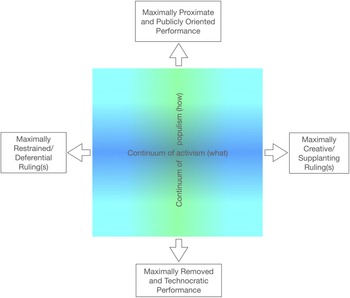
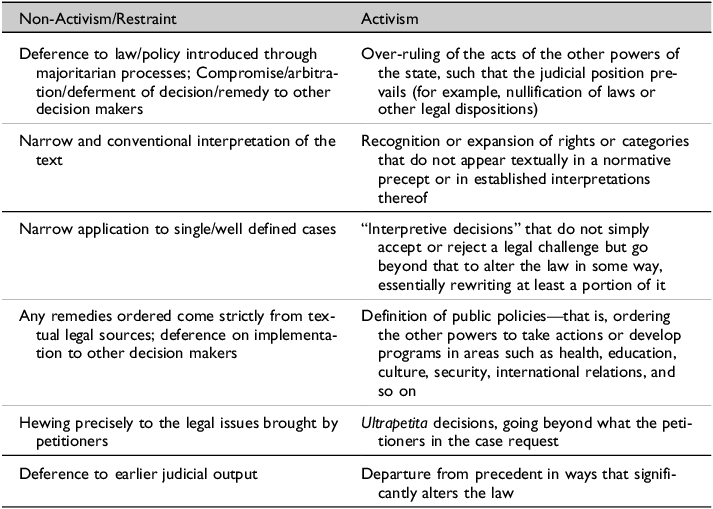
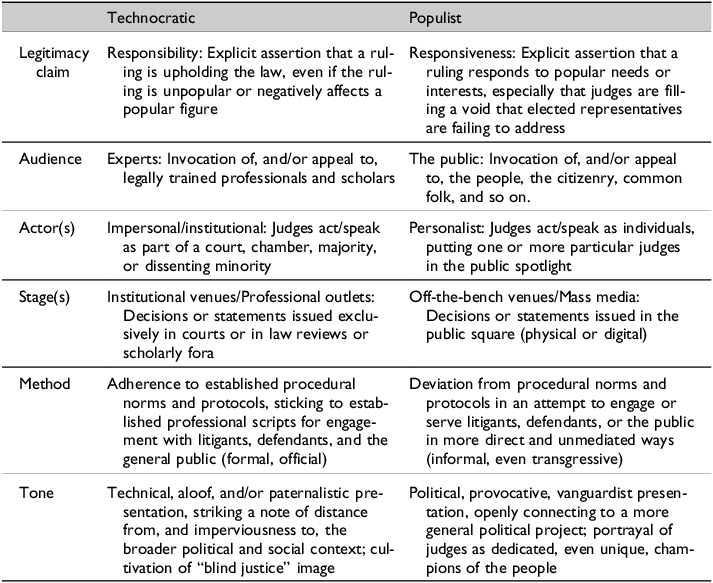
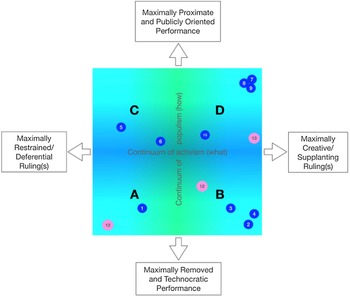

 Open access

