

1. Introduction
In this article I propose a methodological perspective where international law is studied through visual images. I choose a single legal phenomenon for my inquiry and mine the visual culture in search for the images we – international lawyers – associate with it. The visual image is what I investigate. Gazing into and contemplating about the visual in relation to the lived history of the peoples of the Global South is how I go about carrying out this inquiry.
To elucidate this methodological proposition, I focus on the figure of ‘human shields’ under international humanitarian law (IHL), as it deeply shapes how international law operates in today’s most intense scenes of armed violence. In planning, executing, or justifying an attack, no lawyer or public official would think that the object of any armed activity may be a family gathering around a dinner table, a hospital, and certainly not an entire neighbourhood. The phrase ‘human shields’ opens a distinct realm where anything may be (re)interpreted, legally, as liable to indirect, and sometimes direct, harm.
The logicFootnote 1 rests on a narrative in which ‘weaker’ fighters in ‘contemporary’ war tend to compensate for the ‘asymmetry’ of power characterizing their confrontation with modern armies by ‘urbanizing’ warfare, i.e., hiding behind the civilians and civilian structures with a view to ‘shielding’ their operations, personnel, and equipment from enemy operations. This behaviour exploits modern militaries’ unwillingness to violate international humanitarian law, and is thereby commonly framed as posing a ‘challenge’. Militarily and morally superior armies should not be punished for their legal obedience; and inferior belligerents should not be rewarded over an unlawful conduct. Further, the protective civilian status was already lost the moment the civilians were transformed into objects, the logic follows, therefore the harm caused by the attacker is not inflicted on humans as civilians, but on ‘human shields’.
The conclusion that follows is that humans, animals, buildings, entire spaces, and things may – once interpreted within the ‘human shields’ framework – be targeted. Massive death, destruction, displacement, and radical demographic transformations may be legally accepted. The responsibility for civilian loss and suffering, a common refrain continues, may be attributed to the shielded fighter – the author of the crime of transforming humans into shields – not the party whose fire caused the death or destruction.Footnote 2 What is at stake is the ‘bedrock’ of international humanitarian law, the combatant-civilian distinction.Footnote 3 With virtually everything, everywhere, and everyone within a particular space being legally targetable, the ‘civilian’ of IHL becomes an empty category.Footnote 4
The situation in Gaza since October 2023 is extreme. Yet, it is neither the first nor the only example. In the last two decades alone, the ‘human shields’ claim has operated in the world’s most devastating scenes of armed violence in both war and peace contexts that are geographically and politically diverse. Examples of war violence include Gaza and the West Bank (for the two decades preceding the huge escalation in 2023),Footnote 5 Afghanistan,Footnote 6 Ethiopia,Footnote 7 Sri Lanka,Footnote 8 Peru,Footnote 9 Ukraine,Footnote 10 and Yemen.Footnote 11 Moreover, it has shaped the lawfulness of ‘peacetime’ organized violence within postcolonial states. In the ‘war on terror’ in two entirely dissimilar contexts – Colombia and Egypt – the ‘human shields’ framework operated in relation to hostilities in peripheral spaces,Footnote 12 but also travelled to the very centres of both countries’ main cities. Following their framing as ‘human shields’ infiltrated or used by the terrorists, civil protests and protesters in Colombia and Egypt, though outside the scope of IHL, were faced with lethal, yet arguably lawful, state violence.Footnote 13 In the Philippines, not only rebels allegedly use human shields in their hostile activities,Footnote 14 but when Rodrigo Duterte’s ‘War on Drugs’ raids result in the killing of the daughter of an alleged ‘drug dealer’, she is not simply an innocent victim of the police’s conduct, the government claims, but her own father’s ‘human shield’.Footnote 15
In this article, I study this pervasive operation of ‘human shields’ through the particular visual culture it relies upon and reproduces. This original methodological perspective, I argue, allows us to overcome significant shortcomings inherent to mainstream legal scholarship. This mainstream discourse tends to revolve around questions of how law-obedient armies should conduct an attack in the presence of human shields? Some scholars of IHL lean to militarily permissive solutions.Footnote 16 Others, some of whom are driven by ‘humanitarian considerations’, lean to restrictive interpretations of IHL.Footnote 17 Instead of attempting to present answers, my approach scrutinizes that very question, uncovers the political biases and cultural assumptions that inform it, and directs attention to other questions that foreground the rights of colonial and postcolonial subjects and that seek to realize the emancipatory potential of international law.
Some critical scholars have already addressed some of the historical and/or political omissions in the mainstream discourse regarding ‘human shields’.Footnote 18 This article contributes to critical scholarship by adding an important layer: attention to the visual enables a radical inquiry in the space preceding the traditional legal conversation, i.e., the field of the ‘taken-for-granted’.Footnote 19 Instead of dismissing the ‘human shields’ claim in state discourse as merely a strategy of discursive legitimation,Footnote 20 I engage with it seriously and seek to unpack how it operates, not only in the mind of its author but also how it generates resonance with an audience. Rather than engaging in conversations on situations where the use of ‘human shields’ has allegedly created a challenging environment of fighting and instead of examining (photographic) evidence (dis)proving that such a practice has existed on a case-by-case basis, I seek to understand and unpack the knowledge and assumptions that affect our encounter with the news, images, evidence, and information of and about armed violence.
To do so, I draw on insights from Third World Approaches to International Law (TWAIL)Footnote 21 and law and visual culture.Footnote 22 I mine the visual culture, in search of the repository of images we – international lawyers – recall to construct the shielding spectacle whenever we (hear) talk about ‘human shields’. By ‘the image’ I mean the visual materials in the cultural realm; in art, political cartoon, photography, film, and video games. To study how lawyers imagine the ‘human shields’, I investigate the images that expressly accompany the international legal discourse, but also the repository of shared cultural images, imaginations, signs, and assumptions that the legal discourse implicitly summons every time the term ‘human shields’ appears. I gaze into these images to understand the characters of the actors they depict (the shielded, the shield, and the party facing the ‘challenge’ of fighting in the presence of human shields), the dynamics of the relationships bringing them together, and the emotions these images evoke. This exercise does not take place in a historical vacuum. I view these images within their historical context, and most importantly in relation to the lived history of legalized violence in the Global South.
I demonstrate two matters about these images. Firstly, they are capable of evoking powerful emotions that, consequently, generate readiness for radical shifts in the legal frameworks applicable, whereby anything can be interpreted as ‘human shields’ and thus lawfully liable to harm. Secondly, these images reveal the political biases and cultural assumptions underlying contemporary international legal discourse on ‘human shields’ and more broadly on state violence. In contrast to international law’s claims to objectivity, neutrality or universality, the relevance of the image of ‘human shields’ to contemporary scenes of armed violence can only be established through idiosyncratic, radical political and cultural views about the world. I argue that the framework of ‘human shields’ thereby operates through specific ways of imagining the world rooted in Orientalist constructions of the spaces and populations of the Global South.
In Section 2, I explain the significance of ‘human shields’ to the contemporary international legal conversation on lethal violence in war. This section presents a critique of mainstream legal discourse and an engagement with existing critical approaches. It thereby illustrates the importance of the visual imagery of ‘human shields’ to show the limits of the former and added value to the latter. In tune with the theme of this special issue, it highlights why it is crucial to study this visual repertoire from a Global South perspective and draws its methodological contours. In Section 3, I engage with literature on law and the visual to illustrate their profound mutual entanglement – how the affects elicited by the latter shape the discursive and pragmatic operations of the former. This engagement provides the basis my inquiry. Concluding this section, I return to law and the visual, this time to show how a mainstream legal story connotes and contextualizes the images of the shielding spectacle, and thereby enables its operation almost exclusively in Global South contexts, to the disadvantage of the ‘uncivilized’ actor and those in its proximity. Section 4 presents an overview of the visual culture the mainstream legal story taps into. This exercise brings out the centrality of the irregular gangster-terrorist figure to the mainstream legal conversation on organized armed violence. Seen as the threat to peace and order, the imagery of the irregular can, once contemplated about in relation to the history of international law and the Global South, explain what we talk about when we talk about human shields. In other words, it uncovers the assumptions and interests that underlie the ‘human shields’ legal discourse.
2. Why a Global South-centred inquiry into ‘human shields’ matters
2.1 Human shields and the law of lethal proximity
Traditionally, humans referred to as shields are either the subject or object of a voluntary or involuntary act. The former refers to those willingly acting to shield something/someone, while the latter entails compulsion where the civilian is acted upon by the fighter who transforms them into a shield. Today, however, experts refer to a third category. Neve Gordon and Nicola Perugini observe that 95 per cent of those referred to as ‘human shields’ are neither voluntary nor involuntary, but ‘proximate shields’: entire populations become legally categorized as shields ‘without doing or being forced to do anything’, due to their mere presence in their own spaces.Footnote 23 As a result, the civilian space is transformed from ‘a space of life to a space of death’.Footnote 24
Rather than being prosecuted as a crime in itself, proximity shielding operates hereby as a feature of fighting circumstances that legitimizes ‘extraordinary’ conduct that would in ‘normal circumstances’ amount to a crime. With few exceptions in which it formed the object of prosecution,Footnote 25 it operated this way in nineteenth century inter-European wars, twentieth century western overseas wars, and contemporary violence within the postcolonial state.Footnote 26 The ‘mere allegation’ suffices for ‘human shields’ to enable and justify such violence in the field.Footnote 27
Even in the rare occasions where courts of law could scrutinize the conduct of (liberal) state actors assumed to abide by international law, the situation may not differ significantly. This can be illustrated with an example showing the combined effect of the notions of ‘human shields’ and ‘incidentality’Footnote 28 under IHL and the notion of ‘gravity’Footnote 29 under the Rome Statute of the International Criminal Court (ICC), which the Office of the Prosecutor (OTP) applies as a standard governing the process of case selection and prioritization.
In the Afghanistan situation, the OTP regularly mentioned the alleged use of human shields by the Taliban fighters at the preliminary examination stage.Footnote 30 Yet, with the completion of its preliminary examination, shielding disappeared from view as a crime to be prosecuted.Footnote 31 At a later stage, however, it made an abrupt, curious reappearance. In its request for authorization to open an investigation (November 2017), the OTP mentioned ‘human shields’ not in the section where it scrutinized the conduct of the crime’s alleged perpetrator, the anti-government non-state actors, to summarize the crimes in potential cases against them. Rather, it was mentioned in the section examining the conduct of international forces, to work against building potential cases against the latter.Footnote 32
In its examination of the international forces’ conduct, the OTP considered civilian loss to be ‘incidental’; and therefore determined that the ‘information does not provide a reasonable basis to believe that the military forces intended’ the civilians harm.Footnote 33 Towards this conclusion, it relied on anti-government groups’ alleged use of ‘human shields’ and carrying out of military operations ‘in close proximity to civilians’.Footnote 34 Four years after the preliminary determination that such civilian loss was not intended, the OTP would ‘deprioritize’ the aspects of the investigation that concerned the crimes committed by the international forces (September 2021), reasoning its decision by reference to anti-government groups’ ‘graver’ conduct.Footnote 35 So according to the OTP’s logic, we have determined that the anti-government armed groups appear to have used civilians as ‘human shields’, and – at least in part – because of this, the international forces may have not ‘intended’ to cause civilian casualties. Thus, the latter’s conduct is of insufficient ‘gravity’,Footnote 36 where, compared, to anti-government non-state groups (whose victims are actual civilians, not civilians legally interpretable as ‘human shields’). Consequently, the conduct of the international forces is not worthy of further investigation for the time being.Footnote 37
In regular circumstances, the OTP follows a tough process to meet the evidentiary standard appropriate to each stage of a given situation or case.Footnote 38 Only in relation to ‘shielding’, the OTP could exceptionally could loosen its conservative standards, to temporarily name a party an apparent ‘perpetrator’ of shielding, only for the sake of absolving the crime committed by the enemy of that ‘perpetrator’, by interpreting its victims as ‘human shields’ rather than civilians. Although a party was preliminary deemed a ‘perpetrator’ of human shielding, this determination served a specific purpose, but the court would never consider whether that party indeed perpetrated the crime itself, because the OTP would not further investigate or prosecute the crime of human shielding. Perhaps this is because the OTP has no basis to claim that in each international forces’ attack targeting civilians in Afghanistan, the anti-government non-state groups have a case of a ‘human shielding’ crime to answer. ‘Human shields’ in this example has appeared not as a crime to be prosecuted; rather as a relevant fact that rationalizes a special legal regime applicable to the modern army’s conduct – one that interprets civilian loss differently and that, together with other notions (such as the ICC’s ‘gravity’ notion), would enable the OTP to eliminate the need to further allocate resources towards investigating them. In other words, human shields is not there to prosecute; it is there to prevent prosecution.
The Afghanistan example illustrates the role the ‘human shields’ notion may, together with other notions, play in the prosecution of war crimes in an international court of law. Yet, most atrocities do not reach The Hague. The few that overcome all the obstacles the modern legal system embraces – those arising from issues of jurisdiction and admissibility or political and economic pressure – often wait for a long period for limited or no results. The Afghan people waited for the ICC for 15 years. The long-awaited investigation then came out limited in scope, without prospect for prosecution of the atrocities attributed to forces and security personnel of the US and its Afghan allies.Footnote 39 For cases that do not reach justice institutions, the categorization of a group as ‘human shields’ already does immense work in the military field.Footnote 40
2.2 A Global South perspective on the civilizational lineage of human shields
The context in which the notion of ‘human shields’ does this work urges us to bring the peoples of the Global South to the centre of the legal conversation on war violence.Footnote 41 Gordon and Perugini observe in this context that ‘proximate shields’ appear almost exclusively in the Global South.Footnote 42 Although lawyers talk about ‘proximity to the fighting’, the framing works only when civilians are proximate to the non-state actor.Footnote 43 I would add that the ‘human shields’ framework also operates with proximity to a state, nevertheless, only after the said state actor has been associated with or likened to irregular terror. In Iraq, for instance, the CIA report that immediately preceded the 2003 US-led campaign could make references to ‘Saddam’s … positioning of military assets in or near’ civilian areas only because it succeeded the painting of the country as one ruled by a ‘rogue regime’,Footnote 44 led by an individual tyrant evoking the image of the ‘Oriental despot’. In view of this, the critical historical perspective I propose traces the location of ‘human shields’ almost exclusively to (i) the Global South, and (ii) the proximity of actors of particular political organizational structures or ideologies (i.e., non-state actors or despot-led, illiberal rogue states).
This observation aligns with familiar themes in TWAIL. International law has historically faced ‘particular challenges’ in its encounters with Global South societies. Historically work has shown how concepts and entire branches of law were formed by this encounter.Footnote 45 They operated differently, in exceptional ways, precisely due to a perceived difference that characterized the peoples of the Global South, and their cultural and social practices. Anghie shows how international law operated through, and continues to reproduce, a ‘dynamic of difference’, whereby a gap could always be drawn between the civilized and the barbarian, which informed the exclusion of the barbarian from the realm of international law, while presenting international law as the redeemer and civilizer that would realize the potential of the barbarian.Footnote 46 This characterization of non-white populations as uncivilized humans was central to making them international law’s Others.Footnote 47 They were construed as subjects of the universal natural law that governed all humans capable of reason, but lacked sovereignty due to the difference that characterized their cultural and social practices, manifested in their savagery and inability to administer their own affairs in a lawful state.Footnote 48 The lineages of this colonial and civilizational enterprise, as Anghie and others argue,Footnote 49 are echoed in the discourse of the ‘Global War on Terror’ (GWT) as a doctrine that rationalizes ‘exceptional’ jus ad bellum and jus in bello regimes applicable to the war of the democratic against the irregular/undemocratic entity.Footnote 50 It is against the background of this logic of differentiation – sustained by the civilizational core of international law’s colonial encounter and its enduring legacy – that the geographically and historically specific location and application of the ‘human shields’ concept can be understood. As a result, and in line with a key methodological pillar of TWAIL scholarship, I aim to study the concept from within ‘the context of the lived history of the people of the Third World’.Footnote 51
As Gordon and Perugini argue, ‘human shields’ are exemplary of international law’s historical relationship with the Global South. Following centuries of exclusion from the realm of humanity, the moment of decolonization recognized the right to self-determination of peoples from the Global South, but their human-civilian status was simultaneously eviscerated once presented as ‘human shields’.Footnote 52 A central element of this process is the distinction between humane/inhumane violence wielded by civilized/uncivilized, state/non-state, and liberal/illiberal parties. This is evident once we observe that the operation of the ‘human shields’ framework has been closely connected to the language of civilization/savagery within the framework of counterinsurgency and GWT.Footnote 53 Once the ‘human shields’ framework becomes operative, we have already taken for granted that one party cares about international law while the other does not.Footnote 54
At the heart of international law’s civilizational distinctions are images, imaginations, fantasies, and (mis)conceptions about the non-European. Following the construction of people as the ‘Other’, as Edward Said illustrated in his seminal work on Orientalism, international legal mechanisms and justifications were mobilized to transform non-European lands ‘from alien into colonial space’.Footnote 55 The role of the image, I argue, is essential in tracing these colonial continuities in international law. This article illustrates how an image of the ‘Other’ enables the construction of Global South people today as international law’s threshold subjects – not combatants but not human-civilians either, rather ‘human shields’.
3. The international legal imagery of the shielding spectacle
Through the implicit and sometimes explicit use of images, international legal discourse evokes emotions that justify salient shifts in its operation and activate exceptional legal frameworks.
3.1 The visual operates within the legal
My interest in law’s visual culture is informed not only by the power of images and their ‘ability of disclosing things’ and evoking emotions,Footnote 56 but also by their relentlessly and rapidly increasing ability in shaping our understanding of and interaction with reality.Footnote 57 In foregrounding ‘visual culture’ I wish to engage in an exercise of thinking critically about ‘the world of images saturating contemporary life,’ as Amelia Jones puts it, suspending disciplinary limitations ‘defining what and how visual imagery is to be analysed’.Footnote 58 My interest in the image is driven by an urge to know ‘how one knows what one knows in the world, and how this experiential knowledge connects to political power’.Footnote 59
Seeing lies at the heart of how we make sense of the world: ‘it comes before words,’ as John Berger puts it.Footnote 60 We think first and then speak, but to think is to first look, recognize, imagine,Footnote 61 or as Aristotle believed, ‘to speculate in images’.Footnote 62 Peter Goodrich highlights the importance of the images of which our brains are already in possession as ‘the knowledge’ that underlies what we say or write. Walter Benjamin once argued that ‘[i]n the fields with which we are concerned, knowledge comes only flash-like. The text is the long roll of thunder that follows’.Footnote 63 The ‘image’, Goodrich borrows from Benjamin, is the ‘flash’.Footnote 64
Yet, modern law denies the weight of the visual, decrying it as ‘an element of rhetoric, as ornament and lure, seduction rather than reason or argument’.Footnote 65 Although the law exists in a world of images, the legal curriculum wanders therein ‘with blindfolds’,Footnote 66 reserving attention to ‘written reason and the protestant motif of the text alone’.Footnote 67 This goes back to the ‘early modern war on images, the Reformation critique of the figurative and the imagistic, in favour of the religion of the word’.Footnote 68 In law, however, ‘there is no escaping of imagery’, Goodrich insists.Footnote 69
There is a large body of literature on the visuality of (international) law.Footnote 70 This includes work on visualizing justice and the authority of law in artwork,Footnote 71 legal institutions’ architecture and decoration,Footnote 72 customs and courtroom aesthetics,Footnote 73 and how law uses (images from) popular culture.Footnote 74 A central point that runs across this literature concerns the power of the visual in eliciting emotions and generating persuasion, and how the law constantly makes use thereof.
Building on these strands of scholarship, this article focuses on the images that accompany legal discourse as visual culture – as a gate to a world of shared assumptions, beliefs, signs, and biases and emotions, among other things, in society. My proposition starts from what James Boyd White describes as the ‘basic idea’ that ‘as human beings we perceptually imagine and reimagine the world and reflect what we imagine in the ways we talk’.Footnote 75 The dry, technical language that lawyers speak is not what it seems to be; it is already the product of, and also reproduces, certain ways of imagining the world, which are often taken for granted.
Sometimes legal discourse comes with images that purport to possess a neutral descriptive function in relation to its object, – e.g., artworks, photographs, and maps. The authors imagine their object this way and expect that their audience would understand what the report is about when they see these images. For instance, the images of ‘child soldiers’ in legal and policy reports entail specific assumptions about the children, their families and societies, but also about global politics and the (im)morality of certain political actors.Footnote 76 Photographs presented to a US court in an immigration case during the first half of the twentieth century offer a glimpse into the stereotypes and assumptions of ‘Americanness’, whiteness, and race in the US during that time.Footnote 77
International criminal justice, Sofia Stolk explores how the OTP uses maps and landscape descriptions to ‘stimulate the imagination of audiences who are largely unfamiliar with local specificities’, with a view to legitimizing the Court’s interventions and reconciling contradictions about how it operates as well as about the Court’s location in relation to the distant local situations of atrocities.Footnote 78 These materials draw on Orientalist tropes exoticizing the far, unsafe and unstable local space, where subjects are imagined as either violent and dangerous or as helpless victims. ‘This, in turn, provokes questions about the ICC’s “saviour complex”, the basis of its authority, and its universal aspirations’, Stolk writes.Footnote 79 Immi Tallgren studies the centrality of ‘victimhood’ to the legitimacy of international criminal justice and the ‘relationship of images of suffering from “atrocity” or “crime” and a desired support for it’.Footnote 80 In this, Tallgren builds on Susan Sontag’s observation about the ‘expectation of photographic evidence’ that comes with the notion of ‘atrocity’.Footnote 81
When lawyers’ discourse comes with images, it offers a clearer view into the legal imagination of the world, facilitating an inquiry that pierces into the field of the ‘common sense’, which Stuart Hall considers as ‘a moment of extreme ideological closure’.Footnote 82 Most of the time, however, the legal text appears on itself. Even when no visual images are seen, however, the legal text still draws on familiar visual cultural products, through which both the speaker and their audience will fill the gaps. For instance, Stolk studies international prosecutors’ text/speech that taps into shared knowledge and images to paint an ‘ideal, human-inhuman’ perpetrator.Footnote 83
As a creature of culture,Footnote 84 law only obtains meaning within its cultural context, where shared understandings exist.Footnote 85 When jurists talk about legal concepts, Lawrence Rosen notes, we know that the meanings these concepts have ‘will come not just from the experience of legal officials or some inner propulsions of the law but from those broader assumptions, reinforced across numerous domains, that characterise the culture of which law is part’.Footnote 86 In The Silent Language, Edward T. Hall writes that, ‘[c]ulture hides much more than it reveals, and strangely enough what it hides, it hides most effectively from its own participants’.Footnote 87 Law, too, hides more than it reveals.
Scholars intrigued by popular culture and/in law provide useful insights. In the courtroom, Robert Ferguson notes, speakers will use ‘generic forms to explain themselves … while trial observers will impose available generic understandings on what they hear or read in order to make sense of what is happening’.Footnote 88 Everyone in the courtroom exists in society, and interacts with, and consumes, its visual cultural products.Footnote 89 Understanding law as a kind of ‘storytelling’,Footnote 90 Richard K. Sherwin observes, the stories lawyers tell are imported from whatever is available to them in the cultural realm.Footnote 91 Culture is understood in broad terms as a ‘symbolic order’, he writes, that ‘provides the signs, images, stories characters, metaphors, and scenarios, among other familiar materials, with which we make sense of our lives and the world around us’.Footnote 92 For instance, film directors do not display/verbalize everything in the scene – they show/say some and leave some. ‘The stock of images in our minds will suffice to complete the meaning’, Sherwin writes.Footnote 93 When we read/hear legal narratives, we do the same.Footnote 94
3.2 The cultural imagery of human shields
In evoking the powerful emotions that justify exceptional legal frameworks, international legal discourse makes explicit and implicit use of a particular cultural imagery of human shields. These images, of course, have stories. Where used today, however, they are a-historically and apolitically presented in legal reports, classrooms, and books. Lawyers think of them as the right choice, namely the ones that would resonate with a shared imagination, and consequently communicate to an audience what the text/event is about.
Figure 1 shows the principal image of the ‘human shield’ Wikipedia page. It is the main image that appears when you look up the phrase on several search engines, and also provides the visuals accompanying relevant academic and/or policy work.Footnote 95 In this symbolic painting by Sergey Solomko from the era of the First World War, we see a civilian woman clutching her baby – wrapped entirely in fabric, thereby rendered invisible. The mother’s eyes are wide open, revealing an unmistakable look of horror. Her fingers are anxiously arched, her body tightly packed together, as stiff as a pillar of ice. She is unable to do anything but shield her infant – the only source of hope in the painting, albeit unobtrusive – between her chest and arms. The caption of the painting reads: ‘O God! Save my boy that he may avenge us!’ Not quite backgrounded, rather only partially visible, stands a person, hidden – with his heinousness – in a dark space, in the unseen part of the painting, outside its frame. We can tell, however, that the concealed figure is a soldier, for we can clearly see his gun, which emerges from a hand clearly laced with a thick khaki cuff. Even though the soldier cannot be entirely seen, his khaki uniform, hand and gun share the foreground with the frightened woman; in fact, he is even closer – in order of things that appear in the piece – to the foreground than her, rendering him even more foregrounded, delicately though, than her.
Human Shield, Solomko Sergei Sergeevich, 1916. Wikiart.org.
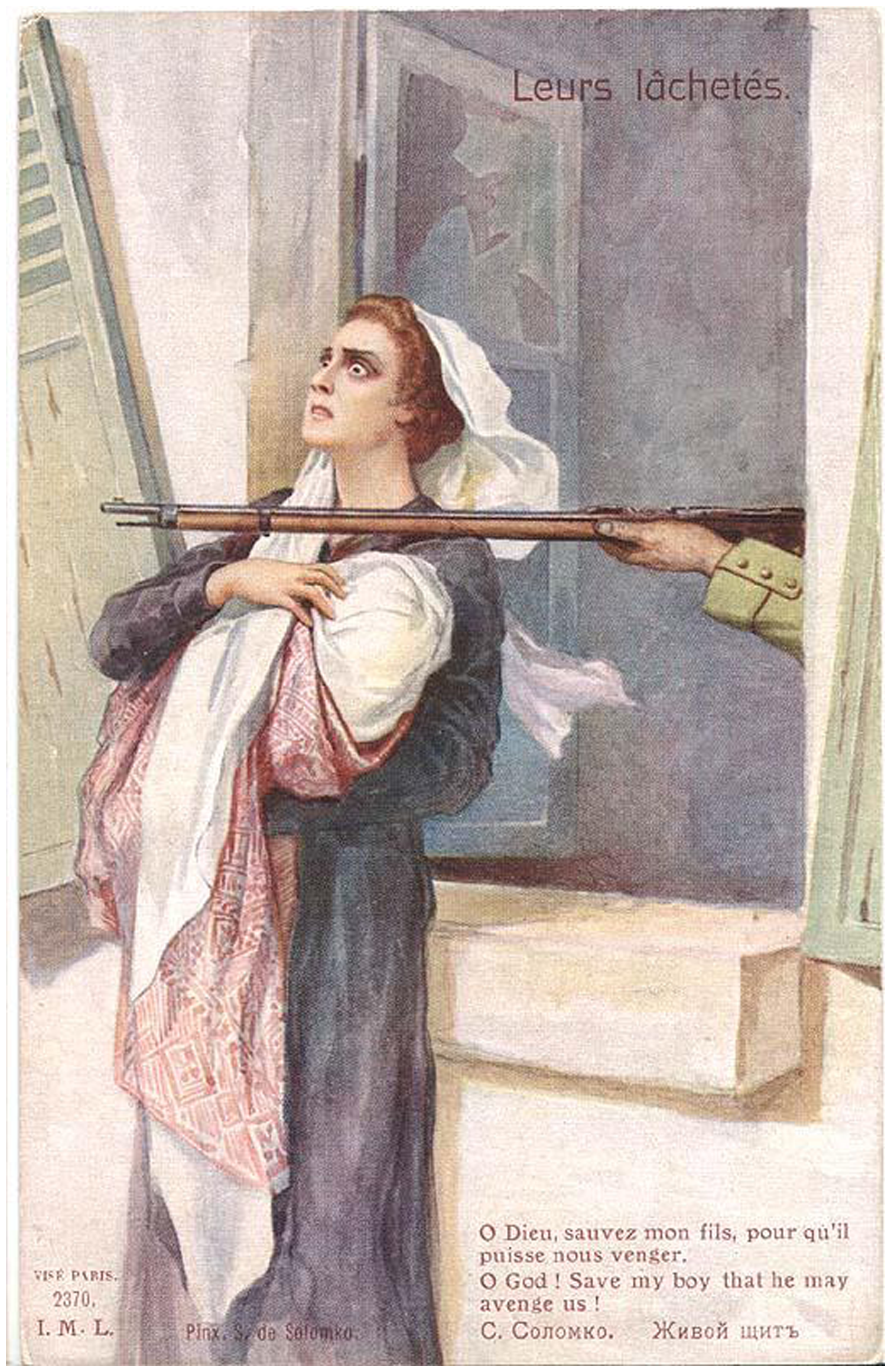
Figure 2 is a book cover of the first ever historical account of human shields.Footnote 96 It features George Bellows’ artwork inspired by Germany’s conduct during the First World War occupation of Belgium.Footnote 97 Again, we see guns but almost do not see the soldiers, who are relegated to a dark, shadowy background. Contrasted with the soldiers’ protective uniform and foregrounded weapons, in the foreground we see a manifestation of vulnerability: naked human flesh, hands raised to the sky, and eyes reflecting despair, horror, or bewilderment. Not unlike Solomko’s choice of a woman and a toddler to depict vulnerability, the ‘exaggeratedly large arms and hands of the victims, which are raised to the sky’ as if in a gesture towards prayer ‘call attention to their subjugation and acquiescence’.Footnote 98
The Barricade, George Bellow, 1918. Library of Congress.
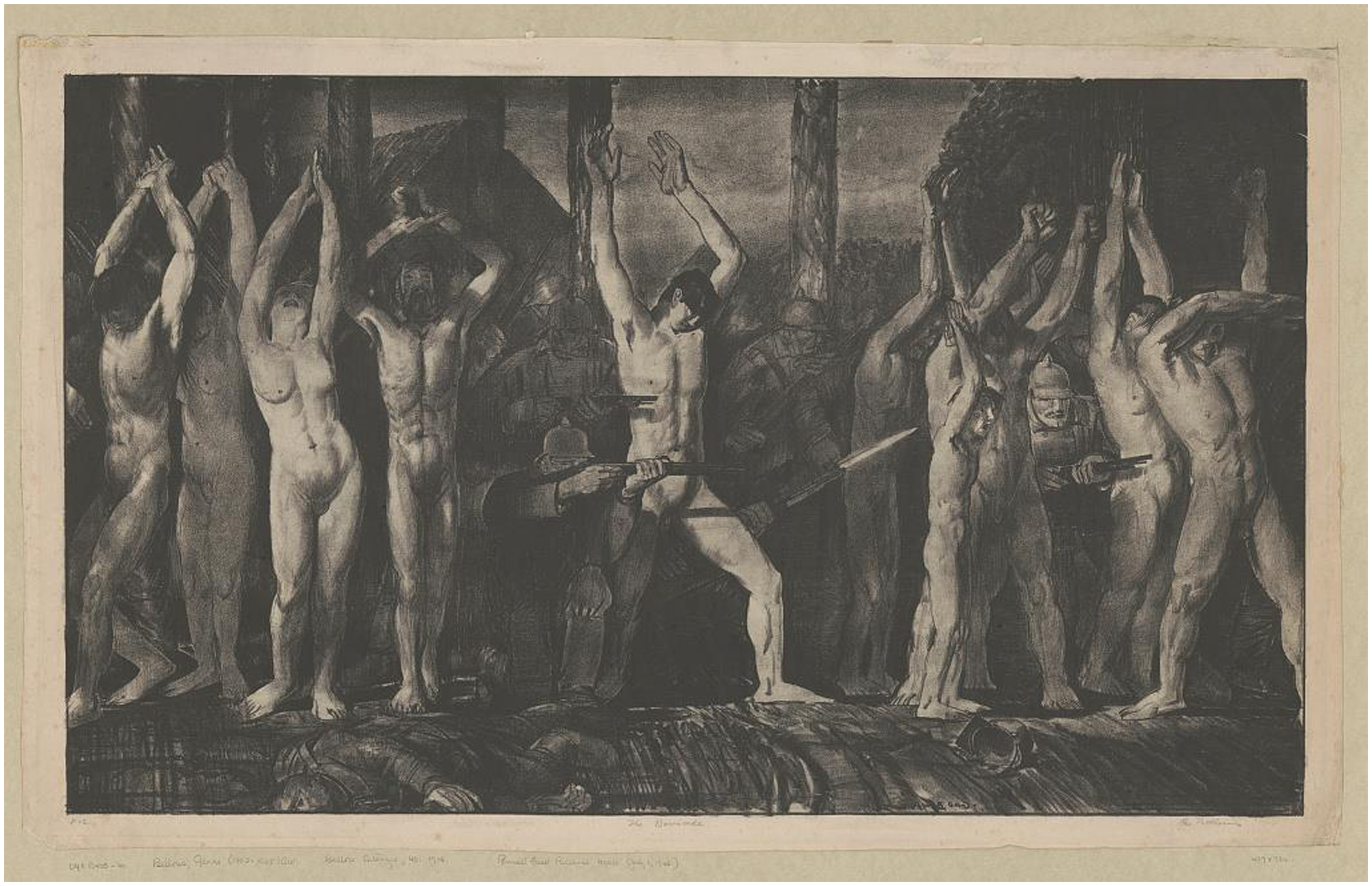
Bellows painting moves between mediums. At once it looks like photography; documenting the moments described in the 1915 German Outrages Report testimonies.Footnote 99 The foregrounded victims may, however, evoke sculptures, possibly ‘recalling depictions of martyred saints from the history of arts’.Footnote 100 It may also resemble performance art, featuring the human shields as its dancers; their limbs at once limp and extended, like puppets dangling from invisible strings. Their expressions are not quite dispirited, but disconcerted.
Both works are not about human shields per se; they are rather about those behind them. It would seem at first glance that both artists wish to call our attention to the victims. It does not require more than a closer look, however, to see that guns and khaki uniforms share the foreground with the victims, and intimately so. It is indeed the shielded guns and uniforms, not the shields, that come at the centre of both paintings. We do not see simply dead bodies, and we are not invited to simply exert emotions of solidarity or sympathy. We are invited to think about what it means to exist somewhere between life and death, to be a human and a shield. The victims are certainly closer to death than life – the woman thinks about a future in which she no longer exists but wishing her toddler ‘may avenge’ them, and the sculpture-like naked bodies already make a claim to martyrdom. But we are not distracted by seeing their actual death, or by seeing the other side of the photograph – the other essential actors that make this spectacle what it is, namely the opposing fighters whose hands will indeed fire the bullets that will directly end the lives of our victims. We are not given the chance to centre the victims, even though they are in fact at the centre, between two firing belligerents.
A single bullet, a tiny wound on any of the victims’ bodies would have sufficed to drive our attention to those fighters standing on the other side. Instead, death, injury, and the indispensable other side of the scene are omitted, to reserve our attention to the state of in-betweenness that the victims have become, and, more importantly, to the only representation of agency in this spectacle, the shielded immoral soldiers. Though the soldiers are backgrounded in part, and even rendered unseeable, the guns and khaki uniforms are depicted as the cause of all the tragic emotions and characteristics defining the situation – the horror and acquiescence; the cruelty and coercion. It is as if the presence of the perpetrators of violence is necessary to strengthen the physical and facial expressions of the victims. By offering us these layers, the artists seem to make covert statements about the characters they represent. Yet, the soldiers themselves, as though cursed for their treachery and cowardice, do not deserve to be recognized or seen; they are obscured in the dark background and, all the more, hidden altogether. The more we think about the ostensibly foregrounded victims and their pain and subjugation, the more we are begged to pay attention to the makers of this tragedy, the authors of the acts of shielding, the agents, those standing behind the shields.
Thinking about the contrast between the representations of the shields and the shielded as light and shadow is insightful. The more we appreciate the humanity of the shield, the more we despise the shielded combatant. Both lights and shadows – civilians and uniformed men – are needed to bring each other out; the dramatic representation of the human shields is also a representation of the men behind the scenes in these artworks. Victims’ pain reflects criminals’ cruelty; their helplessness is a reflection of coercion. As Goethe wrote, ‘[w]here there is much light, the shadows are stronger’.Footnote 101 Indeed, the brighter the horror, vulnerability, and humanity (of the shield), the deeper the brutality, duress, and inhumanity (of the shielded). The men in the dark create an undeniable tension; they are the main actors; the shadow is the ‘defined, primary, subject of the artwork’.Footnote 102 Derived from the conduct of German forces during the First World War, both paintings are marginally about Belgian victimhood, but principally about German criminality.
We are also not given the chance to think about the local resistance, namely, those who are facing the ‘challenge’ the shielding practice poses. The German guns are not directed at the viewer. Rather than in the face of the shields, our point of view is that of a third party, an observer. Indeed, these artworks can be better viewed within a larger body of scholarship concerned with First World War ‘atrocity propaganda’ to delegitimize the Germans, and consequently generate public support for the intervention of Britain, a third party, and present it as a ‘just war’.Footnote 103
3.3 The shielding spectacle in a historical context
It is unsettling to look at the above images in relation to contemporary legal discourse on war. Strictly speaking, the legal notion of ‘human shields’ concerns involuntariness and is unrelated to mere proximity. The hostage-like image corresponds to this earlier legal conception of ‘shielding’, which expressly contained elements of coercion the author of which was the foreign (occupying) force. The Hague Regulations of 1907 declared it unlawful to ‘compel the nationals of the hostile party to take part in the operations of war directed against their own country’.Footnote 104 Until the early twentieth century the terms ‘human shield’ and ‘hostage’ were used sometimes as interconnected, and other times indeed interchangeably.Footnote 105 The human shield’s image therefore does not depict people proximate to the fighting. Rather, involuntariness is the shield’s best descriptor.
This shield is humanized. In Figure 1, it is a singular shield. In Figure 2 they are likened to saints. We do not speak about hostages en masse – we know their personal data, stories, photographs. In contrast, ‘proximity shields’ are pluralized and (imminently) expendable lives spoken of, always, en masse. To the extreme opposite of the humanized shield that must be saved, today’s dominant invocations of ‘human shields’ aim to deprive them of the ‘civilian status’ – what IHL presents as the epitome of innocence and humanity. It is fascinating that these contemporary reinterpretations of IHL describe some pluralized shields, whom we do not know and cannot recognize, in the course of desensitizing the audience towards their death as ‘lawful’,Footnote 106 while summoning imagery of a singularized, extremely humanized shield the suffering of whom should evoke our greatest emotions.
The wageringFootnote 107 in the above images is simply on the enemy’s reluctance to harm its own people. The earliest prohibition of ‘shielding’ concerned this dynamic in Europe.Footnote 108 By contrast, when we talk about ‘human shields’ today, we talk about an immoral actor using people either under its control or actually belonging to the same polity or kin; the attacker’s unwillingness here stems from its humanity and law-obedience, that are so firm that it would not inflict harm on enemy civilians whom the enemy itself has used as shields. The image of the human shield does not resemble contemporary lawyers’ preoccupation with ‘proximity shields’ but they still use it. Why? Is proximity shielding not appalling enough to generate this powerful emotion? In fact, it is not!
Involuntary shielding has historically been the practice of the infiltrating, unfamiliar armed men. Its moral condemnation, at least in the last two centuries, has been unquestionable, so long as the shield’s humanity is recognized. Opposition to this has come only from occupying powers’ jurists and diplomats – e.g., the Germans and British in the past and Israelis and Indians todayFootnote 109 – who strive(d) to present the practice as a necessity of the fight against the irregular. This is precisely why the crime of using enemy civilians as involuntary shields was codified as early as in 1907 (The Hague Regulations). The prohibition of shielding in the Geneva Conventions of 1949 resulted from the ‘concern about the treatment of hostages’.Footnote 110 It was concerned with using enemy prisoners of war and addressed sending or detaining them in specific areas to shield military objectives.Footnote 111 The crime was then extended to the civilian population. At the diplomatic conferences of the Geneva Conventions of 1949, no disagreement arose regarding the criminalization of civilians’ and prisoners’ coercive transfer to an area to render a military objective immune from attack.Footnote 112
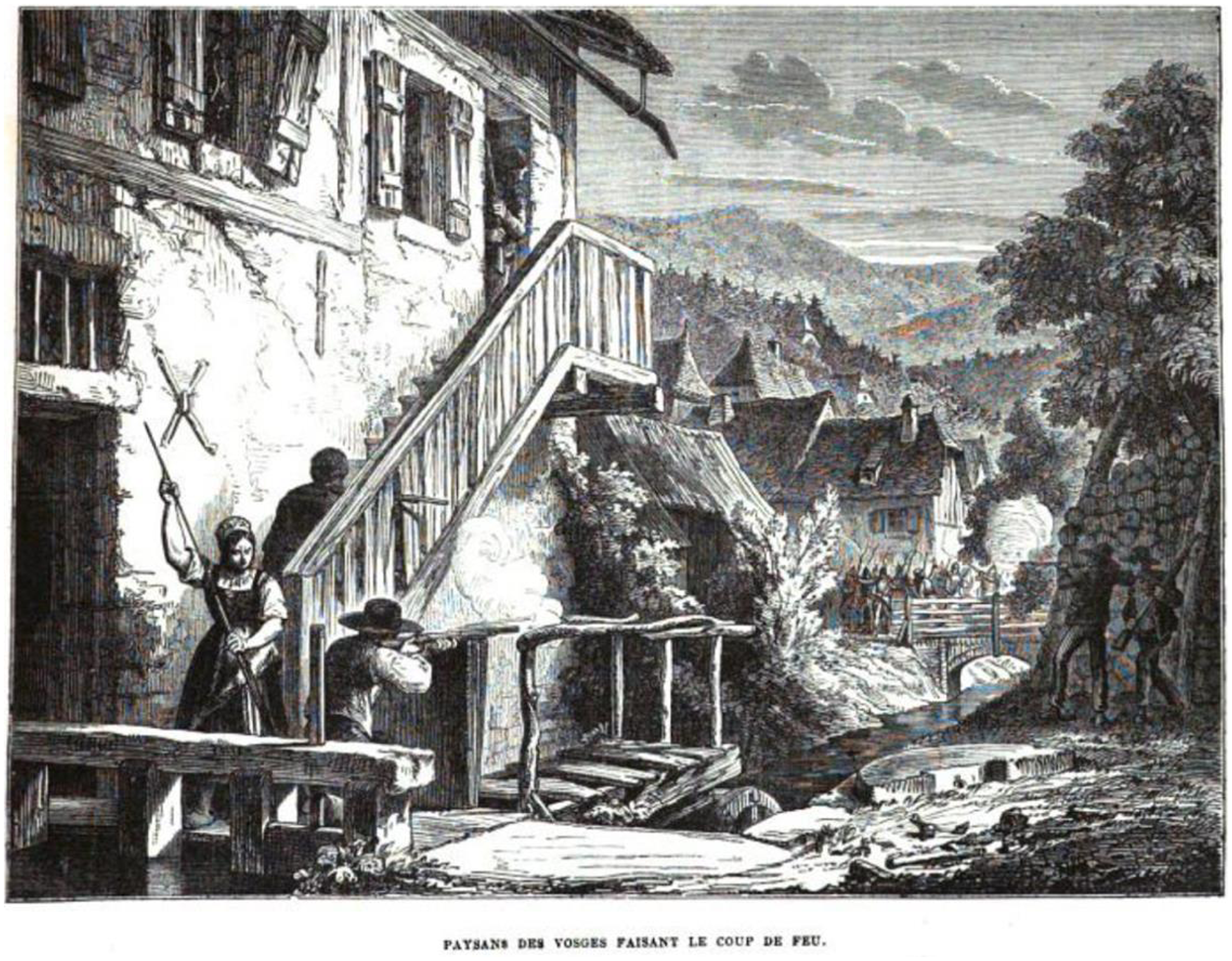
By contrast, hiding in the civilian space has been the practice of those in the position of defence. It has neither been deemed atrocious nor been a practice exclusive to the uncivilized fighter. The Figure 3 female villager (located in the proximity of francs-tireurs firing at the German forces in the northeast of France) does not seem involuntarily present in this location. In fact, she may even be somehow related to some of the fighters. The unfamiliar in this image is the German attacker – not the French defender. The advantage that local resistance movements enjoyed on account of fighting from their own space always frustrated the unfamiliar forces wishing to infiltrate, subjugate, and control. Before the emergence of the ‘human shields’ vocabulary, this frustration was translated into another language – legal still. Irregular and without uniform, French resistance was condemned for its unauthorized use of force – namely, for crossing into the world of sovereignty where states possess an exclusive right to violence. German lawyers advanced an ‘exceptional’ legal framework that enabled generalized violence, but also the use of French nobles as hostage-shieldsFootnote 113 – wagering on the French resistance’s unwillingness to harm its own kin.
Francs-tireurs during the Franco-Prussian War. Original description: Paysans des Vosges faisant le coup de feu (Peasants of the Vosges taking part in combat). Front page, L’Illustration Européenne, Issue No. 2, 20 November, 1870, no. 2, p. xvii.
During the diplomatic conference leading up to the Geneva Conventions, the participating delegates could not agree on the status of civilians already present in the fighting space before it became a ‘fighting’ space. The Danish delegate referred to instances in which the defending army may be justified in requiring the civilian population to remain, pointing to a Second World War situation where Denmark prevented the evacuation of civilians for military necessity considerations.Footnote 114
Since the adoption of the 1978 Protocols Additional to the Geneva Conventions and later the 1998 Rome Statute, the legal prohibition today refers to the act of ‘[u]tilizing the presence of a civilian or other protected person to render certain points, areas or military forces immune from military operations’.Footnote 115 It encompasses both the coercive transfer of civilians as well as utilizing their presence that already precedes the hostilities.Footnote 116 But how do international lawyers in most cases favour the latter meaning and ignore the former, at the very moment they exclusively summon the most dramatic visual depictions of the former? And why?
4. The legal story connotes and contextualizes the image
When we encounter the images in Figures 1 and 2 in a lecture/seminar, book cover, or a social media post today, we do not think of the First World War – of course, unless if we are studying it. Otherwise, today, it provides the visuals for the conversation on, e.g., contemporary operational challenges in the context of security and counterterrorism operations.Footnote 117 I show in this section that a specific legal narrative now connotes and contextualizes the above images of hostage-like human shields, and consequently leads us to make sense of them in ways that enable the ‘exceptional’ operation of international law in contemporary scenes of armed violence.
The context in which the image is made, presented, and re-presented shapes its meaning. As the context changes, the meaning is ‘bound to drain away’, Susan Sontag argues.Footnote 118 Ronald Barthes contends that the meaning of the same photographic image can change depending on who is presenting it and the assumptions associated with, and knowledge about, that person/entity. The image is also subject to ‘connotation procedures’, whereby captions, commentaries, and technical journalistic choices tap into shared cultural knowledge and thereby impose second meanings.Footnote 119 Documentary film narrative ‘tells the viewer what to believe’. It is ‘not only a structuring of events towards a conclusion, but also a structuring of judgment’, John Ellis argues.Footnote 120 Meaning making lacks neutrality. It is shaped by the context in which we encounter the image, and by conventions and cultural assumptions, expectations, and knowledge that we hold. Sontag extends these ideas to our encounter with and interpretation of photographic images.Footnote 121 John Berger explores it in relation to art. ‘The way we see things is affected by what we know or what we believe’, he writes.Footnote 122
The legal discourse of modern warfare also comes with a story. It connotes, contextualizes, and presents the architecture of images that enable us to make sense of the historical images in Figures 1 and 2 in relation to situations taking place almost exclusively in the Global South today. This ‘story’ is not objective:Footnote 123 as any storyteller structures its narrative from a viewpoint, there is no ‘view from nowhere’.Footnote 124 The ‘standpoint’ of the legal discourse, I argue, is that of the attacking army of the (liberal) state. The story of ‘human shielding’, across the legal spectrum, is therefore concerned with: how can the state launch an attack – lawfully – in the proximity of human shields? I elaborate on this point by reference to the practice of and texts from the ICC OTP, the International Committee of the Red Cross (ICRC), and mainstream international legal scholarship.
The act that Article 8(2)(b)(xxiii) of the Rome Statute criminalizes could refer to both categories, the involuntary and the proximate shields. Yet the OTP tends to privilege the latter meaning. In investigative activities on Palestine, it takes seriously the Israeli allegation that Palestinian armed groups use their ‘proximate’ families, neighbours, and countrypeople as shields and would expose them to death.Footnote 125 What the OTP does not consider, by contrast, is Israel’s well-documented, routine practice of using Palestinian locals as hostage-like involuntary shields.Footnote 126 No one knows why the OTP’s application for arrest warrants in May 2024 says nothing on Israeli forces’ use of Palestinian involuntary human shields.Footnote 127 Perhaps it is not ‘grave’ enough if compared to the other crimes in the application for arrest warrants,Footnote 128 but if that is the case, Palestinians fighters’ ‘taking of hostages’ – which indeed appears in the application for arrest warrants – should have equally failed the comparative gravity test. So, what the OTP takes seriously, without much need to satisfy evidentiary standards, is ‘proximity human shielding’: an activity that consists of Palestinian fighters’ wagering on Israel’s assumed humanity and morally-driven unwillingness to harm Palestinian civilians. What it ignores, by contrast, is well-documented ‘involuntary human shielding’: an activity of extreme immorality against Palestinian civilians, and one that can only materialize according to an understanding that Palestinian fighters would not expose their own people to death. The OTP would not observe the simple fact that both practices, as a matter of logic, cannot coexist. It would, moreover, always favour the ‘proximity’ meaning over the more-morally-condemned ‘involuntary’ meaning.
The ICRC deals with ‘human shields’ as part of the ‘challenges’ that, clearly, the law-obedient attacker faces in ‘contemporary’ armed conflict. The second keyword is the ‘urbanization’ of armed conflict, the third is ‘asymmetry’.Footnote 129 We are told that the weaker party:
may be tempted to hide from modern sophisticated means and methods of warfare (and consequently) engage in practices prohibited by IHL, such as feigning protected status, mingling combatants and military objectives with the civilian population and civilian objects, or using civilians as human shields.Footnote 130
Testifying to the key problem, the ICRC constructs the scene and develops its characters, as the ‘[t]echnologically disadvantaged’ belligerent ‘tend[s] to exploit the protected status’ of objects or individuals, triggering the militarily superior belligerent to act ‘in response to constant violations of IHL’. This might subsequently require ‘relax[ing] the standards of protection of civilian persons and civilian objects’.Footnote 131
In mainstream legal scholarship the story is, sometimes blatantly, more explicit. ‘In great part, the dramatic asymmetry characterizing many of today’s conflicts engenders human shielding’, Michael Schmitt frames the problem. The ‘weaker parties have embraced shielding as a “method of warfare”’ that exploits the stronger party’s adherence to the law,Footnote 132 which Schmitt, as well as others,Footnote 133 consider common-sensical. This mainstream discourse features an unsubtle hero-villain character construction. One piece adopts an operative definition of the modern army of the liberal democracy, which is ‘the impeded party’.Footnote 134 Despite its possession of heroic attributes – courage (manifested in its ability to fight in an open space) and ‘superiority’ – the modern army finds itself ‘impeded’ because of other heroic attributes (manifested in its adherence to international law).Footnote 135 The story returns in conventional legal scholarship, notwithstanding the author’s stance.Footnote 136
Therefore, the mainstream legal story deals with ‘human shields’ as a ‘phenomenon’ of ‘contemporary’ warfare, where the ‘asymmetry’ of power tempts the weaker party to ‘urbanize’ the fighting, thereby posing ‘challenges’ to the modern army. It is necessary to note that this discourse is apparently preoccupied with the challenges that IHL itself faces. Yet, a closer reading shows that this anxiety about ‘saving the law’ is, in fact, about saving the modern army from the challenges it faces in operational situations. What is taken for granted is that the modern army is at all times and forever driven by a desire to respect the law. The challenge the modern military – a formation of men armed with the most sophisticated, massively destructive and lethal weapons – is facing, mainstream lawyers tell us, is the challenge that IHL itself is facing.
This story determines our encounter with the images in Figures 1 and 2. It gives these images new meanings, though they retain their ability to provoke strong emotions. Instead of the treacherous occupying state-actor, we now direct our despise against the immoral non-state actor seeking to avoid direct confrontation in ‘asymmetric’ fight. Instead of the hostage-like, humanized, and singularized shield, we are now able to think of non-state actors’ ‘urbanization’ of war, and consequently see entire populations designated en masse as shields, but so anonymized and distant (like the aerially viewed little dotsFootnote 137 in the Israeli army’s visuals) that we are made ready to accept their destruction.
We are therefore required to foreground the ‘challenge’ the attacker faces, adopt its viewpoint, and internalize its perplexment in the face of a ‘dilemma’. We are now required to see the shielding problem as a ‘contemporary phenomenon’ linked to the rise of non-state terrorism, instead of situating the practice within the continuing history of colonialism’s foreign occupation as well as the postcolonial state violence, where both categories of shields have historically existed, as the illegitimate stranger-state actor used the local involuntarily, and the local resistance fought from its local space. In these contexts, it is the state that ‘urbanizes’ war as it exports violence to local communities, towards imposing its control over their lands and people.
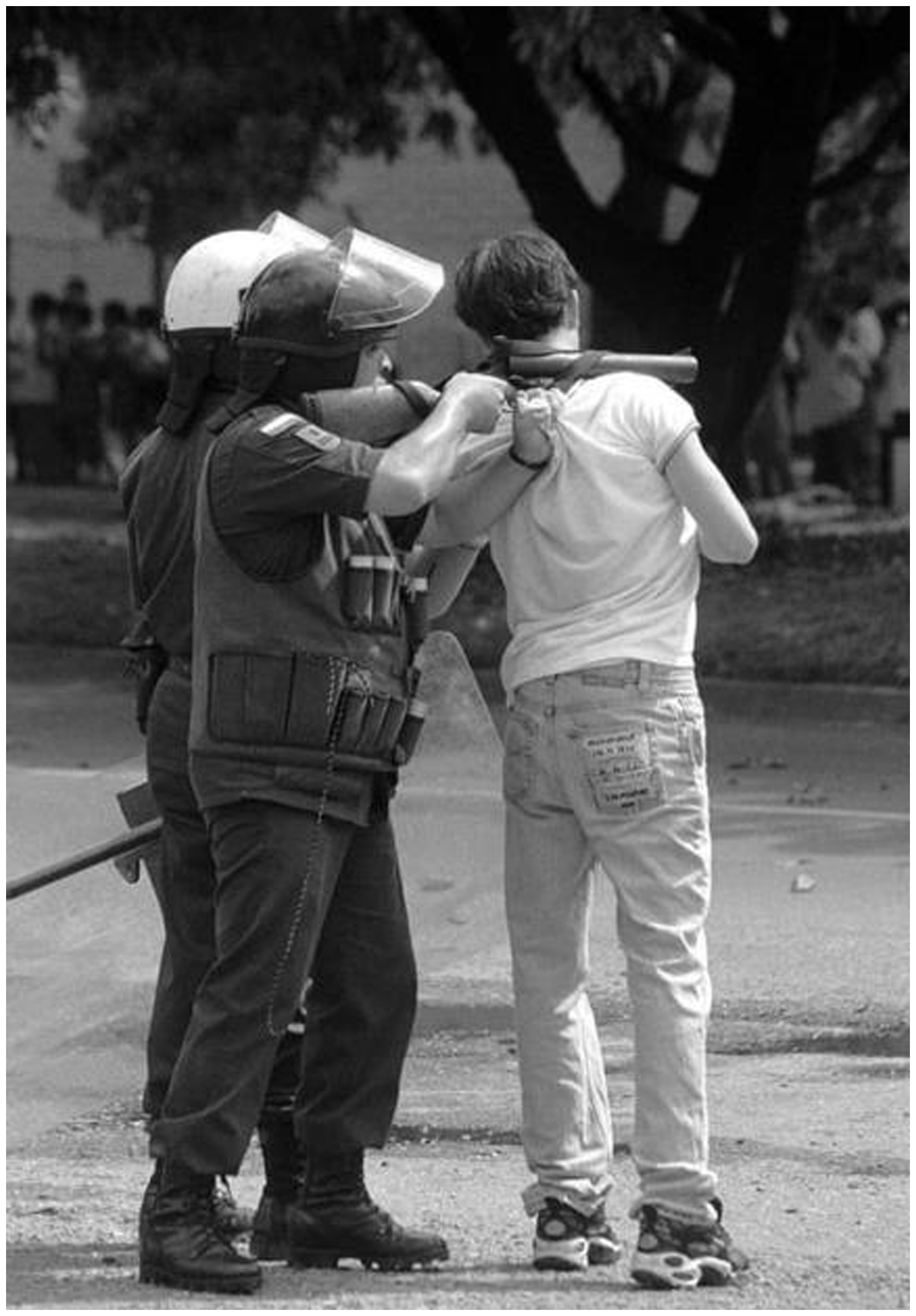
We know that British forces and later the Israeli army have systematically used Palestinians as shields to deter anti-colonial resistanceFootnote 138 – for instance, we know the 2014 Gaza War image showing a confident Israeli soldier shielded by a Palestinian child-shield, whom the former forced to kneel, and the child’s hands appear tied, his eyes banded, and his face appears soulless – eyebrows raised in horror and mouth wide open, like a dead corpse.Footnote 139 We also know Jesus Abad Colorado’s famous image showing Colombia’s EL ESMAD forces forcibly rendering a Colombian student motionless, and using him as a shield to deter the violence of other students (see Figure 4). Both are human shields in the traditional sense. Yet, the mainstream story is so powerful in the way it contextualizes the image. It can marginalize the historical practice of illegitimate-stranger state armed actors and, instead, mobilize images originating from this dynamic, like the First World War-era images, this time, to describe some purportedly ‘contemporary’ practice that materialized due to non-state actors’ attempt to compensate for their weakness in some ‘asymmetric’ situation. How does this happen?
Jesús Abad Colorado, 1999. Colegio INEM, Medellín, Antioquia.
5. From gangsters to guerrillas: Irregulars’ shielding in popular culture
The mainstream legal story taps into powerful images from popular culture, where shielding is a thing of the irregular. It evokes images of the criminal that menaces our everyday lives, likens the guerrilla to the gang, and creates the figure of the gangster-terrorist. This enables the mainstream legal discourse to reproduce contemporary variations of the civilized/uncivilized distinction, whereby ‘exceptional’ frameworks govern state violence against the irregular.
5.1 Gangsters and human shields in popular culture
Outside the scenes of war, popular culture is saturated with images of ghost-like criminals using human shields, whom we might encounter in our everyday lives – say, in an errand to the bank. In the crime genre, or the heist subgenre, films typically feature criminals who would use innocents as hostages and, in tight situations where a shootout erupts, as shields, to counteract their weakness and the law enforcers’ strength. For instance, one could use the language of IHL,Footnote 140 to describe the plot in The Taking of Pelham One Two Three (1974),Footnote 141 where it is indeed the ‘presence’ and ‘movement’ of the innocents under the control of the criminals that ‘shields’ and ‘favours’ their operations, and ‘impedes’ law enforcement operations. This is what renders the former ‘immune’ from the latter.
The figure of the criminal in this genre is mostly disguised, as for instance in the heist and subsequent shootout scenes in Heat.Footnote 142 Like the German fighters in Figures 1 and 2, it is ‘painted in shadow’.Footnote 143 The representation of the gangster spectre, who subjugates innocents to gain an advantage against the law enforcer, is also prevalent in violent video games. In Lethal Enforcers,Footnote 144 the player is the law (or rather ‘Lethal’) enforcer, whose mission is to kill the bad guys (disguised in sunglasses, ski masks or gas masks) while avoiding the innocents (often heard crying, exaggeratedly-dramatically, e.g., ‘Help!’). Many video games revolved around a similar story and characters in the 1990s and 2000s.Footnote 145
The criminal in this genre (both in films and videogames) essentially uses the hostage-like shield to compensate for its inferiority, a plot that is identical to the ‘human shields’ story in contemporary IHL discourse as I discuss in Section 4 above. So, it was not unexpected when, in the end of the shootout scene in Heat, for instance, the gangster picked up a terrified little girl to shield himself. The stock of images we hold in our minds about this genre suffices to eliminate any elements of surprise at the sight of this heinous act. If wartime shielding is prohibited to prevent the ‘attempt to acquire military advantage over an adverse Party’,Footnote 146 in film and videogame depictions alike, the criminal’s advantage is mainly the hostage-innocents under his control, while the law enforcer’s disadvantage is their acclaimed law-obedience and moral superiority.
I am not claiming that these genres are generally evocative of the story and characters of modern warfare. Genres are not unitary; in some films the policeman is the antihero, in others the gangster is not precisely the villain, and in many the audience is encouraged to sympathize with the criminal. Yet, my point is that the storyline, characters, and developments that lead to the shielding scene in the crime genre are the same as in modern warfare. In particular: (i) the gangster exists in the ordinary urban setting and can mingle with ordinary-looking innocents; (ii) shielding materializes as a result of the asymmetry of power characterizing the confrontation between the criminal and the law enforcer; (iii) the scene is interesting fundamentally due to the tension created by the challenge the uniformed man faces; and (iv) the uniformed man’s ‘dilemma’ is the choice between saving the society from crime or killing a member of that society.
5.2 Guerrilla warfare and the imagery of human shields
Political cartoons too are culturally constructed – they draw on shared knowledge and assumptions. Those featuring human shields do so in two senses. First, they widely reproduce the figure of the ghost-like banded criminal. In a cartoon that is widely reproduced in media and social media,Footnote 147 we see a villain – who belongs to the Syrian opposition – banded and wearing gloves, as if on a robbery mission. On the other side, the Syrian Army soldier, tied by his moral superiority – with civilians literally clinging onto him, like children to a protective father – looks perplexed and frustrated, in the face of a ‘dilemma’. Everyone, except the shielded terrorist, appears anxious, frustrated, forced and lacking some degree of agency, as we can tell from the sweat drops and jagged lines around the foreheads. Variations of the same idea are replicated in other cartoons depicting the Rohingya, Ukrainian, or Palestinian criminal-terrorist. Essentially concerned with the shielded fighter’s immorality, not the shields’ lives, the contrast between the criminal-terrorist and the law enforcer in these cartoons suggests that their main concern is: ‘what would you do?’ – the moral ‘dilemma’ humane actors face in war.Footnote 148
Secondly, these cartoons make sense, and generate resonance, only for an audience that shares the same assumptions about the situation and depicted actors. Russia has endeavoured to make the ‘human shields’ framework relevant to its conduct in Ukraine. Yet, imagining Ukrainians, at least inside Europe and North America, does not evoke images of banded criminals or illegitimate actors as in the cartoons we regularly see about actors using human shields.Footnote 149 Consequently, Russian visuals have little currency in Geneva and the Hague; they would always be viewed, rightly, as propaganda.
In contrast to the collective imagination of Ukrainian fighters, engrained assumptions about Islamist fighters assist us to make sense of the other cartoons. In many of these cartoons, the irregular Islamist fighter (in Syria, Myanmar, Palestine) is seen with an evil smile denoting confidence and agency; with the terrified civilians tied to his waist, like an explosive belt; while the shield is a Muslim woman, as we can tell from her wear, namely the black abaya (cloak) and veil serving as shared signifiers of opressed Arab/Muslim women; and the explosive device is a soulless child (perhaps his son) looking more like a doll or a puppet.This evokes four images of Islamic militants: they oppress women, and they use human shields, detonating belts, and child soldiers.
In many of these cartoons,Footnote 151 we see the horrified shields faces, their eyes wide open, and thus know that they are involuntarily placed where they are, but our attention is simultaneously drawn to the fighters’ belonging to the fanatic Islamic ‘ideology of hatred’, the ‘culture of death’.Footnote 152 The cartoon is unmistakably attributing the liability for the imminent death of the innocent, but we know what we need to know to make sense of these cartoons only if we share certain assumptions and images about Islam and terrorism.
These images have deep Orientalist roots,Footnote 153 and are reproduced widely in the visual media, including the post-911 war (on terror) genre.Footnote 154 The opening scene of American Sniper,Footnote 155 puts you behind the sniper’s lens. He/you watch(es) the rooftops to cover the advancing forces. In the first frame, he/you see(s) a man, displaying evil confidence, talking, suspiciously, on the phone. He abruptly disappears into a civilian object, a residential building. Only in the second frame, he/you understand(s) that the man seems to be using a woman and a boy in his terrorist activity.
Tellingly, the ‘highest earning war movie ever’Footnote 156 closely resembles the cartoons I have referred to:Footnote 157 the woman wears the black abaya and veil while the child holds the explosives. The only character that seems confident in the scene is the terrorist – the woman and the boy seem soulless, with disconcerted expressions, like puppets dangling from invisible strings. The moral sniper, while watching and reporting with admirable strength and power, is not only nervous but in fact is the centre of the tension in the scene. The child then runs towards the forces, evoking two more images associated with Islamic terrorism: the child soldier and suicide bomber. The official trailerFootnote 158 goes as follows: the boy is running towards the forces, the forces are approaching, the music creates a tension with a crescendo-glissando-accelerando where the sniper’s heavy breath and heart beats are integrated into the film score – and then … a blank screen! The stock of images in our heads proceeds: would you/he kill a child (shield-soldier-bomber) and/or a woman to save the advancing soldiers – who like you/him came here specifically to save humanity – or … ? What a dilemma! Yet, a right answer to the purported ‘dilemma’ unambiguously exists, both in films and in political cartoons: fire!
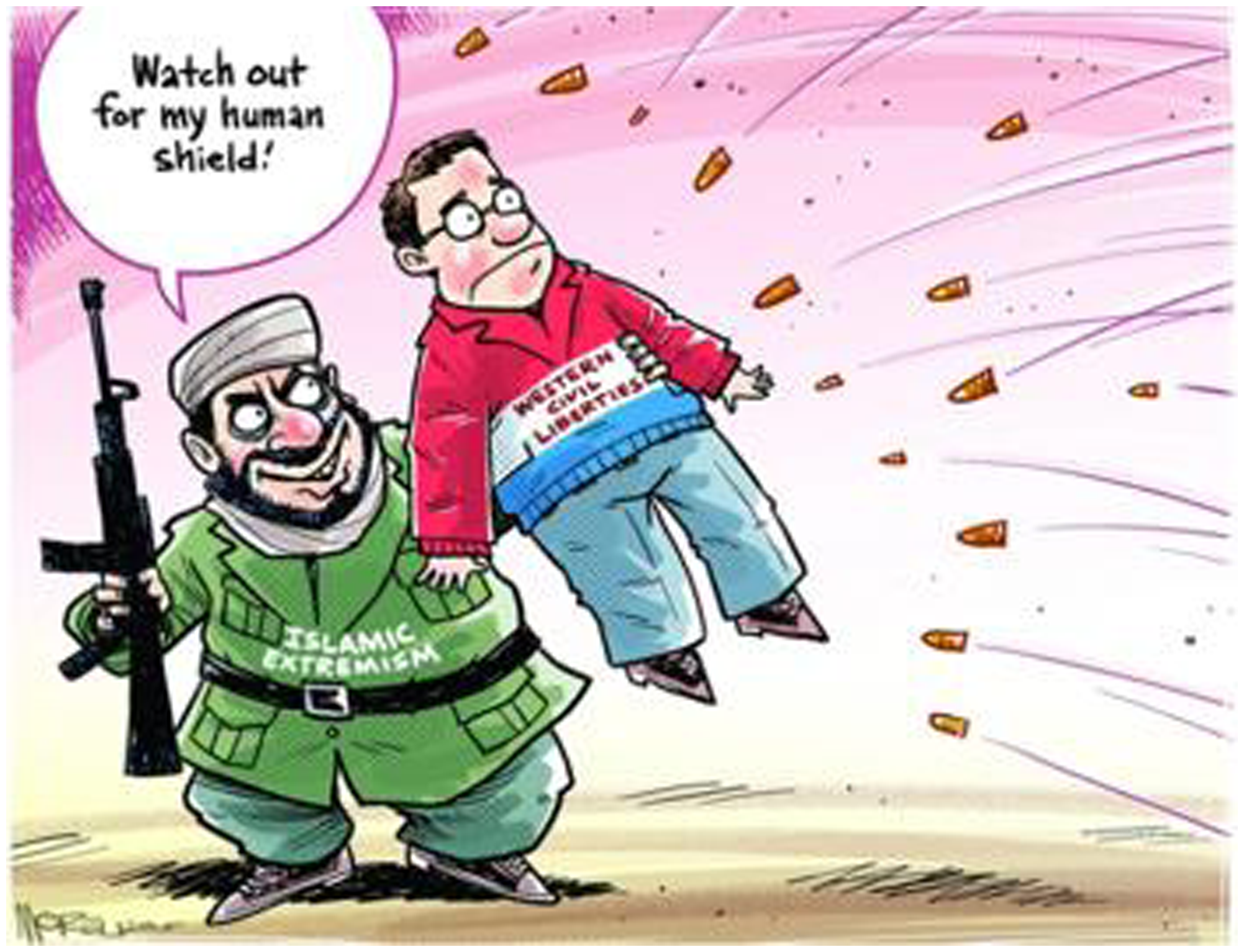
The hybridity of the terrorist figure – an enemy traveling between criminality and combatant status – is featured in Michael Moreu’s work (Figure 5). ‘Islamic extremism’ is seen in quasi-military uniform using ‘Western civil liberties’ as involuntary human shield. The ‘liberties’ could have been depicted as an object (e.g., an actual shield) but Moreu taps on a prejudice he shares with his audience that Islamists, like criminals, use humans as shields. Unlike in the First World War-era artworks, we see the bullets fired by the other party, which is omitted from the frame. The harm to the innocents is happening, Moreu warns the Westerners: our bullets are killing our values. If these values define who ‘we’ are, then we are shooting ourselves. We should restore Western liberties so they may not shield the enemy, he suggests. This is paradoxically realizable through an ‘exceptional’ course of action: killing western values only in relation to the immoral terrorists. But this is not a novelty.
‘Western civil liberties shield Islamic extremism’, Michael Moreu, 2015.Footnote 164
This logic echoes the ‘clash of civilization’ thesis. It confirms Talal Asad’s observation that: ‘[w]hat is really at stake is not a clash of civilisations (a conflict between two incompatible sets of values) but the fight of civilisation against the uncivilized. In that fight, all civilized rules may be set aside’.Footnote 159 ‘This is not a clash of civilizations. It’s a clash between barbarism and civilization. It’s a clash between those who ‘glorify’ death and those sanctify life’, Israel’s leader, almost accurately, reproduced Asad’s observation 17 years later during his address to the congress,Footnote 160 by the time his military campaign by some estimates had already left 180,000 dead.Footnote 161 In the language of the ICRC’s reports on ‘challenges’ of ‘contemporary armed conflicts’, the works suggest to ‘relax the standards of protection of civilian persons and civilian objects’.Footnote 162
5.3 The legal rationalization of violence against and in the proximity of the irregular
The legal rationalization of generalized violence by reference to locals’ tactical use of their space is strongly connected to the figure of the irregular. It historically took place in the context of inter-European military occupation and resistance to it. Lawyers defending occupation forces sought to disavow the civilian status of other Europeans by presenting ‘exceptional’ frameworks as ‘necessary’ to respond to the savage violence of the irregular resistance that hides in its local space.Footnote 163 Gordon and Perugini link this to the extension of the Hobbesian social contract between citizens and the sovereign from the local to international sphere. Local irregular resistance was seen as a gang of criminals who travelled from disrupting sovereign-controlled peace into the inter-sovereign context. Consequently, irregulars’ threat to the legal order justifies an ‘exceptional’ framework where ‘civilian protections can be sacrificed by sovereign states’ to secure their eradication.Footnote 165 This logic ignores many situations where ‘the threat to peace’ is the very presence of illegitimate state forces, not the irregular.
The condemnation of ‘utilising the local space to hide’ and the invitation to imagine oneself in the situation or circumstances of the attacking party, historically, took place when the ‘shields’ and the ‘shielded’ fighters were ‘humans’ but the latter was seen as an irregular savage. It emerged to justify an ‘exceptional’ legal and ethical framework implying stark violations of ‘western values’ against them and their ‘shields’. This did not concern colonized peoples since they did not qualify for the ‘civilian status’.Footnote 166 During Italy’s war on Ethiopia, violence against an African population could be discussed at the League of Nations, a rare occasion at the time, against the backdrop of the unusual inclusion of the African nation into the realm of international law and humanity.Footnote 167 Faced with war crimes allegations, Italy launched a discursive war against the ‘uncivilized negros’ for using medical personnel to deter its attacks. It invited the civilized nations to imagine themselves in its position.Footnote 168
After the period of decolonization and the extension of international legal protections to colonial subjects, the ‘dilemma’ of fighting an ‘unconventional’ war informed contemporary counterinsurgency doctrines. Much of what is said today by mainstream lawyers and spokespeople of modern armies (e.g., Israel and the US) is rooted in Cold War-era preoccupations of people like Carl Schmitt and Samuel Huntington, concerning the fight against the irregular savages who abuse international legal protections recently bestowed upon their peoples and lands.Footnote 169 The idea I emphasize is that seeing ‘the dilemma’ and framing it as such – let alone to favour one solution over the other – is already political. This seeing demands a viewing of the world from a specific point, and it is the standpoint of the modern (liberal) state.
Critically, this ‘dilemma’ no longer takes place exclusively in ‘war context’: it has travelled to settings governed by human rights law. When fighters in contemporary war acquired characteristics of the gangster, its purported travel from criminality to combatancy enabled the ‘human shields’ framework to eviscerate the ‘civilian status’, among other sacrificed protections under IHL. Now the gangster-terrorist is travelling from combatancy back to criminality. Legal vocabularies of war appear in riot police operation and regular police raids. The ‘human shields’ framework is eating up the ‘citizen’ category,Footnote 170 depriving its holders from rights to life and bodily integrity once their exercise of political rights, or – at times – mere physical presence, is deemed to inhibit eradicating a threat to sovereign authority and peace, as in the examples discussed at the outset of this article (e.g., in Gaza’s March of Return, Colombia, Egypt, and the Philippines).Footnote 171
6. Conclusion: Talking about human shields
6.1 Tragic images for powerful legal shifts
The prohibition of ‘shielding’ refers to two different acts: (i) the historically and universally morally condemned atrocious coercion of innocents to the front lines; and (ii) the more recently – and significantly less condemned – tactical utilization of the presence of locals, who are deemed ‘shields’. This can result either from the movement of armed actors to their spaces, or from the fact that that state violence moved into and invaded the peace of their safe space, rendering them ‘proximate’ to gunfire. International law today is almost exclusively concerned with the latter.
Talking about ‘human shields’ today mobilizes images of a tragic spectacle that evokes emotions, so powerful that they justify an ‘exceptional’ legal regime that eviscerates the core of the ‘regular’ regime, the ‘civilian’ status. Yet, the ‘proximity’ image is not powerful enough – all nations, including the nations of civilized Europe, benefited from the advantage the local enjoys in its confrontation with foreign aggressors. In fact, utilizing civilian presence as a military tactic was criminalized only by the time the (modern liberal) state would no longer be in the position of defence.
The image of the hostage-like shield is contextualized and connoted through a specific legal narrative. It presents ‘human shields’ as a ‘contemporary phenomenon’ resulting from the ‘asymmetry’ characterizing the fight between the backward irregular and the modern state army. To avoid direct confrontation with the latter, the former ‘urbanizes’ the fighting. This narrative associates the image of involuntary shielding with the unfamiliar, weak criminal-terrorist, rather than the historical image of the unfamiliar, powerful occupation forces using occupied locals as hostage-shields.
Once construed as the unfamiliar actor whose very presence is illegitimate, the non-state actor, is likened to the gangster that threatens order and peace. In his vicinity, the voluntarily present has voluntarily disavowed their civilian status, while the involuntarily present’s civilian status has already been disavowed by those who victimized them and transformed humans into objects, shields. In IHL language, civilian presence, in this situation, shall not render an objective immune from attack.Footnote 172 In the vicinity of the gangster-terrorist, consequently, there is nothing civilian.
6.2 Sovereign fantasies
This image operates in contemporary talk about human shields only because of a fantasy. The (modern liberal) state is imagined as the familiar protector; the non-state (or the irregular-like undemocratic state) is the menace. Unlike film directors, political cartoonists, and politicians, lawyers cannot make such unsubtle statements about Global South societies. The ‘silent language’ of law, instead, ostensibly says very little – neutrally, apolitically, and even scientifically – as it fits the story of contemporary warfare into a narrative path that makes people go, ‘okay, yeah’.Footnote 173
The problem with these imagined dynamics in relation to the Global South is that in many times the unfamiliar, the menace, is precisely the uniformed man. Some Global South peoples are still under direct foreign military domination. Palestine is one example, but also modern armies still wage overseas war on Global South peoples – not only as US and Russian interventions in Iraq and Syria, but there are also interventions like the Saudi-Emirati in Yemen. Apart from foreign military occupation, moreover, postcolonial states do not represent their people, for many reasons related partly to the continuing history of colonialism.Footnote 174 In many Global South spaces, the state is the source of menace and horror, notwithstanding national or foreign.
International law indefinitely postpones the conversation on the ‘legitimacy’ of state actor’s presence by referring it to the politicized frameworks of jus ad bellum in inter-state war or standards of democratic governance in cases of internal violence. Meanwhile, it takes the state’s position for granted. At the time it seeks to humanize state violence but almost never to prevent it, international law’s standpoint is one where the mere presence of a non-state entity in a space can be viewed as categorically illegitimate. It is inherently unnatural, and thus liable to eradication.
When the Iraqi government defended the city of Mosul in 2014 against the militants of the Islamic State, the common-sensical understanding that state forces’ presence was natural and legitimate would have made bringing up the talk about the ‘civilianization of armed conflict’ sound silly. After the non-state group controlled the city, the Iraqi and international alliance forces later came back to recapture it. As the Islamic State became in the position of defence in 2016, the same population in the same space were categorized en masse as ‘human shields’.Footnote 175
Perhaps in the Iraqi case the character of the Islamic State may be easier to judge as ‘illegitimate’ – as an organization of mostly foreign fighters who have no roots in society. Yet, is the Iraqi State really legitimate? Even after what it did (e.g., during the Mosul battle)? Then in Colombia and Egypt, would illegitimacy describe better state forces’ presence, both in the battlespace and in the city centre (as in the 2013 and 2019 protests in Cairo and Bogotá)? I do not know the answer. The problem is that international law banishes this conversation, while simultaneously enabling it exclusively where it works against non-state formations and those in their proximity.
The questions I am asking about ‘legitimacy’ and the source of war ‘urbanization’, I admit, are difficult where asked in relation to the postcolonial state. Yet, in cases of foreign domination, things should be less complex: who, really, urbanized violence in Palestine and Ukraine? Whose mere presence is the source of locals’ insecurity and horror?
6.3 Orientalist fantasies
The exception to my observations concerning the purportedly ‘exceptional’, but actually predominant, operation of international law confirms, rather than opposes, my arguments. In the exceptional situation where a western modern state finds itself in the position of defence, political biases and cultural assumptions intervene, sometimes baldly.
When Russian lawyers-diplomats endeavoured to paint the Ukrainian fighter as an illegitimate, irregular-like actor that holds his own people in ransom, international law enabled but simultaneously confronted them. On one hand, Russia is indeed harnessing its sovereign privilege to kill and destroy; it is wielding generalized violence at the time of writing, and it is presenting it in legal language. On the other hand, a different legal outcome is possible because the mainstream image of Ukraine – the only non-Global South location spoken of in ‘human shields’ vocabulary – is different. Fighters are legitimate and familiar, civilians are civilized agents, and both belong to one another – imagined more like French locals and francs-tireurs in Figure 3 than any other image in this article. Russia – not Ukrainian resistance – rendered the civilian ‘proximate’ to the fighting and urbanized war, when its violence travelled to Ukrainians’ safe space and invaded its peace.
What enables the image of the horrific spectacle of involuntary shielding to operate today is a fantasy about Global South societies where their people are imagined as either savages (that must be eradicated) or victims (that need to be saved), the spaces as exotic and violent, and the sovereign state as the potential saviour.Footnote 176 Absent such imagined misconceptions, the logic stumbles. This is why we see horrific images coming out of Kiev but do not think about an imagined ‘shielding spectacle’ rendering the fighting ‘exceptional’. We interpret these scenes in Ukraine as atrocities only because the law applicable is ‘regular’ IHL. In contrast, hegemonic images paint an image of ‘exceptionality’ in the Global South and prepare us to accept anything. Populations proximate to the gangster-terrorist are construed, en masse, as either involuntarily shielding them, or perhaps voluntarily – ‘they were not collecting coffee’, as populist leader Álvaro Uribe described Colombian farmers who lived in the proximity of groups sought to be eradicated in his ‘War on Terror’ until their disappearance and execution in a ‘false positives’ scandal-related incident.Footnote 177
But the pretence of the ‘exceptionality’ of civilian proximity in war ignores not only that colonial violence took place primarily in population centres, but also the basic idea that IHL protects the ‘civilian’ as a category describing those affected by – because proximate to – armed conflict. International lawyers’ preoccupation concerns proximity to an imagined uncivilized actor, not ‘proximity’ in itself. It is thus unimaginable to think about the Israelis as shields if military objectives have been brought to their proximity, neither before nor during the hostilities,Footnote 178 and even if Israel endeavours in the midst of war to move its civilians to areas adjacent to military sites.Footnote 179 The idea is that: the presence of the civilized state in the civilian space is natural and it is to protect those in its proximity, the opposite describes the uncivilized.
The ‘Hamas-ISIS’ formula lied at the core of Israel’s 2023–2024 war on Gaza. Once imagined as a nihilist, causeless organization that has no roots in society – like ISIS’ destructive, foreign fighters – the voluntarily present becomes associated with the savage,Footnote 180 the involuntarily present are hostage-like shields in need for liberation, and any Palestinian space becomes illegitimately occupied by the Palestinian savage.Footnote 181 ‘Free Gaza from Hamas’, Israeli propaganda and pro-war movements slogans read,Footnote 182 while Israel’s Ambassador to the UN claimed that ‘just as ISIS destroyed mosques, Hamas-ISIS is willing to blow-up al-Aqsa’, as he verbalized his fantasy that liberal democratic ‘Israel is defending al-Aqsa Mosque’.Footnote 183 Everything can be accepted against the backdrop of an imagined Israeli mission to liberate the victims from the savages.
Any scenes of death and destruction may be legally (re)interpreted. Legal logic takes over our encounter with the visual: at least potentially, children are child-soldiers-shields, hospitals are command-and-control centres, and the land Palestinians steps on is the ceiling of a terror tunnel. So, atrocity is not what the scene of death/destruction shows, and horror is not what it provokes. The image of near-total destruction of Gaza’s Beit Hanoun would provide the visual for a Bloomberg story on tunnels, not on the eradication of the civilian.Footnote 184 Any image is in need for further interpretation, and consequently no conclusions may be developed at the sight of the image of starved flour collectors being aimed at, and subsequently machine-gunned and bombed during ‘the flour massacre’;Footnote 185 ‘nada claro (nothing is clear)’, the banner of Colombia’s most emblematic newspaper, El Espectador, captioned the image of a massacre (a drone image, showing hundreds of human beings, like little dots, aimed at and being shot from the sky).Footnote 186 The ICC OTP would always need more time, since 2014, to confirm the harm was deliberate. ICJ judges still need time to interpret what they see; evidence against Israel does not suffice to order a cessation of all military activity.Footnote 187 This, though less crude, is consistent with the picture the Defence Counsel and two ICJ judges paint: Israel is a democracy with modern institutions that respect and enforce the law (and must be trusted); Hamas-ISIS uses Gaza as a shield (and must be blamed); and subsequently any horrific image is not what it is (and must be legally [re]interpreted).Footnote 188 In the ‘exceptional’ circumstances characterizing the war of the civilized on the uncivilized, ‘any destruction’, as Judge Sebutinde dissents, is not deliberate,Footnote 189 and everything may be accepted.Footnote 190
The dynamic characterized by contemporary variations of the civilized/uncivilized distinction describes virtually all scenes of organized violence in the Global South, where most campaigns of intense violence have taken place since 1945. Thus, neither civilian proximity nor the legal framework it authorizes are ‘exceptional’. Contrary to the fantasy in mainstream legal discourse, it is the law taught in textbooks and classrooms that is exceptional.
A different imagination of Global South societies may redeem international law. We may be able to think of the Palestinian local, the Colombian farmer, and the Egyptian Rabaa Sit-inner neither as voluntary heroes/terrorists nor involuntary hostage-shields. Like Ukrainians, they might be people existing in spaces to which they have some kind of connection – domiciliary, (agri)cultural, historical, or political (their home, farm, workshop, or space of political expression). Perhaps their presence in that space has preceded the violence that the state has brought. Perhaps they are people to the lives and spaces of whom the violence of the unfamiliar uniformed men has, violently, travelled. With this image, international lawyers’ concern with ‘human shields’ would entail a preoccupation with the safety of the civilian rather than the military operation.


 Open access

