

1. Introduction
Ecosystems play a critical role in underpinning the well-being of humanity (Folke et al., Reference Folke, Biggs, Norström, Reyers and Rockström2016; MA, 2005). However, human actions are rapidly modifying the structure and function of the Earth's ecosystems and reducing their potential to support human well-being (Steffen et al., Reference Steffen, Richardson, Rockstrom, Cornell, Fetzer, Bennett and Sorlin2015). Rural communities in developing countries are particularly vulnerable to ecological change due to their direct dependence on ecosystems and their services (Suich et al., Reference Suich, Howe and Mace2015). A major challenge, today and into the future, is to maintain or enhance beneficial material and non-material contributions of nature to a good quality of life for all people. Indeed, the UN Agenda 2030 and the Sustainable Development Goals (Griggs et al., Reference Griggs, Stafford-Smith, Gaffney, Rockström, Ohman, Shyamsundar and Noble2013; Sachs, Reference Sachs2012; UN, 2015) highlight the linked challenge of maintaining ecosystem integrity while addressing poverty and inequality. This challenge requires institutions, behaviours and governance systems that support both benefits from ecosystems to people, and the stewardship of those ecosystems (Guerry et al., Reference Guerry, Polasky, Lubchenco, Chaplin-Kramer, Daily, Griffin and Vira2015).
Since the Millennium Ecosystem Assessment, a proliferation of studies has contributed to the documentation, classification and understanding of how a wide range of ‘ecosystem services’ contribute to human well-being (Cruz-Garcia et al., Reference Cruz-Garcia, Sachet, Blundo-Canto, Vanegas and Quintero2017; Díaz et al., Reference Díaz, Demissew, Carabias, Joly, Lonsdale, Ash and Zlatanova2015; Rounsevell et al., Reference Rounsevell, Dawson and Harrison2010; Suich et al., Reference Suich, Howe and Mace2015; TEEB, Reference Kumar2010). In particular, there has been progress in the literature on the multidimensional nature of human well-being and the different ways in which ecosystem services contribute to enhancing different objective and subjective components of human well-being (Breslow et al., Reference Breslow, Sojka, Barnea, Basurto, Carothers, Charnley and Levin2016; Pascual et al., Reference Pascual, Balvanera, Diaz, Pataki, Roth, Stenseke and Wickson2017; Russell et al., Reference Russell, Guerry, Balvanera, Gould, Basurto, Chan and Tam2013). Engagement with different cultural systems and worldviews has also questioned and broadened conceptualizations and measures of well-being and development (Díaz et al., Reference Díaz, Pascual, Stenseke, Martín-López, Watson, Molnár and Shirayama2018; Diener & Suh, Reference Diener and Suh2000; Pascual et al., Reference Pascual, Balvanera, Diaz, Pataki, Roth, Stenseke and Wickson2017; Sterling et al., Reference Sterling, Filardi, Toomey, Sigouin, Betley, Gazit and Jupiter2017a). Indeed, emerging emphasis on values and culture in the Intergovernmental Science-Policy Platform for Biodiversity and Ecosystem Services (IPBES) illustrates the increased recognition of the importance of human–nature relations in maintaining well-being and protecting biodiversity (Díaz et al., Reference Díaz, Demissew, Carabias, Joly, Lonsdale, Ash and Zlatanova2015, Reference Díaz, Pascual, Stenseke, Martín-López, Watson, Molnár and Shirayama2018; Pascual et al., Reference Pascual, Balvanera, Diaz, Pataki, Roth, Stenseke and Wickson2017). Recent advances have explored cultural aspects of these benefits, going beyond aesthetic and recreational values to also recognize place attachment, sense of belonging, rootedness and spiritual connections such as links between ancestors, spirits and gods to certain places or natural features (Chan et al., Reference Chan, Balvanera, Benessaiah, Chapman, Díaz, Gómez-Baggethun and Turner2016; Cocks et al., Reference Cocks, Alexander, Mogano and Vetter2016, Reference Cocks, Dold and Vetter2012; Pascua et al., Reference Pascua, McMillen, Ticktin, Vaughan and Winter2017; Verschuuren et al., Reference Verschuuren, Subramanian and Hiemstra2014). Others have explored how various social structures and mechanisms of access determine who benefits from ecosystems (Berbés-Blázquez et al., Reference Berbés-Blázquez, Bunch, Mulvihill, Peterson and van Wendel de Joode2017; Berbés-Blázquez et al., Reference Berbés-Blázquez, González and Pascual2016; Daw et al., Reference Daw, Brown, Rosendo and Pomeroy2011; Pascual et al., Reference Pascual, Phelps, Garmendia, Brown, Corbera, Martin and Muradian2014).
At the global level, few studies have investigated how linkages and feedbacks between ecosystem services and well-being determine environmental sustainability and improved livelihoods, with a particular lack of research in the global South (Cruz-Garcia et al., Reference Cruz-Garcia, Sachet, Blundo-Canto, Vanegas and Quintero2017). Furthermore, some human well-being frameworks, such as the international quality of life surveys, do not consider the natural environment as a determinant or constituent of well-being at all (Schleicher et al., Reference Schleicher, Schaafsma, Burgess, Sandbrook, Danks, Cowie and Vira2018). This is an especially concerning research gap for developing countries, challenged with multidimensional poverty and high rates of ecosystem loss (Cruz-Garcia et al., Reference Cruz-Garcia, Sachet, Blundo-Canto, Vanegas and Quintero2017; Suich et al., Reference Suich, Howe and Mace2015). In efforts to reduce poverty through economic growth, it is critical that we do not sever other, more intangible connections to nature that matter for long term sustainability of ecosystems on which people depend (Haider et al., Reference Haider, Boonstra, Peterson and Schlüter2018; Schleicher et al., Reference Schleicher, Schaafsma, Burgess, Sandbrook, Danks, Cowie and Vira2018).
Such a fragmented, disconnected understanding of the complex dynamics between well-being and ecosystems hinders the development of effective stewardship and governance of ecosystems (Folke et al., Reference Folke, Biggs, Norström, Reyers and Rockström2016; Summers et al., Reference Summers, Smith, Case and Linthurst2012). A holistic consideration of the range of ways in which people derive well-being from ecosystems, and how this feeds back to the ways in which people value ecosystems and engage in stewardship and governance of ecosystems, could reveal opportunities for better governance or poverty alleviation and development interventions.
In this paper, we draw on different sets of literature to present a synthesized conceptual model of the structure and operation of this hypothesized ‘feedback loop’. We illustrate aspects of this feedback loop and the potential implications for interventions through two case studies, one thematic case on rangeland management in Southern Africa, and a regional example from West Kalimantan, Indonesia. A social-ecological systems (SES) framing draws direct attention to the need to understand how human–nature relationships can influence stewardship and maintenance of benefits (Folke et al., Reference Folke, Biggs, Norström, Reyers and Rockström2016), and how institutions mediate these linkages in different ways. These insights are informed and inspired by our experiences of place-based research of human–nature relationships in case studies of resource-dependent communities, within the community of practice of the Programme for Ecosystem Change and Society (PECS)Footnote i. While we draw upon the concept of ecosystem services in this paper, we acknowledge that it has become a dominating approach to conceptualize human–nature interactions in the science–policy interface, and has been criticized as masking other ways of study, including the full range of research on human–nature interactions in the social sciences and the humanities (Díaz et al., Reference Díaz, Pascual, Stenseke, Martín-López, Watson, Molnár and Shirayama2018; Stenseke, Reference Stenseke2016). We take a holistic view of ecosystem services and consider both tangible and intangible benefits that can be obtained from nature. We further broaden the discussion by incorporating an understanding of consequent behaviour and actions of resource users as a function of multi-scalar institutional constraints, political capacity, power relations, and cultural and economic values. These aspects are well developed in the existing field of political ecology, and furthermore echo related insights in the disciplines of anthropology, geography and sociology. Finally, we conclude by reflecting on key emerging research questions, to inform development and poverty alleviation interventions that strengthen well-being and connections to nature, and improve sustainability.
2. Conceptual model: The feedback between ecosystems and well-being
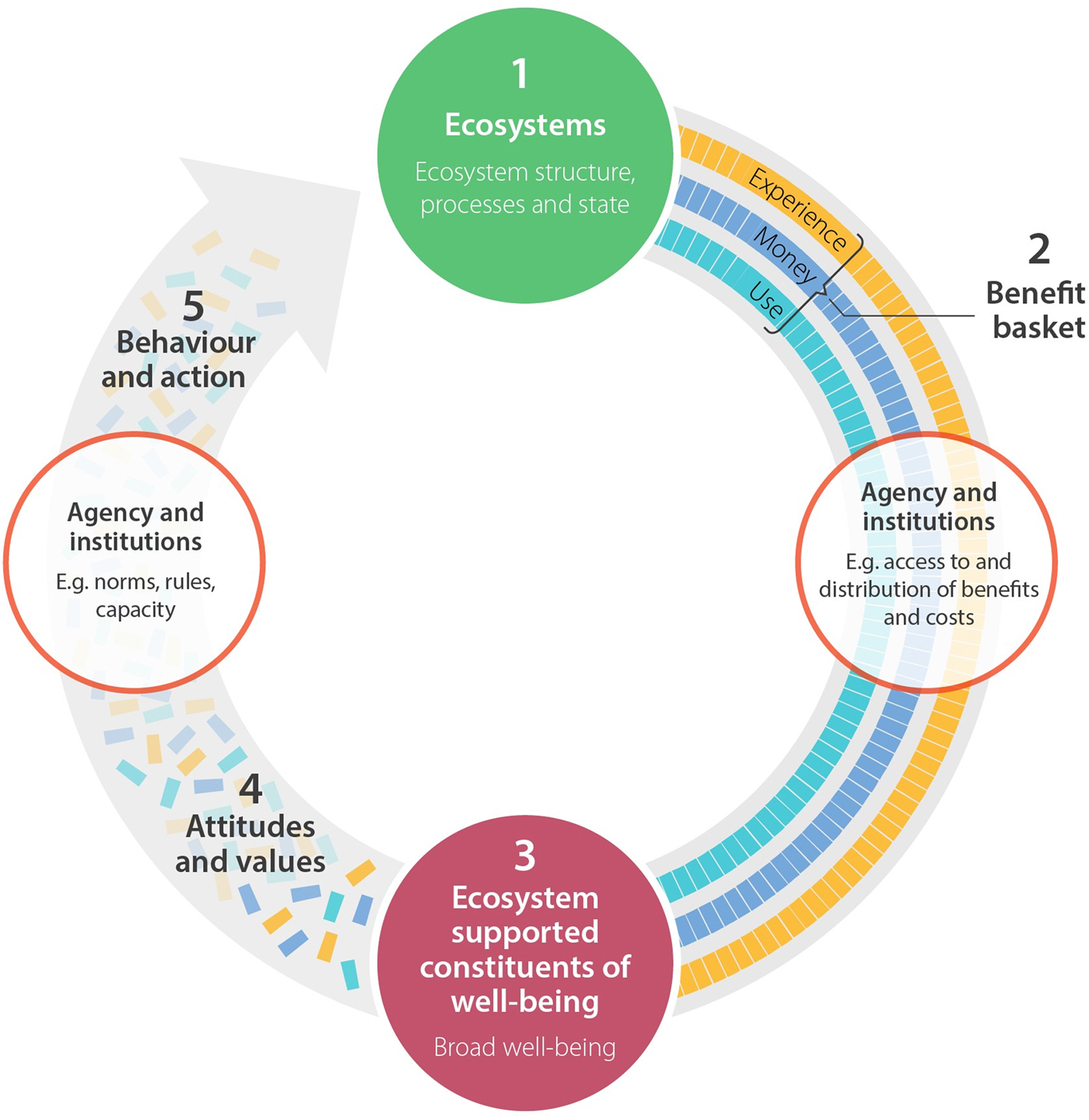
We present a conceptual model (Figure 1; see also Box 1 for use of terms) that brings together different strands of literature to highlight a potential feedback loop connecting mechanisms by which people benefit from nature to their attitudes and behaviours towards local ecosystems, through their material and perceived well-being. This feedback loop could operate at both an individual and collective level. Most importantly, it is mediated through institutions that might structure, enable or constrain individual agency, or reflect the aggregate behaviours of many, or few powerful individuals. Such reinforcing feedbacks have the potential to perpetuate rapid changes in a system (Chapin et al., Reference Chapin, Folke, Kofinas, Chapin, Kofinas and Folke2009). For example, a reduction in well-being benefits due to a decline in ecosystem quality may enhance exploitation and diminish stewardship, which can lead to increased ecosystem degradation and a further decline in benefits (a poverty-environment trap as described by, e.g., Barbier Reference Barbier2010). We also know that under certain conditions, people can and do act as stewards of their dynamic resources and ecosystems through active use and management (Berkes et al., Reference Berkes, Colding and Folke2003; Comberti et al., Reference Comberti, Thornton, Wyllie de Echeverria and Patterson2015; Ostrom, Reference Ostrom1990; also see Box 1). However, a range of social and institutional factors influencing the generation and distribution of ecosystem services on the one hand, and the potential for environmental stewardship on the other, affect how this feedback operates. We draw on existing literature and theory to point to the key factors that could affect such a feedback mechanism and initiate a discussion of the conditions (e.g. historical context, and power relations that shape institutions and agency) which may affect or reinforce patterns of behaviour that result in degradation of ecosystems or in governance systems that steward ecosystems. In the following, we elaborate further on the different parts of the conceptual model outlined in Figure 1.
Integrative conceptual model illustrating the dynamic interrelation between ecosystems (1), their benefits to people (2), well-being (3), and people's values and actions (4–5) that affect the condition of ecosystems. On the right hand side (2), three main mechanisms by which benefits from ecosystems are derived make up a ‘benefit basket’ and contribute to ecosystem-supported constituents of well-being. Three key components of the benefit basket are highlighted: direct use, exchange for money and experience. In reality they are not distinct but interacting and interdependent. Illustrated on the left hand side, is how the well-being derived from these benefits, and people's perception thereof, influence individual and collective attitudes and values towards nature (4), and ultimately the behaviours and actions (5) taken in relation to ecosystems to maintain or enhance benefit. The scattered indications of the benefit basket components illustrate that ecosystem-derived benefits become part of a broader mix of well-being factors that influence values and action. Agency and institutions (red circles) on the right side of the loop refer to factors that mediate the benefits from ecosystems, such as allocation of, and access to resources (which can be restricted by gender, class, race and historical inequities), as well as capacity and willingness to acquire the benefits. On the left hand side, agency and institutions relate to what actions are possible and for whom. Illustration by J. Lokrantz/Azote.
Glossary.
Agency: the capacity of individuals and groups to act independently to make their own free choices (Brown & Westaway, Reference Brown and Westaway2011). Agency can be determined or limited by structure, which includes factors such as gender, ethnicity, customs, class etc. Within a social-ecological systems approach, agency should be considered in a dynamic interplay with structure, where “emergent political processes reflect both the agency of current actors and the influence of historically embedded structures, practices and legacies” (Ezzine-De-Blas et al., Reference Ezzine-De-Blas, Corbera and Lapeyre2015, p. 73).
Attitudes: an evaluation of (including beliefs, feelings and behavioural tendencies towards) a mental or physical object (i.e. a person, place, thing, issue, event or symbol) (Eagly & Chaiken, Reference Eagly and Chaiken1993; Hogg & Vaughan, Reference Hogg and Vaughan2005). The relationship between attitudes and behaviour is often described by the theory of reasoned action, which states that attitudes influence behavioural intentions, which in turn influence actions (Ajzen & Fishbein, Reference Ajzen and Fishbein1980; Casaló & Escario, Reference Casaló and Escario2018). More broadly, the cognitive hierarchy model links values via attitudes to behaviour. In this model, attitudes mediate the influence of values on specific behaviours (Homer & Kahle, Reference Homer and Kahle1988). In general, attitudes refer to specific entities (i.e. person, thing or issue), whereas values have no object of reference (Rokeach, Reference Rokeach1973).
Benefit basket: a set or bundle of benefits that are derived from ecosystems through the different mechanisms of use, money or experience (after Chaigneau et al., unpublished observations).
Ecosystem services: All of the contributions, both positive and negative, of living nature (including its diversity of organisms, ecosystems, and their associated ecological and evolutionary processes) to people's quality of life (MA, 2005). Ecosystem services are co-produced by the interactions between nature and people (Palomo et al., Reference Palomo, Felipe-Lucia, Bennett, Martín-López and Pascual2016; Reyers et al., Reference Reyers, Biggs, Cumming, Elmqvist, Hejnowicz and Polasky2013).
Human well-being: a multidimensional concept, encompassing a number of factors that contribute towards a person's or group's condition and sense of well-being. These factors include the basic material for a good life (e.g. food, income, shelter), physical and mental health, good social relations (e.g. positive relationships with family and friends), security (e.g. personal safety) and freedom of choice and action (e.g. personal fulfilment and freedom of expression) (MA, 2005). Certain dimensions of well-being may be assessed using objective measures such as income. However, well-being is also a highly subjective concept that depends on a person's life satisfaction and happiness (Diener, Reference Diener1984).
Institutions: The humanly devised constraints that structure political, economic and social interaction. They consist of both informal constraints (sanctions, taboos, customs, traditions and codes of conduct) and formal rules (constitutions, laws, property rights) (North, Reference North1991).
Stewardship: the responsible use and management of ecosystems and their natural resources (Enqvist, Reference Enqvist2017). We use stewardship in a broad sense that can describe actions as well as systems of management or governance, and include a range of actors at local level or higher up as embedded in decision making (in contrast to, e.g., ‘local environmental stewardship actions’ as defined by Bennett and colleagues (Reference Bennett, Whitty, Finkbeiner, Pittman, Bassett, Gelcich and Allison2018)).
Values: Schwartz (Reference Schwartz1994, p. 20) building on Rokeach's work on values (Rokeach, Reference Rokeach1973) defines a value as a “belief pertaining to desirable end states or modes of conduct that transcends specific situations, guides selection or evaluation of behaviour, people and events.” Values are more central and deeply held than attitudes and underpin decisions and behaviours (Jones et al., Reference Jones, Shaw, Ross, Witt and Pinner2016; Satterfield, Reference Satterfield2001).
2.1. The benefit basket and mediating factors
Our model illustrates three mechanisms (see point 2, Figure 1) by which benefits from ecosystems are derived (based on Chaigneau et al., unpublished observations). Ecosystems can be used directly (e.g. fish may be caught for household consumption); they can provide a monetary income (e.g. caught fish can be sold at market); or they may constitute an experience (e.g. the act of fishing may contribute to a sense of joy, identity, freedom, autonomy and being respected by others). Of the three mechanisms, the importance of monetary and direct use benefits (mostly of provisioning services) are most widely recognized in ecosystem services literature from the global South (Suich et al., Reference Suich, Howe and Mace2015) and in development interventions. In contrast, non-material benefits derived through experience have traditionally received relatively less attention in the ecosystem services/human well-being literature, as non-material aspects do not easily lend themselves to quantitative assessments (Chan et al., Reference Chan, Satterfield and Goldstein2012; Russell et al., Reference Russell, Guerry, Balvanera, Gould, Basurto, Chan and Tam2013).
The three benefit mechanisms are not mutually exclusive, and can be part of the same ‘benefit basket’. In the Eastern Cape province of South Africa, for example, collecting firewood for cooking not only provides materials that contribute to making meals, but also fosters social cohesion among the women who share the experience of collecting the wood, contributes to self-respect and a sense of identity as hard-working women, and provides them with an opportunity to escape the troubles of home and connect with ancestral spirits in the forest (Cocks et al., Reference Cocks, Dold and Vetter2012). Different benefit mechanisms may therefore contribute directly to different human well-being domains, for example, physical security or health (Doyal & Gough, Reference Doyal and Gough1991; Chaigneau et al., unpublished observations). However, there may be trade-offs between the benefit mechanisms – benefitting from one mechanism may limit or reduce the chances of benefiting from another mechanism from the same ecosystem, potentially creating inequities between different beneficiary groups. For example, setting aside forest areas for ecotourism creates opportunities to earn income for some people in a community, but reduces the access for other groups to harvest and use resources and derive the associated experiential benefit. The benefits of particular ecosystem services, and the costs associated with producing them (e.g. loss of alternative ecosystem services), are often distributed unequally amongst people (Daw et al., Reference Daw, Brown, Rosendo and Pomeroy2011).
The distribution of benefits and costs is determined by social structures and mechanisms of access that operate at the individual and societal levels (see red circles in Figure 1). At an individual level, a person's agency (i.e. a person's capacity to act) in accessing ecosystem services is determined by a range of means, relations and processes (Ribot & Peluso, Reference Ribot and Peluso2003), including entitlements, technology, capital, markets, labour, knowledge, authority, social relationships and social identity (Leach et al., Reference Leach, Mearns and Scoones1999; Palomo et al., Reference Palomo, Felipe-Lucia, Bennett, Martín-López and Pascual2016; Reyers et al., Reference Reyers, Biggs, Cumming, Elmqvist, Hejnowicz and Polasky2013). At a collective level, institutions such as policies, tenure systems, cultural norms, as well as the discourses of and the power relations within these institutions, determine who has the potential to access ecosystems services (Berbés-Blázquez et al., Reference Berbés-Blázquez, González and Pascual2016; Escobar, Reference Escobar, Peet and Watts1996; Hajer, Reference Hajer1995). For example, cultural norms around gender often determine the ecosystem services potentially available to men or women and the means to access these services (Djoudi & Brockhaus, Reference Djoudi and Brockhaus2011). In East Africa, commercial mangrove pole cutting is done exclusively by men, and the poles are predominantly perceived as important for monetary benefit. Women, on the other hand, collect firewood in the mangroves for home use and enjoy the relationships fostered by the experience of collecting together. Consequently, women predominantly perceive this service to be important as a direct use and as an experiential benefit. Institutions reflect historical and contemporary power relations, and also influence the relative power between different social groups, often resulting in inequity in the distribution of benefits and costs from the use of ecosystem services (Berbés-Blázquez et al., Reference Berbés-Blázquez, Bunch, Mulvihill, Peterson and van Wendel de Joode2017). In South Africa, Kepe et al. (Reference Kepe, McGregor and Irvine2015) found that initiation into manhood, which requires seclusion in undisturbed wooded areas, took precedence over women's access to firewood and led to conflict in urban areas where wooded areas were scarce. Institutions and agency therefore influence access to resources and potential benefit baskets at both the individual and collective level.
2.2. From benefits to values, attitudes and behaviours
The left-hand side of Figure 1 (points 3–5) illustrates how people's well-being, and more specifically their perception of nature's contribution to well-being, can impact their attitudes, values and ultimately behaviour towards the natural environment. In general, experiences of nature, and of its management and destruction, have been identified in the literature as one important predictor of individuals’ ‘pro-environmental behaviour’ (Kollmuss & Agyeman, Reference Kollmuss and Agyeman2002). However, the effect is not linear and involves complex interactions with other factors and trade-offs with other values (Klöckner, Reference Klöckner2013).
For one, behaviour may be determined by both the subjective and objective aspects of people's well-being (Coulthard, Reference Coulthard2012). Well-being is a broad and multidimensional concept that does not depend solely on benefits derived from ecosystems. Nevertheless, well-being is increasingly argued to be linked to nature and the benefits it provides and this is an area that needs further inquiry (Díaz et al., Reference Díaz, Demissew, Carabias, Joly, Lonsdale, Ash and Zlatanova2015, Reference Díaz, Pascual, Stenseke, Martín-López, Watson, Molnár and Shirayama2018; MA, 2005; Schleicher et al., Reference Schleicher, Schaafsma, Burgess, Sandbrook, Danks, Cowie and Vira2018). In this conceptual model, we focus particularly on those aspects of well-being that are supported by ecosystems (Figure 1, point 3). The lower section of Figure 1 reflects evidence that the different ways through which ecosystems are perceived to support well-being can inform attitudes, values, beliefs and emotions that people individually or collectively hold with regard to nature (Gavin et al., Reference Gavin, McCarter, Mead, Berkes, Stepp, Peterson and Tang2015; Jones et al., Reference Jones, Shaw, Ross, Witt and Pinner2016; Loomis & Paterson, Reference Loomis and Paterson2014; Sterling et al., Reference Sterling, Filardi, Toomey, Sigouin, Betley, Gazit and Jupiter2017a). Beyond absolute material or immaterial benefits, these attitudes are also affected by the perceived fairness of how benefits are shared. For example, jealousy over unequal benefits from Filipino marine protected areas was a key motivation behind poaching behaviour (Chaigneau, Reference Chaigneau2013).
Points 4 and 5 in Figure 1 indicate how these attitudes and values can, in turn, influence actions towards stewardship of ecosystems. Environmental psychology has shown that environmental attitudes and values are an important factor influencing intentions and thus behaviour (Klöckner, Reference Klöckner2013). However, it is well known that attitudes do not necessarily translate into actions, especially when it comes to pro-environmental behaviour (Dietz et al., Reference Dietz, Fitzgerald and Shwom2005; Kollmuss & Agyeman, Reference Kollmuss and Agyeman2002; Stern et al., Reference Stern, Kalof, Dietz and Guagnano1995; Tanner, Reference Tanner1999; Whitmarsh, Reference Whitmarsh2009). In fact, individual and collective behaviours are constrained (or enabled) by individual agency and the social institutions, rules and norms (see red circle in Figure 1) that govern behaviour around natural resource use and management (e.g. taboos concerning extractive resource use in certain forests in southern Madagascar (Tengö et al., Reference Tengö, Johansson, Rakotondrasoa, Lundberg, Andriamaherilala, Rakotoarisoa and Elmqvist2007)). In understanding the interplay between institutional structures and agency, it is critical to recognize the constraints within which individuals and local actors can manoeuvre. Interventions (and values) are thus locally adapted, re-crafted and embedded in everyday practices (Van Hecken et al., Reference Van Hecken, Bastiaensen and Windey2015). Actions affecting ecosystems in any given setting respond not just to individual perceptions of the ecological dynamics and the benefit basket, but also to an institutional context shaped by particular types of knowledge, ways of doing, habits and norms that have been moulded historically by relations of power (Berbés-Blázquez et al., Reference Berbés-Blázquez, González and Pascual2016; Boonstra & de Boer, Reference Boonstra and de Boer2014; Cote & Nightingale, Reference Cote and Nightingale2012).
Many current approaches to ecosystem-related policies and/or reform have been blind to the historical path-dependency of ecosystem services and their associated values. This has misrepresented the benefits and burdens associated with the preferences of different groups of people, the “complex mosaics of cultural groups and social classes” (Li, Reference Li1996, p. 508) with various and opposed interests, as well as limits to their agency in pursuing alternative ecosystem management or use options (McCusker & Carr, Reference McCusker and Carr2006; White & White, Reference White and White2012).
As well as influencing individual actions, individual values can also be shared through society into more generally held norms and eventually incorporated into institutions that affect collective behaviour (Everard et al., Reference Everard, Reed and Kenter2016). Such behaviours may include restricted use, protection of certain species or spaces, and modifications of ecosystems that strengthen the generation of a range of benefits, such as agro-ecosystems and their associated biocultural diversity (Berkes & Folke, Reference Berkes and Folke1998; Cocks & Wiersum, Reference Cocks and Wiersum2014; Comberti et al., Reference Comberti, Thornton, Wyllie de Echeverria and Patterson2015).
Our model emphasises the impact of aspects of well-being supported directly by ecosystem-related benefit bundles. However, broad material, social and relationalFootnote ii well-being (beyond those dimensions of well-being directly supported by ecosystems) such as income or social status will influence and constrain people's agency to pursue certain courses of action (Sen, Reference Sen1999), with implications for the environment. For example, a fisher might have positive attitudes towards a marine protected area, but still illegally fish there, in order to sell the catch and meet an acute need to pay their children's school fees. In this example, pro-environmental values are traded-off against other values that are shaped by broader well-being needs.
In summary we can see that a complex interplay of attitudes and values, broader well-being considerations, as well as agency and institutions over time, at individual and collective levels, result in behaviour and actions that may positively or negatively impact ecosystems and the services they provide. These behaviours and how they affect ecosystem dynamics complete the well-being–ecosystem loop. The outcomes of this feedback loop may then be interpreted as reinforcing responsible and sustainable outcomes (which can be termed stewardship) or as degrading ecosystems (and consequently reducing well-being and potentially leading to poverty traps). The conceptual model with its different components, indicated as 1 to 5 in Figure 1, can guide an analysis of where interventions may shift the feedback towards sustainable outcomes.
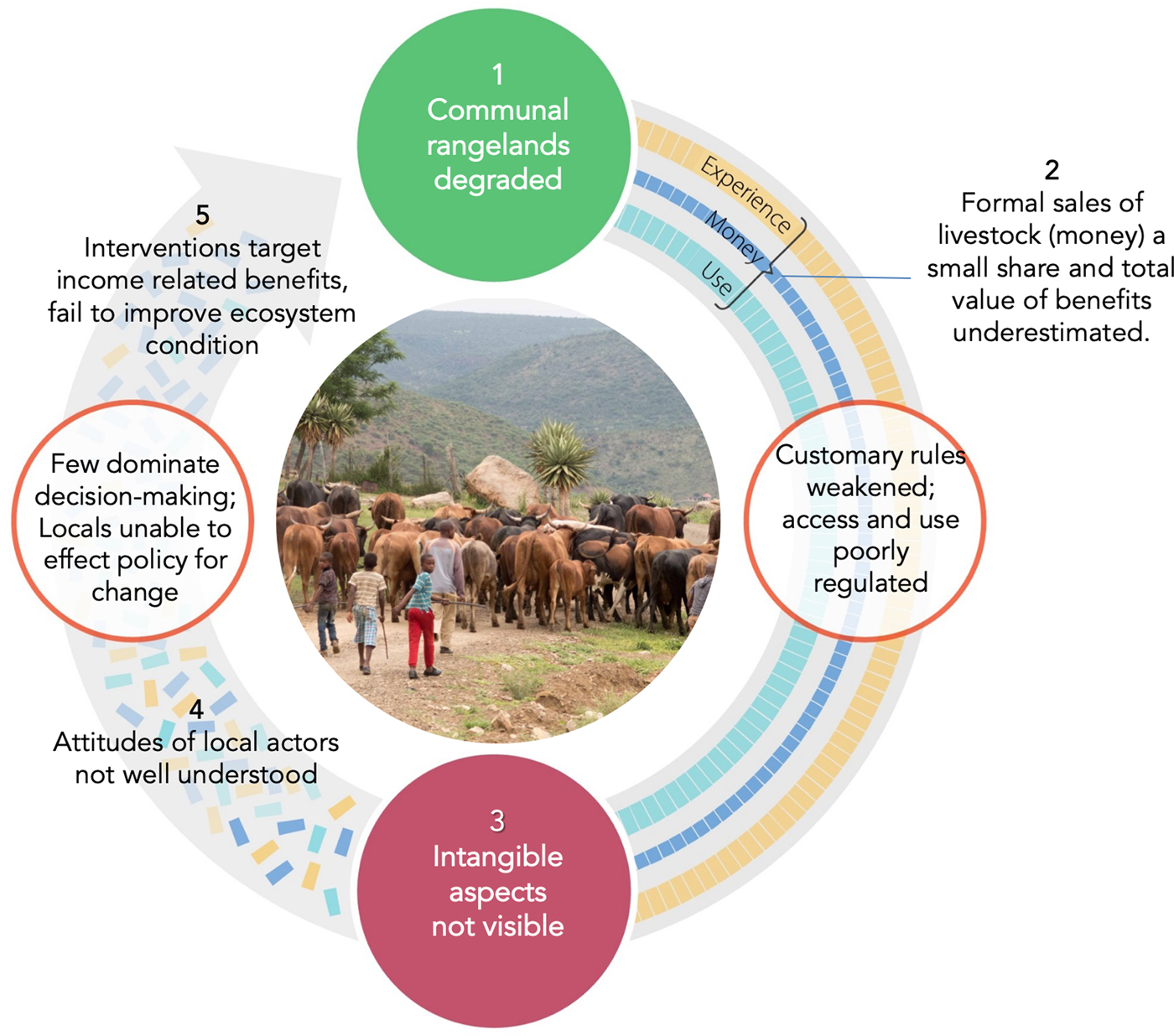
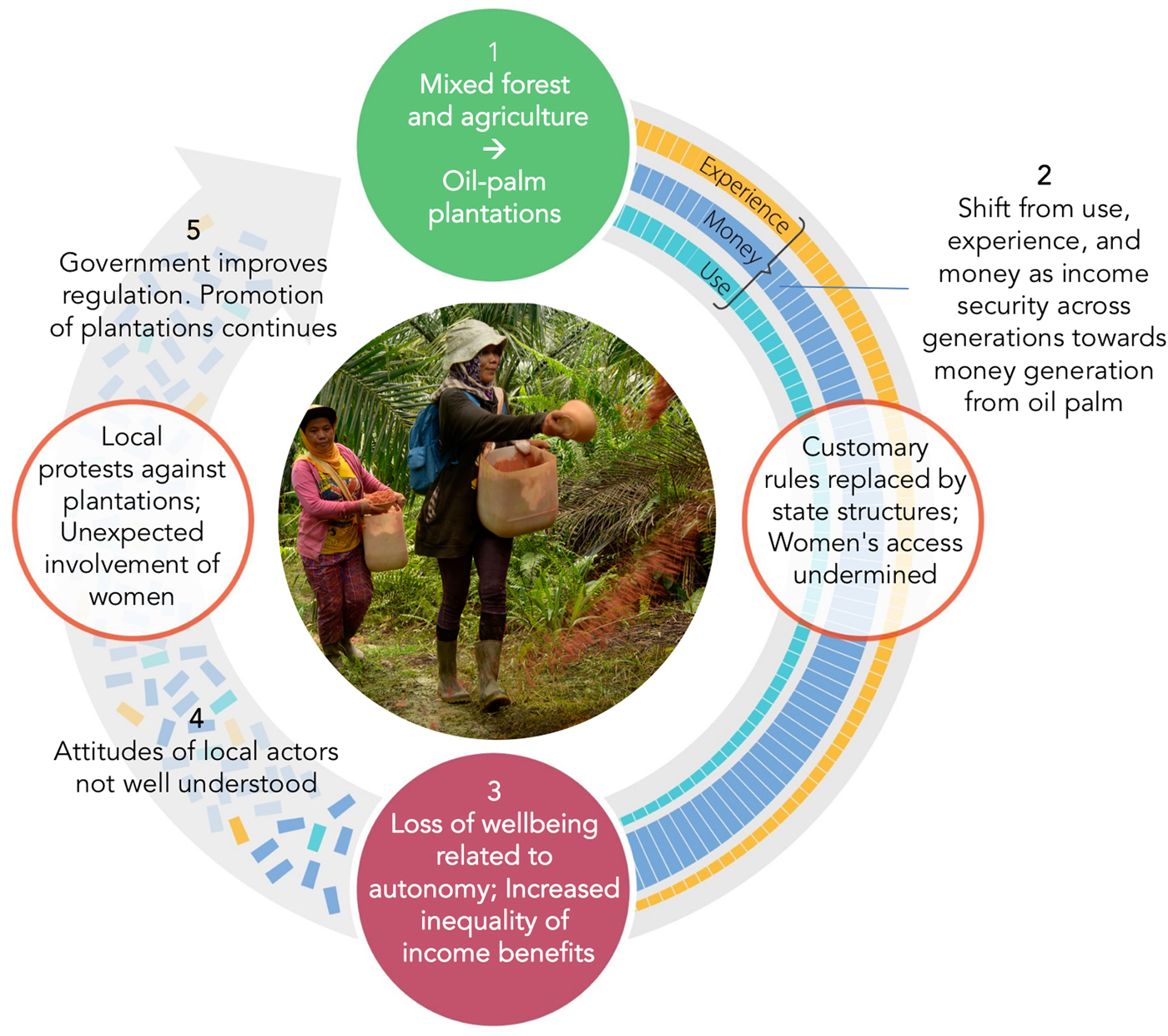
Two case studies, one thematic and one regional, illustrate aspects of the conceptual model and its implications for stewardship and overexploitation. While Figure 1 represents a simplified scheme, in reality, different components of our model have their own dynamics, interactions and feedbacks, and our understanding of respective parts is not evenly distributed. This is further illustrated and to some extent explored in the case studies. The case of communal rangeland management (Box 2, Figure 2) suggests that an incomplete understanding of the full benefit basket, how and why it benefits different groups of people unequally, and the constraints on individual agency have hindered successive waves of interventions to improve rangeland condition and outputs. A regional case study from Kalimantan, Indonesia (Box 3, Figure 3), on the conversion of mixed agricultural and natural landscapes to large-scale palm-oil production, illustrates the shifts in benefit baskets and their beneficiaries, and how this has influenced local people's attitudes and agency in land management decisions.
The conceptual framework as applied to the case study of degraded communal rangelands in southern Africa. The graphics are edited to illustrate how money is a minor part of the benefit basket (2, narrow blue line) and that experience and use are invisible and undervalued (2, yellow and turquoise lines). On the left hand side, the different components of the benefit basket (different coloured pieces) may influence the values and attitudes of local actors (4), but these are not well understood in decision making, and local actors are only involved to a limited degree. Actions to improve rangeland conditions (5) remain focused on reducing stocking rates through sales and thus achieve increased income benefits, but uptake of opportunity for increased sales is low and interventions to change rangeland management and use, often fail. Illustration by J. Lokrantz/Azote. Photograph by Rauri Alcock.
The conceptual framework as applied to the Kalimantan case study, illustrating the shift from mixed forest and smallholder agriculture towards oil-palm cultivation. The graphics are edited to capture how the shifts lead to loss of benefits related to use for food, materials, etc. and experience of identity and autonomy as farmers (2, narrowing lines of yellow and turquoise), and a change in income security over generations towards dominance of sales of oil palm for money (2, expanding width of blue line). On the left hand side, the blue pieces representing money dominate, but the recognition of the use and experience benefits (yellow and turquoise pieces) may be reflected by local values expressed in community protests. Illustration by J. Lokrantz/Azote. Photograph by Icaro Cooke Viera.
Managing the rangeland commons: Why such an elusive goal?
Sustainable management of communal rangelands in semi-arid regions presents an ongoing conundrum to policy makers (Vetter, Reference Vetter2013). Usually, a communal grazing area is evaluated as being overgrazed, degraded and unproductive, and interventions (historically top-down but increasingly participatory) are designed to improve rangeland condition and economic gain. Interventions typically take the form of improved grazing systems and improved livestock breeds coupled with economic incentives such as marketing of livestock. With rare exceptions, these fail to gain broad-based support and are usually short-lived. When assessing these approaches against our conceptual framework, several biases and gaps become apparent:
1. Interventions focus on economic productivity and environmental sustainability of rangeland use but usually fail to consider the full benefits basket (see point 2 in Figure 2). The multiple ways in which rangelands benefit different people through use and monetary exchange are becoming better understood (Hebinck & Shackleton, Reference Hebinck and Shackleton2010; Shackleton et al., Reference Shackleton, Shackleton and Cousins2001; Shackleton et al., Reference Shackleton, Campbell, Lotz-Sisitka and Shackleton2008), but are often not included in rangeland management interventions. The experiential, including cultural, dimensions of livestock ownership and other rangeland uses are poorly understood outside the anthropological literature (Ainslie, Reference Ainslie2005).
2. Even though there is increasing awareness of access issues and inequalities (such as highly skewed livestock ownership, unequal power dynamics between men and women), these factors are seldom effectively considered and addressed (right-hand red circle, Figure 2). Interventions tend to target cattle owners, who are often a minority, that is, relatively wealthy, older men. The interests of women and other people who do not own livestock, but still derive benefits from the common resource, are usually under-represented.
3. Participatory assessments to elicit perceptions of environmental problems and development needs have become commonplace, and often reveal some recognition of land degradation. However, very little is known about the attitudes and values of livestock owners and other users of the rangeland commons (see point 4 in Figure 2). Consequently, in-depth and multifaceted understandings of people's feelings about, and attachment to, their natural environment are rare and seldom inform development interventions.
4. There is often a notable mismatch between land users’ expressed sentiments about the natural environment (e.g. recognition that it has degraded over time) and their behaviours/actions (see point 5 in Figure 2). This commonly takes the form of non-compliance with grazing regulations, but also a lack of uptake of the economic opportunities meant to increase benefits such as selling livestock when market access is improved. The reasons for this are poorly understood. Lack of compliance with grazing regulations may be due to constraints such as water availability, or a lack of locally supported institutions and cooperation (see 4–5 in Figure 2). The seeming reluctance to sell livestock, particularly cattle, is also puzzling if the benefits of livestock are understood purely in economic terms.
There has been considerable research to understand the structural barriers to effective common property management and the constraints limiting the uptake of opportunities made available by development projects. For example, cattle are deeply embedded in economic and kinship networks, as well as having cultural significance, which means that they are not simply an economic good to be traded or disposed of (Ainslie, Reference Ainslie2005). At this point, however, research and interventions tend to be informed by particular lines of evidence (e.g. rangeland ecology but not anthropology and political studies), and as a result target only selected parts of the feedback loop, that is, the monetary benefits and economic incentives for compliance with grazing regulations.
We propose that explicit and careful consideration of the full loop as proposed in our conceptual model would help address this problem and provide guidance for more appropriate and sustainable stewardship and development. For example, understanding the full range of benefits from rangelands and how different people derive them can inform interventions that increase the total benefit basket and benefit people more equitably. This, together with a better understanding of how people perceive and value these multiple benefits, and their relationship with the natural environment, could inform more appropriate strategies for involving people in better resource management.
Evolving social-ecological relationships in Kalimantan.
In the West Kalimantan province of Indonesia, the landscape is changing fast, with state-driven expansion of oil palm as a rural development strategy resulting in mosaics of diversified agriculture and forest transformed into a sea of monoculture plantations. Oil palm has generated handsome revenues in the form of profits, taxes and fees, but the plantation model is skewed towards benefiting large corporations and elites at the expense of smallholders (Cramb & McCarthy, Reference Cramb and McCarthy2016; Li, Reference Li2017). Traditionally, local small-scale Dayak farmers had a diverse relationship with the forest and agricultural land, and tended to derive a benefits basket (see point 2 in Figure 3) from multifunctional landscapes, including food security (representing the ‘use’ mechanism), income security across generations and the flexibility to respond to crises and opportunity (monetary mechanism), as well as the ability to retain autonomy and identity as farmers (experiential mechanism) (De Vos, Reference De Vos2016). This range of benefits was also associated with customary institutions regulating use and access to resources.
However, in the dynamics of this environmental change, the state has co-opted customary institutions and changed rules and norms associated with access, and in the process widened inequity and led to the loss of access to diverse and flexible farming futures (Li, Reference Li2017) (see the red circles in Figure 3). One specific impact of inequity caused by the plantation model is apparent in how the position and livelihood of Dayak women in this already patriarchal community is undermined. Customary tenure systems are a complex, nested mix of communal ownership, as well as ownership based on descent and heritable ownership, where there is no gender differentiation (White & White, Reference White and White2012). However, the shifting of land tenure from the community to the state and the concomitant practice of registering smallholder plots to the ‘family head’ has eroded women's customary rights to land (point 3 in Figure 3). At the same time, loss of the recognition of multiple functions of land has led to both men and women smallholders becoming a class of plantation labourer (Li, Reference Li2015; White & White, Reference White and White2012), with very limited agency to influence any land use decisions.
The threat of loss of well-being in the denigration of local rights and multiple functions of the ecosystem has mobilized local and Dayak farmers to actively express their values (see 4 in Figure 3) by rejecting and resisting plantation projects throughout West Kalimantan (De Vos, Reference De Vos2016; Morgan, Reference Morgan2017). Rural women who are traditionally excluded from politics have also participated actively in protests against oil palm in an unexpected expression of agency. While there have been some successes in the withdrawal of concessions by district heads (De Vos, Reference De Vos2016; Morgan, Reference Morgan2017) the continued expansion of palm throughout the region appears unstoppable. Resistance actions are not universal across all farmers (see 5 in Figure 3). Farmers’ assessments of threats (or opportunities) presented by oil palm are rooted in how they perceive variable property and access arrangements (De Vos, Reference De Vos2016; Maharani et al., Reference Maharani, Moeliono, Wong, Brockhaus, Carmenta and Kallio2019) and in their aspirations for the future (Li, Reference Li2017). The diversity of responses highlights the complexity of social differentiation and different perceptions of benefits and well-being derived from the environment (4 in Figure 3). The rural struggles around land and dispossession in West Kalimantan are not driven merely by a switch to a new crop, but relate to the loss of identity and well-being gained from the management of a diverse landscape, and the detachment of local communities from decision-making and crafting rules for managing the landscape.
The State's various attempts to improve cooperation from local farmers have focused mainly on improving laws and policies on plantations, but such actions have failed to recognize the fundamental importance of addressing the loss of multiple ecosystem benefits (including material and non-material) and the effects of shifting power over land to outside companies and elites. A rural development strategy that aims to improve social, economic and environmental sustainability would strive to better engage with the perceptions and values of the local and Dayak farmers, and create opportunities for palm oil cultivations and other crops at a scale that can enable stewardship over ecosystem function. Failure to apply such a strategy can lead to a downward spiral of erosion of multidimensional well-being, stewardship values and capacity, as well as ecosystem functions and diverse benefits.
3. Discussion
This article draws together multiple strands of literature to call for a more holistic and dynamic understanding of the reciprocal relationship between ecosystems and human well-being. This expands on dominant conceptualizations of both ecosystem services, which tend towards a linear and unidirectional relationship of benefits from ecosystems to human well-being, and conservation, which focuses on reducing the negative human impacts on the environment. In contrast, we aim to emphasize the feedbacks occurring as a result of the multiple and reciprocal links between ecosystems and well-being, and specifically how behaviours towards ecosystems may be affected by the way in which ecosystems benefit people, and how these benefits are distributed and perceived.
Through the conceptual model we bring together sets of literature that have previously interacted only to a limited degree. One reason for this may be the different epistemological assumptions and approaches related to the different scales and resolutions on which the respective research traditions focus. We acknowledge epistemological tensions amongst some of the relevant academic traditions brought together in our conceptual framework. For example, psychological research into connections between values, attitudes and pro-environmental behaviour or action typically focus on the individual, while aggregate valuations of ecosystem services and studies of institutions typically explore patterns and relationships amongst groups or populations, that is, at the collective level. Another example is that while the institutional economics theory of collective action for sustainable governance or management of an ecosystem is rooted in rational choice (Ostrom, Reference Ostrom1990), social anthropology and critical institutionalism suggest that motivations are influenced by social concerns, psychological preferences and culturally and historically shaped ideas that are not always rational (Cleaver, Reference Cleaver2012). We offer the conceptual model as a starting point for generating further dialogue and new hypotheses. It may also serve as a bridging concept between different ‘silos’ of understanding (i.e. a bridging concept in the broadest sense of the word – as a tool to foster interdisciplinarity (Baggio et al., Reference Baggio, Brown and Hellebrandt2015; Deppisch & Hasibovic, Reference Deppisch and Hasibovic2013)).
Our objective for developing the conceptual framework is to enable research and understanding of a more holistic view of interactions between ecosystems and human well-being, using a SES approach. We hope that this can contribute to creating space for multiple framings of the ecosystem and the human well-being relationship including, but not limited to, an ecosystem service conceptualization. We see our approach as complementary to the other ways of conceptualizing human–nature interactions holistically and dynamically, including in the humanities and indigenous and local knowledge systems, which have often challenged dominant scientific discourses (Caillon et al., Reference Caillon, Cullman, Verschuuren and Sterling2017; Gavin et al., Reference Gavin, McCarter, Mead, Berkes, Stepp, Peterson and Tang2015; Pascual et al., Reference Pascual, Balvanera, Diaz, Pataki, Roth, Stenseke and Wickson2017). While not emphasizing well-being, Comberti et al. (Reference Comberti, Thornton, Wyllie de Echeverria and Patterson2015) discuss closing the loop between humans and ecosystems and recognizing how people are involved in actively managing the ecosystem services that are derived from ecosystems, thus recognizing the people's services to nature as well as nature's services to people. They find rich evidence of such a closed feedback loop in many indigenous and local societies, including a range of practices that support ecosystem service generation such as protecting ‘useful’ species (earthworms, nitrogen-fixing plants, pest-eating birds), that are embedded in rituals and taboos (see also Everard et al., Reference Everard, Reed and Kenter2016; Whitmarsh, Reference Whitmarsh2009). We view these findings as complementary to our framework and further support for the need to identify barriers and bridges to closing the loop in different contexts.
3.1. Implications for development interventions
There have been multiple calls for a more thorough inclusion of nature and ecosystem dynamics in our understanding of poverty alleviation (Schleicher et al., Reference Schleicher, Schaafsma, Burgess, Sandbrook, Danks, Cowie and Vira2018). Our conceptual model highlights how the mechanisms by which people derive benefits from ecosystems can potentially influence values, attitudes and actions towards these ecosystems that support human well-being. Informed by a SES perspective, this conceptual model compels us to examine the potential impact of poverty alleviation and development interventions on benefit mechanisms and on individual and collective action in relation to ecosystems. Furthermore, it is critical that interventions are aware of and support rather than erode existing values, rules and norms that are congruent with sustainable ecosystem management. For example, customary rules and tenure systems in many African communities revolve around sacred sites, where use and entry are restricted, which protects biodiversity as well as ecosystem functions (Bodin et al., Reference Bodin, Tengö, Norman, Lundberg and Elmqvist2006; Sheridan & Nyamweru, Reference Sheridan and Nyamweru2008; Tengö et al., Reference Tengö, Johansson, Rakotondrasoa, Lundberg, Andriamaherilala, Rakotoarisoa and Elmqvist2007). Furthermore, the knowledge and management practices of many indigenous communities are embedded in a notion of reciprocity between people and nature that includes responsible behaviour (Comberti et al., Reference Comberti, Thornton, Wyllie de Echeverria and Patterson2015). Interventions that build on such local best practices for sustainability, also have the legitimacy of being community-owned (Mistry et al., Reference Mistry, Berardi, Tschirhart, Bignante, Haynes, Benjamin and de Ville2016; Sterling, Reference Sterling, Betley, Sigouin, Gomez, Toomey, Cullman and Porzecanski2017b).
The conceptual model encompasses a number of potential points of intervention along the feedback cycle. Firstly, many interventions aim to increase the benefits that people receive from ecosystems (see 1–2 in Figure 1). This may be achieved by, for example, improved access to natural spaces, or skills development to increase yields or catch, or better connections to markets at which ecosystem products can be sold. While these strategies have been effective, we suggest that such interventions could be further improved by explicitly considering the multitude of different benefit mechanisms (direct use, monetary and experience), as well as who can access the benefits and who bears the costs. Secondly, interventions may aim to improve awareness of the full range of benefits that are derived from an ecosystem (see 2–4, Figure 1), as this may have a positive influence on values of responsibility and care, which in turn play an important role in promoting stewardship of nature. Thirdly, interventions can support the agency of individuals, collectives and communities to act on their values (4–5, Figure 1) by, for example, recognizing territorial rights, indigenous knowledge and communal/customary governance systems (Caillon et al., Reference Caillon, Cullman, Verschuuren and Sterling2017; Comberti et al., Reference Comberti, Thornton, Wyllie de Echeverria and Patterson2015; Sterling et al., Reference Sterling, Filardi, Toomey, Sigouin, Betley, Gazit and Jupiter2017a). While all of these strategies are typical conservation and development strategies, our conceptual model highlights the inherent interdependencies between these. For example, efforts to support community conservation of ecosystems are common, but may be blind to changing or inequitable benefits from ecosystems that could undermine the values and incentives for community members to invest in conservation or stewardship actions. Similarly, development interventions to improve the management and productivity of rangelands (e.g. the introduction of improved breeding stock linked to marketing schemes) typically target and materially benefit the more affluent and educated owners of cattle, who are a minority (Vetter, Reference Vetter2013). The outcomes of these interventions may negatively impact the benefit basket for marginalized community members such as women and the youth, for example, preventing their access to experiential benefits from these rangelands. This, in turn, affects the relationships that these vulnerable groups have with their local ecosystems, reducing both their local ecological knowledge and their incentives for stewardship (Box 2). The conceptual model could be used as a diagnostic tool to identify points in the feedback loop where interventions can unlock the potential for broader support of stewardship.
In particular, we emphasize the mechanism of experience which contributes to aspects of well-being that are commonly overlooked in economically focused development strategies (Büscher & Dressler, Reference Büscher and Dressler2007; Masterson et al., Reference Masterson, Tengö and Spierenburg2017; Russell et al., Reference Russell, Guerry, Balvanera, Gould, Basurto, Chan and Tam2013). Insights from the humanities and social sciences illustrate that experiences in nature nurture a sense of care and responsibility towards the ecosystem (Bennett et al., Reference Bennett, Whitty, Finkbeiner, Pittman, Bassett, Gelcich and Allison2018; Bramston et al., Reference Bramston, Pretty and Zammit2011; Chawla, Reference Chawla2009; Enqvist, Reference Enqvist2017; Giusti et al., Reference Giusti, Barthel and Marcus2014; Raghuram, Reference Raghuram2016). Development interventions that invest in sustaining existing experiential activities and benefits could both improve neglected aspects of well-being (such as relational well-being), and maintain and encourage protective actions and sustainable management practices of the ecosystem, thus sustaining a virtuous cycle (positive feedback loop) that ultimately supports material benefits from the ecosystem in the long term. This is particularly important in the face of development trajectories that commonly favour ecosystem simplification, commercialization and urbanization. This is evident in the case of Kalimantan (Box 3), where homogenous oil palm plantations are promoted as a form of rural development without understanding the local systems of value around farmer identity, land management and tenure, as well as diverse perceptions of well-being. Explicit consideration of experiential ecosystem benefits, and the potential trade-offs with direct use and money, challenges dominant ideas in development practice and poverty alleviation. Focusing on experiential benefits is key to maintaining the existing ties and positive relations between people and nature, which is important in motivating and maintaining local stewardship actions (Giusti et al., Reference Giusti, Barthel and Marcus2014; Krasny & Tidball, Reference Krasny and Tidball2012). It may also serve as an entry point to better understand the cultural dimensions of experiencing as well as managing ecosystems, which many have argued should inform the implementation and evaluation of poverty alleviation and development initiatives (Díaz et al., Reference Díaz, Pascual, Stenseke, Martín-López, Watson, Molnár and Shirayama2018; Schleicher et al., Reference Schleicher, Schaafsma, Burgess, Sandbrook, Danks, Cowie and Vira2018; Sterling et al., Reference Sterling, Filardi, Toomey, Sigouin, Betley, Gazit and Jupiter2017a).
There is a need for deeper alignment between processes of use, monetary benefits and experiences, as well as institutions and agency to support sustainable development and stewardship. Both case studies (Box 2 & 3) call for a broader and more inclusive range of benefit mechanisms to be recognized, and challenge dominant discourses that inform and justify the types of intervention approaches and institutional structures that empower large corporations and elites over small-scale landholders. Such a shift to a broader perspective would require a transformation of development interventions at a global (conceptual) and at the local (implementation) level; by extending emphasis beyond material needs, and incorporating subjective as well as relational aspects of well-being for communities and individuals (Caillon et al., Reference Caillon, Cullman, Verschuuren and Sterling2017; Sterling et al., Reference Sterling, Filardi, Toomey, Sigouin, Betley, Gazit and Jupiter2017a). Such an approach also emphasizes the need for interventions to be relevant for the local context, and for more representative and inclusive local institutions that can represent the diverse range of values held by communities.
3.2. Key uncertainties and gaps
Figure 1 suggests a distinct feedback loop, but there remain a number of key uncertainties on how or whether such a feedback operates in different contexts, which needs further elaboration and research from different perspectives. The influence of perceived benefits from nature on attitudes and values is complex and uncertain and it is difficult to attribute actions and behavioural outcomes to just one aspect of people's lives. Firstly, not all benefits may be perceived. For example, supporting or regulating ecosystem services are likely to be taken for granted unless they decline, and typically receive less emphasis in participatory assessments of ecosystem services (Martín-López et al., Reference Martín-López, Iniesta-Arandia, García-Llorente, Palomo, Casado-Arzuaga, Del Amo and Montes2012; Rodríguez et al., Reference Rodríguez, Beard, Bennett, Cumming, Cork, Agard and Peterson2006). Meanwhile, management institutions may fail to recognize benefits even if individuals are aware of them (see also Box 2). For example, capitalist markets generally fail to recognize freely provided ecosystem services that have no price (Daily et al., Reference Daily, Polasky, Goldstein, Kareiva, Mooney, Pejchar and Shallenberger2009; Vogl et al., Reference Vogl, Goldstein, Daily, Vira, Bremer, McDonald and Cassin2017), while governance institutions may overlook, undervalue or choose to ignore direct or experience-oriented benefits to marginalized communities (Reed et al., Reference Reed, Allen, Attlee, Dougill, Evans, Kenter and Whittingham2017). Indeed, even when benefits are perceived, this awareness may not be enough to change behaviour towards, for example, stewardship of ecosystem services (Blake, Reference Blake1999; Kollmuss & Agyeman, Reference Kollmuss and Agyeman2002). Furthermore, recent work has highlighted the plurality of values and how contextual values can be formed by deliberative valuation exercises (Kenter, Reference Kenter2016). Context-specific values and attitudes that are relevant for stewardship actions therefore likely require benefits to be consciously considered and reflected upon. Finally, it is unclear to what extent values towards ecosystems are necessarily influenced by the perception of benefits from ecosystems, as, for example, various value systems have notions of care and responsibility that are not dependent on utilitarian reciprocity with ecosystems (Caillon et al., Reference Caillon, Cullman, Verschuuren and Sterling2017; Cocks et al., Reference Cocks, Dold and Vetter2012; Cooper et al., Reference Cooper, Brady, Steen and Bryce2016).Thus, there is a clear need for collaborative research across different disciplines to better tease out the pathways from experience and perceptions of the benefit basket (2–3; Figure 1), to attitudes and values (4; Figure 1) and the implications for actions (5; Figure 1), and finally to impact on ecosystem capacity to generate benefits (1; Figure 1).
Another key gap is in our understanding of how the different ways people benefit from ecosystems (e.g. money, use, experience) can influence attitudes and actions differently, i.e., do the benefits of, e.g., use and experience result in a different set of attitudes and actions than monetary benefits? For example, while women's perceptions of the forest as contributing to their material well-being may be relatively well documented, much less is known about how they feel about, and value, the forest where they harvest firewood. Still less is understood about the contribution of use and experiential benefits to how these feelings and values are developed and mobilized towards action, for example, on behalf of the environment. To what extent are women who derive psychological and relational well-being from collecting firewood (Cocks et al., Reference Cocks, Dold and Vetter2012) inclined to and able to act to protect forest resources? And how does the loss or gain of such aspects of well-being influence behaviour? Along similar lines, some critiques of payments for ecosystem services (PES) schemes have highlighted that monetary benefits from ecosystems may ‘crowd out’ less instrumental values of stewardship based on experiential connections with nature (Ezzine-De-Blas et al., Reference Ezzine-De-Blas, Corbera and Lapeyre2015). Our conceptual model illustrates the importance of gaining a better understanding of these interactions by highlighting the variety of mechanisms through which ecosystems confer benefits, as well as the different ways in which these benefits then shape attitudes and behaviours.
3.3. Future research directions and conclusions
As a potential bridging object between different bodies of knowledge, our conceptual model has helped us to define some critical interdisciplinary research questions for understanding how feedbacks between ecosystems and well-being can nurture or erode stewardship. The first set of questions addresses how different mechanisms of benefit influence values and behaviour. For example, does monetization change attitudes, values and behaviours, and what are the implications for longer term environmental sustainability? How strongly do experiential mechanisms influence action relative to monetary benefits and direct use? Additionally, how do different benefit mechanisms encourage behaviours with effects at different scales (e.g. in one's community vs. at a national level)? A second avenue for future research concerns the interplay between perceived general well-being and the aspects of well-being directly supported by ecosystem services: what is the relative importance of the contribution of ecosystem service-related aspects of well-being to stewardship actions, as opposed to the contribution of broader measures of well-being? We would particularly like to call for research designs that assess components of the loop, while also acknowledging a holistic perspective and the dynamics of the full feedback loop.
A third avenue concerns the role of equity in ecosystem benefits and the ultimate influence of socio-economic inequalities on ecosystem sustainability (Hamann et al., Reference Hamann, Berry, Chaigneau, Curry, Heilmayr, Henriksson and Wu2018). A growing body of research has argued for the inclusion of social feedbacks, where perceptions of equity and justice can significantly influence ecosystem governance (or stewardship) (e.g. Bodin et al., Reference Bodin, Tengö, Norman, Lundberg and Elmqvist2006; Pascual et al., Reference Pascual, Phelps, Garmendia, Brown, Corbera, Martin and Muradian2014). Loft et al. (Reference Loft, Le, Pham, Yang, Tjajadi and Wong2017) and McElwee et al. (Reference McElwee, Nghiem, Le, Vu and Tran2014) show how PES policies in Vietnam are reshaped by rural actors to better reflect local notions of equity, born of deep-rooted place-specific social and cultural norms. While there is a large body of literature that assesses the effect of economic inequality on collaboration through, for example, behavioural experiments, fewer studies assess the links between equity and cooperation in terms of managing an environmental resource (Baland et al., Reference Baland, Bardhan and Bowles2007; Cardenas, Reference Cardenas2003). There is a need for systematic evidence of whether perceived equity (in terms of participation, access to resources and distribution of benefits) leads to stewardship actions and outcomes in the real world. This is an important area for future research and can help to illustrate how these feedbacks have influence on the linkages between well-being and ecosystem stewardship as illustrated in the conceptual model.
Maintaining or enhancing the contributions of ecosystems to human well-being while ensuring that these ecosystems continue to provide benefits for future generations is a major global challenge. How our proposed feedback loop operates within the increasing scope and scale of environmental and social change, including climate change, large scale human migrations and ecosystem degradation could be critical in addressing future sustainability challenges. Rather than considering relationships between ecosystems and well-being as unidirectional, and linear, this paper presents a conceptual model to capture a more dynamic interplay and feedback between well-being and stewardship of nature. Furthering our understanding of the different ways through which well-being can be derived from interactions with ecosystems, as well as the processes through which well-being in turn shapes values and behaviour towards the environment, can highlight potential points of intervention that may lead to virtuous cycles with positive outcomes for both human well-being and ecosystem health through the promotion of environmental stewardship.
Author ORCIDs
Vanessa A. Masterson, 0000-0002-5379-9309
Acknowledgements
The authors wish to thank Belinda Reyers, Dominique Gonçalves and Marika Haeggman for their invaluable contributions to the inception and development of these ideas at the GRAID workshop in Johannesburg in May 2017. The authors also wish to thank Reinette (Oonsie) Biggs for support for the initial workshop. The authors are also grateful to the participants of a workshop session at the PECS II Conference in Oaxaca, Mexico, who provided key feedback on the conceptual model, as well as to Caroline Schill who provided important input. The authors also thank Jerker Lokrantz at Azote for his work on the illustrations.
Author contributions
MT and VAM convened the initial workshop during which the conceptual model was conceived and SV, TC, TMD, MC, VM and GYW contributed to this workshop. The writing of the article was led by VAM with substantial contributions from all authors.
Financial support
The inception workshop was supported by the Swedish Research Council (grant number VR 2014-3394) as well as by the Sida funded project, Guidance for Resilience in the Anthropocene: Investments for Development (GRAID) at the Stockholm Resilience Centre. For writing the paper the authors acknowledge support from the Swedish Research Council (VAM, MT: grant number VR 2014-3394 and VAM: grant number VR 2017-06337), from Sida for the GRAID programme of the Stockholm Resilience Centre (OS, GYW, TMD), as well as a core grant from Mistra to the Stockholm Resilience Centre. SV acknowledges NRF Incentive Funding for Rated Researchers (Grant number 91085) for travel.
Conflict of interest
None.
Publishing ethics
This research and article complies with Global Sustainability's publishing ethics guidelines.


 Open access

