Recurring technological disasters, life-threatening incidents including acts of terrorism, and natural disasters continue to test the ability of communities to be adequately prepared for and respond to and recover from emergencies. The rapid and coordinated response of first responders, law enforcement, emergency management, and hospitals and other health care facilities are critical to saving lives during and after mass casualty events (MCEs). Additionally, experiences throughout the world with MCEs are highlighting the important role that “active bystanders,” that is, individuals at the scene of an event who voluntarily step forward to help others, can play in early assistance to save lives and prevent further injury.
While emergency responders typically reach the scene of an MCE or other life-threatening event quickly, there is always an interval between the time of the event and their arrival. Because bystanders are present at the scene of many such events, their prompt and appropriate involvement can result in an improved outcome for victims. By acting immediately at the scene, bystanders can provide initial notification about the event, relay key information to professional responders, and even supplement emergency responders’ capabilities (especially when trained for this purpose). This was highlighted in the aftermath of the 2013 Boston bombings, when bystanders provided significant initial care, including assisting with access to patients, hemorrhage control, and application of tourniquets and providing patient transport.Reference Kellermann and Peleg 1
Research studies have documented an increase in the survival rate of individuals with out-of-hospital cardiac arrest (OHCA) who received cardiopulmonary resuscitation (CPR) from a bystander.Reference Valenzuela, Roe and Cretin 2 - Reference Herlitz, Ekström and Wennerblom 4 A study of survivors of OHCA in Canada found that bystander CPR was independently associated with a “very good quality of life” for the survivors.Reference Stiell, Nichol and Wells 5
Other research further supports the value of bystander assistance received immediately after a motor vehicle crash as an important predictor of future health and quality of life for the survivors.Reference Brodsky 6 According to European Resuscitation Council and First Aid guidelines, trained bystanders can reduce mortality and reduce morbidity until professional help arrives in cases of injury, sudden illness, or other life-threatening emergency.Reference Van de Velde, Broos and Van Bouwelen 7 , Reference Handley, Koster and Monsieurs 8 Two reports on the September 11, 2001, New York attackReference Crippen 9 and July 7, 2005, London bombingsReference Wessley 10 suggest that first aid provided by bystanders might have saved lives. During the Madrid 2004 bombings, approximately 67% of the injured arrived at hospitals in nonambulance vehicles,Reference Carresi 11 potentially limiting or reducing injury, its long-term effects, and even deathReference Auf der Heide 12 , Reference Swor, Khan and Domeier 13 that may have occurred while waiting for ambulances.
The benefits of raising awareness among the public about the crucial role they can play as active bystanders in an emergency and training them to be prepared, motivated, and ready to act appropriately when they find themselves at the scene of an MCE is becoming increasingly apparent. Several studies have shown the potential trained bystanders have to lessen casualty burden through the prevention of secondary injury. In a study conducted in a 17-county area of central Iowa, training of 2000 citizen bystanders by 120 emergency medical technician instructors was shown to make a difference in bystander knowledge and behavior. Immediately after the training program, participants were more likely to recognize the needs of, and provide initial care for, acutely injured victims; understand the sequence of actions to be performed at the scene of a crash; and know how to prioritize the information provided to 911 operators. There was also evidence of retention of this knowledge 6 months after training.Reference Peterson, Noland and Russell 14
Some countries (eg, Spain, United Kingdom, Israel), have instituted training programs to equip their residents to respond to an MCE or life-threatening emergency. Although similar classes and programs are offered in the United States for those who are motivated to sign up for them, no broad-based initiative exists to educate the entire population on how to (1) keep themselves safe in the event of an MCE; (2) help with rescue and evacuation; (3) offer basic first aid and notify appropriate officials; and (4) interact and collaborate, when appropriate, with professional emergency responders. As a consequence, secondary injuries, morbidity, and deaths may be occurring in the United States from MCEs and other life-threatening emergencies because those at the scene who might be willing to assist are not prepared to do so.
Following research on the actions of bystanders at MCEs around the world, the Centers for Disease Control and Prevention (CDC) recognized the potential impact a publicly and widely available training course for individuals with minimal or no medical knowledge could have on saving lives and preventing further injury in the United States. Although disaster-related trainings are available through, for example, the Community Emergency Response Team program and the American Red Cross (ARC), no trainings aimed at preparing the general public to respond should they encounter an MCE while going about their daily business are known to be available. As a result, the CDC convened a work group of experts and developed the “Becoming an Active Bystander” training course. The course content reflected an intense and productive joint effort by the CDC, the Federal Emergency Management Agency (FEMA), ARC, the American Heart Association (AHA), and the US Department of Health and Human Services’ Office of the Assistant Secretary for Preparedness and Response (ASPR), and is based on published guidelines from the ARC, AHA, American College of Emergency Physicians, and others. The CDC then further collaborated with FEMA to produce the training materials. In addition, to conduct a pilot demonstration of the training, CDC and FEMA collaborated with the ASPR’s Division of the Civilian Volunteer Medical Reserve Corps (DCVMRC) to preliminarily test the training content and structure within the MRC network. This article describes the “Becoming an Active Bystander” training course and the pilot demonstration project conducted by the MRC and offers insights on findings and implications for future trainings.
The “Becoming An Active Bystander” Training Course
The content for the training course was determined from ongoing discussions among federal partners and national stakeholders who identified the need for educational tools and resources to increase the public’s knowledge and proclivity to be active bystanders.
Coordinated by the CDC, a small working group of recognized experts collaborated to produce a draft set of course modules based on findings from a review of scientific literature and media reports on bystander responses during previous incidences. Course content was developed into an instructor manual, participant manual, PowerPoint (Microsoft Corp, Redmond, WA) slide deck with video content, and train-the-trainer manual with the following modules:
-
∙ Module 1: Bystanders Can Make a Difference. Provides participants with an overview of how bystanders have responded in recent emergencies and the valuable role that they can play.
-
∙ Module 2: Assessing the Situation. Participants learn how to assess a situation before taking action and some important tips on what they can do during an emergency.
-
∙ Module 3: Providing Initial Care. Participants learn about and practice a number of key skills that they can utilize if they find themselves in an emergency situation.
-
∙ Module 4: Working with Uniformed Responders on the Scene. Participants learn about how to support responders during an emergency.
-
∙ Module : Offering Comfort. Participants learn about the emotional impact of emergencies on survivors and bystanders.
-
∙ Module 6: Preparing to Be an Active Bystander. Provides participants with a final selection of tips to become better prepared and to encourage others to do the same.
The modules were then reviewed and edited by a larger stakeholder group for accuracy, readability, and appropriateness for the general public. FEMA assumed responsibility for graphics and layout and produced the hard copy materials and training presentation.
The overall goal of the “Becoming an Active Bystander” training course is to strengthen the role and ability of the public to save lives and decrease the probability of death by taking a few, specific helping actions when at the scene of an unexpected emergency incident, including technological disasters, natural disasters, and other life-threatening emergencies.
The course is targeted to the general public, high school age and above. Specifically, the course objectives are to provide these potential active bystanders with the ability to
-
∙ Describe their potential immediate and valuable lifesaving role in the initial response to a mass casualty event or other emergency situation.
-
∙ Provide basic first aid and other assistance during an emergency before the arrival of professional first responders, while keeping themselves safe from further injury or harm.
-
∙ Offer support and comfort to individuals harmed by the emergency.
-
∙ Convey information and collaborate with professional first responders.
-
∙ Find additional training, tools, and other resources to enhance their response skills.
The course is designed to be taught by professionals with considerable medical and disaster response experience who are guided by a structured rubric. This ensures a consistent delivery of content that incorporates real-life experiences to help students with mental preparation on how to respond rather than solely information on the “mechanics” of what to do. The content, while structured, is also flexible enough to allow hands-on practice, role-play scenarios, and relevant film footage. Within each of the modules are short group activities related to the topics presented.
Medical Reserve Corps
The MRC is a national network of volunteer units developed to provide a structure within communities for volunteers to respond to disasters and support public health efforts.Reference Hoard and Tosatto 15 The majority of MRC units are housed within local health departments. Volunteers are recruited from both medical and nonmedical backgrounds, have their credentials verified where applicable, and are trained and organized to enable them to meet their local mission. Initiated as a small pilot project in 2002, the network has since grown to almost 1000 units and over 204,000 volunteers (at the time of writing) committed to improving health, reducing vulnerability, building resilience, and strengthening the emergency preparedness, response, and recovery capabilities of their communities.
MRC units have responded to numerous emergency events since the network’s inception, including hurricanes, tornadoes, wildfires, floods, and winter storms. From a 2013 assessment of the MRC Network Profile, 41% of MRC volunteer respondents said they had participated in an emergency response in the last year. 16 They often support evacuation efforts, augment shelter staffing, assist at call centers and emergency operations centers, and provide medical and support services for mass vaccination clinics.
The DCVMRC supports the MRC network by providing technical assistance, coordination, communications, strategy and policy development, grants and contract oversight, training, and other associated services. It functions as a clearinghouse for information and best practices to help communities establish, implement, and maintain MRC units in order to achieve their local visions for public health and emergency preparedness.
The MRC was determined to be an ideal resource to conduct this pilot project owing to the large pool of experienced medical volunteers to serve as course trainers as well as a large number of nonmedical volunteers to participate as students. In addition, because MRC units are locally focused and consist of volunteers from the communities they serve, it was envisioned that the MRC could be a key means to reach and train community members in becoming active bystanders once the training course is finalized and available for widespread use.
Pilot Demonstration Project Methodology
The purpose of the demonstration project was to have the MRC review the course content and materials, conduct training sessions using the materials, and provide feedback and recommendations to enhance the materials. The project was not designed to examine how well taking the training prepared an individual to become an active bystander but was designed to act as a precursor to a well-designed scientific study of effectiveness.
Selection of MRC Sites, Trainers, and Participants
DCVMRC selected 6 MRC units to be pilot demonstration sites for this project. Rural and urban units, which collectively had a high number of nonmedical volunteers, were identified. Ease of travel to the participating jurisdiction for monitoring visits was also a key factor in determining pilot sites owing to a limited budget.
Instructors for the course were selected by MRC unit leaders on the basis of criteria determined by the CDC, FEMA, and DCVMRC. Pilot project instructors were to have
-
∙ Minimum of 3 years of work experience as a licensed health care provider (RN, PA, MD, etc), emergency medical services technician or paramedic, or trained community health educator.
-
∙ Minimum of current certification in first aid/CPR/AED; additional training such as BLS/ALS preferred.
-
∙ Experience in delivering community-based adult education programs to diverse participants.
-
∙ Experience in responding to life-threatening emergencies in the field (outside a health care facility), preferably mass casualty events involving 2 or more persons.
-
∙ Demonstrated ability to maintain the highest standard of professionalism and respect as an instructor.
All trainers came together via a 2-hour webinar to receive detailed instruction from the CDC expert who had a lead role in developing the course materials. Information was shared on course background and rationale, course curriculum, and practices of successful instructors. Trainers were also given the train-the-trainer manual, which covered instructor requirements, suggested course agendas, course overview and background, tips for teaching adult learners, and guidelines for presenting the course material and leading hands-on activities.
MRC unit leaders organized suitable training dates and locations and sought MRC volunteers and community members to be course participants. Although specific information about participants was not collected, it was requested that they have nonmedical backgrounds and be available for the full course delivery.
Training Delivery
Various options for training delivery were explored, including online web-based instruction and classroom settings. To ensure optimal interaction, participation, and feedback, it was decided that for the pilot phase all training would be delivered in a classroom. MRC trainers were encouraged to adhere to the course structure and content while applying their own expertise, experience, and innovation. Each site had the option to conduct the training over 4 hours with short breaks or in two 2-hour sessions with a meal break in between. The preferred option would then be included in recommendations for optimal course delivery. A CDC representative attended all trainings to assist with delivery, monitor the activity, and conduct evaluations.
Evaluation
A pre-post test questionnaire was developed by the CDC and FEMA to cover key aspects of module content. The 25-question multiple choice test (Table 1) was completed by each participant independently before and after the course. The questions on the posttest were identical to the pretest but their order differed. No control groups were used to test for temporal or testing biases. Participants also completed a course satisfaction survey to share perspectives on the training’s content, design, effectiveness, value, and impact. The CDC monitor who attended all pilot testing sites conducted a focus group discussion at the end of each training session for participants and trainers.
Course Pretest and Posttest Questions

Findings of The Pilot Demonstration Project
MRC Unit Participation
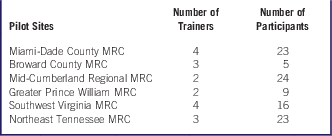
The following 6 MRC units were selected and readily agreed to take part in the demonstration project: Miami-Dade County MRC, Miami, Florida; Broward County MRC, Fort Lauderdale, Florida; Mid-Cumberland Regional MRC, Nashville, Tennessee; Greater Prince William MRC, Manassas, Virginia; Southwest Virginia MRC, Bristol, Virginia; and Northeast Tennessee MRC, Johnson City, Tennessee. Table 2 shows the number of trainers and participants per site.

The highest ratio of trainers to participants was 1:12 and the lowest was 1:1.7. Utilizing a higher number of trainers reduced the number of sections each was to cover, enabling trainers to become more familiar with their assigned material and the relevant course activities; provided variety to participants in terms of instructor style, experience, and expertise; and gave trainers a chance to take a break and observe.
Three sites opted to deliver the course in a 4-hour block of time, with frequent breaks; the other 3 sites divided the course content into two, 2-hour segments, one with a meal approximately half-way through. As the results of the course satisfaction survey to follow will indicate, a 4-hour block verses two, 2-hour sessions was a matter of preference depending on how the material was presented.
Pre- and Posttest Results
Improvements in test scores among participants were observed in every pilot site after course delivery. Of the total 100 participants:
-
∙ 12% scored at least 5 points higher on the posttest than on the pretest (9 participants scored 5 points higher, 1 participant scored 9 points higher, 1 scored 8 points higher, and 1 scored 7 points higher).
-
∙ 68% scored between 1 and 4 points higher on the posttest than on the pretest (12 participants scored 4 points higher, 16 scored 3 points higher, 17 scored 2 points higher, and 23 scored 1 point higher).
-
∙ 13% had no improvement, ie, they had the same score on the pre- and posttests.
-
∙ 7% did worse on the posttests (5 participants scored 1 point lower and 2 scored 2 points lower).
However, because this was not a controlled study nor designed to be, no conclusions on the significance of changes in test scores can be made. A review of questions participants got wrong on the posttest showed that some of the more commonly missed questions (Table 3) could be explained by response options that were not clearly distinguishable, not consistent with written course materials and presentations, not covered adequately in the course, or not consistent with knowledge gained from previous courses or experiences. These ambiguities will be addressed and corrected should the pre- and posttest be utilized in a future study.
Frequently Missed Questions on the Course Posttest

Course Satisfaction
Overall, pilot participants were pleased with the course and rated it favorably. Table 4 shows the percentage of participants who rated each variable on the course satisfaction survey. The 5-point scale for responses was as follows: 4=strongly agree, 3=agree, 2=neutral, 1=disagree, and 0=strongly disagree.
Ratings from Course Satisfaction SurveyFootnote a

a Abbreviation: CPR, cardiopulmonary resuscitation.
Overall, 57% of the participants rated the course to be excellent and another 39% rated it to be good. Seventy-one percent (71%) of the participants felt strongly that they would recommend the course to their family and friends. Other variables rated “strongly agree or agree” by the highest percentage of participants included the following: instructors presented the material in a way I could understand (99%); after taking this course, I am more likely to offer help at the scene of an emergency (92%); my questions were answered in a clear and timely manner (94%); and I am more confident in my ability to help someone in case of emergency (95%).
Course length received among the lowest ratings. While each course determined its own schedule, all were planned for a 4-hour block of time, either delivered in two, 2-hour segments divided by a meal or scheduled for a full morning or afternoon 4-hour block with several breaks. In addition, the instructors varied considerably in the amount of time they spent on each module. Given these variations, most participants felt that the course should be longer, whereas a few wanted it to be shorter overall or delivered in shorter segments.
Participants also gave a lower rating to the appropriateness of the course material for someone with their level of experience and to instructors maintaining a good pace throughout course (86% and 85%, respectively). This may reflect the fact that the participants included many individuals (in some cases, more than half) who had medical and extensive first aid training and thus were outside of the target audience.
Suggestions for Future Courses
The final question on the course satisfaction survey was open-ended. From this and the focus groups, which included the trainers, conducted at each site, the following suggestions were made for improving the course:
-
∙ Add more hands-on practice, including greater use of mannequins;
-
∙ Include more relevant videos;
-
∙ Add content on liability and Good Samaritan laws, including their variability across states;
-
∙ Keep the classroom delivery mode of instruction (rather than provide the course content online or in a web-based format);
-
∙ Keep the participant manual in its current format as a valuable reference after training;
-
∙ Use multiple instructors (2 to 4) to keep the course more interesting and so that participants can benefit from a broader array of experience and perspectives;
-
∙ Expand delivery by holding courses in worksites, colleges (for staff and students), religious institutions, service/volunteer groups, senior centers, and recreational clubs (hiking, biking, climbing);
-
∙ Keep the course free of charge;
-
∙ Adapt the course for younger audiences of school-aged children, boy or girl scouts, after-school programs, etc;
-
∙ Translate the course into Spanish to enable delivery to a larger audience.
Next Steps
Overall, the active bystander training content was well received by MRC trainers and participants and no major modifications were identified. Owing to the success of the pilots, FEMA and ASPR are finalizing the training material for widespread public dissemination, with a focus on involving local stakeholders including MRC units, Community Emergency Response Team programs, Citizen Corps Councils, and local public health agencies.
Although there is already considerable research on the value of bystander response during a disaster, a well-designed study of this training course’s effectiveness may also be conducted should financial support become available. The study would look for demonstrated and significant increases in participant knowledge and willingness to assist victims of a disaster and could contribute to a second version of the training materials. The study would also eliminate the biases of the pilot project including many participants already having substantial knowledge of first aid, for example. The interaction of test effects and training materials such as the “priming” effect of the pretest would also be investigated.
MRC units demonstrated their ability to respond by organizing well-planned training events in a short period of time and with no external financial assistance. The units are also keen to have the materials available so they can reach further into their communities. Because the units are composed of local volunteers, many of whom have medical or emergency response backgrounds, this gives an indication of how important and beneficial they believe this type of training to be for all community members. Also, engaging local emergency management agencies during training events may be an integral part of their preparedness planning processes.
Acknowledgments
The authors and the agencies they represent wish to sincerely thank all the MRC units and state coordinators who participated in this pilot demonstration project. Their efforts in testing the training were greatly appreciated and ensured that the content is relevant to local communities. Special thanks are also extended to Dr David Sugerman (CDC) and Dr Scott Sasser (Emory University) whose leadership and determination were the driving forces behind the active bystander training course concept and development. The authors also thank their colleagues at CDC, FEMA, ASPR, and DCVMRC for their contributions to planning the pilot demonstration project and review of this article. DCVMRC thanks Kathryn Roberts for bringing the project to the MRC network. At the time the pilot demonstration project took place, DCVMRC was part of the Department of Health and Human Services, Office of the Assistant Secretary for Health, Office of the US Surgeon General. Under ASPR, DCVMRC has since been renamed the MRC Program.