


1 Introduction
Interpersonal trust plays an important role in myriad contexts, from economic exchanges and organizational settings to friendships and romantic relationships (Reference Chua, Ingram and MorrisChua, Ingram & Morris, 2008). The factors that influence trust can vary significantly across these domains (Reference Mayer, Davis and SchoormanMayer, Davis, & Schoorman, 1995). To account for this variance, past research has noted the differences between the emotional and cognitive aspects of trust (Reference Johnson-George and SwapJohnson-George & Swap, 1982; Reference McAllisterMcAllister, 1995). More recently, Murray and colleagues (2011) proposed a dual-process model of trust, separating trust into impulsive and deliberative components.
The deliberative aspect of trust often depends on complex considerations. A potential trustor might consider the risk of the situation, as well as the ability, benevolence, and integrity of the trusted party (Reference Mayer, Davis and SchoormanMayer et al., 1995). Ultimately, the trustor has to decide if, given the parameters of the situation, trusting is worth the risk. If the trustor intends to be thorough about this decision, the process could require a significant investment of time and effort. The present research investigates how trust decisions change when the ability to deliberate is compromised. We focus on two factors that interactively affect deliberative trust: self-control (the ability to exert cognitive control over one’s behavior) and the default response (the preselected option that requires the least amount of effort). Taken together, these factors illustrate how trust is shaped by the availability of cognitive resources and the structure of the decision environment.
1.1 Self-control and trust
Decision making often involves resolving conflicts between impulsive and deliberative processes (Loewsenstein, Reference Loewenstein1996). For example, when deciding how to spend a windfall, there may be tension between the impulse to indulge in a frivolous purchase (such as a sports car) and the more prudent goal of saving for retirement. When these dilemmas occur, successfully overriding impulses requires self-control. A prevalent approach to self-control, the strength model, proposes that self-control is a limited resource that is depleted by use and replenished with time (Reference Baumeister, Bratslavsky, Muraven and TiceBaumeister, Bratslavsky, Muraven, & Tice, 1998). The strength model explains the mechanism of self-control with the metaphor of a skeletal muscle: the effort of exercising self-control consumes limited resources, which ultimately results in a temporary state of mental fatigue called ego-depletion. In addition to state-based manipulations of self-control, researchers have examined the capacity for self-control from a trait-based perspective. Recent evidence suggests that the benefits of state- and trait-based self-control are additive (Reference Freeman and MuravenFreeman & Muraven, 2010).
A recurring theme in this program of research is that self-control is valuable for both individuals and societies (Reference Baumeister and AlquistBaumeister & Alquist, 2009). Illustrating the micro-level value of self-control, Reference Tangney, Baumeister and BooneTangney, Baumeister, and Boone (2004) found that trait-level control correlates with academic success, psychological adjustment (i.e., lower levels of anxiety and depression), and physical health. Self-control is also important for societies because it enables individuals to inhibit antisocial behavior. Specifically, past research has found that weak self-control predicts increased aggression (Reference DeWall, Baumeister, Stillman and GailliotDeWall, Baumeister, Stillman, & Gailliot, 2007; Reference Stucke and BaumeisterStucke & Baumeister, 2006) and increased cheating (Reference Gino, Schweitzer, Mead and ArielyGino, Schweitzer, Mead, & Ariely, 2011). Weak self-control also predicts a decreased willingness to help others (Reference DeWall, Baumeister, Gailliot and ManerDeWall, Baumeister, Gailliot, & Maner, 2008), while high levels of self-control correlate with prosocial orientation (Reference Balliet and JoiremanBalliet & Joireman, 2010)—suggesting that self-control may be necessary to engage in effortful prosocial acts.
The behavioral consequences of poor self-control can be accounted for, in part, by changes in decision making (Reference DeWall, Baumeister and MasicampoDeWall, Baumeister, & Masicampo 2008); complex reasoning consumes mental resources, and as such, it depends upon the availability of self-control. Individuals with exhausted mental resources experience greater difficulty with deliberation and rule-based analyses (Reference DeWall, Baumeister and MasicampoDeWall, et al., 2008; Reference Masicampo and BaumeisterMasicampo & Baumeister, 2008). Indeed, decision making and self-control are closely linked, as the act of making difficult choices drains resources (Reference Vohs, Baumeister, Schmeichel, Twenge, Nelson and TiceVohs et al., 2008) and impulsive choices become more likely when resources are scarce (Reference Vohs and FaberVohs & Faber, 2004).
The present research investigates how self-control affects trusting behavior. Trust has been defined as a psychological state comprising the intention to accept vulnerability based upon an expectation of reciprocity (Reference Rousseau, Sitkin, Burt and CamererRousseau, Sitkin, Burt, & Camerer, 1998). A dyadic trust relationship involves two parties, the trustor (who decides whether to trust) and the trustee (the potential recipient of trust). In a typical situation, the trustor chooses between a guaranteed, but modest outcome (distrust) and an uncertain, but potentially larger outcome (trust). Here we operationalize this conflict using an economic scenario known as the investment game (Reference Berg, Dickhaut and McCabeBerg, Dickhaut, & McCabe, 1995). In this game, trustors make decisions about whether to invest money to trustees. The invested money triples, and the trustee decides whether to return some, all, or none of it to the trustor. Trustors can potentially profit from investing, but their returns depend upon the trustee’s response.
Beyond the investment game, trust has been examined in diverse contexts, including close relationships (Reference SimpsonSimpson, 2007) and organizational behavior (Reference Mayer, Davis and SchoormanMayer et al., 1995). Given the variability of trust situations, it is not clear whether self-control will generally inhibit or encourage trust. Is the act of trust an impulsive response that requires an override, or is it the result of an effortful cognitive process? There is reason to believe it depends on context. In professional networks, trust in friendships is more emotional (and less deliberative) than trust in collaborative tasks and economic exchanges (Reference Chua, Ingram and MorrisChua et al., 2008). Dual-process models account for such context effects by differentiating between impulsive and deliberative mental processes (Reference Murray, Pinkus, Holmes, Harris, Gomillion, Akoni, Derrick and LederMurray et al., 2011). Impulsive trust is automatic, associative, and often related to emotion and affect; in contrast, deliberative (or reflective) trust is the result of more effortful considerations, such as perspective-taking, evaluation of perceived risk, and the trustor’s beliefs about the competence and dependability of the trustee.Footnote 1 This distinction is consistent with similar models that separate the emotional and cognitive aspects of trust (Reference Chua, Ingram and MorrisChua et al., 2008; Reference Johnson-George and SwapJohnson-George & Swap, 1982; Reference Mayer, Davis and SchoormanMayer et al., 1995; Reference McAllisterMcAllister, 1995).
The dual-process framework suggests that trust decisions occur in two stages. In the first stage, automatic processes generate an initial response; in the second stage, the trustor engages in deliberation and chooses to accept or modify this initial response. The central hypothesis of our research is that deviating from the initial, impulsive response requires self-control. In other words, we predict poor self-control is associated with greater adherence to the impulsive response. An implication of this hypothesis is that depleting self-control could potentially increase or decrease trust. Consider the investment game: If the initial response is to invest nothing, it follows that depleting self-control will tend to decrease trust. Similarly, if the initial response is to invest everything, poor self-control should have the opposite effect—increasing trust. Critically, this hypothesis is agnostic about whether the effects of self-control are desirable. Under some conditions ego-depletion may increase trust, but trust is not always an optimal response. As Hardin (2004) remarks, “distrust is sometimes the only credible implication of the evidence” (p. 5). Our hypothesis suggests that it is not the content of the response that matters, but the effort required to enact it.
Two recent experiments support our prediction that cognitive depletion correlates with low-effort decisions. Danziger, Levav, and Avnaim-Pesso (2011) measured the sequential decisions of parole judges; they found that the percentage of approved parole requests decreases significantly over a session of repeated decisions (from 65% approval to nearly 0%). The authors’ interpretation of this trend is that repeated decision making induces cognitive fatigue in judges, which in turn causes them to adhere to the low-effort, status quo response (rejecting parole). Consistent with the strength model of control, the probability of parole approval jumps back to its initial level after the judges have a food break. While we find this experiment compelling, the fact that it was deployed in the real-world means that the experimenters could not test an alternative condition where approving parole requests is the status quo.
In another recent experiment, Reference Gallagher, Fleeson and HoyleGallagher, Fleeson, and Hoyle (2011) studied the relationship between self-control and contra-trait behavior (acts that are contrary to one’s personality traits). The authors report that contra-trait behaviors (such as an extravert acting introverted) are effortful and consume self-control resources. This result is of particular relevance because it supports the notion of a flexible relationship between self-control and behavior. The mental effort required to complete an action depends upon contextual factors (in this case, the dispositions of the actor).
As with the preceding experiments, we anticipate that poor self-control leads to impulsive, low-effort choices (whether that happens to increase or decrease trust). In order to test this hypothesis, it is necessary to manipulate the trustor’s initial, automatic response. To this end, we employ a subtle, but powerful manipulation—the default effect.
1.2 Self-control and defaults
In the context of decision making, a default is a preselected option that requires either minimal effort or no action at all. Hence, a default effect (or bias) is present when changing the default causes a change in behavior. There are several possible explanations for this effect. First, people may interpret defaults as recommendations from engineers or policy makers (Reference McKenzie, Liersch and FinkelsteinMcKenzie, Liersch, & Finkelstein, 2006). When faced with a difficult choice (e.g., choosing a retirement plan), people may assume the default option was selected because experts recommend it on good empirical grounds. Another reason is loss-aversion; people view the status quo as being more attractive than its alternatives because the potential losses from change loom larger than the potential gains (Reference Moshinsky and Bar-HillelMoshinsky & Bar-Hillel, 2010). In the language of prospect theory (Reference Tversky and KahnemanTversky & Kahneman, 1981), people may cling to the default because they have adapted to it as their reference point. All of these explanations are consistent with the idea that departing from a default option requires effort.
The process of anchoring-and-adjustment may help explain the mechanism underlying the default effect (Reference Tversky and KahnemanTversky & Kahneman, 1974). Arguably, the default option provides an initial anchor for consideration. Adjusting away from this initial value requires cognitive effort and, in fact, the process of adjusting is generally insufficient. Manipulating the initial anchor can influence final responses, even when the anchor is clearly irrelevant (i.e., a random number). Moreover, people adjust less when their mental resources are impaired (Reference Epley and GilovichEpley & Gilovich, 2006). Under some circumstances, defaults may influence behavior because they provide initial anchors for decisions. The metaphor of anchoring-and-adjustment may be particularly relevant for decisions with many possible responses. Increasing the space of possible responses also increases the cognitive costs of adjustment.
We report two experiments to investigate how self-control and the default effect interactively influence trust. Our central prediction is that poor self-control will lead to impulsive, low-effort decisions. In other words, we expect an interaction between self-control and the default response. Using the investment game as a measure of trust (Reference Berg, Dickhaut and McCabeBerg et al., 1995), both experiments manipulate whether the default response is to invest or keep an endowment of $20. The default response is thus either complete trust or no trust at all. To test the predicted interaction effect, our first experiment manipulates participants’ levels of self-control by inducing the state of ego-depletion. The second experiment measures individual differences in self-control, and then uses trait self-control and the default to predict investing behavior.
2 Experiment 1
The purpose of our first experiment is to test how an experimental manipulation of self-control influences levels of trust, and how this effect interacts with default responses. The investment game serves as a common paradigm for research on trust in social psychology and behavioral economics (Reference Berg, Dickhaut and McCabeBerg et al., 1995). There are two players in the game, the sender (trustor) and the responder (trustee). The sender begins the game with a small monetary endowment (e.g., $20) and has the choice to invest some, all, or none of it. The invested money is tripled and given to the responder, who then decides how much of the resulting amount to return to the sender. The responder has no contractual or enforceable obligation to return any money; in a typical game, both players act anonymously and without any communication. Therefore, the decision to invest is an act of trust.
The procedure for Experiment 1 consists of two phases: In the first phase, participants complete a task to deplete their self-control (or a control task that does not consume self-control). In the second phase of the experiment, participants play the investment game (as trustors). In this game, the default option is randomly manipulated (either to invest or keep all $20). Our hypothesis is that there will be an interaction between self-control and default status. Participants who are in a temporary state of ego-depletion will show greater susceptibility to the default effect.
2.1 Method
Students from Brown university (N = 132) were recruited to participate in a study on decision making. The average age was 19.9 years (SD = 2.5) and 60% were women. The experiment was administered via computer.
Self-control was manipulated using an empirically-validated attention control task (Reference Baumeister, Bratslavsky, Muraven and TiceBaumeister, et al., 1998; Reference Freeman and MuravenFreeman & Muraven, 2010). Participants in the control condition watched a silent video of a woman talking while words flashed on the screen. Those in the ego-depletion condition watched the same video, but were instructed to ignore the flashing words. Successfully ignoring these words requires participants to exert control over their visual attention, depleting self-control resources. When the video finished, participants completed scales to measure mood (α = .76) and arousal (α = .58) from the Brief Mood Introspection Scale (BMIS; Reference Mayer and GaschkeMayer & Gaschke, 1988).
After completing the self-control task, participants played one round of the investment game. They received a $20 endowment that they could invest or keep. Each invested dollar was tripled and given to another player, the responder, who then decided to return some, all, or none of the resulting amount to the investor. Participants were made aware of the fact that the responses of the other player were determined by a computer program that generated output based on the behavior of participants from previous laboratory studies (Reference Pillutla, Malhotra and MurnighanPillutla, Malhotra, & Murnighan, 2003). Participants proceeded to play the game only after reading a page of detailed instructions and providing correct responses to several comprehension questions about the game’s rules.
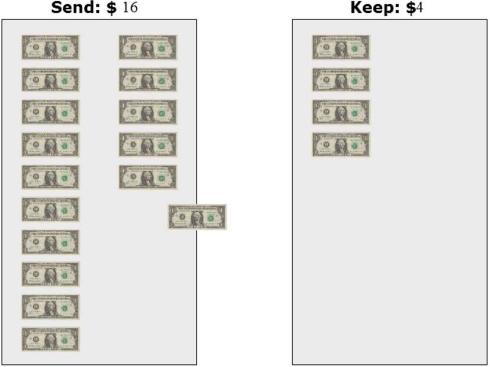
Participants implemented their decisions by dragging-and-dropping dollar bills across the screen (Figure 1). Two defaults were tested: Those in the default-invest condition needed to move dollars in order to keep them, whereas those in the default-keep condition needed to move dollars in order to invest them. The money bins alternated in position between the left and right side of the screen so that participants always dragged bills from left to right, controlling for any directional preferences. Response times were measured for the game. To motivate participants to do their best in the game, they received a lottery ticket for each dollar earned in the game. At the end of data collection, the tickets were entered into a raffle, and three $50 gift certificates were distributed.
A Screenshot of the investment game (default invest). Participants dragged dollars across the screen in order to keep them.
2.2 Results and discussion
The data of eight participants (5.9%) were excluded from analysis. Five correctly guessed the purpose of the ego-depletion task and three completed the study under distracting conditions. Including these participants did not affect the results in any meaningful way (final N = 124).
2.2.1 Mood, arousal, and ego-depletion
We tested for possible confounds of the ego-depletion manipulation. As predicted, there were no significant differences between ego-depleted and control participants in ratings of mood (t = .152, p = .88) or arousal (t = .52, p = .61). Similarly, depleted and control participants rated the attention control task as equally enjoyable, t = .38, p = .71.
2.2.2 Ego-depletion, default status, and trust
Consistent with past research (Reference Berg, Dickhaut and McCabeBerg et al., 1995), the size of the average investment was about half the endowment and there was considerable variability (M = $9.80 out of 20, SD = $6.5). The most common response (19.2%) was to invest half of the endowment. Some participants showed complete trust (17.7%) while a few showed complete distrust (8.8%). Responses were not normally distributed, but this was not a concern given the large sample size and the absence of outliers (Reference Lumley, Diehr, Emerson and ChenLumley, Diehr, Emerson, & Chen, 2002).Footnote 2 The average response time was 37 seconds (SD = 28.8 seconds). See Table 1 for a summary of descriptive statistics.

We conducted a 2 (ego-depletion vs. control) x 2 (default invest vs. keep) between-subject analysis of variance (ANOVA) to test the hypothesis that ego-depletion would reveal or magnify the default effect on investing decisions. The self-control by default interaction effect implied by this hypothesis was significant, F(1, 123) = 4.0, p = .05 (see Figure 2a). This interaction did not change when mood and arousal were added as covariates; furthermore, neither mood nor arousal were significantly associated with investing decisions, Fmood = 1.7, p = .18 and Farousal = .12, p = .73.
Amount invested (out of $20) as a function of self-control and default status. Figure 2a (left) shows the results of Experiment 1, where self-control was manipulated experimentally. Figure 2b (right) shows the results of Experiment 2, where individual differences in self-control were measured.
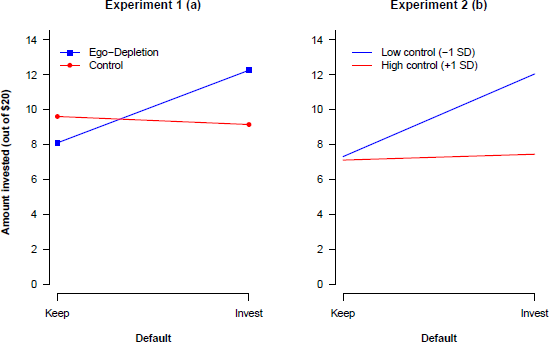
Planned comparisons showed that there was a pronounced default effect in the ego-depletion condition F(1, 123) = 6.5, p = .01, d = .67, but none in the control condition, F = .27, p =.79, d = .05. Besides this critical interaction, there was an almost significant effect of default status, F(1, 123) = 2.57, p = .10. The amount sent increased when investing was presented as the default (M = $10.84) relative to the default keep condition (M = $8.91); however, our simple effects tests showed that this main effect was driven solely by ego-depleted participants. Finally, we noted that the main effect of ego-depletion was not significant, F = .47, p = .48.
The results of Experiment 1 showed that ego-depletion did not directly influence trust; rather, it caused people to make low-effort responses. With self-control intact, investment decisions were not significantly anchored by the defaults. However, if mental resources had been consumed by an unrelated task, adherence to the defaults occurred. This result could not be attributed to individual differences in mood or arousal.
3 Experiment 2
A second experiment, using an individual differences measure of self-control, was designed to replicate and extend the first. Trait self-control predicts many important long-term outcomes, including grade point average, social adjustment, and self-esteem (Reference Tangney, Baumeister and BooneTangney et al., 2004). Based on the results of Experiment 1, we predicted an interaction between trait self-control and the default response. Individuals high in trait self-control would not be sensitive to decision defaults, whereas individuals with low self-control scores would anchor their responses to whichever option was presented as the default. Consistent with the results of the first experiment, we predicted no main effect of self-control.
Our first experiment raised the question of whether the effects of ego-depletion were driven by physical or mental fatigue. The drag-and-drop interface of the investment game required some physical effort as participants had to move individual dollars across the screen. Although the task was frequently completed in less than a minute (mean reaction time = 37 seconds), the interaction we observed may reflect an aversion to physical work. If so, decreasing the physical effort of decision making might eliminate the interaction between default status and self-control. To investigate this possibility, we developed an interface that required minimal effort. Rather than dragging dollars individually, participants needed only to move a slider bar across the screen. If ego-depletion reflects a change in the underlying process of decision making, rather than a change in physical effort, the interaction between depletion and default status should emerge with both response interfaces (drag-and-drop and slider). Assuming that ego-depletion is indeed a consequence of mental fatigue, we predicted that the response method would not moderate the results.
This experiment was conducted using Amazon’s Mechanical Turk service. Experiments using this service provide evidence that it performs similarly to other research methodologies (Reference Buhrmester, Kwang and GoslingBuhrmester, Kwang, & Gosling, 2011; Norton, Anik, Aknin, & Dunn, 2011; Reference Paolacci, Chandler and IpeirotisPaolacci, Chandler, & Ipeirotis, 2010). Use of this service tested the generalizability and robustness of our initial findings. In addition, Mechanical Turk allowed us to study behavior in an online environment where defaults may influence numerous significant decisions.
3.1 Method
One hundred and fifty North-American participants (65% women) were recruited to complete the experiment. The average age was 35.2 years (SD = 12.2 years). Each participant was paid 75 cents upon completion of the experiment, and no performance-based bonuses were offered.
We took several steps to verify the quality of the data: First, we removed five participants who were identified as non-native English speakers. Next, we analyzed response times for each of the nine pages of the experiment. We removed the data of four participants who were outliers in their response times for at least one page. We also checked for duplicate IP addresses, implying repeat participants, but found none. In total, nine participants (6%) were excluded from our analyses. Removing these participants from the data set had no effect on any trends or significant findings (final N = 141).
The experiment consisted of two parts: First, participants completed a 40-item personality questionnaire. This questionnaire contained the 13-item short form self-control scale (Reference Tangney, Baumeister and BooneTangney et al., 2004) intermixed with 27 filler items taken from the International Personality Item Pool (Reference GoldbergGoldberg, 1999).
After finishing the personality inventory, all participants completed the investment game. The rules and instructions were identical to those used in Experiment 1. Participants were randomly assigned to one of two versions of the game. In the drag-and-drop version, participants made their decisions by moving dollars, one at a time, across the screen. In the slider version, participants made their decisions by dragging a slider bar across the screen. In order to maintain overall similarity between the drag-and-drop and slider versions, participants in the slider-version were still shown the money bins, and dollars were automatically moved across the screen whenever the slider was manipulated. As in the first experiment, the two possible defaults were to invest or keep the full monetary endowment.
3.2 Results and discussion
Behavior and response times in the investment game were similar to the results reported in Experiment 1. On average, levels of trust were intermediate with considerable variability between participants (M = $9.20 out of $20, SD = $5.41). In the decision phase of the game, participants spent 36.9 seconds on average (SD = 19.9 seconds) making their choices. As in the first experiment, the most common response was to invest half of the money (28.4%), while some participants invested all of the endowment (11.3%) or none of it (5.0%).
Self-control scores were computed from the 13-item subscale. The scale showed high internal consistency, α = .86, average inter-item correlation = .33.
Our primary analysis was a simultaneous multiple regression with amount invested as the dependent variable. Game type (drag-and-drop vs. slider), trait self-control, default status (invest vs. keep), and the interaction of self-control and default status were tested as predictors. The fit of the overall regression model was significant, F(4, 136) = 4.0, p = .004, adjusted R2= .08.
3.2.1 Main effects
Game type. The type of game (drag-and-drop vs. slider) had a nearly significant main effect on investing, β = .135, t(136) = 1.66, p = .10. Participants invested slightly less in the low-effort slider interface. This trend contradicts the original worry that the findings of Experiment 1 could, in part, be attributed to physical fatigue or laziness. We also tested for higher-order interactions involving game type and other factors, but found none.
Self-control. As in Experiment 1, self-control did not directly affect investment behavior. β = .17, p = .15.
Default effect. Changing the default status from “keep” to “invest,” controlling for other factors, caused participants to invest $2.14 more on average, β = .18, t(136) = 2.2, p = .034.
3.2.2 Self control by default interaction
The critical prediction and finding was the interaction between self-control and the default, β = −.295, t(136) = 2.42, p = .01. To display the interaction’s meaning more effectively, we conducted simple slope tests for participants who were high (+1 SD or more) and participants who were low (−1 SD) in trait self-control (Figure 2b). Among high self-controllers, the default did not affect the amount invested, β = .2, t = .13, p = .89. In contrast, low self-controllers invested more or less money when invest and keep were the default responses, respectively, β = 4.6, t = 3.01, p = .003. In concrete terms, participants with poor self-control invested $4.60 more, on average, when investing was presented as the default option.
Experiment 2 replicated the interaction of self-control and default status in a diverse (in terms of age and academic background), web-based sample. Focusing on individual differences in self-control, we found that only individuals high in trait self-control are not susceptible to the default effect. This effect was robust even when making a decision required minimal physical effort (dragging a slider bar across the screen). This suggests that the observed interaction was driven by changes in the process of decision making, rather than physical fatigue.
4 General discussion
Across two experiments, we find that trust is sensitive to the interaction of two factors: self-control and the default response. Individuals with poor self-control, due to either experimental depletion or individual differences, show greater adherence to the default response. Critically, this interaction could not be explained by changes in mood or arousal (Experiment 1) or physical fatigue (Experiment 2). This finding has significant implications for our understanding of how defaults influence behavior and the mental processes underlying trust.
4.1 Defaults and self-control
The present experiments contribute to a large body of research documenting the pervasiveness of default effects (Reference Thaler and SunsteinThaler & Sunstein, 2008). Changing the default may affect behavior because it is interpreted as a recommendation (Reference McKenzie, Liersch and FinkelsteinMcKenzie, Liersch, & Finkelstein, 2006) or because it changes the framing of potential outcomes (Reference Moshinsky and Bar-HillelMoshinsky & Bar-Hillel, 2010). Here we find that default effects are also related to the availability of cognitive resources. Mentally fatigued decision makers and those with chronically poor self-control show greater adherence to the default response. These results should be considered by organizations and policy makers who intend to manipulate behavior by changing the default.
There is good reason for decision architects to be cautious in selecting defaults to promote desirable behavior. Yet, even if there is no motive to manipulate behavior, sometimes a default must be selected. This raises the question of the optimal default for the investment game. One approach is to select a default that maximizes trust. In the case of the investment game, trustors on the aggregate would benefit from a default that promotes investing because reciprocity increases with trust (Reference Pillutla, Malhotra and MurnighanPillutla et al., 2003). Trustees respond positively when they feel they have been fully trusted, and full trust encourages greater reciprocity (on average). In other words, the more those players invest, the more likely they are to profit. Still, even when trustors invest the full endowment, reciprocity is not unconditional. A nontrivial percentage of trustees return nothing, keeping the entire endowment (Reference Berg, Dickhaut and McCabeBerg et al., 1995; Reference CoxCox, 2004; Reference Pillutla, Malhotra and MurnighanPillutla et al., 2003). Increasing trust can benefit trustors on the whole, but not all individuals are better off.
An alternative approach is to select the default that requires the least decision effort (Reference Thaler and SunsteinThaler & Sunstein, 2008). This default can be empirically derived, and it need not be an all-or-nothing response. In the two experiments reported here, investing half of the endowment ($10 out of 20) was the modal and mean response in the investment game. Therefore, a half-invest/half-keep default ($10 initially allocated to each option) would be the most efficient solution. To see the value of an effort-minimizing default, consider the participants in the control condition of Experiment 1. On average, these participants moved $10.10 to enact their desired outcomes. What would happen if the default were half-trust/half-distrust? How many dollars would the same participants need to move? Assuming that these would make the same final choices, on average, they would need to move only $5.25 each. Changing the default option could lead to a 48% reduction in effort. This solution is appealing because it benefits both unimpaired and ego-depleted decision-makers.
4.2 Impulsive and deliberative trust
Recently, Murray and colleagues (2011) proposed a dual-process model of trust, which differentiates between impulsive and deliberate processes. Across several experiments, they find a fluid and sometimes compensatory relationship between impulsivity and deliberation. For example, impulsive trust can be temporarily strengthened by associative priming, a finding observed in both close relationships (Reference Murray, Pinkus, Holmes, Harris, Gomillion, Akoni, Derrick and LederMurray et al., 2011) and in economic scenarios such as the investment game (Reference Huang and MurnighanHuang & Murnighan, 2010). These associative manipulations influence trusting behavior without changing levels of deliberative trust. Similarly, Murray and colleagues show that deliberative trust can be inhibited by reducing the capacity of working memory. The present results are consistent with these findings; people prefer low–effort, impulsive response when their cognitive resources are limited. Consistent with these findings, our manipulation of self-control supports the notion that the antecedents of trust are flexible.
One limitation of the present research is that it measures trust in economic exchanges (Reference Berg, Dickhaut and McCabeBerg et al., 1995), a context in which trust tends to be more cognitive than emotional (Reference Chua, Ingram and MorrisChua et al., 2008). The interaction effect of self-control and the default response influences behavior through deliberative processes. Thus, the effect is unlikely to replicate in contexts where trust is purely emotional. However, such purely emotional dilemmas are rare, even trust in romantic relationships has bases in cognitive concerns (Reference Murray, Pinkus, Holmes, Harris, Gomillion, Akoni, Derrick and LederMurray et al., 2011).
4.3 Concluding remarks
These experiments illustrate that deliberative trust depends upon two interactive factors: the availability of self-control and the default response. Although the lack of self-control is associated with many undesirable outcomes (Reference Baumeister and AlquistBaumeister & Alquist, 2009), its effect on trust is not necessarily detrimental (nor beneficial). Self-control has an indirect, rather than a direct, influence on trusting behavior. In the case of the investment game, self-control can therefore be associated with an increase or a decrease in trust. When self-control is weak and decision making requires effort, individuals settle for a preselected default response.


 Open access

