

What is sentience?
A sentient being, according to the standard English meaning of “sentient,” is a being who is capable of feeling or perceiving. “Feeling” and “perceiving” do not have exactly the same meaning. Perception is a process whereby the external world is experienced subjectively by a mind. This is mediated by the senses.
In the case of typical humans, these senses are sight, sound, smell, touch, and taste. Some other species share these senses, even if their range of perception via a particular sense differs from ours. For example, some of them hear what we cannot, and we see what some of them cannot. Some animals’ reception of the world is even more different from ours. They experience the world, at least to some degree, via echolocation, magnetoception, electroreception, or hygroreception (perception of moisture content), for example.Footnote 1
There is some scope for philosophical and scientific disagreement about whether some of these means of perception constitute different senses or rather variant ranges of senses that humans do have. For example, is echolocation a variant form of hearing? These are not questions that need to be answered here.
Feeling differs from perceiving in that, at least in principle, it need involve no sensory input. A disembodied mindFootnote 2 would not be connected to any organs of perception, but it could have inner feeling. It could feel pleasure and pain, even though these would not be caused by external stimuli. Indeed, even some embodied minds experience pains that are not caused by external stimuli. For example, some amputees feel pain in the limb that they no longer have.Footnote 3 Nor need feelings be caused only by inaccurate or artificial perceptions. A disembodied mind could be happy or sad, without that emotional state being the result of a perceptual experience, whether veridical or otherwise.
What feeling and perceiving have in common is that both presuppose consciousness. By “consciousness,” I mean a state of subjectivity—something that it feels like to be. Conscious beings are to be distinguished both from mere objects and from nonconscious beings. By “mere objects,” I mean nonliving things—rocks, mountains, and machines, for example. They exist but there is nothing that it feels like to be a rock, a mountain, or a machine.
Nonconscious beings, such as plants, and arguably the simplest of animals, are also objects, but they are not mere objects. Instead, they are living objects. They have the characteristic features of living beings. For example, they metabolize, grow, adapt, and reproduce. Unlike mere objects, which can “die” only in a figurative sense,Footnote 4 living beings can—and do—literally die. However, as is the case with mere objects, there is nothing that it feels like to be a nonconscious being.
Conscious beings are also objects. In the actual world, they are also living beings (although if artificial sentience becomes possible, such beings would, to the extent that they are artificial, not be living beings).Footnote 5 However, conscious beings are not mere objects and are not mere living beings. What sets them apart is consciousness, or having a subjectivity. There is something that it feels like to be a conscious being, even though the content of that feeling very likely differs from species to species and even, to some extent, from individual to individual. Put another way, conscious beings are aware, whether of their environment or merely in the sense of having “internal” feelings.
Some people are inclined to confuse merely living beings with conscious beings. This is because, merely living beings, like conscious perceiving beings, react to stimuli. However, what sets the two kinds of beings apart is the pathway or means of reaction. For example, merely living beings, such as plants, have nociceptive capacity. That is to say, they respond to negative stimuli. However, that response is, to the best of our current knowledge, not mediated via conscious states (because plants, again to the best of our knowledge, have no such states). Something similar can be said about reactions to positive stimuli. The roots of a plant might move toward a water source, but this process is not mediated by conscious states in the way that thirst motivates conscious animals to seek out hydration.
This difference means that the question “What is it like to be a bat?” is a very different kind of question from “What is it like to be a succulent?” The answer to the second question, if our science is correct, is “nothing.” There is nothing that it feels like to be a succulent. By contrast, the answer to the first question is immensely complicated and perhaps even unfathomable. Entering the mind, or the umwelt, of a bat is so difficult precisely because the contents of their consciousness are so different from ours.
That conscious beings can respond to their environment via conscious experience does not mean that they always respond in this way. It is well known, for example, that some vertebrate reactions to the environment are via the reflex arc. They are mediated via the spinal cord rather than the brain. However, even in such cases, the stimulus is also directed to the brain for secondary processing. Thus, it remains the case that the stimulus leads to a feeling or perception, which is not the case in nonconscious beings. This, I shall argue, is morally significant.
Moral significance, like significance more generally, need not be one thing. Something can be significant, or morally significant, in varied ways. However, there are two broad stages to an inquiry into the moral significance of sentience. The first of these is whether sentient beings, on account of their sentience, enter into moral consideration at all. If they do count at all, then the second stage is to determine what the implications are of considering them as sentient beings.
What is moral standing?
Asking whether an entity counts at all is to ask whether that entity has moral standing, moral status, or moral considerability, terms that I shall use interchangeably. To deny that someone or something has moral standing is not to deny that there are moral duties concerning those who (or that) lack moral standing. If a car lacks moral standing, I might still have a duty not to destroy it. However, such a duty would be grounded in the interests of those who do have moral standing. If it is your car, and you have not given me permission to destroy it, then it would be wrong, in the absence of adequate justification, for me to destroy the car, because I will thereby thwart your interests.
The duty might alternatively be more general. It might not be owed to an identifiable individual but to a collection of morally considerable individuals. Consider a tree that is part of a forest on public lands (or even on one’s own land). That tree, along with the others, stores carbon, and converts carbon dioxide into oxygen, thereby preserving the environmental conditions that foster the interests of morally considerable beings. That would provide a moral reason, and under some conditions also a moral duty, not to kill the tree.
Thus, the claim that a car or a tree lacks moral standing does not imply that we may treat cars and trees, however, we wish. However, although we may have duties concerning cars and trees, we do not have duties to them. If something lacks moral standing then we have no duties to it.
In using the examples of cars and trees, I have made only a conceptual point—that one can have duties regarding cars and trees without having duties to them. I have not established that cars and trees do not have moral standing.
As it happens, no philosopher of whom I know, thinks that cars have moral standing. Some (moral) philosophers think that trees have moral standing, but many—arguably most—(moral) philosophers would deny that trees are morally considerable. However, philosophical questions are not appropriately answered by means of a vote. We need to know what we have best reason for thinking is the basis for moral considerability.
Many philosophers have suggested that sentience makes a being morally considerable. One unpromising basis for this is the claim that only sentient beings can have interests.Footnote 6 The reasoning is something like this:
-
1. To be morally considerable one must be capable of being harmed or benefited.
-
2. To be capable of being harmed or benefited, one must have interests.
-
3. Only sentient beings can have interests.
-
4. Therefore, only sentient beings are morally considerable.
Whether or not the conclusion of this argument is true, the argument for it is unsound. At the very least,Footnote 7 the third premise is false. Nonconscious living beings, and even some mere objects, such as machines, can have interests. I shall argue that they do not have the right kind of interests to be morally considerable, but that is different from claiming that they have no interests at all. There are different kinds of interests, and we need to understand what they are before we can determine which kinds have moral significance, and what that significance is.
Varieties of interest
We can distinguish five incremental kinds of interest. These are summarized and explained in Figure 1.
Five kinds of interest—incremental from bottom to top.
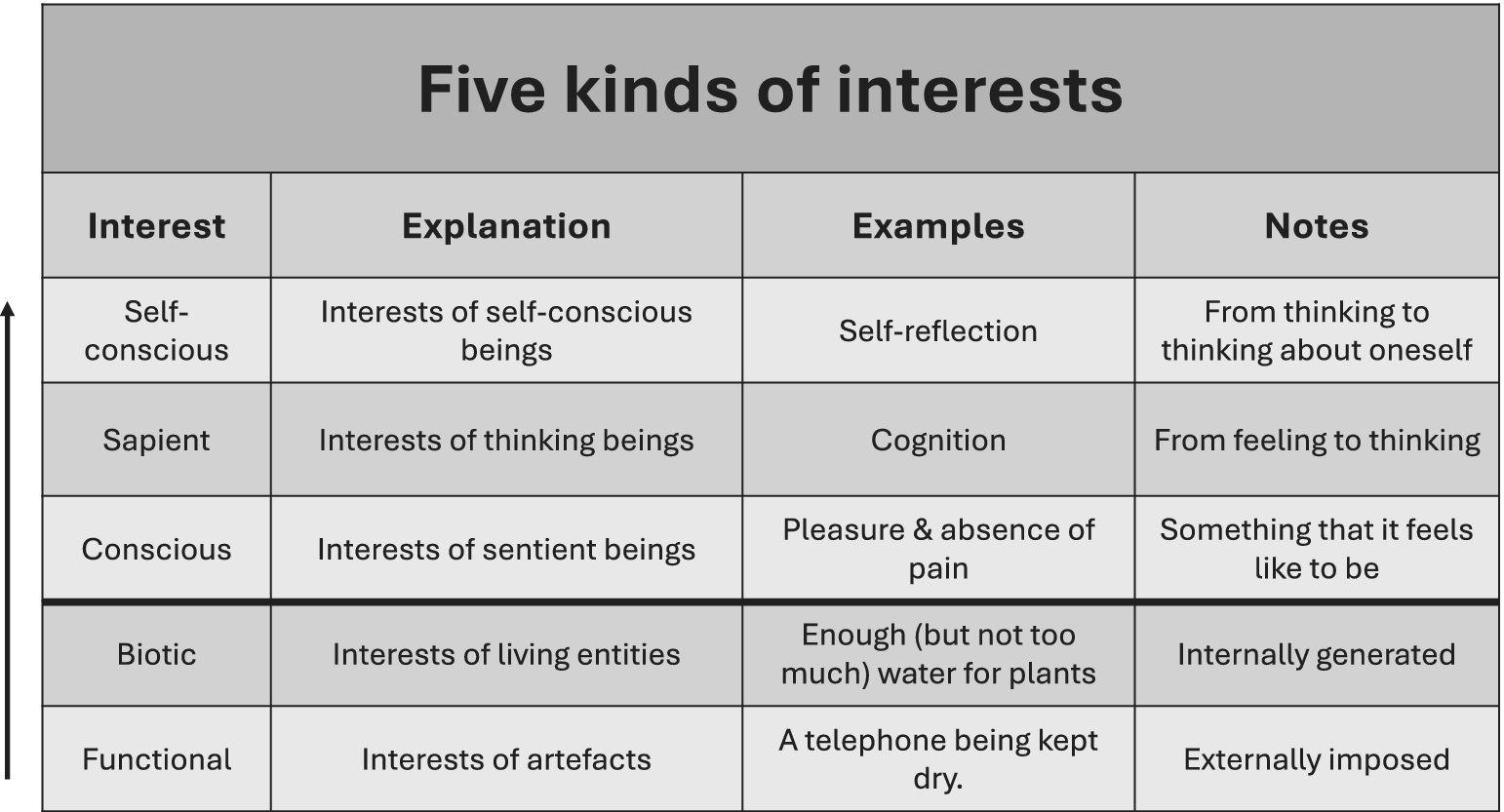
Figure 1. Long description
From bottom to top, the table lists: Functional—interests of artefacts, example is a telephone being kept dry, notes state externally imposed. Biotic—interests of living entities, example is enough but not too much water for plants, notes state internally generated. Conscious—interests of sentient beings, example is pleasure and absence of pain, notes state something that it feels like to be. Sapient—interests of thinking beings, example is cognition, notes state from feeling to thinking. Self-conscious—interests of self-conscious beings, example is self-reflection, notes state from thinking to thinking about oneself.
The most primitive kind of interest is what we might call “functional interests.”Footnote 8 These are the interests that tools and machines can be said to have. This is because they have functions. Some things promote and others impede their functions. For example, those things that promote a car’s functions are good for the car (i.e., in its interests), and those things that impedes its functions are bad for it (i.e., counter to its interests). The sense of good or bad “for the car” that is used here is not a subjective sense. It is not about the car’s own perspective, because there is no such thing. Instead, it is about what is objectively good or bad for a car.
Nonconscious living beings have what we can call “biotic interests.” They are like functional interests, but they are the functional interests of nonconscious living beings. For example, some things, such as water and light, are good for plants, while other things are bad for them. It is in the interests of plants to get what is good for them.
The difference between mere functional interests and those that are also biotic interests, is that the former can only be externally imposed. It is because cars are created to perform certain functions that they have the functions they have.Footnote 9 Theists might want to say the same about biotic interests, with an organism’s functions being imposed by God. However, no such claim must be made about living organisms. We can say of them that their functions are internally generated. They are, quite literally, part of the DNA of the organism.
Speaking about what is good or bad for a car or a plant is an entirely normal and reasonable linguistic activity. We can speak, quite meaningfully, about what is in the interests of a car or a plant, and what is against their interest. It does not follow, however, that cars and plants are morally considerable.
By contrast, there is reason to think that the next kind of interest, what I shall call “conscious interests” do render those who have them morally considerable. Conscious interests are the interests of conscious beings (rather than interests that a being consciously has). A conscious interest is the functional interest of a conscious living organism—that is, of a sentient being.
Before considering the moral significance of conscious interests, and therefore of sentience, it is worth considering two other kinds of interests that can also reasonably be thought to be morally significant. What we might call “sapient interests” are the interests of beings who are not merely sentient but also have some sapient capacity (which can obviously vary in degree). These are the interests of beings who are able to think. The way the word “think” is used here, is to be differentiated from unconscious computation (but it is not to deny that conscious thinkers do not also do some measure of subconscious computation). Computers, and even artificial intelligence have impressive computational capacity but they are not (yet?) conscious. They have functional interests, but neither biotic, conscious, nor sapient interests.
Finally, there are what we can call “self-conscious” interests. These are the interests of those thinking beings whose levels of cognition make self-awareness possible. These interests are self-conscious in the sense of being the interests of self-conscious beings, rather than being interests that a being self-consciously has.
I said that these five categories of interest are incremental. They are incremental in two different senses. First, each kind of interest, except the first, is incorporated in the succeeding kinds of interest. This incrementalism is, to the best of our knowledge, an empirical fact, rather than a conceptual truth.
For example, it is possible in principle, for a sentient being not to be a living being, and thus to have conscious interests without biotic ones. This would, in principle, be the case with artificial sentience. What would be artificial about it, is not that the sentience itself would be artificial, but rather that it would be the sentience of a nonliving being. However, artificially sentient entities would still have functional interests, for it seems impossible for even artificial sentience to exist in the absence of a functional system. While artificial sentience is possible in principle, it does not (yet?) exist in reality, to the best of our knowledge.
Some might say that, at least in theory, sapient interests, and perhaps even self-conscious interests, are also possible in the absence of sentient ones. They might say that this would be true of artificial intelligence that was not also sentient. In addition, some theists might claim that God is sapient but not sentient. I shall bracket these claims for two reasons, one theoretical and one practical.
The theoretical point is that to the extent that sapience, unlike computation, requires consciousness, sapience is conceptually impossible in the absence of some kind of sentience—namely feeling, even if not also perceiving.
The practical point is that even if we set aside the aforementioned theoretical issue, it appears that, in the natural world, there is no sapience in the absence of sentience. There are no examples of sapient beings who are not also sentient. All sapient beings first become sentient, with their sapient capacities developing later in their ontogeny. To the best of our knowledge, when sapience and sentience are lost asynchronously, it is sapience that is lost first. For example, one dements and then dies, rather than loses consciousness and only later dements.
The second sense in which the five kinds of interests are incremental is that we have good reason for thinking that the boundaries between them are not sharp. Consciousness emerges gradually both phylogenetically and ontogenically. In other words, both in the evolutionary process, and in the development of some individual organisms, consciousness emerges gradually. The same is true of both sapience and self-consciousness. Evolutionarily, even the emergence of life from nonliving mechanisms may very well have been gradual.
Sentience and moral standing
If having interests is not what distinguishes conscious beings from both nonconscious beings and those mere objects that have functions, what is it about consciousness that accords sentient beings, but not unconscious organisms and artifacts, moral standing?
To answer this question, it is helpful to distinguish between three claims:
-
(a) Sentience is a necessary condition for being morally considerable.
-
(b) Sentience is a sufficient condition for being morally considerable.
-
(c) Sentience is a necessary and sufficient condition for being morally considerable.
In addressing each of these claims, I assume, as explained earlier, that the five kinds of interest are incremental in the first sense—that there are no self-conscious interests in the absence of conscious interests, no conscious interests in the absence of sentient ones, no sentient interests in the absence of biotic interest, and no biotic interests in the absence of functional ones.
On that basis, to say that sentience is a necessary condition for being considerable, is to say that an entity must pass the threshold of sentience before it can have moral standing. And, to say that sentience is a sufficient condition is to say that passing that threshold is enough for the being to have moral standing. This, in turn, involves denying both that having biotic interests is sufficient to have moral standing, and that having sentient interests is insufficient for having moral standing.
There are those who have affirmed exactly what (a) denies. Some environmentalists believe that biotic interests (and even the interests of ecosystems)Footnote 10 are sufficient for moral standing.Footnote 11
Others have more rather than less demanding requirements for moral standing. They deny exactly what (b) affirms. According to this view, having sentient interests is insufficient for moral standing. Some views claim that sapience is necessary. Others go still further, claiming that self-consciousness is necessary.Footnote 12
How does one resolve such disagreements. It is likely that, in such matters, no “proof” can be offered for any one view, where “proof” is understood as a decisive argument. However, a lower epistemic burden can be met. The question is what, on a balance of considerations, it is most reasonable to think.
Consider (a) first. One way in which one cannot justify the claim that sentience is necessary is merely by noting that some things are bad for, and other things are good for, sentient beings. This is because the same is true of those with no more than functional or biotic interests. On account of having interests, things can be good or bad for them too.
It is difficult to see why one would think that merely because something is good for a machine, the machine’s interests must be considered. In deciding whether to destroy a machine (whether a watch, woodchipper, or weapon), there are many factors to be considered, but I can think of no good reason why the interests of the machine should be among those.
Perhaps the most plausible explanation for this is that the sense in which something can be good or bad for a machine is too limited. Yes, things can promote or impede its functioning, but in the case of a machine with only functional interests, there is no subjectFootnote 13 who is being benefited or harmed. There is no subject to care one way or the other. In that sense, nothing can be good or bad for an entity that has only functional interests.
However, the very same is true of nonconscious living beings. Nothing can be good or bad for them in this second sense. It is true that they, unlike mere objects, are alive, but there is no subject to care about what is good or bad for it.
This may sound question-begging. Am I not simply assuming that having either functional or biotic interests is insufficient? To the extent that I am, this is because justificatory chains must eventually reach some foundational level, and we reach one such foundation in judging whether having functional or biotic interests is sufficient for moral standing. It looks more reasonable to judge that they do not.
Those who disagree must very significantly increase the scope of moral consideration, and they must show us that they are actively considering such factors. Of course, there are ways for them to claim (or, less charitably, pretend) that they are doing so. They can claim that while they are considering such factors, they are always outweighed by other interests—those of sentient, sapient, and self-conscious beings.
However, while it is possible for a consideration of a particular kind always to be overridden, we can reasonably ask what the difference is between a consideration that is always overridden and no consideration at all. If they are impossible to tell apart, then even if there is a difference, there is no practical difference.
In addition, if some people think that merely functional or biotic interests do sometimes make a practical difference, then they need to show how this difference must be explained by a consideration of functional or biotic interests rather than by other interests. For example, if they argue that wanton destruction of a plough or a plant is wrong because it harms the plough or plant, then they need to make a convincing case that this is indeed wrong and not because of its impact on sentient, sapient, or self-conscious interests.
Next, consider (b), and the implicit denial that a being must be either sapient or self-conscious to be morally considerable. The basis for claiming that sentience is a sufficient condition for moral standing is that there is something that it feels like to be sentient. That makes a massive difference. As John Green has observed about pain, it “demands to be felt.”Footnote 14 Sentience involves subjective experience, and this, it is an understatement to say, has a vividness and sometimes an urgency that functional and biotic interests lack. Vividness and (subjective) urgency are not merely increased by sentience but made possible only through sentience. Entities with merely functional or also biotic interests lack this.
Of course, there are those who could simply deny (b), and assert that at least sapient, if not also self-conscious interests, are necessary for moral standing. This implies that not only those animals, but also all those humans whose interests reach only either the sentience or the sapience threshold, lack moral standing. From this, it follows that we have no direct duties to such beings not to inflict suffering on them.
That is so difficult to believe that those who wish to set the threshold for moral standing higher than sentience, desperately find ways to protect those humans who fail to meet the relevant interest threshold, but without attributing moral standing to those humans. Typically, these attempts seek to differentiate between those humans and those animals who fail to the meet the threshold, with the result that they leave the animals, but not the humans unprotected. Others are more inclusive and seek ways also to protect animals but again without attributing moral standing to them.
I shall not review and respond to these moves here.Footnote 15 Instead, I shall note only that the most obvious and plausible explanation for protecting merely sentient beings from the infliction of pain and other negative mental states is that they are sentient. Anybody who really understands what pain is, must recognize that it is not merely bad, but bad in the kind of way that moral agents must consider directly in deciding what they may and may not do.Footnote 16
From the foregoing, we should conclude that sentience is both a necessary and a sufficient condition for moral standing. This does not mean that sapient and self-conscious interests, and indeed, even functional and biotic interests are irrelevant. Although moral standing emerges with sentience, other kinds of interests can still be relevant to how we treat sentient beings. This will become clearer as we consider the further significance of sentience.
The further significance of sentience
The significance of sentience is not limited to its being both necessary and sufficient for moral standing. Determining who has moral standing is only a beginning. Once we know whose interests we need to consider, we still need to know what interests need to be considered. We also need to know what considering those interests implies.
The most obvious interests of sentient beings that need to be considered are interests in avoiding unpleasant mental states, such as pain, and having positive mental states, such as pleasure. If a morally considerable being has these interests, then they need to be considered.
Because perceptual fields differ—most markedly between species, but sometimes also between individuals—not all environmental factors have the same effect on different beings. For example, what we call “subsonic,” is only subsonic to we humans. It might be entirely audible to members of other species. What sounds like silence to us may be noise to others. Thus, while sentient beings all have interests in positive mental states and the avoidance of negative ones, what causes those different kinds of state may differ.
To clarify, the claim is not that we have a duty to prevent the pain of sentient beings, and to cause them pleasure. Determining what our duties are, involves weighing up all the relevant moral considerations. That is not my task here. Instead, I am asking only what interests need to be considered in such deliberations.
However, interests in positive mental states and the avoidance of negative ones are not the only interest that a sentient being can have. For example, because a severe restriction of liberty can induce negative mental states, sentient beings will have an interest in not having their freedom restricted in ways that will cause them frustration.
Typically, sentient beings also have an interest in remaining sentient. In other words, a sentient being has an interest not only in the contents of his or her consciousness, but also in continued consciousness itself.Footnote 17
The reason why something that threatens the consciousness of a conscious being is bad for that being, is the same as the reason why something that threatens the life of a nonconscious being is bad for that being, or why something that threatens the continued functioning of a machine is bad for the machine. The difference, if my earlier arguments are correct, is that what is bad for a machine or a nonconscious being does not matter morally in the way that what is good for a conscious being does.
Because conscious interests count morally, the functional and biotic interests of conscious beings also count. The interests of merely sentient beings are dependent on the fulfillment of their functional and biotic interests.
When a sentient being is also sapient, or sapient and self-conscious, that being has additional interests, over and above the sentient interests. Most obviously, sapient beings have interests in thinking, and self-conscious beings have interests in self-reflection. However, the implications of this are far-reaching. Beings with sapient, and a fortiori with self-conscious interests, have associated capacities and thus interests. These will vary from species to species and from individual to individual within at least some species.
Take the example of freedom again. Like sentient beings, sapient, and self-conscious beings, also have interests in freedom, but those interests will typically be more extensive than the freedom interests of merely sentient beings. For example, self-conscious beings can have interests in political, academic, and religious freedom, which merely sentient (and minimally sapient) beings presumably lack. Similarly, sapient beings will have interests in cognitive stimulation, which merely sentient beings do not have.
Conclusion
I have argued that sentience is highly significant. Sentient beings have what is needed to be morally considerable. Once a being is morally considerable on account of being sentient, whatever other interests that being has must also be considered.
Claiming that sentience is significant should not be understood to imply that becoming sentient is good. While sentence brings moral standing, the fundamental reason for this is that, in becoming sentient, a being becomes vulnerable in ways that make that being in need of moral protection.
As I have argued elsewhere,Footnote 18 that is a bad deal. It is better never to have become a sentient being. However, this does not imply that it is also better to cease to be sentient. Because sentient beings have an interest in continued sentience, they have something to lose. The same is not true of mere objects and nonconscious beings. They exist and can cease to exist, but from the subjective perspective, there is no difference between their existing and their not existing. For that reason, never being sentient is better than both sentience and its loss.
Competing interests
The author declares none.

 Open access

