Twins account for 3.3% of all live births in the United States (Martin et al., Reference Martin, Hamilton, Ventura, Osterman, Wilson and Mathews2012) and are associated with high infant morbidity and mortality (Kogan et al., Reference Kogan, Alexander, Kotelchuck, MacDorman, Buekens, Martin and Papiernik2000; Mathews & MacDorman, Reference Mathews and MacDorman2006). Maternal obesity has been found to be significantly related to an increased risk of preeclampsia and other adverse outcomes (Sebire et al., Reference Sebire, Jolly, Harris, Wadsworth, Joffe, Beard and Robinson2001; Weiss et al., Reference Weiss, Malone, Emig, Bali, Nyberg, Comstock and D'Alton2004). The Institute of Medicine (IOM) in 2009 issued a provisional guideline for gestational weight gain of 25–42 pounds for term twin pregnancies in obese women (BMI ≥30.0 kg/m2) that reflected the interquartile range (25th–75th percentile) of cumulative weight gain among obese women who delivered twins at 37–42 weeks gestation (Institute of Medicine and National Research Council, 2009). Limited data is available, however, documenting the efficacy of this provisional guideline on maternal/neonatal outcomes. A study of 29 obese women found no difference in adverse outcomes between women whose gestational weight gain was below the IOM guideline and women whose gestational weight gain met or exceeded the IOM guideline (Fox et al., Reference Fox, Rebarber, Roman, Klauser, Peress and Saltzman2010). Another study found no difference in outcomes between women whose gestational weight gain was below, equal to, or exceeded IOM guidelines; normal, overweight, and obese women, however, were included in this study (Fox et al., Reference Fox, Saltzman, Kurtz and Rebarber2011). The purpose of this study was to estimate the effect of gestational weight gain on maternal/neonatal outcomes in term (≥37 weeks gestation) twin pregnancies in obese women using the IOM provisional guideline of 25–42 pounds as the reference group.
Materials and Methods
A population-based historical cohort study was conducted using data from the Missouri maternally linked birth and fetal death certificate registry. The methods and algorithms used within the Missouri vital records system have been previously described, are considered reliable, and have been used to validate national data sets of the United States that use matching and linking procedures (Herman et al., Reference Herman, McCarthy, Bakewell, Ward, Mueller, Maconochie and Skjaerven1997; Martin et al., Reference Martin, Curtin, Saulnier and Mousavi2003). The study population included all obese pregnant women (BMI ≥30.0 kg/m2) residing in Missouri who delivered liveborn, term (clinical estimate of gestational age ≥37 weeks) twin infants without congenital abnormalities in 1998–2005. Pre-pregnancy BMI was calculated from self-reported weight and height recorded on the birth certificate. Gestational weight gain was abstracted from the medical chart or provided by the physician. Three categories of gestational weight gain were examined: <25 pounds (includes women who lost weight), 25–42 pounds, and >42 pounds. The 25–42 pound group served as the reference category for all comparisons, as it is the current IOM provisional guideline for weight gain for term twin pregnancies in obese women. The <25-pound group represented women gaining less than the IOM provisional guideline or losing weight during pregnancy, while the >42-pound group represented women whose weight gain exceeded the IOM provisional guideline.
Maternal and neonatal outcomes of this study included preeclampsia, cesarean delivery, instrumental delivery (forceps or vacuum), infant birth weight, infants weighing ≤2,500 grams, 1-min Apgar score <4, 5-min Apgar score <7, and infant mortality ≤1 year. Preeclampsia was defined on the birth certificate as pregnancy-induced hypertension occurring >20 weeks gestation that was characterized by either blood pressure >140/90 mm Hg or an increase in systolic blood pressure ≥30 mm Hg or an increase in diastolic blood pressure ≥15 mm Hg over baseline on two measurements taken six hours apart that was accompanied by generalized and overt proteinuria or edema. Potential confounders that could impact the risk of the above maternal/neonatal outcomes that were adjusted for in the study included maternal age (≤25 years, 26–35 years, >35 years), race (non-Hispanic white, black, Hispanic, other), education (<12 years, 12 years, >12 years), pre-pregnancy body mass index (Class I Obese [≥30.0–<35.0 kg/m2], Class II Obese [≥35.0–<40.0 kg/m2], Class III Obese [≥40.0 kg/m2]), socio-economic status (using enrollment in Medicaid; the Women, Infants, and Children public health program; or food stamp programs as a proxy, as income was not reported on the birth certificate), smoking, parity (0, 1+ prior live births), diabetes, chronic hypertension, and gestational age at delivery. Diabetes was defined on the birth certificate as insulin-dependent diabetes or other diabetes. The latter could be either pre-existing or gestational diabetes. Women were combined into a single diabetes group for purposes of analysis.
Continuous variables were expressed as medians due to lack of normality of the distributions. Categorical variables were expressed as numbers and percentages. Differences in demographic characteristics, medical/obstetrical history, and maternal/neonatal outcomes by gestational weight gain categories were assessed using chi-square test for categorical variables, including the linear-by-linear test for trend. The non-parametric Kruskal-Wallis test was used for all continuous variables. The multivariate predictability of gestational weight gain categories for maternal/neonatal outcomes was examined using multiple logistic regression. Multivariate findings reflect adjustment for the above potential confounders in the model. Maternal/neonatal outcomes also were assessed by gestational weight gain categories according to concordant and discordant twin pairs. Discordance was defined as birth weight ≥20% according to the formula: (birth weight of larger twin – birth weight of smaller twin)/birth weight of larger twin × 100. The 20% level for birth weight discordance was chosen because it is commonly used in twin studies and has been shown to be approximately the level above which perinatal morbidity significantly increases (Amaru et al., Reference Amaru, Bush, Berkowitz, Lapinski and Gaddipari2004; Breathnach et al., Reference Breathnach, McAuliffe, Geary, Daly, Higgins, Dornan and Malone2011). A p value of <.05 was used for statistical significance. All analyses were performed using SPSS version 19.0 for Windows.
This research did not involve interaction with subjects and the existing publicly available data contained no identifying private information. The Saint Louis University Institutional Review Board deemed that this study did not require formal review according to federal regulation 45 CFR 46.102.
Results
The study population of 1,662 twins was born to 405 (48.7%) Class I Obese women, 223 (26.8%) Class II Obese women, and 203 (24.4%) Class III Obese women (Table 1). Over 70% of the women were non-Hispanic white. Approximately 60% of the women lived in poverty and 27.8% of the mothers were nulliparous. Only 38.9% of the women followed the Institute of Medicine's provisional guideline of weight gain during pregnancy of 25–42 pounds. The percentage of women gaining <25 pounds during pregnancy was 30.8%, while 30.3% of the women gained >42 pounds. Eleven of the 256 (4.3%) women in the <25-pound group lost weight during pregnancy, with a range of weight loss of 4–16 pounds and a median weight loss of 8 pounds. Preeclampsia, cesarean delivery, and instrumental delivery occurred in 10.5%, 68.0%, and 6.9% of the women, respectively. Women who gained >42 pounds during pregnancy were more likely to be non-white than women who gained <25 pounds or 25–42 pounds. Women who gained <25 pounds were less likely to be Class I Obese and nulliparous than women who gained 25–42 pounds or >42 pounds. A significant increasing trend with gestational weight gain was found for preeclampsia (p < .05). An increasing trend with gestational weight gain for cesarean delivery was of borderline significance (p = .06).
Maternal Characteristics for 831 Obese Women Who Had Twin Pregnancies in Missouri, 1998–2005

a Maternal race was unknown for one woman who gained <25 pounds during pregnancy; maternal education was unknown for two women who gained <25 pounds during pregnancy; socio-economic status was unknown for one woman who gained <25 pounds during pregnancy; adequacy of prenatal care was unknown for seven women who gained <25 pounds during pregnancy.
b Maternal education was unknown for one woman who gained 25–42 pounds during pregnancy; adequacy of prenatal care was unknown for 10 women who gained 25–42 pounds during pregnancy.
c Maternal race was unknown for one woman who gained >42 pounds during pregnancy; maternal education was unknown for one woman who gained >42 pounds during pregnancy; adequacy of prenatal care was unknown for seven women who gained >42 pounds during pregnancy.
d Enrollment in Medicaid; Women, Infants, and Children's Program; or food stamps.
e The Kotelchuck Index of Adequacy of Prenatal Care defines the levels as inadequate (<50% of expected prenatal care visits), intermediate (≥50%–<80% of expected prenatal care visits), adequate (≥80%–<110% of expected prenatal care visits), and adequate plus (≥110% of expected prenatal care visits).
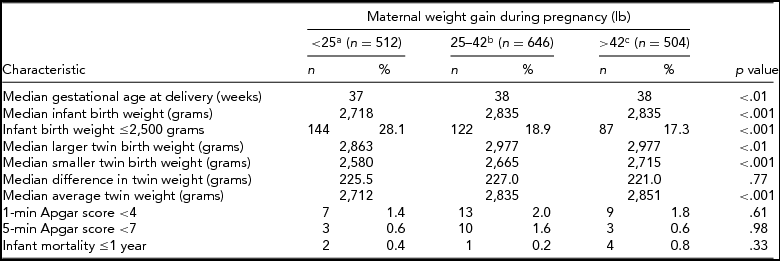
Significant increasing trends with gestational weight gain were found for infant birth weight (p < .001), larger twin birth weight (p < .01), smaller twin birth weight (p < .001), and average twin birth weight (p < .001, Table 2). The weight difference in twin pairs, however, was relatively constant across gestational weight gain categories (p = .77). A significant inverse trend with increasing gestational weight gain was found for infants weighing ≤2,500 grams (p < .001). No significant differences were found for 1-min Apgar score <4, 5-min Apgar score <7, or infant mortality within 1 year.
Outcomes for 1,662 Twins Born to 831 Obese Women in Missouri, 1998–2005

a One-min and 5-min Apgar scores were unknown for one infant whose mother gained <25 pounds during pregnancy.
b One-min and 5-min Apgar scores were unknown for three infants whose mothers gained 25–42 pounds during pregnancy.
c One-min and 5-min Apgar scores were unknown for two infants whose mothers gained >42 pounds during pregnancy.
The incidence and multivariate findings for preeclampsia and infants weighing ≤2,500 grams by gestational weight gain category are given in Table 3. Women who gained >42 pounds had a borderline significantly higher odds of preeclampsia than women who gained 25–42 pounds (adjusted OR 1.72; 95% CI 1.00-2.99, p = .052). Women who gained <25 pounds had significantly higher odds of an infant weighing ≤2,500 grams than women who gained 25–42 pounds (adjusted OR 1.74; 95% CI 1.28–2.36, p < .001). Analyses by obesity class showed that women who gained >42 pounds always had an elevated, although non-significant, odds of preeclampsia than women who gained 25–42 pounds (data not shown). Class I Obese women who gained <25 pounds had significantly higher odds of an infant weighing ≤2,500 grams than women who gained 25–42 pounds (adjusted OR 2.04; 95% CI 1.28–3.26, p < .01). Class III Obese women who gained >42 pounds had significantly lower odds of an infant weighing ≤2,500 grams than women who gained 25–42 pounds (adjusted OR 0.39; 95% CI 0.17–0.91, p < .05).
Incidence and Multivariate Risk of Preeclampsia and Infant Birth Weight ≤2,500 Grams by Pregnancy Weight Gain for 1,662 Twins Born to 831 Obese Women in Missouri, 1998–2005

a Adjusted for maternal age, race, education, pre-pregnancy body mass index, socio-economic status, smoking, parity, anemia, diabetes, chronic hypertension, adequacy of prenatal care, sex of twin, twin discordance, and gestational age at delivery.
b Includes women who lost weight during pregnancy.
Note: CI = confidence interval.
Significant increasing trends with gestational weight gain were found for preeclampsia (p < .05) and cesarean delivery (p < .05) in concordant twin pairs (Table 4). Significant inverse trends with increasing gestational weight gain were found for infants weighing ≤2,500 grams in both concordant and discordant twin pairs (p < .05). Only 73/831 (8.8%) of the twin pairs were discordant, likely rendering the risk pattern of preeclampsia in discordant twin pairs non-significant due to small sample size.
Outcomes by Twin Discordancea for 1,662 Twins Born to 831 Obese Women in Missouri, 1998–2005

a Twin discordance defined ≥20% in birth weight according to the formula: (Birth weight of larger twin – Birth weight of smaller twin)/Birth weight of larger twin × 100.
Discussion
This study focuses on the association of gestational weight gain with maternal/neonatal outcomes in term (≥37 weeks gestation) twin pregnancies in obese women using the revised 2009 IOM provisional guideline of 25–42 pounds. Significant increasing trends across the three gestational weight gain categories of <25 pounds, 25–42 pounds, and >42 pounds were found for infant birth weight, larger twin birth weight, smaller twin birth weight, and average twin birth weight. A significant inverse trend with increasing gestational weight gain was found for infants weighing ≤2,500 grams. These findings are consistent with those of other studies involving twin pregnancies in obese women (Fox et al., Reference Fox, Saltzman, Kurtz and Rebarber2011; Gonzalez-Quintero et al., Reference Gonzalez-Quintero, Kathiresan, Tudela, Rhea, Desch and Istwan2012). Another study noted that larger twin birth weight and smaller twin birth weight increased in obese women whose gestational weight gain met or exceeded the IOM guideline compared to women whose gestational weight gain was below the IOM guideline; the sample size of only 29 obese women, however, precluded the finding of significant differences (Fox et al., Reference Fox, Rebarber, Roman, Klauser, Peress and Saltzman2010). Only 38.9% of the women in our study followed the Institute of Medicine's provisional guideline of weight gain during pregnancy of 25–42 pounds, which is similar to that found in a national sampling of women in 28 states and New York City participating in the population-based surveillance system (PRAMS; Chu & D'Angelo, Reference Chu and D'Angelo2009).
Increased gestational weight gain is a significant risk factor for preeclampsia in obese women (Kabiru & Raynor, Reference Kabiru and Raynor2004). Preeclampsia also occurs with much higher frequency in twin pregnancies than in singleton gestations. In one multicenter trial examining the efficacy of low-dose aspirin for the prevention of preeclampsia, the rates of preeclampsia were found to be 12.7% in twin pregnancies and 4.9% in singleton gestations (Sibai et al., Reference Sibai, Hauth, Caritis, Lindheimer, MacPherson, Klebanoff and McNellis2000). A population-based study of birth certificates in Washington state found that twin pregnancies had a 3.5 increased risk of preeclampsia compared to singleton pregnancies (Coonrod et al., Reference Coonrod, Hickok, Zhu, Easterling and Daling1995). The combination of twin gestation and maternal obesity could amplify the risk for preeclampsia. Efforts to identify and minimize risk factors for preeclampsia in twin pregnancies in obese women should be pursued. Such factors may include limiting gestational weight gain in such pregnancies.
Previous studies of twin pregnancies in obese women have demonstrated that increasing gestational weight gain is associated with larger infants without accompanying increases in complications. The rate of gestational hypertension and gestational diabetes did not significantly increase with increasing gestational weight gain in one study (Fox et al., Reference Fox, Rebarber, Roman, Klauser, Peress and Saltzman2010) and the rate of gestational hypertension, preeclampsia, and gestational diabetes did not significantly increase with increasing gestational weight gain in a second study (Fox et al., Reference Fox, Saltzman, Kurtz and Rebarber2011). The former study again included only 29 obese women. The latter study included 170 women, of whom 117 had a normal pre-pregnancy BMI and the remaining 53 women had an overweight or obese pre-pregnancy BMI. Analyses were performed across all three pre-pregnancy BMI classes simultaneously or only in women with a normal pre-pregnancy BMI. The exact number of obese women in the latter study was unknown and a separate analysis relating gestational weight gain with maternal and neonatal outcomes in obese women was not performed.
A strength of our study was that we had a relatively large sample size of 831 obese mothers and 1,662 twins from which to calculate trends in maternal and neonatal outcomes across gestational weight gain categories. A significant increasing trend with gestational weight gain was found for preeclampsia. Such a finding has not been reported in previous studies. Women who gained >42 pounds had a borderline significantly higher odds of preeclampsia than women who gained 25–42 pounds. Elevated, although non-significant, adjusted odds of preeclampsia were found in all obesity classes for women who gained >42 pounds compared to women who gained 25–42 pounds. It is likely that the small number of preeclampsia cases rendered the study underpowered to detect significant differences between gestational weight gain categories within obesity classes. Prospective studies with larger sample sizes are needed to determine if increasing trends with gestational weight gain for preeclampsia exist by obesity class, to corroborate the increased risk of preeclampsia for women gaining above the IOM provisional guideline of 42 pounds in all obesity classes, and to further examine the association between gestational weight gain and preeclampsia and cesarean delivery by concordant and discordant twin pairs.
The risk of preeclampsia, cesarean delivery, and infants weighing ≤2,500 grams was always much higher for discordant twin pairs than for concordant twin pairs at a particular level of gestational weight gain. This corroborates earlier findings for discordant twin pairs on these and other endpoints (Amaru et al., Reference Amaru, Bush, Berkowitz, Lapinski and Gaddipari2004; Breathnach et al., Reference Breathnach, McAuliffe, Geary, Daly, Higgins, Dornan and Malone2011). The risk patterns for preeclampsia and cesarean delivery in concordant twin pairs indicate that increasing gestational weight gain is significantly associated with increased risk for these outcomes in obese women when twins are similar in size at delivery. The risk pattern for preeclampsia in discordant twin pairs had an increasing trend with gestational weight gain, but was non-significant due to few preeclampsia cases. In contrast, the risk of cesarean delivery was relatively constant across gestational weight gain categories in discordant twin pairs. The amount of gestational weight gain apparently is not significantly associated with the risk of cesarean delivery in obese women when twins are sufficiently dissimilar in size at delivery.
Additional strengths of our study include a historical cohort design that permitted calculation of incidence rates of maternal/neonatal outcomes and the availability of and adjustment for many potential confounding variables that could impact maternal/neonatal outcomes. Limitations of our study include those that are inherent with the use of birth certificate records, such as incomplete or inaccurate reporting of data; self-reported information, such as height and weight; and potential under-reporting of medical conditions, such as chronic hypertension, heart disease, and renal disease. Preeclampsia has been found to match very well between birth certificates with a check-box format (such as used in Missouri), and hospital discharge data, with 85–97% of the former being present in the latter (Frost et al., Reference Frost, Starzyk, George and McLaughlin1984). This corroboration, and that repeated blood pressure measurements with accompanying proteinuria or edema are necessary for a diagnosis of preeclampsia, lessen the potential of an inflated rate of preeclampsia due to artificial elevation of blood pressure that is recorded when a standard size sphygmomanometer cuff is used in obese women (Fonseca-Reyes et al., Reference Fonseca-Reyes, de Alba-Garcia, Parra-Carrillo and Paczka-Zapata2003). Self-reported maternal weight, as appears on Missouri birth certificates and on which pre-pregnancy BMI classes were based, also has been found to be highly correlated with and similar to clinically recorded weight (Lederman & Paxton, Reference Lederman and Paxton1998). Self-reported BMI has been found to match very well with clinically measured BMI in obese (Brunner Huber, Reference Brunner Huber2007) and combined overweight and obese samples (Nawaz et al., Reference Nawaz, Chan, Abdulrahman, Larson and Katz2001). Gestational age was determined by clinical estimate, which has been found to be a more accurate measure of gestational age at delivery than length of pregnancy calculated using the last menstrual period (Callaghan & Dietz, Reference Callaghan and Dietz2010). Our study only examined the endpoints of preeclampsia, cesarean delivery, instrumental delivery, indices of birth weight, Apgar scores, and infant mortality. The impact of gestational weight gain on other adverse short- and long-term maternal and infant outcomes such as gestational diabetes, gestational hypertension, neonatal intensive care unit admission, childhood obesity, childhood cognitive performance, and post-partum weight retention remains to be determined. Our study population consisted of liveborn, term (≥37 weeks gestation) twin infants free of congenital abnormalities, and our findings may not be generalizable to other obese pregnant populations. Only term infants were included in our study because the IOM provisional guideline of 25–42 pounds was based on twin pregnancies in obese women who delivered at 37–42 weeks gestation. Other studies involving twin pregnancies in obese women have used a rate of weight gain of 0.68 pounds/week that is based on the minimal IOM provisional guideline of 25 pounds divided by the minimal duration of 37 weeks for a term pregnancy, which enables other maternal/neonatal outcomes, such as pre-term birth, to be evaluated (Fox et al., Reference Fox, Rebarber, Roman, Klauser, Peress and Saltzman2010; Gonzalez-Quintero et al., Reference Gonzalez-Quintero, Kathiresan, Tudela, Rhea, Desch and Istwan2012). Diet, physical activity, and chorionicity were also potential confounders that could not be assessed.
Our findings are consistent with other studies that report larger infants with increased gestational weight gain in twin pregnancies in obese women. Our study, however, found that this occurred with an accompanying increased risk of preeclampsia and cesarean delivery, particularly in concordant twin pairs. Limiting gestational weight gain should be considered in view of the significant complications of preeclampsia and cesarean delivery. Our findings need corroboration from prospective studies of twin pregnancies in obese women that estimate the effect of gestational weight gain on preeclampsia and cesarean delivery for composite samples of obese women and by obesity class. Prospective studies of other study populations and other short- and long-term maternal and infant outcomes also are needed to evaluate the efficacy of the IOM guideline.
Acknowledgments
The original source of data used in this study was from the Missouri Department of Health and Senior Services, Section of Epidemiology for Public Health Practice. The analyses, interpretations, and conclusions of this study are those of the authors and not the Missouri Department of Health and Senior Services, Section of Epidemiology for Public Health Practice.