
Skip to main content Accessibility help
×
  • Cited by 59
    • This book is unavailable for purchase
    • This textbook has now been replaced with a newer edition and is no longer available for personal or institutional sales. This will not affect access for customers who have previously redeemed access codes or purchased the title via ecommerce.
    • Show more authors
    • You may already have access via personal or institutional login
    • Select format
    • Publisher:
      Cambridge University Press
      Publication date:
      05 June 2014
      16 March 2006
      ISBN:
      9780511808586
      Dimensions:
      Weight & Pages:
      Dimensions:
      Weight & Pages:
    You may already have access via personal or institutional login
    Selected: Paperback
    View cart Buy from Cambridge.org

    Book description

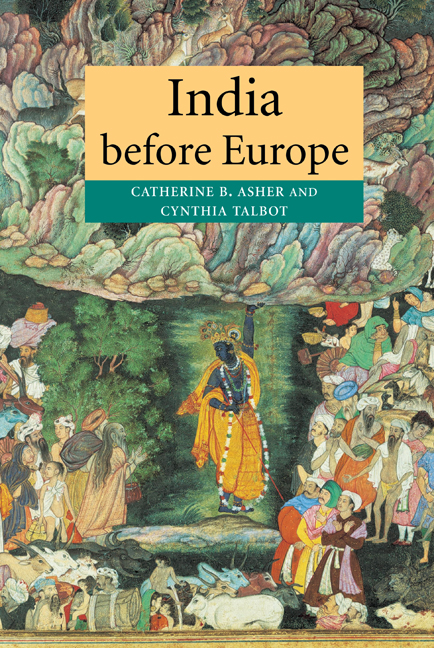
    India is a land of enormous diversity. Cross-cultural influences are everywhere in evidence, in the food people eat, the clothes they wear, and in the places they worship. This was especially the case in the India that existed from 1200 to 1750, before the European intervention. The book takes the reader on a journey across the political, economic, religious and cultural landscapes of medieval India, from the Ghurid conquests and the Dehli Sultanate to the great court of the Mughals. This was a time of conquest and consolidation, when Muslims and Hindus came together to create a unique culture which still resonates in today's India. As the first survey of its kind in over a decade, the book is a tour de force. It is beautifully illustrated and fluently composed, with a cast of characters which will educate students and general readers alike.

    Reviews

    'Asher and Talbot provide an excellent introduction, very necessary in this type of academic work … the excellent maps … assist our understanding of the subject matter … I am convinced that as a model for writing an academic book India before Europe succeeds … The photographs mostly by Frederick M. Asher and Catherine B Asher are likewise first class …'

    Source: The Journal of the Open University History Society

    '… this book will remain a standard in the field for many decades and belongs on the bookshelf of every scholar of South Asia.'

    Source: Religious Studies Review

    Refine List

    Actions for selected content:

    Select all | Deselect all
    • View selected items
    • Export citations
    • Download PDF (zip)
    • Save to Kindle
    • Save to Dropbox
    • Save to Google Drive

    Save Search

    You can save your searches here and later view and run them again in "My saved searches".

    Please provide a title, maximum of 40 characters.
    ×

    Contents

    Bibliography
    Bibliography
    ibn Mubarak, Abu al-Fazl. The Akbar Nama of Abu'l-Fazl, trans. Henry Beveridge. Delhi: Ess Ess Publications, 1977 [1902–39]
    ibn Mubarak, Abu al-FazlA'in-i Akbari, trans. H. Blockmann. Osnabruck: Biblio Verlag, 1983 [1868–94]
    Akhtarazzaman, A. “The Muslim Rulers and Their Non-Muslim Subjects in Thirteenth and Fourteenth Century Eastern India.” In Essays in Memory of Momtazur Rahman Tarafdar, ed. Hasan, Perween and Islam, Mufakharul, pp. 132–48. Dhaka: Dhaka University, 1999
    Alam, Muzaffar. The Crisis of Empire in Mughal North India: Awadh and the Punjab, 1707–1748. Delhi: Oxford University Press, 1986
    Alam, Muzaffar “The Culture and Politics of Persian in Precolonial Hindustan.” In Literary Cultures in History: Reconstructions from South Asia, ed. Pollock, Sheldon, pp. 131–98. Berkeley: University of California Press, 2003
    Alam, MuzaffarThe Languages of Political Islam, India 1200–1800. Chicago: University of Chicago Press, 2004
    Alam, MuzaffarThe Pursuit of Persian: Language in Mughal Politics.” Modern Asian Studies 32 (1998): 3–17
    Alam, Muzaffar and Subrahmanyam, Sanjay, eds. The Mughal State, 1526–1750. Delhi: Oxford University Press, 1998
    Aquil, Raziuddin. “Conversion in Chishti Sufi Literature (13th–14th Centuries).” Indian Historical Review 24.1–2 (1997–98): 70–94
    Ara, Matsuo. “The Lodhi Rulers and the Construction of Tomb-Buildings in Delhi.” Acta Asiatica 43 (1982): 61–80
    Arasaratnam, S.Maritime India in the Seventeenth Century. Delhi: Oxford University Press, 1994
    Arasaratnam, S.Maritime Trade, Society and European Influence in Southern Asia, 1600–1800. Aldershot, Hampshire: Variorum Publishing, 1995
    Asher, Catherine. “Amber and Jaipur: Temples in a Changing State.” In Stones in the Sand: The Architecture of Rajasthan, ed. Tillotson, Giles, pp. 68–77. Mumbai: Marg Publications, 2001
    Asher, CatherineThe Architecture of Mughal India. Cambridge: Cambridge University Press, 1992
    Asher, Catherine “The Architecture of Raja Man Singh: A Study of Sub-Imperial Patronage.” In The Powers of Art: Patronage in Indian Culture, ed. Miller, Barbara Stoler, pp. 183–201. New Delhi: Oxford University Press, 1992
    Asher, Catherine “Delhi Walled: Changing Boundaries.” In City Walls: The Urban Enceinte in Global Perspective, ed. Tracy, James, pp. 247–81. Cambridge: Cambridge University Press, 2000
    Asher, Catherine “Gardens of the Nobility: Raja Man Singh and the Bagh-i Wah.” In The Mughal Garden: Interpretation, Conservation, Implications, ed. Hussain, Mahmoodet al., pp. 61–72. Lahore: Ferozsons, 1996
    Asher, Catherine “Legacy and Legitimacy: Sher Shah's Patronage of Imperial Mausolea.” In Shari'at and Ambiguity in South Asian Islam, ed. Ewing, Katherine, pp. 79–97. Berkeley: University of California Press, 1988
    Asher, Catherine “Mapping Hindu–Muslim Identities Through the Architecture of Shahjahanabad and Jaipur.” In Beyond Turk and Hindu: Rethinking Religious Identities in Islamicate South Asia, ed. David, Gilmartin and Lawrence, Bruce B., pp. 121–48. Gainesville: University of Florida, 2000
    Asher, Catherine “Piety, Religion and the Old Social Order in the Architecture of the Later Mughals and Their Contemporaries.” In Rethinking Early Modern India, ed. Richard, B. Barnett, pp. 193–228. New Delhi: Manohar, 2002
    Asher, Catherine “A Ray from the Sun: Mughal Ideology and the Visual Construction of the Divine.” In The Presence of Light: Divine Radiance and Religious Experience, ed. Matthew, Kapstein, pp. 161–94. Chicago: University of Chicago Press, 2004
    Asher, Frederick, ed. Art of India: Prehistory to the Present. Chicago: Encyclopaedia Britannica, 2003
    Athar, Ali M.The Mughal Nobility Under Aurangzeb, revised edn. Delhi: Oxford University Press, 1997
    Husain, Azzizuddin S. M.Structure of Politics Under Aurangzeb, 1658–1707. New Delhi: Kanishka Publishers, 2002
    Muhammad, Babur, Zahir al-Din. The Baburnama: Memoirs of Babur, Prince and Emperor, trans. and ed. Wheeler M. Thackston. Washington, DC: Freer Gallery of Art, Arthur M. Sackler Gallery and Smithsonian Institution, 1995
    Bailey, Gavin. The Jesuits and the Grand Mogul: Renaissance Art at the Imperial Court of India, 1580–1630. Washington, DC: Freer Gallery of Art, Arthur M. Sackler Gallery, and Smithsonian Institution, 1998
    Banerji, Naseem Ahmed. The Architecture of the Adina Mosque in Pandua, India: Medieval Tradition and Innovation. Lewiston, NY: Edwin Mellen Press, 2002
    Sani, Baqir Najm-i Muhammad. Advice on the Art of Governance: Mau'izah-i Jahangiri, an Indo-Islamic Mirror for Princes, trans. Sajida Sultana Alvi. Albany: State University of New York Press, 1989
    Barani, Zia al-Din. The Reign of Alauddin Khilji, Translated from Zia-ud-din Barani's Tarikh-i-Firuz Shahi, trans. A. R. Fuller and A. Khallaque. Calcutta: Pilgrim Publishers, 1967
    Barendse, R. J.The Arabian Seas: The Indian Ocean World of the Seventeenth Century. Armonk, NY: M. E. Sharpe, 2002
    Barnes, Ruth, Cohen, Steven, and Gill, Rosemary. Trade, Temple and Court: Indian Textiles from the Tapi Collection. Mumbai: India Book House, 2002
    Bartlett, Robert. The Making of Europe: Conquest, Colonization and Cultural Change, 950–1350. Princeton: Princeton University Press, 1993
    Bawa, Vasant Kumar. “The Politics of Architecture in Qutbshahi Hyderabad: A Preliminary Analysis.” In Studies in History of the Deccan: Medieval and Modern, ed. Nayeem, M. A.et al., pp. 329–41. Delhi: Pragati Publications, 2002
    Bayly, C. A.Rulers, Townsmen and Bazaars: North Indian Society in the Age of British Expansion, 1770–1870. Cambridge: Cambridge University Press, 1983
    Beach, Milo Cleveland. Mughal and Rajput Painting. Cambridge: Cambridge University Press, 1992
    Beach, Milo Cleveland, Koch, Ebba, and Thackson, Wheeler. King of the World: The Padshahnama, an Imperial Mughal Manuscript from the Royal Library, Windsor Castle. London: Azimuth Editions and Sackler Gallery, 1997
    Begley, Wayne E.The Myth of the Taj Mahal and a New Theory of its Symbolic Meaning.” The Art Bulletin 61 (1979): 7–37
    Begley, Wayne E. “The Symbolic Role of Calligraphy on Three Imperial Mosques of Shah Jahan.” In Kaladarsana: American Studies in the Art of India, ed. Williams, Joanna, pp. 7–18. New Delhi: Oxford and IBH Publishing, 1981
    Begley, Wayne E., and Desai, Z. A.. Taj Mahal: The Illumined Tomb: An Anthology of Seventeenth-Century Mughal and European Documentary Sources. Cambridge and Seattle: Aga Khan Program for Islamic Architecture and University of Washington Press, 1989
    Bernier, François. Travels in the Mogul Empire, AD 1656–1668, 2nd edn, trans. A. Constable. New Delhi: Munshiram Manoharlal, 1992
    Blake, Stephen P.Shahjahanabad: The Sovereign City in Mughal India, 1639–1739. Cambridge: Cambridge University Press, 1991
    Brand, Michael and Lowry, Glenn. Akbar's India: Art From the Mughal City of Victory. New York: Asia Society Galleries, 1985
    Breckenridge, Carol A. “Food, Politics and Pilgrimage in South India, 1350–1650 A.D.” In Food, Society and Culture, ed. Khare, R. S. and Rao, M. S. A., pp. 21–53. Durham, NC: Carolina Academic Press, 1986
    Brennig, Joseph J. “Textile Producers and Production in Late Seventeenth Century Coromandel.” In Merchants, Markets, and the State in Early Modern India, ed. Subrahmanyam, Sanjay, pp. 66–87. Delhi: Oxford University Press, 1990
    Byrant, G. J.Assymetric Warfare: The British Experience in Eighteenth-Century India.” Journal of Military History 68 (2004): 4–31
    Calkins, Philip B.The Formation of a Regionally Oriented Ruling Group in Bengal, 1700–1740.” Journal of Asian Studies 29.4 (1970): 799–806
    Chandra, Pramod. “Notes on Mandu Kalpasutra of A. D. 1439.” Marg 12.3 (1959): 51–54
    Chandra, Satish. Medieval India: Society, the Jagirdari Crisis and the Village. Delhi: Macmillan India, 1982
    Chandra, SatishMedieval India from Sultanat to the Mughals, Pt. 1: Delhi Sultanat (1206–1526). New Delhi: Har Anand, 1997
    Chattopadhyaya, Brajadulal. Representing the Other? Sanskrit Sources and the Muslims (Eighth to Fourteenth Century). New Delhi: Manohar, 1998
    Chaudhuri, K. N.The Trading World of Asia and the English East India Company, 1660–1760.Cambridge: Cambridge University Press, 1978
    Comissariat, M. S.A History of Gujarat Including a Survey of its Chief Architectural Monuments and Inscriptions. Bombay: Longmans, Green and Co., 1938
    Cort, John. “The Jain Sacred Cosmos: Selections from a Medieval Pilgrimage Text.” In The Clever Adulteress & Other Stories: A Treasury of Jain Literature, ed. Granoff, Phyllis, pp. 245–90. Oakville, Ont.: Mosaic Press, 1990
    Currie, P. M.The Shrine and Cult of Mu'in-al-din Chishti of Ajmer. Delhi: Oxford University Press, 1989
    Dale, Stephen Frederic. The Garden of the Eight Paradises: Babur and the Culture of Empire in Central Asia, Afghanistan and India (1483–1530). Leiden and Boston: Brill, 2004
    Dale, Stephen FredericIslamic Society on the South Asian Frontier: The Mappilas of Malabar, 1498–1922. Oxford: Oxford University Press, 1980
    Das, Asok Kumar. “An Introductory Note on the Emperor Akbar's Ramayana and its Miniatures.” In Facets of Indian Art: A Symposium Held at the Victoria and Albert Museum, ed. Skelton, Robertet al., pp. 94–104. London: Victoria and Albert Museum, 1986
    Datta, Rajat. Society, Economy and the Market: Commercialization in Rural Bengal, c. 1760–1800. New Delhi: Manohar, 2000
    Davis, Richard H.Lives of Indian Images. Princeton: Princeton University Press, 1997
    Dehejia, Vidya. “The Treatment of Narrative in Jagat Singh's Ramayana: A Preliminary Study.” Artibus Asiae 56 (1996): 303–24
    Delvoye, Françoise “Nalini.” “Music Patronage in the Sultanate of Gujarat.” In The Making of Indo-Persian Culture: Indian and French Studies, ed. Alam, Muzaffaret al., pp. 253–80. New Delhi: Manohar, 2000
    Digby, Simon. “The Sufi Shaikh as a Source of Authority in Medieval India.” Purusartha 9 (1986): 57–77
    Digby, SimonWar-Horse and Elephant in the Delhi Sultanate. Oxford: Oxford University Press, 1971
    Doshi, Saryu, ed. Shivaji and Facets of Indian Culture. Bombay: Marg Publications, 1982
    Dundas. Paul, . The Jains. London and New York: Routledge, 1992
    Dunn, Ross E.The Adventures of Ibn Battuta: A Muslim Traveler of the 14th Century. London: Croom Helm, 1986
    Eaton, Richard M. “The Political and Religious Authority of the Shrine of Baba Farid.” In India's Islamic Traditions, 711–1750, ed. Eaton, R. M., pp. 263–84. Delhi: Oxford University Press, 2003
    Eaton, Richard M.The Rise of Islam and the Bengal Frontier, 1204–1760. Berkeley: University of California Press, 1993
    Eaton, Richard M.Sufis of Bijapur: Social Roles of Sufis in Medieval India. Princeton University Press, 1978
    Eaton, Richard M. “Temple Desecration and Indo-Muslim States.” In Beyond Turk and Hindu: Rethinking Religious Identities in Islamicate South Asia, ed. Gilmartin, David and Bruce, B. Lawrence, pp. 246–81. Gainesville, FL: University Press of Florida, 2000
    Entwistle, A. W.Braj: Centre of Krishna Pilgrimage. Groningen: Egbert Forsten, 1987
    Entwistle, A. W. “Representations of Ala'uddin Khalji.” In Studies in Early Modern Indo-Aryan Languages, Literature and Culture, ed. Entwistle, A. W. and Salomon, C., pp. 115–38. New Delhi: Manohar, 1999
    Erdman, Joan L. “Jaipur: City Planning in 18th Century India.” In Shastric Traditions in Indian Arts, 2 vols., ed. Dallapiccola, A. L., pp. 219–33. Stuttgart: Steiner Verlag, 1989, vol. I
    Ernst, Carl. W.Eternal Garden: Mysticism, History, and Politics at a South Asian Sufi Center. Albany: State University of New York Press, 1992
    Ernst, Carl W. and Bruce, B. Lawrence. Sufi Martyrs of Love: The Chishti Order in South Asia and Beyond. New York: Palgrave Macmillan, 2002
    Faruqi, Munis. Princes and Power in the Mughal Empire, 1569–1657. Ph. D. dissertation, Department of History, Duke University, 2002
    Faruqi, Shamsur Rahman. “A Long History of Urdu Literary Culture, Part 1: Naming and Placing a Literary Culture.” In Literary Cultures in History: Reconstructions from South Asia, ed. Pollock, Sheldon, pp. 805–63. Berkeley: University of California Press, 2003
    Flood, Finbarr B.Pillars, Palimpsets, and Princely Practices: Translating the Past in Sultanate Delhi.” RES 43 (2003): 95–116
    Friedman, Yohanan. Shaikh Ahmad Sirhindi: An Outline of his Thought and a Study of his Image in the Eyes of Posterity. Montreal: McGill University Institute of Islamic Studies; McGill-Queens University Press, 1971
    Fritz, John M.Vijayanagara: Authority and Meaning of a South Indian Imperial Capital.” American Anthropologist 88 (1986): 44–55
    Fritz, John M. and Michell, George, eds. New Light on Hampi. Mumbai: Marg Publications, 2001
    Fritz, John M., Michell, George, and Rao, M. S. Nagaraja. Where Kings and Gods Meet: The Royal Centre at Vijayanagara, India. Tucson, AZ: University of Arizona Press, 1984
    Fuller, C. J.Servants of the Goddess: The Priests of a South Indian Temple. Cambridge University Press, 1984
    Ghosh, Pika. Temple to Love: Architecture and Devotion in Seventeenth-Century Bengal. Bloomington: Indiana University Press, 2005
    Gittinger, Mattiebelle. Master Dyers to the World: Technique and Trade in Early Indian Dyed Cotton Textiles. Washington, DC: The Textile Museum, 1982
    Glynn, Catherine. “Evidence of Royal Painting for the Amber Court.” Artibus Asiae 56.1–2 (1996): 67–93
    Glynn, CatherineA Rajasthani Princely Album: Rajput Patronage of Mughal-Style Painting.” Artibus Asiae 60.2 (2000): 2–22
    Glynn, Catherine and Smart, . “A Mughal Icon Re-examined.” Artibus Asiae 57.1–2 (1997): 5–15
    Gommans, Jos J. L.Mughal Warfare: Indian Frontiers and High Roads to Empire, 1500–1700. London and New York: Routledge, 2002
    Gommans, Jos J. L.The Rise of the Indo-Afghan Empire, c. 1710–1780. Delhi: Oxford University Press, 1999
    Gommans, Jos J. L.The Silent Frontier of South Asia, ca. A. D. 1100–1800.” Journal of World History 9.1 (1998): 1–23
    Gommans, Jos J. L., and Dirk, H. A. Kolff, eds. Warfare and Weaponry in South Asia, 1000–1800. Delhi: Oxford University Press, 2001
    Gordon, Stewart. The Marathas, 1600–1818. Cambridge University Press, 1993
    Gordon, StewartMarathas, Marauders, and State Formation in Eighteenth-Century India. Delhi: Oxford University Press, 1994
    Granoff, Phyllis. “The Householder as Shaman: Jain Biographies of Temple Holders.” East and West 42 (1992): 3–01
    Granoff, PhyllisTales of Broken Limbs and Bleeding Wounds: Responses to Muslim Iconoclasm in Medieval India.” East and West 41 (1991): 189–203
    Granoff, Phyllis, ed. The Clever Adulteress & Other Stories: A Treasury of Jain Literature. Oakville, Ont.: Mosaic Press, 1990
    Grewal, J. S.The Sikhs of the Punjab. Cambridge: Cambridge University Press, 1990
    Guenther, Alan. “Hanafi Figh in Mughal India: The Fatawa-i Alamgiri.” In India's Islamic Traditions, 711–1750, ed. Richard, M. Eaton, pp. 209–30. New Delhi: Oxford University Press, 2003
    Guha, Sumit. Environment and Ethnicity in India, 1200–1991. Cambridge: Cambridge University Press, 1999
    Gulbadan, Begum. The History of Humayun (Humayun-nama), trans. Annette S. Beveridge. London: Royal Asiatic Society, 1902
    Guy, John. Woven Cargoes: Indian Textiles in the East.London: Thames and Hudson, 1998
    Guy, John and Swallow, Deborah, eds. Arts of India: 1550–1900. London: Victoria and Albert Museum, 1990
    Gwatkin, Nina. “The Brooklyn Museum Hanging.” In Master Dyers to the World, ed. Gittinger, Mattiebelle, pp. 89–92. Washington, DC: The Textile Museum, 1982
    Habib, Irfan. The Agrarian System of Mughal India 1556–1707, 2nd edn. Delhi: Oxford University Press, 1999
    Habib, Irfan, ed. Akbar and His India. Delhi: Oxford University Press, 1997
    Habib, IrfanMedieval India 1: Researches into the History of India 1200–1750. Oxford University Press, 1992
    Habib, Mohammad. The Political Theory of the Delhi Sultanate (Including a Translation of Ziauddin Barani's Fatawa-i Jahandari, circa, 1358–9 A. D.). Allahabad: Kitab Mahal, 1961
    Habibullah, A. B. M.The Foundation of Muslim Rule in India, 2nd edn. Allahabad: Central Book Depot, 1961
    Hambly, Gavin R. G., ed. Women in the Medieval Islamic World: Power, Patronage, and Piety. New York: St. Martin's Press, 1998
    Hawley, John Stratton. Songs of the Saints of India, trans. J. S. Hawley and Mark Jurgensmeyer. New York: Oxford University Press, 1988
    Horstmann, Monika, ed. Images of Kabir. New Delhi: Manohar, 2002
    Hudson, Dennis. “Siva, Minaksi, Visnu – Reflections on a Popular Myth in Madurai.” In South Indian Temples, ed. Stein, Burton, pp. 107–18. New Delhi: Vikas Publishing House, 1978
    Huntington, Susan L.Art of Ancient India: Buddhist, Hindu, Jain. New York: Weatherhill, 1985
    Hutton, Deborah. The Art of the Court of Bijapur. Bloomington: Indiana University Press, forthcoming
    Hutton, Deborah “Hyderabad: Monuments Related to Indo-Persian Culture.” Encyclopaedia Iranica, ed. Ehsan Yarshater. New York: Center for Iranian Studies, Columbia University, forthcoming
    Battuta, Ibn. The Rehla of Ibn Battuta (India, Maldive Islands and Ceylon), trans. Mahdi Husain. Baroda: Oriental Institute, 1953
    Jackson, Peter. The Delhi Sultanate: A Political and Military History. Cambridge: Cambridge University Press, 1999
    Jahangir, Nur al-Din Muhammad. The Jahangirnama: Memoirs of Jahangir, Emperor of India, trans. and ed. Wheeler M. Thackston. Washington, DC: Freer Gallery of Art, Arthur M. Sackler Gallery; New York: Oxford University Press, 1999
    Joffee, Jennifer. Art, Architecture and Politics in Mewar, 1628–1710. Ph. D. dissertation, Department of Art History, University of Minnesota, 2005
    Joshi, Varsha. Polygamy and Purdah: Women and Society among Rajputs. Jaipur and New Delhi: Rawat Publications, 1995
    Juneja, Monica, ed. Architecture in Medieval India: Forms, Contexts, Histories. Delhi: Permanent Black, 2001
    Kabir, . The Bijak of Kabir, trans. Linda Hess and Shukdev Singh. San Francisco: North Point Press, 1983
    Karashima, Noboru. Towards a New Formation: South Indian Society under Vijayanagar Rule.Delhi: Oxford University Press, 1992
    Keay, John. India: A History.New York: Grove Press, 2000
    Khan, Khafi Muhammad Hashim. Khafi Khan's History of 'Alamgir (Being an English Translation of the Relevant Portions of Muntakhab al-Lubub), trans. S. Moinul Haq. Karachi: Pakistan Historical Society, 1975
    Khan, Ali Muhammad. Mirat-i Ahmadi: A Persian History of Gujarat, trans. M. F. Lokhandwala. Baroda: Oriental Institute, 1965
    Khan, Ali MuhammadMirat-i Ahmadi Supplement, trans. Syed Nawab Ali and C. N. Seddon. Baroda: Oriental Institute, 1928
    Khan, Iqtidar Alam, ed. Akbar and His Age. New Delhi: Indian Council of Historical Research and Northern Book Centre, 1999
    Khandalavala, Karl and Chandra, Moti. “An Illustrated Kalpasutra Painted at Jaunpur in A. D. 1465.” Lalit Kala 12 (1962): 9–15
    Khu, Amir srau. The Campaigns of Alauddin Khalji Being the English Translation of “The Khaza'inul Futuh” of Amir Khusrau, trans. Mohammad Habib. Bombay: D. B. Taraporewala Sons, 1931
    Koch, Ebba. Mughal Architecture: An Outline of Its History and Development (1526–1858). Munich: Prestel, 1991
    Koch, Ebba “The Architectural Forms.” In Fatehpur-Sikri, ed. Brand, Michael and Lowry, Glenn, pp. 121–48. Bombay: Marg Publications, 1987
    Koch, EbbaMughal Art and Imperial Ideology: Collected Essays. Delhi: Oxford University Press, 2001
    Kolff, Dirk. Naukar, Rajput and Sepoy: The Ethnohistory of the Military Labour Market in Hindustan, 1450–1850.Cambridge: Cambridge University Press, 1990
    Kulke, Hermann. “Maharajas, Mahants and Historians: Reflections on the Historiography of Early Vijayanagara and Sringeri.” In Vijayanagara – City and Empire: New Currents of Research, ed. Dallapiccola, A. L. and Lallemant, S. Z., pp. 120–43. Stuttgart: Steiner Verlag, 1985
    Kumar, Sunil. “Assertions of Authority: A Study of the Discursive Statements of Two Sultans of Delhi.” In The Making of Indo Persian Culture, ed. Alam, Muzaffaret al., pp. 37–65. Delhi: Manohar, 2000
    Kumar, Sunil “Qutb and Modern Memory.” In The Partitions of Memory: The Afterlife of the Division of India, ed. Kaul, Suvir, pp. 140–82. New Delhi: Permanent Black, 2001
    Laine, James. Shivaji: Hindu King in Islamic India. New York: Oxford University Press, 2003
    Lawson, Philip. The East India Company: A History. London and New York: Longman, 1993
    Leach, Linda. Mughal and Other Indian Paintings from the Chester Beatty Library, 2 vols. London: Scorpopom Cavendish, 1995
    Leach, LindaPaintings from India. London: Nour Foundation in association with Azimuth Editions and Oxford University Press, 1998
    Leslie, Julia. The Perfect Wife: The Orthodox Hindu Women According to the Stridharmapaddhati of Tryambakayajvan.Delhi: Oxford University Press, 1989
    Levi, Scott C.Hindus Beyond the Hindu Kush: Indians in the Central Asian Slave Trade.” Journal of the Royal Asiatic Society 12. 3 (2002): 2–77
    Lewis, Martin W. and Karen, E. Wigen. The Myth of Continents: A Critique of Metageography. Berkeley: University of California Press, 1997
    Losty, J. P. “Sahib Din's Book of Battles: Rana Jagat Singh's Yuddhakanda.” In The Legend of Rama: Artistic Visions, ed. Dehejia, Vidya, pp. 101–16. Bombay: Marg Publications, 1994
    Huan, Ma. Ying-yai Sheng-lan, “The Overall Survey of the Ocean's Shores” (1433), trans. and ed. J. V. G. Mills. Cambridge: Hakluyt Society, 1970
    Rajgiri, Manjhan Mir Sayyid. Madhumalati: An Indian Sufi Romance, trans. Aditya Behl and Simon Weightman. Oxford: Oxford University Press, 2000
    Marshall, P. J.Bengal: The British Bridgehead, Eastern India 1740–1828. Cambridge University Press, 1987
    Marshall, P. J.East Indian Fortunes: The British in Bengal in the Eighteenth Century.Oxford: Clarendon Press, 1976
    Marshall, P. J., ed. The Eighteenth Century in Indian History. Delhi: Oxford University Press, 2003
    McLeod, W. H.The Evolution of the Sikh Community. Oxford: Clarendon Press, 1976
    Metcalf, Thomas R.Ideologies of the Raj.Cambridge: Cambridge University Press, 1994
    Metcalf, Thomas R.An Imperial Vision: Indian Architecture and Britain's Raj. Berkeley: University of California Press, 1989
    Michell, George. Architecture and Art of Southern India: Vijayanagara and the Successor States. Cambridge: Cambridge University Press, 1995
    Michell, George “Revivalism as the Imperial Mode: Religious Architecture during the Vijayanagara Period.” In Perceptions of South Asia's Visual Past, ed. Catherine, B. Asher and Thomas, R. Metcalf, pp. 187–97. New Delhi: Oxford and IBH; American Institute of Indian Studies, 1994
    Michell, George and Zebrowski, Mark. Architecture and Art of the Deccan Sultanates. Cambridge: Cambridge University Press, 1999
    Nathan, Mirza. Baharistan-i Ghaybi: A History of the Mughal Wars in Assam, Cooch Behar, Behar, Bengal, 2 vols., trans. M. I. Borah. Gauhati: The Government of Assam, Dept. of Historical and Antiquarian Studies, Narayani Handiqui Historical Institute, 1936
    Mi, S. C. sraThe Rise of Muslim Power in Gujarat: A History of Gujarat from 1298 to 1442. Bombay: Asia Publishing House, 1963
    Mitchell, Colin Paul. Sir Thomas Roe and the Mughal Empire. Karachi: Area Study Centre for Europe, 2000
    Mittal, Sushil, ed. Surprising Bedfellows: Hindus and Muslims in Medieval and Early Modern India. Lanham, MO: Lexington Books, 2003
    Morgan, David. The Mongols. Oxford: Basil Blackwell, 1986
    Moynihan, Elizabeth B., ed. The Moonlight Garden: New Discoveries at the Taj Mahal. Washington, DC and Seattle: Arthur M. Sackler Gallery and University of Washington Press, 2000
    Nakhshabi, Ziya al-Din. Tales of the Parrot: The Cleveland Museum of Art's Tutinama, trans. Muhammad A. Simsar. Cleveland: Cleveland Museum of Art, 1978
    Rao, Narayana Velcheru, Shulman, David, and Subrahmanyam, Sanjay. Symbols of Substance: Court and State in Nayaka Period Tamil Nadu. Delhi: Oxford University Press, 1992
    Nath, R.Antiquities of Chittorgadh. Jaipur: Historical Research Documentation Programme, 1984
    Sastri, Nilakantha A.A History of South India from Prehistoric Times to the Fall of Vijayanagar, 4th edn. Madras: Oxford University Press, 1976
    Nizam, al-Din. Nizam ad-din Awliya: Morals for the Heart: Conversations of Shaykh Nizam ad-din Awliya Recorded by Amir Hasan Sijzi, trans. Bruce B. Lawrence. New York: Paulist Press, 1992
    Noble, William A. and Sankhyan, Ad Ram. “Signs of the Divine: Sati Memorials and Sati Worship in Rajasthan.” In Idea of Rajasthan, Vol. 1: Constructions, ed. Schomer, K.et al., pp. 343–89. New Delhi: Manohar Publishers and American Institute of Indian Studies, 1994
    Hanlon, Rosalind. “Manliness and Imperial Service in Mughal North India.” Journal of the Economic and Social History of the Orient 42 (1999): 47–93
    Orr, Leslie C. “Gods and Worshippers on South Indian Sacred Ground.” In The World in the Year 1000, ed. Heitzman, James and Schenkluhn, Wolfgang, pp. 225–54. Lanham, MD: University Press of America, 2004
    Paes, Domingo. “Narrative of Domingo Paes.” In A Forgotten Empire, trans. and ed. Sewell, Robert, pp. 236–90. Delhi: Asian Educational Services, 1982 [1900]
    Paramananda, Kavindra. The Epic of Shivaji, trans. James W. Laine and S. S. Bahulkar. Hyderabad: Orient Longman, 2001
    Patel, Alka. Building Communities in Gujarat: Architecture and Society during the Twelfth through Fourteenth Centuries.Leiden: Brill, 2004
    Pearson, Michael. The Indian Ocean. London: Routledge, 2003
    Pearson, MichaelThe Portuguese in India. Cambridge: Cambridge University Press, 1987
    Petievich, Carla. “Dakani's Radha-Krishna Imagery and Canon Formation in Urdu.” In The Banyan Tree: Essays on Early Literature in New Indo-Aryan Languages, vol. I, ed. Offredi, Mariola, pp. 113–28. Delhi: Manohar, 2000
    Petievich, CarlaWhen Men Speak as Women: Vocal Masquerades in Indo-Muslim Poetry. Delhi: Oxford University Press, forthcoming
    Pinch, William R.Same Difference in India and Europe.” History and Theory 38. 3 (1999): 389–407
    Pollock, Sheldon. “The Sanskrit Cosmopolis, 300–1300: Transculturation, Vernacularization, and the Question of Ideology.” In Ideology and Status of Sanskrit, ed. Jan, E. M. Houben, pp. 197–247. Leiden: E. J. Brill, 1996
    Prakash, Om. European Commercial Enterprise in Pre-colonial India. Cambridge: Cambridge University Press, 1998
    Prakash, Om “From Hostility to Collaboration: European Corporate Enterprise and Private Trade in the Bay of Bengal, 1500–1800.” In Commerce and Culture in the Bay of Bengal, 1500–1800, ed. Prakash, Om and Lombard, Denys, pp. 233–59. Delhi: Manohar and Indian Council of Historical Research, 1999
    Prasad, Pushpa. Sanskrit Inscriptions of the Delhi Sultanate, 1191–1526. Delhi: Oxford University Press, 1990
    Ramaswamy, Vijaya. Textiles and Weavers in Medieval South India. Delhi: Oxford University Press, 1985
    Saraswati, Rangaswami A.Political Maxims of the Emperor Poet, Krishnadeva Raya.” Journal of Indian History 6 (1925): 61–88
    Raychaudhuri, Tapan and Habib, Irfan, eds. The Cambridge Economic History of India, Vol. 1 c. 1200–c. 1750. Cambridge: Cambridge University Press, 1982
    Samarqandi, Razzaq, al-Din, Kamal. “Kamaluddin Abdul Razzaq Samarqandi: Mission to Calicut and Vijayanagar.” In A Century of Princes: Sources on Timurid History and Art, trans. Wheeler M. Thackston, pp. 299–321. Cambridge, MA: The Aga Khan Program for Islamic Architecture, 1989
    Richards, John F.Early Modern India and World History.” Journal of World History 8. 2 (1997): 197–209
    Richards, John F. “The Formulation of Imperial Authority Under Akbar and Jahangir.” In Authority and Kingship in South Asia., ed. Richards, J. F., pp. 285–326. New Delhi: Oxford University Press, 1998 [1978]
    Richards, John F.Mughal Administration in Golconda. Oxford: Clarendon Press, 1975
    Richards, John F.The Mughal Empire. Cambridge: Cambridge University Press, 1993
    Richards, John F. “Norms of Comportment among Imperial Mughal Officers.” In Moral Conduct and Authority: The Place of Adab in South Asian Islam, ed. Metcalf, Barbara, pp. 255–89. Berkeley: University of California Press, 1984
    Richards, John F., ed. The Imperial Monetary System of Mughal India. Delhi: Oxford University Press, 1987
    Rubies, Joan Pau. Travel and Ethnology in the Renaissance: South India Through European Eyes, 1250–1625. Cambridge: Cambridge University Press, 2000
    Saran, Richard D. and Norman, P. Ziegler, trans. and annotated. The Mertiyo Rathors of Merto, Rajasthan: Select Translations Bearing on the History of a Rajput Family, 1462–1660, 2 vols. Ann Arbor, MI: University of Michigan Centers for South and Southeast Asian Studies, 2001
    Sarkar, J. N.The History of Aurangzib Based on Original Sources, 5 vols. Calcutta: M. C. Sarkar, 1924–30
    Schomer, Karine and McLeod, W. H., eds. The Sants: Studies in a Devotional Tradition of India. Berkeley: Berkeley Religious Studies Series; Delhi: Motilal Banarsidass, 1987
    Seyller, John. The Adventures of Hamza: Painting and Storytelling in Mughal India. Washington, DC and London: Freer Gallery of Art, Arthur M. Sackler Gallery, Smithsonian Institution and Azimuth Editions, 2002
    Seyller, JohnWorkshop and Patron in Mughal India: The Freer Ramayana and Other Illustrated Manuscripts of 'Abd al-Rahim. Zurich and Washington DC: Artibus Asiae Publishers in association with the Freer Gallery of Art, Smithsonian Institution, 1999
    Sherwani, H. K. and Joshi, P. M., eds. History of Medieval Deccan,2 vols. Hyderabad: Government of Andhra Pradesh, 1973, 1974
    Shokoohy, M. and Shokoohy, N. H.. “Tughlaqabad: The Earliest Surviving Town of the Delhi Sultanate.” Bulletin of the School for Oriental and African Studies 57. 3 (1994): 5–16
    Sloan, Anna. The Atala Mosque: Between Polity and Culture in Medieval Jaunpur. Ph. D. dissertation, Department of Art History, University of Pennsylvania, 2001
    Smith, Edmund W.Akbar's Tomb, Sikandarah. Archaeological Survey of India, New Imperial Series Vol. 25. Allahabad: Superintendent Government Press, 1909
    Stein, Burton. “Economic Function of a Medieval South Indian Temple.” Journal of Asian Studies 14 (1960): 1–63
    Stein, Burton “Mahanavami: Medieval and Modern Kingly Ritual in South India.” In All The King's Mana, pp. 302–26. Madras: New Era, 1984
    Stein, BurtonVijayanagara. Cambridge: Cambridge University Press, 1989
    Stronge, Susan. Painting for the Mughal Emperor: The Art of the Book, 1560–1660. London: V & A Publications, 2002
    Subrahmanyam, Sanjay. “Iranians Abroad: Intra-Asian Elite Migration and Early Modern State Formation.” Journal of Asian Studies 51. 2 (1992): 340–63
    Subrahmanyam, SanjayPenumbral Visions: Making Polities in Early Modern South India. Delhi: Oxford University Press, 2001
    Subrahmanyam, SanjayThe Political Economy of Commerce: Southern India, 1500–1650. Cambridge: Cambridge University Press, 1990
    Subrahmanyam, Sanjay and Bayly, C. A.. “Portfolio Capitalists and the Political Economy of Early Modern India.” In Merchants, Markets, and the State in Early Modern India, ed. Subrahmanyam, S., pp. 242–65. Delhi: Oxford University Press, 1990
    Taft, Frances. “Honor and Alliance: Reconsidering Mughal–Rajput Marriages.” In Idea of Rajasthan, Vol. 2: Institutions, ed. Schomer, K.et al., pp. 217–41. New Delhi: Manohar Publishers and American Institute of Indian Studies, 1994
    Talbot, Cynthia. “Inscribing the Other, Inscribing the Self: Hindu–Muslim Identities in Pre-colonial India.” Comparative Studies in Society and History 37. 4 (1995): 692–722
    Talbot, Cynthia “The Nayakas of Vijayanagara Andhra: A Preliminary Prosopography.” In Structure and Society in Early South India: Essays in Honour of Noboru Karashima, ed. Kenneth, R. Hall, pp. 251–75. Delhi: Oxford University Press, 2001
    Talbot, CynthiaPrecolonial India in Practice: Society, Region, and Identity in Medieval India. New York: Oxford University Press, 2001
    Talbot, Cynthia “Rudrama-devi, the Female King: Gender and Political Authority in Medieval India.” In Syllables of Sky: Studies in South Indian Civilization, ed. Shulman, David, pp. 391–430. Delhi: Oxford University Press, 1995
    Talbot, Cynthia “The Story of Prataparudra: Hindu Historiography on the Deccan Frontier.” In Beyond Turk and Hindu: Rethinking Religious Identities in Islamicate South Asia, ed. Gilmartin, David and Bruce, B. Lawrence, pp. 282–99. Gainesville: University Press of Florida, 2000
    Tavernier, Jean-Baptiste. Travels in India, 2nd edn., trans. Ball, V.. London: Oxford University Press, 1925
    Teltscher, Kate. India Inscribed: European and British Writing on India 1600–1800. Delhi: Oxford University Press, 1995
    Thapar, Romilla. Somanatha, the Many Voices of a History. New Delhi: Penguin, 2004
    Tillotson, G. H. R.The Rajput Palaces: The Development of an Architectural Style, 1450–1750.New Haven and London: Yale University Press, 1987
    Tirmizi, S. A. I.Edicts from the Mughal Haram. Delhi: Idarah-i Adabiyat-i Delli, 1979
    Topsfield, Andrew. Court Painting at Udaipur: Art Under the Patronage of the Maharanas of Mewar. Zurich: Artibus Asiae and Museum Rietberg, 2001
    Vaudeville, Charlotte. A Weaver Named Kabir. Delhi: Oxford University Press, 1993
    Venkataramanayya, N.The Early Muslim Expansion in South India. Madras: University of Madras Press, 1942
    Verghese, Anila. Archaeology, Art and Religion: New Perspectives on Vijayanagara.Delhi: Oxford University Press, 2000
    Wade, Bonnie. Imaging Sound: An Ethnomusical Study of Music, Art and Culture in Mughal India. Chicago: University of Chicago Press, 1998
    Wade, Bonnie “Music and Dance.” In The Magnificent Mughals, ed. Ziad, Zeenut, pp. 229–68. Karachi: Oxford University Press, 2002
    Wagoner, Phillip B. “Harihara, Bukka, and the Sultan: The Delhi Sultanate in the Political Imagination of Vijayanagara.” In Beyond Turk and Hindu: Rethinking Religious Identities in Islamicate South Asia, ed. Gilmartin, David and Bruce, B. Lawrence, pp. 300–26. Gainesville: University Press of Florida, 2000
    Wagoner, Phillip B. “‘Sultan among Hindu Kings’: Dress, Titles, and the Islamicization of Hindu Culture at Vijayanagara.” Journal of Asian Studies 55 (1996): 8–51
    Wagoner, Phillip B.Tidings of the King: A Translation and Ethnohistorical Analysis of the Rayavacakamu. Honolulu: University of Hawaii Press, 1993
    Welch, Anthony and Crane, Howard. “The Tughluqs: Master Builders of the Delhi Sultanate.” Muqarnas 1 (1983): 1–23
    Wink, André. Land and Sovereignty in India: Agrarian Society and Politics under the Eighteenth-century Maratha Svarajya. Cambridge: Cambridge University Press, 1986
    Wink, AndréThe Slave Kings and the Islamic Conquest 11th–13th Centuries, vol. II of Al-Hind: The Making of the Indo-Islamic World. Leiden: Brill, 1997
    Wright, H. Nelson. The Coinage and Metrology of the Sultans of Delhi.Delhi: Manager of Publications, 1936
    Ziad, Zeenut, ed. The Magnificent Mughals. Karachi: Oxford University Press, 2002
    Ziegler, Norman P. “Some Notes on Rajput Loyalties During the Mughal Period.” In Kingship and Authority in South Asia, ed. John, F. Richards, pp. 242–84. New Delhi: Oxford University Press, 1998 [1978]

    Metrics

    Altmetric attention score

    Full text views

    Total number of HTML views: 0
    Total number of PDF views: 0 *
    Loading metrics...

    Book summary page views

    Total views: 0 *
    Loading metrics...

    * Views captured on Cambridge Core between #date#. This data will be updated every 24 hours.

    Usage data cannot currently be displayed.

    Accessibility standard: Unknown

    Why this information is here

    This section outlines the accessibility features of this content - including support for screen readers, full keyboard navigation and high-contrast display options. This may not be relevant for you.

    Accessibility Information

    Accessibility compliance for the PDF of this book is currently unknown and may be updated in the future.
