

Introduction
The severe economic crisis of recent years, the volatile environments of the markets, technological development and globalization have changed the way in which business is carried out and the relationship of employees with their companies (Tarique & Schuler, Reference Tarique and Schuler2010).
Nowadays, the success of the companies is based on the efficiency with which they identify and manage the challenges they face and the ability to adapt to the new situations that appear in the environment in which they operate. For this reason, companies will achieve success if they are able to get the right people to be in the right place at the right time (Cheng, Bai, & Hu, Reference Cheng, Bai and Hu2022; Schuler, Jackson, & Tarique, Reference Schuler, Jackson and Tarique2011; Thunnissen, Boselie, & Fruytier, Reference Thunnissen, Boselie and Fruytier2013). In this context, companies must know how to effectively manage human capital, so that they can generate and maintain sustainable competitive advantages (Collings & Mellahi, Reference Collings and Mellahi2009; Lara & Salas-Vallina, Reference Lara and Salas-Vallina2017; Ullah, Hameed, Kayani, & Fazal, Reference Ullah, Hameed, Kayani and Fazal2022). This competitive advantage is directly related to the talent of the people who work in the companies (Cheese, Thomas, & Craig, Reference Cheese, Thomas and Craig2008; Smith, Collins, & Clark, Reference Smith, Collins and Clark2005; Van Uden, Knoben, & Vermeulen, Reference Van Uden, Knoben and Vermeulen2017).
In fact, companies that use talent management in their strategies obtain an increasement in their organizational results and also in their competitiveness and value in the market (De Boeck, Meyers, & Dries, Reference De Boeck, Meyers and Dries2018; Ingram & Glod, Reference Ingram and Glod2016; Luna-Arocas & Lara, Reference Luna-Arocas and Lara2020; Oladapo, Reference Oladapo2014). Therefore, effective talent management is one of the critical capabilities that distinguishes successful global companies (Garavan, Reference Garavan2012). Also, talent management is directly related to organizational improvement through innovation (Dorasamy, Reference Dorasamy2021) and efficient access to knowledge (Tarique & Schuler, Reference Tarique and Schuler2010).
In many companies, shortage of talent is an obstacle that hinders the implementation of successful strategies (Farndale, Scullion, & Sparrow, Reference Farndale, Scullion and Sparrow2010). The ability to attract, develop and retain talent is a challenge that all organizations are currently facing (Cheng, Bai, & Hu, Reference Cheng, Bai and Hu2022; Oladapo, Reference Oladapo2014; Sparrow & Makram, Reference Sparrow and Makram2015; Tarique & Schuler, Reference Tarique and Schuler2010; Thunnissen, Boselie, & Fruytier, Reference Thunnissen, Boselie and Fruytier2013; Ullah et al., Reference Ullah, Hameed, Kayani and Fazal2022). There is a renew appreciation of loyalty and long-term engagement of employees both in public and private organizations in the 21st century (Verstraeten, Reference Verstraeten1998).
For this reason, talent management has received considerable interest in the last 15 years by company executives and academics. Some studies (Deloitte., 2010; Guthridge, Komm, & Lawson, Reference Guthridge, Komm and Lawson2006) have indicated that business leaders consider that the search for people with talent is their main concern at present (Thunnissen, Boselie, & Fruytier, Reference Thunnissen, Boselie and Fruytier2013). In addition, academic work on talent management has grown significantly in recent years (Collings, Scullion, & Vaiman, Reference Collings, Scullion and Vaiman2015; Dries, Reference Dries2013; O'Connor & Crowley-Henry, Reference O'Connor and Crowley-Henry2017).
Despite the increase in work on talent management, there is a clear lack of theoretical development that has limited academic work on the subject and its practical usefulness (Lewis & Heckman, Reference Lewis and Heckman2006). However, this statement has been markedly differentiated by the large number of works that have studied talent management since 2007 (Gallardo-Gallardo, Nijs, Dries, & Gallo, Reference Gallardo-Gallardo, Nijs, Dries and Gallo2015; O'Connor & Crowley-Henry, Reference O'Connor and Crowley-Henry2017). Despite this, we believe that there is still a gap between theory and practice (Thunnissen & Gallardo-Gallardo, Reference Thunnissen and Gallardo-Gallardo2017) and that there are very few studies that analyze Talent Management's relationships with key variables (Collings & Mellahi, Reference Collings and Mellahi2009; Dries, Reference Dries2013; Farndale, Pai, Sparrow, & Scullion, Reference Farndale, Pai, Sparrow and Scullion2014; Gallardo-Gallardo & Thunnissen, Reference Gallardo-Gallardo and Thunnissen2016). Among the key variables of these studies are: talent management, talent pools, pivotal talent positions or global talent management.
Our work aims to advance in this line, little studied so far and analyze the relationship of talent management with the ethical behavior of employees and the intention to stay in organizations.
First, we want to study if there is a positive relationship between talent management and ethical behavior. We believe that talent management is a tool that can lead to correct ways of acting when it comes to meeting the objectives and goals of the company. Although there is some study that links Human Resource Management (HRM) with ethical behavior (Palomino & Martinez, Reference Palomino and Martinez2011), there are no studies to date that relate talent management to ethical behavior. Thomas, Schermerhorn, and Dienhart (Reference Thomas, Schermerhorn and Dienhart2004) already pointed out years ago that the strategic leadership of ethical behavior in business could not continue to be ignored, both in academia and in professional practice, and whether we want it or not, the ethical behavior of managers and those who hold a leadership position has a positive or negative influence on those in charge.
In our opinion, the study of this relationship acquires special importance after the scandals that occurred in recent years in Enron, Parmalat, Arthur Andersen, Leman Brothers, etc., were caused by unethical behavior. On the other hand, this is particularly important in these historical moments that we are living a global health crisis like COVID, so we need to look for alternatives that improve not only the business, but the focus of business as a service to society. On many occasions, the excessive desire to increase profits or unscrupulous management, focused exclusively on maximizing shareholder values, can lead to unethical behavior (Brown & Mitchell, Reference Brown and Mitchell2010). Talent management entails a value for meritocracy and respect for individual and group talent of professionals in the company, and if this is fulfilled, it is a very positive message about the opportunity of each employee to be valued for their skills (Fu, Deshpande, & Zhao, Reference Fu, Deshpande and Zhao2011). On the other hand, there are several studies that correlate the presence of ethical values and behaviors with ethical practice in the workplace (Issa & Pick, Reference Issa and Pick2011). These factors may be focused upon when considering the ethical climate of organizations, when considering the service sector.
Secondly, we want to study if talent management generates a greater sense of belonging to the company that entails an increase in the intention to stay, that is to say, if an adequate management of the talent will increase the loyalty of the employees, reducing the rotation of these, which will suppose a decrease of the costs of selection for the company.
The study of this relationship is particularly interesting, because in recent years, a shortage of talent in numerous companies has emerged. For this reason, the managers of organizations struggle to attract and retain talented employees who add value to the company, and the companies formulate strategies to alleviate this shortage of talents (Dries, Reference Dries2013; Oladapo, Reference Oladapo2014; Thunnissen, Boselie, & Fruytier, Reference Thunnissen, Boselie and Fruytier2013).
This shortage of talent affects both public and private sector and has a profound influence in the behaviors of managers. Following Dargie (Reference Dargie1999), it is important to recover a reflection about the loss of something called the ‘public service ethos.’ Values such as integrity, impartiality, objectivity, selection and promotion on merit, as well as accountability, offer a renew appreciation of loyalty and long-term engagement (Verstraeten, Reference Verstraeten1998).
Therefore, our work aims to cover this gap, analyzing the two relationships mentioned above. With these objectives, we have structured the work in the following way. First, we expose the theoretical framework on which our research is based. Later, we describe the hypothesis we wish to contrast. Next, the methodology used, and the results obtained are presented. Finally, the conclusions and limitations of the work are presented, as well as the possible lines of future research.
Theoretical framework: hypothesis
Talent management has received growing interest from managers and academics since a group of consultants from McKinsey coined the phrase ‘War for Talent’ (Collings & Mellahi, Reference Collings and Mellahi2009).
The first scientific work on talent management was done by Lewis and Heckman (Reference Lewis and Heckman2006). This first work focused on establishing definitions, the scope and general objectives of this term, since then this term did not have a clear meaning and was used in different ways to highlight human resources strategies.
Collings and Mellahi (Reference Collings and Mellahi2009) define talent management as activities and processes that identify key positions that contribute to a sustainable competitive advantage, the development of a group of high potential and high performance talents to perform these functions and the development of a strategy of human resources that facilitates that these positions are occupied by competent people committed to the organization. This definition is the most cited in Talent Management works and considers that organizations must differentiate between employees who are strategic actors and those who are not.
As of 2010, empirical studies on talent management increase (Gallardo-Gallardo et al., Reference Gallardo-Gallardo, Nijs, Dries and Gallo2015; Thunnissen, Boselie, & Fruytier, Reference Thunnissen, Boselie and Fruytier2013). That same year, Tarique and Schuler (Reference Tarique and Schuler2010) created a framework on global talent management with the aim of facilitating their understanding and advancing research.
Although since 2014, there has been a strong increase in theoretical and empirical studies on talent management, there is still some ambiguity about the conceptual limits of this term and some talent management relationships with key variables have not been sufficiently studied (Thunnissen & Gallardo-Gallardo, Reference Thunnissen and Gallardo-Gallardo2017). Our work aims to advance in this line by studying the relationship between talent management and ethical behavior, and between talent management and organizational abandonment. We will use two variables to measure talent management: the management talent mentality and the development of employee talent.
Talent management and ethical behavior
There is a generalized perception that managerial ethical behavior is low in organizations. Thomas, Schermerhorn, and Dienhart (Reference Thomas, Schermerhorn and Dienhart2004) already pointed out years ago that the strategic leadership of ethical behavior in business could not continue to be ignored, both in academia and in professional practice. Managers must accept the fact of the moral impact of their leadership and their behavior. These are rarely neutral. In their leadership capacity, managers have a great power to change the ethical mindset of the members of their organizations in a positive direction, or negative (Jovanović, Mijatov, Dragin, Simat, & Majstorović, Reference Jovanović, Mijatov, Dragin, Simat and Majstorović2022; Ullah et al., Reference Ullah, Hameed, Kayani and Fazal2022).
As we have previously indicated, the excessive desire to increase profits or unscrupulous management can lead to unethical behavior, especially among managers (Brown & Mitchell, Reference Brown and Mitchell2010). On the other hand, we also find authors (Cheng, Bai, & Hu, Reference Cheng, Bai and Hu2022; Fu, Deshpande, & Zhao, Reference Fu, Deshpande and Zhao2011; Ullah et al., Reference Ullah, Hameed, Kayani and Fazal2022) who study the relationship between the ethical behavior of managers and their organizational consequences in relation to organizational commitment. Fundamentally, the authors conclude that the four elements of job satisfaction (salary, partners, supervisors and the work itself) have a significant impact on the generation of organizational commitment, but that the perception of the ethical behavior of managers with success for the development of it. That is, we can correlate the organizational commitment and job satisfaction with improvements in managerial ethical behavior (Jovanović et al., Reference Jovanović, Mijatov, Dragin, Simat and Majstorović2022).
More specifically, Swailes (Reference Swailes2013) describes how organizational focus on talent management is often concerned with a small proportion of high-performing employees, and there is a lack of studies about the ethical guidelines about the evaluation system programs. Among the conclusions of Swailes (Reference Swailes2013) he pointed out the need of deeper research about questions related to cross-cultural differences, as well as differences among public and private sectors, and finally about how organizations evaluate the ethical, economic and social contribution of talent management as a service to society.
Talent management and ethical behavior would reinforce work environments, by restoring trust and lost authority (Cheng, Bai, & Hu, Reference Cheng, Bai and Hu2022; Jovanović et al., Reference Jovanović, Mijatov, Dragin, Simat and Majstorović2022). Previous studies by Professors Brown and Treviño (Reference Brown and Treviño2006, Reference Brown and Treviño2014) have identified the traits and behaviors associated with leadership and ethical behavior. Brown, Treviño, and Harrison (Reference Brown, Treviño and Harrison2005: 120) define ethical leadership as ‘a demonstration of normatively appropriate behavior through personal actions and interpersonal relationships, as well as the promotion of such behaviors among subordinates or followers through of a double way of communication, reinforcement and decision making.’
More recently, both authors (Brown & Treviño, Reference Brown and Treviño2014) carry out an empirical study in which they conclude that model examples or roles are related to leadership and ethical behavior. Thus, they conclude that having had an example or role as a managerial ethical model during the professional career is positively related to the ethical leadership of the manager. The importance of having ethical role models is greater or stronger for the leaders or senior managers. In the same way, having had an ethical role model in childhood and youth is positively related to the ethical leadership of followers or subordinates, but this relationship decreases with the age of the leaders or managers.
These studies suggest that organizations can promote and develop ethical leadership and behavior within their environments, through the selection of young employees who have had role models in their youth, and through the support of leaders and managers who are ethical referents since they play a very important role in the development of ethical leadership, especially for leaders or senior managers.
Moral legitimacy and social to operate offer another perspective on this issue. Moral legitimacy provides moral support for social license to operate, in particular when we are related with controversial projects that required social acceptance. But there are times when social license to operate is not supported by moral legitimacy. Nevertheless, it is important to provide objective criteria to evaluate moral legitimacy (Melé & Armengou, Reference Melé and Armengou2016). Moral legitimacy is in the basis of ethical behavior.
On the other hand, and more recently, O'Connor and Crowley-Henry (Reference O'Connor and Crowley-Henry2017) explore the relationship between exclusive talent management, the perception of organizational justice and the commitment of employees. Using the theories of social exchange and labor equity, they come to the conclusion that effectively talent management for high performance and more exclusive personnel generates a greater organizational commitment, but not for the rest of the employees, thus reaching to be a demotivating element for the rest.
In conclusion, the study on the relationship between talent management and ethical behavior is critical to see the results of a situation of labor equity or not. Talent management environment is related with concepts like equity, justice, person-organization fit. All of them refer to the organizations as an ethical role model and will have an impact and a service to society. Therefore, up to the date of our research, there is no theoretical model that properly studies the relationship between talent management and ethical behavior, hence our research is important, since it can contribute to improving the academic literature on this subject.
Talent management and intention to stay
Growing international competition, deregulation, dynamic environment and globalization of markets force organizations to be more flexible to improve their productivity. This situation leads to lower job security for employees at all levels of the organization (Bihani & Dalal, Reference Bihani and Dalal2014; King, Reference King2000). For this reason, employees who add value to the company are difficult to retain, as they will give priority to their professional development over loyalty to a company. In this context, human resources managers are pressured to prevent the best employees from leaving the organization (Horwitz, Chan, & Hesan, Reference Horwitz, Chan and Hesan2003; Oladapo, Reference Oladapo2014).
Taking into account the costs associated with the rotation of the employees, the managers of the companies must carry out an adequate management of the talent that reduces the abandonment of the talented employees, who with their work achieve that the company reaches its objectives (Bihani & Dalal, Reference Bihani and Dalal2014; De Vos & Dries, Reference De Vos and Dries2013; De Vos & Meganck, Reference De Vos and Meganck2009; Horwitz, Chan, & Hesan, Reference Horwitz, Chan and Hesan2003; Luna-Arocas & Morley, Reference Luna-Arocas and Morley2015).
The company must manage the talent of its employees, so that their dedication and commitment generate a competitive advantage for organizations (Guillon & Cezanne, Reference Guillon and Cezanne2014; Thunnissen & Gallardo-Gallardo, Reference Thunnissen and Gallardo-Gallardo2017).
Analyzing whether talent management reduces organizational abandonment, numerous works have used the term ‘psychological contract’ (Ahmad, Donia, Khan, & Waris, Reference Ahmad, Donia, Khan and Waris2019; De Vos & Meganck, Reference De Vos and Meganck2009; Ma, Liu, Lassleben, & Ma, Reference Ma, Liu, Lassleben and Ma2019; Roehl, Reference Roehl2019; Sheehan, Tham, Holland, & Cooper, Reference Sheehan, Tham, Holland and Cooper2019). This concept analyzes employees' subjective interpretations of the promised incentives and the relationship with the results they obtain, including the intention to remain in the company. The works in this field argue that for employees not to leave the company, they must manage the employees' perceptions of what they believe they contribute to the company and what it has promised in exchange for their loyalty and commitment (De Vos & Meganck, Reference De Vos and Meganck2009).
Different works have studied the relationship of organizational abandonment with the development of a professional career or with the reconciliation of work and family, considering affective factors, behaviors and possibilities of finding another job (Horwitz, Chan, & Hesan, Reference Horwitz, Chan and Hesan2003).
According to different studies, the factors for which employees remain in companies are the following: financial rewards, social benefits for employees and their families, job enrichment, prospects for developing a professional career, training and development opportunities, good environment for work, reconciliation of personal and work life (Bihani & Dalal, Reference Bihani and Dalal2014; De Vos & Meganck, Reference De Vos and Meganck2009; Horwitz, Chan, & Hesan, Reference Horwitz, Chan and Hesan2003).
The results obtained in an empirical study indicate that the main reasons for organizational abandonment are: the absence of financial rewards and the lack of career development opportunities. On the contrary, the reasons why employees remain in the company are: good work climate, good relationship with colleagues, content of work, financial rewards and opportunities for promotion and development (De Vos & Meganck, Reference De Vos and Meganck2009). Therefore, a talent management that facilitates the achievement of these points will reduce the abandonment of employees.
Generally, employees leave the company because they are dissatisfied with their work and have the opportunity to leave for another company, where they assume they will be better off (Oladapo, Reference Oladapo2014). This author indicates that the dissatisfaction of employees is due to a mixture of tangible goods (wages and social benefits) and intangibles (relationship with superiors, content of work, lack of confidence in management, difficulty in reconciling work and personal life). It also points out that talent management is essential to ensure the long-term profitability of organizations and offer better results to shareholders (Alexandre & Petit-Romec, Reference Alexandre and Petit-Romec2021; Gelashvili, Aguilar Pastor, Segovia-Vargas, & Camacho, Reference Gelashvili, Aguilar Pastor, Segovia-Vargas and Camacho2019; McNulty & De Cieri, Reference McNulty and De Cieri2016; Oladapo, Reference Oladapo2014; Song, Pan, Pan, & Jiao, Reference Song, Pan, Pan and Jiao2019).
Some authors consider that talent management should contribute to the creation of long-term links between organizations and their employees, with the aim of increasing their permanence rates in the company (Meyers & van Woerkom, Reference Meyers and van Woerkom2013).
Currently, many companies face the problem of shortage of talent since few employees contribute value to the company. According to these authors, in the short term, talent management should focus on the selection and hiring of these employees, but in the long term only, a competitive advantage will be achieved with a talent management that prevents the best employees from leaving the company to go to another option that seems more attractive to them. Therefore, the company must detect the factors that reinforce the commitment and loyalty of valuable employees (Bihani & Dalal, Reference Bihani and Dalal2014).
In addition, we must point out that the interests of employees and their socioeconomic needs vary with the passage of time, and that companies through appropriate talent management must adapt to these changes to avoid the cost of employee turnover (Kumar, Chebolu, & Babu, Reference Kumar, Chebolu and Babu2015).
The results obtained through a series of interviews with employees of the company France Telecom (between 2008 and 2011, 69 employees of this organization committed suicide) point out that the employees wanted to leave the company because it only sought to satisfy the interests of the shareholders (Chabrak, Craig, & Daidj, Reference Chabrak, Craig and Daidj2016). There was a lack of talent management aimed at motivating employees, showing them the value of the work done.
Some works consider that the main factor to avoid the abandonment of the employee is not the salary, but the recognition of the work done (Ferguson & Brohaugh, Reference Ferguson and Brohaugh2009).
At the same time, it must be taken into account that not all employees reason in the same way and, therefore, talent management must be different for those employees who give more importance to money, who will be the ones who more easily leave the company (Luna-Arocas & Tang, Reference Luna-Arocas and Tang2004).
Other studies consider that employees will be more identified with their company when their objectives coincide with those of their company, so that they experience the successes and failures of their organization as their own (Collings & Mellahi, Reference Collings and Mellahi2009; Van Gils, Hogg, Van Quaquebeke, & Van Knippenberg, Reference Van Gils, Hogg, Van Quaquebeke and Van Knippenberg2017).
Taking into account workforce trends, such as demographic change, global supply chains, aging workforce and increasing global mobility, managers must rethink the role of talent management to take advantage of better the talent they have and prevent them from leaving the organization (Oladapo, Reference Oladapo2014).
More recently, a study from Finland (Nie, Lämsä, & Pučėtaitė, Reference Nie, Lämsä and Pučėtaitė2018) focuses on the effects of socially responsible human resource management practices on female employees' turnover intentions. Their findings suggest that organizational measures which support work–family integration should be taken seriously to decrease female employees' turnover intentions.
The previous review of the literature allows us to offer the following hypothesis:
Hypothesis 1: There is a positive and significant relationship between talent management and ethical behavior.
Hypothesis 2: There is a positive and significant relationship between talent management and intention to stay.
Methodology
Method
To carry out the research we used the structural equation modeling (SEM) that relates latent variables obtained from first- and second-order confirmatory analysis models. Also, SEM is a multivariate statistical analysis that combines factorial analysis, which can be first or second order, and multiple regression analysis. In addition, SEM analyzes structural relationships that exist between measurement variables and variables that are latent constructs. One of its strengths is that SEM analyzes the global model through the goodness of fit, that is, the adequacy of the data to the proposed theoretical model.
SEM generates a simultaneous analysis of the relationships between the exogenous variables and the different levels of the endogenous variables (Steensma & Lyles, Reference Steensma and Lyles2000), and its use is recommended to establish models with research data since they simultaneously estimate the errors in the variables as well as the errors in the equations.
In order to check the reliability of the scales in the measurement model, we used what is called the composite reliability that evaluates the internal consistency in a similar way as the coefficient alpha (Fornell & Larcker, Reference Fornell and Larcker1981). We can talk of a good reliability If the value of the composite reliability is higher than .60 (Bagozzi & Yi, Reference Bagozzi and Yi1988).
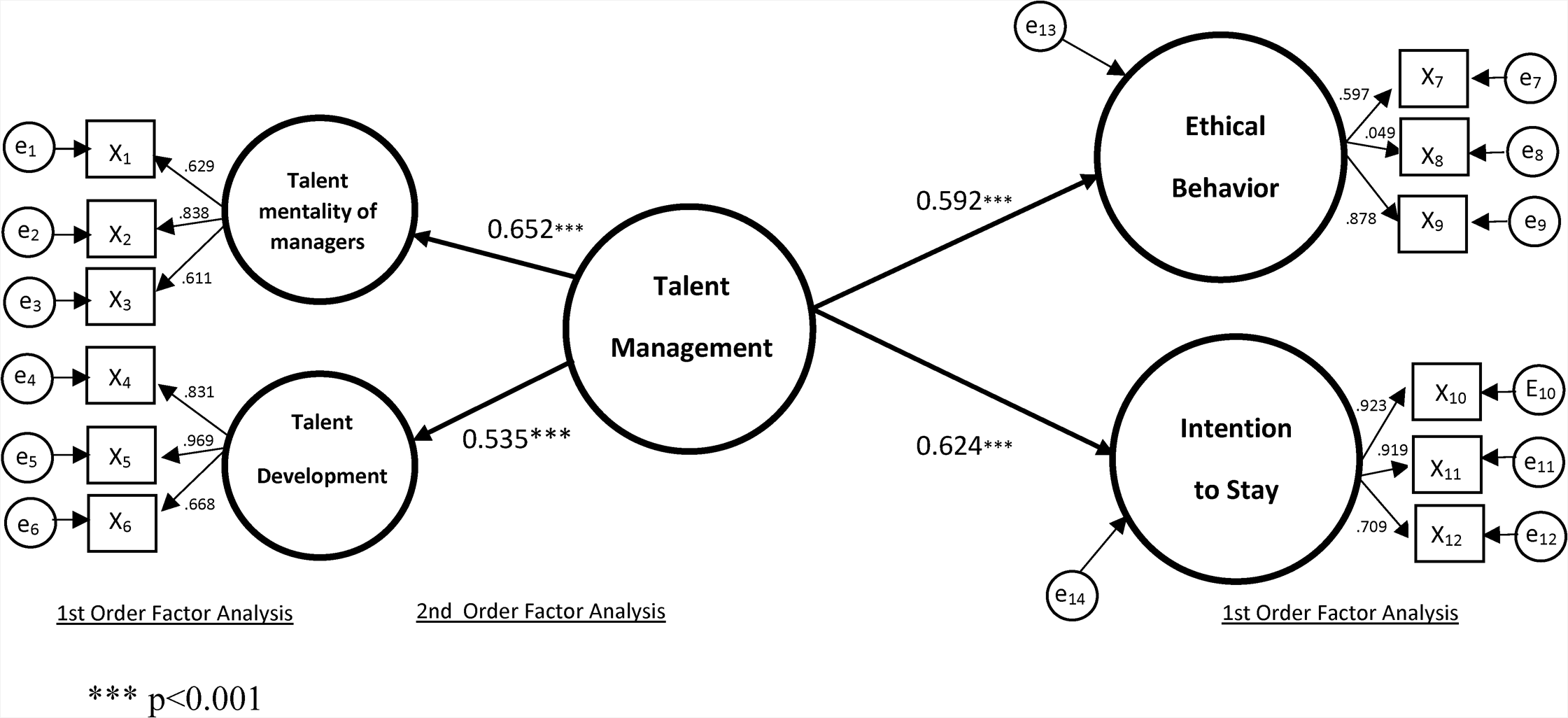
Measurement models allow us to establish not only the reliability of the variables but also their factors through first- or second-order confirmatory factor analysis. In our case, all the variables obtained values higher than .60, indicating good scales (see Table 1). The four variables used in this research were each made up of three items forming a single factor. In addition, the two talent variables (talent mentality of managers and talent development) were used as a second-order factorial analysis to obtain a construct called talent management, and so we relate the causal impact of this construct on ethics and on the intention to stay. Therefore, the variables ethical behavior and intention to stay are dependent variables in the model, with talent management being the independent variable.
Descriptive statistics, reliability and correlations coefficients
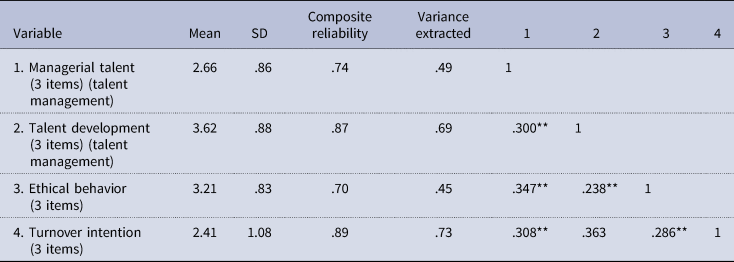
**p < .01 (two-tailed tests).
The presented model in Figure 1 was tested with the software package IBM SPSS AMOS version 26. The model evaluates the degree of similarity in the fit between the predicted data matrix and the obtained actual data matrix. To do this, there are many indicators or goodness-of-fit indices that have evolved over time. In our case, we will use the root mean square residual (RMR), the root mean square error of approximation (RMSA), the goodness of fit index (GFI), the normed fit index (NFI) and the comparative fit index (CFI). To do this, we will compare two models (see Table 2), first the model of independence of variables (model 1), and secondly the proposed model (model 2). The recommendation of the goodness of fit indices is that they have values less than .08 in RMR, less than .08 in RMSE, greater than .80–.90 in GFI, NFI and CFI (Bentler, Reference Bentler1990; Worren, Moore, & Cardona, Reference Worren, Moore and Cardona2002).
Impact of talent management on ethical behavior and intention to stay. ***p < .001.
Adjustment indices of the proposed model

RMR, root mean square residual; RMSA: root mean square error of approximation; GFI, goodness of fit index (GFI); NFI, normed fit index; CFI: comparative fit index.
Sample
The sample was made up of 176 professionals in all category levels of firms (public and private) working in the city and province of Valencia, Spain. The sample was obtained from an offer of participating in the research in two main conferences addressing the topic of management trends in 2019. Of the 400 conference attendees, 184 completed the questionnaire, with eight being eliminated due to missing data.
As regards gender, 59.3% were men and 40.7% were women. The average age was 33.74 years (S = 9.961), with 43.9% being below 30 years of age, 30.1% between 30 and 40 and 26% over 40. As regards present job tenure, the average is 6.91 years (S = 7.301). In total, 76.7% had been at the present organization for 10 years or less, with the remaining 23% having been there over 10 years, with the maximum being 30 years. With regard to total work experience, the average was 12.15 years (S = 9.925). In total, 53.1% had 10 years or less experience, and 25.9% between 10 and 20 years, with 21% having had over 20 years of total work experience. In total, 25.9% had never changed company, while 15.1% had done so once, 20.5% twice, 18.7% three times and 11.4% four times. The remaining 8.4% had done so between five and 15 times.
Moreover, 69.1% indicated that they belonged to private companies and 30.9% to public companies. As regards the degree of responsibility over other employees that individuals in the sample had, 46% had some type of organizational responsibility. More specifically, 5.9% were top management, 9.5% managers, 13% middle-level managers, 15.4% team heads and 56.2% employees. This mix of positions reflected in the sample has the positive aspect of representing all levels of the firm, although at the same time fails to represent any specific population of employees or managers.
In terms of work type, 60.5% were permanent full-time, 16.9% temporary full-time, 13.4% temporary with half-day and 8.7% fixed half-day. The average number of employees is 2,835.74 (S = 16,470,386). More specifically, 21.8% worked in firms with less than 11 employees, 15.8% between 11 and 20 employees, 10.9% between 21 and 50 employees and 17% between 51 and 100 employees. In addition, 15.2% worked in firms with between 101 and 500 employees, 14.5% between 501 and 5,000 and 9.7% over 5,000 employees.
The educational level was high, with 57.6% having a university degree, 32.6% secondary level studies and 9.9% primary level studies. As regards the business sector, 68.9% worked in the service sector, 22.6% in industry, 6.1% in construction and 2.4% in agriculture and fishing. As for place of residence, 60.7% lived in cities of over 500,000 inhabitants, 9.6% between 50,001 and 500,000 inhabitants, 18.6% between 10,001 and 50,000 and 11.1% less than 10,001.
Measurements
We use four operational variables. In fact, to measure talent management, we use two variables adapted from previous studies of different authors (Luna-Arocas, Reference Luna-Arocas2018; Luna-Arocas & Lara, Reference Luna-Arocas and Lara2020; Luna-Arocas & Morley, Reference Luna-Arocas and Morley2015): managerial talent and talent development. Both consisted of three items each.
Talent mentality of the managers is made up of three items which are the following: ‘the way my boss manages the talent of his employees,’ ‘the work climate of talent generated by my leader in the organization’ and ‘the criteria based on talent applied for recognition in the company.’
Also, talent development is measured with three items that are the following: ‘the way my boss manages the talent of his employees,’ ‘the work climate of talent generated by my leader in the organization’ and ‘the criteria based on talent applied for recognition in the company.’
Furthermore, we measure the ethical behavior of the scale of Chen and Tang (Reference Chen and Tang2006) by selecting three items very much related to the general vision that the company has about ethical behaviors. These items are: ‘managers in my company often engage in behavior that I consider unethical’ (reversed item), ‘to be successful in my company, it often takes compromising personal ethics’ (reversed item) and ‘company management has made it clear that unethical conduct will not be permitted.’
Finally, intention to stay was measured with three items adapted from the 15-item scale used by Roodt (Reference Roodt2004). The items were rated on a 5-point response scale, from 1 = never to 5 = every day. The items of this scale were: ‘I have been thinking of quitting my current job,’ ‘I have been evaluating the cost of quitting my current job’ and ‘I am trying to leave my current job.’ Once the data were obtained, the variable was reversed so that the concept was to stay and not leave work.
Results
First, confirmatory factor analysis gives factor structures with good reliability results. This allows us to conclude that the measures can be used as such in the path analysis regression models. Thus, the different factorial load that each item has on its factor can be observed. Likewise, it can be seen how the two factors have significant factorial loads in the second-order factorial, indicating that they make up and explain well the content of the talent management variable. This, in turn, allows this variable to be used to analyze its impact on the two dependent variables: ethical behavior and intention to stay.
As we have commented, talent management would be made up of two factors: talent mentality of the managers and talent development. Both cover two important aspects of talent management. More specifically, the first covers the involvement and understanding of the concepts of talent by management and the steering committee, and with it the real possibility that changes can be made at the organizational level. The second factor covers the degree to which talent development plans are applied so that everyone in the organization can develop their talent, their most effective skills to improve the organization.
Moreover, in order to verify the degree of fit of the proposed theoretical model with the data, two models are compared. The first is the model of independence of the variables among themselves, and the second is a path analysis model where talent management directly impacts on both ethical behavior and the intention to stay in the organization.
Therefore, the proposed model (model 2) presents good fit results. As can be seen in Table 2, the RMR is less than .8, apart from that, the root mean square error is also in the limit of .8. Similarly, fit indices such as the GFI and the CFI have fit values greater than .9, and the NFI is with a value greater than .88. All these results show us that the global fit of the model is good and the model complies with the recommendations of the criteria of the goodness-of-fit indices that we have previously commented on.
This indicates that the proposed model 2 is a good model and therefore allows a more detailed analysis of the standardized regression values between the variables. Thus, it can also be verified that the standardized regression values are significant and positive in the two main relationships proposed.
Looking more specifically at the regression values in the analysis of the global model, we can confirm that talent management has a positive and significant impact on the ethical behavior in organizations (β = .592, p < .001). This confirms the hypothesis that the application of talent management measures, both from the management and from the individual, directly influences the ethical behavior observed in the organization.
Also, the model confirms that talent management has a positive impact on intention to stay (β = .624, p < .001), or what is the same, it would confirm that the effective application of talent management gets loyalty and retain the employees in the organization.
On the other hand, the square multiple correlation measures the proportion of the variance that the predictors account, that is, the degree to which the dependent variables are explained by the independent variables. Thus, 35% of variance in ethical behavior is explained by talent management. Likewise, the intention to remain in the organization is predicted by talent management in 38.9%.
Discussion and conclusion
The results obtained demonstrate the importance of talent management and the need to continue deepening in its study. Next, we will point out the contribution of this work both from a theoretical and a practical perspective.
From a theoretical point of view, first of all, we must highlight that most of the previous works are exclusively theoretical or focus on establishing the definitions, features, theoretical frameworks used or the general objectives of this concept (Collings & Mellahi, Reference Collings and Mellahi2009; Dries, Reference Dries2013; Gallardo-Gallardo & Thunnissen, Reference Gallardo-Gallardo and Thunnissen2016; Lewis & Heckman, Reference Lewis and Heckman2006; Tarique & Schuler, Reference Tarique and Schuler2010). The present work develops an empirical study on talent management which means one more step, with respect to all these works.
Second, most of the empirical studies – carried out as of 2014, as indicated by Gallardo-Gallardo et al. (Reference Gallardo-Gallardo, Nijs, Dries and Gallo2015) – analyze the relationship between talent management and economic variables (productivity, profitability or other financial results), as is the case of the works by McNulty and De Cieri (Reference McNulty and De Cieri2016), Gelashvili et al. (Reference Gelashvili, Aguilar Pastor, Segovia-Vargas and Camacho2019) or Song et al. (Reference Song, Pan, Pan and Jiao2019).
In line with what was stated by Thunnissen and Gallardo-Gallardo (Reference Thunnissen and Gallardo-Gallardo2017), we consider that some talent management relationships with key variables have not yet been sufficiently studied. The present work aims to advance in this line by studying the relationship between talent management and ethical behavior, and between talent management and the intention to stay.
From the point of view of literary or academic review, this research is extremely important, since the relationship between talent management and ethical behavior has not been studied or validated before. Therefore, this relationship is validated from the empirical and theoretical point of view. In addition, the results obtained by demonstrating that talent management contributes to the generation of ethical behaviors confirm previous studies, carried out from another point of view, such as that of Brown and Treviño (2015) on the importance of referents or role models of managers over employees, or that of Jovanović et al. (Reference Jovanović, Mijatov, Dragin, Simat and Majstorović2022) that analyzes the relationship between the perception of an ethical climate and job satisfaction, but without being based on talent management
With regard to the second hypothesis, the results obtained in our study show that talent management manages to retain the organization's employees. In this way, the present work deepens in the line studied by other similar works. Thus, Luna-Arocas, Danvila-Del Valle, and Lara (Reference Luna-Arocas, Danvila-Del Valle and Lara2020) state that the relationship between talent management and organizational commitment is influenced or mediated by the pay satisfaction variable. This work affirms that the permanence of employees in the organization will depend on both economic and noneconomic variables (climate of trust, fairness and reciprocity). Van der Straaten, Niccolò, and Ans (Reference Van der Straaten, Niccolò and Ans2020) analyze the relationship between employee loyalty and salary satisfaction in multinational companies operating in emerging economies. This study shows that salary satisfaction is key to reducing job turnover. Almeida Lopes, Duarte, and Almeida Lopes (Reference Almeida Lopes, Duarte and Almeida Lopes2018) analyze the relationship between talent management and the retention and loyalty of high-performing lawyers who work in law firms. The results of this study recommend the use of tools that facilitate the permanence of valuable employees in the organization and allow the establishment of long-term successful strategies.
Regarding the practical implications of this study, we believe that this work is of interest to business managers, since we are currently in a real ‘war for talent,’ where loyalty strategies become key strategies for business competitiveness. In addition, ethical behavior favors the respect and consideration among the professionals of the company, having clear implications in the improvement of the organizational climate and the perception of equity and perceived justice. In this way, if companies generate more ethical environments, there will be greater effectiveness and visibility of corporate social responsibility policies.
Therefore, an improvement in ethical behavior, both individual and collective, will imply an improvement in job satisfaction and indirectly contribute to recovering the social and collective image of the companies and organizations that have been so severely affected by the recent crisis of COVID.
Likewise, the improvement of the retention rates of an organization is a great opportunity to implement long-term strategies that lead to better business results.
The improvement of the intention to stay has important implications for the company, since if employee turnover is lower, the costs derived from hiring will decrease (personnel selection costs and integration costs of new employees in their job). But even more important than company implications, these results highlight the relevance of ethical behavior and business as a service to society as a whole, not just as individual behaviors.
In addition, in recent years, many companies face the problem of shortage of talent, as there are few employees who add value to the company. For this reason, it is essential that the managers of the companies develop an adequate talent management that avoids the best employees leave the company to go to another one.
The companies must make an effort so that its objectives and those of the most valuable employees coincide. These benefits of companies have a short and mid-term effect, but the long-term effect in society contributes to the increase of the common good.
Limitations and future research
Nowadays, organizations face the task of replacing workers with knowledge and talent, by others with less experience (Oladapo, Reference Oladapo2014). The war of talent is not waged exclusively outside the organization with competing companies, but also within it. The company must be aware that people with different interests and goals coexist within it (Thunnissen, Boselie, & Fruytier, Reference Thunnissen, Boselie and Fruytier2013).
The work on talent management has had a narrow and one-dimensional focus to date. Looking ahead, a more balanced or pluralistic approach should be sought that does not focus exclusively on the performance and effectiveness of the organization. Therefore, it is necessary to extend research to new perspectives that analyze different contexts (Thunnissen, Boselie, & Fruytier, Reference Thunnissen, Boselie and Fruytier2013).
Knowledge of the emotional portfolio of employees is the next challenge facing talent management (Kumar & Raghavendran, Reference Kumar and Raghavendran2013), since retaining employees who contribute value is vital for the health and long-term profitability of companies (Oladapo, Reference Oladapo2014).
On the other hand, methodologically all our measures are subjective, this would also need to be checked with objective measures (Starbuck & Mezias, Reference Starbuck and Mezias1996). Also, the study has been done in a specific culture and the results should be validated in other cultures in order to generalize the results (Doney, Cannon, & Mullen, Reference Doney, Cannon and Mullen1998).
One limitation is the use of self-report questionnaires which could have an impact on the mono-method variance (Kuvaas, Reference Kuvaas2008), although as Howard (Reference Howard1994) indicates, this type of questionnaire is less problematic than what is said in the literature. Although this does not mean that other sources of cross-information should be sought to minimize the problems of common-variance in independent and dependent variables (Spector, Reference Spector1994).
Finally, the model implies two areas in which to continue deepening in future studies. In this sense, other mediating variables that help clarify the normally multivariate relationship between variables will surely appear, and this will help to better understand both the ethical behaviors and the loyalty of employees from talent management.
Conflict of interest
None.
Roberto Luna-Arocas (roberto.luna@uv.es) is a Professor in the Department of Business Management, Faculty of Economy at the University of Valencia. His research interest, and professional experience, focuses on talent management and human resource management. As a writer, he has published a handbook of Talent Management (2017) and several books for practitioners. In addition, he has published many journal scientific articles about these topics. He is also director of a master degree on Talent Management (ninth edition) and has been National President of Practitioners in two main associations, one of HR and other of Executive Coaching.
Ignacio Danvila-del-Valle (idanvila@ucm.es) is an Associate Professor of Human Resources Management and Business Administration and Organizational Theory at the Complutense University of Madrid. He is a Visiting Professor at the Panamericana University. He was a Professor in the Royal University College El Escorial, Villanueva University and European Business School. He holds a PhD in Business Administration and a BA in Economics. He was Chief of Studies of Segur Ibérica's Training Department. He has published different articles in specialized magazines of Human Resources. In addition, he has taken part in numerous international congresses.


 Open access

