

INTRODUCTION
Human remains, dating back to the Mesolithic period in Poland (8000–4500 BC), are a unique and important knowledge source of the many issues related to biology and social life in the oldest human populations (e.g. Gumiński Reference Gumiński1995; Lillie and Richards Reference Lillie and Richards2000; Schulting and Richards Reference Schulting and Richards2001; Sulgostowska Reference Sulgostowska2006). This results mainly from the limited number of well-preserved human bones, both in the whole Europe and in particular in Poland (e.g. Kozłowski Reference Kozłowski1998). Mesolithic human remains are precious and rare findings, thus their analysis was usually restricted to descriptive macroscopic research (e.g. Stęślicka-Mydlarska Reference Stęślicka-Mydlarska1954; Szlachetko et al. Reference Szlachetko, Trzeciakowski and Wierciński1964; Gładykowska-Rzeczycka Reference Gładykowska-Rzeczycka1973; Wiercińska and Szlachetko Reference Wiercińska and Szlachetko1977). However, non-destructive research methods, which today are used in bioarchaeological research allow for a return to the old material (e.g. Tomczyk et al. Reference Tomczyk, Komarnitki, Zalewska, Lekszycki and Olczak-Kowalczyk2014) and validation of the previously studied materials and sites, as well as reassessment of conclusions drawn dozens of years ago. At present in Europe and in the world, Mesolithic remains are a subject to detailed, multidisciplinary analyses, performed according to the latest methodological approach (e.g. Pazdur et al. Reference Pazdur, Fogtman, Michczyński, Pawlyta and Zając2004; Szostek et al. Reference Szostek, Głąb, Lorkiewicz, Grygiel and Bogucki2005; Meiklejohn et al. Reference Meiklejohn, Bosset and Valentin2010). These novel technological analyses provide negligible invasion to the investigated material and does not deprive the specimens of their museum and exhibition value.
The scientific aim of the present project is to apply accelerator mass spectrometry radiocarbon (AMS 14C) dating to Mesolithic human remains (bone and sometimes tooth material) from five archaeological sites in Poland: Janisławice, Giżycko-Perkunowo, Warsaw-Grochów, Wieliszew, and Woźna Wieś. Although the discovery of Mesolithic material took place over 40 years ago, archaeological analyses only included information about the context of discovery of the remains, the type of burial, and artifacts associated with the graves. Similarly, anthropological research only had a macroscopic character, when the material was measured and its anatomy described (Stęślicka-Mydlarska Reference Stęślicka-Mydlarska1954; Wiercińska and Szlachetko Reference Wiercińska and Szlachetko1977). Recent biological studies, including anthropology and genetics, were performed only for the remains of the Janisławice hunter (Stanaszek and Mańkowska-Pliszka Reference Stanaszek, Mańkowska-Pliszka and Brzeziński2013; Witas et al. Reference Witas, Jędrychowska-Dańska, Płoszaj and Brzeziński2013).
The scarcity of the analytical results for such an important archaeological material triggered this project, which is aimed at using the latest bio-chemical analysis to investigate the Mesolithic human remains from Polish regions. The project is completed collaboratively by a team of anthropologists, geneticists, physicists, and specialists in history and archaeology. The research material was transported to the Department of Biological Anthropology Cardinal Stefan Wyszynski University (Warsaw). The osteological material was described using a standard procedure as given in the Standards for Data Collection from Human Skeletal Remains (Buikstra and Ubelaker Reference Buikstra and Ubelaker1994). The protocol contains the following observations: (1) sex and age-at-death assessment, (2) metric skull measurements, (3) metric measurements of the postcranial skeleton, and (4) observation of non-metric skeletal traits. During this phase of research, the bone material was subsampled and transported to other specialist laboratories for genetic testing, isotopic determination, and 14C dating.
The results presented hereafter will focus on the 14C analysis of the remains by AMS, stable carbon (δ 13C) and nitrogen (δ 15N) isotope determination, as well as the C/N ratio; which will be mainly used as sample (in fact, the “collagen” sensu van Klinken Reference van Klinken1999) quality indicators. The oxygen isotope composition, sequencing of genetic material, and the analysis of changes in the tooth enamel using SEM and x-ray techniques is being conducted simultaneously by collaborative research teams. Moreover, the extensive isotopic studies on the diet reconstruction, including measurement of the components in the food chain is an ongoing study.
The diagnostics of collagen extracted from bones for the purpose of 14C dating and isotope studies can be provided by several measurable parameters (DeNiro Reference DeNiro1985; Ambrose Reference Ambrose1990; van Klinken Reference van Klinken1999). The collagen yield should exceed 1%, and the percentage of elements should be 15.3–47% for carbon and 5.5–17.3% nitrogen, by mass. Atomic C/Nat ratios, indicating good preservation, should ideally fall within the range equal to the values obtained for modern animals and humans (C/Nat = 2.9–3.6; Ambrose Reference Ambrose1990). Following the work of Brock et al. (Reference Brock, Higham and Bronk2010) and Tisnerat-Laborde et al. (Reference Tisnérat-Laborde, Valladas, Kaltnecker and Arnold2003), a C/Nat higher than recommended values indicates on a strong diagenesis or/and the presence of considerable amount of humic substances.
The carbon and nitrogen stable isotopic ratios of collagen depend on the diet of an individual. In a typical European inland case, exclusive of C4 plants and marine food resources, the δ 13C value for adult bone collagen falls within a range of −19‰ to −22‰, while δ 15N may cover a much wider range, e.g. from 2‰ to 12‰ (van Klinken Reference van Klinken1999). For the Eastern Baltic area (inland areas in Lithuania), the values for the Late Mesolithic and Subneolithic bones range from −21‰ to −23.5‰ for δ 13C and 10.5‰ to 13‰ for δ 15N (Piličiauskas et al. Reference Piličiauskas, Asheichyk, Osipowicz, Skipitytė, Varul, Kozakaitė, Kryvaltsevich, Vaitovich, Lakiza, Šapolaitė, Ežerinskis, Pamazanau, Lucquin, Craig and Robson2018).
Elevated δ15N values could indicate a considerable proportion of marine or freshwater component in the diet, which should imply the application of a relevant reservoir correction to the 14C dates (e.g. Schulting and Richards Reference Schulting and Richards2001; Cook et al. Reference Cook, Bonsall, Hedges, McSweeney, Boronean and Pettitt2001; Olsen et al. Reference Olsen, Heinemeier, Lübke, Lüth and Terberger2010; Svyatko et al. Reference Svyatko, Mertz and Reimer2015; Marchenko et al. Reference Marchenko, Orlova, Panov, Zubova, Molodin, Pozdnyakova, Grishin and Uslamin2015). However, for the SE Baltic region the freshwater reservoir effect (FRE) reported by Piličiauskas and Heron (Reference Piličiauskas and Heron2015) is highly variable and site dependent, extending from non-present to a few centuries.
In case of children, breast-feeding alters the stable isotope composition. In particular, the δ 15N increases by ca. +3‰ during breast-feeding, and after weaning the δ 15N value approaches that of adults with a similar diet (e.g. Fuller et al. Reference Fuller, Fuller, Harris and Hedges2006). Also, collagen δ 13C values in young children’s bones are enriched, due to the so-called “carnivore” effect, which may reach ca. 1‰ (e.g. Richards et al. Reference Richards, Mays and Fuller2002; Fuller et al. Reference Fuller, Fuller, Harris and Hedges2006).
In any case, a combination of all C/Nat and stable isotope data measured on exactly the same material, which was subjected to 14C dating, provides a valuable tool for either pre-screening the material before dating or critical evaluation of previously obtained 14C dates, as shown by e.g. van Klinken (Reference van Klinken1999), Svyatko et al. (Reference Svyatko, Mertz and Reimer2015), and Marchenko et al. (Reference Marchenko, Orlova, Panov, Zubova, Molodin, Pozdnyakova, Grishin and Uslamin2015). Scirè Clabrisotto et al. (Reference Scirè Calabrisotto, Fedi, Caforio, Bombardieri and Mando2013) reported that reasonable agreement with expected age may be obtained when C/Nat is slightly above the upper limit of the recommended range.
MATERIAL
This manuscript reviews the osteological material from five Mesolithic sites in Poland. In addition, three bone samples from international 14C intercomparison programmes VIRI and SIRI (Scott et al. Reference Scott, Cook and Naysmith2010, Reference Scott, Naysmith and Cook2017) were subjected to the same 14C dating procedures as archaeological samples.
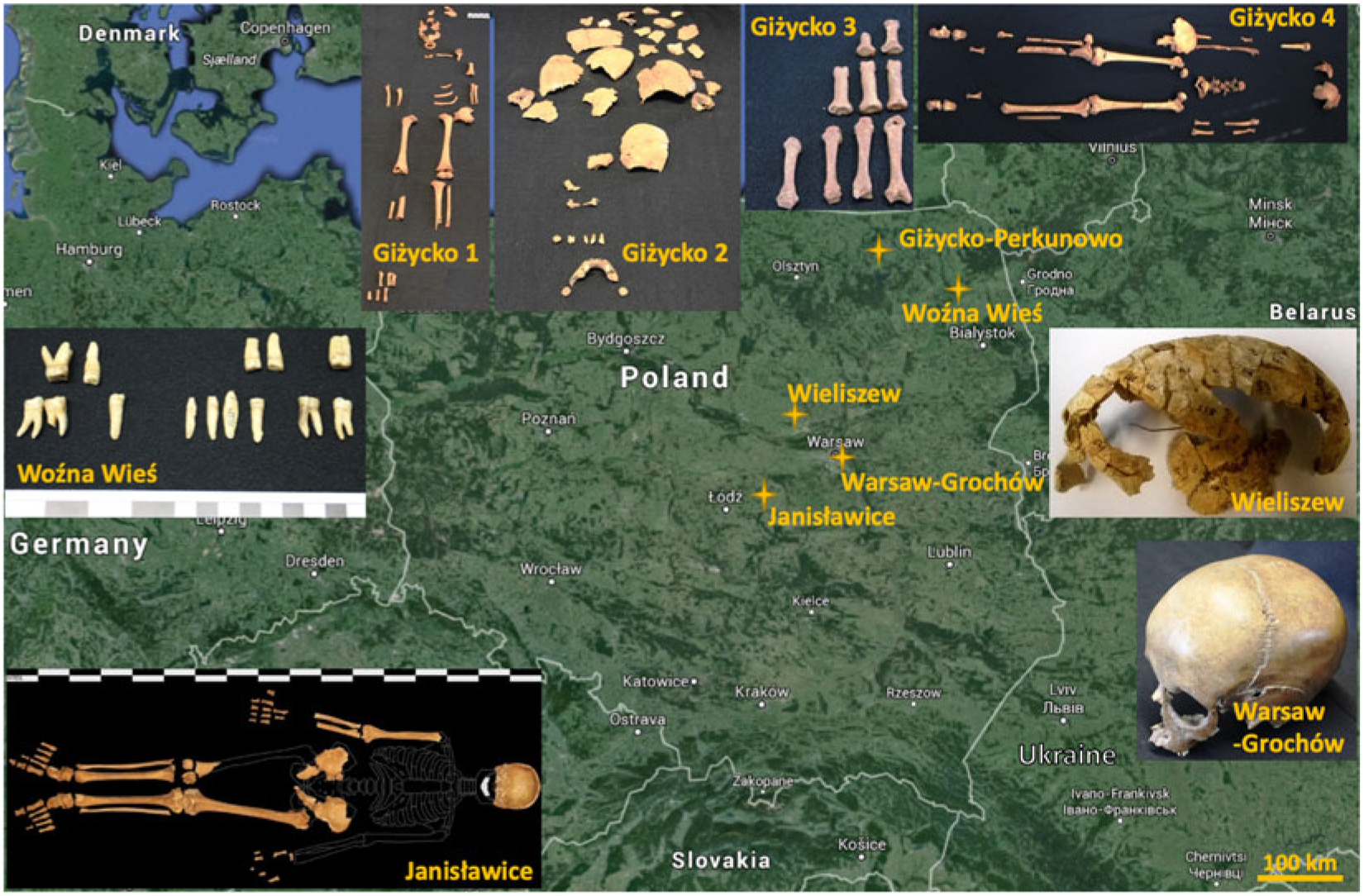
The sites are located in two regions in Poland: Mazovia (Janisławice, Warsaw-Grochów, Wieliszew XI) and northeastern Poland (Giżycko-Pierkunowo, Woźna Wieś). The location of the sites is presented in Figure 1. The material was deposited at the State Archaeological Museum in Warsaw and the Institute of Archaeology and Ethnology of the Polish Academy of Sciences in Warsaw.
Location of the five Mesolithic sites from the two regions: northeastern Poland (Giżycko-Pierkunowo, Woźna Wieś) and the Mazovia region (Wieliszew, Warsaw-Grochów, Janisławice). The insets present the osteological material collected at each site. Background map from www.google.com/maps.
Janisławice
The most famous Mesolithic skeleton from Poland comes from Janisławice (51°50′44″N 20°03′18″E; Chmielewska Reference Chmielewska1954; Figure 1). These are the human bone remains of a 30 to 40-year-old male and were discovered in a sitting position, the find was excavated in 1936–1937. The remains were accompanied by numerous artifacts identified as the hunter’s accessories. The remains were initially investigated and described in detail by Stęślicka-Mydlarska (Reference Stęślicka-Mydlarska1954) and these observations were revised a couple of times later (Cyrek Reference Cyrek1978; Sulgostowska Reference Sulgostowska1990a; Stanaszek and Mańkowska-Pliszka Reference Stanaszek, Mańkowska-Pliszka and Brzeziński2013). The first 14C analysis of the red deer antler was conducted in 1975 but was unsuccessful due to an insufficient collagen amount (Sulgustowska Reference Sulgostowska1990a). The 14C dating of collagen from the femur bone was performed in the Gliwice Radiocarbon Laboratory in 1985 with use of the radiometric technique (gas proportional counting) and provided an age of 6580 ± 80 14C BP (Gd-2432), as reported by Sulgustowska (Reference Sulgostowska1990a) and Pazdur et al. (Reference Pazdur, Awsiuk, Goslar, Pazdur, Walanus and Zastawny1994). The anthropological studies were carried out in 2015, but they did not contain any chronological analysis (Stanaszek and Mańkowska-Pliszka Reference Stanaszek and Mańkowska-Pliszka2015). From this skeleton, two fragments were subjected to this present study: one from femur (named Janisławice Femur) and the second from tibia bone (Janisławice Tibia). The bones have not been subjected to any conservatives.
Additional bone fragments from the Janisławice hunter were discovered in a museum collection archive. A sample of cortical bone fragment was acquired for 14C AMS dating (named Janisławice 2), however, the placement and description of this finding was unsatisfactory, thus the association of this material with the previously escribed hunter bones is uncertain.
Giżycko-Pierkunowo
In July 1965, two graves with skeletons were explored in the Pierkunowo village, near Giżycko in the Mazurian Lakeland (54°04′20″N 21°43′50″E; Figure 1) by the State Archaeological Museum in Warsaw. The graves were situated about 35m from the south-eastern shore of Lake Kisajno. The graves were flat pit-graves without any stone setting. The skeletons, found in lying position, were dyed with ochre (Głosik Reference Głosik1969a).
Four skeletons from three separate graves were sampled for this study. Samples Giżycko 1 (rib fragment from ca. 3-yr-old child skeleton) and Giżycko 4 (phalanx of female adult, 35–39 yr old), both come from the first grave. From the second grave, phalanx bones of a child, ca. 18 months old, were collected (sample named Giżycko 2), and rib bones of and adult (sex and age undetermined) came from the third grave and termed Giżycko 3. The material was not conserved.
Prior to the 14C dating, a chemical method based on fluorine and chlorine content in bone mineral fraction (Wysoczański-Minkowicz Reference Wysoczański-Minkowicz1979) was applied to the female adult bone from this site. The obtained age was 3750 ± 150 BC (Głosik Reference Głosik1969b), which is inconsistent with the archaeological evidence.
Warsaw-Grochów
The human remains (only the cranium, see Figure 1) of so-called “little girl from Grochów” (8–9 yr old) were accidentally discovered in 1961 and they are considered to be the oldest excavated human bones in the Warsaw area. The discovery took place during trench digging on the Nowokinowa street in Grochów (eastern part of Warsaw; 52°14′N 21°1′E). The remains have been found in a layer deposited over the Vistula River, and by stratigraphical relative dating it was assumed, that the skull was about 7000 yr old. However, the remains were not accompanied by any archaeological material (Szlachetko et al. Reference Szlachetko, Trzeciakowski and Wierciński1964) and no chemical analysis has been conducted so far. The skull may have been subjected to conservation.
Wieliszew
In 1961, the human remains from Wieliszew XI were excavated from a large single dune situated on the left bank of the River Narew (52°27′00″N 20°58′08″E). The site is approximately 1 km from the river (Więckowska Reference Więckowska1985). The human material consists of numerous small bone fragments (Figure 1) with a light yellowish color and some gray infusions. A strong degree of mineralization together with cracks of the lamina suggest that this material was cremated. However, the lack of significant deformation of these particular bone fragments shows that the material was not subjected to high temperatures (Wiercińska and Szlachetko Reference Wiercińska and Szlachetko1977). Thus, cremation at low temperature is proposed. In 1962, three fragments of these bones were investigated by using the fluorine-apatite (F/Apatite) method, giving an estimated date of about 4900–4100 BC, but further revision by Wysoczański-Minkowicz (Reference Wysoczański-Minkowicz1979) with the use of the fluoro-chloro-apatite method (F/Cl/Apatite) provided an older age of ca. 5850 BC.
Woźna Wieś
The fragments of a human cranium belonging to an adult with an undetermined age and gender were discovered in 1961 in Woźna Wieś, a village near the Dręstwo Lake, from which the River Jegrznia outflows, belonging to the Elk Lakeland (53°40′53″N 22°45′06″E; Sulgustowska Reference Sulgostowska1990b; Tobolski and Żurek Reference Tobolski and Żurek2012). Paleolithic, Mesolithic, and Neolithic settlements have been discovered on a sandur (outwash plain) and excavated over the years 1974–1978. The traces of the settlement occurred in the lakeside arable fields approximately 500 m from the exiting River Jegrznia. In addition to the abundant flint artifacts, moose and reindeer remains were found in a layer dated to the Alleröd interstadial, as well as subsequent forest animal remains (bison, deer, sheep, and horse) and human bones. The fragments have been glued together to reconstruct the skull shape (see Figure 1).
METHODS
The research methods applied within this study comprise firstly of collagen extraction from bones according to a modified Longin’s protocol in the Gliwice Radiocarbon Laboratory (Piotrowska and Goslar Reference Piotrowska and Goslar2002; Piotrowska Reference Piotrowska2013). All bone samples were cleaned in an ultrasonic bath in demineralized water, then dried and ground in a ball mill. The powdered bone was treated with use of 0.5M hydrochloric acid in a glass vial at a room temperature to decompose the mineral fraction. The acid was replaced several times, and the reaction was considered complete when pH stabilized at <1 and no bubbles were observed. The whole procedure took 1–2 working days. The insoluble residue was rinsed with demineralized water to neutral pH. Next, gelatinization was performed for all the samples: the residue was acidified and kept in 80°C for 12 hr in an acidic solution (HCl, pH = 3). The obtained supernatant was centrifuged, filtered, put in a glass vial and dried in an oven at 75°C. Ultrafiltration was not used. Hereafter, we refer to recovered material as the gelatin, and to this treatment as Treatment A.
In Treatment A, the demineralized residue was not subjected to any NaOH treatment, due to the risk of collagen loss. The second batch of samples was treated with 0.1M NaOH for 30 min at a room temperature, after the demineralization step, and rinsed with demineralized water to a neutral pH. Next, the gelatinization was performed as described above. Hereafter, we refer to this procedure as Treatment B.
The subsample of gelatin was subjected to graphite preparation using an AGE-3 system equipped with a VarioMicroCube by Elementar elemental analyzer and automated graphitization unit (Nemec et al. Reference Nemec, Wacker and Gäggeler2010; Wacker et al. Reference Wacker, Nemec and Bourquin2010). This analyzer (hereafter called VMC-EA) was calibrated with use of acetanilide and sulphanilamide reference materials to obtain the %C, %N and C/N atomic ratios. The 14C concentrations in graphite produced from unknown samples, Oxalic Acid II standards, and coal blanks have been measured by the DirectAMS laboratory, Bothell, USA (Zoppi et al. Reference Zoppi, Crye, Song and Arjomand2007; Zoppi Reference Zoppi2010). The results are reported in Table 1 (reference samples) and Table 2 (archaeological samples). The 14C dates have been subjected to calibration with the use of OxCal v4.3.2 (Bronk Ramsey Reference Bronk2009) and IntCal13 calibration curve (Reimer et al. Reference Reimer, Bard, Bayliss, Beck, Blackwell, Bronk, Buck, Cheng, Edwards, Friedrich, Grootes, Guilderson, Haflidason, Hajdas, Hatté?, Heaton, Hoffmann, Hogg, Hughen, Kaiser, Kromer, Manning, Niu, Reimer, Richards, Scott, Southon, Staff, Turney and van der Plicht2013).
Results for international 14C intercomparison bone samples, prepared with Treatment B method (gelatinization and NaOH wash). Consensus values after Scott et al. (Reference Scott, Cook and Naysmith2010) for VIRI and Scott et al. (Reference Scott, Naysmith and Cook2017) for SIRI. LoB: limit of blank, i.e. the highest apparent 14C concentration reported as Fm value (no correction for background).

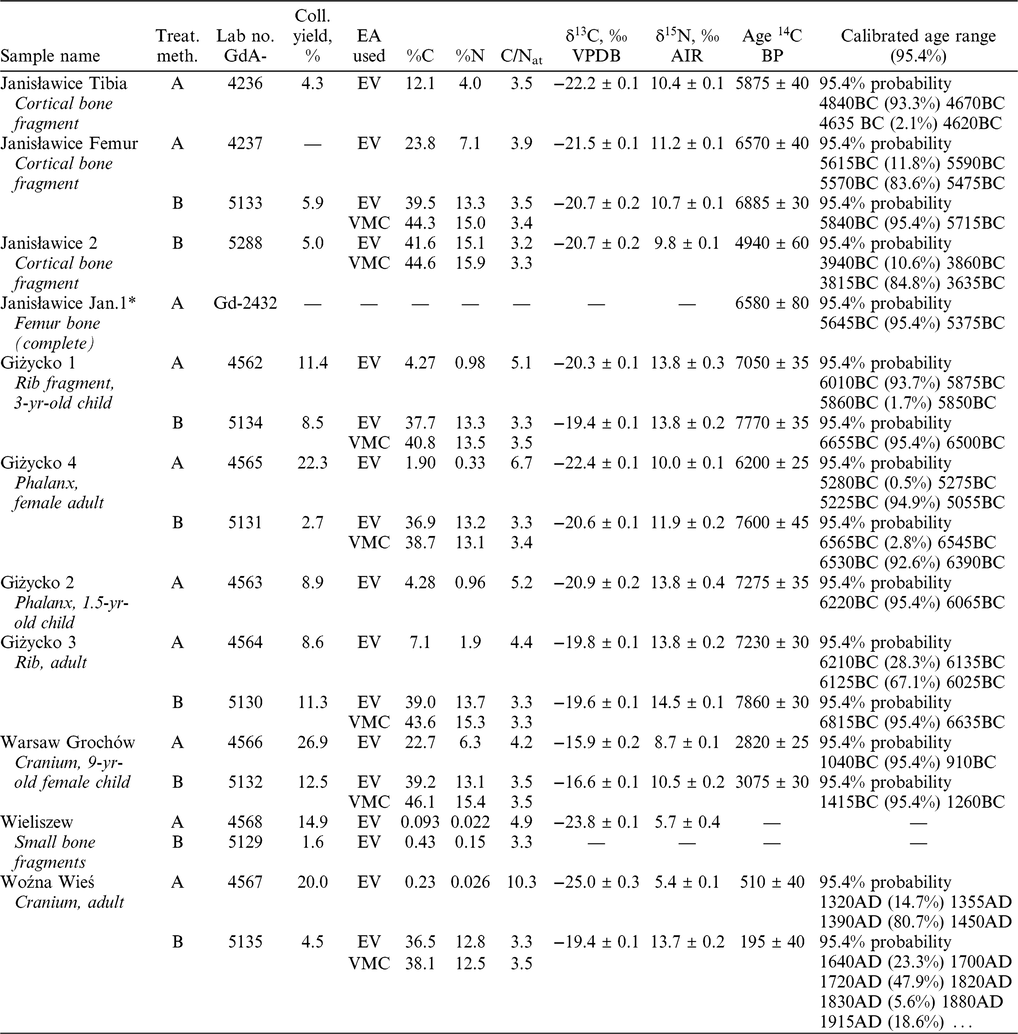
Results of C/Nat, stable isotope, 14C determinations, and calibration. Treatment method A: gelatinization, treatment method B: gelatinization with alkali wash. Elemental analyzers: EV—EuroVector (connected to IRMS system), VMC—VarioMicroCube (connected to graphitization system). The calibration was performed with the use of OxCal v4.3.2 (Bronk Ramsey Reference Bronk2009) and IntCal13 calibration curve (Reimer et al. Reference Reimer, Bard, Bayliss, Beck, Blackwell, Bronk, Buck, Cheng, Edwards, Friedrich, Grootes, Guilderson, Haflidason, Hajdas, Hatté?, Heaton, Hoffmann, Hogg, Hughen, Kaiser, Kromer, Manning, Niu, Reimer, Richards, Scott, Southon, Staff, Turney and van der Plicht2013). * = radiocarbon date reported by Sulgostowska (Reference Sulgostowska1990a), recalibrated.
Another gelatin subsample was assigned for stable isotope analysis of the carbon and nitrogen (δ 13C, δ 15N), %C, %N, and C/Nat quantities by using a CF-EA-IRMS system working in the Gliwice Mass Spectrometry Laboratory. The equipment comprises of a EuroVector elemental analyzer and continuous-flow IsoPrime mass spectrometer. The instrument precision is 0.1‰ for δ 13C and 0.3‰ for δ 15N. The elemental analyzer (hereafter called EV-EA) was calibrated for C/Nat ratios with use of UREA and EMA P2 standards. At least three subsamples from each collagen sample have been prepared, along with the standards: IAEA-C8, IAEA-C5 and EMA P2 for carbon, as well as NO3 and USGS34 for nitrogen. The reported values of δ 13C and δ 15N have been normalized to the VPDB and AIR scales, respectively. The average values are calculated and presented in Table 2 and in Figure 4.
The two elemental analyzers require considerably different sample masses. One gelatin subsample of 3–5 mg was combusted for graphitization in VMC-EA, while for EV-EA the required sample masses of approximately 0.25–0.30 mg.
Two of the reference bone samples (VIRI H and E, GdA-5341 and 5342) were prepared in the second batch of samples. The SIRI C (GdA-5339) bone was prepared in 2014 with the inclusion of alkali treatment (Piotrowska and Goslar Reference Piotrowska and Goslar2002) and the stored gelatin was re-dissolved, filtered with a nylon woven net filter, and dried before combustion and graphitization.
RESULTS AND DISCUSSION
The measurement results for reference bone samples are listed in Table 1, and the results of the archaeological samples for both treatments are listed in Table 2. Unfortunately, the material for two of the samples (Giżycko 2 and Janisławice Tibia S.) was not available for repeated analysis with alkali treatment. The calibration plots are presented in Figure 3, while Figure 4 shows the stable isotope data.
Quality Indicators and 14C Results
The first batch of gelatin, prepared without a NaOH wash by Treatment A, yielded unsatisfactory results, in terms of the C/Nat ratios (3.5–10.3) and depleted %C and %N for almost all the samples (Table 2). The average gelatin yield was 14.6%. Therefore, additional sample material was collected, and the preparation procedure was repeated with an alkali treatment step (Treatment B).
Most of the Treatment B samples yielded less gelatin (6.5% on average) than the previous ones. Quality indicators fell within acceptable ranges, with C/Nat values ranging from 3.2 to 3.5 and the expected carbon and nitrogen content (Table 2). In addition, two independent analysis were performed with two elemental analyzers. The results for C/Nat values do not differ by more than 0.2. This difference is concordant with the reported values for laboratory intercomparison studies (Sealy et al. Reference Sealy, Johnson, Richards and Nehlich2014), and the uncertainty of C/N results reported by Scire-Clabrisotto et al. (Reference Scirè Calabrisotto, Fedi, Caforio, Bombardieri and Mando2013) and Svyatko et al. (Reference Svyatko, Mertz and Reimer2015).
The results for reference bone material indicate a good quality of gelatin with C/Nat 3.1–3.2 (Table 1). The VIRI H determined age agrees perfectly with the consensus value within 1–sigma interval. The SIRI C sample, which may be regarded as background material, gave a Fm value 0.00679 ± 0.00020, which is even lower than the reported consensus value. The most confusing result was obtained for VIRI E, which gave an age ca. 3700 14C yr younger than consensus value. While it is a considerable shift, a very wide range of results for this particular bone sample was reported by Scott et al. (Reference Scott, Cook and Naysmith2010): the interquartile values were 35,320 and 40,400 14C BP (n = 57). After the outliers were omitted the interquartile results, from AMS, were 36,540 and 40,648 14C BP (n = 40). The resulting consensus value was calculated to 39,305 ± 121 14C BP, based on n = 28 dates. According to the methodology applied by Scott et al. (Reference Scott, Cook and Naysmith2010), our result would not be considered as an outlier removed in the first step. The difference from the median (equal to 39,695 14C BP) is 4095, which is less than 7620 (1.5 times the interquartile range, IQR = 5080). However, our result is on the edge of acceptability and indicates an action should be undertaken to further evaluate the reasoning behind this data. It is most likely that our method was not sufficient enough to extract the material with a proper purity. The use of longer alkali treatment, ultrafiltration or a selection of more specific chemical components should be considered. Despite the disputable result for the VIRI E sample, which proved to be problematic for many laboratories, the demonstrated reasonable 14C background level allows to expect our results to be accurate.
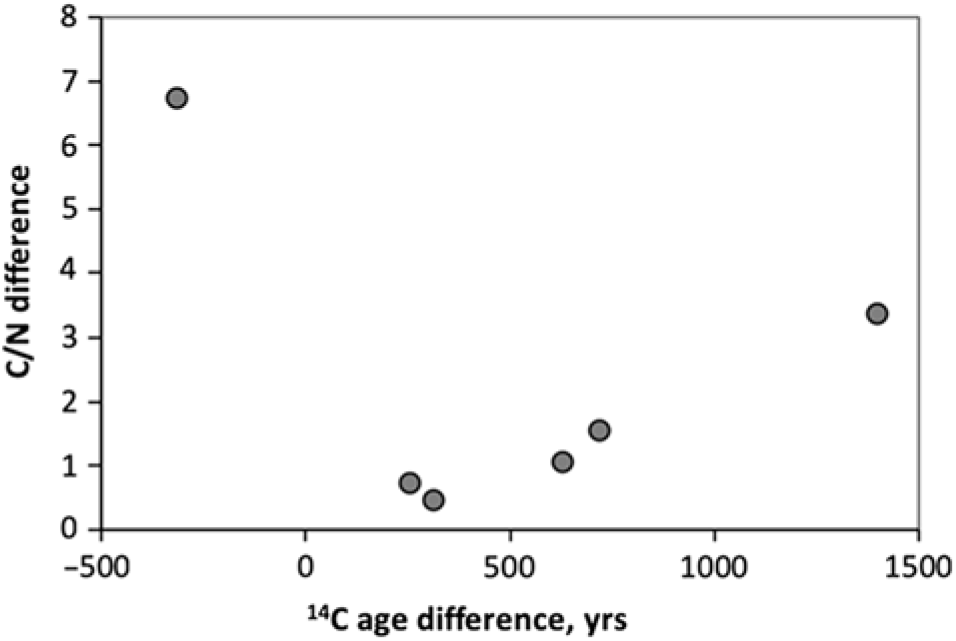
Five of the 14C ages obtained for the archaeological samples from Treatment B are older than the 14C ages for Treatment A by 250–1400 14C yr. This indicates the presence of a contaminant which is younger than the age of bones. Adding this to elevated C/Nat ratios for the Treatment A gelatin, the most probable contaminant is a substance rich in carbon, which was removed by the alkali treatment in Treatment B. The difference between ages for the same samples subjected to Treatments A and B is proportional to the difference in C/Nat ratios for the same samples (Figure 2). Also, the δ 13C was shifted towards values more common for human bone collagen: increased for four of them (Giżycko and Janisławice sites) and decreased for Warsaw-Grochów sample (Figure 3).
Differences in the C/Nat ratios and the 14C ages between the results obtained for Treatment A (simple gelatinization) and Treatment B (gelatinization with alkali wash).
The calibration results of the 14C dates; gray: Treatment A (simple gelatinization), green: Treatment B (gelatinization with alkali wash), blue: radiometric date. The 14C dates have been subjected to calibration with the use of OxCal v4.3.2 (Bronk Ramsey Reference Bronk2009) and IntCal13 calibration curve (Reimer et al. Reference Reimer, Bard, Bayliss, Beck, Blackwell, Bronk, Buck, Cheng, Edwards, Friedrich, Grootes, Guilderson, Haflidason, Hajdas, Hatté?, Heaton, Hoffmann, Hogg, Hughen, Kaiser, Kromer, Manning, Niu, Reimer, Richards, Scott, Southon, Staff, Turney and van der Plicht2013). (Please see electronic version for color figures.)
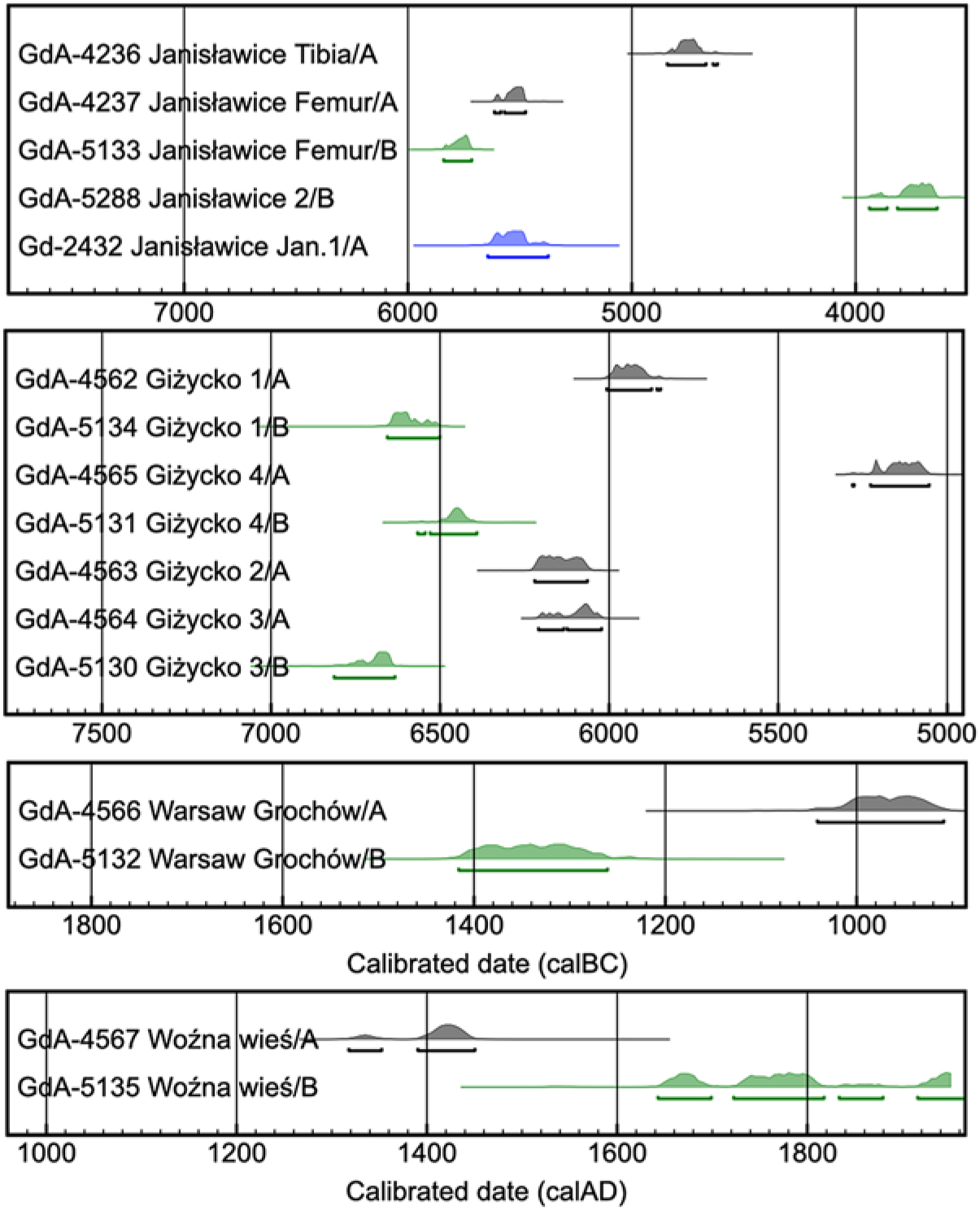
In the case of the Woźna Wieś sample, the new date is 320 yr younger. This sample is also characterized by a significant C/Nat shift from 10.3 to 3.5 between the Treatments A and B, and a huge difference in %C and %N. In this case the contaminant had a carbon content much higher than collagen, and was older than the bone sample. The significant improvement in a quality of dated material is seen also in δ 13C (shift from −25‰ to −19.4‰) and δ 15N (from 5.4‰ to 13.7‰).
Janisławice
For the Janisławice hunter, two cortical bone fragments have been subjected to 14C AMS dating with Treatment A. The one from the tibia bone yielded an age of 5875 ± 40 BP (C/Nat = 3.5), while the femur bone gave a distinctly older result by ca. 700 yr (6570 ± 40 BP, C/Nat = 3.9). This discrepancy is too large to be explained by turnover time in different bone fragments from a single individual, which is dozens of years higher. In the Treatment B the material was only available for the femur bone, and yielded a lower C/Nat ratio (3.4–3.5), an acceptable %C and %N, and gave an even older age of 6885 ± 30 BP.
For the Treatment A the values of δ 13C and δ 15N are higher for the femur bone (−21.5‰, 11.2‰) than for the tibia (−22.2‰, 10.4‰). The δ 13C is even higher for the femur sample treated with alkali (−20.7‰). The δ 13C shows a rising tendency along with the decreasing C/Nat. The humic substances, which are suspected to alter the Treatment A results, would most probably have a δ 13C lower than −25‰ and high C/Nat ratio. Therefore, the observed δ 13C and C/Nat trends confirm this hypothesis.
An AMS age of 6570 ± 40 BP (GdA-4237) is in perfect accordance with the result of 6580 ± 80 (Gd-2432) obtained by radiometric 14C dating on another femur bone (see Figure 3). Both samples were prepared with a similar methodology, namely without alkali treatment, and a similar influence of humic substances on the 14C age can be deduced.
The youngest age 4940 ± 60 BP was obtained for the newly acquired bone fragment. The quality of the gelatin is acceptable with a C/Nat = 3.3 (44.6% C and 15.9% N), and stable isotope composition of δ 13C = −20.7‰, in agreement with Janisławice femur bone. The δ 15N = 9.8‰ is, however, lower by almost 1‰ in comparison with femur bone (see Figure 3). Thus, the discrepancy in the age with other Janisławice samples cannot be explained by contamination, but rather shows it is a fragment of another skeleton, younger by almost 2000 yr. Given the dubious provenience of this sample, this age should be regarded as unreliably associated with the Janisławice hunter skeleton.
In the light of the obtained results the most reliable age of Janisławice hunter skeleton is connected with sample from femur bone, prepared with alkali wash, which is 6885 ± 30 BP, and 5840–5715 cal BC (Table 2, Figure 3).
Giżycko-Pierkunowo
Four bone samples from this site have been subjected to analyses. All the C/Nat values for the samples prepared with Treatment A were higher than for collagen (ranging from 4.4 to 6.8), but still the ages fell within the Mesolithic period. The gelatin samples from the Treatment B are characterized by a considerably lower C/Nat ratios (3.3–3.5) and their 14C ages are shifted towards older values by 630, 720, and 1400 yr. The age difference is proportional to the C/Nat shift (Figure 2), implying the presence of the same contaminant, a younger material of elevated C/Nat, which was removed during the alkali treatment.
The stable carbon and nitrogen isotope composition of the Giżycko samples is also altered by alkali treatment, most noticeably for the sample Giżycko 4, along with the highest C/Nat and 14C age shift (Figure 4). In all cases the δ 13C results for Treatment B are shifted towards more positive values. Therefore, the contamination by the humic substances of high carbon content and δ 13C around −25‰ is the most probable explanation for the rejuvenated ages obtained by Treatment A.
The stable isotope composition of investigated samples. Open symbols: Treatment A (simple gelatinization), filled symbols: Treatment B (gelatinization with alkali wash).
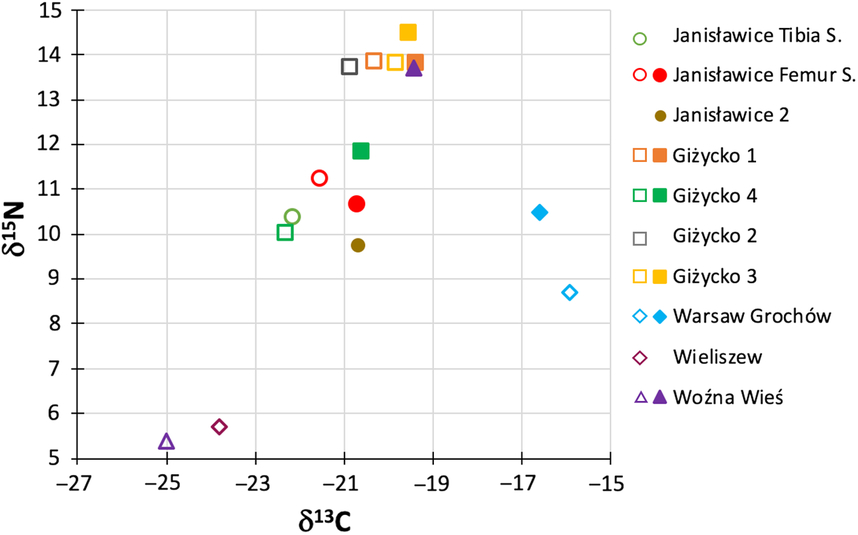
The additional material was not available for the Giżycko 2 sample, which in the first trial (Treatment A) gave gelatin with a C/Nat = 4.9 and age of 7275 ± 35 BP. Following the trend presented in Figure 2, the correct age of this sample can be estimated to be at least 600–700 yr older.
Freshwater food consumption by humans from Giżycko-Pierkunowo site is likely, as the location of the site is in a close vicinity to Lake Kisajno. Therefore, the freshwater reservoir effect (FRE), causing the ages to appear older than the actual age, is likely.
The FRE is a strictly local effect, dependent on the reservoir age of lake-derived food and the proportion of this food in an individual’s diet. According to the data presented by Sensuła et al. (Reference Sensuła, Böttger, Pazdur, Piotrowska and Wagner2006), for Polish lakes the reservoir age for the organic fraction of lake sediments were: TR = 171 ± 76 14C yr for Lake Wigry (NE Poland, 90 km E from lake Kisajno), TR = 539 ± 60 14C years for Lake Gościąż (central Poland, 230 km SW), and TR = 500 ± 200 14C yr for Lake Samle Duże (NE Poland, 85 km E). Using any of these values as FRE estimate may lead to incorrect conclusions, as the organic fraction of lake sediment undoubtedly contain some amount of terrestrial plants. Thus, the presence of a TR reaching a few centuries for Lake Kisajno is to be expected and regarded as minimal FRE estimate.
The stable carbon and nitrogen isotope composition of human bones is also affected by freshwater food consumption. The δ 13C of the possible aquatic dietary component and the aquatic plants in NE Poland, are characterized by having relatively low δ 13C values, close to terrestrial C3 plants. For the Wigry Lake, the average δ 13C for contemporary aquatic plants is ca. −25‰, while for terrestrial C3 plants the δ 13C is equal to ca. −26‰. For the Gościąż Lake, the values are ca. 2‰ lower (Sensuła et al. Reference Sensuła, Böttger, Pazdur, Piotrowska and Wagner2006). Similarly, Reitsema (Reference Reitsema2012) has shown a δ 13C for fish bones ranging from −21.6‰ to −28.2‰. Consequently, the freshwater fish consumption may not be distinguishable by the δ 13C values.
For fish from Polish lakes the relatively wide range of δ 15N was reported by Reitsema (Reference Reitsema2012): 6.6‰ to 12.1‰ for medieval samples from Central Poland. The δ 15N for two investigated bones, Giżycko 1 (3-yr-old child): 13.8‰, and Giżycko 3 (adult): 14.5‰, are even more positive. For the adult it indicates a greater proportion of freshwater fish in the diet. Conversely, a δ 15N = 11.9‰ for another female adult (Giżycko 4) does not suggest a freshwater diet component.
The δ 15N and δ 13C of the 3-yr-old child’s bones (Giżycko 1) are shifted by ca. +2.6 and +1.2‰, respectively, when compared with the values obtained for a female from the same grave (Giżycko 4). These differences are within the range expected for breast-feeding effect, or, less probable, are an effect of the elevated proportion of freshwater protein in a child’s diet. The 14C ages of the two samples are disparate within 2-sigma: 7770 ± 35 14C BP (child) and 7600 ± 45 14C BP (female), but the calibrated age ranges overlap in the period 6570–6500 cal BC. Therefore, a coeval burial of a mother and her child cannot be excluded.
In order to estimate the FRE quantitatively, paired 14C dating of terrestrial vs. freshwater species is typically carried out (e.g. Cook et al. Reference Cook, Bonsall, Hedges, McSweeney, Boronean and Pettitt2001; Olsen et al. Reference Olsen, Heinemeier, Lübke, Lüth and Terberger2010; Piličiauskas and Heron Reference Piličiauskas and Heron2015; Svyatko et al. Reference Svyatko, Mertz and Reimer2015), which was unavailable for this site. An extensive research into stable isotope for a particular site is required and then the application of thorough modelling tools allows one to calculate the proportion of freshwater to terrestrial component in the diet (e.g. Sayle et al. Reference Sayle, Hamilton, Gestsdóttir and Cook2016). A more detailed study on the isotope-based diet reconstructions may provide a prospect to re-evaluate the dates from the Giżycko site, until then the dates should be regarded as maximal.
Warsaw-Grochów
The skull of the 8/9-yr-old girl accidentally excavated in the riverine sediments, in Warsaw, was dated to an age a much younger age than expected stratigraphy. Although the carbon and nitrogen content were satisfactory (22.7% C, and 6.3% N), the C/Nat = 4.2 ratio of the first batch of gelatin was higher than the modern values, and the stable isotope results were as unexpected (δ 13C = −15.9‰ and δ 15N = 8.7‰). Therefore, the preservative(s) which may have been used are the suspected cause of the discrepancy in the results. Repeated preparation provided material which had good quality indicators (12% collagen yield, 46% C, 15% N, C/Nat = 3.5), and the age was shifted by almost 300 years to 3075 ± 30 14C BP (1415–1260 cal BC). Still, the result does not confirm the Mesolithic age of this bone.
The stable isotope composition results are δ 13C = −16.6‰ and δ 15N = 10.5‰. The elevated δ 13C indicates that the girl’s diet was enriched in the 13C isotope. At the present state of study, it might be cautiously concluded, that the girl consumed some C4 plant, e.g. millet, which has a carbon isotopic signature of ca. δ 13C = −11‰ (e.g. An et al. Reference An, Dong, Li, Zhang, Zhao, Zhao and Yu2015) and which was been cultivated and consumed in Poland since ca. 2000 BC (Hunt et al. Reference Hunt, Vander, Liu, Motuzaite-Matuzeviciute, Colledge and Jones2008; Reitsema Reference Reitsema2012).
Wieliszew
The bones sample from the Wieliszew site yielded extremely small amount of gelatin residue, which was sufficient enough to only perform IRMS and C/Nat measurements, requiring micrograms of carbon, and attempts to obtain a graphite were unsuccessful. The C/Nat ratio of this material, from the Treatment A, was 4.9, clearly indicating the presence of a non-collagen component. Also, the δ 13C = −23.8‰ and δ 15N = 5.7‰ were unusual for a human bone, when compared to other results from this study. The second batch sample gave a collagen yield of 1.5% and a C/Nat = 3.3, which are acceptable values, but the carbon and nitrogen content was far too low (0.43% and 0.15%). No other results were achievable due to the low amount of recovered material.
As described by Wysoczański-Minkowicz (Reference Wysoczański-Minkowicz1979), the bones have been burned but not subjected to high temperatures (Wiercińska and Szlachetko Reference Wiercińska and Szlachetko1977), and in this process the collagen must have almost been completely lost. Wysoczański-Minkowicz (Reference Wysoczański-Minkowicz1979) attempted to date the bones with use of fluoro-chloro-apatite method (F/Cl/Apatite) and the result provided an age of ca. 5850 BC, which agrees with archaeological evidence and remains the only available independent age determination for this material.
Woźna Wieś
The first 14C result obtained for Woźna Wieś sample using the Treatment A (GdA-4567, 510 ± 40 14C BP) gave unexpectedly young results, which was inconsistent with archaeological evidence. The quality indicators prove the unreliability of the dating result, namely the carbon and nitrogen content were extremely low, 0.23 and 0.026%, respectively. The C/Nat ratio was equal to 10.3, while δ 13C = −25‰ and δ 15N = 5.4‰. The second date (Treatment B, GdA-5135) was obtained on material with quality indicators characteristic of collagen (%C = 37, %N = 13, C/Nat = 3.5, δ 13C = −19.4‰ and δ 15N = 13.7‰), but gave an even younger age 195 ± 40 14C BP. We conclude, that the dated material was contaminated by a component much older than the actual age of this sample. The glue, which had been used to reconstruct the skull, must have been present in the material despite physical cleaning before preparation, but the alkali treatment was sufficient enough to remove it. In any case, the dating results do not confirm a Mesolithic age for this material.
CONCLUSIONS
The Mesolithic age was confirmed for the Janisławice hunter, which can be placed at 5840–5715 cal BC. Similarly, the Giżycko-Pierkunowo site ages fall within the Mesolithic period. The youngest bone was determined to be 6570–6390 cal BC for the female adult (Giżycko 4), and two other bones Giżycko 1 (child, ca. 3 yr old) and Giżycko 3 (adult, sex and age undetermined) gave slightly overlapping age ranges of 6660–6500 and 6815–6635 cal BC, respectively. However, their δ 15N indicated a proportion of freshwater fish in the diet, which can bias the 14C dating results. The FRE for this site may reach a few centuries, thus their true ages may fall closer to Giżycko 1 in age.
The skull of the “little girl from Grochów” was dated to 1415–1260 cal BC, thus it is not of Mesolithic age. Similarly, the bone from Woźna Wieś was dated to a much younger age, 1640–1880 cal AD. The sample from Wieliszew yielded no datable collagen material.
The investigated bone samples have been difficult material for 14C dating. The presented research confirms, that 14C dating of such relics should be accompanied by a critical assessment of the obtained dates. In this regard the suitability of C/Nat ratios along with δ 13C and δ 15N isotopic determinations was confirmed, similarly to previous studies. We also confirm that separation of purified component for dating should prevail over the will to destroy the minimum amount of the material.
ACKNOWLEDGMENTS
Funding provided in frame of National Science Centre (NCN) project “Old material with new methods: Using the latest bio-chemical analysis in studies of Mesolithic human remains from the Polish areas”, no. 2014/15/HS3/02184, the Ministry of Higher Education and Research grants from the Silesian University of Technology, Institute of Physics, no. BKS-104/RIF/2016, BKS-101/RIF/2017, BK-243/RIF/2016, and BK-229/RIF/2017.


 Open access

